.svg)

Enterprise security reviews now stretch four to six weeks per deal on average, and an expired or outdated compliance report is one of the most common reasons that clock resets to zero.
The short answer to "how long is a SOC 2 report valid for?" is 12 months. But 12 months from when? Why 12 months? Who decided? And what do you do between audits?
This guide covers the full picture with what SOC 2 report validity actually means, how Type 1 and Type 2 differ, and where the 12-month norm came from.
It also covers the 5 misconceptions that cost founders enterprise deals, how SOC 2 bridge letters work and when they fail, and how to keep your compliance current all year in 2026.
Here’s a quick rundown, if you’re short on time.
Quick Facts on SOC 2 Report Validity!
- SOC 2 reports do not technically expire. The industry treats them as valid for 12 months from the end of the audit period.
- The AICPA restricts its official SOC logo to 12 months after report issuance. This is the practical anchor for the 12-month norm.
- SOC 2 Type 1 is a point-in-time snapshot. Generally accepted for 6 to 12 months. Not a substitute for Type 2.
- SOC 2 Type 2 covers control effectiveness over a defined period. Minimum 3 months, typically 12. Valid for 12 months from the end of the reporting period.
- A bridge letter is a management-signed document covering the gap between audits. Valid for 3 to 6 months. Signed by management, not the auditor.
- 83% of enterprise buyers require SOC 2 compliance before vendor onboarding, according to a 2024 Panaseer survey. Letting a report lapse blocks deals.
- Always stay under an active audit period. Gaps create compliance blind spots and require explanation to clients.
Now, let’s get into the details.
What Does SOC 2 Report Validity Actually Mean?
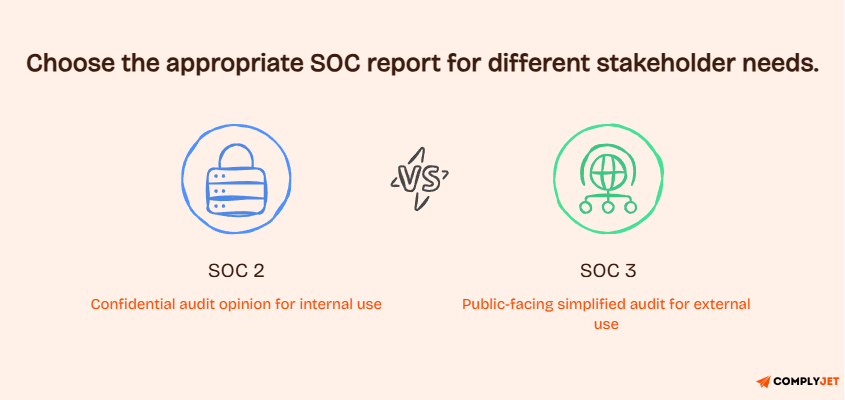
A SOC 2 report itself is confidential and shared only under an NDA. Organisations that want something public-facing use a SOC 3 report instead, a simplified version of the same audit with sensitive control detail removed.
Most people assume validity means an expiry date is stamped on the front page of the report. It is not. A SOC 2 report does not technically expire.
The AICPA, which governs the SOC 2 framework, does not set a mandatory validity period anywhere in its attestation standards. What the market does is set its own convention. Enterprise buyers, vendor risk teams, and security reviewers treat a report as current for 12 months.
After that, they ask for a fresh one or a bridge letter. The effect is identical to an expiry date, even if none exists in writing.
The AICPA does draw one explicit line. It restricts use of the official SOC 2 logo on marketing materials, trust badges, and vendor portals to 12 months after the report issuance date. That restriction became the reference point the entire industry adopted.
For guidance on using the logo correctly, the SOC 2 badge tips post covers exactly what the AICPA permits.
Vendor risk policies codified that 12-month window. Procurement teams follow it even when they have never read the AICPA guidance directly.
The AICPA SOC 2 standards page confirms there is no formal expiry requirement. But there is one more distinction worth getting right. The 12-month window starts from the end of your audit period, not from the date on the report cover.
If your audit covered January through December 2025 and the report was issued in March 2026, the window closes in December 2026. Not March 2027.
Note!
The 12-month clock starts from the end of your audit period, not the date on the report cover. Getting this wrong throws off your entire renewal timeline.
With this foundation in place, the next question is whether the validity window differs between SOC 2 Type 1 and Type 2. It does, and the difference matters more than most founders expect.
SOC 2 Type 1 vs Type 2: How Validity Differs
Both Type 1 and Type 2 are produced by a licensed CPA firm and tied to the same Trust Services Criteria. But they cover fundamentally different things, so their validity windows are different too.
When enterprise buyers ask for a SOC 2 report, they almost always mean Type 2. Founders who have completed only a Type 1 sometimes share it in response.
That creates friction, because what the buyer is checking for is not design intent. It is evidence your controls actually operated over time.
SOC 2 Type 1 Report Validity Period
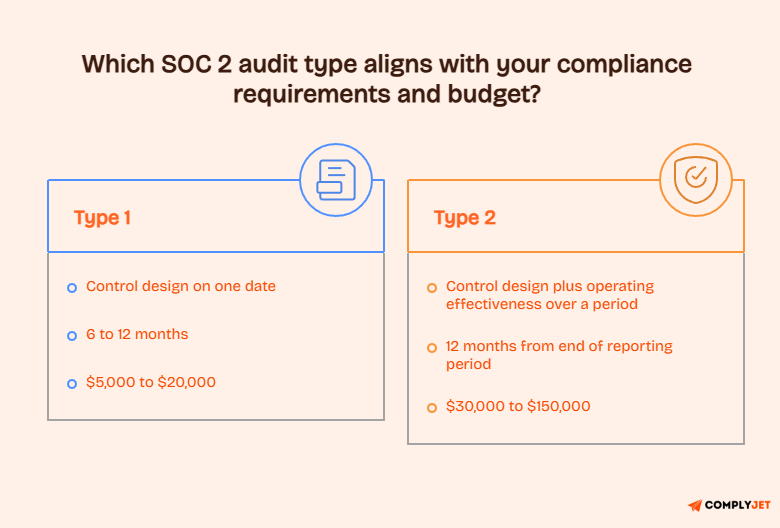
A Type 1 report evaluates whether your controls are suitably designed on a single date. No observation period. No evidence of controls operating over time. Just a point-in-time snapshot.
The AICPA sets no strict validity period for Type 1 reports. Most enterprise buyers accept them for 6 to 12 months after issuance.
After that, the report becomes unreliable, especially if your team, systems, or infrastructure have changed. Type 1 is appropriate for early-stage companies establishing a baseline before a full Type 2 cycle.
For a full breakdown, the Type 1 vs Type 2 guide covers both in depth. Type 1 auditor fees typically run $5,000 to $20,000. Completion takes 5 weeks to 2 months.
SOC 2 Type 2 Report Validity Period
A Type 2 report covers both control design and operating effectiveness over a defined period. The minimum observation window is 3 months. The AICPA recommends at least 6 months.
Enterprise buyers expect 12 months.
The SOC 2 Type 2 guide explains the full scope of what goes into a Type 2 audit.
The report is valid for 12 months from the end of that observation period. Annual renewal is standard across mid-market and enterprise procurement.
When buyers review a Type 2 report, they check Section 1 for the auditor opinion (qualified or unqualified), Section 3 for scope alignment, and Section 4 for control testing results and exceptions.
They also check Section 5 for management responses and review Complementary User Entity Controls, known as CUECs. These are controls your customers must implement for your environment to be fully secure.
First-time Type 2 all-in costs run around $30,000 to $150,000 including preparation, tooling, and auditor fees. Annual renewals run $15,000 to $40,000. The SOC 2 compliance costs guide breaks down where each dollar goes.
Did You Know?
A SOC 2 Type 2 with a 3-month observation period is technically valid. But most enterprise buyers expect a 12-month window. A short period raises questions about evidence depth.
Now that the difference between Type 1 and Type 2 validity is clear, it is worth going one level deeper on where the 12-month norm actually came from.
Why 12 Months? The AICPA Connection Most Miss
Every piece of content on this topic states "12 months" without explaining its origin. The AICPA does not write a rule that SOC 2 reports expire after 12 months.
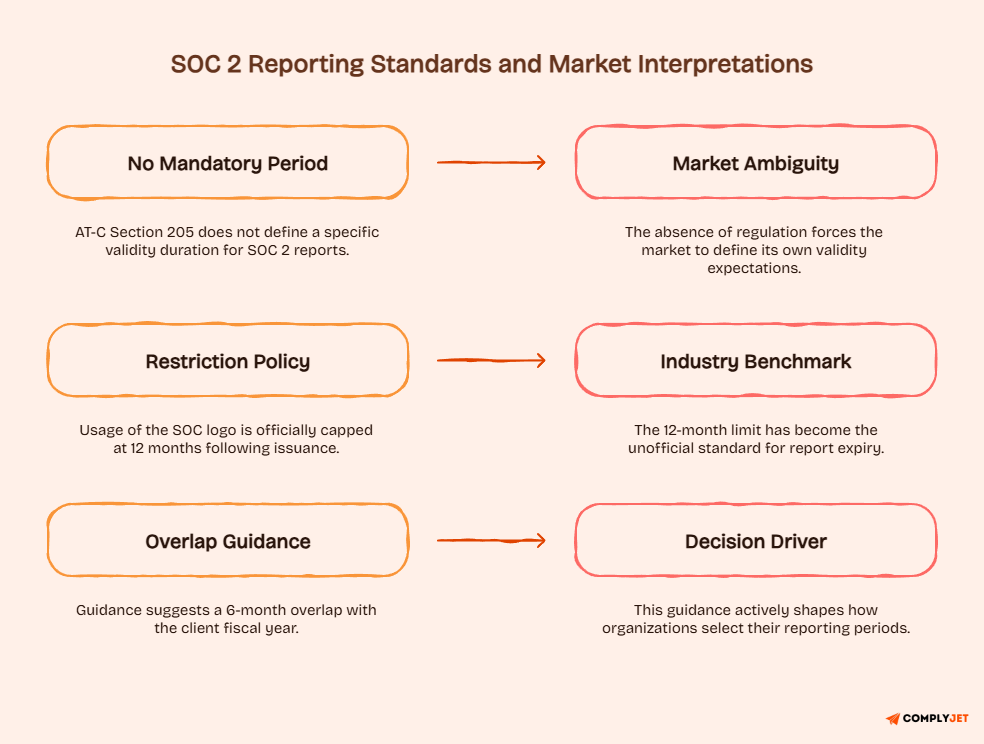
That rule does not exist in AT-C Section 205, the attestation standard that governs SOC 2 examinations.
What the AICPA does restrict is the use of the official SOC 2 logo. If you want to display the SOC mark on your website or sales materials, you can only do so for 12 months after your report issuance date.
That restriction gave the market a concrete reference point. Procurement teams adopted it. Internal vendor risk policies codified it. And now the 12-month window functions as a de facto expiry, even though technically it is not one.
There is also an overlap rule that matters for your planning. Linford and Company, a CPA firm specialising in SOC 2, notes that a SOC 2 report must overlap a client's audit period by at least six months.
If your SOC 2 period does not overlap your client's fiscal year by at least six months, your auditors may find the report insufficient. Read the full guidance on SOC Type II periods for more context.
Founder's Tip!
When a prospect says your SOC 2 is expired, they mean their vendor risk policy will not accept a report older than 12 months. Not that the report is legally void. The practical outcome is the same: you need a new one.
Understanding where the 12-month norm came from helps you negotiate with buyers and plan your renewal cycles with more precision.
But there are five misconceptions about SOC 2 report validity that regularly cost founders deals before they even get to that conversation.
5 SOC 2 Report Validity Misconceptions That Cost Founders Deals
These are not hypothetical scenarios. Each one has cost someone a real enterprise contract.
Knowing them before they catch you is far cheaper than learning them during a stalled deal. Here is what founders consistently get wrong.
1: My SOC 2 Expires on the Report Issue Date
A founder tracks their renewal deadline from the date printed on the front of the report. Their audit period ended in October 2025, but the report arrived in January 2026.
They assume the 12-month clock started in January. By October 2026, their report has already lapsed. The clock started in October, when the audit period closed. Not when the PDF arrived.
2: A Bridge Letter Is as Good as a New Report
Bridge letters have a place in the toolkit. But enterprise procurement teams increasingly cap acceptance at 3 months. Regulated industry buyers in fintech and healthtech often reject them entirely.
A bridge letter keeps a deal moving temporarily. It does not restore the credibility of an outdated report with a serious vendor risk reviewer.
3: Type 1 Will Hold Us Over While We Wait for Type 2
Enterprise buyers require Type 2 for vendor clearance. Type 1 shows your controls were designed correctly at one point in time. It does not show they operated correctly over months.
Sending a Type 1 in response to a Type 2 request often creates more doubt about your compliance maturity than saying nothing at all.
4: The Auditor Signs the Bridge Letter
Management signs it. Typically the CEO, CTO, or CISO. The audit firm's responsibility ends the moment the audit period closes. They have no authority to attest to anything after that window.
Founders sometimes wait for the audit firm to issue something that covers the gap. They will not. That is not how attestation works.
5: Nothing Changed, So Our Old Report Still Counts
SOC 2 validity is about time-bounded evidence of controls operating effectively. It is not about whether your systems changed.
Even with zero infrastructure changes, a 14-month-old report leaves procurement teams unable to confirm your controls are still operating. They assume the possibility of undocumented drift. That is enough to block vendor approval.
Here’s a quick version:
Why This Matters?
The IBM Cost of a Data Breach 2024 report puts the average breach cost at $4.88 million globally. Third-party and vendor-originated breaches average $4.91 million per incident. That is why buyers enforce strict validity windows. A SOC 2 gap analysis before each renewal cycle catches these issues before auditors or buyers do.
With those misconceptions out of the way, it is time to look at what actually happens when your report lapses, from both your side and your buyers' side.
What Happens When Your SOC 2 Report Lapses?
A lapsed report means the audit period ended more than 12 months ago with no new audit completed and no valid bridge letter in place.
Enterprise security reviews have grown more rigorous every year since 2023. A compliance gap is no longer a polite follow-up email. It is a blocked deal or a stalled contract renewal.
Most founders discover this when a deal is already stuck. By that point, the options narrow fast.
You can produce a bridge letter quickly if the buyer will accept one. You can push the deal timeline back while a new audit runs. Or you lose the contract to a competitor with a current report.
How Enterprise Buyers Evaluate Your Report
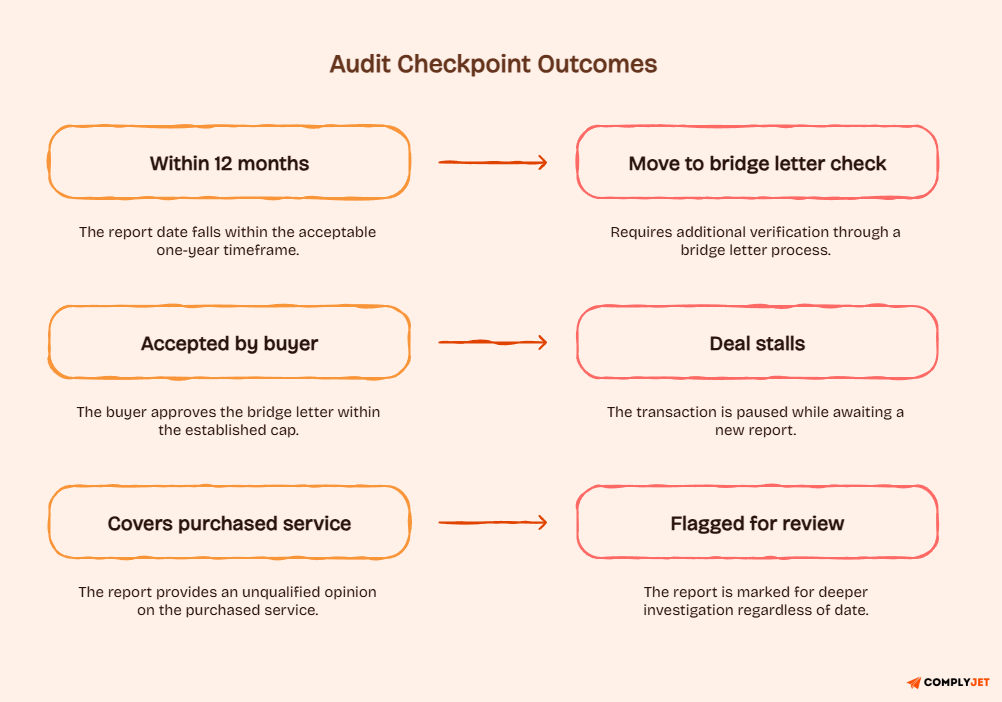
When your SOC 2 report reaches a procurement team, it goes through a structured review. The team checks the audit period end date first, not the issuance date.
If that date is more than 12 months ago, the report is flagged immediately.
They check scope next. Does the audited system cover the specific service you are selling them? If not, the report does not satisfy the requirement even if it is technically current.
They check Section 1 for a qualified or unqualified auditor opinion. Then they scan Section 4 for exceptions and Section 5 for management responses.
Many vendor risk teams use vendor risk management tools to log SOC 2 expiry dates and set automated alerts 60 days before a report lapses.
83% of enterprise buyers require SOC 2 compliance before vendor onboarding, according to a 2024 Panaseer survey. Over a third of organisations have lost deals due to lacking a required security certification.
The Real Business Cost of a Lapsed Report
The immediate impact is a stalled deal. Procurement will not approve a new vendor contract without current documentation. A competitor with a fresh Type 2 report gets the contract you were close to winning.
The slower impact hits at contract renewal time. Enterprise clients typically revisit vendor risk annually. If your report has lapsed by then, they can pause payment or demand remediation before renewing.
Cyber liability insurers have also started factoring SOC 2 status into underwriting. A lapsed report can raise premiums or disqualify you from certain policy tiers entirely.
There is also the investor and M&A angle. Acquirers and growth equity investors review SOC 2 continuity during due diligence. Gaps signal compliance immaturity and affect valuations.
The cost of one lost enterprise deal typically exceeds the cost of an annual renewal audit many times over.
Note!
A lapsed SOC 2 is not just a paperwork problem. It is a revenue problem. Losing one enterprise deal typically costs more than the audit that would have prevented the gap.
The most common short-term fix when a report lapses is a bridge letter. It is worth understanding precisely what it does, how long it lasts, and when it will not help at all.
SOC 2 Bridge Letters: The Safety Net Between Audits
A bridge letter is a management-issued document confirming that no material changes have occurred in the organisation's control environment since the last audit period ended.
It is sent to customers, prospects, or partners who need assurance during the gap between a current and a new report.
Think of it as a temporary bridge, not a permanent road. It gives buyers something to review while your next Type 2 audit is underway. It does not replace the audit.
The SOC 2 bridge letter guide has templates and a breakdown of what each element needs to say if you need to issue one quickly.
How Long Is a SOC 2 Bridge Letter Valid For?
Bridge letters are typically valid for 3 to 6 months from the date of issuance. Most enterprise buyers cap their acceptance at 3 months.
Some regulated industry buyers, particularly in financial services and healthcare tech, will not accept them at all. They insist on a full current report.
The letter stays relevant only until your next SOC 2 Type 2 report is finalised and delivered. At that point, the full report supersedes it.
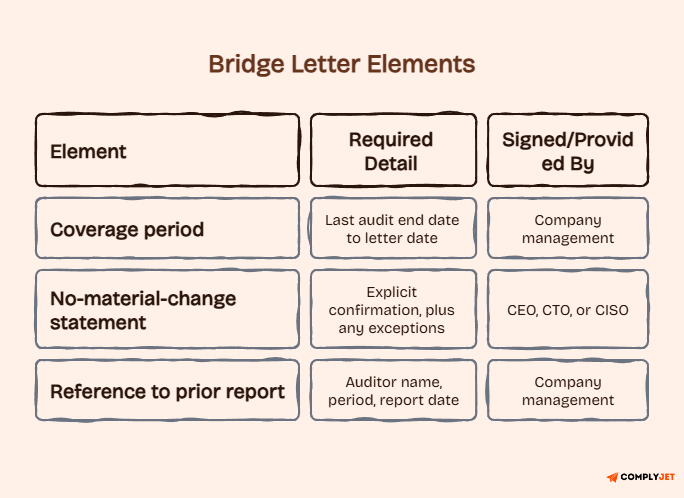
What a Bridge Letter Must Include
A bridge letter that holds up under scrutiny contains six things.
- First, the exact coverage period: start date equals the last audit period end; end date equals the date of the letter.
- Second, a clear statement that no material changes have occurred in the control environment since the last audit.
- Third, a description of any changes that did occur, with context on why they do not affect control effectiveness.
- Fourth, a signature from a C-level executive: CEO, CTO, or CISO. A compliance analyst or department head does not have the authority to issue this type of assurance.
- Fifth, a reference to the specific prior Type 2 report: auditor name, period covered, and report date. Sixth, company letterhead and the signing date.
The CPA firm that ran the original audit does not write or sign the bridge letter. Their attestation ended when the audit period closed.
When Enterprise Buyers Won't Accept a Bridge Letter
There are five situations where a bridge letter will not help, regardless of how well it is written.
The gap is too long. Most enterprise vendor risk policies have a hard cap. If your audit period ended more than 6 months ago, a letter is unlikely to be accepted. You need a new report.
The prior report had a qualified opinion. A letter confirms controls have not changed since the audit. It cannot resolve findings the auditor already documented.
Buyers who flagged a qualified SOC 2 opinion in your prior report will not accept a letter as a remedy.
The prior report's scope did not cover the service being purchased. A letter can only extend assurance over what was already audited. It cannot expand scope retroactively.
The buyer is in a regulated industry. Financial services firms, healthcare organisations, and government-adjacent companies often prohibit reliance on bridge letters. They require a current, in-scope Type 2 report.
The vendor handles sensitive data at scale. If you process PII, electronic protected health information, or financial transaction data for enterprise clients, buyers apply stricter standards. A bridge letter will not satisfy their risk committee.
Tip!
Before sending a bridge letter for an enterprise deal, confirm with the buyer's security reviewer that they will accept one. Five minutes now prevents a two-week delay later.
Start your SOC 2 readiness with ComplyJet. Free trial. No commitment. Start collecting evidence today.
With bridge letters covered, it helps to look at the full SOC 2 audit timeline so you can plan cycles that never produce a gap in the first place.
The SOC 2 Audit Timeline: What You Are Actually Committing To?
SOC 2 is not a project you complete once. It is a cycle you enter and stay in.
Understanding the full timeline is what separates teams that manage their report validity proactively from those that scramble when a deal exposes a gap.
The cycle has three phases. Pre-audit readiness covers implementing controls, closing gaps, and collecting baseline evidence. This phase takes 2 to 6 months for first-time teams.
A SOC 2 audit timeline breakdown explains each phase in detail. Running a gap analysis before you engage an auditor shows you exactly what controls need work.
The second phase is the observation period, when the auditor watches your controls operate. Minimum 3 months. AICPA recommends 6 months. Enterprise buyers expect 12.
After the observation window closes, the auditor takes 4 to 8 weeks to complete testing and draft the final report. First-time teams typically need 6 to 12 months total.
Renewals run 3 to 5 months because controls are already in place.
Choosing the right auditor shapes all of this. The SOC 2 auditor guide covers what to look for and what to avoid.
Reporting period selection is the third decision most founders underinvest in. Align the end of your auditing period with when your largest clients' fiscal years close.
If most of your clients are on a calendar year, an October 31 period end means your report is ready in January, right when their procurement teams are most active.
The AICPA recommends your SOC 2 period overlap at least 6 months with your clients' financial year for the report to be useful in their own audit processes.
Did You Know?
Your renewal audit begins the day your current observation period ends. Not when the report arrives. If your auditing period ends December 31, January 1 is the start of your next cycle. There is no pause in the middle.
Once you understand the timeline, building a compliance rhythm that keeps your SOC 2 report valid without burning the team out each year becomes much more manageable.
How to Stay SOC 2 Compliant Beyond the Report Validity Period?
Compliance is not something you do once a year before an audit. It is how you operate.
Teams that treat SOC 2 as an annual event will always have gaps, exceptions, and scrambles at the wrong moment. Teams that build it into their operating rhythm stay ready without the chaos.
The difference between those two types of teams is not usually budget or headcount. It is process and the right tooling. Three things keep your SOC 2 report validity uninterrupted.
Choose Your Reporting Period Strategically
The period you select shapes everything downstream. If your auditing period does not align with client needs, the report may be technically current but still insufficient for their purposes.
Survey your largest clients on their fiscal year-end dates. Work backwards from when you need the report in their hands. Most enterprise clients want calendar-year coverage.
An audit period ending October 31 gives your auditor until December to finalise the report. That puts it in client hands right at the start of their new procurement cycle.
Choose 12-month periods over 6-month periods wherever possible. Longer periods give auditors more evidence and produce more credible reports.
Avoid auditing periods that end during product launches, major hiring pushes, or fundraising rounds. Your team will not have the bandwidth to support auditor requests during those windows.
Always Stay Under an Active Audit Window
Once you start the SOC 2 audit process, you should always be under an audit period or window. Read this full guidance on SOC 2 audit frequency. The moment your current observation period ends, the next one begins. There is no planned pause.
Gaps between the auditing periods create a window where your controls are not under active auditor observation.
Even a 30-day gap can require explanation to a thorough procurement team. Set internal calendar alerts at 90, 60, and 30 days before your auditing period end date.
Assign a named compliance owner. One person is responsible for knowing the renewal date, engaging the auditor for the next cycle, and flagging anything that needs resolving before the new window opens.
Monitor Controls Continuously, Not Seasonally
Do not save your evidence collection for the month before the auditor arrives. Continuous monitoring is the only way to catch control failures early, before they become audit exceptions.
Automate evidence collection wherever your infrastructure allows. Cloud integrations pull access logs, endpoint configuration data, and vulnerability scan results automatically.
Schedule access reviews quarterly, not annually. Track policy acknowledgements as they happen. Run quarterly internal reviews against your controls list to surface issues you can fix rather than explain.
Two areas that most commonly produce exceptions during audits are background check tracking and password policy enforcement.
Why This Matters?
One missed evidence collection creates an audit exception. One exception can produce a qualified opinion. One qualified opinion can cost you an enterprise deal. The chain is short. Treat monitoring as an operating discipline, not a pre-audit sprint.
ComplyJet makes continuous SOC 2 monitoring affordable for growing teams. See pricing and start for less than you expect.
Building continuous compliance is significantly easier with the right platform. And the platform you choose determines whether your SOC 2 validity is something you manage confidently or something that catches you off guard.
How ComplyJet Keeps Your SOC 2 Always Valid?
ComplyJet is built around one idea: you should never have to worry about producing a valid SOC 2 report.
The platform automates evidence collection, tracks control status in real time, and keeps your compliance posture audit-ready every day. Not just in the weeks before your auditor arrives.
The approach is designed for founders and growing teams. AI-driven workflows break compliance tasks into specific, manageable actions. Hands-on support means you are not navigating the process alone.
ComplyJet was built for cost-conscious SaaS teams, not enterprise compliance departments. The pricing reflects that.
Sheetgo, a data platform trusted by 5 million users, switched from Vanta to ComplyJet to get better alignment between their compliance rhythm and the platform's workflow model.
The switch let them maintain SOC 2 status continuously across multiple frameworks without adding compliance overhead.
Patient Focus, a healthcare company, used ComplyJet to move through SOC 2 much faster than expected. They described it as "intuitively guiding us through what we needed."
See how Sheetgo, Patient Focus, and 15 other teams use ComplyJet to stay SOC 2 compliant year-round.
ComplyJet vs. Other Compliance Platforms
If you are evaluating compliance platforms, the decision usually comes down to price, speed to first report, and how much support you get through the process.
Here is how the main options compare on the factors that matter most for keeping SOC 2 validity uninterrupted:
For a detailed comparison across 10 platforms, the SOC 2 compliance software guide covers pricing, features, and real user feedback side by side.
Founder's Tip?
The teams that keep their SOC 2 valid year-round are not the ones with the most compliance staff. They are the ones with the right platform running in the background while the team ships the product.
Frequently Asked Questions
Does SOC 2 actually expire?
No. There is no expiry date on a SOC 2 report. The AICPA does not set a mandatory validity period in its attestation standards.
However, the industry treats reports as current for 12 months from the end of the auditing period. Most enterprise buyers will not accept a report older than 12 months without a bridge letter or a fresh audit.
Are SOC 2 audits required by law?
No. SOC 2 is a voluntary standard. No government regulation mandates it.
But enterprise customers, cyber liability insurers, and investors increasingly require it as a condition of doing business. For SaaS companies selling to mid-market and enterprise buyers, it is effectively required even though no law says so.
Is SOC 2 compliance mandatory in India?
Not by Indian law or regulation. Indian SaaS companies selling to US and EU enterprise buyers are routinely required to provide a SOC 2 Type 2 report as part of vendor onboarding.
The requirement comes from the buyer, not the regulator. If you are also navigating EU data requirements, the SOC 2 vs GDPR guide explains where the two frameworks intersect.
What happens if you fail a SOC 2 audit?
A SOC 2 audit cannot technically be failed. Auditors issue either an unqualified opinion (clean) or a qualified opinion noting exceptions.
A qualified opinion means your controls did not fully meet the criteria during the observation period. Enterprise buyers treat qualified opinions seriously and typically require remediation evidence or a new audit before approving vendor status.
How long is SOC 2 Type 2 valid for compared to ISO 27001?
SOC 2 Type 2 is valid for 12 months from the end of the auditing period by industry standard. There is no formal expiry.
ISO 27001 has a formal 3-year certification cycle with mandatory annual surveillance audits in between. SOC 2 has shorter renewal cycles but no hard expiry date.
ISO 27001 has a longer formal window but requires continuous surveillance to maintain it. For a full comparison, the ISO 27001 vs SOC 2 guide breaks down both frameworks side by side.
How often does SOC 2 need to be updated?
Annually is the industry standard. Most organisations undergo a Type 2 audit every 12 months, covering a continuous rolling period.
Some organisations run 6-month rolling audits when client demands require higher frequency. There is no regulatory minimum. Client expectations drive the cadence.
How hard is SOC 2 compliance to maintain year-round?
The first audit is the hardest. Controls need to be implemented, evidence needs to flow, and your team learns the process.
Annual renewals are significantly lighter because the infrastructure is already in place. Organisations using compliance platforms with automated evidence collection report that ongoing maintenance is manageable without a full-time compliance hire.
What is the 2-year rule for audits and does it apply to SOC 2?
The 2-year rule is a concept from financial statement auditing related to mandatory auditor rotation in certain regulated contexts. It does not apply to SOC 2.
You can use the same CPA firm for SOC 2 audits indefinitely. Periodic rotation is considered good governance but is not required by any SOC 2 standard.
How long is a SOC 2 bridge letter good for?
A bridge letter is typically valid for 3 to 6 months from issuance. Most enterprise buyers cap acceptance at 3 months.
The letter is superseded the moment your next SOC 2 Type 2 report is finalised and delivered. It is a temporary measure during the gap between audits, not a long-term compliance strategy.
Conclusion
SOC 2 report validity is simpler once you understand the full picture. Reports do not technically expire. The industry treats them as current for 12 months from the end of the auditing period, not from the report cover date.
The AICPA logo restriction is where that 12-month norm originated. Type 1 and Type 2 have different validity windows and serve different purposes. Bridge letters help in a gap but only up to a point.
Continuous compliance is the only way to never find yourself with a lapsed report and a stalled deal.
A current SOC 2 report is not a compliance checkbox. It is an active sales asset. The moment it lapses, you start losing ground to competitors who have theirs current.
Keeping it valid year-round is not a compliance burden. With the right platform, it is just part of how you operate.