.svg)

What nobody tells you up front is that the companies that sail through SOC 2 do not start with an audit. They start with a systematic pre-audit diagnostic procedure that shows you exactly where your security controls fall short before a licensed auditor does.
In other words: A SOC 2 gap analysis.
This single-handedly separates a clean first-attempt pass from an expensive, deal-delaying failure.
More than 70% of organisations fail their first attempt without a prior gap assessment, according to audit practitioners. That is not a warning but a planning fact.
So, this guide will cover the full lifecycle for assessing your controls against the AICPA Trust Services Criteria, analysing every gap you find, and closing each one before your auditor’s observation period begins.
Whether you are a Series A founder or a compliance manager running your second Type 2 renewal, this is going to help you.
Want to know what your auditor would flag before the audit begins? Book a ComplyJet demo, and we’ll show you how your controls, evidence, and missing tasks can be mapped into a clear SOC 2 gap analysis roadmap, without chasing spreadsheets or guessing what to fix next.
Quick Summary
- A SOC 2 gap analysis is a pre-audit diagnostic. It compares your existing security controls against the AICPA’s Trust Services Criteria to find deficiencies before a licensed auditor does. It is not the official audit. It is the step that makes the audit survivable.
- The terms gap analysis and gap assessment mean the same thing in practice. A readiness assessment is slightly broader. It includes scope definition, system descriptions, and evidence preparation. The gap analysis is the core control-mapping component within it.
- The gap rate for first-time SOC 2 pursuers is predicted to be 40-60%.
- A SOC 2 Gap analysis timeline is usually extended from one to four weeks, depending on the organisation's size.
- The average data breach cost in 2025 was $4.4 million.
- Compliance automation platforms reduce gap remediation effort by 60 - 80%
- The bottom line is that a SOC 2 compliance gap analysis costs a fraction of a failed audit or a lost enterprise deal. It is the single most valuable step before you pursue certification.
Now that the basics in place, let's dive deeper.
What Is a SOC 2 Compliance Gap Analysis?
A SOC 2 compliance gap analysis is a systematic review of your current security controls. You compare what you have against what the AICPA’s Trust Services Criteria require. What remains is your gap list.
Think of it as a dry run before the real thing. You find the problems on your own terms, privately, before an auditor puts them in a customer-visible report.
Gap Analysis vs. Gap Assessment
Both terms describe the same process: mapping your controls to the Trust Services Criteria and identifying what is missing. The terminology varies by context.
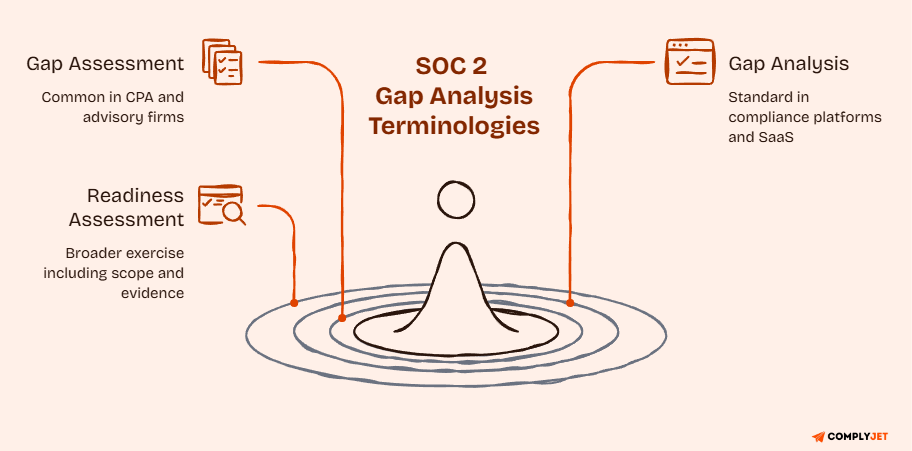
“Gap assessment” is common in CPA and advisory firm language.
“Gap analysis” is standard in compliance platforms and SaaS contexts.
The nuance worth knowing: a readiness assessment is a broader exercise. It includes scope selection, system descriptions, and evidence preparation. The gap analysis includes the control-mapping diagnostic. When an advisor runs a readiness assessment, the gap analysis is always embedded inside.
Why does it come brefore your Audit?
A gap analysis is an internal exercise. You own the output. It is not shared with customers. A formal SOC 2 audit is a third-party attestation conducted by a licensed CPA firm. The output is a report that enterprise procurement teams read.
Gap findings caught in your internal analysis are private and correctable. Exceptions found during a formal SOC 2 Type 2 audit appear in the customer-visible report. That distinction is the entire reason the gap analysis exists as a preparation step.
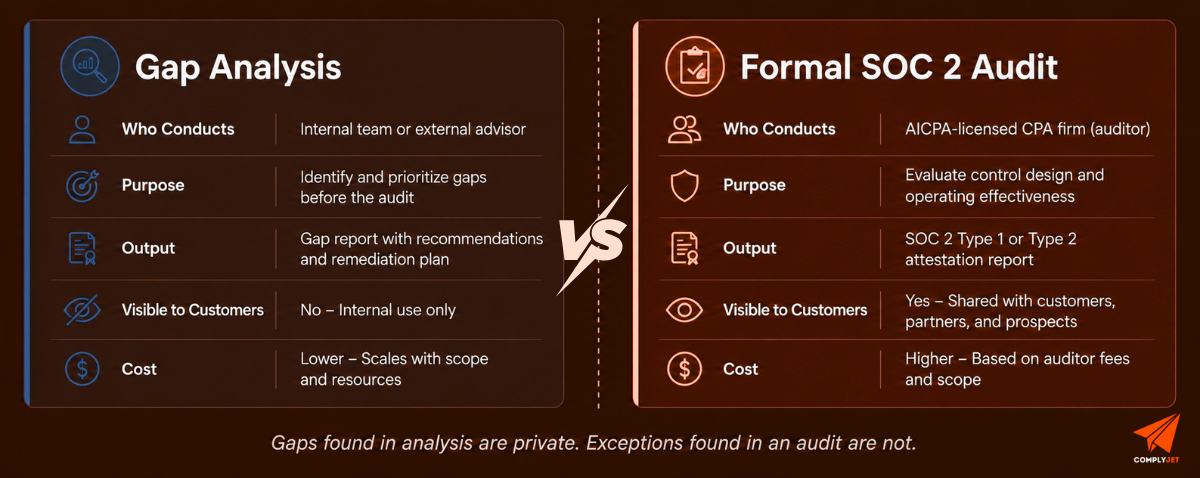
Why this matters: You need an unqualified opinion from an auditor. Yes, unqualified. A qualified audit opinion, which happens when controls fail during the observation period, can cost you enterprise deals even after you are certified. The gap analysis is how you prevent that outcome before it happens.
Understanding what a gap analysis is sets the foundation. Knowing whether you actually need one right now is equally important.
Who Needs a SOC 2 Gap Analysis?
SOC 2 is not legally required. No regulator will fine you for not having it. But the market will.
Most SaaS companies begin thinking seriously about a SOC 2 gap assessment around Series A, when the first large enterprise deal enters the pipeline.
Before that, the cost-benefit case is usually weak. After that, it is often urgent.
Which Industries and Company Types Need SOC 2?
The companies that consistently pursue SOC 2 are those storing, processing, or transmitting customer data on behalf of someone else.
That covers:
- SaaS companies serving enterprise customers
- Cloud infrastructure and hosting providers
- Managed service providers
- Fintech platforms are often required by banking and payments partners.
- Healthtech companies, alongside HIPAA compliance
- HR tech and legal tech firms handling sensitive employee or client data
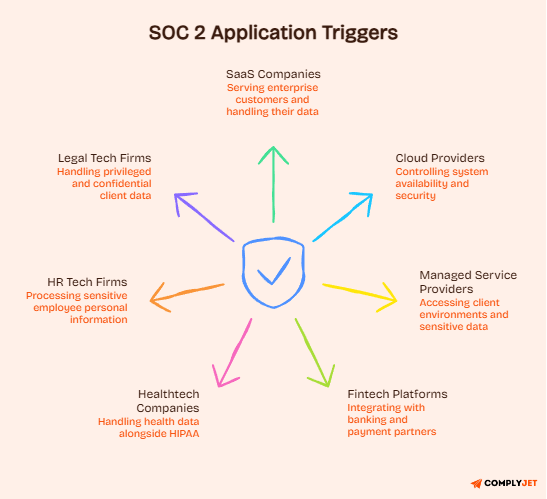
If your product touches customer data and you sell to businesses, you will face the SOC 2 question.
When Is the Right Time to Start?
Enterprise procurement teams increasingly require a SOC 2 report before signing vendor contracts. Without one, deals stall at the RFP stage.
The Four Business Triggers That Signal It’s Time for a Gap Analysis
The first trigger is an enterprise RFP with SOC 2 listed as a vendor requirement.
The second is an approaching annual Type 2 renewal, when your existing report is nearing 12 months old.
The third is a material infrastructure change: a cloud migration, acquisition, new product line, or significant headcount growth.
The fourth is a post-incident review, where a security event revealed weaker controls than expected. Any of these four scenarios should prompt an immediate gap analysis.
Founder’s tip: Do not wait for a lost deal to start your SOC 2 gap analysis. That deal is typically unrecoverable by the time your audit report is ready.
Before you assess your gaps, you need to understand the framework you are assessing against.
What among the 5 AICPA Trust Services Criteria Applies to you?
The Trust Services Criteria are the AICPA’s framework for SOC 2. They define exactly what auditors evaluate. Your gap analysis is essentially a self-assessment against these criteria.
There are five categories. Only Security is mandatory. Availability, Processing Integrity, Confidentiality, and Privacy are added based on your business model and customer requirements.
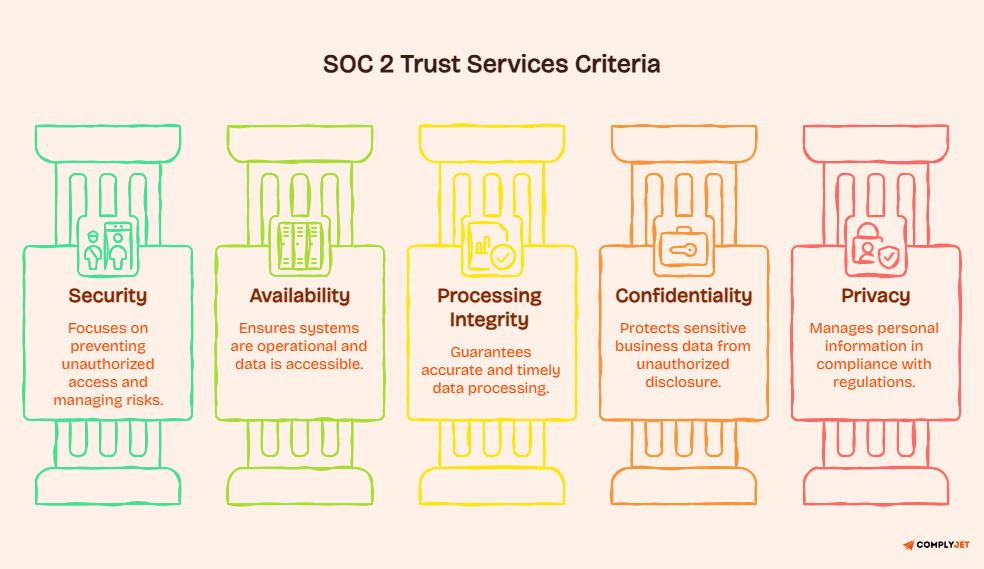
The Security category alone contains 33 individual controls across the Common Criteria series, CC1 through CC9.
How to Decide Which Trust Services Criteria Belong in Your Gap Analysis Scope
Start with Security. Then ask your customers what they require. Enterprise procurement questionnaires often specify which categories they expect. That is your clearest signal for scope decisions.
Add Availability if you have uptime SLAs in customer contracts. Add Privacy if you process personal data from EU or California residents. A narrower scope means a shorter gap analysis and a lower audit fee. Add categories because a customer or regulator requires them, not because they sound relevant.
Tip: Every additional TSC category adds controls, evidence requirements, and audit time. Scope decisions have a direct impact on your total first-year SOC 2 cost.
What Did the 2022 AICPA Points of Focus Revision Actually Change?
In 2022, the AICPA published updates to the Points of Focus for the Trust Services Criteria. The criteria themselves did not change. The interpretive guidance auditors use did.
Three changes matter for your 2026 gap analysis. First, auditors now have clearer guidance on evaluating controls mapped to NIST and ISO 27001 alongside TSC. Second, the distinction between Confidentiality and Privacy was sharpened. Third, supply chain risk and emerging technology guidance were added explicitly. If your gap analysis was built before 2022, parts of it may be outdated.
Understanding the framework is step one. Knowing how your Type 1 versus Type 2 strategy changes your gap approach is step two.
SOC 2 Type 1 vs. Type 2 - How Does Your Gap Analysis Strategy Change?
The SOC 2 report has two types, and your gap analysis approach differs significantly depending on which one you are targeting. Getting this wrong wastes remediation time and money.
Quote box
Type 1 evaluates whether your controls are designed correctly at a single point in time.
Type 2 evaluates whether your controls operated effectively over a sustained period, typically six to twelve months.
Running a Gap Analysis for SOC 2 Type 1
For SOC 2 Type 1, the core question is: do the right controls exist and are they properly designed? Your gap analysis should focus on design adequacy. Do you have a written incident response plan? Is there a documented change management process? Are policies current and formally approved?
You do not need to prove controls operated for months. You need to prove they are in place and logically structured. Evidence completeness matters less here than design adequacy.
What Changes with SOC 2 Type 2?
For SOC 2 Type 2, design is just the baseline. You also need to prove controls ran consistently over the observation period. Evidence gaps are just as critical as missing controls.
If access review logs are incomplete, if your penetration test was not documented, if change approvals were not recorded, those are gaps. An auditor flags them the same way they flag a missing control.
Also read: SOC 2 Type 1 vs SOC 2 Type 2: What’s the Difference?
Recommended Audit Path for First-Time SOC 2 Pursuers
The standard path is: run your gap analysis first, pursue Type 1 to validate control design, then move to Type 2 to demonstrate sustained operation. Most auditors and advisors recommend this sequence.
Do not skip directly to Type 2.
Enterprise buyers increasingly prefer Type 2 reports. But attempting it before a clean Type 1 baseline increases the risk of a qualified opinion significantly.
A finding in Type 2 appears in a customer-visible report. A finding in your internal gap analysis does not.
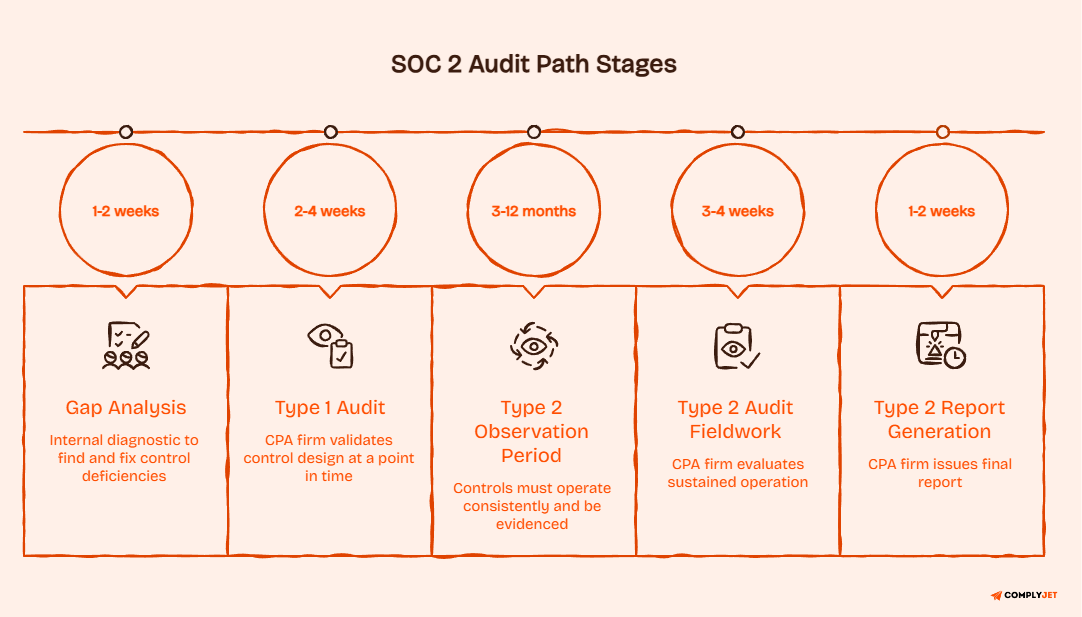
Note: A Type 1 audit functions as an extended gap analysis from the auditor’s perspective. Treat it as a rehearsal and not the final performance.
With the strategy clear, here is the actual methodology.
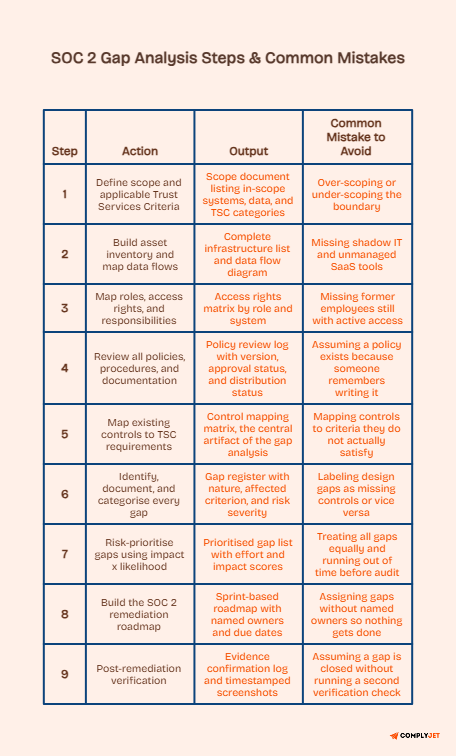
How Do You Actually Conduct a SOC 2 Gap Analysis? The 9-Step Process
The gap analysis process is not complicated. It requires discipline and a clear sequence. Most organisations struggle not because the steps are hard, but because they skip around or start too late.
Each step builds on the previous one. Jumping ahead creates holes in your control mapping and leads to an incomplete gap register.
Step 1 - Define Your Scope and Applicable Trust Services Criteria
Decide what is in scope first.
Which systems, applications, infrastructure, and data fall inside your SOC 2 boundary? Which Trust Services Criteria apply based on your business model?
Scope definition determines everything. A poorly scoped gap analysis produces a register that either over-reports, making remediation feel impossible, or under-reports, giving false confidence before the audit.
Step 2 - Build Your Asset Inventory and Map Data Flows
List every server, cloud instance, SaaS tool, and endpoint that handles in-scope data. Then trace how data moves through your environment. Where does it enter, where is it stored, where does it exit?
This step reveals shadow IT and forgotten infrastructure. Both become control gaps immediately.
Step 3 - Map Roles, Access Rights, and Responsibilities
Document who can access what.
Map every role to the systems it can reach. Identify admin-level permissions and confirm they are still appropriate.
This step consistently surfaces the most common first-time finding: former employees who still have active system access.
Step 4 - Review All Policies, Procedures, and Documentation
Collect every policy document your organisation has.
Check when each was last reviewed, whether it was formally approved, and whether it reflects how things actually work today.
Policies that are outdated, unapproved, or never distributed to employees are treated the same as missing policies by auditors.
Step 5 - Map Existing Controls to TSC Requirements
For each TSC criterion, ask: Do we have a control? Is it documented? Is it operating consistently? The output is a control mapping matrix. This is the central artifact of the entire SOC 2 compliance gap analysis.
Did you know? The Security criteria contain 33 individual controls. Most first-time organisations have roughly half of these reliably documented before their first gap analysis.
Step 6 - Identify, Document, and Categorise Every Gap
For each criterion with no control, or a weak one, record three things: the nature of the gap, which TSC criterion it affects, and how severe the risk is.
Categorise gaps by type: missing control, design gap where a control exists but is not structured correctly, or operational gap where a control exists but is not consistently followed or evidenced.
Step 7 - Risk-Prioritise Every Gap Using the Impact x Likelihood Matrix
Not all gaps are equal. Some block your audit outright. Some are documentation fixes that take an afternoon. Rank each gap by potential impact if exploited and the effort required to close it.
High-impact, low-effort gaps go first. High-impact, high-effort gaps need dedicated project timelines. Low-impact gaps get bundled toward the end.
Step 8 - Build Your SOC 2 Remediation Roadmap
Assign every gap to a named owner with a due date. Define what evidence the auditor will need once each gap is closed. The remediation roadmap is a living document.
Review it weekly. Update it as gaps close. Track evidence collection status alongside remediation status.
Step 9 - Implement Post-Remediation Verification Before Audit Day
Closing a gap and verifying it is closed are two different tasks. After each remediation, run a confirmation check. Export a timestamped screenshot showing MFA is enforced. Pull access review logs. Confirm SIEM coverage across in-scope systems.
Auditors do not take your word for it. Evidence collected before audit day removes the stress of scrambling during fieldwork.
The methodology tells you how to find gaps. Now let’s look at what you are most likely to find.
The Most Common Gaps in SOC 2 Readiness Assessments
For organisations pursuing SOC 2 for the first time, the typical gap rate is 40-60%, according to KirkpatrickPrice findings. Roughly half of all assessed control areas will contain deficiencies. This is expected. It is what the gap analysis is built to surface.
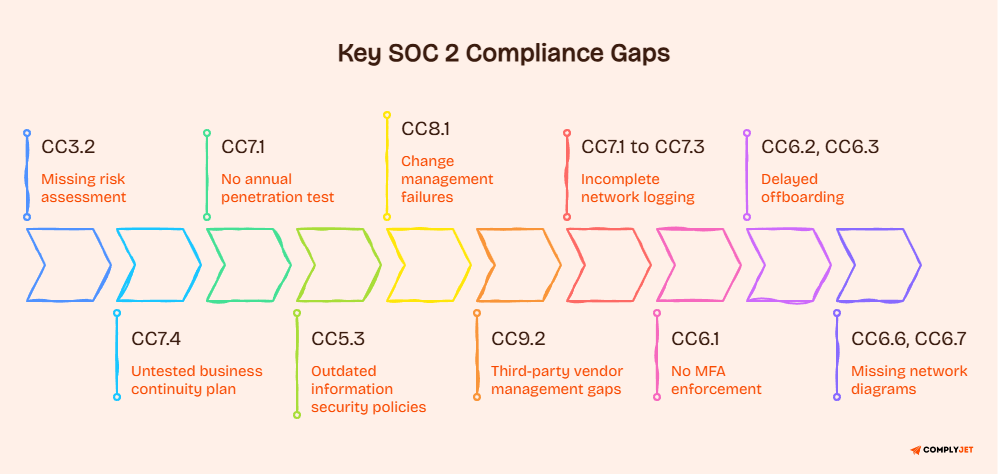
The gaps below represent the most consistently cited findings across multiple audit firms and compliance advisory sources. If this is your first SOC 2 gap assessment, expect to see most of them.
1. Risk Assessment
CC3.2 is the SOC 2 control that requires a documented, maintained risk assessment process. Most organisations perform informal risk conversations. They just never write them down or set a review cadence.
Auditors need a dated risk assessment document, a risk register, and evidence of an annual review cycle. Fix this early. Other controls are built on top of it.
2. Business Continuity Plans
Plans that exist on paper but have never been tested fail the Availability criterion. CC7.4 requires demonstrated recovery capability, not just documented plans.
Auditors ask for a dated tabletop exercise report with named participants and evidence of plan updates after the exercise. A plan with no test history does not count.
3. Annual Penetration Test
CC7.1 requires proactive vulnerability monitoring. Without an annual penetration test from a qualified third-party firm, auditors have no evidence that you searched for exploitable weaknesses.
Evidence needed: a penetration test report naming the firm, scope, date, and a remediation log for findings. Allow 90 days between your pen test and audit fieldwork.
4. Outdated Information Security Policies
CC5.3 requires policies to be implemented and communicated. Policies not reviewed in over 12 months, lacking approval signatures, or never formally distributed fail this criterion.
Every policy needs a version number, approval date, approver name, and distribution records. Annual review cycles are the minimum auditor expectation.
5. Change Management
CC8.1 requires a formal change approval workflow. Self-approvals, where developers deploy their own code without a second reviewer, violate segregation of duties. This is one of the most commonly cited findings in SOC 2 Type 2 reports.
A protected branch policy requiring peer review before merge is the simplest technical fix. Auditors need ticketing records showing second-party approvals tied to deployed changes.
6. Third-Party Vendor Management
According to the Verizon 2024 DBIR, 62% of data breaches involved a third-party vendor. CC9.2 requires managing vendor risk. Most organisations have no formal vendor inventory, no risk tiering, and have never collected SOC 2 reports from critical vendors.
Build a vendor registry. Assign risk tiers based on data access level. Request SOC reports annually from high-risk vendors.
Our vendor risk basics explains how to structure this process.
7. Network Logging
CC7.1 through CC7.3 require continuous monitoring and a defined alert-response process. If logs from critical systems are not flowing into a central SIEM, auditors will flag it.
Evidence needed: SIEM configuration showing in-scope systems are covered, a documented alert runbook, and log retention settings of at least 90 days.
8. MFA Policy
CC6.1 requires logical access controls preventing unauthorised access. Multi-factor authentication is the single most commonly cited quick-win finding in first-time SOC 2 audits.
Auditors need an MFA policy and a screenshot showing enforcement at the identity provider level. Optional MFA is insufficient. It must be mandatory for all in-scope accounts.
9. Delayed Offboarding Process
CC6.2 and CC6.3 require timely access removal when employees leave. Active accounts for former employees appear as a critical finding in virtually every first-time audit.
Integrate your HRIS with your identity provider so accounts deactivate automatically on the termination date. Auditors need policy documentation and access review records confirming that no former employees retain access.
10. Network Diagrams
CC6.6 and CC6.7 require controls over network access. Without a current network diagram, auditors cannot evaluate whether segmentation meets criteria. There is no workaround for this one.
The diagram needs trust zones, external connection points, and data classification boundaries. It must be version-controlled and dated. Simple tools like draw.io work fine. The content matters more than the format.
For a deeper breakdown of policies, evidence, controls, and audit readiness, read our SOC 2 Compliance Requirements: End-to-End Guide.
With common gaps covered, here is what has changed specifically for 2026.
New SOC 2 Gap Areas That Auditors Scrutinise in 2026
The standard gap list covers what has been consistently true for years. But auditor expectations evolve. In 2026, there are four areas where progressive SOC 2 engagements are asking new questions that most gap analysis guides do not address.
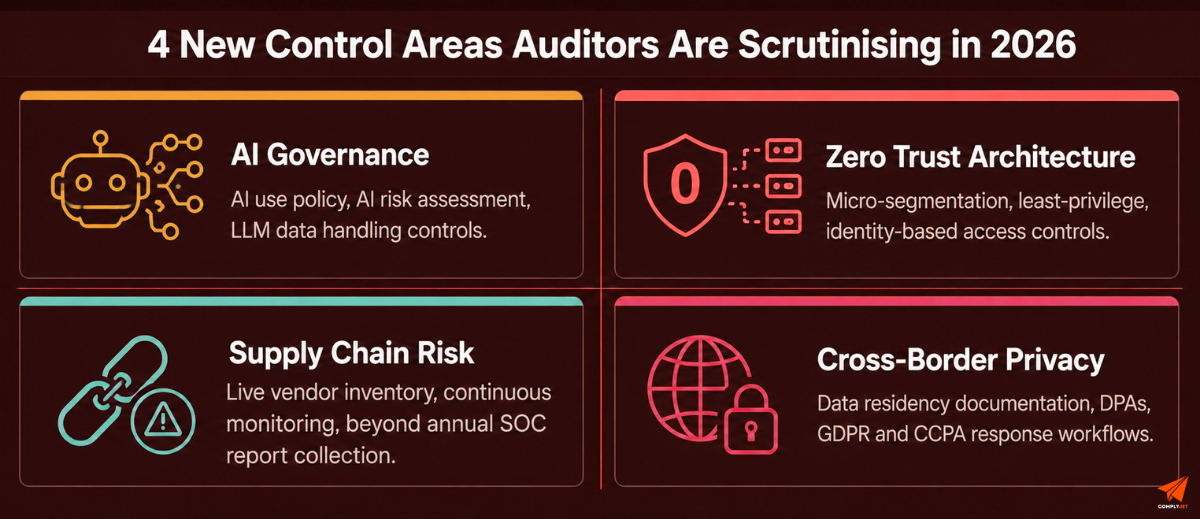
These are not theoretical risks. They reflect real changes in how the audit community approaches modern threat and technology landscapes.
AI Governance
If your product uses AI tools, auditors want to know whether you have an AI use policy and an AI risk assessment process. This covers how AI tools handle customer data and whether employees can feed sensitive information into public AI models.
Add an AI use policy and an AI tool approval workflow to your 2026 gap analysis scope. If your engineers use AI coding assistants or your product integrates an LLM, these controls are no longer optional in progressive SOC 2 audits.
Zero Trust Architecture
Zero Trust Architecture operates on one principle: never trust, always verify. Auditors increasingly expect micro-segmentation, least-privilege access enforcement, and identity-based controls rather than network-location-based access.
Your 2026 gap analysis should document network segmentation, confirm identity provider least-privilege enforcement, and verify that conditional access policies are in place. A full Zero Trust implementation is not required before your audit. Evidence of the direction is.
Third-Party Supply Chain Risk
Auditors now expect a continuous vendor risk programme. A live vendor inventory with risk tiering, periodic reassessments of high-risk vendors, and ongoing monitoring of critical vendor security posture are becoming standard expectations.
Collecting vendor SOC reports at onboarding was sufficient two years ago. It is not sufficient now. Your vendor risk programme needs to be ongoing, not episodic.
Cross-Border Privacy Controls
If you process personal data from EU or California residents, GDPR and CCPA enforcement directly affect your Privacy criterion scope. Auditors now expect documentation of where personal data is stored, processed, and transferred across jurisdictions.
This includes Data Processing Agreements with EU-based vendors, CCPA response workflows, and documented data residency decisions for each in-scope system.
Stage-based guidance is next, because “ready” means something different depending on your size.
What Does “Ready” Look Like for Your Business?
“Ready” is not a fixed standard. A 15-person startup and a 300-person SaaS company face completely different gap profiles. The minimum viable control set is not the same at both stages.
Here is what good looks like at each stage of company growth.
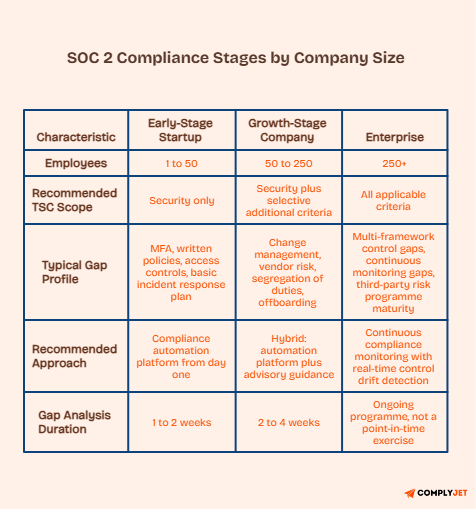
Early-Stage Startup with 1–50 Employees
Start with Security TSC only.
Priority controls are MFA, role-based access, written security policies, and a basic incident response plan. These are also the most commonly cited first-time gaps at this stage.
Use a compliance automation platform from day one. The manual approach costs more in staff time than the platform costs in licensing. A gap analysis at this stage typically takes one to two weeks.
Growth-Stage Company with 50–250 Employees
At this stage, your gap profile expands. Change management becomes critical as engineering teams grow.
Vendor risk management becomes complex as your SaaS tool count grows. Segregation of duties and offboarding processes become audit priorities.
The recommended approach is hybrid: a compliance platform for technical automation and evidence collection, plus advisory guidance for policy review and control design decisions.
Enterprise with 250+ Employees
At enterprise scale, SOC 2 is one of several frameworks you are managing. ISO 27001, HIPAA, and PCI DSS often co-exist. A multi-framework gap analysis, mapping controls across all applicable frameworks simultaneously, reduces total compliance effort significantly.
Continuous monitoring replaces point-in-time gap analysis with real-time control drift detection. Your gap register stays current rather than accurate only at the time of the last assessment.
Finding gaps is step one. Building a plan that actually closes them is the harder part.
How Do You Build a SOC 2 Remediation Plan That Closes Every Gap?
A gap register without a remediation plan is a list of problems. The plan converts that list into a clean audit. Most teams underestimate how structured this process needs to be.
The most common failure mode is treating remediation as an informal to-do list.
So, keep this for reference.
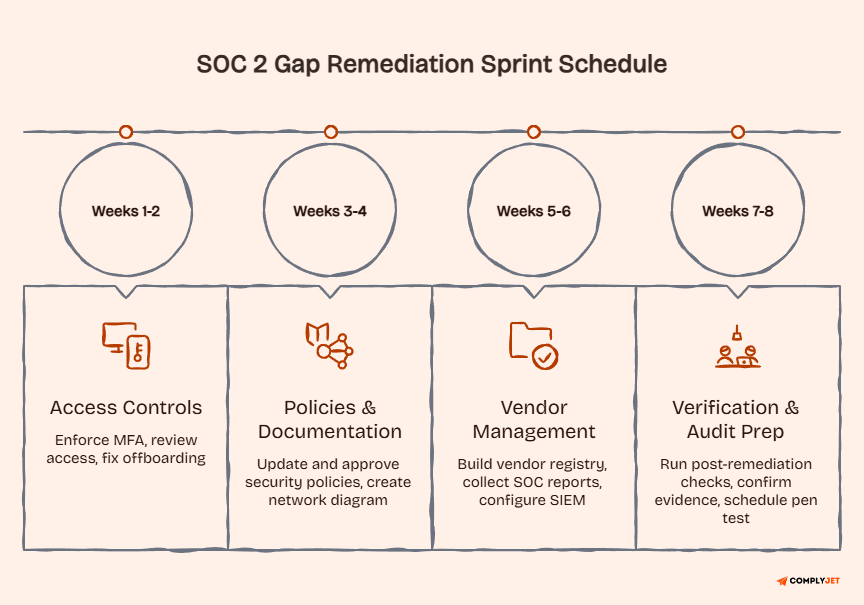
Turn Gap Findings Into Sprint-Based Remediation Tasks
Treat the remediation roadmap like a product sprint backlog. Assign each gap to a named owner.
Group related gaps into two-week sprints by theme: access controls in Sprint 1, policies in Sprint 2, vendor management in Sprint 3.
Review progress weekly. Update the roadmap as gaps close. High-risk gaps go into Sprint 1 without exception.
Evidence for Each Major Control Area
Evidence requirements vary by control type. For access controls: MFA enforcement screenshots and access review logs with reviewer names and dates. For policies: version-controlled documents with approval signatures and distribution records.
For incident response: a dated tabletop exercise report. For change management: ticketing records showing second-party approvals.
Verify Remediation Before Your Auditor Arrives
After closing each gap, verify it is actually closed. Do not rely solely on the person who fixed it. Run a second internal check or use automated control testing in your compliance platform.
For technical controls, export timestamped configuration screenshots. For procedural controls, confirm a documented output exists with dates and named participants.
Prevent Gaps From Reappearing
A gap closed in Month 1 can reopen by Month 6 without monitoring. Control drift is the primary cause of audit exceptions during Type 2 observation periods.
Set automated alerts for changes to critical configurations. Review access rights quarterly. Schedule annual policy reviews. Compliance platforms handle most of this through continuous control testing.
Understanding gaps and closing them leads to the natural next question: What does the output document of this process actually look like?
What Does a SOC 2 Gap Analysis Report Actually Look Like?
The gap analysis report is an internal document. It is not your SOC 2 attestation. It is not shared with customers. It is the planning artifact your security team, CISO, and leadership use to drive remediation.
Most organisations do not know what to expect before they see one. That creates confusion about what you are paying for when you hire an advisor or use a compliance platform.
The 7 Core Sections of a SOC 2 Gap Analysis Report?
A well-structured gap analysis report contains these components.
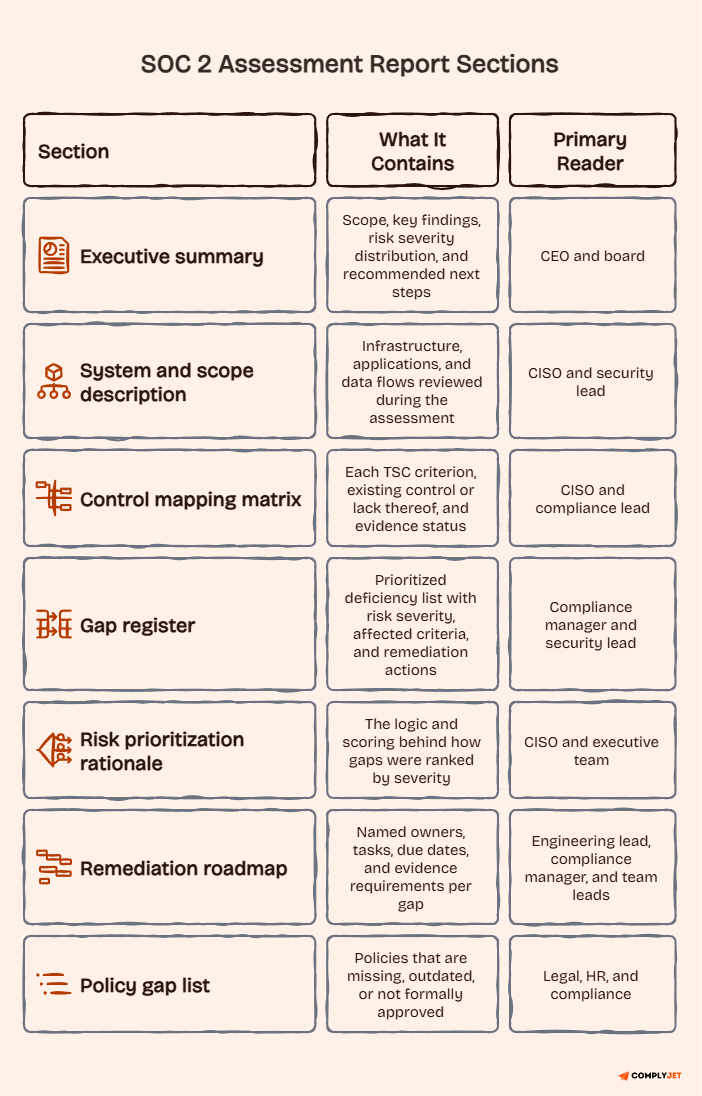
Difference Between a Gap Finding and an Audit Exception
A gap finding lives in your internal report. You fix it. The auditor never sees it. An audit exception appears in the formal SOC 2 report that gets shared with customers.
Gap findings are private and correctable. Audit exceptions are public and damaging. The entire purpose of a SOC 2 compliance gap analysis is to convert potential exceptions into internal findings you can close before they reach the auditor.
Good to know: many first-time founders are surprised to learn that the gap analysis report carries no formal weight with customers. Its entire value lies in what it enables you to find and fix.
How Does a Gap Finding Lead to a Qualified Audit Opinion?
If a gap is not closed before the Type 2 observation period begins and the auditor observes a control failure during that period, it becomes an exception. Enough exceptions in key control areas produce a qualified opinion.
As per the SANS Institute, a qualified opinion signals control failures to every customer who reviews the report. That frequently triggers additional vendor questionnaires and, in some cases, contract reviews.
How Much Does a SOC 2 Gap Analysis Cost in 2026?
Cost is the question most compliance guides avoid. The range is wide because organisational complexity varies. But the ROI case is consistent regardless of what you spend.
Understanding the cost structure before you start helps you budget accurately and choose the right approach.
What Is the Phase-by-Phase Cost Breakdown for a SOC 2 Gap Analysis?
Third-party advisory gap analysis costs vary by organisation size. Small startups with simple infrastructure typically spend between $7,000 and $15,000. Mid-size companies with complex systems range from $15,000 to $50,000. Enterprises with multiple environments can exceed $50,000.
Automated compliance platforms reduce these costs significantly by replacing manual evidence collection and control mapping. Our SOC 2 audit costs guide breaks down the full first-year cost, including audit fees, tooling, and platform licensing.
What Hidden Costs Do Most organisations Miss When Budgeting for SOC 2?
Most founders budget for the audit fee and miss everything around it. Staff time is the highest hidden cost. Engineers pulled into evidence collection and remediation are not building products.
Other missed costs include policy writing and legal review, remediation tooling like SIEM subscriptions and pen testing firm fees, and the ongoing operational overhead of maintaining controls after certification.
Why this matters: the audit fee typically represents only 30 to 40% of the total first-year SOC 2 cost. The remaining 60 to 70% catches most teams completely off guard.
What Is the ROI of a SOC 2 Gap Analysis?
Compare the cost of a gap analysis against what it prevents. The IBM breach report puts the average 2024 data breach cost at $4.88 million. A failed first audit costs $30,000 to $100,000 in re-audit fees, remediation, and deal delay.
A single blocked enterprise deal can represent hundreds of thousands in annual contract value. Against those numbers, the gap analysis is not a cost. It is the cheapest risk mitigation you can buy before your first audit.
Which Approach Is Right for You?
There is no universally correct answer. The right approach depends on your team’s expertise, budget, timeline, and whether this is your first SOC 2 pursuit.
All three approaches can produce a valid gap analysis. The differences are in cost, objectivity, speed, and ongoing utility after the assessment is complete.
No option is perfect. The real mistake is treating SOC 2 as either only a people problem or only a software problem.
Pros and Cons of Running a SOC 2 Gap Analysis Internally
- Running the gap analysis internally saves money. Your team already knows your systems, workflows, and controls well, which can make the process faster and more cost-effective.
- The main risk is optimism bias. Teams often underreport or overlook deficiencies in the systems they built and manage themselves.
- Internal assessments work best for organisations with a mature security function and prior SOC 2 experience, especially those already running annual refresh assessments.
- For first-time SOC 2 efforts, the risk of missing contextual gaps is high. Without prior experience, organisations may fail to identify weaknesses, control misalignments, or auditor expectations that are not immediately obvious internally.
When Does It Make Sense to Hire a SOC 2 Gap Assessment Consultant?
A third-party consultant brings independence and practitioner-grade expertise. Their output carries more weight with subsequent auditors and is more likely to surface nuanced procedural gaps that internal teams overlook.
The investment is most clearly justified for first-time pursuits where the cost of a missed gap is highest.
Remember: only a licensed CPA firm accredited by the AICPA can conduct the formal SOC 2 Type 1 or Type 2 audit. Advisory consultants help you prepare for it. They do not produce the attestation report.
What Can Automated Compliance Platforms Do - and What Can’t They Replace?
Compliance platforms connect to your cloud infrastructure, identity providers, and SaaS tools via API integrations. They automatically collect evidence and test controls against the Trust Services Criteria. They surface gaps in real time.
What they cannot replace: human judgment on whether a control’s design is adequate, policy review for organisational fit, and vendor risk assessments requiring outreach and direct evaluation.
Why Do Most Organisations Benefit from a Hybrid Approach?
Combining a compliance platform for technical control testing and evidence collection with advisory guidance for control design review and policy development balances speed, cost, and thoroughness.
The platform handles continuous monitoring after your initial certification. The advisor is engaged for specific high-judgment decisions. For most growing SaaS companies, this is the most practical path to sustainable compliance.
What to Look for in a SOC 2 Gap Analysis Platform?
Compliance automation platforms vary significantly in depth, pricing, and what they are optimised for. Choosing the wrong platform for your stage means paying for features you do not use or missing automation you actually need.
The features that matter most for gap analysis are automated control mapping against the Trust Services Criteria, deep integrations with your existing infrastructure, pre-built policy templates, and clear evidence collection workflows.
Pricing that fits your stage matters equally. The best platform for a 500-person company is rarely the best platform for a 20-person startup.
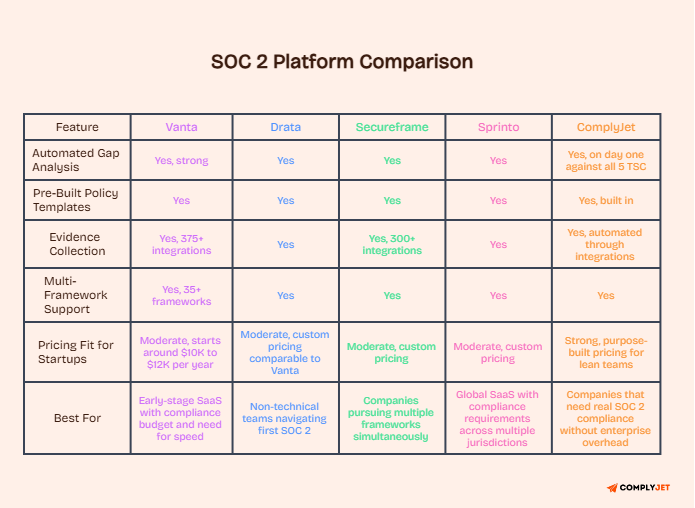
Vanta
Vanta is strong on integrations and brand recognition. It is widely used by early-stage SaaS companies and has a large auditor network. Pricing starts at approximately $10,000 to $12,000 per year. For lean teams, this is a significant upfront investment.
Drata
Drata offers clean onboarding and a guided experience. It is a strong choice for non-technical compliance teams navigating SOC 2 for the first time. Pricing is comparable to Vanta and is custom-quoted.
Secureframe
Secureframe supports over 35 compliance frameworks with broad integrations. It is a good fit for companies pursuing multiple certifications simultaneously, such as SOC 2 alongside ISO 27001. Pricing is custom.
ComplyJet - Purpose-Built for Lean Compliance Teams
ComplyJet is built for companies that need real SOC 2 compliance without an enterprise compliance budget. Connect your AWS, GCP, or Azure environment alongside your identity provider, and an automated gap analysis against all five Trust Services Criteria begins on day one.
No multi-week advisory engagements before you even know where you stand.
Pre-built policy templates, automated evidence collection, and sprint-based remediation workflows are all built into the platform. Gaps get assigned to named owners with due dates. Evidence collection status is tracked automatically. Your whole team sees compliance progress in one place.
Pricing is designed for growing SaaS companies without enterprise compliance overhead. Teams using ComplyJet have reached SOC 2 Type 1 certification in as little as six weeks from their initial gap analysis.
Visit our pricing page to see current plans, or start a free trial to see the automated gap analysis running live on your own environment.
Sprinto
Sprinto has strong adoption in Asian markets and handles multi-framework compliance well. It is a practical option for global SaaS companies with requirements across multiple jurisdictions.
Platform Comparison at a Glance
The decision comes down to your stage and priorities. Enterprise teams with multi-framework requirements benefit from broader platform depth. Teams looking for cost-effective, purpose-built SOC 2 compliance choose ComplyJet.
See our SOC 2 compliance automation software guide 2026 for a deeper comparison organised by use case.
Frequently Asked Questions
Where Can I Find a SOC 2 Gap Assessment Template?
A SOC 2 gap assessment template is typically a control mapping matrix. It lists each TSC requirement alongside columns for existing controls, gap status, risk severity, and remediation owner.
The AICPA Trust Services Criteria document is the authoritative free reference for building one. Compliance platforms generate this matrix automatically from your connected integrations.
What Should a SOC 2 Gap Assessment Checklist Include?
A SOC 2 gap assessment checklist should cover all five Trust Services Criteria categories, your asset inventory, data flow documentation, policy review status, access control configuration, vendor inventory, and evidence collection readiness.
Our SOC 2 compliance checklist provides a practical starting framework organised by control area.
What Are the Best Tools for Automating SOC 2 Compliance Gap Assessments?
Compliance automation platforms connect to your cloud and SaaS tools to automatically collect evidence and test controls against the Trust Services Criteria. ComplyJet automates gap detection, continuous control monitoring, and evidence collection from day one.
The right tool depends on your stage, budget, and the number of frameworks you need to support simultaneously.
What Is a SOC 2 Type 2 Gap Letter?
Your auditing CPA firm issues a SOC 2 gap letter to bridge the period between the end of one observation period and the beginning of the next audit cycle.
Enterprise procurement teams treat reports as current for 12 months. The gap letter provides continuity assurance to enterprise customers during renewal delays.
How Often Should I Conduct a SOC 2 Gap Analysis?
Conduct a gap analysis before your first Type 1 audit, before each annual Type 2 renewal, and after any material change to your infrastructure, product, or organisational structure.
Organisations using continuous compliance monitoring may replace point-in-time gap analysis with real-time control drift detection between formal audit cycles.
Can I Conduct a SOC 2 Gap Analysis Myself?
Yes. An internal team that understands the Trust Services Criteria can map controls, identify gaps, and build a remediation roadmap. First-time organisations should supplement internal reviews with a compliance platform or advisory guidance to reduce optimism bias.
The formal SOC 2 audit can only be conducted by a licensed CPA firm accredited by the AICPA. That requirement does not apply to the gap analysis itself.
Is SOC 2 the Same as ISO 27001?
No. SOC 2 is an AICPA framework that produces a US-focused attestation report used in enterprise vendor due diligence. ISO 27001 is an international certification standard recognised worldwide.
The two frameworks overlap significantly in control requirements.
Read our ISO 27001 vs SOC 2 comparison for a full side-by-side breakdown.
What Is the Difference Between SOC 1, SOC 2, and SOC 3?
SOC 1 reports on controls relevant to customer financial reporting. It applies to payroll and payment processors.
SOC 2 reports on Security, Availability, processing integrity, confidentiality, and privacy controls for technology companies.
SOC 3 is a public summary of the SOC 2 report, available for unrestricted sharing. Enterprise buyers require the full SOC 2 Type 2 report, not the SOC 3 summary.
Can You Fail a SOC 2 Audit?
Effectively, yes. Auditors issue opinion types rather than binary pass/fail results. A qualified opinion means one or more controls failed during the observation period.
Per the SANS Institute, a qualified opinion signals control failures to every customer who reviews the report. That frequently triggers additional vendor questionnaires and contract reviews.
The 5 SOC 2 Principles
The five Trust Services Criteria categories are Security (mandatory), Availability, Processing Integrity, Confidentiality, and Privacy. Security is required for every SOC 2 report.
The remaining four categories are included based on your business model, customer contracts, and regulatory requirements.
How Long Is a SOC 2 Type 2 Report Valid For?
A SOC 2 Type 2 report covers a specific observation period, typically 6 to 12 months. Enterprise customers treat it as current for 12 months from the end of that observation period.
Most organisations renew annually to maintain continuous vendor approval status with enterprise buyers.
What Companies Offer SOC 2 Gap Analysis and Readiness Assessment Services?
Three types of organisations offer SOC 2 gap analysis services. CPA and advisory firms such as KirkpatrickPrice, LBMC, and ISPartners provide practitioner-grade assessments. Cybersecurity consulting firms provide technical security-led assessments.
Compliance automation platforms, including ComplyJet, offer built-in software-driven gap analysis, automated evidence collection, and continuous monitoring.
Conclusion
You now have the full picture. A SOC 2 gap analysis is not optional preparation. It is the step that determines whether your audit produces a clean, unqualified opinion or a qualified one that follows you into every enterprise sales conversation for the next 12 months.
Assess your controls against the Trust Services Criteria. Analyse and document every deficiency in a gap register. Close every gap with verifiable evidence before your auditor’s observation period begins.
The 40-60% gap rate for first-time organisations is normal. The companies that pass on the first attempt are not those with fewer gaps. They are the ones who found and fixed their gaps before audit day.