.svg)

Let me introduce you to Marcus (the VP of Engineering at a 40-person B2B SaaS company), who received two compliance requests on the same day.
A US healthcare prospect asking for a SOC 2 Type 2 report before contract review.
A European customer asking for Records of Processing Activities (ROPA), a signed Data Processing Agreement (DPA), and evidence of how the company handles Data Subject Access Requests.
Marcus forwarded both to his compliance team with one note: “We are mid-SOC 2 audit anyway. This should cover both, right?”
It covered neither. Marcus lost the deal. Do not be like Marcus.
Hundreds of SaaS companies end up in the same situation as Marcus every year. They assume that SOC 2 vs GDPR is a naming difference rather than a fundamental difference in purpose, authority, and enforcement.
In 2026, with GDPR fines collectively exceeding €5.88 billion across 3,194+ enforcement actions, the cost of confusing these two frameworks has never been higher.
This guide covers everything. What each framework actually is, where they overlap, where they do not, what GDPR requires that SOC 2 will never cover, and the exact sequence a SaaS company should follow when it needs both.
Want to know where your SOC 2 and GDPR gaps are before a customer asks? Start a free ComplyJet trial and see which controls, documents, and evidence your team already has and what is still missing.
Before diving deep, here is the fast version of the SOC 2 vs GDPR picture for 2026.
SOC 2 vs GDPR: 8 Things to Know
- SOC 2 is a voluntary security audit standard. GDPR is EU law. SOC 2, governed by the AICPA, produces an audit report. GDPR is usually enforced by national data protection authorities and carries fines up to €20 million or 4% of global annual revenue.
- Neither replaces the other. SOC 2 compliance does not make you GDPR compliant. GDPR compliance does not produce a SOC 2 report.
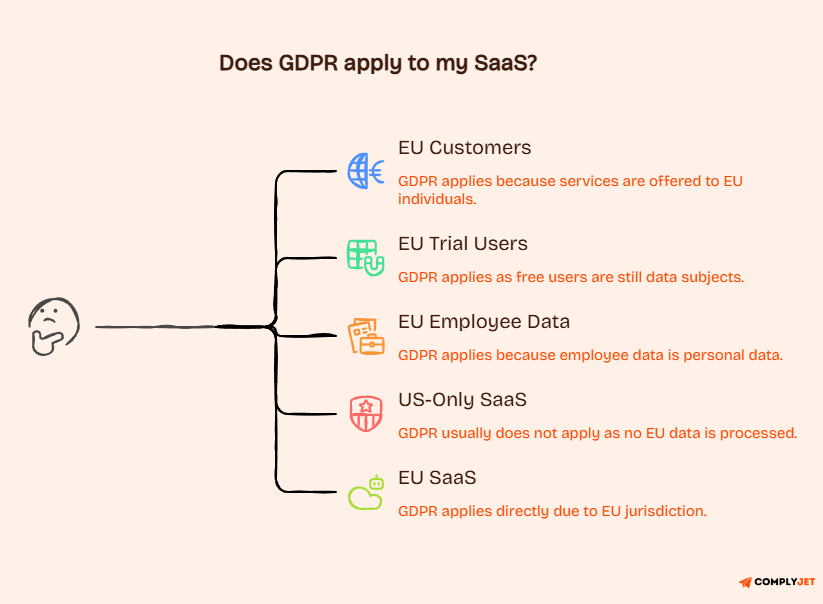
- GDPR applies to your US startup the moment you have EU users. Article 3 of GDPR has explicit extraterritorial reach. Offering services to EU individuals triggers full GDPR obligations regardless of where your company is incorporated.
- SOC 2 is what enterprise customers ask for. GDPR is what regulators require. Both matter, for different reasons.
- The two frameworks overlap significantly in security controls. Encryption, access controls, MFA, incident response, and vendor risk management satisfy requirements under both.
- GDPR requires 4 operational documents SOC 2 never produces: ROPA, DPIAs, DPAs with every vendor, and compliant Privacy Notices.
- The EU-US Data Privacy Framework (July 2023) changed how US SaaS companies transfer EU data. This is a GDPR obligation, not a SOC 2 one.
- Cumulative GDPR fines exceeded €5.88 billion across 3,194+ enforcement actions as of January 2025. Eight of the ten largest fines hit US-based companies.
Now, we go deeper.
What You Should Know About SOC 2?
SOC 2 expands to System and Organisation Controls 2. It is an attestation standard by the AICPA.
It’s not a certification. It’s an attestation report produced by a licensed CPA firm after auditing your systems.
No regulator fines you for not having SOC 2. The penalty will be losing contracts. Enterprise procurement teams in North America routinely require a SOC 2 Type 2 report before they sign with any vendor that handles their data. That market pressure is why most B2B SaaS companies pursue it.
The 5 Trust Services Criteria That Govern SOC 2
SOC 2 evaluates your controls against what the AICPA calls the Trust Services Criteria. There are five of them. Only one is mandatory.
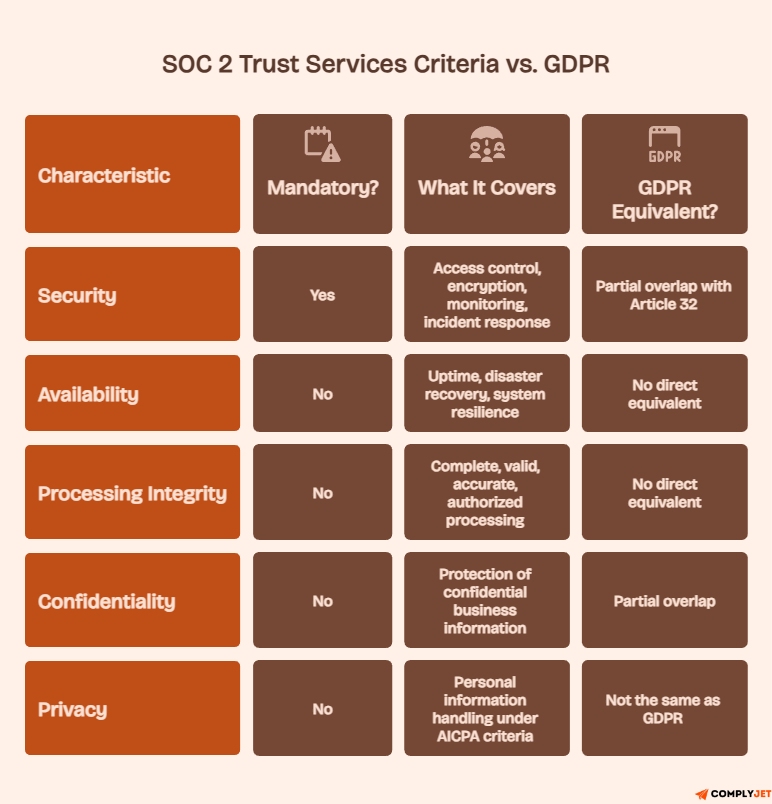
Security is the mandatory criterion in every SOC 2 report. It covers access controls, encryption, incident response, risk assessment, change management, and monitoring.
The other four are optional: Availability covers uptime and disaster recovery. Processing Integrity covers whether your system processes data completely and accurately. Confidentiality covers the protection of business data you have committed to keep confidential. Privacy covers personal information handling.
One critical clarification is that the SOC 2 Privacy criterion is based on the AICPA’s Generally Accepted Privacy Principles and not the GDPR. Selecting the Privacy criterion does not make you GDPR compliant. It does not cover data subject rights, lawful basis documentation, or 72-hour breach notification to regulators. These are entirely separate obligations.
Many founders assume checking the Privacy TSC box takes care of their GDPR exposure. It does not. Build your GDPR program independently.
SOC 2 Type 1 vs Type 2: What Enterprise Buyers Want?
SOC 2 comes in two types. Type 1 is a point-in-time snapshot. It says your controls were designed correctly as of a specific date. Type 2 says your controls operated effectively over 6 to 12 months. Enterprise procurement teams almost always require Type 2.
Type 1 typically costs between $10,000 and $150,000 and takes 3 to 8 months from kickoff.
Type 2 costs between $15,000 and $430,000 depending on firm size and scope, and takes 6 to 20 months in total. The observation period alone is 6 to 12 months. Factor that into your timeline before you commit to an enterprise deal.
If you need a quick explainer on audit types before deciding which one to pursue first, start here: SOC 2 Type 1 vs Type 2: What’s the difference?
It will save you months of confusion.
Now that you have SOC 2 grounded, let’s look at the other side of the equation. This regulation has nothing to do with what your customers want and everything to do with what regulators require.
What You Should Know About GDPR?
GDPR stands for General Data Protection Regulation. It entered into force on May 25, 2018, replacing the Data Protection Directive 95/46/EC. It is EU law, not a framework and not a voluntary standard. Every word of it is enforceable by national data protection authorities across the EU.
The extraterritorial reach is what surprises most US founders.
Under Article 3 of GDPR, the regulation applies to any organisation offering goods or services to EU individuals, regardless of where that organisation is incorporated.
A US SaaS company with a single EU customer has full GDPR obligations. Fines can reach €20 million or 4% of global annual revenue under Article 83, whichever is higher.
The 7 GDPR Principles Every SaaS Team Must Know
Article 5 of GDPR sets out seven principles that govern all personal data processing. These are not optional guidelines. They are the legal foundation of the entire regulation.
- Lawfulness, fairness, and transparency: You must have a valid legal basis, and you must be honest with individuals about how their data is used.
- Purpose limitation: Collect data for specific, explicit, legitimate purposes. Do not reuse it for incompatible ones.
- Data minimisation: Collect only what is necessary for the stated purpose.
- Accuracy: Keep data accurate and up to date.
- Storage limitation: Do not retain data longer than necessary.
- Integrity and confidentiality: Apply appropriate security measures.
- Accountability: Be able to prove compliance, not just claim it.
That last principle is the one that defines the documentation burden. GDPR does not say “be compliant.” It says, “Prove you are compliant.” That distinction drives every record, every policy, and every audit trail your program needs.
The 6 Lawful Bases and Which Ones SaaS Teams Use
Article 6 of GDPR requires that all personal data processing have a lawful basis. There are six: consent, contract, legal obligation, vital interests, public task, and legitimate interest.
Most B2B SaaS companies should rely on contract or legitimate interest, not consent. Choosing consent for B2B processing creates a real problem.
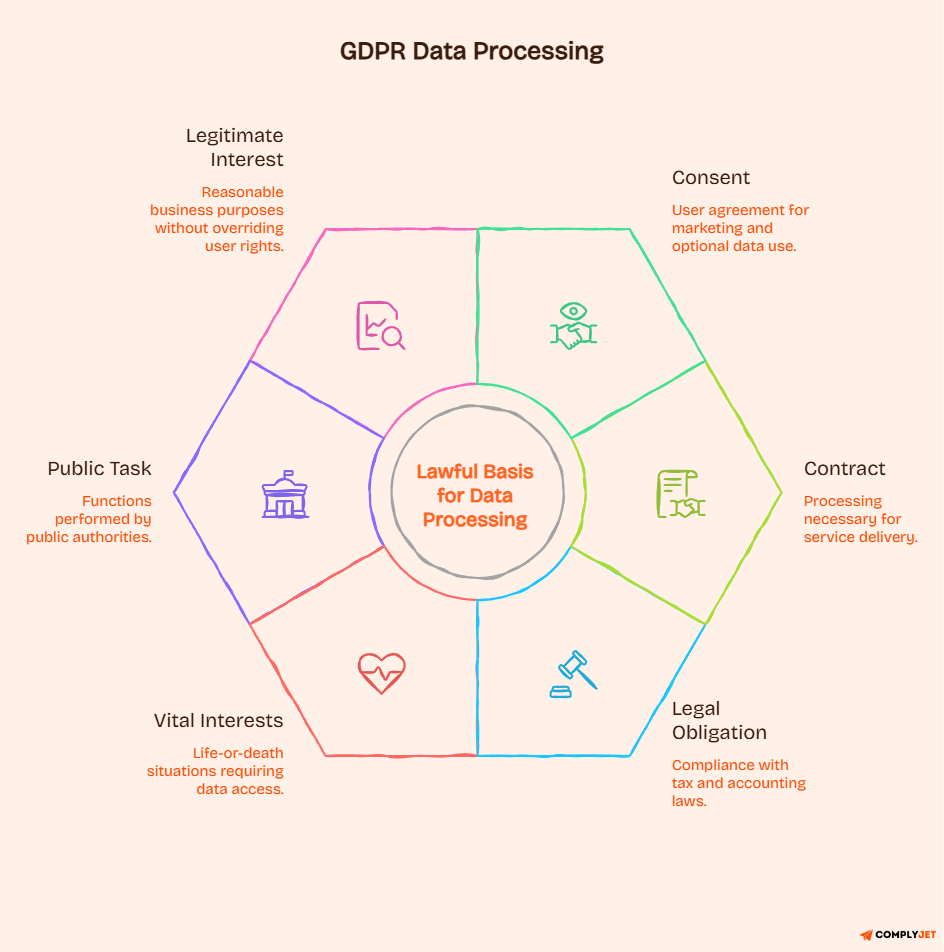
Users can withdraw consent at any time, which immediately triggers deletion rights. For most SaaS use cases, contract or legitimate interest is the correct basis. Choose wrong, and you cannot fix it retroactively. The lawful basis cannot be changed after processing begins.
Founder’s Tip!
If you process data to deliver a service your customer signed up for, your basis is almost certainly a contract. Do not overcomplicate it with consent boxes; you will struggle to honour them later.
The frameworks are now both grounded. The real clarity comes from putting them side by side.
SOC 2 vs GDPR: The Full Side-by-Side Breakdown
SOC 2 is a voluntary market infrastructure. GDPR is a mandatory legal infrastructure. They exist for different principles.
SOC 2 serves enterprise customers who want proof that their systems are secure.
GDPR serves EU individuals who have legal rights over their personal data.
Here is the full comparison across 15 dimensions:
The conclusion is the same regardless of which direction you read this table. Neither framework is a superset of the other.
They serve different principles and produce different outputs. SaaS companies with both North American and EU exposure need both.
Where SOC 2 and GDPR Overlap?
When you build strong security controls for SOC 2, you are simultaneously building the technical and organisational safeguards GDPR Article 32 requires. This overlap is not coincidental. Both frameworks draw from the same pool of security best practices.
The key question is not whether these controls exist. It is whether your documentation and evidence collection are structured to satisfy both auditors and regulators at the same time.
That is the practical difference between a dual compliance program and paying for everything twice.
1. Access Controls, RBAC, and MFA
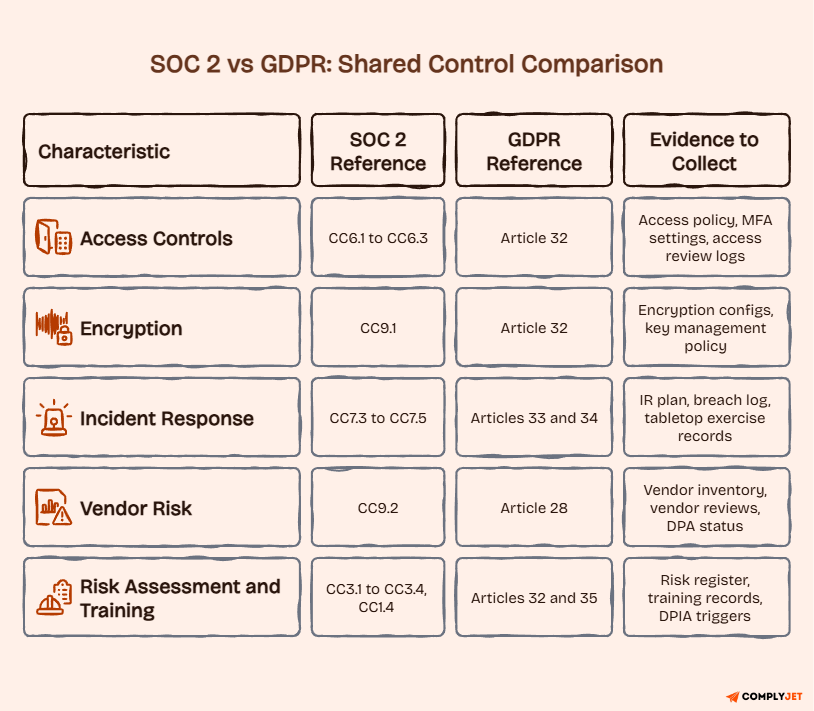
SOC 2 CC6.1 through CC6.3 require role-based access controls, least-privilege principles, user provisioning and deprovisioning workflows, and quarterly access reviews. GDPR Article 32 requires that access controls be part of your technical safeguards. The same controls satisfy both.
According to Verizon’s DBIR research, 74% of data breaches involve privileged account access. MFA for all privileged accounts, strict RBAC policies, and access review logs count as evidence for both your SOC 2 auditor and your GDPR Article 32 documentation simultaneously.
2. Encryption at Rest and in Transit
SOC 2 CC9.1 covers encryption of sensitive data at rest and in transit. GDPR Article 32 explicitly lists encryption as an appropriate technical safeguard. Both frameworks require it. Neither mandates specific algorithms.
Both assess whether your encryption is appropriate to the risk level.
AES-256 at rest and TLS 1.2 or 1.3 in transit satisfy both. Your key management documentation serves both programs.
Build it once and structure it to reference both the SOC 2 control and the GDPR article. That is the entire efficiency gain in this section.
Read: SOC 2 Controls List: The Complete Founder’s Guide (2026)
3. Incident Response and Breach Plans
SOC 2 CC7.3 through CC7.5 require a documented incident response plan with evidence of detection, containment, and recovery. GDPR Articles 33 and 34 require breach notification procedures and timelines.
The shared controls are IR plan documentation, tabletop exercise records, breach logs, and escalation procedures.
The key difference is flagged here for a reason. SOC 2 has no 72-hour regulatory notification deadline. GDPR does.
A compliant combined IR plan must include the GDPR notification trigger as a distinct step. Without it, your SOC 2 IR plan leaves a regulatory gap the moment any EU personal data is involved in an incident.
4. Vendor Risk and Third-Party Audits
SOC 2 CC9.2 requires a vendor risk management program: inventory vendors, assess their security, and monitor them over time. GDPR Article 28 requires signed Data Processing Agreements with every data processor, plus approval rights over subprocessors and the right to audit them.
The shared controls are vendor inventory, annual security reviews, and requesting SOC 2 reports from your own vendors. The difference matters here, too. SOC 2 asks whether your vendors are secure. GDPR asks whether you have legal contracts governing every processing relationship.
Read: Third-Party Risk Management 2026: TPRM Lifecycle, Tips and Best Practices
5. Risk Assessment and Security Training
SOC 2 CC3.1 through CC3.4 require a formal annual risk assessment and risk treatment plan. GDPR Article 32 requires risk-based security decisions. GDPR Article 35 requires DPIAs for high-risk processing. Your annual risk assessment, risk register, and security awareness training records count as evidence for both.
IBM’s 2025 Cost of a Data Breach report puts the average global breach cost at $4.88 million. Regular employee security training is one of the highest-ROI investments in reducing that exposure, and it counts toward both your SOC 2 CC1.4 requirement and GDPR’s Article 5(1)(f) integrity and confidentiality obligation.
The overlap is real and valuable. But it only covers part of the story. The GDPR obligations that SOC 2 does not touch at all are where most compliance programs fall short.
SOC 2 vs GDPR: Control Mapping
Here is the full reference table mapping SOC 2 TSC criteria to GDPR articles. Use this when structuring your evidence collection to avoid duplicating work.
The ratio: 12 of 24 controls are shared, 5 are SOC 2 only, and 11 are GDPR only. Build the shared 12 first. They are your compliance foundation.
What GDPR Requires That SOC 2 Never Covers?
A completed SOC 2 Type 2 audit says nothing about consent, data subject rights, cross-border transfer safeguards, or the legal basis for processing EU personal data. These are not gaps in your SOC 2 program. They are independent GDPR obligations that exist entirely outside what SOC 2 was designed to evaluate.
Think of it this way. SOC 2 builds the security foundation. GDPR adds a legal layer on top of it that your auditor was never asked to check.
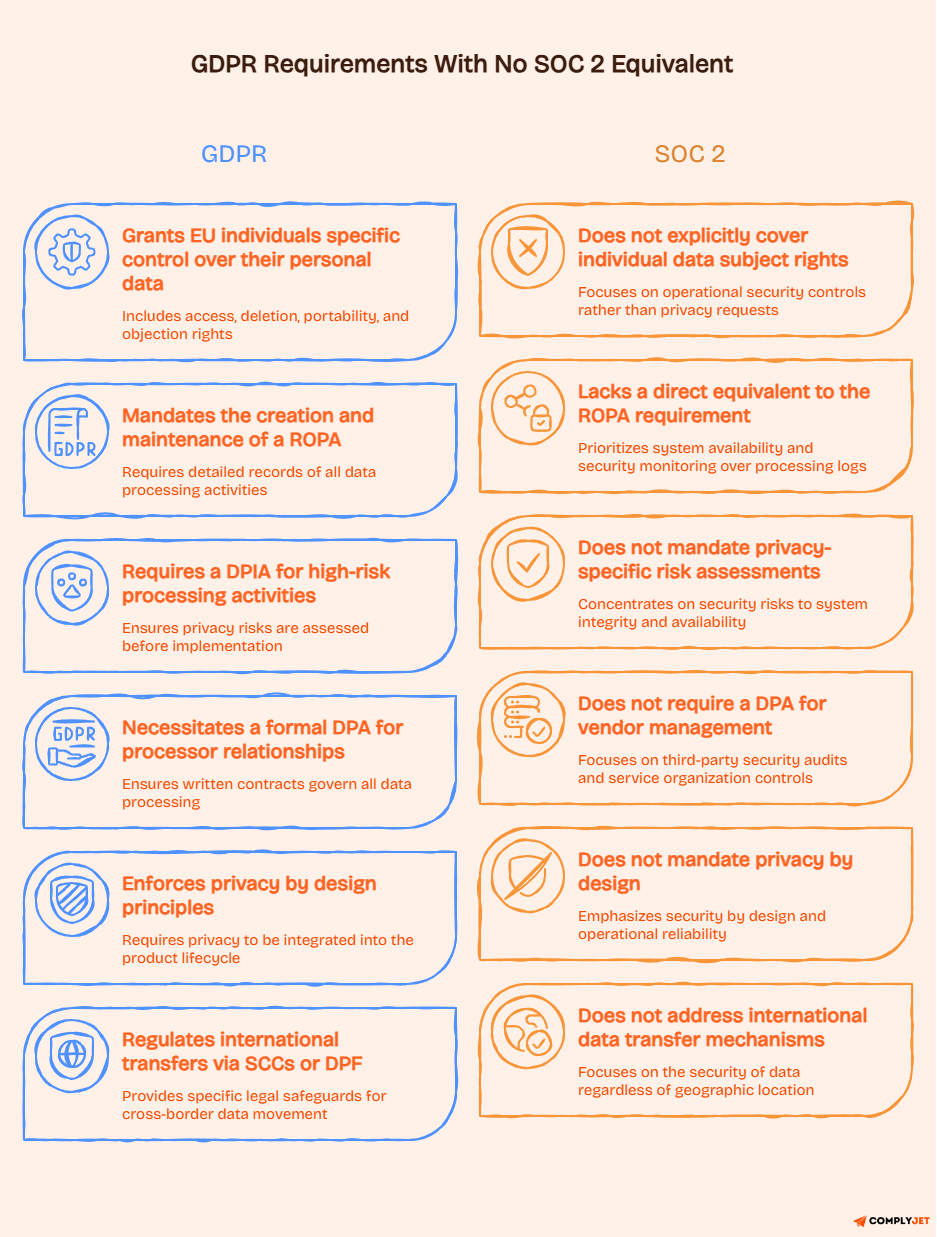
Data Subject Rights: 8 Rights SOC 2 Ignores
GDPR Articles 15 through 22 give EU individuals eight rights over their personal data. SOC 2 has no equivalent for any of them.
- Right to access (Article 15): obtain a copy of personal data held
- Right to rectification (Article 16): correct inaccurate data
- Right to erasure (Article 17): delete data on request
- Right to restrict processing (Article 18): pause processing while accuracy is contested
- Right to portability (Article 20): receive data in a structured, machine-readable format
- Right to object (Article 21): object to processing for legitimate interest or marketing
- Rights over automated decisions (Article 22): protection from fully automated decisions with significant effects
The DSAR response deadline is 1 month from receipt, extendable to 3 months for complex requests under Article 12. No SOC 2 control ensures a response reaches a data subject within 30 days. You need a dedicated DSAR workflow.
Records of Processing Activities (ROPA)
GDPR Article 30 requires a written record of all processing activities maintained by both controllers and processors. The ROPA must include data categories, data subject categories, processing purposes, recipient categories, international transfer details, retention periods, and security measures.
No SOC 2 equivalent exists at any level. Companies with fewer than 250 employees may be exempt, but processors rarely qualify for that exemption. If your SaaS product processes personal data on behalf of customers, you are a processor, and the ROPA is mandatory.
Data Protection Impact Assessments (DPIA)
GDPR Article 35 requires a DPIA before beginning high-risk processing activities. The EDPB published an updated DPIA template in April 2026. Use it. Nine trigger categories exist: profiling, special category data, systematic monitoring, large-scale processing, combining datasets, processing data of vulnerable individuals, new technologies, automated decision-making with significant effects, and biometric data for identification.
SOC 2 has risk assessments, but they evaluate business and system risk, not data subject rights risk. A SOC 2 risk assessment does not satisfy the DPIA requirement. They answer different questions.
Data Processing Agreements With Every Vendor
GDPR Article 28 requires that every data processor operate under a written Data Processing Agreement with the controller. As a SaaS company, you need DPAs with every customer before processing begins. You also need DPAs with every subprocessor you use: AWS, Stripe, HubSpot, analytics providers, and email tools.
SOC 2 vendor risk management assesses whether your vendors are secure. It never mandates formal DPA contracts. A SOC 2 report is what a customer uses to vet you as a processor. It does not replace the DPA itself.
Data Protection Officer: Do You Need One?
GDPR Article 37 makes a DPO mandatory in three situations: you are a public authority, you carry out large-scale systematic monitoring of individuals, or you process special category data on a large scale. The DPO can be internal or external.
Polish data protection authorities fined a company €5,814 in 2025 specifically for failing to designate a required DPO. That is a small fine by GDPR standards, but it demonstrates that enforcement reaches companies of all sizes. SOC 2 has no DPO requirement at all.
Privacy by Design and Default (Article 25)
GDPR Article 25 requires that data protection be embedded in system design from the start, not added afterwards. Privacy by Default means only necessary data is processed, and it is not accessible to unlimited people by default.
The IAPP describes Article 25 as GDPR’s sleeping giant, increasingly cited in enforcement actions. SOC 2 has no mandatory privacy-by-design obligation. Building privacy into your product architecture from the ground up is a GDPR requirement, not a SOC 2 one.
International Data Transfers and SCCs
GDPR Articles 44 through 49 prohibit personal data from leaving the EEA without adequate protection. Schrems II in July 2020 invalidated Privacy Shield. The current mechanisms are the EU-US Data Privacy Framework (July 2023), Standard Contractual Clauses, and Binding Corporate Rules.
Every US SaaS company with EU customers must identify and document its transfer mechanism before processing begins. SOC 2 is completely silent on cross-border data transfer rules. This entire GDPR-only territory has no SOC 2 equivalent.
What SOC 2 Delivers That GDPR Can’t Replace?
GDPR compliance produces no document that an enterprise security team can review. No national data protection authority issues a compliance certificate. No auditor co-signs a GDPR attestation report. That is not how GDPR works.
SOC 2 produces a 40 to 100-page attestation report verified by an independent licensed CPA firm.
Enterprise procurement teams in North America rely on this document to unblock security review queues, answer vendor security questionnaires, and close contracts.
SOC 2 also covers system availability, processing integrity, and confidentiality of non-personal business data, dimensions that GDPR does not address at all.
The core distinction is that SOC 2 provides security controls to customers while GDPR provides legal compliance to regulators. These are not the same question, and neither framework answers the other’s question.
SOC 2 vs GDPR for B2B SaaS: Who Needs What?
The compliance requirement is determined by who buys from you and where they are located, not by where you are incorporated. That is the framework to apply here. Your customer geography is the primary variable.
Understanding the SOC 2 vs GDPR for b2b saas question matters because many founders treat compliance as a monolithic task. It is not. Each framework serves a different stakeholder, and mixing them up wastes time and money.
SOC 2 vs GDPR for US Customers
US enterprise customers ask for SOC 2 Type 2 in vendor security reviews. Customer security questionnaires from US buyers almost always reference SOC 2 and almost never ask for GDPR documentation.
If your entire customer base is US-based, SOC 2 is your compliance priority.
The one exception: if any EU personal data exists anywhere in your system, including trial users, beta users, or employee data from EU-based team members, GDPR obligations are triggered regardless.
US-focused SaaS companies should prioritise SOC 2 and build GDPR-ready controls in parallel as the business scales.
SOC 2 vs GDPR for EU Customers
EU customers care primarily about GDPR compliance. An Article 28 Data Processing Agreement must be signed before an EU customer can lawfully use your SaaS as a processor. That is a legal requirement, not a negotiation point.
Many EU enterprise buyers also request SOC 2 reports, especially from US-headquartered vendors, as additional security evidence beyond GDPR obligations. Here is the decision matrix:
Eight of the ten largest GDPR fines to date hit US-based companies, not EU-native ones. Geography does not protect you from GDPR.
Should a SaaS Startup Get SOC 2 or GDPR First?
Here is the direct answer. If you have EU users, even one person on a free plan, GDPR is legally required. Start immediately. There is no revenue threshold, no minimum user count, and no grace period under the law.
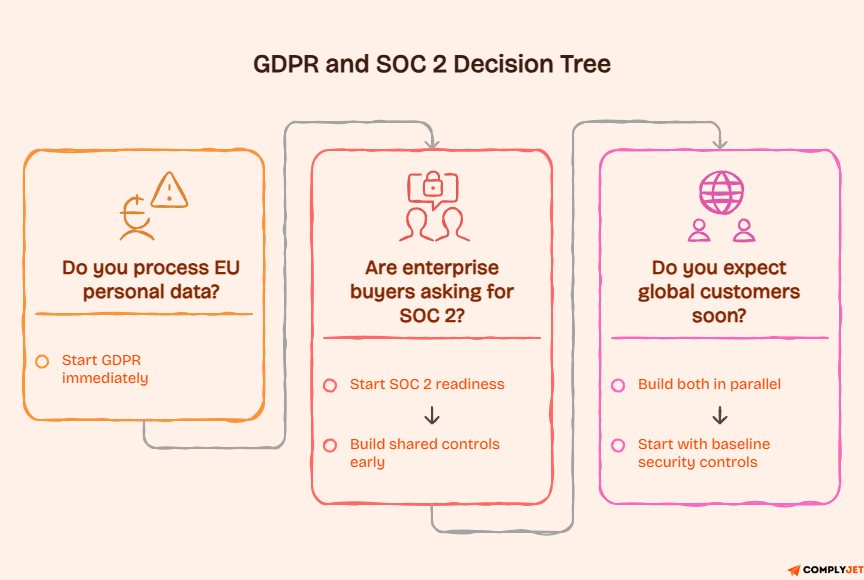
If North American enterprise deals are in your pipeline and no EU personal data exists, start SOC 2 Type 1 to unblock procurement. Then build toward Type 2 for sustained enterprise relationships.
The practical sequence for most SaaS companies looks like this. Build shared controls first: encryption, access controls, MFA, incident response, vendor risk, and security training. These satisfy both frameworks and form the compliance foundation.
Begin your SOC 2 observation period. Layer GDPR-specific requirements in parallel: ROPA, DPAs, privacy notice, lawful basis documentation, DSAR workflow. Run both simultaneously.
Why this matters?
SOC 2 Type 2 takes 6 to 20 months from kickoff. GDPR initial readiness, if shared controls already exist, takes approximately 2 to 3 months. They can and should run in parallel. The most expensive compliance mistake is building them sequentially with no architecture thinking.
How to Comply With SOC 2 and GDPR Together?
The companies that build SOC 2 and GDPR as two completely separate programs pay for the same controls twice. A unified program uses a single control framework and layers each regulation’s specific obligations on top. That is the “map once, satisfy twice” principle.
The shared controls layer is your foundation. Encryption, access controls, incident response, vendor risk management, and security training satisfy both. The SOC 2-specific layer adds the system description, TSC selection, and observation period evidence collection. The GDPR-specific layer adds ROPA, DPAs, privacy notice, lawful basis documentation, and DSAR workflow.
How SOC 2 Supports GDPR Readiness?
SOC 2 security controls built for CC6 and CC7 directly satisfy GDPR Article 32 safeguards. Your vendor inventory built for CC9.2 becomes the foundation for GDPR Article 28 DPA requirements.
Add a DPA signing status column to your existing vendor tracker. The same vendor list serves both programs.
Your SOC 2 incident response plan, if written to include GDPR’s 72-hour notification trigger, covers both obligations simultaneously.
Your SOC 2 risk assessment process can incorporate data subject rights risk, satisfying the GDPR DPIA trigger assessment. Shared evidence includes access logs, training records, encryption configurations, and vendor assessments.
SOC 2 gap analysis work done early in your readiness program will also surface many of the security gaps that GDPR Article 32 requires you to address. Start there and let the results guide both programs.
Can You Use SOC 2 Evidence for GDPR?
Yes, partially.
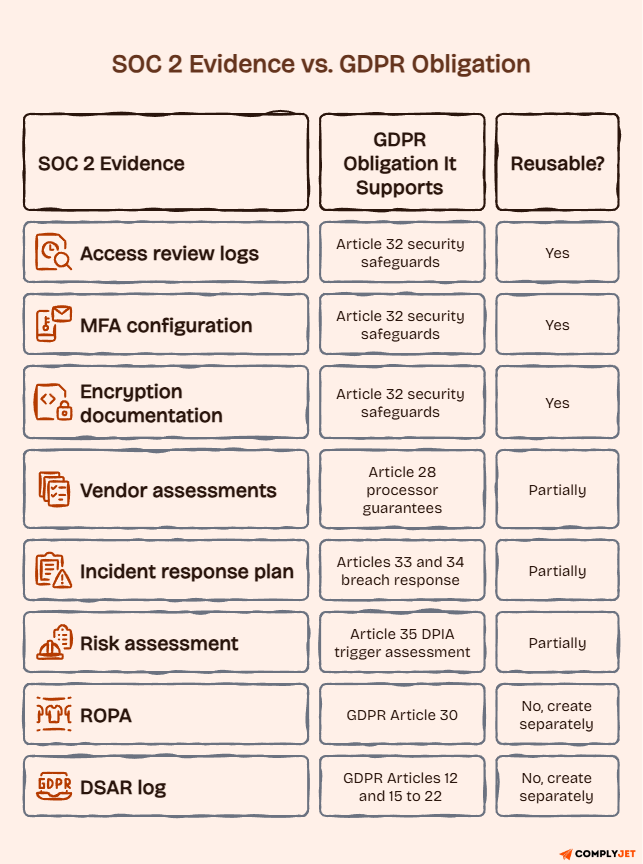
SOC 2 evidence directly supports GDPR Article 32 documentation. Access logs, encryption documentation, vendor assessments, and training records all count. The AICPA TSC CC6.1 and GDPR Article 32 share identical safeguard requirements. The same access control policy satisfies both.
No, for GDPR-specific obligations. Consent records, ROPA, DPIA documentation, and DSAR logs have no SOC 2 equivalent.
These must be created and maintained independently. A practical approach: extend your SOC 2 audit logs to include GDPR Article 30 processing purpose fields.
Extend your vendor assessments to include DPA signing status. The same trackers serve both programs with minor additions.
GDPR’s 72-Hour Rule vs SOC 2 Breach Response
Breach response is the control area most likely to expose your compliance gap under pressure. SOC 2 and GDPR address different obligations, and a company that builds only one is exposed to the other the moment an incident occurs.
GDPR Article 33 requires notification to your supervisory authority within 72 hours of becoming aware of a personal data breach where the breach poses a risk to individuals’ rights.
The clock starts when you become aware, not when the breach occurred. Detection lag can cause a violation before any response begins. GDPR Article 34 requires notifying affected data subjects directly when the breach poses a high risk to their rights.
SOC 2 CC7.3 through CC7.5 require a documented and operating incident response plan and evidence of communication to affected user entities. There is no regulatory notification deadline. SOC 2 breach obligations are contractual, not regulatory.
A compliant combined IR plan should detect and contain the incident, determine whether EU personal data is involved, start the 72-hour GDPR clock if it is, notify the supervisory authority, and simultaneously preserve SOC 2 incident evidence for the auditor. One plan, two sets of obligations, if written correctly.
Did you know?
IBM’s 2025 breach data shows the mean time to identify and contain a breach is 241 days. That detection lag makes the 72-hour GDPR notification rule operationally difficult for companies without proper monitoring. Invest in detection, not just response.
GDPR Data Subject Rights: The Workflow SOC 2 Skips
A DSAR (Data Subject Access Request) is a formal request from an EU individual for information about their personal data. Any EU user of your product can submit one at any time. The response deadline is 1 month from receipt under Article 12, extendable to 3 months for complex requests.
SOC 2 builds no workflow for this. No TSC criterion covers DSAR workflow design. No SOC 2 control ensures a response reaches a data subject within 30 days. The first DSAR a company receives often exposes a process gap that should have been built months earlier.
Here is the practical DSAR workflow:
- Receive DSAR and log receipt immediately, starting the 30-day clock.
- Verify the requester’s identity without placing excessive burden on them.
- Search all data stores, including your database, CRM, analytics tools, and email systems.
- Compile the response covering all required elements: data held, processing purposes, recipients, retention period, and data sources.
- Deliver within 30 days.
- Log the outcome for your GDPR documentation.
SOC 2 audit logs help locate what data a user’s account touched and when. That is useful for mapping data locations during a DSAR. But the workflow itself, the 30-day clock, the identity verification, the structured response, has no SOC 2 equivalent.
SOC 2 vs GDPR in 2026: What’s Changed?
Both frameworks are evolving in 2026. Three regulatory changes matter most for the SOC 2 vs GDPR picture for SaaS companies this year.
The GDPR compliance landscape for US companies looks meaningfully different in 2026 than it did in 2023. Enforcement is faster, AI adds new complexity, and cross-border cases are now bound by formal timelines.
The EU AI Act and GDPR: SaaS Must Read
The EU AI Act entered full application in August 2024. High-risk AI system obligations are phased through 2026. If your SaaS product uses AI features on EU personal data, you now have layered obligations under both GDPR and the EU AI Act simultaneously.
GDPR Article 22 protections against automated decision-making are under increasing regulatory scrutiny for AI-enabled products. DPIAs are increasingly required before deploying AI on EU personal data. The overlap between Article 35 triggers and AI system deployment is growing.
The EDPB and the European Commission have signalled that joint GDPR and AI Act guidance is expected in 2026.
GDPR Procedural Regulation: January 2026
The GDPR Procedural Regulation entered into force on January 1, 2026. It harmonises how national DPAs cooperate on cross-border enforcement cases. It sets a 15-month maximum timeframe for resolving cross-border cases and introduces simplified procedures for straightforward violations.
The impact for SaaS is direct. The period of slow, uncertain cross-border enforcement is ending. For multinational SaaS companies, this means enforcement becomes faster and more predictable. If you have been relying on enforcement delays as a buffer, that buffer is shrinking.
EU-US Data Privacy Framework: Current Rules
The EU-US Data Privacy Framework was adopted on July 10, 2023, by the European Commission. It replaced the invalidated Privacy Shield, which was struck down by the Schrems II ruling in July 2020.
US companies can self-certify under the DPF to receive EU personal data lawfully. Standard Contractual Clauses remain required for US companies that have not self-certified. SOC 2 has no equivalent mechanism. This is GDPR-only compliance territory.
UK GDPR vs EU GDPR: The Post-Brexit Gap
UK GDPR is the domestic UK equivalent of EU GDPR, enforced by the Information Commissioner’s Office. The EU has granted the UK an adequacy decision, meaning EU personal data can flow to the UK without SCCs, currently in place but subject to review.
For most SaaS companies serving both UK and EU users, the practical approach is to build a unified GDPR-equivalent program with UK-specific documentation:
UK SCCs for transfers outside the UK, and privacy notice references to ICO rather than national EU DPAs. The underlying compliance requirements are nearly identical.
GDPR Fines in 2026 To Look Out For
The assumption that GDPR only targets Meta and Google is wrong.
The GDPR Enforcement Tracker shows 3,194+ enforcement actions and approximately €5.88 billion in cumulative fines as of January 2025. The distribution of that enforcement includes companies of every size.
The largest fines on record:
- Meta received €1.2 billion from the DPC Ireland in May 2023 for EU-US data transfers, the largest single GDPR fine issued.
- Amazon received €746 million from Luxembourg in 2021 for advertising targeting.
- TikTok received €530 million from the DPC Ireland in 2025, the third-largest fine on record.
- Meta received an additional €251 million in December 2024, arising from the 2018 breach. Eight of the top ten fines hit US-based companies.
Mid-market enforcement is also real.
Polish data protection authorities fined a company €5,814 in 2025 for failing to designate a required DPO.
A single data subject complaint can trigger a full DPA investigation. With the GDPR Procedural Regulation now active, that investigation concludes faster than it used to.
Why this matters?
the GDPR EU representative requirement and enforcement exposure are not hypothetical for US SaaS companies. The data shows they are the primary enforcement target. Build the program before the complaint arrives.
SOC 2 vs GDPR: Real Costs and Timelines
Compliance is an investment decision. The question is whether the cost of a proactive program is less than the cost of enforcement, lost deals, or delayed audits. The answer is almost always yes.
SOC 2 Type 2 costs: audit fees range from $15,000 to $430,000, depending on the firm tier and scope selected. Internal labour runs 100 to 500+ hours, equivalent to $50,000 to $75,000 when a technical lead dedicates half-time over 6 months.
Readiness and automation tooling costs $4,000 to $30,000 per year. Timeline: Type 1 from kickoff is 3 to 8 months. Type 2 is 6 to 20 months total.
GDPR initial readiness costs: legal counsel for DPAs and privacy notices runs $5,000 to $20,000. A privacy platform or consent management tool costs $2,000 to $10,000 per year. An external DPO, if required, runs $5,000 to $30,000 per year.
Initial readiness takes 2 to 4 months. If shared SOC 2 controls already exist, GDPR adds approximately 2 to 3 months of additional work.
A unified program is approximately 30 to 40% more efficient than building each framework independently. The shared controls are already built. The documentation extensions are minor. The audit evidence overlaps significantly.
How ComplyJet Handles SOC 2 and GDPR Together?
ComplyJet SOC 2 compliance software starts at $4,000 per year, up to 50% less than legacy platforms, and handles both frameworks from a single control library.
The unified SOC 2 and GDPR compliance challenge is exactly what ComplyJet was built to solve for lean SaaS teams.
The platform automates evidence collection across 350+ integrations, maps controls to both frameworks simultaneously, and coordinates your audit with vetted CPA firms.
Sheetgo, serving 5 million users worldwide, switched from Vanta to ComplyJet and completed multi-framework compliance in a fraction of the expected time.
You get SOC 2 and GDPR as two of 25+ supported frameworks in a single platform. Automated access reviews, vendor risk management, and risk assessments run continuously.
The Trust Centre gives your customers customer-facing compliance evidence on demand. The 1:1 Slack support team owns the compliance workflow, so your engineering and ops teams can keep building.
SymmetRE achieved SOC 2 readiness in two weeks with ComplyJet, with what they described as bite-sized tasks that their team could actually own.
If you want to understand exactly what the SOC 2 audit covers and how to get ready in weeks, the SOC 2 compliance guide walks through the full process.
Frequently Asked Questions
Is SOC 2 required for GDPR compliance, or are they separate?
They are entirely separate frameworks. SOC 2 is a voluntary security attestation standard from the AICPA. GDPR is EU law. Neither requires the other.
SOC 2 controls can satisfy several GDPR Article 32 technical safeguard requirements, making them complementary. But having SOC 2 does not make you GDPR compliant, and GDPR compliance does not produce a SOC 2 report.
Does GDPR require your vendors to hold a SOC 2 certification?
GDPR does not specify SOC 2 as a vendor requirement. Article 28 requires processors to provide sufficient guarantees of appropriate technical and organisational measures.
In practice, many data controllers request SOC 2 Type 2 reports as evidence of those guarantees. But the obligation is on you to assess vendor security. How a vendor demonstrates it is flexible under GDPR.
Can you use SOC 2 audit evidence to satisfy GDPR documentation requirements?
Partially. SOC 2 evidence, including access logs, encryption configurations, vendor assessments, and training records, can directly support GDPR Article 32 documentation.
However, SOC 2 evidence cannot substitute for GDPR-specific documents: ROPA, DPAs, DPIAs, and DSAR logs have no SOC 2 equivalent and must be built independently.
Is SOC 2 the same as GDPR for data protection purposes?
No. SOC 2 evaluates how well your systems are secured. GDPR governs how EU personal data is collected, processed, and protected. SOC 2 demonstrates strong technical safeguards.
GDPR requires much more: lawful basis for processing, data subject rights, regulatory breach notification, and international transfer safeguards. The SOC 2 vs GDPR distinction is one of purpose, not just geography.
SOC 2 vs GDPR: Which is better for SaaS companies?
Better is the wrong frame. SOC 2 helps you close enterprise deals by proving security controls to customers. GDPR ensures you are legally allowed to process EU personal data. Most SaaS companies with global ambitions need both.
SOC 2 is driven by market demand. GDPR is a legal obligation. If you serve EU users, GDPR is non-negotiable. If you sell to North American enterprises, SOC 2 is practically mandatory.
When exactly do SaaS startups need both SOC 2 and GDPR together?
The moment you have any EU-based users, even on a free tier, or any enterprise customer asking for security documentation, you should consider it. GDPR applies as soon as EU personal data is processed.
There is no revenue threshold or grace period. SOC 2 becomes necessary when enterprise procurement starts requesting it. For most startups, both pressures arrive simultaneously around Series A or the first major enterprise deal.
Does SOC 2 Type 2 cover the same privacy requirements as GDPR?
SOC 2 Type 2 with the Privacy criterion tests controls against the AICPA’s Generally Accepted Privacy Principles, not GDPR. These overlap in areas like data minimisation, consent, retention, and security.
But GDPR’s privacy requirements go further: data subject rights, lawful basis documentation, ROPA, DPIA, DPO designation, and international transfer safeguards are not evaluated under any SOC 2 report.
How do GDPR and SOC 2 data breach notification rules actually differ?
GDPR Article 33 requires notification to your supervisory authority within 72 hours of becoming aware of a personal data breach that poses a risk to individuals’ rights. SOC 2 requires a documented incident response plan and evidence of communication to affected customers, but imposes no regulatory notification deadline.
SOC 2 breach obligations are contractual. GDPR breach obligations are regulatory and enforceable by national data protection authorities.
How do GDPR and SOC 2 handle vendor and third-party risk differently?
SOC 2 CC9.2 requires a vendor risk management program: inventory vendors, assess their security, and monitor them over time. GDPR Article 28 requires signed Data Processing Agreements with every data processor, plus approval rights over subprocessors and the right to audit them.
SOC 2 asks whether vendors are secure. GDPR asks whether legal contracts govern every processing relationship. Both are required for different reasons.
Is GDPR mandatory for US-based companies processing EU resident data?
Yes. GDPR Article 3 has explicit extraterritorial jurisdiction. Any organisation offering goods or services to EU individuals must comply with GDPR regardless of its incorporation location.
Eight of the ten largest GDPR fines to date have been issued against US-based companies. A US SaaS company with EU users has full GDPR obligations: privacy notices, lawful basis documentation, data subject rights, and 72-hour breach notification.
Can GDPR-covered personal data be stored on US servers legally?
Yes, but only with an appropriate transfer mechanism documented and in place. The EU-US Data Privacy Framework (adopted July 2023) allows US companies that self-certify to receive EU personal data lawfully. Standard Contractual Clauses are the alternative for companies that have not self-certified.
Without either mechanism, transferring EU personal data to US servers violates GDPR Articles 44 through 49, even if the data is encrypted and secured under a completed SOC 2 program.
How do SOC 2 and GDPR security requirements compare in practice?
At the technical safeguards level, requirements are highly similar. Both demand encryption, access controls, MFA, vulnerability management, incident response, and regular risk assessments. GDPR Article 32 and SOC 2 CC6 and CC7 cover the same ground.
The key difference is scope: GDPR applies these requirements specifically to personal data processing, while SOC 2 applies them to the entire system in scope. Building them together eliminates duplication and maximises evidence reuse.
The Bottom Line
Marcus eventually built both programs. The SOC 2 Type 2 report closed the Fortune 500 deal. The GDPR program, including ROPA, DPAs, privacy notices, DSAR workflow, and lawful basis documentation, satisfied the Amsterdam customer. Both ran simultaneously.
The shared controls built for SOC 2 became the foundation for GDPR’s Article 32 safeguards. The incremental GDPR work took weeks, not months.
The lesson is this. Gdpr vs SOC 2 is not an either/or question. It is a sequencing and architecture question.
Build the shared foundation once. Layer each framework’s specific requirements on top. Manage both from a single SOC 2 compliance checklist and control library, so evidence collection does not happen twice.
The SOC 2 and GDPR compliance burden is real. But it is manageable with the right architecture and the right tool. Ready to run SOC 2 and GDPR from one platform?
ComplyJet automates evidence collection, maps controls across both frameworks, and coordinates your audit, all starting at $4,000 per year. Book your free demo and see how fast audit-ready actually looks.