.svg)

Every time ISO 27001 comes up, the conversation hits the same wall, what does ISO 27001 cost? And why does no one give a clear answer?
The confusion exists because there is no single number. The ISO 27001 certification cost depends on your audit scope, how ready your team is, the tools you use, any outside help, and how much work is still left.
This blog breaks down ISO 27001 cost in a simple way. It covers certification price, audit cost, implementation cost, cost for small businesses, and consulting fees.
If you only focus on the headline ISO 27001 certification cost, you may miss the real expenses that impact your budget. That’s where teams overspend, underbudget, or delay certification.
Before you commit your budget, understand where your actual costs will come from. Talk to an expert for a tailored estimate.
What Is ISO 27001 Certification Cost? (And What You’re Actually Paying For)
Before we talk about numbers, let’s understand what you are really paying for.
Most companies think ISO 27001 certification is a one-time fee paid to an auditor or certification body. That fee is only a small part of the total cost.
In reality, ISO 27001 is about building and running a system to manage information security. The cost reflects all the work that goes into it. It is not a product you can buy once. It is a system you set up and keep running.
So, the real cost is the full investment needed to design, build, check, and maintain your Information Security Management System (ISMS) in line with ISO 27001.
You can break this into four main parts. Each one adds to the total cost in a meaningful way.
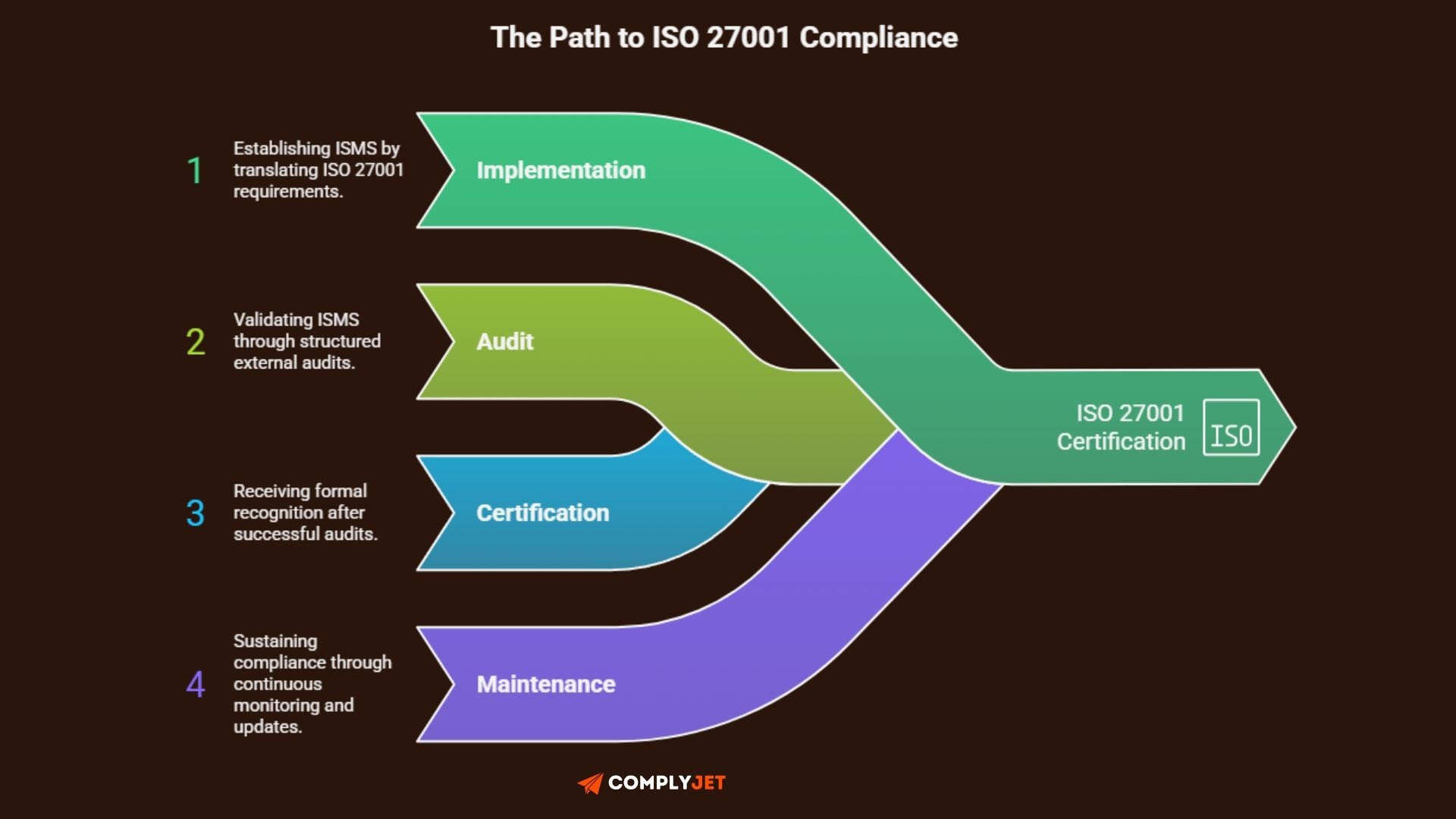
Implementation
Implementation is where you build the foundation of your Information Security Management System (ISMS). It starts with translating ISO 27001 requirements into real operational practices that fit your business.
This includes defining security policies, procedures, and governance structures that align with how your teams actually work. You also conduct risk assessments to identify vulnerabilities and decide which controls need to be implemented.
From there, controls are applied across your infrastructure, applications, and workflows. For SaaS companies, this often means mapping cloud environments, third-party tools, and data flows in detail. At the same time, you strengthen access management, monitoring systems, and secure development practices.
This phase requires strong collaboration across engineering, DevOps, and compliance teams. It also demands significant internal bandwidth, as documentation, coordination, and system alignment take time. The effort increases further in complex environments with multi-cloud setups, microservices, or fast release cycles.
Audit
Once implementation is in place, the next step is validation through an external audit. ISO 27001 follows a two-stage audit process.
The first stage focuses on reviewing your documentation, policies, and overall readiness. The second stage goes deeper, evaluating whether your controls are actually implemented and working in daily operations.
At this stage, consistency becomes critical. What is documented must match what teams are doing in practice. You need to prepare clear evidence such as logs, access records, risk registers, and internal audit reports.
Audit preparation also requires coordination across teams, ensuring that key stakeholders are available to support the process. For companies with distributed teams or multi-region infrastructure, this adds another layer of complexity. As a result, audit effort and cost can vary depending on company size, scope, and operational setup.
Certification
Certification is the outcome of successful implementation and audit. Once you pass the audit, an accredited certification body formally recognizes your compliance with ISO 27001.
This stage involves administrative processes such as certificate issuance, audit reporting, and validation. While it is the most visible milestone, it is important to understand that certification is not a standalone achievement. It reflects the work already done in implementation and audit.
Compared to earlier stages, certification costs are relatively smaller. However, the value it delivers is significant. It acts as a strong trust signal for customers, partners, and stakeholders, showing that your security practices meet global standards.
Maintenance
ISO 27001 does not end with certification. Maintaining compliance is an ongoing process that becomes part of your daily operations.
You need to continuously monitor systems, update policies, and revise risk assessments as your infrastructure and business evolve. Annual surveillance audits are conducted to ensure that you continue to meet ISO 27001 requirements.
Regular internal audits help identify gaps and drive continuous improvement. At the same time, teams must stay aligned through training and awareness programs to ensure consistent security practices.
For SaaS companies, maintenance becomes even more dynamic. Frequent product updates, new integrations, and infrastructure changes require constant updates to controls and documentation. Over time, this ongoing effort becomes a key cost driver, ensuring that your certification remains valid and effective.
If you’re unsure what needs to be implemented, this ISO 27001 compliance checklist can help you get started.
ISO 27001 Certification Cost by Region (Global SaaS Benchmarks)
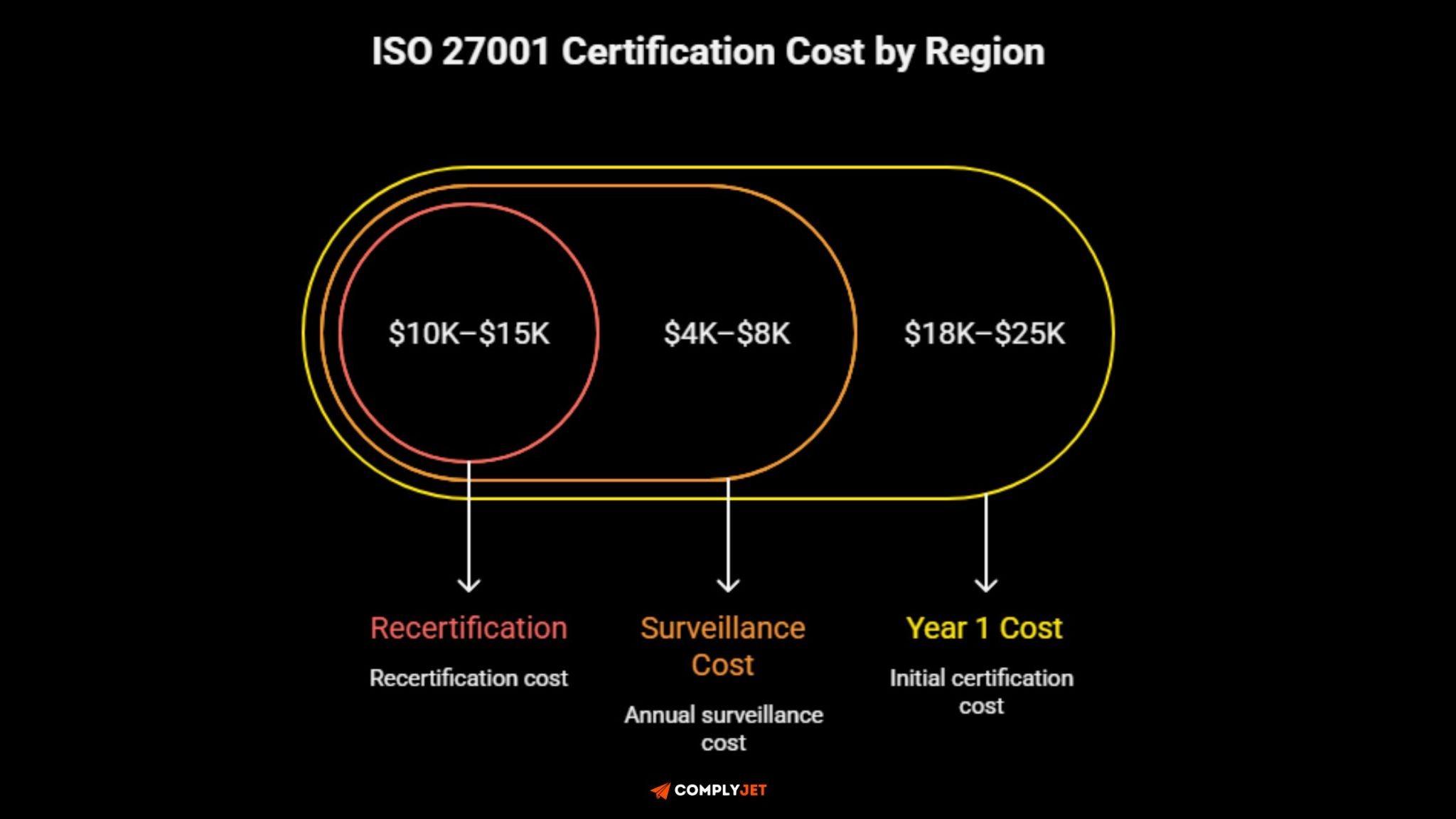
This is where most guides fall short. They give one number, but the reality is global.
If you are running a SaaS company, your market is rarely in one place. You might be based in India, selling to US clients, and onboarding users in Europe. In this case, a single cost estimate can be misleading.
What really matters is understanding how costs change by region, especially for global SaaS businesses. Most guides oversimplify this by giving one range or focusing on one region.
A better approach is to look at cost differences across regions while keeping your SaaS setup in mind.
US-based SaaS
For US-based SaaS companies, ISO 27001 certification costs are generally on the higher side. This is mainly due to higher auditor and consulting rates. There is also a strong focus on detailed documentation, evidence collection, and mature implementation of controls.
Audits tend to be more demanding, especially for companies targeting enterprise clients or operating in regulated industries. The typical first-year cost usually ranges between $18,000 and $35,000.
However, this can increase further with complex setups like multi-cloud environments or distributed systems. Enterprise-focused companies often fall on the higher end, as audits involve deeper scrutiny and more preparation.
EU-based SaaS
In Europe, ISO 27001 costs are influenced not just by the standard itself but also by regulatory overlap, especially GDPR. Companies need to invest more effort in data protection, documentation, and risk management.
There is a strong emphasis on privacy controls and accountability, which adds to the implementation effort. The typical cost ranges between €20,000 and €40,000. In many cases, companies also need to align multiple frameworks at once.
While this increases upfront effort, it can improve efficiency over time by reducing duplicate work. Operating across multiple European countries can further increase scope and complexity.
India-based SaaS (with global clients)
For India-based SaaS companies, costs are generally lower due to more affordable labor and consulting rates. However, companies serving global clients still need to meet international standards.
There is a strong focus on documentation and audit readiness, especially for US and EU customers. The typical cost falls between ₹12–18 lakh (~$15,000–$22,000).
While local cost advantages help, export-focused SaaS companies may still see higher costs due to stricter client expectations. Infrastructure complexity and a global customer base can also push costs toward the higher end.
Cost Matrix (Global SaaS View)
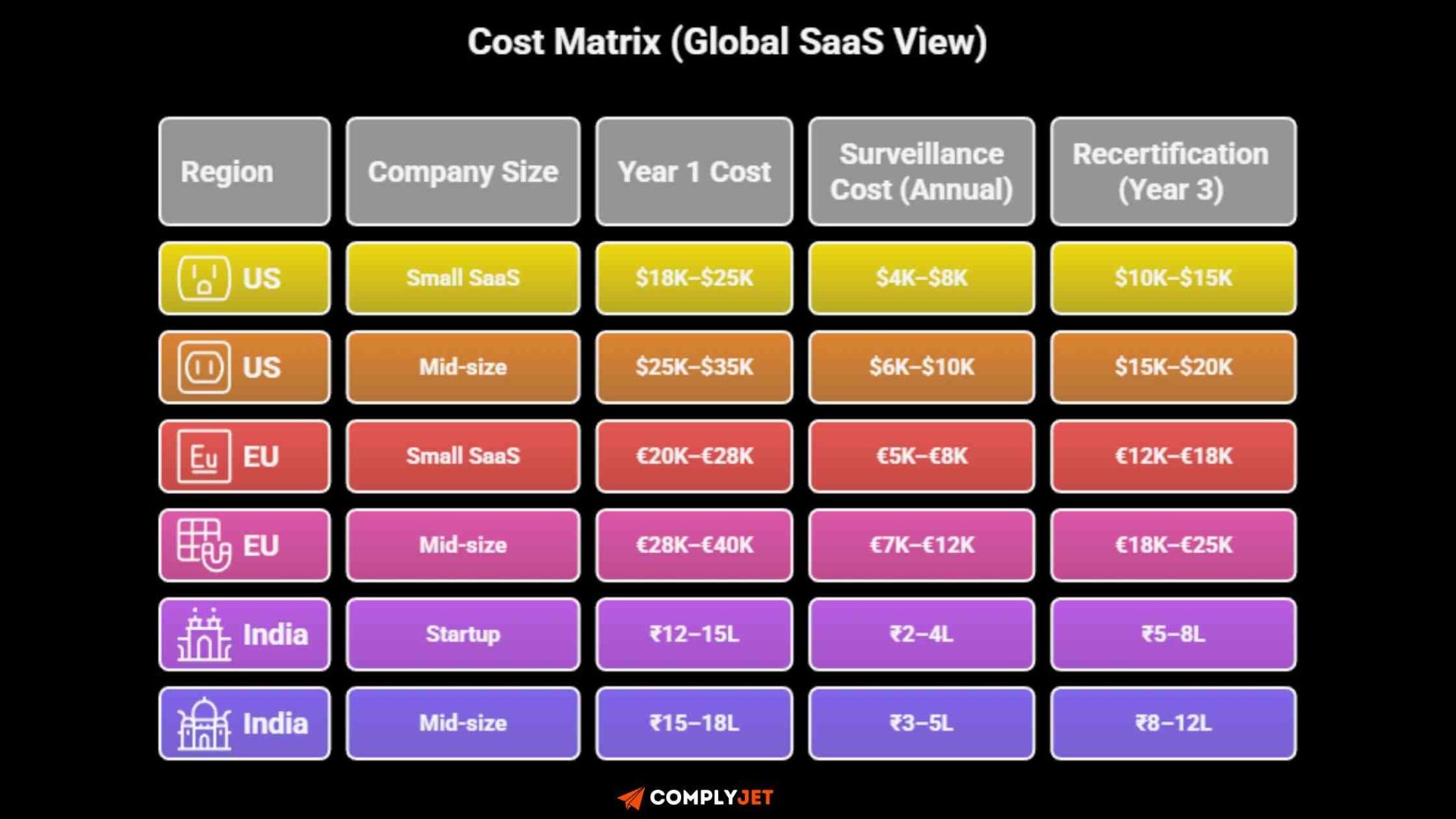
The above matrix provides a more realistic, SaaS-friendly view of ISO 27001 certification cost by region, covering not just the initial investment but also ongoing and renewal costs.
Why Costs Differ Across Regions
ISO 27001 costs vary across regions for a reason. It depends on economic, operational, and regulatory factors that affect both implementation and audits.
Labor and consulting costs are a big factor. Prices are higher in the US and parts of Europe than in India. Auditor experience also matters. More skilled auditors usually charge more.
Company maturity also affects cost. If you already have strong security practices and documentation, the effort is lower. If you are starting from scratch, it costs more.
Infrastructure adds to the cost too. SaaS companies with multi-cloud setups, remote teams, and many integrations need more work, no matter where they are based.
Regulations also play a role. In regions like the EU, aligning with laws like GDPR adds extra work at the start, but can make things easier later.
ISO 27001 Cost Breakdown (Detailed for SaaS Companies)
Many articles talk about the total ISO 27001 cost, but do not explain how it is spread across stages.
For SaaS companies, this is important because the cost is not fixed. It changes across implementation, audit, certification, and maintenance. It also depends on your infrastructure, speed of deployment, and global setup.
A clear cost breakdown helps you see where your money goes, plan your resources better, and understand why two similar companies can still have very different total costs.
Implementation Cost (ISO 27001 Implementation Cost)
The ISO 27001 implementation cost is typically the largest portion of the total certification investment, as it involves building your Information Security Management System (ISMS) from scratch or aligning existing systems with ISO 27001 requirements.
Initial stage (Gap assessment and planning)
The process starts with understanding where you stand today. This means identifying the gaps between your current security setup and ISO 27001 requirements. You define the scope, identify key assets, and plan how your ISMS will be structured.
At this stage, companies often invest in external consultants or internal audits to perform the gap analysis. It also requires time from leadership and compliance teams to align on scope and priorities, which becomes an important part of the overall cost.
Core implementation stage (System design and control mapping)
This is where most of the ISO 27001 implementation cost comes in. You start building your ISMS by creating policies, procedures, and documentation that align with ISO 27001 standards.
At the same time, you run risk assessments and define treatment plans. Controls are then mapped across your infrastructure, including cloud platforms like AWS, Azure, or GCP, as well as APIs and third-party tools.
Many companies also invest in automation platforms at this stage to manage policies, evidence, and compliance workflows more efficiently. This phase requires strong involvement from engineering and DevOps teams to ensure that controls are not just documented but actually implemented.
Advanced implementation stage (Operationalization)
In this stage, the focus shifts from setup to execution. Controls are actively enforced across systems and workflows.
This includes deploying logging, monitoring, and access control systems, along with strengthening identity management and incident response processes. Teams also start preparing audit-ready evidence and aligning daily workflows with compliance requirements.
At this point, the ISMS becomes part of regular operations rather than a separate compliance effort.
For SaaS companies, ISO 27001 implementation costs increase significantly in environments with multi-cloud infrastructure, CI/CD pipelines, microservice architecture, and global deployments, as each component must be secured, documented, and validated.
Audit Cost (ISO 27001 Audit Cost)
The ISO 27001 audit cost is the second major component and is directly tied to validating your implementation.
Stage 1 Audit (Documentation and Readiness Review)
The first stage focuses on reviewing whether your ISMS is properly designed and documented. Auditors check your policies, procedures, and overall readiness for certification.
At this point, costs mainly include auditor fees for the initial review and the internal effort required to organize documentation. Teams need to ensure that policies, risk assessments, and procedures are clearly structured and aligned with ISO 27001 requirements.
Stage 2 Audit (Full Certification Audit)
This is the most intensive part of the audit process. Auditors assess whether your controls are not just documented but actually implemented and working in daily operations.
This involves detailed validation through interviews, system walkthroughs, and evidence checks. Costs at this stage depend on factors like company size, number of employees, and audit scope. For SaaS companies with distributed teams and global infrastructure, the effort and cost are usually higher due to added complexity.
Post-Audit Stage (Corrective Actions and Re-audit)
If auditors find any non-conformities, additional work is required to fix them. This may include updating controls, improving documentation, or addressing gaps in implementation.
In some cases, a re-audit may be needed, which adds both time and cost. These extra steps can significantly increase the overall ISO 27001 certification cost, especially if the initial preparation was not thorough.
The ISO 27001 audit cost is not just about auditor fees; it also includes the internal cost of preparation, coordination, and operational disruption during audits.
If you're planning implementation, understanding your actual ISO 27001 cost breakdown can help you avoid delays. You can also talk to an expert to map this to your infrastructure.
Certification Cost (ISO 27001 Certification Cost Component)
The cost of ISO 27001 certification is often misunderstood. While it is the most visible part of the process, it is usually smaller compared to implementation and audit costs.
Certification Issuance Stage
Once you successfully pass the audit, the certification body issues your ISO 27001 certificate. This stage includes fees paid for certification, along with administrative costs related to audit reports and compliance validation.
Accreditation and Validation Stage
After issuance, your audit results are formally reviewed to ensure they meet international standards. This step confirms that your implementation aligns with the requirements set by the certification body and follows proper accreditation guidelines.
Recognition Stage
This is where certification starts delivering real value. It serves as official proof that your organization meets ISO 27001 requirements.
You can now use this certification in sales conversations, marketing, and enterprise deals. It acts as a strong trust signal, helping you build credibility with customers, partners, and stakeholders.
Maintenance Cost (ISO 27001 Maintenance Cost)
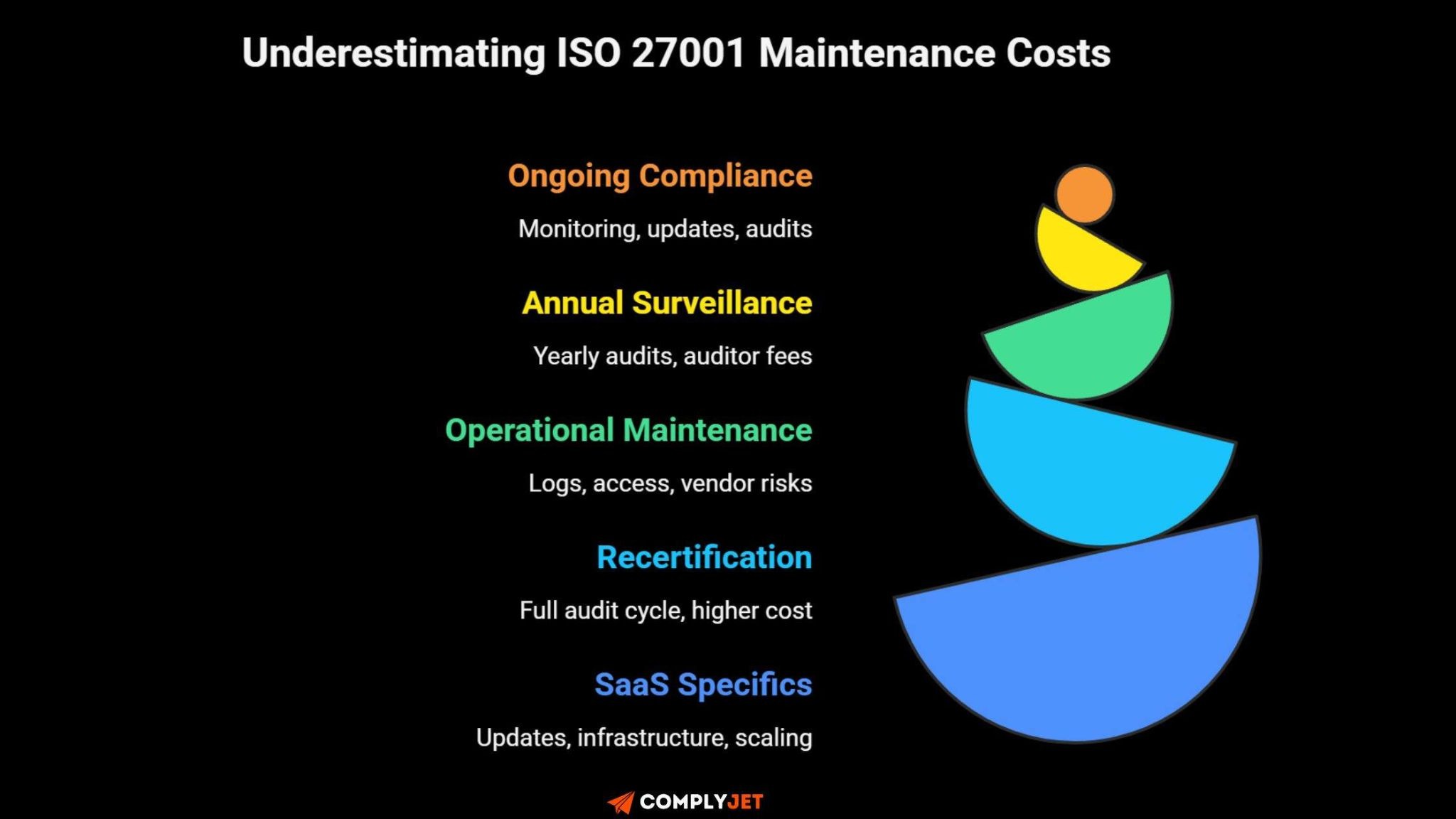
The ISO 27001 maintenance cost is where many companies underestimate the long-term investment. Certification is valid for three years, but maintaining it requires continuous effort.
Ongoing Compliance Stage
After certification, compliance becomes an ongoing effort. You need to continuously monitor your controls and systems to ensure they remain effective. This also includes regularly updating policies, procedures, and risk assessments as your business and infrastructure evolve.
Internal audits and management reviews play a key role in identifying gaps and maintaining alignment with ISO 27001 requirements. Over time, compliance becomes part of your day-to-day operations rather than a one-time activity.
Annual Surveillance Audit Stage
To maintain your certification, certification bodies conduct yearly surveillance audits. These audits check whether your organization continues to meet ISO 27001 standards.
This stage involves both auditor fees and internal effort for preparation. Teams need to ensure that documentation is updated and evidence is readily available, which adds to ongoing costs.
Operational Maintenance Stage
On a daily level, maintaining ISO 27001 involves managing logs, reviewing access controls, handling vendor risks, and responding to incidents. You also need to keep audit-ready evidence updated across systems.
For SaaS companies, this becomes more dynamic as systems change frequently. Regular updates to infrastructure, integrations, and workflows require continuous alignment with compliance requirements.
Recertification Stage (Year 3)
After three years, you go through a full recertification audit, similar to the initial certification process. This is more detailed than surveillance audits and involves higher costs and effort.
At this stage, your entire ISMS is reviewed again to ensure it still meets ISO 27001 standards and reflects your current operations.
For SaaS companies, ISO 27001 maintenance costs increase due to continuous product updates, infrastructure changes, and scaling operations, all of which require ongoing updates to controls and documentation.
Factors That Affect ISO 27001 Certification Cost
Two SaaS companies can spend very different amounts. Here’s why.
ISO 27001 cost is not fixed. That is where most confusion starts. Many guides give a general range, but the actual cost depends on your setup, systems, and how prepared you are.
It is not just about the certificate. The cost depends more on how complex your business is and how ready you are before you begin.
Company Size
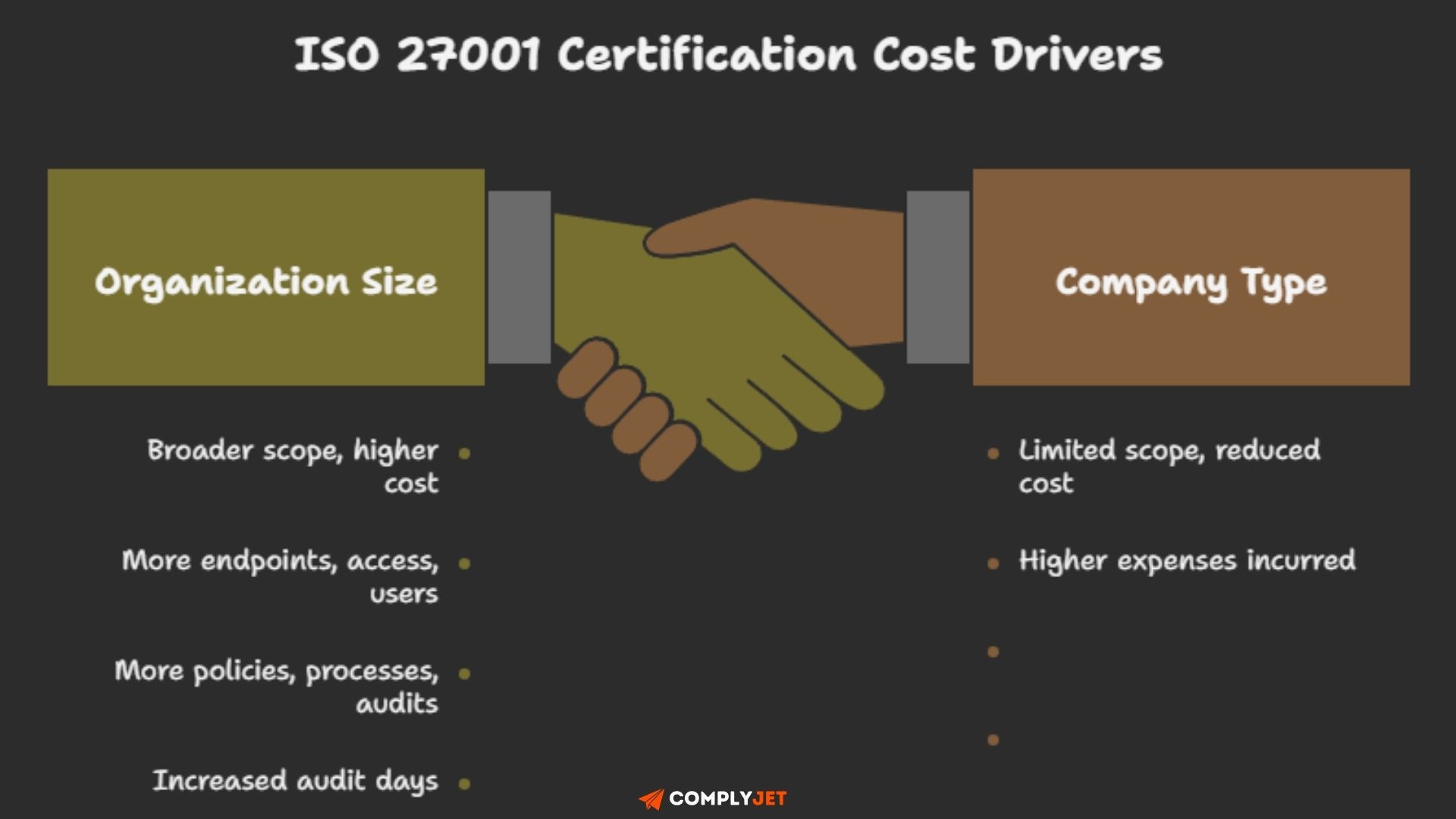
Company size plays a big role in ISO 27001 cost.
Larger organizations have a wider scope, which increases the effort required for certification. More employees mean more systems to manage, more access controls, and more users to monitor.
As the number of departments grows, so does the need for policies, processes, and audit coverage. Certification bodies also calculate audit time based on team size, which adds to the cost.
In contrast, startups and small SaaS companies can keep the scope limited and reduce costs. Mid-size and enterprise companies usually face higher expenses due to their scale.
If you're just getting started, understanding the ISO 27001 guide for startups is equally important for planning your journey
Infrastructure Complexity
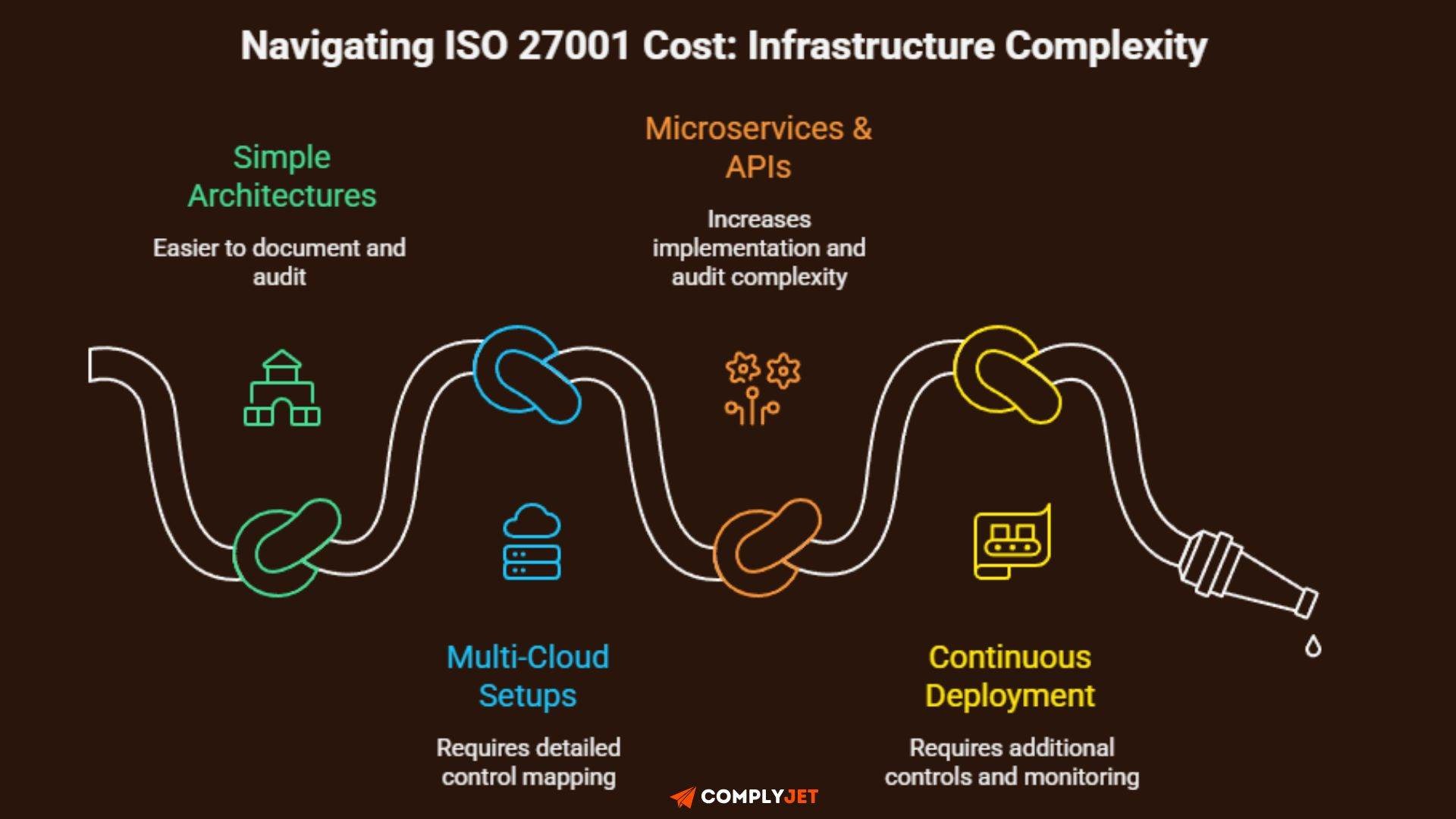
One of the biggest factors that affects ISO 27001 cost is how complex your technical environment is.
If your setup is simple, with fewer systems, it is easier to document and audit. But as your infrastructure grows, the effort increases.
SaaS companies using multi-cloud environments like AWS, Azure, or GCP need more detailed control mapping. Microservices, APIs, and third-party integrations add further complexity in both implementation and audits.
If you use continuous deployment (CI/CD), you also need extra controls, monitoring, and documentation.
In simple terms, the more complex your infrastructure, the higher your implementation and audit costs.
Data Sensitivity (Fintech, Healthtech, etc.)
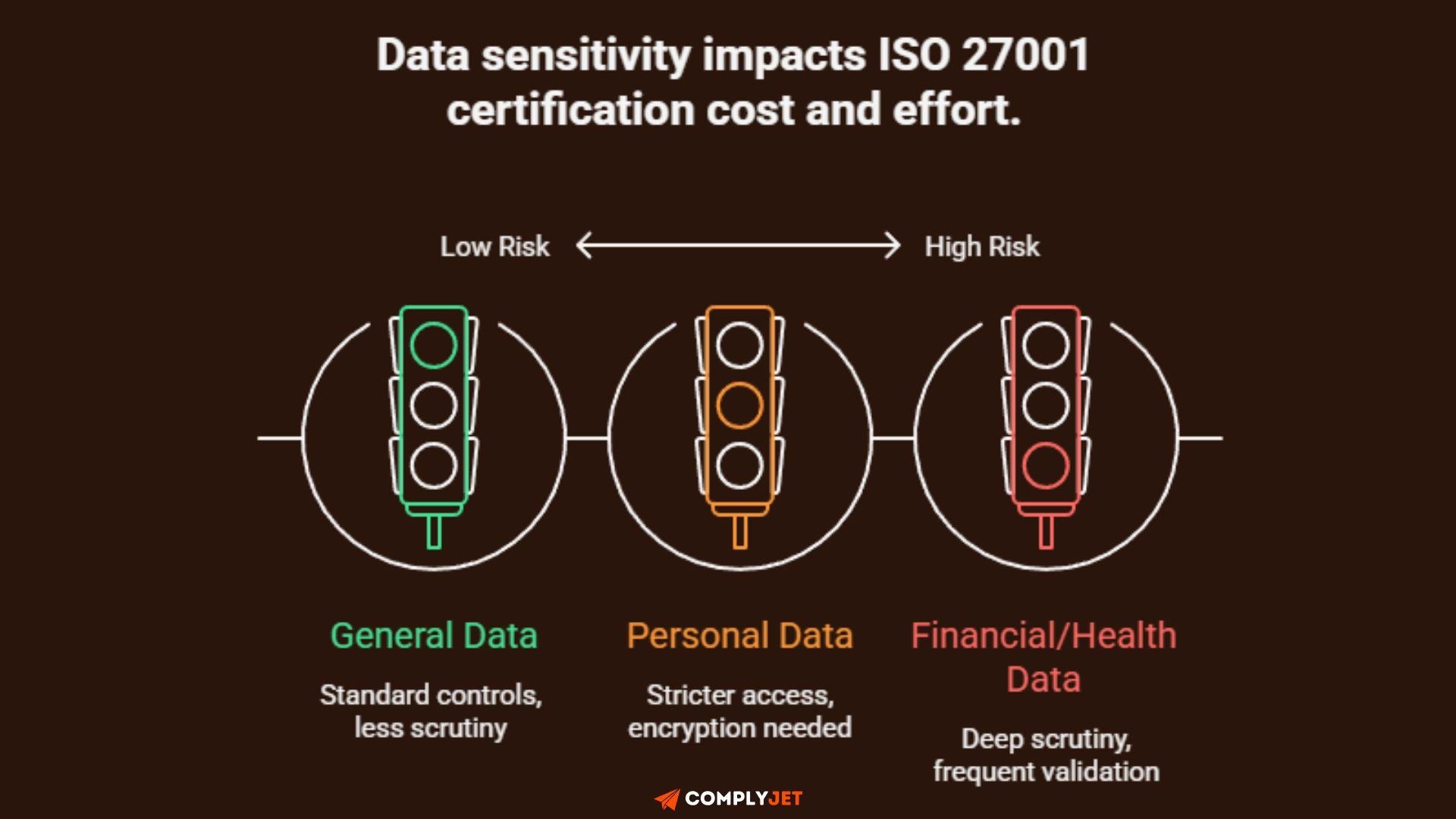
The type of data your company handles has a big impact on ISO 27001 cost.
If you work with financial data, healthcare records, or personal data (PII), the requirements are stricter. You need stronger controls like encryption, access management, and continuous monitoring, which increases both effort and cost.
Auditors also apply more scrutiny to high-risk industries such as fintech, healthtech, and SaaS platforms handling sensitive data. This means more detailed checks and validation.
In simple terms, higher risk leads to more documentation, more controls, and more effort, which adds to the overall cost.
Geographic Presence
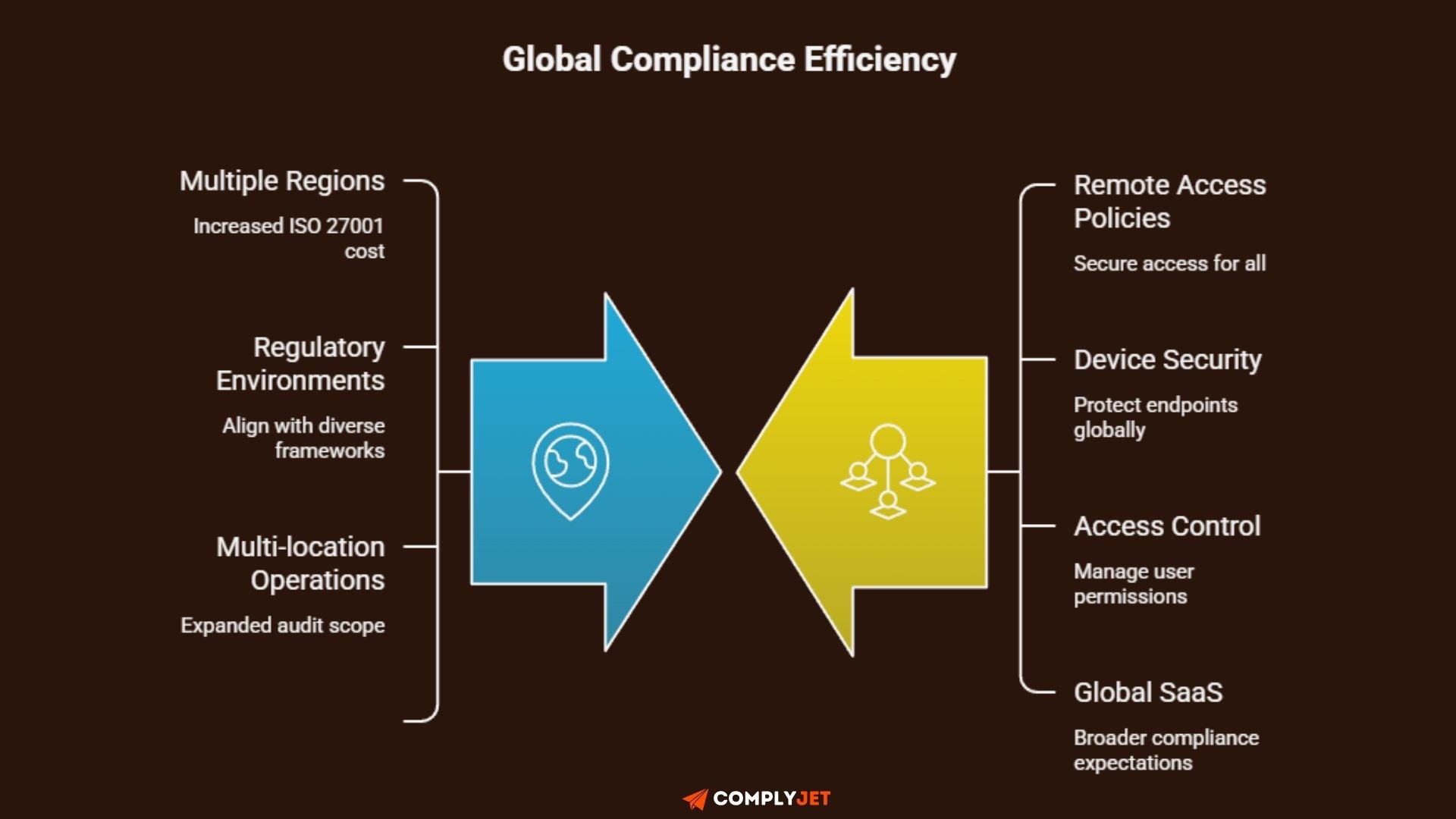
Operating in multiple regions increases ISO 27001 cost because it adds complexity.
Different regions have different regulations, such as GDPR in Europe and CCPA in the US. This means you need to align with multiple frameworks at the same time.
Managing operations across locations also expands the audit scope and requires more coordination. With distributed teams, you need additional policies for remote access, device security, and access control.
As a result, global SaaS companies often face higher costs due to broader compliance requirements.
Existing Compliance Maturity
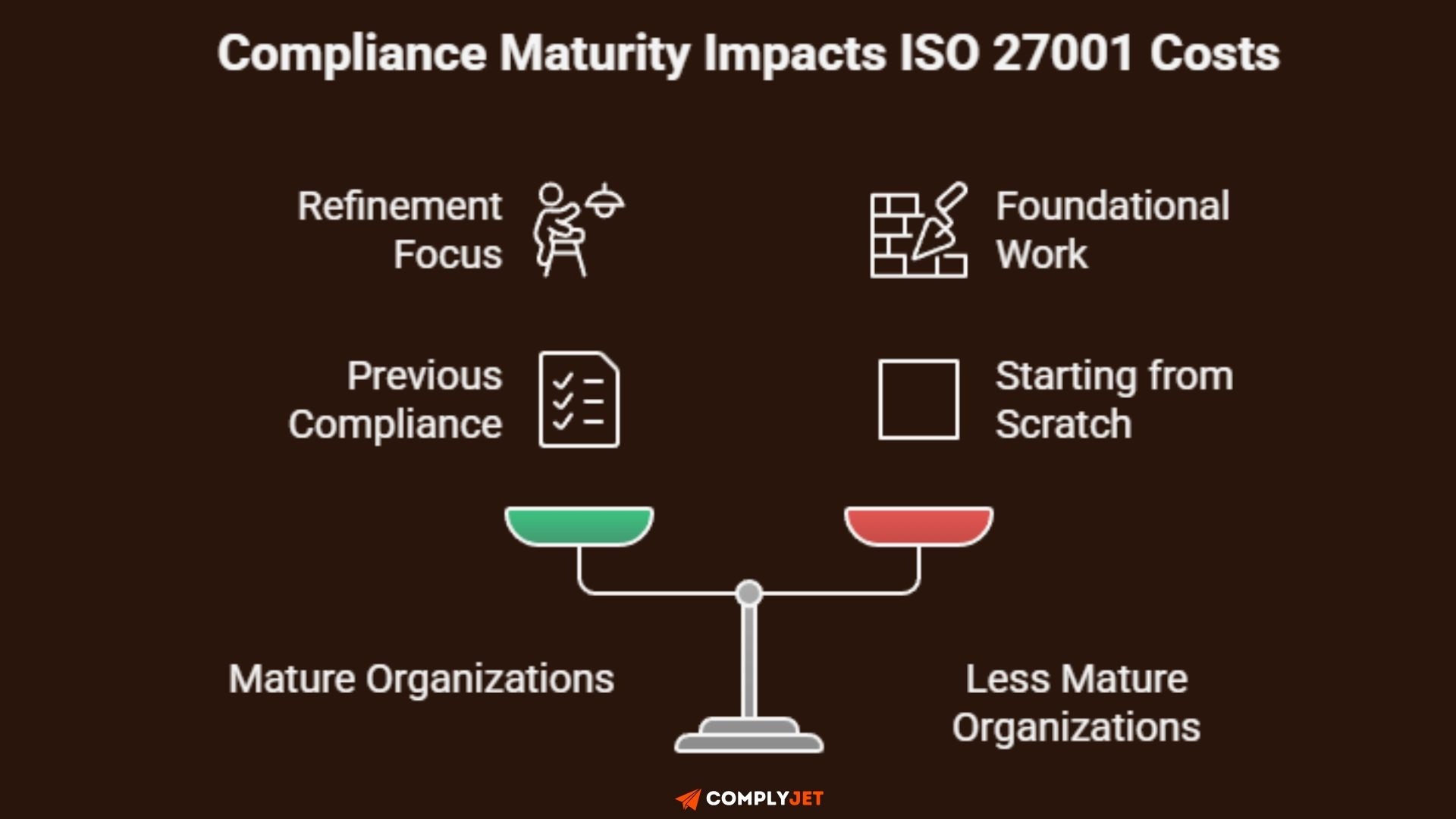
One of the most overlooked factors in ISO 27001 cost is how prepared your organization already is.
If you already have security practices, policies, and controls in place, the implementation effort is much lower. You can build on what exists instead of starting from scratch.
On the other hand, companies without this foundation usually face higher implementation costs. They need to set up everything from the ground up, which takes more time and effort.
If you have worked with frameworks like SOC 2, GDPR, or NIST, the process becomes faster. Many controls can be reused or adapted.
In simple terms, mature organizations spend more on refining and improving systems, while less mature ones spend more on building everything from the beginning.
Use of Automation vs Manual Processes
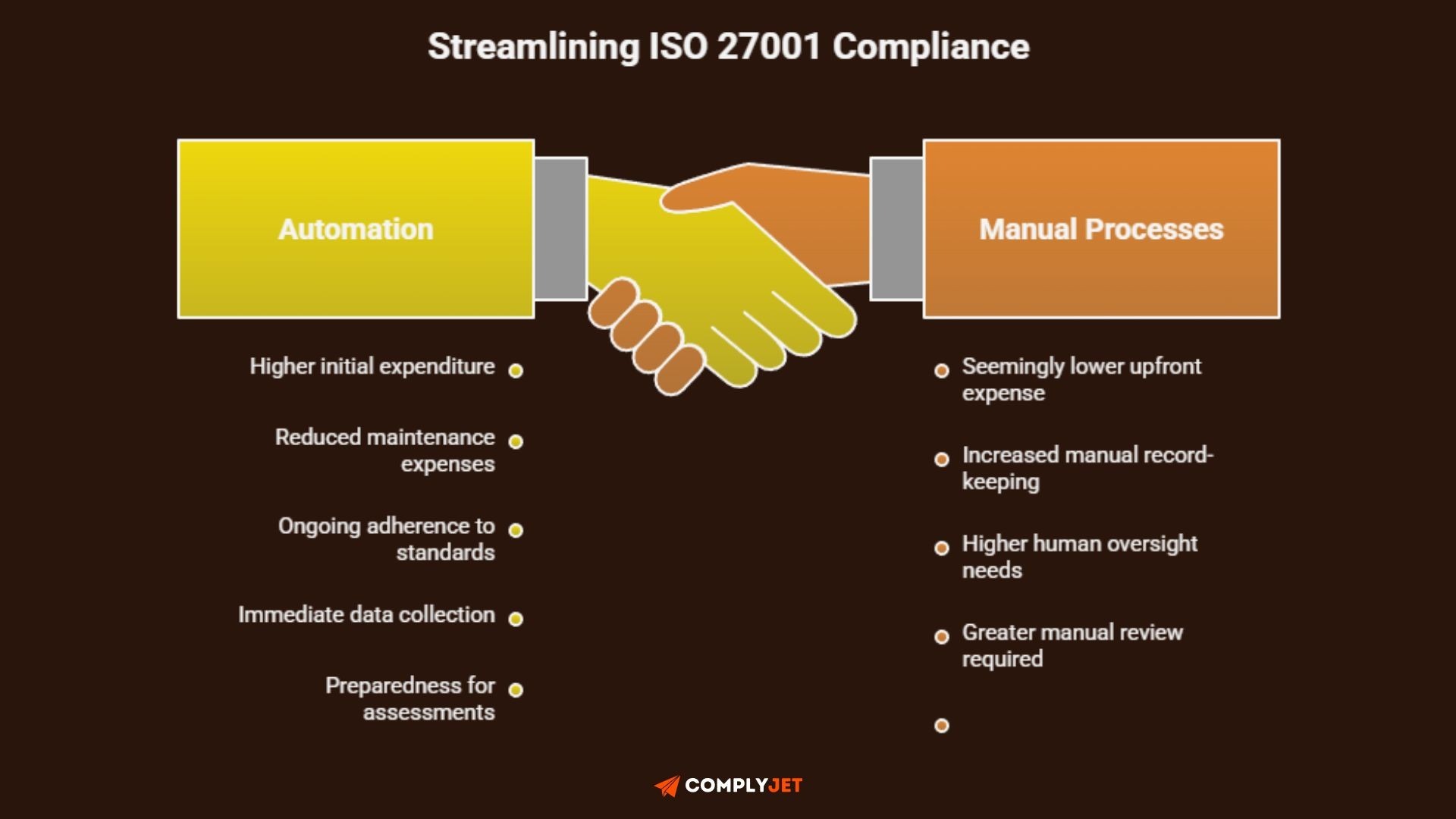
The choice between automation and manual processes has a direct impact on both cost and efficiency.
Automation tools usually require a higher upfront investment, but they help reduce long-term costs, especially for maintenance. They make it easier to manage compliance continuously, collect evidence in real time, and stay audit-ready without heavy manual effort.
On the other hand, manual processes may look cheaper at the start, but they often lead to more work over time. Teams spend more effort on documentation, monitoring, and preparing for audits, which increases internal costs.
For SaaS companies, this difference becomes even more important. With frequent system changes, automation helps keep everything up to date and reduces the burden on internal teams.
ISO 27001 Cost for Different SaaS Business Sizes
Let’s look at cost in real SaaS scenarios.
General benchmarks help, but ISO 27001 cost makes more sense when you look at your company size and stage. The standard is the same for everyone, but the effort and complexity change as your company grows.
This helps founders and operators estimate costs more clearly, whether they are a startup, a small business, or a larger SaaS company.
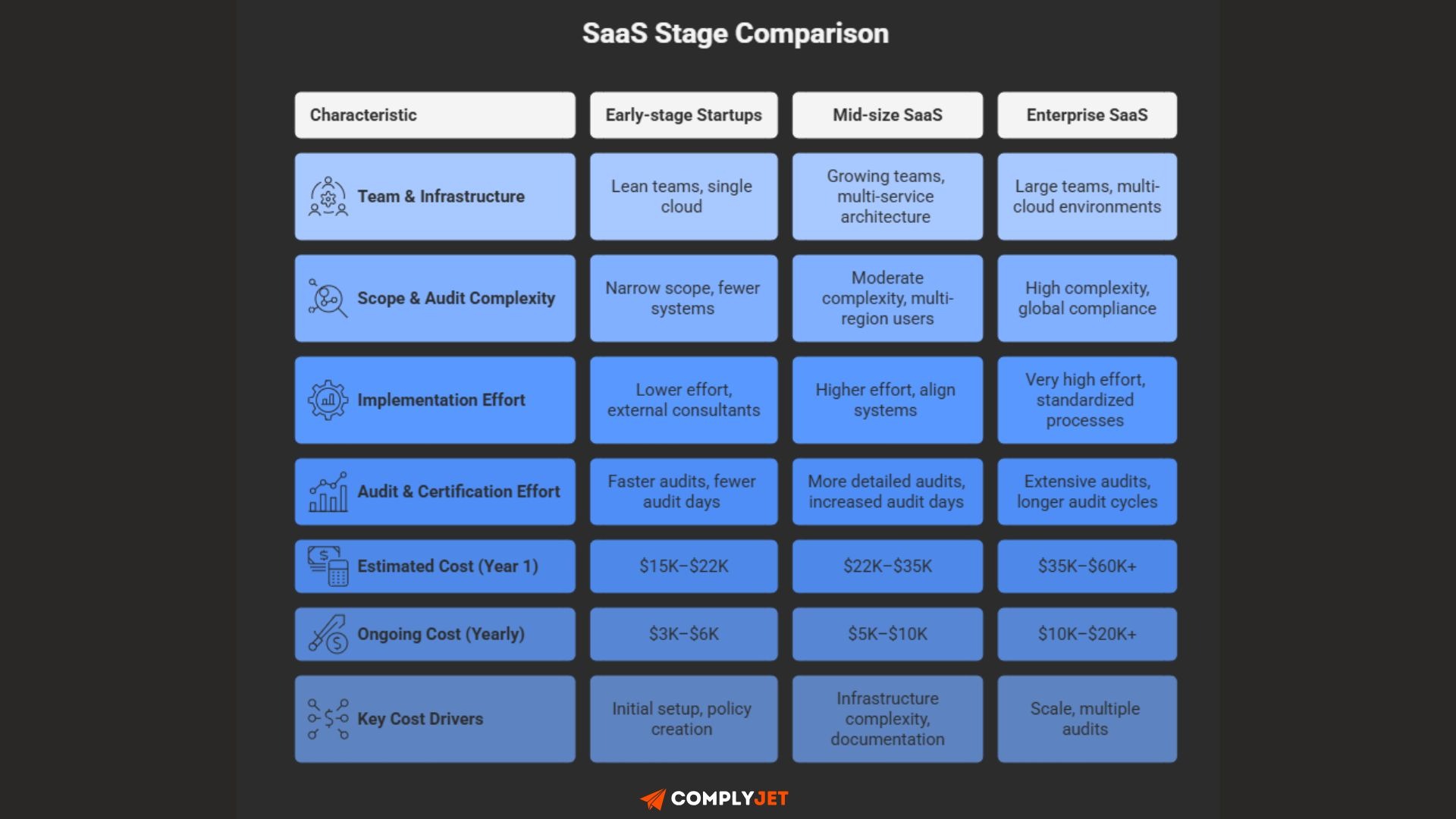
When you look at ISO 27001 cost through this lens, it becomes clear that the standard itself does not change, but the effort required to implement and maintain it scales with your business.
For startups, the focus is on speed and scope control. For mid-size SaaS companies, it is about managing growth and complexity. For enterprises, it becomes a core part of governance and global operations.
This is why understanding the ISO 27001 cost for small businesses and startups versus larger SaaS organizations is essential for accurate planning and decision-making.
Before you start, make sure you understand the ISO 27001 internal audit process, since this checklist assumes your audit groundwork is ready.
Hidden Costs Most ISO 27001 Guides Don’t Tell You
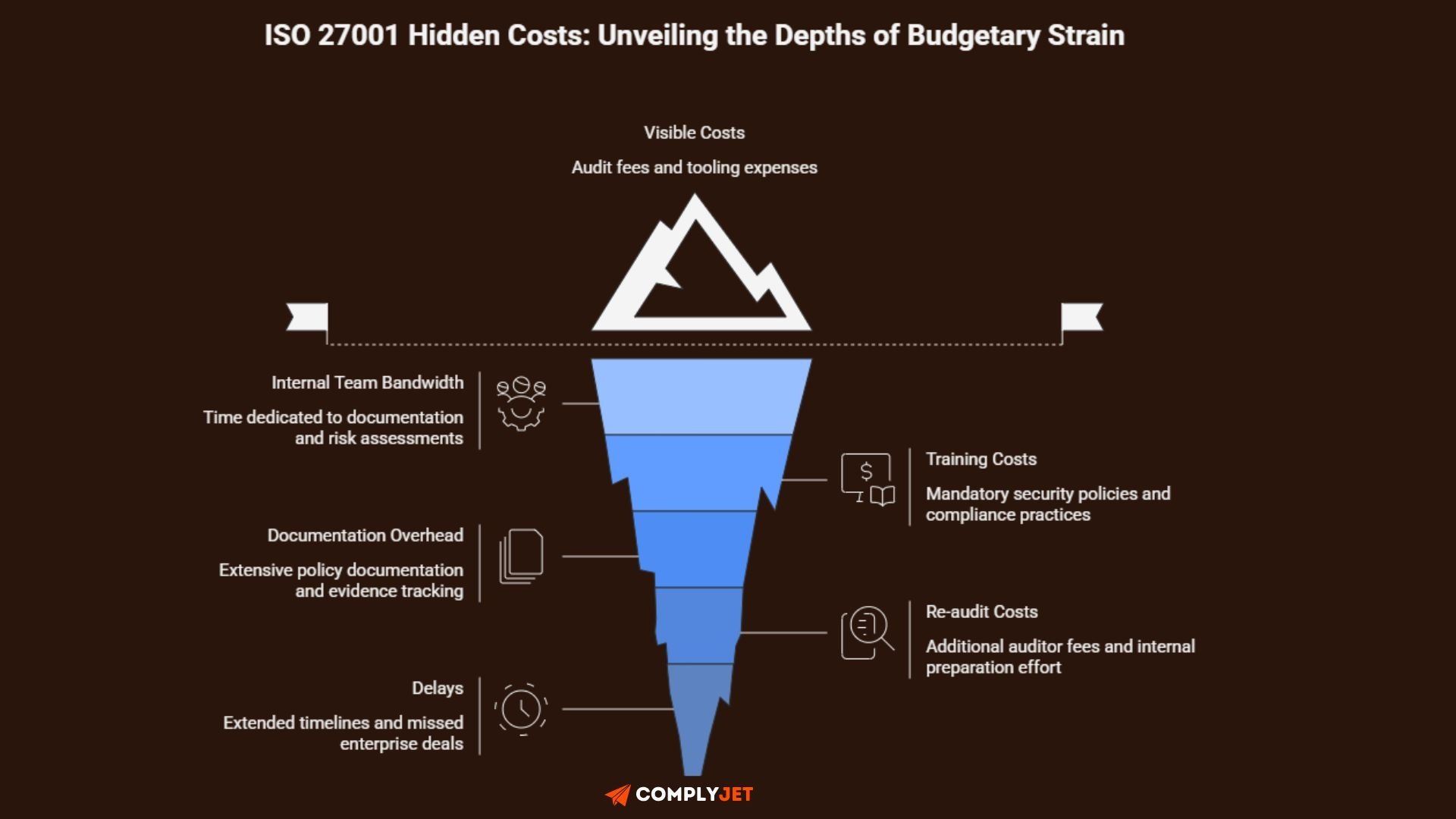
This is where most budgets break. Many articles focus only on visible costs like audit fees and tools. But they miss the hidden costs that add up during implementation.
For SaaS companies, these costs matter more. They depend on your team’s time, internal work, and how often your systems change.
If you ignore them, you may underestimate the effort, face delays, or even fail the audit.
Internal Team Bandwidth
One of the most underestimated hidden costs of ISO 27001 is the time your internal teams need to invest. Engineering, DevOps, and security teams often spend weeks working on documentation, risk assessments, and control implementation.
At the same time, leadership needs to be involved for approvals, decision-making, and overall governance. This effort does not happen in isolation. It often competes with product development and release cycles. For startups and mid-size SaaS companies, this creates a significant opportunity cost that is rarely factored into initial estimates.
Training Costs
Another key cost comes from training your teams. Employees need to understand security policies, follow compliance practices, and stay aware of evolving risks.
This includes onboarding sessions, regular training programs, and sometimes specialized training for teams handling sensitive data or critical systems. For distributed teams, ensuring consistent understanding adds even more effort. Since training needs to be repeated as teams grow and policies evolve, it becomes an ongoing investment rather than a one-time activity.
Documentation Overhead
ISO 27001 requires extensive documentation, including policies, processes, and audit evidence. Creating this from scratch can be time-consuming, especially for companies without prior compliance experience.
Even after initial setup, documentation needs to be updated regularly as systems, workflows, and infrastructure change. Keeping everything audit-ready becomes a continuous task. Without automation, this manual effort increases workload and also raises the risk of errors.
Re-audit Costs
If issues are found during the Stage 2 audit, companies may need to go through re-audits. This means additional auditor fees and more internal effort to fix gaps.
Often, this involves revisiting parts of the implementation, updating controls, or improving documentation. Poor preparation or rushed execution is a common reason for these extra costs, which are rarely included in initial ISO 27001 estimates.
Delays
Delays are one of the most overlooked yet impactful hidden costs. When timelines extend, internal resources are tied up for longer, and consulting costs may increase.
Delays can also affect business outcomes. For example, missing certification deadlines can slow down enterprise deals. Coordination challenges across teams and regions, along with rework caused by unclear scope or incomplete preparation, often add to these delays.
How ISO 27001 Helps SaaS Companies Win Deals
So far, we have focused on the cost of ISO 27001. But that is only one part of the story. The bigger question is what you get from that investment.
For SaaS companies, ISO 27001 is not just about compliance. It affects how fast deals move, how much trust you build, and whether you are considered at all.
In simple terms, it has a direct impact on your business outcomes.
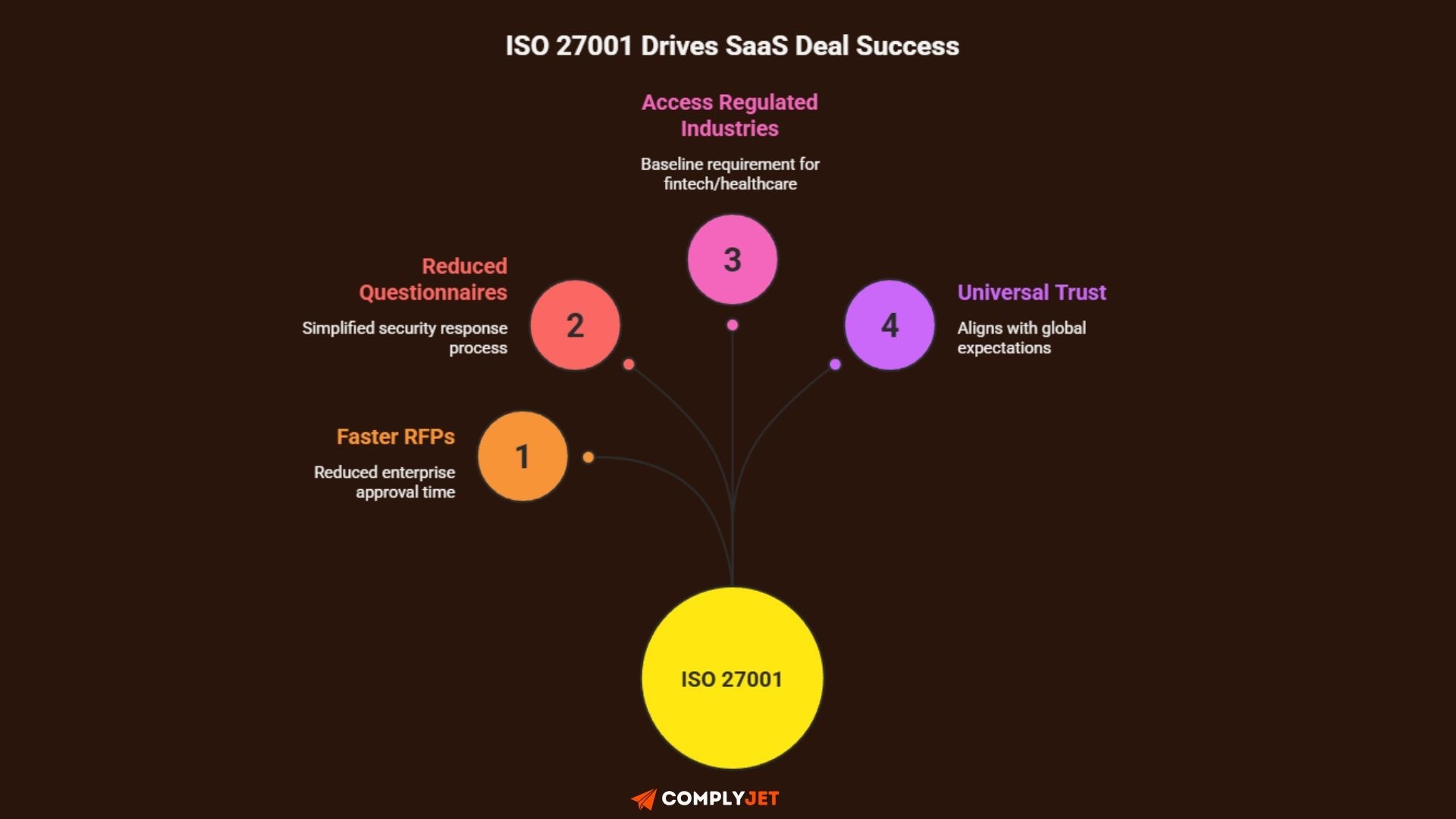
Faster Enterprise RFP Approvals
For SaaS companies selling to enterprises, deals often slow down at the RFP stage. This is where strict security and compliance checks come in.
ISO 27001 helps reduce this delay. It gives you a globally recognized framework that matches what enterprises expect.
This makes it easier for procurement teams to review your security and move deals forward faster, without long back-and-forth discussions.
Reduced Security Questionnaire Cycles
Security questionnaires can take weeks if you have to create answers from scratch.
ISO 27001 makes this much easier. Your policies, controls, and evidence are already in place and well organized.
This helps teams respond faster, stay consistent, and reduce delays. As a result, sales cycles become shorter.
Access to Regulated Industries
In industries like fintech and healthcare, ISO 27001 is often expected. It is not a bonus. It is a basic requirement. Without it, many opportunities are out of reach.
It helps SaaS companies qualify for deals, build trust early, and get into conversations that may not happen otherwise.
For companies targeting enterprise clients in the US and Europe, ISO 27001 works as a global trust signal. It shows your security meets international standards.
This reduces friction in cross-border deals and strengthens your position during vendor checks by proving you follow a clear and structured approach to security.
ISO 27001 as a Trust & Brand Signal
Compliance is usually where the conversation starts, but it is not where the impact ends.
ISO 27001 quietly becomes part of how your company is perceived, not just by auditors, but by customers, investors, and partners who are constantly evaluating risk before they decide to trust you.
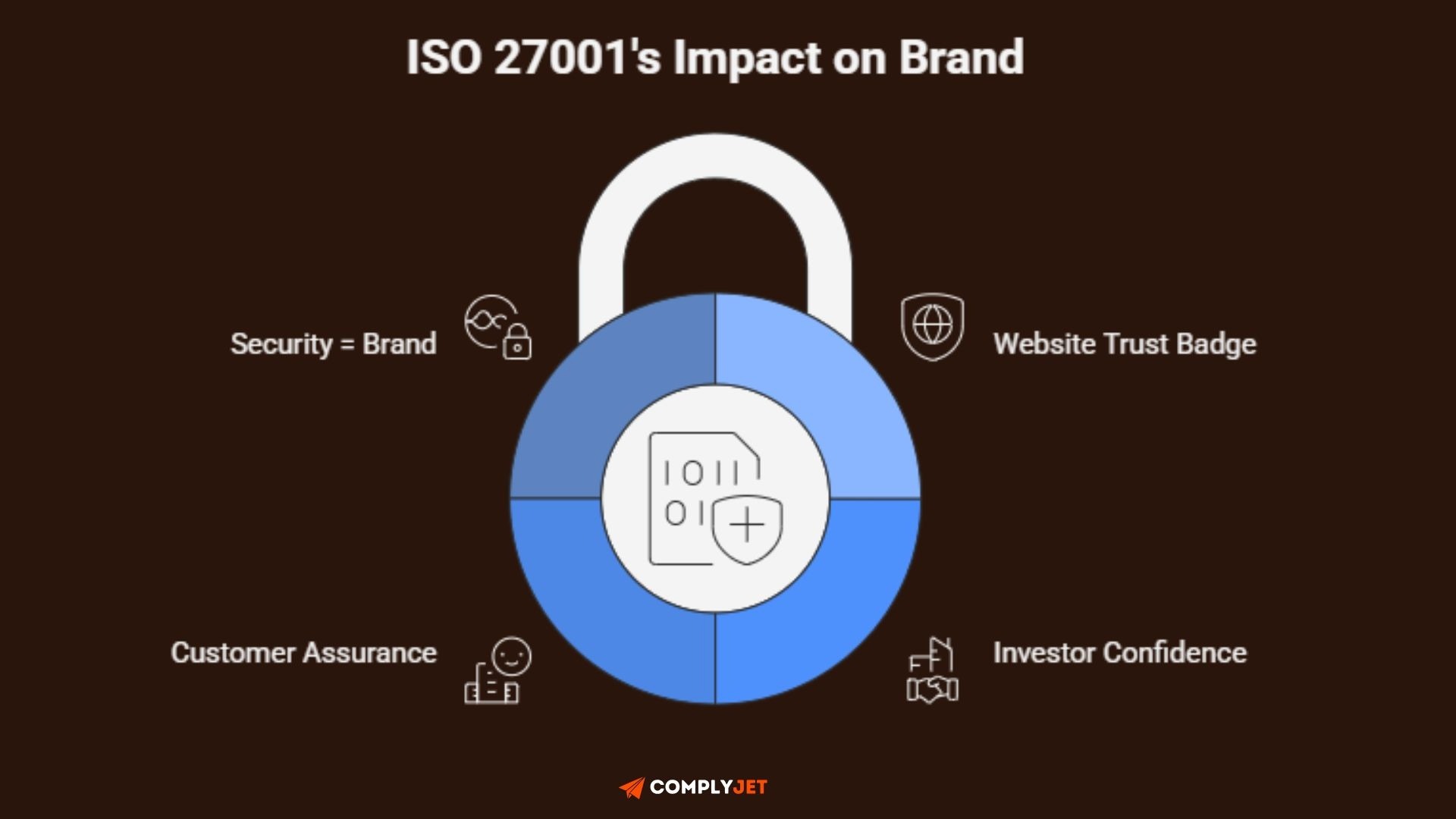
Website Trust Badge
Once you get ISO 27001 certified, it starts showing up across your website. You’ll see it on security pages, landing pages, and even pricing sections where buyers are already judging credibility.
It works as a quiet trust signal. It reduces doubt and shows that your company follows clear, globally accepted security practices. This often helps improve conversions early in the buyer journey.
Investor Confidence
From an investor’s point of view, ISO 27001 shows that your company is mature and aware of risks. This matters a lot for SaaS businesses that handle sensitive data.
It signals that you are not just chasing growth, but also building strong and reliable systems. This makes it easier to build trust during fundraising and smooths out due diligence conversations.
Customer Assurance
For customers, especially enterprise buyers, ISO 27001 builds trust. It shows that security is not handled casually, but through a clear and audited system.
This reduces their sense of risk and makes vendor checks easier. It also helps build stronger, long-term relationships by proving that data protection and compliance are part of how the company operates.
Security = Brand
Over time, ISO 27001 stops being just a compliance task and becomes part of how your company is seen in the market. It shapes your brand and how others trust you.
Today, trust plays a big role in buying decisions. Security is no longer just a backend function. It becomes something visible that shows your reliability, builds credibility, and signals that your company is ready to scale.
ISO 27001 vs SOC 2 Cost (Which One Makes Sense?)
If you're a SaaS founder, this question comes up sooner than you expect: ISO 27001 or SOC 2… which one should you choose first?
At first, it feels like a cost question. But it quickly becomes a bigger decision about your market, customers, and long-term growth. Both frameworks build trust and show your security strength, but they differ in structure, geography, and how costs add up over time.
A clear comparison helps you see not just the cost difference, but which one fits your current stage and future plans better.
ISO 27001 vs SOC 2 Cost Comparison Table
You can also read ISO 27001 vs SOC 2: The Definitive Guide (2026)
ISO 27001 in Your Compliance Stack (Beyond Just Certification)
Most teams start by treating ISO 27001 as a one-time certification. Something to complete and move on from. But in reality, it does not work that way.
As companies grow, especially SaaS businesses with global customers, compliance needs start to overlap. Different clients ask for different frameworks. Different regions bring different rules.
At that point, security is no longer about one certification. It becomes about how everything fits and works together.
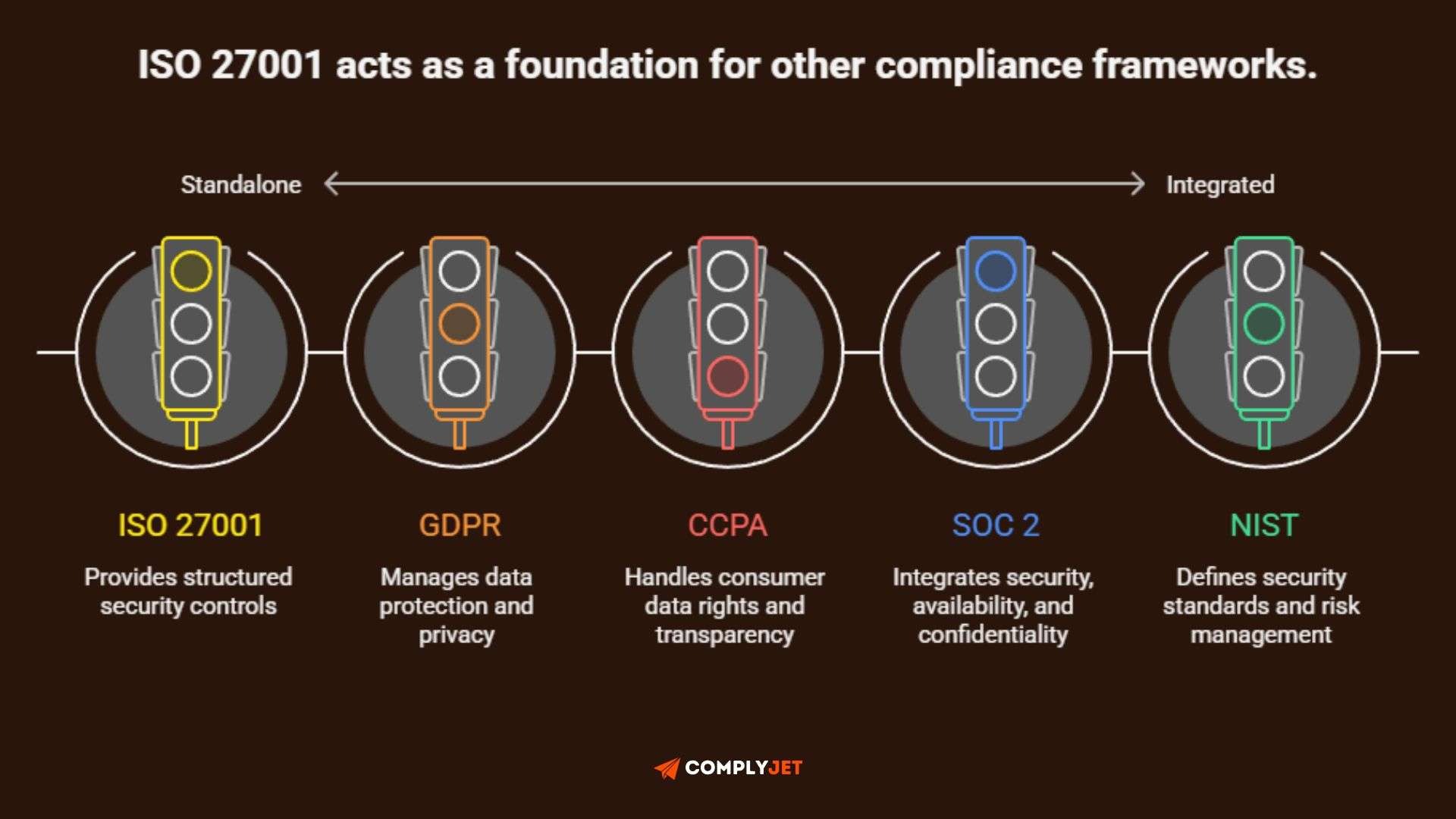
This is where ISO 27001 becomes more than just a requirement. It starts acting as a foundation that other frameworks can build on.
GDPR Alignment
For companies working in Europe or serving European customers, GDPR sets strict rules for data protection and privacy. ISO 27001 does not replace GDPR, but it helps you meet many of its security requirements.
If you already have ISO 27001, it becomes easier to show how you protect data, manage risks, and handle incidents. You already have systems in place.
Instead of building a new setup just for GDPR, you can extend your existing ISMS to cover these needs. This reduces duplicate work and keeps your processes consistent.
You can also refer to GDPR Compliance: Strategic Due Diligence for US Startups
CCPA Readiness
In the United States, laws like CCPA focus on how companies handle consumer data and protect user rights. ISO 27001 is not a privacy law, but it supports many of the practices needed to manage data securely.
With ISO 27001 in place, companies already have processes for access control, data handling, and risk checks. This makes it easier to adapt to CCPA requirements.
As a result, companies can reduce the extra effort needed for compliance and keep their security practices consistent across different regions.
SOC 2 Integration
SOC 2 is one of the most common frameworks for SaaS companies, especially in the US. It is different from ISO 27001, but many of the core controls are similar, like security, availability, and confidentiality.
If you already have ISO 27001, getting SOC 2 becomes easier. Many controls are already set up and documented, so you do not have to start from scratch.
You can map your existing processes to SOC 2 requirements, which saves both time and cost. That is why many companies use ISO 27001 as a base and then add SOC 2 when needed.
NIST Mapping
Frameworks like NIST are widely used, especially by government and large companies, to manage security and risk. ISO 27001 follows many of the same ideas, like risk checks, security controls, and ongoing improvement.
For SaaS companies, this makes things easier. If you already have ISO 27001, you do not have to start from scratch for NIST. You can map the two and show compliance more easily.
In simple terms, ISO 27001 gives you a strong base to meet NIST requirements.
You can give a read to NIST Compliance Guide
How to Reduce ISO 27001 Certification Cost
Yes, you can reduce your cost. ISO 27001 may seem expensive at first, but a big part of the cost depends on how you approach it.
With the right strategy, you can lower both direct costs and internal effort without affecting compliance quality. The goal is not to cut corners, but to use your time, tools, and resources in a smarter way.
Option 1: Implementing ISO 27001 Internally
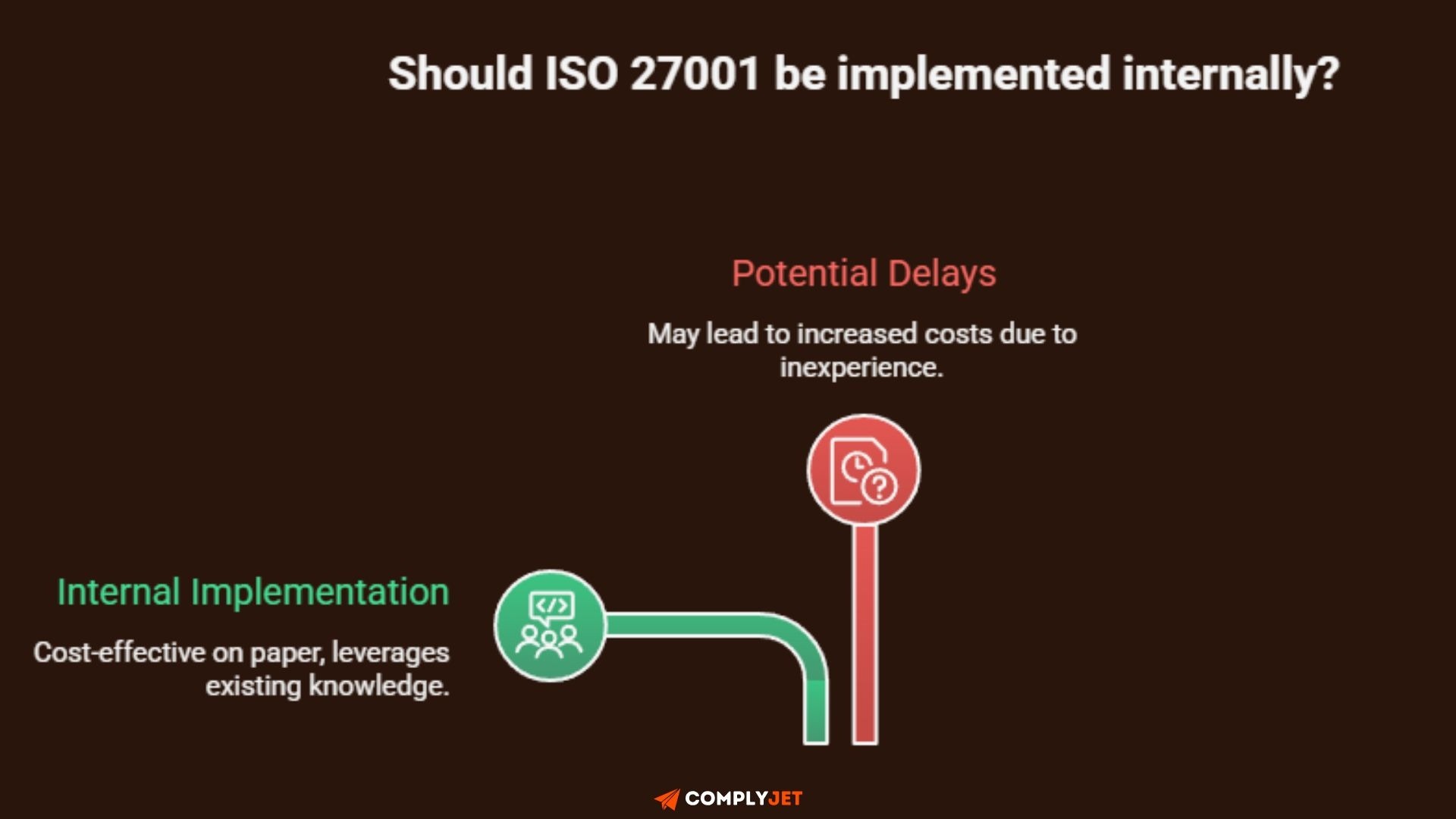
Handling ISO 27001 internally may look like the cheapest option at first. You do not pay for external consultants, and your own team manages everything.
Usually, teams from engineering, DevOps, or security take this on. They build the ISMS, create policies, and prepare for audits.
This works best if your company already has some security experience or people who understand compliance. In that case, you can save money by using what you already have instead of starting from scratch.
But the savings depend on how well it is executed. If your team lacks experience, things can take longer. Understanding requirements, setting up controls, and preparing documents may slow down the process.
This can lead to delays, rework, or even failed audits. So while the upfront cost is lower, the hidden cost in time and effort can be high.
Option 2: Hiring a Consultant
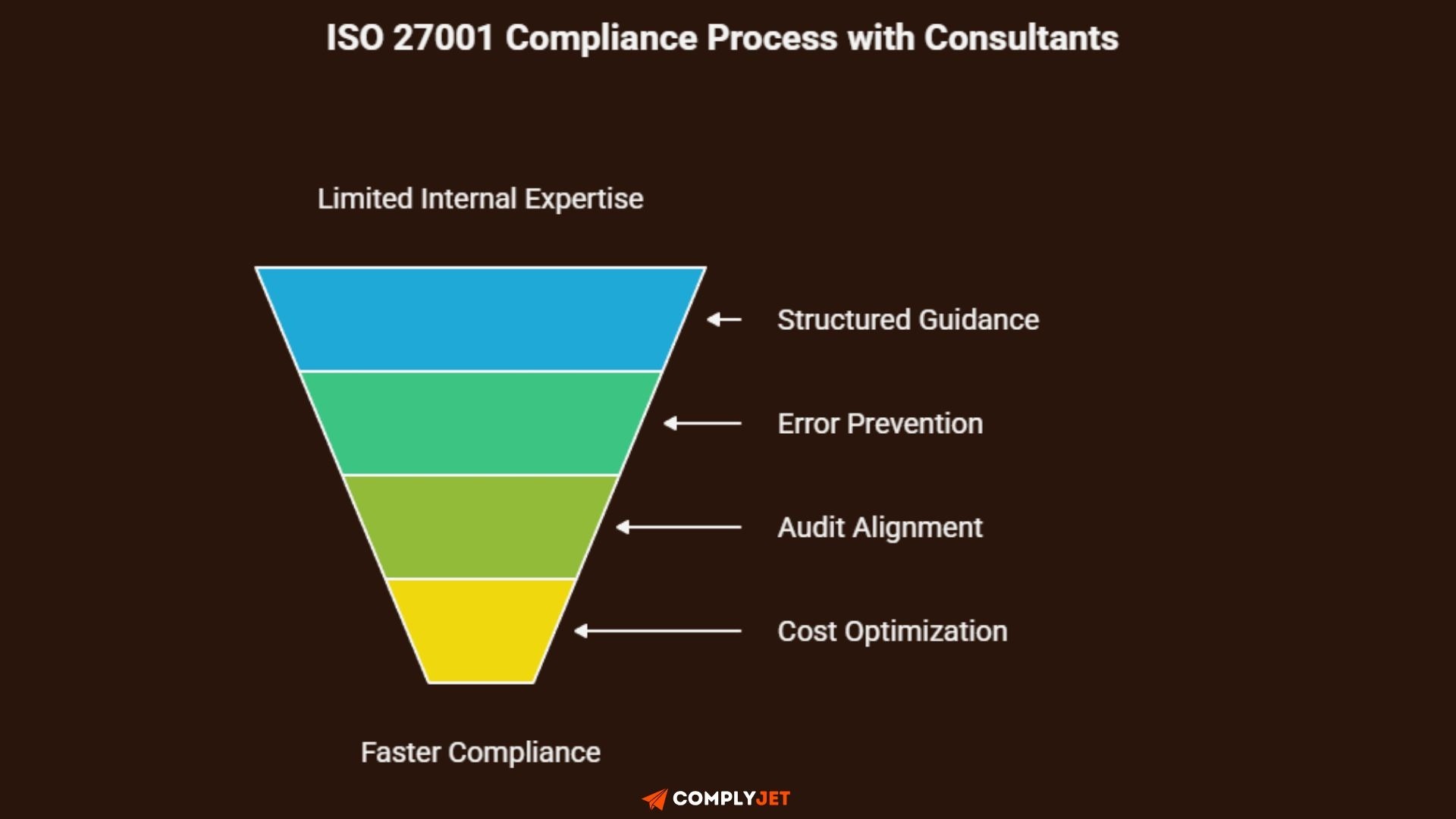
Hiring a consultant is often the fastest way to get ISO 27001 done, especially if your team lacks experience. They guide you, help you avoid mistakes, and make sure your work meets audit requirements from the start.
They can also save costs in the long run. By preventing rework, failed audits, and delays, consultants help you move faster and reduce wasted effort. They also bring structure and make sure the right teams handle the right tasks.
But consultants are expensive. Costs can vary a lot and often go into tens of thousands of dollars. For companies with smaller budgets, this may not be the best full-time approach.
A better option can be to use consultants only where needed, like for gap assessments or audit preparation. This way, you get the benefits without the full cost.
Option 3: Using a Compliance Automation Platform
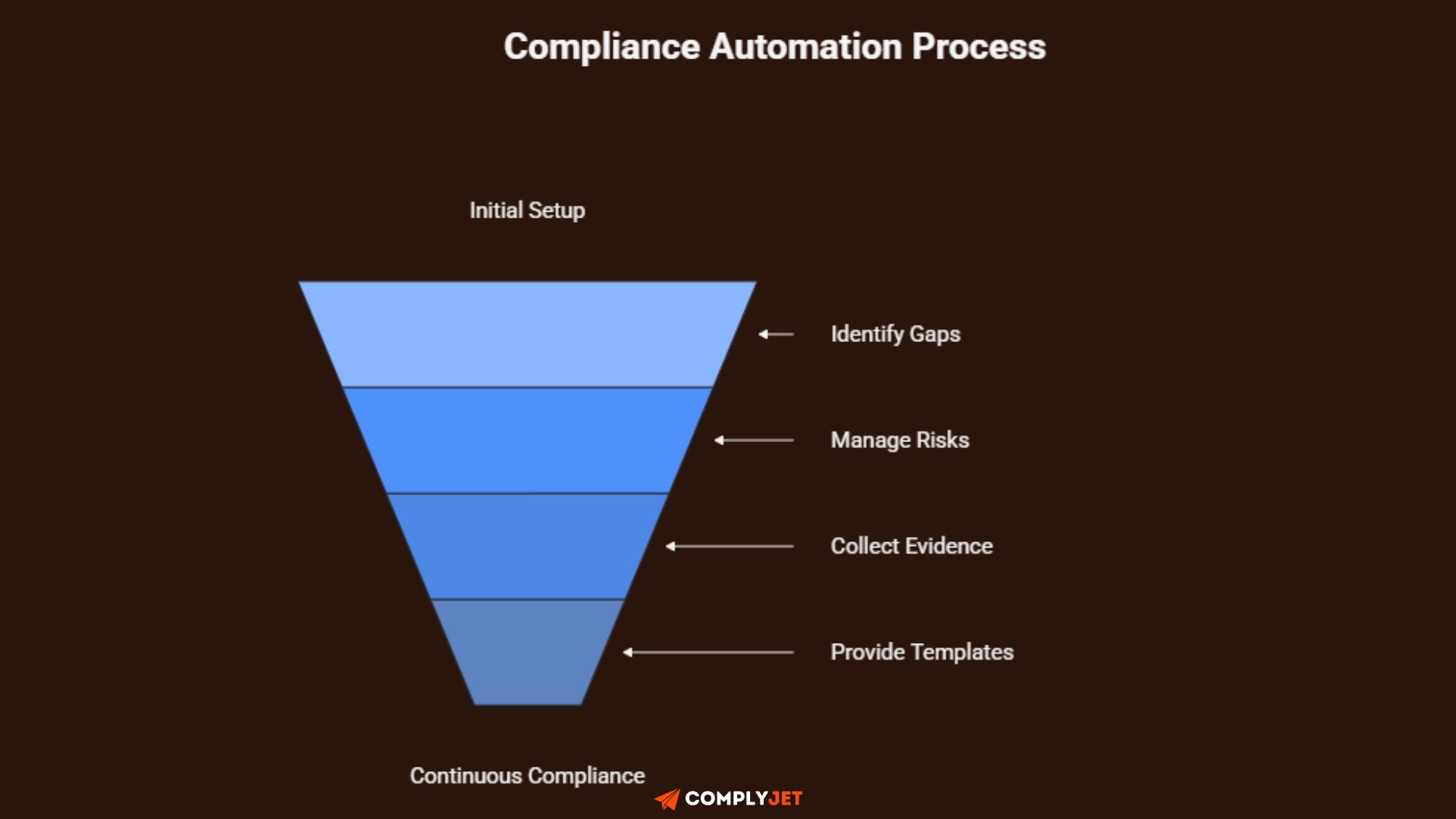
A compliance automation platform makes ISO 27001 easier to manage and more scalable. It reduces effort by handling many repetitive tasks for you.
These tools connect with your systems to find gaps, manage risks, collect audit evidence, and give ready-to-use policy templates. This cuts down a lot of manual work, which is often a hidden cost.
For SaaS companies, this is even more helpful. Systems change often, and automation keeps everything up to date. It helps you stay compliant, reduces manual tracking, and keeps your documents ready for audits.
There is an upfront cost, but it usually saves money over time by improving efficiency and reducing engineering effort.
ISO 27001 Cost Comparison: Platforms & Approaches
Choosing how you approach ISO 27001 has a direct impact on your total cost, not just financial costs, but also time, internal effort, and the speed to certification. While most companies focus on upfront pricing, the real difference shows up in how efficiently you move through implementation and audits.
Here's a clearer comparison across common approaches and leading platforms:
Table 1 - Cost, Time & Effort Comparison
Table 2: Effort, Pros & Trade-offs
If you're evaluating tools, here’s a breakdown of Sprinto alternatives and competitors.
Frequently Asked Questions About ISO 27001 Cost
How much does ISO 27001 certification cost?
ISO 27001 usually costs between $15,000 and $40,000+. The final cost depends on your company size, systems, region, and audit scope.
Why is ISO 27001 expensive?
It is not just a one-time fee. It includes implementation, audits, documentation, and ongoing maintenance. It also requires internal time and effort.
How long does ISO 27001 certification take?
It usually takes 3 to 12 months. The timeline depends on your readiness, system complexity, and how smoothly the process runs.
Can startups afford ISO 27001?
Yes. Startups can manage costs by keeping the scope small and using automation. It is often a smart investment to build trust early.
What affects ISO 27001 cost?
Costs depend on your company size, system complexity, data sensitivity, locations, current security maturity, and whether you use automation or manual processes.
Conclusion: From Compliance Cost to Growth Investment
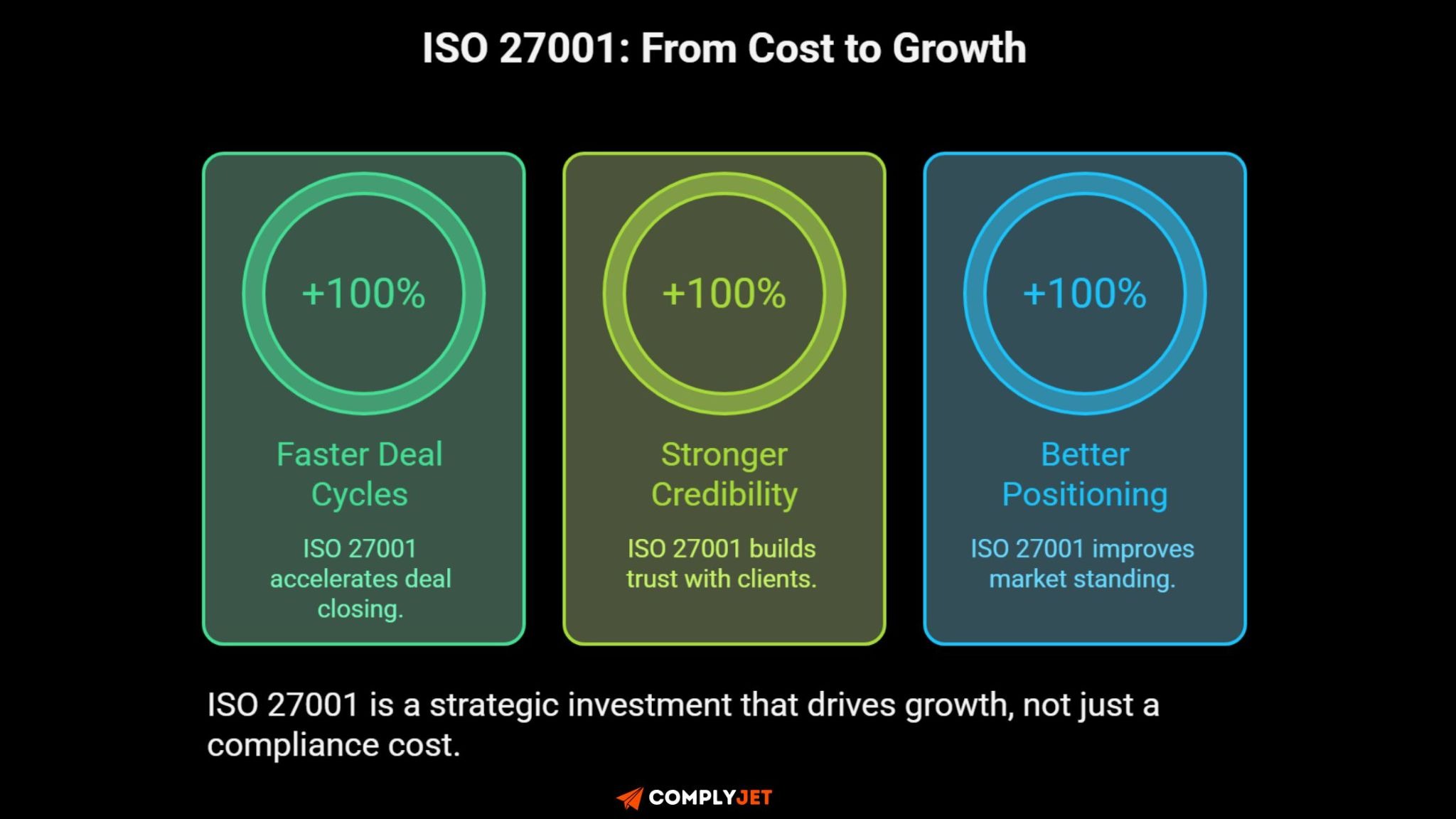
Most teams start by seeing ISO 27001 as just a cost. They focus on budgets and estimates without fully understanding what it involves. But as companies move closer to enterprise deals, that view starts to change.
When security questionnaires stop slowing down deals and procurement becomes smoother, the value becomes clear. ISO 27001 starts to affect how fast you close deals and how much customers trust your systems.
What looks like a one-time expense is actually an ongoing investment. It includes implementation, audits, and continuous compliance. It also fits well with how SaaS companies grow and operate across markets.
The real return shows up in faster deal cycles, stronger trust, and better positioning with enterprise clients and investors. Over time, ISO 27001 shifts from being a cost to becoming a growth driver.
So instead of only asking how much it costs, the better question is what it helps you unlock.
Get a tailored ISO 27001 cost estimate for your SaaS business.
Still unsure where your costs will land? Talk to an expert and get a realistic estimate based on your current setup.