.svg)

You’re evaluating vendor risk management software and every tool you’ve looked at either requires a sales call to see pricing, feels built for a team three times your size, or treats vendor risk as a checkbox inside a larger GRC platform you don’t need yet.
The category is messier than it looks. Pure TPRM platforms, GRC suites with VRM modules, questionnaire automation tools, and security ratings platforms all compete for the same keywords. Half charge per vendor, which gets expensive as your stack grows. And the line between “this is serious third party risk management software” and “this barely qualifies” isn’t obvious from a website.
I reviewed 10 vendor risk management tools covering the full range: dedicated TPRM platforms, compliance platforms with built-in VRM, and questionnaire-focused tools. For each, I looked at what’s actually included in the base price, how the questionnaire workflow operates in practice, and whether a small team could realistically run this without a dedicated risk manager.
Why third party risk management software is more than an annual questionnaire
Most teams manage vendor risk with a spreadsheet and a Google Form. Send questionnaires once a year, wait six weeks for responses, paste the answers somewhere, repeat. It works until your SOC 2 auditor asks for evidence of ongoing vendor oversight. Or until a vendor suffers a breach and you have no record of when you last assessed them.
Key stat
57% of organizations terminated a vendor relationship due to security concerns in 2026 — those decisions were made by teams with data, not annual questionnaires.
What vendor risk management software actually does is build infrastructure around that process: a centralized inventory of all your third parties, risk scoring that tells you which vendors need more scrutiny, automated questionnaire workflows that follow up without manual nudging, and an audit trail that proves the work happened. For SOC 2 compliance and ISO 27001 certification, vendor risk isn’t optional. Both frameworks require evidence that you’ve assessed the risks your suppliers introduce.
A 2026 survey found that 57% of organizations had terminated a vendor relationship due to security concerns, up from 50% the year prior. Those decisions weren’t made casually. They were made by teams with data. Annual questionnaires alone can’t produce that data consistently. You need a system.
One terminology note: “third party risk management software” and “third party vendor risk management software” refer to the same category. Enterprise teams tend to say TPRM. Smaller organizations tend to say VRM. The tools serve the same need.
How we evaluated these vendor risk management tools
Six criteria drove the selection and ordering:
Key insight
The most important question for each tool: is vendor risk management included in the base plan, or is it a paid add-on that doubles your cost?
- VRM depth: Does the tool actually manage vendor risk end-to-end, or is it a feature bolted onto a broader platform?
- Questionnaire automation: Can it send, track, and follow up without manual nudging after the initial send?
- Risk scoring: Does it tier vendors so you know where to focus limited time?
- Continuous monitoring: Does it surface changes in vendor risk posture between annual reviews, or is it truly once-a-year?
- Audit-readiness: Does it produce evidence that satisfies SOC 2, ISO 27001, or HIPAA auditors specifically?
- Fit by company size: I’ve called this out clearly for each tool. A 15-person startup and a 5,000-person enterprise have different needs here.
Quick comparison: top third party vendor risk management platforms in 2026
| Tool | Best for | Pricing | Standout feature |
|---|---|---|---|
| Vanta | Startups on a compliance platform | Custom add-on | 400+ integrations, AI vendor discovery |
| OneTrust | Enterprise GRC + VRM | Contact | 50+ built-in frameworks, AI-accelerated assessments |
| ComplyJet | Startups, first compliance program | From $5,000/yr flat | Compliance + VRM in one flat-rate platform |
| Panorays | Mid-market, attack surface focus | ~$30K+/yr | Questionnaires + external cyber scanning |
| Venminder | Financial services TPRM | Contact | Outsourced expert assessments (Vendiligence) |
| ProcessUnity | Enterprise TPRM at scale | From $15,000/yr | Global Risk Exchange, 370K+ vendor profiles |
| Prevalent | Large enterprise TPRM | Contact | 800+ templates, managed services |
| Drata | Scaling startups, multi-framework | Custom add-on | Agentic TPRM, AI risk summaries |
| Secureframe | Compliance-first startups | Contact | Shadow IT detection, AI questionnaire automation |
| Whistic | Questionnaire automation + Trust | Contact | Two-sided: assess vendors and share your own profile |
ComplyJet handles the entire compliance stack: policies, controls, evidence collection, and your SOC 2 or ISO 27001 audit, with vendor risk management included in every plan. Book a free demo to see it in action.
The 10 best vendor risk management software in 2026
1. Vanta

Vanta is the category default for startups pursuing SOC 2 or ISO 27001. Most companies encounter it early and often. The vendor risk management module sits inside the broader compliance platform and covers the main bases: automated vendor discovery (including shadow IT and AI tools your team has connected), inherent risk scoring, questionnaire automation, and continuous monitoring for vendor-side breaches or material changes.
The honest framing: VRM is an add-on, not a core feature. If you’re already a Vanta customer on the base compliance plan, expect to pay around $11,200/year on top of your existing subscription. That’s a meaningful additional cost that often comes as a surprise during renewal negotiations. If you’re evaluating Vanta specifically for vendor risk, factor that into your total cost. You can read more in our Vanta pricing breakdown.
With 4.6/5 across 2,424 reviews, Vanta is well-regarded. The complaints tend to be about pricing opacity and the modular cost structure, not the product itself.
“
We're a small company without a dedicated security team, and we needed to get SOC 2 compliant. That's where Vanta really helps. Normal engineers and operations people who don't have deep expertise in security controls can use Vanta and trust it to guide them through the whole audit process. It makes something that feels overwhelming actually manageable for a small team like ours.
★★★★★Verified User· Operations · Small Business
Via G2 ↗Key features:
- Automatic vendor discovery and shadow IT detection
- Inherent risk scoring, automated and customizable
- AI-powered vendor security assessments
- Evidence requests and automated follow-ups to vendors
- Continuous 24/7 monitoring for vendor breaches and material changes
- Evidence retrieval from vendor Trust Centers
- Questionnaire automation (25 to 144 per year depending on tier)
- 400+ integrations for continuous evidence collection
Pros of Vanta
- Industry-leading integration library makes it easy to pull vendor evidence
- Compliance and VRM in one platform for teams already doing SOC 2 or ISO 27001
- Strong audit trail; auditors know what to expect from Vanta evidence packages
Cons of Vanta
- VRM is a paid add-on, not included in base plans
- All pricing is custom and opaque; expect multiple sales calls before you see a number
- Costs stack up quickly across modules; not the most predictable pricing model
Pricing: Custom across all tiers. VRM module reported at approximately $11,200/year on top of base compliance plan.
Best for: Startups and mid-market SaaS companies already pursuing SOC 2 or ISO 27001 who want compliance and vendor risk management in a single platform.
2. OneTrust
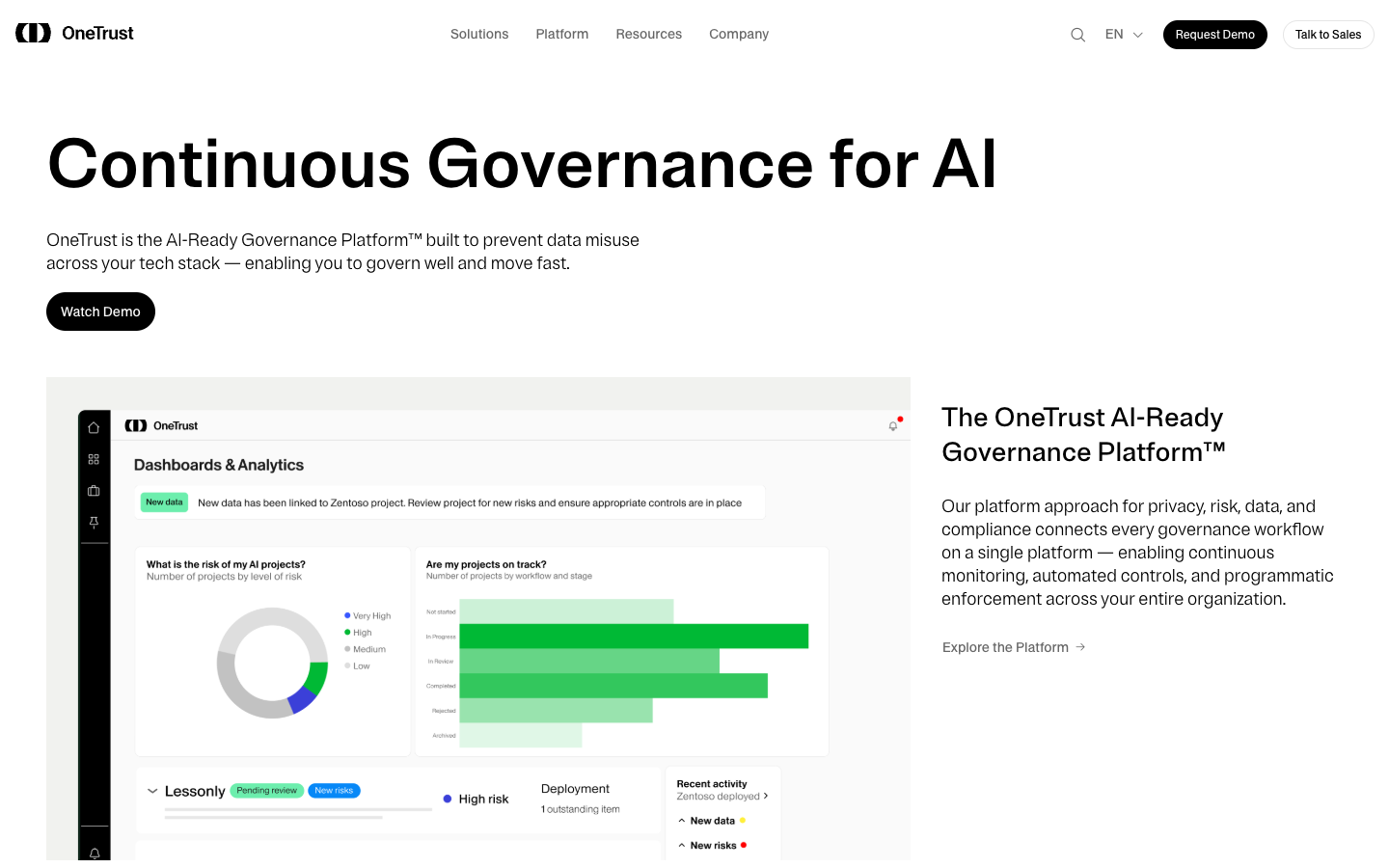
OneTrust is the enterprise standard for third-party risk management. It’s comprehensive, highly configurable, and sized for organizations with a dedicated GRC function. If you need 50+ built-in control frameworks, conditional-logic assessment workflows, and role-based dashboards that produce board-level reporting, OneTrust delivers.
The tradeoff is complexity. OneTrust is not a tool you configure in a weekend. It takes real implementation effort, internal ownership, and in most cases, a dedicated vendor risk program to run it properly. The AI-powered data collection that claims to accelerate assessments by up to 70% is genuinely useful at scale, but you need the vendor volume to justify it.
For smaller companies, the support model has been a documented pain point. The platform is optimized for enterprise buyers, and the support structure reflects that.
“
After a domain change, I lost account access and spent 45+ days unable to regain entry. Despite being a paying customer, I've been caught in a loop with no way to log in. I strongly discourage smaller companies from using OneTrust due to inadequate support structures for non-enterprise clients.
★☆☆☆☆Nicolas C.· CEO · 2–10 employees
Via Capterra ↗Key features:
- Centralized third-party inventory with vendor profiles
- Automated risk assessments with pre-built or custom templates and conditional logic
- 50+ built-in control frameworks, plus custom framework imports
- Rules-based workflow automation for risk mitigation and stakeholder assignment
- Real-time vendor monitoring with automated reassessment triggers
- Role-based compliance dashboards and exportable PDF reports
- AI-powered data collection (accelerates assessments by up to 70%)
Pros of OneTrust
- Comprehensive framework coverage across 50+ standards
- Battle-tested at enterprise scale; large organizations know how to buy and run it
- AI-accelerated assessments genuinely reduce manual work at high vendor volumes
Cons of OneTrust
- Complex to implement and maintain; not realistic for small teams without a GRC function
- Support structure is enterprise-first; SMB users have reported significant gaps
- Pricing is opaque and enterprise-only; no public tiers
Pricing: Contact only. Pricing scales by admin user count and third-party inventory size.
Best for: Mid-to-large enterprises with dedicated GRC teams needing a comprehensive multi-module platform covering vendor risk, privacy, and compliance.
3. ComplyJet
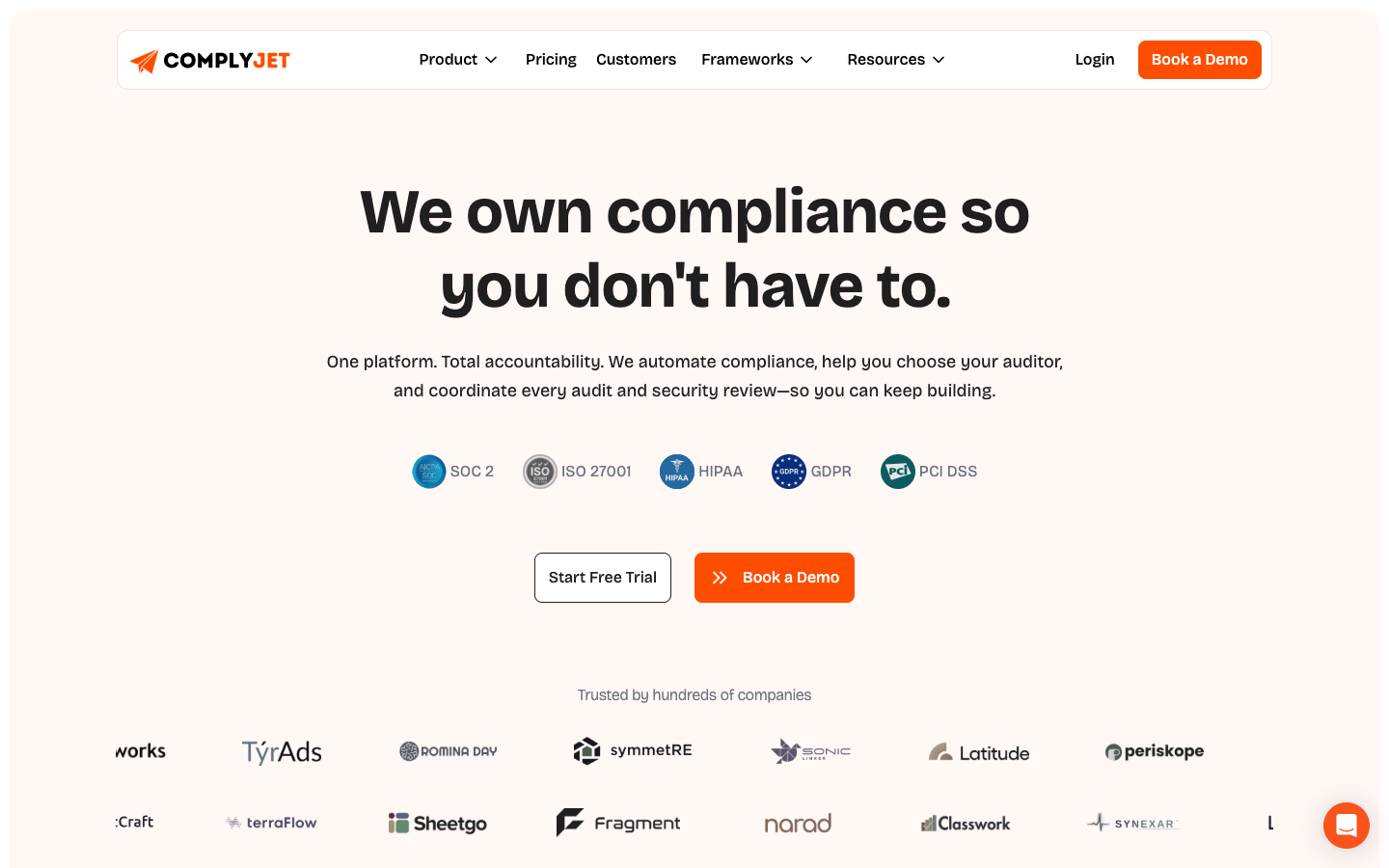
ComplyJet is a compliance automation platform for early-stage startups, and vendor risk management is part of the platform, not a paid add-on. That’s the main practical difference from tools like Vanta or Drata: you’re not buying a compliance platform and then paying again for vendor risk features on top. The two programs run together from day one.
The platform covers the core vendor risk workflow: a centralized vendor inventory, customizable security questionnaires with automated follow-ups, risk scoring and tiering to prioritize where you focus, remediation tracking, and framework-mapped vendor controls for SOC 2, ISO 27001, and HIPAA. There are 350+ integrations for continuous monitoring and evidence collection. A team guides you through the process, so if you’re doing this for the first time, you’re not left to figure out what “adequate vendor assessment” means on your own.
Pricing is publicly listed and flat: $5,000/year for a single framework (e.g. SOC 2 or ISO 27001), $8,000/year for two frameworks (e.g. HIPAA + SOC 2). It’s priced per company, not per seat. The cost stays the same whether you have 10 people or 50.
This isn’t the right tool if you’re managing hundreds of vendors across a mature TPRM program. It’s built for teams doing compliance for the first time who want vendor risk handled inside the same workflow, without a separate tool to buy, implement, and maintain.
Key features:
- Centralized vendor inventory with risk classifications
- Customizable security questionnaires with automated follow-ups
- Risk scoring and tiering for vendor prioritization
- Remediation tracking with task assignment
- Framework-mapped vendor controls for SOC 2, ISO 27001, and HIPAA
- AI-assisted policy drafting
- 350+ integrations for continuous monitoring
- Trust Center for sharing security posture with prospects
Pros of ComplyJet
- Compliance and VRM in one platform; no add-on costs
- Flat per-company pricing: predictable regardless of headcount
- Team-guided process; you’re not left to configure and run this alone
- Publicly listed pricing; no sales call required to understand the cost
Cons of ComplyJet
- Better suited to early-stage companies than mature enterprise TPRM programs
- Smaller vendor volume and fewer enterprise workflow features than dedicated TPRM platforms
“
The platform makes it simple: it splits the work into four buckets with clear, bite-sized tasks we could fit into our routine. No sales gauntlet or upselling. The clearest, most sensible option.
Artur G.· CTO · Symmetre
Via complyjet.com ↗
Pricing: $5,000/year (single framework), $8,000/year (two frameworks). Flat per company, not per seat.
Best for: Early-stage startups (<50 employees) pursuing their first SOC 2 or ISO 27001 certification who want vendor risk management built into their compliance program.
4. Panorays
Panorays takes a different approach from most VRM tools. Instead of relying on questionnaires alone, it combines automated questionnaire workflows with external attack surface scanning, giving you both the vendor’s self-reported security posture and an independent view of their actual digital footprint. For security teams that don’t fully trust questionnaire-only results, that outside-in scan adds real signal.
The platform covers the full vendor lifecycle: onboarding, inherent risk scoring (Risk DNA assessments), continuous monitoring, automated remediation plans, and Nth-party visibility into your vendors’ vendors. It’s recognized as a Forrester Leader in Cybersecurity Risk Rating Platforms (Q2 2024), which reflects the maturity of the external scanning capabilities. With 4.5/5 across 52 reviews, it’s well-regarded, though the review volume is smaller than some competitors.
The pricing is not startup-friendly. Entry level starts around $30,000/year for 50 to 150 vendors, which puts Panorays in mid-market territory. If you have under 50 vendors and just need to satisfy SOC 2 auditor requirements, this is more platform than you need.
“
Working with Panorays was a definite step forward in terms of how we now check our vendors' cybersecurity. We saved time and got a more thorough view of our cyber posture, and were able to undergo accreditation processes faster with their reports. The customizable security questionnaires, external scanning speed and thoroughness, and responsive customer service were standout strengths.
★★★★★Ido I.· CTO · Computer Software company
Via Capterra ↗Key features:
- Supply chain discovery: uncovers hidden third- and Nth-party dependencies
- Risk DNA assessments with context-based risk scoring against industry standards
- External attack surface monitoring: independent scan of vendor digital footprints
- Smart questionnaires, automatically tailored per vendor
- Continuous monitoring with automated alerts on vendor security changes
- Automated remediation plans with centralized vendor collaboration
- Nth-party risk visibility across the full supply chain
Pros of Panorays
- Questionnaire + outside-in attack surface view gives a more complete picture than either alone
- Nth-party visibility catches dependencies your questionnaire process would miss
- Forrester-recognized; strong in regulated industries (DORA, NIS2, ISO 27001)
Cons of Panorays
- Starting price (~$30K/yr) is too high for most early-stage startups
- Smaller review community (52 reviews) than Vanta or Drata
- External scan focus may be more than needed for basic SOC 2 vendor compliance
Pricing: Custom. Estimated $30,000–$60,000/year for 50–150 vendors; $60,000–$150,000/year for 150–500 vendors.
Best for: Mid-market organizations managing large vendor portfolios who want questionnaire automation and external attack surface monitoring in a single platform.
5. Venminder
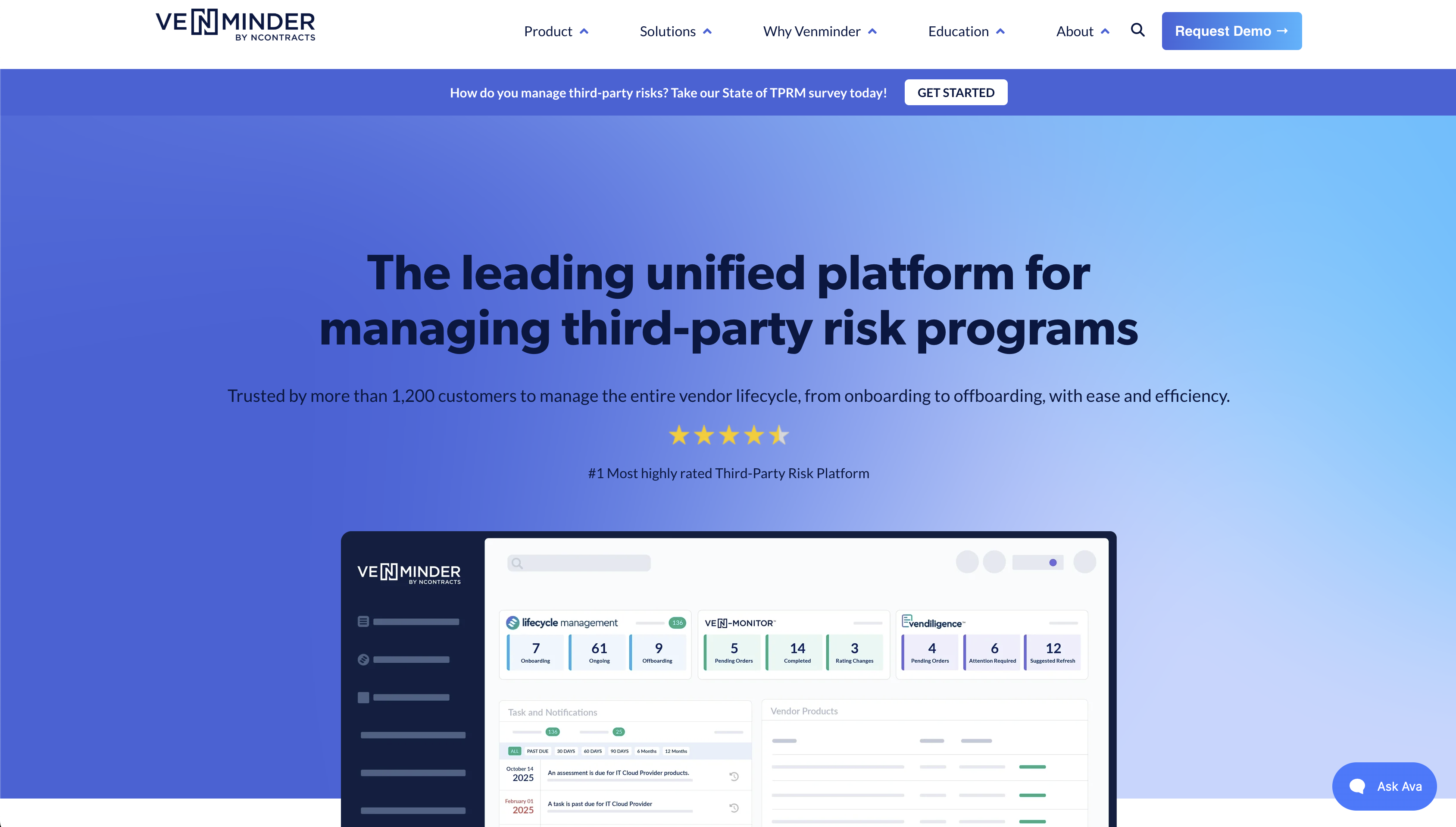
Venminder is one of the most purpose-built TPRM platforms on this list. It covers the full vendor lifecycle from onboarding to offboarding and has a differentiator that most VRM tools don’t: Vendiligence, an outsourced expert assessment service where Venminder’s in-house analysts evaluate vendors on your behalf across areas like cybersecurity, financial health, and business continuity. For teams that don’t have internal capacity to run thorough vendor assessments, this is meaningful.
The platform has 4.7/5 across 115 reviews, which is strong. Common praise is for customer support and the single-source-of-truth vendor register.
Two things worth flagging: first, pricing is contact-only with a Professional/Enterprise tier structure and a mandatory flex fund minimum on top of the annual fee, making total cost unpredictable until you’re deep in the sales process. Second, Venminder was acquired by Ncontracts in August 2024 and now operates as part of a broader compliance platform for financial institutions. Existing customers haven’t reported major disruption, but buyers should factor the acquisition into any long-term platform decision.
Venminder skews heavily toward regulated financial services companies: banks, credit unions, fintechs, and healthcare organizations. If you’re a B2B SaaS startup without regulatory obligations beyond SOC 2, it’s probably more tool than you need.
“
One of my favorite benefits of Venminder is the customer support. It is easy to get ahold of a representative whenever I have any questions. The best thing I like is that it is a single source of truth for all vendors, risk and compliance — removing the panic of audit prep.
★★★★★Verified User· Compliance Professional
Via G2 ↗Key features:
- Full vendor lifecycle management: onboarding, ongoing oversight, offboarding
- Vendiligence: outsourced expert control assessments from Venminder analysts
- Ven-monitor: continuous monitoring across cybersecurity, financial health, ESG, and business continuity
- Customizable questionnaire library
- Contract management with centralized tracking
- 4th-party risk assessment capability
- SLA and oversight workflow management
Pros of Venminder
- Vendiligence outsourced assessments remove the burden from internal teams
- 4.7/5 rating; consistently praised for support quality
- 4th-party risk assessment covers exposure from your vendors’ vendors
Cons of Venminder
- Pricing not transparent; mandatory flex fund minimum adds to total cost unpredictably
- Acquired by Ncontracts (August 2024); long-term roadmap and support model in transition
- Heavy finserv focus; less relevant for general SaaS compliance programs
Pricing: Contact only. Professional and Enterprise tiers, plus optional Vendiligence assessment packages (flex fund minimum required).
Best for: Financial services organizations (banks, credit unions, fintechs) that need a full-service TPRM platform with outsourced expert assessment capability.
6. ProcessUnity
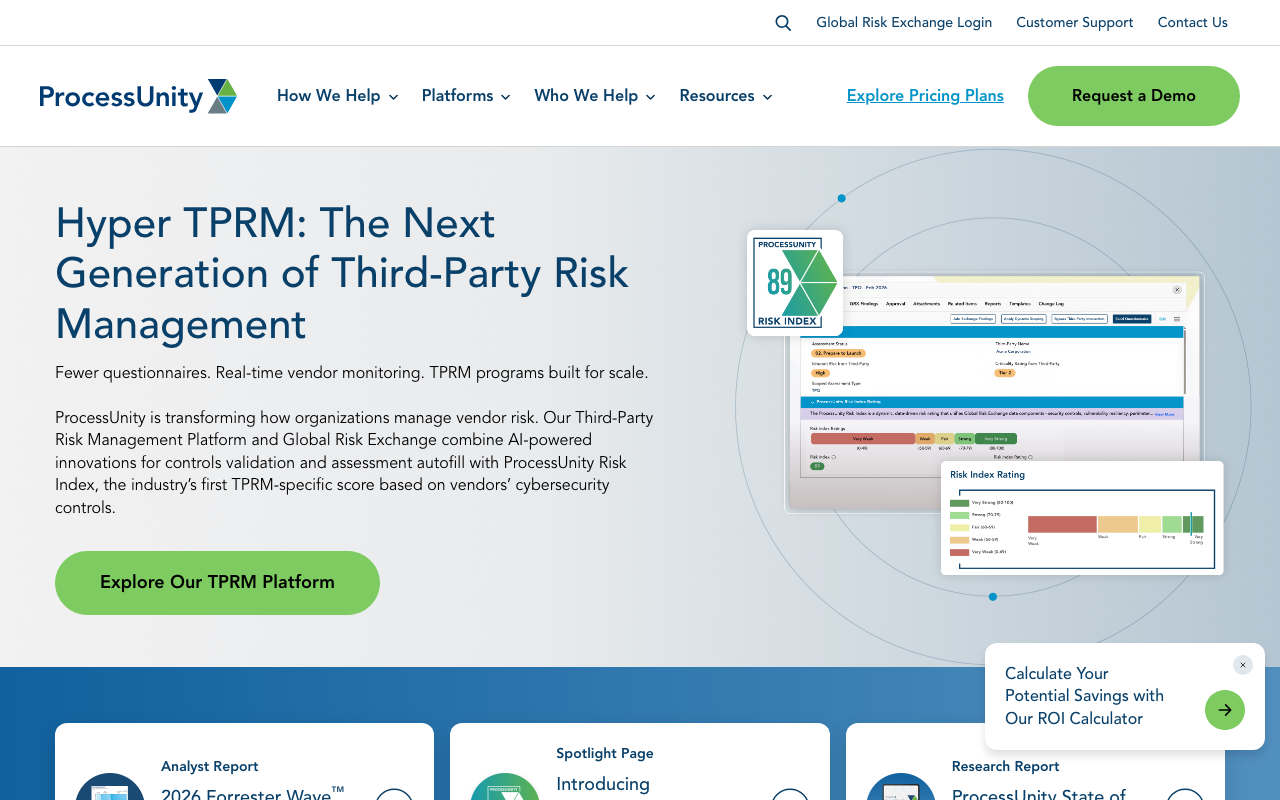
ProcessUnity has a differentiator worth paying attention to: the Global Risk Exchange, a database of 18,000+ completed vendor assessments and 370,000+ curated vendor profiles. If a vendor you’re assessing has already been through an assessment on the platform, you may not need to send them a questionnaire at all. For organizations managing large vendor portfolios where questionnaire fatigue is a real problem (vendors ignoring your outreach, assessments sitting incomplete for months), this is a genuine operational benefit.
The platform was named a Leader in the 2026 Forrester Wave for TPRM, which reflects its maturity in the enterprise segment. The AI Evidence Evaluator can reduce document review time from days to seconds. Notable customers include Blackstone, Live Nation, and ICON plc.
The entry-level VRM Essential Edition starts at $15,000/year for organizations under $250M in revenue, which makes it one of the more accessible enterprise TPRM platforms on a per-dollar basis. That said, admin setup has a real learning curve, and minor customizations often require paid professional services rather than being self-service. Plan for implementation time.
“
User friendly, Easy to implement, Easy to customize. Strong capabilities in reporting and automation. Drawbacks include lag between updates and overlapping patches.
★★★★☆Prajwal D.· Finance · Banking industry
Via SoftwareReviews (Info-Tech) ↗Key features:
- Global Risk Exchange: 18,000+ completed assessments, 370,000+ vendor profiles
- AI Evidence Evaluator: reduces document review from days to seconds
- ProcessUnity Risk Index: TPRM-specific cybersecurity controls scoring
- Pre-built and custom assessment questionnaires (SIG Lite/Core, custom TPQ)
- Real-time third-party monitoring
- Vendor performance reviews and SLA tracking
- Remediation workflow management
- Custom API connections and integrations with security ratings providers
Pros of ProcessUnity
- Global Risk Exchange reduces questionnaire burden when vendors are already in the database
- Forrester Wave Leader 2026; one of the most mature enterprise TPRM platforms
- Entry-level tier at $15K/yr is more accessible than comparable enterprise TPRM tools
Cons of ProcessUnity
- Steep admin learning curve; configuration is not self-serve
- Minor changes to workflows often require paid professional services
- Not the right fit for teams that don’t have internal TPRM program ownership
Pricing: VRM Essential Edition from $15,000/year (organizations <$250M revenue). Enterprise pricing on request.
Best for: Enterprise organizations managing large vendor populations who want to reduce questionnaire burden using pre-completed assessments.
7. Prevalent
Prevalent is a comprehensive enterprise TPRM platform, now part of Mitratech following its acquisition in October 2024. It covers the widest set of vendor risk use cases on this list: 800+ assessment templates, AI-assisted questionnaire completion, a global vendor intelligence network with pre-completed assessments, continuous monitoring across cyber, compliance, and operational dimensions, and expert managed services for organizations that want a vendor alongside the software.
The 50+ regulatory framework coverage includes NIST, DORA, NIS2, GLBA, and supply chain-specific regulations like the German LkSG and Canada’s S-211. For organizations operating across multiple jurisdictions with complex regulatory obligations, that breadth matters.
With 4.2/5 across 124 reviews, Prevalent scores slightly lower than some competitors, which reflects the complexity involved in implementing and running a platform of this scope. The pricing is enterprise-only, with estimates starting at $50,000/year and going well above $250,000 for large deployments. The Mitratech acquisition means Prevalent now sits inside a broader GRC portfolio; buyers should evaluate whether that continuity represents stability or risk depending on their situation.
“
Mitratech's TPRM partnership has been instrumental in addressing our evolving client needs. We successfully deployed the solution across approximately 144 critical vendors from a base of 150 clients. The fastest and smoothest implementation we have ever seen, with quick time to value. The platform's flexibility supports both initial assessments and continuous vendor monitoring, though it requires organisational commitment and team capacity to maximise its powerful capabilities.
★★★★★Adam C.· Director - Governance, Risk and Compliance · Information Technology and Services
Via Capterra ↗Key features:
- 800+ assessment templates with AI-assisted completion
- Global vendor intelligence network with pre-completed assessments
- Continuous monitoring: cyber, compliance, and operational
- Vendor lifecycle management: onboarding through offboarding
- 4th-party risk assessment
- Managed services option: Prevalent handles assessments on your behalf
- 50+ regulatory frameworks including DORA, NIS2, NIST 800-161, LkSG
Pros of Prevalent
- 800+ templates and managed services remove most of the internal workload
- Broadest regulatory framework coverage on this list
- Pre-completed assessment network reduces vendor questionnaire fatigue
Cons of Prevalent
- Enterprise-only pricing ($50K+ to start); not accessible for most startups or SMBs
- Acquired by Mitratech (October 2024); product continuity uncertain long-term
- Requires organizational commitment and a dedicated team to run effectively
Pricing: Contact only. Estimated $50,000–$250,000+/year depending on modules and vendor count.
Best for: Large enterprises with mature TPRM programs across multiple regulatory jurisdictions needing managed services alongside the platform.
8. Drata

Drata is a GRC platform with 8,000+ customers and one of the highest user ratings on this list: 4.8/5 across 1,153 reviews. Its approach to vendor risk management centers on AI agents that autonomously collect vendor documents, evaluate them against your defined criteria, flag gaps, and facilitate follow-up without manual intervention.
If your biggest pain point is the time spent chasing vendors for documentation, Drata’s agentic TPRM workflow is worth looking at. You can read more in our full Drata review.
The platform covers the full vendor risk workflow: a third-party directory with assessment history, AI-generated risk summaries from SOC reports and questionnaires, cross-framework mapping for SOC 2, ISO 27001, GDPR, HIPAA, and more, and executive-ready reporting. The Vendor Source Sync integrates with procurement systems and app discovery tools to build your vendor inventory automatically.
There’s a pricing caveat worth flagging explicitly. Vendor risk management is a paid add-on in Drata, not included in the base compliance plan. A reviewer noted being surprised by the cost during procurement. If you’re buying Drata for compliance and expecting VRM to be included, confirm the scope in writing before signing.
“
Newer risk management features are rather costly add-ons and we weren't made aware of these costs during the procurement process. The vendor risk management module helps us have a central place to not only track vendors and risk, but assign tasks to executives and employees who need to review them.
Verified User· SMB
Via G2 ↗Key features:
- Agentic TPRM: AI agents collect vendor documents, evaluate criteria, and flag gaps
- Vendor Source Sync: integrates with procurement systems and app discovery tools
- AI Risk Summaries: synthesizes SOC reports, questionnaires, and vendor evidence
- Third-Party Directory: assessment history, evidence, and risk classification per vendor
- One-click vendor risk assessment with criteria-based evaluation
- Cross-framework control mapping (SOC 2, ISO 27001, GDPR, HIPAA, PCI DSS, DORA)
- Executive-ready compliance reports with evidence citations
Pros of Drata
- Agentic AI reduces manual vendor follow-up; genuinely saves hours per assessment cycle
- 4.8/5 rating across 1,153 reviews is the highest on this list
- 300+ integrations; multi-framework coverage in a single platform
Cons of Drata
- VRM is a paid add-on, not included in base plan; total cost higher than it first appears
- Pricing is custom and not published; buyers report unexpected costs during procurement
- Better suited to scaling companies than sub-10-person teams
Pricing: Custom across all tiers. VRM module is a paid add-on. Real-world costs reported at $10,000–$45,000/year total depending on company size and modules.
Best for: Scaling startups and mid-market companies needing a unified GRC and TPRM platform with strong AI automation.
9. Secureframe
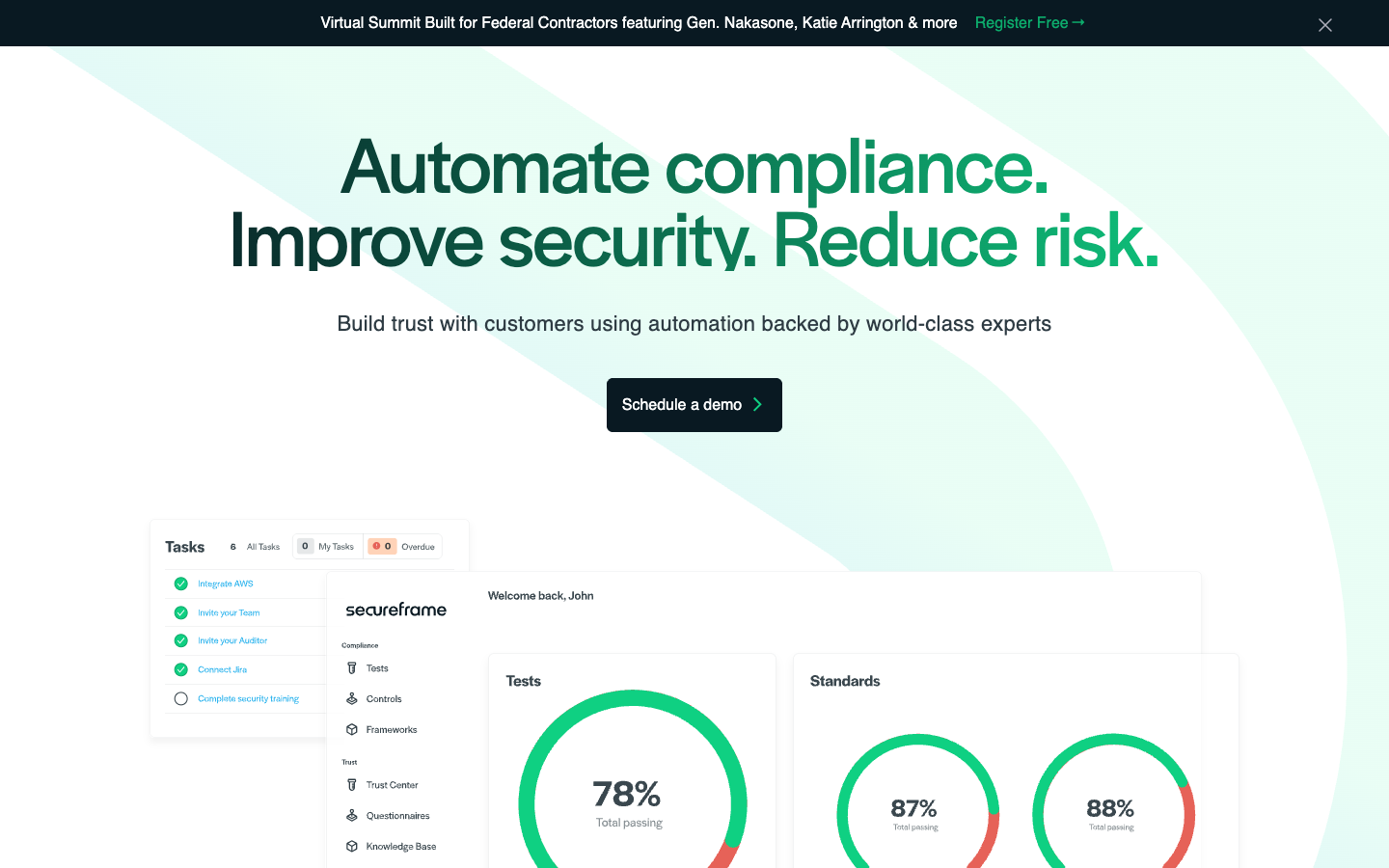
Secureframe is a compliance automation platform with 6,000+ customers and a vendor risk module built into its core platform. The standout feature for VRM is the AI-powered questionnaire automation: Comply AI reads SOC 2 reports and vendor policy documents and extracts answers to questionnaire items automatically, reducing the back-and-forth with vendors considerably.
Shadow IT detection via SSO-based app monitoring catches vendors your team has added without going through a formal vendor review process. Fourth-party risk assessments cover exposure from your vendors’ vendors. These are features you’d expect from a dedicated VRM tool, wrapped inside a compliance platform that also handles SOC 2, ISO 27001, HIPAA, and PCI DSS evidence collection.
The pricing structure has three tiers (Fundamentals, Complete, Defense), all contact-only. Advanced vendor risk features, including questionnaire automation and detailed access reviews, require the Complete tier. If you’re on Fundamentals for cost reasons, the VRM capabilities are limited.
“
Supplier and vendor management/form creation are really easy to use. Everything is all in one place.
★★★★★Calli B.· Account Executive · Financial Services
Via Capterra ↗Key features:
- Centralized vendor dashboard with risk scoring and recurring review scheduling
- AI questionnaire automation: extracts answers from SOC 2 reports and policy documents
- Shadow IT detection via SSO-based app access monitoring
- Fourth-party risk assessment capability
- Custom risk scores, tags, and assessment templates
- Vendor access reviews (Complete tier)
- 300+ integrations for continuous monitoring
- Trust Center for compliance posture sharing
Pros of Secureframe
- AI questionnaire automation is genuinely useful; reduces manual extraction from vendor documents
- Shadow IT detection catches vendors that bypassed your procurement process
- High rating across a large review base (792 reviews)
Cons of Secureframe
- Advanced VRM features require the Complete tier; not fully accessible on Fundamentals
- Pricing is contact-only; no way to self-qualify cost before a sales conversation
- VRM is a module, not the core product; depth is lighter than dedicated TPRM platforms
Pricing: Custom across Fundamentals, Complete, and Defense tiers. Advanced VRM features require Complete tier.
Best for: Startups pursuing SOC 2 or ISO 27001 that want vendor assessments handled inside their existing compliance platform without buying a separate tool.
10. Whistic
Whistic operates on a model most VRM tools don’t: it serves both sides of the security questionnaire process. Your team uses it to assess vendors. And if your vendors use Whistic’s Trust Center, they can share their pre-built security profile with you directly, eliminating the questionnaire exchange entirely. For organizations that send and receive a lot of security questionnaires (you’re assessing your vendors and your customers are assessing you), this bilateral approach is a genuine efficiency gain.
The Assessment AI claims 96% accuracy in automating assessment tasks, with confidence scoring and document citations so reviewers can verify the output. SOC 2 summary analysis automatically distills control coverage from vendor SOC 2 reports. Notable customers include Uber, Spotify, Amazon, Google, and Airbnb, which speaks to the trust the platform has built in security-conscious enterprise environments.
With 4.6/5 across 52 reviews, Whistic is well-regarded. The review count is smaller than Vanta or Drata, which reflects its more specialized positioning. It’s not a broad GRC platform; it’s focused specifically on the questionnaire and Trust Center workflow.
“
I find Whistic easy to search and see potential for many more service providers to be connected to it. I appreciate the overview of relevant SOC 2 reports, periodic security assessments, and information security policies that can all be found in one place.
★★★★☆Verified User· Security / Compliance professional · SMB
Via G2 ↗Key features:
- Assessment AI: automates up to 90% of assessment tasks with 96% accuracy and document citations
- Trust Center: centralized hub for managing and sharing security and compliance documentation
- Trust Center Exchange: access pre-completed vendor security profiles
- SOC 2 Summaries: AI-generated control summaries from vendor SOC 2 reports
- Smart Response: automated questionnaire completion using stored documents
- Continuous breach monitoring with structured alerts
- 50+ standardized assessment frameworks (Assess tier)
Pros of Whistic
- Two-sided model reduces questionnaire burden for both sides of the relationship
- Assessment AI with confidence scoring adds transparency to automated extraction
- Strong enterprise customer logos; Uber, Spotify, Google, Amazon all trust it
Cons of Whistic
- Smaller company (~55 employees); less integration depth than Vanta or Drata
- Not a full GRC platform; compliance evidence collection requires separate tooling
- Pricing is entirely contact-only across all tiers
Pricing: Contact only. Three packages (Core, Assess, Trust Center) plus add-ons.
Best for: Mid-market and enterprise teams that frequently send and receive security questionnaires and want to reduce the overhead on both sides.
How to choose vendor risk management software
You’ve read through ten options. Here’s how to narrow it down without spending three months in demos.
Free Demo
Compliance + vendor risk in one platform
SOC 2, ISO 27001, HIPAA — VRM included in every plan. No add-on fees.
Standalone VRM vs. GRC platform with a VRM module
If you’re already running a compliance program for SOC 2 or ISO 27001, buying a separate VRM tool means maintaining two systems, syncing data manually, and explaining to your auditor why your vendor inventory lives somewhere different from your compliance evidence. A GRC platform with VRM built in avoids that friction.
If you have a dedicated, mature third-party risk program with hundreds of vendors, a complex assessment workflow, and a full-time risk team, a standalone TPRM platform (ProcessUnity, Prevalent, Venminder) gives you more depth than most GRC tools offer.
Watch for one thing: some GRC platforms advertise “vendor risk management” on the product page but charge for it separately as a module. Vanta and Drata both do this. Confirm whether VRM is included in the base plan before signing.
How many vendors you’re actually managing
The number matters more than it seems:
- Under 50 vendors: Questionnaire automation, risk scoring, and an audit trail is enough. Don’t buy enterprise TPRM software for 30 vendors.
- 50 to 300 vendors: You need automated workflows, tiering, and continuous monitoring. Mid-market tools like Panorays or platform-based tools like Secureframe and ComplyJet cover this well.
- 300+ vendors: Pre-completed assessment databases (ProcessUnity’s Global Risk Exchange, Prevalent’s vendor intelligence network) start to justify their cost. Questionnaire fatigue is a real problem at this scale.
Questionnaire-first vs. continuous monitoring
These are genuinely different approaches to vendor risk:
Questionnaire-first tools (Venminder, ProcessUnity, Whistic) build your vendor risk picture from what vendors tell you. Good for regulatory compliance evidence. Simpler to run. Auditors understand it.
Continuous monitoring tools (Panorays, Vanta) surface changes in vendor risk posture between annual reviews, through external scanning or ongoing data feeds. Better for catching incidents as they happen. More complex to configure.
Most mature programs use both. If you’re starting out, questionnaire-first is the right starting point. Add monitoring as the program matures.
Teams that need deeper, sourced research on a specific vendor (ownership structure, litigation history, sanctions exposure) beyond what a questionnaire or scan surfaces typically use a dedicated research agent like Grep alongside their VRM platform rather than instead of it.
Pricing model and total cost of ownership
Per-vendor pricing is the most common structure in this market, and it scales poorly. A vendor list that starts at 30 grows to 80 within two years for most companies. Per-vendor pricing means your cost grows with it.
Flat pricing per company (ComplyJet charges the same whether you have 10 people or 50, regardless of vendor count) keeps cost predictable. If you’re early-stage with limited runway, the billing model matters as much as the feature set.
The other cost to track: add-on fees. Vanta charges ~$11K/year for the VRM module. Drata charges separately for TPRM. If you see “vendor risk management” on a pricing page, ask whether it’s included or a billable add-on.
Buying by stage
If you’re a startup pursuing SOC 2 or ISO 27001 for the first time, ComplyJet includes vendor risk management in every plan: flat pricing, 350+ integrations, and a team that guides you through the process. Book a free demo.
- Startup / first compliance program: ComplyJet, Secureframe, or Vanta. You want VRM as part of your compliance workflow, not a separate purchase. Prioritize tools where pricing is predictable and setup doesn’t require a dedicated risk manager.
- Scaling / 50–500 employees: Drata, Panorays, or Whistic. More automation, multi-framework support, and dedicated vendor risk workflows. Budget for VRM as a module if you go the GRC platform route.
- Enterprise / 500+ employees or regulated industries: OneTrust, ProcessUnity, Prevalent, or Venminder. You need dedicated TPRM depth, large vendor assessment coverage, and in many cases, managed services alongside the software.
Frequently asked questions
What is vendor risk management software?
Vendor risk management software helps organizations identify, assess, monitor, and manage the risks introduced by their third-party suppliers and service providers. It replaces manual spreadsheets and ad-hoc email questionnaires with a structured system: a centralized vendor inventory, automated questionnaire workflows, risk scoring, and an audit trail that proves the work happened.
For companies comparing vendor risk management software reviews, the key questions are whether VRM is included in the base plan, how questionnaire automation actually works, and what evidence it produces for auditors.
How do you choose vendor risk management software?
Start with your vendor count, your compliance framework requirements, and whether you’re already on a GRC platform. Under 50 vendors doing SOC 2 for the first time? A GRC platform with VRM built in is almost always the right call. Managing hundreds of vendors across multiple regulatory frameworks? A dedicated TPRM platform gives you more depth. The How to Choose section above walks through each decision point in detail.
What’s the difference between VRM and TPRM?
Vendor risk management (VRM) and third-party risk management (TPRM) describe the same function. TPRM is the broader regulatory and enterprise term. VRM is more common in startups and mid-market companies. You’ll see both used interchangeably across the tools in this list, with no meaningful difference in what they actually do.
Do startups need vendor risk management software?
Yes, if you’re pursuing SOC 2 or ISO 27001 for startups. Both frameworks require evidence that you’ve assessed the risks your vendors introduce. Without a system, most teams scramble to compile questionnaire responses at audit time and come up short. You don’t need enterprise TPRM software: a lightweight vendor inventory with questionnaire tracking and risk scoring is enough for a 20-person team’s first audit cycle.
What should a vendor security questionnaire include?
A standard vendor security questionnaire should cover: security policies and governance, access controls and identity management, encryption at rest and in transit, incident response and breach notification, business continuity and disaster recovery, data handling and subprocessor disclosures, and fourth-party dependencies. Standard frameworks like SIG Lite and CAIQ cover these domains systematically. Good VRM software comes with pre-built templates aligned to these frameworks, so you’re not building questionnaires from scratch.
Final thoughts
Most early-stage companies don’t need enterprise TPRM software. They need a vendor inventory, a questionnaire workflow that doesn’t require manual chasing, and evidence their auditor can read. The tools that serve that need well are the GRC platforms with VRM built in: the question is whether VRM is included in the base price or charged as a separate module.
Free Demo
Starting your first compliance program?
Flat pricing, 350+ integrations, a team that guides you through every step.
If you’re pursuing SOC 2 or ISO 27001 for the first time and want vendor risk management handled inside the same platform, without an add-on bill or a separate tool to manage, ComplyJet is worth looking at: flat pricing, 350+ integrations, and a team that guides you through the process.
If you’re a startup pursuing SOC 2 or ISO 27001 for the first time, ComplyJet is built for you: flat pricing, 350+ integrations, and a team that guides you through compliance from start to finish.