.svg)

You’ve decided to get SOC 2. Now you’re looking at a dozen SOC 2 compliance software platforms, all claiming to automate the process, none of them willing to show you a price without a demo call. Vanta, Drata, Sprinto, Secureframe: from the outside they all look similar. They’re not.
The differences that actually matter (how much is genuinely automated versus manual, what happens to pricing in year two, whether someone drives the process for you or hands you a dashboard and good luck) are not obvious from a features page.
I’ve reviewed 10 of the most widely used SOC 2 compliance platforms, comparing real pricing where it’s available, honest pros and cons, and who each is actually built for.
Here’s what I’ll cover:
- What separates strong platforms from average ones
- A quick comparison across all 10 tools with real pricing where available
- Detailed reviews with honest pros, cons, and who each is built for
- A buying guide by company size
What SOC 2 compliance software actually does
Before these tools existed, getting SOC 2 ready meant months of manual work: spreadsheets tracking which controls were in place, evidence folders stuffed with screenshots, and quarterly scrambles to pull audit artefacts together before an auditor showed up. If you're new to the framework itself, our SOC 2 compliance guide is a good starting point before you shop for software.
Why it matters
Knowing which controls apply, how to remediate gaps, and how to prepare for an auditor: that's where support models vary enormously between platforms.
SOC 2 compliance software solves this by integrating directly with your cloud stack. Connect your AWS account, GitHub, GSuite, and other tools, and the platform continuously pulls the evidence your auditor will ask for: access logs, change management records, security configurations, employee training completions. Instead of collecting this manually, controls are always monitored and evidence is always current.
What the software doesn’t solve on its own is judgment. Knowing which controls apply to your infrastructure, how to run a SOC 2 gap analysis and remediate what it finds, and how to prepare a first-time audit team for what an auditor actually scrutinises: that’s where support models vary enormously. Some platforms hand you a dashboard and a knowledge base. Others give you a compliance expert who drives the process. That gap is one of the most important things to understand before you sign.
How we picked the top 10 SOC 2 compliance software tools
I evaluated these tools across six criteria:
Watch out
Most platforms hide pricing behind a sales process — and year-2 renewals on Vanta and Drata commonly come in 30–50% above the initial contract.
- Automation depth: how much evidence collection is genuinely automated versus manual uploads
- Integration breadth: number and quality of cloud tool integrations (AWS, GitHub, GSuite, and others)
- Time to audit-ready: how fast teams actually reach audit readiness, based on user reviews and market reputation
- Support model: self-serve with software access versus full compliance ownership where the vendor drives the outcome
- Pricing transparency: public pricing versus opaque sales process with surprise year-2 increases
- User reviews: real-world signal from verified buyers across G2, Capterra, Reddit, and peer forums
Quick comparison table
| Tool | Best for | Starting price | Standout feature |
|---|---|---|---|
| Vanta | Series B+ and enterprise | Contact | 400+ integrations |
| Drata | Mid-market SaaS (50-250 employees) | ~$7.5K/yr | AI-native GRC |
| ComplyJet | Seed-Series A startups | From $5K/yr | End-to-end compliance ownership |
| Sprinto | SaaS startups, no per-user fees | ~$7K/yr | No per-user pricing |
| Secureframe | First SOC 2, guided experience | Contact | 300+ integrations |
| Scrut Automation | Fast audit readiness | ~$15K/yr | Highest-rated in category |
| Thoropass | One-vendor audit and software | ~$14.5K/yr | Built-in auditor network |
| Scytale | Multi-framework startups | Contact | 60+ frameworks |
| OneTrust | Enterprise GRC, multi-framework programs | Contact | Collect once, comply many (50+ frameworks) |
| Oneleet | Startups wanting security + compliance bundled | Contact | Pen testing built in |
ComplyJet owns your compliance program end-to-end: policies, controls, evidence collection, and your SOC 2 or ISO 27001 audit. You get the outcome, not just the software. Book a free demo to see it in action.
KEEP READING
Not sure where to start before you shop for software?
Run through the 10-step SOC 2 checklist first.
The 10 best SOC 2 compliance software in 2026
1. Vanta

Vanta is the category-defining platform for SOC 2 compliance. It has held the number one spot in G2’s Security Compliance category for 14 consecutive quarters, and for many enterprise buyers, it is simply the default answer. With 400+ integrations, it is the broadest platform in the market. Connect your cloud tools and evidence collection runs itself.
For Series B and beyond, Vanta makes sense: the brand recognition carries weight in enterprise procurement, the integration depth covers even unusual tech stacks, and the platform has been battle-tested at scale. The AI Agent for policy generation and questionnaire automation, built to handle RFP responses and security reviews, saves meaningful time as the compliance program matures.
Where it gets complicated is pricing. Vanta does not publish its prices, and the custom quoting process tends to produce numbers that start at $15-30K per year for SMB and climb quickly. More importantly, year-2 renewals frequently come in 30-50% higher than the initial contract. Multiple reviewers flag this specifically. It is not a dealbreaker for teams with budget, but it is something to nail down in writing before you sign.
“
Vanta made our SOC 2 audit significantly easier by automating evidence collection across all our cloud tools. The integrations with AWS and GitHub just worked out of the box.
★★★★☆Verified User· SMB · 51–200 employees
Via G2 ↗Key features:
- AI Agent for policy generation and questionnaire automation
- 400+ integrations for automated evidence collection
- Continuous controls monitoring with real-time alerts
- Trust Center for sharing compliance status with customers
- User access reviews and vendor risk management
- Multi-framework support (SOC 2, ISO 27001, HIPAA, GDPR, PCI DSS, and more)
Pros of Vanta
- Broadest integration library in the category
- Strong brand recognition for enterprise procurement
- Clean UI with a clear audit readiness dashboard
Cons of Vanta
- No public pricing; year-2 renewals commonly 30-50% higher than year one
- Custom quoting can take weeks before you know the actual cost
- Overkill for early-stage teams who don’t need 400+ integrations
Pricing: No public pricing. Four tiers: Essentials, Plus, Professional, Enterprise. Median around $15-30K per year for SMB. Year-2 renewals commonly increase significantly.
Best for: Series B+ companies and enterprises with compliance budgets who want the market-leading brand and the broadest integration library.
2. Drata

Drata positions itself as the AI-native GRC platform, and it has earned that framing. Among mid-market SaaS companies pursuing multiple frameworks simultaneously, it has developed a reputation for clean engineering and the best auditor collaboration portal on the market. If your team has grown to where you need SOC 2 plus ISO 27001 and you want a platform that handles both without friction, Drata is a serious option.
The continuous control monitoring is solid, and the auditor portal means you are not emailing evidence packages back and forth when audit season arrives. Multi-framework support covers 12+ standards, and the policy management layer is well-built.
The trade-off is cost complexity. Drata’s base pricing starts around $7.5-15K per year, but each additional framework adds $3-10K per year on top. By the time you are running two or three frameworks, the contract looks very different from what the initial sales conversation suggested. Year-2 increases of 10-30% or more are common. Get the full picture of what you will pay in year two before signing.
“
Drata is well-built and the continuous monitoring gives us confidence our controls are always in check. The auditor collaboration feature made our first SOC 2 much smoother.
★★★★☆Verified User· SMB · 11–50 employees
Via G2 ↗Key features:
- AI-native compliance automation
- Continuous control monitoring
- Multi-framework support (12+ frameworks)
- Auditor collaboration portal
- Risk management and vendor risk management
- Policy management and employee training
Pros of Drata
- Clean interface, among the best in the category
- Excellent auditor collaboration portal
- Strong multi-framework support for growing compliance programs
Cons of Drata
- Per-framework add-on costs add up fast
- Pricing is opaque until deep in the sales cycle
- Year-2 increases of 10-30%+ are common
Pricing: Foundation $7.5-15K per year (1 framework, under 50 employees). Advanced $15-25K per year. Enterprise $25-100K+. Per-framework add-ons $3-10K each. Median around $25K per year.
Best for: Mid-market SaaS companies (50-250 employees) running multiple compliance frameworks simultaneously who want the best auditor collaboration portal.
3. ComplyJet
Most compliance platforms sell you software and leave you to convert it into a certification. ComplyJet owns the outcome instead. Gap assessment, policy drafting, evidence collection, auditor coordination, pre-audit checks: ComplyJet runs it. You stay involved at the decision points, but you are not the one doing the compliance work.
This matters most for teams doing compliance for the first time with no in-house expertise. The difference between having the software and having someone who knows what auditors actually scrutinise is significant. ComplyJet’s model is built around closing that gap. Their curated auditor network is also part of the product, not something you source separately after signing.
The platform covers everything you would expect: 350+ integrations for automated evidence collection, AI-assisted policy drafting across 25+ framework-ready templates, continuous controls monitoring, a Trust Center for sharing compliance status with enterprise prospects, and questionnaire automation. Pricing is public. Core is $5K per year (1 framework, up to 50 employees), Plus is $8K per year for 2 frameworks. Audit fees start from $3K via their network of independent accredited auditors.
The honest limitation: ComplyJet is built for early-stage teams. If you are at 200 employees managing five frameworks with a dedicated compliance team, you are past the profile they are optimised for.
“
ComplyJet allowed us to move much quicker than expected through the SOC 2 process by intuitively guiding us through the process we needed to complete. The ComplyJet team was always available for questions and very responsive to our specific needs.
★★★★★Andy B.· Director of Technology · Small-Business
Via G2 ↗Key features:
- End-to-end compliance ownership: ComplyJet runs the program, you get the outcome
- 350+ integrations for automated evidence collection
- AI-assisted policy drafting (25+ framework-ready policies)
- Continuous controls monitoring
- Trust Center for sharing compliance status with prospects
- Curated auditor network included
- Questionnaire automation and vendor risk management
Pros of ComplyJet
- Owns the compliance outcome end-to-end: you get the attestation, not just access to a tool
- Transparent public pricing with no surprise renewals
- Fastest path for first-time compliance teams with no in-house expertise
Cons of ComplyJet
- Less suited for teams that want to manage compliance entirely in-house
- Smaller brand name than Vanta or Drata (though 5.0/5 on user reviews)
Pricing: Core $5K per year (1 framework, up to 50 employees). Plus $8K per year (2 frameworks). Audits from $3K via independent accredited auditors.
Best for: Seed to Series A startups (1-50 employees) pursuing compliance for the first time to close enterprise deals, especially teams with no prior compliance experience.
CUSTOMER STORY
Narad, a GRC platform itself, picked ComplyJet
For its own SOC 2 attestation, instead of building it in-house.
4. Sprinto
Sprinto has the strongest peer validation of any startup-focused SOC 2 platform: 1,633 reviews at 4.8 stars. That is not a number you accumulate without consistently delivering for the companies it is built for. The platform is designed around SaaS startup workflows, with an intelligent control framework that adapts to how your infrastructure is actually set up rather than mapping you to a generic template.
One thing worth highlighting: Sprinto does not charge per user. In a market where many platforms price per seat, this becomes material as your team grows. Your compliance cost does not spike when you hire your 30th engineer.
The support model is good. The compliance manager assigned to your account is frequently cited in reviews as genuinely useful, not just a CSM who schedules check-ins. Time-to-audit-ready is consistently fast in peer reviews.
The one friction point most reviewers flag: the platform can feel complex when you first get in. There is a configuration phase that takes some getting used to, and a handful of integrations require manual setup. Once the initial setup is done, it runs well. Budget for the onboarding ramp.
“
Sprinto made our SOC 2 Type II a much smoother experience than I expected. The continuous monitoring meant we walked into the audit with zero surprises. Our compliance manager was genuinely helpful throughout.
★★★★★Verified User· SMB · 11–50 employees
Via G2 ↗Key features:
- Automated evidence collection with real-time monitoring
- Intelligent control framework that adapts to your business
- No per-user pricing
- Risk and control mapping
- Employee security training and vendor risk management
- Auditor portal and multi-framework support
Pros of Sprinto
- Top-rated support and compliance manager model
- No per-user pricing (significant as your team grows)
- Excellent continuous monitoring once set up
Cons of Sprinto
- Interface can feel complex during initial setup
- Some integrations require manual configuration
Pricing: Starter ~$7-8K per year. Professional ~$8-10K per year. Advanced ~$11-15K per year. Enterprise $20K+. No per-user charges. Median around $15K per year.
Best for: SaaS startups pursuing their first SOC 2 or ISO 27001 who want strong peer validation, no per-seat pricing, and a responsive compliance manager.
5. Secureframe
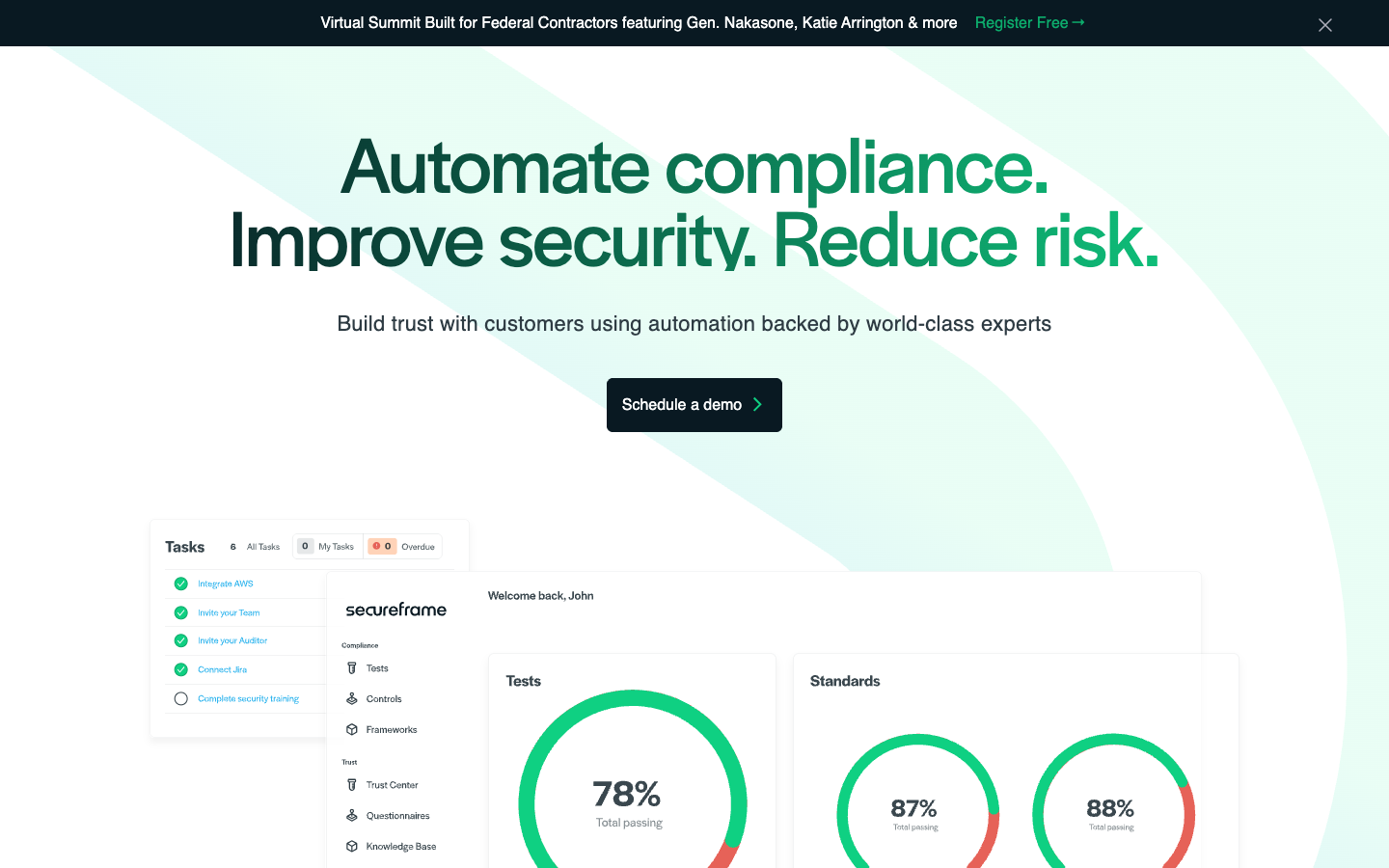
Secureframe has built strong traction with companies that have grown past their first SOC 2 and now need to manage compliance as an ongoing program. Mid-market teams running 50-500 employees often find the platform’s structure useful: clear evidence requirements, 300+ integrations, and compliance manager support that keeps the process moving without requiring deep in-house expertise.
The guided workflows are genuinely well-designed. The CMMC-specific Defense tier is also worth noting if you are pursuing US government contracts — that kind of framework-specific depth is uncommon in this category.
Where Secureframe falls short is pricing transparency. No public tiers, no ballpark numbers. You need to go through a sales process before you know what you will pay, which makes comparison shopping harder. Some reviewers also note that a handful of controls require more manual effort than expected despite the platform’s automation claims.
“
Secureframe was the right choice for our first SOC 2. The platform held our hand through the whole process — evidence collection was almost fully automated and our compliance manager kept us on track.
★★★★☆Verified User· SMB · 51–200 employees
Via G2 ↗Key features:
- Guided compliance workflows designed for first-time auditors
- 300+ integrations for automated evidence collection
- Infrastructure monitoring
- Custom frameworks, controls, and tests
- Personnel management and employee security training
- Risk management, policy management, and Trust Center
Pros of Secureframe
- Strong structure for ongoing compliance programs, not just first-time audits
- 300+ integrations with guided evidence workflows
- CMMC support (Defense tier) for government-facing companies
Cons of Secureframe
- No public pricing: requires a sales process to get any number
- Some controls require more manual effort than expected
Pricing: Contact for pricing. Three tiers: Fundamentals, Complete, Defense (CMMC-specific). No public numbers.
Best for: Mid-market companies (50-500 employees) that have moved past their first audit and want a structured platform for managing compliance as an ongoing program.
6. Scrut Automation

Scrut Automation is one of the strongest platforms in this list for companies that have a dedicated compliance function or GRC team running the program internally. The platform is built for depth: automated evidence collection, continuous monitoring, risk and vendor risk management, policy management, employee training, multi-framework support, and an auditor portal all in one place. For a compliance lead who wants full visibility and control, it is a well-built environment to work in.
India-founded with strong US and global traction, Scrut has earned a reputation for fast time-to-compliance and proactive support. Reviews consistently describe a team that flags issues before the auditor does. That matters when you are running a program that cannot afford surprises. It also won the G2 2026 Best Software Award in the GRC category, backed by 1,298 reviews at 4.9 stars.
Starting around $15K per year, it sits in a similar pricing band to Sprinto and Drata entry-tier.
“
Scrut got us to SOC 2 Type II audit-ready in under 3 months. The support team was genuinely on top of things — they flagged gaps before our auditors did. Highest-rated compliance tool on G2 for good reason.
★★★★★Verified User· SMB · 11–50 employees
Via G2 ↗Key features:
- Automated evidence collection and continuous controls monitoring
- Risk management and vendor risk management
- Policy management with pre-built templates
- Employee security training
- Multi-framework support
- Auditor collaboration portal and Trust Center
Pros of Scrut Automation
- Built for compliance teams that want depth and full control over the program
- Fast time-to-audit reputation, consistently validated in reviews
- Outstanding support responsiveness (4.9/5 across 1,298 reviews)
Cons of Scrut Automation
- No public pricing
- More platform than an early-stage startup with no compliance team needs
Pricing: Starting around $15K per year. Custom pricing for enterprise and multi-framework programs. No public pricing page.
Best for: Companies with a dedicated compliance function or GRC team who want a full-featured platform with strong support and fast time-to-audit.
7. Thoropass
Thoropass (formerly Laika) solves one specific problem most compliance platforms leave open: sourcing your auditor. With Thoropass, the audit relationship is bundled into the product. You sign up, and the auditor is part of the package. No separate engagement, no hunting for an accredited firm, no parallel relationship to manage.
For teams that find the vendor-plus-separate-auditor model messy, this is a genuine simplification. The platform covers evidence collection, continuous monitoring, policy management, and vendor risk management. The compliance team assigned to your account keeps the process on track.
The honest trade-off: automation depth is narrower than Vanta or Drata. A handful of integrations require manual evidence uploads where you would expect automation, and reviewers specifically mention this as a gap. Thoropass is strong on the human and audit side of compliance. The software layer, while functional, is not where it differentiates.
“
Having the auditor built into the platform was genuinely convenient — we didn't have to go source our own auditor. The process felt streamlined. Some evidence collection required more manual work than I expected compared to what was advertised.
★★★★☆Verified User· SMB · 11–50 employees
Via G2 ↗Key features:
- Built-in auditor network (audit bundled into the product)
- Automated evidence collection and continuous monitoring
- Policy management and personnel management
- Vendor risk management
- Multi-framework support
- Audit management portal
Pros of Thoropass
- Single vendor for both compliance software and the SOC 2 audit
- No need to source or manage a separate auditor
- Responsive compliance team
Cons of Thoropass
- Automation depth narrower than Vanta or Drata
- Some integrations require manual evidence uploads
Pricing: Platform around $8.7K per year. SOC 2 audit bundle adds roughly $5.8K. All-in median around $14.5-30K per year depending on scope. Enterprise custom.
Best for: Teams that want compliance software and the SOC 2 audit managed by a single vendor, without sourcing an auditor separately.
8. Scytale

Scytale is one of the few platforms in this list that leads with AI across the entire compliance workflow, not just in isolated features. Policy generation, evidence mapping, control recommendations: the AI layer is woven into how the platform works, not bolted on.
The framework breadth is also notable: 60+ compliance frameworks, including SOC 2, ISO 27001, HIPAA, GDPR, and many others. For companies that expect to pursue multiple certifications in the next 12-24 months, Scytale covers more ground without requiring a platform switch later.
The compliance advisors assigned to accounts are consistently well-reviewed. Scytale also offers an optional consulting add-on for teams that want deeper hands-on guidance beyond the software layer. Not every platform offers this cleanly, and it is useful for teams in complex regulatory environments.
“
We went from zero compliance posture to SOC 2 Type II ready in about 3 months. The AI-assisted policy generation and the team's ongoing support made a huge difference. Very smooth audit experience.
★★★★★Verified User· SMB · 11–50 employees
Via G2 ↗Key features:
- AI-powered compliance automation across the full workflow
- 60+ compliance frameworks
- Automated evidence collection and continuous monitoring
- Pre-built policy templates
- Employee training and vendor risk management
- Compliance advisory add-on available
Pros of Scytale
- Strong AI integration throughout the platform
- Broad framework coverage for multi-standard programs
- Fast time-to-compliance with attentive compliance advisors
Cons of Scytale
- No public pricing
- Consulting add-ons increase cost for teams that need more hands-on support
Pricing: Custom-quoted by company size and framework count. No public pricing. Consulting add-ons available at additional cost.
Best for: Startups and scale-ups pursuing multiple compliance frameworks who want a strong AI-first platform with optional advisory support.
9. OneTrust
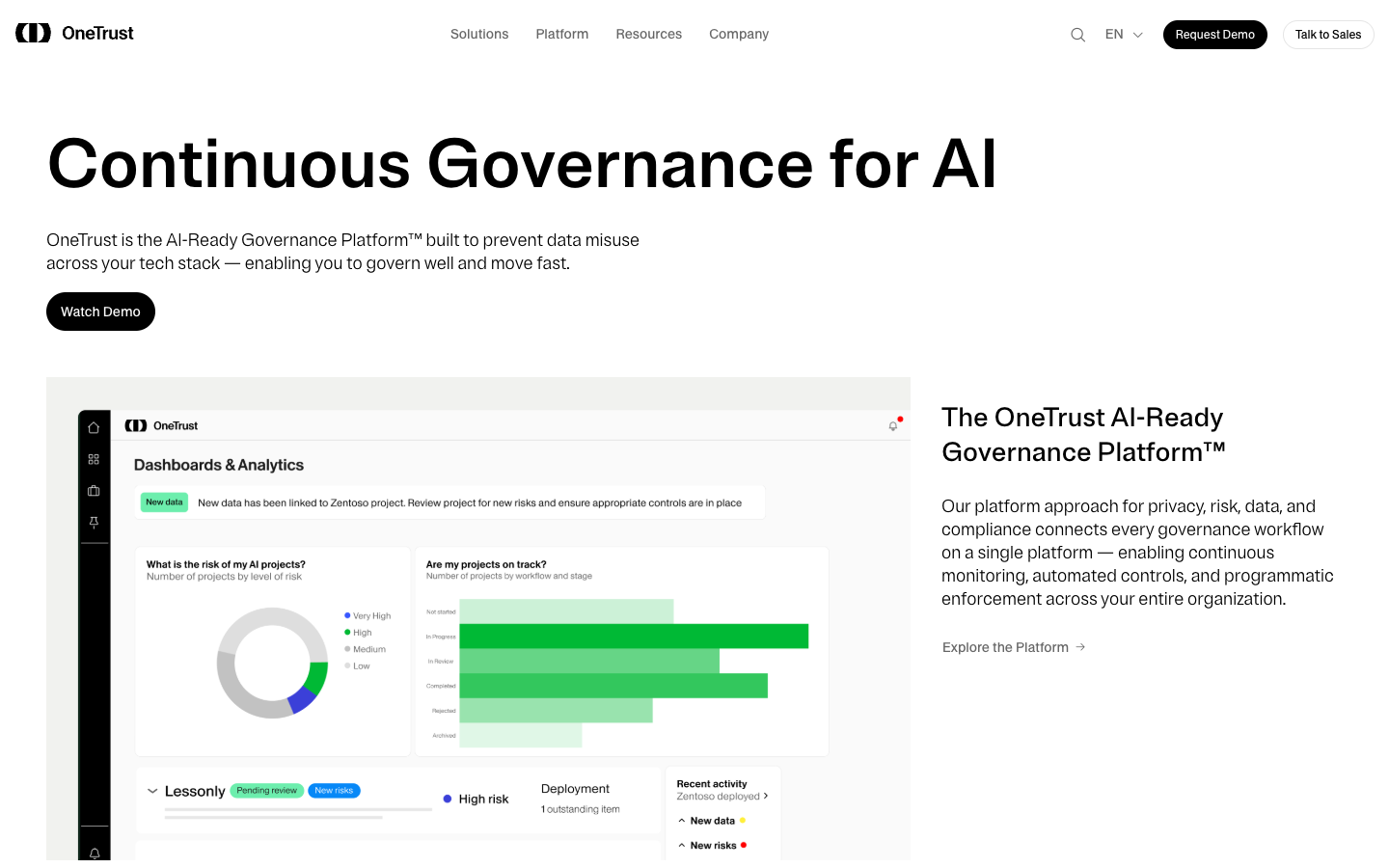
OneTrust is the enterprise GRC platform that shows up when a company has outgrown point compliance tools and needs a single system of record across privacy, risk, and compliance. Its SOC 2 capability sits inside a broader trust management suite originally built on the Tugboat Logic acquisition. The core proposition: collect evidence once and map it across 50+ frameworks simultaneously, rather than running separate evidence programs per standard.
For enterprise teams managing SOC 2 alongside ISO 27001, GDPR, HIPAA, and NIS2, that cross-framework efficiency is real. The “collect once, comply many” model reduces duplicated effort significantly once the platform is configured. The integration with OneTrust’s privacy and third-party risk modules also matters if your compliance program spans beyond InfoSec into legal and procurement.
The honest trade-off: OneTrust is not a startup tool. Pricing starts at $50K+ per year for the GRC suite. Implementation is complex, reviewers consistently note a steep learning curve, and support quality tends to scale with what you spend. If you are a 20-person startup doing your first SOC 2, this is the wrong platform. If you are a 500-person company that wants fewer vendors and already uses OneTrust elsewhere, the consolidation argument becomes compelling.
“
OneTrust is powerful once configured. The ability to map evidence across multiple frameworks without recollecting it saves our compliance team significant time. The initial setup is complex and the learning curve is real.
★★★★☆Verified User· Enterprise · 1,001–5,000 employees
Via G2 ↗Key features:
- 50+ compliance frameworks with shared evidence mapping
- Automated evidence collection via pre-built integrations
- Unified platform spanning InfoSec, privacy, and third-party risk
- Real-time control monitoring and audit-ready documentation
- Policy management and implementation guidance
- Enterprise GRC reporting and dashboards
Pros of OneTrust
- Best cross-framework efficiency in the category with shared evidence
- Consolidates compliance, privacy, and risk into one platform
- Strong brand recognition in enterprise procurement
Cons of OneTrust
- Not suited for startups: pricing starts at $50K+, complex to implement
- Steep learning curve with slow initial configuration
- Support quality reported to scale with contract size
Pricing: No public pricing. GRC suite starts above $50K per year. Enterprise-only contracts. Contact for quote.
Best for: Enterprise companies (500+ employees) managing SOC 2 alongside multiple other compliance frameworks who want a single platform for compliance, privacy, and third-party risk.
10. Oneleet

Oneleet is the only platform in this list that bundles real penetration testing into the compliance workflow. Not automated scans: manual pen testing by certified security experts, with findings tracked, remediated, and logged directly as audit evidence. For SOC 2, which requires you to demonstrate your security posture, that is a meaningful difference from platforms that leave pen testing as something you sort out separately.
Founded by Bryan Onel, who has 10+ years in offensive security, Oneleet is built around the premise that compliance and actual security should not be separate processes. The platform covers the full compliance stack: automated evidence collection, continuous monitoring, policy management, vendor risk management, and an AI-assisted questionnaire layer. The security side adds vCISO support, attack surface management, and code security scanning. It is YC-backed (S22) and has raised $33M Series A.
The trade-offs are real. No public pricing, and based on market feedback, the bundled services make it one of the pricier options in the startup tier. Oneleet also does not let you run multiple frameworks in parallel, so if you are pursuing SOC 2 and ISO 27001 simultaneously, you will need to sequence them. For a team that wants the pen test and compliance certification tied together in one vendor relationship, those trade-offs are often worth it.
“
Oneleet simplified compliance by combining pen testing, remediation, evidence collection, and auditor management in one place. Closing deals and getting our SOC 2 report done quickly while actually becoming more secure.
★★★★★Verified User· SMB · 11–50 employees
Via G2 ↗Key features:
- Manual penetration testing bundled into the compliance workflow (findings become audit evidence)
- Automated evidence collection and continuous controls monitoring
- vCISO support included
- AI-powered risk assessments and questionnaire automation
- Trust Center and employee security portal
- 13+ compliance frameworks (SOC 2, ISO 27001, HIPAA, GDPR, PCI DSS, and more)
Pros of Oneleet
- Pen testing and compliance in one vendor: no separate engagement to manage
- Security-first approach means the audit evidence reflects real security posture
- Strong support from a team with genuine offensive security background
Cons of Oneleet
- No public pricing; bundled services make it one of the pricier options in this category
- Cannot run multiple frameworks simultaneously
Pricing: Custom-quoted. No public pricing. Bundled services (pen test, vCISO) make pricing higher than software-only platforms.
Best for: Startups that need both pen testing and SOC 2 compliance and want to handle both under one vendor rather than running two separate engagements.
How to choose SOC 2 compliance software
No platform is right for every team. The right choice depends on your stage, how much of the compliance work you want to own internally, and what your two-year cost picture looks like. These four questions will get you to a shortlist fast.
Free Demo
Let ComplyJet own your SOC 2 from day one.
Audit-ready in weeks, not months. SOC 2, ISO 27001 and more. Flat pricing, no surprises.
What size is your company?
Company size is the most reliable first filter. The platforms in this list are not interchangeable across stages, and choosing the wrong tier is the most common mistake.
Startups (seed to Series A, 1-50 employees): ComplyJet is the clear choice here. The reason is not just the price point, though it is the most transparent in the category. It is the model: ComplyJet owns the compliance outcome, which means your team does not need to develop compliance expertise from scratch to work through a SOC 2 compliance checklist on your own. Sprinto and Secureframe are strong runners-up if you prefer a more self-directed experience with good tooling and support.
Mid-sized companies (50-250 employees): Drata or Sprinto. Both handle multi-framework compliance at scale with strong automation. Choose Drata if you want the best auditor collaboration portal. Choose Sprinto if you are adding headcount quickly and do not want per-seat pricing to compound your costs.
Enterprise (250+ employees): Vanta is the default at this scale. OneTrust earns a serious look if you are already using it for privacy or third-party risk management — the cross-framework consolidation pays off when you are running 5+ standards. Oneleet is worth considering if your security posture needs real work alongside the compliance program and you want both handled by one vendor.
How much of the process do you want to own?
There is a spectrum: on one end, platforms that give you a dashboard and let you drive; on the other, platforms that assign you an expert and drive it for you. Neither is wrong, but the mismatch between what you buy and how your team actually operates is where projects stall.
If you have no compliance background and this is your first SOC 2, self-serve platforms will slow you down. Look for dedicated support that actively moves the process forward. If you have an in-house compliance team and want control, a full-featured platform like Drata or Vanta gives you the depth to run it yourself.
A useful question to ask any vendor before signing: “Will someone from your team own our compliance program, or are we the primary owners with your platform as the tool?”
What does pricing really look like over two years?
Most platforms in this list do not publish pricing, and the year-2 renewal is frequently higher than the initial contract. Vanta and Drata renewals commonly come in 30-50% above year one. Get year-2 renewal caps in writing before you sign anything.
ComplyJet is the exception: public pricing, and what is listed is what you pay. Factor in audit fees separately — most platforms exclude these. Independent SOC 2 auditors typically charge $3-15K. Thoropass bundles this into their offering.
How many frameworks do you need now and in 18 months?
If you are targeting just SOC 2 for now, the entry tier of any platform covers you. The question worth asking is what happens when you add ISO 27001 or HIPAA in a year. Drata charges $3-10K per additional framework. That is worth knowing before you are locked in.
For teams expecting to pursue 5+ frameworks: Scytale (60+ frameworks) is built for that scope. For teams that also need pen testing as part of the program: Oneleet bundles both under one contract.
How fast do you need to be audit-ready?
SOC 2 Type I typically takes 2-4 months with a good platform and responsive support. Type II requires a 6-12 month observation period by definition. The variance between platforms on Type I timelines largely comes down to the support model. Teams where the vendor owns the process (ComplyJet) or provides strong compliance manager support (Sprinto, Scrut Automation) consistently report faster times-to-audit than teams on self-serve platforms learning the process as they go.
If you have a hard deadline (an enterprise deal waiting on the certification), prioritise support quality and responsiveness over feature count.
If you are a startup doing compliance for the first time, ComplyJet owns the process end-to-end: you get the certification, not just the software. Transparent pricing, 350+ integrations, and an auditor network included. Book a free demo.
Frequently asked questions
What is SOC 2 compliance software?
SOC 2 compliance software automates the process of achieving and maintaining SOC 2 compliance. SOC 2 is an attestation, not a certification: your auditor issues a report, not a certificate. Instead of manually gathering screenshots and spreadsheets for your auditor, the platform integrates with your cloud tools and continuously pulls the evidence required across the SOC 2 Trust Services Criteria: security, availability, processing integrity, confidentiality, and privacy.
What is the best SOC 2 compliance software?
It depends on your stage. For startups doing compliance for the first time: ComplyJet (compliance fully owned for you, public pricing from $5K per year) or Sprinto (highest-rated among startup-focused platforms). For mid-market companies: Drata or Sprinto. For enterprise: Vanta. If you want transparent pricing with no sales process: ComplyJet publishes full pricing publicly.
How much does SOC 2 compliance software cost?
Most platforms do not publish pricing. Real-world contracts range from around $7K per year (Sprinto starter) to $50K+ for enterprise platforms like OneTrust. ComplyJet is the exception, with public pricing starting at $5K per year. Audit fees are usually separate and typically run $3-15K for independent auditors. Watch for year-2 renewal increases on Vanta and Drata, which commonly run 30-50% above the initial contract. See our full SOC 2 compliance cost breakdown for the full picture beyond just software.
How long does it take to get SOC 2 compliant?
SOC 2 Type I typically takes 2-4 months with a compliance platform. Type II requires a 6-12 month observation period by design. Most platforms aim for 90 days to audit-ready for Type I. That timeline holds for teams with good support and automated evidence collection. It stretches for teams on self-serve platforms without prior compliance experience. See our full breakdown of how long SOC 2 actually takes for the factors that move that number.
Do I need SOC 2 Type I or Type II?
Type I is a point-in-time attestation: your controls exist and are designed correctly as of the audit date. Type II proves they have been operating effectively over 6-12 months. Enterprise buyers increasingly require Type II. Start with Type I if you are under deal pressure and need proof fast. Plan for Type II in year two. For the full breakdown, see SOC 2 Type 1 vs Type 2.
Final thoughts
Choosing SOC 2 compliance software is not about finding the most features at the lowest price. It is about finding the right fit for where your company actually is.
If you are Series B and above with a compliance budget and enterprise procurement requirements, Vanta is the safe, well-validated choice. If you are scaling fast across multiple frameworks, Drata or Sprinto. If you are an early-stage startup doing this for the first time to close enterprise deals, and you want compliance fully managed without building internal expertise first, ComplyJet is built for exactly that.
SOC 2
Ready to swap spreadsheets for automation?
ComplyJet owns the process end-to-end, from gap assessment to final report.