.svg)

A US-based SaaS company loses a €15 million contract with a German enterprise client. The reason? The procurement team asked for "GDPR certification," and the company couldn't provide it.
The CEO calls the compliance team. "Get us GDPR certified immediately."
The compliance lead responds: "There is no such thing as official GDPR certification."
Confusion follows; the deal is lost. And the company learns an expensive lesson about what GDPR certification actually means versus what the market thinks it means.
This scenario plays out regularly in boardrooms across New York, San Francisco, Boston, Dallas, and Atlanta. Businesses pursue "GDPR certification" without understanding that the term itself represents a category of compliance activities, not a single certificate you obtain and frame on the wall.
The regulatory reality is more nuanced than most vendors admit.
Prove your GDPR compliance posture to enterprise buyers without confusion or delay.
Get Your GDPR Compliance Assessment
This guide cuts through the noise. You will learn what GDPR certification actually means under the regulation, what certificates businesses actually need to demonstrate compliance, the real cost structure behind each option, how Article 42 certification schemes work, and which path makes sense for your specific business context.
What Is GDPR Certification? Understanding the Regulatory Framework
The term "GDPR certification" creates immediate confusion because it means different things in different contexts. Some vendors sell "GDPR certification programs." Enterprise buyers request "proof of GDPR certification." And compliance teams search for "how to get GDPR certified."
The regulatory text provides clarity that the market often lacks.
The Official GDPR Certification Mechanism: Article 42
Article 42 of GDPR establishes a formal certification framework. It states that member states, supervisory authorities, the European Data Protection Board, and the European Commission shall encourage the establishment of data protection certification mechanisms.
These mechanisms are designed to demonstrate compliance with GDPR requirements. The certification is voluntary. It can apply to controllers, processors, and specific processing operations.
However, here is the critical detail most businesses miss: as of 2026, very few Article 42 certification schemes have been approved and made operational at scale.
The European Data Protection Board maintains a register of approved certification mechanisms. The number of active, broadly recognized schemes remains limited. Most operate in specific jurisdictions or for narrow processing activities.
What "GDPR Certification" Actually Means in Practice
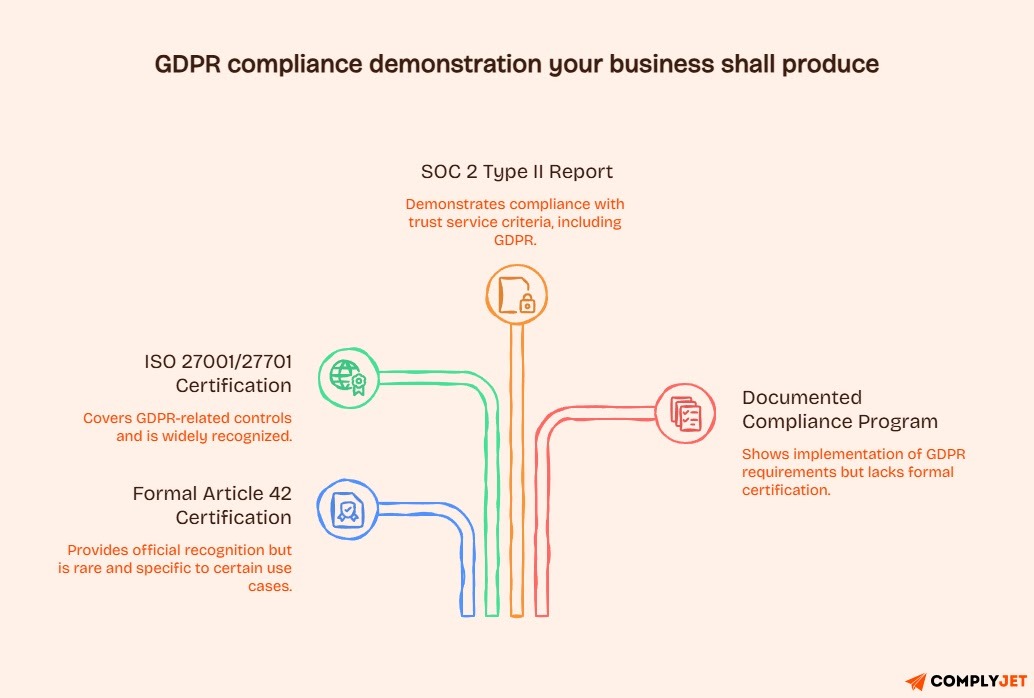
When an enterprise buyer asks for GDPR certification, they typically mean one of four things:
- Formal Article 42 certification from an accredited body (rare, specific use cases)
- ISO 27001 or ISO 27701 certification that covers GDPR-related controls
- SOC 2 Type II report with GDPR-relevant trust service criteria
- Documented GDPR compliance program with evidence of implementation
The market has filled the gap left by the limited availability of the Article 42 scheme with alternative compliance demonstrations. These alternatives carry different levels of regulatory recognition, market acceptance, and cost implications.
Understanding which option your business actually needs requires cutting through vendor marketing and focusing on what regulators accept and what buyers trust.
Is GDPR a Certification? Clarifying the Misconception
No. GDPR is a regulation, not a certification standard.
The General Data Protection Regulation is European Union law. It sets legal requirements for data protection and privacy. You cannot "get GDPR certified" the way you get ISO 27001 certified or SOC 2 audited.
What you can do is demonstrate GDPR compliance through various certification and attestation mechanisms that map to GDPR's requirements. The distinction matters when evaluating vendor claims and setting realistic compliance objectives.
GDPR Certification Requirements: What Businesses Actually Need
The requirements for demonstrating GDPR compliance depend entirely on which certification path you pursue. There is no universal checklist because the certification landscape is fragmented across multiple frameworks.
Article 42 Certification Requirements
For businesses pursuing formal GDPR certification under Article 42, the requirements are defined by the specific certification scheme approved in your jurisdiction.
General requirements include:
- Documented compliance with GDPR Articles 5 through 22 (lawfulness, data subject rights, processing principles)
- Technical and organizational measures appropriate to the risk level
- Data protection by design and default implementation evidence
- Records of processing activities (RoPA) that are current and complete
- Data breach notification procedures tested and documented
- Data protection impact assessments for high-risk processing
- Vendor due diligence and data processing agreements in place
The certification body will audit these elements against the approved criteria document for that specific scheme. The depth and breadth of the audit depend on the scheme's scope and the processing activities it covers.
ISO Certification Pathways for GDPR Compliance
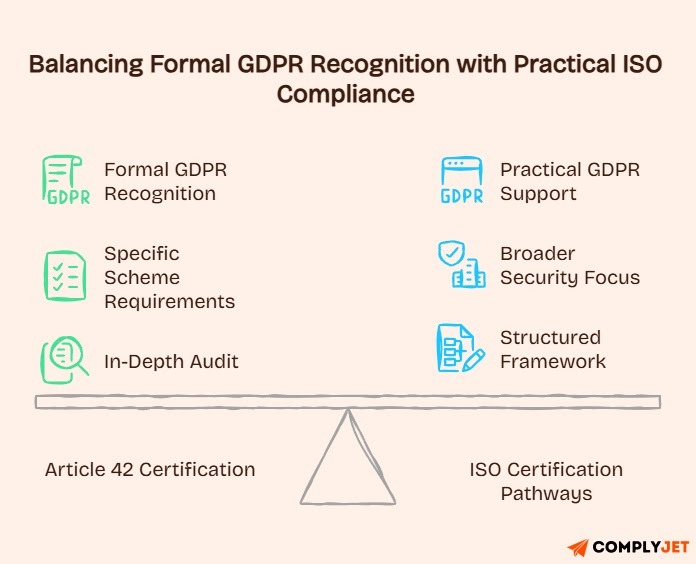
Most businesses demonstrate GDPR compliance through existing ISO standards rather than waiting for Article 42 schemes to mature.
ISO 27001: Information Security Management
ISO 27001 is not a GDPR certification, but it addresses many of the same security and risk management requirements. Achieving ISO 27001 certification demonstrates that your organization has implemented systematic controls for information security, which overlaps significantly with GDPR's security requirements under Articles 32-34.
ISO 27701: Privacy Information Management
ISO 27701 extends ISO 27001 specifically for privacy management. It maps directly to GDPR requirements and provides a structured framework for demonstrating compliance.
ISO 27701 certification is the strongest third-party attestation currently available for comprehensive GDPR compliance coverage. It is recognized by European data protection authorities and accepted by enterprise procurement teams globally.
Insights: The French CNIL’s guidance on certification explicitly notes that ISO 27701 can be used as a structured privacy management framework that “supports” GDPR compliance but does not replace Article 42 schemes, highlighting its practical but non‑regulatory nature.
ISO 42001: AI Management Systems and GDPR
The new ISO 42001 certification addresses artificial intelligence management systems. For organizations processing personal data through AI systems, this standard becomes relevant alongside GDPR compliance requirements.
ISO 42001 certification demonstrates governance over AI systems, which addresses GDPR Article 22 (automated decision-making) and helps satisfy data protection impact assessment requirements for AI-driven processing.
SOC 2 Type II as GDPR Compliance Evidence
SOC 2 Type II reports are American-origin audit frameworks, but they are widely accepted in Europe as evidence of systematic compliance practices. When properly scoped, a SOC 2 Type II report can address many GDPR requirements through the privacy trust service criteria.
SOC 2 Type II provides time-tested evidence of control effectiveness, which European buyers understand and accept as a proxy for GDPR maturity even though it is not a GDPR-specific certification.
GDPR Certification Requirements for ISO Certified Companies
If your organization already holds ISO 27001 certification, the path to demonstrating GDPR compliance becomes clearer and more cost-effective.
Existing ISO 27001 holders can:
- Extend to ISO 27701 through a gap assessment and supplemental audit (typically 30-50% less effort than a standalone ISO 27701 certification)
- Leverage existing controls that satisfy both ISO 27001 and GDPR requirements
- Use the same certification body to streamline the audit process
- Maintain integrated management systems rather than running parallel compliance programs
The overlap between ISO 27001 Annex A controls and GDPR security requirements means that ISO-certified companies are often 60-70% compliant with GDPR's technical and organizational measures before beginning formal GDPR-focused work.
Organizations without existing ISO certification face a longer path, but can pursue ISO 27701 as an integrated implementation rather than implementing GDPR requirements in isolation.
Already ISO 27001 certified? See how ComplyJet accelerates your ISO 27701 extension.
Schedule Assessment
GDPR Certification Schemes: Article 42 Implementation Status
Article 42 established the framework for GDPR certification schemes, but implementation has been slower than the regulation's authors anticipated. Understanding the current state of these schemes helps set realistic expectations about what certification options are actually available.
How Article 42 Certification Schemes Work
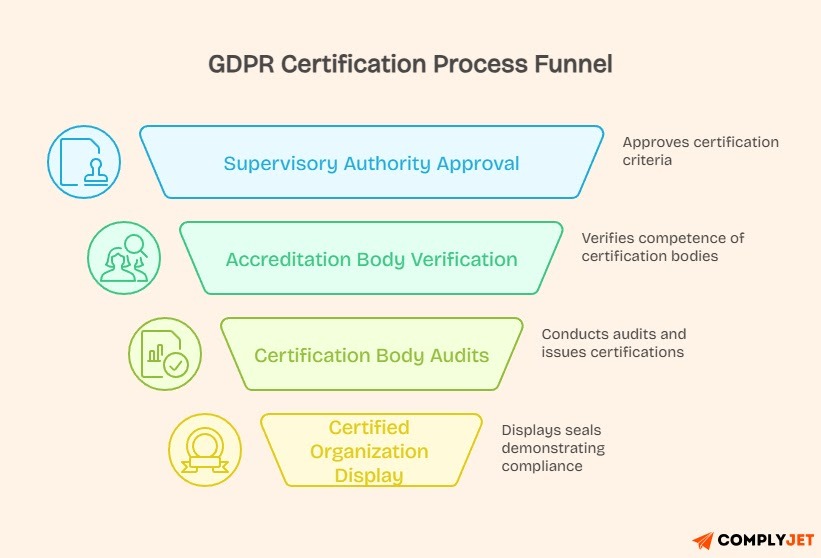
The Article 42 framework operates through a multi-tier structure:
- Supervisory authorities (data protection authorities in each EU member state) approve certification criteria
- Accreditation bodies verify that certification bodies meet competence requirements
- Certification bodies conduct audits and issue certifications to organizations
- Certified organizations display seals demonstrating compliance with the approved criteria
The certification is valid for a maximum of three years and requires regular monitoring and renewal. Supervisory authorities can revoke certifications if compliance lapses or if the certification criteria change.
Current Status of Approved Certification Schemes
As of 2026, the European Data Protection Board's register shows limited approved certification schemes with broad applicability. Most schemes are:
- Jurisdiction-specific (approved in one member state, not recognized EU-wide)
- Sector-specific (limited to particular industries or processing types)
- Still in pilot phase (accepting applications but not at scale)
Notable schemes include:
- Certification schemes for cloud service providers in specific member states
- Code of conduct certifications for particular industry sectors
- Processing-specific certifications for activities like consent management
The fragmentation means that businesses operating across multiple EU jurisdictions often cannot rely on a single Article 42 certification to demonstrate compliance everywhere they operate.
Data Insight: As of early 2026, the EDPB’s register lists only a handful of approved GDPR certification mechanisms across the entire EU, with several member states still having no operational scheme at all.
GDPR Certification Schemes for E-Commerce Data Protection Compliance
E-commerce businesses face particular challenges because they process customer data across borders, manage complex consent scenarios, and handle payment information alongside personal data.
Specialized e-commerce certification considerations:
- Cross-border data transfer mechanisms must be certified
- Cookie consent management requires a specific compliance demonstration
- Payment processing often requires separate PCI DSS compliance
- Marketing automation and behavioral tracking need a documented lawful basis
Some certification schemes specifically address e-commerce processing activities, but coverage varies by jurisdiction. Most e-commerce businesses combine ISO 27701 certification with documented GDPR compliance programs rather than pursuing narrow Article 42 schemes.
The practical approach for e-commerce companies involves:
- ISO 27701 certification for systematic privacy management
- PCI DSS for payment security (required separately)
- Documented consent management procedures
- Regular GDPR compliance audits by third parties
- Trust center that displays all compliance artifacts publicly
This combination provides broader market recognition than any single Article 42 scheme currently available for e-commerce contexts.
GDPR Certification Cost: Real Numbers and Total Cost of Ownership
The question "How much does GDPR certification cost?" has no single answer because the cost structure depends entirely on which certification path you pursue, your organization's current compliance maturity, and the scope of data processing activities being certified.
The market provides wide cost ranges that often mislead buyers. Breaking down actual costs by certification type and organization size provides more actionable planning data.
Article 42 Certification Cost Structure
For organizations pursuing formal Article 42 certification through an accredited certification body, costs include:
These ranges assume moderate complexity. Organizations with complex data processing activities, multiple jurisdictions, or significant compliance gaps can see costs rise by 50-100% above these figures.
ISO 27701 Certification Cost Breakdown
ISO 27701 certification typically costs less than standalone Article 42 certification while providing broader market recognition.
Organizations already holding ISO 27001 certification can reduce these costs by 40-60% because the information security management system foundation is already in place.
SOC 2 + GDPR Documentation Approach
Many US-based businesses serving European markets opt for SOC 2 Type II combined with documented GDPR compliance rather than pursuing ISO certification.
Cost structure for this approach:
- SOC 2 Type II audit: $25,000 - $100,000 (varies by scope and auditor)
- GDPR compliance documentation: $15,000 - $50,000 (policies, procedures, RoPA, DPIAs)
- Privacy trust service criteria addition: $5,000 - $15,000 (incremental to standard SOC 2)
- Annual renewal: $20,000 - $60,000
This approach provides strong evidence of systematic compliance practices at a total cost that is often 20-30% lower than formal ISO certification, though it lacks the specific "certification" label that some European buyers request.
Hidden Costs Most Organizations Miss
The certification fee itself is typically 30-40% of the total compliance cost. Organizations that budget only for the audit consistently underestimate the total cost of ownership.
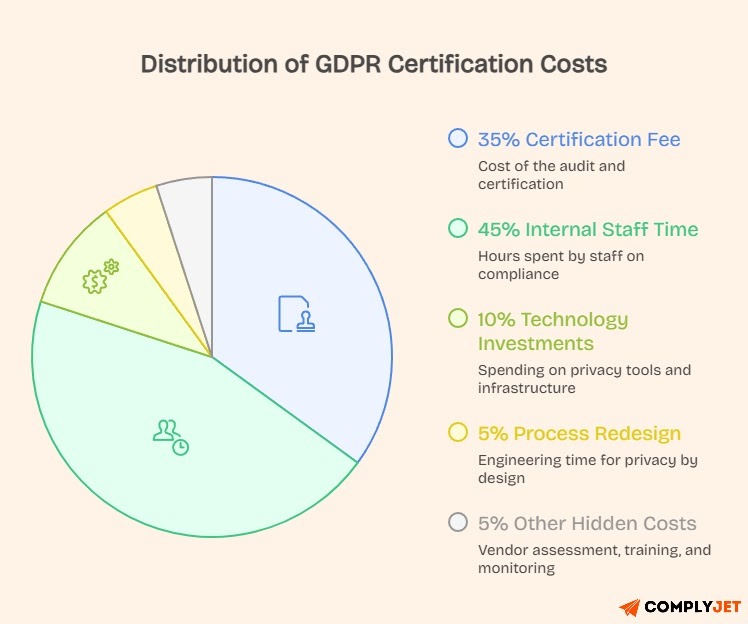
Hidden cost categories:
- Internal staff time (400-1,200 hours, depending on maturity and scope)
- Technology investments (consent management platforms, data discovery tools, encryption infrastructure)
- Process redesign (engineering time to implement privacy by design)
- Vendor assessment (reviewing and updating data processing agreements)
- Training programs (staff education on GDPR requirements)
- Ongoing monitoring (continuous compliance validation and evidence collection)
A realistic total cost of ownership for the first 24 months runs 2-3x the certification audit fee alone. Organizations that use compliance automation platforms can reduce internal effort by 40-60%, which typically offsets the platform cost within the first year.
Regional Cost Variations: New York, San Francisco, Boston, Dallas, Atlanta
GDPR certification cost varies by region based on consultant availability, auditor rates, and competitive market dynamics.
Regional cost multipliers relative to baseline:
- New York: 1.2-1.3x (high demand, premium rates)
- San Francisco: 1.3-1.5x (tech concentration, limited auditor capacity)
- Boston: 1.1-1.2x (strong compliance market, moderate competition)
- Dallas: 0.9-1.1x (lower cost of living, growing compliance market)
- Atlanta: 0.9-1.0x (competitive market, multiple qualified firms)
These multipliers apply primarily to consulting and implementation costs. Certification body audit fees are more standardized regardless of location, though travel expenses for on-site audits vary.
Organizations can reduce regional cost impact by engaging remote consulting firms or using compliance automation platforms that eliminate the need for extensive hands-on consulting.
Reduce your GDPR certification cost by 40-60% with automated evidence collection and continuous compliance monitoring.
See How ComplyJet Works
How to Get GDPR Compliance Certification: Step-by-Step Process
The path to demonstrating GDPR compliance through certification follows a structured process regardless of which certification framework you pursue.
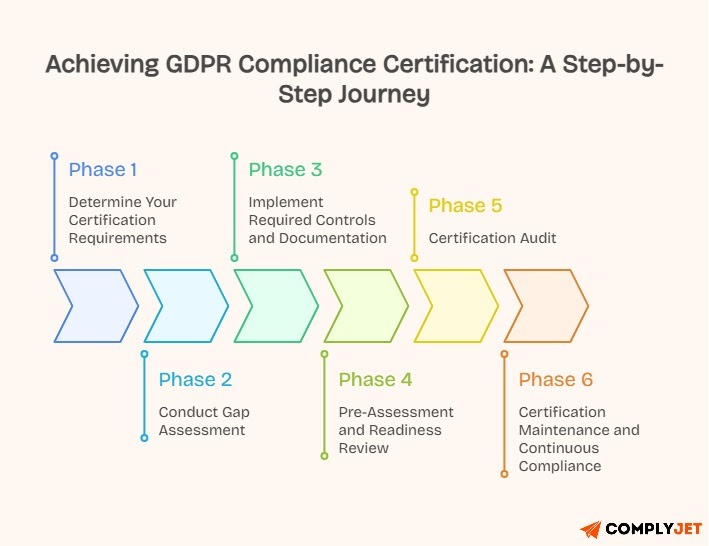
Understanding each phase helps set realistic timelines and resource expectations.
Phase 1: Determine Your Certification Requirements
Before engaging consultants or certification bodies, establish what certification you actually need based on your business context.
Ask these questions:
- Are customers explicitly requesting GDPR certification, or do they accept alternative compliance demonstrations?
- Which markets do you operate in, and which certification schemes are recognized there?
- Do you already hold ISO 27001, SOC 2, or other relevant certifications that can be extended?
- What is your budget and timeline for achieving certification?
- Will Article 42 certification provide a competitive advantage in your specific market?
Most businesses discover that ISO 27701 or SOC 2 with privacy criteria provides better market recognition at a lower cost than pursuing narrow Article 42 schemes, particularly if operating globally rather than in a single EU jurisdiction.
Phase 2: Conduct Gap Assessment
A gap assessment identifies the distance between your current state and the certification requirements.
Gap assessment deliverables:
- Current state documentation of existing privacy and security controls
- Gap analysis mapping requirements to existing controls and identifying missing elements
- Remediation roadmap with prioritized actions and timeline estimates
- Cost estimate for implementation and certification
- Risk assessment of compliance gaps and their business impact
The gap assessment typically takes 2-4 weeks for mid-market organizations and provides the foundation for realistic project planning. Organizations that skip this step consistently underestimate implementation effort and cost.
Phase 3: Implement Required Controls and Documentation
This is the most resource-intensive phase. Implementation timelines vary from 3 months for organizations with strong existing compliance programs to 12+ months for those starting from scratch.
Core implementation work streams:
3.1 Data Mapping and Inventory
- Identify all personal data processing activities
- Document data flows across systems and third parties
- Create and maintain Records of Processing Activities (RoPA)
- Classify data by sensitivity and risk level
3.2 Policy and Procedure Development
- Draft GDPR-compliant privacy policies
- Create data subject rights request procedures
- Develop breach notification processes
- Establish vendor management protocols
- Document data retention and deletion schedules
3.3 Technical Control Implementation
- Deploy encryption for data at rest and in transit
- Implement access controls and authentication
- Configure audit logging and monitoring
- Deploy data loss prevention controls
- Establish backup and recovery procedures
3.3 Organizational Controls
- Conduct staff privacy training
- Establish data protection roles and responsibilities
- Create a privacy governance structure
- Implement privacy by design in development processes
- Document control effectiveness evidence
3.4 Vendor and Third-Party Management
- Review and update data processing agreements
- Conduct vendor risk assessments
- Validate vendor compliance with GDPR
- Establish ongoing vendor monitoring
Organizations with existing SOC 2 compliance programs can leverage significant overlap in control requirements, reducing implementation time by 40-50%.
Phase 4: Pre-Assessment and Readiness Review
Before engaging the certification body for a formal audit, conduct an internal readiness review to validate that all requirements are met and evidence is complete.
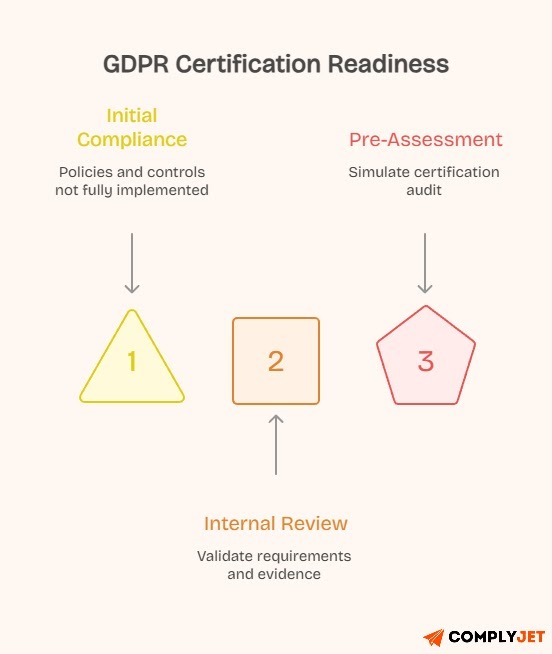
Readiness checklist:
- All policies and procedures are documented and approved
- Technical controls implemented and tested
- Evidence of control operation collected (6-12 months for Type II reports)
- RoPA current and complete
- Data subject rights request procedures tested
- Breach response plan documented and tested
- Staff training completed and documented
- Vendor assessments current
Many organizations engage independent consultants to conduct a pre-assessment audit that simulates the certification audit. This identifies gaps before the formal audit, reducing the risk of findings or certification delays.
Phase 5: Certification Audit
The formal certification audit follows the structure defined by the chosen certification framework.
For ISO 27701:
- Stage 1 Audit (documentation review): 1-2 days
- Gap remediation period: 2-4 weeks
- Stage 2 Audit (implementation testing): 2-5 days, depending on scope
- Corrective action period (if needed): 2-4 weeks
- Certification decision: 2-3 weeks after completion
For Article 42 schemes:
The audit structure depends on the specific scheme's requirements, but generally follows a similar two-stage process with documentation review followed by implementation verification.
For SOC 2 Type II:
The audit covers a defined period (typically 6-12 months) and examines whether controls operated effectively throughout that period. The SOC 2 audit typically requires 2-4 weeks of auditor time spread across the review period.
Phase 6: Certification Maintenance and Continuous Compliance
Certification is not a one-time event. All frameworks require ongoing compliance monitoring and periodic recertification.
Maintenance requirements:
- Annual surveillance audits for ISO certifications (1-2 days annually)
- Full recertification every 3 years for ISO, annually for SOC 2
- Continuous monitoring of control effectiveness
- Updates to documentation as processing activities change
- Staff training as requirements evolve
- Incident response when breaches occur
- Regulatory tracking to stay current with GDPR guidance
Organizations that treat certification as a project rather than a program consistently struggle with recertification and often let certifications lapse, which eliminates the business value they were intended to create.
The most successful programs integrate compliance into operational workflows through automation platforms that collect evidence continuously, monitor control effectiveness in real-time, and maintain always-current documentation.
GDPR Compliance Certificate vs. Documented Compliance: What Buyers Actually Accept
The market creates confusion between formal certification and documented compliance programs. Understanding what enterprise buyers actually require helps businesses invest in the right approach.
What Enterprise Procurement Teams (Actually) Request in reference to GDPR?
When a European enterprise buyer requests "GDPR certification" in an RFP or security questionnaire, they typically accept multiple forms of evidence:
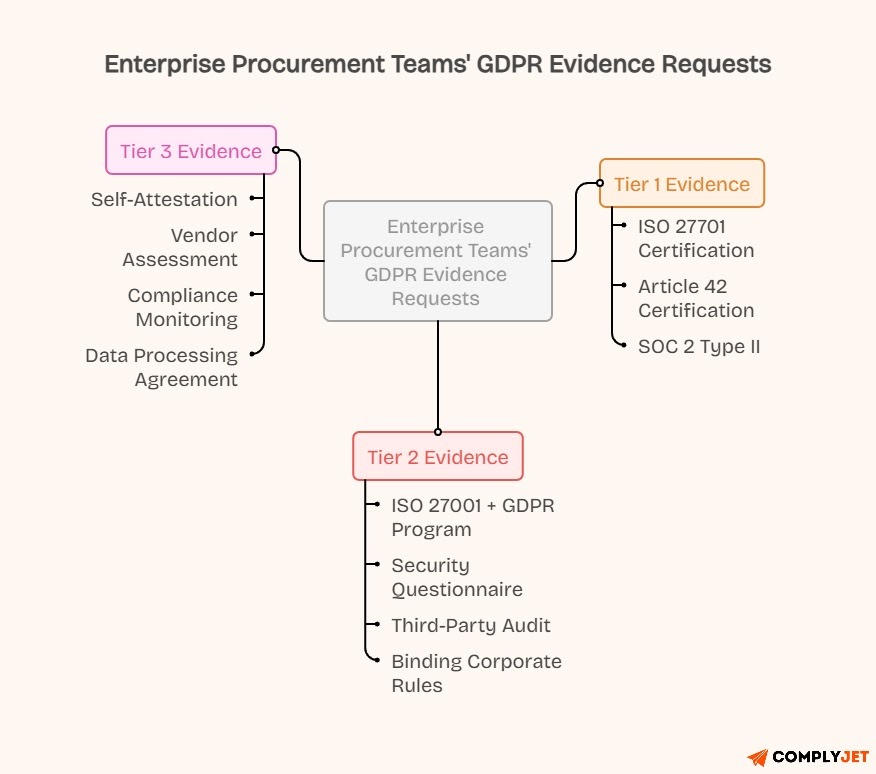
Tier 1 Evidence (Highest Recognition):
- ISO 27701 certification from an accredited body
- Article 42 certification from an approved scheme
- SOC 2 Type II with privacy trust service criteria
Tier 2 Evidence (Widely Accepted):
- ISO 27001 + documented GDPR compliance program
- Detailed security questionnaire responses with supporting evidence
- Independent third-party GDPR audit report
- Binding Corporate Rules approval (for multinational organizations)
Tier 3 Evidence (Minimum Acceptable):
- Self-attestation with documented policies and procedures
- Vendor security assessment questionnaire responses
- Evidence of ongoing compliance monitoring
- Data processing agreement template review
Most enterprise buyers accept Tier 2 evidence without hesitation, particularly when combined with a transparent trust center that displays compliance artifacts publicly. The formal certification primarily adds value in highly regulated industries or when competing against vendors that already hold certification.
Data Insight: In a 2023 ENISA survey on cloud procurement, over 70% of EU public‑sector and large private‑sector buyers reported that ISO 27001 or SOC 2 reports were “sufficient” evidence of GDPR‑related controls when combined with documented policies, even when RFPs initially mentioned “GDPR certification.”
Trust Centers as Compliance Demonstration
Public-facing trust centers have become the standard method for demonstrating compliance posture to enterprise buyers without requiring formal certification.
Effective trust centers display:
- Current SOC 2 reports (with confidential sections redacted)
- ISO 27001/27701 certificates
- Privacy policy and data processing terms
- Security whitepaper
- Subprocessor list
- Penetration test summaries
- Compliance framework mappings
- Incident response process
A well-constructed trust center answers 70-80% of buyer questions before a sales call, accelerating deal cycles significantly. ComplyJet customers report 40-60% reduction in security questionnaire volume after launching public trust centers.
Build a trust center that demonstrates GDPR compliance without constant manual updates.
See Trust Center Demo
SSL Certificates and GDPR: Common Technical Questions
Technical certification questions arise frequently in GDPR contexts, particularly around SSL/TLS certificates.
Does GDPR require SSL certificate management?
GDPR Article 32 requires appropriate technical measures to ensure data security, including encryption of personal data in transit. SSL/TLS certificates are the standard implementation of transit encryption for web-based applications.
While GDPR does not explicitly mandate SSL certificates, the absence of SSL for applications handling personal data would be considered a control failure in any compliance audit. Certificate lifecycle management (issuance, renewal, revocation) is therefore a GDPR compliance requirement in practice.
Is a free SSL certificate sufficient for GDPR compliance?
Yes, from a pure GDPR perspective. The regulation does not specify certificate authorities or commercial vs. free certificates. Let's Encrypt certificates provide the same cryptographic protection as commercial certificates.
However, commercial SSL certificates often include:
- Extended validation (EV) that displays the organization name in the browser
- Wildcard support for multiple subdomains
- Longer validity periods (reducing renewal frequency)
- Insurance coverage for certificate failures
- Priority support for reissuance
The choice between free and commercial SSL certificates is a business decision, not a compliance requirement. Both satisfy GDPR's encryption mandate when properly implemented.
Does GDPR require certificate lifecycle management?
Yes, indirectly. GDPR requires that security measures remain effective over time. Expired certificates break encryption and create security vulnerabilities. Therefore, certificate lifecycle management (tracking expiration, automating renewal, and managing revocation) is a necessary operational control for maintaining GDPR compliance.
Organizations with multiple domains and certificates should implement automated certificate management to prevent expiration-related outages and security gaps.
Is There a GDPR Compliance Certificate in the USA? Understanding Cross-Border Recognition
US-based businesses frequently ask whether a GDPR certification obtained in the United States holds the same weight as European-issued certifications. The answer depends on which certification body issues the certificate and whether it operates under European accreditation.
US-Based Certification Bodies and GDPR
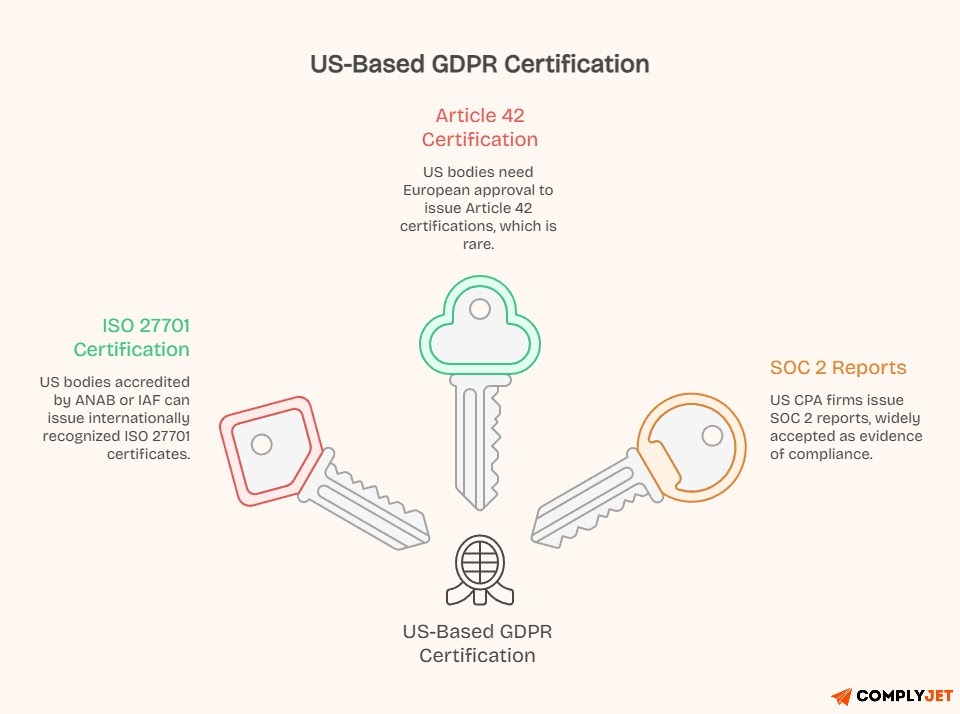
Several certification bodies operate in the United States and offer GDPR-related certifications, but not all carry equal regulatory recognition.
For ISO 27701 certification:
US-based certification bodies accredited by the ANSI National Accreditation Board (ANAB) or other IAF-recognized accreditation bodies can issue ISO 27701 certificates that are recognized internationally, including in Europe. The accreditation chain matters more than the certification body's physical location.
For Article 42 certification:
Article 42 schemes must be approved by European supervisory authorities. US-based certification bodies cannot issue Article 42 certifications unless they have been specifically accredited by a European supervisory authority for an approved scheme. As of 2026, this is extremely rare.
For SOC 2 reports:
SOC 2 is an American framework overseen by the AICPA. All SOC 2 reports are issued by US-based CPA firms or their international affiliates. European buyers widely accept SOC 2 Type II reports as evidence of systematic compliance practices, though SOC 2 is not a GDPR certification.
How European Buyers View US Certifications
European enterprise buyers have become sophisticated about compliance certifications over the past several years. They understand that a US company can hold legitimate GDPR-relevant certifications issued by US-based bodies.
What matters to European buyers:
- Accreditation chain: Is the certification body accredited by an internationally recognized authority?
- Scope alignment: Does the certification scope cover the processing activities relevant to the buyer's data?
- Audit rigor: Was the audit conducted according to recognized standards with independent verification?
- Currency: Is the certification current, and when does it expire?
A US company with ISO 27701 certification from an ANAB-accredited body faces no credibility gap with European buyers compared to a European company with the same certification from a European body.
The location of the certified organization matters far more than the location of the certification body, and even organizational location is secondary to the actual controls implemented and verified.
GDPR Certification for US Companies: Practical Pathway
US businesses serving European markets should follow this prioritization:
- Establish a GDPR compliance program with documented policies, procedures, and controls
- Pursue SOC 2 Type II with privacy trust service criteria (most common in the US market)
- Consider ISO 27701 if competing in deals where European buyers specifically request ISO certification
- Build a public trust center displaying all compliance artifacts
- Maintain Standard Contractual Clauses or Data Privacy Framework certification for data transfers
This combination provides maximum flexibility to address buyer requirements across different European markets and industries without over-investing in certifications that provide limited incremental value.
Key Takeaway: For most US mid-market SaaS companies, SOC 2 Type II + documented GDPR compliance + public trust center addresses 95% of European buyer requirements at 60% of the cost of formal ISO 27701 certification.
How ComplyJet Simplifies GDPR Certification and Continuous Compliance
The fundamental challenge with GDPR certification is not achieving it once. The challenge is maintaining compliance continuously while minimizing the operational burden on your team.
Manual compliance programs collapse under their own weight. Spreadsheets fall out of date. Evidence collection becomes a scramble before each audit. Policy updates sit in draft for months. And your team spends more time gathering compliance evidence than actually improving security.
ComplyJet eliminates this operational overhead through an integrated platform that handles the full compliance lifecycle.
See how ComplyJet help businesses achieve and stay compliant without any operational overhead!
Automated Evidence Collection Across 350+ Integrations
ComplyJet connects directly to your existing technology stack: AWS, Azure, GCP, GitHub, Jira, Okta, Slack, and 350+ other tools. The platform automatically collects compliance evidence as your systems operate normally.
Evidence collected automatically:
- Access control configurations and changes
- Encryption status across databases and storage
- Vulnerability scan results and remediation timelines
- Employee security training completion
- Incident response activity and documentation
- Vendor security assessments and reviews
- Code review and approval workflows
- Backup and disaster recovery testing
When your ISO 27701 surveillance audit arrives, the evidence is already collected, organized, and mapped to specific control requirements. What traditionally takes 40-80 hours of manual work reduces to 2-4 hours of review.
Multi-Framework Coverage in One Platform
GDPR compliance rarely exists in isolation. Most businesses need SOC 2 for US customers, ISO 27001 for European buyers, and HIPAA for healthcare data.
ComplyJet provides unified coverage across GDPR, SOC 2, ISO 27001, ISO 27701, HIPAA, PCI DSS, and 20+ other frameworks. Controls are mapped once and applied across all relevant frameworks. Policy updates cascade automatically. Evidence collection supports multiple audits simultaneously.
This eliminates the tool sprawl and cost multiplication that comes from using separate platforms for each framework.
Real-Time Compliance Monitoring and Drift Detection
Compliance is not static. Configurations change. New vulnerabilities emerge. Staff turnover creates training gaps. Vendors change their security posture.
ComplyJet monitors your compliance posture continuously and alerts you when drift occurs:
- Encryption is disabled on a production database
- MFA removed from an administrative account
- Required security training is becoming overdue
- Critical vulnerability remaining unpatched past SLA
- Vendor security assessment expiring
These alerts let you fix issues before they become audit findings or actual security incidents. Continuous monitoring transforms compliance from a point-in-time certification into an always-current operational practice.
Streamlined Audit Coordination
When audit time arrives, ComplyJet provides auditors direct access to evidence through a secure portal. Auditors can review controls, test samples, and request additional evidence without constant back-and-forth emails.
The platform generates audit-ready reports mapped directly to ISO 27701 requirements, Article 42 scheme criteria, or SOC 2 trust service criteria. Audit preparation time drops from weeks to days.
Trust Center That Demonstrates Compliance Publicly
ComplyJet includes a public-facing trust center that displays your compliance posture in real-time. Upload your SOC 2 report, display your ISO certificates, publish your privacy policy, share your security whitepaper, and list your subprocessors.
Enterprise buyers can review your compliance artifacts without submitting security questionnaires, which accelerates sales cycles and reduces repetitive questionnaire volume by 40-60%.
See how companies like yours reduced GDPR certification cost and audit preparation time by 60% with ComplyJet.
Schedule Demo
Frequently Asked Questions About GDPR Certification
What is GDPR certification?
GDPR certification is a third-party verification that your data protection practices comply with GDPR requirements. While Article 42 of GDPR establishes formal certification schemes, most businesses demonstrate compliance through ISO 27701 certification, SOC 2 Type II reports, or independently audited compliance programs.
Is there a GDPR certification?
Not yet at scale. Article 42 GDPR allows for official certification schemes, but few are operational as of 2026. Most organizations demonstrate GDPR compliance through ISO 27701 or SOC 2 Type II certifications instead.
How to get GDPR compliance certification?
Follow these steps:
- Choose a certification: ISO 27701 (global recognition) or SOC 2 Type II (US market)
- Gap assessment: Identify compliance gaps
- Implementation: Deploy required controls and documentation
- Audit: Complete a formal audit by an accredited certification body
Timeline: 3-12 months, depending on current maturity.
How much does GDPR certification cost?
- Small businesses: $36,000-$76,000 (first year)
- Enterprises: $167,000-$390,000 (first year)
- Article 42 certification: €20,000-€340,000+
Costs cover gap assessment, implementation, audit fees, and surveillance. Organizations with existing ISO 27001 reduce costs by 40-60%.
Is GDPR a certification?
No. GDPR is a regulation—EU law that sets data protection requirements. You cannot "become GDPR certified" like an ISO certification. Instead, you demonstrate compliance through ISO 27701, Article 42 schemes, or third-party verified compliance programs.
Does GDPR require certificate lifecycle management?
Yes, indirectly. Article 32 requires appropriate security measures, including encryption for data in transit. This requires valid SSL/TLS certificates. Expired certificates break encryption and violate GDPR security requirements, making certificate lifecycle management operationally mandatory.
How to become GDPR compliant?
Core requirements:
- Document all personal data processing activities
- Implement technical and organizational security measures
- Establish data subject rights request procedures
- Conduct data protection impact assessments (DPIAs) for high-risk processing
- Update privacy policies and consent mechanisms
- Train staff on GDPR requirements
- Implement breach notification procedures
Timeline: 6-18 months for most organizations.
What are the GDPR certification requirements for companies?
Key requirements:
- Compliance with GDPR Articles 5-22 (lawfulness, data subject rights, processing principles)
- Risk-appropriate technical and organizational security measures
- Privacy by design implementation
- Current records of processing activities (Article 30)
- Tested breach notification procedures
- Completed DPIAs for high-risk processing
- Vendor due diligence with data processing agreements (DPAs)
Specific requirements vary by certification scheme (ISO 27701, Article 42, SOC 2).
Is there a GDPR compliance certificate in the USA?
Yes, with distinctions:
- ISO 27701: US-accredited certification bodies can issue globally recognized certifications
- Article 42 GDPR: Must be issued by EU-accredited certification bodies
- Most common for US companies: SOC 2 Type II with privacy criteria—widely accepted by European buyers as evidence of GDPR compliance
How does ISO 42001 certification relate to GDPR compliance?
ISO 42001 certifies AI management systems. It complements GDPR compliance for organizations using AI to process personal data by:
- Demonstrating governance over AI decision-making
- Addressing GDPR Article 22 (automated decision-making rights)
- Supporting transparency and accountability requirements
Note: ISO 42001 is not a GDPR certification but helps satisfy GDPR obligations for AI-driven processing.
Final Words: Mapping Your GDPR Certification Path Forward
The GDPR certification landscape will remain fragmented for the foreseeable future. Article 42 schemes will continue a gradual rollout. ISO standards will evolve. SOC 2 will maintain its position as the American standard that Europeans accept. And businesses will continue navigating this complexity while trying to close deals and maintain customer trust.
The organizations that succeed are treating GDPR compliance as an operational discipline, not a certification trophy.
The right GDPR compliance certification approach for your business depends on your market, your customers, your current compliance maturity, and your budget. For some organizations, ISO 27701 certification provides the clearest competitive advantage. For others, SOC 2 Type II with a strong trust center achieves the same business outcome at a lower cost.
What is non-negotiable is the need for actual compliance. A certificate without controls is worse than no certificate, because it creates false confidence that evaporates the moment a breach occurs or a regulator investigates.
Build compliance first. Add certification when it accelerates revenue or reduces friction with enterprise buyers. And automate the entire process so compliance becomes a background operation rather than a constant scramble.
Get GDPR compliant faster and prove it to enterprise buyers without operational chaos or audit stress.
Start Your Compliance Assessment