.svg)

If you have looked into ISO 27001 even once, you have probably noticed one thing. Everyone talks about it, but very few explain how to actually get certified.
The ISO 27001 certification process often feels confusing, even for teams that know it is important. Most resources explain what it is, but not how to actually go through it step by step.
Consider a growing SaaS company trying to close enterprise deals. The product is strong, but conversations slow down when security requirements come up. Without certification, building trust becomes difficult, and opportunities begin to slip.
This is where most teams struggle. The steps are unclear, timelines feel uncertain, and ownership is often missing.
ISO 27001 is not just a certification. It is a structured approach to managing security and building long-term credibility.
In this guide, you will understand the steps, timelines, costs, and how different businesses approach certification.
If you are planning to start your ISO 27001 journey and want clarity on the process, speaking with an expert can help you move faster and avoid common mistakes.
What Is ISO 27001 Certification? (And Who Actually Needs It)
Before jumping into the process, it helps to understand what you are actually working toward.
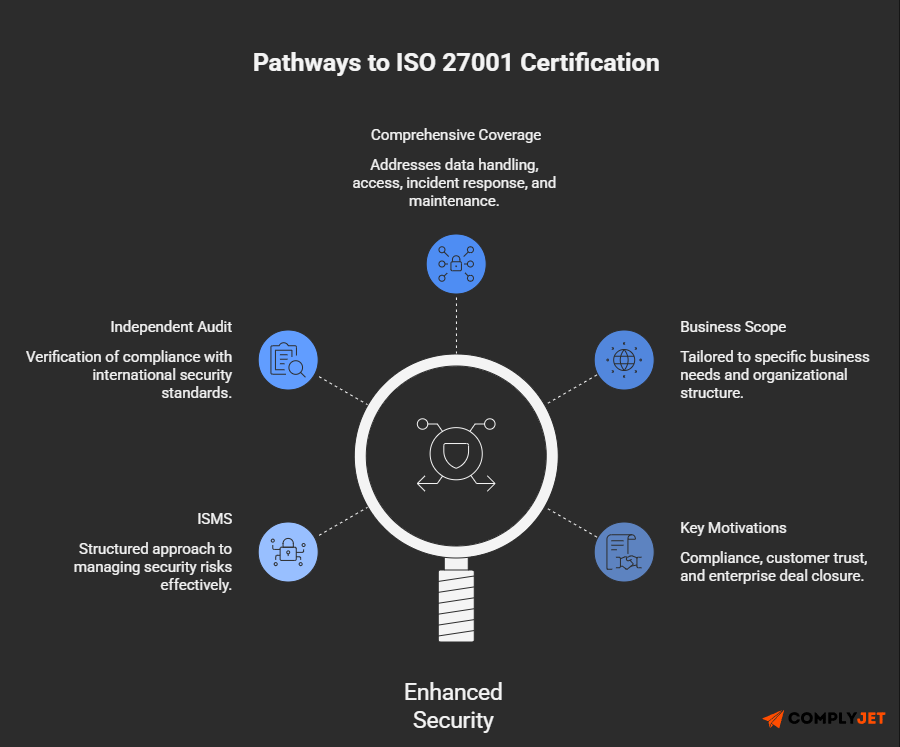
ISO 27001 is an international standard for building an Information Security Management System, often referred to as ISMS. In simple terms, it is a structured way to identify, manage, and reduce security risks within an organization.
Getting ISO 27001 certification means that an independent auditor has verified that your systems, processes, and controls meet the requirements of the standard. It is not limited to tools or technology. It covers how your organization handles data, manages access, responds to incidents, and maintains security over time.
The scope of ISO 27001 depends on your business. Some companies include their entire organization, while others start with a specific product, system, or department.
So who actually needs ISO 27001 certification?
It is especially relevant for:
- SaaS companies handling customer data
- Cloud-based businesses managing infrastructure or applications
- Enterprises with complex systems and compliance requirements
- Startups that want to work with enterprise clients
Most businesses pursue ISO 27001 for a few key reasons. It helps meet compliance requirements, builds trust with customers, and often becomes essential when closing enterprise deals where security is a priority.
In many cases, ISO 27001 is not just a requirement. It becomes a signal that your business takes security seriously.
ISO 27001 Certification Process (Step-by-Step)
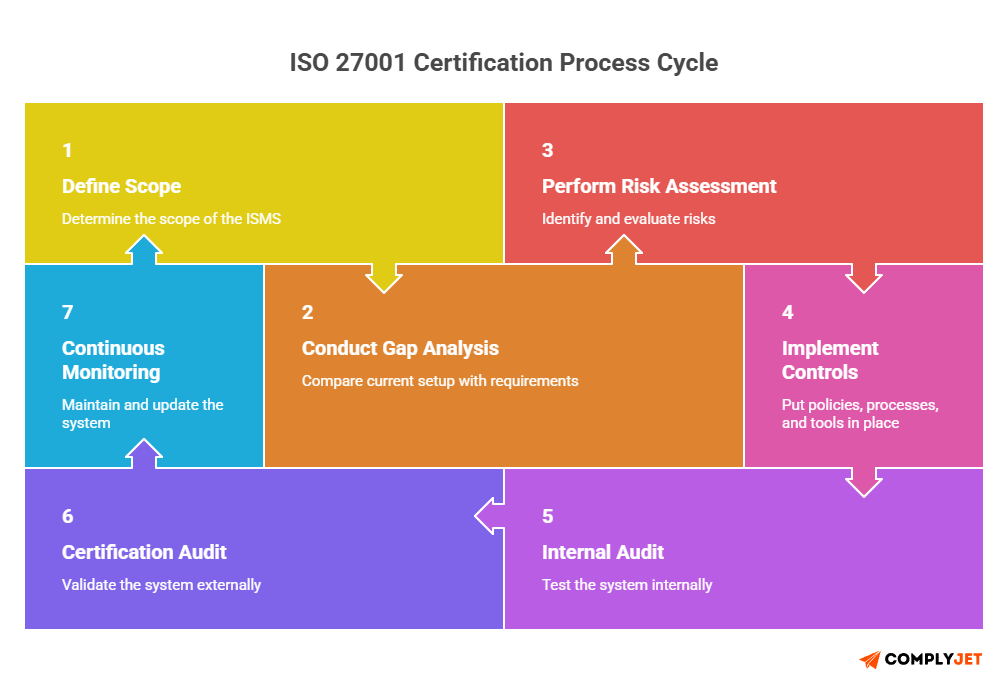
If you break it down, the ISO 27001 certification process is not complicated. What makes it difficult is how it is executed inside a company.
There are multiple moving parts, different teams involved, and a lot of documentation. But at its core, the process follows a clear structure. Once you understand that structure, it becomes much easier to plan and execute.
Here is how the ISO 27001 certification process actually works in practice.
Step 1: Define the Scope of Your ISMS
This is where everything starts.
You need to decide what exactly you are certifying. Not your entire company, unless that is required. Most teams start with a defined scope.
This includes:
- the product or system you want to certify
- the type of data involved
- the teams responsible for managing it
A tighter scope makes the entire process faster, easier, and more manageable. A vague scope usually leads to delays later.
Step 2: Conduct a Gap Analysis
Before building anything new, you need to understand where you stand.
A gap analysis compares your current setup with ISO 27001 requirements. It shows:
- what you already have
- what is missing
- what needs to be fixed
Most companies realize at this stage that they are not starting from zero. They already have some controls in place, just not structured or documented properly.
For a step-by-step walkthrough of how to run one, see our ISO 27001 gap analysis guide.
Step 3: Perform Risk Assessment and Treatment
ISO 27001 is fundamentally about managing risk.
In this step, you identify:
- what could go wrong
- how likely it is
- what impact it would have
Then you decide what to do about it.
Some risks need controls. Some need monitoring. Some can be accepted.
The goal is not to eliminate all risk. It is to manage it in a structured and documented way.
Step 4: Implement Security Controls
This is where strategy turns into execution.
Based on your risk assessment, you implement controls to manage those risks.
These controls usually fall into three areas:
1. Policies
These define how your organization handles security. For example:
- access control policies
- data protection policies
- incident response guidelines
2. Processes
These ensure that policies are followed consistently. For example:
- how incidents are reported and handled
- how access is granted or revoked
- how systems are monitored
3. Tools
These support enforcement and visibility. For example:
- logging systems
- monitoring tools
- access management platforms
A common mistake here is treating this step as documentation work only. In reality, auditors will check whether these controls are actually followed in day-to-day operations.
So the focus should be on implementation, not just documentation.
If you want to understand how these controls map to the standard's structure, our guide to the ISO 27001 domains breaks down each control area in detail.
Step 5: Internal Audit and Readiness Check
Before bringing in external auditors, you need to test your system internally.
An ISO 27001 internal audit helps you:
- identify gaps you may have missed
- check whether controls are working
- ensure documentation is complete
Think of this as a dry run. It reduces surprises during the actual audit.
Step 6: Certification Audit (Stage 1 and Stage 2)
This is where everything gets validated.
Up to this point, you have built your ISMS, implemented controls, and prepared documentation. Now an external certification body steps in to check whether everything actually works as expected.
The ISO 27001 audit happens in two stages.
Stage 1 Audit
This stage focuses on your documentation and overall readiness.
Auditors review your policies, risk assessment, scope, and ISMS structure to understand how your system is designed. They are not testing everything in detail yet. Instead, they are checking whether you are prepared for the full audit.
For example, an auditor might review your access control policy and ask:
- Is it clearly defined?
- Does it match your scope?
- Is it aligned with ISO 27001 requirements?
If there are gaps, you usually get time to fix them before moving to Stage 2.
Stage 2 Audit
This is the actual certification audit.
Here, auditors go beyond documents and look at how things work in practice. They want to see whether your team is actually following the processes you have defined.
For example:
- If you have an access control policy, they may check user access logs
- If you have an incident response process, they may ask how recent incidents were handled
- If you have monitoring tools, they may review logs or alerts
They may also speak with team members to understand how processes are followed in real situations.
This stage is about consistency. What is written should match what is happening.
Passing this stage means your organization meets ISO 27001 requirements.
Step 7: Certification Issued and Continuous Monitoring
Once you pass the audit, you receive ISO 27001 certification.
But this is not the end of the process.
You are expected to:
- maintain your controls
- update your system as your business changes
- go through regular surveillance audits
ISO 27001 is not a one-time project. It is an ongoing system that evolves with your company.
If you look at it this way, the ISO 27001 certification process is not about ticking boxes. It is about building a system that can hold up under real scrutiny.
Want a guided ISO 27001 certification process instead of figuring it out alone? See how ComplyJet works.
How to Obtain ISO 27001 Certification (Practical Approach)
Now let’s make this real. The ISO 27001 certification process looks structured on paper, but the way you execute it depends on how your team chooses to approach it.
Most companies follow one of three paths. Each comes with its own trade-offs in terms of cost, speed, and risk.
If you are a startup or early-stage SaaS company, your approach to ISO 27001 will look different.
Read: ISO 27001 for Startups
DIY (Internal Team)
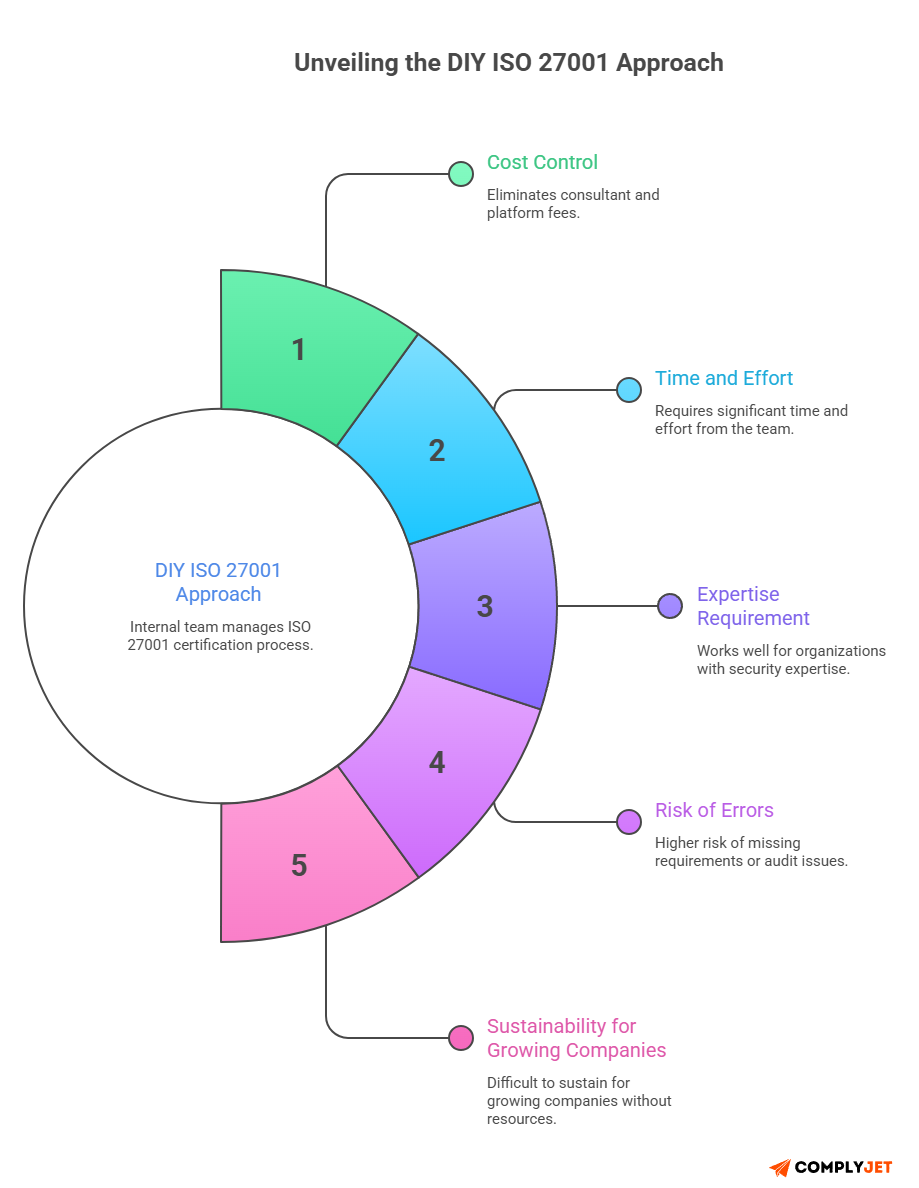
Some companies choose to handle the entire ISO 27001 certification process internally.
In this approach, the internal team manages everything. This includes understanding ISO 27001 requirements, creating policies, implementing controls, and preparing for audits.
This works well for organizations that already have strong security and compliance expertise.
The biggest advantage is cost control. There are no consultant or platform fees. However, it requires significant time and effort from the team.
Without prior experience, the process can become slow and difficult. There is also a higher risk of missing requirements or facing issues during the audit.
For growing companies without dedicated compliance resources, this approach can be hard to sustain.
Consultant-Led Approach
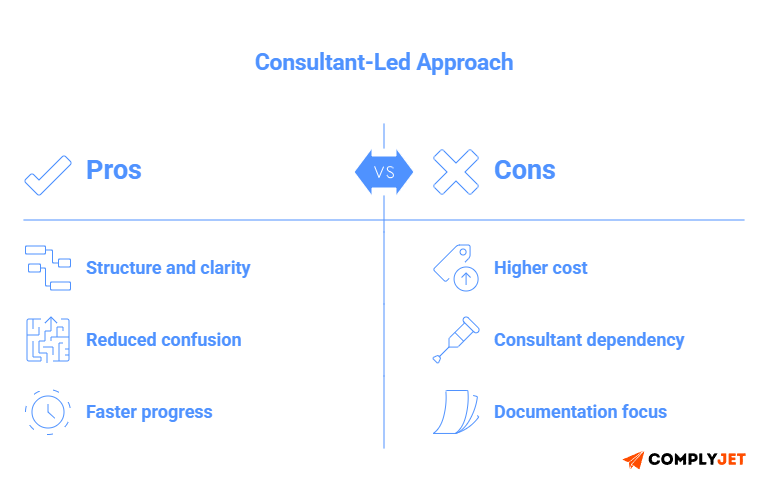
Another common approach is working with external consultants who specialize in ISO 27001 certification. These consultants guide the organization through the process, helping with gap analysis, documentation, implementation, and audit preparation.
This approach provides more structure and clarity, especially for teams that are new to ISO 27001. It can significantly reduce confusion and help avoid common mistakes, which often leads to faster progress. However, it comes at a higher cost, and the outcome depends heavily on the quality of the consultant.
In some cases, consultants may focus more on documentation rather than ensuring that controls are effectively implemented, which can create challenges during the audit stage.
Automation Platforms
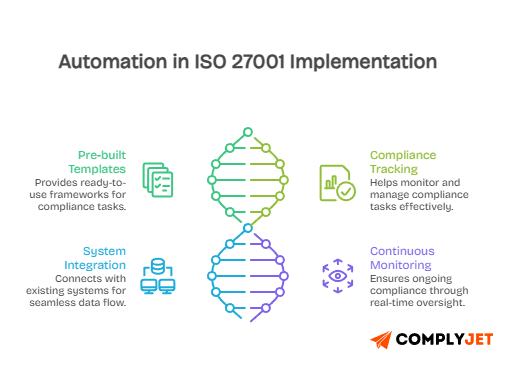
Many modern organizations, particularly SaaS companies, rely on automation platforms to manage ISO 27001 implementation. These platforms provide pre-built templates, help track compliance tasks, integrate with existing systems, and support continuous monitoring.
This approach offers a balance between speed and scalability. It reduces manual effort, keeps everything organized, and makes it easier to manage audits. Teams can move faster without having to build everything from scratch.
However, there is still a cost associated with using these platforms, and they do not replace the need for internal ownership. The system still needs to be actively managed and followed within the organization.
Book a demo to understand how your team can complete ISO 27001 certification faster.
ISO 27001 Certification Process for Different Business Types
The process is the same, but execution differs.
While the ISO 27001 certification process follows a standard structure, how it is implemented varies significantly depending on the type of business.
Factors such as team size, infrastructure complexity, and available resources influence how quickly and efficiently a company can move through the process.
Small Businesses
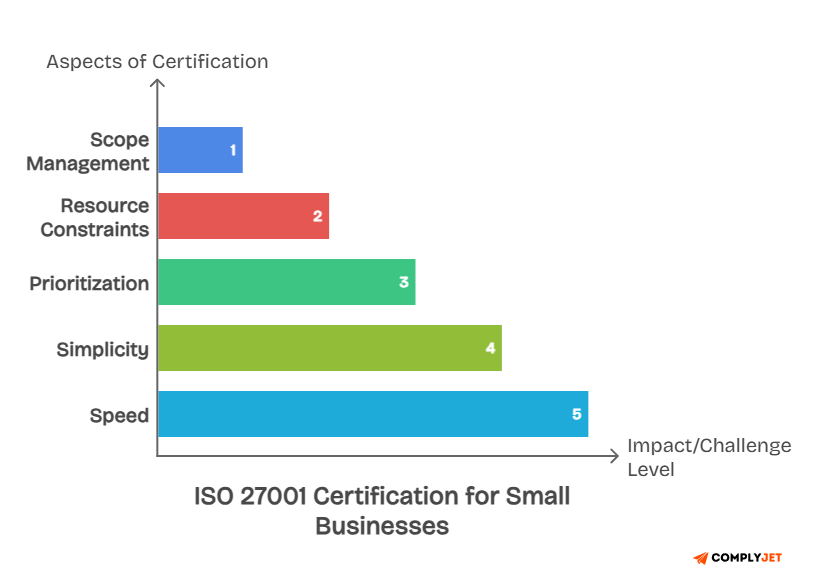
For small businesses, the ISO 27001 certification process is usually more focused and manageable. With limited resources and smaller teams, the scope is often narrower, which makes implementation faster.
Many small businesses choose to certify a specific product or function rather than the entire organization.
However, resource constraints can also be a challenge. Teams often handle multiple responsibilities, and dedicating time to compliance can slow down progress. The key for small businesses is to keep the scope tight, prioritize essential controls, and avoid overcomplicating the process.
When done right, smaller teams can move through certification relatively quickly compared to larger organizations.
SaaS Companies
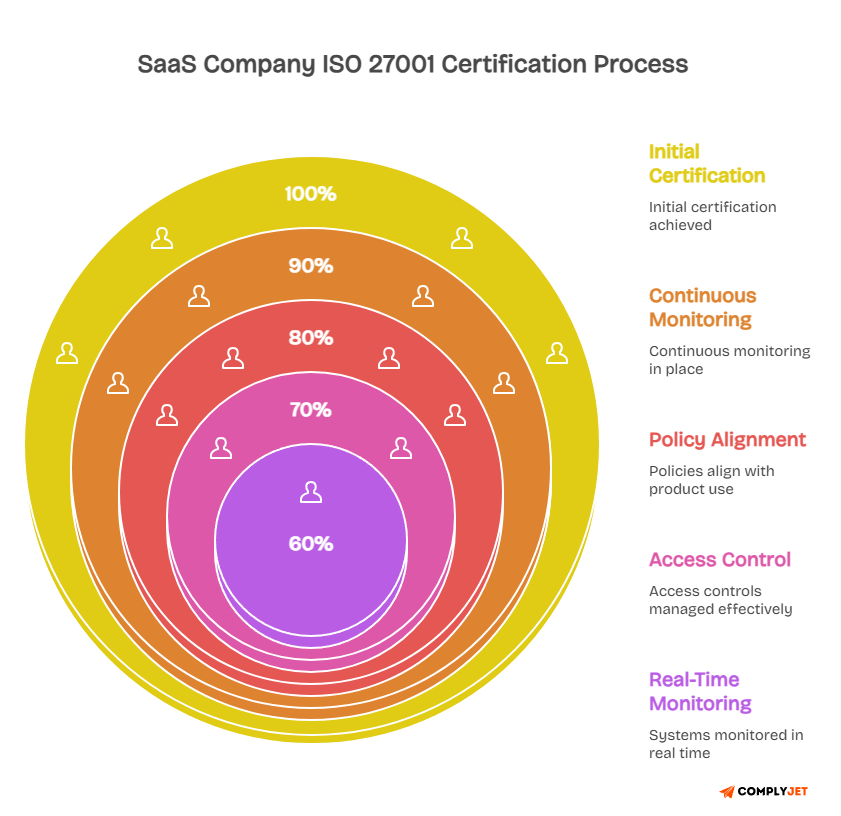
For SaaS companies, the ISO 27001 certification process is closely tied to cloud infrastructure and continuous operations. Since these companies handle customer data and operate in dynamic environments, security controls need to be actively maintained rather than set once.
The process often involves integrating with cloud providers, managing access controls, monitoring systems in real time, and ensuring that policies align with how the product is actually used.
Continuous monitoring becomes critical, as changes in code, infrastructure, or user access can directly impact compliance.
SaaS companies often adopt tools and automation to keep up with these changes. The focus is not just on achieving certification, but on maintaining it as the product evolves.
Enterprises
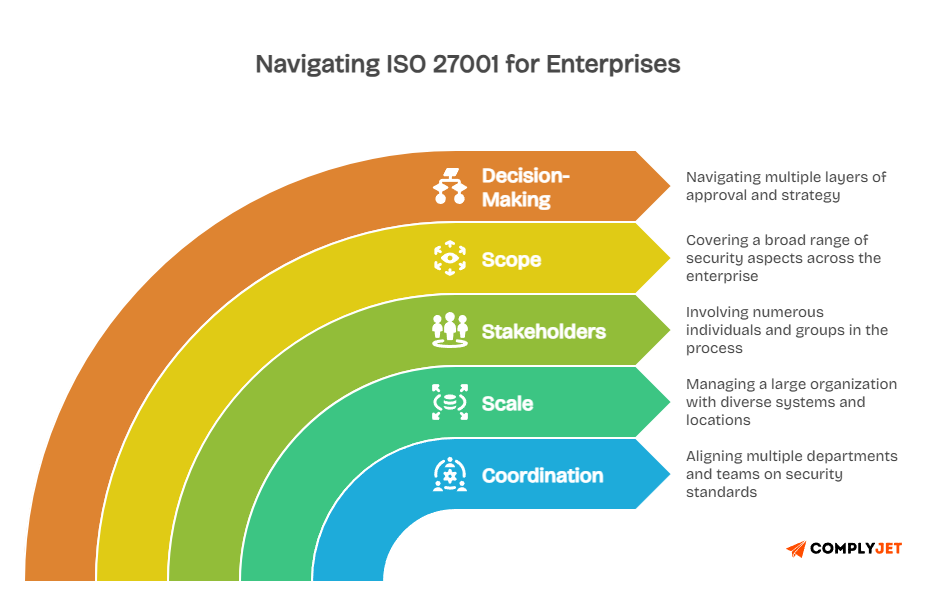
Getting ISO 27001 certified in an enterprise is not just about implementation. It is about coordination.
Think about this. A large organization with multiple departments, different systems, and teams spread across locations is trying to align on one security standard. Now imagine getting all of them to follow the same process consistently.
That is where the complexity comes in.
For enterprises, the ISO 27001 certification process becomes more challenging because of scale. There are more stakeholders involved, broader scope, and multiple layers of decision-making
You can also read A Practical Guide to Help Founders
Cloud-Based Companies
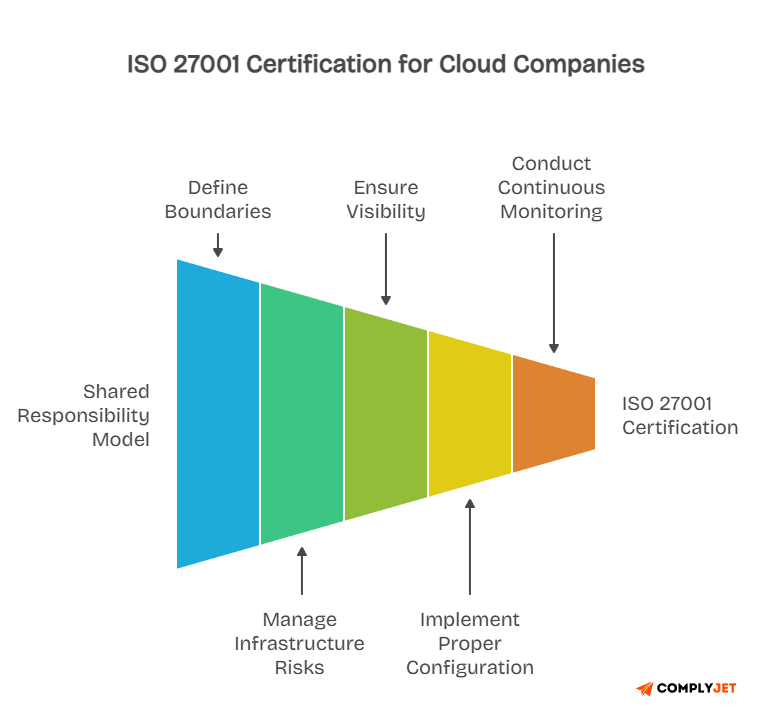
Cloud-based companies face a unique challenge in the ISO 27001 certification process due to the shared responsibility model. While cloud providers handle certain aspects of infrastructure security, the organization is still responsible for how services are configured, accessed, and managed.
This creates a need for clear boundaries. Companies must understand what the cloud provider is responsible for and what falls under their own control. Misalignment here can lead to gaps in security and compliance.
In addition, infrastructure risks such as misconfigurations, access control issues, and dependency on third-party services need to be carefully managed.
For cloud-based businesses, the focus is on visibility, proper configuration, and continuous monitoring to ensure that security standards are maintained.
The rise of cloud-based audit management tools has resulted in a 45% reduction in manual auditing errors.
How Long Does ISO 27001 Certification Take?
One of the most common questions teams ask is simple. How long will this take?
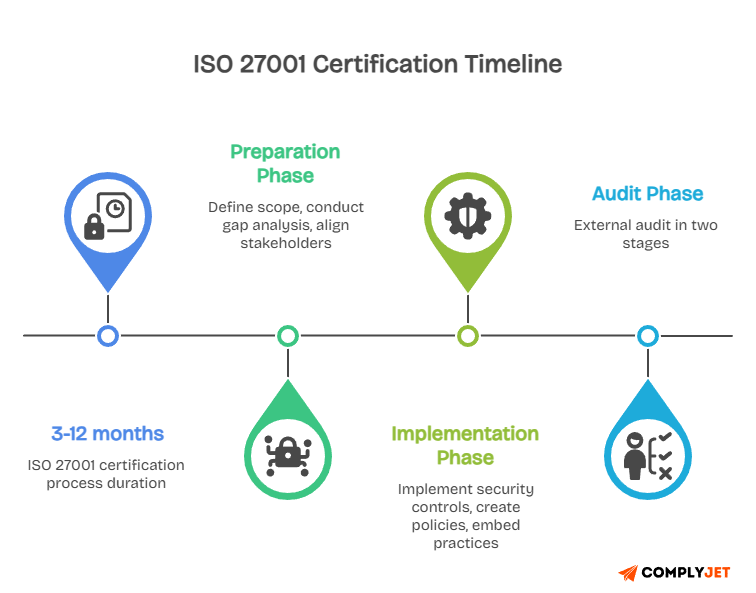
The ISO 27001 certification process typically takes 3 to 12 months, depending on how prepared your organization is and how efficiently the process is executed. While the timeline varies, most companies go through three clear phases.
Preparation Phase
This is where the foundation is set.
In this phase, you define the scope of your ISMS, conduct a gap analysis, and understand what needs to be done. You also align internal stakeholders and decide how you will approach the certification process.
For companies that already have basic security practices in place, this phase can move quickly. For others, especially those starting from scratch, it may take more time to build clarity and structure.
A strong preparation phase makes everything that follows much smoother.
Implementation Phase
This is the most time-intensive part of the process.
Here, you implement security controls, create policies, and ensure that processes are actually followed within the organization. It is not just about documentation. It is about making sure that security practices are embedded into daily operations.
This phase often takes the longest because it involves coordination across teams, changes in workflows, and consistent execution.
The speed of this phase depends heavily on internal ownership and how actively teams are involved.
Audit Phase
This is the final stage before certification, and where everything gets validated.
An external certification body conducts the audit in two stages. The first stage focuses on documentation and readiness, ensuring your ISMS is properly defined. The second stage evaluates how your controls work in practice.
Auditors will not just review policies. They will look for evidence such as logs, reports, and actual execution of processes.
For example, a company may have an access control policy in place, but if access reviews are not performed regularly, it creates a gap. What is written must match what is happening.
If your preparation is strong, this phase is straightforward. To avoid delays, run an internal audit, verify your controls, and ensure your team understands their responsibilities.
What Affects the Timeline?
Even though the process follows these phases, the actual timeline depends on a few key factors.
Company size plays a major role, as larger organizations have more systems and stakeholders involved. Readiness also matters, since companies with existing controls and policies can move faster.
Finally, resource availability is critical. Teams with clear ownership and dedicated effort tend to complete certification much more efficiently.
In practice, organizations that treat ISO 27001 as a structured project with clear ownership stay closer to the shorter end of the timeline, while others often experience delays.
For a phase-by-phase breakdown of what to expect at each stage, see our ISO 27001 certification timeline guide.
How Much Does ISO 27001 Certification Cost?
Process and cost go hand in hand.
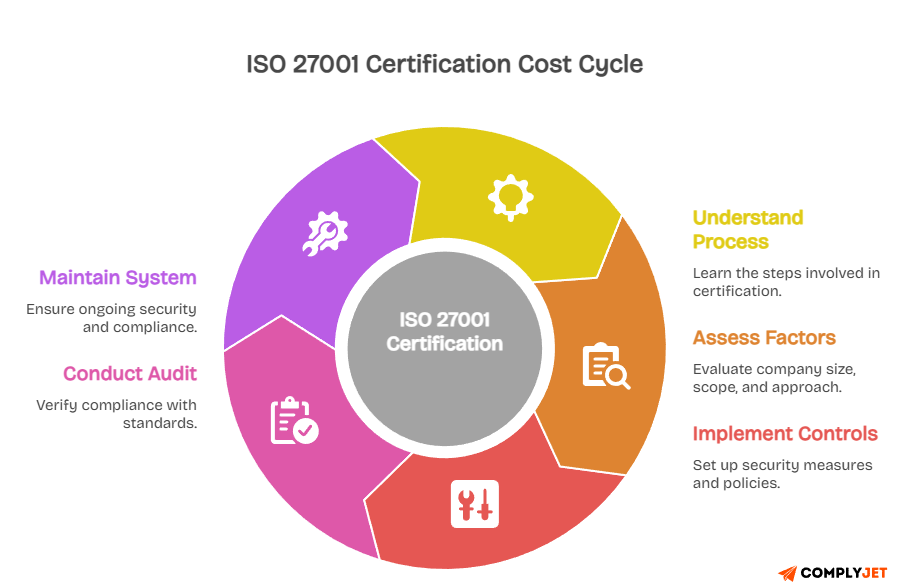
Once you understand the ISO 27001 certification process, the next logical question is cost. The answer is not fixed because the total investment depends on multiple factors, such as company size, scope, and the approach you choose.
In general, the cost of ISO 27001 certification includes implementation, audit, and ongoing maintenance. Smaller companies with a limited scope usually fall on the lower end, while larger organizations with complex systems and broader scope require a higher investment.
The approach you take also impacts cost. Handling the process internally may reduce external expenses but increase time and effort. Working with consultants or using automation platforms can speed up the process, but comes with additional costs.
Instead of looking at ISO 27001 as a one-time expense, it is more useful to think of it as an investment in security, trust, and long-term growth. For many businesses, especially those working with enterprise clients, the value it unlocks often outweighs the cost.
For a detailed breakdown of ISO 27001 certification cost, including pricing ranges and hidden costs, refer to our complete cost guide.
ISO 27001 Audit Process: Stages, Checklist & What to Expect
The audit is where everything comes together.
Up to this point, you have defined your scope, implemented controls, and prepared your system. The audit is where an external certification body evaluates whether everything you have built actually meets ISO 27001 requirements.
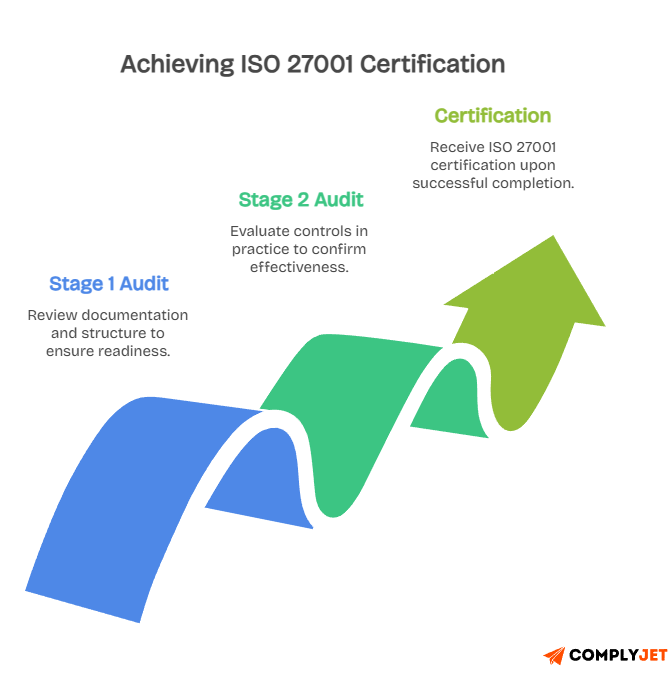
The ISO 27001 audit process is typically divided into two stages, followed by a detailed evaluation based on a checklist.
Stage 1 Audit
The first stage focuses on readiness and documentation.
At this stage, auditors review your Information Security Management System to understand how it is structured. They check whether your policies, procedures, and documentation align with ISO 27001 requirements.
This is not a deep technical audit yet. Instead, it ensures that your organization is prepared for the full assessment. If gaps are identified here, you are usually given time to address them before moving to the next stage.
Stage 2 Audit
The second stage is the actual certification audit.
Here, auditors go beyond documentation and evaluate how your controls work in practice. They look for evidence that your policies are being followed, your processes are active, and your security measures are effective.
This may involve reviewing logs, checking access controls, validating incident response processes, and speaking with team members. The focus is on consistency between what is documented and what is actually happening.
If everything meets the required standard, your organization moves toward certification.
ISO 27001 Audit Checklist (What Auditors Look For)
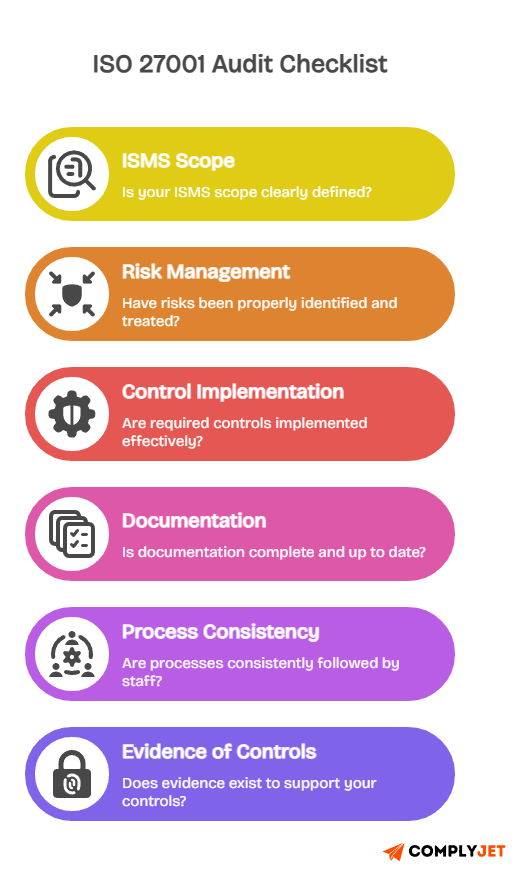
Throughout the audit process, auditors follow a structured checklist to evaluate your system.
They assess whether:
- your ISMS scope is clearly defined
- risks have been properly identified and treated
- required controls are implemented
- documentation is complete and up to date
- processes are consistently followed
- evidence exists to support your controls
The checklist is not just about ticking boxes. It is about verifying that your security practices are real, repeatable, and effective.
The ISO 27001 audit process may seem intimidating, but if your preparation is solid and your system is properly implemented, it becomes a straightforward validation rather than a hurdle.
Common Challenges in ISO 27001 Certification
Here is where most teams struggle.
The ISO 27001 certification process is structured, but challenges come from execution. Teams often underestimate the effort and run into issues midway.
For example, documentation may be completed, but controls are not followed in daily operations. Or ownership is unclear, so key tasks get delayed.
The problem is not complexity, but consistency.
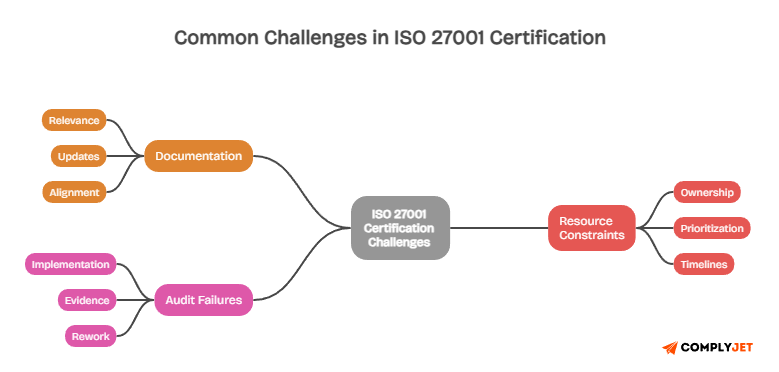
To avoid this, assign clear ownership, align documentation with actual practices, and run regular internal checks. This helps catch gaps early and keeps the process on track.
For a closer look at where teams commonly go wrong, see our guide to ISO 27001 implementation mistakes.
Documentation
One of the biggest challenges is documentation. It is not just about creating policies, but making sure they are relevant, updated, and aligned with actual practices. Many teams either over-document or rely on generic templates that do not reflect how the organization actually operates. This creates gaps during audits, where documented policies do not match real execution.
Resource Constraints
This is where things start slipping. Resource constraints are a common issue in the ISO 27001 certification process. It often becomes an additional responsibility instead of a dedicated role.
For example, a team handling product, operations, and compliance together may delay tasks like risk reviews or audits simply because other priorities take over.
Without clear ownership, work gets pushed, timelines stretch, and progress slows down. The fix is simple but important. Assign ownership early and treat ISO 27001 as a priority, not a side task.
Many companies solve this by building a dedicated GRC function to own compliance work long-term. Our guide to GRC careers breaks down what that role looks like and how to structure it.
Audit Failures
Audit failures or delays usually occur when there is a disconnect between documentation and implementation. Controls may exist on paper but are not followed in practice, or evidence is not properly maintained. This often leads to rework, additional audit cycles, and increased time and cost.
How to Speed Up ISO 27001 Certification
Yes, you can reduce time significantly.
While the ISO 27001 certification process naturally takes time, most delays are not due to the framework itself but how it is executed. With the right approach, teams can move much faster without compromising quality.
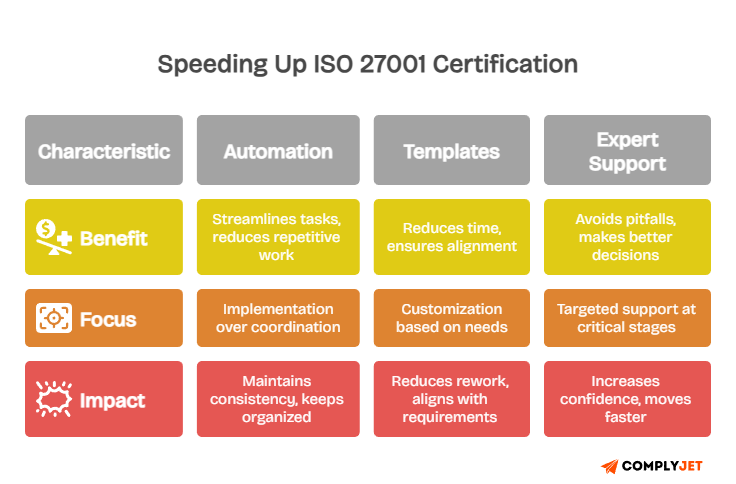
Use Automation
Automation plays a major role in speeding up ISO 27001 certification. Instead of managing everything manually, automation tools help streamline tasks such as policy management, control tracking, and evidence collection. This reduces repetitive work and keeps everything organized in one place.
For teams working in fast-moving environments, especially SaaS companies, automation also helps maintain consistency as systems and processes evolve. It allows you to focus more on implementation rather than coordination.
Use Templates
Starting from scratch is one of the biggest reasons teams slow down.
Using pre-built templates for policies, risk assessments, and documentation can significantly reduce the time required. Templates provide a structured starting point, which you can then customize based on your organization’s needs.
This not only speeds up the process but also ensures that your documentation aligns with ISO 27001 requirements from the beginning, reducing the chances of rework later.
Get Expert Support
Having the right guidance at the right time can make a noticeable difference.
Experts who have worked on multiple ISO 27001 implementations understand common pitfalls and know how to avoid them. They can help you make better decisions early in the process, which prevents delays during later stages such as audits.
This does not always mean fully outsourcing the process. Even targeted support at critical stages can help teams move faster and with more confidence.
Start your free trial and see how ISO 27001 implementation works in a structured workflow.
ISO 27001 Certification as a Growth Lever (Beyond Compliance)
Let’s go beyond the process.
Most teams start ISO 27001 thinking about compliance. They want to meet requirements, pass audits, and check a box. But in practice, ISO 27001 often becomes much more than that. It starts influencing how your business grows, how customers perceive you, and how quickly you can move in competitive markets.
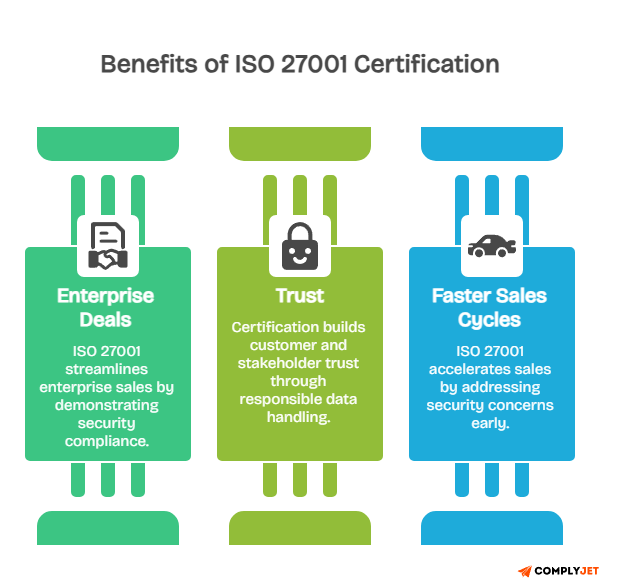
Enterprise Deals
For companies selling to enterprise clients, ISO 27001 can directly impact deal outcomes.
Enterprise buyers care deeply about security. Without a recognized certification, your team ends up answering long security questionnaires, going through multiple review cycles, and facing delays in approvals. In many cases, deals do not move forward at all.
With ISO 27001 in place, a large part of that friction is removed. It acts as a signal that your security practices meet a recognized standard, which makes it easier for procurement and security teams to move forward with confidence.
Trust
ISO 27001 also plays a key role in building trust.
Customers want to know that their data is handled responsibly. Certification gives them that assurance. It shows that your organization follows structured processes and takes security seriously.
This trust extends beyond customers. It also matters for partners, investors, and stakeholders who evaluate your business from a risk perspective. Over time, this becomes part of your brand.
Faster Sales Cycles
One of the less obvious benefits of ISO 27001 is its impact on sales speed.
Without certification, sales teams often spend significant time addressing security concerns during late-stage conversations. This slows down deal cycles and increases the workload on both sales and technical teams.
With ISO 27001 in place, many of these concerns are already addressed. Conversations move faster, fewer back-and-forths are required, and decisions are made more quickly.
ISO 27001 may start as a compliance requirement, but for many businesses, it becomes a growth enabler. It reduces friction, builds confidence, and helps teams move faster in markets where trust and security are critical.
ISO 27001 in Your Compliance Stack
ISO 27001 does not exist alone.
Most organizations do not operate with a single framework. As they grow, they need to align with multiple standards and regulations depending on their customers, geography, and industry. ISO 27001 often becomes the foundation that connects and supports these requirements.
How ISO 27001 Fits with Other Frameworks
SOC 2
For companies working with US-based customers, SOC 2 is often a parallel requirement.
While SOC 2 focuses on trust service criteria such as security, availability, and confidentiality, ISO 27001 provides a broader management system for handling security risks. Many of the controls overlap, which means that having ISO 27001 in place can make SOC 2 implementation more structured and efficient.
Instead of treating them as separate efforts, organizations often use ISO 27001 as a base and map SOC 2 requirements on top of it.
For companies working with US clients:
SOC 2 Checklist: SOC 2 Compliance Checklist
You can also read ISO 27001 vs SOC 2: The Definitive Guide (2026)
GDPR
For companies handling data of European users, GDPR becomes a critical requirement.
While GDPR is a regulation and ISO 27001 is a standard, both focus heavily on data protection and risk management. ISO 27001 helps organizations build processes around data handling, access control, and incident response, which directly supports GDPR compliance.
It does not replace GDPR, but it makes it easier to demonstrate that proper security measures are in place.
For companies handling EU data:GDPR Compliance Guide
ISO 27001 is the fastest-growing certification type globally, forecast to grow at a CAGR of 14.2% through 2032, driven by cybersecurity threats and data privacy regulations like GDPR and CCPA.
NIST
For organizations working with government or highly regulated industries, NIST frameworks are often relevant.
NIST provides detailed guidelines for managing cybersecurity risks, especially in the US. ISO 27001 aligns well with these principles and can act as a structured system for implementing them.
Many organizations use ISO 27001 as a management layer and align specific controls with NIST requirements where needed.
For broader security frameworks:NIST Compliance Guide
ISO 27002
ISO 27002 is often confused with ISO 27001, but the two play different roles. ISO 27001 is the certifiable management system standard, while ISO 27002 provides detailed implementation guidance for the security controls referenced in Annex A.
Many teams use both together: ISO 27001 to build and certify the ISMS, and ISO 27002 as a reference for how to actually implement each control. For a full breakdown of the differences, see ISO 27001 vs ISO 27002.
Frequently Asked Questions About ISO 27001 Certification Process
How do I get ISO 27001 certified?
To get ISO 27001 certified, you need to implement an Information Security Management System, conduct a gap analysis, perform risk assessments, apply security controls, and pass a two-stage audit by an accredited certification body. Once approved, your organization receives ISO 27001 certification.
How long does ISO 27001 certification take?
ISO 27001 certification typically takes 3 to 12 months. The timeline depends on your company size, existing security practices, and available resources. Organizations with better preparation and clear ownership can complete the process faster.
How much does ISO 27001 certification cost?
The cost of ISO 27001 certification depends on scope, company size, and implementation approach. It usually includes implementation, audit, and maintenance costs. Small businesses spend less, while larger organizations with complex systems incur higher costs.
Who needs ISO 27001 certification?
ISO 27001 certification is needed by organizations that handle sensitive data or work with enterprise clients. It is especially important for SaaS companies, cloud-based businesses, startups, and enterprises that must demonstrate strong security practices.
What are ISO 27001 requirements?
ISO 27001 requirements include establishing an Information Security Management System, defining scope, identifying risks, implementing controls, maintaining documentation, and undergoing regular audits. The goal is to manage information security risks in a structured and consistent way.
Conclusion: From Confusion to Certification
For many teams, ISO 27001 starts as a requirement but quickly turns into a challenge. The biggest barrier is not understanding what needs to be done, but figuring out how to execute it in a structured and practical way.
The ISO 27001 certification process may seem complex, but it becomes predictable when broken into clear steps.
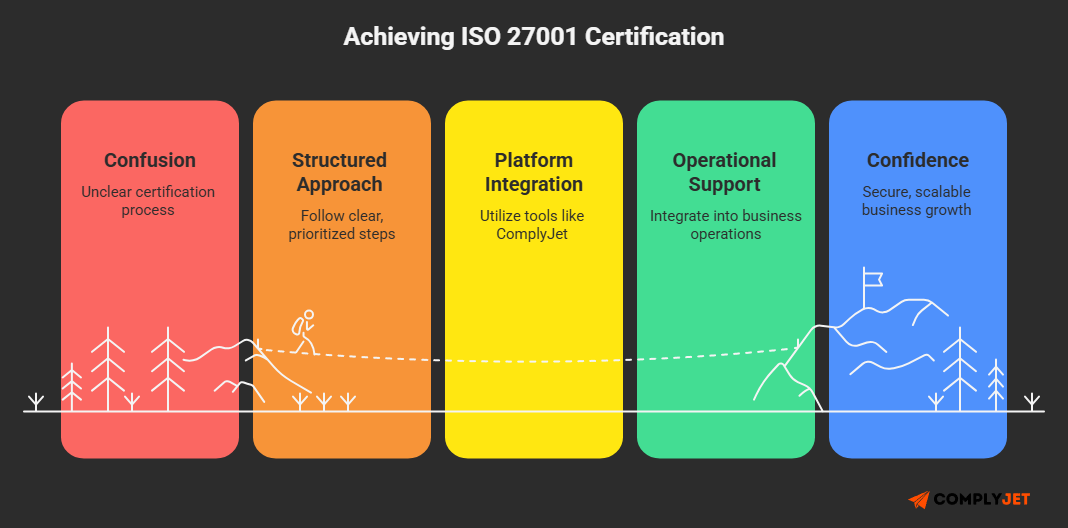
Once you understand the process, the timeline becomes easier to plan, and the strategy becomes clearer to execute. It is not about doing everything at once, but about following a structured approach with the right priorities and ownership.
For most teams, the real shift happens when ISO 27001 is no longer seen as just a compliance requirement. It becomes a system that supports how the business operates, builds trust with customers, and enables growth.
This is where platforms like ComplyJet come in. Instead of managing everything manually, teams can use a more structured approach with built-in workflows, templates, and guidance designed for modern businesses, especially SaaS companies. It helps reduce manual effort, keeps everything organized, and makes the certification process easier to manage end-to-end.
Certification is not just about passing an audit. It is about creating a foundation that helps your business scale securely and confidently.
If you are planning to move forward with ISO 27001 and want a clearer, faster path, the right tools and guidance can make a significant difference.
Start your ISO 27001 certification journey with ComplyJet