.svg)

The Industrialization of Trust
You likely need an ISO 27001 certificate. Perhaps a big enterprise deal is blocked. Maybe your board is demanding it. Five years ago, this meant hiring a consultant. You paid them hourly to manage spreadsheets. Today, you buy software. Vanta didn't just enter this market. They built it. They turned complex international standards into automated API checks. They industrialized trust for modern companies.
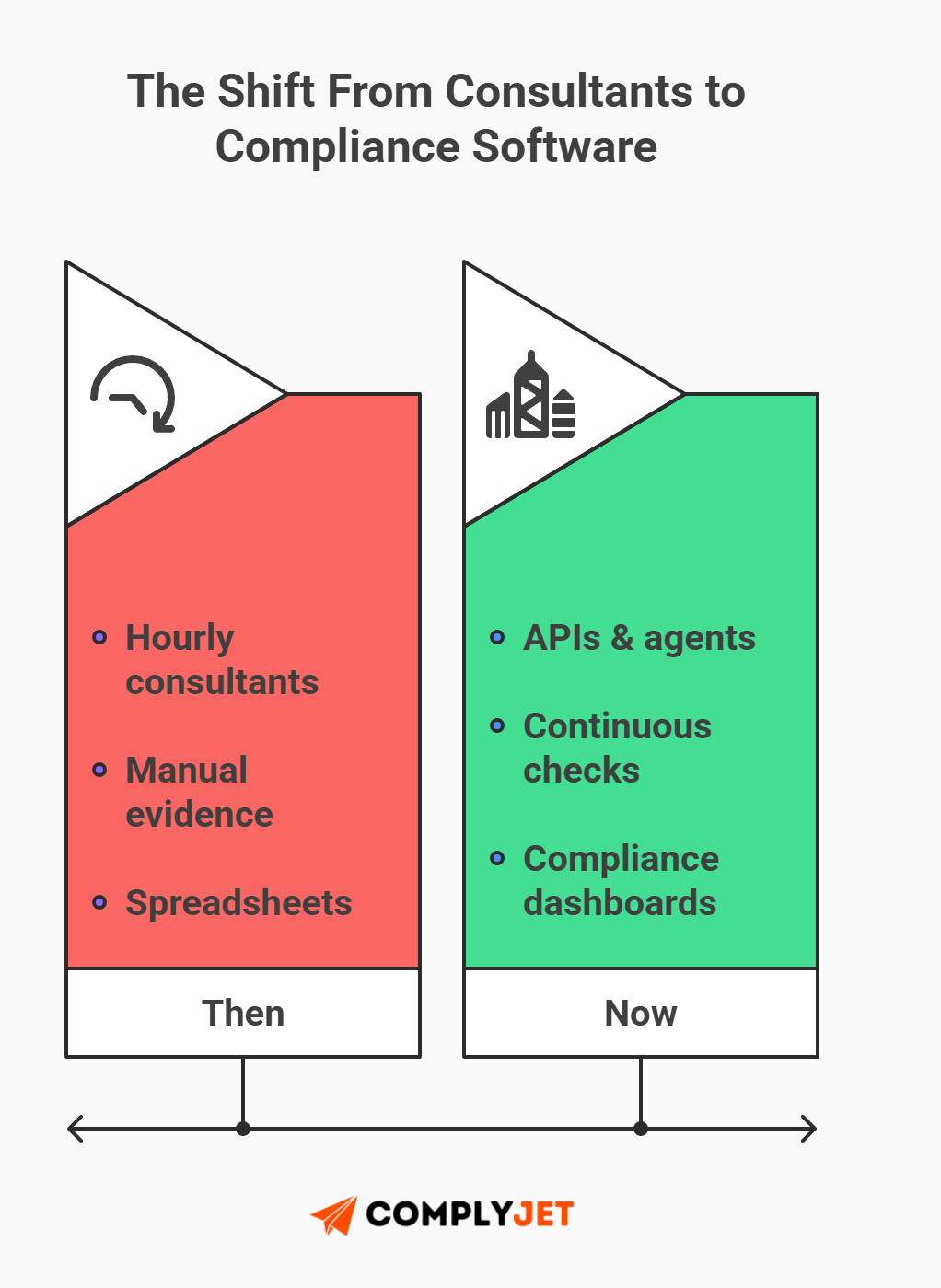
The shift is massive. Vanta's ISO 27001 compliance tools have commoditized the path to a badge. They replaced human judgment with binary tests. This is efficient. But it carries a risk. We call it the "Green Checkmark" fallacy. Don't fall for the "set it and forget it" myth. For a detailed review of Vanta's compliance solutions, click here.
Vanta sells speed. Its marketing highlights customer outcomes where teams achieve ISO 27001 certification in roughly half the time of a manual process - often positioning timelines around the 12-week mark for well-prepared organizations. This is technically possible. However, there is a catch. The software checks configuration. It does not check governance. Vanta proves your engineers use Multi-Factor Authentication (MFA). It cannot prove your leaders understand the nuances behind it.
This guide is for founders and CTOs. It is for lean security teams of one. If you are debating Vanta versus Drata or Sprinto, this is for you. We will break down exactly what the platform automates. We will also show you where the manual work hides. Let's look past the marketing gloss. For a thorough comparison of Vanta's compliance features, pricing and user reviews with other industry options, read our Vanta Alternatives article.
Big firms hide behind ticket queues. We don't. At ComplyJet, you get direct access to leadership, not a Tier 1 support bot. Get high-level guidance, not generic answers. Chat with our founders now.
Vanta ISO 27001 Compliance: Methodology & The 2022 Transition
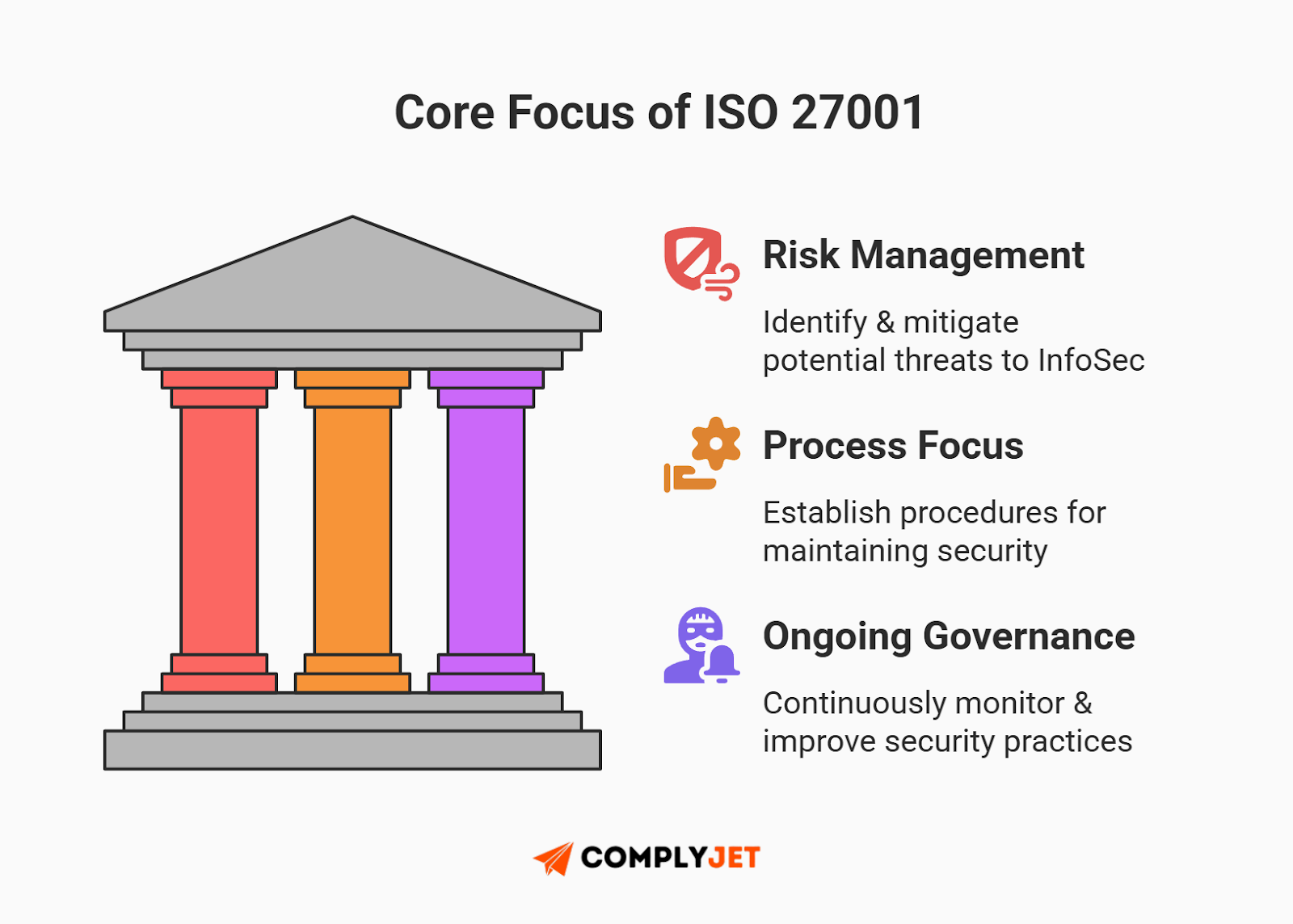
To evaluate Vanta, we must understand its core philosophy. It differs significantly from the standard itself. ISO 27001 is a management standard. It focuses on the process of risk management. It asks how you manage sensitive data.
Vanta operates on engineering logic. It seeks to prove security through binary configurations. It checks for encrypted hard drives. It verifies Multi-Factor Authentication (MFA). It confirms background checks are done.
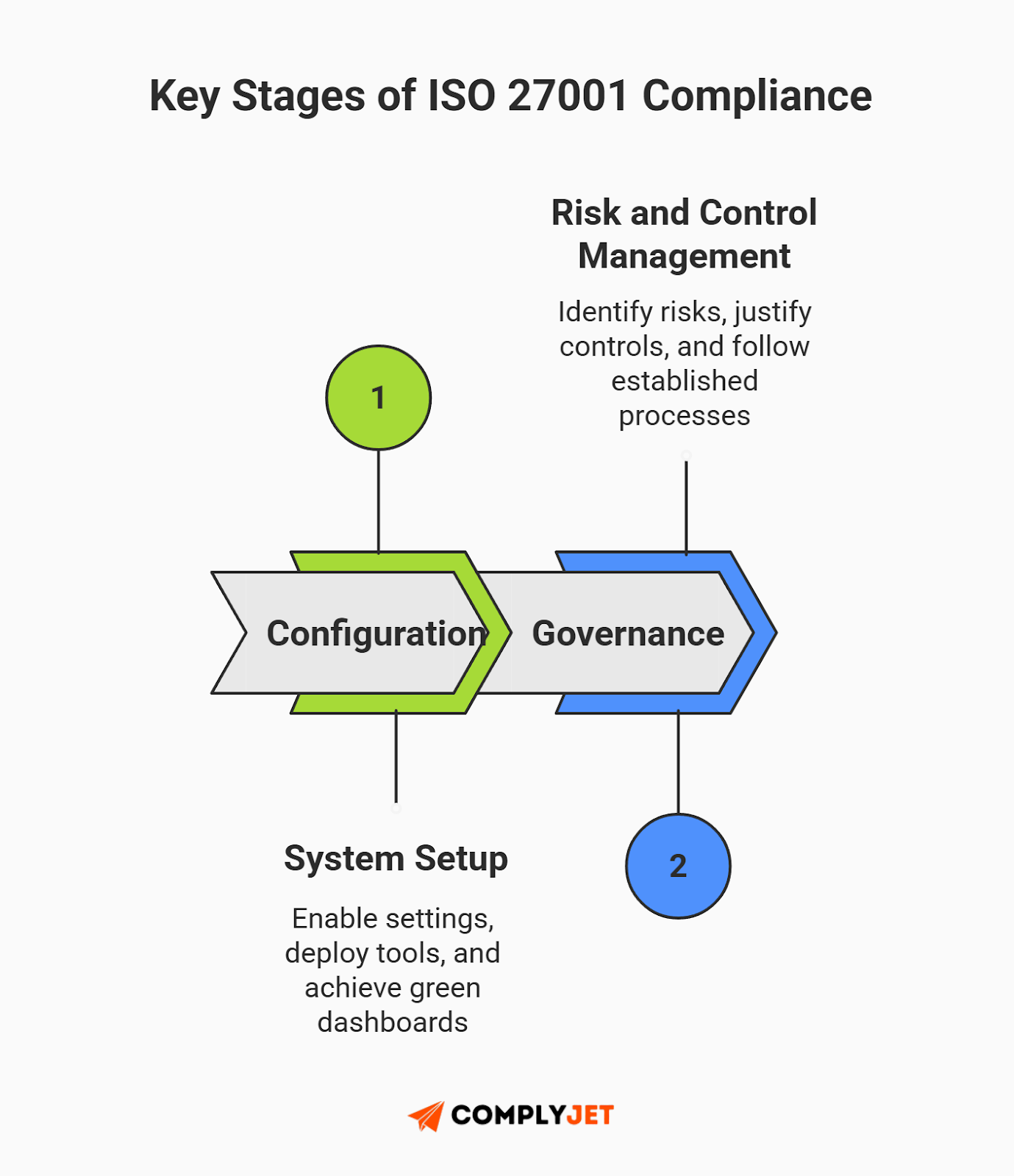
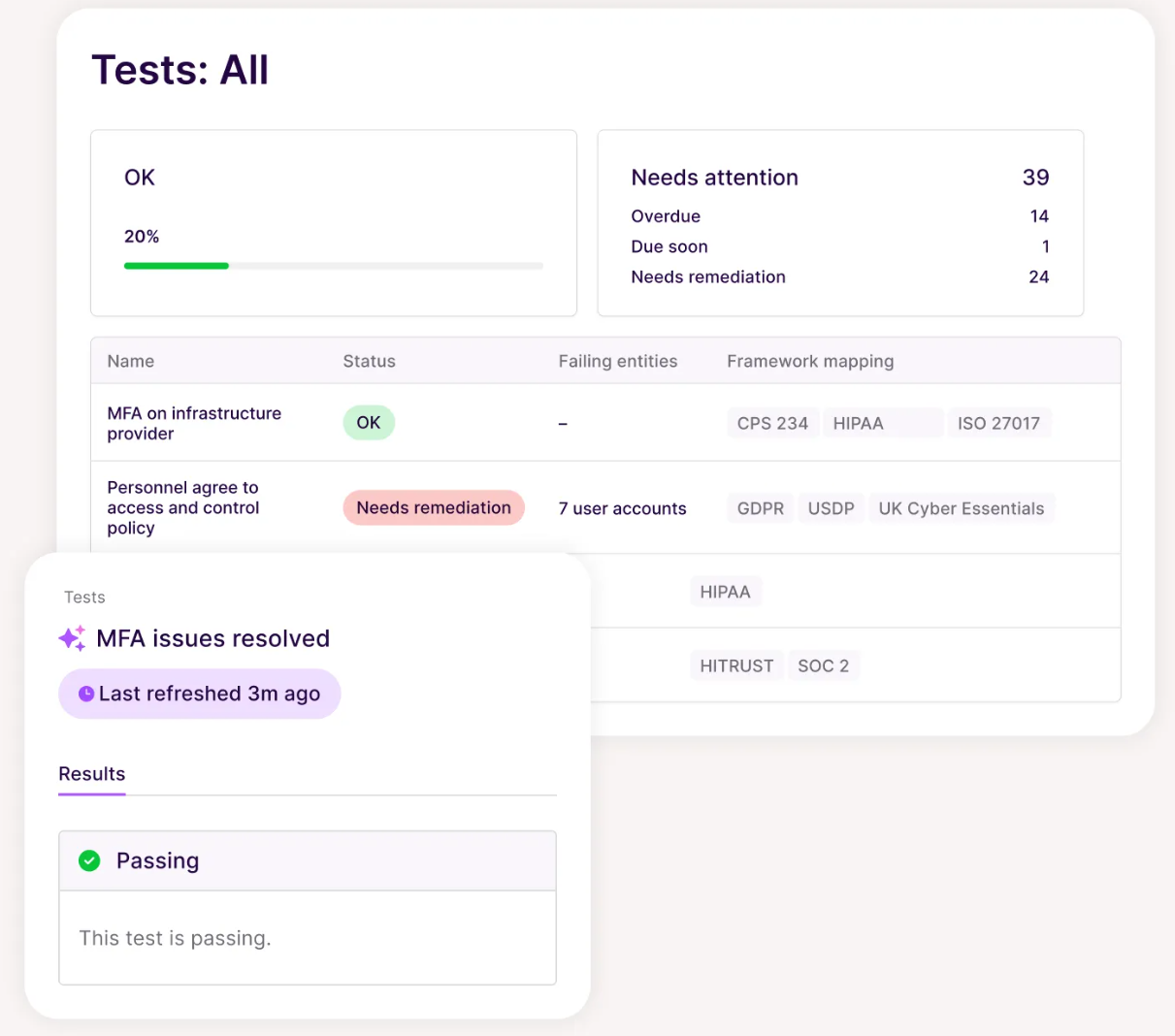
This creates a tension. We call it the gap between configuration and governance. Vanta excels at configuration. It relies on you for governance. The platform runs hourly tests. If a test passes, Vanta infers compliance. But an auditor needs more. They need to know why a control exists. They check if you actually manage it.
This is the danger of "checkbox compliance." You might adopt Vanta's default policies to get a green dashboard. But you might not understand the rules you just signed. An auditor can see a perfectly configured cloud setup. Vanta ensures that. But that same auditor can fail you if you cannot explain the risk rationale. A passing dashboard does not guarantee a passing audit.
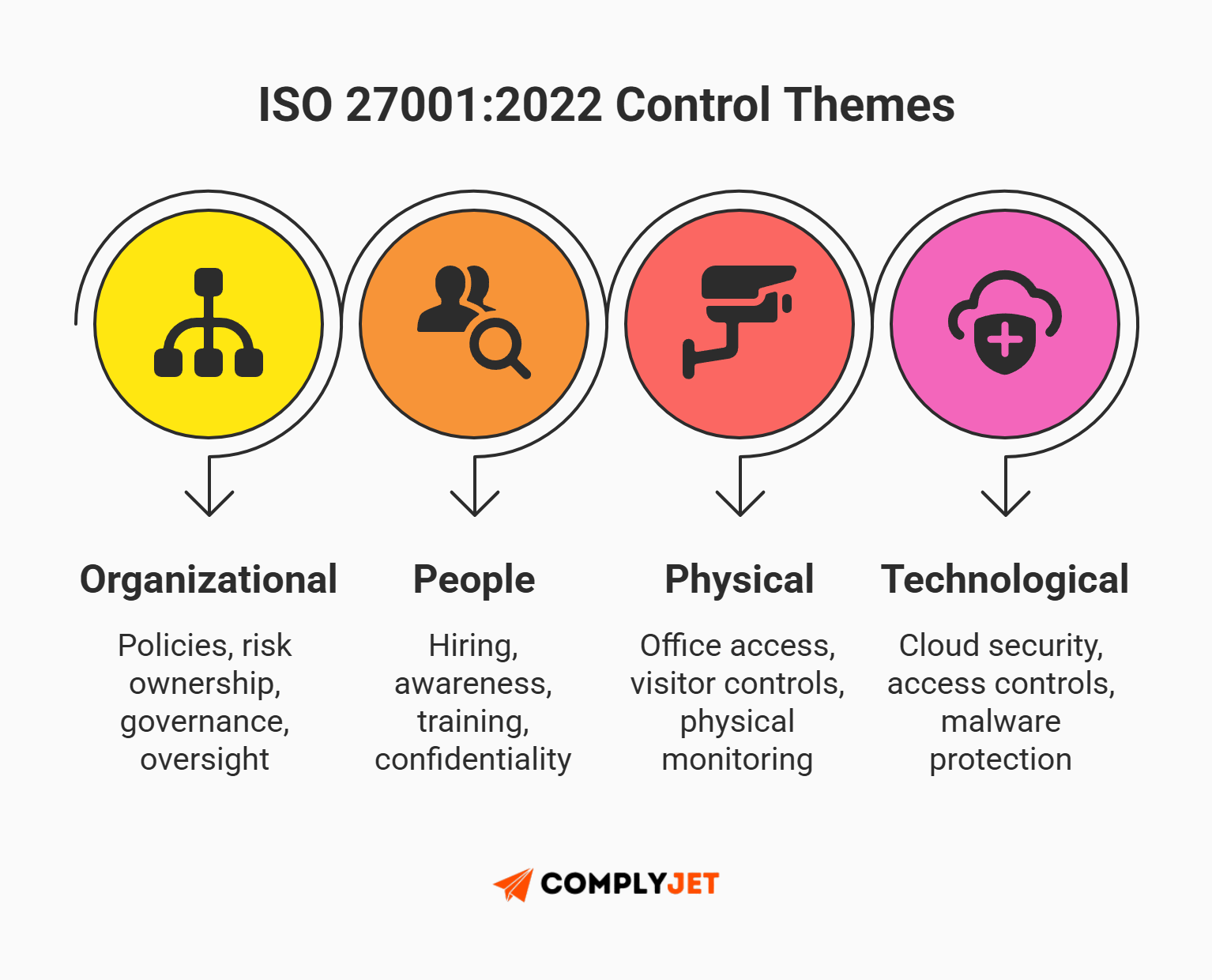
This methodology faced a test with the ISO 27001:2022 update. The standard changed. It consolidated 114 controls down to 93. It reorganized them into four themes. Manual teams faced a nightmare. They had to overhaul their entire Statement of Applicability (SoA). Spreadsheets had to be rewritten. Vanta adapted its platform to meet these new ISO 27001 compliance requirements automatically.
They built a dynamic mapping engine. This is a massive value add. For legacy customers, the tool re-maps existing evidence. It takes data from the 2013 standard and moves it to the 2022 structure. This preserves your audit trail. You do not lose historical data. You do not have to manually re-number rows in Excel.
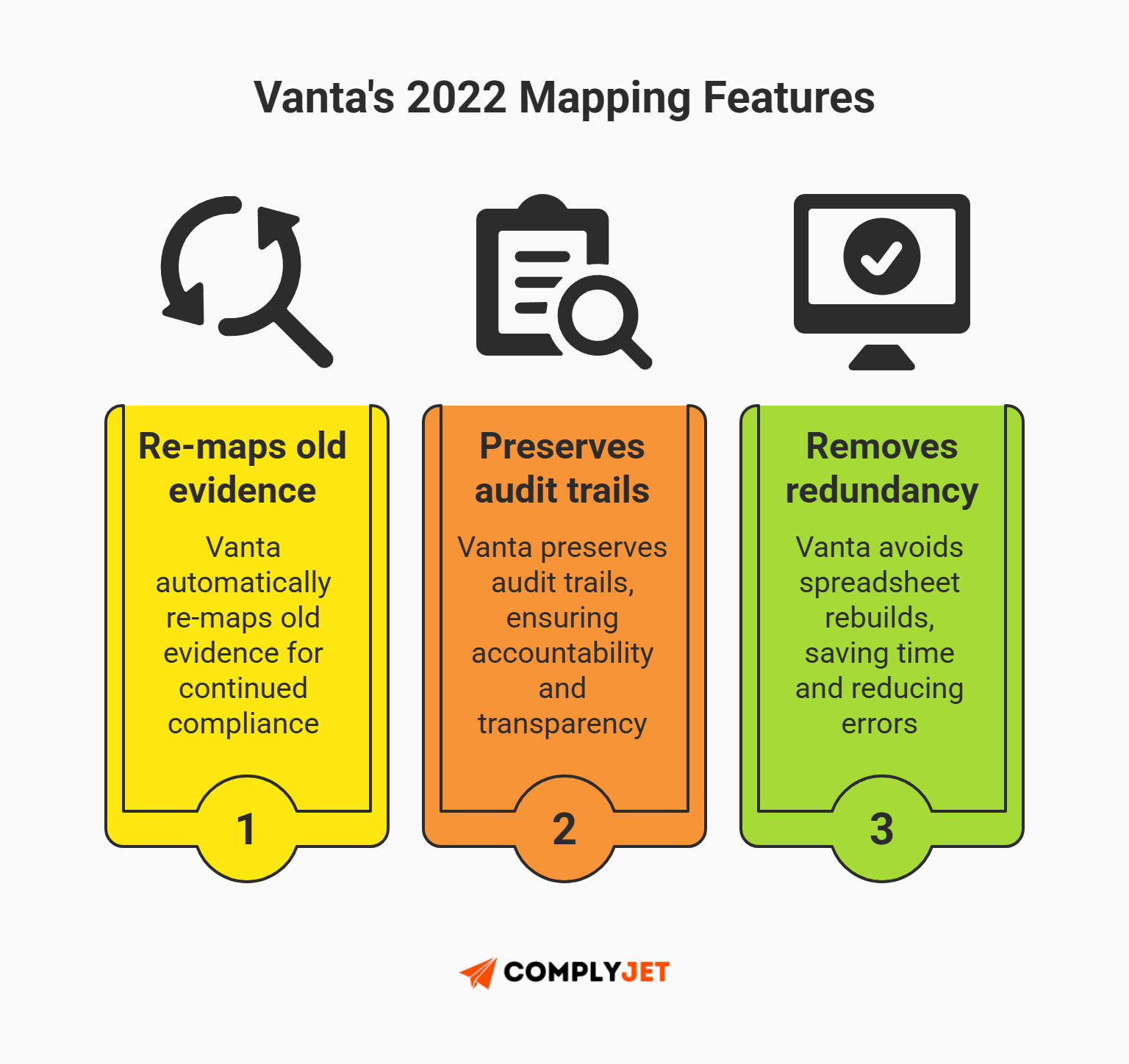
Vanta handles the structural reorganization of ISO 27001 controls for you. This lets you focus on the new content. You can work on Data Masking or Threat Intelligence. You stop wasting time on administrative tasks. This agility is why massive enterprises stick with Vanta. It handles the boring structural work so they can focus on the actual risks.
Breakdown of Vanta's ISO 27001 Software Features
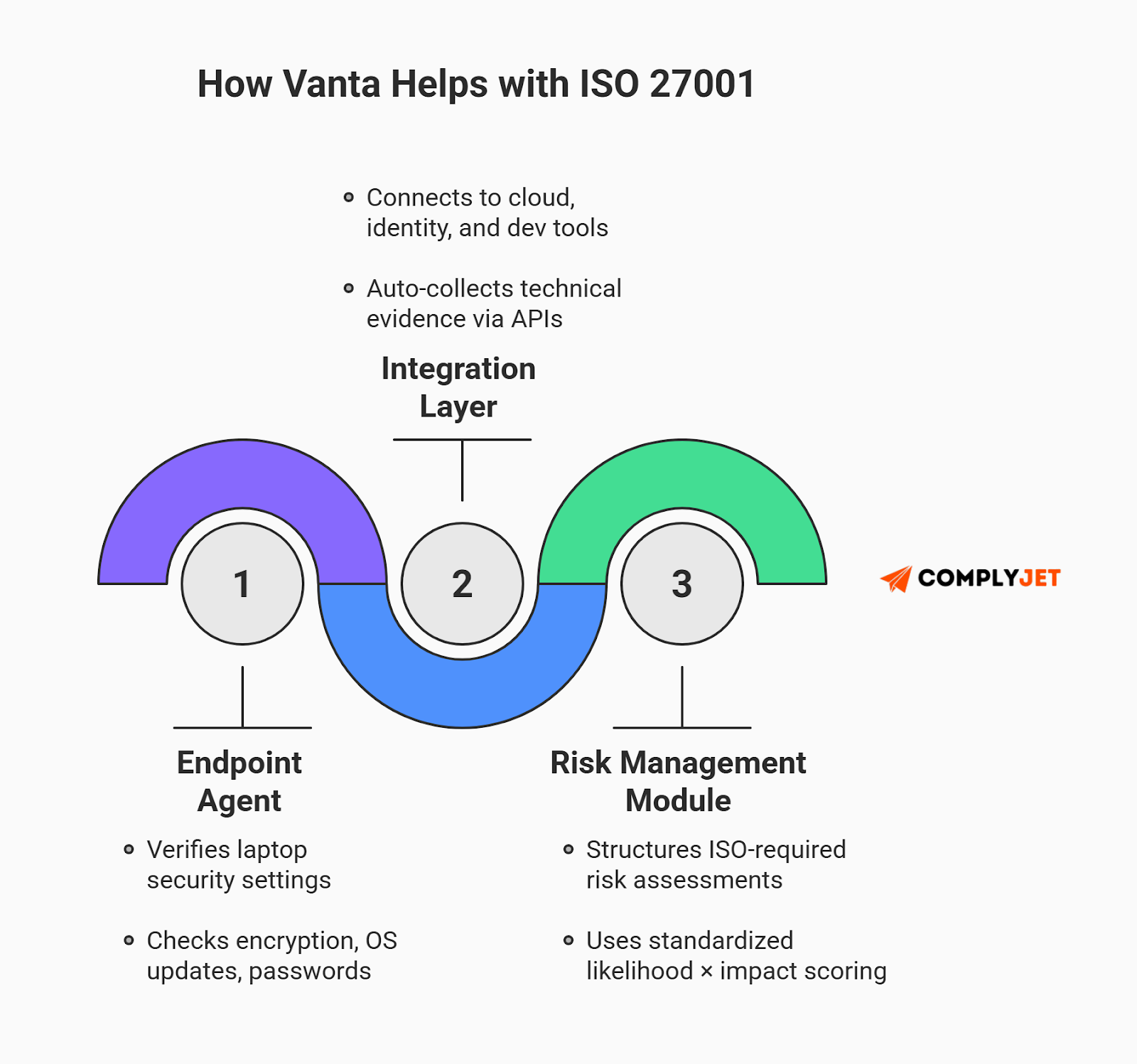
Vanta is not a monolith. It is a composite of distinct subsystems. To understand if it fits your stack, you must dissect the components. We will look at the agent, the integrations, and the risk module. These are the core Vanta ISO 27001 software features that drive the platform.
The Agent
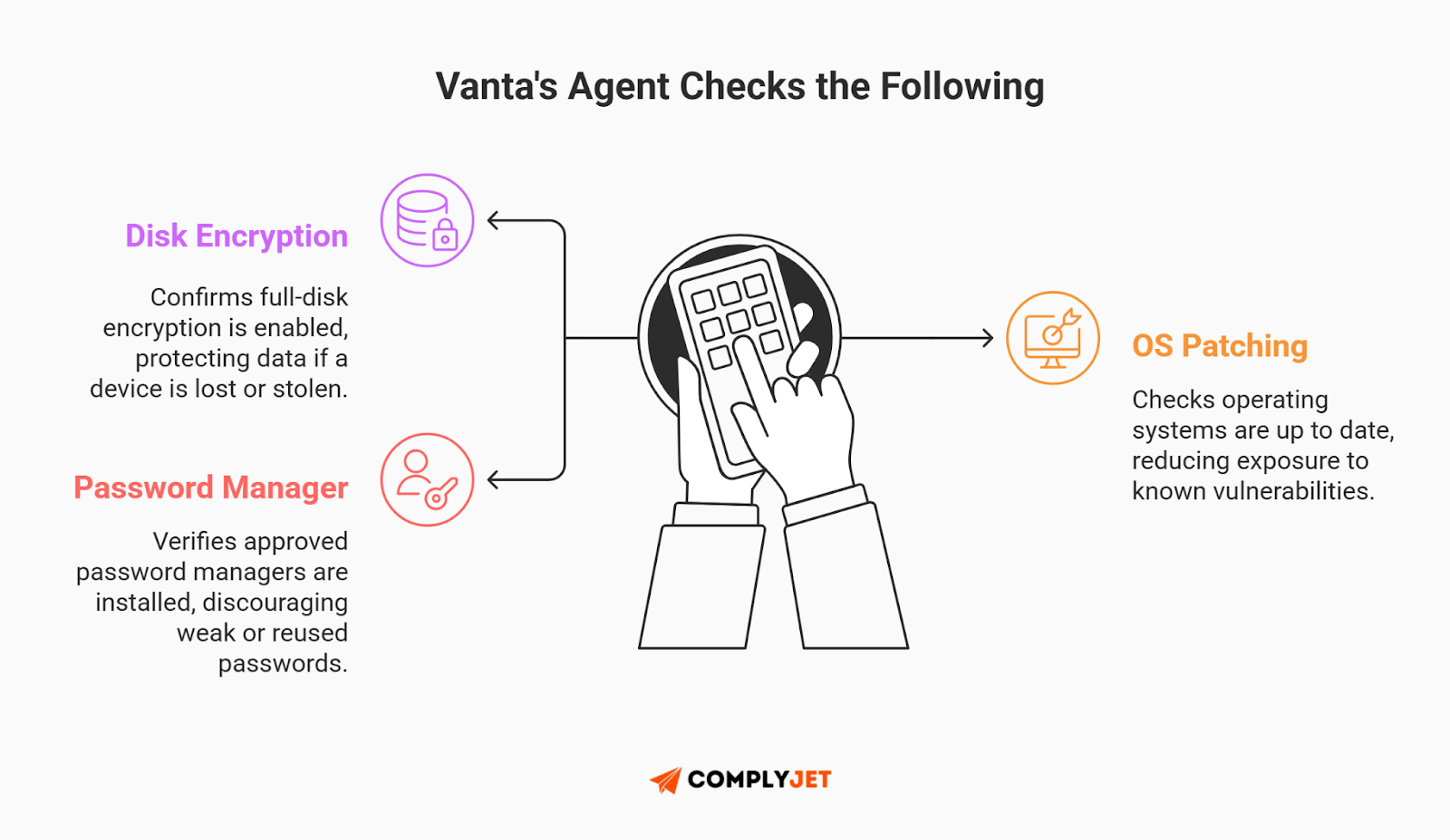
Perhaps there is no component as impactful as the agent. You install this lightweight daemon on every employee laptop. It is essential for automation. It monitors specific ISO 27001 controls related to device security. It checks if hard drives are encrypted. It verifies that password managers are installed. It ensures operating systems are patched.
The good news? It works. It turns complex endpoint verification into a simple binary pass/fail. You don't have to chase screenshots of system settings.
The friction comes from culture. Employees hate installing "monitoring software." They fear it tracks keystrokes or browsing history. It doesn't. But the perception of spying can cause distrust in privacy-sensitive engineering teams.
Also, be warned if you run Linux. Support there has historically lagged behind macOS and Windows, creating visibility gaps.
The Integration Layer
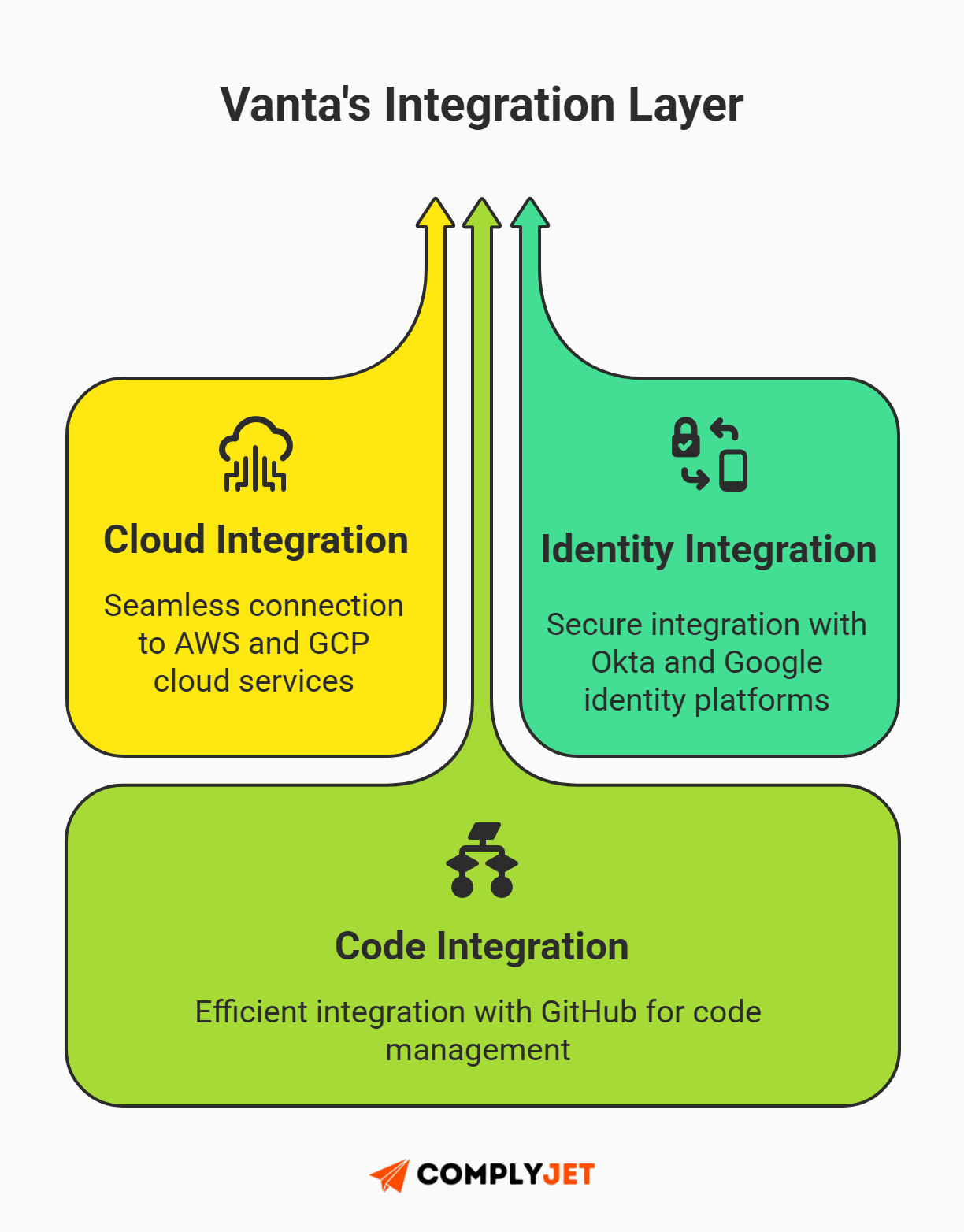
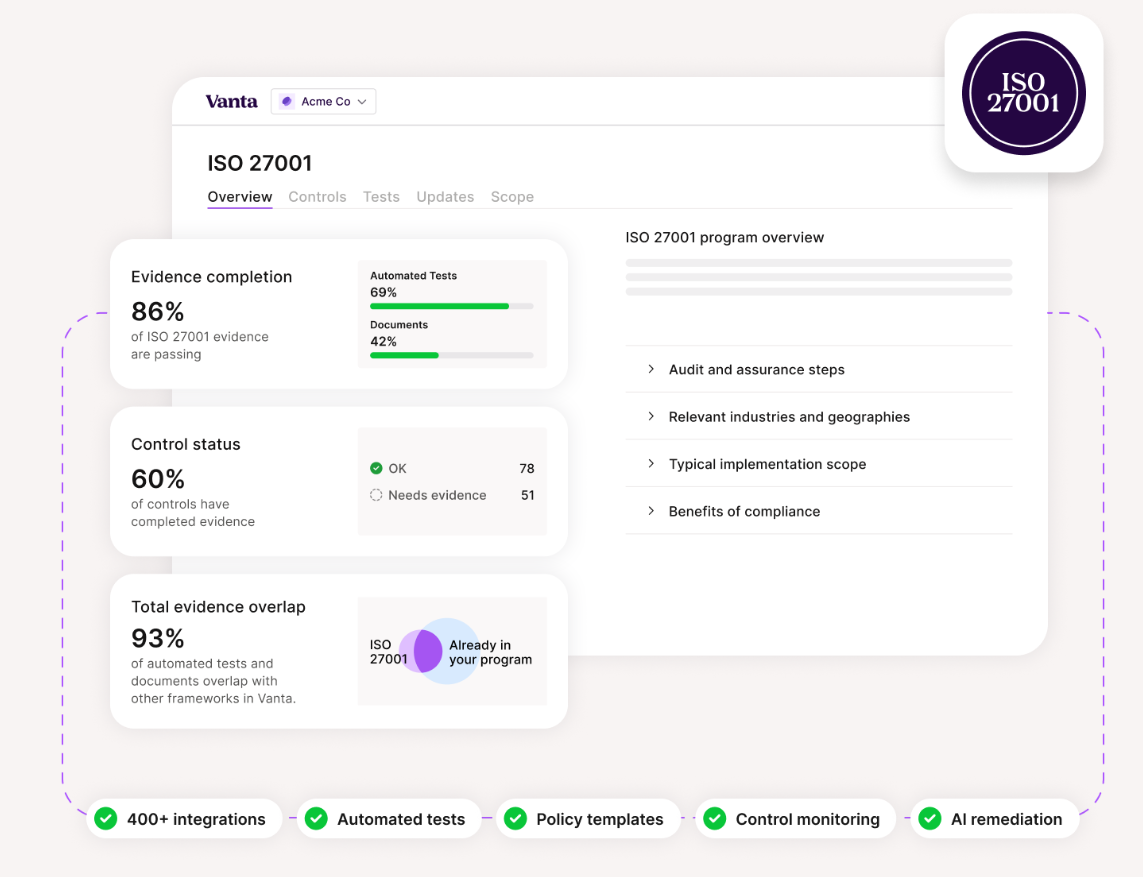
The primary value proposition lies in the API layer. Vanta boasts over 400 integrations. It connects to your cloud (AWS, GCP), your identity provider (Okta, Google), and your code repositories (GitHub). This is the second pillar of Vanta's ISO 27001 software features suite. It automates evidence collection for the vast majority of technical requirements.
If you have a "standard stack," this is magic. A startup on AWS, Slack, and Google Workspace gets instant value. But there is a trap. We call it the "Integration Cliff."
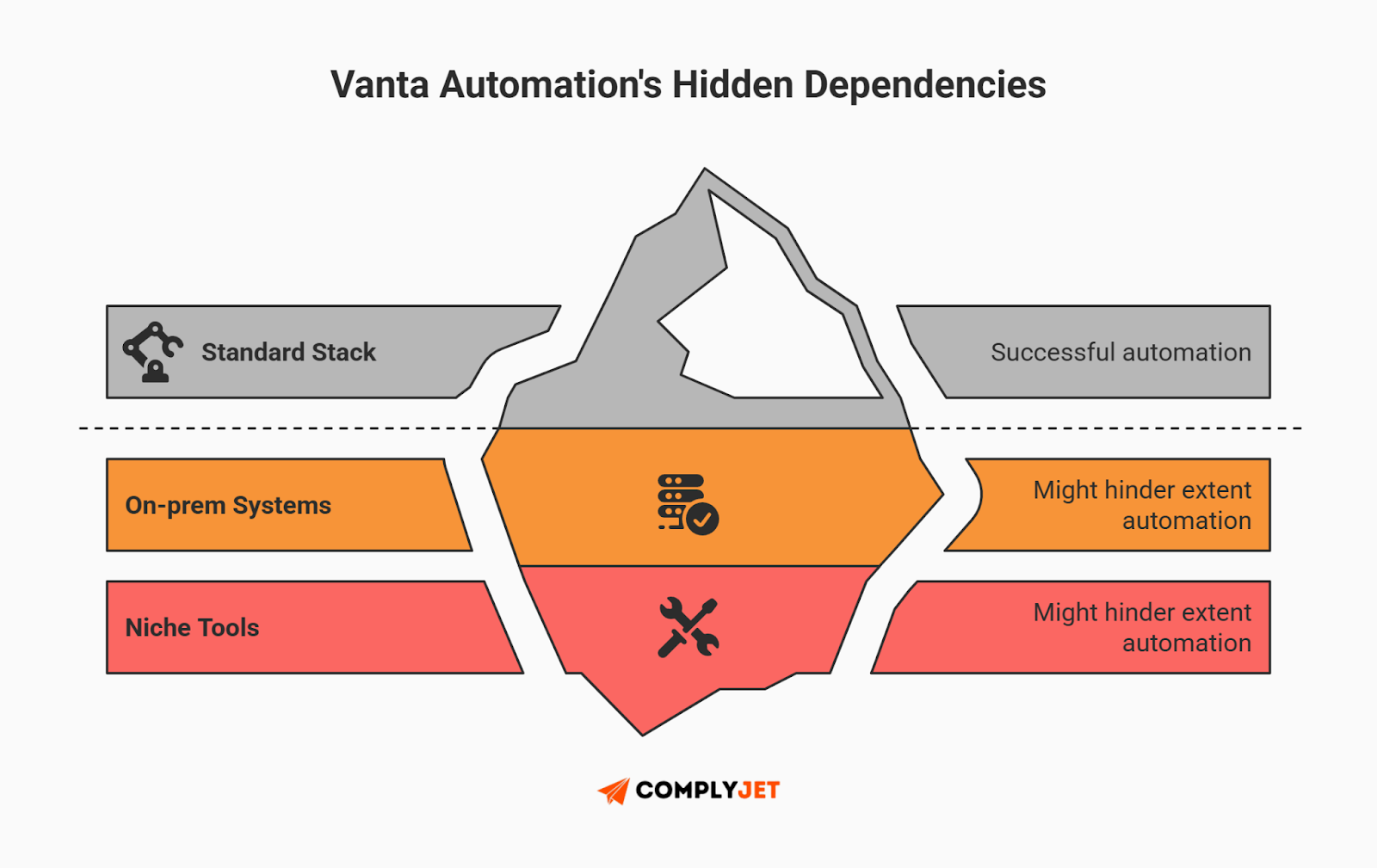
If you step off the beaten path, automation stops. Do you have on-premise servers? Do you use a niche HR system? If so, you might hit a wall. At that point, you are forced back to manual screenshot uploads. Needless to say, the ROI collapses if your stack is not standard.
The Risk Management Module
ISO 27001 requires a formal risk assessment. Vanta replaces the traditional spreadsheet with a built-in module. It allows you to select risks from a library. You score them on a standard 5x5 matrix (Likelihood vs. Impact).
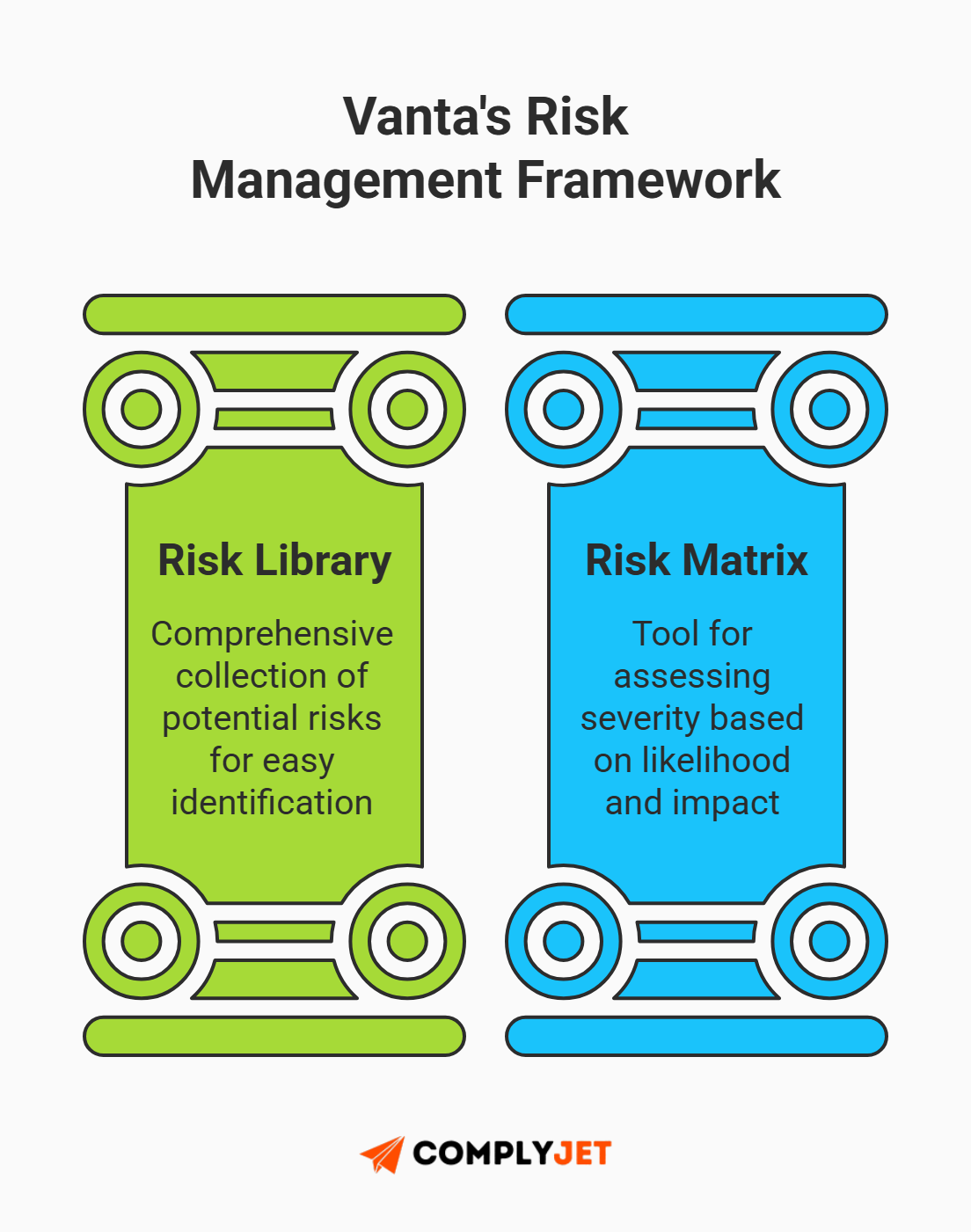
For a Series A startup, this is perfect. It is simple. It gets the job done. It satisfies the auditor. However, it lacks depth for certain clientele. Enterprise CISOs may find it too basic. Vanta does not claim to support quantitative modeling like Monte Carlo simulations. It can be inferred that it relies on qualitative inputs.
If you need complex financial impact analysis, this module will feel restrictive. For most founders, though, it is better than a broken Excel file and removes a lot of manual hassle.
Founder Tip: Getting compliant matters, but making it visible matters just as much. Vanta's Trust Center gives customers a clear, self-serve way to see your ISO 27001 posture without turning every deal into a security questionnaire.
Source: Vanta
Deep Dive: Vanta ISO 27001 Controls & Automation Gaps
Vanta is not a magic wand. It is a rigorous automated filing cabinet. To understand its true value, you must look at the 93 controls of Annex A. While automation works perfectly in some domains, it may also fail in others.
Where Vanta Wins: Annex A.6 & A.8
The platform shines when it can talk to another computer. This is most evident in the Technological and People domains.
Consider the Technological domain Annex A.8 - Asset Management. This is the platform's "sweet spot." Vanta's agents and integrations continuously monitor these ISO 27001 controls with zero human input. Take Control A.8.10 (Information Deletion).
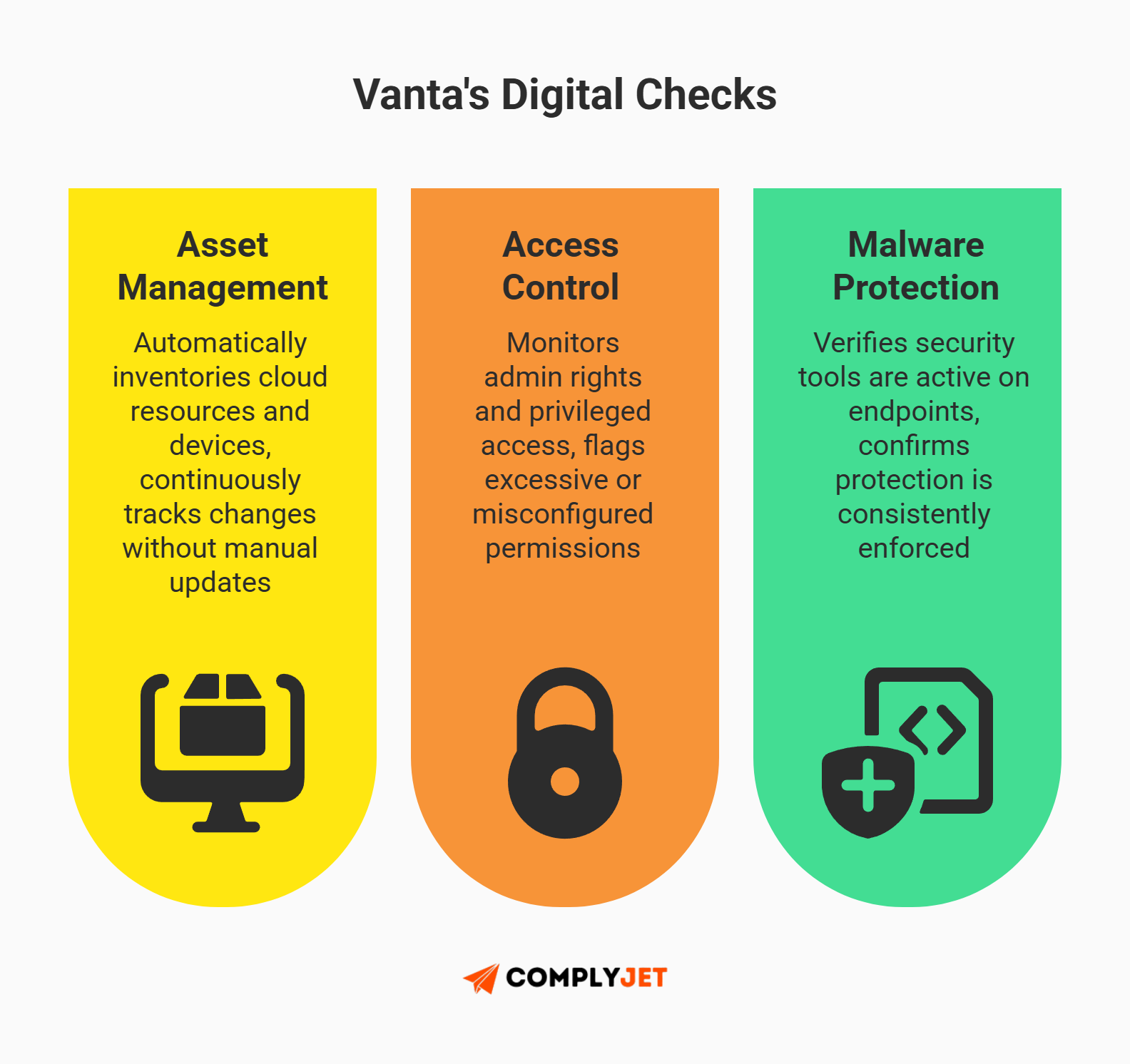
Vanta automatically checks your AWS S3 bucket lifecycles. It confirms that data is deleted when it should be. Take A.8.2 (Privileged Access Rights). The system audits your Okta or Azure AD settings. It flags you immediately if you have too many admins.
It even checks malware protection (A.8.7 - Protection Against Malware) by verifying that CrowdStrike or Windows Defender is active on every laptop. This runs the risk of transforming complex technical verification into simple "Pass/Fail" tests.
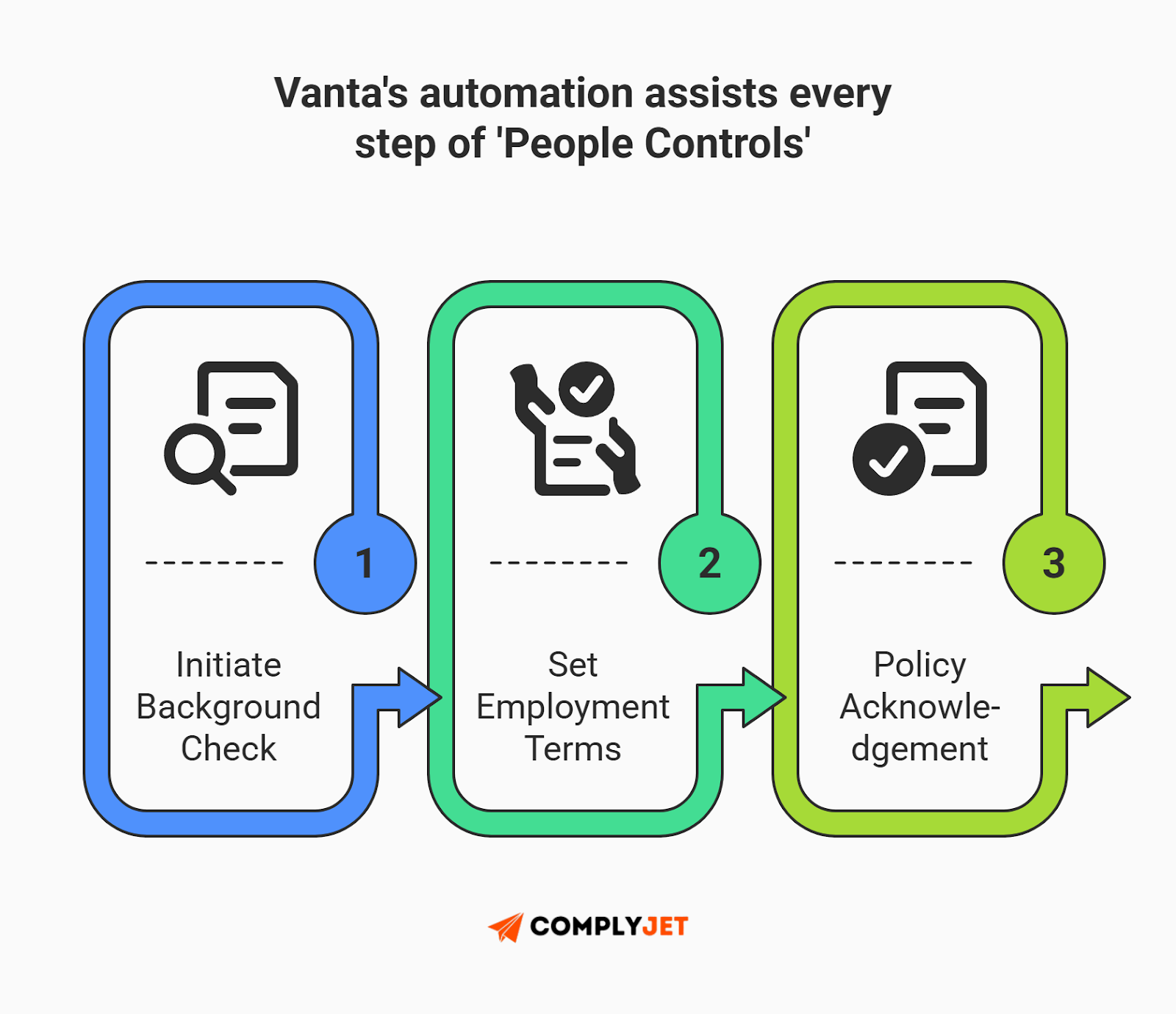
The same applies to People controls (Annex A.6). HR is notoriously messy. Vanta cleans it up. It integrates with your background check provider (like Checkr) and your HRIS (like Rippling). It automatically collects evidence for Screening (A.6.1).
It tracks who has signed their confidentiality agreements (A.6.2 - Terms and Conditions of Employment). You do not need to email HR for PDF exports. The dashboard just turns green. This is where automation feels like magic.
Where Vanta May Struggle: Annex A.7 - Human Resource Security
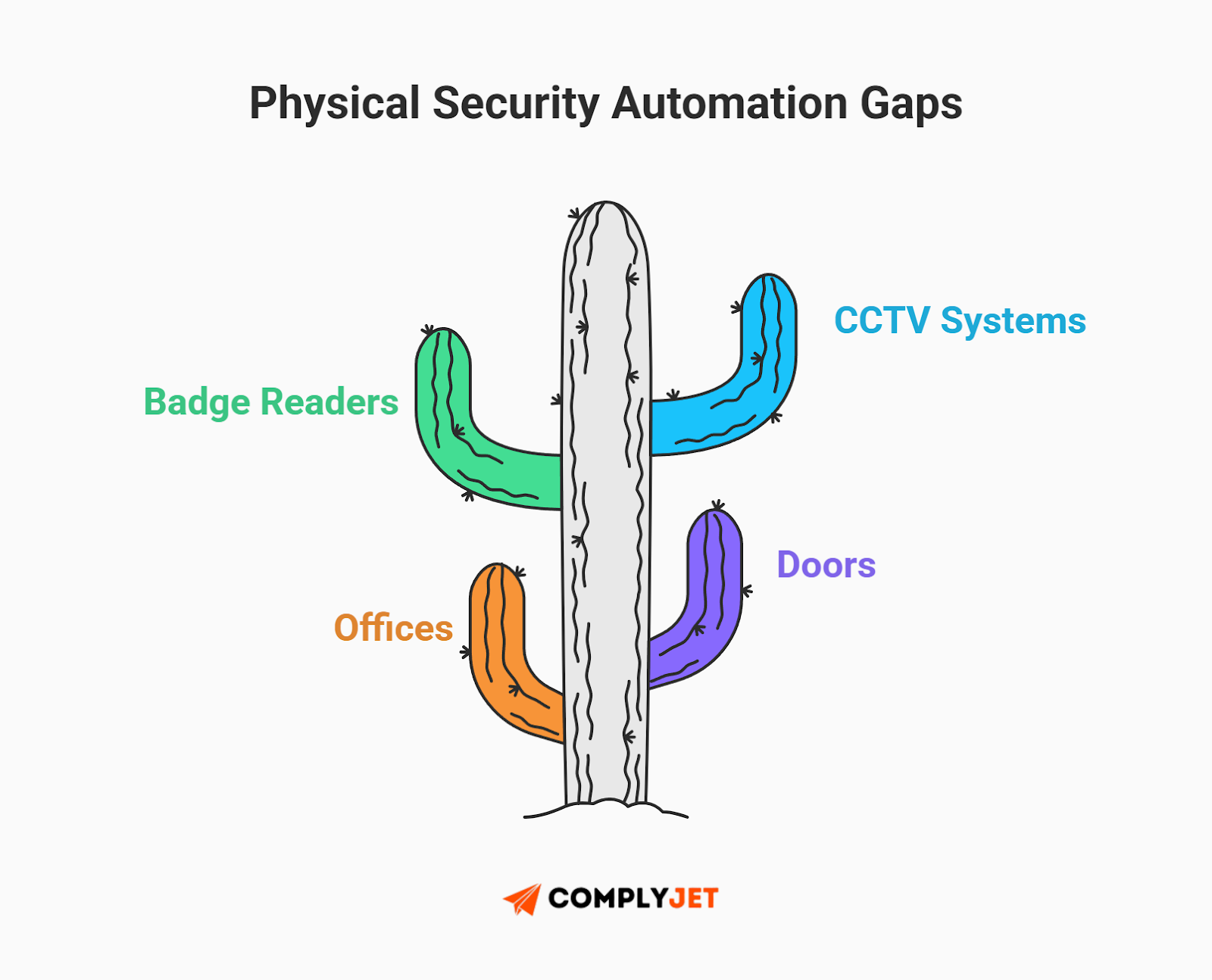
The magic breaks when you touch the physical world. Vanta has no eyes. It cannot see your office. It cannot see your server room. Vanta's ISO 27001 software features, robust though they might be, cannot fix physical data leaks.
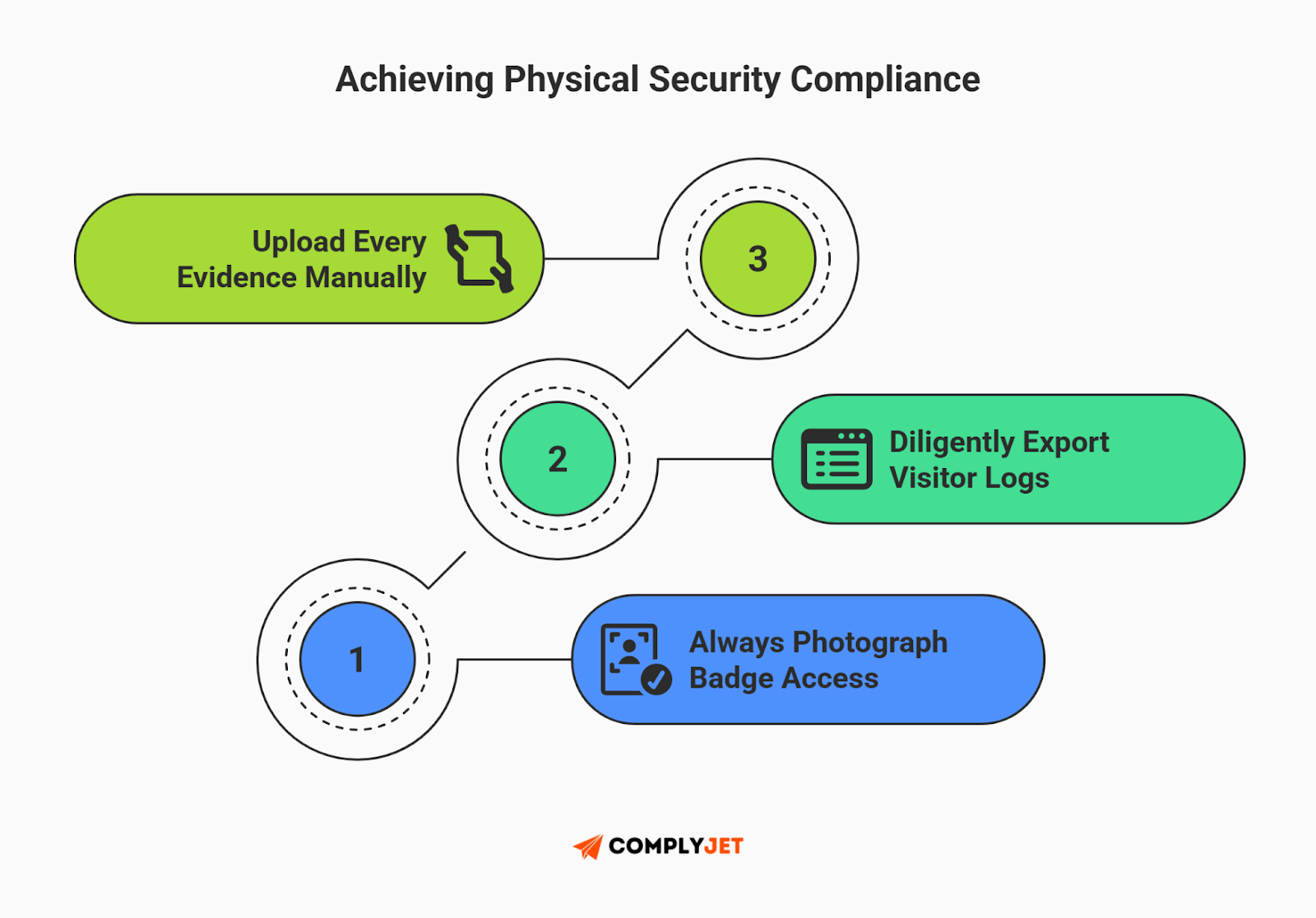
For physical ISO 27001 controls, Vanta's API model collapses. There is no API for a locked door. Consider Control A.7.2 (Physical Entry). The standard requires you to protect access to your facility. Vanta cannot verify this. You must manually take a photo of your badge reader. You must upload it. You must export a CSV of your visitor logs and upload that.
The same applies to A.7.4 (Physical Security Monitoring). Do you have CCTV? Vanta doesn't know. You have to take a screenshot of your camera feed and drag it into the browser. If you are fully remote and rely on AWS, Vanta can pull Amazon's SOC 2 report to satisfy the data center requirement. But if you have a headquarters, the burden of proof falls entirely on you. You become a manual data entry clerk for every physical requirement.
Founder Tip: Clicking "pass" isn't enough. An auditor will interview you. Make sure you understand why a control exists, not just that it's green. If you can't explain the risk rationale, you will fail the interview stage.
The "Offline" Asset Problem (Annex A.5)
The gaps extend to organizational controls (Annex A.5), specifically regarding inventory. Control A.5.9 requires an inventory of information assets. Vanta is great at listing what it can see. It lists every laptop with an agent. It lists every server in your AWS account.
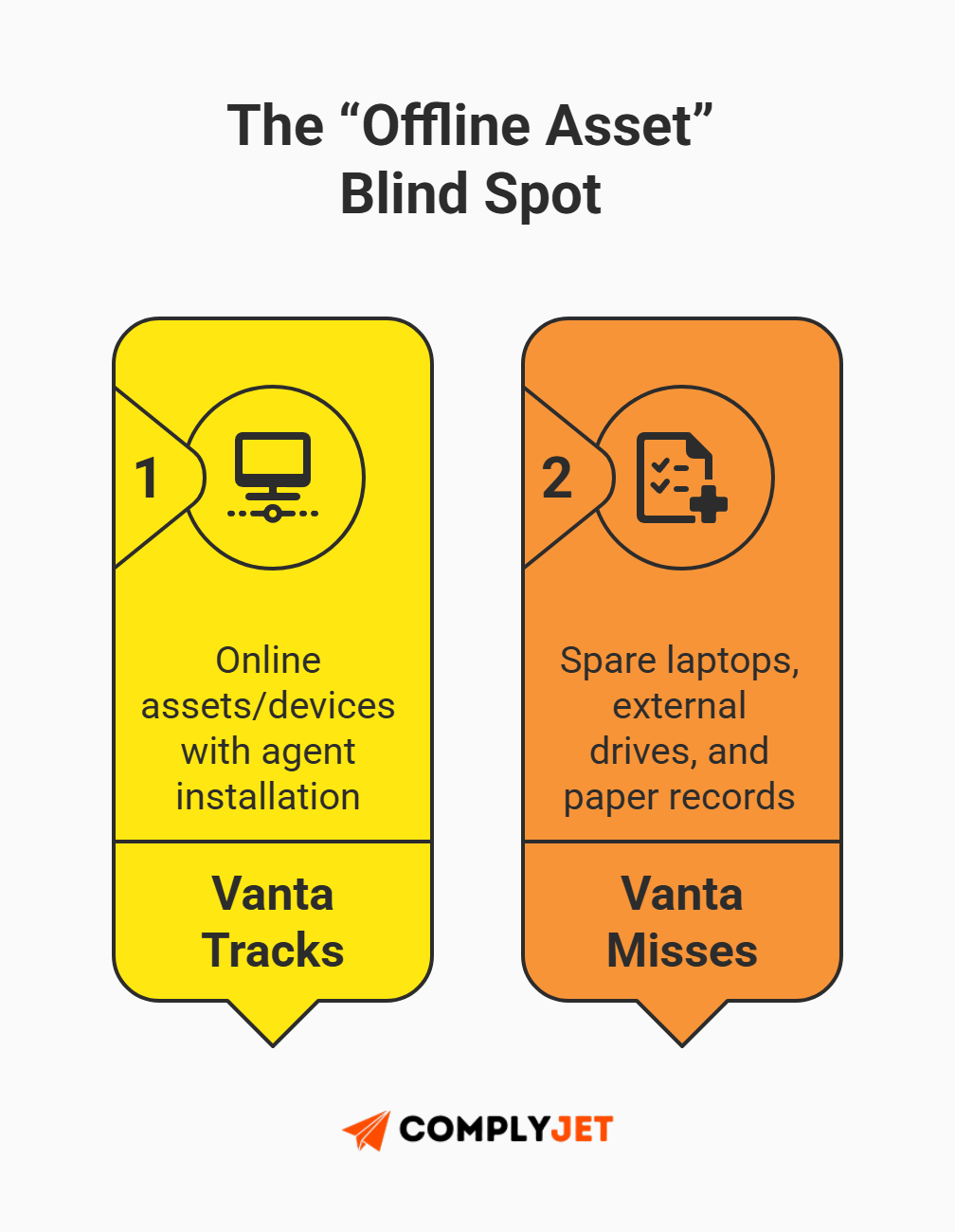
But it misses the "dumb" assets. It does not know about the spare laptops in the IT closet that are turned off. It does not know about the paper contracts in your filing cabinet. It does not know about external hard drives. These are "invisible" to the software. Yet, the standard demands they be managed.
Founder Tip: Vanta misses offline assets. Spare laptops in a closet or hard drives in a drawer are invisible to the API. Maintain a simple spreadsheet for these "dumb" assets to satisfy Annex A.5 controls.
To pass the audit, you must maintain a separate, manual inventory for these items. You then upload this spreadsheet to Vanta. The platform acts merely as a storage folder here. It offers no intelligence. It offers no automation.
Managing the inventory for these specific ISO 27001 controls falls back on you. If you forget to update that manual spreadsheet, you will fail the control, regardless of how green your dashboard looks.
Founder Tip: Don't wait for the audit to check your physical security. Vanta can't see your office. Walk around now. Take photos of your badge readers and visitor logs. Upload them manually today so you don't scramble later.
The Audit Experience & Vanta ISO 27001 First Attempt Pass Rate
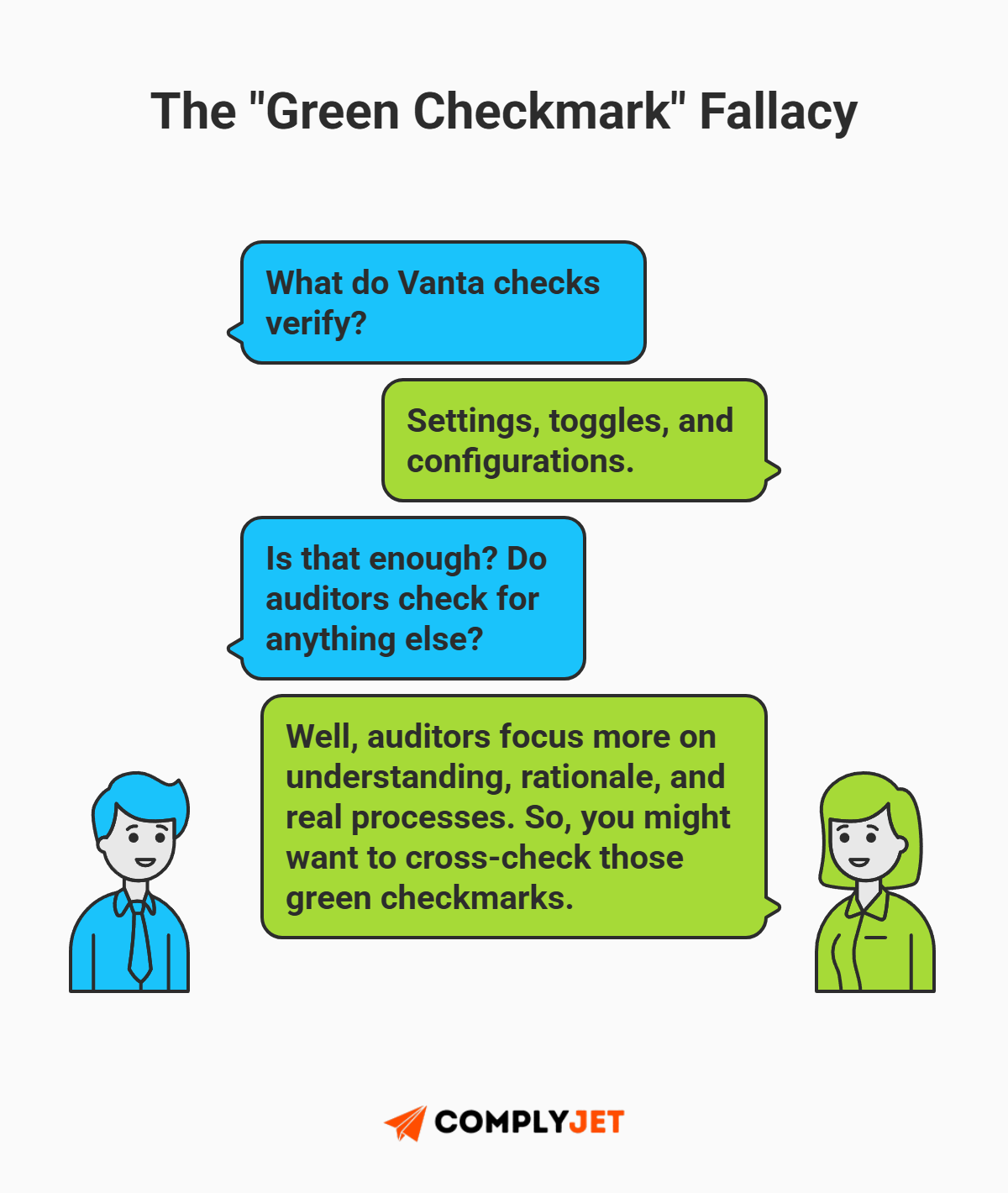
A persistent frustration for founders stems from the "Green Checkmark Fallacy." This is the dangerous belief that a 100% score on the Vanta dashboard guarantees a pass. It does not. Vanta measures configuration. Auditors measure effectiveness.
The distinction is critical. Vanta mostly operates on binary logic. Did you click the button? Yes. Therefore, the control passes. An auditor operates on context. Did you understand why you clicked the button? Consider the "Access Review" control. The dashboard might show this as complete because a manager clicked "Confirm" in the UI.
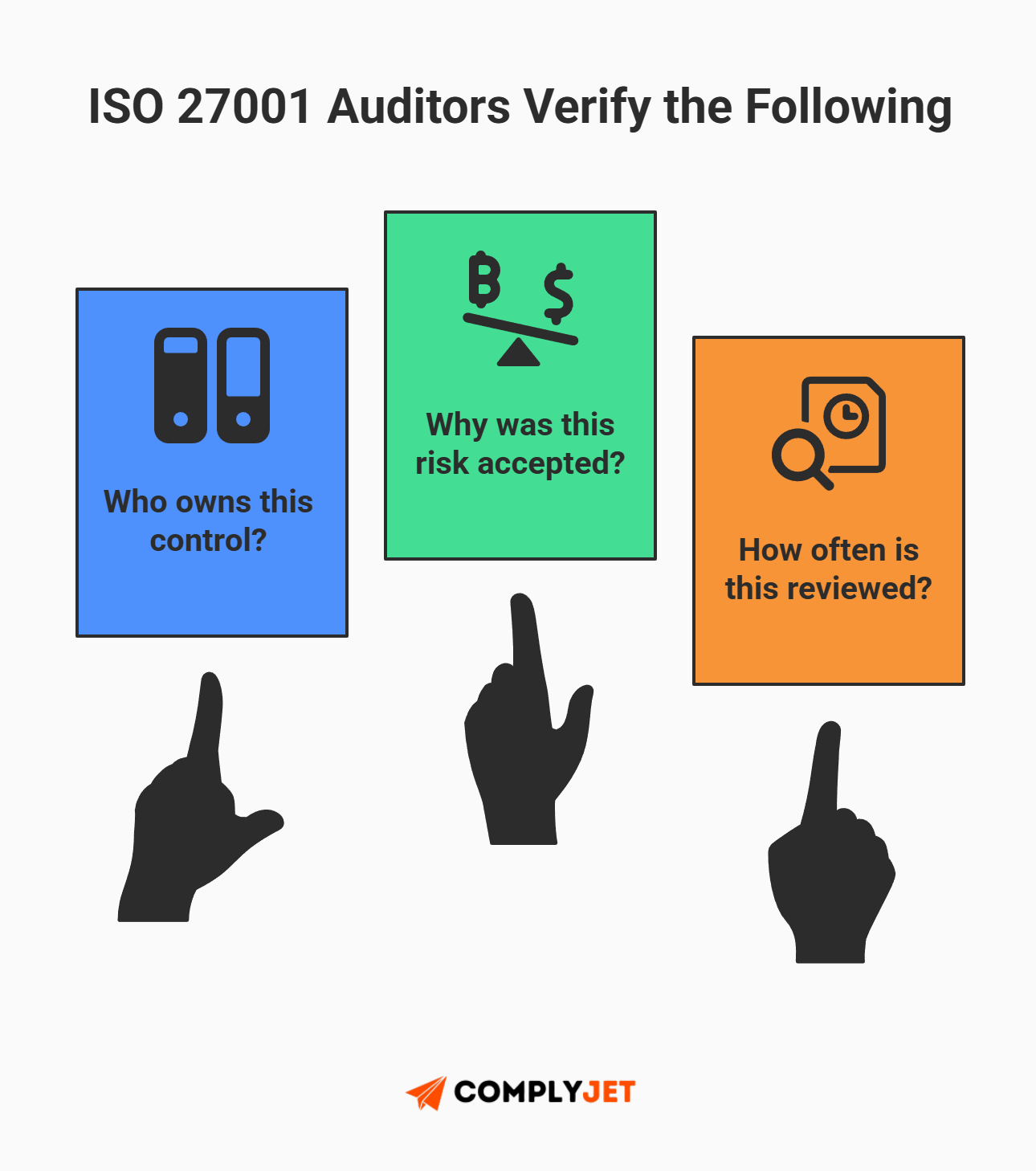
However, during the Stage 2 audit, the auditor will interview that manager. If it is found that you just clicked the button without actually reviewing the user list, you fail. The software sees a pass. The human sees a process failure. This is where most gaps are found with Vanta's ISO 27001 compliance solutions.
Despite these pitfalls, Vanta's ISO 27001 first attempt pass rate is reportedly high. Please note that Vanta does NOT release any such statistics officially (the estimates are based on user reviews by third-party entities so take it with a grain of salt). This is largely due to the "Vanta-friendly" audit ecosystem.
Vanta has cultivated a network of partner firms like Prescient Assurance, Barr Advisory, and the Johanson Group. These auditors are trained on the platform. They know exactly where to look for evidence. This familiarity significantly accelerates Vanta's ISO 27001 time to certification because it eliminates the "discovery" phase of the audit.
However, this streamlined ecosystem, so common in the modern compliance landscape, draws criticism from some corners. Skeptics argue it creates a potential conflict of interest. They question the rigor of an audit that relies so heavily on automated outputs from a partner platform. Yet, for a founder, the deal is compelling. If you use a partner firm, Vanta's ISO 27001 first attempt pass rate is pretty robust, provided you haven't blatantly ignored the manual "Context of Organization" documents.
Founder Tip: Is speed your priority? Use Vanta's partner ecosystem (like Barr or Prescient). They know the software. This skips the discovery phase and cuts weeks off your timeline compared to bringing in an outsider.
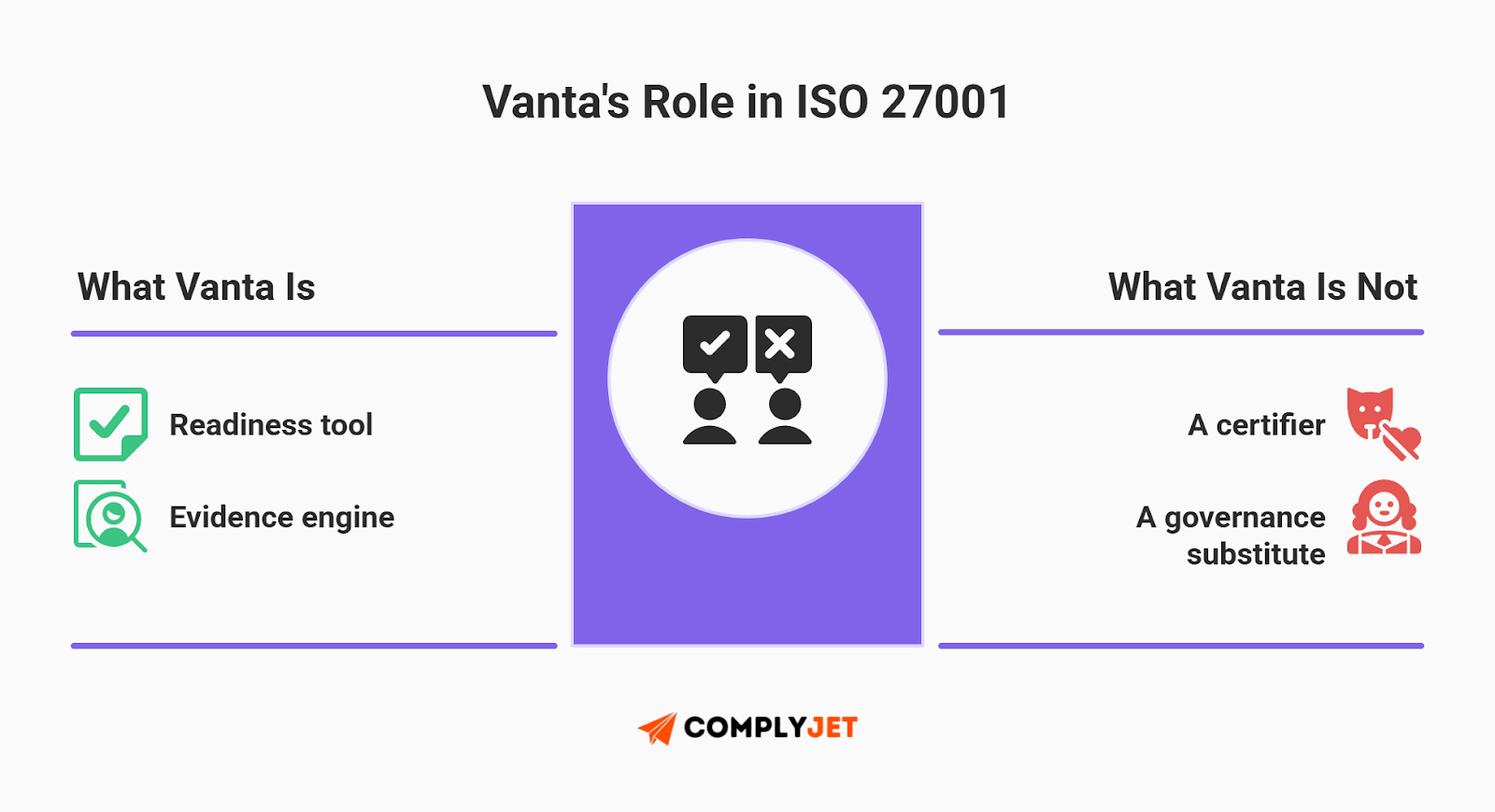
Finally, remember your roles. Vanta is a readiness tool. It is not a certifier. You must still hire an accredited Registrar to perform the audit. Vanta gets you to the starting line. The Registrar decides if you finish. Do not confuse the software subscription with the certification itself.
Vanta Pricing for ISO 27001 & Hidden Costs
Vanta employs a SaaS pricing model, and as such, is notoriously opaque. They rely on sales quotes rather than public lists.
However, by aggregating data from hundreds of user reports, we can get a fair estimate of Vanta's pricing for ISO 27001. It scales based on headcount and framework count. Needless to say, these numbers are supposed to be indicative. For exact numbers, you'd have to get in touch with the company directly.
- Essentials/Plus Tier (<20 Employees): Expect to pay $7,500 - $12,000 annually. This targets Seed/Series A startups. It typically includes a single framework and limited support.
- Professional Tier (50-200 Employees): Costs jump to $15,000 - $35,000. This is for Series B/C scale-ups. It adds priority support and basic Vendor Risk Management (VRM).
- Enterprise Tier (200+ Employees): For late-stage companies, prices soar to $40,000 - $80,000+. This unlocks full API access, SSO enforcement, and unlimited workspaces.
The Hidden Budget Killers
| Cost Item | Estimated Price Range | Founder Note |
|---|---|---|
| The Registrar Audit Fee | $12,000 - $20,000 (Year 1) | You do not pay this to Vanta; you must pay this directly to the certification body to perform the audit. |
| The "Framework Tax" | $5,000 - $15,000 | The cost to add ISO 27001 if you already use Vanta for SOC 2. |
| Pen Testing | $4,000 - $10,000 | Not explicitly required, but recommended for Control A.12.6; Vanta sells this as an add-on or you can hire an external firm. |
The platform fee is merely your entry ticket. To calculate the true Vanta ISO 27001 cost, you must include the "invisible" line items. These often catch first-time buyers off guard.
- The Audit Fee: You do not pay this to Vanta. You pay it directly to the certification body (Registrar). For the initial year (Stage 1 + Stage 2), you should budget $12,000 - $20,000. Annual surveillance audits may cost another $8,000 - $12,000.
- The Framework Tax: This is a frequent source of user frustration. Vanta prices compliance frameworks separately, meaning organizations that already use Vanta for SOC 2 typically pay an additional annual fee to add ISO 27001.
Based on aggregated buyer reports and independent pricing analyses, this add-on commonly falls in the mid four-figure to low five-figure range (often cited around $5,000 - $15,000 per year), depending on company size and contract scope.
- Penetration Testing: ISO Control A.12.6 requires technical vulnerability management. Vanta offers bundled pentesting services for $4,000 - $10,000. It is convenient. It checks the box. However, sophisticated enterprise buyers often view these as "glorified vulnerability scans".
Source: Vanta
If you sell to rigorous customers, they may reject this cheap bundle and demand an independent firm for pentests. For any prospective founder, understanding the difference between manual pen testing and automated vulnerability scans is crucial. To learn more about their differences and get a clear idea of Vanta's pentesting offerings, click here.
Stop paying the "Enterprise Tax." ComplyJet offers automated ISO 27001 compliance built specifically for lean teams. Same certification, fraction of the price.
The Renewal Trap
Your first invoice is often a trap. Startups are known to receive aggressive discounts to join the ecosystem - sometimes up to 70% off. However, renewal contracts often revert to list price. Reviews often show invoices jump from $8,000 to $18,000 in Year 2. This drastically inflates Vanta's long-term pricing for ISO 27001.
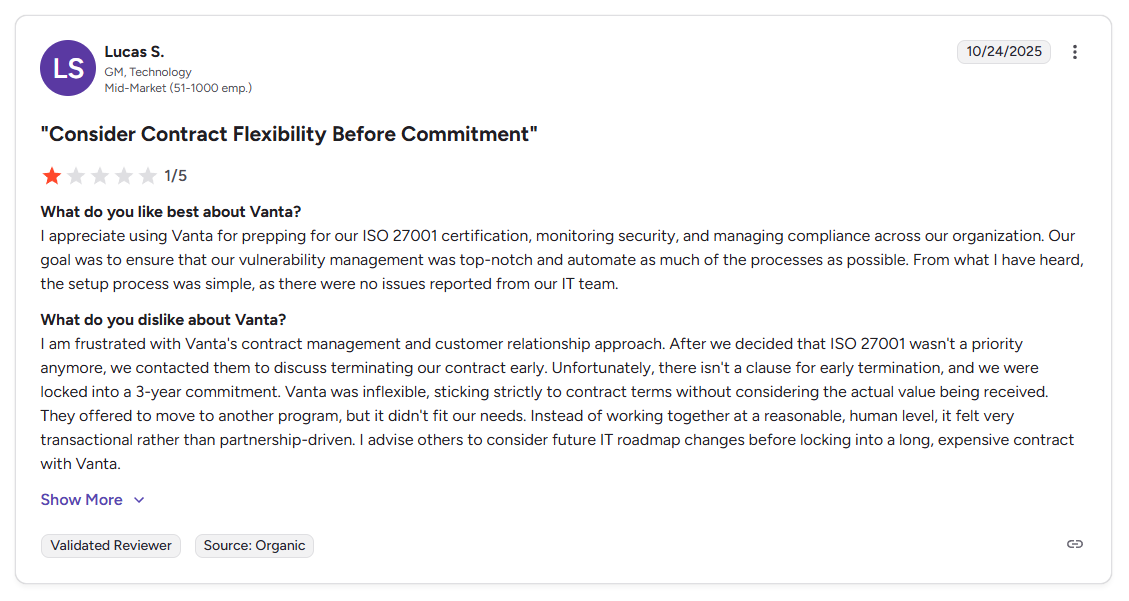
Furthermore, contracts often contain auto-renewal clauses requiring 60-90 days notice to cancel. If you miss that window, you are locked in. Always negotiate a "price cap" (e.g., max 5% uplift) to keep your total Vanta ISO 27001 cost predictable. Learn more about Vanta's pricing tiers and their features here.
Founder Tip: Never sign the first contract without a renewal price cap. Vanta's year-one discounts are great, but year-two can double. Negotiate a max 5% uplift clause before you sign to avoid the "Year 2 Cliff."
Competitor Analysis: Drata vs. Sprinto vs. Vanta
While Vanta created the category, the market is now saturated with capable competitors. The choice between Vanta and its alternatives, such as Drata and Sprinto, is no longer about "who has automation" - they all do. It is about specific organizational fit.
Vanta vs. Drata
Drata is widely considered Vanta's primary peer competitor. They position themselves as the "Enterprise-Grade" alternative. The core difference lies in philosophy. Drata focuses heavily on "Compliance as Code". It allows for greater customization of controls and test logic. This appeals to CTOs and security engineers who want to tweak the how of compliance. Vanta, by contrast, favors a more opinionated, rigid, "out-of-the-box" approach.
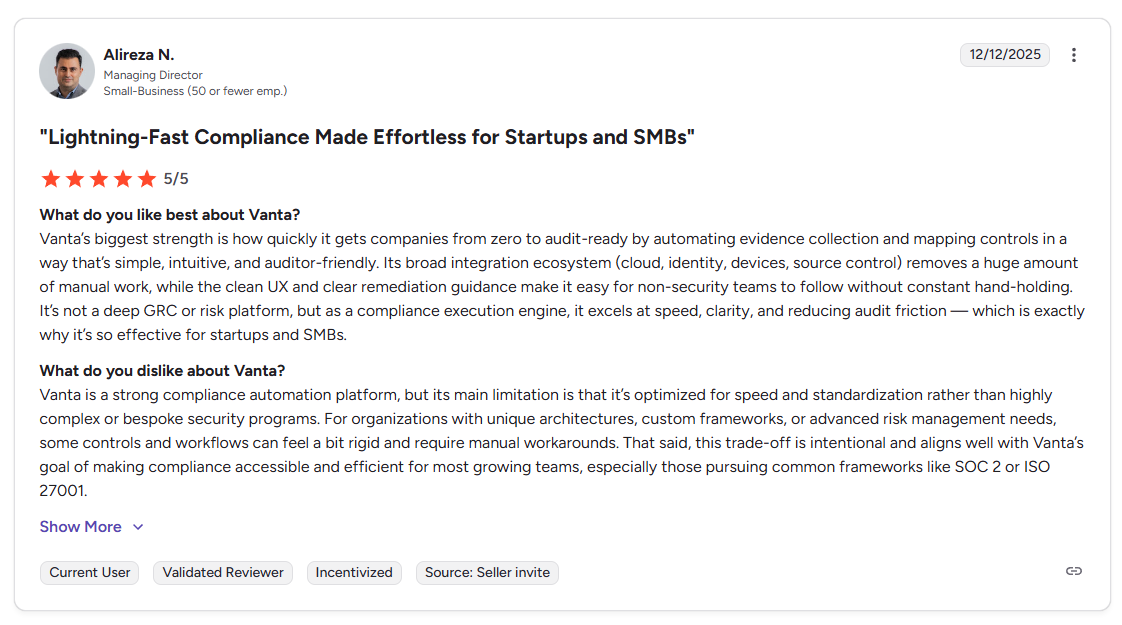
This philosophical difference extends to architecture. Drata offers robust agentless options and deep API flexibility, making it a better fit for complex, non-standard cloud environments. While Vanta's ISO 27001 software features rely heavily on a deployed agent to monitor endpoints, Drata provides more ways to collect evidence without touching the employee device.
If you have a dedicated security engineer who wants to build a custom program, Drata wins. If you want the fastest path to a badge with minimal configuration, Vanta wins.
Vanta vs. Sprinto
Sprinto challenges Vanta from the "Value" and "Granularity" angle. They often win over SMBs and bootstrapped startups.
Sprinto excels at "Entity Level" monitoring. It breaks compliance down into granular to-do lists for every employee and device. This may provide deeper visibility into why a control is failing compared to Vanta's standard ISO 27001 software features, which can sometimes feel like a high-level dashboard summary.
Furthermore, Sprinto is noted for a more "hand-held" onboarding experience. They offer white-glove implementation support even at lower tiers, whereas Vanta often reserves this for enterprise clients.
Then there is the economics. Teams have quoted Sprinto to be generally ~20-30% cheaper than Vanta's listed pricing for ISO 27001. They are also more transparent about avoiding per-user or per-framework price gouging. For a funded Series B company, Vanta's massive integration library and auditor network might justify the premium. However, for bootstrapped founders where every dollar counts, this difference in Vanta's total ISO 27001 cost can be the deciding factor.
User Sentiment: Greenwashing & Alert Fatigue
A scan of digital forums reveals the unvarnished reality of using Vanta. While marketing highlights efficiency, the user base frequently discusses the friction of living with the tool. The most consistent complaint is "Alert Fatigue."
Vanta's "Continuous Monitoring" engine runs hourly tests. This sounds robust in a sales deck. In practice, it creates a "sea of red". If a developer disables MFA for five minutes to debug code, Vanta flags it. If a laptop is offline for a weekend, Vanta flags it.
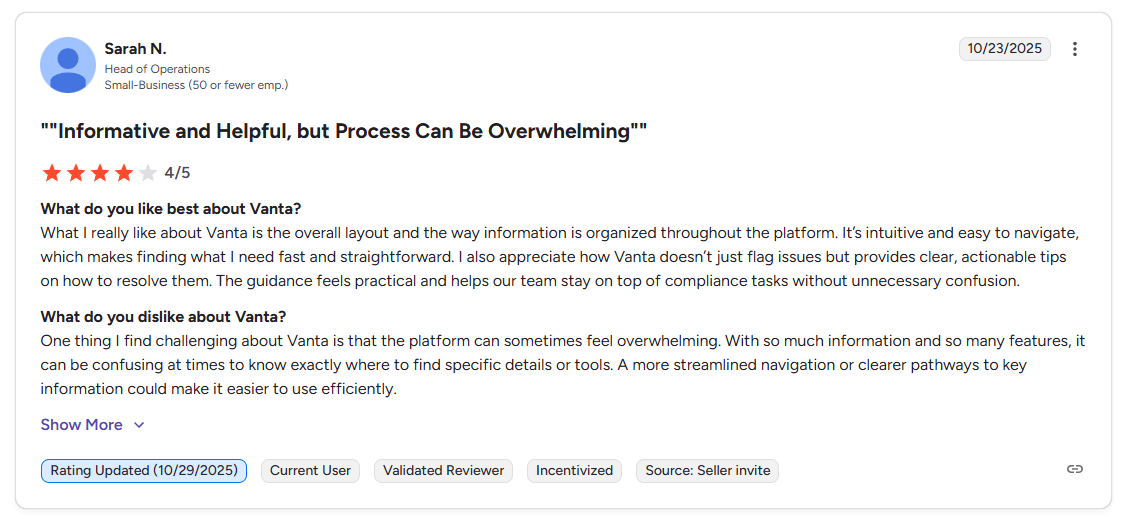
The volume of notifications is overwhelming. IT teams eventually learn to ignore them. System administrators often create email filters to auto-archive Vanta alerts, defeating the entire purpose of the tool. The promise of Vanta's continuous ISO 27001 compliance may dissolve into background static that teams actively tune out.
Founder Tip: Vanta alerts can be noisy. A developer disabling MFA for 5 minutes triggers a "fail." Assign one admin to triage these weekly rather than daily. This prevents your team from ignoring the dashboard entirely due to "alert fatigue."
Support is another friction point. User sentiment reveals a sharp stratification based on how much you pay. Enterprise customers on the "Enterprise" tier often praise their dedicated Customer Success Managers (CSMs).
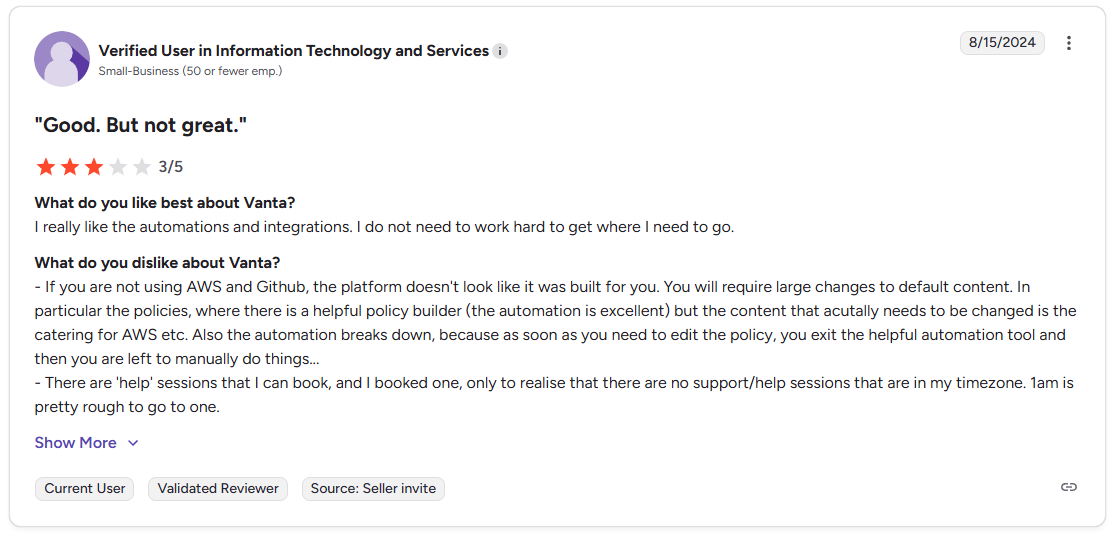
However, startups on the "Essentials" tier report a "Support Black Box". You submit a ticket. You wait days. If you are facing a tight audit deadline, this silence is terrifying. According to reviews, smaller customers often feel abandoned compared to their enterprise counterparts.
Tired of support tickets and waiting days for a reply? ComplyJet gives you direct access to compliance experts, not bots. Get certified without the silence.
Finally, there is a pervasive anxiety about "greenwashing." Users worry the platform gives executives a false sense of security. The dashboard shows 100% health. Executives see green and assume the company is secure. But deep down, the actual processes may be rotting. A policy might exist in Vanta, but no one in the company follows it. The software marks it as a pass because the document is uploaded.
This creates a disconnect. Even though the Vanta ISO 27001 first attempt pass rate remains high, technical leaders often question if that success reflects actual security rigor or just a well-configured facade.
FAQs: Common Founder Queries
Does Vanta guarantee I pass the audit?
No software can guarantee a pass, but Vanta's ISO 27001 first attempt pass rate is reportedly high for companies that use Vanta-trained partner auditors. However, this high rate assumes you haven't ignored the manual "Context of Organization" documents. If you treat the platform as a "set it and forget it" tool, you risk failing the Stage 2 interviews.
What is the realistic timeline for a Series B startup?
Source: Vanta
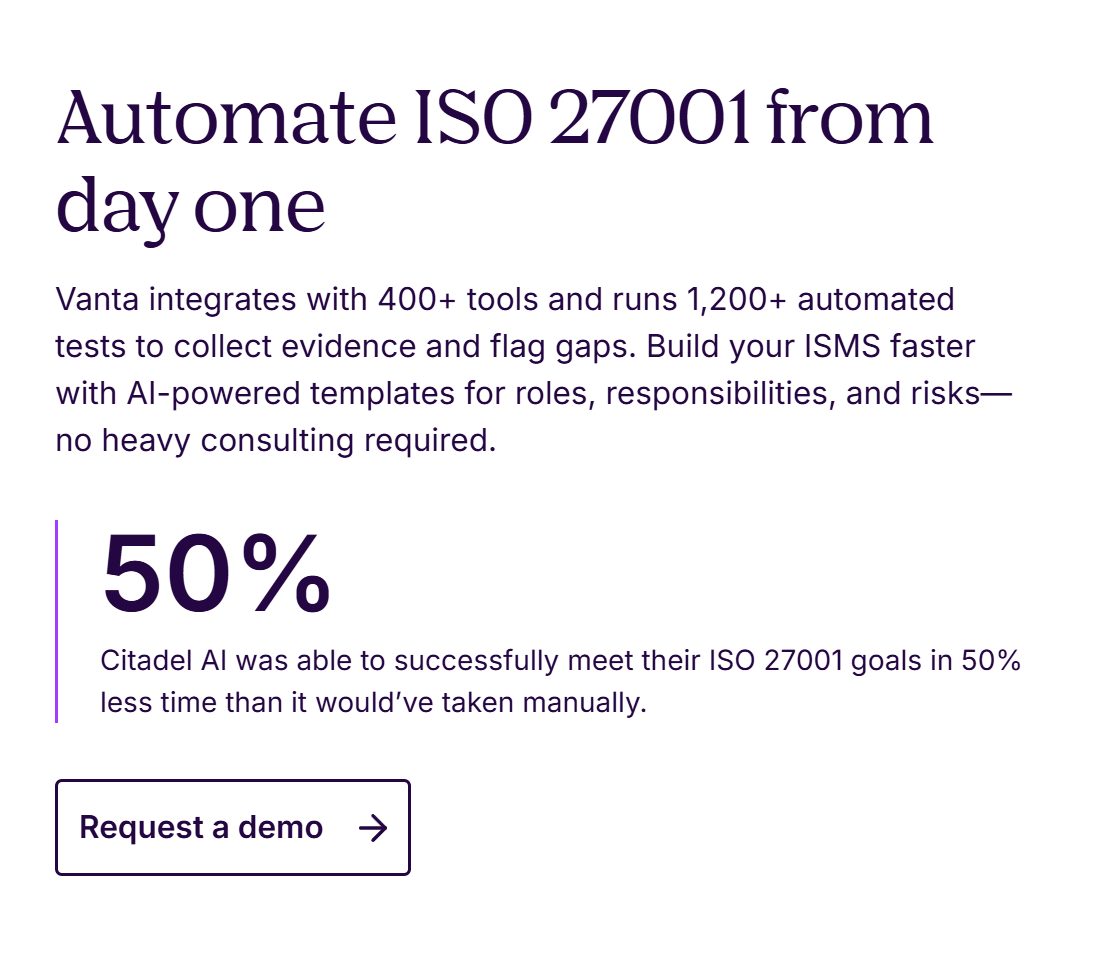
Vanta markets a 50% reduction, but this is a best-case scenario. Realistically, Vanta's true ISO 27001 time to certification could get closer to 4-5 months. You can configure the software in weeks, but you will need extra time to find an auditor, schedule the Stage 1 review, and fix the "manual" gaps in physical security and HR policies.
If I have SOC 2, is ISO 27001 just a quick add-on?
Technically, yes; financially, no. There is roughly 80% overlap between SOC 2 and ISO 27001 controls, meaning your existing evidence (encrypted laptops, MFA) auto-populates. However, Vanta reportedly charges a "framework add-on" fee ($5k-$15k) to unlock this mapping, which users often criticize as paying twice for the same data, though it must be noted that it is a common occurrence in the compliance scene.
Does Vanta automate the physical security controls?
No. Vanta has no API for your office door or filing cabinet. For physical controls (Annex A.7), you must manually upload photos of visitor logs, badge readers, and clean desks. If you are fully remote, you can leverage AWS's physical security evidence, but you still need to document your remote work policy.
Are penetration tests included in the platform fee?
No. ISO 27001 requires technical vulnerability management (often interpreted as a pentest). Vanta sells this as an add-on service with its partners (~$4k+), or you can hire an external firm. It is not included in the base subscription. ISO 27001 doesn't typically require a thorough pen test report, but you should know what you're paying for and getting in return.
Why is my renewal quote so much higher than my first year?
Vanta often provides aggressive discounts (up to 70%) for first-year startups. These discounts rarely apply to renewals, leading to a "Year 2 Cliff" where costs can double. Always negotiate a renewal price cap in your initial contract and watch out for hidden upsells which can trigger additional costs.
Final Verdict: Is Vanta Right for Your ISO 27001 Journey?
Vanta is a powerful tool, but it isn't a silver bullet. It's best understood as automation for the repetitive parts of compliance, not a substitute for governance or judgment.
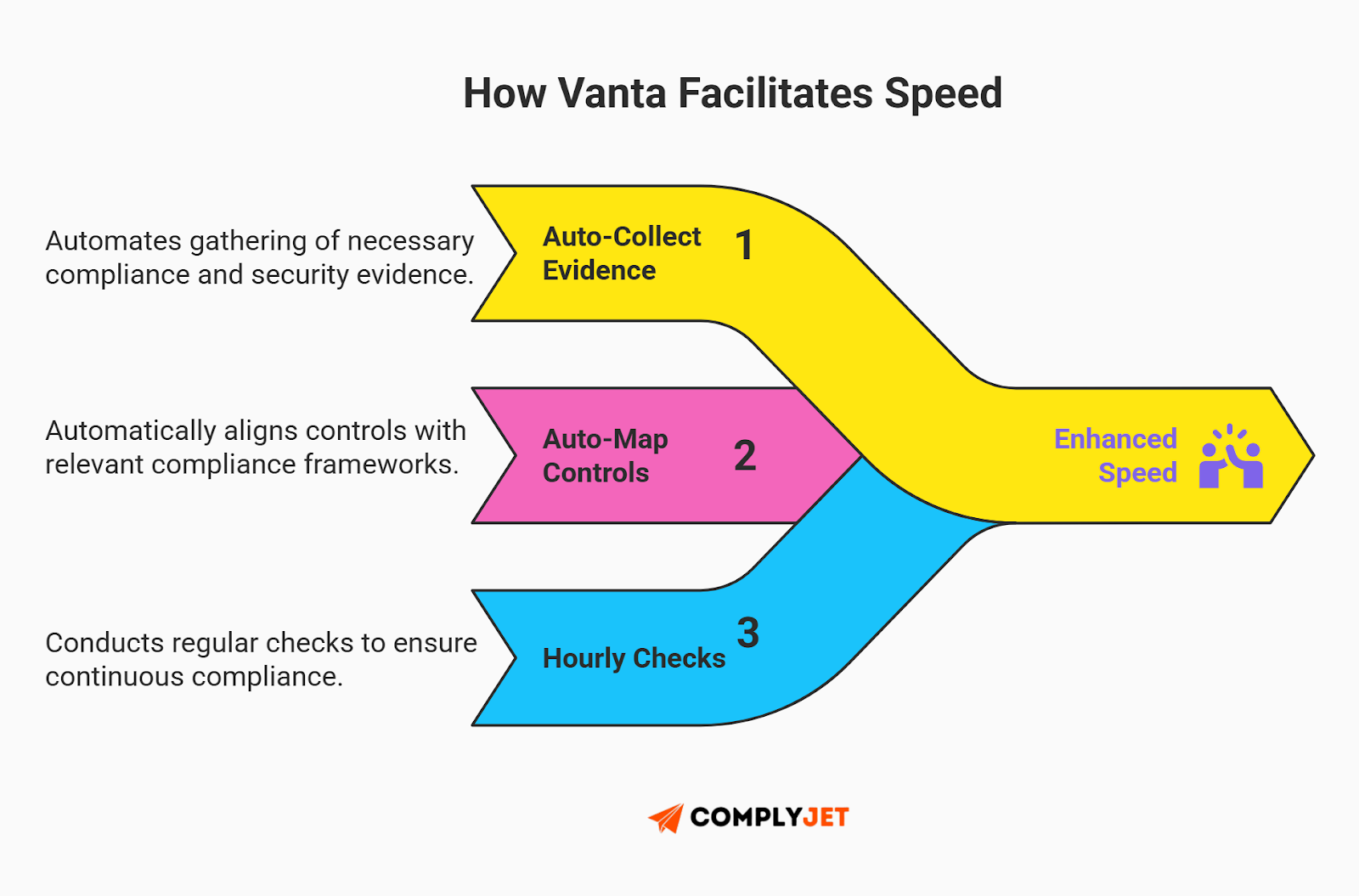
Get Vanta if velocity is your primary driver. If a Series B term sheet hangs in the balance, the massive reduction in Vanta's ISO 27001 time to certification is worth the price tag. It fits perfectly if you run a "Standard Stack" - pure AWS, Okta, and Macs. It acts as a force multiplier for lean security teams who need to automate the grunt work of evidence collection just to survive.
Reconsider Vanta if you manage physical servers or hybrid infrastructure. The automation breaks down, and you will spend more time uploading screenshots than you save. Skip it if you are bootstrapped. The total Vanta ISO 27001 cost - including the external audit fee - might kill your runway. Also, avoid it if your CISO demands bespoke risk governance that does not fit a rigid template.
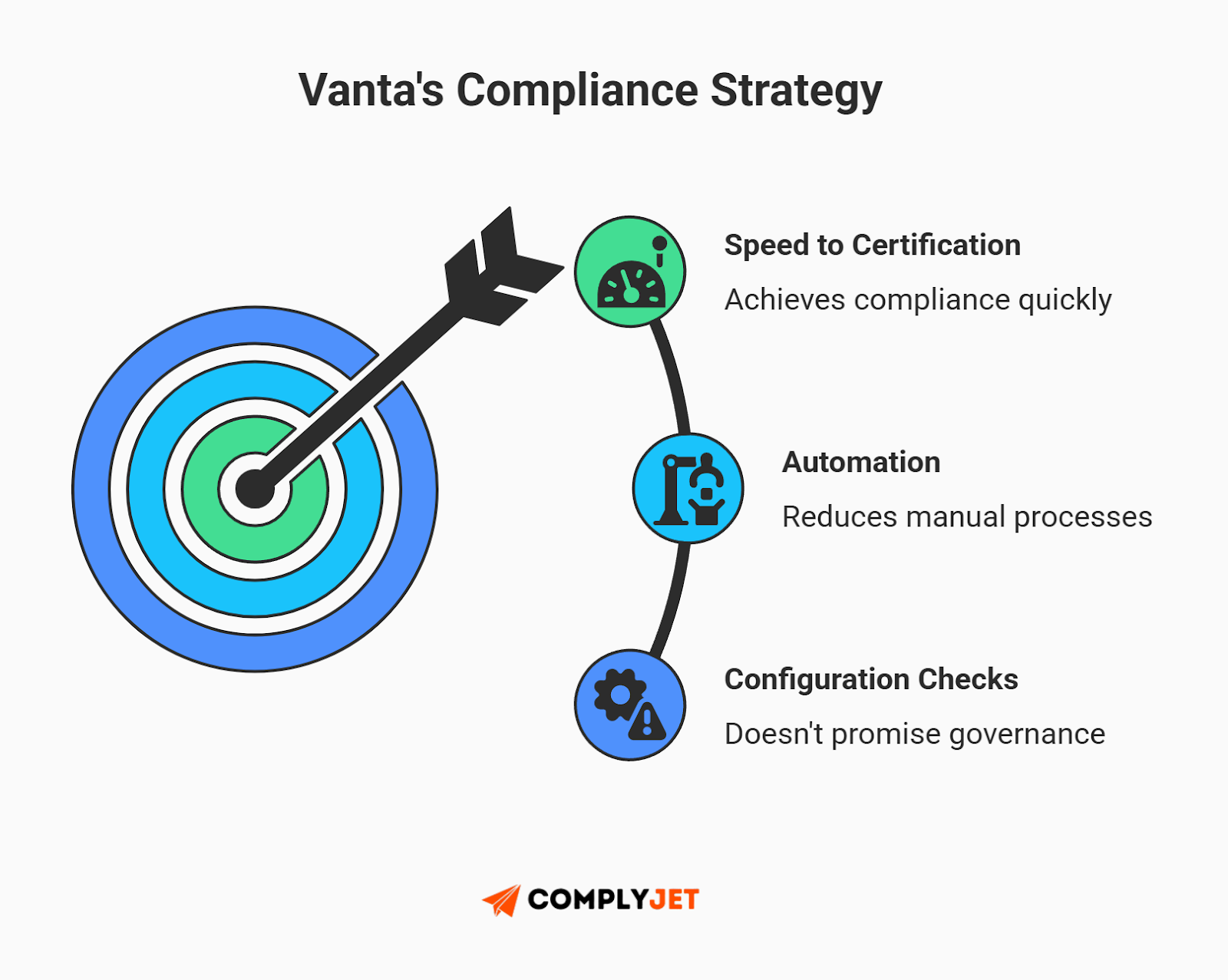
Ultimately, the platform delivers on speed. It drastically shortens Vanta's ISO 27001 time to certification by automating the technical heavy lifting. But do not trust the green lights blindly. To ensure you are benefitted from Vanta's ISO 27001 first attempt pass rate, you must "red team" your own dashboard.
Hire a consultant to find the logical gaps the software misses before the auditor does. If you respect the tool's limits, Vanta's premium pricing for ISO 27001 pays off. The result is a fast, Vanta backed ISO 27001 time to certification. Used correctly, Vanta's ISO 27001 compliance is a strategic asset. Used passively, it is just an expensive placebo.
Compliance shouldn't burn your runway or make you take decisions blindly. We built ComplyJet for founders who need guidance about the process, close deals, and not manage bloatware. Simple, efficient, and budget-friendly with transparent pricing structures.