.svg)

If you’ve ever prepared for an ISO 27001 audit, you already know documentation is not the hardest part. The real challenge is presenting it in a way auditors actually trust.
That’s exactly where an ISO 27001 audit report becomes critical, because it is not just a collection of documents but the single place where your entire ISMS is evaluated and validated.
Most teams don’t struggle with implementing controls or writing policies, but they do struggle with showing that those controls actually work in practice, and that gap is where audit reports either make the process smooth or turn it into weeks of revisions and back-and-forth.
There’s also a lot of confusion around what a “good” ISO 27001 audit report actually looks like, which often leads to over-documentation, vague findings, and uncertainty before the audit even begins.
But here’s the shift most teams miss: an ISO 27001 audit report is not just a compliance document; it is proof that your security system works, and when structured correctly, it builds trust and speeds up certification.
In this blog, we’ll break down what an ISO 27001 audit report includes, share a real example, explain how to prepare it, and highlight common mistakes to avoid.
If you are planning to start your ISO 27001 journey and want clarity on the process, speaking with an expert can help you move faster and avoid common mistakes.
What Is an ISO 27001 Audit Report (And Why It Matters)
Before jumping into structure, let’s understand what this document actually does.
An ISO 27001 audit report is the outcome of an internal or certification audit, and it provides a clear summary of how effective your Information Security Management System (ISMS) actually is in practice.
It doesn’t just list what you have implemented, it shows whether your controls are working, where the gaps are, and what needs to be improved.
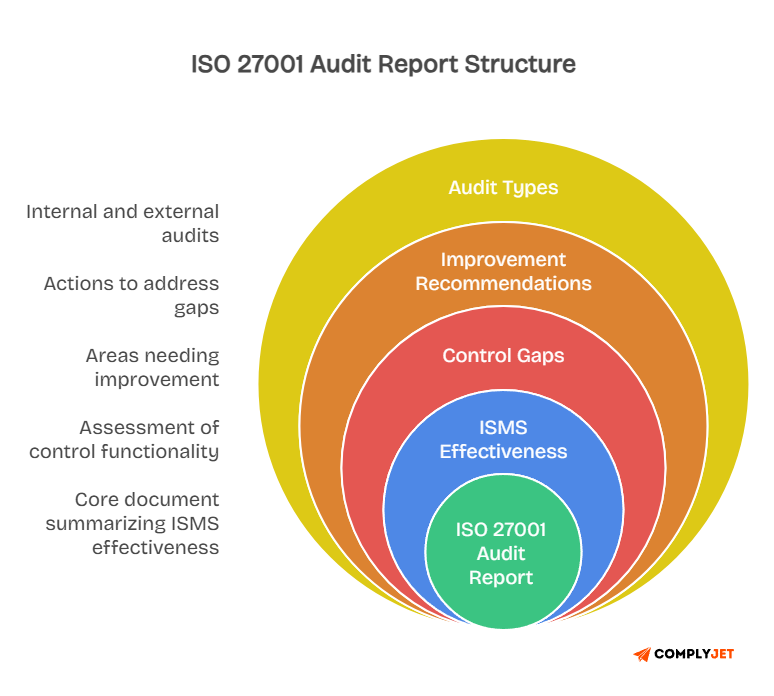
To understand its role better, it helps to distinguish between two types of audits.
An internal audit report is prepared before certification to assess readiness and identify gaps, while an external (certification) audit report is created by auditors during Stage 1 and Stage 2 audits to determine whether your organization meets ISO 27001 requirements.
Both reports serve different purposes, but together they form the foundation of your certification journey.
This is also why the audit report plays such a critical role in the overall process. It acts as proof of compliance, supports auditor decision-making, and builds trust with stakeholders who rely on your security posture.
A well-structured ISO 27001 audit report makes it easier for auditors to validate your system, while a weak one can slow down certification and create unnecessary friction.
If you're new to this, understanding the ISO 27001 certification process can help you see where audit reports fit in.
Why Most ISO 27001 Audit Reports Fail (And How to Avoid It)
Most teams don’t fail audits because of weak security. They fail because of poor reporting.
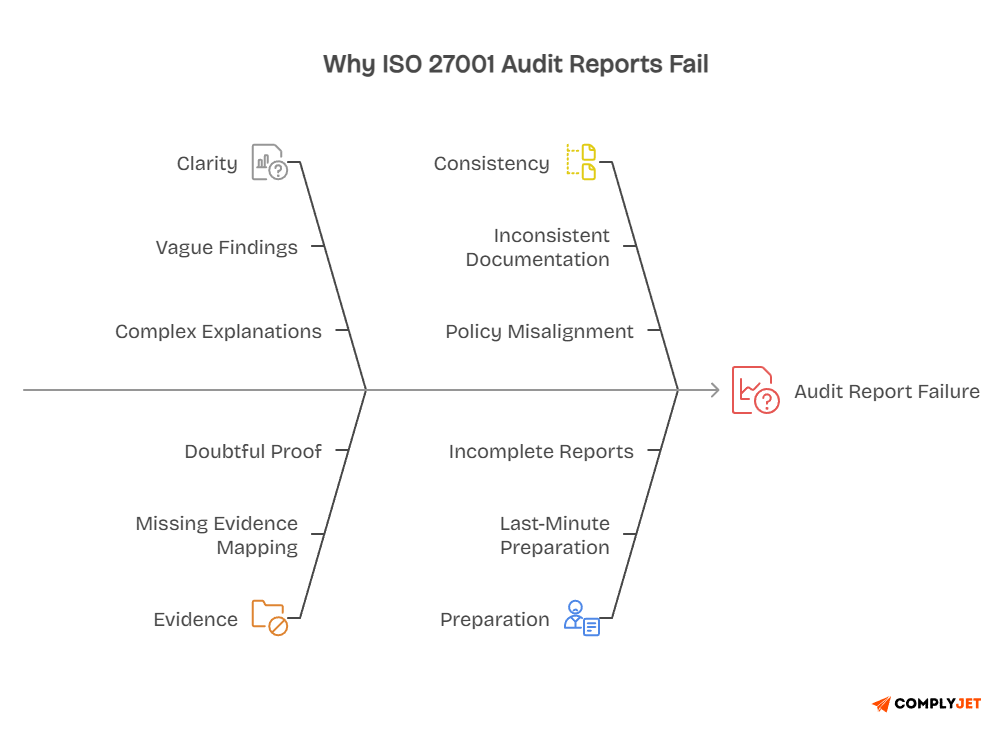
The issue is not missing controls or policies. The issue is how those controls are presented in the audit report. A common problem is a lack of clarity, where findings are either too vague or too complex, making it difficult for auditors to understand the actual situation.
Another major gap is missing evidence mapping, where controls are not clearly linked to proof, which creates doubt and follow-up questions.
Inconsistent documentation also creates problems. When policies, procedures, and findings do not align, it reduces trust in the system. Last-minute preparation makes this worse because reports are rushed, incomplete, and often contain errors.
The key shift is simple. An audit report is not a checklist. It is a combination of clear explanation and supporting evidence. Every finding should explain what is happening and be backed by proof.
If you want to avoid delays and repeated audit cycles, focus on making your audit report clear, consistent, and evidence-driven from the start.
What Does an ISO 27001 Audit Report Include?
Let’s break down what a complete audit report actually looks like.
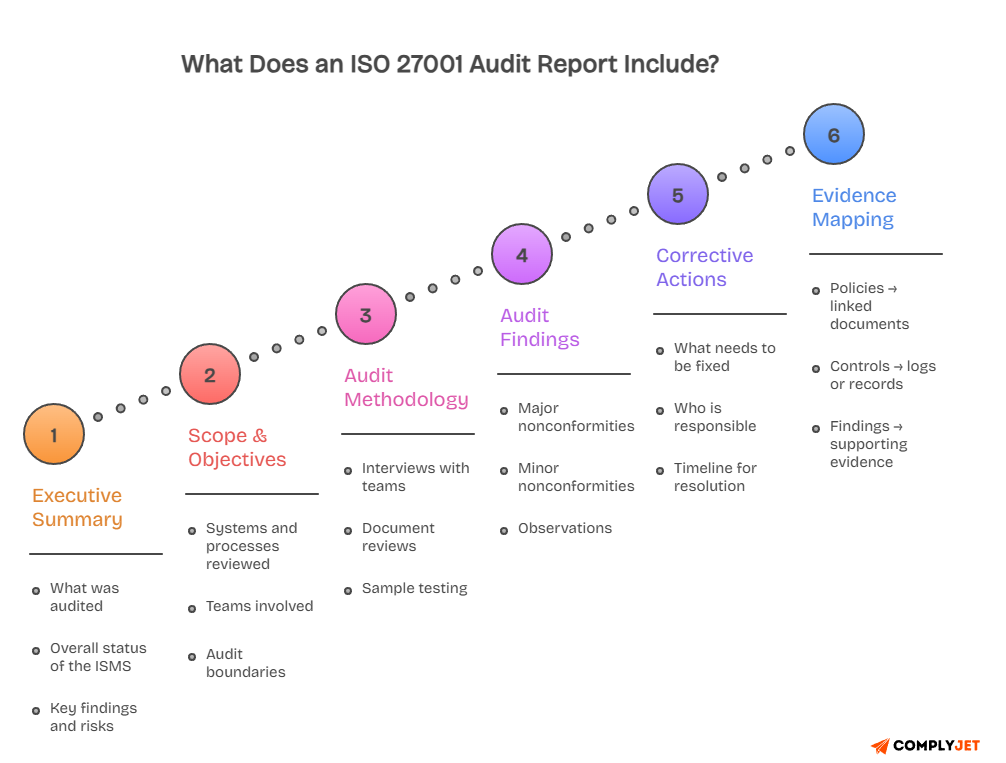
Executive Summary
This section gives a quick snapshot of the audit so anyone can understand the overall outcome without going into details.
- What was audited
- Overall status of the ISMS
- Key findings and risks
Think of it as the section leadership reads first to understand where things stand.
Scope & Objectives
This defines what was covered in the audit and what was not.
- Systems and processes reviewed
- Teams involved
- Audit boundaries
For example, if your audit only covers cloud infrastructure and not HR processes, it should be clearly stated here.
Audit Methodology
This explains how the audit was actually conducted.
- Interviews with teams
- Document reviews
- Sample testing
This helps auditors understand that your audit was structured and not random.
Audit Findings
This is the core of the report and where most of the focus goes.
- Major nonconformities
- Minor nonconformities
- Observations
Each finding should clearly explain:
- What the issue is
- Why it matters
- Where it was found
For example, instead of saying “access issue found,” a clear finding would specify inactive users not removed within a defined timeline.
Corrective Actions
Every finding should lead to a clear next step.
- What needs to be fixed
- Who is responsible
- Timeline for resolution
Without ownership and deadlines, findings remain open and hard to track.
Evidence Mapping
This connects your controls to actual proof.
- Policies → linked documents
- Controls → logs or records
- Findings → supporting evidence
For example, if you claim access reviews are done monthly, you should link logs or reports that prove it.
This structure is where most teams either pass smoothly or get stuck in audit loops.
How to conduct an ISO 27001 internal audit in 7 steps
An ISO 27001 internal audit isn’t just a compliance checkbox, it’s a structured way to test how well your Information Security Management System actually works in practice. When done right, it helps you spot gaps before an external auditor does.
The process typically follows these seven steps:
- Define the scope of the internal audit
- Prepare a detailed ISO 27001 audit checklist
- Conduct the internal audit
- Evaluate findings and document observations
- Prepare the internal audit report
- Carry out the management review
- Implement corrective actions and follow-up processes
ISO 27001 Audit Report Example (Real Breakdown)
Now let’s move from theory to what this actually looks like.
Sample:
Here’s the same audit finding structured in a clean table format:
This is how auditors expect findings to be presented in an ISO 27001 audit report sample.
First, the finding is clearly defined and linked to a specific ISO clause, which gives it context. The severity level helps auditors understand the impact. The observation explains the issue in a direct and measurable way, without vague language.
The recommendation is actionable and specific, which shows that the issue can be resolved. Assigning an owner and a deadline makes the corrective action accountable and trackable.
What makes this strong is clarity, structure, and traceability. An auditor can quickly understand what the issue is, why it matters, and how it will be fixed without asking follow-up questions.
Want a guided ISO 27001 certification process instead of figuring it out alone? See how ComplyJet works.
What Auditors Actually Look For in an Audit Report
This is where most blogs stop, but this is what actually matters.
Auditors do not just read your ISO 27001 audit report. They assess whether they can trust it. A well-written report makes validation easier, while a weak one creates delays and follow-up questions.
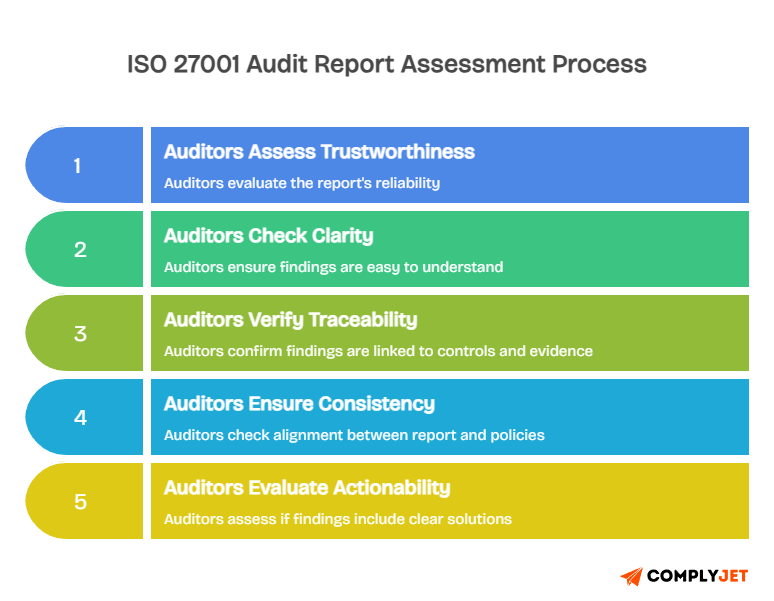
- Clarity
Findings should be direct and easy to understand. Avoid vague or overly complex language so auditors can quickly grasp the issue without confusion. - Traceability
Every finding should be linked to a specific control and supported by evidence. Auditors need to see how each conclusion is derived and verified. - Consistency
Your audit report, policies, and supporting documents should align. Any mismatch creates doubt and reduces confidence in your system. - Actionable findings
Each issue should clearly state what needs to be fixed, who is responsible, and the timeline for resolution. This shows your ability to respond effectively.
Auditors are not trying to fail you. They are trying to verify that your system actually works.
Start your free trial and see how ISO 27001 implementation works in a structured workflow.
How to Write an ISO 27001 Audit Report (Step-by-Step)
Let’s simplify how teams actually build this.
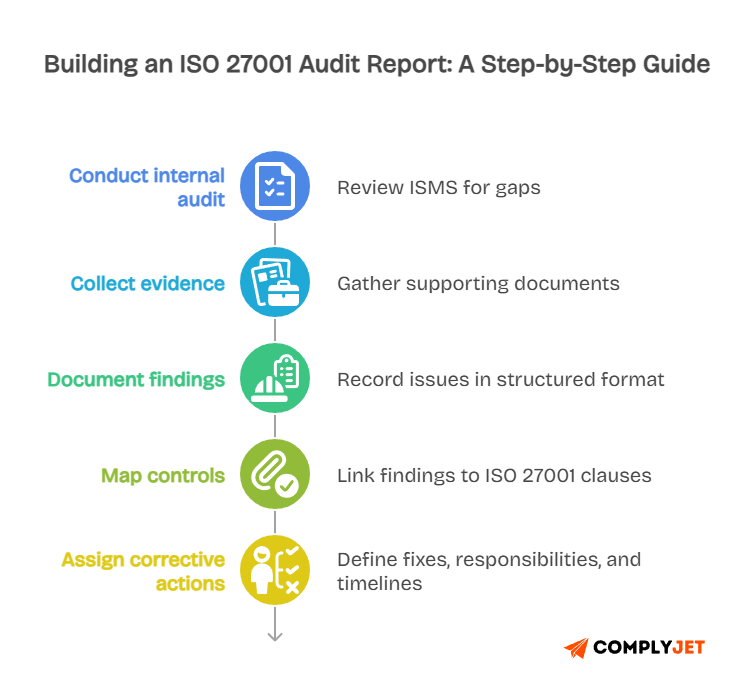
1. Conduct an internal audit: Start by reviewing your ISMS to identify gaps before the certification audit. This helps you understand what is working and what needs improvement.
2. Collect evidence: Gather supporting documents such as policies, access logs, risk assessments, and records. Every control should have clear proof.
3. Document findings: Record issues in a structured format. Each finding should clearly explain the problem and its impact without vague language.
4. Map controls: Link each finding to the relevant ISO 27001 clause or control. This ensures traceability and helps auditors validate your report.
5. Assign corrective actions: Define what needs to be fixed, who is responsible, and the timeline. This makes the report actionable and easier to track.
This is where most teams start looking for automation to avoid manual chaos.
Another estimate values it at $1.8 billion, growing to $3.8 billion by 2033 at 11.5% CAGR. Recurring nonconformities affect 70% of audits due to inefficient processes.
Common Mistakes in ISO 27001 Audit Reports
We’ve seen teams do everything right and still struggle here.
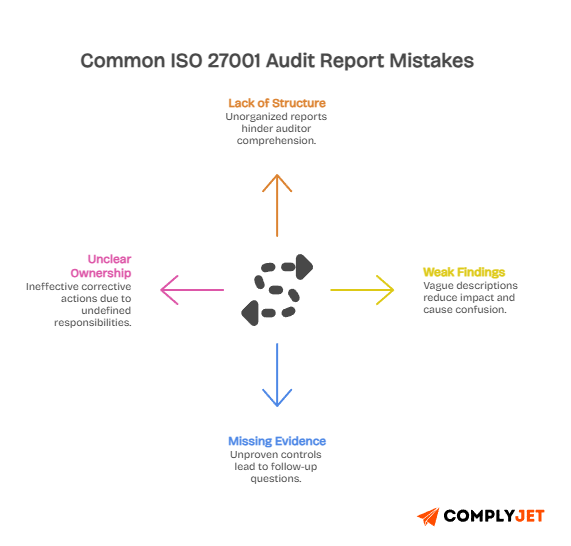
One of the most common issues is the lack of structure, where the audit report is not organized in a clear and logical way, making it difficult for auditors to follow or understand the key findings.
Another major problem is weak findings, where issues are described in vague terms without proper context, which reduces their impact and creates confusion.
Missing evidence is another critical gap, where controls are mentioned but not supported with proof, leading to follow-up questions and delays.
Along with this, unclear ownership makes corrective actions ineffective, as responsibilities and timelines are not clearly defined, making it difficult to track progress.
Avoiding these ISO 27001 audit mistakes can significantly reduce delays and repeated audit cycles.
How to Prepare for an ISO 27001 Audit (Before the Report)
The report is only as strong as your preparation.
Preparation starts with conducting internal audits to identify gaps before the certification audit begins. This helps you fix issues early and avoid surprises later.
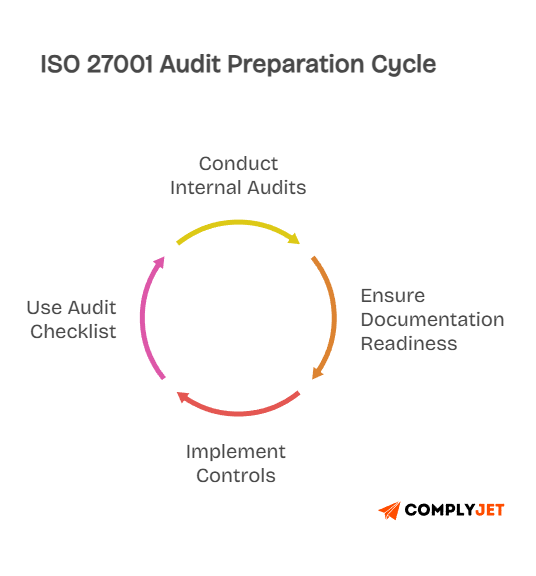
Along with this, documentation readiness is critical, where all policies, procedures, and records should be complete, updated, and easily accessible.
Control implementation is equally important, as auditors will not just check if controls exist but whether they are actually working in practice. This means your processes should be tested and consistently followed.
Using an ISO 27001 audit checklist can help ensure nothing is missed, from risk assessments to access controls and monitoring activities.
A structured checklist makes the audit process more predictable and reduces last-minute stress.
A detailed ISO 27001 audit checklist can help ensure nothing is missed.
For a detailed breakdown of ISO 27001 certification cost, including pricing ranges and hidden costs, refer to our complete cost guide.
ISO 27001 Audit Report for Different Business Types
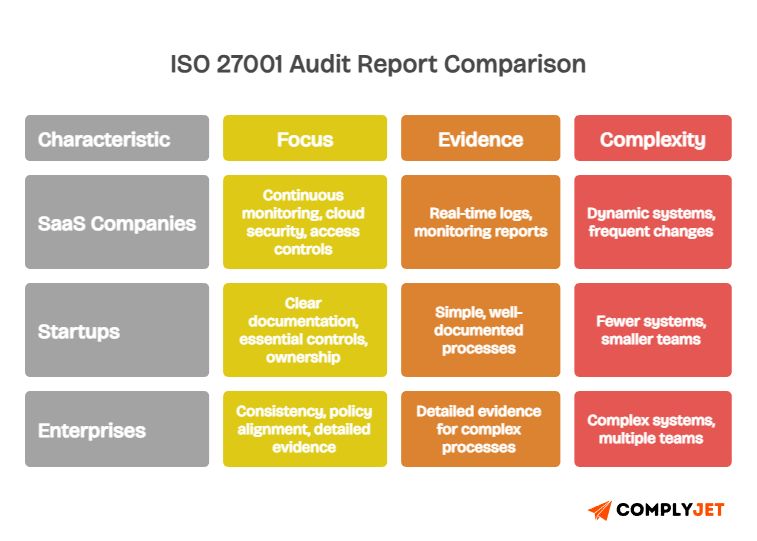
Not every ISO 27001 audit report looks the same, because every business operates differently. The structure remains the same, but how you execute it depends on your systems, team size, and complexity.
SaaS Companies
For SaaS companies, audit reports focus heavily on continuous monitoring, cloud infrastructure, and access controls. Since systems change frequently, auditors expect evidence that reflects real-time practices.
For example, if you claim user access is reviewed monthly, your report should include recent access logs, not outdated screenshots.
What to focus on:
- Real-time evidence, such as logs and monitoring reports
- Cloud security controls and access management
- Consistent tracking of changes
If your systems are dynamic, your evidence should be equally dynamic.
Startups
Startups usually have fewer systems and smaller teams, so the audit report should be lean but clear. Overcomplicating documentation can slow you down without adding value.
For example, instead of creating long policies, a startup can maintain simple, well-documented processes that are easy to validate.
What to focus on:
- Clear and simple documentation
- Cover all required controls without unnecessary detail
- Ensure ownership of actions is defined
If you are a startup or early-stage SaaS company, your approach to ISO 27001 will look different.
Read: ISO 27001 for Startups
Enterprises
Enterprises deal with complex systems, multiple teams, and layered processes, so audit reports need to be more detailed and aligned across departments.
For example, if access control is handled differently across teams, the audit report must show how those variations still meet the same control requirements.
What to focus on:
- Consistency across teams and departments
- Clear alignment between policies and actual practices
- Detailed evidence for complex processes
In enterprise environments, alignment matters as much as implementation.
Adapting your audit report to your business type makes it easier to manage and more effective during the audit process.
Why Audit Reports Matter Beyond Compliance
This is where most teams underestimate the impact.
An ISO 27001 audit report is not just a document for passing audits. It directly influences how your business is perceived by potential customers, especially in enterprise sales.
For enterprise deals, your audit report often becomes part of the vendor evaluation process. A clear and well-structured report can reduce back-and-forth and speed up approvals. When customers see strong audit findings and properly mapped evidence, it builds confidence in your security posture.
Customer trust is another key factor. Organizations want assurance that their data is secure, and your audit report acts as proof that your systems are reliable and compliant.
It also impacts sales cycles. A strong audit report can remove objections early, reduce security questionnaires, and help close deals faster.
Your audit report is not just for auditors; it helps customers trust your security and make faster decisions to work with you.

Key Insight: The global ISO 27001 certification market hit $21.42 billion in 2026, projected to reach $74.56 billion by 2035 at 15.2% CAGR, driven by cyber threats and regulations.
How ComplyJet Helps Simplify Audit Reporting
Instead of chasing documents across tools, emails, and spreadsheets, ComplyJet brings everything into one place so your audit process stays structured and predictable.
It helps you map evidence directly to controls, so every requirement is backed by proof without manual tracking. With a centralized dashboard, you can manage policies, findings, and documentation in one system, which reduces confusion and saves time.
It also gives you clear visibility into audit readiness, so you always know what is complete and what still needs attention.
If you want to simplify your ISO 27001 audit process, ComplyJet helps you stay audit-ready without the last-minute chaos.
Frequently Asked Questions About ISO 27001 Audit Reports
What is an ISO 27001 audit report?
An ISO 27001 audit report is a document that summarizes the results of an audit and evaluates how effectively your ISMS is implemented and maintained.
How to write an ISO 27001 audit report?
Start with an internal audit, collect supporting evidence, document findings clearly, map them to relevant controls, and assign corrective actions with ownership and timelines.
What does an audit report include?
It typically includes an executive summary, scope, methodology, audit findings, corrective actions, and evidence mapping to support each control.
What are audit findings?
Audit findings are identified issues, gaps, or observations during the audit, categorized as major nonconformities, minor nonconformities, or improvement areas.
Conclusion: From Audit Stress to Audit Readiness

ISO 27001 audits don’t have to feel overwhelming.
Once you understand the structure of an audit report, prepare your documentation in advance, and learn from real examples, the entire process becomes clearer and more manageable.
The confusion usually comes from not knowing what auditors expect, but when you focus on clarity, consistency, and evidence, your audit report becomes much easier to build and validate.
At its core, an audit report is simple. It brings together structure, preparation, and proof in one place. When done right, it helps auditors assess your system quickly and reduces delays in the certification process.
The key is to start early, stay organized, and avoid last-minute fixes.
Start preparing your ISO 27001 audit report early, or let ComplyJet help you get audit-ready faster.