.svg)

A green dashboard and a signed SOC 2 report are two different things, and the gap between them is where most confusion about Vanta actually lives. Vanta can automate almost everything that leads up to a report. It cannot produce the report itself, and it cannot guarantee an auditor agrees with everything the dashboard says, a friction point that catches even well-prepared teams off guard once the actual audit interview starts. In this article, we will walk you through exactly where that gap shows up, what closing it actually costs, and when a different platform closes it better.
Vanta is a compliance automation platform built around continuous control monitoring, automated evidence collection, and readiness tracking for a SOC 2 audit. The audit and the report belong to an independent, accredited CPA firm operating under the AICPA's SOC for Service Organizations framework, a step no automation platform, Vanta included, gets to skip.
Here's what's ahead:
- What Vanta's automation actually covers, with the real numbers behind the marketing
- Type 1 vs. Type 2, and the SOC 3 mix-up hiding inside "Vanta SOC 2 type 3" searches
- Why the report type isn't just a technicality
- Common mistakes teams make with Vanta specifically, drawn from practitioners who've done it
- The real path from Vanta's dashboard to a signed report, and who actually audits it
- What a Vanta SOC 2 engagement actually costs, cross-checked against independent audit firms
- Where Vanta's automation earns its reputation, and where real users say it doesn't
- When Vanta is the right call, and when Drata, Sprinto, or ComplyJet are worth a look instead
What Vanta Actually Automates for SOC 2 Compliance
Vanta's SOC 2 product does a specific, well-defined set of things, and it's worth being precise about them since the gap between "automated" and "compliant" is exactly where founders get tripped up.
As per Vanta's own product documentation, the platform runs 1,200+ automated tests that monitor controls on an hourly basis, connecting to more than 400 tools across cloud infrastructure, identity providers, code repositories, and HR systems, AWS, Azure, Okta, GitHub, Wiz, Cloudflare, Google Cloud, and LaunchDarkly among them. A newer layer, marketed as Vanta AI, reviews flagged evidence and suggests remediation steps, including code snippets engineers can use to fix a failing test directly. None of that is exaggerated, it's a genuinely capable automation layer, and it's the reason Vanta became the category default in the first place.
Two specifics are worth knowing: First, Vanta claims meaningful evidence reuse across frameworks for teams pursuing more than one: roughly 80% of SOC 2 evidence carries over to ISO 27001, 40% to HIPAA, and 35% to GDPR, which matters if SOC 2 and ISO 27001 are both on your roadmap. Second, the audit itself still runs through a defined network of outside firms. Vanta doesn't audit anyone itself.
| What Vanta's automation does | What only an independent auditor can do |
|---|---|
| Confirms a control is configured (MFA is on, logging is enabled) | Confirms the control actually holds up under audit-grade scrutiny |
| Flags evidence gaps before the audit window starts | Tests whether evidence was collected consistently over the full period |
| Tracks readiness against SOC 2's control categories | Forms the professional opinion that becomes the actual report |
| Runs continuously, in the background, 1,200+ checks at a time | Signs their name to the outcome, personally and professionally |
Vanta is compliance automation software, not an auditing firm. It prepares the evidence an external auditor reviews. It doesn't grant SOC 2 status on its own, no matter how green the dashboard looks, and no matter how confident a customer testimonial sounds.
SOC 2 Type 1 vs. Type 2, and Where the "Type 3" Confusion Comes From
Once the automation-versus-audit boundary is clear, the next thing worth sorting out is which report you're actually being asked for, because Type 1 and Type 2 answer genuinely different questions, and the AICPA is specific about the distinction.
Under AICPA TSP Section 100, every SOC 2 report is scored against five Trust Services Criteria:
- Security
- Availability
- Processing Integrity
- Confidentiality
- Privacy
Security is mandatory in every report. The other four only apply if they're relevant to what you've actually committed to your customers, which is why two companies' SOC 2 reports can cover meaningfully different ground even though both say "SOC 2" on the cover page.
A SOC 2 Type 1 report is a snapshot. It confirms your controls are designed correctly as of one specific date, the way a home inspection confirms the wiring was installed to code on the day someone looked at it. While, a Type 2 report is closer to a security camera than a snapshot: an auditor observes your controls operating over a real window, typically three to twelve months, and confirms they held up the whole time, not just on a good day. Type 2 is what most enterprise buyers actually ask for, and it's the one that carries real weight in a vendor security review.
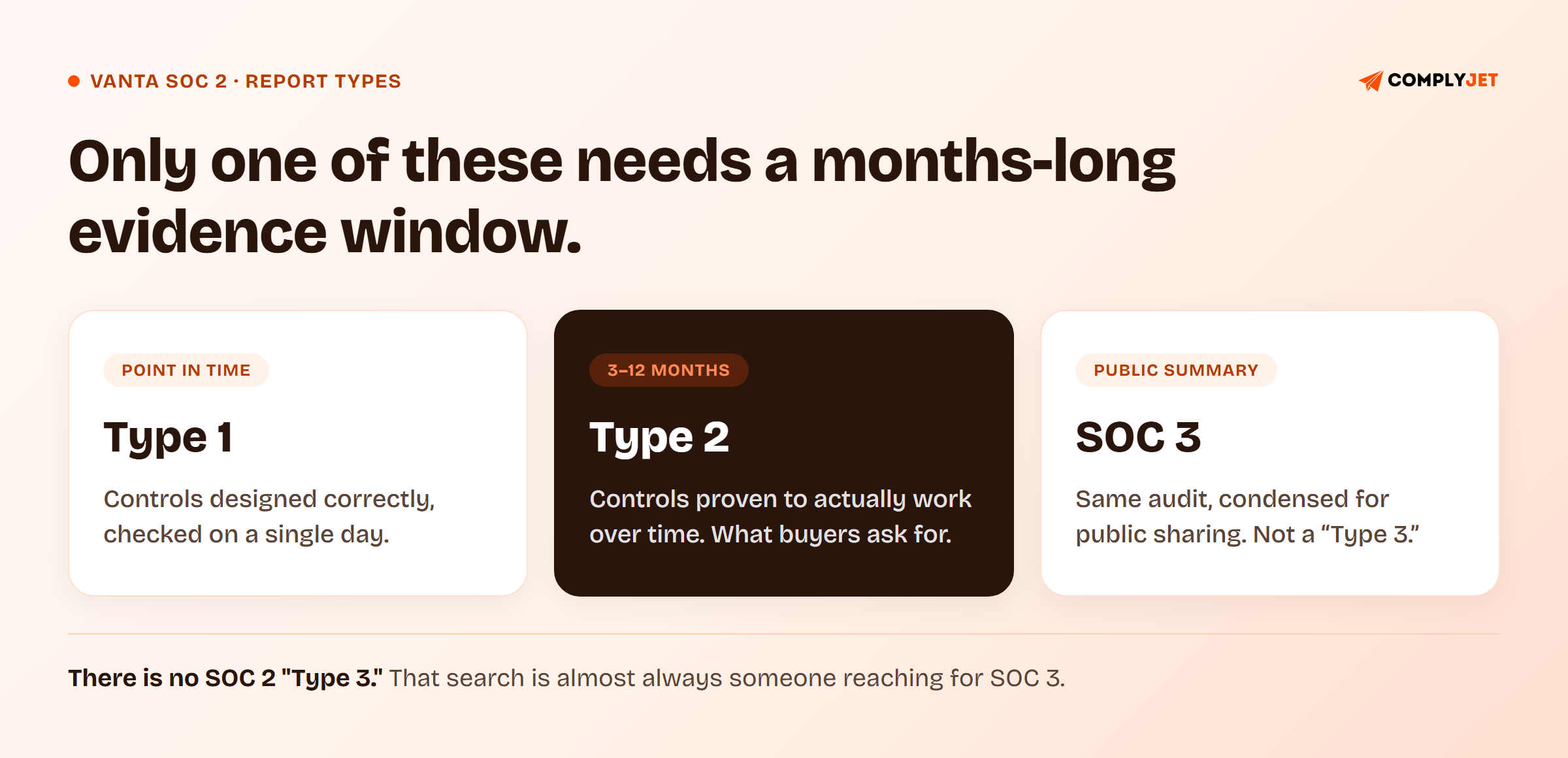
One confusion worth clearing up directly rather than leaving as a footnote: whether SOC 2 has a "Type 3" tier above Type 2.
The Difference between SOC 1 vs. SOC 2, quickly
A related mix-up comes up just as often: SOC 1 and SOC 2 sound like versions of the same thing, and they aren't. The short version, straight from how the AICPA scopes its own SOC suite: SOC 1 covers controls relevant to financial reporting, the kind of thing that matters to auditors focused on statement accuracy. SOC 2 covers security, availability, and confidentiality controls against the Trust Services Criteria above, the kind of thing a customer's security team actually asks about. Different audience, different purpose, and SOC 2's control categories don't map cleanly onto SOC 1's at all. Neither report is a more advanced version of the other.
Why the Report Type Actually Matters
None of this is academic once a customer's security team is the one reading your report. SOC 2 is an attestation, not a certification, and that distinction changes what you can honestly claim.
There's no pass/fail badge to earn here, no logo to slap on a homepage the way a product certification works. A SOC 2 report is an auditor's professional opinion on whether your controls operated effectively, delivered with specific scope and specific caveats.
| A certification | SOC 2 (an attestation) | |
|---|---|---|
| What it is | Pass or fail against a fixed standard | An auditor's professional opinion on your controls |
| Who "grants" it | A certification body issues a badge | No one grants it, the report itself is the evidence |
| What a vendor should claim | "We are certified" | "An independent auditor reviewed our controls and issued an opinion" |
When a vendor says "we're SOC 2 compliant," what that should mean is the right column above, not the left one. Buyers who know the difference read reports more carefully, request the actual document rather than taking a logo at face value, and increasingly treat a current report as a gate rather than a nice-to-have, a shift that tracks directly with the rising cost of getting security wrong: healthcare breaches alone averaged $7.42 million in 2025, against a $4.44 million global average, per IBM's 2025 Cost of a Data Breach Report. Buyers who don't know the difference are exactly the ones a thin Type 1 report can quietly mislead.
Key Friction Points in Vanta's SOC 2 Experience
Featured pages usually describe the ideal expectations from a platform instead of what it actually does. Friction shows up later, once a team is actually living inside the process, and a handful of patterns come up often enough across public reviews of Vanta and the practitioners who've used it.
| Friction point | What it looks like in practice |
|---|---|
| Year-two pricing jump | First-year quotes often carry an aggressive discount. ComplyJet's own Vanta Trust Center research found renewal-year increases commonly landing in the 10% to 30% range, and customer reviews referenced in ComplyJet's Vanta Pricing Guide describe hikes arriving with little advance warning. |
| Support thins out below enterprise tier | The same pricing research found repeated mentions of slower, less personal support once an account isn't a top-tier customer, a pattern distinct from the platform's technical capability. |
| Alert fatigue from continuous monitoring | Running 1,200+ automated tests around the clock means a real volume of notifications. ComplyJet's Vanta ISO 27001 research found teams that don't tune what they're watching tend to start tuning out the alerts altogether. |
| Integration cliff on non-standard stacks | The 400+ integrations cover mainstream infrastructure well. Teams on older or less common systems, per that same ISO 27001 research, describe the automation thinning out fast once they're off that list, pushing evidence collection back to manual work. |
| Auditor interpretation isn't automatable | Covered in more detail just below, an auditor's judgment call can diverge from what a green dashboard implies, and no automation layer resolves that gap on its own. |
| Skepticism from buyers reviewing a live dashboard | ComplyJet's Vanta Trust Center research also surfaced buyer-side sentiment describing an automated trust page as "security theater" until the underlying report itself gets reviewed directly, a reminder that a live dashboard and a signed report don't carry equal weight with every buyer. |
None of these are disqualifying on their own. They're the kind of detail that shapes whether a team's actual experience with Vanta matches the marketing page, and worth going in with eyes open about.
Common Mistakes Teams Make With Vanta SOC 2
Knowing the terminology is one thing. Knowing where teams actually trip up while running Vanta specifically is a different, and it tends to come from people who've lived through it rather than a features page.
- Starting too late: A healthcare-focused practitioner interviewed by Out of Pocket put it bluntly: "a mistake that people new to healthcare make is that they do not get their compliance stuff in order early." The pattern isn't specific to healthcare. Vanta's automation shortens evidence collection, it doesn't shorten the fact that a Type 2 report needs a three-to-twelve-month observation window before anyone can audit it.
- Treating the dashboard's interpretation as the auditor's: The same interview describes a real exchange that captures this well: an auditor asked for evidence that all SQL databases were encrypted, the team explained they didn't run any SQL databases, and the auditor still wanted evidence of that absence. SOC 2's principles-based standard gives auditors real interpretive latitude, and a green Vanta dashboard doesn't bind an auditor to agree with it.
- Skipping the audit-fee line item when budgeting: The subscription price is the visible number. The independent auditor's fee, discussed in full below, is the one that catches teams off guard because Vanta's own pricing pages don't set it.
- Assuming automation replaces cultural adoption: Vanta automates technical evidence collection well. It has no mechanism for making sure an engineer actually understands why a control exists rather than just satisfying the check, and that gap is exactly what an experienced auditor's interview questions are designed to surface.
- Assuming a Type 1 report satisfies an enterprise buyer: It often doesn't. Some teams get a Type 1 first as a stepping stone, which is reasonable, but presenting it as equivalent to a Type 2 in a sales cycle is a common and avoidable stumble.
How Vanta's Automation Maps to the Real SOC 2 Audit Process
With the terminology and common pitfalls out of the way, the more practical question is what actually happens between signing up for Vanta and having a report in hand, since the automation and the audit are two distinct phases run by two distinct parties, governed by a specific auditing standard.
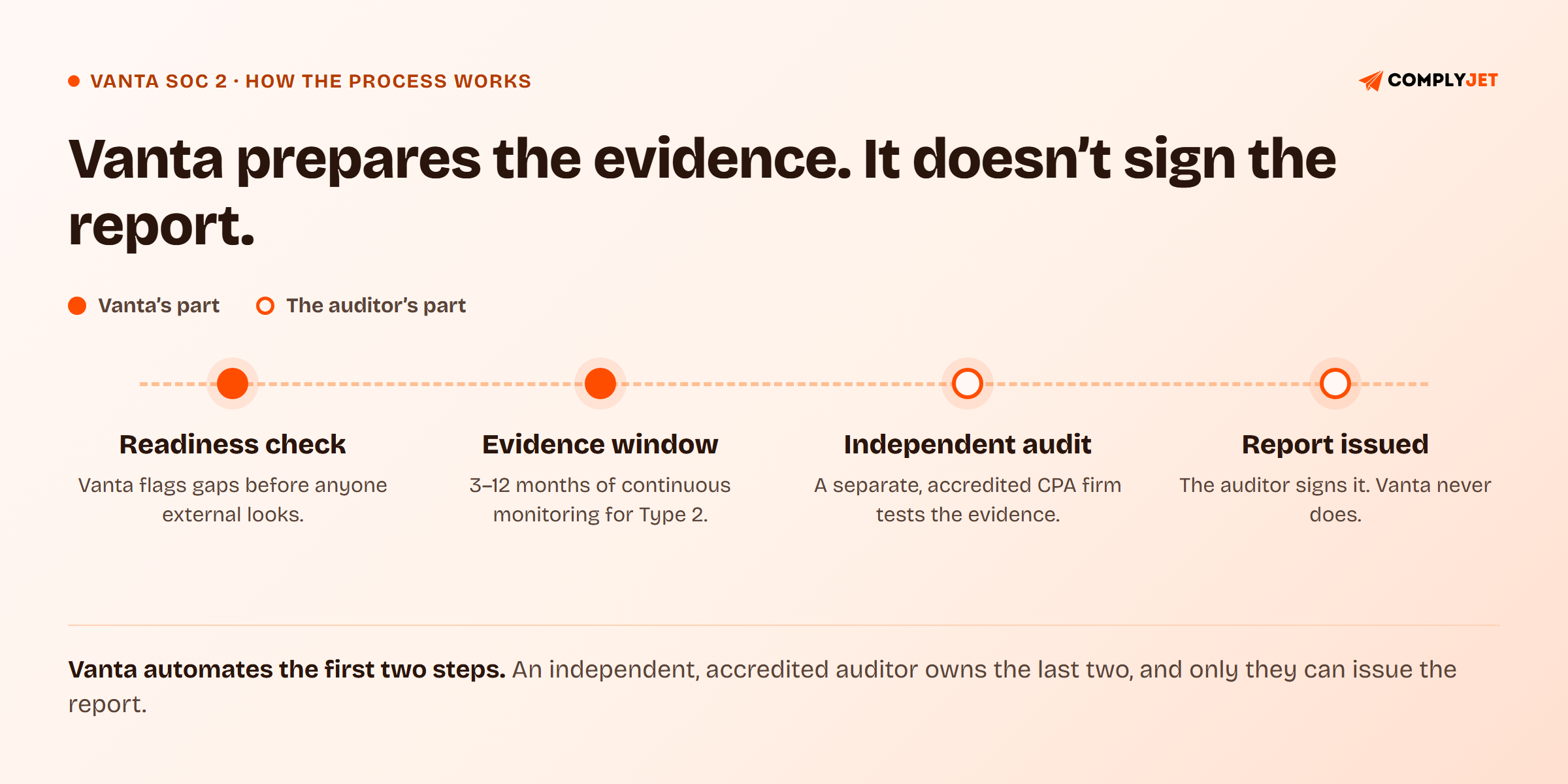
- Readiness assessment: Vanta's dashboard scans your current setup against SOC 2's control categories and flags what's missing before anyone external is involved.
- Gap remediation: You fix what the readiness check surfaced, usually policies that don't exist yet, access reviews that aren't scheduled, or integrations that need to be connected. This is also where a documented gap analysis earns its keep, since it's the difference between remediation that's targeted and remediation that's guesswork.
- Evidence collection window: For a Type 2 report, this runs three to twelve months. Vanta collects evidence continuously in the background rather than you gathering it manually at the end.
- Independent audit: The audit itself runs under AICPA's SSAE 18 standard, specifically AT-C Sections 105 and 205. Vanta partners with a defined set of accredited CPA firms rather than auditing anyone itself, worth stating plainly since it's a common point of confusion. Choosing that auditor is its own decision, separate from choosing Vanta.
- Report issued: The auditor signs it. Vanta's dashboard turning green is not the same event, and it's worth not treating it as one. Reports don't last forever either, worth knowing before a customer asks: check how long a SOC 2 report stays valid between renewal cycles.
Readiness checklist basics
Inside that readiness phase, most of the real work sorts into a handful of control categories, and knowing them makes the gap-remediation step far less of a scramble. ComplyJet's own SOC 2 compliance checklist walks through this in more depth, but the categories that consistently surface are:
- Access control, who can reach what, and how access gets removed when someone leaves
- Change management, how code and infrastructure changes get reviewed before shipping
- Incident response, a documented plan, not just an intention
- Vendor risk management, tracking the SOC 2 status of your own subprocessors, the same lens a vendor security questionnaire applies from the other side of the table
- Policy documentation, written, dated, and actually followed, not just filed away
What a Vanta SOC 2 Report Actually Costs
Readiness work and evidence collection aren't free, and the honest cost picture for a SOC 2 engagement has two separate line items that rarely get discussed together: the platform subscription, and the audit fee that no platform, Vanta or otherwise, gets to set. Vanta's figures below come from its own product documentation and, for the audit fee, an independent CPA firm's published rates. ComplyJet's come directly from its own live pricing page. Both exclude the audit fee from the subscription price, worth noting since that's the number most comparisons skip entirely.
| Cost component | Vanta | ComplyJet |
|---|---|---|
| Platform subscription, single framework (SOC 2) | ~$10,000/year (Core plan) | $4,000/year on a 3-year term, $5,000/year on a 1-year term (Core plan) |
| Platform subscription, two frameworks (e.g. SOC 2 + HIPAA) | $15,000-$30,000/year (Plus plan) | $6,400/year on a 3-year term, $8,000/year on a 1-year term (Plus plan) |
| Independent CPA audit fee, Type 2, excluded from the platform price either way | Vanta's own estimate: $30,000-$60,000. Independent firms like Linford & Co quote $15,000-$100,000 depending on scope and firm tier | Starts from $3,000, final cost set by the auditor, team size, and scope, same audit-excluded structure as Vanta |
| All-in realistic total, subscription plus audit plus internal prep time | $75,000-$150,000+ | Same audit-fee variability applies regardless of platform. The subscription-price gap above is the main structural difference |
Audit pricing varies by firm tier, scope, and how many systems are in play, not by which automation platform brought the auditor the evidence, which is why Vanta's own estimate and an independent auditor's own figure don't fully agree either.
For the full breakdown across every framework, not just SOC 2, the Vanta Pricing Guide covers plan tiers, renewal-year changes, and where the hidden costs tend to show up.
Where Vanta's SOC 2 Automation Is Strong, and Where It Isn't
Like any compliance platform, Vanta excels in some areas and has practical limitations in others. Separating those two gives a more realistic picture of what the platform can (and cannot) automate.
Note for readers: Vanta ships SOC 2-related product and framework updates on a regular cadence. Pricing, scope, and automation coverage from a year ago aren't guaranteed to still be accurate, so it's worth checking what's actually changed before quoting last year's numbers to a customer or an auditor.
When Vanta Fits, and When a Different Platform Might Fit Better
The automation, the audit fee, and the real limitations all point to the same question: which platform actually fits your team. Vanta isn't the only name worth weighing.
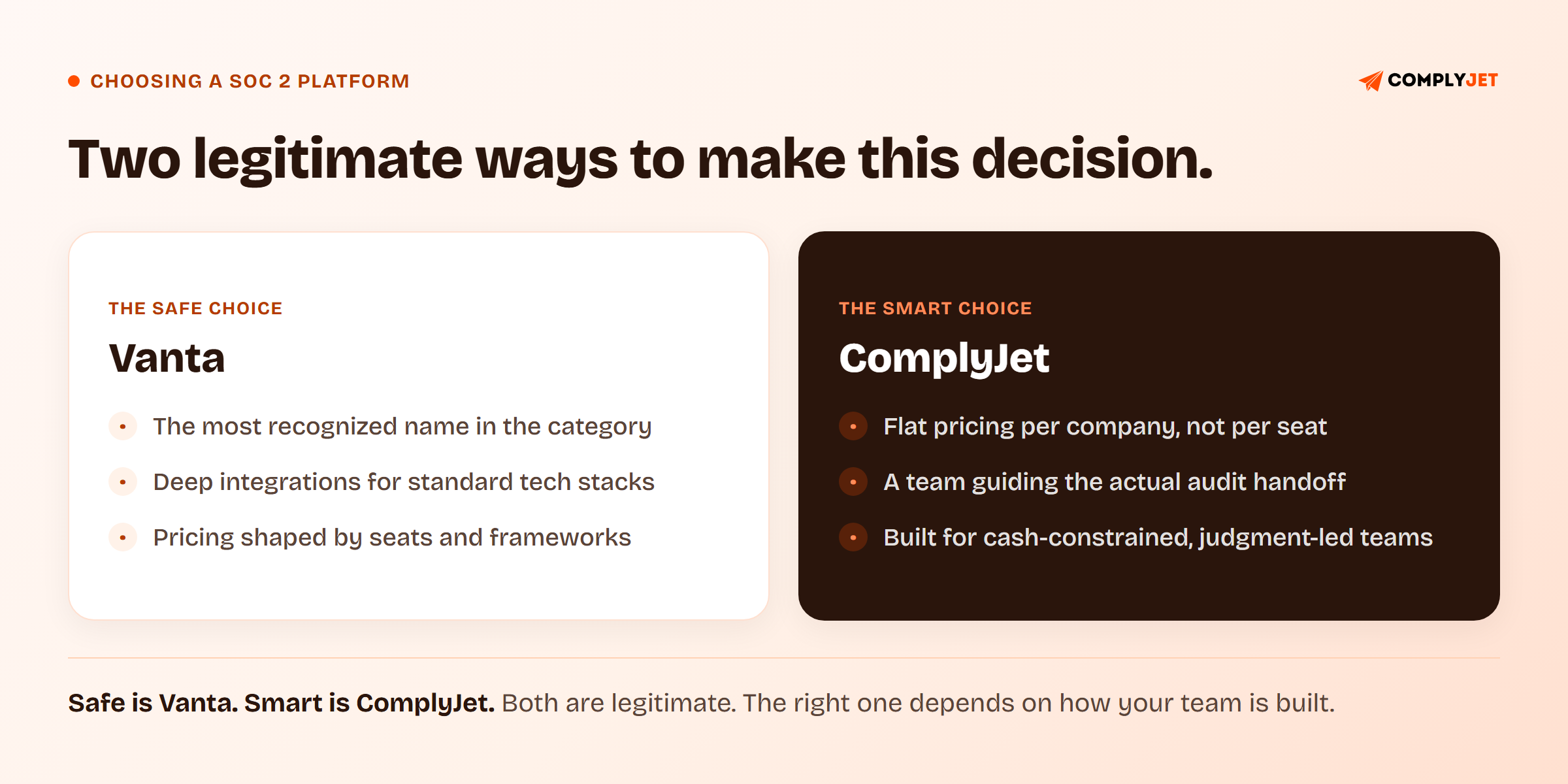
Vanta is the category default for a reason. It's the most recognized name in this space, its integration library covers nearly every standard stack, and for a team that wants the safest, most widely understood answer in a board meeting, that's a legitimate, sensible choice. Nothing above changes that.
Two other names come up often enough to mention directly. Drata covers similar automation ground for teams that want Vanta-style breadth with a different support relationship or contract structure. Sprinto tends to fit teams that want more built-in audit guidance bundled directly into the platform rather than a self-serve dashboard, useful for a team with genuinely zero in-house compliance experience.
ComplyJet Shifts From Default to Smarter Approach for Startups Pursuing SOC 2
ComplyJet takes a different shape entirely: flat, per-company pricing across every framework instead of a structure that grows with seats and add-ons, plus a team that stays involved through the actual audit handoff, not just the automation dashboard. That's not a cheaper-by-default claim, it's altogether a smarter model built specifically for startups pursuing their first SOC 2 without a compliance department to lean on. ComplyJet's compliance automation and audit management cover the same functional ground as what's described above, and ComplyJet vs Vanta breaks the feature-by-feature differences down in full.
Set side by side, here's how the three actually stack up:
| Vanta | Drata | ComplyJet | |
|---|---|---|---|
| Pricing shape | Tiered by plan and employee count, ~$10K-$30K+/year | Tiered by employee band and framework count, ~$7.5K-$100K+/year | Flat per-company rate across frameworks, $4K-$8K/year |
| Integration breadth | 400+, broadest in the category | Comparable breadth and automation depth | Covers standard stacks, a narrower library |
| Support model | Self-serve dashboard, support tiered by plan | Self-serve dashboard, support tiered by plan | A team involved through the actual audit handoff |
| Best fit | Teams that want the most recognized name in the room | Teams that want similar breadth with different contract terms | First-time SOC 2 teams without a compliance hire |
None of the three is wrong. The table is a starting point for narrowing, not the whole decision.
Vanta versus Drata specifically deserves more room than a paragraph here can give it. Vanta vs Drata 2025 covers that head-to-head directly, and Vanta Competitors and Alternatives maps the broader landscape if Vanta, Drata, and Sprinto aren't the only names on your shortlist.
FAQs
What is Vanta SOC 2?
Vanta SOC 2 refers to using Vanta's compliance automation platform to prepare for a SOC 2 audit. Vanta automates evidence collection, continuous control monitoring across 400+ integrations, and readiness tracking. It doesn't perform the audit itself, an independent, accredited CPA firm does that separately under AICPA's SSAE 18 standard.
Does Vanta issue the SOC 2 report itself?
No. Vanta prepares the evidence and readiness work, but only an independent, accredited CPA firm can test that evidence and issue an actual SOC 2 report. Vanta partners with a defined set of audit firms rather than auditing anyone directly.
What's the difference between SOC 2 Type 1 and Type 2 in Vanta?
Type 1 confirms your controls are designed correctly as of one specific date. Type 2 confirms those controls operated effectively over an observation window, typically three to twelve months. Most enterprise buyers ask for Type 2 specifically, and it's the report that carries real weight in a vendor security review.
Is there a SOC 2 Type 3?
No. SOC 2 only comes in Type 1 and Type 2, per the AICPA's own framework. SOC 3 is a separate, public-facing report built on the same underlying audit, not a third tier of SOC 2.
What's the difference between SOC 1 and SOC 2?
SOC 1 covers controls relevant to financial reporting. SOC 2 covers security, availability, and confidentiality controls against the AICPA's five Trust Services Criteria. They serve different audiences and different purposes, neither is a more advanced version of the other.
Is SOC 2 a certification?
No, it's an attestation. An independent auditor forms a professional opinion on whether your controls operated effectively, with defined scope and caveats. There's no pass/fail badge the way a product certification works.
What does a Vanta SOC 2 audit actually cost?
Expect roughly $10,000 to $30,000 a year for the Vanta platform depending on plan. The separate independent audit fee varies more by source: Vanta's own estimate is $30,000 to $60,000 for a Type 2 engagement, while independent audit firms like Linford & Co quote $15,000 to $100,000 depending on scope and firm tier. All-in, including internal prep time, realistic totals often land between $75,000 and $150,000.
What are the most common mistakes teams make with Vanta SOC 2?
Starting the process too late relative to the three-to-twelve-month Type 2 window, treating the automation dashboard's green status as equivalent to an auditor's opinion, presenting a Type 1 report as if it satisfies an enterprise buyer who expects Type 2, and budgeting for the subscription while forgetting the separate audit fee entirely.
What do users complain about most with Vanta's SOC 2 process?
The recurring themes are a year-two pricing jump after an aggressive first-year discount, support that thins out once an account isn't top-tier, alert fatigue from a high volume of continuous-monitoring notifications, and an integration cliff on non-standard infrastructure. None are disqualifying, but worth knowing before signing a first-year contract.
What is the alternative to Vanta for SOC 2?
Several compliance automation platforms compete directly with Vanta for SOC 2, including ComplyJet, Drata, and Sprinto. Drata suits teams that want similarly broad automation with a different support relationship. Sprinto tends to fit teams that want more built-in audit guidance rather than a self-serve dashboard. The right fit depends on team size, budget structure, and how much hands-on guidance a team needs through the actual audit. See the full ComplyJet vs Vanta comparison →
Vanta vs Drata, which is better for SaaS SOC 2 compliance?
Both are established platforms with broad integration coverage. The honest answer depends on specific stack fit, support model, and pricing structure rather than a universal winner, which is exactly why that comparison gets its own dedicated article rather than a quick verdict here.
Related Reading
- Vanta ISO 27001 Guide: the parallel framework page this article was the missing counterpart to.
- Vanta Pricing Guide 2025: full cost breakdown across all frameworks, not just SOC 2.
- Vanta Trust Center: what happens after the report, how it gets shared with buyers.
- Vanta vs Drata 2025: the direct platform comparison referenced above.
- Vanta Competitors and Alternatives: broader alternative landscape.
- SOC 2 Type 1 vs Type 2: the general, non-Vanta-specific explainer.
- SOC 2 Compliance Cost: platform-agnostic cost breakdown.
- SOC 2 Controls: the Trust Services Criteria in full detail.
- How to Choose a SOC 2 Auditor: the decision Vanta's platform choice doesn't make for you.
- SOC 2 Gap Analysis and Assessment: what a real readiness assessment covers.
- What Is a Bridge Letter: what covers you between report renewals.
- ComplyJet vs Vanta: direct feature and pricing comparison page.
- ComplyJet's Compliance Automation Platform: what ComplyJet's own automation covers.