.svg)

You win a first meeting with your top enterprise prospect. Two days later, a 150-question spreadsheet lands in your inbox with a two-week deadline and a subject line that reads “Vendor Security Assessment.” Your security lead is tied up on a product sprint. Your sales rep is cc’d and panicking. This is the moment most security questionnaire automation tools are trying to solve, and most are doing it badly.
Security questionnaire automation uses AI trained on your existing policies, prior responses, and certification evidence to answer inbound assessments automatically. The better ones handle 80 to 95% of questions without human input. You review the remainder, not the whole thing.
If you are trying to find the best AI for security questionnaires at your stage, the answer depends heavily on whether you are also pursuing a compliance certification or just need a point solution. I reviewed 11 security questionnaire tools, covering pure-play automation platforms and compliance platforms with built-in questionnaire modules, looking at AI accuracy, setup burden, format coverage, and total cost of ownership. Here is what I found.
Best picks at a glance
- Best overall: Conveyor — purpose-built, 95%+ accuracy, trusted by Figma and Atlassian
- Best for startups: ComplyJet — handles questionnaire automation and your SOC 2 or ISO 27001 cert in one flat-fee platform
- Best AI plus human backup: SecurityPal — certified analysts behind every answer, 12-hour SLA
- Best for teams already in Google Drive: Arphie — zero library maintenance, connects directly to your existing docs
- Best enterprise RFP tool: Loopio or Responsive (formerly RFPIO) — deep workflow management for large proposal teams
How security questionnaires became every startup’s slowest sales blocker
Five years ago, a vendor security review might have been two pages of checkbox questions. Today, the standard SIG questionnaire runs to over 800 questions across 20 domains. Enterprise procurement teams have got more careful, their legal and compliance functions have got more involved, and the bar keeps rising.
Key insight
At twenty questionnaires a year, that is a full quarter of one person's time spent answering largely the same questions in slightly different formats.
For a startup, this creates a real problem. You are getting these questionnaires because you are winning. The bigger the deal, the longer the questionnaire. And each one pulls an engineer or security lead off actual work for anywhere from six to twelve hours. At twenty questionnaires a year, that is a full quarter of one person’s time spent answering largely the same questions in slightly different formats.
The shift that AI tools make possible is converting that from an active task to a review task. Instead of answering from scratch, you build a knowledge base from your existing security questionnaire documentation, certifications, and prior responses. The AI matches incoming questions to your knowledge base, generates draft answers with confidence scores, and flags the ones it cannot match. You review the flagged items and approve the rest. For most teams, that cuts a twelve-hour job to under two.
How we evaluated the best security questionnaire software
I used six criteria to rank tools in this list:
Why it matters
Only a handful of tools on this list publish a starting price — pricing opacity is the rule, not the exception, in this category.
AI accuracy and hallucination rate: What percentage of questions does the AI answer correctly? Any tool can claim high accuracy. I weighted the ones that publish actual numbers or have credible third-party validation.
Knowledge base setup burden: How much manual work is required before the AI is useful? Tools that auto-ingest your existing documentation rank higher than ones requiring you to build a library from scratch.
Format and portal coverage: Does it handle spreadsheets, web portals like OneTrust and ProcessUnity, and email-attached questionnaires? Format gaps are the most common source of friction in day-to-day use.
Standalone versus platform: Is this a point solution for questionnaires only, or part of a broader compliance program? Neither is better universally. The right answer depends on where you are in your compliance journey.
Pricing transparency: Only a handful of tools on this list publish a starting price publicly. For the rest, I note the pricing model.
Verified real-world use: G2 listings, review counts, and named customer references. I did not include tools I could not verify had meaningful adoption.
Quick comparison: top security questionnaire automation tools
| Tool | Best for | Pricing | Standout feature |
|---|---|---|---|
| Conveyor | Mid-market SaaS | Pricing on request | 95%+ accuracy, 0.01% hallucination rate |
| Vanta | Teams already on Vanta | Pricing on request | 95% AI acceptance, Agentic Trust Platform |
| SafeBase by Drata | Trust center plus questionnaires | Pricing on request | Browser extension auto-fills portals |
| ComplyJet | Startups doing first compliance | From $5,000/yr | Questionnaire plus full compliance, flat pricing |
| Skypher | Security-heavy mid-market | Pricing on request | 96% accuracy, Fortune 500 customers |
| SecurityPal | Enterprise with SLA needs | Pricing on request | AI plus certified humans, 12-hr SLA |
| Arphie | GTM teams in Google/SharePoint | Pricing on request | 84% acceptance, zero library maintenance |
| 1up.ai | Sales-led teams | Pricing on request (free trial) | Answer Hub, browser plugin |
| Loopio | Enterprise proposal teams | From $20,000/yr | 80+ connectors, 10+ yrs training data |
| Responsive | Fortune 500 procurement | Pricing on request | 8.7M+ Q&A pairs, 1,150+ reviews |
| ResponseHub | Lean teams, standalone tool | From $149/mo | Sentence-level citations, no-card trial |
Free Demo
Questionnaire automation + compliance certification in one platform.
SOC 2, ISO 27001, HIPAA — flat pricing from $5,000/year.
The 11 best security questionnaire automation tools in 2026
1. Conveyor
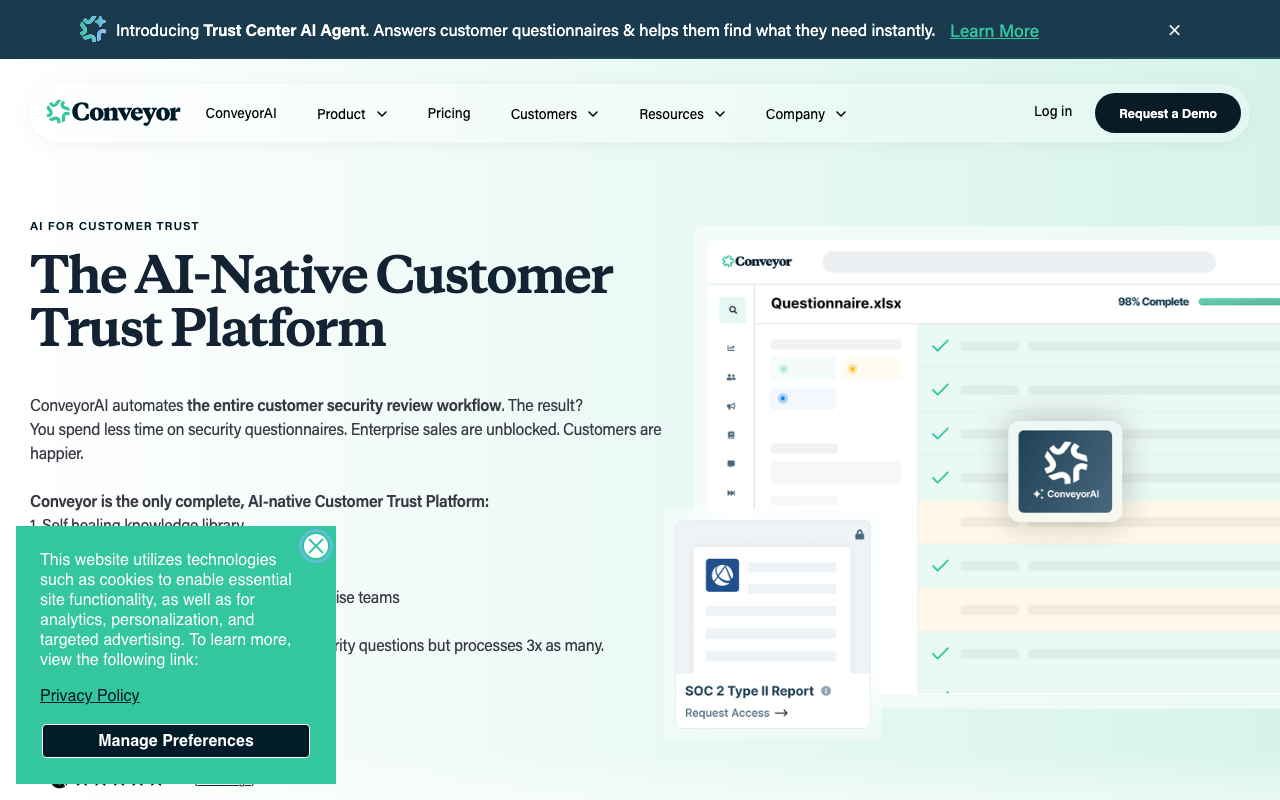
Conveyor is the closest thing the security questionnaire category has to a market leader. It is purpose-built for the problem: AI agents handle questionnaire responses, trust center management, and RFP completions from a single platform. The AI claims a 95%+ answer accuracy rate with a hallucination rate below 0.01%, which is the most specific published number in the category.
What makes Conveyor worth looking at for mid-market teams is the self-healing knowledge library. It does not require constant maintenance. The system flags gaps and inconsistencies and surfaces them for review. The browser extension handles portal-based questionnaires including OneTrust and Zip directly. Customers like Figma, Atlassian, Zapier, and Carta have put their trust programs on it.
The main friction point is the credit-based pricing model: you pay per trust center access and per questionnaire processed, which can get expensive at scale.
“
It has helped speed up the process of responding to client security questionnaires. With a simple file upload, you can review the output — instead of answering from scratch, you just review and edit. Cuts down so much time.
★★★★★Verified User· SMB
Via G2 ↗Key features:
- 95%+ accurate AI-generated answers with a 0.01% hallucination rate
- Self-healing knowledge library with support for 50+ languages
- Browser extension for portal questionnaire auto-completion
- Source citation and gap detection
- Integrations with Salesforce, Slack, and HubSpot
- Agentic Trust Center for customer self-service document access
Pros of Conveyor
- Best-in-class published accuracy numbers with a cited hallucination rate
- Auto-healing knowledge library reduces ongoing maintenance
- Trusted by well-known SaaS companies at scale
Cons of Conveyor
- Credit-based pricing is hard to predict at volume
- Trust Center customization options are limited compared to SafeBase
- No published entry-level pricing
Pricing: Pricing on request. Credit-based model tied to questionnaire volume and trust center access.
Best for: Mid-market SaaS teams handling frequent inbound security questionnaires who want a dedicated, purpose-built platform.
2. Vanta

Vanta is the compliance category default, and its questionnaire automation sits inside that broader platform. If you are already on Vanta for SOC 2 or ISO 27001, adding questionnaire automation means your AI is trained on your actual compliance evidence, not just uploaded documents. That is a meaningful difference from standalone tools.
The Agentic Trust Platform Vanta launched in January 2026 adds autonomous routing: questions that need human input are automatically assigned to the right subject matter expert, with reminders sent and final approval looped back to the security lead. The published acceptance rate is 95%, and an IDC study puts average review time improvement at 81% faster. For a full breakdown of Vanta’s platform pricing, our Vanta pricing guide covers what to expect.
The downside: questionnaire automation is a paid add-on with volume limits (144 questionnaires per year on the standard tier, 288 on advanced). If you are receiving more than that, you will hit a ceiling.
“
Vanta's questionnaire automation has been a game changer. What used to take days now takes minutes — the AI pulls from our existing evidence and gives us review-ready answers.
★★★★★Verified User· SMB
Via G2 ↗Key features:
- AI auto-answers 80%+ of questions from compliance evidence and prior responses
- 95% acceptance rate from internal testing
- Multi-language support for Spanish, French, German, and Portuguese
- Automated SME routing and approval workflows
- Support for spreadsheets, documents, and web portals
- Slack and email notifications for team collaboration
Pros of Vanta
- Evidence-trained AI is more accurate than generic document uploads
- Tight integration with the rest of your compliance program
- Strong brand recognition among enterprise buyers
Cons of Vanta
- Questionnaire automation is an add-on, not included in base plans
- Volume caps (144 or 288 per year) limit active sales teams
- Full platform may be overkill if you only need questionnaire automation
Pricing: Pricing on request. Available as standalone or add-on, with two tiers at 144 and 288 questionnaires per year.
Best for: Companies already on Vanta for compliance who want questionnaire automation trained on their actual evidence library.
3. SafeBase by Drata
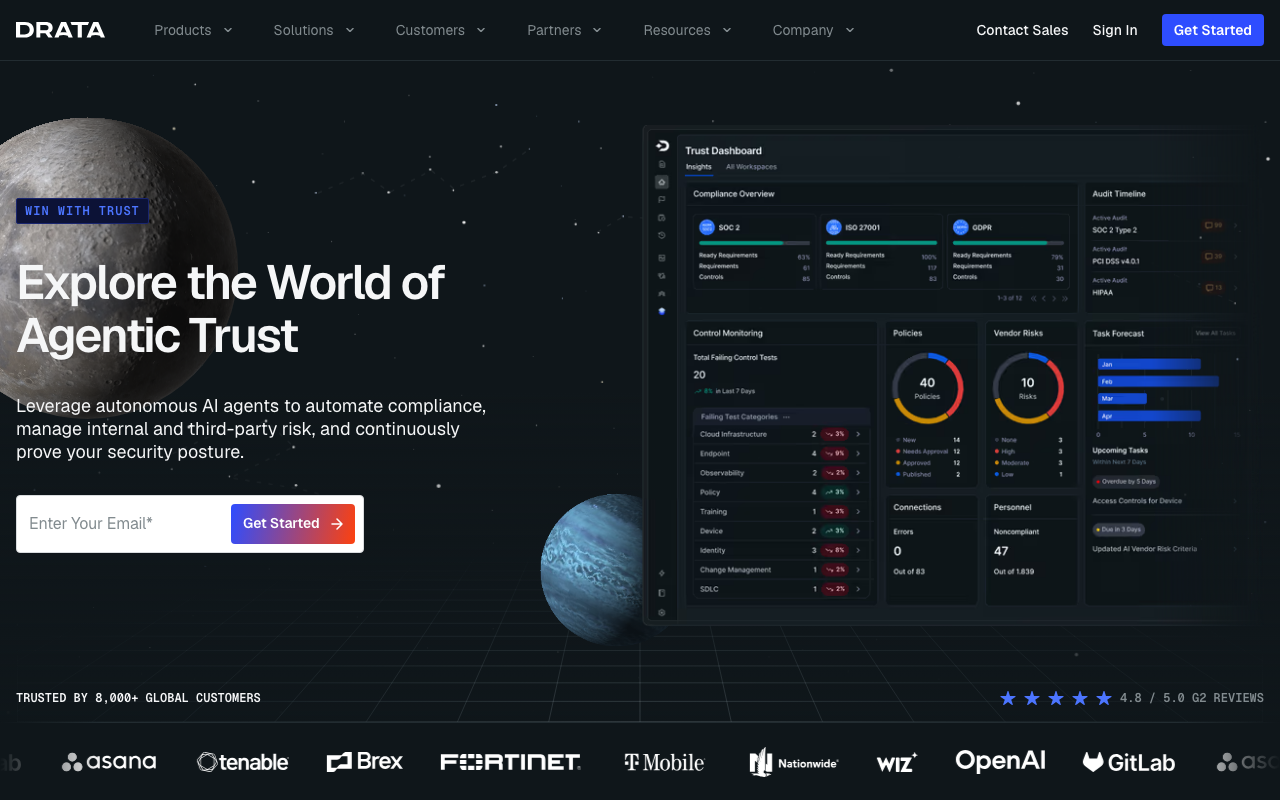
SafeBase started as a standalone trust management platform before Drata acquired it in 2024. It now operates as the trust layer of the Drata platform but still works as a standalone product. The core offering is a branded Trust Center that customers access for self-service security documentation, which reduces inbound questionnaire volume before automation even enters the picture. Our Drata review covers the full platform if you want more context on the compliance side.
For questionnaires that do arrive, the Chrome extension is the standout feature: it auto-fills answers directly into major third-party risk management portals, cutting the copy-paste cycle that eats most security teams’ time. The knowledge base stores finalized responses automatically, so your library improves without manual curation. The main consideration is the acquisition context: SafeBase’s product roadmap is now tied to Drata’s priorities, which is worth weighing if you want an independent long-term tool.
“
SafeBase makes it effortless to handle incoming security questionnaires. The Trust Center means customers can self-serve a lot of questions before even sending a questionnaire.
★★★★★Verified User· Mid-Market
Via G2 ↗Key features:
- AI-powered answer generation from approved Trust Center sources
- Chrome extension auto-fills major third-party risk portals
- Centralized questionnaire management replacing email and spreadsheets
- Role-based access controls and structured approval workflows
- Automatic knowledge base storage of finalized responses
- Sheet selection and column auto-mapping for spreadsheet questionnaires
Pros of SafeBase by Drata
- Trust Center reduces inbound volume before automation is even needed
- Browser extension handles portal-based questionnaires well
- Drata integration benefits teams already on that platform
Cons of SafeBase by Drata
- Product roadmap is now tied to Drata’s priorities
- Standalone pricing is less clear post-acquisition
- Less suitable for teams that want a fully independent point solution
Pricing: Pricing on request. Available standalone or bundled with Drata.
Best for: Teams that want a Trust Center plus questionnaire automation, or Drata customers who want questionnaire features natively.
4. ComplyJet
Most startups end up buying a questionnaire automation tool and a compliance platform separately. ComplyJet is the argument for not doing that. It is a compliance automation platform built for companies under 50 people that treats questionnaire automation as one module inside a broader program: the same platform that collects your SOC 2 or ISO 27001 evidence also powers your questionnaire responses.
Your AI knowledge base is built from your actual compliance work, not a separate library you have to maintain in parallel.
The pricing is flat per company, not per seat. At $5,000 per year for a single framework and $8,000 for two, the cost stays the same whether you have five engineers or forty. That is a relevant data point when every other tool on this list requires a demo call before showing you a number. The 350+ integrations mean evidence connects automatically.
For teams pursuing their first certification and getting hit with enterprise questionnaires at the same time, this handles both without doubling your spend. Honest limitation: ComplyJet is built for early-stage companies. If you are post-Series B with a dedicated security team and already certified, a purpose-built tool like Conveyor will probably fit your workflow better.
Key features:
- AI-powered security questionnaire automation backed by a compliance-evidence knowledge base
- 350+ integrations for automated evidence collection
- Custom-branded Trust Center for customer self-service
- 25+ framework support including SOC 2, ISO 27001, HIPAA, GDPR, and PCI DSS
- Flat per-company pricing, not per-seat
- End-to-end audit coordination with vetted auditors
Pros of ComplyJet
- Questionnaire automation and compliance certification in one platform
- Flat pricing that does not scale with headcount
- A team guides you through the outcome from day one, not just the software
Cons of ComplyJet
- Best suited for early-stage companies, not enterprise security orgs
- Less specialized than pure-play tools for high-volume questionnaire use cases
- Smaller review base than more established competitors
“
The AI is masterfully implemented. Getting guidance from an AI Agent deeply integrated with my data saved me tens of hours. I can’t recommend ComplyJet enough!
Naveen Kashyap· CTO · Fragment Data
Via complyjet.com ↗
Pricing: $5,000/year for a single framework, $8,000/year for two frameworks. Flat per-company, not per-seat.
Best for: Early-stage startups (under 50 people) pursuing their first compliance certification who also need questionnaire automation.
5. Skypher
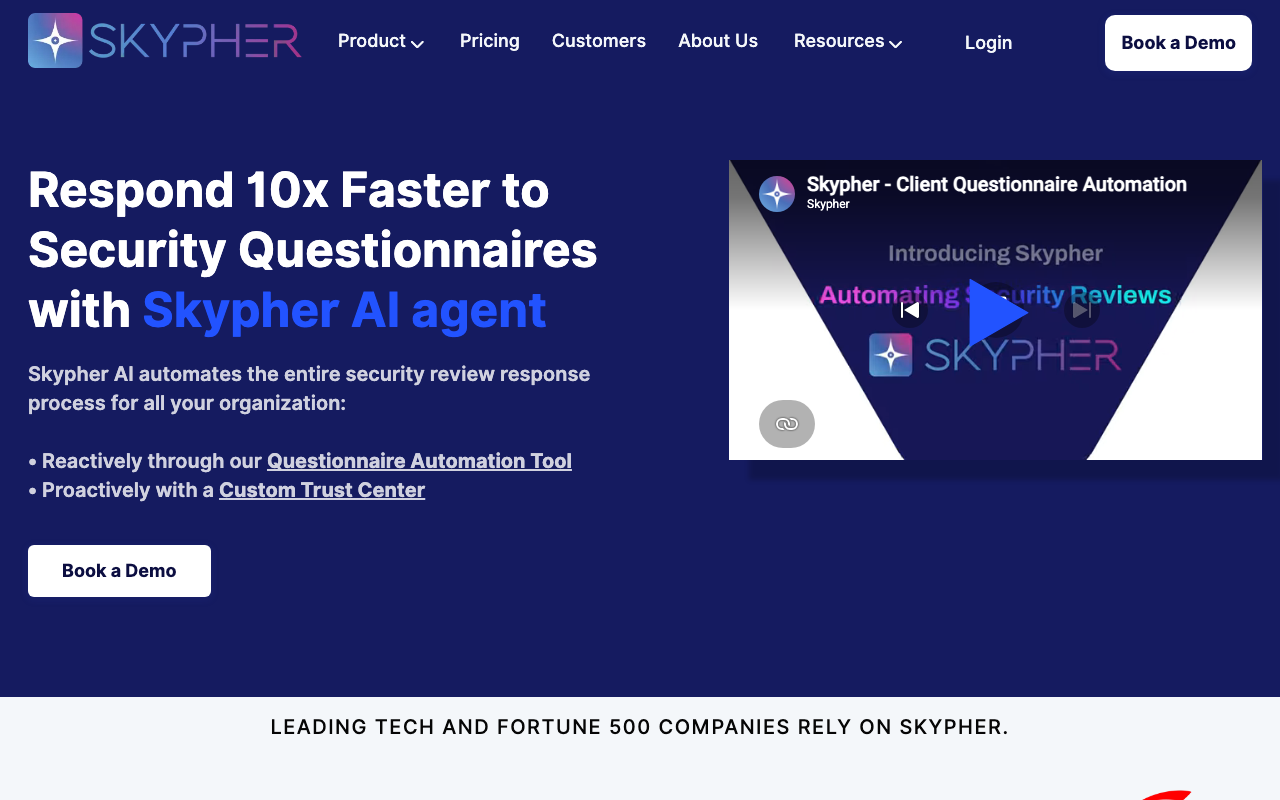
Skypher is an AI-native platform that ingests your existing documentation — past questionnaires, DDQs, policies, and compliance certificates — to build a private knowledge base without manual input. Every answer it generates comes with a confidence score and a source citation, so reviewers know exactly what to trust and what needs checking. The browser extension handles portal submissions directly in OneTrust and similar tools.
The 96% accuracy figure and a customer list that includes Adobe, Deel, and Retool puts it in credible company for mid-market teams. It is SOC 2 Type II certified, which matters in compliance-sensitive industries. The limitation: G2 review volume is still small relative to more established tools, so the long-term reliability data is thinner than for Conveyor or Responsive.
“
Skypher handles our questionnaires 10x faster than before. The confidence scores mean we only spend time on the edge cases — everything else is auto-filled accurately.
★★★★★Verified User· Mid-Market
Via G2 ↗Key features:
- AI knowledge base auto-built from past questionnaires, DDQs, and policies
- Browser extension for portal auto-completion including OneTrust
- 96% accuracy with confidence scores and source citations
- Supports ISO 27001, SOC 2, NIST, and SIG frameworks
- SOC 2 Type II certified
- Human-in-the-loop review workflow
Pros of Skypher
- High published accuracy with source-cited answers per response
- Auto-built knowledge base requires minimal setup effort
- Fortune 500 trust: Adobe, Deel, and TeamViewer as named customers
Cons of Skypher
- Smaller G2 review base than category leaders
- Pricing not published; custom quote required
- Less suitable for teams that need deep RFP workflow management
Pricing: Pricing on request. Flexible pricing for companies of all sizes.
Best for: Security and compliance teams at mid-market companies managing frequent inbound questionnaires across multiple portals.
6. SecurityPal
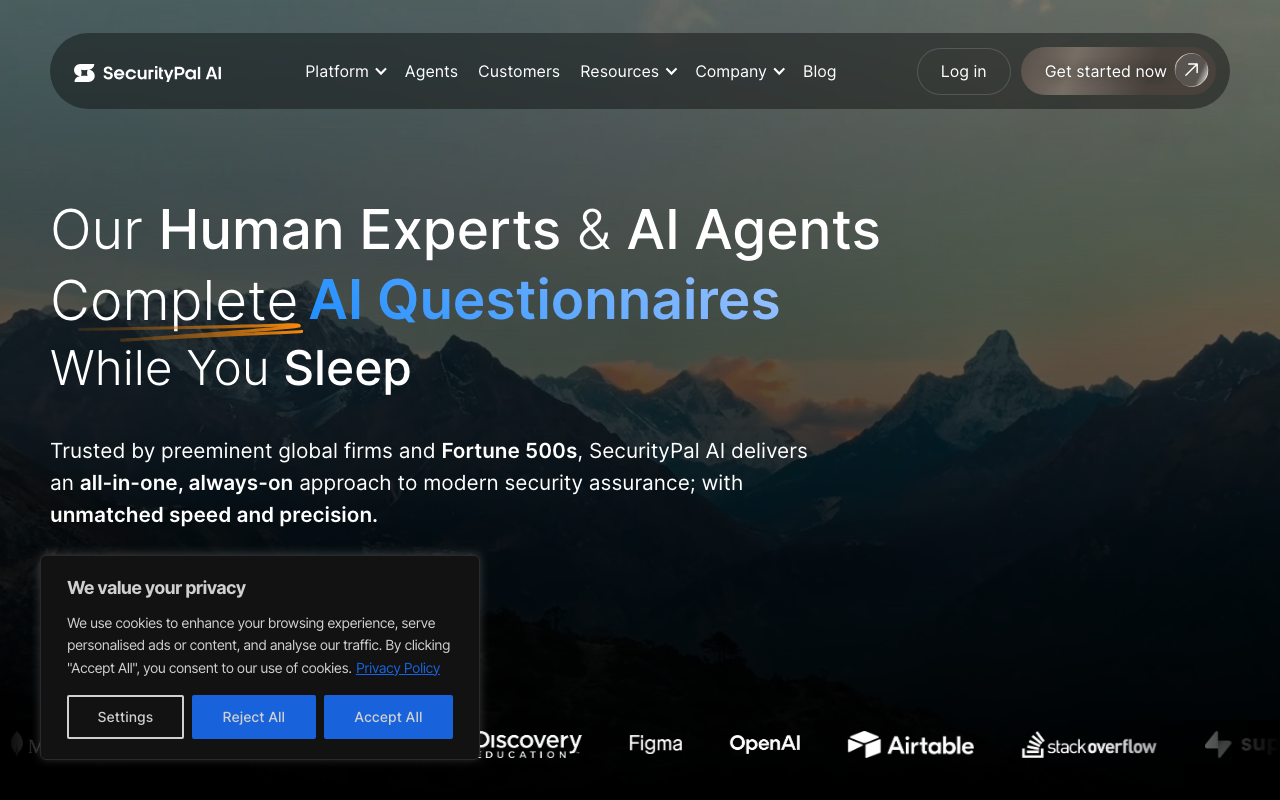
SecurityPal takes a different approach from every other tool on this list: it combines AI agents with certified human analysts behind each response. Every answer goes through expert review before delivery. The result is a 12-hour completion SLA, which is the kind of commitment you can put in front of a sales team with confidence.
The customer list reflects this positioning: Figma, MongoDB, OpenAI, Grammarly, Snap, Airtable, and Plaid all use it. For companies in that tier, where an incorrect answer in a security review has real commercial or legal consequences, the human backstop is worth the cost. For a 20-person startup, it is probably overkill.
“
SecurityPal offers the speed of AI and the precision of certified human analysts. They're accountable for outcomes.
★★★★★David Hwang· Enterprise
Via G2 ↗Key features:
- Security Questionnaire Concierge with a 12-hour completion SLA
- AI agents backed by certified human security analysts
- Trust Center with customizable brand-aligned profiles
- Knowledge Library with AI-enriched security documentation
- Vendor Assess and TPRM for third-party risk management
- SecurityPal Flows for end-to-end automation
Pros of SecurityPal
- Guaranteed 12-hour turnaround with human verification on every answer
- Trusted by some of the most security-conscious companies in tech
- Covers third-party risk management alongside inbound questionnaires
Cons of SecurityPal
- Enterprise pricing; not designed for small teams or budget-conscious buyers
- The human-in-the-loop model is slower than pure automation for low-stakes questionnaires
- Limited public review data
Pricing: Pricing on request. Enterprise pricing model.
Best for: Enterprise security teams that need AI speed with a guaranteed, human-verified accuracy SLA.
7. Arphie
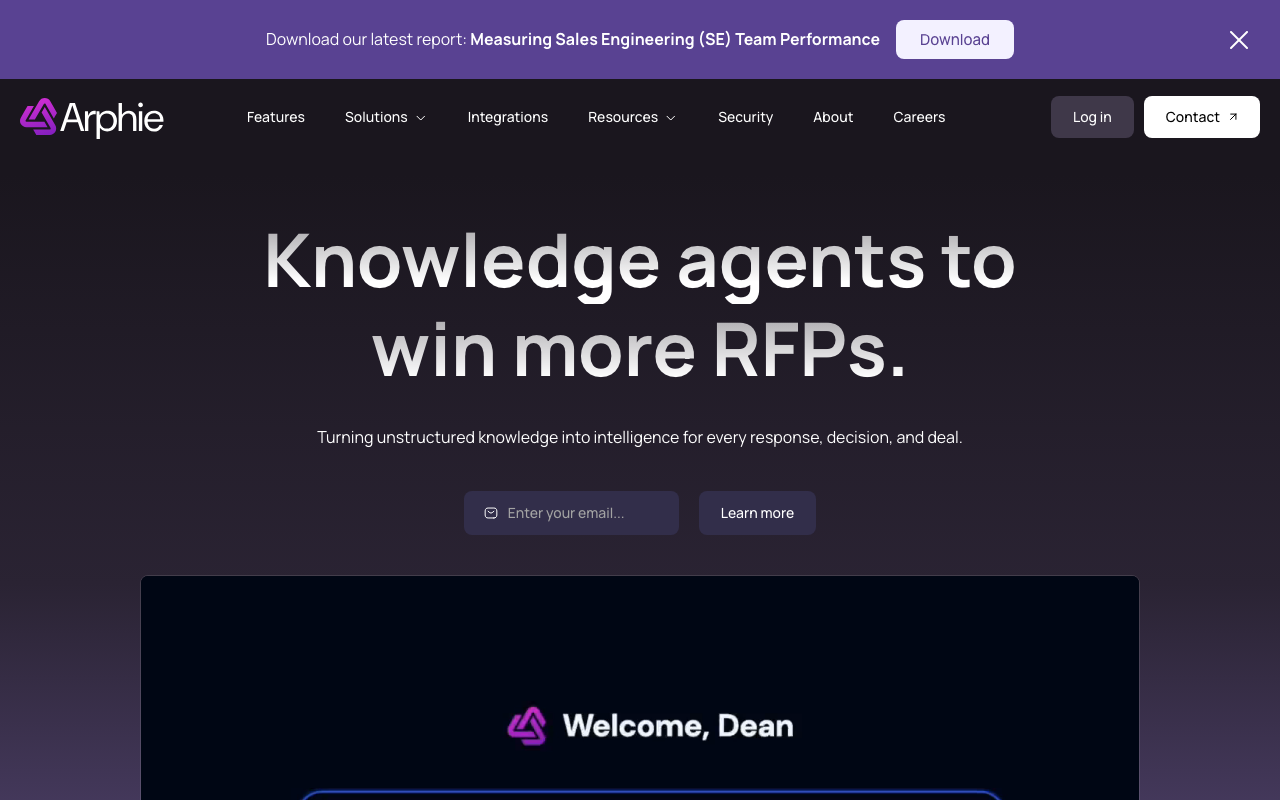
If your security documentation lives in Google Drive, SharePoint, Confluence, or Notion, Arphie is worth looking at closely. Its knowledge activation agents connect directly to your existing sources without requiring you to build a separate Q&A library. Answers come with source citations and confidence scores, and a Smart Merge feature cleans up duplicate content automatically.
The published acceptance rate is 84%, and one documented customer case saw InfoSec review queues drop from three-week turnarounds to one-day turnarounds by enabling teams to self-serve first drafts before expert review. The zero data retention policy, meaning your data is never used to train their models, is a meaningful differentiator for teams in regulated industries. The 4.9/5 G2 score is notable, though the review volume is still small.
“
Arphie cut our InfoSec review queue from 3 weeks to 1-day turnarounds. Teams can self-serve first drafts before expert review — the source citations build confidence fast.
★★★★★Verified User· Mid-Market
Via G2 ↗Key features:
- Knowledge activation agents that pull from existing docs without manual library setup
- 84% acceptance rate with source citations and confidence scores
- Live integrations with Google Drive, SharePoint, Confluence, Notion, Seismic, and Highspot
- Smart Merge for deduplicating and cleaning up content
- Zero data retention: customer data is not used for model training
- SOC 2 Type 2 certified
Pros of Arphie
- Zero-maintenance knowledge management: no separate library to build or update
- Source citations make review fast and build stakeholder confidence
- Strong privacy stance with zero data retention by default
Cons of Arphie
- 84% acceptance rate is lower than Conveyor or Skypher
- Smaller integration footprint than Loopio or Responsive for enterprise teams
- Thin G2 review base despite strong scores
Pricing: Pricing on request. Demo required.
Best for: GTM and InfoSec teams whose documentation lives in Google Drive or Confluence and who want zero-maintenance knowledge management.
8. 1up.ai
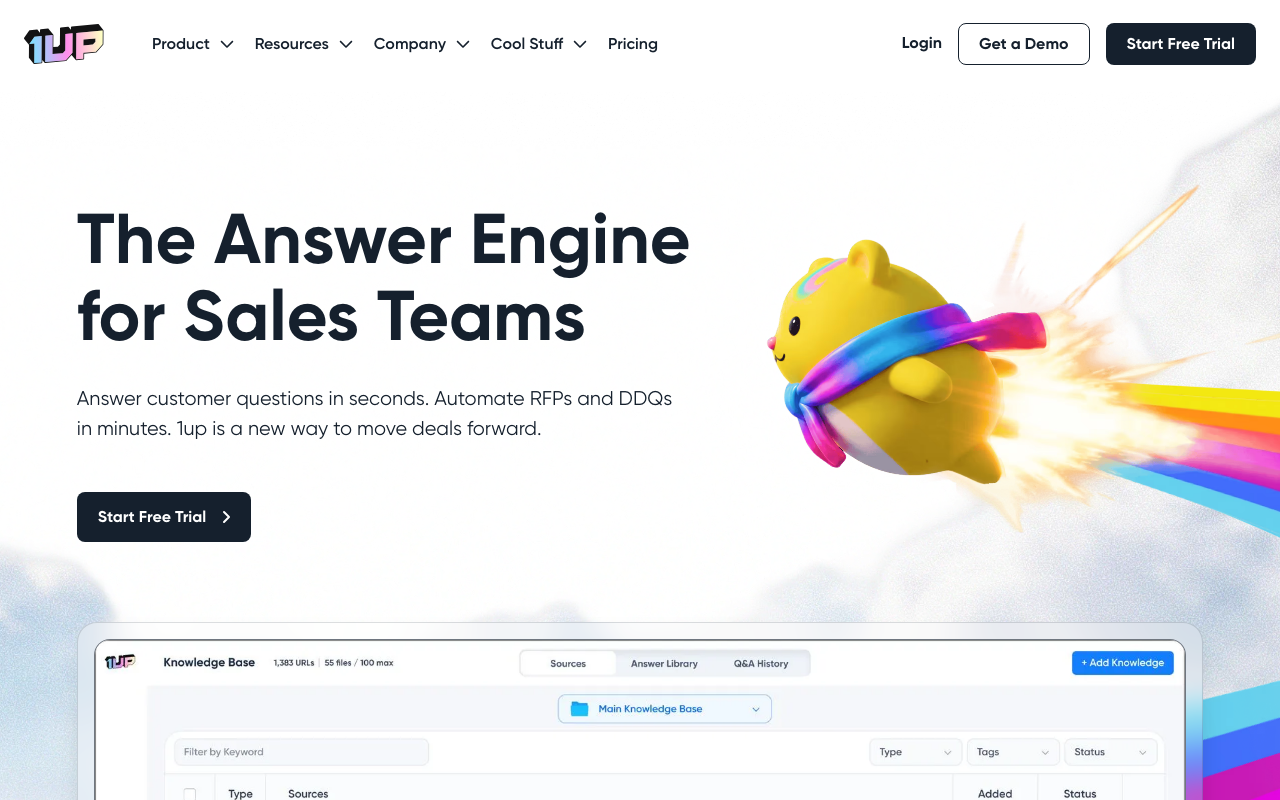
1up.ai positions itself as an answer engine for sales teams, and that framing tells you most of what you need to know about where it fits. It handles security questionnaires, RFPs, and DDQs from the same platform, with an Answer Hub that gives sales reps instant access to approved answers during calls. The browser plugin auto-fills portal questionnaires, and integrations with Slack and Teams mean answers are accessible in context without switching tools.
If security questionnaire automation is your only need, 1up is capable but slightly off-angle. If you also need to streamline RFP responses and give your sales team faster access to approved content, the combined use case is strong. JumpCloud reports 90 to 95% questionnaire completion rates. A free trial is available, which is rare in this category.
“
1up handles RFPs and security questionnaires that used to take days in just a few hours. The answers are pulled from our actual documentation so there's no guesswork.
★★★★★Verified User· SMB · 11–50 employees
Via G2 ↗Key features:
- RFP and security questionnaire automation from trusted company sources
- Answer Hub for 24/7 customer self-service responses
- Browser plugin for auto-filling web-based questionnaire portals
- AI DDQ response automation
- Slack and Teams integration for instant answers during sales calls
- Integrations with Confluence, Google Drive, Notion, and SharePoint
Pros of 1up.ai
- Free trial available, which is uncommon in this category
- Strong combination of RFP plus security questionnaire automation for sales teams
- Browser plugin handles portal submissions without copy-pasting
Cons of 1up.ai
- Primarily optimized for sales use cases, not security team workflows
- Less specialized than pure-play tools for high-volume security reviews
- No published pricing beyond free trial
Pricing: Pricing on request. Free trial available.
Best for: Sales-led teams that need security questionnaire automation alongside broader RFP and sales enablement automation.
9. Loopio
Loopio is one of the most established names in response management, with over 1,700 companies using it and AI trained on more than ten years of real proposal and questionnaire data. Its content connectors reach 80+ enterprise knowledge sources, the broadest integration footprint on this list. It connects natively to Salesforce, Microsoft Copilot 365, Slack, and Teams.
The caveat is the price. Loopio starts at $20,000 per year for ten seats, one of the few published entry prices in this category, and it tells you something about the target customer. This is a tool built for organizations with dedicated proposal managers and complex, multi-team response workflows. For a 15-person startup, the cost and setup complexity are both too high. For a 300-person company with a presales team and a formal RFP process, it likely justifies itself.
“
Loopio is the backbone of our response process. The content library is solid and the AI suggestions have improved significantly. The $20k entry point is steep for smaller teams, though.
★★★★☆Verified User· Enterprise
Via G2 ↗Key features:
- Response Intelligence AI trained on 10+ years of proposal data
- 80+ content connectors including SharePoint and Google Drive
- Automated project workflows and web-portal auto-fill
- Salesforce, Microsoft Copilot 365, Slack, and Teams integrations
- AI-driven proposal readiness analytics
- SOC 2 Type II certified infrastructure
Pros of Loopio
- Deepest knowledge source integration of any tool on this list
- Purpose-built for complex, multi-team response workflows
- Strong track record with large enterprise customers
Cons of Loopio
- $20,000/year starting price excludes most startups and SMBs
- Setup complexity requires dedicated effort over weeks, not days
- More RFP-oriented than security-questionnaire-first
Pricing: From $20,000/year (10 seats). Custom enterprise pricing above that.
Best for: Enterprise teams with dedicated proposal or presales functions managing high volumes of RFPs and security questionnaires.
10. Responsive (formerly RFPIO)
Responsive is the most review-validated tool on this list: 4.5/5 across 1,150+ reviews, with 25+ Fortune 100 customers including Microsoft, SAP, Okta, Accenture, and LinkedIn. The platform maintains 8.7M+ Q&A pairs and its AI agents are trained on data from over $600 billion in managed opportunities. That scale is meaningful: the model has seen more proposal and questionnaire data than any other tool here.
The tradeoff is that Responsive is built for organizations that treat proposal and questionnaire response as a core business function with dedicated headcount. The onboarding is involved. If you have a team that can use it fully, it is one of the most capable platforms available. If you are a startup where the security lead also does three other jobs, you will not get the most out of it.
“
Responsive has the deepest feature set of any RFP tool we evaluated. The AI has gotten much better — for security questionnaires it pulls from our approved library accurately. The onboarding is involved but worth it.
★★★★☆Verified User· Enterprise
Via G2 ↗Key features:
- AI agents trained on data from $600B+ in managed opportunities
- 8.7M+ Q&A pairs maintained on the platform
- 80% faster RFP response delivery (vendor claim)
- Native integrations with Salesforce, Slack, and major CRMs
- Collaborative workflow management for large teams
- Knowledge democratization across organizations
Pros of Responsive (formerly RFPIO)
- Most review-validated platform in the category (1,150+ reviews, 4.5/5)
- Massive training data corpus produces high-quality answers at scale
- Trusted by a significant portion of the Fortune 100
Cons of Responsive (formerly RFPIO)
- Significant onboarding investment required
- Enterprise-oriented: not the right fit for lean startup teams
- No published pricing
Pricing: Pricing on request. Enterprise pricing model.
Best for: Fortune 500 companies and large enterprises with high-volume RFP and questionnaire operations and dedicated proposal teams.
11. ResponseHub

ResponseHub is a standalone questionnaire tool for teams that already hold their certification elsewhere. It covers security questionnaires, RFPs and DDQs, and the thing it does differently is show its working: every AI-generated answer carries a citation to the exact sentences in your policies or past responses that produced it, alongside a confidence rating. Reviewing becomes a verification step against source text rather than a judgement call on a percentage.
What makes it worth a look for smaller teams is the setup path and the price. The knowledge base builds from whatever you already have — past questionnaires, dragged-in policy PDFs, a Notion or Google Sheets CSV export — or from a generated NIST CSF baseline if you are starting from nothing, and it keeps itself current through AI-suggested additions pulled from each questionnaire you complete. Completed questionnaires export back into the buyer’s original Excel or Word file with answers written into the right cells, and the Chrome extension handles portal-based questionnaires in OneTrust, Archer, Whistic and ProcessUnity. Multi-tenant workspaces let MSSPs and consultancies run questionnaires across several client organisations from one account.
“
Security questionnaires used to be the bottleneck at the end of every deal. Now we can usually turn them around in a morning.
Rory McCarthy· VP Client Solutions · CareerMinds
Via responsehub.ai ↗Key features:
- Sentence-level citations showing the exact source text behind every answer
- AI confidence rating on each generated response
- Round-trip export into the buyer’s original Excel or Word file
- Chrome extension for portal questionnaires (OneTrust, Archer, Whistic, ProcessUnity)
- Knowledge base from past questionnaires, policy PDFs, CSV import or a generated NIST CSF baseline
- Multi-tenant workspaces for MSSPs and consultancies answering across multiple clients
Pros of ResponseHub
- Published pricing and a no-card trial, so you can evaluate without a sales cycle
- Citations point at specific sentences rather than just attaching a confidence score
- Unlimited viewer seats and unlimited AI-generated answers on every plan
Cons of ResponseHub
- No published accuracy or acceptance rate to compare against Conveyor or Skypher
- Portal coverage is four tested portals, narrower than the larger platforms
- SSO and SCIM provisioning are Enterprise-tier only
Pricing: From $149/month (Starter, 2 editor seats). Business $399/month, Enterprise $799/month billed annually. Additional editor seats $49/month. Seven-day free trial.
Best for: Lean security and sales teams at B2B SaaS companies that want questionnaire automation on its own, without adopting a compliance platform to get it.
How to choose security questionnaire automation software
Standalone tool or compliance platform?
This is the first question worth answering before you book any demos. Standalone security questionnaire tools like Conveyor, Skypher, Arphie, and 1up solve the questionnaire problem specifically and deploy faster. Compliance platforms like ComplyJet, Vanta, and SafeBase by Drata treat questionnaire automation as one module inside a broader certification program.
If you are already SOC 2 or ISO 27001 certified, a standalone tool is probably the right call. If you are not yet certified, you will almost certainly need both a certification tool and a questionnaire tool anyway. A platform that handles both in one place typically costs less than buying two separate products.
How much AI accuracy matters for your volume
At five to ten questionnaires per year, the difference between 84% and 96% accuracy is not meaningful. You will review the output either way. At fifty or more questionnaires per quarter with a small team, that gap starts to matter: a higher acceptance rate means fewer items needing human review per batch.
The more important number to ask about is the hallucination rate, not the acceptance rate. A tool that auto-accepts 95% of answers but hallucinates 2% of responses puts incorrect, confident-sounding answers in front of your prospects. Ask vendors directly: what is your hallucination rate, and what happens when confidence is low?
Does it support the formats your customers actually send?
Most tools handle spreadsheet-based questionnaires well. The gaps tend to appear at the edges: web portals like OneTrust, Zip, and ProcessUnity require a browser extension to auto-fill directly, and email-attached PDFs are still handled poorly by most platforms. Before committing to any tool, test it against the actual format your highest-value prospects are using. Do not assume.
What does vendor security questionnaire automation setup actually cost you?
Setup effort varies significantly across tools. Arphie and Conveyor auto-ingest your existing documentation; you can be useful within a few days. Loopio and Responsive require you to populate a structured Q&A library first; budget two to four weeks of real effort. ComplyJet ties setup to your certification onboarding, typically two to three weeks. None of this appears on any pricing page.
Free Demo
Questionnaire automation + compliance certification in one platform.
SOC 2, ISO 27001, HIPAA — flat pricing from $5,000/year.
Buying by stage
Startups (under 30 people, under 20 questionnaires per year): ComplyJet covers the questionnaires and the compliance program in one flat fee. If you are already certified and only need questionnaire automation, Skypher or 1up are simpler to deploy.
Scaling companies (30 to 200 people, 20 to 100 questionnaires per year): Conveyor or SafeBase by Drata. Purpose-built accuracy, sales stack integrations, and portal coverage.
Enterprise (200+ people, 100+ questionnaires per year): SecurityPal for SLA-backed delivery with human verification, Loopio or Responsive for organizations with dedicated proposal management teams and complex multi-team workflows.
Frequently asked questions
What is a security questionnaire?
Quick tip
Ask vendors directly: what is your hallucination rate, and what happens when confidence is low? Acceptance rate alone is misleading.
A security questionnaire is a structured assessment sent by a prospective customer or partner to evaluate your organization’s security posture before sharing data or entering a contract. Common formats include the SIG questionnaire, CAIQ, and custom spreadsheets. Our guide to security questionnaires covers the main formats and how to respond to each in detail.
How do you automate security questionnaires?
Security questionnaire automation works in three steps: you build a knowledge base from your existing documentation and prior responses, the AI matches incoming questions to relevant answers with a confidence score, and a human reviews flagged items before sending. The result is not fire-and-forget. It is review-and-approve, with the AI handling the drafting and the human handling quality control.
What are the best AI tools for security questionnaires?
The best AI for security questionnaires depends on your context. For most mid-market SaaS teams, Conveyor leads on accuracy and trust center features. For startups doing compliance for the first time, ComplyJet combines questionnaire automation with the certification itself. For enterprise teams with a guaranteed-SLA requirement, SecurityPal is the most defensible choice. Among pure-play security questionnaire tools, Conveyor and Skypher consistently rank highest for AI accuracy.
How accurate is AI for security questionnaire automation?
The published range across tools in this list is 80% to 96%. Accuracy is affected primarily by the quality and completeness of your knowledge base, how regularly your answers are updated, and how well the tool handles your specific questionnaire formats. The more important metric is the hallucination rate: a tool that auto-answers 95% of questions but hallucinates 2% of responses is worse in practice than one that auto-answers 85% with near-zero hallucinations.
What is the difference between a security questionnaire tool and a compliance platform?
A security questionnaire tool is a point solution: it handles inbound questionnaire responses only. A compliance platform like ComplyJet or Vanta handles certifications (SOC 2, ISO 27001, HIPAA), evidence collection, controls management, and questionnaire automation as part of the same program. If you are not yet certified, a platform is almost always the more efficient spend. If you are certified and only need to reduce response time, a standalone tool deploys faster.
Which GRC software offers the best security questionnaire automation?
Among GRC and compliance platforms, ComplyJet, Vanta, and SafeBase by Drata are the strongest options. ComplyJet is the best fit for early-stage startups: it handles questionnaire automation and your SOC 2 or ISO 27001 certification in one flat-fee platform.
Vanta suits teams already on that platform for compliance, since the questionnaire AI trains on your actual evidence. SafeBase by Drata combines a branded Trust Center (which reduces inbound volume) with automation for the questionnaires that do arrive.
Final thoughts
Security questionnaire automation has moved from a nice-to-have to a prerequisite for companies selling into enterprise. The tools on this list cover the full spectrum: from startup-friendly compliance platforms to enterprise-grade response management systems with dedicated human analysts behind every answer.
Key insight
The smart choice is not the most famous tool. It is the one that matches your stage and your actual workflow.
The smart choice is not the most famous tool. It is the one that matches your stage and your actual workflow. If you are a startup pursuing your first SOC 2 or ISO 27001 certification and fielding questionnaires from enterprise prospects at the same time, ComplyJet handles both in one place at a price that makes sense before you have closed your Series A.
If you’re a startup pursuing SOC 2 or ISO 27001 for the first time, ComplyJet is built for you: flat pricing, 350+ integrations, and a team that guides you through the process from day one.