.svg)

Ask an AI startup founder which SOC 2 platform they picked, and a surprising number will mention a feature called "AI governance," then admit they never actually checked what it does. It turns out that matters a lot, because on at least two of the platforms in this list, "AI governance" means something entirely different from what an AI company actually needs.
This is a ranking of the top SOC 2 compliance platforms for AI companies, scored on the thing most comparisons skip: whether the platform actually helps you produce evidence for how you build and govern your own model, not just how you back up your database. The eight platforms here are Vanta, ComplyJet, Drata, Scrut, Sprinto, Thoropass, Secureframe, and Oneleet.
soc 2 ai compliance is not the same evaluation as generic SOC 2 shopping. An AI company's auditor asks about training-data lineage and hosted-model vendor risk in a way a standard SaaS auditor never does, and most compliance platforms were built years before that question existed.
By the end of this, you'll know which of these platforms actually has something built for that question, and which ones are running generic compliance automation with an AI label stapled on top. Here's what's ahead:
- What an auditor actually asks an AI company that they wouldn't ask a generic SaaS company
- The full ranked list, dimension by dimension
- How this ranking scores AI-governance readiness, not just integrations and price
- Why SOC 2 evidence looks different for a company building on top of a model
- What each platform actually costs, and the pricing trap that hits fast-scaling AI teams specifically
- A decision framework for picking the right one for your team
What Auditors Actually Test Before You Pick From the Top SOC 2 Compliance Platforms for AI Companies
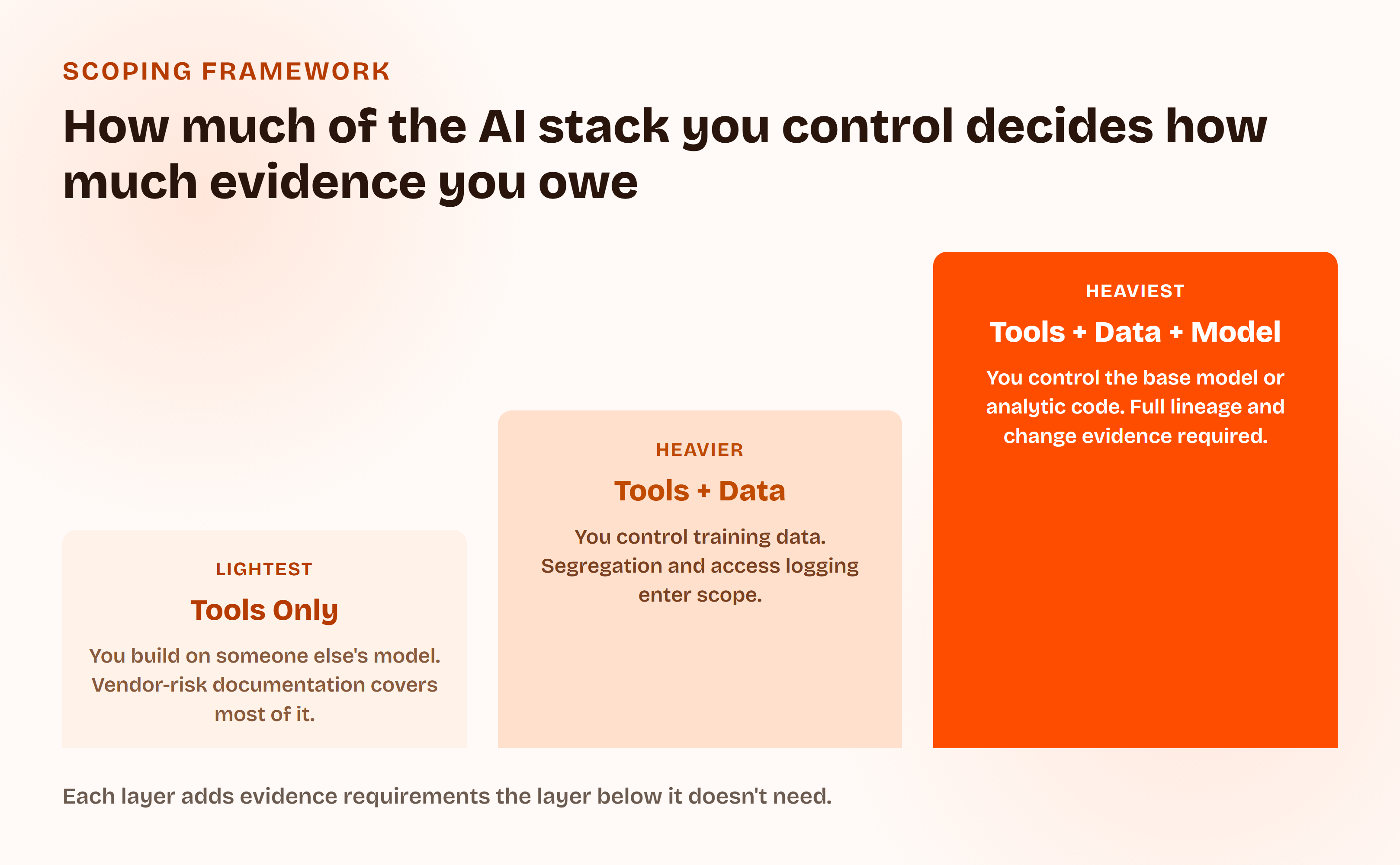
Before ranking platforms on how well they help produce evidence, it helps to know what that evidence actually is.
Model lineage. Auditors increasingly ask a company to name a specific production model version and reproduce its training history: dataset snapshot, code commit, hyperparameters, and who approved the change. This is the single most AI-specific ask on the list, and it's the one generic SOC 2 tooling wasn't built to automate.
Shadow AI. Employees pasting company data into an unapproved AI tool is now a real, named audit risk, not a hypothetical one. A platform that gives zero visibility into this is asking you to police it manually.
Scope, by how much of the stack you control. A useful framework here: if you only provide tools on top of someone else's model, your evidence burden is lighter. If you also control the training data, it's heavier. If you control the base model or analytic code itself, it's heaviest. Each layer adds evidence requirements the layer below it doesn't need.
Put plainly: the Trust Services Criteria don't change for an AI company. The evidence that satisfies them does. A platform's job is to make that evidence collectible without slowing your team down.
SOC 2 Audit for AI Companies, SOC 2 Compliance for AI Startups, and SOC 2 Controls for AI Systems
A soc 2 audit for ai companies hinges on evidence a platform either automates or leaves entirely manual. For soc 2 compliance for ai startups specifically, pre-seed through Series B, usually with no dedicated security hire yet, the practical question is which platform's soc 2 controls for ai systems actually reach model lineage and training-data evidence, and which ones stop at generic access-control and vendor-questionnaire automation.
The Top SOC 2 Compliance Platforms for AI Companies, Ranked (Beyond the Best SOC 2 Compliance Software List)
This narrows ComplyJet's own general best soc 2 compliance software buyer's guide into something scoped specifically to soc 2 platforms for ai startups, soc 2 for ai saas products, and soc 2 compliance software for ai teams building on top of a model. If you're not an AI company, that generalist guide is the better starting point.
Full scoring methodology, including exactly how AI-governance readiness was measured, follows right after the rankings below.
| # | Platform | AI-governance readiness | Pricing structure | Best for |
|---|---|---|---|---|
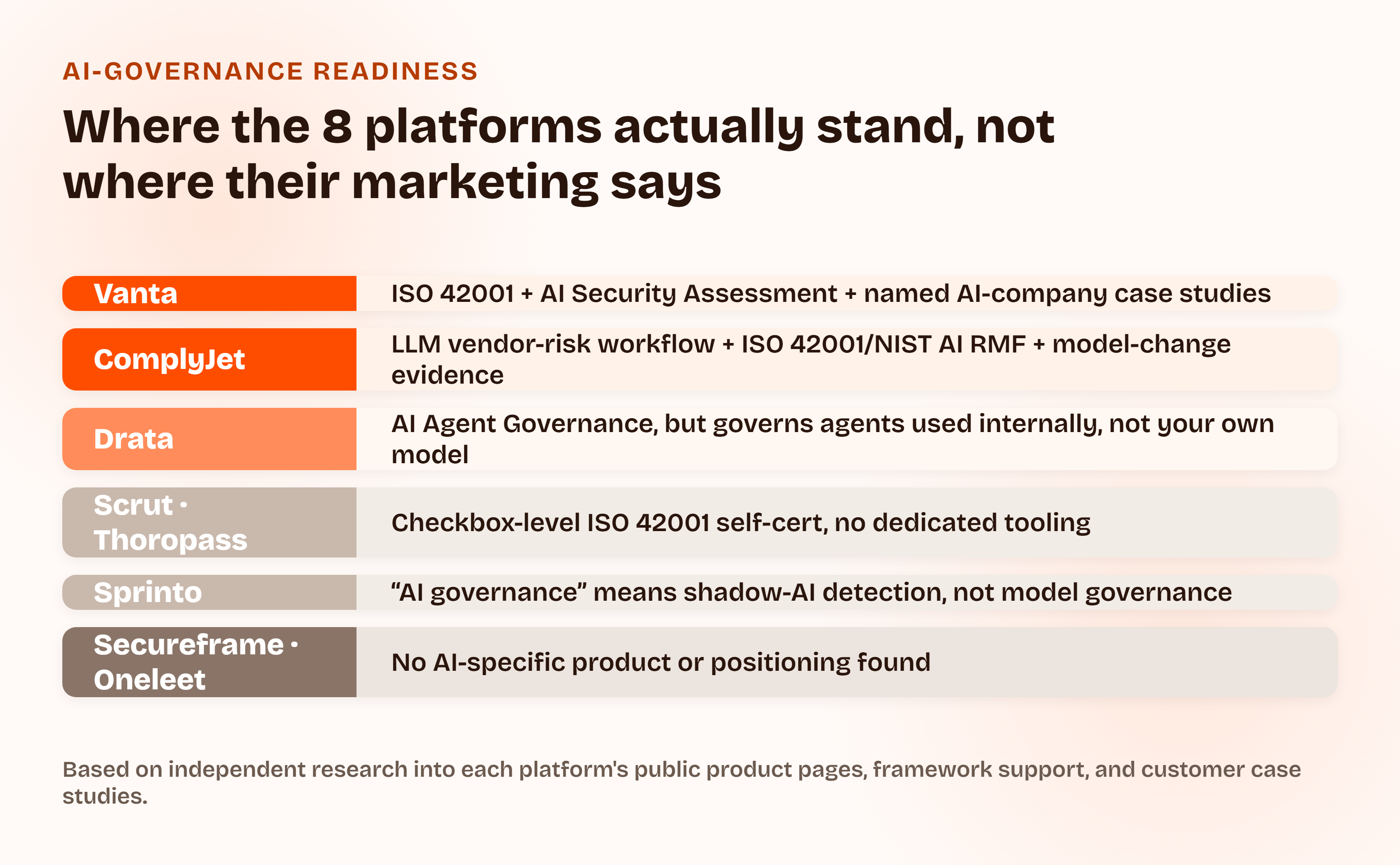
| 1 | Vanta | Strong: ISO 42001, AI Security Assessment, named AI-company case studies | Headcount + framework tiers | Teams that want the most-referenced default |
| 2 | ComplyJet | Strong: LLM vendor-risk workflow, ISO 42001/NIST AI RMF support, model-change evidence | Flat, published, per company | Lean AI teams that want guidance and no renewal surprises |
| 3 | Drata | Emerging: AI Agent Governance, but governs agents used internally, not your own model | Headcount + framework tiers | Engineering-heavy teams wanting deep DevOps control |
| 4 | Scrut | Checkbox: ISO 42001 self-cert, no dedicated tooling | Headcount tiers, some non-cancellable contracts | Teams that want risk-register depth over AI-specifics |
| 5 | Sprinto | Mismatched: "AI governance" means shadow-AI detection, not model governance | Headcount + framework tiers | Teams that value onboarding speed above all else |
| 6 | Thoropass | Early: ISO 42001, new GenAI DDQs, unproven for AI companies | Platform fee plus separate audit subscription | Teams that want the audit firm and platform bundled |
| 7 | Secureframe | None found | Headcount + framework tiers | Non-technical teams wanting a guided standard process |
| 8 | Oneleet | None found | Fully custom-quoted, demo-gated | Teams that want pentesting bundled into one contract |
1. Vanta
Screenshot captured from Vanta's official website, for informational purposes only.
Vanta is the widest-integration, most-referenced platform in this category, and it's also the clear leader on AI-governance readiness. It shipped ISO 42001 framework support in 2024, self-certified against it in 2025, and built a dedicated AI Security Assessment product aligned to NIST AI RMF and the EU AI Act. It's also the only platform here with real named AI-company customers, Granola, Clay, and Factory, with actual case studies, not just logos.
Where it falls short: renewal-year price increases in the 30 to 50 percent range are a near-universal complaint, and its tests are described by reviewers as rigid and template-driven, which can friction against a nonstandard AI stack.
Worth knowing plainly: a 2025 product-code bug briefly leaked some customer data across accounts. Vanta says under 20 percent of third-party integration data and under 4 percent of customers were affected, and it was fixed in about nine days. Notable for a company selling trust, reported factually rather than as a reason to disqualify the platform outright.
| Pros | Cons |
|---|---|
|
|
Pricing: quote-based on headcount and frameworks, reportedly around $10,000/year at the entry tier up to $30,000 to $80,000/year at enterprise scale.
2. ComplyJet
Screenshot captured from ComplyJet's official website, for informational purposes only.
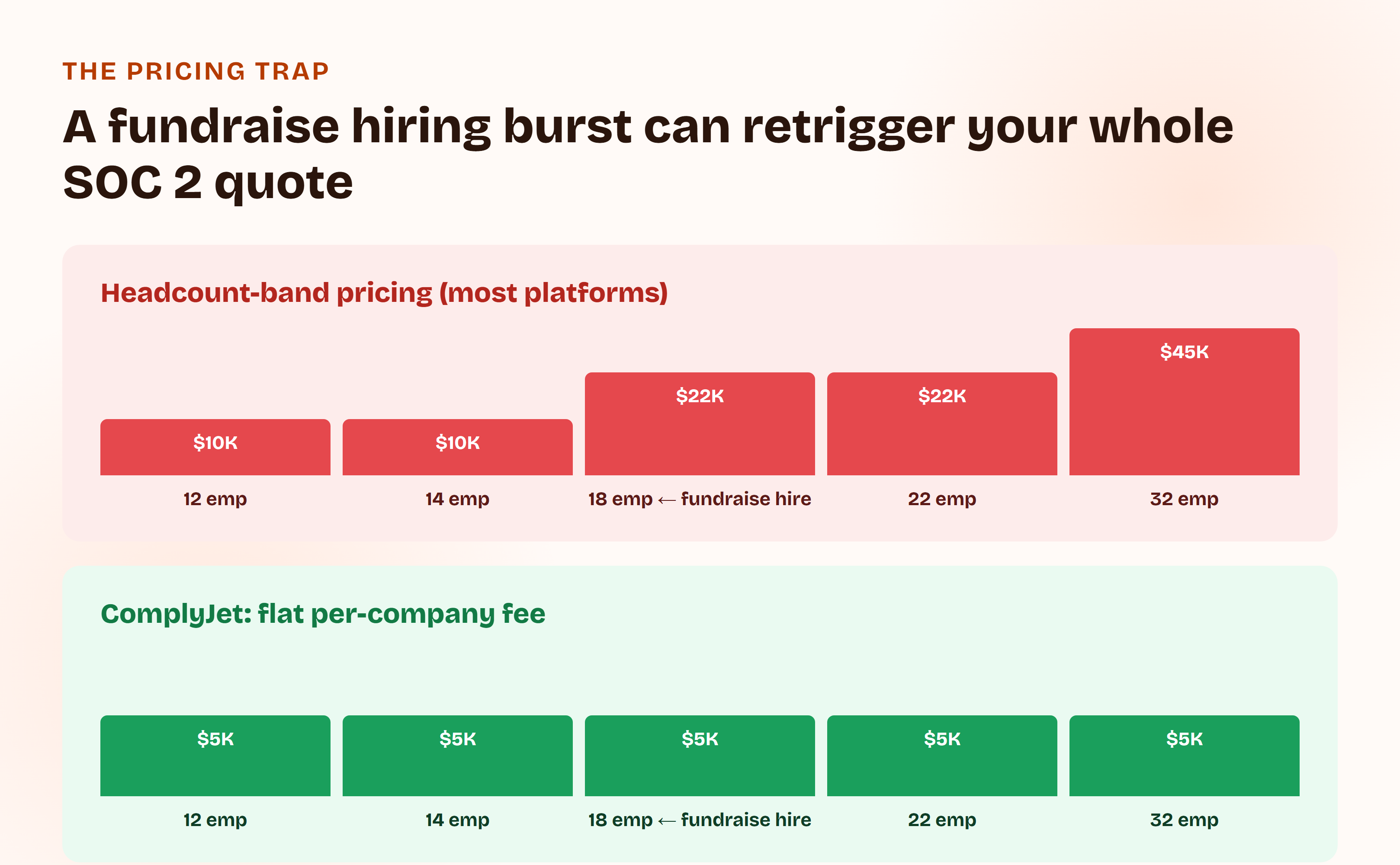
ComplyJet's differentiator for this list isn't brand size. It's a flat, published, per-company price, $5,000/year for one framework or $8,000/year for two, that doesn't move as your headcount grows. Every other platform in this list bills on headcount bands, which means a fast-scaling AI team can cross a pricing tier mid-year, often right when a fundraise adds a burst of new engineers.
ComplyJet also has a genuine AI-governance workflow: an LLM vendor-risk assessment process, support for ISO 42001 and NIST AI RMF as actual frameworks, and evidence-collection tooling built around model changes, training-data handling, and prompt and inference logging. That puts it ahead of five of the seven other platforms on this specific axis, and second only to Vanta overall.
Where it falls short, honestly: a smaller integration library and less brand recognition than Vanta or Drata. The tradeoff is a guided process instead of a self-serve one, which is the better fit for a lean team without an in-house security hire, not for a team that wants to configure everything itself.
| Pros | Cons |
|---|---|
|
|
Pricing: $5,000/year single framework, $8,000/year for two, flat and published upfront.
3. Drata
Screenshot captured from Drata's official website, for informational purposes only.
Drata is the strongest choice here for an engineering-heavy team that wants deep CI/CD and DevOps visibility rather than the lightest possible setup. Its auditor ecosystem is real: over 80 percent of Drata customers reportedly meet their auditor through the platform itself.
Its newest move, AI Agent Governance, is the most technically ambitious AI product in this whole list, discovering and governing AI agents running inside an organization and enforcing policy before a violating action executes. The important nuance: it governs agents your team uses internally. It does not certify your own AI product as trustworthy to your enterprise buyers the way Vanta's AI Security Assessment does, and it currently ships deepest for Anthropic, with other model providers still in development.
Where it falls short: the same renewal-price pattern as Vanta, fewer integrations, and a real setup-effort cost, one reviewer summary put it as "only works if you do it the Drata way." No AI-company case studies were found.
| Pros | Cons |
|---|---|
|
|
Pricing: quote-based, reportedly $7,500 to over $100,000/year depending on stage.
4. Scrut
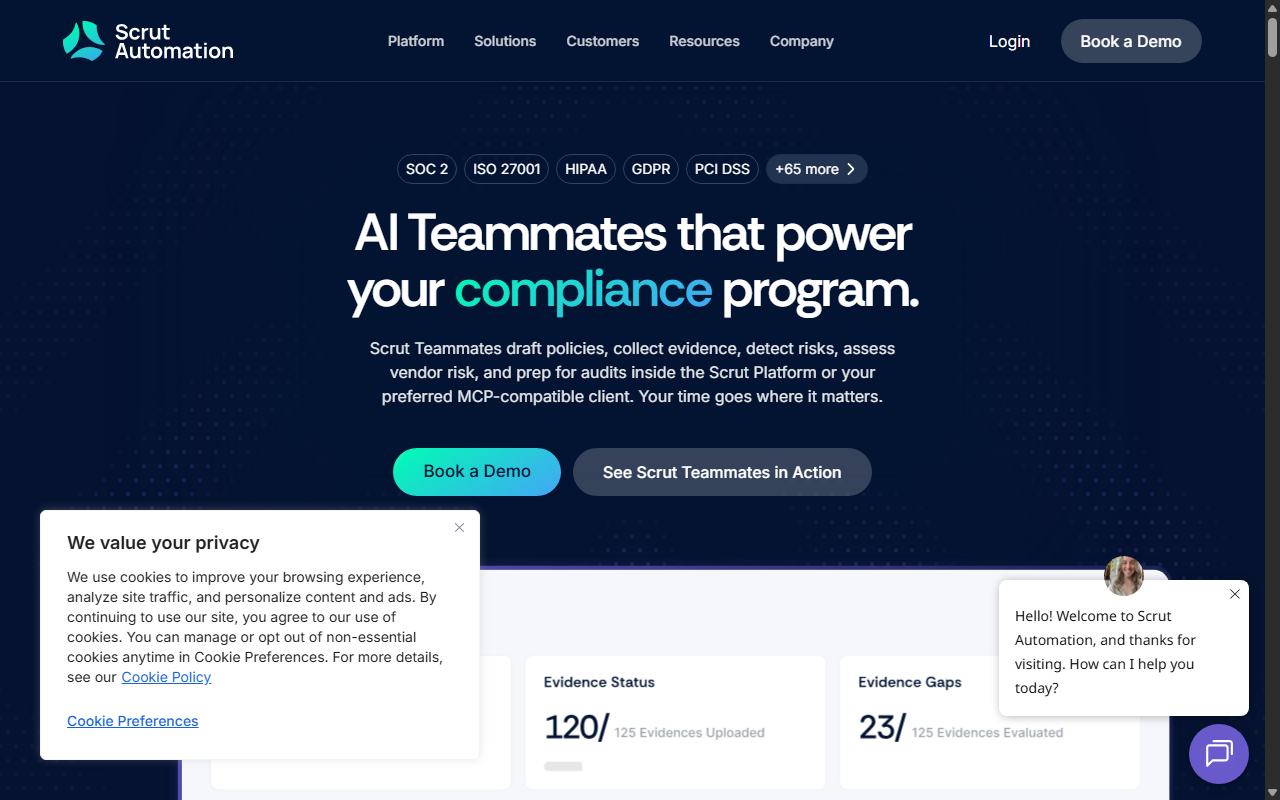
Screenshot captured from Scrut's official website, for informational purposes only.
Scrut rebranded itself as an "AI Compliance Automation Platform," which oversells what's actually there. Its real strength is risk-register and vendor-risk depth, plus broad multi-framework coverage.
On AI specifically, it's checkbox-level: ISO 42001 self-certified, NIST AI RMF supported, but no dedicated AI vendor-risk product and no developed AI-company case study. Reviewers also flag a clunky interface, manual integration setup, and support that runs on an India-based timezone, a real friction point for a US team. AWS Marketplace contract terms for Scrut are also non-cancellable and non-refundable, worth knowing before signing anything through that channel.
| Pros | Cons |
|---|---|
|
|
Pricing: headcount-tiered; AWS Marketplace lists a flat $15,000/year for up to 20 employees.
5. Sprinto
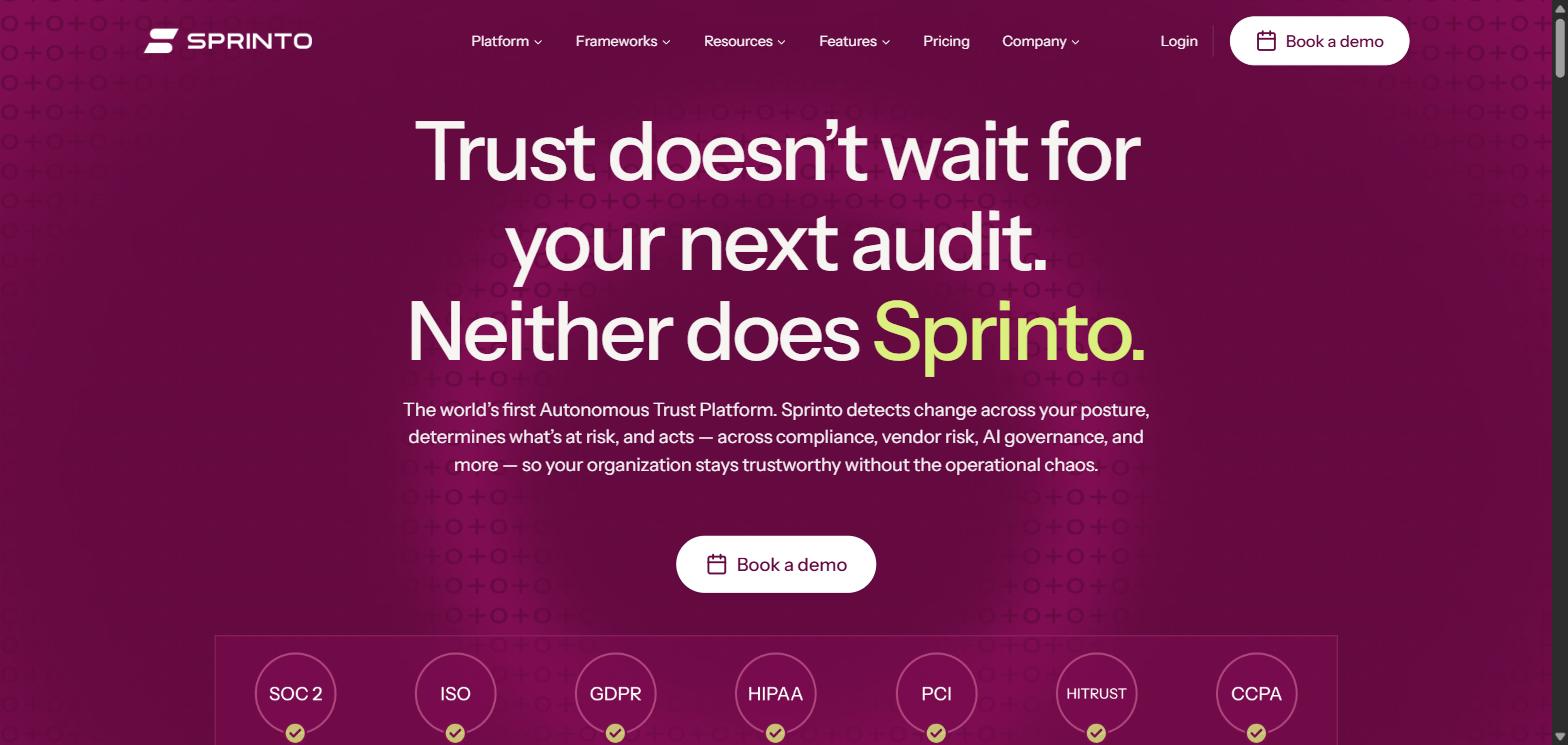
Screenshot captured from Sprinto's official website, for informational purposes only.
Sprinto has some of the highest review scores in this category, and its onboarding support is genuinely fast. It's a reasonable pick for a team that values speed to first audit above everything else.
Its AI story is the clearest label mismatch on this list. "AI governance" here means detecting shadow-AI and SaaS-sprawl inside your own company, not managing the risk of the model you're building. If you're an AI company looking specifically for model-risk tooling, this feature will not do what its name suggests.
Where it falls short: no public pricing or free trial, a downloaded app rather than a fully web-based product, and a small number of reported disputes over billing and sales pressure worth a direct conversation with the vendor before signing.
| Pros | Cons |
|---|---|
|
|
Pricing: headcount and framework-based, third-party estimates land around $8,000 to $30,000/year.
6. Thoropass
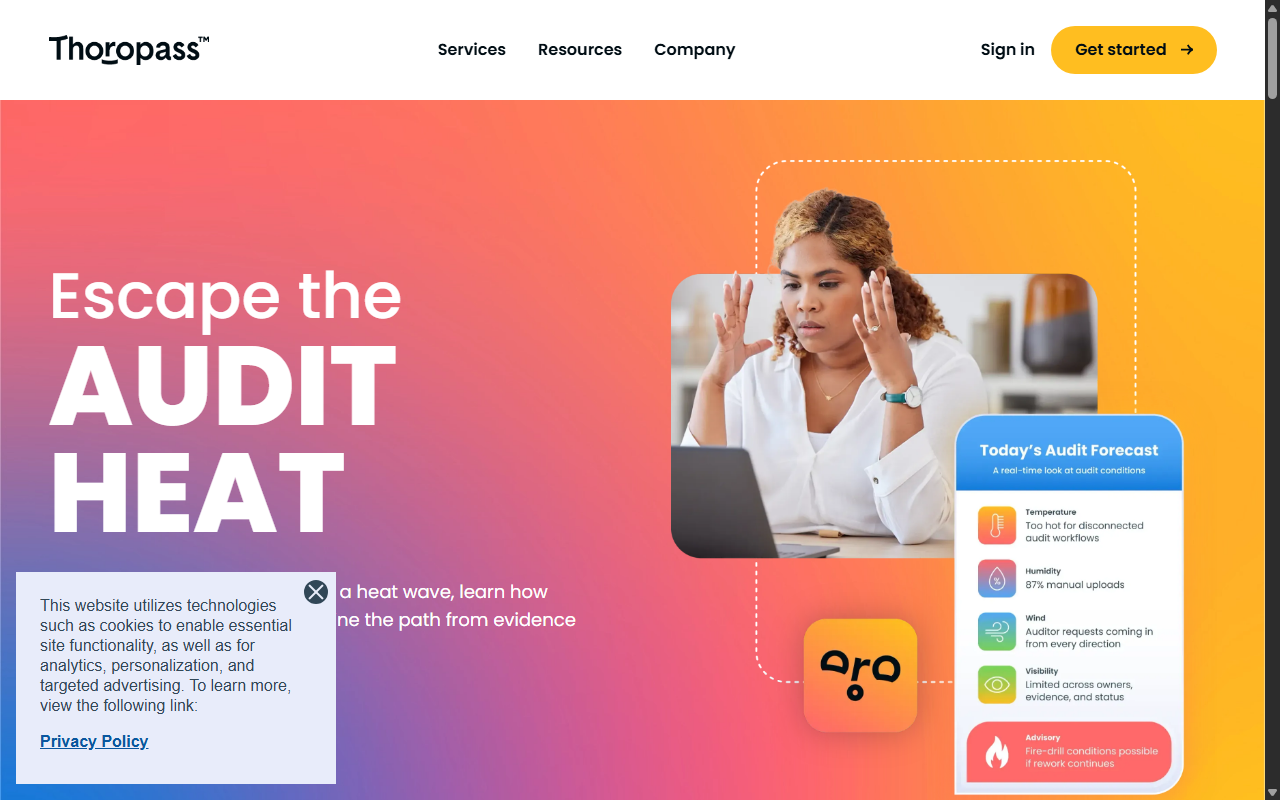
Screenshot captured from Thoropass's official website, for informational purposes only.
Thoropass is the only platform on this list that bundles the software with its own in-house, licensed CPA audit firm. That genuinely removes one step most buyers dread: finding and vetting a separate auditor.
Its AI moves are recent: ISO 42001 self-certification, a new "GenAI DDQs" feature for AI-generated vendor questionnaire responses, and an AI-pentesting service. All of it launched in 2025 and 2026, so there's no AI-company case study yet to confirm it holds up in practice.
Where it falls short: cost is flagged as steep even by reviewers who otherwise rate it well, and one reviewer described evidence collection as "extremely basic and manual," a direct contradiction of the platform's own AI-powered marketing. The bundled-audit model is also a lock-in if you already have a preferred auditor.
| Pros | Cons |
|---|---|
|
|
Pricing: fully custom-quoted; buyer-reported figures put the median around $26,000 to $30,000/year.
7. Secureframe
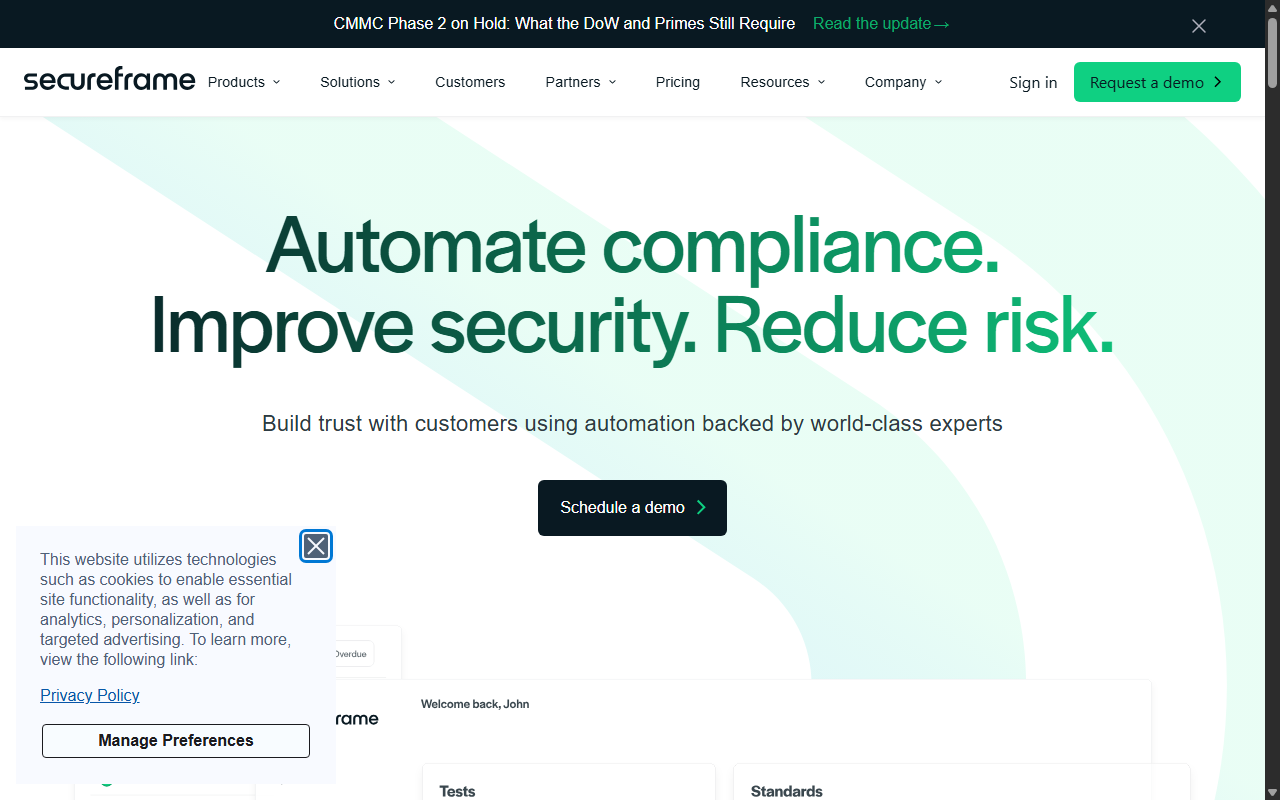
Screenshot captured from Secureframe's official website, for informational purposes only.
Secureframe leans on guided, hand-held onboarding through its own in-house compliance experts, which makes it a solid pick for a team with no security or compliance hire at all.
On AI specifically, there's nothing here. No ISO 42001 support, no NIST AI RMF alignment, no AI-agent product, no AI-company case study. One direct, worth-repeating critique from reviewers: the platform "works against you rather than with you" the further your setup diverges from the standard playbook, exactly the situation an AI company with a novel training-data pipeline is in. A separate reviewer complaint that task generation "breaks developer velocity" lands hardest on a fast-shipping AI engineering team specifically.
| Pros | Cons |
|---|---|
|
|
Pricing: quote-based, roughly $7,500 to $15,000/year for a small single-framework team, up to $60,000 to $100,000+/year at enterprise scale.
8. Oneleet
Screenshot captured from Oneleet's official website, for informational purposes only.
Oneleet bundles in-house pentesting into its compliance subscription rather than selling checklist automation alone, and it lets you keep your own auditor instead of routing you into a fixed network.
There's no AI-specific product here either. A few of its named customers are AI companies, but they're treated as generic logos, not tailored case studies. Its integration library is narrower than most of this list, around 20 platforms, a real bottleneck if your stack includes any specialized ML tooling. Multi-framework work also runs sequentially rather than in parallel, which slows down a team chasing SOC 2 and ISO 27001 at once for the same enterprise deal.
| Pros | Cons |
|---|---|
|
|
Pricing: fully demo-gated, no public numbers; third-party estimates put small teams around $12,000 to $18,000/year.
How We Scored the Top SOC 2 Compliance Platforms for AI Companies
Two dimensions went into the ranking above, applied to all eight platforms.
The first is the standard compliance-automation fit every buyer already checks: pricing transparency, integration breadth, support model, audit-partner network, and how much the platform slows down a team shipping model or infra changes weekly.
The second, and the one most comparisons skip, is AI-governance readiness specifically. Does the platform have a native LLM vendor-risk-assessment workflow. Does it support ISO 42001 or NIST AI RMF as an actual framework, not a nav-menu mention. Does it automate evidence collection for model changes and training-data handling.
Does it integrate with any part of an actual ML stack: Databricks, Hugging Face, MLflow, Weights & Biases. None of the eight platforms researched here connect to any of those tools yet, which is worth stating plainly as a shared market gap rather than a single vendor's failing.
soc 2 controls for ai systems, in practice, means checking whether a platform's automated evidence collection reaches model-change tracking at all, or whether that part still has to happen in a spreadsheet.
Why the Top SOC 2 Compliance Platforms for AI Companies Aren't Interchangeable
soc 2 ai compliance does not cover model quality, hallucinations, or bias. It covers the Trust Services Criteria, security, availability, confidentiality, processing integrity, and privacy, applied to how a company builds and runs its product. For an AI company, that same set of criteria pulls in evidence a generic SaaS audit never touches.
Three gaps show up almost every time. First, ai vendor soc 2 requirements: if your product calls OpenAI, Anthropic, or any hosted model, that provider is a subprocessor. Your auditor wants a documented vendor-risk assessment plus proof you configured data retention and training opt-out correctly.
Second, training-data segregation: who can access raw training data, and how is that access logged. Third, prompt and inference logging with PII or PHI redaction, which is one of the most common evidence gaps auditors flag on a first-time AI-company audit.
This is not an ISO 42001 or NIST AI RMF explainer. For the deeper AI-governance-framework side of things, see our ISO 27001 AI Compliance guide. This article is specifically about picking the right platform for soc 2 for ai companies, though several of the platforms already ranked above bundle AI-framework support alongside SOC 2 itself.
SOC 2 for AI Companies vs. SOC 2 Compliance for SaaS AI Products (and AI Vendor SOC 2 Requirements)
soc 2 for ai companies (a team building or fine-tuning a model, or wrapping one into a core product feature) is a different buyer shape than soc 2 for ai saas products in the broader sense, or soc 2 compliance for saas ai products, a SaaS company that has added AI features but isn't building the underlying model. The platform ranking above applies most directly to the first group, though most of these platforms serve both.
Regardless of which group you're in, ai vendor soc 2 requirements are the one constant. Any company calling a hosted model provider needs a documented subprocessor risk assessment, whichever platform ends up handling the rest of the audit.
Half the platforms in this market slapped an "AI governance" label on a feature that already existed. The other half genuinely built something new. Reading past the label is the actual skill a buyer needs right now. — Upendra Varma, CTO at ComplyJet
How the Top SOC 2 Compliance Platforms for AI Companies Price Their Plans
Every platform researched here bills on headcount bands plus framework count plus add-ons, not strictly per seat. ComplyJet does this differently: a flat fee, not per seat, so headcount growth isn't a worry. That distinction matters more for an AI company than it sounds: a lean 15-person team gets startup-tier pricing, but hiring a burst of engineers mid-year for a fundraise can cross a headcount band and retrigger a full quote renegotiation, right when budget attention is already stretched thin.
Renewal-year price increases, 20 to 50 percent depending on the vendor, are the single most consistent complaint across Vanta, Drata, Secureframe, and Sprinto specifically. Budget for year two, not just the year-one quote you're handed during the sales call.
For a team still comparing soc 2 platforms for ai startups on cost alone: platform fees across this list range roughly $7,000 to over $100,000/year depending on stage and framework count, plus separate audit fees typically $10,000 to $40,000. ComplyJet's flat $5,000 to $8,000/year published pricing is the one concrete exception to the quote-gated, renewal-shock pattern found everywhere else in this research.
Choosing Among the Top SOC 2 Compliance Platforms for AI Companies
There's no single right answer here, but the decision breaks down cleanly by team shape.
- An engineering-heavy team that wants deep DevOps control and can invest setup time: Drata.
- A lean, cash-constrained AI startup that wants guided support, a real AI-governance workflow, and no headcount-band renegotiation risk: ComplyJet.
- A team that wants the most-referenced default and already has AI-company peers to point to: Vanta.
- A team that wants pentesting bundled into the same contract: Oneleet.
- A team that wants its audit firm and software to be the same vendor: Thoropass.
For soc 2 compliance for ai startups specifically, the sharpest dividing line isn't feature count. It's whether the platform actually reaches AI-specific evidence or stops at the generic layer, and whether its pricing model punishes you for growing fast. If what you're really shopping for is soc 2 compliance software for ai teams rather than a generic SaaS checklist tool, that distinction is the one to hold onto.
Common Mistakes That Undermine the Top SOC 2 Compliance Platforms for AI Companies
- Assuming SOC 2 covers model quality, bias, or hallucinations. It doesn't, and no platform on this list changes that. That's a separate governance question, not a SOC 2 one.
- Taking a feature literally named "AI governance" at face value. An ai governance policy claim on a pricing page can mean shadow-AI detection or actual model governance. Check which one before you factor it into your decision.
- Ignoring ai vendor soc 2 requirements until an auditor asks. Document your hosted-model provider relationships as subprocessor risk early, not during audit week.
- Picking a platform on brand alone, without checking integration gaps. None of the eight platforms here connect to Databricks, Hugging Face, MLflow, or Weights & Biases yet.
- Underestimating year-two renewal costs. Budget against the renewal-year figure, not the year-one quote.
- Not checking whether headcount-band pricing will retrigger a renegotiation mid-fundraise. Ask directly where the next pricing tier sits before signing.
- Treating the audit as a one-time event. For soc 2 compliance for saas ai products, evidence collection needs to keep pace as the model changes, not just at renewal time.
FAQs
What Is SOC 2 Compliance for AI Companies?
It's the same Trust Services Criteria, security, availability, confidentiality, processing integrity, and privacy, applied to a company that builds or operates an AI product. The audit adds evidence a generic SaaS company never has to produce: model lineage, training-data handling, and hosted-model vendor risk.
How Does SOC 2 Apply to AI Systems?
The criteria themselves don't change. What changes is the evidence: naming a specific production model version and reproducing its training history, logging prompts and inference with proper redaction, and documenting any hosted model provider as a subprocessor.
Is ChatGPT SOC 2 Compliant?
OpenAI's own SOC 2 status doesn't answer the question that matters for your audit. If your product calls a hosted model like ChatGPT, your auditor wants your own documented vendor-risk assessment for that relationship, regardless of what OpenAI has certified on its own end.
Which SOC 2 Platform Is Best for an AI Startup?
It depends on team shape more than feature count. An engineering-heavy team fits Drata. A lean, cash-constrained team that wants guidance and real AI-governance coverage fits ComplyJet. A team that wants the most-referenced default fits Vanta. See the decision framework above for the rest.
Do AI Companies Need SOC 2 Compliance?
It isn't legally required, but it's typically a prerequisite for closing enterprise deals, the same driver as any SaaS company, sharpened by extra buyer scrutiny around how the AI itself handles data.
How Much Does SOC 2 Compliance Cost for an AI Company?
Platform fees across this list range roughly $7,000 to over $100,000/year depending on stage and framework count, plus separate audit fees typically $10,000 to $40,000. ComplyJet's flat $5,000 to $8,000/year is the one published exception to the quote-gated norm.
Related Reading
- Best SOC 2 Compliance Software, the generalist buyer's guide this article narrows into the AI-company persona.
- ISO 27001 AI Compliance: Security Guide 2026, for the ISO 27001/ISO 42001 side of AI governance, not covered here.
- Oneleet vs Vanta vs Drata, a deeper three-way comparison among three of the platforms ranked here.
- Oneleet vs Secureframe, a deeper two-way comparison among two of the platforms ranked here.
- Vanta SOC 2: Pricing, Report Types, and the Real Process, a full standalone Vanta deep-dive.