Related Articles
No items found.
.svg)

You start your ISO 27001 implementation with a clear plan. Define policies, assess risks, and prepare for audits.
Then AI tools enter the picture.
Suddenly, policies can be generated in minutes. Risk assessments feel automated. Audit checklists are created with a prompt. What used to take weeks now looks like it can be done in hours.
And that’s where the confusion begins.
Can AI actually help in ISO 27001 implementation, or does it create more risk?
Can AI systems themselves be compliant with ISO 27001 requirements?
And more importantly, can you trust AI-generated outputs when it comes to something as critical as audits and certification?
Most content online either overhypes AI or dismisses it completely. But neither approach helps when you're actually trying to implement ISO 27001 in a real organization.
This guide is not theoretical.
We will break down exactly where AI fits within ISO 27001, where it does not, and how teams are using it in practice without compromising compliance. No jargon, no generic advice, just clear and implementation-focused insights you can apply.
If you're already exploring ISO 27001 and considering AI tools, the process can get overwhelming fast. Book a demo with ComplyJet to see how teams are simplifying compliance without spreadsheets or chaos.
ISO 27001 AI compliance becomes much easier to understand when you separate it into two clear ideas.
AI in compliance and AI under compliance. These are not the same, but both matter when you are implementing ISO 27001 in a modern environment.
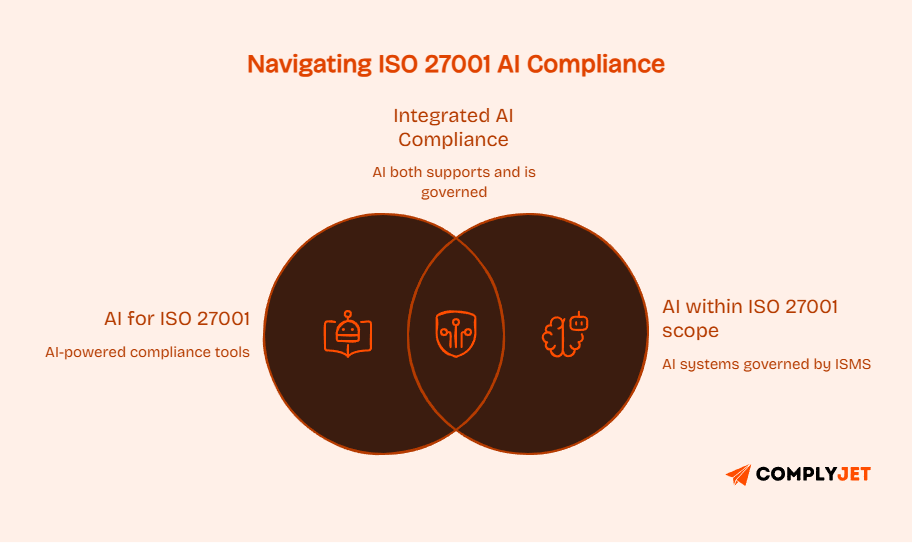
This refers to using AI as a tool to support compliance activities.
Traditionally, ISO 27001 involves a lot of manual work. Writing policies, conducting risk assessments, preparing audit evidence, and maintaining documentation can take weeks or even months.
AI changes that.
Teams now use AI to generate policy drafts based on their organization type, create risk registers from structured inputs, and build audit checklists quickly. Monitoring also becomes more proactive. Instead of periodic reviews, AI systems can continuously flag gaps, anomalies, or missing controls.
This does not mean compliance is automated end-to-end. AI helps with speed and structure, but human validation is still critical. Every output needs to be reviewed to ensure it aligns with your actual processes, risks, and controls.
Think of AI here as an accelerator, not a decision-maker.
This is where compliance becomes more serious.
If your organization uses AI tools extensively, builds AI products, or processes sensitive data through AI systems, then those systems fall within the scope of your ISMS.
In this case, AI is not just helping you. It needs to be governed.
Your AI models, training datasets, APIs, and outputs are treated as information assets. Like any other asset, they introduce risks. These can include data leakage, unauthorized access, lack of transparency in outputs, and over-reliance on automated decisions.
All of these risks must be identified and managed within your ISMS.
Ignoring this layer is where many teams go wrong. They focus on using AI for compliance but forget to assess the risks of AI itself.
ISO 27001 adoption surge: The number of valid ISO 27001 certificates nearly doubled from 48,671 in 2023 to 96,709 in 2024.
ISO 27001 is fundamentally a risk-driven framework.

It does not tell you what technology to use. It tells you how to think about risk and apply controls based on it.
When AI is involved, the approach stays the same.
You identify where AI is being used, what data it touches, what risks it introduces, and what controls are needed to manage those risks. This includes access control, data protection, monitoring, vendor evaluation, and internal governance policies around AI usage.
The system does not change. The scope expands.
ISO 27001 does not explicitly mention AI, but it fully applies to it. Whether you are using AI to speed up compliance or managing AI as part of your environment, the same principles of risk management, control implementation, and continuous improvement still apply.
ISO 27001 compliance has never been about complexity. It has always been about execution.
And that is exactly where most teams struggle.
Start with documentation. Policies are written in Word docs, shared over email, and updated in silos. No one is fully sure which version is final. What exists on paper often does not match what happens in practice.

Then come audits. Evidence is collected only when an audit is near. Teams chase screenshots, logs, and approvals at the last minute. This leads to delays, gaps, and unnecessary back-and-forth with auditors.
Visibility is another issue. Risk registers sit in spreadsheets. Controls are tracked manually. If something breaks, you usually find out later, not when it happens.
This is the traditional model. It works, but it is slow, reactive, and hard to scale. AI is changing this at the workflow level.
Documentation is no longer the starting problem. Teams can generate policies quickly and focus on aligning them with actual processes. Updates are easier to manage because changes can be applied across documents without starting from scratch.
Audit preparation also shifts from periodic to continuous. Instead of collecting evidence in a rush, systems can capture it as activities happen. Access logs, approvals, and control checks can be recorded and organized in real time.
The biggest shift is visibility. With AI in the loop, compliance is no longer something you check occasionally. You can see where you stand at any point. If a control is missed or a risk changes, it gets flagged early.
Here’s the next section, keeping the tone practical, grounded, and not overly “AI-sounding,” with real mini examples:
AI is not used in one single part of ISO 27001. Its value comes from how it fits into multiple stages of the workflow, especially the parts that are repetitive, time-consuming, or prone to inconsistency.
When used correctly, it does not replace the compliance process. It removes friction from it.

Policy drafting is usually the first bottleneck in ISO 27001. Teams either start from scratch or adapt generic templates that do not fully match their operations.
AI helps by generating structured drafts based on inputs like company size, industry, and data handling practices. This gives teams a starting point that is closer to reality.
It also helps in maintaining policies over time. Instead of rewriting documents, teams can update sections as processes change and keep everything aligned.
For example, if a company introduces a new remote access tool, AI can suggest updates to access control and remote working policies based on that change.
Risk assessment is another area where teams spend significant time collecting inputs and scoring risks manually.
AI can assist in identifying potential risks by analyzing systems, workflows, and data flows. It can also help standardize risk scoring so that similar risks are evaluated consistently.
This does not mean risks are decided automatically, but the process becomes more structured.
For example, if a team adds a new third-party vendor, AI can flag common risks associated with vendor access, data sharing, and dependency, helping the team assess them faster instead of starting from scratch.
Audit preparation often becomes a last-minute activity, even for teams that plan ahead.
AI shifts this by helping collect and organize evidence continuously. Instead of searching for documents and logs before an audit, teams can have a system where evidence is already mapped to relevant controls.
It can also help maintain audit logs in a structured way, making it easier to present information during audits.
For example, access control evidence such as login records or approval logs can be automatically tagged and stored, so when an auditor asks for proof, it is already available without manual effort.
One of the biggest gaps in traditional compliance is the lack of real-time tracking.
AI can monitor systems and flag issues as they happen. This includes missed control activities, unusual access patterns, or incomplete records.
Instead of waiting for periodic reviews, teams can act on issues earlier.
For example, if a required approval step is skipped in a workflow, the system can flag it immediately instead of it being discovered weeks later during a review.
Mapping controls, especially Annex A controls, to internal processes can be time-consuming and confusing for teams new to ISO 27001.
AI can assist by suggesting mappings between controls and existing policies, risks, and evidence. This helps ensure that nothing is missed and reduces the effort required to connect different parts of the ISMS.
For example, when a team defines a risk related to data access, AI can suggest relevant Annex A controls and link them to existing policies and evidence, creating a more complete and connected view.
AI governance platforms reduce compliance effort by 20–30%, improving cost efficiency over time
As AI becomes part of everyday business operations, teams are starting to face a practical question during compliance planning. Is ISO 27001 enough, or do you also need ISO 42001?
To answer that, it helps to clearly understand what each standard is designed for.
ISO 27001
ISO 42001
The difference becomes clearer when you compare them directly:
In practice, these standards are not competing.
ISO 27001 helps you secure information. ISO 42001 helps you govern AI systems. Together, they cover both data and decision-making layers.
The key is to align your compliance approach with how deeply AI is integrated into your operations. If AI is becoming central to what you do, relying only on traditional information security frameworks may not be enough.
Only 17% of companies have technical controls capable of preventing employees from uploading confidential data to public AI tools.
When teams start integrating AI into their workflows, the biggest mistake is treating it as just another tool. In an ISO 27001 context, AI needs to be viewed from multiple angles within the ISMS, not as a standalone component.
At a practical level, AI shows up in three key roles.

For example, if your team uses an AI tool to process customer data, that tool is no different from any other system handling sensitive information. It must be listed, tracked, and governed.
For example, an AI tool generating reports based on internal data might expose sensitive information if prompts are not controlled properly. This becomes a risk that needs to be identified and mitigated.
For example, using an external AI API means your data is being processed outside your environment. This needs to be assessed under vendor risk and contractual controls.
Once you look at AI through these roles, it becomes clear where it fits inside the ISMS.
To manage AI effectively within ISO 27001, governance needs to be clearly defined.
In practice, nothing in the ISMS framework changes when AI is introduced. What changes is the scope and the type of risks you are managing.
AI simply becomes another layer within your system, but one that requires closer attention because of how it interacts with data, decisions, and external dependencies.
Breaches involving shadow AI cost organizations $4.63 million on average $670,000 more than standard incidents.
Implementing ISO 27001 with AI does not change the structure of the framework. What changes is how efficiently you execute each step. Instead of handling everything manually, AI can support the process by reducing effort, improving consistency, and keeping things moving.
Here is how the implementation typically looks when AI is part of the workflow.

Start by defining what your ISMS will cover, including systems, data, teams, and any AI tools you use. If AI interacts with sensitive data or business processes, it needs to be included from the beginning so that risks are not missed later.
Once the scope is clear, identify risks across your environment. Along with standard risks, include AI-specific ones such as data leakage through prompts, unreliable outputs, and dependency on external tools. AI can assist in suggesting common risks, but the final assessment should reflect your actual setup.
After identifying risks, decide how each one will be handled. This includes mitigation, acceptance, or transfer. In an AI context, this could involve restricting sensitive data usage, adding approvals, or choosing more secure vendors.
Link each risk to relevant controls, including Annex A controls. This step ensures that every risk has a defined way to be managed. AI can help suggest mappings and make the process more structured and faster.
At this stage, AI helps reduce manual effort by supporting tasks like policy drafting, risk structuring, and control tracking. This improves consistency and reduces the time spent on repetitive work.
Create policies, procedures, and the statement of applicability. Instead of writing everything manually, AI can generate drafts and help maintain them as your processes evolve, keeping documentation aligned with reality.
Evidence should be captured continuously rather than at the end. Logs, approvals, and access records can be organized in real time so that they are ready when needed for audits.
Run an internal audit to identify gaps in controls, documentation, and evidence. AI can support by generating checklists and highlighting missing areas, but human review is still necessary for validation.
In the final stage, review everything, fix remaining gaps, and ensure audit readiness. By this point, most of the work is already structured, and AI helps keep it organized and accessible.
The global ISO 27001 certification market was valued at $18.59 billion in 2025 and is expected to reach $74.56 billion by 2035, with AI-enabled monitoring cited as a key emerging trend.
Not every organization uses AI in the same way for ISO 27001 compliance. Some are still managing everything manually, while others are building systems that can predict and prevent compliance gaps.
This can be understood as a maturity curve with four levels.

At this stage, everything is handled manually. Policies are created in documents, risks are tracked in spreadsheets, and evidence is collected only when needed.
Audits are reactive, and most of the effort goes into preparing for them rather than maintaining compliance continuously. This approach works in the early stages but becomes difficult to manage as the organization grows.
Here, teams start using tools to streamline repetitive tasks. Documentation may be centralized, reminders are automated, and workflows for approvals or control tracking are structured.
However, the system still depends heavily on manual inputs, and insights are limited. Compliance becomes more organized, but not necessarily smarter.
At this level, AI is actively used to support compliance activities. Policies can be generated and updated faster, risks can be identified with more consistency, and evidence can be collected continuously.
Teams start relying on AI to structure their ISMS, reduce manual effort, and maintain better visibility. Decision-making still remains human-led, but the system becomes significantly more efficient.
This is the most advanced stage. Compliance is no longer just reactive or even continuous, it becomes predictive. Systems can identify potential risks before they turn into issues, flag gaps in controls early, and provide insights into where compliance may break down.
Instead of preparing for audits, teams are always audit-ready. The focus shifts from managing compliance to optimizing it.
Most organizations today are between Level 1 and Level 2, with some moving towards Level 3.
AI can simplify ISO 27001 implementation, but it also introduces new challenges that teams need to manage carefully.

Trust issues
Validation complexity
Auditor skepticism
Over-automation risks
Integration challenges
In practice, AI works best as a support layer. The key is balancing automation with validation and keeping human oversight strong.
Manual vs AI-Powered ISO 27001 Compliance
The difference between manual and AI-powered ISO 27001 compliance is not just about speed. It affects how consistently compliance is maintained, how visible risks are, and how prepared teams are at any point in time.
Here is a detailed comparison:
For startups, ISO 27001 is often tied to growth, not just compliance. Deals, partnerships, and investor trust depend on it, but resources are limited, and timelines are tight.
The real issue is not complexity, but lack of clarity. Teams either overbuild processes or rely on generic templates that do not match their workflows.
AI helps by speeding up tasks like policy creation and risk identification, but it works best when combined with a structured approach. The goal is to stay lean and build compliance that supports execution, not slows it down.
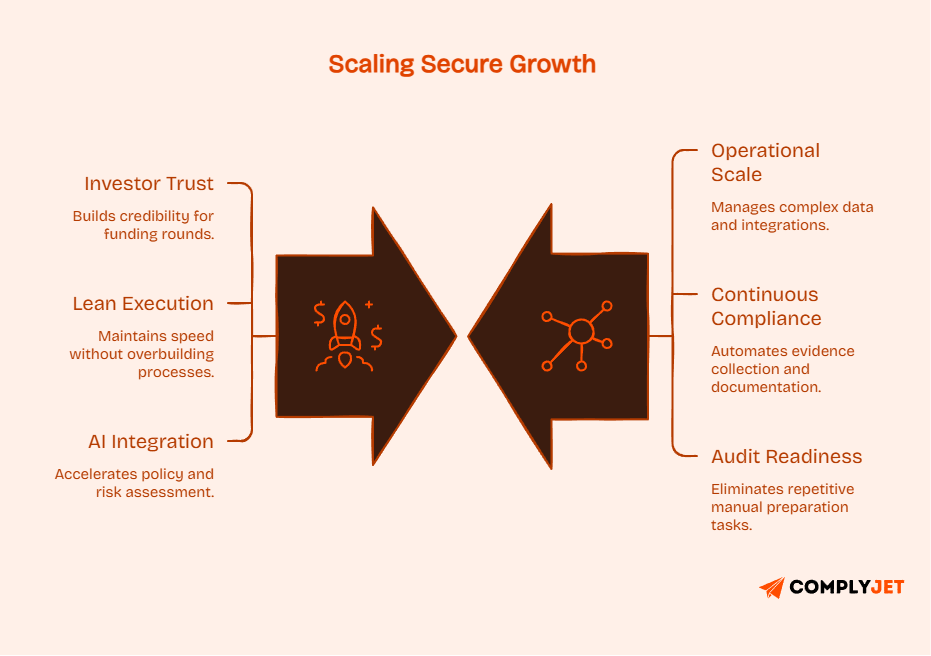
For SaaS companies, compliance becomes a scaling problem. As products grow, managing access, data, and integrations gets more complex.
Manual processes start breaking down. Documentation goes out of sync, evidence is scattered, and audit preparation becomes repetitive.
AI helps shift this to a more continuous model where documentation stays updated and evidence is collected as part of daily operations. The focus should be on structure over complexity.
ComplyJet helps startups and SaaS companies achieve ISO 27001 faster without slowing down product development.
ISO 27001 becomes harder to manage as your processes grow and spreadsheets stop scaling. The right tools help centralize compliance, automate repetitive work, and keep everything aligned in one system.
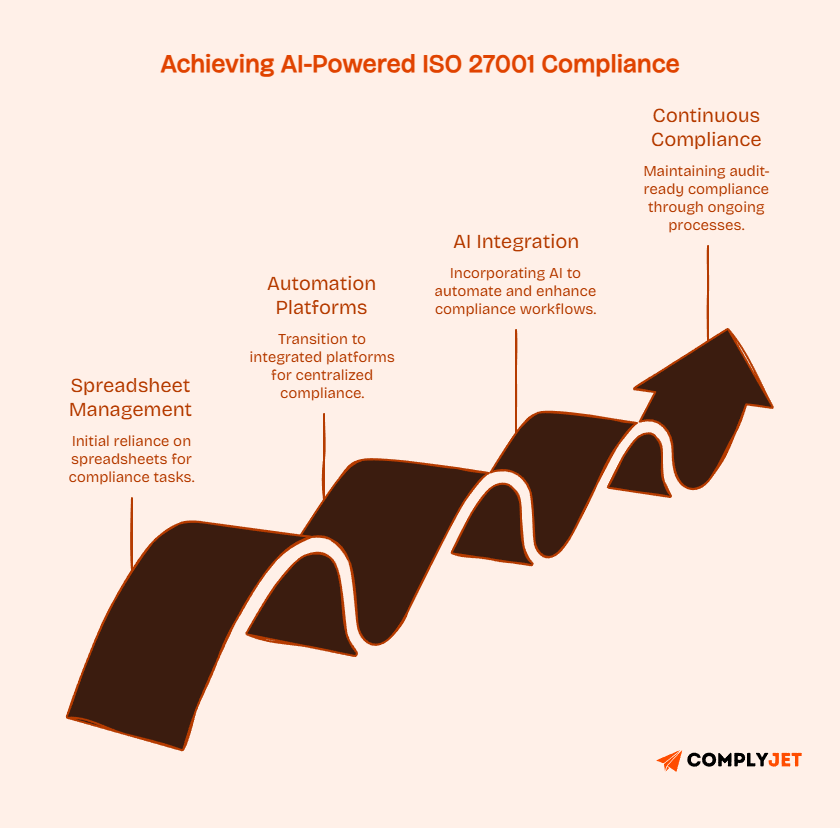
Most ISO 27001 implementations start with spreadsheets. Risk registers sit in one file, policies in another, and evidence is scattered across folders. As the scope grows, this setup becomes harder to manage. Version control breaks, visibility drops, and teams spend more time organizing data than actually working on compliance.
Automation platforms solve this by bringing everything into one place. Policies, risks, controls, and evidence are connected, which makes tracking and updates easier. Instead of working across multiple tools, teams operate within a structured system that reflects how compliance actually works.
AI strengthens these platforms by reducing manual effort. It can generate policy drafts, structure risk assessments, and suggest control mappings. More importantly, it supports continuous workflows. Evidence gets collected as activities happen, and compliance stays closer to audit-ready at all times.
ComplyJet combines centralized compliance with AI-driven workflows. It connects policies, risks, controls, and evidence in one system, so teams do not have to rely on spreadsheets or disconnected tools. The focus is on keeping compliance aligned with real operations while making it easier to manage.
If you want to experience AI-powered compliance without committing upfront, start a free trial with ComplyJet and see how your ISO 27001 workflow becomes structured instantly.
It refers to using AI to support compliance processes and managing AI systems within your ISMS. This includes identifying risks, applying controls, and ensuring proper governance of AI usage.
Yes, AI can speed up tasks like policy creation, risk assessment, and documentation. However, certification depends on real implementation, so human validation is still essential.
AI helps organize evidence and identify gaps, making audit preparation easier. But outputs must be reviewed carefully to ensure they reflect actual practices.
ISO 27001 does not mention AI directly, but it fully applies to it. Any AI system handling data becomes part of your ISMS and must be managed accordingly.
ISO 42001 focuses on governing AI systems, including risks like bias and transparency. It complements ISO 27001 by covering areas beyond traditional information security.

AI is making ISO 27001 faster to implement by reducing manual work and improving consistency. It helps with documentation, risk tracking, and audit readiness, especially for teams working with limited resources.
But speed without control creates new risks.
AI outputs still need validation, and compliance still needs structure. Without that, you risk misaligned documentation and gaps that surface during audits.
The right approach is simple. Use AI to reduce effort, but keep strong governance over decisions and processes.
AI can help you achieve ISO 27001 faster, but only if you control it properly.
If you're serious about achieving ISO 27001 while using AI tools, you need structure, not guesswork. Book a demo with ComplyJet and get a clear, audit-ready roadmap without delays or confusion.
© 2026 ComplyJet. All rights reserved.