.svg)

You've sat through two demos, read both pricing pages twice, and you're still stuck. The oneleet vs secureframe decision looks close on paper: both get you to SOC 2 or ISO 27001, both automate evidence collection, and both cost less than hiring compliance headcount. It stops looking close the moment you look at how each one actually gets you there.
Here's the direct answer. Oneleet is the security-first, concierge-style platform: it bundles real security work into the compliance process, lets you keep your own auditor, and keeps upfront cost low, built for startups that don't have a dedicated compliance person yet. Secureframe is the automation-first platform: broader integrations, continuous control monitoring, and a more structured, guided onboarding, built for teams that expect to add frameworks and want less internal hand-holding required.
Quick answer
Oneleet = lower-cost, security-work-bundled-in, choose-your-own-auditor platform for startups doing their first framework. Secureframe = automation-first, broader-integration platform with guided onboarding, built for teams scaling into multiple frameworks. Pick based on whether you want control or guidance.
Neither platform is the objectively better product. They're built for different team shapes, and most of the "which is better" debate online skips that part entirely.
By the end of this article, you'll know exactly which one fits your team, not just what each one does in isolation. Here's what's ahead:
- What actually separates Oneleet's and Secureframe's approach to compliance
- Why picking wrong here costs more than a support ticket
- A side-by-side look at both platforms, dimension by dimension
- Where each platform pulls ahead on implementation, audit experience, and scale
- What each platform's pricing structure actually looks like
- A decision framework for SOC 2 buyers stuck between the two
ComplyJet
There's a third way to frame this decision
Instead of owning the process yourself (Oneleet) or navigating guided automation on your own (Secureframe), ComplyJet's team drives compliance with you end to end, audit partners included.
Oneleet vs Secureframe: Two Roads to the Same Certification
A feature checklist is the wrong place to start this oneleet secureframe comparison, since both platforms automate roughly the same core tasks: evidence collection, control monitoring, audit prep. What actually separates them is the model underneath, whether the compliance work gets done for you, or the platform makes it easier for your own team to do it.
Oneleet grew out of a security-first, pentest-and-audit background, and that shows in how the platform is built: security work is native to the product, not sold as an add-on. Secureframe grew as a pure compliance-automation platform, built around integrations and continuous monitoring that plug into the tools you already run, rather than doing security work itself.
Oneleet — Security Work Bundled Into Compliance
Oneleet packages real security work, not just documentation, directly into its platform. The pitch is straightforward: instead of hiring a pentest vendor, a security consultant, and a compliance tool as three separate relationships, you get one contract and the flexibility to choose your own auditor.
That consolidation is also why Oneleet's sticker price can look higher than a bare compliance tool at first glance. It's rarely comparing the same scope of work.
Pros
- Bundles real security work into the compliance platform itself, useful for teams with no in-house security hire.
- Keeps the flexibility to choose your own auditor instead of being routed into a fixed network.
- Lower, more transparent entry-level pricing than a fully guided automation platform.
Cons
- Narrower integration library and framework breadth than a platform built around integrations first.
- Less structured onboarding, which can be a hurdle for a team with no in-house compliance experience.
- Costs can climb as you add vulnerability scanning, training, or third-party integrations beyond the base plan.
Secureframe — Guided Automation With Built-In Support
Secureframe takes the opposite starting point: automate as much of the manual compliance work as possible, then guide the team through the rest. Continuous control monitoring, integrated evidence collection, and built-in policy templates and training modules sit at the core of its automation-first platform, aimed at teams scaling compliance across more than one framework without hiring for it.
Onboarding reflects the same philosophy. Secureframe pairs new customers with onboarding specialists rather than leaving the platform to be self-navigated, which matters more for a team new to compliance than for one that's done this before.
Pros
- Broader automation coverage and integration library, built for teams scaling across multiple frameworks.
- Structured onboarding with dedicated specialists, useful for teams with no prior compliance experience.
- Built-in policy templates and training modules reduce the need for separate third-party tools.
Cons
- Higher, less transparent base pricing, typically requiring a sales conversation rather than a published rate.
- Guided onboarding can slow down a small, technically confident team that wants to move fast.
- Doesn't bundle in the kind of hands-on security work Oneleet builds around.
That split, hands-on security work versus guided automation, is the throughline for every section below.
Most teams don't lose time picking between Oneleet and Secureframe. They lose time picking one, then discovering six months in that the tradeoff they never thought about, auditor flexibility, or onboarding speed, was the one that actually mattered for their team. — Upendra Varma, CTO at ComplyJet
Why the Oneleet vs Secureframe Decision Actually Matters
Picking wrong here doesn't just mean an awkward vendor switch later. It means real cost, in one direction or the other.
Choose Secureframe when a lean team could have handled Oneleet's more hands-on model, and you've paid for guided depth you didn't need, plus a longer onboarding runway before your first audit even starts. Choose Oneleet when you're about to add ISO 27001 or HIPAA on top of SOC 2, and you'll likely rebuild integration and control-mapping work that Secureframe's broader automation would have handled the first time.
Both mistakes cost the same thing in the end: budget and audit-timeline slippage, during the exact period you can least afford either.
Note
This isn't a "which platform is more mature" question. Both are established vendors in this space. The cost of picking wrong is a mismatch between what you actually need and what you signed up for, not a mismatch in product quality.
Oneleet vs Secureframe at a Glance
Here's the side-by-side, dimension by dimension:
| Dimension | Oneleet | Secureframe |
|---|---|---|
| Core model | Security work bundled into the compliance platform | Automation-first, integration-and-monitoring-led |
| Auditor choice | Choose your own auditor | Guided toward a platform auditor network |
| Onboarding | Leaner, more self-serve | Structured, specialist-guided |
| Framework scalability | Solid for one or two frameworks | Built for scaling across multiple frameworks |
| Support model | Email/chat-based, no guaranteed dedicated manager | Dedicated support access on higher tiers |
| Pricing structure | Lower, more transparent entry point | Higher base, more bundled in |
| Best for | Startups without in-house security or compliance staff | Teams expecting to add frameworks and want guided depth |
Treat this as the starting map, not the whole decision. A platform that wins on paper in one row can still be the wrong fit once you weigh how your actual team works day to day.
Secureframe vs Oneleet: Where Each Platform Pulls Ahead
The secureframe vs oneleet comparison gets more useful once you go dimension by dimension instead of staying at the surface level. Here's where each one actually pulls ahead.
Implementation Speed and Onboarding
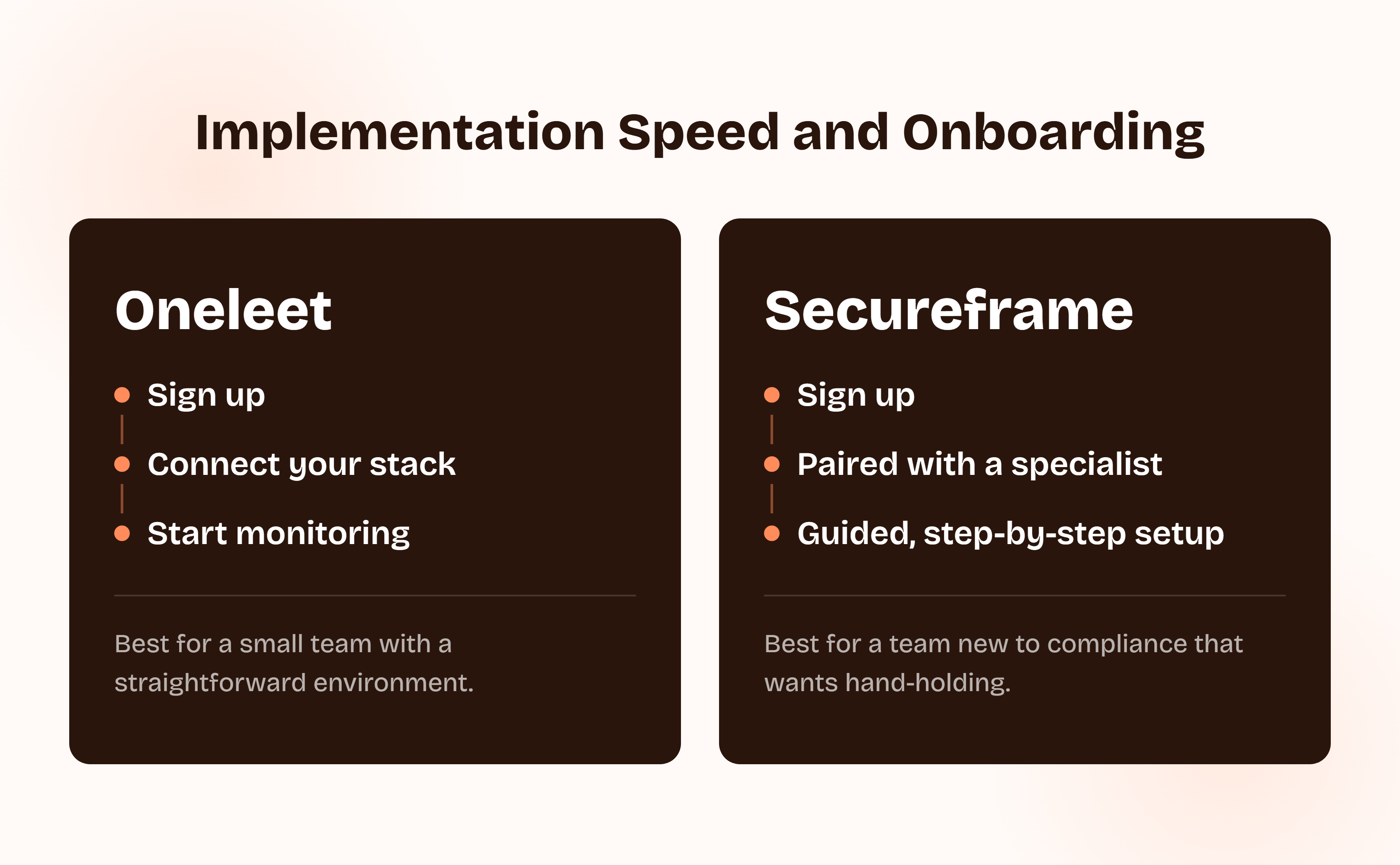
Oneleet markets itself as quick to get running, and for a small team with a straightforward environment, that holds up. Once the compliance scope broadens, especially across more than one framework, more of the setup work falls on your team to self-navigate, since dedicated onboarding resources are limited.
Secureframe's onboarding is more structured by design: new customers get paired with onboarding specialists and step-by-step guidance. That reduces the risk of misconfiguration for a team new to compliance, at the cost of a longer runway for a small, agile team that wants to move fast.
Audit Experience and Ongoing Support
Oneleet lets you choose your own auditor, which matters if you already trust a relationship, but it offers less built-in tooling to streamline evidence handoff, so more of that coordination happens manually. Secureframe leans toward a more guided audit experience and deeper support-tier access on its higher plans, at the cost of some auditor flexibility if you want to stay entirely outside its network.
Treat any specific claim about dashboards, SLAs, or support-tier details you find in other comparison articles as a starting point to verify directly with each vendor, not a settled fact. Feature specifics change faster than most comparison content gets updated.
ComplyJet
The audit relationship shouldn't be an afterthought
Whichever platform you pick, someone still has to turn its output into a passed audit. ComplyJet builds a vetted audit-partner network directly into the process, not bolted on after the software.
Framework Scalability and Integrations
Oneleet's integration library and framework coverage skew toward the common cases, SOC 2 and ISO 27001 in particular, which is enough for a team planning to stay within one or two frameworks for now. Secureframe's broader integration coverage and multi-framework mapping make it the more scalable choice if HIPAA, PCI DSS, or GDPR are already on your roadmap alongside SOC 2.
That scalability isn't free. Adding frameworks on either platform still takes real setup work; Secureframe just tends to require less of it repeated per framework.
| Where each pulls ahead | Winner |
|---|---|
| Implementation speed for a small, simple team | Oneleet |
| Structured onboarding for a first-time compliance team | Secureframe |
| Auditor choice flexibility | Oneleet |
| Guided audit experience and support depth | Secureframe |
| Staying within one or two frameworks | Oneleet |
| Scaling into three or more frameworks | Secureframe |
Oneleet vs Secureframe Pricing: What Each Platform Actually Costs
Pricing structure matters more than any dollar figure here, because neither Oneleet nor Secureframe publishes a fixed public price list. Both quote custom deals based on team size, frameworks, and scope, so any specific number you see, including elsewhere in this article, should be treated as directional, not a guaranteed quote.
Oneleet's published positioning leans toward a lower, more transparent entry price, aimed at startups evaluating tools quickly. Costs tend to rise as you add extras like vulnerability scanning, security training, or third-party integrations beyond the base plan.
Secureframe's pricing structure is positioned as more enterprise-oriented, with a higher initial quote that bundles in more out of the gate: policy templates, training modules, evidence management. That can reduce how much you'd otherwise spend on separate tools, but getting an accurate number requires a direct sales conversation rather than a published rate card.
The oneleet vs secureframe pricing question, in other words, isn't "which number is smaller." It's whether you'd rather pay less upfront and add tools as you need them, or pay more upfront and get more bundled in from day one.
Note
Neither company publishes verified pricing. Nothing in this section is a quote, and any dollar figure you see elsewhere for either platform should be confirmed directly with the vendor before you budget against it.
Oneleet vs Secureframe SOC 2: Which Team Should Pick Which
The oneleet vs secureframe soc 2 question is usually the real one buyers are asking, since SOC 2 is what most first-time compliance teams are actually shopping for. Here's how it tends to break down by team shape, not by feature checklist.
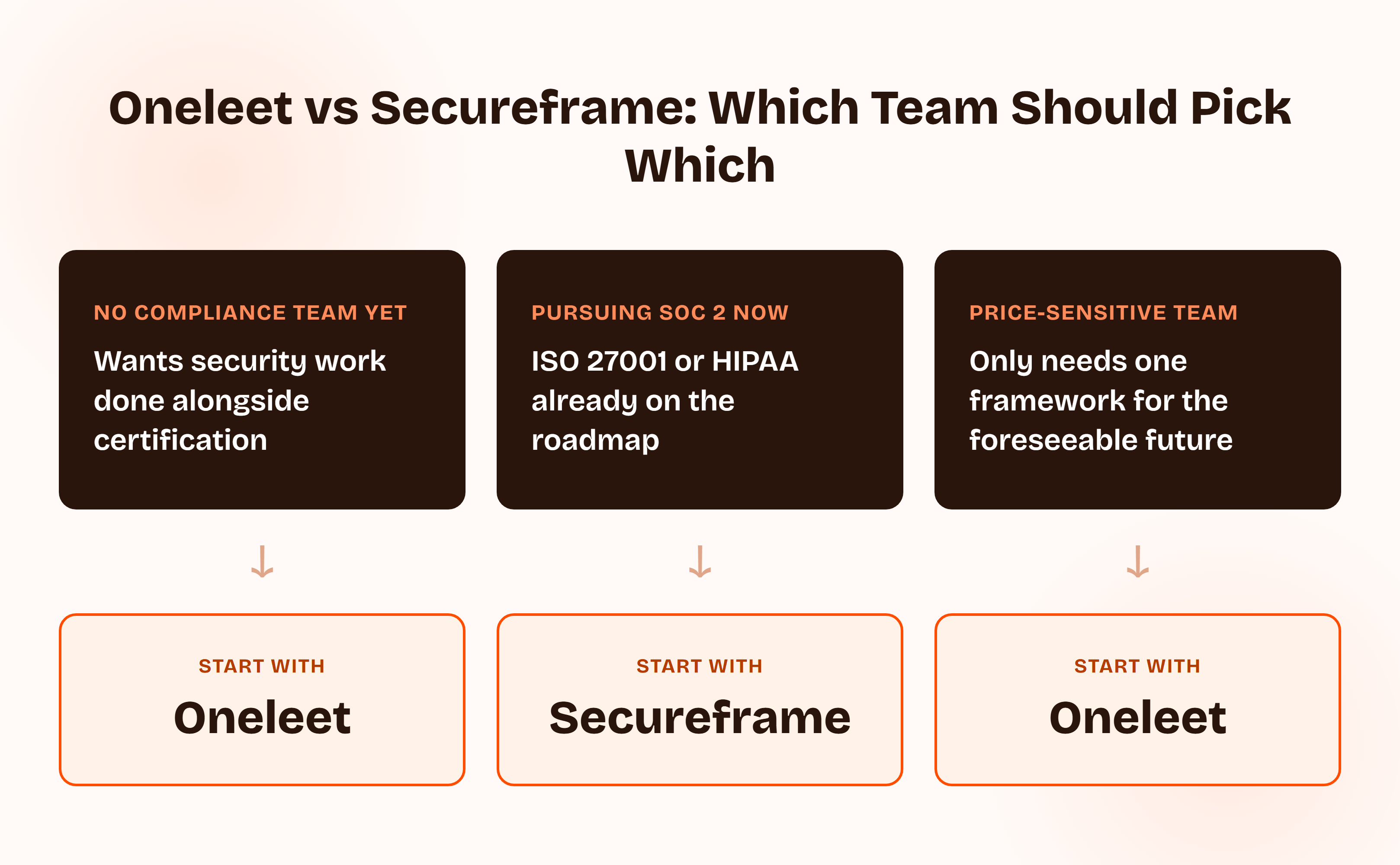
- Pre-compliance-team startup that wants security work done alongside certification: Oneleet's bundled model reduces the number of vendors you're managing during your first audit, and lets you keep an auditor relationship you already trust.
- Team pursuing SOC 2 now with ISO 27001 or HIPAA already on the roadmap: Secureframe's broader framework mapping and guided onboarding tend to pay off sooner than they cost, since you won't be rebuilding integration work per framework.
- Price-sensitive team that only needs one framework for the foreseeable future: Oneleet's lower, more transparent entry point is the harder cost to beat, as long as you're comfortable managing more of the process yourself.
Neither answer is universal. A 10-person startup with a technical founder and a 40-person team with its first dedicated ops hire can land on opposite sides of this same question, and both would be right for their own team.
Oneleet vs Secureframe Comparison Mistakes to Avoid
This oneleet secureframe comparison mistake shows up more than any other: judging by sticker price alone, without accounting for what's bundled in versus billed separately. Here are the others worth knowing before you sign anything.
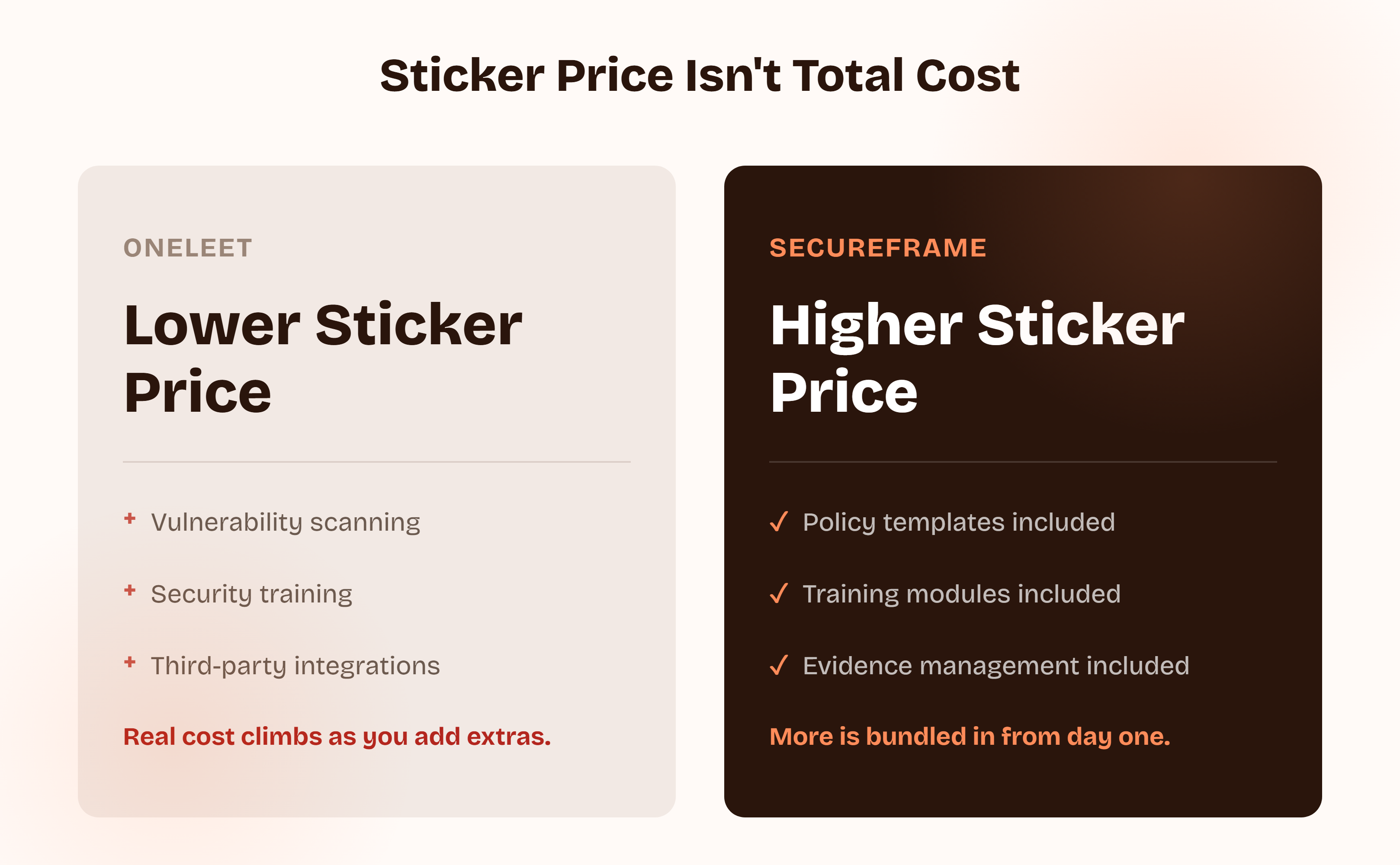
- Comparing sticker price without accounting for bundled services. Oneleet's lower number and Secureframe's higher one aren't pricing the same scope of work.
- Assuming both cover every framework equally well. Coverage breadth differs by framework, not just by platform, so check your specific one.
- Not confirming auditor-network overlap before signing. Oneleet's auditor flexibility and Secureframe's guided network affect how audit-day coordination actually goes.
- Treating "more integrations" as automatically better. A longer list doesn't help if the tools you actually use aren't on it.
- Skipping the audit-experience question until after signing. Ask exactly how audit day works and who coordinates with your auditor, before you're locked into a contract.
- Trusting a competing vendor's comparison page as neutral. If a "neutral" Oneleet vs Secureframe article ends by recommending a third platform, treat its specific claims about either company as marketing, not fact.
Most of these mistakes share the same root cause: comparing Oneleet and Secureframe as if they were interchangeable line items instead of two different operating models built for different teams.
Oneleet vs Secureframe: Making the Final Call
Strip away the feature lists, and the oneleet vs secureframe decision comes down to one honest question: do you want to run more of this yourself, or hand more of it off? Oneleet rewards teams comfortable managing their own auditor and adding tools as needs emerge. Secureframe rewards teams who'd rather pay upfront for guidance and let a broader platform absorb more of the setup work.
Neither answer is wrong. The expensive mistake is picking based on brand recognition or sticker price instead of that actual tradeoff.
If you've read this far and neither platform feels like a clean fit, that's worth sitting with rather than forcing a choice. A team that wants hands-on audit support without giving up flat, predictable pricing usually isn't choosing between "cheap" and "guided" at all: it's looking for an option that doesn't ask it to pick.
That's the gap ComplyJet is built to sit in, not as the cheaper alternative to either platform, but as the more considered one for a team that has actually thought through what it needs.
ComplyJet
Flat per-company pricing, not per seat
If you want hands-on guidance and predictable pricing without picking between Oneleet's and Secureframe's tradeoffs, ComplyJet's flat per-company fee stays the same as your team grows.
FAQs
Which Is Better, Oneleet or Secureframe?
There's no universal winner. Oneleet is better if you want security work bundled in, lower upfront cost, and the flexibility to keep your own auditor. Secureframe is better if you want broader automation, guided onboarding, and you're planning to scale into more frameworks. The right one is whichever matches your team's actual gaps.
Is Oneleet Cheaper Than Secureframe?
Oneleet's entry pricing is generally positioned lower and more transparent, but neither company publishes a fixed rate. Total cost depends on what you add on top of Oneleet's base plan and how much of Secureframe's bundled depth you'd actually use. Get a direct quote from both before assuming either is cheaper for your specific scope.
Oneleet vs Secureframe for Startups: Which Should You Choose?
For a startup with no in-house security or compliance hire that only needs one framework right now, Oneleet's lower cost and bundled security work tend to fit best. For a startup that already knows it's adding a second or third framework soon, Secureframe's guided onboarding and broader automation are usually worth the higher entry cost.
Do Oneleet and Secureframe Support the Same Compliance Frameworks?
Both support the common ones, SOC 2, ISO 27001, and HIPAA among them, but coverage depth and how easily you can add a new framework differ. Secureframe's platform is built around scaling into more frameworks over time; Oneleet's coverage is solid but narrower. Confirm your specific framework against each vendor's current list before deciding.
Can I Switch From Oneleet to Secureframe (or Back) Later?
You can, but it isn't seamless. Evidence and control mappings are only partially portable between any two compliance-automation platforms, so switching means redoing some setup work, not a clean migration. It's rarely worth switching mid-audit-cycle; if you're going to change, do it between audit periods.
Is There a Good Oneleet Secureframe Alternative?
A few exist, including Vanta, Drata, and Sprinto, each with its own tradeoffs worth researching on its own terms. The right oneleet secureframe alternative depends on the same team-shape question this article walks through, not a single universal pick. If what's holding you back from both Oneleet and Secureframe is per-seat pricing uncertainty or wanting more hands-on guidance through the audit itself, ComplyJet's flat per-company model is worth a look too.
Related Reading
- Oneleet vs Vanta vs Drata: Which Should You Actually Pick?, for readers also weighing Vanta or Drata.
- Oneleet vs Vanta, the dedicated two-way Oneleet and Vanta breakdown.
- Oneleet vs Delve, for readers also considering Delve.
- Sprinto vs Oneleet, for readers also considering Sprinto.
- Oneleet Pricing Exposed, full Oneleet total-cost-of-ownership breakdown.
- Oneleet Alternatives, for readers who conclude neither platform fits.