.svg)

Six months into SOC 2 prep, someone on your team finally asks the question everyone's been avoiding: what actually happens once the auditor shows up? Nobody on the call has a real answer.
The SOC 2 audit process runs through five phases: getting audit-ready, a gap analysis to catch problems before an auditor does, selecting and engaging an accredited auditor, the formal audit itself, and a final report carrying one of four possible opinions. Skip any phase or rush it, and the next one gets harder.
The SOC 2 process starts once you've decided which report you need. For a breakdown of the differences between Type I and Type II, see our SOC 2 Type 1 vs. Type 2 comparison.
This guide covers everything that follows: what each phase actually involves, roughly how long the whole thing takes, and what tends to go wrong along the way.
Here's what's ahead:
- What actually happens during a SOC 2 audit, phase by phase
- Why treating this as a compliance formality costs more than treating it as a real process
- Getting audit-ready: scope, documentation, and the internal risk assessment
- The gap analysis and remediation process, and why skipping it is the most expensive shortcut on this list
- How to choose and engage an auditor who won't slow the whole thing down
- What the formal audit actually looks like, week by week
- The four report opinion types, and what each one actually means
- A realistic phase-by-phase timeline, and the most common mistakes that stretch it out
SOC 2 Audit Process Overview: What Actually Happens During the Audit
A SOC 2 audit process is the sequence a company works through to get an independent CPA firm to formally attest that its security controls exist and, for a Type II, that they worked as designed over time. It exists because "trust us, we're secure" isn't evidence, and enterprise buyers stopped accepting it as one a long time ago.
This SOC 2 audit process overview covers the sequence end to end, not just the fieldwork most guides focus on. SOC 2 itself is defined by the AICPA's own Trust Services Criteria, the standard every accredited auditor tests against, and understanding that standard is what makes the rest of this process make sense rather than feeling like an arbitrary sequence of hoops.
Five phases make up the process, and they run in a fixed order because each one depends on the last:
| Phase | What happens | Who's driving it |
|---|---|---|
| 1. Readiness | Define scope, document policies and controls, run an internal risk assessment | Your team, internally |
| 2. Gap analysis and remediation | Identify where current controls fall short of SOC 2 requirements, fix what's fixable before the audit starts | Your team, sometimes with outside help |
| 3. Auditor selection | Find and engage an AICPA-accredited CPA firm to perform the audit | Your team, evaluating auditors |
| 4. Formal audit | The auditor tests controls, gathers evidence, and forms an opinion | The auditor, with your team supporting |
| 5. Report delivery | The auditor issues the final SOC 2 report with one of four opinion types | The auditor |
Everything before Phase 4 happens without an auditor in the room. That distinction matters more than it sounds like it should: a rushed or skipped readiness phase doesn't just slow things down later, it's usually the direct cause of the deficiencies an auditor ends up flagging in Phase 4.
How Often Do SOC 2 Audits Actually Fail on the First Attempt?
SOC 2 doesn't work on a simple pass/fail grade the way a certification exam does. There's no score, and there's no red stamp that says "failed." What actually happens is that the auditor's opinion reflects what they found, and a first-attempt audit with real deficiencies typically comes back with a qualified opinion rather than the clean, unqualified one most companies are aiming for.
We haven't found a single, reliably sourced figure for what percentage of first-attempt SOC 2 audits come back qualified or worse, and a specific number here would be a guess dressed up as a fact.
What's consistent across the audits we've seen is which categories of deficiency show up most often: incomplete access-control reviews, evidence trails with gaps (a policy that exists but was never actually followed for a full quarter), and vendor-risk documentation that's thinner than the actual vendor relationships in place.
None of these are exotic findings. They're the same handful of gaps, repeated across most first-time audits, which is exactly why a real gap analysis in Phase 2 catches most of them before an auditor ever does.
Why the SOC 2 Audit Process Matters Beyond Just Passing
A rushed audit doesn't just risk a worse opinion. It risks the wrong opinion at the exact moment a deal is waiting on it.
Picture the actual sequence: a company skips a real gap analysis, assuming their existing security practices are "probably fine," and goes straight to booking an auditor. Three weeks into fieldwork, the auditor flags a pattern of missed access reviews going back two quarters. That's not a quick fix. It's a remediation cycle, a delayed report, and an enterprise deal sitting in legal review with no report to attach to the contract.
The companies that treat SOC 2 as a checklist to get through are the ones who end up redoing it. The ones who treat the readiness phase as the actual work get through fieldwork without surprises, because there aren't any left to find. — Upendra Varma, CTO at ComplyJet
The cost of getting this wrong isn't abstract. It's a delayed close, a second remediation cycle, and a second round of auditor fees for the same audit period. Getting the process right the first time is cheaper than getting it wrong once.
There's a trust dimension too, separate from the timeline. A prospect who asks for a SOC 2 report is asking a specific question: can this vendor actually back up its security claims with independent evidence, or is it just marketing copy. A rushed audit that comes back qualified doesn't answer that question cleanly, and a clean answer is usually the whole reason the report got requested in the first place.
Phase 1: Getting Audit-Ready: Scope, Documentation, and Risk Assessment
Readiness is the work you do before an auditor ever sees anything. It starts with scope: every SOC 2 audit covers Security, and a company chooses whether to also include Availability, Confidentiality, Processing Integrity, or Privacy, depending on what its customers and contracts actually require.
From there, readiness means assembling the documentation an auditor will eventually ask for: written security policies, access-control procedures, incident-response plans, and evidence that these aren't just documents but things the company actually does. An internal risk assessment closes out this phase, identifying the specific risks to the company's data, infrastructure, and people that the rest of the program needs to address.
None of this needs to happen from scratch every audit cycle. A company going through its second or third SOC 2 audit process is mostly maintaining and updating documentation that already exists, rather than writing it for the first time, which is one real reason renewal audits move faster than a first attempt.
The SOC 2 Audit Process for Service Providers and SaaS Startups
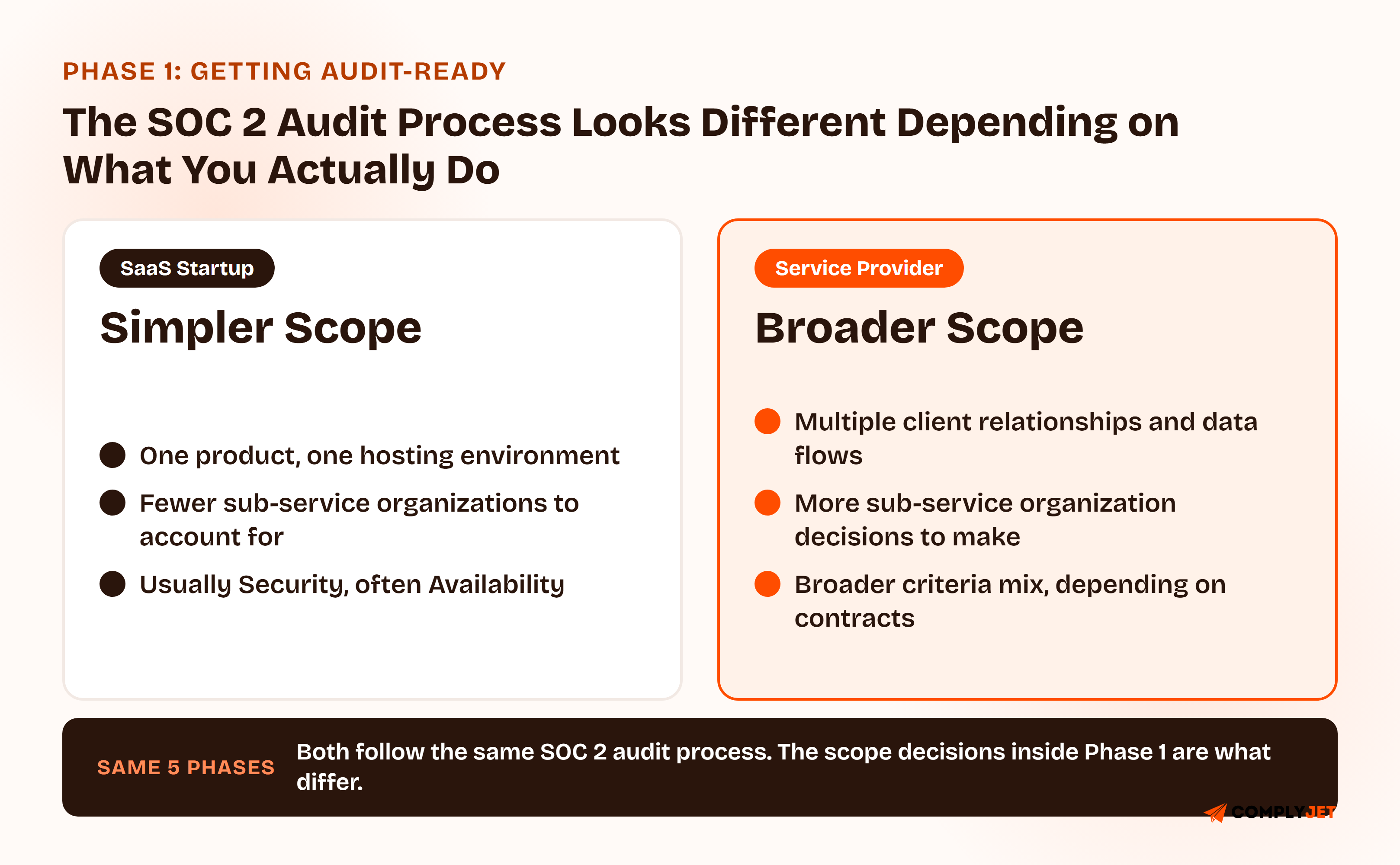
The shape of readiness shifts depending on what the company actually does. A pure SaaS product usually has a simpler scope: one product, one hosting environment, a more contained set of sub-service organizations to account for. A broader service provider handling client data directly, especially one relying on multiple downstream vendors, has more scoping decisions to make about which of those relationships fall inside the audit boundary.
The SOC 2 Type 2 audit process for SaaS startups differs from a Type 1 readiness pass in one specific way: a Type 2 requires proving controls operated consistently across the whole observation period, not just that they existed on the day someone checked. That changes what "ready" means. A policy written the week before an audit kickoff doesn't have months of evidence behind it yet.
Phase 2: SOC 2 Audit Remediation and the Gap Analysis Process
A gap analysis is the company checking its own work before an auditor does. It compares current controls against SOC 2's actual requirements and produces a specific list of what's missing, what's incomplete, and what needs to change before fieldwork begins.
This stage is the SOC 2 audit remediation process in miniature: every identified gap gets an owner, a priority, and a fix-by date. A gap analysis that produces a list nobody actually works through isn't a gap analysis, it's a document that exists to be ignored.
We've covered the full methodology, including the specific steps a real gap analysis walks through, in our dedicated guide to running a SOC 2 gap analysis. The short version: scope the environment, review policies against requirements, test technical controls, check the risk register, map evidence to what auditors will actually ask for, and produce a report that ranks findings by severity rather than burying them in a flat list.
Phase 3: Choosing and Engaging Your SOC 2 Auditor
A SOC 2 audit has to be performed by a CPA firm accredited by the AICPA, and that firm has to be genuinely independent of the company being audited. Beyond that baseline requirement, not every accredited auditor is a good fit for every company, and the difference shows up in how smoothly the formal audit actually runs.
Worth asking directly before signing an engagement letter: how many audits has this firm done in a company's specific industry, what's their typical turnaround from kickoff to final report, and how do they handle follow-up questions during fieldwork. A firm that's audited a dozen early-stage SaaS companies will move faster and ask sharper questions than one whose experience is mostly with larger enterprises in a different sector.
It's also worth actually confirming a firm's accreditation rather than taking their letterhead at face value. NASBA's CPAVerify tool confirms whether a CPA license is active, and it takes under five minutes to check.
We've written a full breakdown of what to actually look for in our guide to choosing a SOC 2 auditor, including a longer list of questions worth asking before you sign anything.
Phase 4: Inside the SOC 2 Type 2 Audit Process, Week by Week
This is the phase most people picture when they think "audit," and it's also the one that generates the most anxiety, mostly because nobody explains what it actually involves in practical terms.
It opens with a kickoff and planning meeting, where the auditor confirms scope, walks through the audit timeline, and explains exactly what evidence they'll need and in what format. From there, the auditor works through a structured request-and-review cycle: they ask for specific evidence (screenshots of configuration settings, exported access logs, copies of signed policies, records of completed security training), review what comes back, and follow up on anything unclear or incomplete.
Control testing and walkthroughs happen alongside the evidence review. For a Type II audit, this means testing whether a control operated consistently across the whole observation period, not just confirming it exists today. The auditor also reviews management's written assertion, the company's own formal statement about its system and controls, and checks it against what the evidence actually shows.
A walkthrough usually means sitting down with whoever actually owns a control and watching them demonstrate it, rather than just reading a policy that describes it. If a policy says access reviews happen quarterly, the auditor wants to see the actual review, with real timestamps and real names attached, not a description of what a review would look like. That's the part that catches companies who documented a process well but never actually ran it.
SOC 2 Audit Process Steps, From Kickoff to Final Testing
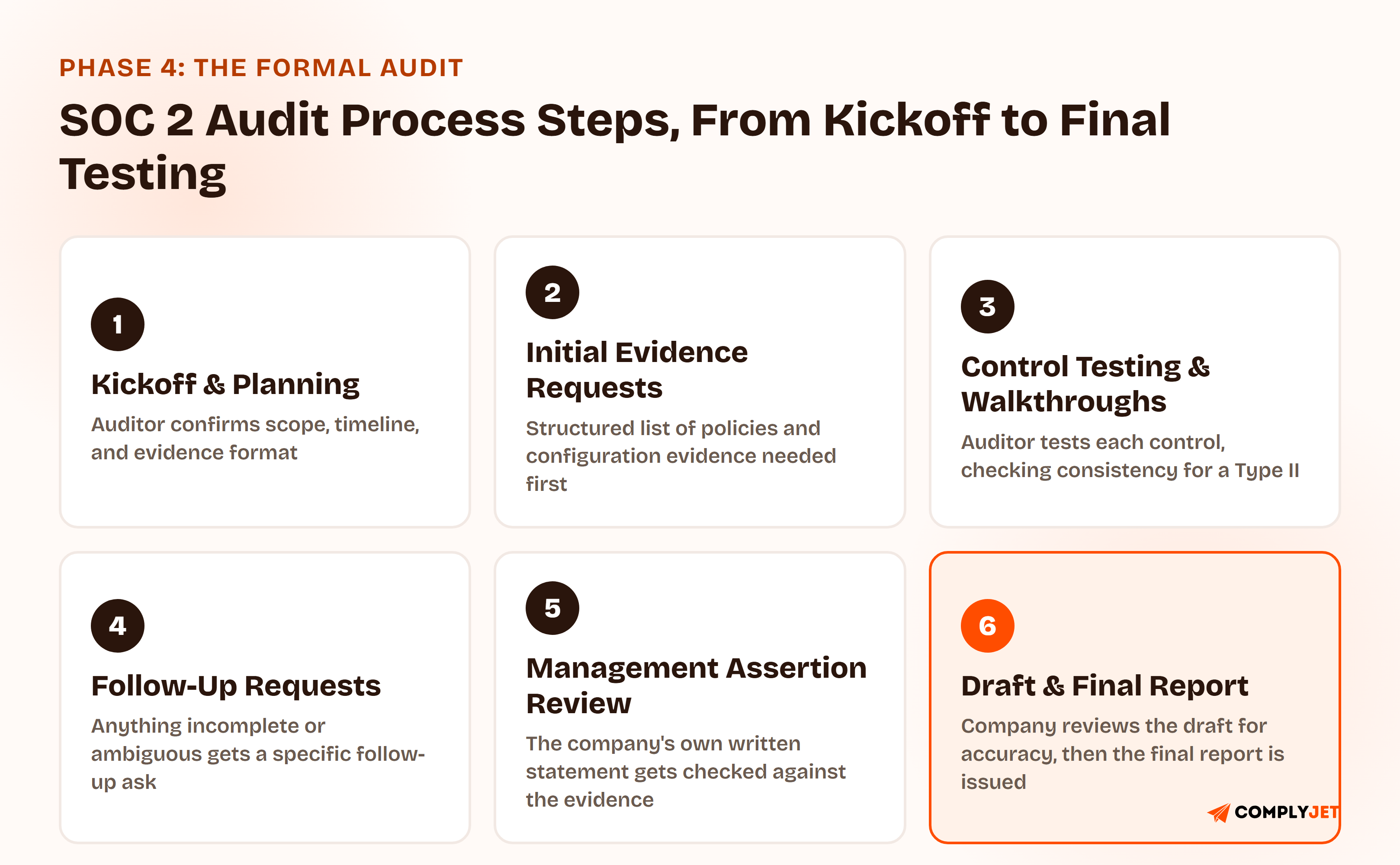
- Kickoff and planning meeting. The auditor confirms scope, timeline, and evidence format expectations.
- Initial evidence requests. The auditor sends a structured list of what they need first, usually policies and system-configuration evidence.
- Control testing and walkthroughs. The auditor tests each control, for a Type II checking consistency across the full observation window.
- Follow-up requests and clarifications. Anything incomplete or ambiguous gets a specific follow-up ask, sometimes several rounds of them.
- Management assertion review. The auditor checks the company's own written statement about its controls against the evidence gathered.
- Draft report and final testing. The auditor circulates a draft, the company reviews it for factual accuracy, and the final report gets issued.
Laid out visually, those six steps look like this:
Most of the actual time in this phase goes to the evidence request-and-follow-up cycle, not to any single dramatic step. A well-prepared company with organized evidence moves through this quickly and predictably. A company still hunting for screenshots mid-audit does not, and it shows in how many follow-up rounds the auditor ends up needing.
Understanding Your SOC 2 Audit Report and Opinion Types
The final report is a formal document, typically structured around five sections: management's assertion, the auditor's own opinion, the company's description of its systems, the detailed testing of controls against the relevant Trust Services Criteria, and any information outside the auditor's scope. Most readers only need to focus closely on two of those: the opinion and the testing results.
The description-of-systems section is worth a second look too, even though it rarely gets the same attention as the opinion. It's where the auditor lays out exactly what was in scope, which matters if the report is ever handed to a customer or partner who needs to confirm the audit actually covered the specific product or environment they care about.
The opinion is the single most consequential line in the whole report. There are four possible types:
| Opinion | What it means |
|---|---|
| Unqualified | No material issues found. The cleanest possible outcome, sometimes with minor exceptions noted that don't affect the overall opinion. |
| Qualified | A material issue exists, but it's confined to a specific, identified area, not pervasive across the whole system. |
| Adverse | Pervasive, significant control failures. The system doesn't meet the criteria being tested, broadly rather than narrowly. |
| Disclaimer of opinion | The auditor couldn't gather sufficient evidence to form an opinion at all. |
For the full breakdown of what separates a clean opinion from the other three, and what specifically pushes an audit from qualified into adverse territory, see our dedicated guide to SOC 2 unqualified opinions. And once the report is in hand, it doesn't stay current forever. Our guide to SOC 2 report validity covers exactly how long it holds up before the next audit cycle needs to start.
SOC 2 Audit Process Timeline: Readiness Duration and How Long the Full Process Takes
Ask "how long does a SOC 2 audit take" and most answers only cover the fieldwork itself, which is the shortest phase in the whole process. The real answer spans every phase from readiness through report delivery.
| Phase | Type I timeline | Type II timeline |
|---|---|---|
| Readiness | 4-8 weeks | 4-8 weeks |
| Gap analysis and remediation | 2-6 weeks | 2-6 weeks, though remediation for a Type II often needs to complete before the observation window even starts |
| Auditor selection and engagement | 2-4 weeks | 2-4 weeks |
| Formal audit (fieldwork) | 2-4 weeks | 2-4 weeks of active fieldwork, on top of a 6-12 month observation period that has to elapse first |
| Report delivery | 1-2 weeks after fieldwork closes | 1-2 weeks after fieldwork closes |
SOC 2 readiness and audit process duration together typically run several months longer than the fieldwork itself, which is exactly the part most first-timers underestimate. A Type I can realistically close out in two to three months from a standing start. A Type II, once the 6-to-12-month observation period is factored in, is closer to eight months to a year for a first-time audit.
For the fuller breakdown of what drives that range up or down, including what actually shortens it on a second or third audit cycle, see our complete guide to how long a SOC 2 audit takes.
Treat this SOC 2 audit process timeline as a planning tool, not a guarantee. A company that starts its gap analysis late, or spends an extra month hunting for an available auditor, pushes every phase after it back by the same amount. The phases don't compress to make up for a slow start; they just happen later.
Common Mistakes That Slow Down the SOC 2 Compliance Audit Process
Most delays in a SOC 2 compliance audit process trace back to a handful of repeatable mistakes, not bad luck. The same patterns show up whether it's a small SaaS startup's first audit or a service provider's third renewal cycle.
- Starting the auditor search after the gap analysis instead of alongside it. Good auditors book out weeks in advance, and a finished gap analysis doesn't help if fieldwork can't start for another two months.
- Treating the gap analysis as a formality rather than the actual point of the readiness phase. A gap analysis that produces a list nobody works through is functionally the same as skipping it, and it defeats the whole purpose of running a SOC 2 audit remediation process before an auditor is involved.
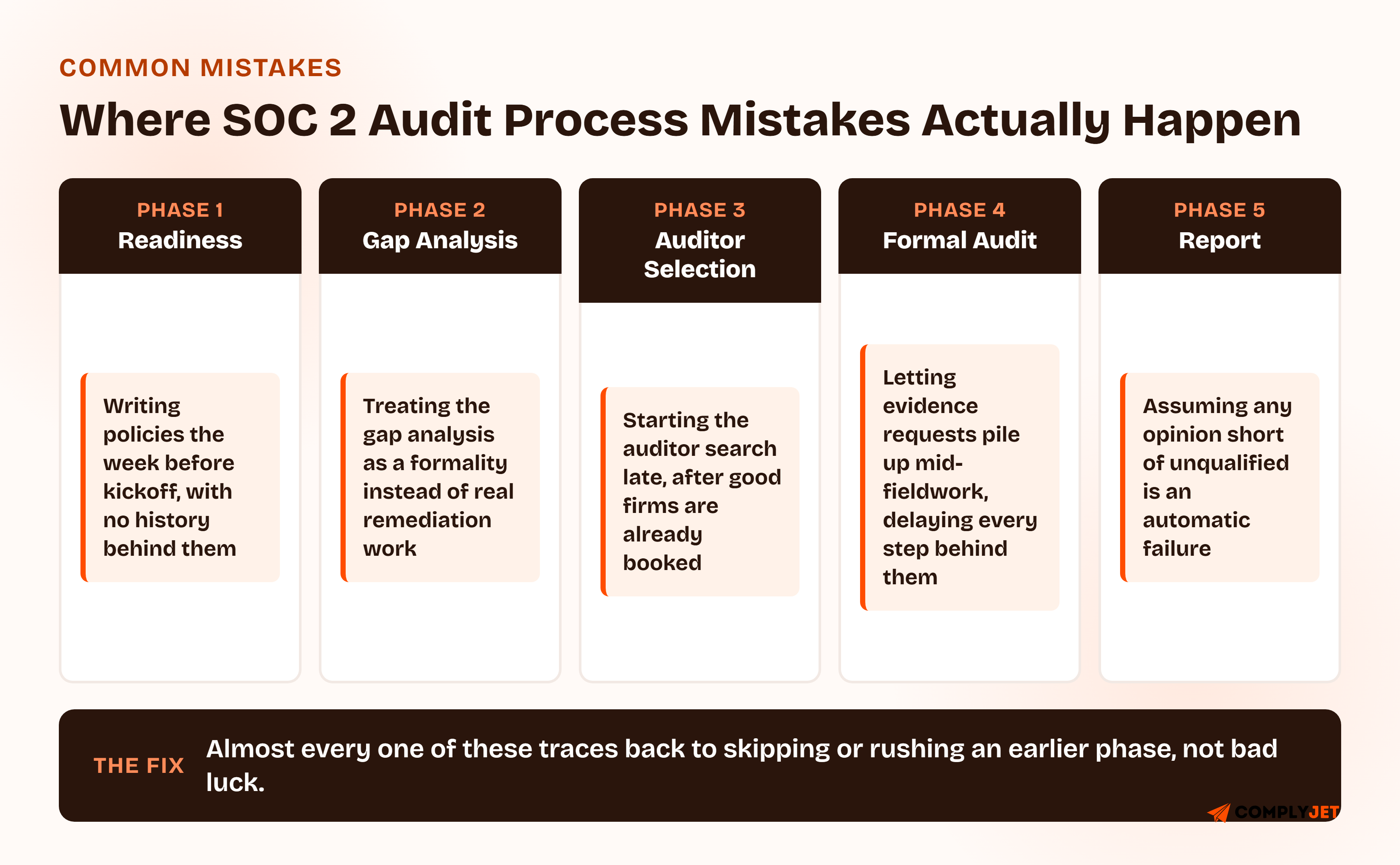
- Writing policies the week before kickoff. For a Type II, evidence needs to exist across the whole observation period. A policy with no history behind it isn't evidence of anything yet.
- Underestimating the Type II observation period. Companies budgeting for "a few weeks of audit" are usually thinking of fieldwork alone, not the 6-to-12-month window that has to elapse before fieldwork can even happen.
- Missing subservice-organization scoping decisions early. Deciding late whether a vendor's infrastructure is inside or outside scope forces rework that a Phase 1 decision would have avoided, and it's a more common miss for service providers juggling several downstream vendors than for a single-product SaaS startup.
- Skipping straight to "the audit steps" without doing the readiness work first. Following a list of SOC 2 audit process steps is useful once the underlying documentation and evidence actually exist. It doesn't substitute for the readiness and gap-analysis phases that come before it.
- Letting evidence requests pile up mid-fieldwork. A slow response to a follow-up request doesn't just delay that one item, it delays every step behind it.
- Assuming the report opinion is binary. Treating anything short of unqualified as an automatic failure misses the real distinction between a narrow, fixable qualified opinion and a genuinely serious adverse one.
Mapped against the five phases, most of these mistakes cluster in one predictable spot each:
How ComplyJet Fits Into Your SOC 2 Audit Process
ComplyJet supports companies through every phase covered here, not just the readiness paperwork. That includes evidence collection and control mapping during Phase 1 and 2, and access to a vetted network of audit partners when it's time for Phase 3, so choosing an auditor isn't a cold search from scratch.
Pricing is flat per company, not per seat, which matters most for exactly the kind of early-stage team going through this process for the first time and trying to budget for it honestly, without a surprise bill tied to headcount growth mid-audit.
FAQs
What Is the Audit Process for SOC 2?
It's a five-phase sequence: getting audit-ready (scope, documentation, internal risk assessment), a gap analysis and remediation cycle, selecting and engaging an AICPA-accredited auditor, the formal audit itself, and a final report carrying one of four possible opinions. Each phase depends on the one before it.
What Percentage of SOC 2 Audits Fail on the First Attempt, and What Are the Most Common Deficiencies Found?
There isn't a single, reliably sourced figure for this, and SOC 2 doesn't use a binary pass/fail grade in the first place. What shows up most often in first-attempt audits with real problems are incomplete access-control reviews, evidence gaps where a policy exists but wasn't consistently followed, and thin vendor-risk documentation.
What Platforms Help Track SOC 2 Audit Progress and Deliver Actionable Insights?
Compliance automation platforms, including Vanta, Drata, Secureframe, and ComplyJet, all offer some version of a dashboard that tracks control status, flags evidence gaps, and shows audit progress in real time rather than leaving it to a spreadsheet someone updates manually.
How Long Does the SOC 2 Audit Process Take From Start to Finish?
A Type I can realistically close out in two to three months from a standing start. A Type II takes closer to eight months to a year for a first-time audit once the required 6-to-12-month observation period is factored in, not just the few weeks of active fieldwork.
What's the Difference Between the SOC 2 Type 1 and Type 2 Audit Process?
A Type I audit checks whether controls are designed properly on a single date. A Type II checks whether those same controls actually operated effectively across an extended period, usually 6 to 12 months. The process for a Type II includes everything a Type I does, plus the additional time needed to build that operating history. For the full comparison, see our SOC 2 Type 1 vs. Type 2 guide.
Related Reading
- SOC 2 Gap Analysis: Identify Compliance Gaps Before Your Audit, for the full gap-analysis methodology summarized in Phase 2.
- How to Choose a SOC 2 Auditor, for the complete auditor-evaluation criteria summarized in Phase 3.
- SOC 2 Unqualified Opinion, for a deeper look at what the cleanest possible report opinion actually means.
- SOC 2 Report Validity, on how long a finished report stays current before the next audit cycle.
- SOC 2 Type 1 vs. Type 2, for readers who haven't yet decided which type of audit to pursue.
- How to Review a SOC 2 Report From a Vendor, for readers on the other side of this process, evaluating a vendor's report rather than going through their own audit.