.svg)

A pull request adds a new S3 bucket. It merges clean, the apply runs, and six months later an auditor asks for proof the bucket was encrypted the entire time, not just today. The Terraform code says it should be. That's not the same thing as proof.
Terraform infrastructure as code audit evidence is the specific set of artifacts, a locked and versioned remote state, a terraform plan run in CI and retained, a PR-linked apply, that an auditor can independently verify, as opposed to a state file or a clean config that only looks like proof. Some of what Terraform produces holds up. Some of it doesn't, and knowing the difference before an audit starts is the entire point of this piece.
We work with early-stage engineering teams heading into SOC 2 constantly, and the ones who already run Terraform through a disciplined CI/CD workflow are almost always closer to audit-ready than they realize, once they know which artifacts to actually retain.
By the end of this, you'll know exactly which SOC 2 criteria map to which Terraform artifacts, why a terraform plan run on a laptop and discarded is worth nothing to an auditor while the same plan run in CI is strong evidence, where drift breaks the evidence trail entirely, and what to actually hand your auditor. Here's what's ahead:
- What terraform infrastructure as code audit evidence actually means, and what it isn't
- Why this matters more than a clean
terraform planat review time - Which SOC 2 criteria map to which specific Terraform artifacts
- The PR-to-apply trail as change-management evidence
- Where drift breaks the evidence trail completely
- A practical checklist for what to hand your auditor
- Common mistakes teams make treating Terraform state as automatic proof
Terraform Infrastructure as Code Audit Evidence: What It Actually Means
Terraform infrastructure as code audit evidence is the subset of what Terraform produces, state, plan output, and version history, that an auditor can independently verify as proof a control was enforced, not just documentation claiming it was.
Building SOC2-shaped infrastructure in Terraform, encrypting the bucket, locking down the IAM policy, turning on CloudTrail, is only half the job. The other half is proving it stayed that way for the whole audit period, and that's a distinct, harder problem than writing the config correctly in the first place.
This is a different topic from ComplyJet's own guide to compliance as code in CI/CD, which covers scanning Terraform and other infrastructure config for misconfigurations before a change ever merges. That's a prevention question: does this pull request introduce a problem? This article picks up after that: once the change has already shipped, what specifically proves it happened the way the pipeline says it did.
Why Terraform Infrastructure as Code Audit Evidence Matters More Than a Clean Terraform Plan
A clean terraform plan at the moment someone reviews it proves one thing: the infrastructure matches the config right now. A SOC 2 Type II audit doesn't ask about right now. It asks whether a control operated effectively across the entire review period, usually six to twelve months, which is a materially different question.
Picture the gap directly: an auditor asks for proof that a specific S3 bucket has been encrypted for the last two quarters, not just that it's encrypted today. A terraform plan run this morning answers a question nobody asked. What actually answers it is a locked, versioned state history showing the encryption setting was there from the first apply, plus the PR trail showing nobody quietly removed and re-added it in between.
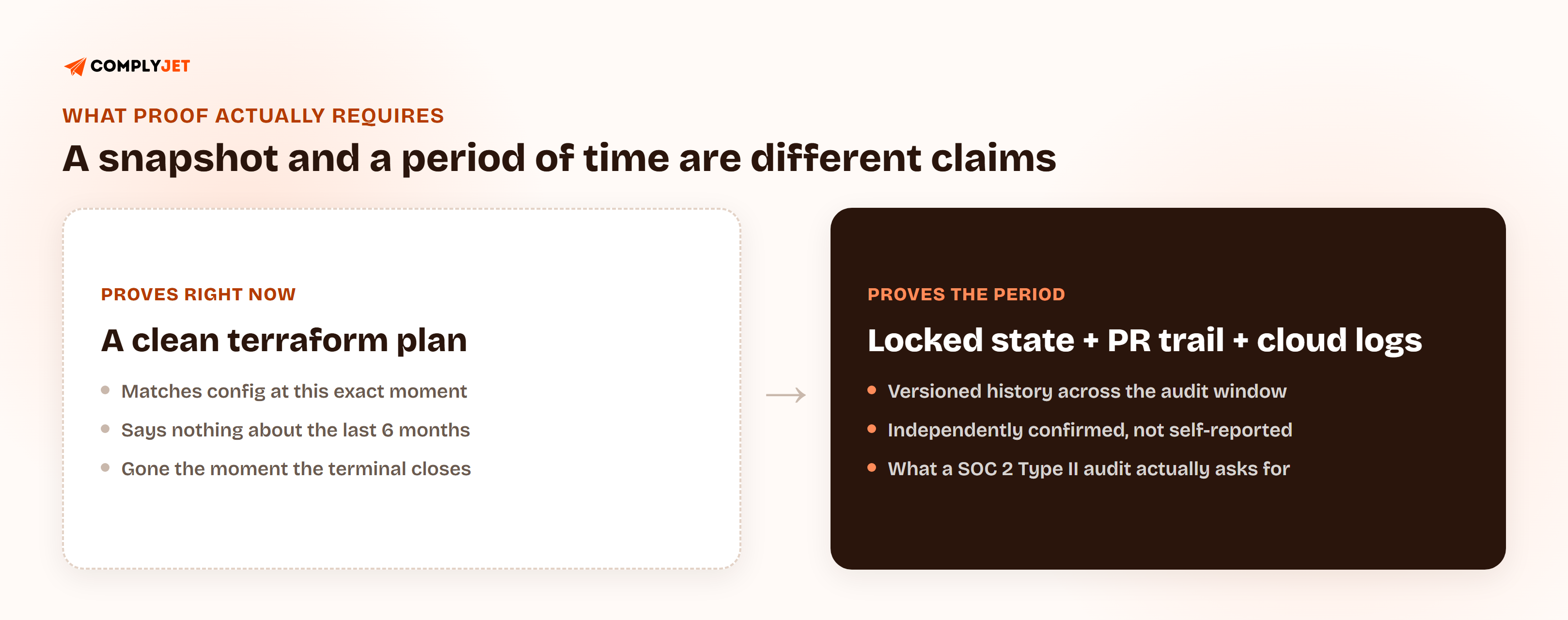
That's the exact substitution teams make without noticing: a plan that answers "is it correct right now" standing in for evidence that answers "did it stay correct."
This is where the framework's own language matters. SOC 2 Type II is explicitly about controls operating over time, not at a single point, which is why a one-time snapshot of clean infrastructure never satisfies it on its own.
Terraform Infrastructure as Code Audit Evidence and SOC 2: What Auditors Actually Ask to See
Terraform SOC 2 compliance work starts with knowing which artifacts an auditor will actually accept as proof, not just which ones feel thorough to build. Auditors typically ask for three things: a record of what changed, a record of who approved it, and a record that the approved state stayed in place.
A Terraform state file is sometimes treated as inherently tamper-proof evidence on its own. That's an overstatement worth correcting directly. Good terraform audit evidence doesn't rest on one artifact, it rests on Terraform's own record plus independent confirmation.
The more defensible position, and the one a careful auditor will actually hold you to, is that Terraform's state and history are a strong supporting record, while the evidence an auditor trusts most tends to come from the cloud provider's own audit trail, AWS CloudTrail, GCP Cloud Audit Logs, Azure Activity Log, observing what the apply actually did to the account. Terraform tells you what was intended. The cloud provider's own logs confirm what actually happened.
Infrastructure-level vulnerability tracking is a related piece of this same cross-referenced picture, worth setting up alongside the audit trail rather than after:
That's a separate evidence stream from the change-management trail this article focuses on, but auditors typically ask for both from a team running infrastructure in the cloud.
Terraform State File Compliance: Local vs. Remote, Locked vs. Unlocked
Terraform state file compliance depends entirely on how the state is stored, not on the fact that a state file exists.
- Local, unversioned state proves nothing. It lives on one laptop, can be edited by hand, and leaves no record of who changed what or when.
- A remote backend with locking (S3 with DynamoDB locking, Terraform Cloud, Terraform Enterprise) turns state into an actual change record. Locking prevents two applies from corrupting each other mid-run, and versioning preserves every prior state so a specific point in time can be reconstructed later.
- Versioning is the part that actually matters for an audit. A locked backend without version history still only proves the current state, not that it held for the whole period.
State alone still isn't full evidence. It has to be tied to a reviewed, logged apply, which is what the next section covers.
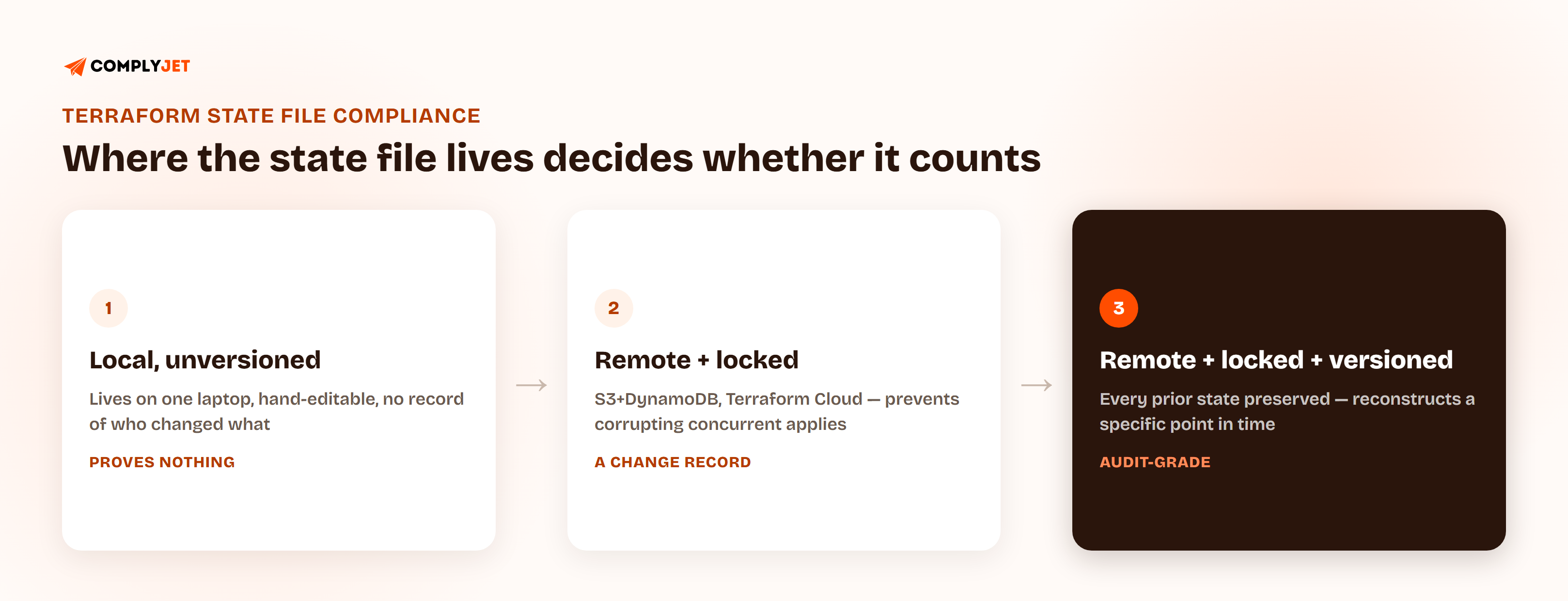
Most teams already sit at tier two, a locked remote backend, without realizing tier three, versioning, is the part an auditor actually cares about.
Mapping SOC 2 Criteria to Terraform Infrastructure as Code Audit Evidence
This is the core of the piece: which specific SOC 2 criteria map to which specific Terraform artifact, and, just as important, which artifact that looks similar doesn't actually satisfy that criterion.
| SOC 2 Criterion | What Counts as Evidence | What Doesn't |
|---|---|---|
| CC6 (access control) | IAM/role definitions in version-controlled config, tied to a reviewed PR that changed them | A screenshot of current IAM settings with no change history behind it |
| CC7 (monitoring) | CloudTrail/Cloud Audit Logs/Activity Log entries triggered by the apply, retained for the audit period | Terraform state alone, with no cloud-provider log confirming the change actually landed |
| CC8 (change management) | A terraform plan run in CI, attached to a reviewed PR, with a required-approval gate before apply | A plan run locally on a laptop and discarded, with no reviewer attached |
The distinction in that last row matters most: a terraform plan is not inherently evidence. A terraform plan that ran in CI, got attached to a pull request, and required a reviewer's sign-off before the apply proceeded is strong change-management evidence. The exact same command run on someone's laptop, reviewed by no one, and never saved anywhere is not, even though the output looks identical.
Terraform does have one lesser-known artifact worth verifying directly rather than taking on faith: a check_results field appears in Terraform state when the configuration uses check blocks, and it records whether each defined validation passed or failed at apply time (source: HashiCorp's Terraform checks documentation). That's a genuinely useful, specific evidence artifact for teams already writing custom checks, though it only exists if those checks were defined in the first place.
Terraform Plan Audit Evidence: What to Save From Every Terraform Apply
Terraform plan audit evidence has to be deliberately saved, because a plan's default output disappears the moment the terminal or CI job that ran it closes.
- Run the plan with an output file:
terraform plan -out=plan.tfplaninstead of letting it print and vanish. - Export it to a reviewable, timestamped format:
terraform show -json plan.tfplan > plan.json, which produces a structured record a reviewer or an auditor can actually read (source: HashiCorp's Terraform CLI documentation on inspecting plans). - Store that JSON file as a build artifact in CI, tied to the specific PR and commit it came from, not as a one-off download someone has to remember to grab.
Running the plan is the easy part. Making it survive past the moment it ran is the step that actually determines whether it counts as evidence later.
Terraform Change Management Evidence: The PR-to-Apply Trail
Terraform change management evidence is the strongest evidence class covered in this entire piece, and it's worth stating plainly rather than hedging: a well-configured PR-to-apply trail is close to airtight.
Walk the full chain: an engineer opens a pull request changing a Terraform file. The saved plan output gets attached or commented on the PR automatically. A required reviewer approves the change. CI applies it, and the state update, the reviewer's approval, the merge timestamp, and the apply log all end up in one connected record, with nothing manually written down at any step.
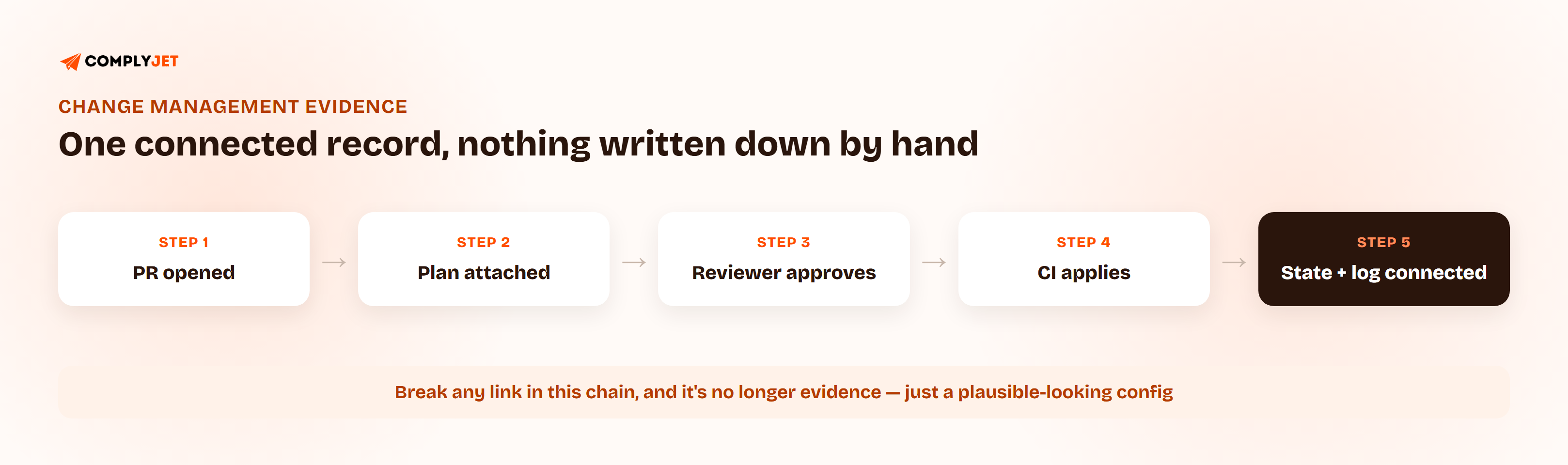
That's what a real change-management record looks like end to end, as opposed to a policy document that describes how changes are supposed to happen.
The teams that struggle at audit time almost never have a Terraform problem. They have a retention problem: the plan ran, the review happened, and then none of it was saved anywhere an auditor could later find it. — Upendra Varma, CTO at ComplyJet
Contrast that full chain with a change made by editing a resource directly in the cloud console. Nothing about that change touches Terraform, the PR trail, or a reviewer. It's invisible to everything covered in this section, and it's exactly the case the next section is about.
Terraform Drift Detection Compliance: Where the Evidence Trail Breaks
Terraform drift detection compliance is the honest limitation section of this article, and it deserves to be stated as plainly as the strengths above.
Drift is infrastructure that no longer matches the Terraform configuration because someone changed it outside the pipeline, directly in the cloud console, through a different tool, or via an emergency fix during an incident. When that happens, Terraform's own evidence trail has nothing to show, because the change never went through Terraform, a PR, or a reviewer at all.
The fix isn't eliminating drift, which isn't fully realistic on a small team without locking down console access entirely. It's catching it. Running terraform plan on a schedule, not only at PR time, surfaces drift as soon as it happens, and a clean scheduled plan run is itself a small piece of evidence: it shows the declared state and the real state matched at that checkpoint, not just at the last deploy.
Teams running Terraform Cloud have one more layer worth knowing the real scope of. Terraform Cloud's audit trail captures run lifecycle events, state version changes, and team and permission changes, retained for 14 days (source: HashiCorp's Terraform Cloud audit trail documentation).
Terraform cloud audit logs are only available on the Standard and Premium tiers, not the free tier. A team assuming they exist by default, on whatever plan they happen to be on, is a real and specific mistake worth checking before an audit, not after.
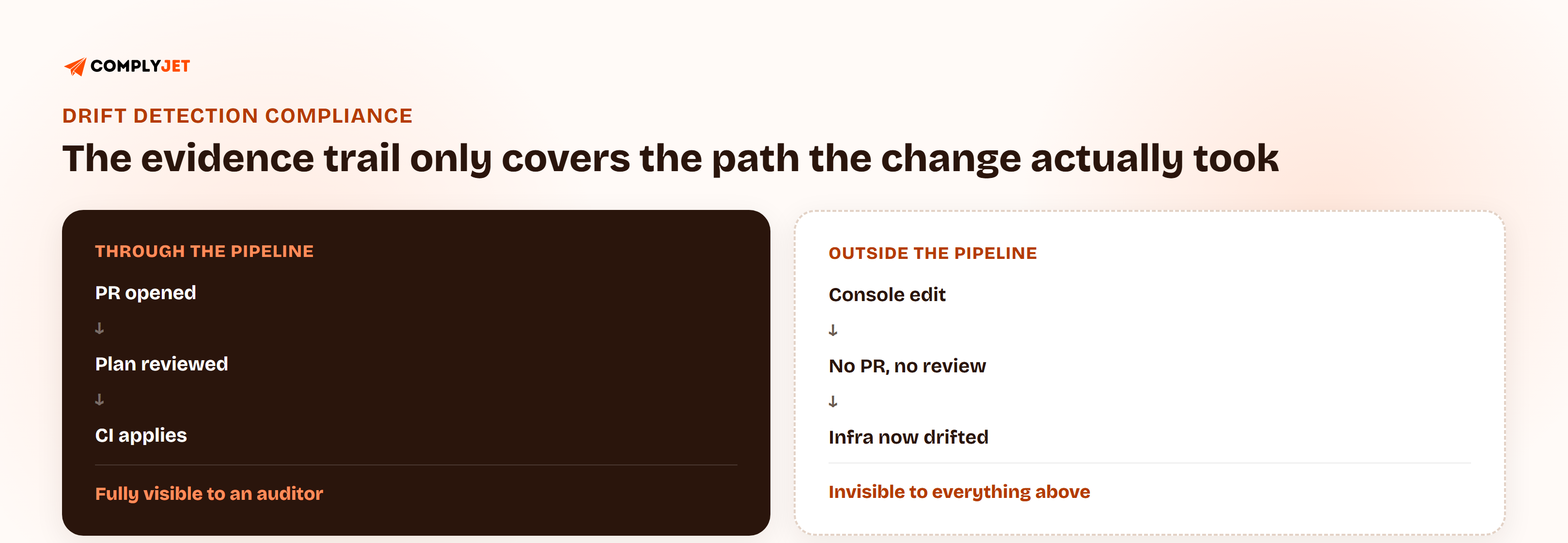
Both paths can produce the exact same end state in the cloud account. Only one of them leaves anything behind for an auditor to check.
Building a Terraform Infrastructure as Code Audit Evidence Checklist for Your Auditor
Here's a discrete list of what to actually collect, tied directly back to the mapping above:
- Remote state, locked and versioned. S3+DynamoDB, Terraform Cloud, or Terraform Enterprise, not local state, ever.
- Saved plan output for every apply, exported to JSON and stored as a CI build artifact tied to its PR and commit.
- The PR trail itself: the diff, the plan attached to it, the required reviewer's approval, and the merge and apply timestamps.
- Cloud-provider audit logs (CloudTrail, Cloud Audit Logs, Activity Log) covering the same period, as the independent confirmation of what Terraform's state claims happened.
- Scheduled drift-check results, showing regular confirmation that the declared state and the real state matched, not just a single clean plan at deploy time.
- Terraform Cloud audit logs, exported if you're on a tier that has them, covering workspace, run, and permission changes.
Each item on that list maps back to a specific SOC 2 criterion from the table above. None of it is complicated to collect; it just has to be retained deliberately, which is the difference between real terraform audit evidence and a Terraform directory plus a promise that it's compliant.
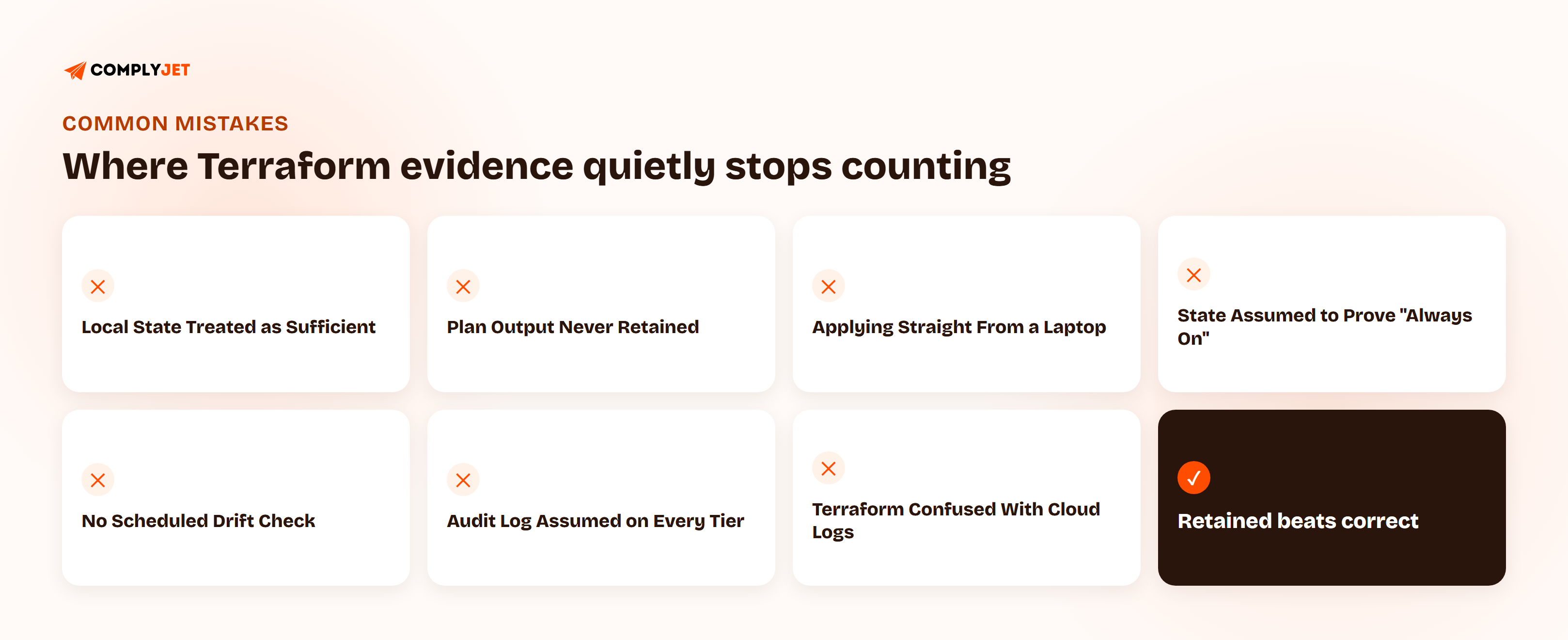
Common Terraform Infrastructure as Code Audit Evidence Mistakes
- Treating local state as sufficient. If the state only ever lived on one engineer's laptop, there's no independent way to prove it wasn't quietly edited.
- Never retaining plan output. A plan that ran and vanished from a terminal window is functionally identical, from an auditor's perspective, to a plan that never ran.
- Applying directly from a laptop outside CI. Even with remote state, an apply with no PR, no reviewer, and no CI log attached breaks the change-management story completely.
- Assuming the state file alone proves a setting was always on. State shows the current declared value. Only version history across the full period proves it held the whole time.
- Never running a scheduled drift check. Without one, console changes and manual fixes accumulate invisibly until something breaks or an auditor asks a question nobody can answer.
- Assuming Terraform Cloud's audit log exists on every plan. It's a Standard/Premium-tier feature. Teams on the free tier have no audit trail to point to unless they build one elsewhere.
- Mixing up Terraform's evidence with the cloud provider's. Terraform proves intent. CloudTrail-class logs prove what actually happened. An auditor who asks for one and gets the other will ask again.
None of these require special tooling to check for, just retention discipline applied consistently from the first apply.
How ComplyJet Fits In
ComplyJet doesn't replace Terraform, a remote state backend, or a CI pipeline. It sits on top of what they already produce and turns it into organized, audit-ready evidence: pulling PR history and plan records from GitHub, cloud-provider audit logs from AWS, GCP, or Azure, and mapping both to the SOC 2 criteria they satisfy.
That's the practical core of terraform soc 2 compliance work for a small team: retain the right artifacts, then let a platform map them instead of doing it by hand.
That matters most for teams without a dedicated platform-engineering function, since none of the artifacts covered above have to be manually re-collected the week before an audit starts.
It sits alongside the CI/CD-level scanning covered in ComplyJet's compliance-as-code guide, not in place of it.
FAQs
How do Terraform state files work as audit evidence?
A state file records the infrastructure Terraform believes exists. On its own, especially if it's local and unversioned, it proves very little. Stored in a locked, versioned remote backend and tied to a reviewed PR-to-apply trail, its history becomes a real change record an auditor can independently check.
Does a Terraform plan count as SOC 2 evidence?
It depends entirely on how it was run. A plan executed locally and discarded proves nothing after the fact. A plan run in CI, saved as a JSON artifact, attached to a reviewed pull request, and gated by a required approval is strong change-management evidence for SOC 2's CC8 criterion.
How does Terraform help with SOC 2 compliance?
Terraform helps in two distinct ways: it lets teams encode controls like encryption and access restrictions directly into infrastructure config, and, when its state, plan output, and change history are properly retained, it generates a real evidence trail for those same controls without separate manual documentation.
What SOC 2 controls can Terraform automate?
Terraform's artifacts map cleanly to three criteria: CC6 (access control) through version-controlled IAM and role definitions, CC7 (monitoring) through cloud-provider audit logs triggered by applies, and CC8 (change management) through a reviewed plan-to-apply trail. None of the three work as evidence unless the underlying artifacts are actually retained.
Is a Terraform state file tamper proof?
Not inherently. A local state file can be edited by hand with no trace. A remote backend with locking and versioning (S3+DynamoDB, Terraform Cloud, Terraform Enterprise) makes tampering far harder to hide, since every prior version is preserved, but the strongest confirmation still comes from the cloud provider's own audit log, not from the state file in isolation.
Related Reading
- Compliance as Code: Baking SOC 2 Controls Into Your CI/CD Pipeline, for the pipeline-scanning side of this same practice.
- SOC 2 Audit Process, Start to Finish, for how this evidence fits into the full audit.
- SOC 2 Auditor Independence: Why It Matters and How to Check It, for the auditor-facing side of evidence review.