.svg)

Your SOC 2 report is signed, dated, and sitting in a shared drive. Then a customer's security team asks one question nobody prepped for: who audited this, and are they actually independent from the platform that ran it?
SOC 2 auditor independence means the CPA firm that issued your report has no financial, operational, or judgment-compromising tie to your company or your compliance platform. It's governed by specific rules in the AICPA's Code of Professional Conduct, not a vague ethical aspiration or a line in a sales deck. A report is only as credible as the independence of the auditor behind it.
By the end of this, you'll be able to name the specific red flags, ask the specific questions, and check an auditor relationship against real rules instead of a gut feeling. Here's what's ahead:
- What SOC 2 auditor independence actually means, and what it doesn't
- Why the whole report depends on it
- The actual AICPA rules behind it, cited directly, not paraphrased
- The tool-provider conflicts of interest regulators are watching in 2026
- How to evaluate your own auditor relationship
- The red flags that show up when independence isn't real
What Is SOC 2 Auditor Independence?
SOC 2 auditor independence means the CPA firm issuing your report has no relationship with your company, or with the compliance platform facilitating the audit, that could compromise its objective judgment. That's the whole definition. Everything else is detail on how that gets checked and where it breaks.
Auditor independence requirements aren't optional guidance a firm can take or leave. They're specific, enforceable rules a CPA firm has to satisfy before it's even allowed to sign a SOC 2 report. A firm that fails independence isn't delivering a weaker opinion, it's not delivering a valid one at all.
Two things independence is not. It isn't the auditor being difficult, slow, or unfriendly to work with, and it isn't a general reputation claim like "they're a respected firm." It's a specific, rule-governed relationship structure that either holds or doesn't, independent of how the engagement feels day to day.
Independence vs. Competence
These are two separate questions, and a report can fail on either one. A competent, well-regarded auditor can still be compromised on independence if the fee structure or the platform relationship crosses a line. An independent auditor with no conflicts can still do a shallow audit if they're not competent or thorough. Checking one doesn't check the other.

Why SOC 2 Auditor Independence Is What Audit Integrity Actually Means
A SOC 2 report is only as trustworthy as the audit behind it. A customer, investor, or acquiring company relying on that report isn't really evaluating your controls directly, they're trusting the auditor's judgment about your controls. If that judgment isn't independent, soc 2 audit integrity breaks down at the source, and the whole chain of trust the report is supposed to establish collapses quietly, without anyone necessarily noticing until it matters.
When independence is compromised, the report doesn't become obviously wrong. It becomes a document that looks like assurance without functioning as assurance. It still has a CPA firm's name on it, still cites the right Trust Services Criteria, still reads like every other SOC 2 report.
The difference is invisible until someone asks the right question, or until a real incident exposes a control that was never actually tested. That gap between a report that looks credible and one that actually is credible is the entire reason soc 2 audit integrity has to be checked directly, not assumed from a polished PDF sitting in a shared drive.
This is exactly why "is my SOC 2 report credible" is a fair question to ask even after the report is in hand, not just before you engage an auditor. A credible report is one where the auditor's independence and the rigor of the testing both hold up to scrutiny, not just one where a report exists.
AICPA Independence Rules SOC 2 Non-Attest Services Must Follow
SOC 2 auditor independence isn't a matter of professional opinion. It's grounded in specific sections of the AICPA's Code of Professional Conduct, the same rulebook that governs every attest engagement a CPA firm performs, whether the client is a Fortune 500 company or a ten-person startup running its first SOC 2 cycle.
| Rule area | ET section | What it requires |
|---|---|---|
| Independence Rule | 1.200.001 | The base requirement: no financial or other interest that could compromise objectivity toward the client |
| Independence Standards for SSAE Engagements | 1.297 | Independence rules specific to attestation engagements like SOC 2, not just traditional financial audits |
| Conceptual Framework for Independence | 1.210.010 | A risk-based method for identifying threats to independence not covered by a specific rule |
| Conflicts of Interest for Members in Public Practice | 1.110.010 | Requires disclosure and safeguards when a firm's other relationships could bias its judgment |
| Determining Fees for an Attest Engagement | 1.230.030 | Restricts fee arrangements (like contingent or platform-set fees) that tie payment to audit outcomes |
| Commissions and Referral Fees Rule | 1.520.001 | Limits compensation for referring clients between a platform and an audit firm |
SOC 2 Auditor Independence and the Self-Review Problem
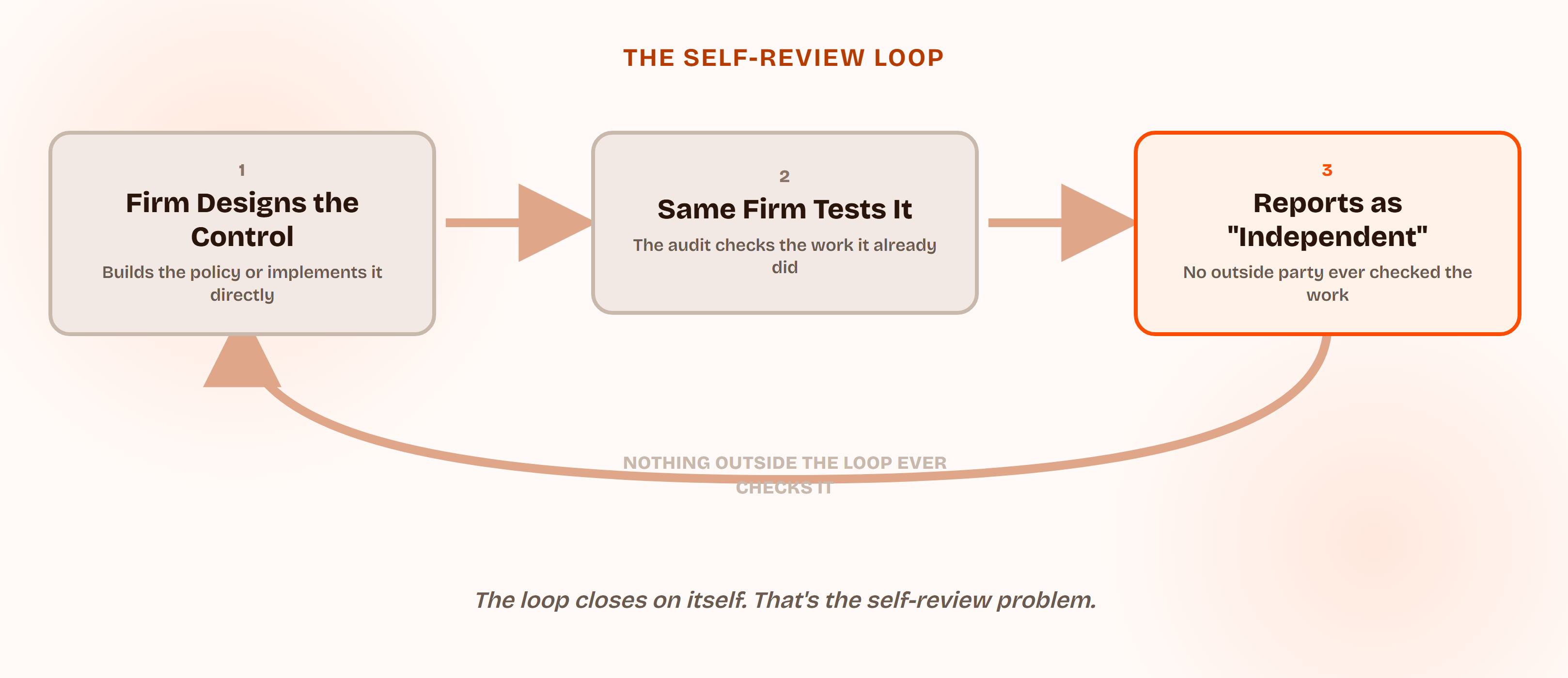
One of the clearest independence violations is self-review: an auditor can't design or implement the same controls they later audit. That principle, per Sensiba's analysis of the AICPA's own SOC 2 guidance, means a CPA shouldn't implement controls, take on management responsibility, or insert themselves as a decision-maker in how a system is designed or operated.
In practice, this means a SOC 2 non-attest services line on an engagement matters more than it looks. If the same firm, or an affiliated one, helped build your access-control policy and then tests that policy during the audit, it's reviewing its own work, not yours.
The same logic applies to a compliance platform that builds its own "readiness" tooling and then treats passing that tooling as equivalent to independent testing, or to a firm that runs penetration testing or incident response for a client and then audits the controls those same services touch. Either way, the auditor ends up grading work it had a hand in producing, which is precisely what the self-review threat is meant to catch.
The 2026 AICPA Update on SOC 2 Auditor Independence
In April 2026, the AICPA's Professional Ethics Division published new interpretive guidance specifically on SOC engagement ethics risks tied to tool-provider relationships, covered in the Journal of Accountancy's April 2026 issue and made available in the AICPA's Online Ethics Library from April 27, 2026 under "Relationships With SOC Tool Providers."
It names two concrete threat categories: undue influence, meaning pressure to subordinate professional judgment, and self-interest, meaning financial benefits tied to fee arrangements. Both apply directly to the compliance-platform-plus-auditor model most companies use today, not just to the old-fashioned financial-statement audits the independence rules were originally written around.
SOC 2 Auditor Conflict of Interest and the Readiness Platform Problem
The 2026 AICPA guidance names specific arrangements that create a SOC 2 auditor conflict of interest, and they're worth checking against your own setup one by one.
- Cross-referral arrangements. A compliance platform steering client introductions to a specific audit firm, with or without compensation changing hands.
- Observation rights. A platform holding contractual rights to observe audit work or sit in on discussions between the auditor and the client.
- Deadline pressure. A platform setting completion timelines that push an auditor to conclude before they'd otherwise be satisfied with the evidence.
- Bundled fees. A software-plus-audit package where the platform, not the audit firm, effectively sets the examination fee.
- Non-disparagement clauses. Contract language that would stop an auditor from communicating a required finding to the client.
- Pay-to-access evidence. An auditor being required to pay the platform for access to the evidence they need to complete the examination.
A SOC 2 readiness platform auditor relationship deserves the same scrutiny as any other audit arrangement, not less. If the platform and the audit firm are affiliated, share ownership, or are connected through an exclusive referral deal, that's the first thing worth checking, not an afterthought once the report is in hand.
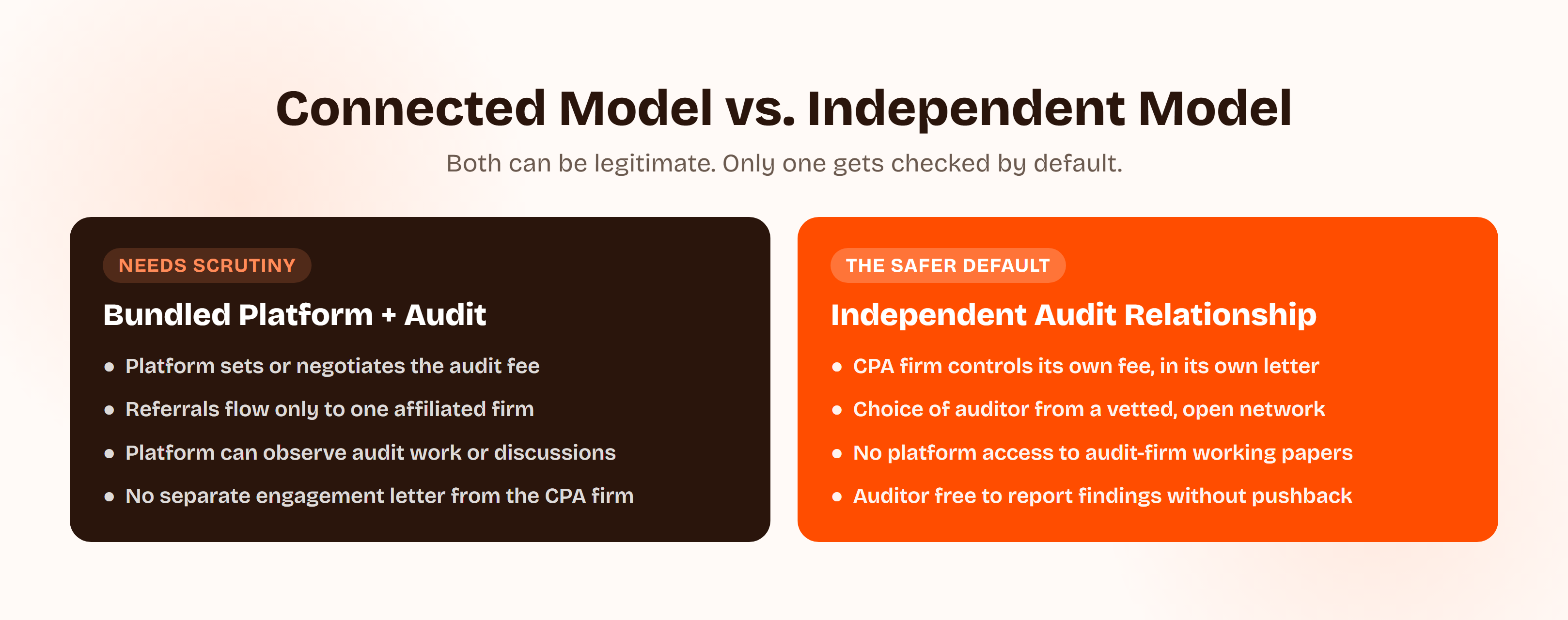
None of this makes a connected model automatically disqualifying on its own. Some platforms do connect to an affiliated but legally separate CPA entity, and that structure can still satisfy independence rules if the safeguards are real: a genuinely separate engagement letter, a fee the audit firm controls, and no contractual leverage running back to the platform.
The point isn't to assume bad faith. It's to actually check the structure of a soc 2 readiness platform auditor relationship rather than assume the connection is fine because the platform says so, and to ask the same questions of a connected model that you'd ask of any independent one.
How to Evaluate a SOC 2 Audit for Real Auditor Independence
Knowing how to evaluate a SOC 2 audit for independence doesn't require a law degree. It requires asking specific questions and expecting specific answers, not vague reassurance.
- Who signs the report, and are they independent of the platform? Ask directly whether the signing CPA firm has any ownership, referral-fee, or fee-setting relationship with the compliance platform involved. A clean answer names the firm and describes the relationship in plain terms, not a deflection back to "we work with several great partners."
- Did the firm help design any control it later tested? If the same organization built your policies and then tested them, that's a self-review problem, not a convenience. Ask specifically whether any non-attest work (policy drafting, control implementation, remediation consulting) came from the same firm signing the report.
- Is the report's language genuinely company-specific? A report that reads identically to another company's, down to the phrasing, suggests templated conclusions rather than real testing.
- What did evidence sampling actually look like? A credible auditor can describe their sampling method, sample sizes, and what they did when something didn't check out. A vague "we reviewed everything" answer isn't a real answer.
- Does "fast" mean efficient, or does it mean skipped? Automation can speed up evidence collection without compromising the audit. It's a problem when speed comes from skipping walkthroughs, sampling, or professional judgment, not just paperwork.
- Does the engagement letter come directly from the audit firm? A separate, direct engagement letter is a basic sign the CPA firm, not the platform, controls the terms of the audit.
This doubles as a working SOC 2 audit quality checklist, and the AICPA independence rules SOC 2 auditors have to follow are exactly what each question is checking against, not a generic best-practices list. Keep it, and run through it before signing an engagement letter and again before accepting the finished report, not just once.
Red Flags That Signal Your SOC 2 Auditor Independence Isn't Real
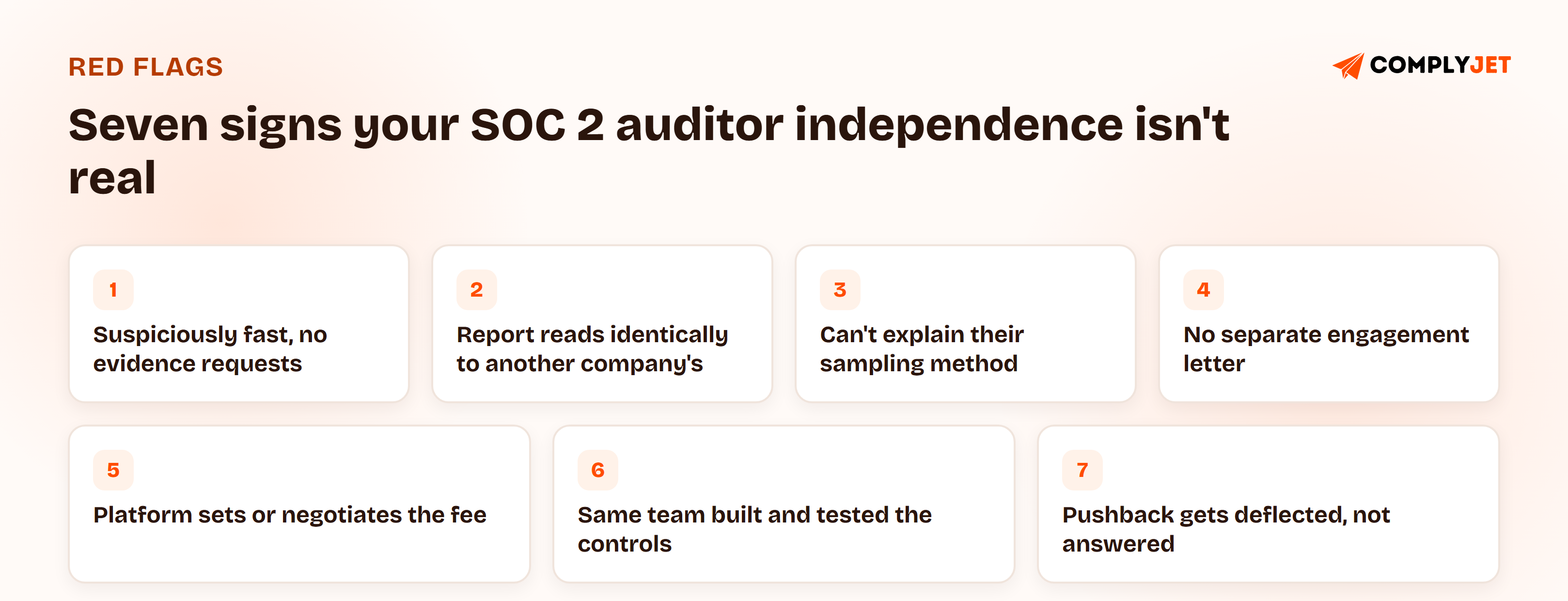
Most independence failures don't announce themselves. They show up as small, specific patterns, and most of them trace back to the auditor independence requirements covered above, just visible from the outside rather than read directly off a rulebook.
- An audit that finished in days with almost no evidence requests. Real testing takes real time, even with automation doing the collection work.
- A report whose narrative reads identically to another company's. Copy-pasted conclusions are a sign nobody actually looked closely at yours.
- An auditor who can't explain their own sampling methodology. If they can't describe how they picked what to test, they may not have tested much at all.
- No separate engagement letter from the audit firm. If the only paperwork is with the platform, not directly with the CPA firm, that's worth questioning immediately.
- The platform sets or negotiates the audit fee on the firm's behalf. Fee control is one of the clearest independence threats named in the AICPA's own rules.
- The same team that built your controls also tested them. This is the self-review problem showing up in practice, not just in theory.
- Pushback gets deflected instead of answered. A credible auditor will explain their independence posture directly. Evasiveness is itself a signal.
None of these require special access to spot. They're visible from outside the audit itself, which is exactly why they're worth checking before anyone relies on the report.
How ComplyJet Supports SOC 2 Auditor Independence
To be direct: ComplyJet doesn't audit or certify SOC 2 compliance. Auditor independence is a CPA-firm function governed by AICPA rules, not something a software platform can grant or vouch for on its own behalf.
Where ComplyJet fits in is the groundwork that makes an independent audit go well. We keep evidence collection, control implementation, and audit judgment on separate sides of the relationship, and work with a vetted, independent audit-partner network rather than an in-house or affiliated CPA arrangement. The goal is a customer who can hand any qualified, independent auditor a clean, organized body of evidence, not a customer locked into one connected audit path.
FAQs
What makes a SOC 2 auditor independent?
A SOC 2 auditor is independent when the issuing CPA firm has no financial, operational, or fee-based tie to the company being audited or the compliance platform facilitating the audit, per the AICPA's Independence Rule and its SSAE-specific independence standards. Independence has to hold before the engagement starts and throughout the audit period.
Can a compliance platform also be my SOC 2 auditor?
No. A software platform itself can't be the CPA firm issuing the report, and a firm that also builds the readiness tooling it later tests against runs into the same self-review problem. Some platforms connect to an affiliated but separate CPA entity, which can be independent in practice, but that structure deserves direct scrutiny rather than an assumption.
What are red flags in a SOC 2 audit?
An audit that finishes unusually fast with almost no evidence requests, a report whose language reads identically to another company's, an auditor who can't describe their sampling methodology, and a platform that sets or negotiates the audit fee on the firm's behalf are the clearest warning signs.
What is a non-attest service in SOC 2?
A non-attest service is work like designing controls, implementing a policy, or building readiness tooling that isn't the audit itself. When the same firm provides significant non-attest services and then audits that same work, it creates a self-review threat to independence under AICPA rules.
Is My SOC 2 Report Credible?
A credible report comes from an auditor with no compromising ties to your company or platform, real evidence testing rather than templated conclusions, and a transparent, explainable sampling methodology. If any of those are missing or vague, the report's credibility is worth questioning even if it's already signed.
What questions should I ask my SOC 2 auditor?
Ask who signs the report and whether that firm has any financial or referral relationship with your compliance platform, whether they designed any control they're now testing, how they sampled evidence, and what happens when something doesn't check out. Vague or deflected answers are themselves informative. Working through the full soc 2 audit quality checklist above before you ask covers the rest.
Can my SOC 2 auditor also help implement my controls?
Generally, no, not without creating a self-review threat. An auditor providing significant non-attest services, like designing or implementing the controls they later test, compromises the independence the AICPA's rules require for a valid SOC 2 opinion.
Related Reading
- How to Choose a SOC 2 Auditor: The Full Guide, for the earlier question of which auditor to pick in the first place.
- How to Review a SOC 2 Report From a Vendor, for reading a report you already have in hand.
- SOC 2 Audit Process, Start to Finish, for the operational mechanics of the audit itself.
- Is SOC 2 a Certification?, for the attestation-vs-certification distinction that independence protects.