.svg)

What if your biggest prospect sent over a vendor security questionnaire? You open it. Page 3, question 47: “Has your organisation conducted a third-party penetration test in the last 12 months?” If the answer is no, you just lost your biggest client.
This scenario is playing out across hundreds of B2B SaaS sales cycles right now. It also plays out mid-audit, when an auditor asks for penetration test evidence, and your team has 30 days to find a vendor, schedule a test, fix findings, and package everything for review.
Vulnerability exploitation as a breach initiation path surged 180% year-over-year in 2024, nearly tripling in one year. The urgency around SOC 2 penetration testing has never been higher.
SOC 2 penetration testing sits at the intersection of compliance, security, and revenue. The AICPA does not explicitly mandate it. But the practical answer in 2026 is that you need it to close enterprise deals and satisfy auditors.
This guide covers the exact SOC 2 penetration testing requirements, the full process from scoping to evidence packaging, what auditors accept, how much it costs, how to pick the right vendor, and how to connect your pen test results to a clean SOC 2 certification.
Still figuring out how to turn pen test evidence into audit-ready SOC 2 proof?
Book a free ComplyJet demo and see how your findings, remediation tasks, auditor evidence, and SOC 2 controls can stay connected in one place before question 47 costs you a deal.
Here’s a quick summary if you’re short on time.
SOC 2 Penetration Testing in 2026
- SOC 2 does not explicitly mandate penetration testing. But AICPA’s CC4.1 names it as the leading example of a “separate evaluation,” making it the de facto standard for audit evidence in 2026.
- CC4.1 is the governing criterion. The AICPA Trust Services Criteria under CC4.1 state that management should use “a variety of different types of ongoing and separate evaluations, including penetration testing.” That language puts pen testing first in the list.
- Annual testing is the minimum. For SOC 2 Type 2, the test must fall within the audit observation period to count as valid evidence.
- Grey box testing is the recommended method for SOC 2. It skips time-consuming discovery while delivering targeted, scope-matched control assessment.
- Cost ranges from $5,000 to $30,000 or more. A standard SaaS scope covering a web app, API, and cloud infrastructure typically runs $8,000 to $25,000.
- Automated-only reports are not sufficient. Auditors need human-driven adversarial testing. AI-only or scanner-only outputs can be rejected.
- Critical findings do not automatically fail your audit. A documented corrective action plan paired with retest evidence is what auditors want to see.
- Third-party testing carries more weight than internal testing with both auditors and enterprise buyers.
Now that you know the basics, let’s dive deep.
What Is SOC 2 Penetration Testing?
SOC 2 is a framework developed by the AICPA that validates a service organisation has the security controls needed to protect customer data.
It evaluates organisations against five Trust Service Criteria: Security (mandatory in every audit), Availability, Processing Integrity, Confidentiality, and Privacy.
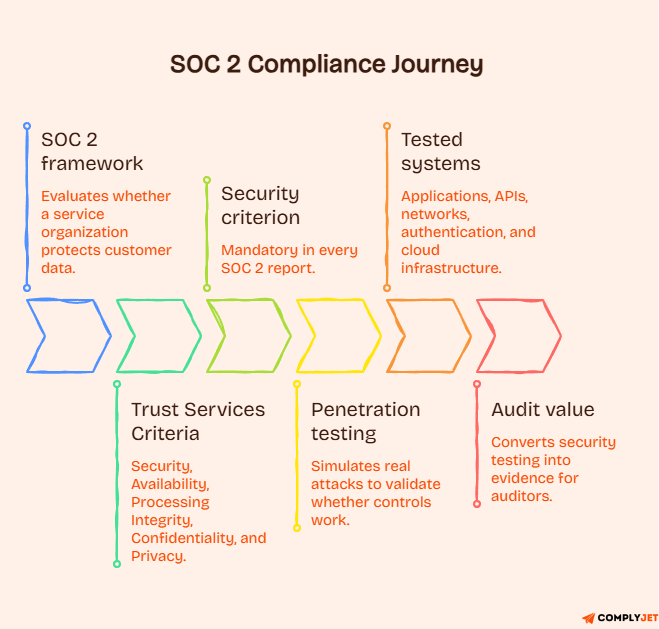
SOC 2 penetration testing is an authorised simulated cyberattack conducted within your SOC 2 system boundary. Testers attempt to exploit real weaknesses in your applications, APIs, network, and cloud infrastructure.
Every finding gets mapped to specific Trust Service Criteria rather than treated as a generic security report.
The distinction matters more than most people realise. Documentation tells an auditor your controls exist. A penetration test shows them that your controls actually work when a real attacker tries to break them. Application misconfiguration was an attack vector in 26% of web application breaches in 2025, and 56% of organisations experienced a breach or compromise in the preceding 12 months.
Policies on paper do not catch those.
Tip!
If you are new to SOC 2, start with understanding your SOC 2 compliance basics before diving into penetration testing. It will help you understand exactly which controls your pen test is validating.
Now that you understand what SOC 2 penetration testing is, the next question every founder asks is the obvious one: do you actually have to do it?
Does SOC 2 Require Penetration Testing?
The honest answer has three layers, and most guides give you only one.
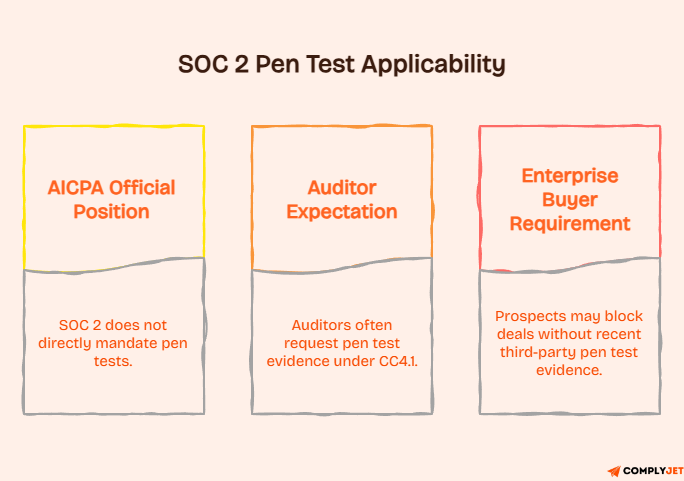
The AICPA does not explicitly mandate penetration testing anywhere in its Trust Services Criteria. The word “required” does not appear next to pen testing in the framework. That is layer one.
Layer two is the auditor’s expectation. In 2026, most SOC 2 auditors treat penetration testing as standard CC4.1 evidence, especially for Type 2 engagements.
When an auditor sees no pen test in your evidence binder, their first question is: Why not? You need a documented justification and alternative evidence. Most teams find it easier to just run the test.
Layer three is your enterprise buyers. They do not care what the AICPA technically requires. When a prospect sends a security questionnaire with question 47, they want a yes. For B2B SaaS companies pursuing enterprise deals, penetration testing is effectively mandatory because of buyer expectations, independent of what your auditor says.
Why this matters?
Missing a pen test does not just risk your audit. It risks your pipeline. Enterprise procurement teams treat a missing pen test as a red flag, regardless of your SOC 2 report status.
Is Pen Testing Required for SOC 2 Type 1?
SOC 2 Type 1 is a point-in-time snapshot. Auditors assess whether your controls are appropriately designed on a specific date. They are not evaluating whether those controls operated over time.
For Type 1, pen testing carries less weight. Auditors reviewing Type 1 primarily want to see policies, procedures, and documented control design. A single pen test can appear as supporting evidence, but it is not the audit’s central focus.
Here is the catch: enterprise buyers do not distinguish between Type 1 and Type 2. A prospect asking for your pen test results does not care which audit type you ran. They want the evidence. So even for Type 1, doing the pen test is often the right call.
Does SOC 2 Type 2 Require Penetration Testing?
Type 2 is a different story. The audit covers operating effectiveness over 3 to 12 months. Pen testing becomes the most compelling single piece of evidence you can produce, because it shows your controls held up under real adversarial conditions during the period under review.
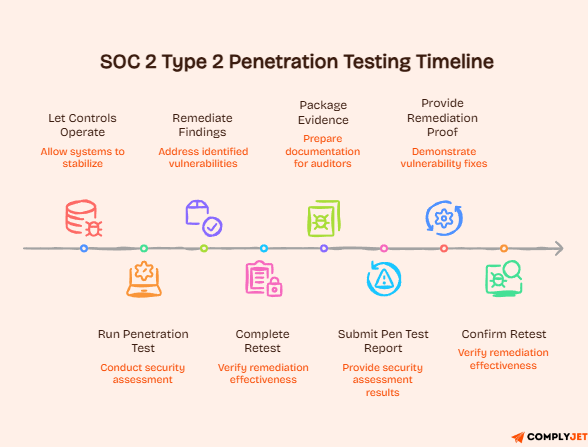
The test must fall within the audit observation period to count. A pen test completed before your observation period started, or after it ended, does not satisfy CC4.1 for that audit cycle. Ideal timing is months 4 to 8 of a 12-month observation period. That leaves 30 to 60 days for remediation and retest before your auditor begins fieldwork.
A pen test paired with a documented remediation trail and a retest report is far more compelling than the pen test alone.
That three-part package is what creates strong Type 2 evidence. You can also find more on managing your SOC 2 audit timeline to time this correctly.
With the “is it required” question answered, let us look at the specific criteria your pen test actually satisfies.
What Are SOC 2 Penetration Testing Requirements in 2026?
SOC 2 penetration testing requirements are not a single checkbox. Multiple Trust Service Criteria are satisfied by a well-executed pen test, and understanding which criteria map to which test activities helps you build audit-ready evidence from day one.
Most competitors cover only CC4.1 and CC7.1. The full picture is more specific than that, and auditors who know their criteria will notice if your evidence does not connect the dots.
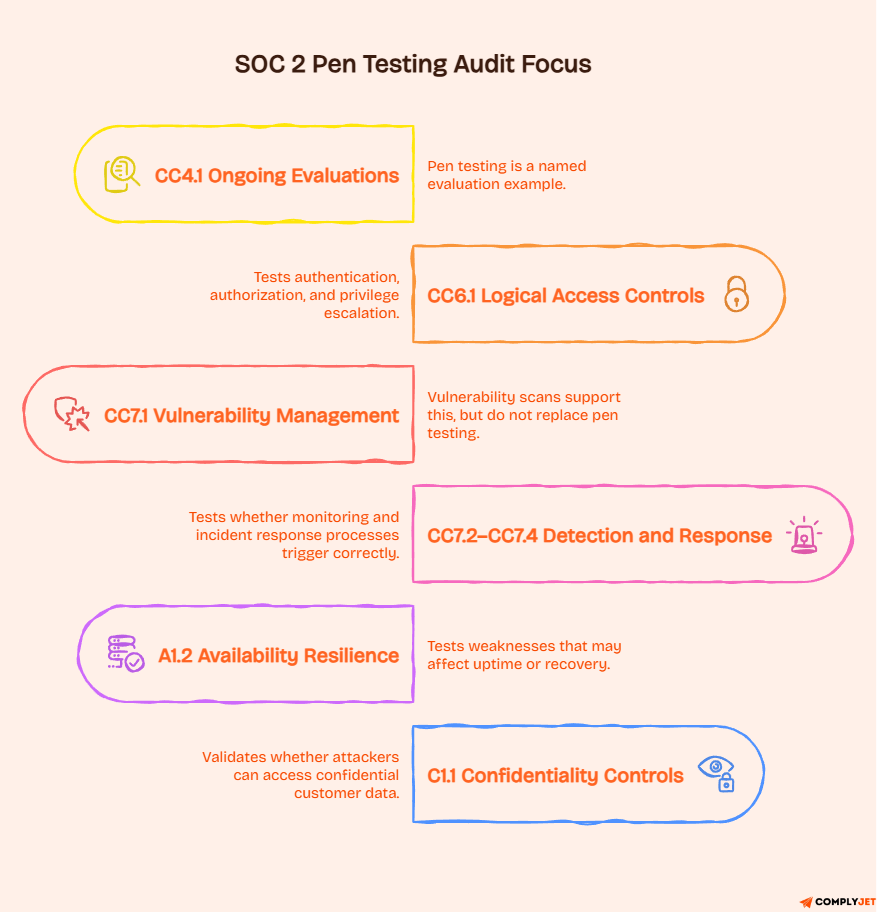
The split between CC7.1 and CC4.1 is one of the most misunderstood points in SOC 2. Vulnerability scanning maps to CC7.1. Penetration testing maps to CC4.1. Both are expected. Neither alone is enough. Explore the full breakdown in our SOC 2 gap analysis guide.
What Does AICPA CC4.1 Say About Pen Testing?
CC4.1 is the anchor criterion for penetration testing in SOC 2. The exact AICPA language, from the 2017 Trust Services Criteria revised in 2022, states:
“Management uses a variety of different types of ongoing and separate evaluations, including penetration testing, independent certifications made against established specifications (for example, ISO certifications), and internal audit assessments.”
Notice what comes first. The AICPA lists penetration testing before ISO certifications and internal audits. That ordering is intentional. CC4.1 corresponds to COSO Principle 16 on monitoring activities.
The AICPA is telling you exactly what it expects to see as evaluation evidence.
When your auditor references CC4.1 during fieldwork and asks about your testing program, this is the language they are working from. Quote it back to them with your pen test evidence, and you are having a very different conversation than a team that cannot explain the connection.
Read: SOC 2 Controls List: The Complete Founder’s Guide (2026)
With the criteria mapped out, let us look at how pen testing requirements differ depending on which SOC 2 type you are pursuing.
SOC 2 Type 1 vs Type 2 Pen Testing: Key Differences
SOC 2 Type 1 and Type 2 serve different purposes, and your pen test plays a different role in each. Here is how the two compare.
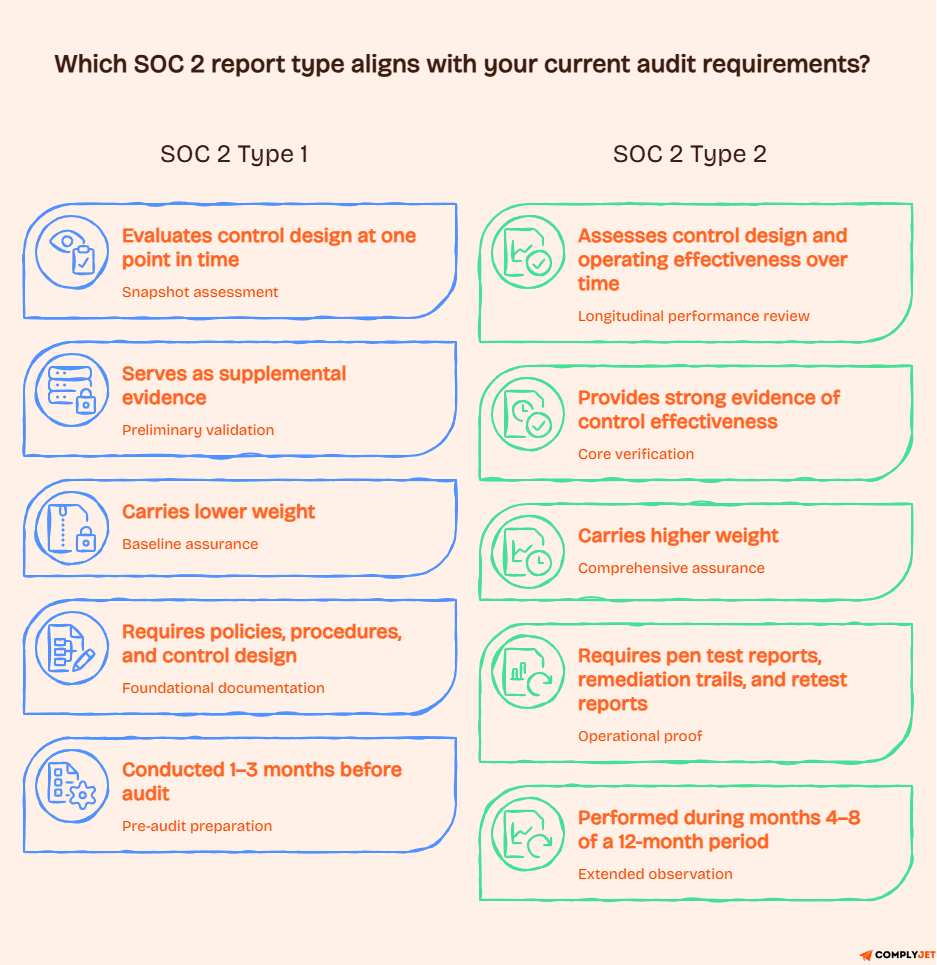
For Type 1, the pen test validates that your security architecture works as described. For Type 2, it demonstrates that your controls held up under adversarial conditions over the entire review period.
Did you know?
A Type 2 pen test without a remediation trail is far weaker than a Type 2 pen test with findings, a corrective action plan, and a verified retest report. The process of finding and fixing is the actual audit evidence, not just the initial test.
Now that you know how pen testing fits each audit type, it is time to understand which type of pen test is right for your environment.
What Are the Types of SOC 2 Penetration Testing?
Not every penetration test is built the same way. The approach your vendor takes and the systems they cover directly affect what evidence you produce and whether it satisfies your auditor. SOC 2 pen testing breaks down across two dimensions: how much information the testers start with, and what systems they target.
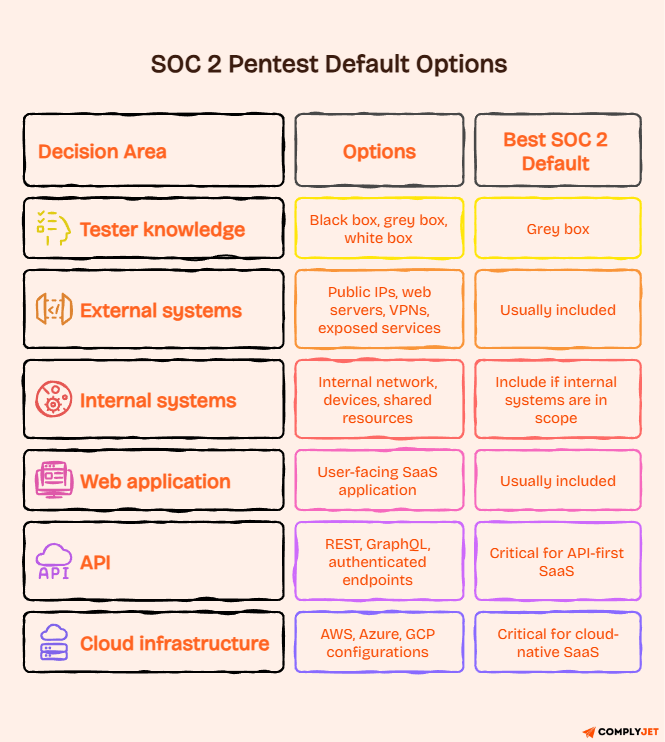
Choosing the wrong combination wastes money and produces weak audit evidence. Getting it right means your pen test speaks directly to the criteria your auditor is checking.
Black Box, White Box, or Grey Box for SOC 2?
Black box testing simulates an external attacker with zero prior knowledge. The tester discovers everything from scratch. This is the most realistic simulation, but it spends significant time on reconnaissance that may not generate relevant audit evidence.
White box testing gives testers complete access such as architecture diagrams, source code, and configuration details.
It is the most thorough approach, but it costs more and takes longer. A minimum frequency of every six months is common for organisations using white box testing.
Grey box testing is the industry recommendation for SOC 2 compliance. Testers receive partial information, enough to skip time-consuming discovery and focus directly on the controls your auditor cares about.
It is the most efficient method for producing targeted, scope-matched evidence. For most SaaS companies, grey box is the right default.
External and Internal Network Penetration Testing
External network testing evaluates all internet-facing systems within your SOC 2 boundary: web servers, email infrastructure, API servers, VPN gateways, and any publicly accessible management interfaces. It simulates what an external threat actor would attempt against your perimeter.
Internal network testing goes behind the perimeter. It tests desktops, printers, internal servers, and shared resources. It emulates a compromised insider or an attacker who has already breached the perimeter.
This category of testing validates your detection and response capabilities, which map directly to CC7.2 through CC7.4.
Web Application and API Penetration Testing
Web application testing covers the OWASP Top 10 2025 vulnerability categories, including Broken Access Control, Cryptographic Failures, Injection attacks, Security Misconfiguration, and Server-Side Request Forgery. This is the most common scope for SaaS companies.
API testing runs alongside web and mobile app testing and covers the OWASP API Security Top 10 2023.
The most common and impactful finding is Broken Object Level Authorisation (BOLA), where one user can access another user’s data by manipulating API parameters. API-first SaaS companies should treat this scope as non-negotiable.
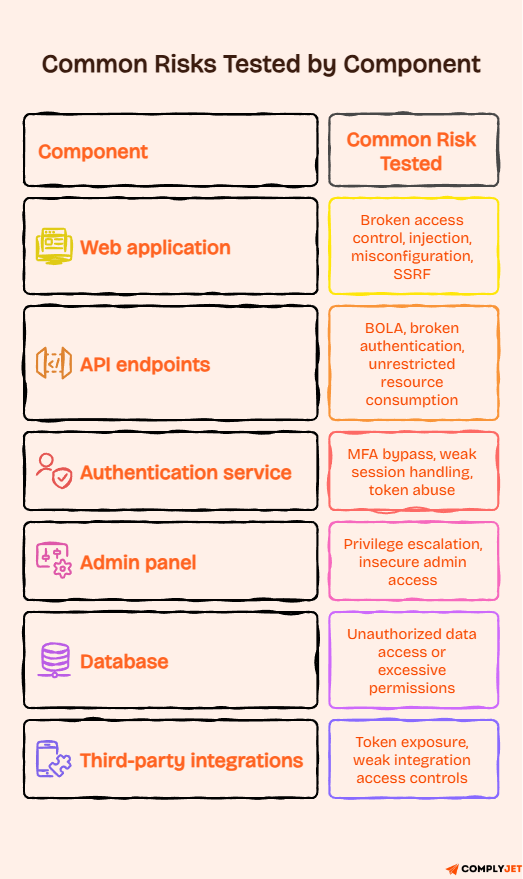
Understanding your SOC 2 password requirements alongside your API authentication controls gives your tester a clearer picture of what to probe.
Cloud Infrastructure Testing for AWS, Azure & GCP
Cloud infrastructure testing evaluates your AWS, Azure, or GCP environments against the shared responsibility model.
You manage from the OS upward in IaaS environments, application and data in PaaS, and data plus access in SaaS configurations. Misconfigurations within your responsibility zone are what testers look for.
Common findings include misconfigured S3 buckets, over-permissive IAM roles, unencrypted data at rest, and exposed management interfaces. According to Tenable’s 2024 Cloud Security Outlook, 95% of organisations surveyed suffered a cloud-related breach in the previous 18 months, with insecure identities and misconfiguration as the leading causes. Cloud scope is not optional for companies running on public infrastructure.
Understanding the types of pen testing sets the stage for one of the most important clarifications in this entire topic: What is the actual difference between a penetration test and a vulnerability scan?
Pen Testing vs Vulnerability Scan: What SOC 2 Needs
Most founders assume a vulnerability scan is close enough. It is not, and the distinction is important enough that auditors will specifically ask which approach you used.
A vulnerability scan is automated. It identifies potential weaknesses. It maps to CC7.1. A penetration test is human-driven and manual. It actively exploits identified weaknesses to produce proof of impact. It maps to CC4.1. Both are expected for a complete SOC 2 program. Neither alone satisfies the full picture.
According to NIST SP 800-115, penetration testing specifically involves “targeting individual binary components or the application as a whole to determine whether intra or intercomponent vulnerabilities can be exploited.” That definition requires human judgment, not just tool output.
A critical warning for 2026: AI-only or scanner-only platforms marketed as “pen tests” are not acceptable. Auditors look for human-driven adversarial testing with exploitation evidence, chained attack paths, and business logic findings that scanners cannot surface. A statement of work that references no recognised methodology (Penetration Testing Execution Standard, NIST SP 800-115, or OWASP WSTG) is a red flag your auditor will notice.
Software vulnerabilities were involved in 31% of security incidents in 2026, surpassing stolen credentials as the top entry vector. A scan that identifies CVEs is not the same as a test that proves they can be chained into a breach.
Now that you know what type of testing SOC 2 actually needs, here is exactly how a proper engagement runs from start to finish.
The SOC 2 Penetration Testing Process: Step by Step
A proper SOC 2 pen test has nine distinct phases. Most engagements that fail audit review cut corners somewhere in this sequence, usually at scoping, remediation, or evidence packaging.
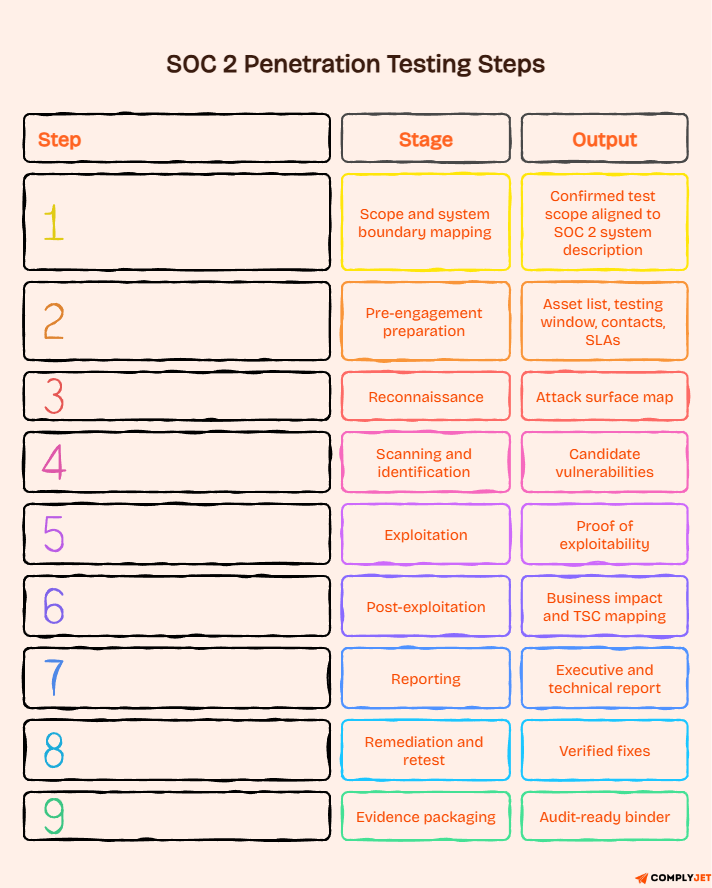
Step 1: Scoping and System Boundary Mapping
Your pen test scope must mirror your SOC 2 system description exactly. If the system description says customer data lives in your production environment, APIs, and AWS infrastructure, all three must be in scope. Auditors check this. Scope misalignment is the primary reason pen test evidence gets challenged.
Step 2: Pre-Engagement Preparation
Document every system within the SOC 2 boundary. List all external network ranges, IPs, web apps, and APIs. Confirm the testing window falls within your audit observation period. Establish your internal coordination contacts across engineering and security. Set your remediation SLAs before the test begins: Critical and High findings get 7 to 14 days, Medium findings get 30 days, and Low findings get 90 days.
Step 3: Reconnaissance
The tester maps your attack surface through passive and active information gathering. Asset inventory, entry point identification, and service enumeration happen here.
Step 4: Scanning and Vulnerability Identification
Static and dynamic analysis identifies potential attack vectors. Port scanning, service fingerprinting, and configuration review generate the list of candidates for active testing.
Step 5: Exploitation
This is the phase that separates a pen test from a vulnerability scan. Testers manually exploit identified weaknesses. They chain low-risk findings into high-impact attack paths. Business logic flaws get surfaced here because only a human tester can recognise them. Authentication bypass, privilege escalation, and network segmentation violations are all tested in this phase.
Step 6: Post-Exploitation and Impact Assessment
Testers demonstrate persistence and lateral movement to show real-world business impact. Every finding gets mapped to a specific Trust Service Criterion.
Step 7: is reporting
The output includes an executive summary, CVSS-scored findings, exploitation evidence (screenshots, command outputs, session logs), and remediation recommendations mapped to TSC criteria.
Step 8: Remediation and Retest
Findings get fixed according to SLA priorities. A retest verifies that each fix actually works. The retest report is a separate document and becomes part of your audit binder.
Step 9: Evidence Packaging
Your final audit binder contains the original pen test report, remediation documentation showing what was fixed and when, the retest report confirming closure, and formal corrective action plans for any findings that required extended timelines. Review our SOC 2 audit checklist to make sure your binder is complete before fieldwork begins.
The process tells you how to run a pen test. What comes next tells you how to make sure your auditor actually accepts what you produce.
What Do SOC 2 Auditors Want from Your Pen Test?
Auditors are not reviewing your pen test to see if you found vulnerabilities. They are reviewing it to see if your security monitoring and response program works. That distinction changes what your evidence needs to look like.
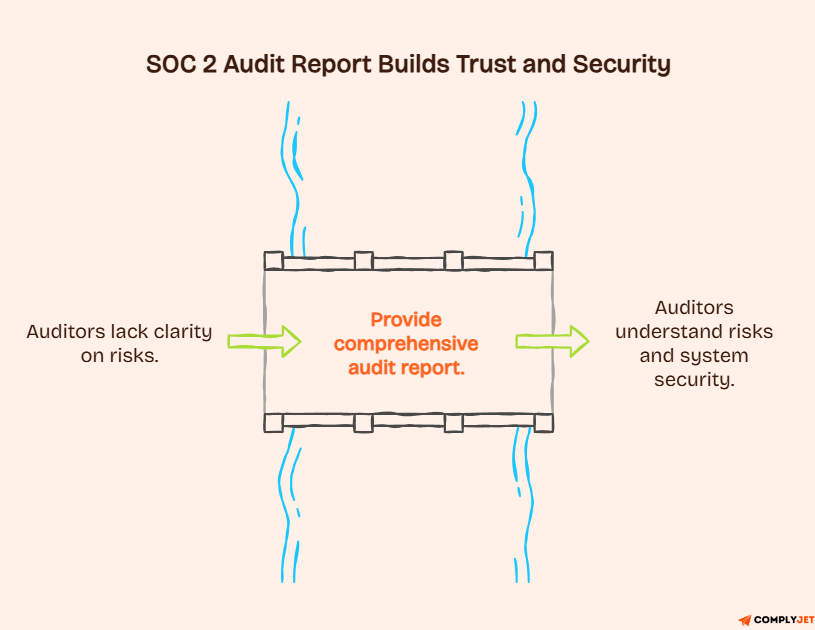
A pen test report that reads like a generic security assessment, without TSC criterion mapping and retest documentation, is not audit evidence. It is a security document. The two are not the same thing in the eyes of your auditor.
What Should a SOC 2 Pentest Report Include?
A credible, audit-ready penetration test report must contain nine components:
- Executive summary written without technical jargon, for auditors and leadership to understand
- CVSS-scored findings, rated on the Common Vulnerability Scoring System scale from 0 to 10
- Exploitation evidence in the form of screenshots, command outputs, and session logs proving vulnerabilities were actively tested, not just identified
- Proof that all in-scope systems were covered, documented as scope coverage confirmation
- Findings mapped to specific Trust Services Criteria, with CC4.1 as the minimum
- Risk-prioritised remediation recommendations that are specific and actionable
- Remediation documentation showing what was fixed, when, and by whom
- Retest results confirming each fix were verified as effective
- Technical appendix with raw data for your engineering team
Third-party pen tests carry significantly more weight with auditors than internal testing. Independent evaluation provides assurance that internal teams have not inadvertently worked around their own known weaknesses.
What If Critical Vulnerabilities Are Found?
Critical findings do not fail your SOC 2 audit. This is one of the most misunderstood points in the entire pen testing conversation.
What auditors want to see is a documented corrective action plan plus a retest report showing the fix worked. The process of finding a critical issue, documenting it, fixing it within SLA, and verifying the fix through retest actually demonstrates a mature security program. That is precisely what CC4.1 is designed to surface.
The only scenario that damages your audit outcome is unresolved critical findings at the end of the remediation period. Auditors will note “exceptions” or issue “qualified opinions” for those in the final report.
According to Verizon’s DBIR 2024, 68% of breaches involve a non-malicious human element. Vulnerabilities being discovered is expected and normal, not embarrassing. What matters is how you respond. Read more on what a qualified audit opinion means for your SOC 2 report.
Once you understand what auditors want, cost becomes the next practical question every founder needs answered.
How Much Does SOC 2 Pen Testing Cost in 2026?
Penetration testing costs vary significantly depending on scope, vendor, and engagement depth. Here is a realistic breakdown for 2026.
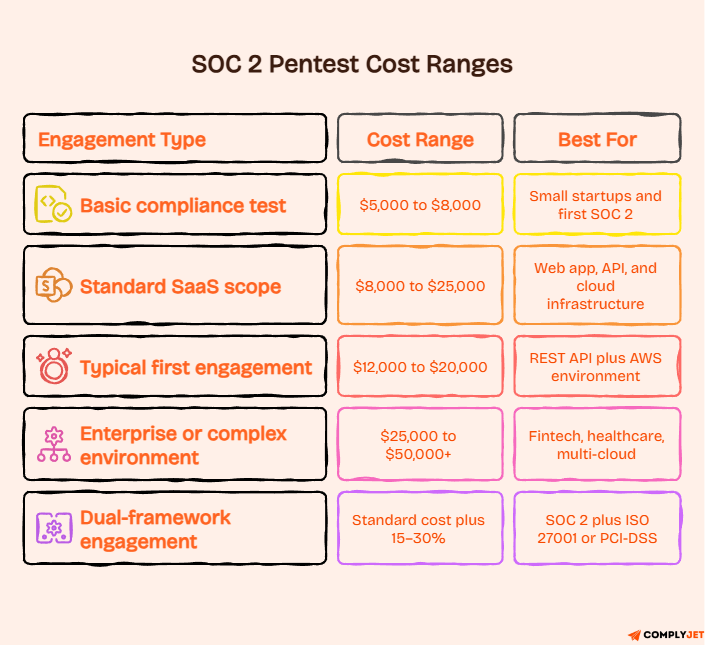
Dual-framework engagement (SOC 2 + ISO 27001) Standard cost plus 15 to 30% Companies pursuing multiple certifications
Several factors affect where your cost lands. The number of applications and APIs in scope is the biggest driver. Cloud environment complexity adds cost, especially multi-cloud configurations. Grey box testing costs less than white box testing. Whether retesting is included in the engagement fee or billed separately affects your total. Expedited timelines carry a premium, and audit season (Q1 and Q3) means vendor calendars fill fast.
The ROI case is straightforward. IBM’s Cost of a Data Breach 2024 report, covering 604 organisations across 16 countries, put the global average breach cost at $4.88 million. Healthcare averaged $9.77 million. Financial services averaged $6.08 million. A $20,000 pen test that prevents one breach delivers a potential 244x return at the global average. The same report found that organisations using AI and automation in security saved $2.2 million in breach costs compared to those that did not.
The additional ROI comes from your sales pipeline. Enterprise contracts that require pen test evidence as a procurement condition are often six or seven figures. Delaying the pen test delays those deals.
Founder’s tip: If you are managing both SOC 2 and ISO 27001 requirements, scope both frameworks into a single pen test engagement. The add-on cost is 15 to 30%, far less than two separate engagements. Learn how to handle SOC 2 vs HIPAA requirements together for a similar dual-framework approach.
Knowing what it costs is one decision. Choosing the right vendor is the next step, and it matters just as much.
How to Choose a SOC 2 Pen Testing Provider?
Picking a pen test vendor for SOC 2 is not the same as picking a general security firm. You need a vendor who understands TSC criteria, can produce audit-ready reports, and will be available when your auditor has questions during fieldwork.
Use this 10-point checklist before signing a statement of work.
- SOC 2-specific experience: Can they show sample reports with TSC criteria mapping? If they cannot, walk away.
- Team certifications: Look for OSCP+ (OffSec’s 24-hour proctored hands-on exam with a 3-year expiration, now officially called OSCP+), GPEN (GIAC’s 82-question exam with a CyberLive practicum), CREST, and OSWE. OSCP+ is the gold standard because it requires demonstrated exploitation skill under timed conditions, not just knowledge recall.
- Methodology reference in the statement of work: The SOW must name a recognised framework. PTES (Penetration Testing Execution Standard), NIST SP 800-115, or OWASP WSTG are the acceptable standards. No methodology reference means ad hoc testing, which auditors may reject.
- Human-driven testing: Ask directly whether testing is manual. AI-only or tool-based outputs may fail auditor review under CC4.1.
- Sample report available: Verify it contains CVSS scores, exploitation evidence, TSC mapping, executive summary, and a technical appendix.
- Retesting included as standard: Retest evidence is required for the audit binder. Vendors who charge extra for retesting add an unpredictable cost to your engagement.
- Direct access to the tester: You should be able to ask the individual tester questions during and after the engagement, not relay everything through a project manager.
- Timeline alignment: Verify the vendor can deliver within your observation period. Q1 and Q3 are peak audit seasons, and vendor calendars fill months in advance.
- Remediation SLA commitment: Good vendors specify what critical findings require immediate escalation. Vague SLA language signals inexperience with compliance engagements.
- Professional liability insurance: Enterprise-grade providers carry errors and omissions coverage for compliance engagements.
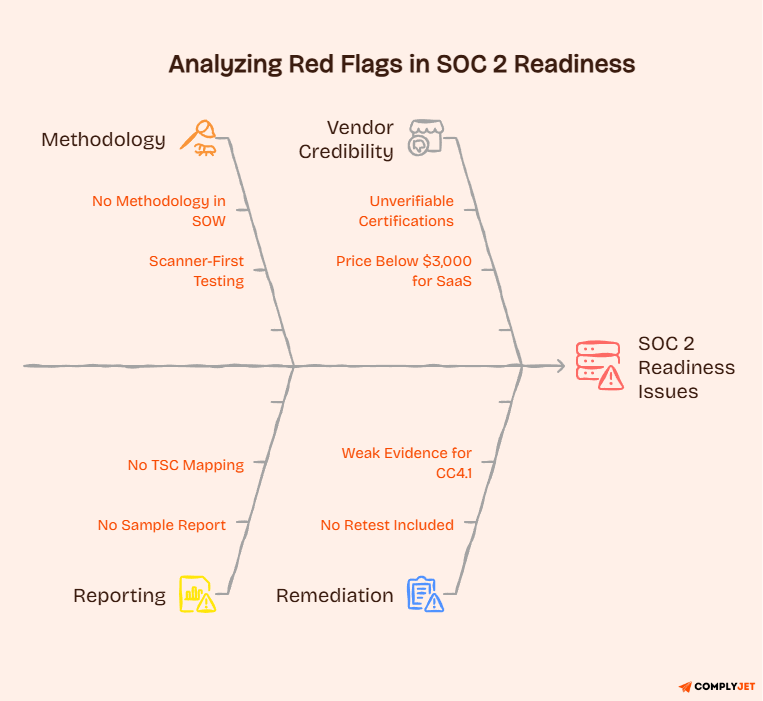
Red Flags in a SOC 2 Pen Test Vendor
Some warning signs are easy to miss until after you have signed the contract.
- Statement of work with no methodology reference
- Automated scanner is used as the primary testing tool
- No sample report available for review before signing
- Certification claims that cannot be verified on EC-Council, GIAC, or OffSec registries
- No retesting is included as standard in the base engagement fee
- Inability to explain which TSC criteria their findings will map to
- Price below $3,000 for a SaaS environment: quality, human-driven testing cannot be delivered profitably at that price point
The r/netsec and r/sysadmin communities on Reddit are useful for peer recommendations on pen testing vendors who have real SOC 2 experience. Real practitioner feedback is often more useful than vendor websites.
Choosing the right vendor is important. Understanding how your SOC 2 pen test requirement compares to other frameworks you may also be managing is equally important.
SOC 2 vs ISO 27001 vs PCI-DSS: Pen Testing Compared
If you are managing compliance across multiple frameworks, understanding exactly what each one requires from a pen test saves time and money.
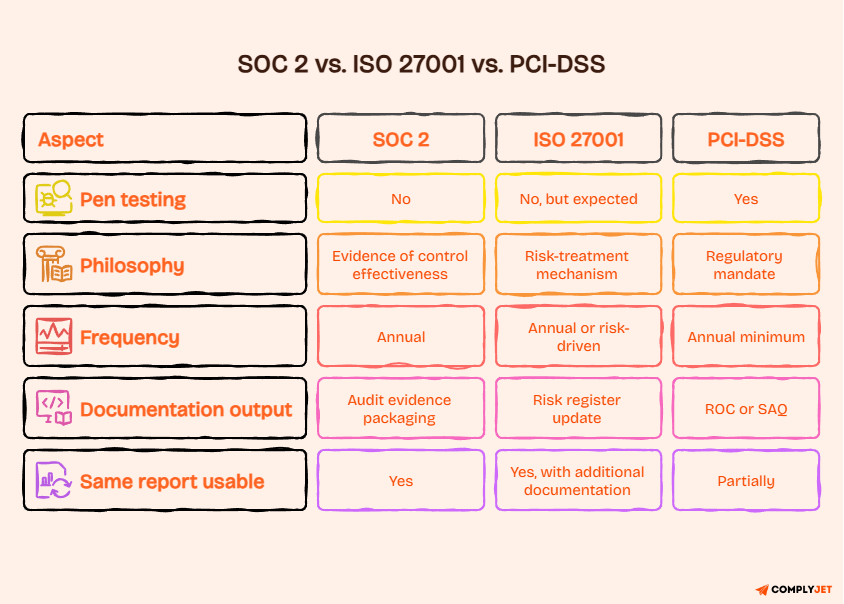
PCI-DSS is the most prescriptive of the three. It explicitly and mandatorily requires penetration testing under Requirement 11.3, with specific requirements for segmentation testing and annual internal and external testing cycles.
SOC 2 treats pen testing as evidence of control effectiveness. ISO 27001 uses it as a risk-treatment mechanism that feeds the risk register and ISMS management review.
The practical opportunity here is the single-engagement approach. A properly scoped pen test can satisfy SOC 2 CC4.1, ISO 27001 Annex A controls, and PCI-DSS Requirement 11.3 simultaneously. You need explicit dual or triple scoping in your statement of work, and your vendor must understand all three frameworks.
The add-on cost is far lower than three separate engagements. The AICPA publishes framework mappings between the Trust Services Criteria and ISO and NIST controls that are useful for this exercise.
Once your pen test is complete, its value extends well beyond the audit itself.
Penetration Testing SOC 2 Compliance Benefits for Business
A pen test is not a cost of compliance. For B2B SaaS companies, it is a business enabler with five distinct returns.
- First, it closes enterprise deals faster. Enterprise prospects require pen test evidence in vendor security questionnaires before they finalise contracts. Labour AI, a ComplyJet customer, achieved its first major enterprise warehouse contracts only after completing SOC 2 attestation backed by penetration test evidence.
- Second, it finds real vulnerabilities before attackers do. OWASP A06 in the Top 10 2025 specifically names Vulnerable and Outdated Components as a systemic risk category. Software vulnerabilities were a factor in 31% of breaches in 2026. Finding a critical API authentication flaw during a $20,000 test costs far less than discovering it through a breach that averages $4.88 million in damage.
- Third, it satisfies the auditor’s evidence requirements. CC4.1 is the cornerstone of every SOC 2 Security criterion audit. Pen testing produces the clearest, most credible evidence that controls work under real-world adversarial conditions. No other single activity produces comparable CC4.1 evidence.
- Fourth, it builds customer trust. Companies with recent pen tests can reference them in their SOC 2 report, Trust Centre, and customer-facing security documentation. This shortens enterprise security review cycles significantly.
- Fifth, it enables multi-framework compliance efficiency. One pen test can satisfy SOC 2 CC4.1, ISO 27001 Annex A controls, and PCI-DSS Requirement 11.3 simultaneously.
Read: ISO 27001 Penetration Testing Explained (2026 Guide)
Your pen test evidence is only as valuable as your ability to manage and present it. That is where the right compliance platform changes everything.
From Pen Test Evidence to SOC 2 Certification
Most companies get the pen test done, then struggle with everything that comes after. Collecting evidence, tracking remediation against findings, organising the audit binder, mapping findings to criteria, and communicating with the auditor: these steps are where compliance programs break down, not in the testing phase.
ComplyJet automates the entire post-pen-test workflow. You upload your pen test report once. Findings and remediation evidence get mapped to SOC 2 Trust Services Criteria automatically. Your audit binder builds in real time as remediation is tracked and retest results are logged. ComplyJet’s 350 or more integrations handle automated evidence collection from the tools your engineering team already uses.
Fragment Data, a ComplyJet customer, fast-tracked their SOC 2 certification after their pen test using ComplyJet’s AI-powered compliance workflow. Their team noted: “The AI is masterfully implemented. The guidance saved me tens of hours.”
Why SaaS Companies Are Switching to ComplyJet
Once your SOC 2 penetration test is complete, the compliance platform you choose determines how fast that evidence becomes a certification. Companies are making the switch to ComplyJet for a specific set of reasons.
ComplyJet delivers audit readiness in 2 to 3 weeks on average. It offers direct pen test evidence integration rather than routing everything through third-party connectors. AI-powered compliance guidance works through the SOC 2 process step by step.
A Trust Centre is included rather than sold as an add-on. Security questionnaire automation is built in. Frameworks supported include SOC 2, ISO 27001, HIPAA, and GDPR. A free trial is available with no credit card required.
For SaaS companies that completed their pen test and need to move fast without overpaying, ComplyJet is worth exploring. Book your free demo now!
Before your pen test begins, a short preparation process makes the difference between clear evidence and a scramble.
Pre-Pen Test Checklist: Get Your SOC 2 Audit Ready
Preparation before the pen test is as important as the test itself. Most evidence problems are created in the scoping phase, not during testing.
Work through these 10 steps before your engagement begins:
- Map every system within your SOC 2 system boundary and document it precisely
- Identify all external network ranges, IP addresses, and hostnames in scope
- List every web application and API that must be tested
- Document cloud environments, regions, and account configurations
- Confirm the pen test window falls within your Type 2 audit observation period
- Assign an internal testing coordinator, typically your Head of Engineering and Head of Security, together
- Set remediation SLAs in advance: Critical and High at 7 to 14 days, Medium at 30 days, Low at 90 days
- Prepare a high-fidelity test environment if production testing carries operational risk
- Notify your engineering and DevOps teams of the testing window and expected disruption level
- Brief your SOC 2 auditor in advance: let them know a pen test is scheduled and confirm when results will be available
Pre-briefing your auditor on the pen test is often overlooked. Most auditors appreciate it because it reduces fieldwork friction and signals that your security program is intentional rather than reactive.
Use our SOC 2 Type 2 guide to align your testing calendar with your audit observation period from the start.
Even with good preparation, specific mistakes consistently derail SOC 2 pen testing programs.
Common SOC 2 Penetration Testing Mistakes to Avoid
Most SOC 2 penetration testing failures are predictable. These seven mistakes account for the majority of audit evidence problems.
The scope is too narrow and does not match the system description. If your pen test covers the web application but excludes the cloud environment hosting customer data, your auditor will question the evidence. The system boundary in your pen test scope must mirror the system description in your SOC 2 report exactly.
Test completed outside the audit observation period. A pen test from 14 months ago does not satisfy CC4.1 for a current Type 2 audit. Timing is not a formality. It is a technical requirement for the evidence to count.
Automated scanner report submitted as pen test evidence. Some vendors deliver a vulnerability scan and call it a penetration test. Auditors increasingly recognise the difference. The dead giveaway is a report with no exploitation evidence, no chained attack narratives, and no business logic findings.
No retest documentation. Finding a critical vulnerability and remediating it counts for nothing without a retest report confirming the fix. That retest is what closes the evidence loop for CC4.1.
Findings not mapped to TSC criteria. A generic security report does not satisfy SOC 2 audit requirements. An audit-ready pen test report maps every finding to the specific Trust Service Criterion it affects.
Critical findings left unresolved. Discovering a critical issue and failing to remediate it before the audit period ends leads to qualified opinions or exceptions in the final SOC 2 report.
Vulnerability exploitation now represents 20% of all breaches, up from 14% in the prior year’s report. Auditors and enterprise buyers are paying attention to how you handle what you find.
Internal testing only, no third-party validation. Internal security teams can supplement but not replace third-party pen testing. Auditors and enterprise buyers want external, independent validation. An internal team testing their own environment is not the same as an unaffiliated firm doing it.
Check our SOC 2 background check requirements and other control-level guides to make sure your full evidence set is in order before your auditor arrives.
Frequently Asked Questions
Is penetration testing mandatory for SOC 2 Type 1 environments?
Penetration testing is not mandatory for SOC 2 Type 1. Type 1 assesses control design at a specific point in time. Auditors focus on policy documentation, procedure design, and the logical architecture of controls.
A pen test may appear as supporting evidence, but it is not the central focus. However, enterprise customers reviewing a Type 1 report may independently require pen test evidence before signing a contract, making it practically necessary regardless of the audit requirement.
What is the AICPA’s official guidance on SOC 2 penetration testing?
The AICPA does not explicitly mandate penetration testing in its Trust Services Criteria. CC4.1 states that management should use “a variety of different types of ongoing and separate evaluations, including penetration testing, independent certifications made against established specifications (for example, ISO certifications), and internal audit assessments.”
By naming penetration testing first, AICPA has made it the de facto standard evaluation method for satisfying CC4.1.
What are the SOC 2 Type 1 penetration testing requirements per CC6.1?
CC6.1 requires organisations to implement logical access security software, infrastructure, and architectures that protect information assets. Penetration testing supports CC6.1 by actively verifying that access controls cannot be bypassed.
For Type 1, this means the pen test should include authentication testing and privilege escalation attempts to validate the design of access controls, not just that policies documenting them exist.
What does external perimeter testing cover in SOC 2 Type 1?
External perimeter testing evaluates all internet-facing systems within the SOC 2 system boundary: web servers, API endpoints, email infrastructure, VPN gateways, and publicly accessible management interfaces. For Type 1, this validates the design of perimeter controls such as firewalls, WAFs, and access controls.
For Type 2, the same test type serves as evidence that those controls operated effectively over the audit period.
Are there cost-effective penetration testing solutions for SOC 2?
Yes. Grey box testing reduces engagement time compared to white box, lowering cost without sacrificing SOC 2-relevant coverage. For a typical SaaS company with one web application, a REST API, and AWS infrastructure, expect $8,000 to $20,000 for a properly scoped engagement. Combining SOC 2, ISO 27001, and PCI-DSS requirements in a single engagement further reduces duplicated costs.
Our SOC 2 auditor selection guide can help you find auditors who work well with vendors offering dual-framework pen testing.
Can enterprise pen testing cover both SOC 2 and PCI compliance?
Yes. A single well-scoped engagement can satisfy SOC 2 CC4.1 and PCI-DSS Requirement 11.3. The key is explicit dual-scoping in the statement of work. Note that PCI-DSS requires segmentation testing as a separate component when network segmentation is used to reduce the cardholder data environment scope.
Enterprise organisations managing multiple frameworks regularly commission dual-framework engagements to reduce overhead.
What red flags should I watch for in a SOC 2 API pen testing vendor?
Watch for: no explicit mention of OWASP API Security Top 10 in their methodology; inability to describe how they test for Broken Object Level Authorisation; no prior experience with API-first SaaS architectures; report samples showing only automated scanner output; and no process for testing authenticated API endpoints across multiple user roles.
API-first SaaS requires testers who understand REST, GraphQL, and OAuth deeply, not just generic network testers.
Is SOC 2 penetration testing available for companies in the US and Canada?
Yes. SOC 2 is an AICPA framework primarily used in the US and Canada, and penetration testing services for SOC 2 compliance are widely available in both markets. When selecting a vendor, confirm they have experience with US and Canadian SOC 2 auditors specifically.
Regional data privacy laws, including CCPA in California and PIPEDA in Canada, may also factor into your scope discussion.
Can software automate SOC 2 and ISO 27001 penetration test sharing?
Yes. Modern GRC platforms can automate the collection, organisation, and sharing of pen test evidence across multiple compliance frameworks simultaneously. ComplyJet lets you upload a pen test report once and maps findings and remediation evidence to both SOC 2 Trust Services Criteria and ISO 27001 Annex A controls.
This eliminates manual reformatting and creates a timestamped audit trail for both SOC 2 Type 2 observation periods and ISO 27001 management reviews.
What counts as acceptable penetration testing for SOC 2 compliance?
To satisfy SOC 2 auditors in 2026, a pen test must be conducted by a qualified third-party firm with verifiable credentials (OSCP+, GPEN, CREST), follow a recognized methodology (PTES, NIST SP 800-115, or OWASP), be scoped to systems within the SOC 2 boundary, include active exploitation evidence (not just a vulnerability list), map findings to Trust Services Criteria, include a retest report confirming remediation, and be completed within the audit observation period for Type 2.
Scanner-only or AI-generated reports generally do not meet this standard.
What is the specific focus of penetration testing for SOC 2 Type 1?
SOC 2 Type 1 pen testing validates the design of security controls, not their ongoing effectiveness. Specific focus areas are: authentication mechanisms (can they be bypassed?), network segmentation (are internal segments truly isolated?), access control implementation (does least-privilege work in practice?), and encryption enforcement (is data actually encrypted in transit and at rest, not just documented as such?).
The test provides point-in-time evidence that the security architecture described in the system description works as intended.
Does SOC 2 penetration testing require certified testers?
SOC 2 does not mandate specific tester certifications. However, certifications are one of the primary signals auditors use to assess the credibility of a pen test engagement. Certifications that carry weight include OSCP+ (24-hour proctored practical exam, widely considered the most rigorous), GPEN (82-question exam with CyberLive practicum), and CREST (recognised in regulated industries).
If a vendor cannot name the certifications held by the individual testers assigned to your engagement, that is a red flag.
Conclusion
Go back to page 3, question 47. “Has your organisation conducted a third-party penetration test in the last 12 months?” If you have read this guide, you now have everything you need to answer yes and to back it up with audit-ready evidence.
The three layers still hold: the AICPA does not require it, your auditor expects it, and your enterprise buyers demand it.
At an average breach cost of $4.88 million according to IBM’s 2024 research, a $20,000 pen test investment is one of the clearest ROI decisions in your compliance program.
Getting your pen test done is the first step.
Turning that report into a clean SOC 2 certification is where ComplyJet takes over. Automated evidence collection, AI-powered compliance guidance, and audit readiness in weeks. A free trial is available with no credit card required.