Related Articles
No items found.
.svg)

ISO 27001 is a risk-based framework focused on identifying and reducing security risks. Many organizations implement controls and complete documentation, but that does not guarantee real protection.
Cyber threats are increasing in scale and complexity. Attackers target cloud systems, SaaS platforms, and sensitive data. At the same time, customers and auditors expect proof that security controls actually work.
Penetration testing helps bridge this gap. It goes beyond identifying vulnerabilities and actively tests how systems behave under attack. It shows how an attacker could gain access, move within systems, or extract data.
This makes penetration testing essential for ISO 27001. It provides audit evidence and validates whether controls are effective in real conditions. More importantly, it helps reduce actual risk instead of relying on assumptions.
Trying to understand if your systems are actually secure before ISO 27001 certification? Start with a free trial and uncover real vulnerabilities before auditors do.
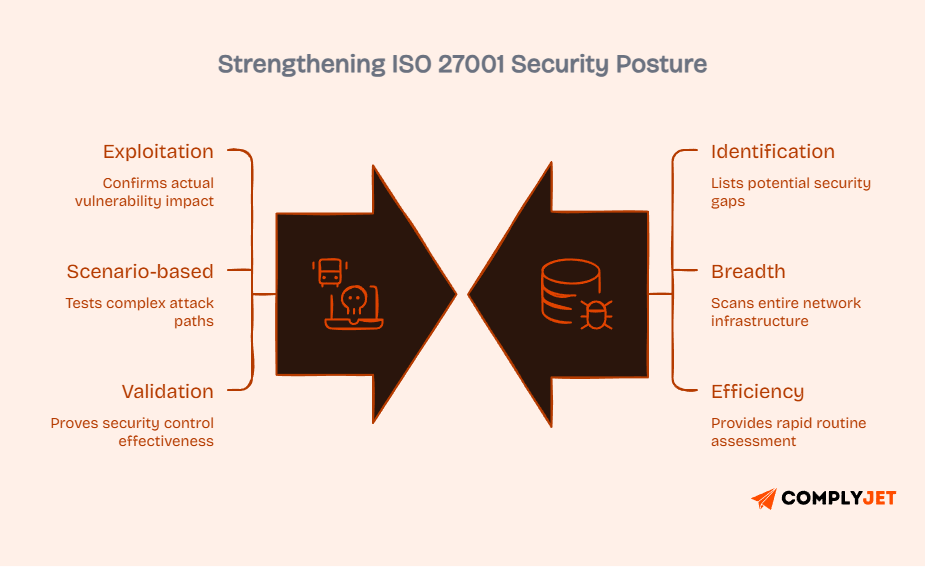
Penetration testing is a controlled security test. Experts simulate real-world attacks on systems, applications, or networks.
The goal is not just to find vulnerabilities. It is to prove how those weaknesses can be exploited to gain access to or impact data.
In ISO 27001, penetration testing validates whether your security controls actually work. It tests the effectiveness of controls identified during risk assessment.
Vulnerability scanning is different. It is automated and lists known weaknesses. It does not confirm whether those issues can be exploited.
Penetration testing goes deeper. It is manual and scenario-based. It attempts to exploit vulnerabilities and combine them into real attack paths.
This difference matters for ISO 27001. The standard focuses on reducing risk, not just identifying it.
Penetration testing helps uncover exploitable risks that could lead to breaches or system compromise.
It also provides stronger audit evidence and ensures your security is tested, not assumed.
You can also read - ISO 27001 vs 27002: Roles, Differences Explained (2026)
Penetration testing is not explicitly mandatory in ISO 27001. The standard does not require every organization to perform it.
However, in practice, it is often expected.
ISO 27001 follows a risk-based approach. This is where penetration testing becomes relevant.
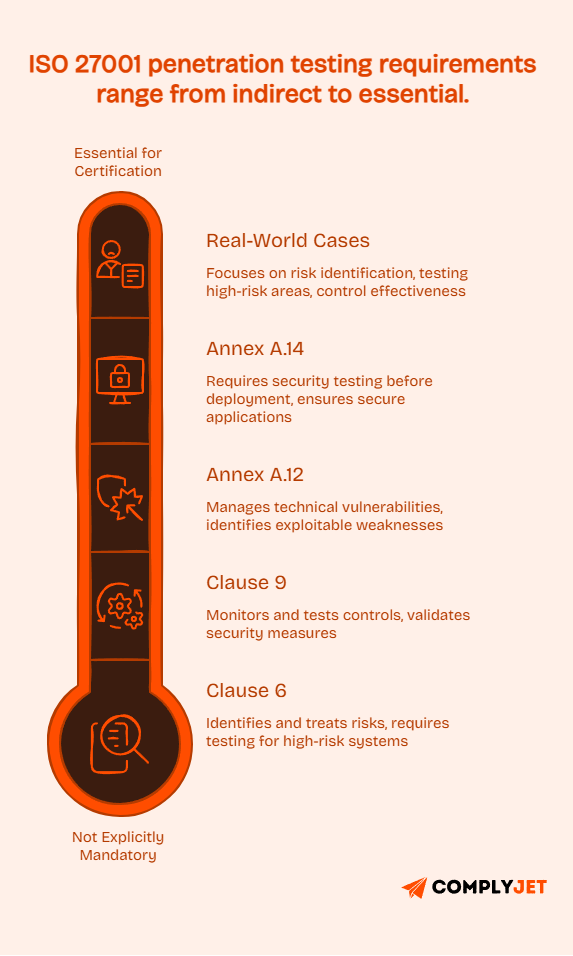
Penetration testing supports this by validating real-world attack scenarios.
Auditors do not ask if penetration testing is mandatory.
They focus on:
If critical systems exist and no testing is performed, it raises concerns.
In most real-world cases, penetration testing becomes necessary to prove that risks are controlled.
So, while not mandatory on paper, it is often essential for certification.
The 2024 Pen Testing Report by CoreSecurity reveals that 43% of cybersecurity professionals conduct penetration testing one to two times per year.
Penetration testing plays a direct role in validating key ISO 27001 controls. It is not just a security activity. It is a control validation mechanism.
This difference is critical for ISO 27001. The standard requires risk reduction, not just documentation.
Penetration testing connects policy with real-world security. It ensures controls are not only implemented, but also tested under actual attack conditions.
Read this - ISO/IEC AWI 29147
Penetration testing is not one-size-fits-all. Different types are used based on scope, access, and business needs.
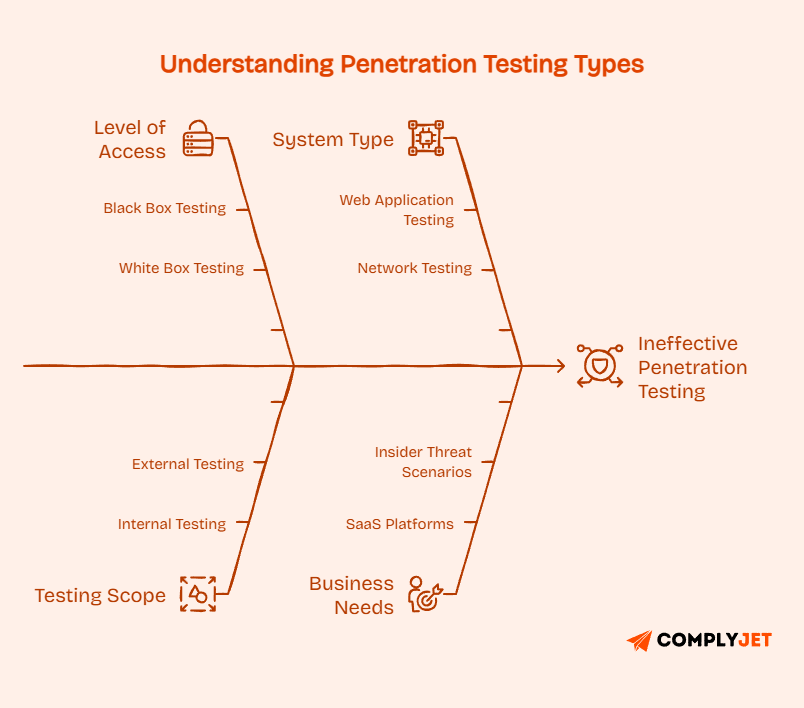
Startups usually focus on external exposure and core applications.
Enterprises require deeper testing across systems, networks, and internal access layers.
Choosing the right type ensures that testing aligns with risk, scale, and ISO 27001 requirements.
A structured penetration testing process is essential for ISO 27001. It ensures testing aligns with risk, produces audit-ready evidence, and validates control effectiveness.
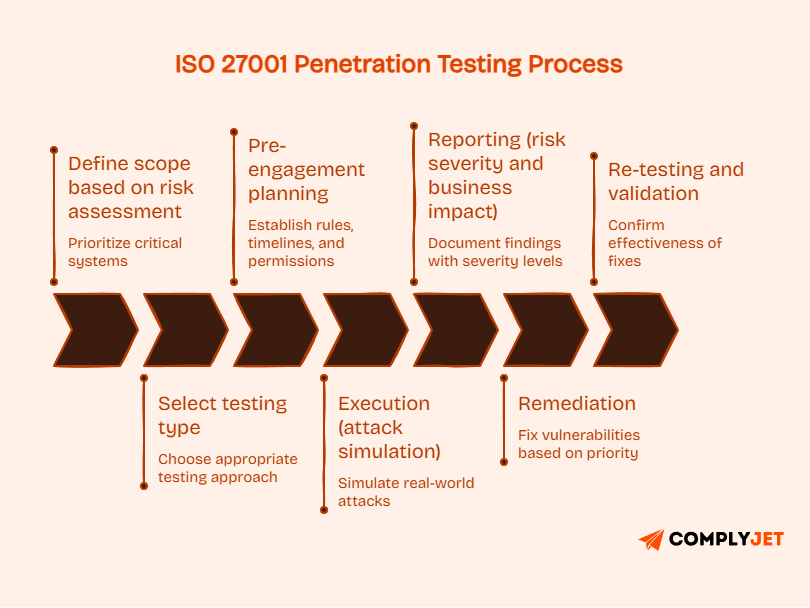
The process starts with defining the scope. This should be based on the organization’s risk assessment and ISMS. Critical systems such as applications, APIs, and cloud environments should be prioritized.
Auditors expect the scope to be clearly documented and justified. If high-risk systems are excluded without reasoning, it raises concerns. A common mistake is testing everything without prioritizing risk, which reduces effectiveness.
The next step is selecting the right testing approach. This depends on system complexity and risk level. Black box, gray box, or white box testing may be used.
Auditors expect a clear rationale for the chosen method. The approach should align with business risk. A common mistake is relying only on automated or basic testing.
Planning defines rules, timelines, and permissions. It ensures testing is controlled and does not disrupt operations.
Auditors expect formal approvals, defined boundaries, and documented objectives. Skipping this step often leads to compliance gaps and lack of traceability.
This is where testers simulate real-world attacks. They attempt to exploit vulnerabilities and identify possible attack paths.
Auditors look for evidence of testing activity and coverage of critical systems. A common mistake is limiting testing to surface-level checks instead of deeper exploitation.
Findings are documented with severity levels and business impact. Reports should explain risks clearly for both technical and non-technical stakeholders.
Auditors expect structured reports with clear risk ratings and system mapping. Poorly written or overly technical reports reduce their effectiveness.
After testing, vulnerabilities must be fixed based on priority. High-risk issues should be addressed first.
Auditors expect evidence that remediation actions have been taken and tracked. Delayed or ignored fixes are a common issue.
The final step is validating that fixes are effective. Re-testing confirms that identified vulnerabilities are resolved.
Auditors expect proof of re-testing and closure of risks. Skipping this step leaves gaps in compliance and risk management.
This process ensures penetration testing becomes part of continuous risk validation, not just a one-time activity.
You can also read - ISO 27001 Domains Explained: Complete Guide (2026)
Penetration testing should be performed regularly to maintain ISO 27001 compliance and ensure ongoing risk validation. The frequency depends on system changes, risk level, and business operations.
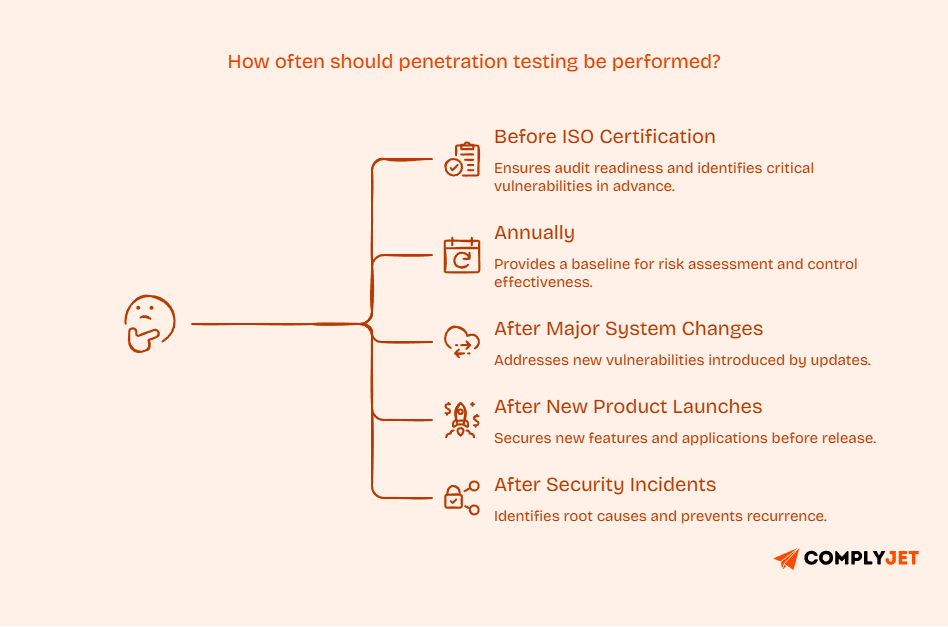
Penetration testing should be conducted before the certification audit. It helps identify and fix critical vulnerabilities in advance. This ensures that controls are tested and audit-ready.
Auditors expect evidence that high-risk systems have been validated before certification. Skipping this step can lead to audit findings.
At a minimum, penetration testing should be performed once a year. This aligns with regular risk assessments and control reviews.
Annual testing ensures that new vulnerabilities are identified and existing controls remain effective over time.
Any significant infrastructure or application change requires testing. This includes cloud migrations, architecture updates, or integration of new systems.
Changes can introduce new vulnerabilities, even if existing controls are strong.
New features, applications, or APIs should be tested before and after release. This is critical for SaaS and product-based companies.
Testing ensures that new components do not expose the system to additional risks.
If a breach or incident occurs, penetration testing should be conducted immediately. It helps identify root causes and prevent recurrence.
This approach ensures continuous risk validation and strengthens long-term security.
IBM's 2024 report found that recovery took more than 100 days for most of the small number (12%) of breached organizations that were able to fully recover, underscoring the long-term operational cost of breaches that could have been prevented
Penetration testing and vulnerability assessment serve different roles in ISO 27001. Both are important, but they answer different questions.
A vulnerability assessment tells you what could be wrong. Penetration testing shows what can actually be exploited and how serious the impact is.
Vulnerability assessments are useful for continuous monitoring. They help maintain visibility into known weaknesses across systems.
Penetration testing provides depth. It validates whether vulnerabilities can be chained together and exploited in real scenarios.
For ISO 27001, both are required in practice. Vulnerability assessments support ongoing risk identification, while penetration testing proves whether controls are effective.
Using only vulnerability scanning creates blind spots. Using only penetration testing limits coverage.
Together, they provide complete security validation.
Want to see how real-world penetration testing works in your environment? Book a demo and watch vulnerabilities identified, exploited, and reported step by step.
A SaaS company handling customer data had a publicly exposed cloud server. The system was configured for quick deployment, but security settings were not fully reviewed.
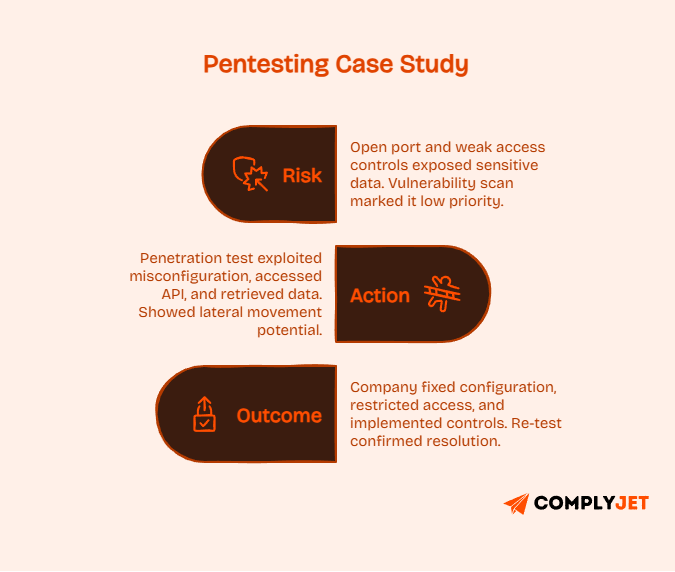
The server had an open port and weak access controls. Sensitive data was accessible through an exposed API endpoint.
A vulnerability scan flagged the issue, but it was marked as low priority due to lack of clear impact.
During a penetration test, the tester exploited the misconfiguration. They accessed the API, bypassed authentication, and retrieved sample customer records.
The test also showed how an attacker could escalate access and move laterally across connected systems.
This converted a theoretical vulnerability into a confirmed high-risk issue.
The company immediately fixed the configuration, restricted access, and secured the API. Additional monitoring and access controls were implemented.
A re-test confirmed that the vulnerability was fully resolved.
Without penetration testing, this issue could have remained unnoticed until exploited by an attacker.
This case highlights the value of penetration testing in ISO 27001. It validates real risk, strengthens controls, and prevents potential data breaches before they happen.
The global penetration testing market was valued at approximately $2.45 billion in 2024 and is projected to grow to $6.25 billion by 2033, with a CAGR of 12.5% — driven by escalating cybersecurity threats and stringent regulations like GDPR, HIPAA, and PCI DSS.
Many organizations perform penetration testing, but fail to get real value from it. These mistakes reduce effectiveness and create gaps in ISO 27001 compliance.
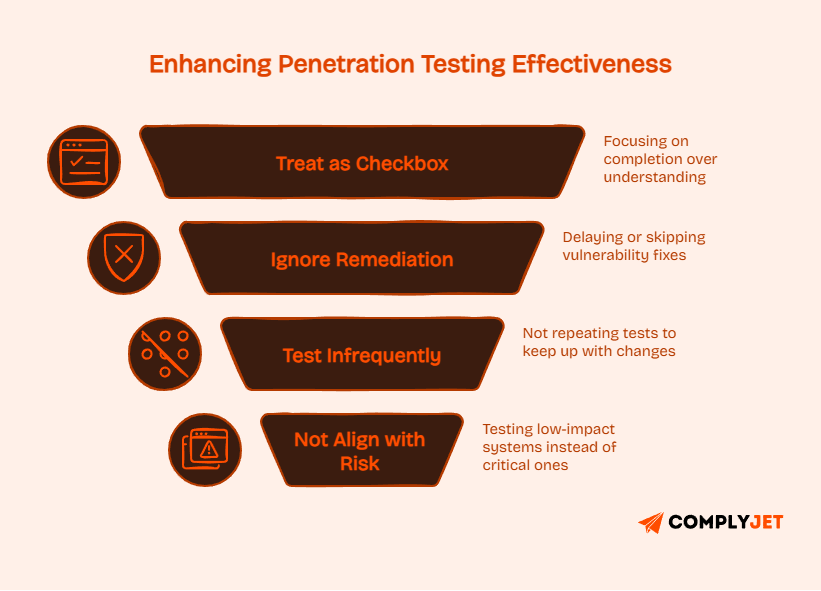
Some companies conduct penetration testing only to satisfy audit requirements. The focus stays on completing the activity, not understanding the results.
This approach limits the value of testing. Without deeper analysis, risks remain unresolved.
Finding vulnerabilities is only the first step. Many organizations delay or ignore fixing them.
Unresolved issues leave systems exposed. Auditors also expect proof that identified risks are addressed.
Penetration testing is often done once and not repeated. Systems, however, change continuously.
New vulnerabilities can appear after updates, integrations, or infrastructure changes. Infrequent testing leads to outdated security validation.
Testing is sometimes performed without linking it to risk assessment. This results in low-impact systems being tested while critical assets are ignored.
ISO 27001 requires a risk-based approach. Testing should focus on high-risk areas to be effective.
Avoiding these mistakes ensures penetration testing supports both compliance and real security improvement.
You can also read - 12 Common ISO 27001 Implementation Mistakes to Avoid (2026)
Penetration testing is evolving with the use of AI and automation. These technologies improve speed, coverage, and consistency, but they do not replace human expertise.
AI helps identify patterns, prioritize vulnerabilities, and simulate attack scenarios. It can analyze large systems quickly and highlight high-risk areas.
This reduces manual effort and improves focus on critical risks.
Traditional penetration testing is periodic. Modern platforms enable continuous testing by running automated checks throughout the development lifecycle.
This is useful for SaaS and cloud environments where systems change frequently. Continuous testing helps detect new vulnerabilities early.
Penetration testing is often seen as an expense, but the cost of a breach is significantly higher. Comparing both highlights the real return on investment.
Penetration testing is a proactive investment. It helps identify exploitable risks before attackers do.
A breach is reactive and expensive. It affects operations, trust, and revenue.
From an ROI perspective, spending on testing reduces the likelihood and impact of costly incidents. It also supports compliance and builds customer confidence.
In most cases, the cost of prevention is significantly lower than the cost of recovery.
Supply chain risk is growing rapidly, with third-party involvement in breaches now up 60% and breaches involving a third party accounting for 48% of all breaches in Verizon's 2026 DBIR.
Choosing the right penetration testing vendor is critical for both security and ISO 27001 compliance. Not all vendors provide the same level of depth, reporting, or support.
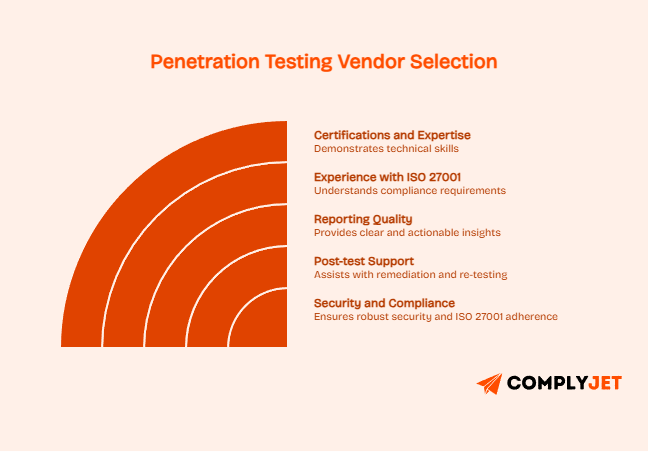
Look for recognized certifications such as CEH, OSCP, or CREST. These indicate that testers have the required technical skills and follow industry standards.
However, certifications alone are not enough. Practical experience matters more.
The vendor should understand ISO 27001 requirements and audit expectations. This ensures testing aligns with risk assessment, Annex A controls, and compliance needs.
Vendors without ISO experience may miss key compliance gaps.
The final report should be clear, structured, and actionable. It must include risk severity, business impact, and proof of exploitation.
Reports should be easy for both technical teams and auditors to understand.
Good vendors do not stop at reporting. They assist with remediation, clarify findings, and support re-testing.
This ensures vulnerabilities are actually fixed and validated. Choosing the right vendor is not just about testing. It is about ongoing security improvement and audit readiness.
Platforms like ComplyJet combine penetration testing with compliance workflows. This helps organizations align testing with ISO 27001 requirements, track remediation efforts, and stay audit-ready without having to manage multiple tools.
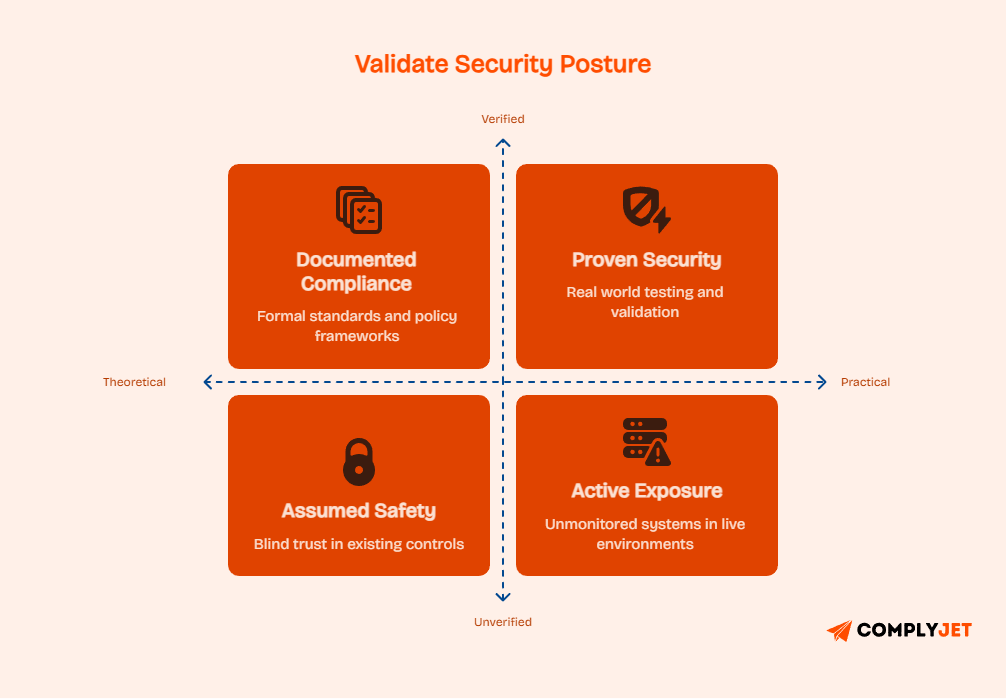
ISO 27001 helps define and manage security controls. But compliance alone does not guarantee protection.
Penetration testing validates whether those controls actually work. It identifies real, exploitable risks that cannot be seen through documentation alone.
In practice, penetration testing is not optional. It strengthens ISO certification and ensures your security is tested, not assumed.
The difference is clear.
Compliance shows intent, testing proves security.
Ready to validate your security in real-world conditions? Book a demo and see how penetration testing works in your environment.
© 2026 ComplyJet. All rights reserved.