.svg)

You are building product. Then an email lands from a big prospect. It asks for your SOC 2 report. Your stomach drops a little.
You are not alone. Data breaches now cost companies a global average of $4.44 million, and US firms saw that number climb to $10.22 million in 2025. Enterprise buyers know this.
That is why they ask for proof before they sign anything.
This guide answers three things every founder needs to know about SOC 2 for startups and SaaS companies. Do you need it now? What does it really cost? And what is the fastest path to get it done? Just the honest version.
SOC 2 for Startups in 2026: Quick Read
- SOC 2 is an attestation from a CPA firm, not a government law.
- Only one control area, called Security, is required for every audit.
- Type 1 checks your setup on one day. Type 2 checks it over months.
- A first Type 1 audit costs $20,000 to $45,000 all in.
- A first Type 2 audit costs $35,000 to $80,000 all in.
- 85% of mid-market buyers and 98% of Fortune 500 firms want Type 2, according to buyer preference data.
- Start the process 3 to 6 months before your first big enterprise deal.
- Automation tools cut the busywork from 100+ hours to a few hours a month.
What Is SOC 2 and How Does It Work for SaaS Startups?
SOC 2 stands for System and Organisation Controls 2. It is a report created by AICPA SOC 2 criteria, the group that sets rules for accountants in the US.
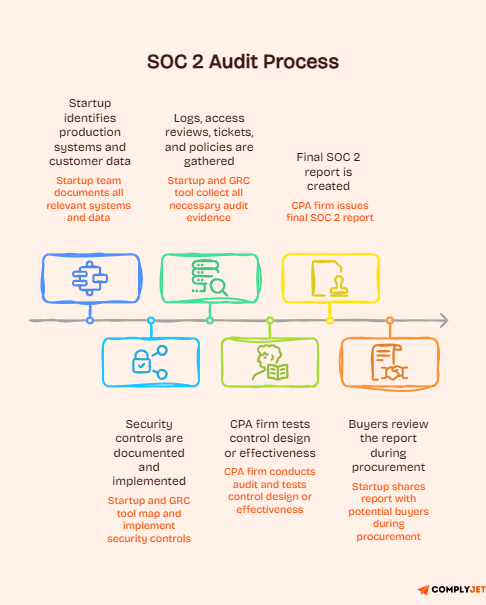
Think of SOC 2 as a health check for how you protect customer data. A licensed CPA firm looks at your systems. Then they write a report saying whether your controls work the way you claim. That is how SOC 2 compliance for SaaS startups actually functions in practice.
The Five Trust Services Criteria, Explained Simply
SOC 2 breaks security into five buckets, called trust services criteria. Only one is required. The rest are optional add-ons.
- Security: keeps out people who should not have access. Required for every audit.
- Availability: proves your system stays up and running as promised.
- Processing integrity: proves your data processing is accurate and complete.
- Confidentiality: protects information marked as private, like contracts.
- Privacy: covers how you collect and use personal data.
Most early startups only need Security. Adding each extra criterion adds roughly 20 to 30 % more to your audit cost. Do not add ones you do not need yet.
SOC 2 Type 1 vs Type 2: The Startup Decision
A Type 1 report is a snapshot. The auditor looks at your controls on one specific day and confirms they exist.
A Type 2 report is more like a movie. It checks whether those same controls actually worked over three to twelve months. This is what most enterprise buyers really want to see, and it is the key SOC 2 Type 1 vs Type 2 differences for startups question founders ask first.
Many startups start with Type 1 to unblock a deal fast, then move into a full Type 1 vs Type 2 journey while Type 2 evidence collects in the background.
Did You Know?
The AICPA updated its official SOC 2 guidance in July 2025. Make sure your auditor is working from that current version, not an older one.
Understanding what SOC 2 actually is gets you halfway there. The harder question is whether your startup needs it right now, or if you are jumping the gun.
Do Startups Actually Need SOC 2? The Honest Answer
Not every startup needs SOC 2 today. Some need it badly. Others would be wasting money and slowing down real work.
The honest answer depends on where your revenue is coming from and how sensitive your data is. Here is how to tell which camp you are in, without sales-page spin.
You clearly need SOC 2 soon if any of these are true for you.
- An enterprise deal is stuck waiting on a security questionnaire.
- You are raising a Series A or B, and buyers ask about compliance.
- You handle personal data, health data, or financial data at scale.
It is probably too early if these describe your team instead.
- Your infrastructure changes weekly, so controls cannot stay stable.
- Nobody on your team owns security decisions.
- You are still pre-product or have no enterprise pipeline yet.
The numbers back this up. According to a benchmark report, 60% of B2B companies are more willing to work with a SOC 2 compliant vendor. And 36% of companies said they lost a deal because they lacked a required certification, up from 29% the year before.
Founder's Tip!
If your first enterprise deal is 90 days out and you have nothing started, begin today. The audit itself takes 3 to 5 months at minimum.
Once you know you actually need it, the real question becomes which type of report to chase first, and in what order to run them.
SOC 2 Type 1 vs Type 2: Which One Does Your Startup Need?
This is where most founders get stuck. The good news is the decision follows a simple pattern once you see it laid out.
Type 1 proves your controls exist on paper and in practice, on one date. Type 2 proves those same controls held up over real time, using logs, tickets, and access records as SOC 2 compliance checklist evidence.
The smartest move for most early startups is a bridge strategy. Get Type 1 done fast to unblock the deal in front of you. Start your Type 2 observation window at the same time.
By the time your Type 2 report is ready, you are not starting from zero. You already have a year of proof behind you. Read the full Type 1 vs Type 2 guide for the detailed evidence list.
Note!
If your existing report expires before your next audit finishes, your auditor can issue a bridge letter. It covers the gap so procurement teams are not left waiting.
Series A and Seed companies can usually stop at Type 1 for now. Series B and up almost always need Type 2. Fintech, healthtech, and legal tech should skip straight to Type 2.
Knowing which report you need matters. But nothing shapes a founder's decision faster than the number at the bottom of the invoice.
What Does SOC 2 Compliance Really Cost for Startups?
Here is the part every guide skips. The auditor's invoice is only about 40% of what you will actually spend on SOC 2 in year one.
The rest hides in engineering hours, tooling, training, and policy work nobody budgets for upfront. Below is the honest full picture, based on typical auditor pricing data for early-stage companies.
Boutique SaaS-focused auditors typically charge $8,000 to $25,000. Big Four firms can run $30,000 to $100,000 or more for the same scope. For a first audit, boutique usually wins.
There is a cautionary tale worth remembering here. One over-scoping case study tracked a fintech startup that included its HR system, marketing site, and Slack in scope. Its audit ballooned to $85,000 over nine months.
Tip!
Scope your first audit to production systems and customer data only. Every extra system you add is more evidence to collect, and more money spent proving things nobody asked about.
The good news is that costs drop in year two. Renewal audits typically cost 20 to 40% less, since your controls and evidence process are already built. Read the full SOC 2 compliance cost guide for a line-by-line breakdown.
Cost tells you what SOC 2 takes out of your bank account. The roadmap tells you what it takes out of your calendar, and how to shrink both.
How to Get SOC 2 Compliant: The Startup Roadmap
Getting audit-ready is not one giant task. It breaks down into three real phases, each with its own traps and shortcuts.
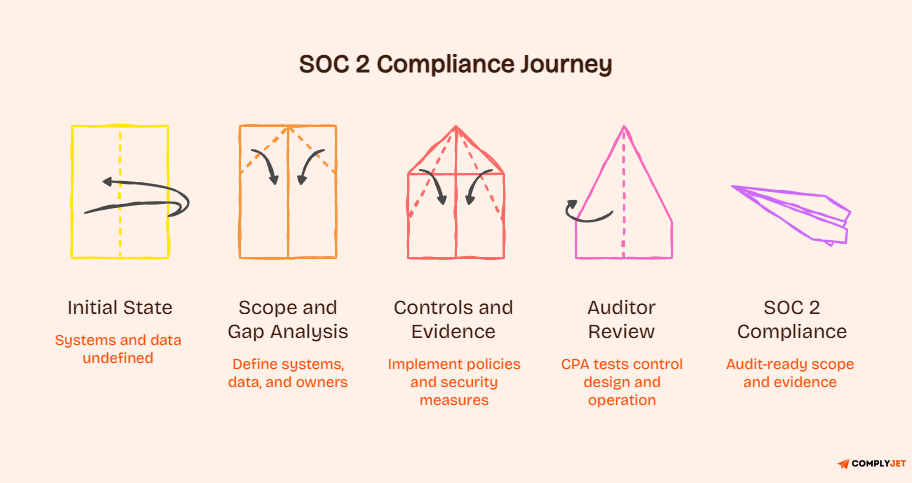
Skip any one of these phases, and you will pay for it later, either in audit exceptions or in a much bigger invoice. Here is what each phase actually involves.
Step 1: Gap Analysis and Minimum Viable Scope
A gap analysis is a check of where your current setup falls short of SOC 2 requirements. Run this before you talk to any auditor.
Minimum viable scope means including only your production environment and customer data systems. Nothing more. This single decision is what keeps your first audit affordable.
Why This Matters: Auditors price based on scope complexity. Every extra internal system in scope is paying for controls that add zero trust with customers.
A gap analysis guide can help map this out early.
Step 2: Policies, Controls, and Evidence Setup
SOC 2 auditors expect twelve core policies. These cover things like access control, incident response, and vendor management. Copied templates from the internet rarely survive scrutiny.
Your policies need to match how your team actually works, not how a template assumes you work. Technical controls like MFA, encryption, and access logging back up what the policies claim.
Evidence is the proof an auditor actually reviews. Logs, tickets, and access records matter more than the policy document itself.
A full SOC 2 controls list shows exactly what auditors expect to see.
Step 3: Selecting Your Auditor and Scheduling the Audit
Not all auditors are equal. Look for ones with cloud-native experience and real startup clients, not just a CPA license.
A cheap auditor who issues a report full of exceptions can cost you more in lost deals than a slightly pricier, more thorough firm would have. Book early, since good boutique auditors fill their calendars fast.
The full choosing a SOC 2 auditor breakdown walks through the exact questions to ask before signing.
Following this roadmap gets your audit done. But the tool you pick to run it can either cut your timeline in half, or quietly add months to it.
Best SOC 2 Tools for Startups: Honest Comparison (2026)
Every GRC platform writes its own comparison guide, and every one of them conveniently wins. This section skips that game and gives you the real tradeoffs.
Compliance automation tools handle evidence collection, policy tracking, and auditor coordination for you. Without one, this work eats 100 to 200 engineering hours. With one, it drops to 4 to 8 hours a month.
How to Pick the Right SOC 2 Tool for Your Startup Stage?
If you are under 50 people chasing your first SOC 2 report, prioritise cost, support quality, and speed to audit. Feature lists matter less than they seem.
If you run a complex cloud stack with 50 to 200 employees, integration depth becomes the bigger factor. The right tool at the wrong stage often costs more than the wrong tool entirely.
Tip!
Ask any vendor how many startups under 50 employees they took through a completed audit in the last year. That answer tells you more than any feature comparison chart.
How ComplyJet Compares for Early-Stage SaaS Startups?
Among the best SOC 2 software options for 2026, most platforms sit in the $7,500 to $20,000 per year range for startup tiers. Pricing varies by integration count and support level.
ComplyJet is built specifically for early-stage SaaS teams under 50 employees chasing a single framework. It is not the right fit for a 300-person company running 500 integrations, and that is by design.
Customer results speak for this focus. SymmetRE got SOC 2 ready in two weeks. Precognition Labs cleared enterprise security blockers in under two weeks. NextSolutions AI reached audit-ready status in five weeks.
See the full SymmetRE case study to see what that timeline actually looked like week by week.
Choosing your platform is one decision. Choosing your compliance framework in the first place, especially if you have customers outside the US, is another one entirely.
SOC 2 vs ISO 27001: Which Should Your Startup Get First?
If all your customers sit in the US, this decision is easy. If you have European customers or global ambitions, it gets more interesting.
SOC 2 is the AICPA standard, built for North America. ISO 27001 is the international standard, more common across Europe and increasingly required under EU rules like NIS2.
The two standards actually share 65 to 75 % of their controls, based on ISO 27001 comparison data. That overlap is exactly why combined engagements typically run 30 to 40% cheaper than doing both separately.
If your customers are US-based B2B SaaS buyers, get your SOC 2 framework work done first.
If NIS2 or EU procurement rules apply to you, look at the ISO 27001 framework instead, or plan both together from day one.
Once your audit closes, whichever standard you picked, the work is not actually over. What happens in the twelve months after matters just as much.
Life After Your SOC 2 Audit: What Ongoing Compliance Looks Like?
Getting your report is not the finish line. SOC 2 reports are considered current for 12 months, and enterprise buyers expect a fresh one every year.
Some customers with especially sensitive requirements ask for renewal every six months instead. Your compliance work becomes an ongoing part of running the business, not a one-time project you finish and forget.
The good news is that year two is much easier than year one. Controls are already built. Evidence collection is already automated. Renewal costs typically drop 20 to 40 % as a result.
Why This Matters?
A report that expires mid-sales-cycle is a real deal risk. Many procurement teams have a strict policy against reports older than 12 months. Put your renewal date on the calendar the day your audit closes.
Teams using automation tools spend just 4 to 8 hours a month keeping compliance current after the first audit. That time mostly goes to reviewing new evidence and confirming nothing has changed unexpectedly.
There is a bonus here too. Your SOC 2 controls map closely to ISO 27001, HIPAA, and GDPR requirements. That overlap makes every future framework cheaper to add.
Full SOC 2 report validity details cover renewal timing in depth.
You now have the full picture, from first audit to year two renewal. A few questions still come up again and again, so let's answer them directly.
SOC 2 for Startups: Frequently Asked Questions
Is SOC 2 mandatory for SaaS startups?
No. SOC 2 is not a government law for most SaaS companies. It is contractually required by many enterprise buyers, which makes it practically non-negotiable once your customers are mid-market or larger.
How long does SOC 2 compliance take for a startup?
Type 1 typically takes 3 to 5 months from kickoff to final report. Type 2 takes 9 to 14 months, since it needs an observation period of several months built in.
How do SOC 2 SaaS solutions work for startups?
Compliance platforms connect to your cloud tools and pull evidence automatically. They track control status, manage policies, and coordinate with your auditor, replacing manual spreadsheet tracking entirely.
Which SOC 2 provider is best for Type 2 startups?
It depends on your size and budget. Smaller teams under 50 people often do better with startup-focused platforms. Larger engineering teams with complex cloud setups may need deeper integration coverage instead.
Is SOC 2 compliance automation for startups worth it?
For almost every startup doing a first audit, yes. Manual evidence collection alone eats 100 to 200 engineering hours. Automation tools typically cut total compliance costs 30 to 50%, with some teams seeing up to 70% savings.
What is the SOC 2 compliance checklist for early-stage startups?
Run a gap analysis first. Define your minimum scope. Write and approve twelve core policies. Set up technical controls like MFA and logging. Then select an auditor and schedule fieldwork.
Can startups get SOC 2 without using a GRC tool?
Technically yes, but it costs more. Manual evidence collection takes 100 to 200-plus engineering hours, which usually costs more than a year of platform access for a small team.
What happens if a startup fails a SOC 2 audit?
SOC 2 does not have a strict pass or fail outcome. Auditors issue an unqualified opinion, meaning controls passed, or a qualified opinion, meaning some exceptions were found. See SOC 2 audit outcomes for what each opinion type actually means for your next sales conversation.
Conclusion
SOC 2 for startups comes down to three decisions: whether to start now or wait. Whether to go Type 1 first or straight to Type 2. And which tool fits your stage, not someone else's marketing page.
The auditor invoice is only 40 % of your real spend. The fastest path is almost always Type 1 now, with Type 2 observation running quietly in the background. And scoping narrow in year one is nearly always the right call.