.svg)

A security questionnaire asks you to attach your "SOC 2 certification." You go to pull it from the folder and pause: the file your auditor sent you is called a report, not a certificate. Is SOC 2 a certification worth double-checking before you send it? Yes, and the gap between what people call it and what it actually is trips up more founders than it should.
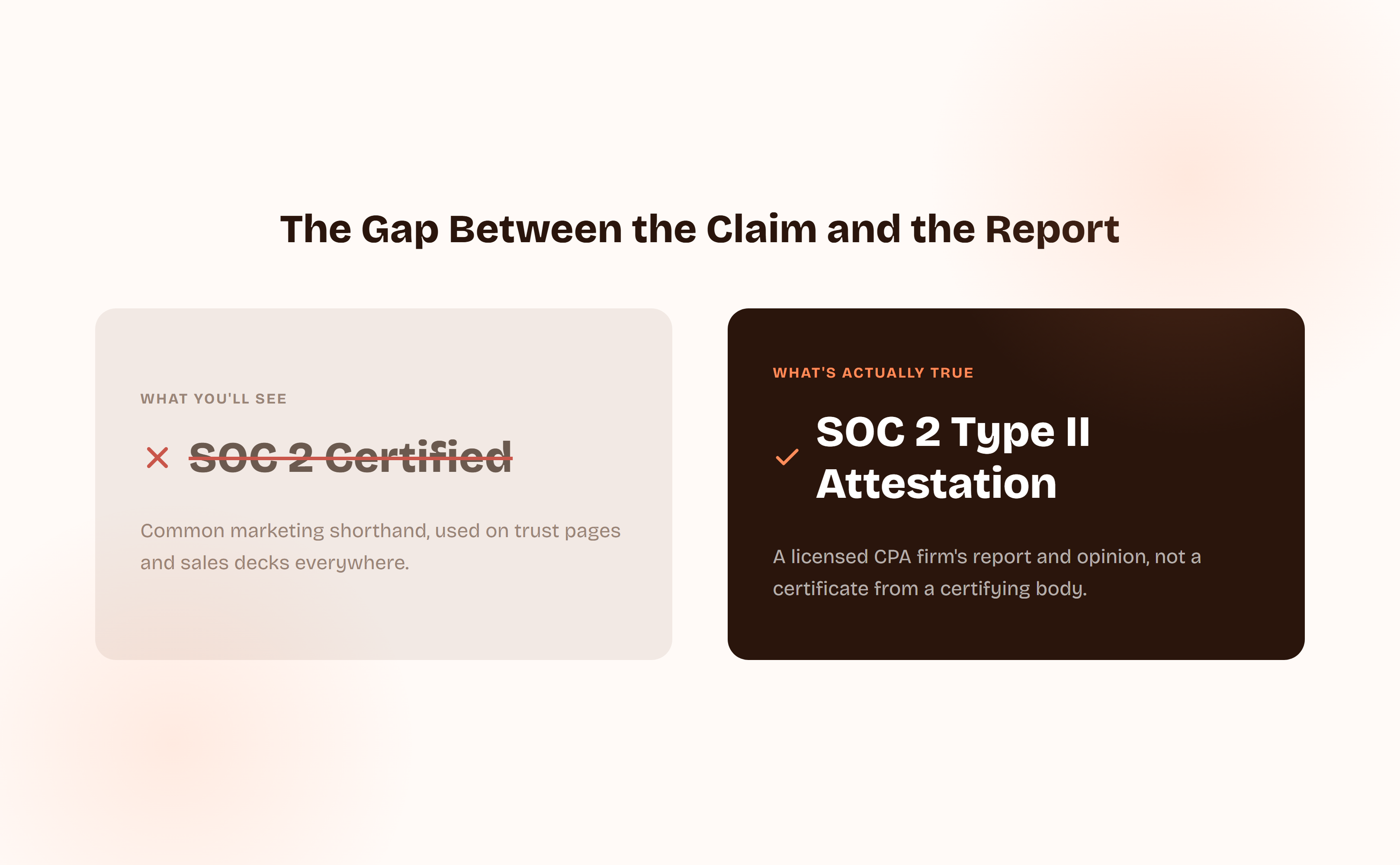
SOC 2 is an attestation: a licensed CPA firm's audit-based opinion on whether your controls meet the AICPA's Trust Services Criteria. There's no certifying body, no pass/fail grade, and no badge issued for meeting a bar. What you get is a report, and the report either supports a clean opinion or it doesn't.
By the end of this, you'll know exactly why that distinction exists, whether it's worth caring about, and how to describe your own SOC 2 report accurately in marketing copy, sales calls, and your trust center.
Here's what's ahead:
- The technical difference between an attestation and a certification
- Why "SOC 2 certification" is everywhere anyway, even though it's imprecise
- Whether the wording actually matters, or is just pedantry
- Type I vs. Type II, and how long a SOC 2 report is actually good for
- Why SOC 1 has the exact same labeling problem
- A practical guide to describing your report correctly
Is SOC 2 a Certification? The Technical Answer
Attestation and certification are two different mechanisms, and SOC 2 only fits one of them. An attestation is a CPA firm's formal, audit-based opinion on whether a company's controls meet a defined set of criteria. There's no pass/fail threshold. There's an opinion: unqualified (clean), qualified (some exceptions noted), adverse, or a disclaimer.
A certification works differently. It requires a certifying body that issues a credential and can revoke it. ISO 27001 works this way: an accredited certification body audits a company and issues an actual certificate with an expiration date. SOC 2 has no equivalent body. The AICPA writes the standards, but it doesn't certify anyone against them.
What Is a SOC 2 Certification, Technically? (There Isn't One)
If you're Googling what is a SOC 2 certification, the honest technical answer is that there isn't one. What exists is a SOC 2 report, produced by a licensed CPA firm after an audit against the Trust Services Criteria. Any CPA firm can perform this work; there's no single monopoly certifier the way ISO's accredited bodies work.
The AICPA's own description of the SOC suite frames it as a set of service offerings CPA firms provide through an examination engagement, not a certification program with a certifying body (Source: AICPA & CIMA, System and Organization Controls: SOC Suite of Services).
Linford & Co, a CPA firm that performs these audits directly, puts it even more bluntly: "Although a SOC 2 is technically an attestation report, it's very common for people to call a SOC 2 a certification. It's not a certification."
SOC 2 Attestation vs Certification: The Technical Difference
Everything above boils down to five concrete differences: who issues it, what you actually receive, and whether a pass/fail even exists. Worth seeing side by side rather than scattered across paragraphs.
SOC 2 attestation vs certification, side by side:
| Attestation (SOC 2) | Certification (e.g. ISO 27001) | |
|---|---|---|
| Issued by | Licensed CPA firm | Accredited certification body |
| Deliverable | Report with an auditor's opinion | Certificate with an expiration date |
| Pass/fail exists? | No, it's a graded opinion | Yes, you either pass the audit or you don't |
| Who can perform it | Any licensed CPA firm | Only accredited certification bodies |
| Governing standard | AICPA's SSAE 18 | ISO's accreditation rules |
SOC 2 Is Not a Certification: So Why Does Everyone Say It Is?
SOC 2 is not a certification, and the AICPA's own materials back that up. Yet "SOC 2 certified" shows up on trust center pages, in sales decks, and in job postings constantly. The gap isn't malice; it's convenience.
"Certification" is shorter and more familiar than "attestation report." Most buyers already understand what a certification implies, so vendors reach for the word that lands fastest, even when it's not quite right. Search engines reinforce this: the whole topic still gets filed under the parent term "soc2 certification," even though the AICPA has never used that phrase in its own standards.
The confusion isn't limited to any one vendor. "Certification" and "attestation" get used interchangeably across the industry without anyone resolving which one is technically correct, and that's exactly why "soc2 certification" keeps circulating as shorthand: nobody's correcting it consistently.
Sloppy-but-common usage in a sales call is different from a written claim that doesn't match your actual report. That distinction is worth separating out, and it's the next question worth answering directly.
Why "Is SOC 2 a Certification" Isn't Just Semantics
Here's where the stakes actually sit. A startup that writes "SOC 2 certified" on its trust center or in a security questionnaire is making a specific, checkable claim. A technical buyer or enterprise security reviewer who requests the underlying report and finds an attestation, not a certificate, may read the mismatch as a credibility flag, not a rounding error.
In a spoken sales call, the stakes are lower. Saying "we're SOC 2 certified" out loud rarely causes friction, mostly because the person you're talking to uses the same loose shorthand themselves.
The practical rule: precision matters most in writing, especially anywhere a claim can be checked against the actual report; trust pages, marketing copy, and contracts. It matters far less in a spoken aside. That's not an excuse to be careless everywhere else, just a sense of where the real risk concentrates.
Is SOC 2 Type 2 a Certification? Type I vs. Type II, Explained
No. Type I and Type II are both attestation report types, not certification tiers. A Type I report is a point-in-time snapshot: did your controls exist and were they designed properly on a single date. A Type II report covers a 6 to 12 month observation window: did those same controls actually operate effectively the whole time.
| Type I | Type II | |
|---|---|---|
| What it proves | Controls existed and were designed properly, on one date | Controls operated effectively over the full window |
| Observation window | A single point in time | 6 to 12 months |
| Enterprise buyer preference | Rarely sufficient on its own | Generally what's actually requested |
| Best used for | A first report while Type II evidence accumulates | Ongoing, annual renewal reports |
Enterprise buyers weight Type II more heavily for a specific reason: Type I only proves a control existed on the day someone looked. Type II proves it held up under real operating conditions for months, which is a much harder bar to clear.
A "qualified opinion" on a Type II report usually means the auditor found a specific control that didn't operate consistently, not that the company failed outright. The report still gets issued, just with that exception noted.
SOC 2 Report Validity: How Long Does It Actually Last?
There's no expiration date on a SOC 2 report, because there's no certificate to expire. What exists instead is a fixed observation window (typically 6 to 12 months for Type II), and most enterprise buyers expect a fresh report roughly every 12 months to stay current.
In the gap between report periods, a bridge letter covers you: a short statement from your auditor confirming no material changes since the last report. Continuous, automated evidence collection is what keeps that gap short instead of turning into a scramble every renewal cycle. For the full mechanics of renewal timing, see ComplyJet's breakdown of SOC 2 report validity.
Founders don't get tripped up by attestation versus certification because they're careless. They get tripped up because every tool and every competitor's marketing page uses "certified" the same loose way, so the wrong word feels normal by the time it reaches your own trust page. — Varun Jain, CEO at ComplyJet
Why "Is SOC 2 a Certification" Applies to SOC 1 Too
The same logic extends to SOC 1. It's also an AICPA attestation, not a certification, just scoped to controls over financial reporting instead of security. Nobody "gets SOC 1 certified" any more than they get SOC 2 certified; both frameworks produce a report and an opinion, not a credential.
For the full comparison of scope, audience, and which one actually applies to your business, see SOC 1 vs SOC 2: Key Differences, Compliance, and Which You Need. It's worth checking even if you're confident you only need SOC 2; the two get requested by different audiences for different reasons, and it's an easy scope to get wrong.
How to Answer "Is SOC 2 a Certification" in Your Own Marketing
Getting the wording right isn't about pedantry; it's about not writing a claim that falls apart the moment someone requests your actual report. Here's how to phrase it correctly across the places it matters most:
| Where it shows up | Common claim | Accurate alternative |
|---|---|---|
| Trust center / security page | "SOC 2 certified" | "SOC 2 Type II attestation" or "SOC 2 compliant," report available on request |
| Sales decks and questionnaires | "We passed our SOC 2" | "We received an unqualified opinion on our SOC 2 Type II report" |
| Marketing badges and logos | "SOC 2 certification badge" | A plain link to your report or trust center; there's no official badge to display |
| Job postings and investor decks | "SOC 2 certified company" | "SOC 2 attested" or "SOC 2 compliant" |
None of this means avoiding "SOC 2 compliant" in casual usage; buyers rarely penalize that phrase. What actually creates risk is a specific, written claim ("certified," "certification," "passed") that doesn't match the report someone can request and read for themselves.
Common Misconceptions About SOC 2 "Certification"
- "SOC 2 has a pass/fail grade." False. The outcome is an auditor's opinion (unqualified, qualified, adverse, or disclaimer), not a binary result.
- "SOC 2 is an accreditation." False. Accreditation is a separate mechanism that typically applies to the auditors or CPA firms themselves, not to the company being audited.
- "SOC 2 is a security certification like ISO 27001." False equivalence. ISO 27001 has an actual certifying-body model, which is exactly why it's fair to call that one a certification and SOC 2 isn't.
- "Once you have SOC 2, you're done." False. It's a recurring attestation cycle tied to a fixed observation window, not a one-time credential.
- "Any consultant can issue a valid SOC 2 report." False. It has to be a licensed CPA firm specifically; that's an AICPA requirement, not a formality.
Where ComplyJet Fits In
Whether the underlying claim is "SOC 2 certified" or the more accurate "SOC 2 attested," the work behind it is the same: evidence collection, control monitoring, and getting audit-ready without a spreadsheet holding the whole process together. Is SOC 2 a certification claim you can back up if someone actually checks? That's the real test, not the label on your trust page.
ComplyJet supports attestation readiness for both SOC 1 and SOC 2, not just SOC 2, which matters for the companies that need both. We work through the automation and evidence side directly, alongside a vetted audit-partner network, rather than handing over software and leaving you to turn it into an audit-ready outcome alone.
Is SOC 2 a Certification? FAQs
Is SOC 2 a Certification or an Attestation?
It's an attestation. The AICPA doesn't certify companies directly; a licensed CPA firm issues an opinion on whether your controls meet the Trust Services Criteria, and that opinion is delivered as a report, not a certificate.
Is SOC 2 a Certification or an Accreditation?
Neither, technically. It's an attestation. Accreditation is a different mechanism that generally applies to the CPA firms or auditing bodies themselves, not to the company being audited.
What Gets SOC 2 Certified?
Nothing, in the formal sense. A company's controls get audited against the Trust Services Criteria, and that audit produces a report containing the auditor's opinion, not a certificate.
Is SOC 2 Type 2 a Certification?
No. Type II is an attestation report covering a 6 to 12 month observation period, not a certification tier. Type I and Type II are both report types under the same attestation framework.
Is SOC 2 a Security Certification?
Not in the way ISO 27001 or a credential like CISSP are. Those have a formal certifying body behind them. SOC 2 doesn't; it's an attestation performed by a CPA firm.
Is SOC 2 a Compliance Certification?
No. "Compliance" and "certification" get paired loosely in marketing language, but the actual deliverable is still an attestation report, not a certification of any kind.
How Long Is a SOC 2 Certification Good For?
There's no expiration date, because there's no certificate. A Type II report covers a fixed observation window, typically 6 to 12 months, and most buyers expect a fresh report annually to stay current.
Related Reading
- SOC 1 vs SOC 2: Key Differences, Compliance, and Which You Need, the full framework comparison referenced above, for readers unsure which report actually applies to them.
- Vanta SOC 2: Pricing, Report Types, and the Real Process, useful for readers evaluating how a specific vendor frames its own SOC 2 status.