.svg)

A prospect's security team asks for your SOC 2 report. Their finance team, on a separate call the same week, asks for your SOC 1. Someone internally wonders out loud whether you're also supposed to have a SOC 3.
SOC 1 vs SOC 2 vs SOC 3 comes down to what's being tested and who's allowed to read the result. SOC 1 covers a service organization's controls over financial reporting, for an audience of financial auditors. SOC 2 covers security and the rest of the Trust Services Criteria, for an audience of security-conscious buyers. SOC 3 is a condensed, general-use version of a SOC 2 report, built to be shared publicly rather than gated behind an NDA.
The phrase shows up reordered and abbreviated in search just as often as it does in the standard order: soc 1 vs 2 vs 3, soc 1 vs soc 2 soc 3, soc 2 vs soc 1 vs soc 3. All of it points at the same three-report comparison.
If your actual decision is narrower than all three at once, two deeper breakdowns exist: SOC 1 vs SOC 2 for the framework-level mechanics, and SOC 2 vs SOC 3 for exactly how a SOC 3 gets built from an existing SOC 2. This article is the three-way side by side.
Getting this wrong costs real time. Commissioning the wrong report means restarting a process that can take months to complete, right when a deal is waiting on it. By the end of this, you'll know what each report actually tests, whether all three split into Type 1 and Type 2 the same way, what drives cost and timeline for each, and which one (or combination) fits your business.
Here's what's ahead:
- What SOC 1, SOC 2, and SOC 3 actually cover
- The core differences, side by side
- Whether SOC 3 has its own Type 1 and Type 2 the way SOC 1 and SOC 2 do
- Cost and timeline for each report
- Which one you actually need, with a concrete example
- The mistakes companies make comparing all three
What Each Report Covers in SOC 1 vs SOC 2 vs SOC 3
All three come from the same standard-setting body. Searched as soc 1 vs soc 2 vs soc 3 aicpa report types, SOC 1, SOC 2, and SOC 3 are all issued under AICPA attestation standards. That shared root is exactly why they get mixed up, even though each one tests something completely different.
What a SOC 1 Report Covers
A SOC 1 report evaluates a service organization's internal controls over financial reporting, known as ICFR. The governing standard is SSAE 18, specifically AT-C section 320. The audience is narrow: a customer's own financial statement auditors, who use your report to reduce the testing they'd otherwise have to do directly on your systems.
Typical SOC 1 candidates are payroll processors, fund administrators, and SaaS billing platforms, any business whose systems could materially affect a customer's own financial statements.
What a SOC 2 Report Covers
A SOC 2 report evaluates controls against the Trust Services Criteria: security (mandatory), plus any combination of availability, confidentiality, processing integrity, and privacy the company chooses to include. The standard is AICPA AT-C 105 and 205. The audience is security-conscious buyers, procurement teams, and enterprise customers doing vendor due diligence.
What a SOC 3 Report Covers
A SOC 3 report tests the same Trust Services Criteria as SOC 2, using the same underlying evidence. What's different is the output: a general-use summary with no detailed control descriptions and no test results, built specifically to be shared publicly instead of handed out under an NDA.
All three also share a scoping concept worth naming: subservice organizations. If a company relies on a third-party vendor (a cloud host, a payment processor) for part of what's being audited, the report has to account for that vendor's controls too.
That happens through one of two methods: the carve-out method, which excludes the subservice organization's controls and simply notes the gap, or the inclusive method, which folds the subservice organization's own controls directly into scope. This applies the same way whether the underlying report is SOC 1 or SOC 2.
All three reports also rest on the same backbone document: a written management assertion, where the company itself formally states what its system does and which controls are in place, before the auditor tests any of it. The auditor's job is to confirm whether that assertion holds up, not to write the description from scratch.
Most companies don't start with SOC 3. They get asked for SOC 2 by a buyer, get it, and only later realize a public summary version would save them from fielding NDA requests every time a prospect just wants proof. — Upendra Varma, CTO at ComplyJet
SOC 1 vs SOC 2 vs SOC 3 Comparison: The Core Differences Side by Side
| Dimension | SOC 1 | SOC 2 | SOC 3 |
|---|---|---|---|
| Purpose | Financial reporting controls (ICFR) | Security and other Trust Services Criteria | Public summary of a SOC 2 engagement |
| Standard | SSAE 18, AT-C 320 | AT-C 105 and 205 | Same TSC basis as SOC 2 |
| Audience | Customer's financial auditors | Security teams, procurement, enterprise buyers | General public, marketing use |
| Detail level | Full control descriptions and test results | Full control descriptions and test results | High-level summary only, no test details |
| Public distribution | No, restricted and NDA-gated | No, restricted and NDA-gated | Yes, built for public sharing |
The row most people get wrong is public distribution. SOC 2 feels like the "shareable" report because it's the one everyone talks about, but it's just as restricted as SOC 1. Neither can go on a marketing page. SOC 3 is the only one of the three built for that.
Purpose is the row that decides everything else. Get this one wrong and the rest of the report doesn't matter, because you've had the wrong audit performed entirely. A payroll SaaS company that gets a SOC 2 when its customer's finance team actually needed a SOC 1 hasn't saved time, it's started over.
Audience explains why the same underlying company can end up needing more than one report. A customer's finance team and a customer's security team are different people, asking different questions, and a single report rarely satisfies both.
In practice, that means a SOC 1 report tends to land on a controller's or finance auditor's desk. A SOC 2 report lands with a CISO or security-review team instead. A SOC 3 report is the one that ends up linked from a website footer or a sales deck, since anyone can read it without signing anything first.
Detail level is where SOC 3 earns its place. SOC 1 and SOC 2 both include the full system description, control descriptions, and the auditor's detailed test results, which is exactly the information a company doesn't want circulating publicly. SOC 3 strips all of that out and keeps only the auditor's overall opinion.
Whether it's searched as soc 1 vs soc 2 vs soc 3 or reordered as soc 2 vs soc 1 vs soc 3, it's the same three reports being compared. The table above doesn't change based on which order they come to mind in.
If your decision is really just SOC 1 vs. SOC 2, our full breakdown goes deeper on how the two frameworks are scoped and requested differently. If it's really just SOC 2 vs. SOC 3, that comparison covers the mechanics of building one from the other in full.
SOC 1 vs SOC 2 vs SOC 3 Differences: Do All Three Split Into Type 1 and Type 2?
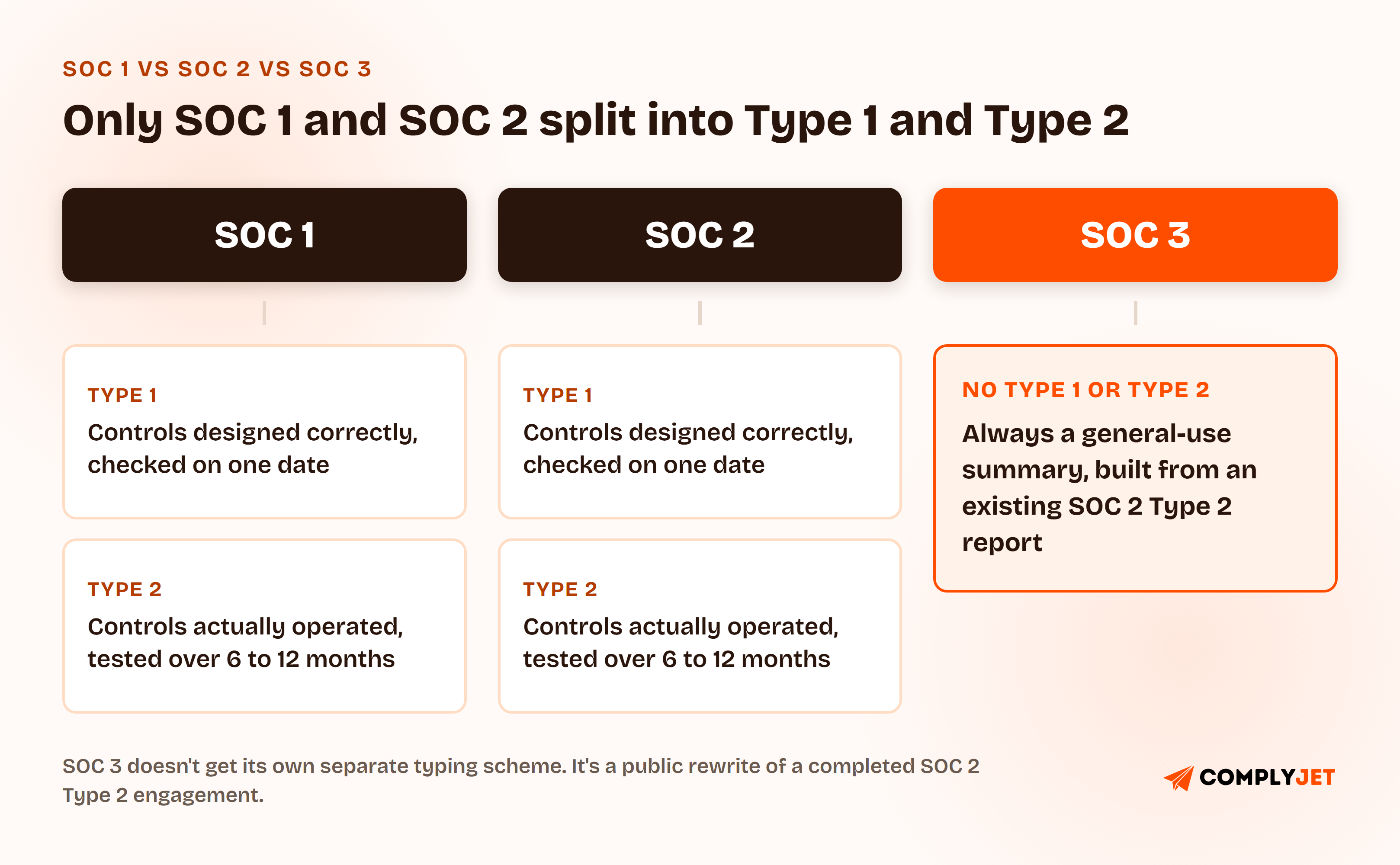
SOC 1 and SOC 2 both split into Type 1 and Type 2. A Type 1 report checks whether controls are designed correctly as of one specific date. A Type 2 report checks whether those same controls actually operated effectively across a period, usually 6 to 12 months.
SOC 3 does not have its own Type 1 or Type 2. It's a general-use rewrite of an underlying SOC 2 Type 2 report, not a separately typed audit with its own design-only or period-based version.
In practice, a SOC 3 is almost always built from a SOC 2 Type 2 report rather than a Type 1. A Type 1 only confirms controls were designed correctly on one date, which gives a public audience very little to lean on. A Type 2's months of operating evidence is what actually makes a public trust claim worth publishing.
This is the one genuinely nuanced part of any soc 1 vs soc 2 vs soc 3 comparison, since a flat side-by-side table tends to smooth right over it. For the full Type 1 vs. Type 2 mechanics within each framework, our SOC 1 breakdown and our SOC 2 breakdown both go deeper than this section needs to.
SOC 1 vs SOC 2 vs SOC 3 Reports: Cost and Timeline, What to Expect
There's no single, independently sourced dollar figure that applies across every company and every report type here. Cost scales with the auditor's own rates, how many Trust Services Criteria are in scope for SOC 2, and whether it's a first-time engagement or a renewal. What's consistent is why the costs differ, not one number that fits everyone.
SOC 1 and SOC 2 are broadly comparable in cost complexity, since both require a full audit engagement with its own scoping and evidence review. SOC 3 is typically the cheapest of the three to add, because it's a marginal cost layered on top of an existing SOC 2 Type 2 engagement rather than a ground-up audit of its own.
Timeline follows the same logic. A Type 1 report, whether SOC 1 or SOC 2, can close in a matter of weeks once your controls are actually documented. A Type 2 report needs its 6-to-12-month observation window to fully elapse before the auditor has anything to sample evidence from, no matter how prepared you are on day one.
SOC 3 moves fastest of all once the underlying SOC 2 Type 2 report exists. It's largely a condensing and redaction exercise at that point, not a new audit cycle, so it typically adds weeks rather than months to a program that's already running.
| Report | Fieldwork Once Ready | What Has to Elapse First |
|---|---|---|
| SOC 1 Type 1 | A few weeks | Nothing, it's a point-in-time review |
| SOC 1 Type 2 | A few weeks of fieldwork | A 6-to-12-month observation window |
| SOC 2 Type 1 | A few weeks | Nothing, it's a point-in-time review |
| SOC 2 Type 2 | A few weeks of fieldwork | A 6-to-12-month observation window |
| SOC 3 | Days to a couple of weeks | A completed SOC 2 Type 2 to summarize |
The table's takeaway is simple: the bottleneck almost never sits with the auditor's calendar. It sits with whichever observation window has to run its course first, which is exactly why starting that clock early matters more than negotiating a faster audit.
None of these are one-time projects either. A Type 2 report, whether SOC 1 or SOC 2, covers a specific observation period and has to be renewed on a recurring cadence, typically annually, to stay current for customers who keep asking for the latest one. A SOC 3 built on top of that SOC 2 needs refreshing on the same schedule, since it's only as current as the SOC 2 Type 2 it summarizes.
First-time engagements also cost more than renewals across all three report types, mainly because a first audit involves designing and documenting controls from scratch. A renewal is testing controls that already exist and already have a track record, which is a lighter lift for both the company and the auditor.
The number of Trust Services Criteria in scope moves SOC 2 cost more than almost anything else. A security-only SOC 2 is the leanest version of the report. Adding availability, confidentiality, processing integrity, or privacy each expands the control set an auditor has to test, and most companies add criteria only once a specific customer actually asks for that coverage.
Which One Do You Actually Need: SOC 1 vs SOC 2 vs SOC 3 Decision Guide
Match the report to the business model, not the other way around. A financial or payroll-adjacent service organization needs SOC 1, since that's what a customer's finance team will actually ask for. A SaaS or security-conscious B2B vendor needs SOC 2, since that's what a customer's security team will ask for. Anyone who wants a shareable, public trust signal adds SOC 3 on top of an existing SOC 2.
| If Your Business Is | You Likely Need |
|---|---|
| Payroll, billing, or fund administration for customers | SOC 1 |
| A SaaS or B2B vendor closing security-conscious deals | SOC 2 |
| Both of the above at once | SOC 1 and SOC 2 |
| Already SOC 2 compliant, tired of NDA requests for proof | SOC 2 plus SOC 3 |
Can a company have SOC 1, SOC 2, and SOC 3 all at once? Yes. They're not mutually exclusive, and it's common for a company that touches both customer financial data and general security-sensitive data to hold more than one.
Can you turn a SOC 2 report into a SOC 3 report? Yes, in the sense that matters practically. SOC 3 reuses the underlying SOC 2 Type 2 testing rather than requiring a fresh audit, so it's closer to a repackaging step than a separate compliance project.
A SaaS Company's Path From SOC 1 to SOC 2 to SOC 3
A vertical SaaS platform that also processes customer payroll data is a clean example of needing all three, in sequence. Its first enterprise deal stalls until the customer's finance team gets a SOC 1 report covering the payroll-processing controls specifically.
The next enterprise deal stalls on a different desk: the customer's security team wants a SOC 2 covering the platform's broader security posture, separate from the payroll-specific controls SOC 1 already covers. These run as genuinely separate audits, on separate observation periods, since they're testing different controls for different readers.

Once that SOC 2 Type 2 is in hand, the company adds a SOC 3 purely to stop fielding NDA requests from smaller prospects who just want proof of compliance on the website. The sales team gets a link they can send to anyone, the security-conscious enterprise buyers still get the full SOC 2 under NDA, and neither process interferes with the other.
SOC 1 vs SOC 2 vs SOC 3 Mistakes Companies Keep Making
Most of these mistakes come from treating the three reports as tiers of the same thing rather than three separate answers to three separate questions. Once that framing is fixed, the rest of the decision gets a lot more mechanical.
- Treating SOC 3 as a cheaper substitute for SOC 2 in a vendor security review. Enterprise security teams want the full SOC 2 report, not the public summary. A SOC 3 doesn't satisfy that request.
- Assuming SOC 1 covers security controls. It doesn't. SOC 1 is scoped to financial reporting controls only; security, availability, and the rest of the Trust Services Criteria are SOC 2's job entirely.
- Assuming every company needs all three from day one. Most companies need one, sometimes two. Adding a report nobody's actually asked for is wasted audit spend.
- Treating SOC 3 as its own ground-up audit. It's a byproduct of an existing SOC 2 engagement, not a separate compliance project with its own timeline and cost structure.
- Confusing "SOC 3" with a "Type 3" report. No such designation exists in the AICPA framework. Only SOC 1 and SOC 2 split into Type 1 and Type 2.
- Skipping SOC 1 because SOC 2 is the more commonly discussed report. If the business genuinely touches a customer's financial reporting, SOC 2 alone won't satisfy that customer's finance team.
- Not accounting for subservice organizations in scope. A vendor whose infrastructure your service relies on has to be addressed under the carve-out or inclusive method, in a SOC 1 or a SOC 2 report alike. Leaving it out entirely is a gap an auditor will flag.
- Publishing a SOC 3 report that's already stale. Since a SOC 3 only stays current alongside its underlying SOC 2 Type 2, a company that lets the SOC 2 lapse without renewing is effectively linking to an outdated claim on its own website.

How ComplyJet Supports SOC 1 and SOC 2 Compliance
ComplyJet provides SOC 1 analysis and attestation support alongside SOC 2, not just SOC 2 alone. That includes mapping the financial-reporting controls a SOC 1 audit examines and the Trust Services Criteria a SOC 2 audit examines, so a company that needs both isn't managing two disconnected processes with two separate vendors and two separate evidence trails.
Pricing is flat per company rather than per seat, which matters most for a growing company that's realized, from working through this article, that it may need more than one report. A company that starts with SOC 2 and later adds SOC 1, or the other way around, doesn't get penalized with a second per-seat contract on top of the first.
FAQs
SOC 1 vs SOC 2 vs SOC 3: What Is the Difference?
SOC 1 tests controls over financial reporting for an audience of financial auditors. SOC 2 tests security and related Trust Services Criteria for business buyers. SOC 3 takes that same SOC 2 testing and repackages it as a public summary anyone can read, with no detailed control descriptions.
Is There a SOC 4 Report?
No. The AICPA's System and Organization Controls framework stops at SOC 1, SOC 2, and SOC 3, and nothing beyond it. If you've seen "SOC 4" referenced somewhere, it isn't a recognized AICPA report type.
Can a Company Have SOC 1, SOC 2, and SOC 3 All at Once?
Yes. They're not mutually exclusive. A company whose work touches both customer financial reporting and general security posture commonly holds a SOC 1 and a SOC 2, and can add a SOC 3 on top of the SOC 2 for public use.
SOC 1 vs SOC 2 vs SOC 3: Which One Do I Need?
It depends on what's being tested and who's asking. Financial or payroll-adjacent service organizations need SOC 1. SaaS and security-conscious B2B vendors need SOC 2. Anyone wanting a shareable public trust signal adds SOC 3 on top of an existing SOC 2.
Can You Turn a SOC 2 Report Into a SOC 3 Report?
Yes, practically speaking. A SOC 3 reuses the underlying SOC 2 Type 2 testing rather than requiring a new audit, so it's closer to a repackaging and redaction step than a separate engagement.
Does SOC 3 Have a Type 1 and Type 2 Like SOC 1 and SOC 2?
No. Only SOC 1 and SOC 2 split into Type 1 (point-in-time) and Type 2 (period of time) versions. SOC 3 is always a general-use summary of an underlying SOC 2 engagement, most commonly a Type 2, without its own separate typing.
Is a SOC 3 Report as Trustworthy as a SOC 2 Report?
They're based on the same underlying testing, so the assurance behind them is the same. What differs is detail. A SOC 3 gives a buyer confidence that the testing happened; a SOC 2 gives an auditor or security team enough detail to evaluate exactly how. Neither report is "more true" than the other. They're just built for different levels of scrutiny.
Are There Other SOC Reports Besides SOC 1, 2, and 3?
A few adjacent ones exist under the same AICPA umbrella. SOC for Cybersecurity and SOC for Supply Chain are separate report types with their own scope, aimed at broader enterprise-wide risk rather than a specific service organization. "SOC 2+" isn't a distinct report either, it's a SOC 2 engagement that adds criteria from another framework, like HIPAA or ISO 27001, into the same audit.
None of these replace SOC 1, SOC 2, or SOC 3 for the specific service-organization use case this article covers. They're worth knowing exist mainly so a mention of "SOC for Cybersecurity" in a sales conversation doesn't get confused with the SOC 1 vs SOC 2 vs SOC 3 comparison this article is actually about.
Related Reading
- SOC 1 vs SOC 2, for the full framework-level comparison if your decision is really just between these two.
- SOC 2 vs SOC 3, for exactly how a SOC 3 report gets built from an existing SOC 2 engagement.
- SOC 1 Type 1 vs. Type 2, for the Type 1/Type 2 mechanics specific to SOC 1.
- SOC 2 Type 1 vs. Type 2, for the Type 1/Type 2 mechanics specific to SOC 2.
- What Is a Bridge Letter?, on covering the gap between two Type 2 observation periods for either report.
Sources: AICPA & CIMA — System and Organization Controls (SOC) Suite of Services; Wikipedia — SSAE No. 18