.svg)

A customer's finance team asks for your SOC 1 report before they'll close the deal, and someone on your side asks the obvious follow-up: Type 1 or Type 2? Nobody's entirely sure, and the two words that keep showing up in search results (SOC 2 Type 1 vs Type 2) turn out to be a different report entirely.
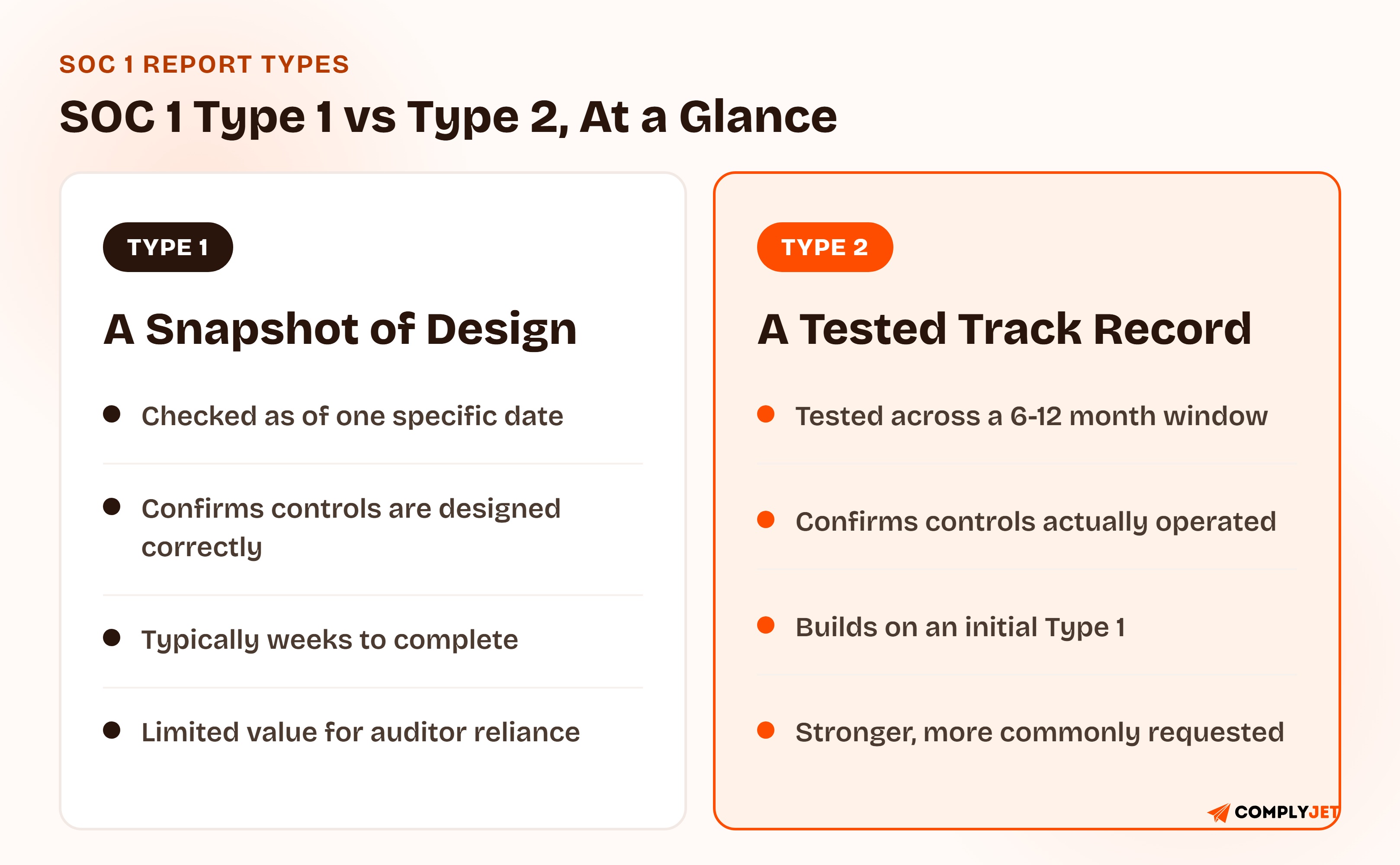
SOC 1 Type 1 vs Type 2 comes down to time. A SOC 1 Type 1 report checks whether your controls over financial reporting are designed correctly, as of one specific date. A SOC 1 Type 2 report checks whether those same controls actually operated effectively over a period, usually 6 to 12 months. Type 2 is the stronger, more commonly requested assurance. Type 1 is faster and often a first-year stepping stone toward it.
Quick answer
SOC 1 Type 1 is a point-in-time snapshot of control design. SOC 1 Type 2 tests whether those controls actually operated effectively across a 6-to-12-month window. Type 2 gives a customer's auditors more to rely on, and most companies move to it after an initial Type 1.
One thing worth stating plainly before going further: this article is about SOC 1's own Type 1 vs Type 2 split, not the SOC 2 version of the same question. SOC 2 has its own separate Type 1 vs Type 2 decision, covered in our SOC 2 Type 1 vs. Type 2 guide. If a customer is asking about controls tied to security or availability rather than financial reporting, that's the article to read instead.
By the end of this, you'll know exactly what separates the two report types, how long each realistically takes, what it costs to get one over the other, and how SOC 1 Type 2 relates to the very differently scoped SOC 2 Type 2.
Here's what's ahead:
- What a SOC 1 report actually is, and what Type 1 and Type 2 each test
- Why the distinction matters once a customer's own auditors are involved
- SOC 1 Type 1 vs Type 2, compared side by side
- SOC 1 Type 2 vs SOC 2 Type 2: same label, different subject matter
- Realistic timelines for each report type
- What actually drives the cost difference between them
- Which one to get first, with a concrete example
- The mistakes that trip up first-time SOC 1 companies
What Is a SOC 1 Report? SOC 1 Type 1 vs Type 2, Defined
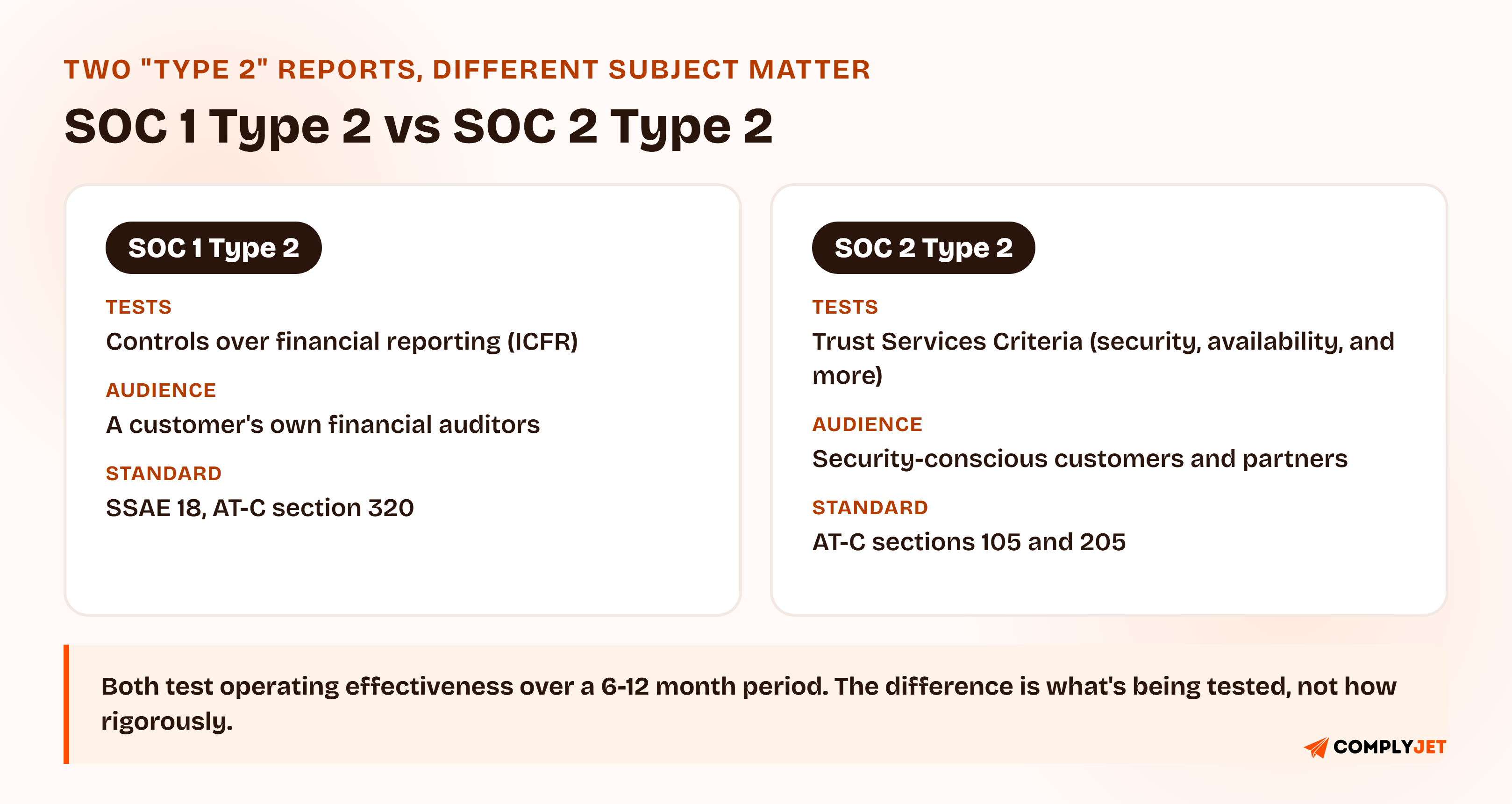
A SOC 1 report evaluates a service organization's controls over financial reporting, known as ICFR. The audience is narrow and specific: a customer's own financial statement auditors, who use your SOC 1 report to reduce the amount of testing they'd otherwise have to do themselves on your systems.
That's a different job from SOC 2, which is aimed at a security-conscious buyer rather than an auditor. Our SOC 1 vs SOC 2 comparison covers that framework-level distinction in full. This article stays inside SOC 1 and answers a narrower question: once you know you need a SOC 1 report, which type of it do you need?
The governing standard is SSAE 18, specifically AT-C section 320, issued by the AICPA. It's worth naming the section directly rather than gesturing vaguely at "an AICPA standard," since it's what an auditor's engagement letter and final report will actually cite.
Note
You'll still occasionally see the phrase ssae 16 soc 1 type 1 vs type 2 in searches and older vendor content. SSAE 16 was the standard's name before 2017, when SSAE 18 replaced it. The Type 1/Type 2 distinction itself didn't change, only the standard's name and a handful of subservice-organization monitoring requirements did.
Whether the search was for ssae 16 soc 1 type 1 vs type 2 or the current SSAE 18 phrasing, the underlying resources describe the exact same two report types.
The question itself gets asked a few different ways depending on who's asking: a customer's procurement team might phrase it as soc 1 report type 1 vs type 2, while someone already deep in the audit process might frame it as soc 1 type 1 vs soc 1 type 2. Both are pointing at the same underlying decision this article works through.
SOC 1 Type 1: A Snapshot of Your Controls
A Type 1 report answers one question: are the controls you've documented actually designed the way you say they are, as of a specific date. The auditor reviews your system description and control design, confirms it's suitably designed to meet its stated objectives, and issues an opinion as of that single point in time.
It doesn't test whether the controls worked in practice over any stretch of time. That's the tradeoff for being faster to obtain.
SOC 1 Type 2: Proof Your Controls Actually Worked
A Type 2 report covers everything a Type 1 does, then adds the harder part: operating effectiveness testing across an observation period, typically 6 to 12 months. The auditor pulls evidence samples throughout that window, not just on one day, to confirm the controls were actually followed consistently.
That's the difference between "here's what we designed" and "here's what we actually did, repeatedly, for months." A customer's auditors generally trust the second claim more, because it's backed by a track record rather than a design document.
Why SOC 1 Type 1 vs Type 2 Matters to Your Customers
The distinction isn't academic once a customer's financial auditors are the ones reading your report. Auditors rely on a SOC 1 report to reduce their own testing of your systems, a practice called control reliance. A Type 1 report gives them very little to actually rely on: it says the controls exist and are designed well, but nothing about whether they held up.
A Type 2 report is what most auditors actually want to lean on, because it carries months of evidence rather than a single date's snapshot. Some customers will accept a Type 1 for a first-year vendor relationship as a placeholder, understanding a Type 2 is coming. Fewer will accept it indefinitely.
The mistake I see most often isn't picking the wrong type. It's not finding out which one a customer's auditors actually need until the renewal conversation is already underway. — Upendra Varma, CTO at ComplyJet
Getting this wrong shows up at the worst possible time: mid-renewal, when a customer's finance team asks for period coverage you don't have yet, and the only fix is waiting out a new observation window.
SOC 1 Type 1 vs Type 2: The Real Differences, Side by Side
| Dimension | SOC 1 Type 1 | SOC 1 Type 2 |
|---|---|---|
| What's tested | Design of controls only | Design + operating effectiveness |
| Reporting period | A single point in time | An observation window, usually 6-12 months |
| Evidence gathered | One-time documentation review | Samples pulled throughout the whole period |
| Typical use case | First-time audit, or a fast initial assurance | Ongoing customer reliance, renewal cycles |
| Auditor reliance value | Limited | Substantially higher |
The difference between soc 1 type 1 and type 2, in one line: Type 1 proves your controls are designed correctly on a given day. Type 2 proves they were actually followed, consistently, for months. Same controls, same framework, a different bar of proof.
Both reports also share real similarities worth naming so the comparison isn't lopsided. Both require the same management assertion, the same system description, and the same underlying set of controls over financial reporting; Type 2 doesn't test a different set of controls, it tests the same ones more rigorously.
SOC 1 Type 2 vs SOC 2 Type 2: Same Words, Different Job
This is a real point of confusion, and it's one neither of the two on-topic guides we reviewed while researching this article actually addresses. Both "Type 2" labels mean the same mechanical thing: tested for operating effectiveness over a period, not just confirmed as designed on one date.
What differs is the subject matter. SOC 1 Type 2 tests controls over financial reporting, for an audience of financial auditors. SOC 2 Type 2 tests controls against the Trust Services Criteria (security, availability, confidentiality, processing integrity, and privacy), for an audience of security-conscious customers and partners. Same rigor, same "over a period" structure, completely different set of controls being examined.
Some readers land on this question from an even wider angle, trying to compare soc 1 vs soc 2 type 1 vs type 2 all in one breath, frameworks and report types at once. This section only untangles the report-type half of that. For the framework-level half, the fuller SOC 1 vs SOC 2 breakdown in our dedicated comparison is the better read.
A company handling both customer financial data and general security-sensitive data can end up needing both reports. That's not double work on the same controls, since the two reports examine largely different control sets, but it is two separate audits, two separate observation periods if both are Type 2, and two separate reports to manage on their own renewal clocks.
How Long SOC 1 Type 1 vs Type 2 Actually Takes
A Type 1 can move fast once your controls are actually documented and designed. Once readiness work is done, the audit itself, review of the design, confirmation against the standard, opinion issuance, can close out in a matter of weeks.
A Type 2 can't move at that speed no matter how prepared you are, because the observation period itself is the bottleneck. The 6-to-12-month window has to actually elapse before the auditor has anything to sample evidence from. Being fully ready on day one doesn't shorten a period that hasn't happened yet.
That's why so many first-time SOC 1 companies sequence it this way: get a Type 1 first, both to satisfy an immediate customer ask and to formally start the clock, then let the Type 2 observation period run in parallel with normal operations before that audit begins.
Watch out
Waiting until a Type 2 is explicitly requested to start the observation period. The window itself takes months regardless of how quickly the audit fieldwork happens afterward, so the clock is the thing to start early, not the paperwork.
What Drives the Cost Gap: SOC 1 Type 1 vs Type 2
Neither guide we reviewed on this topic addresses cost at all, which leaves most first-time SOC 1 companies guessing. There's no single, independently sourced dollar figure that applies across every company here, since cost scales with the number of controls in scope and the auditor's own rates. What's consistent is why Type 2 costs more, not a specific number.
A Type 2 audit reviews evidence across the entire observation period rather than a single date, which means more auditor hours reviewing more evidence samples, more rounds of follow-up on anything incomplete, and a longer overall engagement to manage. None of that is optional padding. It's the actual work behind the stronger assurance a Type 2 provides.
Pro tip
Budget for the evidence-collection lift, not just the auditor's invoice. The bulk of the added cost in a Type 2 engagement is internal time spent gathering and organizing months of evidence, which is exactly the part that's easiest to underestimate going in.
SOC 1
Flat per-company pricing means the cost gap doesn't come as a surprise
ComplyJet prices by company, not by seat, so moving from a Type 1 to a Type 2 doesn't carry a headcount-driven price shock on top of the added audit work.
SOC 1 Type 1 vs SOC 1 Type 2: Which One Do You Need First?
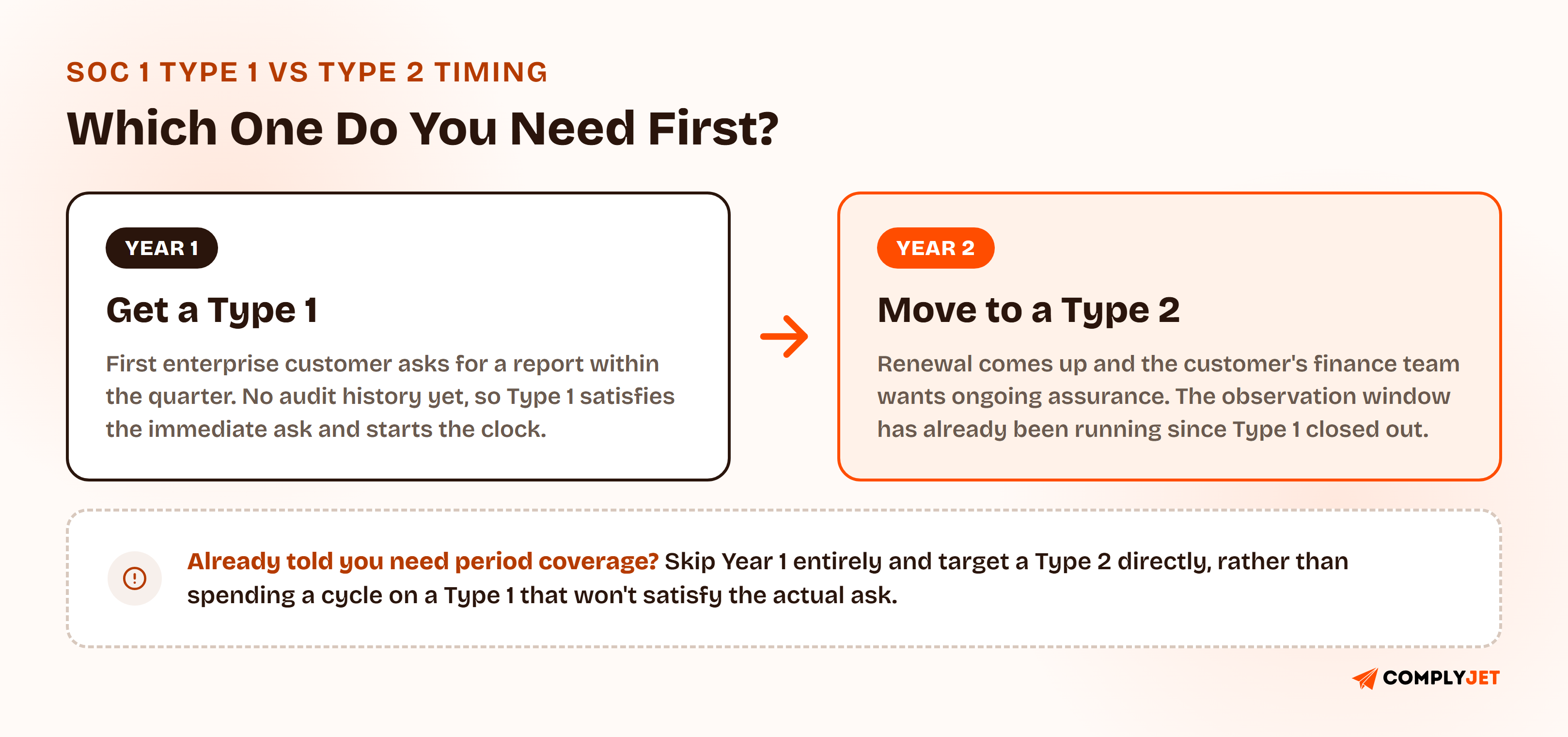
However it gets framed, whether as soc 1 type 1 vs type 2 or as a soc 1 report type 1 vs type 2 decision, the practical answer for a company going through this for the first time is usually a Type 1 first, then a Type 2 on the following cycle. It establishes that controls exist and are designed properly, satisfies an immediate customer ask, and starts the clock toward the Type 2 observation period.
A company that's already been explicitly told by a customer's auditors that they need period coverage, not a snapshot, should skip straight to targeting a Type 2 rather than spending a cycle on a Type 1 that won't satisfy the actual ask.
A concrete version of this: a payroll-processing SaaS company signs its first enterprise customer and gets asked for a SOC 1 report within the quarter. There's no existing audit history to point to. A Type 1 is realistic on that timeline and satisfies the immediate request.
The following year, once that same customer's finance team wants ongoing assurance for renewal, the company moves to a Type 2. By then, the observation period has already been running since the Type 1 closed out, so the Type 2 audit isn't starting from zero.
Common Mistakes Companies Make With SOC 1 Type 1 vs Type 2
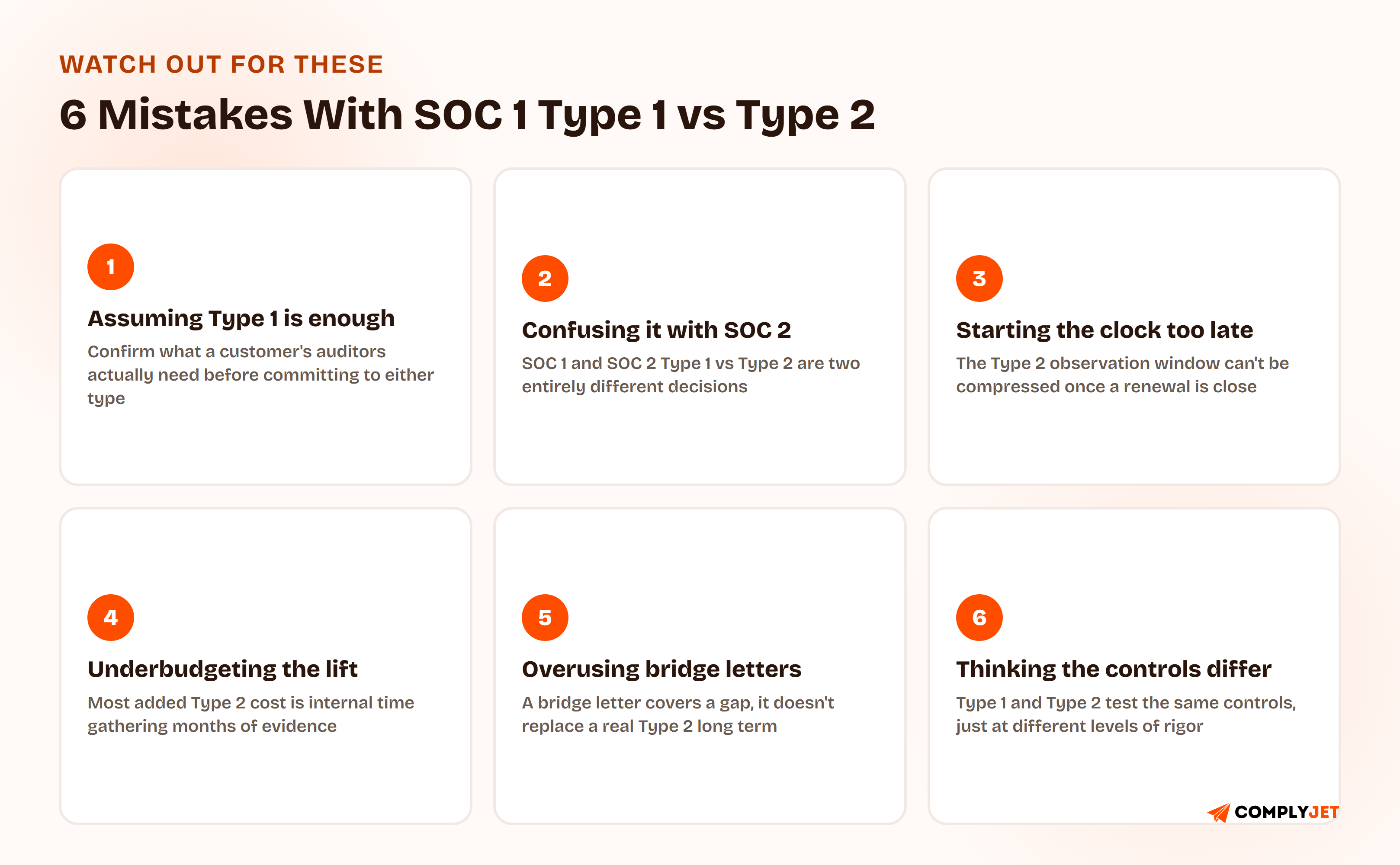
- Assuming a Type 1 satisfies a customer who actually needs Type 2 coverage. Confirm what a customer's auditors expect before committing to either type, not after the report is already issued.
- Confusing this with the SOC 2 Type 1 vs Type 2 decision. The two frameworks test entirely different controls; getting the wrong framework's report doesn't help either side.
- Starting the Type 2 observation window too late relative to a renewal deadline. The window itself can't be compressed, no matter how quickly the audit fieldwork moves once it starts.
- Underbudgeting the evidence-collection lift for a Type 2. The added cost is mostly internal time spent gathering months of evidence, not just a bigger auditor invoice.
- Treating a bridge letter as a permanent substitute for a real Type 2. A bridge letter covers a gap between reports, not an ongoing replacement for one. Our guide to bridge letters covers what they can and can't do.
- Assuming Type 1 and Type 2 test different controls. They test the same controls at different levels of rigor, not two separate sets.
How ComplyJet Supports SOC 1 Type 1 vs Type 2 Audits
ComplyJet provides SOC 1 analysis and attestation support for both Type 1 and Type 2 engagements, not just SOC 2. That includes helping map and document the financial-reporting controls a SOC 1 audit actually examines, and organizing evidence collection so a later move from Type 1 to Type 2 doesn't mean starting from scratch.
Pricing is flat per company rather than per seat, which matters most for a first-time SOC 1 company trying to budget honestly for both the initial Type 1 and the Type 2 that typically follows it.
Audit Support
Moving from a SOC 1 Type 1 to a Type 2 shouldn't mean starting over
ComplyJet supports SOC 1 attestation for both types, with evidence collection that carries forward instead of resetting between audit cycles.
FAQs
What Is a SOC 1 Type 2 Report?
It's a report that tests both the design and the operating effectiveness of a service organization's controls over financial reporting, across an observation period of typically 6 to 12 months. It's the stronger of the two SOC 1 report types, and the one most customers' auditors prefer to rely on.
SOC 1 Type 1 vs Type 2: What's the Difference?
Type 1 checks whether controls are designed correctly as of one specific date. Type 2 checks whether those same controls actually operated effectively across an extended period. Type 2 includes everything Type 1 covers, plus months of additional evidence. Put simply, the difference between soc 1 type 1 and type 2 is a snapshot versus a tested track record.
How Long Does a SOC 1 Type 2 Audit Take?
The observation period itself runs 6 to 12 months, and it has to fully elapse before the audit fieldwork can even begin. Including a realistic readiness phase beforehand, most first-time companies should plan for close to a year from kickoff to final report.
Can You Go Straight to SOC 1 Type 2 Without a Type 1 First?
Yes. A Type 1 isn't a mandatory prerequisite, it's a common practical choice for first-time companies that want a faster initial report while the Type 2 observation period runs. A company that already knows it needs period coverage can target a Type 2 directly.
Is SOC 1 Type 2 Harder to Get Than Type 1?
It's not harder in terms of the standard being applied, but it demands more sustained evidence. Controls have to actually operate consistently for months, not just be designed well on paper, which is a higher practical bar even though the underlying requirements are the same.
SOC 1 Type 2 vs SOC 2 Type 2: What's Actually Different?
Both test operating effectiveness over a similar observation period, but they examine different controls for different audiences. SOC 1 Type 2 covers controls over financial reporting for a customer's financial auditors. SOC 2 Type 2 covers the Trust Services Criteria for security-conscious customers and partners.
Which GRC Platforms Help Streamline Evidence Collection for a SOC 1 Type 2 Report?
Compliance automation platforms, including ComplyJet, Vanta, and Drata, all offer some version of evidence collection and control mapping that reduces the amount of manual document-hunting a Type 2's longer observation period otherwise requires.
Related Reading
Anyone approaching this as the broader soc 1 vs soc 2 type 1 vs type 2 question, comparing frameworks and report types together, should start with the first two links below before coming back here for the type-level detail.
- SOC 1 vs SOC 2, for the framework-level comparison, useful before worrying about which report type to get.
- SOC 2 Type 1 vs. Type 2, the SOC 2 version of this exact question, for readers who landed here about the wrong framework.
- SOC 2 Audit Process, Start to Finish, for the fuller phase-by-phase walkthrough once a report type is decided.
- How to Review a SOC 2 Report From a Vendor, for readers evaluating someone else's report rather than obtaining their own.
- What Is a Bridge Letter?, on covering the gap between two reports without treating it as a substitute for a real Type 2.
Sources: AICPA & CIMA — System and Organization Controls (SOC) Suite of Services; Wikipedia — SSAE No. 18