.svg)

A security questionnaire lands in your inbox asking for your SOC 2 report. Three weeks later, your own accountant mentions a SOC 1. If you've never had to weigh soc 1 vs soc 2 before, it's reasonable to feel like you're being asked the same question twice.
You're not. SOC 1 and SOC 2 are both AICPA attestation reports, but they exist to answer different questions for different audiences. SOC 1 tells a financial statement auditor, yours or your customer's, whether your controls over financial reporting are reliable. SOC 2 tells a customer's security team whether your controls actually protect their data. Most companies only ever need one of the two, and the fastest way to know which is to ask who's requesting it and why.
By the end of this, you'll know exactly which report applies to your business, what it actually costs and takes, and the two questions almost nobody answers directly: whether you can reuse audit evidence across both, and what a fintech company processing payments specifically needs.
Here's what's ahead:
- Who actually asks for each report, and why
- The core difference, side by side
- SOC 1 vs SOC 2 compliance: which applies to your business, including SaaS, fintech, and dual-report cases
- Why "SOC 1 vs SOC 2" isn't the same question as "Type 1 vs Type 2"
- What it actually costs and how long it takes
- Whether you can reuse controls or evidence between the two audits
SOC 1 vs SOC 2: Who's Actually Asking You for the Report, and Why
Every SOC report exists because someone downstream needs to trust a system they don't control. The question that actually separates soc 1 vs soc 2 isn't about controls. It's about who that someone is, and what they're trying to protect themselves from.
Both reports sit under the same AICPA attestation framework, which is part of why they get confused so often. This exact comparison is sometimes searched as "soc 1 vs soc 2 aicpa," and the short answer is that both are governed by SSAE 18, the standard that replaced SSAE 16 back in 2017.
If you're reading older material that still frames this as "ssae 16 soc 1 vs soc 2," the comparison logic underneath hasn't changed, only the standard's name has. What also hasn't changed is who's allowed to sign off: only a licensed CPA firm can issue either opinion, and that single fact is why the answer to "which firms provide these audits" further down is shorter than most people expect.
The two most common SOC questions founders bring me aren't about controls. They're "who's actually going to read this report" and "do I need one or both." Once you answer that, the rest tends to sort itself out. — Upendra Varma, CTO at ComplyJet
That framing is really a soc 1 vs soc 2 purpose differences question before it's a controls question. Purpose determines which report applies, and it's worth settling before you spend a dollar on either audit.
SOC 1 Exists for Your Auditor and Investors
SOC 1 assesses internal controls over financial reporting, usually shortened to ICFR (in plain terms, the processes that make sure the numbers in a company's financial statements are accurate). Who requests it: your own financial statement auditor, or a customer's auditor if your systems touch numbers that flow into their books.
The engagement runs under SSAE 18, specifically AT-C Section 320. Typical use cases: payroll processing, insurance claims administration, fund administration, and anything else where a mistake in your system becomes a mistake in someone else's financial statements.
SOC 2 Exists for Your Customers and Security Reviewers
SOC 2 assesses controls against the Trust Services Criteria, a set of five categories covering security, availability, processing integrity, confidentiality, and privacy. Who requests it: enterprise customers doing vendor security review, almost always through a security questionnaire before a contract gets signed.
The engagement runs under SSAE 18 as well, specifically AT-C Sections 105 and 205. Security is the one mandatory criterion. The other four get scoped in based on what's actually relevant to your product, which is a decision your SOC 2 controls list should reflect directly.
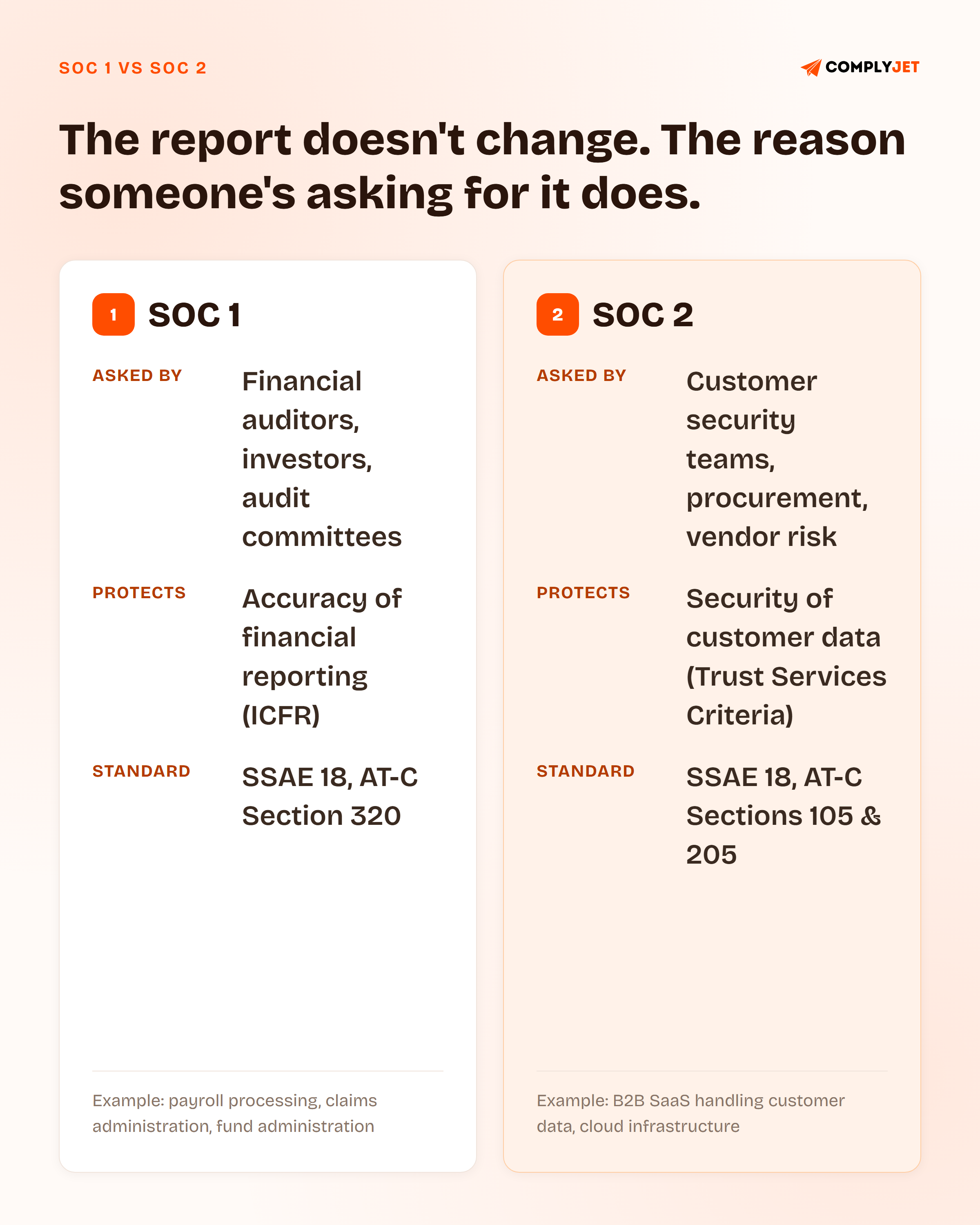
SOC 1 vs SOC 2 Reports: The Core Difference, Side by Side
Neither report is a certificate, and that's worth stating plainly before anything else. Both are attestations: an independent auditor's opinion on whether your controls existed and worked, not a pass or fail badge you either earn or don't.
Here's the difference, side by side:
| SOC 1 | SOC 2 | |
|---|---|---|
| Purpose | Controls relevant to a customer's financial statements | Controls relevant to security and data protection |
| Governing standard | SSAE 18, AT-C Section 320 | SSAE 18, AT-C Sections 105 and 205 |
| Who reads it | Financial statement auditors, investors, audit committees | Security teams, procurement, enterprise customers |
| Example use case | Payroll, claims administration, fund administration | B2B SaaS handling customer data, cloud infrastructure |
| Typical requester | Your own or a customer's financial auditor | A customer's security or vendor-risk team |
Linford & Co, a CPA firm that performs both audit types, frames the distinction the same way: SOC 1 exists because a service organization's processing affects someone else's financial statements, and SOC 2 exists because a service organization's security posture affects someone else's risk exposure. Wipfli makes the same split, and both firms land on the same practical test: ask who's relying on you, and for what.
If you've never actually opened either type of report, it helps to see what a SOC 2 report looks like before you request one. The layout, the sections, and the language are broadly similar across both soc 1 vs soc 2 reports, even though the content inside is different.
SOC 1 vs SOC 2 Compliance: Which One Applies to Your Business
This is the part most comparisons skip. Knowing the definitions doesn't tell you which soc 1 vs soc 2 compliance obligation actually applies to your business right now.
SOC 1 vs SOC 2 for SaaS Companies
Most B2B SaaS companies land squarely in SOC 2 territory. Unless your product specifically processes transactions that hit a customer's financial statements (billing infrastructure, payment processing, fund movement), SOC 1 usually isn't the report anyone's going to ask you for.
If you're comparing platforms to help manage the SOC 2 side of this, ComplyJet's roundup of SOC 2 compliance software covers the landscape without pretending every tool fits every stage of company.
This holds regardless of headquarters location. The same decision logic applies to a search for "soc 1 vs soc 2 for saas companies australia" or its UK equivalent; jurisdiction doesn't change which report applies, since AICPA attestation standards aren't tied to where a company is incorporated.
SOC 1 vs SOC 2 Cybersecurity Requirements
When this comparison gets framed as "soc 1 vs soc 2 cybersecurity," the answer is worth stating directly: SOC 1 has no cybersecurity-controls scope of its own. It tests financial-reporting controls only. SOC 2 is the one built around security, availability, processing integrity, confidentiality, and privacy. If cybersecurity is the actual concern driving the question, SOC 2 is almost always the report in play.
SOC 1 vs SOC 2 for Fintech and Payments Companies
This is a real, specific question that shows up in search demand with almost no direct coverage anywhere: which report does a fintech company processing payments actually need?
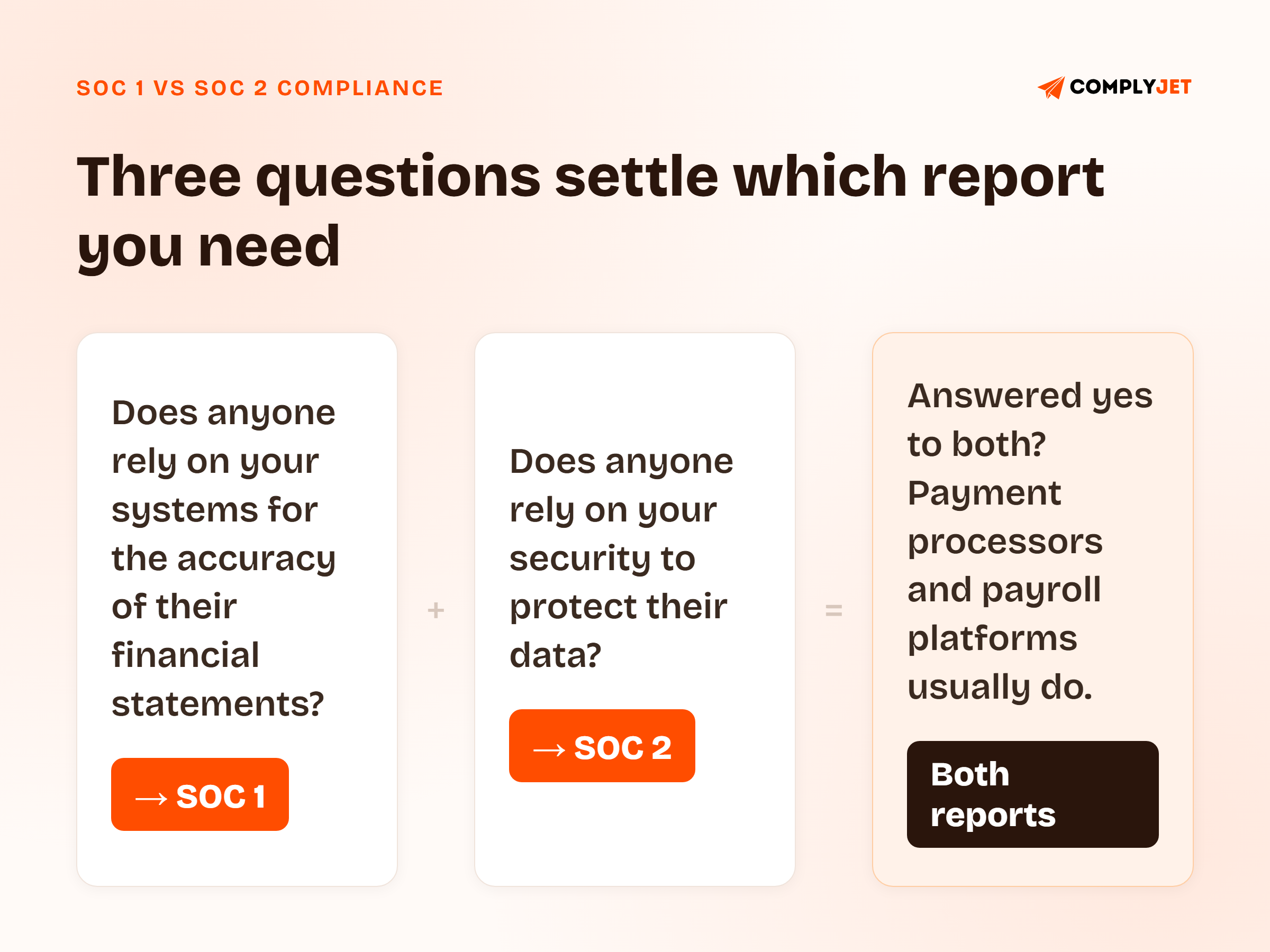
Usually both. A payments company touches financial reporting data for its customers (transaction records that flow into their books), which puts it in SOC 1 territory. It also holds sensitive customer and payment data, which puts it in SOC 2 territory too. The two audits run on separate tracks, but for a payments business, treating this as an either-or question is usually the wrong framing from the start.
Do You Need SOC 1 and SOC 2 Compliance at the Same Time?
Some businesses genuinely need SOC 1 and SOC 2 compliance running in parallel, and it's worth naming the overlap instead of treating "both" as a footnote. Payment processors, payroll platforms, and fund administrators are the clearest examples: they affect a customer's financial statements and hold sensitive data that customer's security team cares about.
Even large cloud providers split this the same way. AWS publishes separate SOC 1 and SOC 2 reports rather than one combined document, precisely because the two audiences (financial auditors and security reviewers) want different evidence. If you end up needing both, expect two separate engagements, two separate opinions, and two separate reports, even where some of the underlying evidence overlaps.
SOC 1 vs SOC 2 Type 1 vs Type 2: Two Different Questions
It's an easy mix-up. "SOC 1 vs SOC 2 Type 1 vs Type 2" shows up as its own search phrase often enough that it's worth addressing head-on rather than assuming the framework question resolves it.
Once you've settled which framework applies (SOC 1 or SOC 2), a second, separate decision follows: Type 1 or Type 2. That decision deserves its own deep dive rather than a rushed paragraph here.
For the full breakdown of what changes between the two report types, go to our full breakdown of SOC 2 Type 1 vs Type 2. The same Type 1 versus Type 2 logic carries over to a soc 1 vs soc 2 audit either way, just applied to financial-reporting controls instead of security controls once you're on the SOC 1 side.
SOC 1 vs SOC 2 Audit: What Compliance Actually Costs and How Long It Takes
Real numbers are hard to find as there are several factors which influence the costs. However, here're rough estimates of the industry standards vs what ComplyJet offers.
| Typical audit fee | ComplyJet platform cost | What drives the cost | First-time timeline | |
|---|---|---|---|---|
| SOC 1 | No separately published industry figure; scales with the number and nature of financial-reporting control objectives in scope | $5,000/year | Count and complexity of ICFR-relevant controls | Similar Type 1 / Type 2 split as SOC 2, below |
| SOC 2 Type 1 | $15,000–$40,000 | $5,000/year | Number of Trust Services Criteria selected | 4–8 weeks |
| SOC 2 Type 2 | $25,000–$100,000+ | $5,000/year | Same TSC scope, plus the length of the observation window | 9–15 months for a first report |
Zooming out, Linford & Co's own 2026 audit-cost analysis puts overall SOC audit fees, SOC 1 or SOC 2, somewhere between $20,000 and $150,000 industry-wide, with a median around $30,000.
The same analysis notes that Big Four firms price meaningfully above that range, starting in the low six figures and climbing into the millions for large, complex engagements, while boutique and mid-size audit firms are where most of that $20,000–$150,000 range actually lives. That range also includes a real readiness-assessment cost most companies underestimate. A SOC 2 gap analysis done properly before the actual audit adds cost up front but tends to shorten and de-risk the audit itself.
Here's the pattern worth noticing: audit firms publish detailed SOC 2 pricing constantly, because that's where the demand is. SOC 1 pricing gets far less public attention, not because it's rare, but because most of the companies searching for SOC comparisons today are SaaS businesses evaluating SOC 2, not the payroll processors and fund administrators who make up most of the actual SOC 1 market.
One timeline detail that almost never gets mentioned: renewal audits move faster than first-time ones. Once your first Type 2 report exists, subsequent renewal cycles can often run back-to-back without a fresh Type 1 gap in between, since the auditor is extending an existing evidence trail rather than starting from zero. If a gap does open up between report periods, a bridge letter is what covers it, for either framework.
For a deeper breakdown of SOC 2 pricing specifically, ComplyJet's own cost guide goes further than the summary above.
Can You Reuse Controls or Evidence Between a SOC 1 and a SOC 2 Audit?
This question gets asked constantly and answered almost nowhere. The honest answer is yes, partially, and no, not entirely.
In practice, the overlap tends to concentrate in the operational evidence: who has access to what, how changes get approved and logged, and how vendors are managed. What doesn't overlap is the actual test: a SOC 1 auditor is testing against financial-reporting risk, and a SOC 2 auditor is testing against the Trust Services Criteria. Drata's own comparison of the two frameworks lands on the same practical point, framed slightly differently: shared infrastructure and shared evidence-gathering activities, separate opinions.
If your business is one of the ones covered above that needs both reports, this is exactly where that overlap pays off. Gathering evidence once and mapping it into both audits saves real time, even though the audits themselves stay separate.
Where ComplyJet Fits, for SOC 1 or SOC 2
Everything above should get you to a clear answer: SOC 1, SOC 2, or both. Whichever it is, the work that follows is the part that actually eats a founder's time: evidence collection, control monitoring, and getting an audit-ready package together without a spreadsheet holding it all together.
ComplyJet supports both sides of this decision. On SOC 2, we work through the automation and evidence side with you directly, rather than handing over software and leaving you to turn it into an audit-ready outcome alone. On SOC 1, ComplyJet provides SOC 1 analysis and attestation support through the same guided process and audit-partner network, rather than treating it as a different company's problem.
FAQs
What's the one-sentence difference between SOC 1 and SOC 2?
SOC 1 tests controls relevant to a customer's financial statements, for auditors. SOC 2 tests controls relevant to security and data protection, for customers and security reviewers. Most companies only need one.
Do I need a SOC 1 report, a SOC 2 report, or both?
Ask who's requesting it and why. If it's a financial auditor asking about your impact on their books, that's SOC 1. If it's a customer's security team asking about your data protection, that's SOC 2. Payment processors, payroll platforms, and similar businesses often need both.
Where does ISO 27001 fit if I already need SOC 1 and SOC 2?
ISO 27001 is a separate, certifiable information security management standard, not an AICPA attestation like SOC 1 or SOC 2. It's common for a company to hold ISO 27001 alongside SOC 2, especially for customers outside the US. For the fuller comparison, ISO 27001 vs. SOC 2 covers where the two overlap and where they don't.
Why do SOC 2 projects often take longer than SOC 1 audits, in practice?
SOC 2 usually involves more Trust Services Criteria, more evidence types across more systems, and more cross-team coordination (engineering, IT, HR, and security all contribute evidence). SOC 1 tends to concentrate evidence within finance and the specific processes that touch financial reporting, which is a narrower, more contained scope to manage.
Is SOC 1 relevant if my company isn't a financial business?
Rarely. If nothing about your product processes transactions that flow into a customer's financial statements, SOC 1 usually isn't the report anyone will ask you for. Most non-financial SaaS companies can rule it out early and focus on SOC 2 instead.
Which firms actually perform SOC 1 and SOC 2 audits?
Only licensed CPA firms can issue either report; that's an AICPA requirement, not a vendor choice. If you're not sure how to pick one, ComplyJet's guide to choosing a SOC 2 auditor walks through what actually matters in that decision, and ComplyJet's own audit-partner network exists specifically to make that step less of a cold search.
Is a SOC report a certification?
No. SOC 1 and SOC 2 are both attestations, an auditor's opinion on whether your controls existed and operated effectively. There's no pass or fail badge, no logo you're issued for meeting a bar. Anyone describing a SOC report as a "certification" is using the word loosely, not accurately.
Related Reading
- SOC 2 Type 1 vs. Type 2, for the report-type questions within same framework.
- ISO 27001 vs. SOC 2, compare features, pricing, approach, and strategies for both frameworks.
- Azure SOC 2 report, if you're trying to figure out where a cloud provider's own SOC 1, SOC 2, and SOC 3 reports fit into your evidence.