.svg)

You are three calls deep into an enterprise deal. The buyer's security team asks for your SOC 2 report. You send it over, gated behind an NDA, and the deal moves forward.
Then they ask if they can post it on their own vendor page.
That one question is the whole SOC 2 vs SOC 3 story in a nutshell. One report is built for private due diligence. The other is built to be shown to the world.
Here we break down what each report actually contains, what it really costs, the one AICPA rule that connects them, and how to decide which one your company needs right now.
If you only have two minutes, read this section. It answers the core "SOC 2 vs SOC 3" question before we go deep.
Now let's slow down and look at each report on its own.
What Is SOC 2 and What It Contains?
SOC 2 stands for System and Organisation Controls 2. It is an AICPA framework built for companies that store, process, or handle customer data.
The exam is run by a licensed, independent CPA firm under a standard called SSAE 18. It checks whether your security controls actually work, not just whether they exist on paper.
Founder's tip!
Think of SOC 2 as your private homework. It proves your controls to the people who need proof, not to the general public.
SOC 2 is a restricted-use report. That means it only goes to people who need it, like customers, prospects, business partners, and regulators, usually behind an NDA. There is no ISO 27001-style public certificate here.
There are two flavours of SOC 2.
- SOC 2 Type 1 checks whether controls are designed well at one point in time.
- SOC 2 Type 2 checks whether those same controls actually worked over a period of months. Most enterprise buyers want Type 2.
While SOC 2 is not a legal requirement in the US, it has become an unwritten rule in B2B tech sales. Try selling into a mid-market or enterprise account without one and you will feel the friction fast.
Many teams pair it with an internal risk management program to keep controls audit-ready year-round.
Once your company has a solid SOC 2 Type 2 in hand, the natural next question becomes what to do with it publicly. That question has a name, and it is SOC 3.
Read: SOC 2 Type 1 vs Type 2: What’s the difference?
The Five Trust Services Criteria
Every SOC 2 and SOC 3 exam is measured against five categories called the Trust Services Criteria. Only one of them is required. The rest depend on your business.
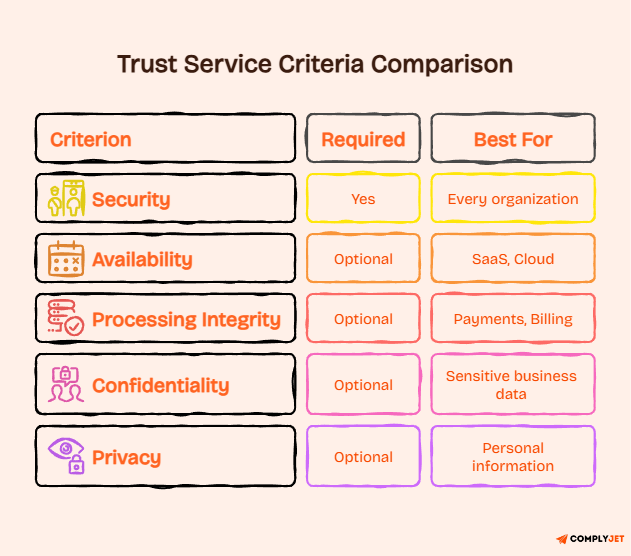
- Security is the mandatory one, sometimes called the Common Criteria. It covers protection against unauthorised access, both physical and digital.
- Availability checks whether your system stays up as promised. This matters most for companies selling on uptime guarantees or SLAs.
- Processing Integrity looks at whether data processing is complete, accurate, and timely. Payment platforms and billing systems lean heavily on this one.
- Confidentiality protects data marked as sensitive, like intellectual property or financial records. Privacy is narrower, and it governs how personal information is collected and used.
Note!
Only Security is required. Companies pick the other four based on what customers actually ask about during due diligence.
What Is SOC 3?
SOC 3 stands for System and Organisation Controls 3. It runs on the exact same standard and the same Trust Services Criteria as SOC 2, just packaged differently.
Here is the one line that explains everything. SOC 3 keeps the auditor's opinion, but strips out every sensitive detail, including individual controls, test steps, and any exceptions found.
Pro tip!
Because the sensitive parts are gone, you can post a SOC 3 on your website, attach it to a sales deck, or send it to a reporter with zero risk.
Once you complete a SOC 3 exam, you are allowed to display the official AICPA SOC logo on your site. It is a logo, not a seal, since the old seal program ended in October 2014.
Learn how to: Make the Most of Your SOC 2 Badge With Expert AICPA Tips!
Third-party transparency now shapes buying decisions more than people realise. Vendor audit visibility is a real factor in how enterprises pick partners, which is exactly the gap a public SOC 3 fills.
That covers the two reports on their own. Now let's line them up side by side and see exactly where they split apart.
SOC 2 vs SOC 3: The Key Differences Explained
The fundamental split comes down to audience. SOC 2 speaks to people who need to evaluate your controls in detail, like procurement teams and security leads.
SOC 3 speaks to everyone else. That includes your marketing site, your sales deck, and a random prospect who found you through a Google search.
Key insight
Same audit, two very different documents. One is built for scrutiny, the other for speed.
Ready to move faster through your next audit cycle? See how ComplyJet's audit management tools keep evidence organised before your auditor even asks for it.
Audience, Access, and Distribution
SOC 2 stays locked down. It gets shared under NDA or through a secure data room, and only with people the AICPA defines as authorised recipients.
SOC 3 has no such restrictions. Post it publicly. Attach it to an RFP. Nobody needs special access.
A real example helps here. AWS keeps its SOC 2 behind AWS Artifact, which needs an account and an access agreement. Its SOC 3 is a free PDF anyone can download.
The reason is simple. A full SOC 2 exposes architecture details and control weaknesses. Handing that to the public would be handing a map to anyone looking for gaps.
What Each Report Actually Contains?
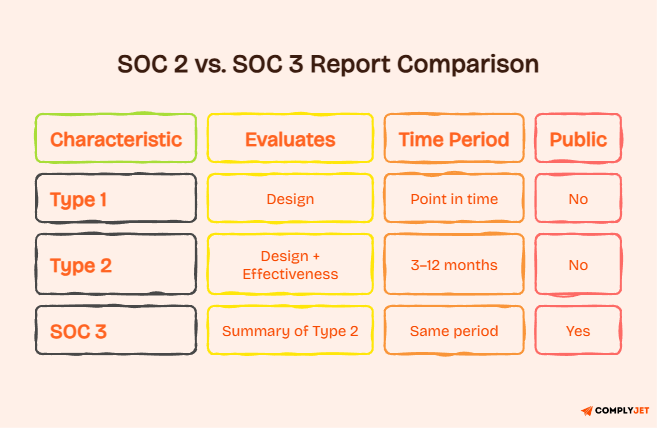
A SOC 2 report includes the auditor's opinion, management's assertion, a full system description, every individual control tested, the test steps used, and any exceptions found.
A SOC 3 report includes only the auditor's opinion, management's assertion, and a short, high-level system overview. Nothing more.
That is not a limitation. It is the entire design goal. SOC 3 gives the public the outcome without handing over the evidence.
SOC 2 Type 1, Type 2, and SOC 3: How They Relate
SOC 2 Type 1 checks control design at a single point in time. It answers, "Do these controls exist and make sense on paper?"
SOC 2 Type 2 checks the same controls in action over a period of 3 to 12 months. It answers, "Did these controls actually work consistently?"
SOC 3 is always built from a Type 2 exam. There is no such thing as a Type 1 SOC 3, and there is no such thing as "SOC 2 Type 3" either. That phrase is simply a misnomer.
Now that the report contents are clear, the next question every founder asks is the same one. What does all of this actually cost?
SOC 2 vs SOC 3 Cost: What You'll Actually Pay?
Cost is usually the first question on every compliance call. Here is the short answer. SOC 2 is where the real money goes, and SOC 3 rides along almost for free.
The full picture looks different depending on company size, scope, and how much manual work your team has to do to get audit-ready.
Don't miss!
Preparation, not the audit fee, is what actually drains time and budget in most SOC 2 journeys.
Based on data from 182 audit firms, SOC 2 Type 1 typically runs $10,000 to $60,000, with most small and mid-sized companies landing between $10,000 and $30,000.
SOC 2 Type 2 runs higher, from $15,000 to $100,000, with most SMBs paying $20,000 to $50,000 for the audit fee alone, and $30,000 to $50,000 all-in once you add readiness tooling. The full journey typically takes 6 to 18 months.
SOC 3, on the other hand, usually adds only a few thousand dollars, since it uses the exact same testing already done for SOC 2. Some auditors even include it at no extra charge.
Want to see how ComplyJet's pricing stacks up against manual audit prep costs? It is worth a look before you sign with an auditor.
Cost makes the SOC 3 decision easy once you understand it. But there is one rule that comes before cost even matters, and it trips up a lot of founders.
Can You Get a SOC 3 Without a SOC 2?
No. This is not a convention or a suggestion. It is a hard requirement written into how the AICPA structures these reports.
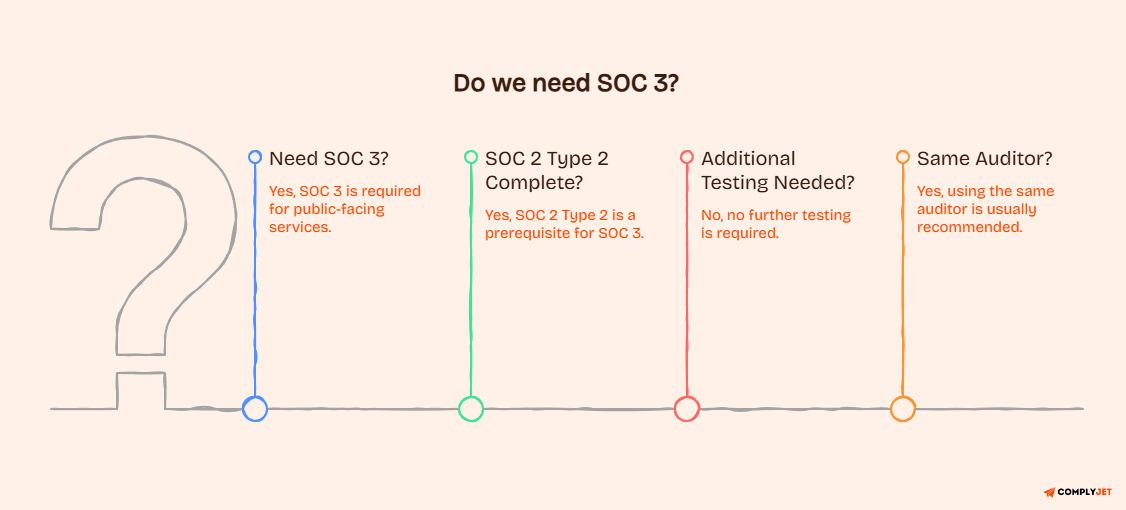
A SOC 3 is derived directly from a completed SOC 2 Type 2 exam. There is no such thing as a standalone SOC 3 audit that skips SOC 2 entirely.
Key insight
The same auditor who ran your SOC 2 simply issues an abbreviated version as your SOC 3. No extra fieldwork required.
This matters for planning. Do not budget for SOC 3 as a cheaper shortcut around SOC 2. Complete the SOC 2 readiness assessment first, then request both reports at the close of the same engagement.
Once you understand this rule, the whole roadmap gets simpler. Finish SOC 2, then layer SOC 3 on top for almost no extra cost or time.
Real Companies That Publish SOC 3 Publicly
Talk is cheap in this space, so let's look at who actually does this in the real world. Three companies make the case better than any explanation could.
These are not small players. They are the biggest cloud providers on the planet, and they all follow the exact same playbook described above.
Did you know?
AWS's most recent SOC report round covers 188 services in scope, all under one attestation cycle.
AWS keeps its SOC 2 gated behind AWS Artifact, but its SOC 3 report is a free, public PDF anyone can download without an account.
Microsoft follows the same pattern. Its Azure SOC 3 offering page is public, while the full SOC 2 report requires a signed agreement to access.
Google Cloud does the same through its SOC 3 compliance page, audited by Ernst & Young and Coalfire. Massive companies with millions of customers all land on the identical solution.
These three prove the model works at any scale. Now let's turn that into a decision framework you can actually use for your own company.
SOC 2 vs SOC 3: Which Does Your Business Need?
There is no universal answer here, because it depends entirely on who you sell to and how your deals actually close.
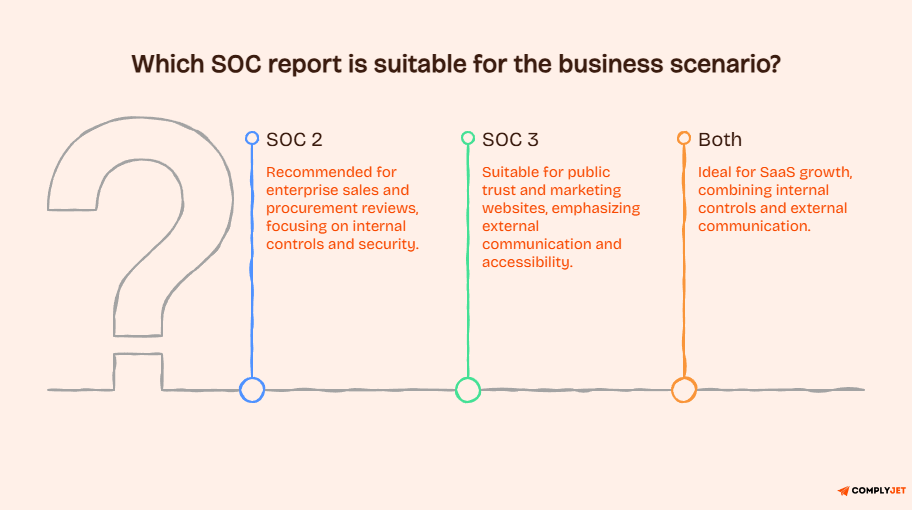
Most growing SaaS companies eventually need both, just not always at the same time or for the same reason.
Note!
Think of SOC 2 as the credential your sales team needs in the room, and SOC 3 as the one your marketing team needs on the website.
When Is SOC 2 What You Need?
Enterprise customers almost always require a SOC 2 during vendor onboarding. It has become a standard gate in B2B procurement, whether or not it is legally mandated.
Regulated industries feel this even harder. Healthcare tech, fintech, legal tech, HR platforms, and government contractors all lean on SOC 2 as baseline proof.
Precognition Labs, removed enterprise blockers in under two weeks once their audit prep was properly organised. That is what a tight SOC 2 process looks like in practice.
When SOC 3 Adds Real Value?
If your prospect base is broad rather than deeply enterprise, SOC 3 earns its keep fast. Mid-market and SMB buyers rarely request a formal SOC 2 review, but they still want proof.
A public SOC 3 removes NDA friction entirely. Prospects can check your security posture before a single sales call happens.
It also shortens enterprise sales cycles. Buyers who see a SOC 3 early arrive at the formal review stage already reassured, which speeds everything downstream.
When to Get Both? (And Why Most Companies Should)
Here is the math that makes this an easy call. SOC 2 costs $15,000 to $100,000 and takes 6 to 18 months. SOC 3 adds a few thousand dollars and a few weeks.
Skipping SOC 3 to save roughly 5% of your compliance spend is a poor trade, especially since the marketing and sales value of a public report keeps paying off long after the audit ends.
Once you have both reports in hand, the real skill is knowing how to actually use them. That is where SOC 3 becomes more than a checkbox.
SOC 3 as a Trust and Sales Acceleration Tool
Enterprises increasingly weigh third-party audit transparency when picking vendors, and a public SOC 3 is the cleanest way to hand that transparency over without friction.
Posting your SOC 3 on a security page signals maturity before a prospect ever picks up the phone. That is a compounding advantage, not a one-time win.
Founder's tip!
Put your SOC 3 in the very first outreach email to a new enterprise prospect. It removes an objection before it forms.
The practical playbook is simple. Post the PDF publicly, reference it in RFP responses, and link to it in product announcements.
A trust centre makes this a lot less manual to maintain.
The AICPA SOC Logo and How to Use It Correctly
Once your SOC 3 exam is complete, you can display the registered AICPA SOC logo on your site. It is a trademark, and it comes with brand guidelines you need to follow.
It is a logo, not a seal. The old seal program was shut down back in October 2014, so anything calling it a "SOC 3 seal" is using outdated language.
The logo stays valid for 12 months from the report date. Once your underlying report expires, you have to complete a new exam before displaying it again.
SOC 3 is a powerful tool once you have it. But getting to that point starts with the harder part, which is actually preparing for SOC 2 without burning out your engineering team.
How to Prepare for SOC 2 (and SOC 3) Without the Overhead?
The preparation phase eats most of the time in any SOC 2 engagement. Gap analysis, control design, evidence collection, and remediation all happen before an auditor even shows up.
Manual prep is slow. Evidence lives in scattered spreadsheets, Slack threads, and someone's memory, which makes audit season painful for engineering teams.
Tip!
The teams that move fastest treat evidence collection as an ongoing habit, not a scramble two weeks before the audit.
This is exactly where a compliance automation platform earns its cost back.
Continuous access reviews, automated vulnerability management, and built-in policy management all reduce the manual load that normally falls on your team.
Security questionnaires from prospects pile up during this same period too. Questionnaire automation and security awareness training tracking both plug directly into the same evidence base your auditor will ask for.
One ComplyJet customer, symmetRE got SOC 2 ready in just two weeks once their evidence collection stopped being manual. That is the kind of timeline automation makes possible.
Once your SOC 2 program is in place, one more comparison tends to confuse people, and it has nothing to do with SOC 3 at all.
SOC 1 vs SOC 2 vs SOC 3: Where SOC 1 Fits?
SOC 1 is a completely different animal. It evaluates internal controls over financial reporting, not security, availability, or privacy in any SOC 2 sense.
Companies that need SOC 1 include payroll processors, trust departments, benefit plan operators, and loan servicers, since their systems directly touch a customer's financial statements.
Note!
If your product processes payments or payroll for clients, you may need SOC 1 in addition to SOC 2, not instead of it.
SOC 1 runs under a different standard entirely, AT-C Section 320, compared to the AT-C Section 205 that governs both SOC 2 and SOC 3.
If you are a SaaS company or cloud provider, you almost certainly need SOC 2 compliance, not SOC 1. Many teams pursuing SOC 2 also layer in HIPAA or ISO 27001 depending on their customer base.
Now that every report type has its place, let's clear up the questions that come up most often once teams start planning their own audit.
FAQ: Common Questions About SOC 2 vs SOC 3
What is the difference between a SOC 2 Type 2 and a SOC 3 report?
Both come from the same exam. SOC 2 Type 2 is detailed and restricted, covering control design and effectiveness over months. SOC 3 is the public summary version, with no sensitive detail included.
Is SOC 3 worth it for a startup or early-stage company?
Not until you have a SOC 2 Type 2 already. Early-stage teams should focus on SOC 2 readiness first. Once that is done, adding SOC 3 for a small extra cost is usually worth it.
How long does getting a SOC 3 take after completing SOC 2?
Weeks, not months. No new testing is needed. Your auditor simply prepares an abbreviated version of the existing SOC 2 report, which typically takes just a few weeks to finalise.
Can I display the AICPA SOC logo after completing a SOC 3?
Yes, under the AICPA's official brand guidelines. The logo stays valid for 12 months from the report date, and it is a logo, not a seal, since the seal program ended in 2014.
What industries benefit most from having a SOC 3 report?
Cloud infrastructure, healthcare SaaS, fintech, payroll and HR software, and any competitive SaaS category where security transparency helps close deals faster all benefit heavily from a public SOC 3.
What is "SOC 2 Type 3"? Is that the same as SOC 3?
No, there is no such thing as SOC 2 Type 3. SOC 3 is its own separate report category, not a third type within the SOC 2 framework. It is a common but incorrect phrase.
How often do SOC 2 and SOC 3 reports need to be renewed?
SOC 2 Type 2 reports are typically renewed annually, and SOC 3 follows the same cycle since it is issued from the same exam. The AICPA logo expires with the underlying report too.
Bottom Line
SOC 2 is your detailed, restricted proof built for due diligence. SOC 3 is your public trust signal, built for everyone else who never asks for an NDA.
They serve different audiences at different stages of the same trust journey, and for most growing tech companies, getting both ends up being the obvious call once the economics are clear.