.svg)

A pull request sits unreviewed for a week because the required-reviewer rule got turned off during a hotfix and nobody turned it back on. Nothing breaks. No alert fires. Six months later, an auditor asks for evidence that every production change went through review, and that one week is a gap nobody remembers creating.
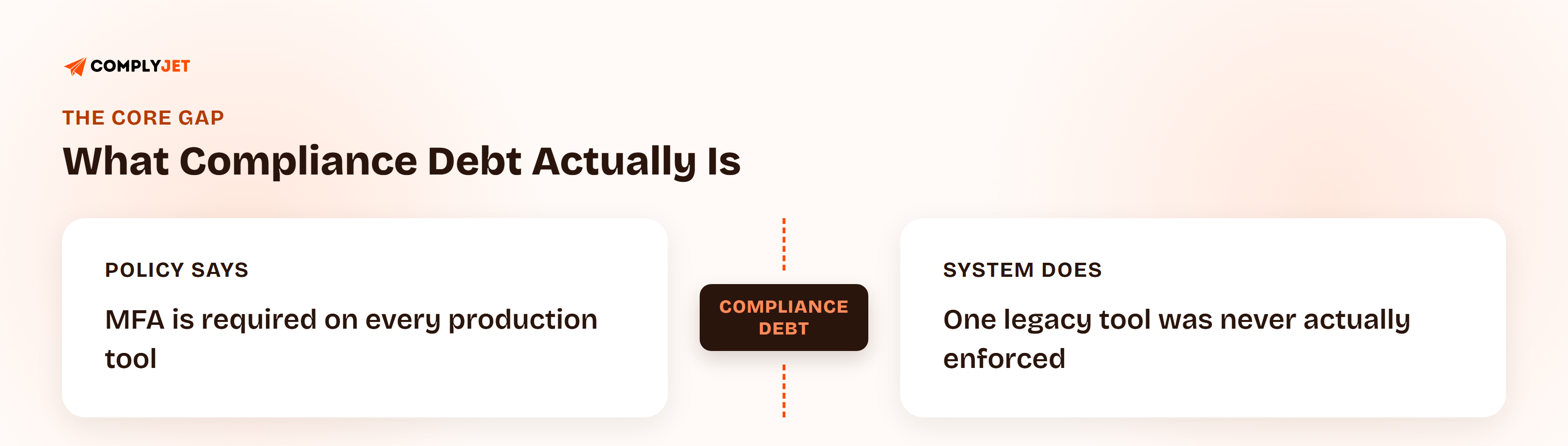
Compliance debt is the accumulated distance between what a company's security policies claim and what its systems actually enforce: access that should have been revoked, evidence that should have been logged, a control that used to run but quietly stopped. It piles up the same way technical debt does, one reasonable shortcut at a time, and it compounds the same way too.
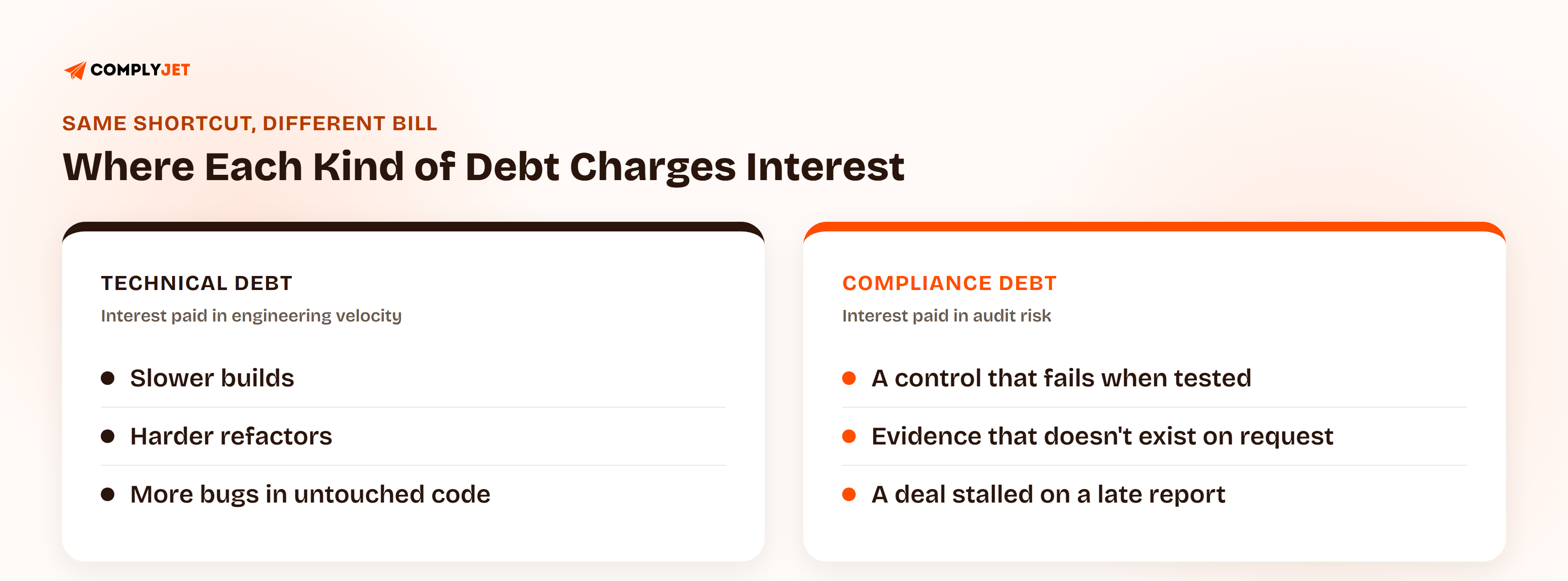
The difference is where the interest gets paid. Technical debt shows up as slower builds and harder refactors. Compliance debt shows up as a failed control, a stalled deal, or a finding on an audit report.
By the end of this, you'll be able to name the four kinds of compliance debt an auditor actually finds, run a five-minute self-check against your own stack, and know where to start paying it down without stalling feature work. Here's what's ahead:
- What compliance debt actually is, and how it differs from plain technical debt
- Why it piles up even on teams that genuinely care about security
- The four categories a SOC 2 audit actually surfaces
- How the cost compounds the longer a gap sits unresolved
- A self-check you can run against your own stack this week
- How to pay it down without stopping feature work
What Is Compliance Debt?
Compliance debt is any gap between a documented compliance control and what the system or team actually does, left unresolved because something else took priority. It isn't a formal audit term. It's a mental model borrowed directly from "technical debt," because the mechanics are identical: a shortcut that made sense in the moment, deferred instead of fixed, quietly getting more expensive the longer it sits.
It shows up in specific, ordinary places: an access review that didn't happen this quarter because the sprint got busy, a policy that says MFA is required but was never enforced on one legacy tool, a control an auditor was told exists but that nobody can actually produce evidence for. None of these feel urgent when they happen. That's exactly what makes them debt instead of an incident.
Compliance Debt vs Technical Debt: What's Actually Different
Both are shortcuts taken under time pressure that cost more to fix later than they would have cost to do right the first time. That's where the similarity ends.
Technical debt's interest is paid in engineering velocity: slower builds, harder refactors, more bugs surfacing in code nobody wants to touch. Compliance debt's interest is paid in audit risk: a control that fails when tested, evidence that doesn't exist when an auditor asks for it, a deal that stalls because a report can't be produced on time.
There's real overlap once a framework like SOC 2 is in scope. An undocumented manual deploy process is technical debt and compliance debt at the same time, one because it's fragile, the other because there's no trail proving changes went through review. Paying it down fixes both problems at once.
Why Compliance Debt Piles Up: The Technical Debt Compliance Risk Nobody Tracks
The cause almost never comes down to a team not caring. It's that compliance debt is invisible day to day. A missing access review doesn't break a build or page anyone at 2 a.m. Nothing alerts on it, so nothing forces a fix.
It ties directly into shipping speed. Every "we'll document that later" and "let's revisit access after this sprint" is a small compliance debt entry, the same instinct that creates ordinary technical debt, just with no CI check catching it on the way in.
Before a framework is formally in the picture, this is still audit readiness technical debt sitting alongside the ordinary engineering backlog, getting more expensive to trace the longer it sits. Left alone long enough, it becomes a compliance backlog engineering team members inherit from whoever set up the original process, usually without any record of why a control was skipped in the first place.
The Four Types of Compliance Debt SOC 2 Audits Actually Find
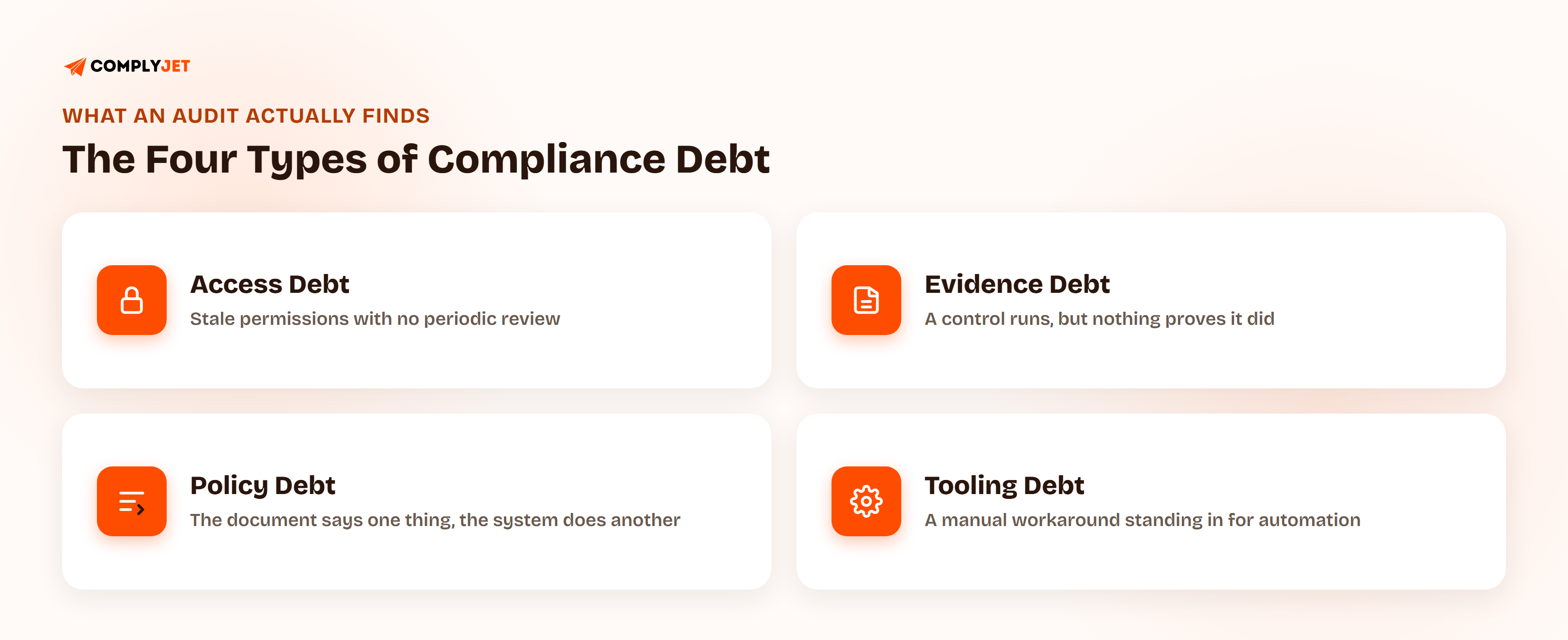
Most of what shows up in an audit falls into one of four categories, and each one maps to a specific set of SOC 2 trust service criteria an auditor is actually testing against, not a vague "security gap."
| Debt Type | What It Looks Like | SOC 2 Criteria It Hits |
|---|---|---|
| Access debt | Stale permissions, offboarded employees with lingering access, no periodic review | CC6.1, CC6.2, CC6.3 |
| Evidence debt | A control that genuinely runs, but was never logged or screenshotted anywhere provable | Spans most CC criteria, depending on the control |
| Policy debt | A written policy that no longer matches what the system actually does | CC1, CC5 |
| Tooling/process debt | A manual workaround standing in for something that should be automated, like a spreadsheet tracking access instead of the identity provider itself | CC7, CC8 |
Access debt compliance teams find first in a review, because it's the easiest to check and the most likely to have quietly drifted since the last audit. Someone left the company, their access didn't get revoked on the same day, and six months later nobody remembers to ask why.
Evidence debt SOC 2 auditors specifically probe for is the harder one to catch, because the underlying control might genuinely be working. The problem isn't the control. It's that there's no trail proving it ran, so an auditor has no way to verify a claim that happens to be true.
Of the four, evidence debt is the one that catches teams most off guard, for a specific reason:
Evidence debt is the category that surprises teams the most, because the control usually isn't broken. It's just invisible. Teams assume "it's working" is the same as "we can prove it worked," and an auditor doesn't accept the first one on its own. — Upendra Varma, CTO at ComplyJet
How Compliance Debt Compounds Before an Audit
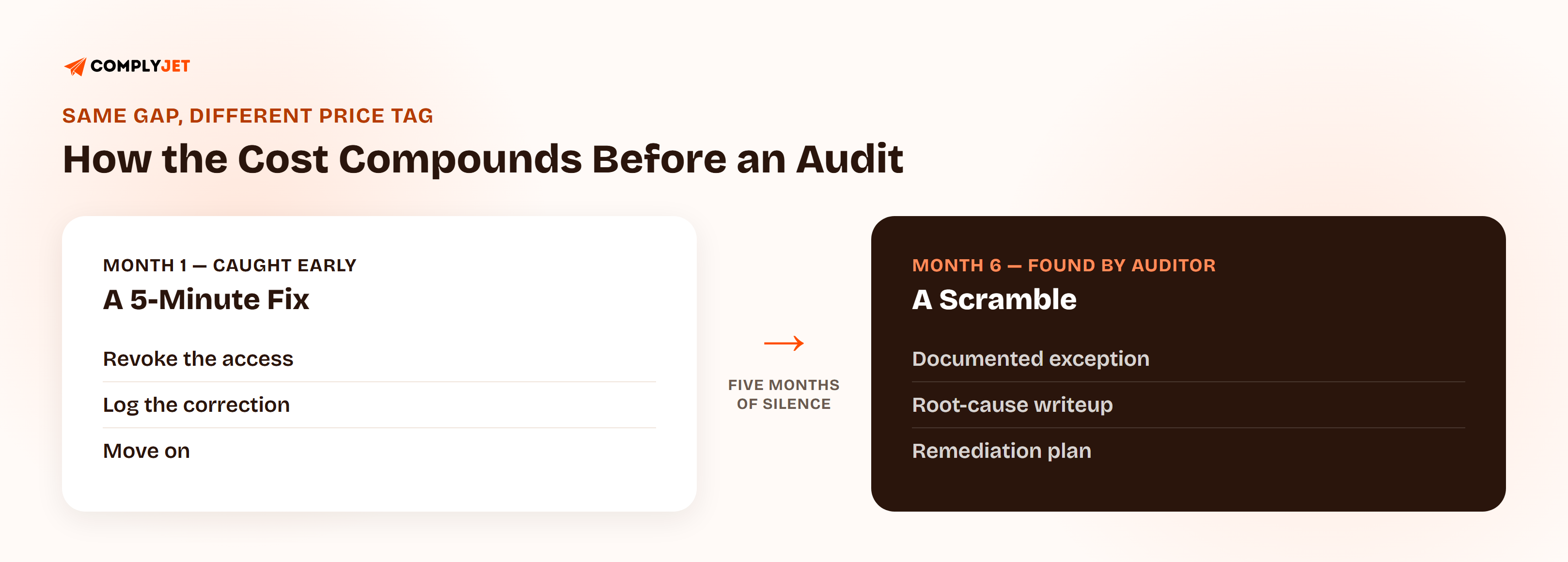
The interest-rate comparison to technical debt isn't just a metaphor, it plays out on a real timeline. A stale access review caught in March costs about an hour to fix: revoke the access, log the correction, move on. The same gap discovered three weeks before an audit costs a scramble across every system it touches, plus the real risk of it getting flagged as a finding on the final report.
Take a departed contractor whose access never got revoked. Catching it in month one is a five-minute deprovisioning task. Explaining it to an auditor in month six is a documented exception, a root-cause writeup, and a remediation plan, three artifacts that didn't need to exist if the gap had been closed when it was created.
The compounding mechanism is specific: every piece of compliance debt left unresolved makes the next audit's evidence pull slower too, because nobody remembers exactly why the gap exists or whether it's still true. Debt from last year's audit doesn't just sit there. It makes this year's review harder to run.
How to Measure Compliance Debt: A Quick Self-Check
This is how to measure compliance debt without waiting for a formal audit to surface it, or leaning on a vague maturity score that doesn't tell you what to actually go fix. Run through these against your own stack:
- Can you produce, right now, a current list of everyone with access to production and when it was last reviewed?
- Does every control in your last risk assessment or policy document have a real, current owner, not just a name from a year-old doc?
- If an auditor asked for evidence of a specific control today, could you produce it in minutes, or would someone have to go reconstruct it from memory?
- Are there any manual spreadsheets standing in for something your existing tools could already track automatically?
- Has a written policy changed in the last year without the underlying system changing to match, or the other way around?
If more than one or two of those questions gave you an uncomfortable answer, that's not a failure, it's a normal starting point. The next section is what to do with it.
Paying Down Compliance Debt Without Stalling Feature Work
The prioritization principle is the same one that works for ordinary technical debt: fix what's cheapest to close now and most expensive to explain later, not necessarily whatever feels most urgent in the moment.
- Run the self-check above and log every gap you find. Don't fix silently. Writing it down is what makes the pattern visible instead of a one-off surprise next quarter.
- Fix access debt first. It's usually the fastest category to close and the one an auditor checks earliest, so it has the highest payoff for the least effort.
- Automate the evidence trail for controls that already run correctly. A control that works but isn't logged is still evidence debt. Wiring up logging stops new debt from accumulating even before you touch the backlog.
- Retire manual workarounds one at a time, starting with whichever spreadsheet or side process touches the most controls at once.
- Put a recurring review on the calendar. Paying down compliance debt isn't a one-time cleanup before an audit, it's the same discipline as a regular tech-debt sprint, applied to a different backlog.
Common Mistakes Teams Make With Compliance Debt
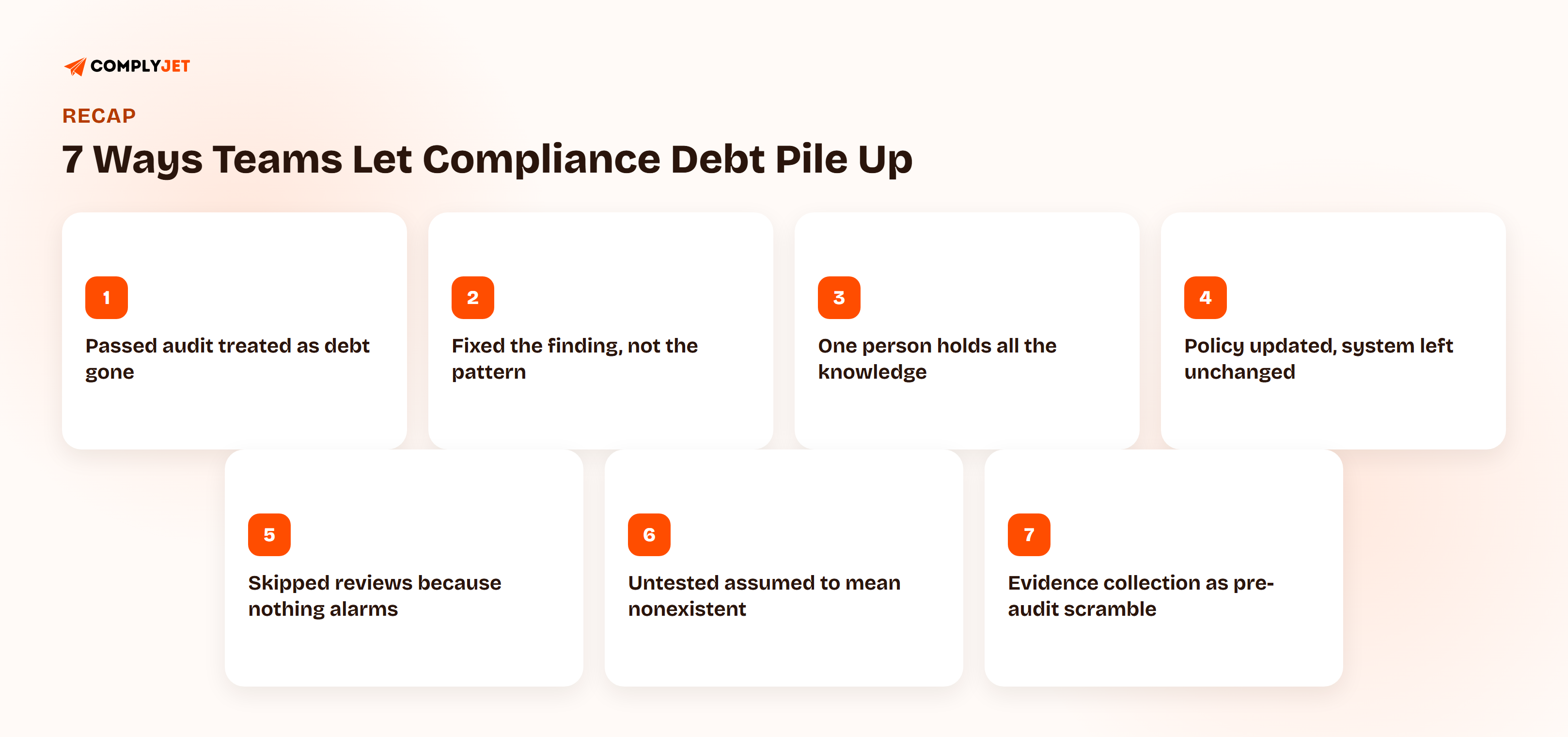
- Treating a passed audit as proof the debt is gone. An audit confirms the debt was paid down enough to pass, not that it's permanently resolved. New debt starts accumulating the same day.
- Fixing the specific finding an auditor flagged, not the pattern that caused it. If one stale access grant got flagged, the real fix is a review process, not just revoking that one account.
- Letting one person hold all the tribal knowledge of what's actually enforced. When that person leaves, the debt becomes invisible to everyone else until it's discovered the hard way.
- Updating a policy document without checking whether the system matches it. A policy rewrite that isn't reflected in the actual configuration just creates a new gap in the opposite direction.
- Deferring access reviews specifically because nothing alerts when they're skipped. The absence of an alarm isn't the absence of risk.
- Assuming debt that didn't surface in the last audit doesn't exist. Auditors sample. A gap that wasn't tested this cycle is still a gap.
- Treating evidence collection as a pre-audit scramble instead of an ongoing habit. The scramble is exactly what turns a small gap into a stressful one.
None of these are exotic failures. They're the ordinary ways deferred maintenance turns into an audit finding.
How ComplyJet Fits In
ComplyJet doesn't eliminate compliance debt on its own. A policy still has to match reality, and access still has to be reviewed by an actual person making an actual judgment call. What it does close, specifically, is the evidence debt category: pulling proof directly from the systems already in place, GitHub, cloud providers, identity providers, instead of someone reconstructing it by hand three weeks before an audit.
Concretely, that means continuous access-review tracking and automated evidence collection across 350+ integrations, so the debt that used to pile up silently between audits gets caught closer to when it actually happens, not discovered all at once during the next review cycle.
Once the evidence side is automated, formalizing an actual audit is a separate, much smaller step:
Here's what choosing the non-debt path looked like for a team that hit this exact fork under deal pressure:
That's the same fork the self-check above is meant to catch -- take the shortcut under pressure, or skip it and avoid the month-six surprise entirely.
FAQs
What is compliance debt?
It's the accumulated gap between what a company's compliance policies say and what its systems actually enforce: unrevoked access, missing evidence, a control that stopped running without anyone noticing. It builds the same way technical debt does, one deferred fix at a time.
Is compliance debt the same as technical debt?
They're related but not identical. Technical debt's cost shows up as slower engineering velocity. Compliance debt's cost shows up as audit risk, a failed control, or missing evidence. A lot of technical debt becomes compliance debt too, once a framework like SOC 2 is in scope.
How does technical debt affect compliance?
Technical shortcuts, an undocumented deploy process, a manual workaround instead of an automated check, often double as compliance gaps once there's a framework to test against. The same fragile process that slows down engineering is usually also the one with no audit trail behind it.
How do you measure compliance debt?
Run a self-check against four categories: access debt, evidence debt, policy debt, and tooling debt. Can you produce current access records in minutes? Does every control have a real owner? Could you show evidence for a control right now without reconstructing it? That gives a concrete answer, not a vague score.
How do you pay down compliance debt?
Log every gap the self-check finds instead of fixing silently, start with access debt since it's usually the fastest to close, automate evidence collection for controls that already work correctly, and retire manual workarounds one at a time. Put a recurring review on the calendar so it doesn't rebuild.
What causes compliance debt?
Mostly, invisibility. A skipped access review doesn't break a build or trigger an alert, so there's no forcing function to fix it. Every "we'll document that later" is a small entry in the same backlog, and nothing catches it until an auditor asks.
How does compliance debt affect a SOC 2 audit?
It's usually what an audit actually finds: stale access, missing evidence for a control that runs correctly but was never logged, a policy that no longer matches the system. Debt discovered during an audit costs far more to explain than the same gap caught and fixed months earlier.
Related Reading
- Compliance as Code: Baking SOC 2 Controls Into Your CI/CD Pipeline, the prevention-side companion: what stops this debt from accumulating in the first place
- SOC 2 Audit Process, Start to Finish, for where compliance debt actually surfaces during the audit itself
- What Is Compliance Automation? How It Works, for the broader platform-level answer to closing evidence debt specifically