.svg)

Compliance automation is the reason a five-person startup can walk into a SOC 2 audit with the same evidence trail as a company ten times its size.
Compliance automation is software that continuously monitors your systems, collects audit evidence, and flags control gaps automatically, replacing the spreadsheets, screenshots, and manual reminders most companies use to prepare for a SOC 2, ISO 27001, HIPAA, or PCI DSS audit. It doesn't decide what "compliant" means. It automates the work of checking your actual systems against whatever a framework already requires, continuously, instead of scrambling to piece it together once a year.
Quick answer
Compliance automation connects to your cloud infrastructure, HR system, and dev tools, pulls evidence directly from them (access logs, config snapshots, training records), maps that evidence to the controls a framework requires, and alerts you the moment something drifts out of compliance. It's the mechanism that makes chasing more than one framework at once realistic for a small team.
By the end of this, you'll know exactly how compliance automation works mechanically, where it stops being useful, and what to actually look for if you're evaluating a platform instead of just trusting a polished demo.
Here's what's ahead:
- What compliance automation actually means, and how it's different from a GRC platform
- How compliance automation works under the hood
- What happens when companies skip it and track compliance manually
- What this looks like specifically for SOC 2, ISO 27001, HIPAA, and PCI DSS
- What to look for when evaluating compliance automation software
- The misconceptions that trip people up before they've even started
What Is Compliance Automation, Exactly?
Compliance automation is technology that replaces the manual, human-run parts of compliance work, evidence collection, control checks, and policy tracking, with an automated, continuous process.
Picture what it replaces. Before automation, getting audit-ready means someone manually screenshotting AWS configurations, emailing employees to chase proof they finished security training, and re-checking access logs by hand the week before an auditor shows up. That work doesn't scale past one framework, and it barely scales past one audit cycle.
Compliance automation software doesn't invent the compliance bar. A framework like SOC 2 or ISO 27001 already defines what "compliant" means. What the software does is continuously check your actual systems against those regulatory requirements and surface the gap the moment it appears, instead of the week before an auditor asks.
This exists now for a specific reason: the number of frameworks a growing company has to satisfy keeps stacking. A SaaS company that only needed SOC 2 two years ago is now fielding HIPAA questions from a healthcare customer and GDPR questions from a European one, often in the same procurement cycle.
Enterprise buyers increasingly want proof before the deal closes, not a promise to get compliant after signing. Manual tracking was never built to answer three frameworks' worth of vendor-security questionnaires at once, and that's the gap compliance automation fills.
Compliance Automation vs. Compliance Software vs. GRC Platforms
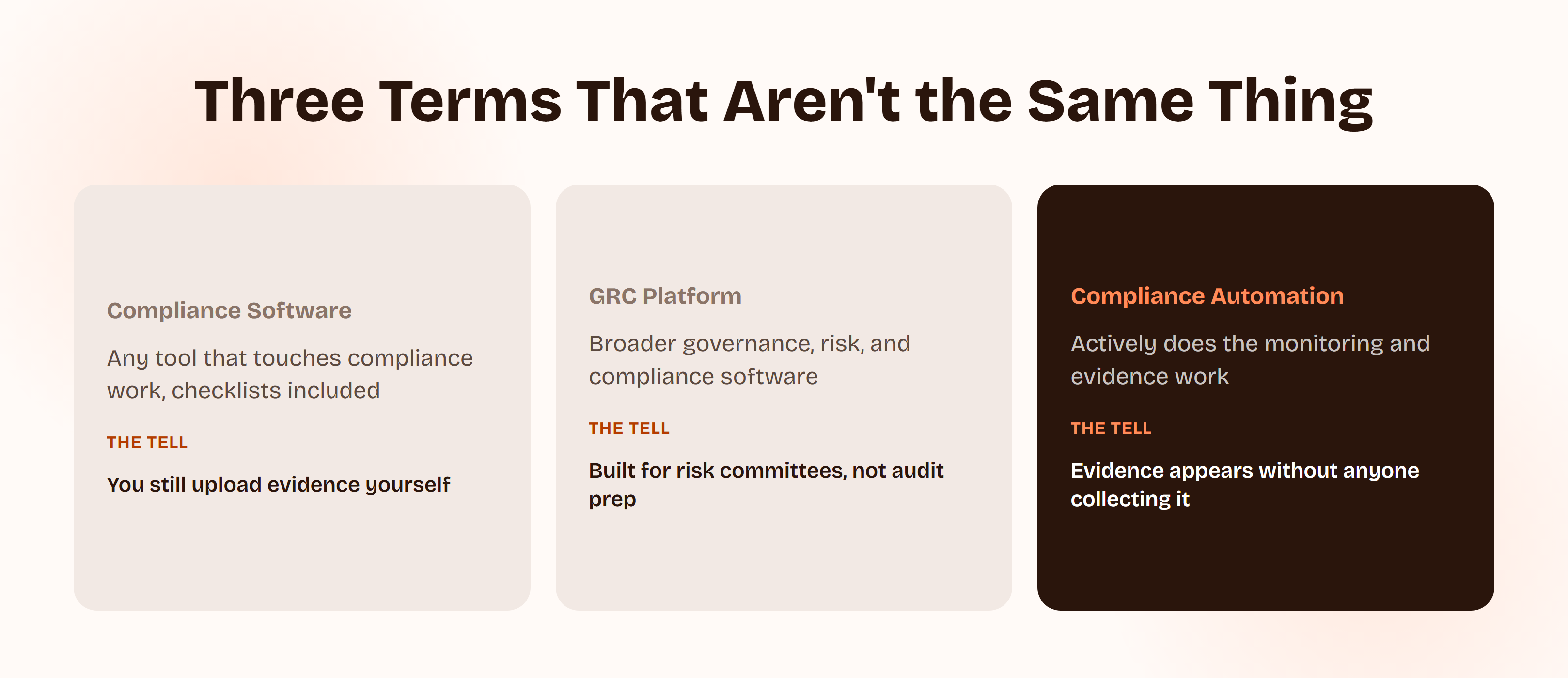
These three terms get used interchangeably in vendor marketing, and they aren't the same thing. Knowing the difference matters if you're evaluating a tool and trying to figure out what you're actually buying.
| Term | What it actually means | The tell |
|---|---|---|
| Compliance software | Any tool that touches compliance work, including checklist and document-management tools | You still manually upload evidence and mark tasks done yourself |
| GRC platform | Governance, Risk, and Compliance software, usually broader and enterprise-scale, covering risk registers and board-level reporting | Built for risk committees and audit committees, not just audit prep |
| Compliance automation | The subset of both that actively does the monitoring and evidence-gathering work, not just organizes it | Evidence appears in the platform without anyone manually collecting it |
The practical test: if a platform still requires someone to log in and manually upload a screenshot every quarter, that's compliance software wearing an automation label. Real compliance automation pulls the evidence itself.
Picture two vendor demos back to back. In the first, the salesperson clicks into a dashboard and shows you a checklist with green checkmarks someone manually ticked off last week. In the second, the salesperson clicks into the same kind of dashboard, but pulls up the actual AWS config that generated a check mark ten minutes ago, with a timestamp. Only one of those is compliance automation. The other is a nicer spreadsheet.
How Does Compliance Automation Work?
The short version is "it monitors things," but that undersells the actual mechanism, and the mechanism is what makes the difference between a tool that saves real hours and one that just moves the busywork somewhere else.
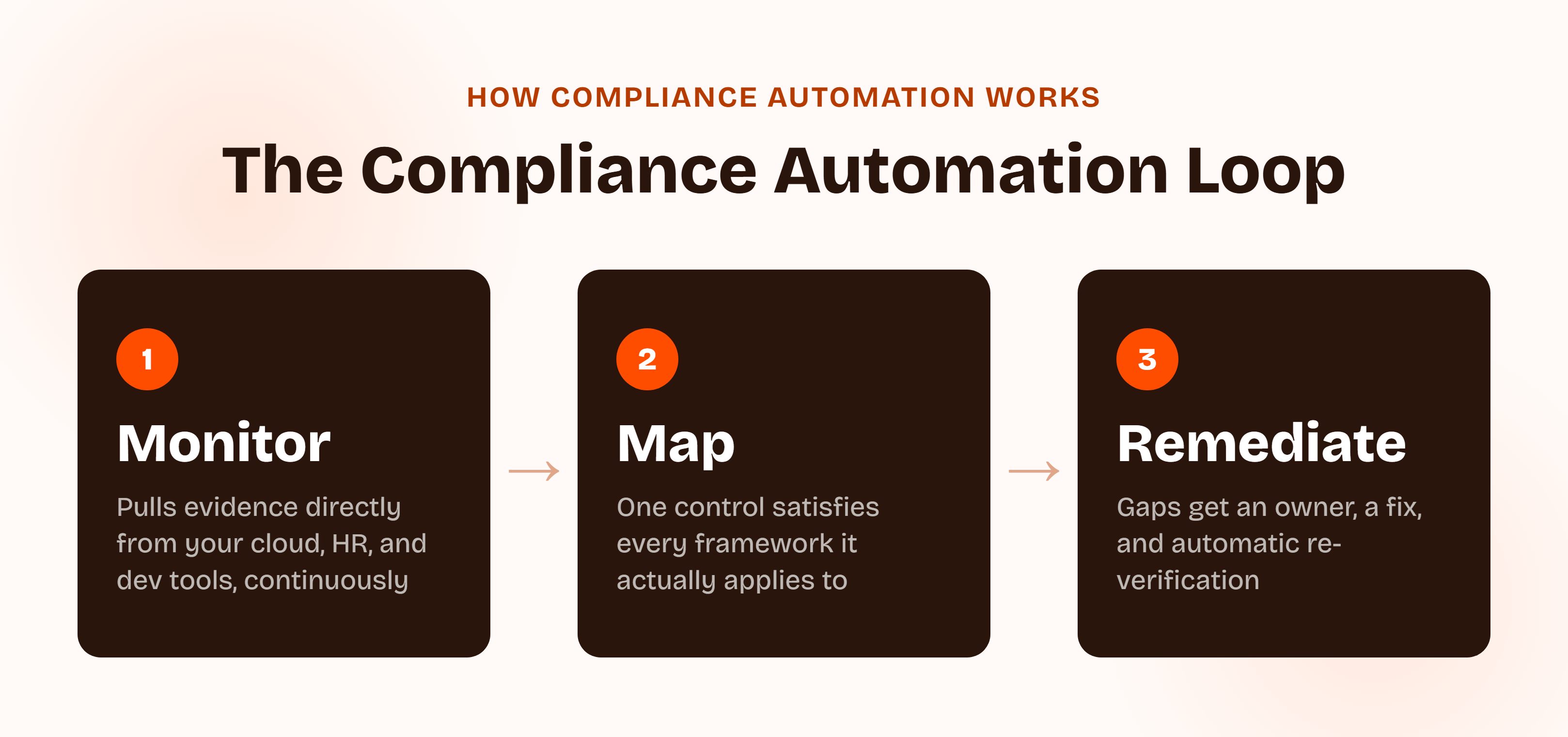
So how does compliance automation work in practice, step by step, once it's actually connected to your systems? It comes down to three things: continuous monitoring, control mapping, and remediation.
Continuous Monitoring and Evidence Collection
Compliance automation software integrates directly with the systems that generate compliance-relevant activity: cloud infrastructure (AWS, GCP, Azure), identity providers, HR platforms, and dev tools like your ticketing system and code repository.
Instead of someone checking whether multi-factor authentication is still enforced once a quarter, the software checks continuously and pulls the evidence the moment it's generated: config states, access logs, policy acknowledgments, and closed security tickets.
Say an engineer offboards on a Friday afternoon. Under a manual process, someone has to remember to revoke their access across every system, and someone else has to remember to screenshot proof of that revocation months later for the audit. Under compliance automation, the offboarding ticket closing triggers an access check across connected systems automatically, and the evidence that access was revoked within the required window gets captured the same day, not reconstructed from memory during audit season.
That's the real shift. Point-in-time review means your compliance posture is only ever as current as the last manual check. Continuous monitoring means it's current right now, which is exactly what an auditor is trying to verify in the first place.
Control Mapping Across Frameworks
A single piece of evidence often satisfies more than one framework's requirement at the exact same time. Proof that MFA is enforced across your infrastructure can satisfy a SOC 2 control and an ISO 27001 control simultaneously, because both frameworks are asking a version of the same underlying question.
Control mapping is the mechanism that connects one control to every framework it applies to, so a company chasing SOC 2 and ISO 27001 in the same year isn't collecting the same evidence twice under two different names. This is the part of compliance automation that makes multi-framework compliance realistic for a five-person team instead of something that needs a dedicated hire per framework.
Take encryption at rest as a concrete example. SOC 2 asks for evidence that sensitive data is encrypted in storage. ISO 27001's Annex A asks a version of the same question under its own control numbering.
Without control mapping, a team documents the same encryption configuration twice, once per framework, in two different formats an auditor expects to see. With it, one piece of evidence satisfies both, and the platform tracks which framework each mapped control belongs to behind the scenes.
Alerts, Gaps, and Remediation
Detecting a gap and fixing it are two different problems, and automation that only handles the first one just moves the manual work downstream instead of removing it.
Flagging a gap isn't the hard part anymore. The platforms that actually save teams time are the ones that assign an owner, track the fix, and re-verify automatically once it's resolved. Detection without a remediation loop is just a longer to-do list. — Upendra Varma, CTO at ComplyJet
A real remediation loop looks like this: a gap gets detected, an owner gets assigned automatically based on who's responsible for that system, the fix gets tracked to completion, and the control gets re-verified without anyone needing to remember to check back.
Compare that to a platform that only sends an email alert and stops there. The gap still gets found eventually, but finding it was never the expensive part. The expensive part was always tracking who owns the fix, following up until it's actually done, and proving to an auditor months later that it happened on schedule. A remediation workflow is what turns "we know about the problem" into "the problem is documented as solved."
Why Manual Compliance Tracking Breaks Down
Manual compliance tracking works, technically, for exactly as long as nothing changes: one framework, one audit a year, one person who remembers where everything lives. Almost no growing company stays in that state for long.
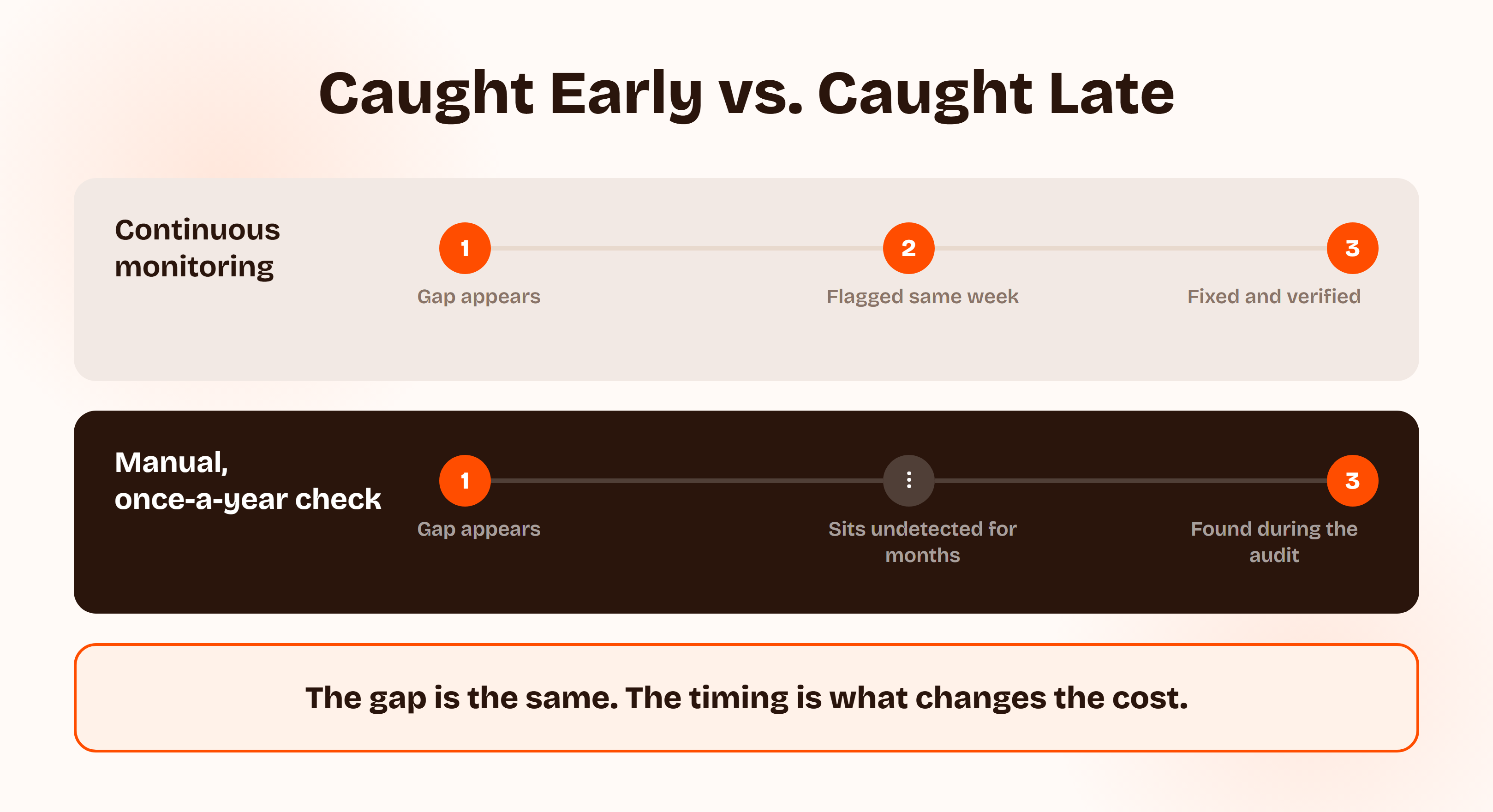
The first crack shows up in audit readiness. Compliance work that only happens in the weeks before an audit means the actual state of your controls is a guess the rest of the year. Nobody's watching in between.
You're three weeks from your SOC 2 audit window opening and someone asks for proof that access reviews happened every month for the past six months. There isn't a clean record. There's a half-finished spreadsheet, a few Slack threads, and a strong belief that it probably happened. That's not a hypothetical. It's the default state of audit readiness under a manual process, discovered at the worst possible time to discover it.
Watch out
A control that quietly drifts out of compliance in month three and gets caught by the auditor in month eleven costs far more to fix than the same gap caught the week it happened. Manual, periodic checks find problems late by design, not by accident.
The second crack shows up when a second framework enters the picture. A company that's already meeting SOC 2's regulatory requirements and now needs ISO 27001 or HIPAA discovers how much of that "new" work is actually the same control, re-documented from scratch because nothing mapped the overlap. That's hours spent proving something the company already knew was true.
None of this requires anything to go wrong operationally. It's just what happens when compliance work depends on someone remembering to do it, on top of their actual job.
What This Looks Like Across SOC 2, ISO 27001, HIPAA, and PCI DSS
Compliance automation doesn't work identically across every framework, because the frameworks themselves aren't asking for the same thing.
| Framework | What automation typically covers | What still needs a person |
|---|---|---|
| SOC 2 | Continuous control monitoring across the audit window, access reviews, vendor management evidence | Auditor judgment on control design, the actual attestation opinion |
| ISO 27001 | ISMS documentation upkeep, risk register tracking, control evidence mapped to Annex A | Risk assessment methodology, management review decisions |
| HIPAA | Access-log monitoring, PHI-handling evidence, workforce training tracking | Business associate agreement review, breach risk analysis judgment calls |
| PCI DSS | Network segmentation evidence, cardholder-data-environment scoping, vulnerability scan tracking | Scope validation, compensating control justification |
The SOC 2 audit itself still runs through the same auditor-led phases automation doesn't replace: scoping, gap analysis, the observation period, and the final report. What changes is how much of the evidence-gathering inside those phases happens on its own instead of by hand. PCI DSS compliance leans even more on automation for the ongoing scanning and segmentation evidence a manual process would struggle to keep current between assessments.
HIPAA is the outlier worth calling out specifically. A meaningful chunk of HIPAA compliance is a risk analysis and a set of policies a human has to actually write and periodically reassess, not a system state software can verify on its own.
Automation handles the access-log and PHI-handling evidence well. It doesn't replace the judgment call of whether a given risk-mitigation approach is actually reasonable and appropriate for the organization, which is language straight out of the HIPAA Security Rule itself.
What to Look for in Compliance Automation Software
Most demos look impressive. The questions below are what actually separate a compliance automation platform that saves real hours from one that just adds a dashboard on top of the same manual work.
- Integration breadth. Does it connect to the actual systems you run, not just the popular ones in the demo? An integration list that's heavy on logos but light on your actual stack won't collect much real evidence.
- Real control mapping, not framework silos. If adding a second framework means redoing evidence collection from scratch, the mapping isn't real, it's just two separate checklists sharing a login screen.
- Remediation, not just detection. Ask to see what happens after a gap is flagged, not just how the alert looks. A notification with nowhere to go is not a workflow.
- Coverage outside SOC 2. Plenty of platforms are built SOC 2-first and treat everything else, ISO 27001, HIPAA, PCI DSS, as a secondary feature bolted on afterward. Ask specifically how deep that coverage goes for the framework you actually need.
- Pricing that doesn't punish growth. A genuinely useful compliance automation platform should get more cost-efficient per additional framework, not less, since that's the actual tell for whether the underlying control mapping is real.
- A real answer for "what happens if we fail a control mid-audit." A platform's response to that question, not its dashboard, tells you how much of the workflow is actually built out.
Pricing
ComplyJet supports 25+ frameworks under one flat, per-company price
As your team grows from 5 people to 40, the price doesn't move with headcount. That's the reassurance a lot of compliance automation pricing doesn't give you.
If you're comparing named platforms rather than just the category, the breakdown of SOC 2 compliance software covers ten of them side by side.
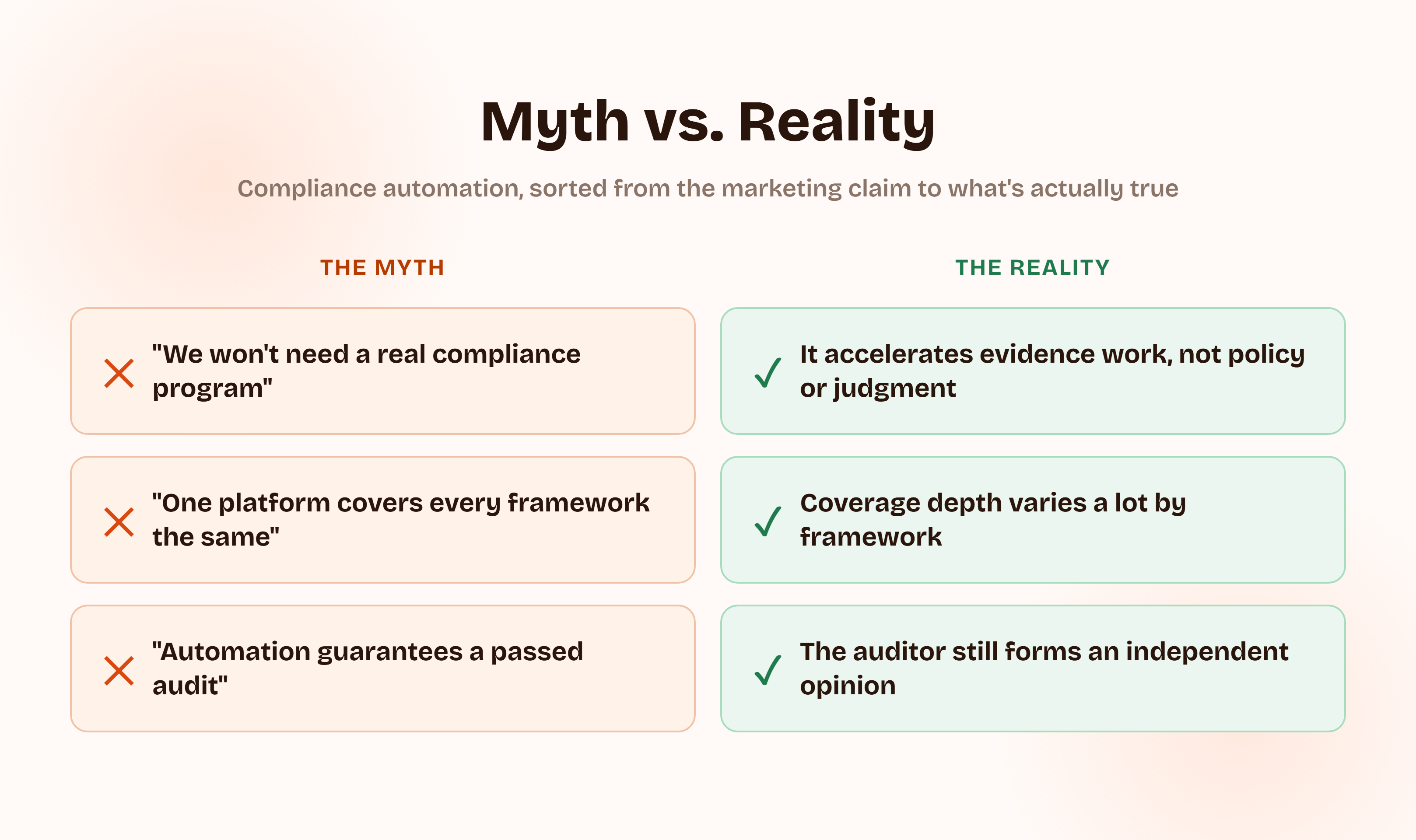
Common Misconceptions About Compliance Automation
A few assumptions cause more wasted evaluation time than anything else on this list.
- "Automation means we don't need a real compliance program." It doesn't. It accelerates the evidence work, but it doesn't replace the policies, training, and judgment calls a program still requires. Someone still has to decide what the policies should say.
- "One platform covers every framework identically." Coverage depth varies a lot by framework. A compliance automation platform built around SOC 2 often treats HIPAA or PCI DSS as an afterthought, with thinner integrations and shallower control mapping than its flagship framework gets.
- "Automation guarantees a passed audit." It doesn't. An auditor still forms their own opinion on control design and evidence quality; software prepares the evidence, it doesn't stand in for the audit itself or override an auditor's professional judgment.
- "This is only worth it once you're past Series B." The opposite is usually true. The point of automating early is avoiding a dedicated compliance hire before the company actually needs one, and the evidence habits built early scale cleanly into later audits.
- "More integrations always means more automation." An integration that only reads data still needs a workflow layer that acts on what it finds. A long integrations list with no remediation behind it is still mostly manual work with extra dashboards.
- "Once it's set up, it runs itself forever." Frameworks get updated, infrastructure changes, and new integrations get added as the company grows. Compliance automation reduces ongoing maintenance considerably; it doesn't eliminate it entirely.
The Bottom Line on Compliance Automation
Every piece of this comes down to one shift: compliance work moves from something a person remembers to do once a year to something a system checks continuously. That's compliance automation in one sentence, and everything else in this piece is detail underneath it.
Start with the framework the business actually needs audited, not with a feature list. SOC 2 because an enterprise deal is asking for it, HIPAA because of the data involved, PCI DSS because payment cards touch the product. Evaluate a platform against that specific framework's real evidence requirements first, and let broader multi-framework coverage matter once a second framework is genuinely on the calendar.
Support
ComplyJet pairs the software with a team that guides you through it
Automation handles the evidence collection. ComplyJet's team helps turn that evidence into a completed audit, not just a dashboard of green checkmarks.
The questions below cover what actually comes up once you're comparing specific platforms instead of just the category.
FAQs
Is compliance automation the same as a GRC platform?
Not quite. A GRC platform is a broader category built around governance, risk, and compliance reporting, often for enterprise risk committees. Compliance automation is the specific piece that actively monitors systems and collects evidence, and it can exist inside a GRC platform or as a standalone, audit-focused tool.
How does compliance automation actually reduce manual work?
It replaces the evidence-gathering and monitoring steps that used to require someone manually checking systems and uploading proof. It doesn't replace judgment calls like control design or how a business responds to a genuine incident. Those still need a person.
Can compliance automation replace an auditor?
No. It prepares evidence faster and keeps it current, but the auditor still reviews that evidence and forms an independent opinion. Nothing about automation changes who signs the report.
How long does it take to get audit-ready with automation?
It depends heavily on your starting point and the framework, but the honest range for a company starting from near zero is a few weeks to a couple of months to get controls in place and evidence flowing, well ahead of the months a fully manual process typically takes to reach the same audit readiness.
If a vendor gives you a specific number without asking about your current setup, treat it skeptically. Real audit readiness depends on how much of your infrastructure is already in a compliant state before the platform even connects, not just how fast the software itself can be configured.
Does compliance automation work across multiple frameworks at once?
Yes, and that's where control mapping does the real work. A control that satisfies part of SOC 2 can satisfy an overlapping ISO 27001 or HIPAA control at the same time, so a second or third framework doesn't mean starting evidence collection over from scratch.
The overlap is rarely 100%. A meaningful share of controls map cleanly across two closely related frameworks like SOC 2 and ISO 27001, and the rest are genuinely framework-specific requirements that still need their own dedicated evidence, no shortcuts available.
Is compliance automation worth it for an early-stage startup?
If there's a real audit deadline on the calendar and no dedicated compliance hire yet, yes. That's exactly the gap it's built to close: getting audit-ready without pulling an engineer off product work for a month or hiring a compliance lead before the company can really justify one.
Related Reading
- Best SOC 2 Compliance Software — for comparing named platforms once you understand the category
- PCI DSS Compliance: What It Is, Who Needs It, and How It Works — a framework-specific deep dive on one of the frameworks covered above
- Is SOC 2 a Certification? — same plain-English approach applied to a different persistent point of confusion
- SOC 2 Audit Process, Start to Finish — the actual audit process compliance automation feeds evidence into
- CCPA Compliance Guide — another framework guide in the same informational style