.svg)

Selling into healthcare means proving trust before the contract is signed. For most SaaS vendors, that proof starts with two procurement questions: “Are you HIPAA compliant?” and “Can you share your SOC 2 Type 2 report?”
If you build software that touches patient data, this is your reality. Both questions are coming. And if you cannot answer them, the deal dies before it starts.
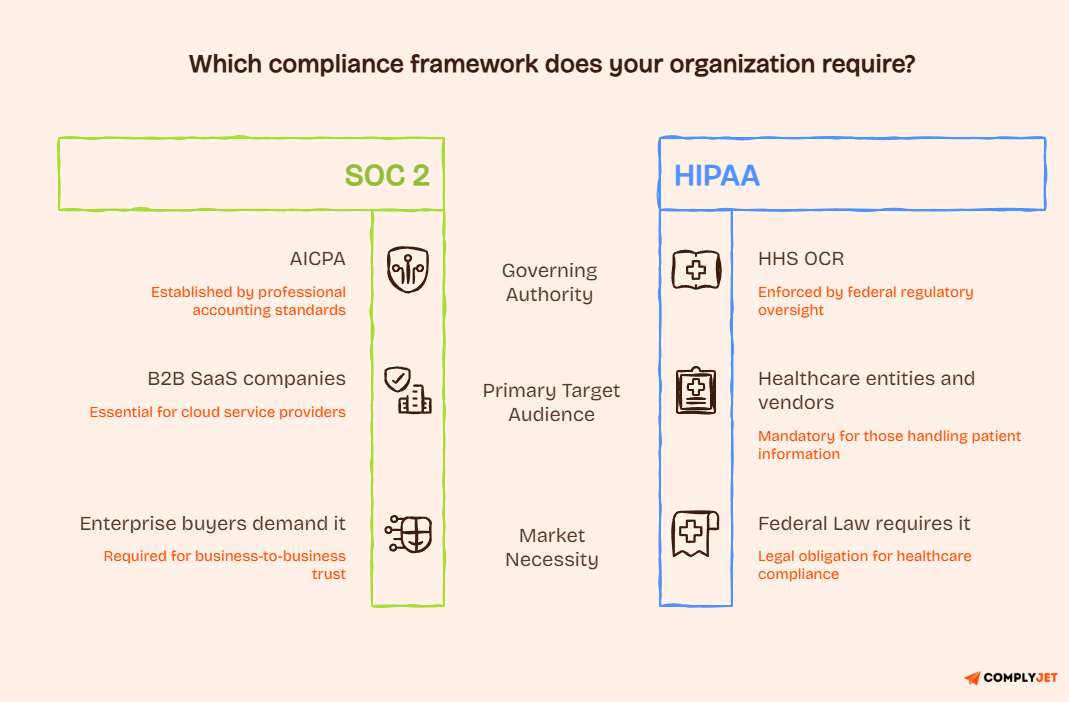
What most compliance guides miss is that SOC 2 and HIPAA are not the same thing. They are not interchangeable. One is a federal law. The other is a market-driven audit standard.
Confusing the two costs healthcare SaaS companies real money, real time, and real deals.
According to IBM’s Cost of a Data Breach Report, healthcare data breaches cost an average of $10.9 million per incident in 2025, the highest of any industry. So you must understand which framework signals the security of your business better.
Here, we break down SOC 2 vs HIPAA thoroughly. You will clearly know what each one is, who needs what, where they overlap, what they cost, their timelines, and how to pursue both or any one without losing your mind.
Before we go deep, here is a fast rundown of where each framework stands today. Use this as your reference point throughout.
SOC 2 vs HIPAA: Quick Answers for 2026
- SOC 2 is a voluntary security audit framework governed by the AICPA. It is designed for service organisations that handle client data. It tells your enterprise buyers that your security controls actually work.
- HIPAA is a US federal law passed in 1996 and enforced by the HHS Office for Civil Rights. It governs how organisations handle protected health information, also known as PHI.
- SOC 2 is for any B2B service company whose clients demand security evidence. HIPAA is for any organisation that creates, receives, or transmits PHI, including healthcare providers, insurers, and the vendors who serve them.
- Healthcare SaaS companies almost always need both. SOC 2 satisfies your enterprise sales process. HIPAA satisfies the law.
- SOC 2 produces an audit report from a CPA firm. HIPAA produces no formal report. Compliance is self-managed and enforced by HHS OCR through investigations and fines.
- SOC 2 Type 2 audits typically cost between $30,000 and $80,000. HIPAA compliance programs vary widely depending on organisation size and the maturity of existing controls.
- The 2026 HIPAA Security Rule update introduces mandatory encryption, multi-factor authentication, and annual penetration testing. These requirements now closely mirror SOC 2 security controls, which means pursuing both at the same time is smarter than ever.
Platforms like ComplyJet enable healthcare companies to pursue SOC 2 and HIPAA compliance simultaneously through shared controls and automated evidence collection. Book a quick 5-minute demo to learn what it means for you.
Now that you have the fast version, let’s unpack SOC 2 first so you know what buyers are actually asking for.
What Is SOC 2 and What Does It Actually Cover?
SOC 2 expands to System and Organisation Controls 2. It is a security audit framework developed by the AICPA to help service organisations demonstrate that their internal controls protect client data. The audit is conducted by a licensed CPA firm and not a certification body, which makes the output a report rather than a certificate.
Did you know? SOC 2 is usually called a certificate, but it is actually an attestation. Auditors and procurement reviewers pay attention to these distinctions. Incorrect phrasing can create friction in enterprise sales cycles or even delay vendor approval processes.
Think of SOC 2 like a health inspection for your data systems. A restaurant gets inspected by a food safety officer. Likewise, you get audited by a CPA (Certified Public Accountant) who checks whether your controls around data access, encryption, monitoring, and incident response are actually working.
If they are, you get a clean report. Your enterprise clients use that report to decide whether they trust you with their data.
SOC 2 is primarily built around five Trust Services Criteria that you must be aware of:
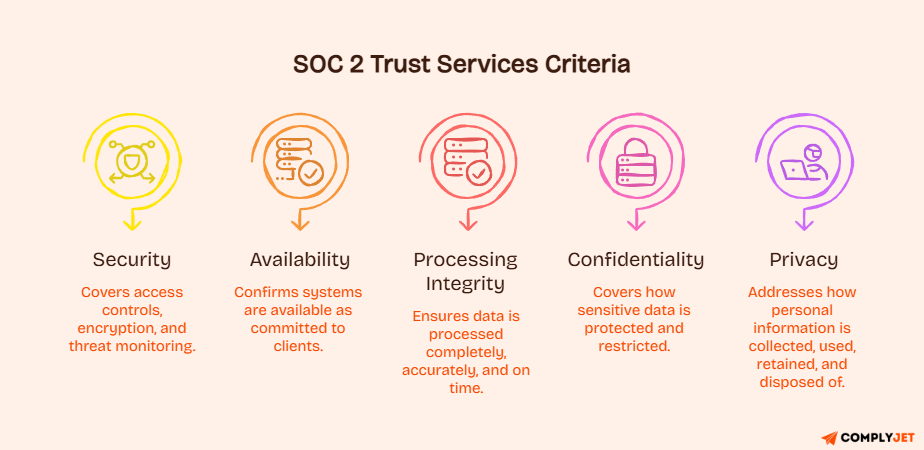
- Security: the mandatory baseline for all SOC 2 reports, covering access controls, encryption, and threat monitoring.
- Availability: confirms your systems are available as committed to clients.
- Processing Integrity: ensures data is processed completely, accurately, and on time.
- Confidentiality: covers how sensitive data is protected and restricted.
- Privacy: addresses how personal information is collected, used, retained, and disposed of.
Most companies include Security as the foundation. You choose additional criteria based on what your clients care about and what your service commitments require. If you handle personal data at scale, adding the Privacy criterion is worth considering.
Tip: Most enterprise procurement teams will ask for your SOC 2 report before they send you a contract. Having it shortens sales cycles while not having a report might end a deal silently, without the buyer ever explaining why.
SOC 2 Type 1 vs Type 2: Which One Do Buyers Want?
There are two versions of a SOC 2 report, and the difference matters when you are talking to enterprise buyers.

A SOC 2 Type 1 report is a point-in-time snapshot. An auditor reviews your controls on a specific date and confirms that they are designed correctly. It says your systems look right today. It does not prove they have been working consistently over time.
A SOC 2 Type 2 report covers an observation period that is typically between six and twelve months. The auditor reviews whether your controls operated effectively throughout that window. This is what enterprise buyers want.
Type 1 is a good starting point if you are new to compliance.
Type 2 is what closes the deal with large clients and unlocks healthcare enterprise accounts. If you’re preparing for your first SOC 2 audit, understanding the SOC 2 audit process helps you plan realistically.
Note: Some buyers will accept a Type 1 report as an interim measure while you are working toward Type 2. Ask your prospective client’s security team directly. Many will tell you.
Also read: SOC 2 Type 1 vs Type 2: What’s the difference?
SOC 2 proves your security controls work for enterprise buyers, but healthcare deals also raise a separate legal question: HIPAA.
What Is HIPAA and Who Does It Apply To?
HIPAA is not optional for healthcare organisations or the vendors who serve them. The Health Insurance Portability and Accountability Act sets the legal floor for protecting patient health information in the United States. It applies to a wider group of organisations than most founders realise.
HIPAA covers two main categories in which you might fall, and based on which you will decide if you need HIPAA compliance:
- Covered entities: This includes healthcare providers, hospitals, clinics, health insurers, and health information clearinghouses.
- Business associates: These are the vendors, software companies, and service providers that handle PHI on behalf of the covered entities. If your software is capable of processing, storing, or transmitting PHI for a hospital or clinic, you are a business associate under HIPAA by definition.
Despite the categories, HIPAA is also built around five rules:

- The Privacy Rule governs how PHI can be used and disclosed. It gives patients rights over their own health data.
- The Security Rule sets technical, administrative, and physical safeguards for electronic PHI, known as ePHI.
- The Breach Notification Rule requires covered entities and business associates to notify affected individuals, HHS, and sometimes the media when a breach occurs.
- The Omnibus Rule extended HIPAA obligations explicitly to business associates and their subcontractors.
- The Enforcement Rule establishes the penalty structure for non-compliance, ranging from $100 to $50,000 per violation, with annual caps up to $1.9 million per violation category.
In 2023, HHS OCR received 38,884 HIPAA complaints. Enforcement is real, and it is increasing. For healthcare SaaS companies, the question is not whether HIPAA applies to you. It is whether you have taken the steps to comply.
Did you know? Many early-stage healthcare startups assume HIPAA only applies once they are large. That is incorrect. If your product touches PHI on day one, your obligations begin on day one.
What Is a Business Associate and Why Does It Matter for SaaS
If you build software for healthcare organisations and your product uses or interacts with patient data, then you are a business associate. That label comes with legal obligations that most SaaS founders do not read carefully until a deal is at risk.
As a business associate, you are expected to sign a Business Associate Agreement, commonly called a BAA, with every covered entity you work with.
The BAA is a legal contract that defines how you handle PHI, what you do in the event of a breach, and what your liability looks like.
Without a signed BAA, both parties are exposed to significant fines. The covered entity cannot legally share PHI with you, and you cannot legally receive it.
The BAA is what your legal team and your client’s legal team will review line by line. Getting your HIPAA compliance infrastructure right before you sign your first BAA matters.

Understanding what goes into a HIPAA business associate agreement before you sign is one of the smartest early moves a healthcare SaaS founder can make.
Founder’s tip: Before signing any BAA, ensure that your internal controls, access management policies, and incident response plan are well-documented and operational. Because a BAA signed without the underlying compliance infrastructure is a legal liability.
Once you understand HIPAA’s legal scope, the next step is comparing it directly against SOC 2 so you do not treat them as interchangeable.
SOC 2 vs HIPAA: Core Differences Side by Side
SOC 2 vs HIPAA discussions start with understanding that they are solving different problems for different audiences. SOC 2 answers your enterprise buyers. HIPAA answers the law. Both matter, but they have different owners, different outputs, and different consequences when you fail.
Here is how they compare across the dimensions that matter most to your business:
The most important difference between SOC 2 and HIPAA is in their nature.
SOC 2 is market-driven compliance. Your clients demand it. If you do not have it, you lose business.
HIPAA is a legally mandated compliance. If you do not have it, the government can fine you and publish your breach on the HHS Wall of Shame.
Another key distinction would be that SOC 2 is industry-agnostic. A payroll software company, a CRM vendor, and a healthcare analytics platform can all pursue SOC 2.
HIPAA applies only to organisations operating in or serving the healthcare ecosystem. This is where the SOC 2 vs HIPAA compliance requirements conversation gets specific to your business model.
Why this matters: A clean SOC 2 Type 2 report can replace hundreds of hours of vendor security questionnaires across your entire client base. HIPAA compliance easily unlocks the ability to legally operate in healthcare markets. Neither one substitutes for the other.
The differences are clear, but the real efficiency comes from understanding where SOC 2 and HIPAA overlap.
Where SOC 2 and HIPAA Overlap?
The SOC 2 vs HIPAA conversation gets more interesting when you look at what they share. There is meaningful overlap between the two frameworks, and that overlap is growing as the 2026 HIPAA Security Rule updates take effect.
SOC 2 vs HIPAA requirements overlap more than most teams expect:
Access Controls: Both demand strong access controls, so you know who can access sensitive data, when they can access it, and why they need that access.
Access Change: Both require clear processes for access changes, so permissions are updated when employees join, move roles, or leave the company.
Encryption: Both require encryption for sensitive data at rest and in transit, so data stays protected in storage and while moving between systems.
Incident Response: Both mandate incident response planning, so your team knows what to do when a security issue or data breach happens.
Risk Assessments: Both require regular risk assessments, so you can find security gaps before they turn into audit findings or real incidents.
Audit Logging: Both require audit logging, so you can track who accessed what data, when they accessed it, and what actions they took.
Vendor Management: Both demand third-party vendor and subprocessor management, so outside tools handling sensitive data are held to the same standard as your own systems.
In practical terms, if you build a strong SOC 2 security program, you will have already addressed a significant portion of HIPAA’s Security Rule requirements.

Estimates across the compliance industry suggest that a well-scoped SOC 2 program can cover 60 to 70% of HIPAA’s technical safeguard requirements. The remaining gap tends to be in HIPAA-specific areas like PHI access logging, BAA management, patient rights workflows, and breach notification timelines.
This overlap is exactly why pursuing both SOC 2 and HIPAA compliance at the same time is more efficient than doing them sequentially. You build the controls once and map them to both frameworks. Shared evidence means less duplicated effort and a faster path to audit readiness.
Platforms built for SOC 2 and HIPAA compliance take this approach and reduce total compliance work significantly. If you want to cut your compliance preparation time, these unified compliance platforms map your SOC 2 controls to HIPAA requirements automatically, eliminating duplicate work. See how it works.
Because the two frameworks share many core controls, the next question is which one your business actually needs first.
Which Framework Does Your Business Actually Need?
This is the question that actually matters. The answer depends on your business model, your customer profile, and whether your product touches PHI. Let us break it down by company type.
Case 1:
If you are a B2B SaaS company with no healthcare customers and no PHI in your systems, you need SOC 2. Your enterprise buyers will ask for it. HIPAA does not apply to you unless your product category changes.
Case 2:
If you build healthcare software and your product touches patient data, you need both. HIPAA applies to you as a legal matter the moment your first covered entity client shares PHI with your system. SOC 2 applies to you as a commercial matter because your enterprise buyers will ask for it alongside the BAA. Running both programs in parallel is the smart move.
Case 3:
If you are a healthcare provider or payer, meaning a hospital, clinic, or insurer, HIPAA is your primary obligation. SOC 2 may be requested by your technology vendors or enterprise partners, but it is not your core compliance requirement. Understanding what HIPAA compliance for healthcare providers looks like operationally is a good starting point.
Case 4:
If you build health IT tools like analytics software, AI-driven clinical tools, or revenue cycle management platforms, HIPAA applies if you process PHI. SOC 2 applies because your hospital and payer clients will ask for it. At scale, HITRUST becomes worth evaluating as a more comprehensive framework for this segment.

Should Healthcare Startups Do SOC 2 or HIPAA First?
This is the most common question healthcare SaaS founders ask. The honest answer is that you should pursue HIPAA first, then layer SOC 2 on top, ideally running both programs simultaneously if your compliance infrastructure allows it.
Here is the logic. HIPAA is a legal obligation. If your product is live and touching PHI without a compliant HIPAA program in place, you are exposed to regulatory risk today. That risk does not care about your funding stage or your headcount.
SOC 2 is a commercial advantage. Failing to have a SOC 2 report costs you deals, but it does not trigger government enforcement or personal liability for your leadership team.
The best approach for most healthcare startups is to use a compliance platform that treats SOC 2 and HIPAA as parallel workstreams sharing the same evidence base. This cuts your total time to compliance readiness significantly and avoids paying for the same controls twice.

Getting clear on SOC 2 compliance for healthcare startups before you start helps you prioritise intelligently.
ComplyJet’s pricing starts at a fraction of what traditional audit firms charge. You get both frameworks covered without the overhead. See plans and pricing.
Once you know whether you need SOC 2, HIPAA, or both, the practical question becomes cost, timeline, and audit effort.
SOC 2 vs HIPAA: Cost, Timeline, and Audit Process
Cost and timeline are where SOC 2 vs HIPAA planning gets real. Most founders underestimate what compliance actually takes until they are mid-process and burning runway on last-minute readiness sprints.
Understanding the full picture before you start saves time, money, and a lot of internal friction.
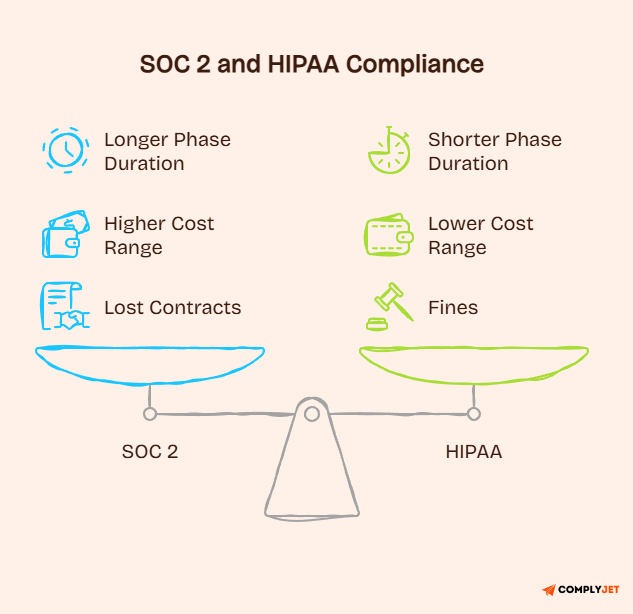
The two frameworks differ not just in cost but in how compliance is measured, who measures it, and what happens when you fall short. SOC 2 runs on an annual audit cycle driven by your clients. HIPAA runs on a continuous obligation cycle driven by federal law. Both demand real investment. Neither rewards shortcuts.
SOC 2 Cost Breakdown
SOC 2 costs fall into three buckets: readiness, audit fees, and ongoing maintenance. Most companies underestimate the readiness phase because it is invisible until you actually start.
SOC 2 readiness costs cover the work you do before an auditor ever touches your systems. This includes documenting policies, implementing controls, setting up evidence collection, closing security gaps, and running internal risk assessments. If you are doing this manually with internal staff, expect to spend two to four months and hundreds of engineering and compliance hours. If you use a compliance platform, this phase compresses significantly.
Audit fees are what you pay the CPA firm that conducts your SOC 2 examination. Here is a realistic breakdown:
- SOC 2 Type 1 audit: $10,000 to $30,000 depending on scope and firm size
- SOC 2 Type 2 audit: $30,000 to $80,000 for most mid-sized SaaS companies
- Larger enterprise scopes with multiple Trust Services Criteria can exceed $100,000
Ongoing maintenance costs include your compliance platform subscription, internal staff time for continuous monitoring, annual policy reviews, and your yearly re-audit. These costs are real but predictable once your program is running.
Tip: The highest hidden cost in SOC 2 is engineer time. Every hour your engineering team spends gathering audit evidence or answering auditor questions is an hour not spent on product. Automation reduces this drag significantly.
SOC 2 Timeline: What to Expect
The SOC 2 timeline depends on two variables: how mature your existing security controls are and whether you are using a compliance automation platform or going manual.
Here is what a realistic SOC 2 timeline looks like for a typical early to mid-stage SaaS company:
- Weeks 1 to 4: Gap assessment. You identify which controls you have, which you are missing, and what evidence you need to collect.
- Weeks 4 to 12: Remediation and control implementation. You close the gaps, document your policies, configure monitoring tools, and begin continuous evidence collection.
- Weeks 12 to 16: Type 1 readiness window. If pursuing Type 1 first, your auditor can now assess your control design.
- Months 4 to 10: Type 2 observation period. Your controls operate under live audit observation for six to twelve months.
- Months 10 to 12: Auditor fieldwork and report issuance. The CPA firm reviews your evidence and issues the final SOC 2 report.
With a compliance platform like ComplyJet that automates evidence collection and maps controls continuously, the readiness phase can be compressed to six to ten weeks. The observation period remains fixed because auditors require a minimum window of operating effectiveness. You cannot shortcut that part. What you can shortcut is everything that comes before it.
Understanding the SOC 2 audit timeline in detail helps you set realistic expectations with your leadership team.
Note: Some enterprise clients will accept a SOC 2 Type 1 report as an interim measure while your Type 2 observation period is running. This lets you close deals without waiting twelve months for a full Type 2 report. Always ask your prospect’s security team if they will accept Type 1 during the transition period.
HIPAA Cost Breakdown
HIPAA cost is harder to pin down because there is no single audit fee. There is no CPA firm you pay to issue a report. Instead, HIPAA compliance is an ongoing program with multiple cost components that compound over time.
Here is a realistic breakdown of what HIPAA compliance costs for a healthcare SaaS company:
- Initial risk assessment: $5,000 to $20,000 if outsourced to a HIPAA consultant or compliance firm
- Policy and procedure development: $5,000 to $15,000 for a full HIPAA policy library if built externally
- Technical control implementation: Variable, but plan for $10,000 to $50,000 in engineering time to implement encryption, access controls, audit logging, and MFA across your systems
- Staff training program: $2,000 to $10,000 annually, depending on team size and training format
- Annual risk assessment refresh: $3,000 to $10,000 per year
- HIPAA compliance platform subscription: Varies by vendor but typically ranges from a few thousand to tens of thousands per year
Total first-year HIPAA compliance investment for a healthcare SaaS startup commonly falls between $30,000 and $100,000. Larger organisations with complex data flows and multiple covered entity clients can spend significantly more.
The cost of non-compliance is the number that should focus your attention. According to HHS OCR enforcement data, the average settlement amount for significant HIPAA breaches in recent years has exceeded $1 million. Fines alone can reach $1.9 million per violation category per year. Add breach notification costs, legal fees, and client churn, and a single HIPAA failure can cost more than your entire compliance program over five years.
Did you know? HIPAA fines are tiered based on culpability. Tier 1 applies when the organisation did not know about the violation. Tier 4 applies when the violation was due to willful neglect and was not corrected. The difference between tiers is the difference between $100 and $50,000 per violation. Having a documented, operational compliance program is the single most effective way to avoid the higher tiers.
HIPAA Timeline: What to Expect
Unlike SOC 2, HIPAA has no defined observation period or audit window. Compliance is continuous and begins the moment your product touches PHI. That said, building a HIPAA compliance program from scratch follows a predictable sequence.
Here is what a realistic HIPAA compliance timeline looks like:
- Weeks 1 to 3: Scope definition. You identify all PHI your system touches, all locations where it is stored or transmitted, and all third parties who access it.
- Weeks 3 to 6: Risk assessment. You conduct a formal HIPAA risk analysis covering threats to ePHI confidentiality, integrity, and availability.
- Weeks 6 to 10: Policy development. You draft and approve required HIPAA policies covering privacy, security, breach notification, and workforce training.
- Weeks 8 to 14: Technical control implementation. You implement required safeguards, including encryption, access controls, audit logging, automatic logoff, and MFA.
- Weeks 12 to 16: Staff training. All workforce members who handle PHI complete HIPAA privacy and security training.
- Ongoing: Annual risk assessment refresh, policy reviews, BAA management, and breach preparedness testing.
With a compliance platform that includes HIPAA policy templates, automated risk assessment workflows, and control monitoring, this timeline compresses significantly. Many ComplyJet customers complete their initial HIPAA compliance program in eight to twelve weeks.
Getting a clear view of HIPAA compliance requirements before you start helps you avoid common scope gaps that slow down the process.
SOC 2 vs HIPAA: Side-by-Side Cost and Timeline Summary
Here is a direct comparison to make the SOC 2 vs HIPAA planning conversation easier for your leadership team:
The numbers look significant in isolation. But the real comparison is not the cost of compliance versus zero. It is the cost of compliance versus the cost of failure. For SOC 2, failure means losing enterprise deals to competitors who have their report ready. For HIPAA, failure means regulatory investigations, public breach disclosures, and fines that dwarf what a proper compliance program would have cost.
Why this matters: Most healthcare SaaS companies that pursue both SOC 2 and HIPAA through a unified platform spend significantly less than they would pursuing each framework separately through traditional audit firms. Shared controls mean shared evidence. Shared evidence means one compliance program, not two.
After the numbers are clear, the next decision is whether to manage compliance manually or use a platform built for both frameworks.
SOC 2 vs HIPAA: Compliance Tools
Managing SOC 2 and HIPAA compliance manually is possible. It is also expensive, slow, and difficult to sustain as your company grows. A dedicated compliance platform changes the economics and the timeline significantly.
ComplyJet is built specifically for companies that need to run SOC 2 and HIPAA compliance programs without building a full internal compliance team. The platform connects to your existing tech stack, automates evidence collection, monitors controls continuously, and produces audit-ready documentation for both frameworks from a single source of truth.
If you are evaluating your options for healthcare SaaS compliance, understanding what to look for in a platform is the right starting point.
Why Compliance Platforms Beat DIY or Single-Audit Firms
The traditional path to SOC 2 or HIPAA compliance involves hiring a consultant or engaging a traditional audit firm. That model works, but it comes with real limitations that compound over time.
Traditional firms charge separately for each engagement. Your SOC 2 readiness assessment is one project. Your HIPAA risk assessment is another. Your annual SOC 2 re-audit is a third. Each engagement starts with evidence gathering from scratch, which means your team spends hundreds of hours compiling the same documentation multiple times across different audit cycles.
Manual evidence collection also creates gaps. Controls that look compliant on audit day may not have been operating effectively throughout the year. Auditors who review point-in-time evidence cannot tell the difference between a control that worked consistently and one that was patched together the week before the audit. Continuous monitoring eliminates that risk entirely.
Understanding the SOC 2 compliance process helps you see where automation adds the most value.
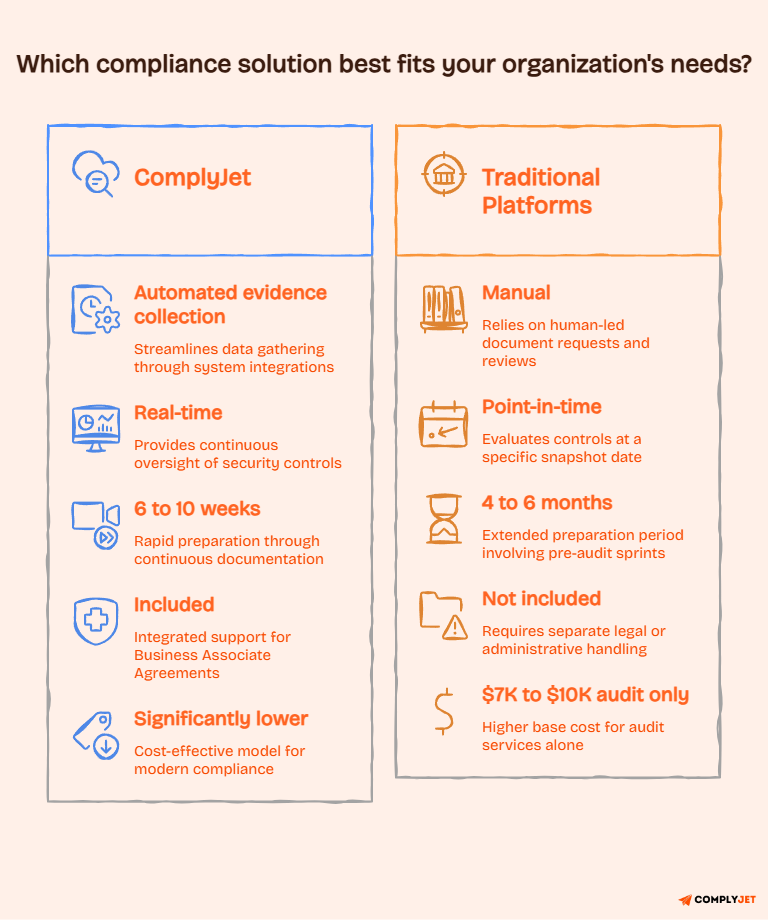
ComplyJet vs Other Compliance Tools
When evaluating compliance platforms for SOC 2 vs HIPAA coverage, the differences come down to scope, automation depth, and pricing. Here is how ComplyJet compares to the traditional engagement model.
The gap between a legacy compliance workflow and a platform like ComplyJet is not just about price. It is about how much of your team’s time gets consumed by compliance overhead versus actual product and business work.
See how ComplyJet customers in healthcare SaaS achieved SOC 2 and HIPAA readiness in under 90 days. Read customer stories.
Ready to get SOC 2 certified? ComplyJet’s SOC 2 compliance program includes readiness assessment, evidence automation, and auditor-ready reporting. Start your SOC 2 journey.
Tools can reduce the workload, but the 2026 changes make it even more important to build your compliance program correctly from the start.
HIPAA and SOC 2 in 2026: What Is Changing?
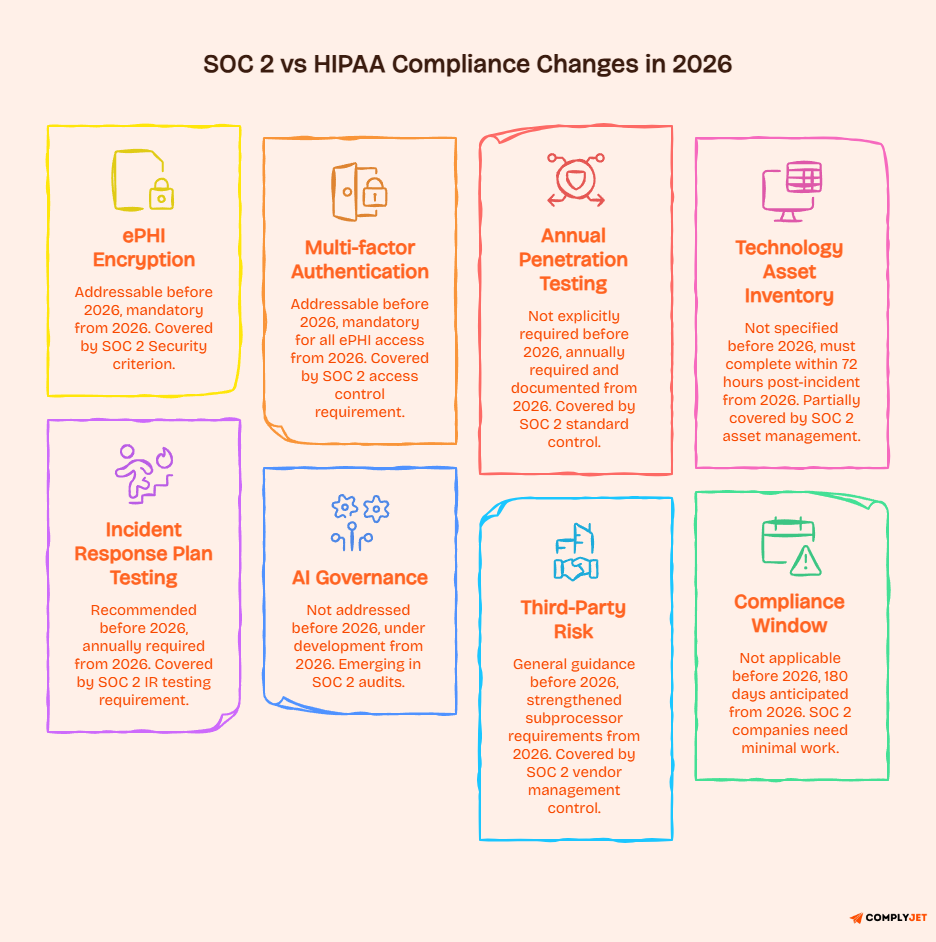
The SOC 2 vs HIPAA landscape in 2026 looks different from what it did even two years ago. Both frameworks are evolving, and the changes matter for how you plan your compliance program today.
The biggest shift is in HIPAA. In January 2025, HHS published a proposed update to the HIPAA Security Rule with significant new requirements. The final rule is expected to be effective in 2025 or 2026.
The key proposed changes include:
- Mandatory encryption for ePHI, where encryption was previously listed as “addressable” and often left incomplete.
- Required multi-factor authentication as a technical safeguard.
- Technology asset inventories must be completed within 72 hours of a security incident.
- Annual penetration testing.
- Explicit testing of incident response plans.
These are not minor adjustments. For healthcare SaaS companies, they represent a meaningful increase in the technical rigour required to maintain HIPAA compliance. The good news is that all of these new requirements align directly with what a strong SOC 2 security program already covers.
Companies with SOC 2 programs in place are significantly better positioned to satisfy the updated HIPAA Security Rule requirements than organisations that have treated HIPAA as a documentation-only exercise.
On the SOC 2 side, the AICPA has been refining guidance around:
- AI-related controls and third-party risk management
- If your product uses AI models that process client data or PHI, expect more scrutiny in your SOC 2 audit around how those models are governed, monitored, and controlled.
Staying current on SOC 2 compliance requirements is increasingly important as these frameworks become more technical.
Tip: If you are just starting your compliance journey in 2026, build your program to the new HIPAA Security Rule requirements from day one. The cost of retrofitting controls later is significantly higher than building them correctly up front.
With the 2026 changes covered, let’s answer the most common questions teams ask when comparing SOC 2 and HIPAA.
SOC vs HIPAA: Most Common FAQs
What is the difference between HIPAA and SOC 2 Type 2?
HIPAA is a US federal law that requires healthcare organisations and their business associates to protect patient health information. HHS OCR enforces it with fines and penalties for non-compliance.
SOC 2 Type 2 is a voluntary audit report issued by a licensed CPA firm that confirms a service organisation maintained effective security controls over a six to twelve-month period.
The core difference is this: HIPAA is a legal mandate that you must satisfy to operate legally in healthcare. SOC 2 Type 2 is a market-driven attestation that your enterprise buyers require before they trust you with their data.
Does SOC 2 Type 2 cover privacy?
SOC 2 includes Privacy as one of its five Trust Services Criteria, but it is optional. Organisations select the criteria relevant to their service commitments and client obligations.
If a company handles personal data and includes the Privacy criterion in its audit scope, the SOC 2 report will address privacy controls around data collection, use, retention, and disposal.
However, SOC 2 privacy coverage and HIPAA’s Privacy Rule are not equivalent. HIPAA’s Privacy Rule is specific to PHI and includes patient rights that SOC 2 does not address.
Is SOC 2 Type 2 HIPAA compliant?
Achieving SOC 2 Type 2 does not make your organisation HIPAA compliant, and HIPAA compliance does not satisfy your SOC 2 obligations. They are separate frameworks designed for different purposes.
That said, a strong SOC 2 program covering the Security criterion addresses a meaningful portion of HIPAA’s Security Rule technical safeguards, particularly around access controls, encryption, incident response, and audit logging. The two frameworks are complementary, not interchangeable. Understanding SOC 2 and HIPAA differences in depth helps you scope both programs accurately.
What is SOC 2 in simple terms?
SOC 2 is a security audit that tells your business customers how well your organisation protects their data.
An independent auditor spends six to twelve months reviewing your internal systems and controls, then issues a formal report. If the report is clean, your enterprise clients can confidently sign contracts knowing their data is handled responsibly.
For most B2B SaaS companies, a SOC 2 Type 2 report is the single most effective document for accelerating enterprise sales cycles.
What are the 5 main HIPAA rules?
HIPAA is built on five rules.
The Privacy Rule governs how PHI can be used and disclosed, and gives patients rights over their health information.
The Security Rule sets required technical, administrative, and physical safeguards for electronic PHI.
The Breach Notification Rule requires covered entities and business associates to notify affected individuals and HHS when a breach occurs.
The Omnibus Rule extended HIPAA obligations formally to business associates and their subcontractors.
The Enforcement Rule establishes the penalty structure ranging from $100 to $50,000 per violation with annual caps up to $1.9 million per violation category.
Is the SOC 2 Type 2 report confidential?
Yes. SOC 2 Type 2 reports are confidential documents. They contain detailed descriptions of your internal controls, audit findings, and operating effectiveness results. They are not publicly distributed. Standard practice is to share them with clients, prospects, or partners under a non-disclosure agreement.
This is different from ISO 27001 certification, which produces a publicly visible certificate. If a prospect asks you to share your SOC 2 report, it is normal to request an NDA first. Most enterprise procurement teams will expect this.
Who needs SOC 2 Type 2 compliance?
Any B2B service organisation whose clients require evidence of data security practices before signing contracts benefits from SOC 2 Type 2. This includes SaaS companies, cloud service providers, data centres, managed service providers, and healthcare technology vendors.
SOC 2 is not legally required in the United States, but it has become effectively mandatory for selling into enterprise and mid-market accounts across technology, finance, healthcare, and professional services.
If your sales team is losing deals to a “we need your SOC 2 report” objection, that is your signal to prioritise it. Getting started with a SOC 2 readiness assessment is the right first move.
What are SOC 2 Type II, ISO 27001, and HIPAA?
These are three distinct compliance frameworks. SOC 2 Type II is a US-based audit report for service organisations, confirming that security controls operated effectively over an observation period.
ISO 27001 is an international standard for information security management systems, resulting in a publicly visible certification recognised globally. HIPAA is a US federal law specific to healthcare data protection.
Many global healthcare SaaS companies eventually pursue all three: ISO 27001 for credibility in international markets, SOC 2 for US enterprise sales, and HIPAA for legal compliance when handling patient data. Understanding how ISO 27001 vs SOC 2 compares helps you sequence them strategically.
Is HIPAA changing in 2026?
Yes. HHS published a proposed update to the HIPAA Security Rule in January 2025, with the final rule expected to take effect in 2025 or 2026.
The updated rule makes encryption of ePHI mandatory, where it was previously listed as an addressable specification that many organisations left incomplete. It introduces required multi-factor authentication, mandatory annual penetration testing, incident response plan testing requirements, and a 72-hour window to complete technology asset inventories following a security incident.
These changes bring HIPAA’s technical requirements significantly closer to what a strong SOC 2 security program already covers. Companies with existing SOC 2 programs will have a head start on satisfying the updated rule.
What is better than SOC 2 compliance?
For most US-based B2B SaaS companies, SOC 2 remains the most recognised and requested security attestation for enterprise sales. At scale or for global markets, ISO 27001 offers broader international recognition and is increasingly requested by European enterprise buyers.
For high-security healthcare and government environments, HITRUST CSF is considered a more comprehensive and rigorous framework that incorporates HIPAA, SOC 2, NIST, and other standards into a single assessment.
The right answer depends on your buyer profile, your geographic markets, and the sensitivity of the data you handle. Most companies start with SOC 2, add HIPAA if they operate in healthcare, and evaluate ISO 27001 or HITRUST as they scale.
Conclusion
The SOC 2 vs HIPAA question does not have one universal answer. It has an answer that is specific to your business, your customers, and the data you handle.
If your enterprise buyers are asking for security evidence, you need SOC 2. If your product touches patient health information, you need HIPAA. If you build healthcare software and sell to hospitals, insurers, or clinics, you almost certainly need both.
The sooner you accept that reality, the sooner you stop treating compliance as a blocker and start treating it as a competitive advantage.
The good news in 2026 is that SOC 2 and HIPAA compliance share more common ground than they ever have. The incoming HIPAA Security Rule updates push technical requirements in a direction that SOC 2 has already mapped. Building one strong security program that satisfies both frameworks is not only possible, it is also the most efficient path forward for healthcare SaaS companies at any stage.
You do not need to choose between speed and thoroughness. You need the right platform and the right starting point.

ComplyJet helps healthcare and SaaS companies achieve SOC 2 and HIPAA compliance faster, without the overhead of a traditional audit firm. Start with a free trial or book a demo to see exactly how the platform handles both.