.svg)

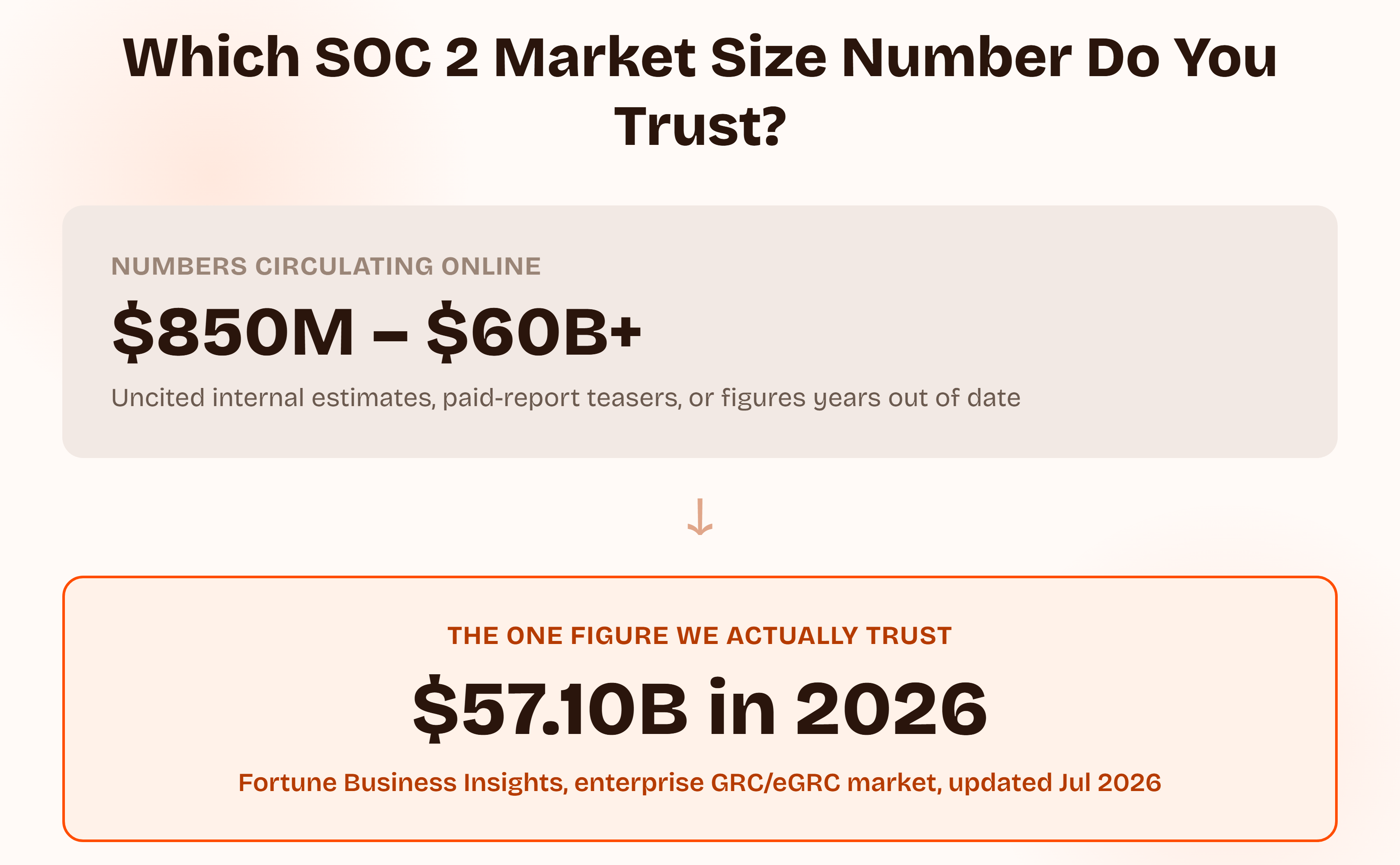
Look up the SOC 2 compliance market size 2026 and you'll get answers ranging from under $1 billion to more than $60 billion, sometimes on the same search results page. Nobody's lying. They're measuring different things and calling it the same market.
What's actually driving growth in 2026 is buyer-side pressure and breach fallout, not a new rule or a fresh compliance deadline, and that distinction changes how you should think about the whole category.
In this article we have explained what's really pushing SOC 2 demand higher this year, and which widely repeated stats about this market have no real source behind them at all.
Here's what I'll cover:
- Why the SOC 2 compliance market size 2026 numbers floating around disagree so wildly
- The one figure that's actually independently sourced, and why it's the right one to anchor on
- What's genuinely driving 2026 growth (spoiler: it isn't a new AICPA rule)
- Whether SOC 2 adoption is actually rising, and how many companies really hold a report
- Common myths about this market that don't survive a source check
SOC 2 Compliance Market Size 2026: Why the Numbers All Disagree
"The SOC 2 market" sounds like a single number. It isn't.
At least four different markets hide under that phrase: what CPA firms charge to actually run the audits, the broader GRC or eGRC software category, compliance-automation tooling specifically (the Vanta/Drata/Secureframe/ComplyJet layer that automates evidence collection), and framework-specific vertical slices, like a report scoped to "SOC 2 for financial services" alone. The table below breaks down what each one actually covers.
Here's the part that trips almost everyone up: nobody says which one they mean. A $850 million estimate and a $60 billion estimate aren't fighting each other. They're just answering two completely different questions.
It gets messier once you look closer. Several of the highest-circulated numbers trace back to uncited internal estimates or paid-report teaser pages with no real methodology behind them.
Even the compliance automation market size figures that do exist rarely separate SOC 2-specific tooling from the rest of the category, since most vendors in this space sell into several frameworks at once. Not because anyone's lying, just because you can't compare two figures when you don't know what either one is actually counting.
The takeaway: any real "state of SOC 2 compliance 2026" snapshot has to say which of these four it means before it states a number. Almost none currently do.
GRC Software Market Size vs. Compliance Automation Market Size vs. the SOC 2 Compliance Market Size 2026
| Category | What it actually includes | Published figure found |
|---|---|---|
| CPA audit and attestation services | Fees paid to CPA firms and auditors to produce SOC 2 reports themselves | Not independently tracked as a standalone market |
| GRC / eGRC software (broadest category) | Enterprise governance, risk, and compliance software spanning every framework, not just SOC 2 | $57.10B in 2026 (Fortune Business Insights) |
| Compliance-automation tooling | Platforms automating evidence collection specifically for frameworks like SOC 2, ISO 27001, and HIPAA | Estimates circulate in the low billions; none independently verified |
| Framework or vertical-specific slices | Narrower reports scoped to one framework and one industry, e.g. "SOC 2 for financial services" | $4.2B for 2025 in one report, based on proprietary modeling, not independently confirmed |
No independently sourced, SOC 2-only dollar figure survived a source check for this article. Every SOC-2-isolated number traces back to a non-independent source (more on exactly which claims in the myths section below). The most defensible number to cite is the broader eGRC figure, clearly labeled as the category it actually is.
The SOC 2 Compliance Market Size 2026 Number We Actually Trust
How big is the SOC 2 compliance market? The honest answer: there isn't a trustworthy SOC 2-only figure, but there is a trustworthy category figure it sits inside.
Fortune Business Insights puts the enterprise GRC/eGRC software market at $49.85 billion in 2025, rising to $57.10 billion in 2026, with a projected $129.45 billion by 2034, a 10.80% compound annual growth rate. That report was last updated July 20, 2026, which makes it one of the freshest dated grc software market size figures available anywhere in this space.
This is a GRC-category number, not a SOC 2-isolated one, and it's still the right one to anchor on. SOC 2 attestation demand is a major driver inside this broader category. It just isn't tracked as its own separate line item by any independent research firm, so borrowing the category figure and labeling it honestly beats inventing precision that doesn't exist.
Compare that to what's actually circulating: SOC-2-automation figures under $1 billion, broader compliance-automation figures in the low billions, and vertical-specific reports in the mid single digits, none of them citing a named, dated, external source. A single figure that names its source, states its update date, and is upfront about which category it covers is a meaningfully higher bar than anything else found in this search.
What's Actually Driving SOC 2 Market Growth in 2026
Growth in 2026 is real. It's just not coming from where most articles imply it's coming from. Real soc 2 market growth right now shows up in buyer behavior and procurement checklists, not in a press release or a new regulation.
| Driver | What the data shows | Source |
|---|---|---|
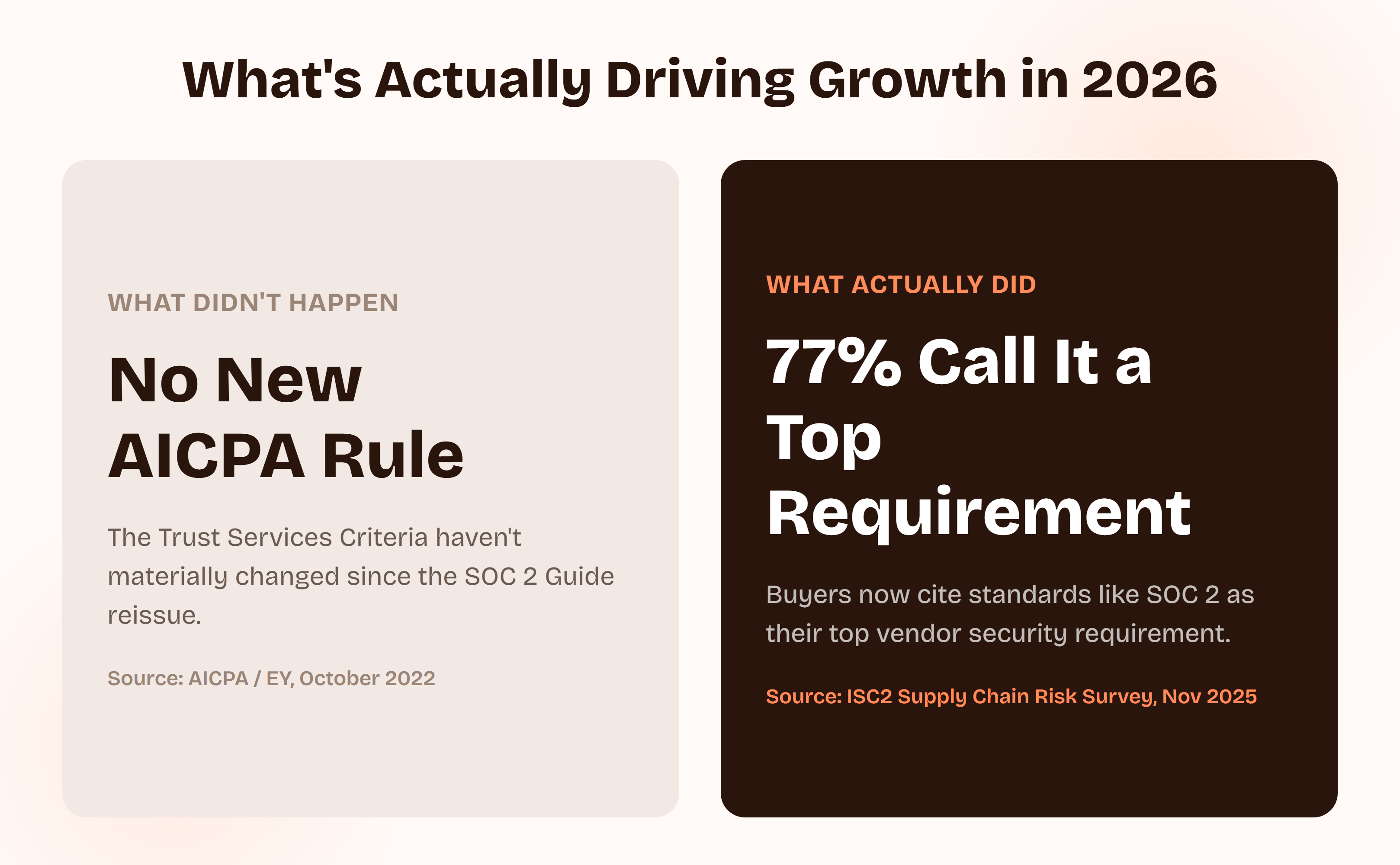
| No new compliance mandate | No material change to SOC 2's Trust Services Criteria since the AICPA's guide reissue | AICPA / EY, October 2022 |
| Buyer-side procurement pressure | 77% of organizations cite standards like SOC 2, ISO 27001, or NIST as their top vendor security requirement | ISC2 2025 Supply Chain Risk Survey, November 2025 |
| Rising third-party breach exposure | Third-party and partner involvement in breaches doubled year-over-year to 30% of all breaches | Verizon 2025 Data Breach Investigations Report, April 2025 |
| Uneven breach cost pressure | Global average breach cost fell to $4.44M, but the US average hit a record $10.22M | IBM Cost of a Data Breach Report 2025, July 2025 |
It's Not a New AICPA Rule. It's Buyer-Side Pressure.
The AICPA hasn't materially changed SOC 2's Trust Services Criteria in 2025 or 2026. The last substantive update was the SOC 2 Guide reissue in October 2022, along with revised points of focus that accompanied it. If you're expecting a new regulatory trigger behind this year's growth, there isn't one.
The real driver sits on the buyer's side of the table. ISC2's 2025 Supply Chain Risk Survey, based on responses from 1,062 cybersecurity professionals collected in August 2025, found that 77% of organizations now cite standards like SOC 2, ISO 27001, or NIST as their top requirement when evaluating a vendor.
That number climbs to 84% in financial services and 87% among military and defense contractors. Procurement teams are asking for this proof more often, not because a rule changed, but because they're managing more third-party risk than they used to, and that shift alone accounts for a meaningful share of the soc 2 market growth this year.
The Breach Data Behind the 2026 Push
Verizon's 2025 Data Breach Investigations Report found that third-party and partner involvement in breaches doubled year-over-year, from 15% to 30% of all breaches. That's exactly the kind of exposure a SOC 2 report exists to help a buyer rule out before a deal closes, and it's a large jump in a single year.
IBM's Cost of a Data Breach Report 2025 adds a genuinely counterintuitive wrinkle. The global average breach cost fell to $4.44 million, the first decline in five years, driven largely by faster AI-assisted containment, with a mean time to identify and contain of 241 days, a nine-year low.
But the US average moved the opposite direction, hitting a record $10.22 million. Costs are falling globally even as exposure in the US rises, which raises rather than lowers the pressure on US-heavy SaaS vendors specifically.
Is SOC 2 Compliance Actually Growing? What the Adoption Data Shows
Yes, in the sense that matters: buyer-side demand for the proof is verifiably rising. No, in the sense of having one precise "SOC 2 adoption rate" number you can point to, because nobody independently tracks that figure.
The ISC2 data above is the strongest evidence available that procurement pressure is real and growing. Beyond that, you'll see compliance-automation platforms publish their own adoption breakdowns, often showing SOC 2 adoption rising sharply as companies mature past their earliest funding stage. Those numbers are directionally consistent with the independent buyer-side data, but they come from a vendor's own first-party survey, not a neutral source, so treat them as supporting context rather than independent confirmation.
How Many Companies Actually Have SOC 2 Reports Today
Nobody knows, and that's a more honest answer than most of what's published on this. Every competitor page reviewed for this article states a specific report-count figure as settled fact, with no source behind it. The accurate answer is that the real number isn't public, and treating any specific total as more than a rough estimate overstates what anyone actually knows.
The State of SOC 2 Compliance 2026: Who's Capturing the Growth
The compliance-automation category, Vanta, Drata, Secureframe, Sprinto, Oneleet, Scrut, and ComplyJet among others, has largely consolidated around automated evidence collection as the default way companies now pursue SOC 2. A few years ago, that process ran almost entirely on spreadsheets and outside consultants. It doesn't anymore, and that shift is a real part of what's expanding the market, separate from the report volume itself.
What this piece deliberately won't do is restate a specific vendor's valuation, revenue, or market-share percentage as current fact. The one source found with those figures was published in November 2024 and hasn't been independently updated since, which makes any number pulled from it roughly a year and a half stale by the time you're reading this. That's exactly the kind of unattributed-and-outdated claim the rest of this article is trying to correct, not repeat.
The more useful way to read "who's capturing the growth" isn't as a vendor leaderboard at all. It's as a shift in what buyers now expect by default.
A few years ago, a startup could plausibly get away with a manual, spreadsheet-driven SOC 2 process and still close enterprise deals on schedule. That's a harder position to hold in 2026, not because any single vendor won the category, but because automated evidence collection has become the baseline expectation rather than a competitive edge. That's a genuinely different kind of market shift than a simple growth-rate number captures.
| A few years ago | In 2026 | |
|---|---|---|
| How companies pursued SOC 2 | Spreadsheets, manual evidence collection, outside consultants | Automated evidence collection via a compliance-automation platform |
| What that signaled to buyers | A competitive edge worth calling out | The baseline expectation, not a differentiator |
Common Myths About the SOC 2 Compliance Market Size 2026 Numbers
A few other claims worth flagging before you repeat them anywhere:
- "70% or more of B2B SaaS deals require a SOC 2 report." Repeated across a huge number of blogs and comparison pages. No independently verifiable survey or source could be located for this specific figure, despite how often it gets cited as settled fact.
- "The average SOC 2 audit costs $20,000 to $50,000." Every version of this range traces back to vendor pricing pages or self-reported lead-generation directories aggregating unverified quotes, not a controlled independent survey.
- "There's a reliable count of how many companies currently hold a SOC 2 report." There isn't, as covered above. Treat any specific total you see as an estimate, not a fact.
- "SOC 2 is getting a major framework update in 2026." It isn't. The last substantive AICPA update was in October 2022, and nothing since has materially changed the Trust Services Criteria.
- "Cyber insurers give preferential rates for SOC 2 Type II specifically." A real narrative in trade press, but no primary insurer or analyst report could be independently confirmed to back a specific rate claim.
What the SOC 2 Compliance Market Size 2026 Data Means for Your Compliance Decision
The case for pursuing SOC 2 in 2026 rests on verifiable buyer-side pressure and rising third-party breach exposure, not on market-size hype or an urgent new rule. That changes how you should prioritize it against everything else competing for your team's time.
Every founder we talk to has seen a version of the "$2 billion market" slide somewhere. What actually matters to their business isn't the size of that market, it's whether their next enterprise deal gets stuck on a security questionnaire they can't answer yet. That's the number worth tracking. — Upendra Varma, CTO at ComplyJet
Going forward, when you run into a vendor's own "market size" or "market growth" claim, ask which of the four categories above the number is actually describing (audit services, GRC/eGRC software, compliance-automation tooling, or a narrow vertical slice) before treating it as comparable to any other number you've seen. Most of the confusion in this space comes from comparing two figures that were never measuring the same thing.
And given the Verizon and IBM data on rising third-party and US-specific breach exposure, earlier SOC 2 investment reduces future procurement friction. It's not just a one-time checklist item to clear before an audit; it's a standing answer to a question your buyers are asking more often, not less.
That framing also matters for how you read your own runway. If you're deciding between spending the next quarter on a new feature or on getting your first SOC 2 report started, the market-size headline shouldn't be the deciding factor either way.
The ISC2 and Verizon data above make the actual case: the deals you're trying to close are increasingly gated on this proof, on a timeline set by your buyers' procurement cycles, not by how fast the broader category is growing.
Where ComplyJet Fits In
As buyer-side pressure, not new rules, keeps pushing more early-stage companies toward SOC 2, ComplyJet helps them get through the process with guided, team-supported implementation and continuous evidence collection. The growth in demand documented above doesn't have to translate into a growth in internal busywork for a team that doesn't have a compliance hire yet.
SOC 2 Compliance Market Size 2026 FAQs
How Big Is the SOC 2 Compliance Market Size 2026?
There's no independently verified SOC 2-only figure. The closest defensible number is the broader enterprise GRC/eGRC software market, which Fortune Business Insights put at $57.10 billion for 2026, growing at a 10.80% compound annual rate.
Is SOC 2 Compliance Growing?
Demand pressure is real and verifiable. ISC2's 2025 survey found 77% of organizations now treat standards like SOC 2 as a top vendor security requirement, even though no independent body tracks a precise SOC 2 adoption rate on its own.
Why Is SOC 2 Demand Increasing?
Mainly buyer-side pressure and breach fallout, not a new compliance mandate. The AICPA hasn't materially changed SOC 2's criteria since October 2022, while third-party breach involvement doubled year-over-year according to Verizon's 2025 DBIR.
What's Driving SOC 2 Compliance Growth?
Rising vendor-risk scrutiny from enterprise buyers, increased third-party breach exposure, and the normalization of automated evidence collection as the default way to pursue and maintain a report, rather than the manual, consultant-heavy process of a few years ago.
How Many Companies Have SOC 2 Reports?
No independent registry publishes this number. Figures like "10,000 to 20,000-plus reports issued" that circulate online trace back to unaudited internal tracking from a single source, not a verified count.
What Is the SOC 2 Compliance Market Size 2026?
Repeating the honest answer on purpose: there's no independently sourced SOC 2-isolated figure. The defensible anchor is the broader GRC/eGRC market at $57.10 billion for 2026, understood as the wider category SOC 2 demand sits inside rather than a number unique to SOC 2 alone.
Related Reading
- SOC 1 vs SOC 2: Key Differences, Compliance, and Which You Need, for readers whose real question is which framework they need, not how big the market is.
- Is SOC 2 a Certification? Attestation vs. Certification, Explained, the terminology piece behind why "certified" and "compliant" get used loosely in market reporting too.
- Vanta SOC 2: Pricing, Report Types, and the Real Process, for evaluating a specific platform's own claims against the category-wide data in this piece.