.svg)

A pooled database with row-level security passes code review, ships fast, and works fine for eighteen months. Then an enterprise prospect's security team asks for evidence that their data is isolated from every other tenant sharing that database, and the honest answer is a paragraph of explanation instead of a document.
That gap is what multi-tenant SaaS compliance actually comes down to. SOC 2, HIPAA, and PCI DSS don't mandate a specific tenancy architecture. They mandate that you can prove tenants can't reach each other's data, and each architecture proves that differently, at a different cost.
We'll cover the three tenancy models (shared database, schema-per-tenant, database-per-tenant), what each one costs at audit time, whether row-level security actually holds up under SOC 2, and the concrete signals that mean it's time to change models before an audit or a deal forces the question. By the end, you'll be able to map your own architecture to the exact evidence an auditor will ask for.
Here's what's ahead:
- What multi-tenant SaaS compliance actually means, and why there's no dedicated "multi-tenancy clause" in any framework
- The three tenancy models and what each one costs, at audit time and otherwise
- Whether row-level security compliance is enough, or just a starting point
- The real trigger points for moving to database-per-tenant
- What auditors specifically ask to see for each model
- The mistakes engineering teams make when isolation is treated as a security feature instead of an architectural decision
What Is Multi-Tenant SaaS Compliance?
Multi-tenant SaaS compliance means being able to demonstrate, with evidence, that tenants sharing your infrastructure can't access each other's data, configuration, or backups. Not "we're pretty sure" or "we reviewed the query code once." Evidence: logs, test results, configuration an auditor can inspect directly.
Tenant isolation SOC 2 requirements don't come from a special multi-tenancy clause, because there isn't one. They come from the same Common Criteria SOC 2 applies to any system: CC6.1 (logical access is restricted to what's authorized) and CC6.6 (the system is protected against unauthorized access at its boundaries). Your tenancy model determines how hard those criteria are to satisfy, not whether they apply.
Isolation vs. Authorization
This distinction trips up more teams than any other part of multi-tenant compliance. Authorization answers "is this person allowed to see this resource." Isolation answers a different question: "even if the application logic has a bug, is it structurally possible for one tenant's request to touch another tenant's data."
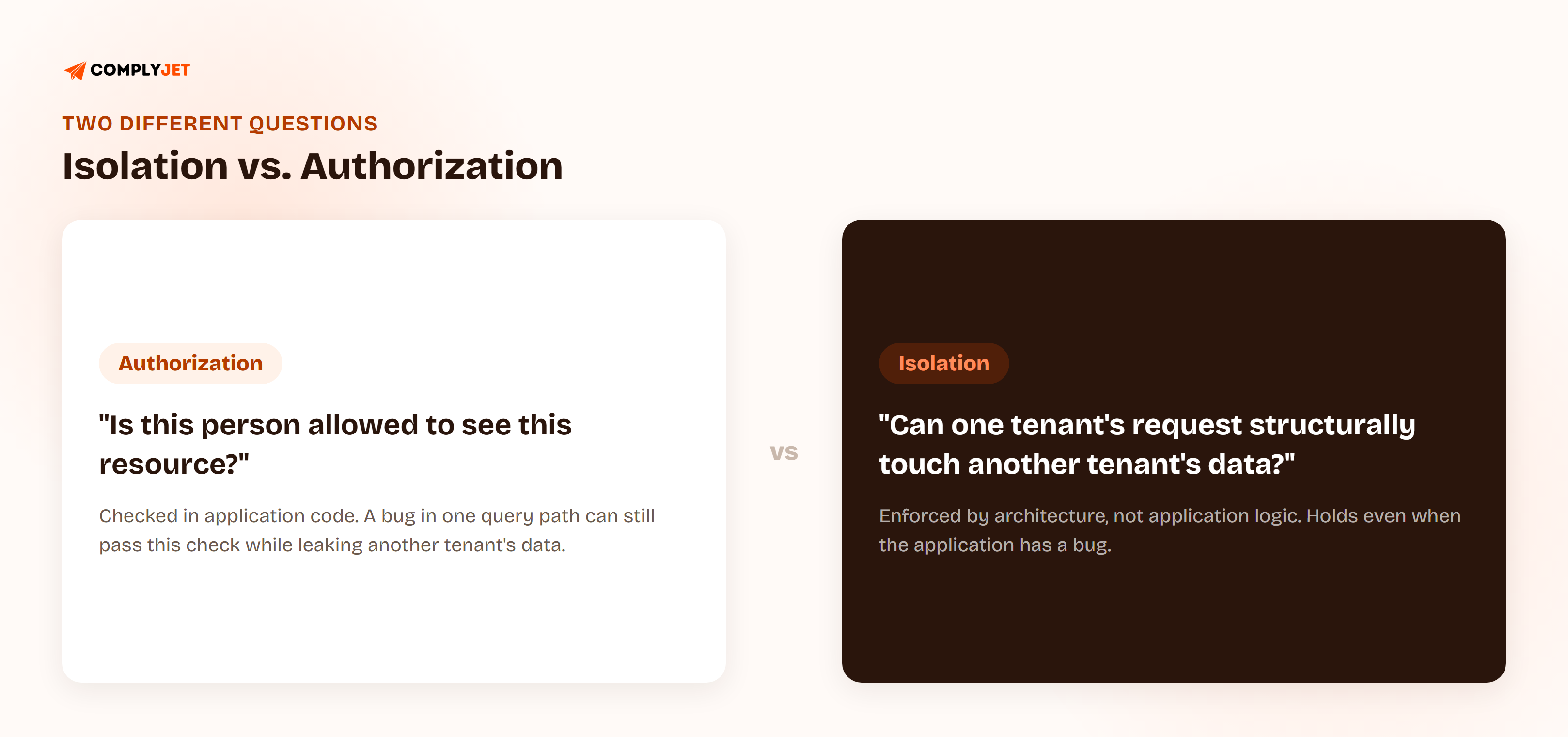
A missed WHERE tenant_id = ? clause in one query path is an authorization bug that becomes an isolation failure. The two get conflated constantly because a working authorization layer masks the absence of a real isolation boundary, right up until the one query path where it doesn't.
That's also why a passing authentication and authorization test suite tells you nothing about isolation on its own. The tests that catch a real isolation gap are the ones written specifically to try crossing the boundary: authenticated as tenant A, deliberately attempting to read or write tenant B's data. Most test suites never include that case, because it isn't a case anyone thinks to write until something has already gone wrong.
Why Multi-Tenant Architecture Compliance Gets Harder as You Scale
Multi-tenant architecture compliance decisions made at ten tenants don't automatically hold at five hundred. "We've reviewed the query code and we're careful" is a defensible answer from a three-person engineering team. It stops being credible evidence the moment an auditor is asking for continuous, provable controls across a full audit period, not a one-time assurance.
The gap tends to surface the same way every time: an auditor, or an enterprise prospect's security questionnaire, asks for per-tenant isolation evidence that a pooled database with row-level security as its only control can't produce cleanly. At that point the company is generating that evidence by hand, under deadline pressure, instead of having designed for it from the start.
The cost of getting isolation wrong isn't abstract, either. IBM's 2024 Cost of a Data Breach Report put the average global breach cost at $4.88 million, the largest single-year jump since the pandemic period. A multi-tenant breach caused by an isolation gap is a worse version of that number, not a better one: it's one incident that touches every affected tenant's data at once, not a single company's.
Tenancy architecture is a decision with a compliance bill attached, whether or not anyone on the team thought of it that way at the time. The bill just doesn't come due until the first audit or the first enterprise security review. — Upendra Varma, CTO at ComplyJet
Pooled vs Siloed Tenant Architecture: The Three Models to Know
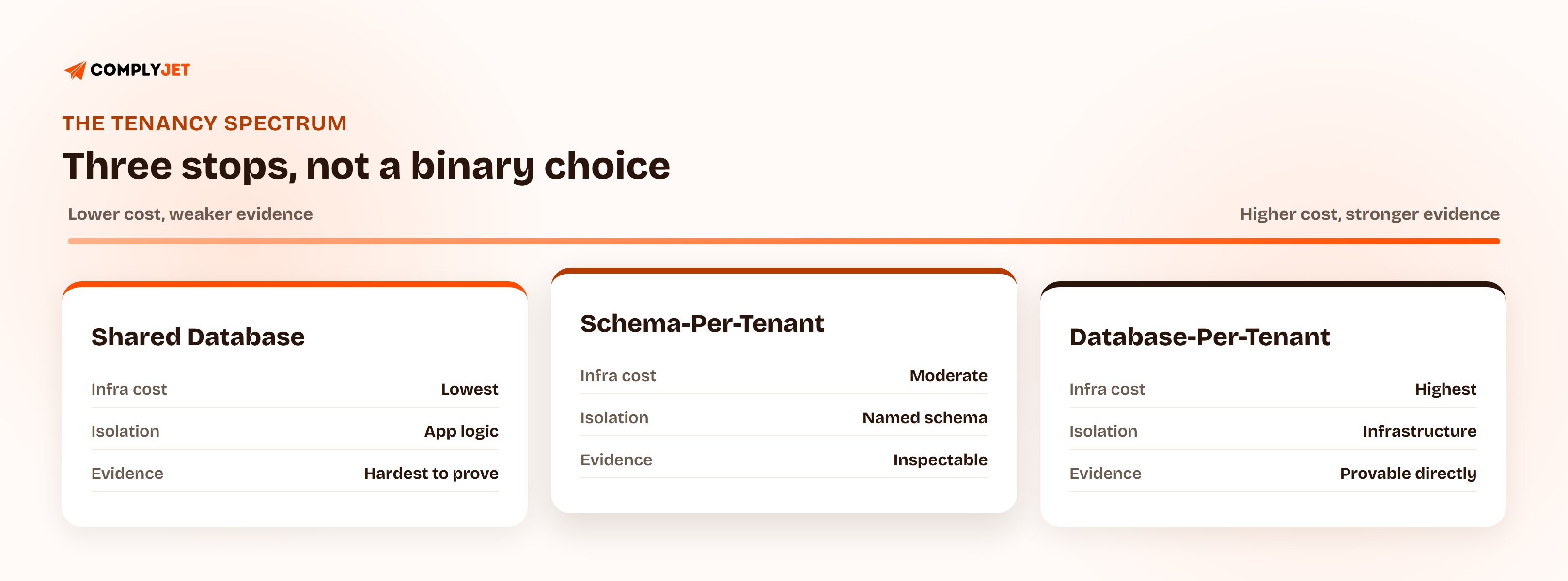
Pooled vs siloed tenant architecture isn't a binary choice. It's a spectrum with three common stops on it, each trading operational cost for isolation strength differently.
| Model | How isolation is enforced | Infrastructure cost | Audit-evidence difficulty |
|---|---|---|---|
| Shared database | Application logic + row-level filtering by tenant ID | Lowest, one database to run | Highest, requires code review, logs, and targeted pen-testing |
| Schema-per-tenant | Separate schema per tenant, one database instance | Moderate, migration tooling is the real cost | Moderate, schemas are inspectable but still share instance-level resources |
| Database-per-tenant | Fully separate database per tenant | Highest, per-tenant operational overhead | Lowest, isolation is provable by pointing at infrastructure |
The shared database model is the one most SaaS products start on, and there's nothing wrong with that. It's cheap to run and it's genuinely fine for a company with no regulated tenants and no enterprise deal requiring dedicated isolation yet. The tradeoff shows up later, not on day one.
The Hybrid Reality
Most companies at any real scale don't pick one model forever. The common pattern is a shared, pooled database for smaller or self-serve tenants, with database-per-tenant reserved for the handful of enterprise or regulated tenants that specifically require it. That hybrid isn't a compromise; it's usually the correct answer, because building database-per-tenant infrastructure for every free-tier signup is its own kind of waste.
Row-Level Security Compliance: Is a Shared Database Ever Enough for SOC 2?
The shared database vs siloed database compliance gap isn't about whether row-level filtering "counts" as a real control. It does. The gap is in the shape of the evidence it produces. A siloed database lets you point an auditor at infrastructure-level access grants that are true by construction. A shared database requires you to produce a penetration test specifically scoped to cross-tenant access, sampled query logs, and code review history for the isolation logic itself, none of which exists automatically.
Schema Per Tenant Compliance: The Middle Ground Most Teams Land On
Schema per tenant compliance sits between the other two models. One database instance to operate, same as the shared model, but each tenant's schema is a distinct, nameable object an auditor can be shown directly. That's stronger evidence than row filtering, without the operational cost of running hundreds of separate database instances.
The real cost here isn't infrastructure. It's migration tooling. Coordinating a schema change across hundreds of tenant schemas without downtime is the operational tax this model charges instead of a bigger infrastructure bill.
Teams typically move to this model when a single enterprise customer's security review asks a question a shared database can't answer cleanly, but a full database-per-tenant buildout isn't justified by the rest of the customer base yet. It's the pragmatic middle step, not a permanent architecture in most cases.
Database Per Tenant vs Shared Database: When the Tradeoff Actually Flips
The database per tenant vs shared database decision isn't "which is better" in the abstract. It's which one your actual next two or three tenants, or your next audit cycle, actually require. A few concrete signals mean it's time to move:
- A specific enterprise deal makes dedicated isolation a contract requirement. Not a hypothetical future enterprise customer, an actual one asking for it in writing.
- You're onboarding a HIPAA-covered tenant. HIPAA doesn't mandate database-per-tenant either, but the risk calculus around PHI usually tips the decision.
- An audit finding specifically calls out the isolation control. If an auditor has already flagged it once, it will get flagged again until the architecture, not just the documentation, changes.
- The manual evidence-generation work is now taking longer each audit cycle than a migration would. This is the quiet signal teams miss, because the cost is spread across a team's time instead of showing up as one line item.
Tenant Isolation Audit Evidence for Multi-Tenant SaaS Compliance
This is the part most competitor guides skip: mapping a specific SOC 2 Trust Services Criterion to the specific evidence artifact each tenancy model can, or can't, produce for it.
| SOC 2 Criterion | What the auditor asks for | Shared database evidence | Database-per-tenant evidence |
|---|---|---|---|
| CC6.1 (logical access) | Proof that access is restricted to what's authorized, per tenant | Code review history, tenant-scoped query tests, sampled access logs | Per-database access grants and IAM policy, verifiable directly |
| CC6.6 (boundary protection) | Proof the system prevents unauthorized access at its boundaries | A penetration test specifically scoped to cross-tenant access | Network- or instance-level isolation, confirmed by infrastructure config |
| CC6.7 (encryption) | Data is encrypted appropriately in transit and at rest | Shared encryption keys across tenants, documented as a scoping decision | Per-tenant encryption keys, provable key-management records |
Tenant isolation audit evidence for a shared database usually means a penetration test report scoped specifically to cross-tenant access, sampled query logs proving the tenant filter held under test, and code review records for the isolation logic. None of that exists automatically. All of it has to be generated and kept current.
Tenant isolation SOC 2 testing gets easier, not harder, the more the isolation boundary lives in infrastructure rather than application logic. Infrastructure configuration is something an auditor can inspect directly. Application logic is something they have to trust was tested thoroughly, every time, for the whole audit period.
Every artifact in the table above eventually has to be described in the audit report itself, not just collected. ComplyJet's help center walks through building that document:
Common Multi-Tenant SaaS Compliance Mistakes Engineering Teams Make
- Treating authentication and authorization as the same thing as isolation. A user being correctly logged in and correctly permissioned says nothing about whether the isolation boundary between tenants actually holds.
- Never penetration-testing specifically for cross-tenant access. Testing that each tenant's own login and permissions work correctly is not the same test as trying to reach tenant B's data while authenticated as tenant A.
- Sharing encryption keys across all tenants by default. Fine for most tenants, a real problem the moment one regulated tenant specifically requires a dedicated key, and that requirement is easy to miss until a contract or a security questionnaire surfaces it.
- Assuming a shared cache or message queue is isolated because the primary database is. Tenant context has to be enforced at every layer data flows through, not just the database. A cache key collision or an unscoped queue consumer can leak data even when the database itself is airtight.
- Discovering the isolation gap during a customer's security review instead of before it. By the time a prospect's security team asks the question, the honest answer should already be a document, not an explanation written on the spot.
- Migrating tenancy models under deadline pressure instead of ahead of the deal that requires it. A rushed migration under a signed contract's timeline is a worse version of the same project done six months earlier, on the team's own schedule.
How ComplyJet Supports Multi-Tenant SaaS Compliance
ComplyJet doesn't choose or validate a tenancy architecture for a company. That decision stays with the engineering team, and it should: it's an architecture and cost tradeoff, not a compliance checkbox.
What ComplyJet does is the part that comes after the architecture decision is made. Once a tenancy model is in place, ComplyJet's integrations collect the resulting access-control, encryption, and monitoring evidence continuously, so a team isn't manually assembling isolation documentation by hand every audit cycle, on whichever model they've chosen.
Here's what that looked like for a company whose product is itself a shared platform serving thousands of separate business customers:
FAQs
What is tenant isolation in a SaaS application?
Tenant isolation is the set of controls that prevent one tenant sharing your infrastructure from accessing another tenant's data, configuration, or backups, even when both are using the same underlying database, cache, or message queue. It's distinct from authentication and authorization, which control who can log in and what a logged-in user can do, not whether the isolation boundary between tenants actually holds.
Is a shared database compliant with SOC 2?
Yes, a shared database with row-level security can pass a SOC 2 audit. The requirement is being able to prove the isolation is consistent and tested, typically through a penetration test scoped specifically to cross-tenant access, sampled query logs, and code review history, not through the database structurally preventing cross-tenant access on its own.
How does tenant architecture affect a SOC 2 audit?
Your tenancy model determines what evidence you can produce and how much of it has to be generated by hand. A database-per-tenant model lets you point an auditor at infrastructure-level access grants. A shared database requires application-level evidence: tests, logs, and code review records covering the isolation logic specifically.
What database model is best for compliance?
There isn't a universally "best" model. A shared database is cheaper and fine without regulated or enterprise tenants requiring dedicated isolation. Schema-per-tenant is a reasonable middle step. Database-per-tenant produces the cleanest audit evidence but carries the highest operational cost, and is usually reserved for the tenants that specifically require it.
Do I need a separate database per tenant for compliance?
Not by default. Move to database-per-tenant when a specific signal shows up: an enterprise contract requiring dedicated isolation, a HIPAA-covered tenant, an audit finding naming the isolation control directly, or when the manual evidence-generation work for a shared model is taking longer each cycle than a migration would.
Is row-level security enough for SOC 2 compliance?
It can be, but only with supporting evidence: a targeted penetration test, tested query logs, and code review history for the isolation logic. Row-level security enforced at the database layer itself, rather than only in application code, produces stronger evidence, since it holds even if application code has a bug.
When should a SaaS company move to database-per-tenant?
When one of the concrete triggers appears: a signed enterprise deal requiring it, onboarding a HIPAA-covered tenant, a named audit finding, or when the ongoing cost of manually documenting a shared model's isolation now exceeds the cost of migrating. Reversing a database split later is far harder than making the move forward, so this is worth deciding deliberately rather than waiting for pressure to force it.
Related Reading
- SOC 2 Audit Process, Start to Finish, for how isolation evidence fits into the full audit once collection is underway
- How to Review a SOC 2 Report From a Vendor, for evaluating a vendor's own isolation claims from the buyer's side
- Vendor Risk Management Metrics: The KPIs and KRIs That Matter, for tracking isolation and access-control evidence on an ongoing basis, not just at audit time