.svg)

An auditor asks for proof that your API enforces least-privilege access. You point to the code: OAuth scopes, JWT validation, a gateway in front of everything. The auditor nods, then asks for the logs showing it actually worked that way every week for the last six months. That's the moment API security and compliance stop being the same conversation.
API security and compliance overlap wherever an API touches customer or regulated data, but they're not the same test. Security asks whether the control exists and works. Compliance asks whether you can prove, with dated evidence, that it kept working across the whole audit period.
SOC 2, ISO 27001, and PCI DSS auditors don't have a separate "API checklist." They apply the same access-control, logging, and change-management criteria they'd apply to a database or an admin panel, and APIs usually have the thinnest evidence trail of any of them.
By the end of this, you'll know exactly what a SOC 2, ISO 27001, or PCI DSS auditor actually asks to see on your APIs, not just what a generic API security checklist tells you to build. Here's what's ahead:
- What API security and compliance actually means once you're inside an audit, not just a code review
- Why authorization gaps on APIs are the first thing auditors surface
- The specific evidence SOC 2 and PCI DSS auditors ask for, and how it differs
- What gets sampled from your access logs, and when
- A practical framework for building this in without a platform-engineering team
What API Security and Compliance Means in Practice
There's no separate "API compliance" framework. APIs are just another in-scope system component under SOC 2, ISO 27001, or PCI DSS, tested against the same access control, monitoring, and change management criteria as everything else in the environment.
API authentication and authorization compliance is where most engineering teams already have real controls: OAuth flows, JWT validation, scoped permissions. What's missing is usually the second half of the equation. Building the control into the code proves it exists. An audit tests whether it operated consistently, which requires evidence the code itself doesn't generate on its own unless someone wired up the logging deliberately.
This applies to any SaaS company with a public or partner-facing API that touches customer or regulated data, not just API-first products. A B2B app with a webhook integration or a partner data feed carries the same exposure as a company that sells API access as the product.
Why API Security and Compliance Gaps Surface First in Audits
APIs are usually the least-reviewed access path in a company. There's no UI to click through during a quarterly access review, so they get skipped, and that's exactly why auditors probe them early.
A passing penetration test doesn't mean a passing audit. A pen test finds vulnerabilities at a point in time. An audit tests whether a control operated consistently across the entire period being reviewed, which is a materially different bar. A team can close every finding from last quarter's pen test and still fail an access-control test six months later because nobody kept the evidence that the fix held.
Watch out: the gap that shows up most often isn't a missing control, it's a missing paper trail for a control that was actually working fine.
Broken Object Level Authorization Compliance: An API Security and Compliance Blind Spot
Broken object level authorization compliance failures happen when an API checks that a caller is authenticated but never checks whether that caller is allowed to access the specific object requested, like swapping a user ID in a request URL and getting back someone else's data. OWASP's API Security Top 10 lists this as the single most common API vulnerability class, and it maps directly to SOC 2's logical-access criteria and ISO 27001's access-control clauses.
What makes this an api security and compliance blind spot specifically: the code can pass every functional test (the endpoint returns data correctly) while still failing the authorization check an auditor cares about (whether it returns the right data to the right caller). Functional testing and authorization testing answer different questions, and teams that only run the first assume they've covered the second.
| What Gets Tested | Functional QA | Compliance Audit |
|---|---|---|
| Does the endpoint return data? | Yes, this is the whole test | Not the question being asked |
| Does it return the right caller's data only? | Rarely tested explicitly | This is the actual test |
| Did this hold true every week for 6-12 months? | Not applicable | Yes, and it must be evidenced |
The API Security Audit Checklist Auditors Actually Use
Most public API security audit checklists are written for engineers deciding what to build. What an auditor actually walks through is closer to this:
| Control Area | What "In Place" Looks Like | What "Evidenced" Looks Like |
|---|---|---|
| Authentication | OAuth/JWT enforced on every endpoint | Log of auth failures/successes, retained across the audit period |
| Authorization | Scoped, least-privilege access per caller | Access-grant and access-revocation records tied to specific identities |
| Rate limiting | Limits configured at the gateway | Logs showing limits actually triggered, not just configured |
| Encryption in transit | TLS enforced | Config screenshot or automated scan confirming it, dated |
| Logging | Requests logged centrally | Retrievable logs for any date within the audit period, not just recent ones |
| Key/token management | Tokens issued with expiry, rotated | Issuance and revocation records, especially for third-party integrations |
The structural difference from a typical api security audit checklist you'd find in a general security blog: every row here has two columns, not one. "In place" is the engineering half. "Evidenced" is the compliance half, and it's the half that actually gets tested.
SOC 2 API Security Requirements: What API Security and Compliance Means for CC6 and CC7
SOC 2 doesn't name APIs specifically anywhere in the Trust Services Criteria. SOC 2 API security requirements live inside CC6 (logical access) and CC7 (system monitoring), the same two criteria that govern every other access path in the environment.
For APIs specifically, CC6 means proving access-granted and access-revoked evidence exists not just for human user accounts, but for API keys, service accounts, and OAuth client credentials too. It's easy to review human accounts quarterly and forget that a third-party integration's API key never gets the same review.
CC7 means proving the API layer is monitored: rate-limit triggers, anomalous request patterns, failed-auth spikes, all logged and reviewed, not just configured and forgotten. StackHawk's own writeup on SOC 2 and APIs confirms auditors expect this kind of ongoing evidence, not a one-time control description.
Api security controls for soc 2 compliance means demonstrating both design and operating effectiveness: the control exists (design), and it ran consistently for the entire Type II period (operating effectiveness). Most engineering teams build for the first and don't realize the second is a separate, evidenced claim until their first audit.
The teams that struggle with API evidence almost never have a security problem. They have a "we never thought anyone would ask for six months of proof" problem. — Upendra Varma, CTO at ComplyJet
PCI DSS API Security Requirements for Payment-Handling Endpoints
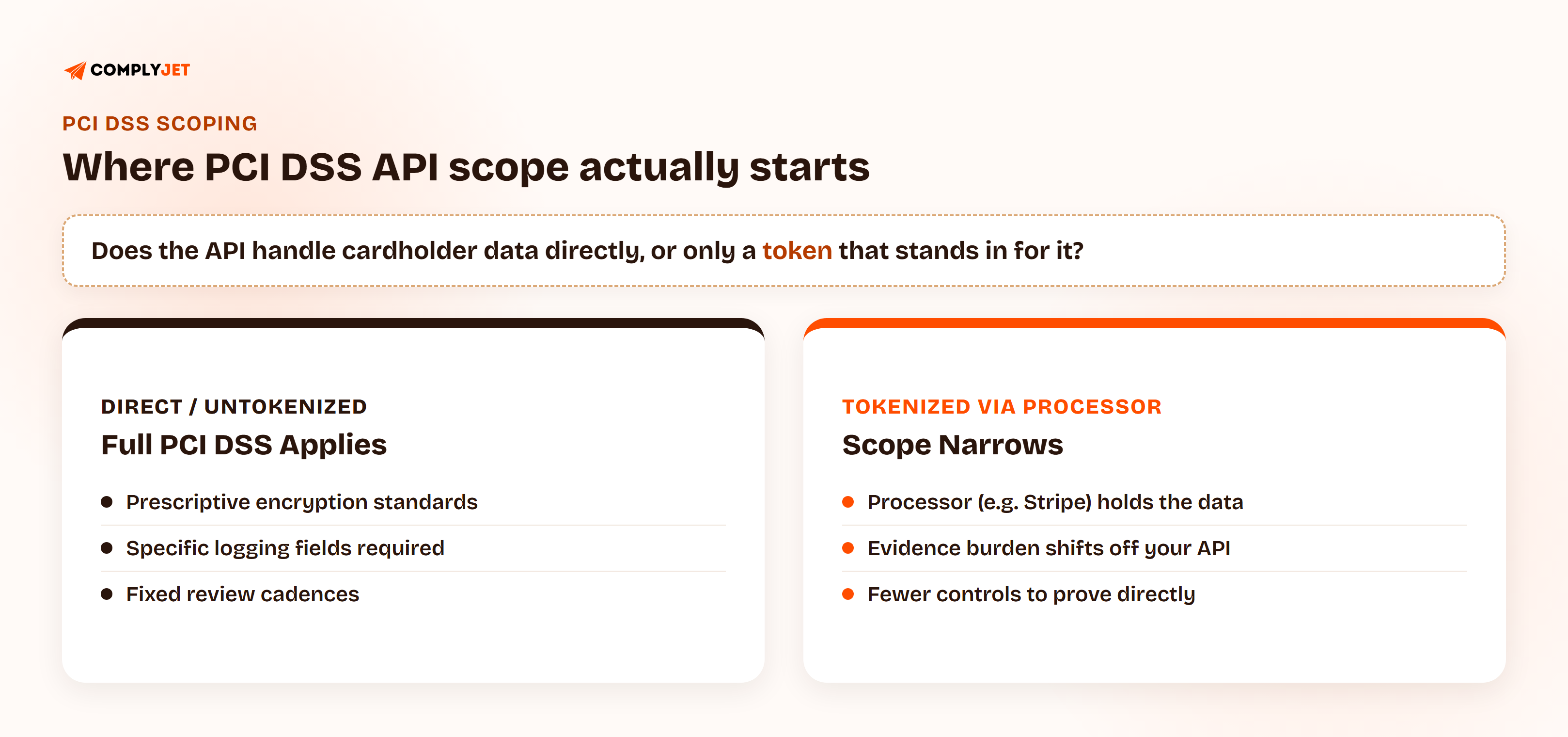
PCI DSS API security requirements only apply if an API touches cardholder data directly, or a token that stands in for it. That scoping question comes first, because it changes everything downstream.
Where PCI DSS differs from SOC 2: it's prescriptive rather than design-your-own-control. Specific encryption standards, specific logging fields, specific review cadences are spelled out rather than left to the organization to define and then prove. That can actually simplify life for a small team, since there's less ambiguity about what "good" looks like, but it also means less room to argue a lighter-touch control is sufficient.
Pro tip: most early-stage SaaS companies are better off tokenizing payment data before it ever reaches their own API layer (via a processor like Stripe) rather than trying to prove PCI DSS controls directly on their own endpoints. It narrows scope instead of expanding the evidence burden.
API Access Control Audit Evidence: What Gets Sampled, and When
This is the mechanic most API security content skips entirely. SOC 2 Type II evidence collection doesn't just check that a control exists once. It samples dated records from specific points spread across the whole audit period. If access reviews run monthly, an auditor typically asks for a handful of specific months, not every single one, but enough to catch a gap.
Api access control audit evidence for an API specifically means request-level records: request ID, subject identity, scope or role granted, allow/deny decision, and a timestamp, all retrievable for whatever date the auditor happens to pick, for the entire period under review.
A missing or overwritten sample at one sampled date is a reportable exception, even if the control ran perfectly every other day of the year. That asymmetry, one gap outweighing months of clean operation, is what actually drives log-retention decisions, not a generic "keep your logs" rule.
| Evidence Type | What to Retain | Why It Gets Sampled |
|---|---|---|
| Access request logs | Request ID, identity, scope, decision, timestamp | Proves authorization decisions, not just that a request happened |
| Token issuance/revocation | When a key was issued, to whom, when revoked | Proves stale credentials don't linger after an integration ends |
| Access review sign-offs | Who reviewed API access, when, what changed | Proves the review actually happened on schedule |
| Rate-limit trigger logs | When limits fired, on which endpoint | Proves monitoring controls are live, not just configured |
For a concrete look at what "issued, scoped, and revoked" actually looks like for one specific kind of API key, ComplyJet's own help center has a walkthrough:
API Audit Logs Compliance: What API Security and Compliance Requires You to Keep
Api audit logs compliance comes down to a specific field list, not a vague "log everything" instruction: request ID, subject or caller identity, the scope or role granted, the allow/deny decision, a timestamp, and, where relevant, the data classification of whatever was returned.
Retention has to survive the full audit observation period, plus enough buffer that a re-sample request doesn't hit a gap. A common technical mistake: shipping logs to a SIEM or observability stack that's genuinely well-built, then rotating them out on a 30- or 60-day retention policy that predates the compliance requirement, so the logs are gone long before the 6-12 month audit window closes.
Building an API Security Compliance Framework That Survives an Audit
A practical, lightweight sequence for building an api security compliance framework that produces evidence on its own, rather than requiring someone to assemble it manually before every audit:
- Inventory every API endpoint and what data or system it touches, including internal and partner-facing ones people forget about.
- Map each endpoint to the relevant control: CC6/CC7 for SOC 2, the equivalent ISO 27001 Annex A clauses, or PCI DSS scope if cardholder data is involved.
- Automate evidence capture at the gateway or logging layer rather than relying on manual screenshots taken right before an audit starts.
- Schedule recurring access reviews with a paper trail, specifically including API keys and service accounts, not just human user logins.
- Set log retention to match the audit period, not the default the logging tool shipped with.
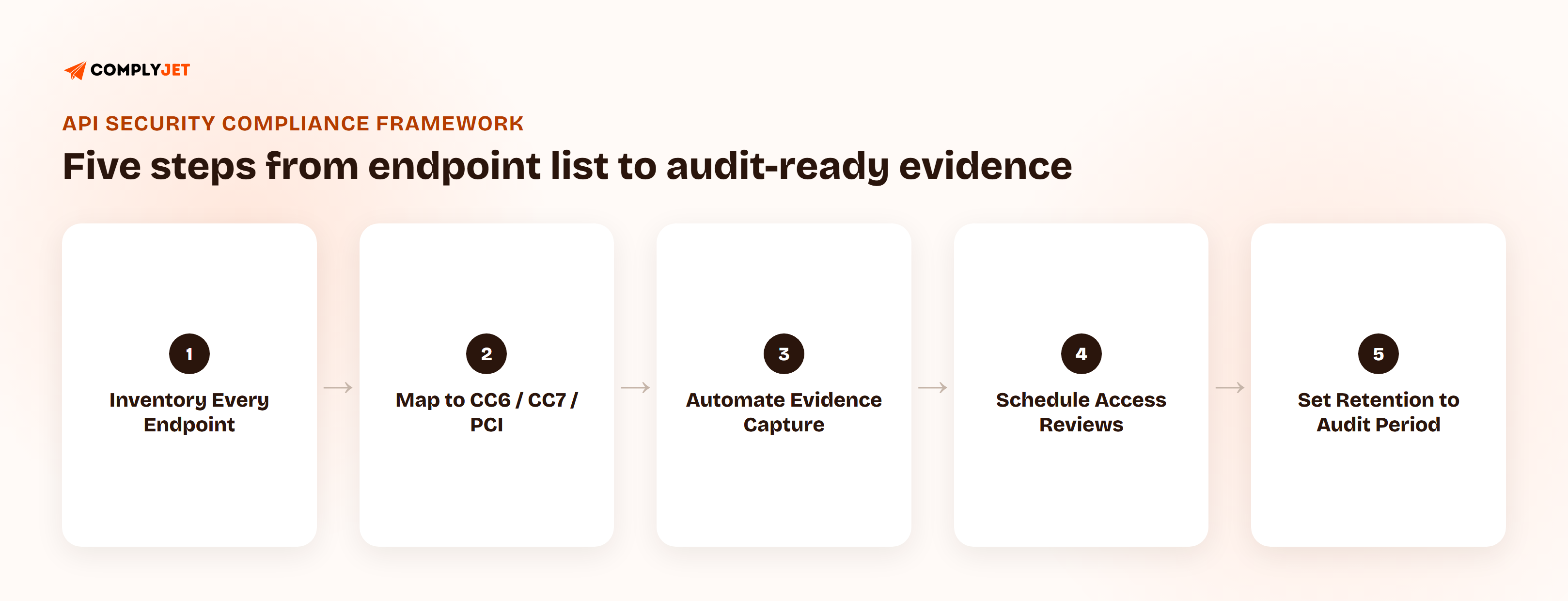
That's the difference between an api security compliance framework that exists as a slide in a security deck and one that actually produces evidence on demand, on any date an auditor happens to pick.
Common API Security and Compliance Mistakes That Turn Into Audit Exceptions
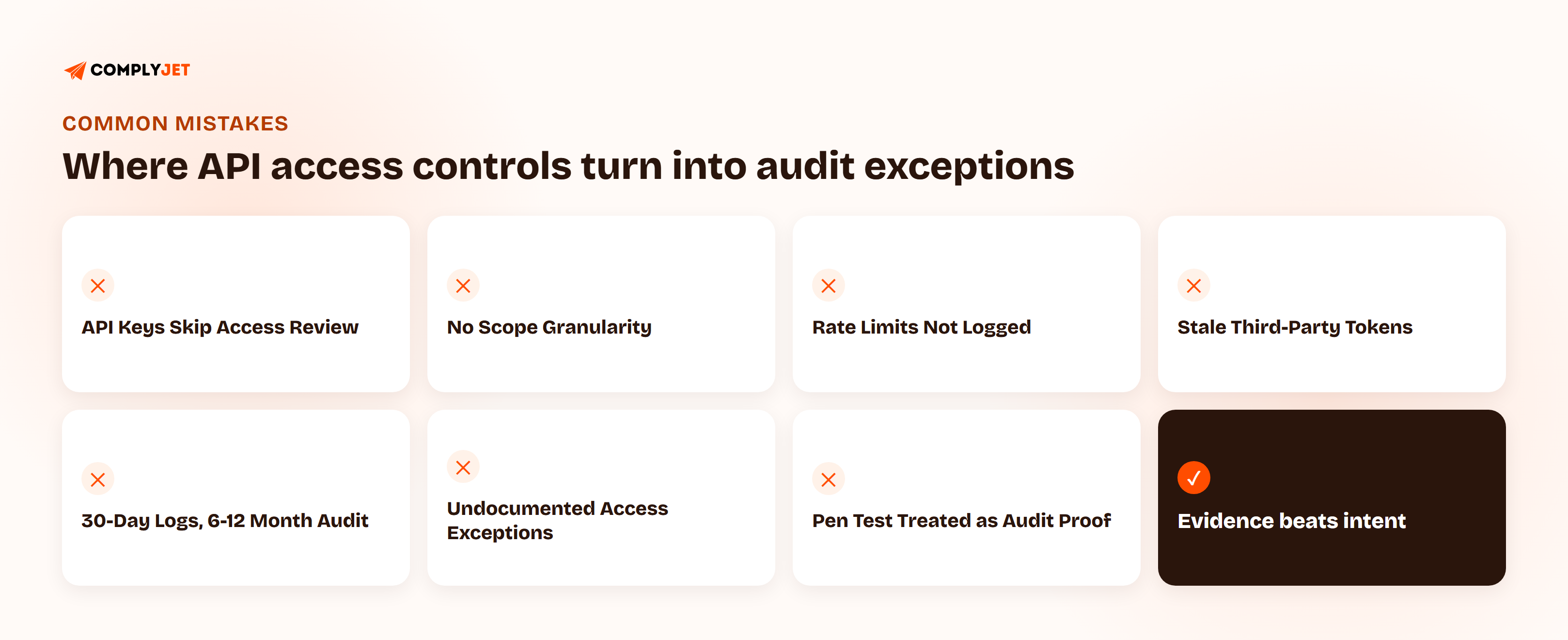
- Treating API keys and service accounts as exempt from access reviews. Human accounts get reviewed quarterly; the integration token from eighteen months ago never does.
- No scope or role granularity. Every integration gets full read/write access because narrower scopes were never built, which fails least-privilege testing outright.
- Rate limiting configured but not logged. The control exists; there's no way to prove it ever actually triggered.
- Third-party API tokens never revoked after an integration ends. A vendor relationship ends, the token quietly keeps working, and nobody notices until an auditor asks for a current access list.
- Logs retained for 30 days when the audit period is 6-12 months. The control worked the whole time; the proof didn't survive long enough to show it.
- No record of why an access exception was granted. A one-off broad-access grant for a migration or incident response, with nothing written down about why or when it was supposed to end.
- Assuming a clean penetration test substitutes for operating-effectiveness evidence. It answers a different question, and auditors know the difference even when engineering teams don't.
- Treating "we pass our pen test" as equivalent to having api security controls for soc 2 compliance in place. A pen test is a point-in-time check; an auditor wants proof the same controls held for the entire period under review.
How ComplyJet Helps With API Security and Compliance
ComplyJet doesn't replace API security tooling. It doesn't run its own WAF, API gateway, or DAST scans, and it isn't trying to be one. What it does is connect to the tools already generating this evidence, your cloud provider, your logging stack, your identity provider, and pull the access and audit records those systems already produce into one place mapped to the specific SOC 2 or ISO 27001 criteria they satisfy.
That matters for api security and compliance specifically because the evidence problem is rarely "we lack a control." It's "the control worked, but nobody can produce six months of proof of it on demand." ComplyJet's evidence collection is built around exactly that gap: continuous, automatic, and tied to the criterion an auditor will actually ask about.
Here's what that looked like for a small engineering team that had none of this evidence trail in place a few months earlier:
FAQs
What do auditors check for API security?
Auditors check that authentication and authorization are enforced consistently, that access is least-privilege and reviewed on schedule, and that request-level logs exist and are retrievable for any date across the audit period, not just recently. They're testing whether the control operated over time, not just whether it exists today.
What evidence do SOC 2 auditors want for APIs?
Request-level access logs (identity, scope, decision, timestamp), token issuance and revocation records for API keys and service accounts, access review sign-offs, and monitoring evidence like rate-limit trigger logs. All of it needs to be retrievable for whatever date the auditor samples, not just the most recent period.
How do I prepare my APIs for a SOC 2 audit?
Start by inventorying every endpoint and what it touches, then map each one to CC6 (access control) and CC7 (monitoring). Automate log capture at the gateway level, set retention to cover the full audit period, and run an access review that explicitly includes API keys and service accounts, not just human logins.
Is API security part of a SOC 2 audit?
Yes, but not as a separate line item. SOC 2 has no API-specific criterion. APIs get tested under the same access control (CC6) and monitoring (CC7) criteria as every other system component, which means the same evidence standards apply.
What is broken object level authorization, and why does it matter for compliance?
It's when an API checks that a caller is authenticated but not whether they're authorized to access the specific object requested, letting one user pull another user's data by changing an ID in the request. It maps directly to SOC 2's access-control criteria and is one of the most common findings in API security reviews.
How often should API access logs be reviewed for compliance?
Match the review cadence to what you claim in your own policy, monthly is common, and keep records proving each review actually happened. The specific frequency matters less than being able to prove the cadence you committed to was actually followed for the whole audit period.
Do I need API security testing for SOC 2 compliance?
SOC 2 doesn't mandate a specific testing tool, but you do need to demonstrate that access and authorization controls work and are monitored. Regular API security testing (functional and authorization-specific) is one of the more reliable ways to generate the evidence an auditor will ask for, even though it's not a checkbox requirement on its own.
Related Reading
- Compliance as Code: Baking SOC 2 Controls Into Your CI/CD Pipeline, for teams that want to build this same evidence-capture habit into their CI/CD pipeline, not just their API layer.
- SOC 2 Audit Process, Start to Finish, for the full audit process this evidence ultimately feeds into.
- ISO 27002 Checklist: Controls, Categories, and How to Use It, for the underlying control catalog CC6/CC7-equivalent ISO clauses map to.