Three months into your SOC 2 Type II window, the auditor asks for evidence of the quarterly access review for every quarter. The dashboard has been green the whole time. The review that was due in month two never happened, because nobody owned it.
A continuous monitoring policy prevents that gap. It turns "we have tools switched on" into "someone checks this, on this date, and does something when it fails."
A continuous monitoring policy is the written rule for how a company keeps checking that its security controls still work after the audit: which controls are checked, by what method, how often, who reviews the result, what turns a failed check into a tracked finding, and how status reaches leadership.
Two boundaries up front. It is not the logging and monitoring policy, which decides what events are logged, kept and alerted on. It is not a buying guide either; for that, see our compliance monitoring tools comparison. This policy sits above both and owns the cadence, the owners and what happens on failure.
Quick answer
The policy needs nine parts: purpose and scope, roles, monitoring strategy, a frequency rule with a matrix, methods, finding handling, exceptions, reporting and review. The framework anchors are SOC 2 CC4.1 and CC4.2, ISO 27001 clause 9.1, NIST CSF 2.0 DE.CM and NIST SP 800-53 CA-7. Most startup checks run daily, monthly or quarterly, not in real time.
By the end of this guide you will know exactly what to check, how often, who owns each check and what to do when one fails. You will also have full sample clauses and a free, ungated PDF.
Here's what I'll cover:
- What the policy is, and how policy, strategy and plan fit together
- What SOC 2, ISO 27001, NIST CSF, NIST 800-53 CA-7 and FedRAMP each expect, in one table
- A worked monitoring frequency matrix you can adopt as a starting point
- How a failed check becomes a tracked, closed finding
- How to report results, right-size the policy for a startup and roll it out
- Sample clauses for every section and the mistakes auditors notice
What Is a Continuous Monitoring Policy?
A continuous monitoring policy is a short rule set that makes control checks somebody's job. It names the controls, the checks, the cadence and the owners, and says what happens when a check fails.
The term comes from US federal security. NIST SP 800-137 (September 2011) defines information security continuous monitoring (ISCM) as "maintaining ongoing awareness of information security, vulnerabilities, and threats to support organizational risk management decisions."
In startup terms: the audit tests a moment, and monitoring tests every week after it. The policy is what puts the weekly test on someone's calendar.
It covers more than systems. A good policy includes:
- Automated technical checks, such as configuration drift, MFA coverage, vulnerability scans and backup jobs
- People-dependent checks, such as access reviews, training completion and policy acknowledgements
- Third-party checks, such as expired vendor SOC 2 reports and new subprocessors
"Continuous" does not mean real time for everything. NIST frames frequency as whatever is sufficient to support risk decisions, and SP 800-137 notes that FISMA set the federal floor for control assessments at no less than annually. Most of a startup's checks run daily, weekly, monthly or quarterly.
Continuous Monitoring Policy vs Logging and Monitoring Policy, Vulnerability Management and Monitoring Tools
Several neighbouring documents sound alike. Use this table to send each question to the right one, so the documents point at each other instead of repeating each other.
| Question | Document that answers it | What this policy says in one line |
|---|---|---|
| Which events are logged, kept and alerted on? | Logging and monitoring policy | Log pipeline health is checked daily |
| How are vulnerabilities scanned and fixed, and by when? | Vulnerability management policy | Scan results feed the findings process |
| How are patches applied? | Patch management policy template | Patch status is one row in the matrix |
| How are changes approved? | Change management policy | Unapproved production changes are checked weekly |
| When is a detection a security incident? | Incident management policy | Failed checks that meet incident criteria are handed over |
| How are vendors assessed? | Third-party risk management policy | Vendor posture is checked quarterly |
| Which tool should run the checks? | Compliance monitoring tools comparison | Any tool is fine if every check has an owner |
Continuous control monitoring is the vendor term for automated, ongoing tests of controls. It is one method this policy can name. It is not a substitute for the policy, because a tool cannot decide who reviews an access list or approves an exception.
Note
Keep this policy short by pointing to the others. It owns only the cadence, the ownership and the finding-handling layer. If it starts restating log retention or patch windows, it will go stale in two places at once.
Continuous Monitoring Policy, Continuous Monitoring Strategy and Continuous Monitoring Plan: How the Three Fit
Federal guidance separates three layers, and it helps to know which one you are writing.
- Policy: what must happen and who is accountable. Short, approved by leadership, changes rarely.
- Continuous monitoring strategy: what you monitor and why, based on risk. NIST 800-53 puts the organization-wide version in PM-31 and the system-level version in CA-7.
- Continuous monitoring plan: the operating detail, such as the frequency matrix, the tools and the ticket queue. It changes whenever your stack does.
Real examples follow this layering. California's State Administrative Manual section 5335.1 is a two-paragraph mandate that requires each state entity to develop a monitoring strategy. FedRAMP's legacy model asked providers for a continuous monitoring plan for each system.

A startup does not need three documents. Write one policy with the strategy as a short section and the plan as an appendix, which is how the template below is built.
Why a Continuous Monitoring Policy Matters After the First Audit
The first audit is the easy one. Controls decay between audits because nobody's calendar says otherwise.
What does that decay look like? Usually something small that becomes a finding:
- A quarterly access review skipped once, which becomes a SOC 2 Type II exception.
- A storage bucket made public during a Friday deploy and found by a customer's scanner.
- A departed contractor's SSO account still active two months later.
- A vendor's SOC 2 report that expired and nobody re-requested.
- A backup job failing silently since a migration.
None of these needs a sophisticated attacker. Each needs only a check nobody owned.
Decisions made for the first audit stick around, too. A Hacker News commenter put it bluntly in July 2022: "Every engineering decision you make to support a Type I is something you'll need to live with in your Type II" (thread). The same applies to frequencies. Promise monthly in the policy and the auditor will test monthly.
The policy gets asked for in four places:
- The SOC 2 Type II observation window, where the auditor tests whether controls operated throughout the period
- ISO 27001 surveillance audits, which look at monitoring and measurement under clause 9
- Customer security questionnaires that ask how you monitor control effectiveness
- Federal and state buyers who ask about continuous monitoring, often shortened to ConMon
Pro tip
The policy must answer one question in a single line: "If a control stopped working on Monday, who would know, and by when?" If you cannot find that answer in under a minute, the policy is not finished.
Which Frameworks Expect a Continuous Monitoring Policy: SOC 2, ISO 27001, NIST and FedRAMP
None of the commercial frameworks requires a document with this exact title. All of them test whether you monitor controls on an ongoing basis. NIST 800-53 CA-7 is the one place where continuous monitoring is a named control.
SOC 2 Continuous Monitoring: CC4.1, CC4.2 and the Type II Window
SOC 2 continuous monitoring lives in the monitoring activities criteria of the AICPA Trust Services Criteria. In summary:
- CC4.1 asks the company to select, develop and perform ongoing and/or separate evaluations to confirm that controls are present and functioning. Its points of focus include varying the scope and frequency of evaluations by risk.
- CC4.2 asks the company to evaluate deficiencies and communicate them in time to the people responsible for corrective action.
These are our paraphrases, so read the criteria text itself before you quote it in a policy.
Here is why it matters in Type II. The auditor tests across the whole observation window, so your policy's frequencies define what gets tested. A CPA who says they spent five years on SOC 2 fieldwork at Deloitte wrote on Hacker News in August 2026 that at small-company scale "populations are tiny", and that their firm's method "defaults to testing complete populations." Every scheduled check is evidence, and every missed one shows.
See our guides to SOC 2 Type 1 vs Type 2 and SOC 2 controls for the wider picture. System monitoring under CC7.2 belongs to the logging policy, not this one.
SOC 2
Keep SOC 2 controls checked between audits
ComplyJet runs continuous control monitoring across the Trust Services Criteria and keeps checking after your audit completes, so issues surface before they become findings.
ISO 27001 Continuous Monitoring: Clause 9.1, Internal Audit and Corrective Action
ISO 27001 continuous monitoring sits in the performance evaluation clauses of ISO/IEC 27001:2022. In summary:
- Clause 9.1 asks you to decide what needs monitoring and measuring, the methods, when it is done, who does it, and when results are analysed and evaluated.
- Clause 9.2 (internal audit) and clause 9.3 (management review) consume those results.
- Clause 10.2 covers nonconformity and corrective action, which is where failed checks end up.
Clause 9.1's questions map almost one-to-one onto the columns of a frequency matrix. That makes the matrix the simplest clause 9.1 evidence you can produce.
Annex A 8.16, Monitoring activities, is about watching networks, systems and applications for anomalous behaviour. That belongs to the logging policy. Our ISO 27001 internal audit guide shows how monitoring results feed the audit. Clause wording here is our summary, so confirm it against the standard.
NIST CSF 2.0 Continuous Monitoring: The DE.CM Category
NIST CSF 2.0 has a category called Continuous Monitoring (DE.CM) in its Detect function. It says assets are monitored to find anomalies, indicators of compromise and other potentially adverse events.
Five subcategories are active in CSF 2.0:
- DE.CM-01: networks and network services
- DE.CM-02: the physical environment
- DE.CM-03: personnel activity and technology usage
- DE.CM-06: external service provider activities and services
- DE.CM-09: computing hardware, software, runtime environments and their data
DE.CM-04, -05, -07 and -08 were withdrawn in CSF 2.0 and folded into -01 and -09.
To be precise about scope: DE.CM is about detecting adverse events, so it sits closer to the logging policy. The control-effectiveness side of this policy maps better to CSF's improvement outcomes. Our NIST compliance guide covers the framework end to end.
NIST 800-53 CA-7 and NIST 800-137: Where the Continuous Monitoring Policy Comes From
NIST 800-53 CA-7 (Continuous Monitoring, Rev. 5.2.0) asks for a system-level monitoring strategy and a program that includes seven elements:
- Metrics the organization defines
- Frequencies for monitoring and for assessing control effectiveness
- Ongoing control assessments
- Ongoing monitoring of the defined metrics
- Correlation and analysis of the results
- Response actions to address the results
- Reporting security and privacy status to defined roles at a defined frequency
Two enhancements matter here. CA-7(1) asks for independent assessors. CA-7(4) splits risk monitoring into effectiveness, compliance and change monitoring. PM-31 is the same idea at the organization level.
NIST 800-137 gives the program six steps: define a strategy, establish the program, implement it, analyze data and report findings, respond to findings, and review and update. SP 800-137A (May 2020) explains how to assess the program itself.
Why should a startup with no federal contract care? Because CA-7's seven elements are the cleanest checklist of what a policy must decide. The template below follows them.
FedRAMP Continuous Monitoring in 2026: From ConMon Deliverables to the VDR Rules
FedRAMP continuous monitoring changed this year. FedRAMP's own legacy playbook describes a ConMon model based on NIST SP 800-137, with deliverables due monthly, annually, every three years and as needed. That model included a monthly plan of action and milestones (POA&M) reviewed by agency authorizing officials, an annual assessment by an independent third-party assessment organization (3PAO), and significant change requests.
Many compliance guides still quote the legacy remediation windows of 30, 90 and 180 days for high, moderate and low findings. Those come from the pre-2026 model.
Here is what changed, according to fedramp.gov:
- The legacy ConMon playbook has been marked as reference-only legacy content since June 24, 2026.
- The 2026 Vulnerability Detection and Response rules for Rev5 are required for initial and ongoing certification from December 7, 2026, with a grace period that ends March 7, 2027.
- Detection is explicitly broader than traditional vulnerability scanning.
- Fixed severity windows give way to timeframes set by potential agency impact, exploitability and internet reachability, ranging from 4 days to 192 days.
If you are pursuing a FedRAMP authorization, read the rules directly on fedramp.gov and see our FedRAMP compliance software comparison. This section is background, because a commercial SaaS policy borrows FedRAMP's structure, not its deadlines.
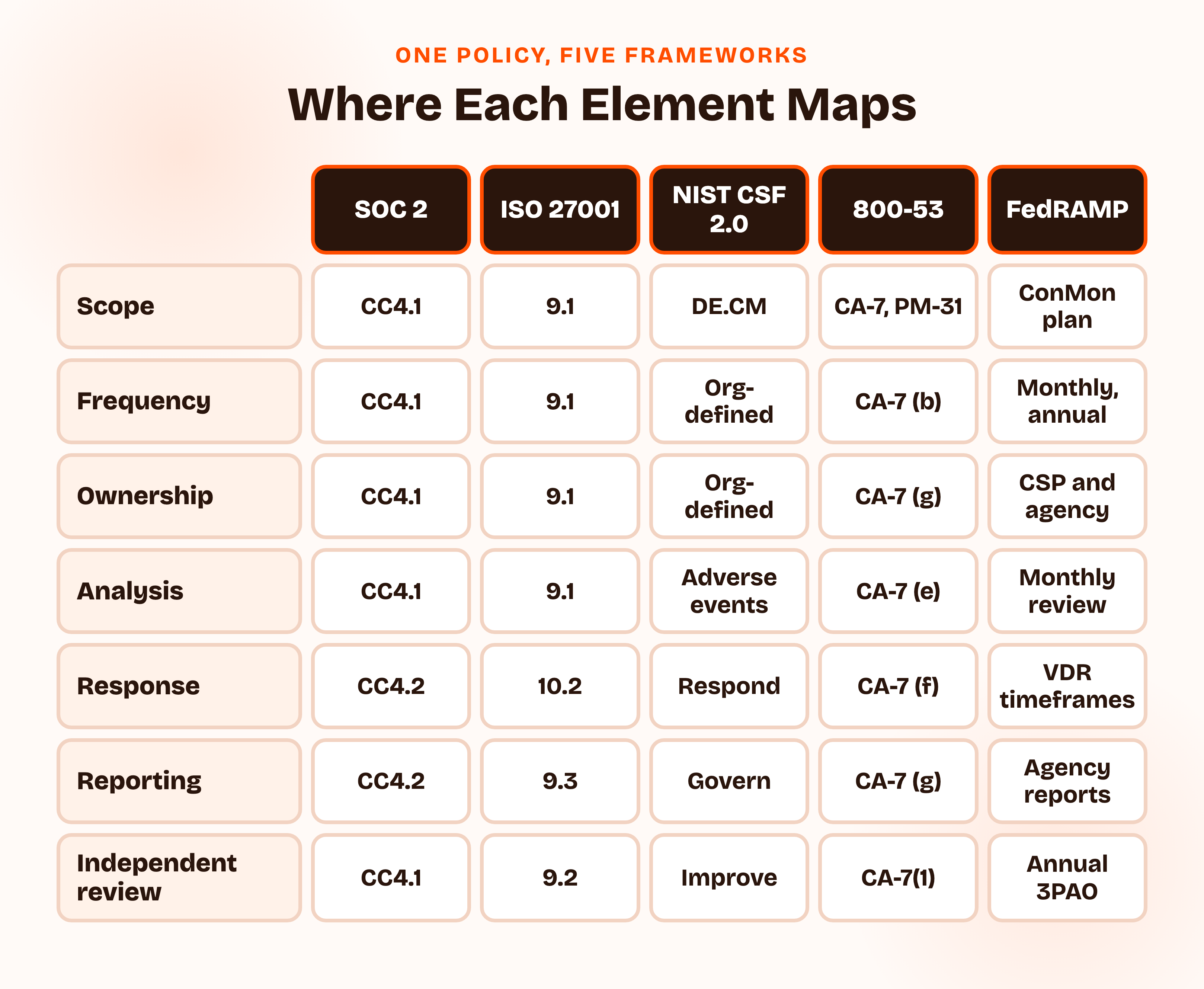
Here is how each policy element maps across the five frameworks:
| Policy element | SOC 2 | ISO 27001 | NIST CSF 2.0 | NIST 800-53 | FedRAMP |
|---|---|---|---|---|---|
| Scope and strategy | CC4.1 (risk-based evaluations) | 9.1 (what to monitor) | DE.CM scope | CA-7, PM-31 | ConMon strategy and plan |
| Frequency | CC4.1 (scope and frequency) | 9.1 (when) | Organization-defined | CA-7 (b) | Monthly, annual and as-needed deliverables |
| Ownership | CC4.1 (who evaluates) | 9.1 (who) | Organization-defined | CA-7 (g) roles | Provider and agency roles |
| Analysis | CC4.1 | 9.1 (analyse and evaluate) | Adverse event analysis | CA-7 (e) | Monthly reviews |
| Response | CC4.2 (deficiencies) | 10.2 (corrective action) | Respond outcomes | CA-7 (f) | POA&M, VDR timeframes |
| Reporting | CC4.2 (communicated) | 9.3 (management review) | Governance outcomes | CA-7 (g) | Agency reporting |
| Independent review | CC4.1 (separate evaluations) | 9.2 (internal audit) | Improvement outcomes | CA-7(1) | Annual 3PAO assessment |
Monitoring Frequency: A Worked Matrix for What to Check and How Often
"Define your frequencies" is easy to say. Here are defaults to start from.
These are our recommended starting defaults, not requirements of any standard. Adjust each one to your risk, your stack and what you can actually sustain.
| Control area | Check | Method | Default frequency | Owner | Evidence kept | Escalate when |
|---|---|---|---|---|---|---|
| Identity and access | MFA coverage, accounts of leavers | Automated | Daily | Engineering lead | Check history | Any admin without MFA, any leaver active after their last day |
| Privileged access | Access appropriateness review | Manual | Quarterly | System owner | Signed review | Review not done within 10 business days of quarter end |
| Cloud configuration | Public storage, encryption at rest, open security groups | Automated | Daily | Engineering lead | Scan history | Any public data store or unencrypted production data |
| Vulnerabilities | Scans and fix status | Automated | As set in the vulnerability management policy | Engineering lead | Scan reports, tickets | Fix past its deadline |
| Endpoints | Disk encryption, OS updates, screen lock | Automated | Daily | IT or security lead | Device report | Device non-compliant for 7 days |
| Logging pipeline | Logs still arriving from each source | Automated | Daily | Engineering lead | Ingestion alerts | Any source silent for 24 hours |
| Backups | Job success; restore test | Automated; manual | Daily; quarterly | Engineering lead | Job logs, restore record | Failed job not rerun within a day |
| Change management | Unapproved production changes | Automated | Weekly | Engineering lead | Change report | Any unapproved change |
| Vendors | Expired SOC 2 reports, new subprocessors | Manual | Quarterly | Policy owner | Vendor register | Critical vendor report expired 30 days |
| People | Training, policy acknowledgements, background checks | Automated tracking | Monthly | People lead | Completion records | Overdue 30 days after hire |
| Assets | Inventory reconciliation | Manual | Monthly | IT or security lead | Reconciled inventory | Unknown device or system found |
| Policies | Policy review | Manual | Annually | Policy owner | Version history | Review overdue |
The logging row checks only that logs keep arriving. What gets logged stays in the logging and monitoring policy, and the asset row follows the asset management policy.
How do you set a monitoring frequency? By risk and rate of change, which is the logic CC4.1 and CA-7 both describe. A control that can change on any deploy needs a daily automated check. A control that changes once a year needs a quarterly human look.

Continuous Control Monitoring: Automated vs Manual Checks
Automate what a system can prove, such as configuration, coverage and job status. Keep people on what needs judgement, such as whether someone should still have admin access or whether a vendor's new report is acceptable.
Every automated check still needs a named human owner. An alert with no owner is a log entry, not a control.
Watch out
Do not copy every frequency in the matrix into the policy body. Put a rule in the policy ("each check runs at the frequency in Appendix A") and keep the matrix as an appendix you can update without re-approving the whole policy.
When a Check Fails: Thresholds, Findings and Closure
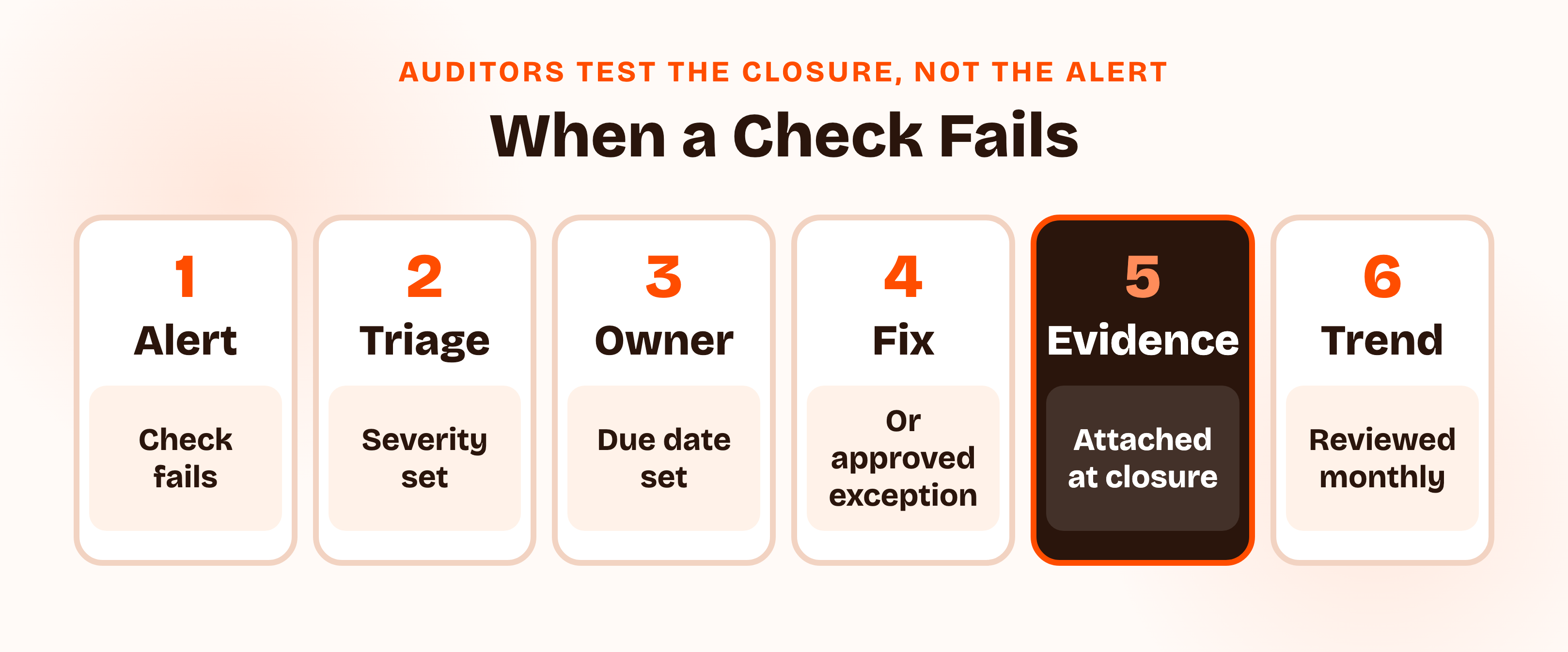
Monitoring with no rule for failures is just a dashboard. Auditors test the closure, not the alert.
The workflow is short, and every step leaves evidence:
- The check fails and a ticket opens automatically, or the owner logs it.
- Triage happens within a set window, and a severity is assigned.
- An owner and due date are set.
- The fix is made, or an exception is approved and recorded.
- Closure evidence is attached, such as a screenshot, a config export or a re-run check.
- Trends are reviewed monthly, so repeat failures get a root cause.
This is CA-7 elements (e) and (f) in practice, and it is how you show CC4.2's "communicated in time to those who act."
Severity sets the clock. These windows are our recommended defaults. Vulnerability deadlines stay in the vulnerability management policy.
| Severity | Example | Triage within | Fix target | Who must know |
|---|---|---|---|---|
| Critical | Customer data in a public bucket; MFA off on an admin account | 4 hours | Contain the same day | Security owner and CTO |
| High | Leaver account still active; backups failing | 1 business day | 7 days | Control owner and security owner |
| Medium | Missed access review; laptop without disk encryption | 3 business days | 30 days | Control owner |
| Low | Overdue policy acknowledgement | 5 business days | 60 days | Control owner |
Exceptions, Incidents and Alert Fatigue
Some findings cannot be fixed on time. Allow an exception only with a named approver, a reason, compensating controls and an end date, and record it in the risk register under your risk management policy. Nobody approves their own exception.
Some failed checks are really incidents. A public bucket that held customer data is not just a configuration finding. Hand it over under the incident management policy and keep the finding linked to the incident.
Then there is noise. A Hacker News commenter wrote in March 2020 that most security monitoring products "exist for a compliance checklist rather than to provide any value for security teams", with "alert fatigue being the biggest offender" (thread).
Important
Tune or retire checks that fire without anyone acting on them. A check that fails every week while nobody responds is evidence against you, not for you.
Reporting Continuous Monitoring Results to Leadership
CA-7 element (g) and ISO 27001 clause 9.3 ask the same thing: status goes to named people at a set frequency. In a startup, that means a monthly one-page summary to the founder or CTO and a quarterly review that feeds the management review.
Keep the one-pager boring and consistent. The same five lines every month make trends obvious.
| Line in the monthly summary | Example |
|---|---|
| Checks passing | 46 of 49 |
| Open findings by severity and age | 0 critical, 1 high (6 days), 2 medium |
| Overdue items | 1 medium past due date |
| Exceptions approved this month | 1, ends 31 March |
| Trend since last month | Endpoint findings down from 5 to 1 |
The quarterly review asks a bigger question: are we checking the right things at the right frequency? That is the "review and update" step of SP 800-137 at startup size.
Plenty of small teams already run this rhythm without a big security function.
Customer Story
"It made SOC 2 and ISO 27001 readiness clear and manageable with automated workflows, evidence collection, and expert support."
David Orr, COO, Romina Day
Continuous Monitoring for Startups: Right-Sizing the Policy
A 15-person SaaS company has no security operations centre and no GRC team. Continuous monitoring for startups means one named owner, the automation you already pay for, and a short quarterly list of human checks.
The table shows how the policy grows with the team. These are our recommended defaults.
| Team size | Policy owner | Automated | Manual | Reporting |
|---|---|---|---|---|
| 1 to 15 people | CTO or a founder | Cloud configuration, MFA, endpoints, backups | Quarterly access and vendor review | Monthly note to founders |
| 15 to 50 people | Security or engineering lead | Add change and logging pipeline checks | Add monthly asset and people checks | Monthly one-pager, quarterly review |
| 50 and above | Dedicated security owner | Most technical controls | Separate control owners per area | Monthly report to leadership, quarterly to the board |
What does a Type II auditor actually want from a small team? Evidence that each scheduled check happened and each failure was handled. Not a 24/7 operations centre.
A note from me
A template does not make you compliant. Deciding the frequencies and the owners is the real work, and it takes an afternoon with your engineering lead, not a consultant.
Free Continuous Monitoring Policy Template: Sample Clauses You Can Adapt
Below is the full continuous monitoring policy template text, section by section. Brackets mark the facts only you can fill in. Each clause shows the SOC 2, ISO 27001 and NIST 800-53 references it serves, matching the framework table above.
Continuous Monitoring Policy Example: Sample Clauses for Each Section
Use this continuous monitoring policy example as a first draft, then cut anything you do not actually do.
Sample clause: Purpose and scope (SOC 2 CC4.1, ISO 27001 9.1, NIST 800-53 CA-7)
[Company] maintains this policy to confirm, on an ongoing basis, that its security controls are in place and working. It applies to all production systems, corporate systems, devices, personnel controls and third parties that store or process [Company] or customer information, including [list of environments].
Sample clause: Roles and responsibilities (SOC 2 CC4.1, ISO 27001 9.1, NIST 800-53 CA-7(g))
The [Policy Owner] maintains this policy and the monitoring frequency matrix. Each control owner named in Appendix A runs or reviews their checks and handles findings. The [Engineering Lead] maintains automated checks and ticket routing. The [People Lead] owns training, acknowledgement and background check monitoring. [Leadership role] receives monthly reports and approves high and critical exceptions.
Sample clause: Monitoring strategy and risk basis (SOC 2 CC4.1, ISO 27001 6.1 and 9.1, NIST 800-53 CA-7, PM-31)
[Company] selects controls for monitoring and sets their frequency based on the risk assessment, the rate at which each control can change and the requirements of [SOC 2 / ISO 27001 / customer contracts]. The strategy is reviewed at least annually and after any significant change to systems or risk.
Sample clause: Monitoring frequency (SOC 2 CC4.1, ISO 27001 9.1, NIST 800-53 CA-7(b))
Each check runs at the frequency set in Appendix A. The [Policy Owner] may increase a frequency at any time and may reduce one only with a recorded risk rationale. A scheduled check that does not run is itself logged as a finding.
Sample clause: Methods and tooling (SOC 2 CC4.1, NIST 800-53 CA-7(c), CA-7(d))
Checks are automated where a system can produce the evidence, and manual where human judgement is needed. Automated checks run in [tool names]. Manual checks are scheduled in [shared calendar or tracker] and recorded with the reviewer's name and date.
Sample clause: Analysis and finding handling (SOC 2 CC4.2, ISO 27001 10.2, NIST 800-53 CA-7(e), CA-7(f))
Every failed check is recorded as a finding in [ticketing system], triaged and given a severity, owner and due date within the windows in the severity table. A finding is closed only when evidence of the fix is attached. Findings that meet incident criteria are handled under the [Incident Management Policy].
Sample clause: Exceptions and risk acceptance (SOC 2 CC4.2, ISO 27001 6.1.3, NIST 800-53 CA-7(f))
A finding that cannot be fixed by its due date requires an exception approved by [approver role], with the reason, compensating controls and an end date no later than [number] days. Exceptions are recorded in the risk register. No one may approve their own exception.
Sample clause: Reporting (SOC 2 CC4.2, ISO 27001 9.3, NIST 800-53 CA-7(g))
The [Policy Owner] sends a monthly monitoring summary to [Leadership role] showing checks passing, open findings by severity and age, overdue items, approved exceptions and trends. A quarterly review assesses whether checks and frequencies remain appropriate and feeds the management review.
Sample clause: Independent review (SOC 2 CC4.1, ISO 27001 9.2, NIST 800-53 CA-7(1))
At least [annually], a person independent of the control owners, such as an internal auditor or [external assessor], reviews a sample of checks, findings and closures to confirm the program operates as described.
Sample clause: Review, version control and enforcement (SOC 2 CC4.1, ISO 27001 7.5, NIST 800-53 CA-7)
The [Policy Owner] reviews this policy at least [annually] and after significant changes. Each version is dated and approved by [approver]. Failure to perform assigned checks or handle findings may lead to action under [Company] disciplinary procedures.
Full sample text sits on this page. The PDF adds the frequency matrix, a monthly report template, a findings log and a framework mapping, with no email gate.
Free Template
Download the Free Continuous Monitoring Policy Template (PDF)
Sample clauses for every section, a monitoring frequency matrix, a severity table, a monthly report template, a findings log and a framework mapping. No form, no email.
Facts to Decide Before You Fill In the Template
Gather these before you open the template:
- Systems and environments in scope
- Which framework drives the cadence: SOC 2, ISO 27001 or both
- Which checks your existing tools already automate
- Who owns each control area
- Your severity windows and who approves exceptions
- Who receives the monthly report, and when
Delete every clause you do not run. A policy that promises checks the company does not perform is worse than a short one.
Rolling Out the Continuous Monitoring Policy and Proving It Works
Writing the policy is the easy half. These steps turn it into something an auditor can test:
- Inventory your controls and map each one to at least one check.
- Set frequencies with the matrix, starting from the defaults.
- Assign an owner to every check, automated ones included.
- Connect automated checks and route failures to a ticket queue.
- Schedule manual checks in a shared calendar with reminders.
- Approve and publish the policy, with version and date.
- Send the first monthly report, even if it is short.
- Run the first quarterly review and adjust frequencies that proved too tight or too loose.
Then keep the evidence where you can find it. This is what each audience asks for:
| Evidence | Who asks for it |
|---|---|
| Approved policy with version and date | SOC 2 auditor, ISO 27001 auditor, customers |
| Frequency matrix | SOC 2 auditor, ISO 27001 auditor |
| Check run history | SOC 2 auditor |
| Findings log with closure evidence | SOC 2 auditor, ISO 27001 auditor |
| Approved exceptions | SOC 2 auditor, ISO 27001 auditor |
| Monthly reports and quarterly review notes | ISO 27001 auditor (management review), customers |
| Annual policy review record | All of the above |
Note
The policy cannot make a check meaningful if the check tests the wrong thing. Review the check list itself once a year, which is the "review and update" step in NIST SP 800-137.
Continuous Monitoring Policy Mistakes Auditors Notice
These are easy to get wrong, and each one shows up in testing:
- Frequencies the team never meets. Write "weekly" and miss three weeks, and the policy itself produces the exception.
- Automated checks with no human owner. The tool flags the issue and nobody is on the hook to fix it.
- Everything set to real time. When every check alerts constantly, nothing gets triaged.
- Findings closed without evidence. A ticket marked "done" with no screenshot or re-run proves nothing.
- Monitoring only the audit scope. Production drifts in the account nobody put in scope.
- Leaving out vendor and people controls because no tool checks them automatically.
How ComplyJet Helps You Keep Continuous Monitoring Running
ComplyJet connects to your stack through 350+ integrations and runs continuous control monitoring, flagging issues before they become audit findings. Every check is timestamped and stored as evidence, so the run history in the evidence table builds itself.
It also covers the checks people usually forget: periodic access reviews, policy drafting with acknowledgement tracking, training records, device checks through an MDM agent, vulnerability tracking and vendor risk tracking. And a team guides you through setting it up.
To be clear about limits: ComplyJet does not replace a SIEM or your logging stack. It does not support FedRAMP or NIST 800-53 programs, and no platform can certify you on its own.
Free Demo
See continuous monitoring running on your own stack
A 30-minute walkthrough of control checks, findings and evidence with the ComplyJet team.
FAQs
What Is a Continuous Monitoring Policy?
It is the written rule for how a company keeps checking that its security controls still work between audits. It names the checks, their frequency and owners, how failures become tracked findings and how status is reported. It sits above the logging policy and the tools that run the checks.
What Should a Continuous Monitoring Policy Include?
Purpose and scope, roles, the monitoring strategy and risk basis, a frequency rule backed by a matrix, methods, finding handling with severity windows, exceptions, reporting, independent review, and policy review. Those match the seven elements of NIST 800-53 CA-7.
How Is a Continuous Monitoring Policy Different From a Logging and Monitoring Policy?
The logging and monitoring policy decides which events are logged, how long they are kept and what triggers an alert. The continuous monitoring policy decides which controls are checked, how often, by whom and what happens when a check fails. Log pipeline health is one row in its matrix.
What Is Information Security Continuous Monitoring (ISCM)?
ISCM is NIST's term, defined in SP 800-137 as maintaining ongoing awareness of information security, vulnerabilities and threats to support risk management decisions. The publication sets out six steps, from defining a strategy to reviewing and updating it.
What Does NIST 800-53 CA-7 Require?
A continuous monitoring strategy and program with defined metrics, defined frequencies, ongoing control assessments, ongoing monitoring of metrics, correlation and analysis, response actions and status reporting to defined roles. CA-7(1) adds independent assessment, and CA-7(4) adds effectiveness, compliance and change monitoring.
Does SOC 2 Require Continuous Monitoring?
SOC 2 has no criterion named continuous monitoring, but CC4.1 expects ongoing or separate evaluations of controls and CC4.2 expects deficiencies to be communicated to those who fix them. In a Type II report, the auditor tests whether your checks actually ran across the observation window.
Does ISO 27001 Require Continuous Monitoring?
ISO 27001 clause 9.1 requires you to decide what to monitor and measure, how, when, by whom and when results are evaluated. Internal audit (9.2), management review (9.3) and corrective action (10.2) use the results. A written policy and frequency matrix are the simplest way to show this.
What Changed in FedRAMP Continuous Monitoring in 2026?
FedRAMP marked its legacy ConMon playbook as reference-only from June 24, 2026. The 2026 Vulnerability Detection and Response rules for Rev5 become required on December 7, 2026, with a grace period to March 7, 2027. Fix timeframes now depend on potential agency impact and exploitability, from 4 to 192 days.
How Often Should Security Controls Be Monitored?
By risk and rate of change. Controls that can change with any deploy, such as cloud configuration and MFA coverage, suit daily automated checks. Access reviews and vendor reviews usually run quarterly, and policies are reviewed annually.
What Is Continuous Control Monitoring?
Continuous control monitoring is automated, ongoing testing of controls, usually through a compliance platform connected to your systems. It is one method a continuous monitoring policy can use. People still need to own failures and run the checks that need judgement.
Who Owns the Continuous Monitoring Policy?
In a startup, usually the CTO, a founder or the security lead. Each control area then has its own owner for checks and findings. Keep the person who approves exceptions separate from the person asking for one.
What Evidence Do Auditors Expect for Continuous Monitoring?
An approved policy, the frequency matrix, run history for each check, a findings log with closure evidence, approved exceptions, monthly reports, quarterly review notes and an annual policy review. Auditors look for proof that scheduled checks happened and failures were handled.
Related Reading
- Logging and Monitoring Policy: what events are logged, retained and alerted on
- Best Compliance Monitoring Tools: choosing a tool to run the checks
- Vulnerability Management Policy: scan cadence and remediation windows
- Patch Management Policy Template: applying fixes
- Change Management Policy: approving and tracking changes
- Incident Management Policy: when a failed check is an incident
- Risk Management Policy: exceptions and risk acceptance
- Third-Party Risk Management Policy: vendor monitoring
- Information Security Policy: the umbrella policy this one hangs from
- ISO 27001 Internal Audit: where monitoring results feed in
This guide and the template are for general information and are not legal or audit advice. Standard and criteria wording on this page is our summary, so confirm it against the published text.