.svg)

You’re looking at a dozen tools, all claiming “continuous compliance monitoring,” none of them willing to show you a price before a 45-minute demo call. Half of them are built for teams of 500. The other half started shipping their UI three months ago.
I reviewed 10 compliance monitoring tools for this article, focusing on three things that actually matter for startups: how deep the automation really goes (not just what the landing page claims), what you’ll actually pay once the sales call is over, and whether the platform helps you cross the audit finish line or just tracks your controls and waves goodbye.
The compliance monitoring software landscape has never been more crowded, and most buyers can narrow it down to two or three real candidates in about 20 minutes if they know what to look for.
Here’s what I found.
Why Continuous Compliance Monitoring Is No Longer Optional
Most teams treat compliance like a once-a-year project. You prep for the audit, scramble to collect evidence, pass, and go quiet until the next cycle. The problem is that SOC 2 Type II specifically requires you to demonstrate that your controls were operating continuously over an observation period, not just that they existed on audit day. ISO 27001 has the same expectation.
Key insight
Security reviews now routinely ask for a live compliance dashboard or a recent SOC 2 report. Showing up with a PDF from 18 months ago has started costing deals.
This is where continuous compliance monitoring earns its name. A good tool tests your controls against requirements every 24 hours, flags drift when something changes, and collects evidence automatically so your audit readiness doesn’t decay between cycles. Without it, you’re relying on someone to manually check whether MFA policies are still enforced, whether terminated employees still have active accounts, whether encryption settings have drifted after a cloud config change. That’s not a compliance program. That’s hoping nobody looks too closely.
Enterprise buyers have noticed. Security reviews now routinely ask for a live compliance dashboard or a recent SOC 2 report. Showing up with a PDF from 18 months ago has started costing deals.
How We Evaluated These Compliance Monitoring Tools
I looked at each tool across six criteria:
Why it matters
Most buyers can narrow this down to two or three real candidates in about 20 minutes if they know what to look for.
- Continuous monitoring depth: does it test controls daily, or just prompt you to upload evidence on a schedule?
- Framework coverage: SOC 2, ISO 27001, HIPAA, GDPR, PCI DSS as the baseline, with credit for AI governance frameworks like ISO 42001
- Integration breadth: cloud infra, identity providers, HR systems, dev tools; more automation means fewer evidence gaps
- Pricing transparency: can you estimate your cost before talking to sales, or is everything a black box until demo call three?
- Startup fit: how much time and expertise does it take to get running? A 10-person team needs something different from a dedicated GRC team
- Audit support: does the platform help you cross the finish line, or hand you a controls list and wish you luck?
Quick Comparison: Top Compliance Monitoring Tools (2026)
| Tool | Best for | Pricing | Standout feature |
|---|---|---|---|
| Vanta | Scaling startups and mid-market | Custom (quote required) | 400+ integrations, largest ecosystem |
| Drata | Cloud-native SaaS teams | ~$7K–$50K+/yr | 4.8/5 across 1,153 reviews |
| ComplyJet | Early-stage startups | $5K–$8K/yr flat | Flat pricing, guided outcomes, 350+ integrations |
| Sprinto | Startup-native teams | ~$6K–$25K/yr | Fast time-to-audit for cloud-native stacks |
| Scrut Automation | Growth-stage companies | ~$10K–$30K/yr | 4.9/5 across 1,298 reviews, 60+ frameworks |
| Secureframe | First-time compliance buyers | ~$7.5K–$20K/yr | 30+ in-house compliance experts |
| Thoropass | Companies wanting auditor + software bundled | Custom | In-house licensed auditors included |
| Hyperproof | Multi-framework GRC teams | ~$12K–$54K/yr | 140+ framework templates |
| AuditBoard | Enterprise / Fortune 500 | $40K–$150K+/yr | SOX + audit + risk in one platform |
| OneTrust | Enterprise privacy + compliance | Custom | 500+ integrations, 300+ jurisdictions |
ComplyJet handles the entire compliance stack: policies, controls, evidence collection, and your SOC 2 or ISO 27001 audit. Book a free demo to see it in action.
The 10 best compliance monitoring tools in 2026
1. Vanta

Vanta is the default answer when someone in a startup Slack asks which compliance tool to use. That reputation is earned: 16,000+ customers, 400+ integrations, and the largest ecosystem of auditors who already know the platform. If you want the choice that nobody in your board meeting will question, Vanta is it.
The platform’s continuous monitoring is genuinely strong. It pulls evidence automatically from your cloud stack, identity provider, HR system, and dozens of other sources, tests controls on an ongoing basis, and flags issues in real time.
You also get a Trust Center for sharing compliance posture with prospects, an AI-powered questionnaire tool (the Vanta Agent), and vendor risk management, all in one place. For a SOC 2 or ISO 27001 motion at a 50–200 person company with a dedicated security owner, Vanta handles the scope well.
The honest trade-off: Vanta prices on a per-seat model and costs scale with headcount. No rates are published; every tier requires a sales conversation. Third-party data puts typical startup spend at $10K–$30K+ per year. For a 10-person team, that’s a significant commitment for what is often one framework and a single audit cycle.
Our Vanta pricing guide breaks down what you’ll actually pay, and our Vanta alternatives roundup covers what to look at if the pricing model isn’t the right fit.
“
Vanta helped me find an auditor and made that process so much smoother … the list of needed policies helped us to create internal policies and saved me weeks of writing and anguish.
★★★★★Head of Engineering· Small Business
Via G2 ↗Key features:
- 400+ integrations for automated evidence collection
- Real-time control monitoring across SOC 2, ISO 27001, and 10+ other frameworks
- AI-powered questionnaire automation (Vanta Agent)
- Trust Center for customer-facing compliance visibility
- Vendor risk management and user access reviews
Pros of Vanta
- Largest integration library in the category
- Most auditors already know the platform
- Strong brand credibility with enterprise buyers
Cons of Vanta
- No published pricing; requires a sales call to get a number
- Per-seat model means cost grows with headcount
- Can feel over-engineered for a 10-person startup
Pricing: Custom, four tiers (Essentials through Enterprise). No published rates; expect $10K–$30K+/yr for a typical startup.
Best for: Scaling startups (50–200 employees) and mid-market companies with a dedicated security or compliance owner.
2. Drata

Drata sits just below Vanta on name recognition but arguably above it on raw automation depth. Its 4.8/5 rating across 1,153+ reviews and 14 consecutive G2 Leadership quarters say something real: this platform works, and the people using it are willing to say so publicly.
The core mechanic is evidence collection tested every 24 hours. Not available on a schedule, not triggered when you connect an integration, but actually tested, automatically, daily, across your entire control set. For a SOC 2 Type II observation period where continuous monitoring is the entire point, that matters.
Drata also handles cross-framework mapping well: connect your AWS stack once and Drata maps the same evidence across SOC 2, ISO 27001, and GDPR simultaneously rather than requiring separate collection three times.
One thing worth flagging: Drata is fundamentally built for US SaaS companies with cloud-native infrastructure. If your stack is more on-premise, or if you need deep EMEA regulatory coverage out of the box, you may hit some limits. And while the Foundation tier starts around $7K/year, most teams find they need the Advanced tier ($15K+) once they’re running a real compliance program. Read our full Drata review for a deeper breakdown.
“
Drata has been amazing in preparing my customers for SOC 2. 85% of the evidence is automatically gathered and tested every 24 hours. No more screenshots and manual gathering of evidence. The best part is knowing the control is actually being enforced on a daily basis.
★★★★★Debra B.· SMB
Via G2 ↗Key features:
- Automated evidence collection tested every 24 hours
- 300+ integrations across cloud, identity, and dev tools
- Cross-framework control mapping across SOC 2, ISO 27001, HIPAA, and 20+ others
- Compliance as Code for policy automation
- Auditor collaboration portal built in
Pros of Drata
- Highest G2 rating in this roundup (4.8/5)
- Deep automation that genuinely reduces manual work
- Strong auditor relationships and ecosystem
Cons of Drata
- Most teams quickly outgrow the Foundation tier; $15K+ is closer to the real entry point
- Primarily US-centric; EMEA regulatory coverage is thinner
- Less hand-holding than smaller vendors; assumes you have compliance context
Pricing: Foundation ~$7K–$7.5K/yr (1 framework, up to 50 employees) | Advanced ~$15K/yr | Enterprise $25K–$50K+/yr
Best for: US SaaS companies with cloud-native infrastructure and a dedicated compliance or security owner.
3. ComplyJet
ComplyJet is built for one specific situation: an early-stage startup that needs to get compliant, get audited, and close that enterprise deal, without burning six months of engineering time or paying for a platform built for a team ten times its size.
The platform covers 25+ frameworks including SOC 2, ISO 27001, HIPAA, GDPR, and PCI DSS, with 350+ integrations for automated evidence collection and AI-assisted policy drafting. But what actually differentiates ComplyJet isn’t a feature. It’s the model: a team guides you through the process end-to-end, not just software you configure yourself and figure out alone. The distinction matters for first-time compliance buyers more than any feature comparison.
Pricing is publicly listed and flat per company: $5,000/year for a single framework, $8,000/year for two (such as HIPAA and SOC 2 together). That rate doesn’t change whether you have 10 or 50 people. On a per-seat compliance tool, growing from 15 to 40 engineers is a renewal negotiation. On ComplyJet, it isn’t.
The honest limitation: ComplyJet is a newer brand. If your board or your enterprise prospect specifically asks whether you used Vanta, the name recognition isn’t there yet. For buyers where brand gravity matters more than fit, that’s worth knowing.
“
ComplyJet got us SOC 2 Type II certified in under four months. The team was hands-on throughout and the flat pricing meant no surprises on the invoice.
Artur G.· CTO, Symmetre
Via complyjet.com ↗Key features:
- Continuous control monitoring across 25+ frameworks
- Automated evidence collection with 350+ native integrations
- AI-assisted policy drafting
- Trust Center for sharing compliance posture with enterprise prospects
- A team that guides you through the process from setup to audit, not just software access
Pros of ComplyJet
- Only flat-rate pricing in this category: cost stays fixed regardless of headcount
- 350+ integrations, more than most tools at this price point
- Outcome-focused support model, not just software access
- Fast time to audit for first-time compliance buyers
Cons of ComplyJet
- Newer brand; less name recognition than Vanta or Drata
- G2 review volume still building
- Better fit for startups and SMBs than for enterprise-scale programs
Pricing: $5,000/year (single framework) | $8,000/year (two frameworks). Flat per company, not per seat.
Best for: Seed to Series A startups (1–50 employees) pursuing their first SOC 2, ISO 27001, HIPAA, or GDPR certification.
4. Sprinto
Sprinto is probably the strongest direct competitor to Vanta for startups that care about speed. The platform is AI-native, built specifically for SaaS teams: it knows AWS, GCP, and Azure cold, maps to the typical startup tech stack, and gets you from zero to audit-ready faster than most tools in this list. The 4.8/5 rating across 1,635+ reviews backs that up.
Where Sprinto earns its reputation is onboarding: every customer gets a dedicated onboarding manager (not just a help center link), and the platform’s control mapping is built to minimize the gap between “connected integrations” and “controls passing.” For a founder doing compliance alongside product work, that structure matters more than you’d think.
The pricing is custom and requires a sales call, with third-party estimates at $6K–$25K/year depending on tier and team size. It gets expensive quickly beyond the base tier. US brand recognition is also still building compared to Vanta and Drata, though the Accel backing and trajectory are credible signals. Read our Sprinto review for the full picture, or Sprinto alternatives if you’re not sure it’s the right fit.
“
The customer support was great throughout the project. Being a small company Sprinto was terrific in keeping everything together and becoming a foundation in our information security work.
★★★★★Tomas M.· Small business
Via Capterra ↗Key features:
- Real-time continuous monitoring with automated control testing
- 300+ native integrations
- Multi-framework support with shared evidence across standards
- Dedicated onboarding manager included
- ISO 42001 (AI governance) support
Pros of Sprinto
- 4.8/5 rating with 1,635+ reviews, one of the strongest in category
- Startup-native design with fast time-to-audit
- Dedicated onboarding support included, not an upsell
Cons of Sprinto
- Pricing is custom-quoted and rises sharply beyond the base tier
- US brand recognition still growing compared to Vanta or Drata
- Limited enterprise-grade GRC modules for teams needing more than compliance automation
Pricing: Custom (~$6K–$25K/yr depending on tier and team size)
Best for: Cloud-native startup teams pursuing SOC 2 or ISO 27001 for the first time, especially those wanting structured onboarding support.
5. Scrut Automation

Scrut Automation sits at the top of the category on raw G2 rating: 4.9/5 across 1,298+ reviews, which is remarkable for a platform of its size. It supports 60+ frameworks (more than Vanta or Drata), has 400+ automated tests, and runs 24/7 continuous monitoring with AI-powered remediation guidance through a feature called Scrut Teammates.
For growth-stage companies running multiple compliance programs simultaneously, say, SOC 2 and ISO 27001 in parallel, or adding GDPR on top of an existing program, Scrut’s framework depth is a genuine advantage. Its 1,500+ controls library and 200+ policy templates reduce the lift of standing up each new framework from scratch.
The honest weakness: Scrut has around 100 native integrations versus the 300–400 that Vanta and Drata offer. For teams with complex or non-standard stacks, that gap creates more manual evidence collection. It’s also a smaller brand in the US market, though its Lightspeed-backed trajectory is worth noting.
“
Cost-effective and easy to use software that helps you reach compliance quickly and offers helpful customer support. Affordable pricing compared to alternatives like Vanta and Drata, with a responsive support team.
★★★★★Anuj P.· 11-50 employees
Via Capterra ↗Key features:
- 24/7 continuous control monitoring across 60+ frameworks
- AI-powered remediation guidance (Scrut Teammates)
- 400+ automated tests and 1,500+ controls library
- Access reviews, vendor assessment, and device monitoring
- 200+ ready-to-use policy templates
Pros of Scrut Automation
- Highest overall rating in this list (4.9/5)
- Best framework breadth for multi-framework programs
- Strong AI-powered guidance for remediation
Cons of Scrut Automation
- 100 native integrations vs. 300–400 for category leaders
- Smaller US brand presence
- No published pricing
Pricing: Custom (~$10K–$30K/yr; AWS Marketplace lists $15K/yr for up to 20 employees on a 12-month contract)
Best for: Growth-stage companies managing multiple compliance frameworks simultaneously, particularly those needing deep framework coverage.
6. Secureframe
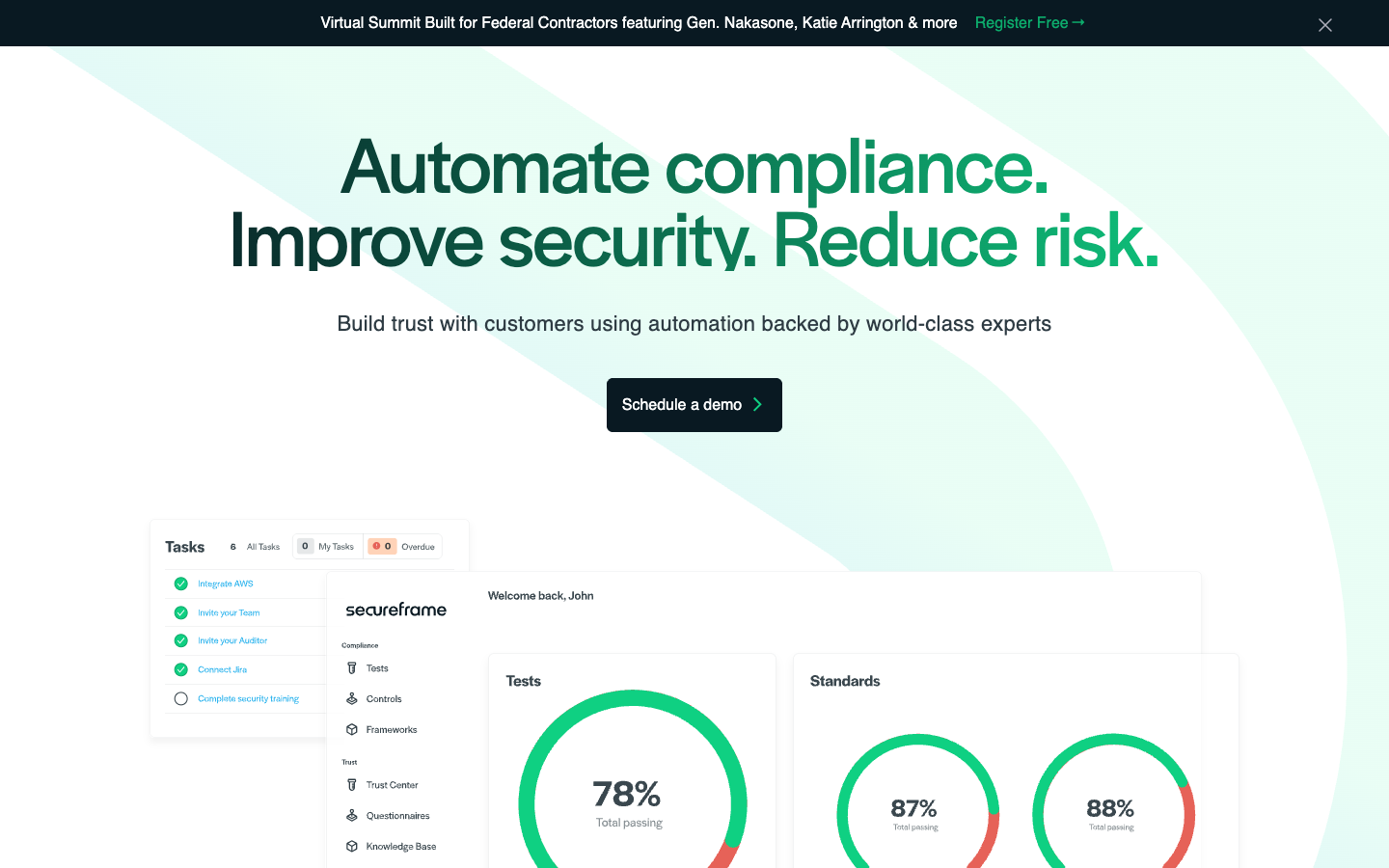
Secureframe takes a different angle from most tools in this list: it pairs its automation platform with 30+ in-house compliance experts and former auditors. For a first-time compliance buyer who has never been through an audit cycle, that combination of software and human guidance is a real differentiator.
The platform covers the compliance monitoring essentials well: automated evidence collection, continuous control testing, user access reviews, vendor risk management, and a Trust Center. 300+ integrations handle most standard cloud and SaaS stacks. The AI-powered task automation helps surface what needs doing and when.
What sets Secureframe apart is the expert layer. Most platforms direct you to a knowledge base or a CSM when you have a compliance question. Secureframe can actually answer it from someone with auditor experience. For 6,000+ customers, that model has worked. The trade-off is price: the Complete tier (the one most teams actually need) runs $14K–$20K/year, putting it above Sprinto and ComplyJet but below Vanta’s typical range.
“
Secureframe's support team was quick to provide assistance throughout our initial SOC 2 audit. The platform makes it incredibly easy to organize compliance evidence.
★★★★★Shaun K.· 2–10 employees
Via Capterra ↗Key features:
- Automated evidence collection and continuous monitoring
- 300+ integrations
- 30+ in-house compliance experts and former auditors on staff
- AI-powered compliance task automation
- Vendor risk management and user access reviews
Pros of Secureframe
- Expert-backed support is a genuine differentiator, not just a CSM
- Strong onboarding experience for first-time compliance buyers
- 6,000+ customers with consistent positive reviews
Cons of Secureframe
- Complete tier ($14K–$20K/yr) adds up quickly for a startup
- Smaller G2 review volume than Vanta or Drata
- Defense tier pricing is fully opaque
Pricing: Fundamentals ~$7.5K/yr | Complete ~$14K–$20K/yr | Defense: pricing on request
Best for: First-time compliance buyers who want expert guidance alongside automation, particularly at the SMB level.
7. Thoropass
Thoropass (formerly Laika) has a structural differentiator no other tool in this list can claim: it employs its own licensed auditors in-house, so the software and the audit come as one package. You don’t find an auditor separately, coordinate between your compliance platform and the audit firm, or manage two separate relationships. It’s one contract, one team.
For companies pursuing SOC 2, HIPAA, or HITRUST who find the “get the tool, then separately find an auditor” motion annoying or risky, Thoropass solves a real coordination problem. The platform also includes CREST-accredited penetration testing, which is uncommon at this tier.
The trade-off is flexibility. When you buy Thoropass, you’re buying their auditors. If you have an existing auditor relationship you want to preserve, this model doesn’t work for you. Pricing is also fully opaque: no published rates, which makes budget planning harder than it should be.
“
Thoropass helped us to complete our SOC 2 evidence submission and audit process. The platform allowed us to have a centrally-located repository to maintain our compliance documentation and evidence, and delegate tasks to the appropriate team members where we could upload evidence simultaneously. The Customer Success Manager was committed to helping us achieve success throughout our SOC 2 journey.
★★★★★Verified User· Small Business
Via G2 ↗Key features:
- In-house licensed auditors, not just audit partner referrals
- Real-time compliance monitoring and drift alerts
- CREST-accredited penetration testing included
- Access review automation
- Trust Center for customer-facing compliance visibility
Pros of Thoropass
- Unique bundled-auditor model eliminates separate audit firm coordination
- Strong for SOC 2, HIPAA, and HITRUST
- Penetration testing included, which is rare at this price point
Cons of Thoropass
- No flexibility to choose your own auditor
- No published pricing; fully custom contracts
- Fewer native integrations than Vanta or Drata
Pricing: Custom only. Software and audit services bundled; no published tiers.
Best for: SMBs in SaaS, healthcare, or fintech that want auditors and compliance software under one roof, especially for SOC 2, HIPAA, or HITRUST.
8. Hyperproof
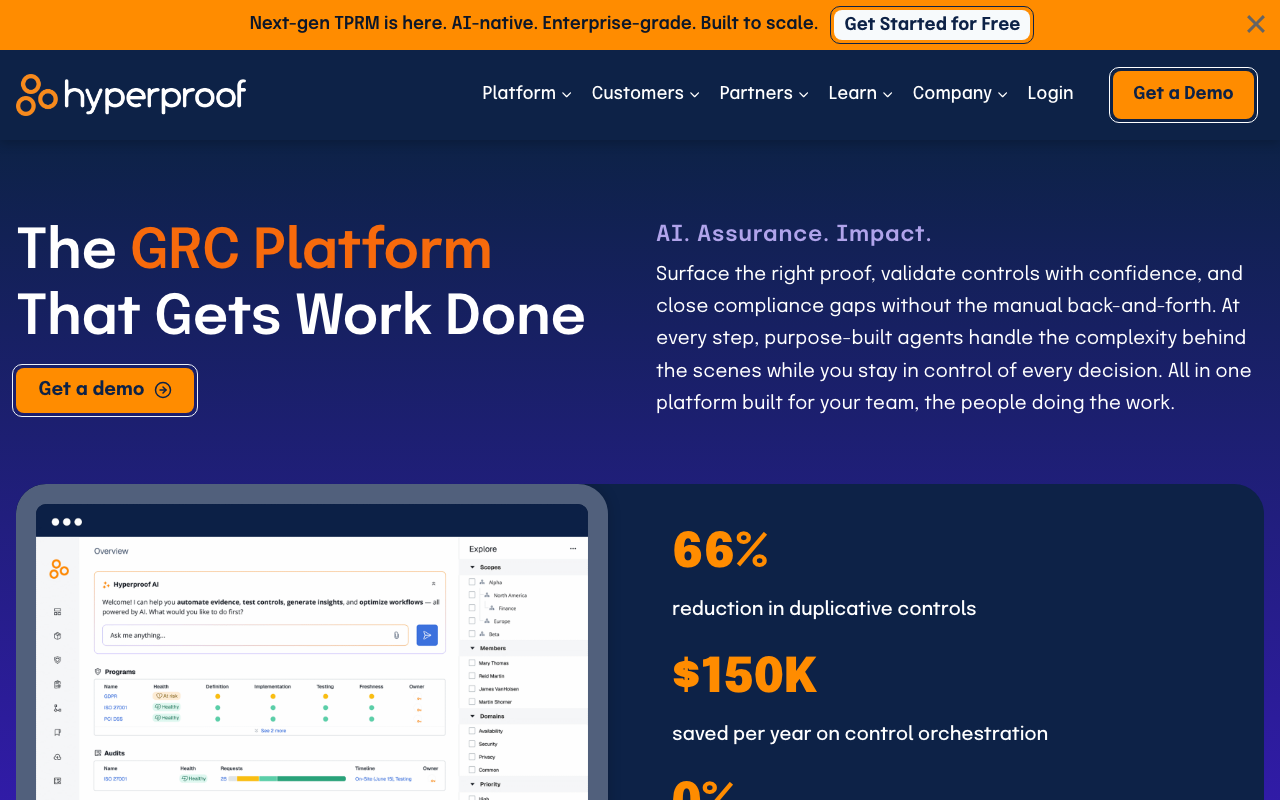
Hyperproof is the choice for teams managing a large number of overlapping frameworks and needing serious cross-framework control reuse. Its 140+ pre-built framework templates are more than any other tool on this list, and its Hypersyncs automated evidence collection is well-regarded by mid-market GRC teams.
One thing worth flagging before you evaluate it: Hyperproof was acquired by Expent in October 2025. The product continues to operate, but ownership changes can affect roadmap, support quality, and renewal dynamics. If you’re signing a multi-year contract, it’s worth asking explicitly what that acquisition means for your agreement. Our Hyperproof review covers the platform in more depth.
The headline summary: strong technology for complex multi-framework programs, but median deal sizes around $40K/year put it well outside startup range.
“
Hyperproof greatly reduced manual workload and improved visibility across the team by streamlining compliance into a centralized, collaborative process with strong automation capabilities.
★★★★★Giorgi L.
Via Capterra ↗Key features:
- 140+ pre-built compliance framework templates
- Automated evidence collection (Hypersyncs)
- AI-assisted control mapping across frameworks
- Third-party and vendor risk monitoring
- Cross-framework control reuse to eliminate duplication
Pros of Hyperproof
- Unmatched framework breadth (140+ templates)
- Strong reputation for complex multi-framework environments
- Cross-framework control reuse saves meaningful time
Cons of Hyperproof
- Acquired by Expent (October 2025): ownership uncertainty worth asking about
- Median deal size ~$40K/yr, well outside startup range
- Lighter review volume than category leaders (213 reviews)
Pricing: Custom (~$12K/yr entry; median deals ~$40K/yr)
Best for: Mid-market teams managing 5+ overlapping compliance frameworks with a dedicated GRC function. Not a fit for early-stage startups.
9. AuditBoard
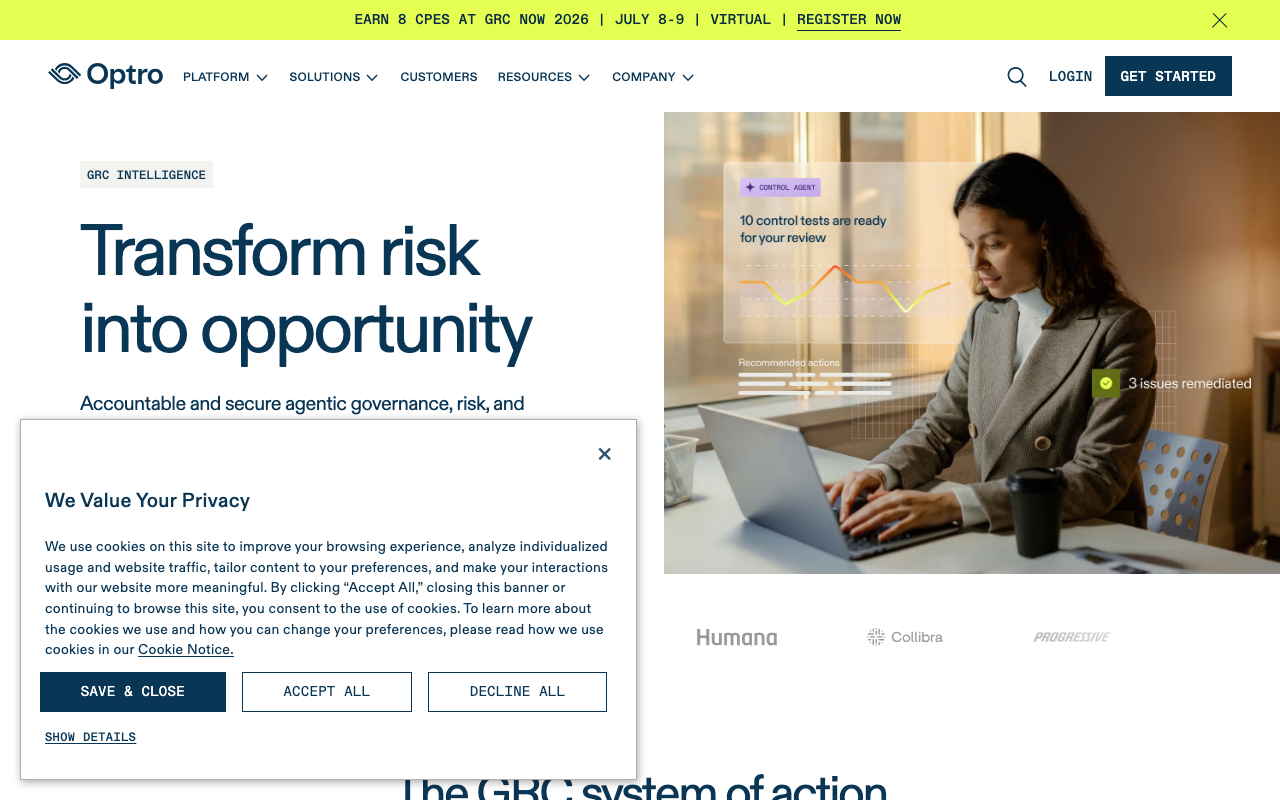
AuditBoard is rebranding to Optro as of March 2026, but it’s still widely known by its original name. The platform is the dominant choice for enterprise internal audit teams: it handles SOX controls testing, internal audit lifecycle management, enterprise risk management, and compliance monitoring across a single platform. Nearly 50% of the Fortune 500 use it.
If you’re a startup reading this, it’s probably not your answer. Deal sizes typically run $40K–$150K+/year, implementation is serious, and the platform is built around a full internal audit function that most companies under 200 people don’t have. But if you’re evaluating tools for a mid-market or enterprise compliance program that includes SOX and internal audit alongside GRC, AuditBoard (Optro) sits at the top of that category.
The $3B+ Hg Capital acquisition in 2024 and the March 2026 rebrand to Optro are worth tracking; the product roadmap and brand positioning are actively in transition.
“
The ease of use means that stakeholders constantly give feedback on how easier the system is to navigate. However, bugs and issues appear when features are rolled out before proper testing.
★★★★★Brett D.· Mid-market, Utilities
Via Capterra ↗Key features:
- SOX automation and internal controls testing (SOXHUB)
- Internal audit lifecycle management (OpsAudit)
- IT/cyber risk and compliance monitoring (CrossComply)
- ESG program management and disclosure reporting
- AI governance with shadow AI inventory
Pros of AuditBoard
- Best-in-class for SOX and internal audit
- 2,000+ enterprise customers, including Fortune 500
- Unified platform spanning audit, risk, compliance, and ESG
Cons of AuditBoard
- $40K–$150K+/yr: not a startup tool
- Rebranding to Optro (March 2026) creates near-term uncertainty
- Heavy implementation lift; dedicated project management typically required
Pricing: $40,000–$150,000+/year; fully custom contracts.
Best for: Large enterprises and mid-market companies with a full internal audit function. Not suited for startups.
10. OneTrust
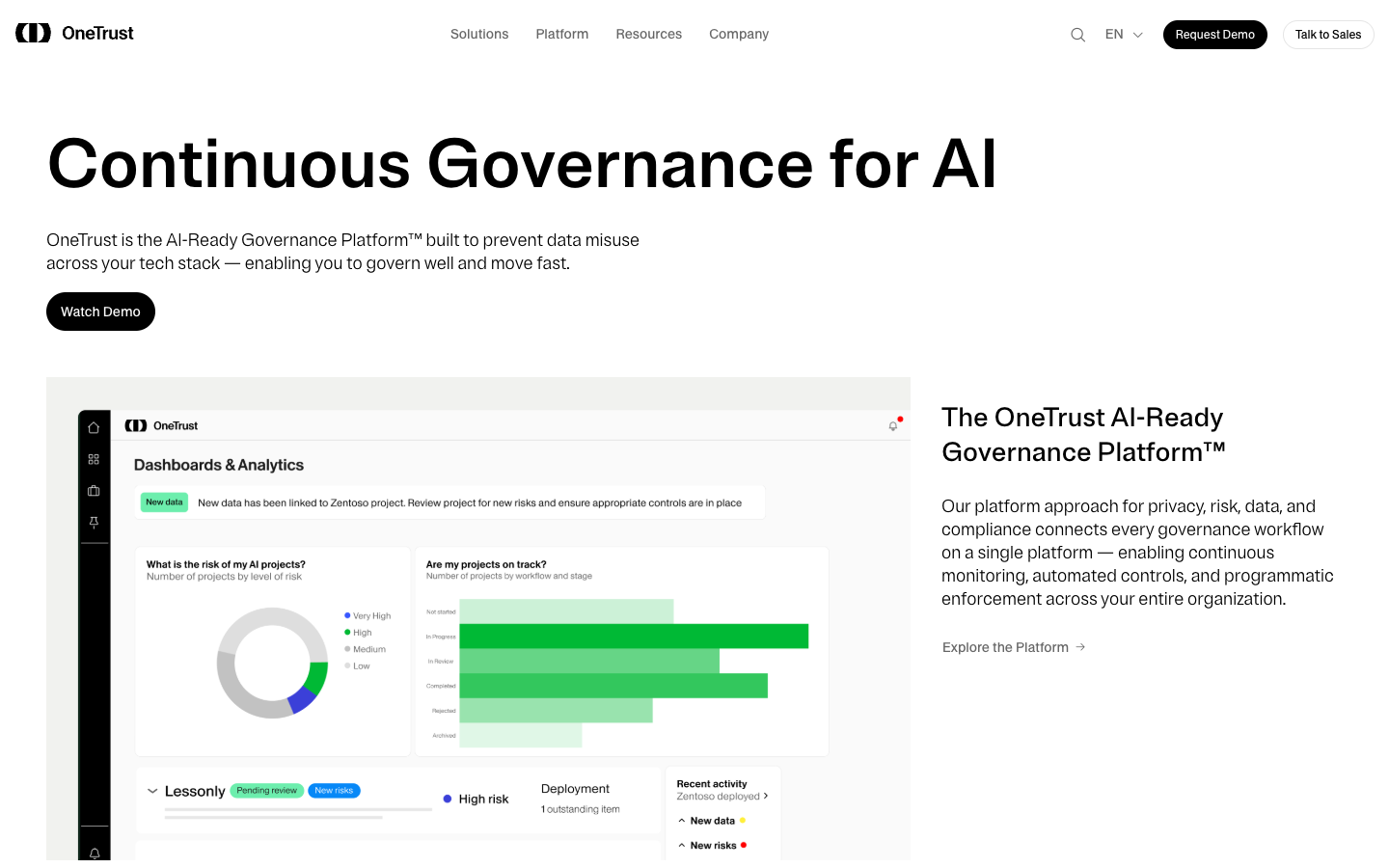
OneTrust is a different kind of compliance tool. Where most platforms on this list are compliance-automation-first (get you to SOC 2 or ISO 27001), OneTrust is governance-first: privacy, AI governance, consent management, and data lifecycle management all live in one platform. Tech risk and compliance monitoring is one module among many.
For teams whose primary compliance obligation is privacy regulation (GDPR, CCPA, LGPD) rather than security frameworks, OneTrust is the default enterprise choice: 14,000+ customers, 500+ integrations, and coverage across 300+ global jurisdictions. If you’re building in the EU and need GDPR coverage that goes deeper than most SOC 2 platforms offer, OneTrust covers that space.
For startups, though, the fit is usually poor. Smaller contract sizes mean worse support, which appears in reviews consistently. The platform is complex to configure. And the 4.4/5 rating, lowest in this roundup, reflects implementation friction that smaller teams struggle with. If you need privacy compliance as part of a broader SOC 2 or ISO 27001 program, most of the tools above handle it without the OneTrust overhead.
“
I appreciated the all-in-one approach to privacy, security, and compliance and valued the automation that streamlines consent management and data mapping. However, the platform can feel overwhelming to navigate due to its extensive feature set, and configuration requires significant effort, particularly for smaller teams.
★★★★★Brittany P.· 2-10 employees
Via Capterra ↗Key features:
- Privacy automation and data lifecycle management
- AI governance with runtime policy enforcement
- Consent and preference management
- Tech risk and compliance monitoring
- Third-party risk management across 500+ integrations and 300+ jurisdictions
Pros of OneTrust
- Broadest privacy and compliance platform in the market
- 14,000+ customers including Fortune 500
- Best-in-class for GDPR, CCPA, and global regulatory coverage
Cons of OneTrust
- 4.4/5 rating, lowest in this roundup; implementation complexity is a consistent complaint
- Known for poor support responsiveness at smaller contract sizes
- Overkill for startups: privacy and security compliance are available in simpler tools
Pricing: Custom, module-based. Tech Risk & Compliance median ~$10,514/yr; full enterprise deployments run significantly higher.
Best for: Mid-to-large enterprises managing privacy regulations (GDPR, CCPA, LGPD) alongside security compliance. Not a startup tool.
How to choose a compliance monitoring tool
What frameworks do you actually need?
Not all tools cover all frameworks with equal depth. SOC 2 support is universal across everything in this list. But HITRUST, FedRAMP, and ISO 42001 have thinner coverage across the field. If you need HITRUST specifically, Thoropass and Secureframe are your strongest options. If FedRAMP is on your roadmap, Vanta and Drata have the deepest support.
Free Demo
See exactly how ComplyJet fits your stack.
SOC 2, ISO 27001, or HIPAA: flat pricing, 350+ integrations, guided to the finish line.
The practical question to ask vendors: which frameworks do you support end-to-end, and which ones do I map myself? The gap between “supported” and “you configure it from scratch” is larger than most sales decks admit.
How much automation do you actually need?
There’s a real difference between a platform that tests controls automatically every 24 hours and one that helps you collect and organize evidence on a manual schedule. If you have a dedicated compliance owner and a complex cloud stack, deeper automation pays for itself quickly. If it’s a founder doing compliance alongside product work, prioritize simplicity and guided support over maximum configurability.
The question worth asking before you choose: who on your team will own this week-to-week? If the honest answer is “whoever has 20 minutes,” choose a tool with strong guided workflows, not maximum feature depth.
Is the pricing model predictable as you grow?
Per-seat pricing means your compliance cost grows with headcount. Model it at 25 and 50 employees before signing. Most tools in this list don’t publish rates, which makes that math hard. The tools that do (or where third-party data is available) are noted in the comparison table above.
This is one of the sharpest decision points for growing startups. A team expecting to go from 15 to 50 people in the next year should think carefully about a per-seat model before committing. Without a hard price cap, compliance monitoring tool spend becomes unpredictable fast if you’re hiring aggressively on a per-seat model.
ComplyJet handles the entire compliance stack: policies, controls, evidence collection, and your SOC 2 or ISO 27001 audit. Book a free demo to see it in action.
How much implementation support do you get?
Some platforms hand you a knowledge base and a CSM who checks in quarterly. Others have teams that actively drive the process. For first-time compliance buyers, the quality of onboarding and ongoing support often determines whether you reach your audit in four months or twelve.
Worth asking during the sales call: who is my point of contact after onboarding, how often do we speak, and what do they actually help with?
Startup, scaling, or enterprise?
The right tool tier usually maps to your stage:
- Startups (<50 employees, first certification): ComplyJet, Sprinto, Scrut Automation, Secureframe. All built for this motion.
- Scaling (50–200 employees, multi-framework): Vanta, Drata, Thoropass. More complexity, more automation depth.
- Enterprise (200+ employees, SOX, internal audit): AuditBoard, Hyperproof, OneTrust.
Frequently asked questions
What is a compliance monitoring tool?
A compliance monitoring tool is software that continuously tracks whether your security controls are working as required, collects evidence automatically, and alerts you when something drifts out of compliance. The key word is continuous: unlike point-in-time audit prep, a good monitoring tool tests your controls every 24 hours and catches issues before they become audit findings. Most tools in this category also support a full compliance reporting workflow so you’re audit-ready on an ongoing basis.
How do you set up a compliance monitoring tool?
The typical setup flow: connect your cloud, identity, and SaaS integrations, map your controls to the framework you’re pursuing (SOC 2, ISO 27001, etc.), configure alert thresholds, assign evidence owners across your team, and invite your auditor when you’re ready. On a good platform, initial setup should take under a week. The quality of onboarding support varies significantly across vendors, which is why it’s one of the criteria worth asking about before you buy.
Where to buy compliance monitoring tools
If you’re asking where to buy compliance monitoring tools: most are sold direct through the vendor’s website after a demo call. Some (Scrut, Thoropass) are also available on the AWS Marketplace, which can simplify procurement for teams with existing AWS credits. Before buying, evaluate: framework coverage for your exact program, integration depth against your specific stack, pricing model against your headcount trajectory, and support quality against your team’s compliance experience.
What’s the difference between compliance monitoring and GRC software?
Compliance monitoring focuses on continuously tracking controls and evidence for specific frameworks like SOC 2 or ISO 27001. GRC (Governance, Risk, and Compliance) is broader: it adds enterprise governance workflows, risk management programs, and typically internal audit capabilities on top of compliance automation. Most tools in this list are compliance-automation-first. AuditBoard, Hyperproof, and OneTrust lean GRC and are priced and scoped accordingly. Our GRC vs IRM guide covers the distinction in more depth if you’re evaluating the full spectrum.
How much does compliance monitoring software cost?
The range is wide: ComplyJet starts at $5,000/year flat, while AuditBoard runs $40K–$150K+/year for enterprise programs. Most startup-focused tools (Sprinto, Scrut, Secureframe) fall in the $7K–$25K/year range depending on framework count and team size. What drives price: number of frameworks, per-seat versus flat pricing model, whether audit services are bundled in, and enterprise add-ons.
If you need a firm price cap, compliance monitoring tool costs are otherwise hard to model in advance: most vendors quote custom. ComplyJet is the only option in this list with a published flat rate: $5K/year (one framework) or $8K/year (two frameworks), no per-seat scaling.
Final thoughts
The right compliance monitoring tool is rarely the most famous one. Vanta is the default: well-known, well-funded, and built for the team that wants the safe choice. But for a startup that has evaluated the field carefully and knows what it needs, there are better-fit options at every price point.
Free Demo
Get compliant this quarter, not next year.
Early-stage teams use ComplyJet to hit SOC 2 or ISO 27001 in under 4 months.
If you’re an early-stage team pursuing SOC 2 or ISO 27001 for the first time, start with the tools built for that motion: ComplyJet, Sprinto, Scrut, or Secureframe. They’ll get you across the finish line without enterprise overhead, and without paying for a platform that assumes you have a dedicated compliance team.
If you’re a startup pursuing SOC 2 or ISO 27001 for the first time, ComplyJet is built for you: flat pricing, 350+ integrations, and a team that guides you through the process from day one.