.svg)

You’ve decided to pursue FedRAMP. Now you’re on your fourth vendor call this week, every platform claims it “fully supports” FedRAMP, and none of them will tell you what that actually means for your specific impact level until you’re three demos in.
FedRAMP is harder to evaluate tools for than SOC 2 or ISO 27001, for one reason: the technical surface area is enormous. You’re not just picking a GRC platform. You’re picking something that needs to handle NIST 800-53 Rev 5 control mapping, SSP generation (which can run to 1,000+ pages), continuous monitoring post-authorization, and increasingly, KSI-based reporting for the FedRAMP 20x pathway. Most tools do some of this well. Very few do all of it well.
I reviewed 9 fedramp compliance software tools, covering everything from general-purpose platforms like Vanta and Drata to FedRAMP-specialist tools like Paramify and Anitian. I looked specifically at impact level coverage, SSP automation depth, NIST 800-53 Rev 5 support, and what actually happens after you get your ATO. Here’s what I found.
Why FedRAMP is unlike any compliance program you’ve run before
Key insight
FedRAMP requires a 3PAO to independently validate your security controls before an ATO is issued. The work doesn't stop at authorization — continuous monitoring is mandatory for the life of the system.
SOC 2 gives you a report. ISO 27001 gives you a certificate. FedRAMP gives you an ATO, an Authority to Operate, issued not by FedRAMP itself but by a federal Authorizing Official who’s vouching for your system’s security with their career on the line.
That changes the dynamic completely.
You can’t just collect evidence and schedule an audit. FedRAMP requires a 3PAO (Third Party Assessment Organization), a specific type of accredited assessor, to independently validate your security controls before the ATO is issued. You also can’t call it done once you’re authorized: the program requires continuous monitoring, including monthly vulnerability scans, quarterly POA&M updates, annual security assessments, and incident reporting whenever something goes wrong. The work doesn’t stop at the ATO. It gets lighter, but it never stops.
The impact level you target determines how much work you’re in for. Low and LI-SaaS (for tools that store minimal federal data) carry a lighter control set. Moderate, which is where most commercial SaaS companies land when selling to civilian agencies, means roughly 325 NIST 800-53 Rev 5 controls. High is reserved for systems handling law enforcement, defense, or sensitive financial data, and the control count climbs significantly.
One thing worth understanding before you evaluate any tool: FedRAMP’s control baseline is on NIST 800-53 Rev 5. Some older platforms still map evidence to Rev 4 controls, which creates gaps your 3PAO will flag. It’s a quiet but important distinction. Verify a tool’s control catalog version before committing.
The newer FedRAMP 20x pathway, launched in 2025, changes the model for Low authorizations. Instead of proving 325+ controls one by one, you demonstrate 17 Key Security Indicators (KSIs): measurable security outcomes like MFA enforcement, encryption at rest, and vulnerability scan cadence, in machine-readable OSCAL format. No agency sponsor required. Tools like Paramify, Vanta, and Anitian are furthest ahead on 20x support; others are still catching up.
How we evaluated these 9 FedRAMP software tools
Why it matters
ConMon is where teams get blindsided. Most tools market to the authorization path. Fewer are honest about what happens after you get your ATO.
I looked at each platform across seven criteria:
- FedRAMP impact level coverage: Does it support Low, LI-SaaS, Moderate, High, and 20x? Many tools cover Moderate but have thin support above or below it.
- SSP and documentation automation: How much of the SSP burden does the tool actually eliminate? Some platforms generate 30% of an SSP. Some generate 90%.
- Continuous monitoring support: ConMon is where teams get blindsided. I specifically checked whether tools address post-ATO obligations, not just the authorization path.
- 3PAO collaboration features: Can your assessor work inside the platform, or does documentation live in email threads during assessment?
- Pricing transparency: I’ve noted where pricing is public and where you’ll need a sales call to get a number.
- NIST 800-53 Rev 5 native support: Is the tool’s control catalog built on Rev 5, or retrofitted from Rev 4? A Rev 4-based tool will have gaps in the current FedRAMP baseline.
- Track record: Ratings, customer reviews, and evidence of actual authorizations delivered.
Quick comparison table
| Tool | Best for | Pricing | FedRAMP levels | Rating |
|---|---|---|---|---|
| Vanta | Multi-framework SaaS | Contact | Low, Mod, High, 20x | 4.6/5 (2,352 reviews) |
| Drata | Engineering-led teams | Contact | LI-SaaS, Low, Mod, High | 4.7/5 (1,153 reviews) |
| Secureframe | SMB + specialist support | Contact | Full range incl. 20x | 4.7/5 (789 reviews) |
| Hyperproof | Orgs needing FedRAMP-authorized GRC env | Contact | Low, Mod, High | 4.5/5 (213 reviews) |
| Anitian | Full managed FedRAMP path | Contact | Low, Mod, High, 20x | — |
| Paramify | FedRAMP 20x + SSP automation | $8K–$28K/yr | Low, Mod, High, 20x | 5.0/5 (16 reviews) |
| RegScale | DevSecOps / OSCAL-native | Contact | Low, Mod, High | — |
| ZenGRC | Mid-market GRC + FedRAMP | ~$30K+/yr | Moderate | 4.4/5 (104 reviews) |
| Xacta | Defense contractors, federal agencies | Contact | Low, Mod, High, 20x | — |
The 9 best FedRAMP compliance software tools in 2026
1. Vanta

Vanta is the closest thing the compliance automation category has to a default choice. Over 10,000 companies use it, it has 2,352 reviews, and it covers 20+ frameworks including the full FedRAMP stack from Low to High to 20x. Crucially, Vanta itself holds FedRAMP 20x Moderate Authorization, which means when you use it to manage your federal compliance program, you’re not adding an unauthorized tool to your compliance boundary.
For FedRAMP specifically, Vanta’s strengths are breadth and integration density. It connects to 400+ tools, maps controls to NIST 800-53 Rev 5 across all FedRAMP baselines, generates SSPs with AI-assisted policy drafting, and exports OSCAL packages that are 3PAO-ready. The FedRAMP 20x module assembles machine-readable KSI packages automatically.
If you’re also running SOC 2, ISO 27001, or HIPAA simultaneously, the cross-framework control reuse is where Vanta really earns its price. You can dig into how pricing stacks up in our Vanta pricing breakdown.
The honest limitation: Vanta isn’t purpose-built for FedRAMP. It’s a multi-framework platform where FedRAMP is one of many supported frameworks, and the experience shows in places. Teams pursuing Moderate or High sometimes find they need more specialist support than the platform provides on its own.
“
Vanta helps collect evidence for SOC 2 audits automatically, though some manual work remains needed.
★★★★★Jitae K.· Computer Software
Via Capterra ↗Key features:
- 100% pre-mapped FedRAMP requirements across Low, LI-SaaS, Moderate, High baselines
- Automated evidence collection from 400+ integrated tools
- SSP generation with AI-assisted policy drafting
- OSCAL package export for 3PAO-ready audit packages
- FedRAMP 20x KSI package assembly
- Vendor and third-party risk management
- Trust Center for sharing security posture with enterprise buyers
Pros of Vanta
- Widest integration ecosystem in the category
- Strong brand recognition with enterprise buyers and agency procurement teams
- FedRAMP 20x support with OSCAL-native KSI packages
- Largest review base: 4.6/5 across 2,352 reviews
Cons of Vanta
- Pricing scales steeply with framework add-ons; FedRAMP-specific modules carry separate costs
- Not purpose-built for FedRAMP; specialist support is limited compared to FedRAMP-only platforms
- FedRAMP is a module add-on; pricing for the FedRAMP-specific features requires a sales conversation
Pricing: Contact for pricing (FedRAMP module is an add-on; base platform pricing varies by framework count and employee size)
Best for: SaaS companies pursuing FedRAMP alongside other frameworks (SOC 2, ISO 27001, HIPAA) who want the broadest integration ecosystem and strong brand recognition with federal buyers.
2. Drata

Drata has built its reputation on being the cleanest, most intuitive compliance automation platform in the market. 8,000+ organizations use it, and with a 4.7/5 across 1,153 reviews, it consistently outscores everything else in user satisfaction. For FedRAMP, it covers LI-SaaS, Low, Moderate, and High baselines with pre-mapped NIST 800-53 controls, and a ConMon module that handles post-authorization monitoring requirements.
What makes Drata stand out for technical teams is the AI-powered control analysis layer. Before your 3PAO shows up, Drata’s agents analyze your control test failures and explain what went wrong and why, in plain language rather than control jargon. That’s genuinely useful when you’re preparing for a security assessment and your engineers need to understand the remediation path.
Drata itself holds FedRAMP 20x Low Pilot Authorization, so it stays within your compliance boundary. Our Drata review covers the platform in more depth.
The FedRAMP module is newer relative to Drata’s SOC 2 and ISO 27001 features, and it shows in a few areas: deeper federal-specific automation like ConMon-grade continuous monitoring is less mature than in purpose-built FedRAMP tools.
“
Ease of use and intuitive interface simplifies daily compliance management. Strong automation of evidence collection and audit workflows.
★★★★★Verified User· Small Business
Via G2 ↗Key features:
- FedRAMP LI-SaaS, Low, Moderate, and High with pre-mapped NIST 800-53 controls
- 170+ integrations with automated evidence collection
- AI-powered control analysis that explains failures before 3PAO reviews
- POA&M tracking with ownership assignment and remediation workflows
- ConMon support for post-authorization maintenance requirements
- Multi-framework control reuse: NIST 800-53 controls applied across frameworks simultaneously
- Trust Center and AI questionnaire automation
Pros of Drata
- Best UI in the category; compliance leads and engineers both find it intuitive
- Real-time control failure alerts catch issues before your 3PAO does
- Strong customer success support; CSM quality is consistently praised in reviews
- AI-powered control analysis reduces back-and-forth with your 3PAO before the assessment
Cons of Drata
- FedRAMP module is newer and less deep than its SOC 2 feature set
- FedRAMP module pricing requires a sales conversation; not publicly listed separately from base platform
Pricing: Contact for pricing (FedRAMP module is an add-on; base platform pricing varies by employee count and framework tier)
Best for: Series A–C SaaS companies with engineering-led compliance programs pursuing FedRAMP alongside SOC 2 or HIPAA.
3. Secureframe
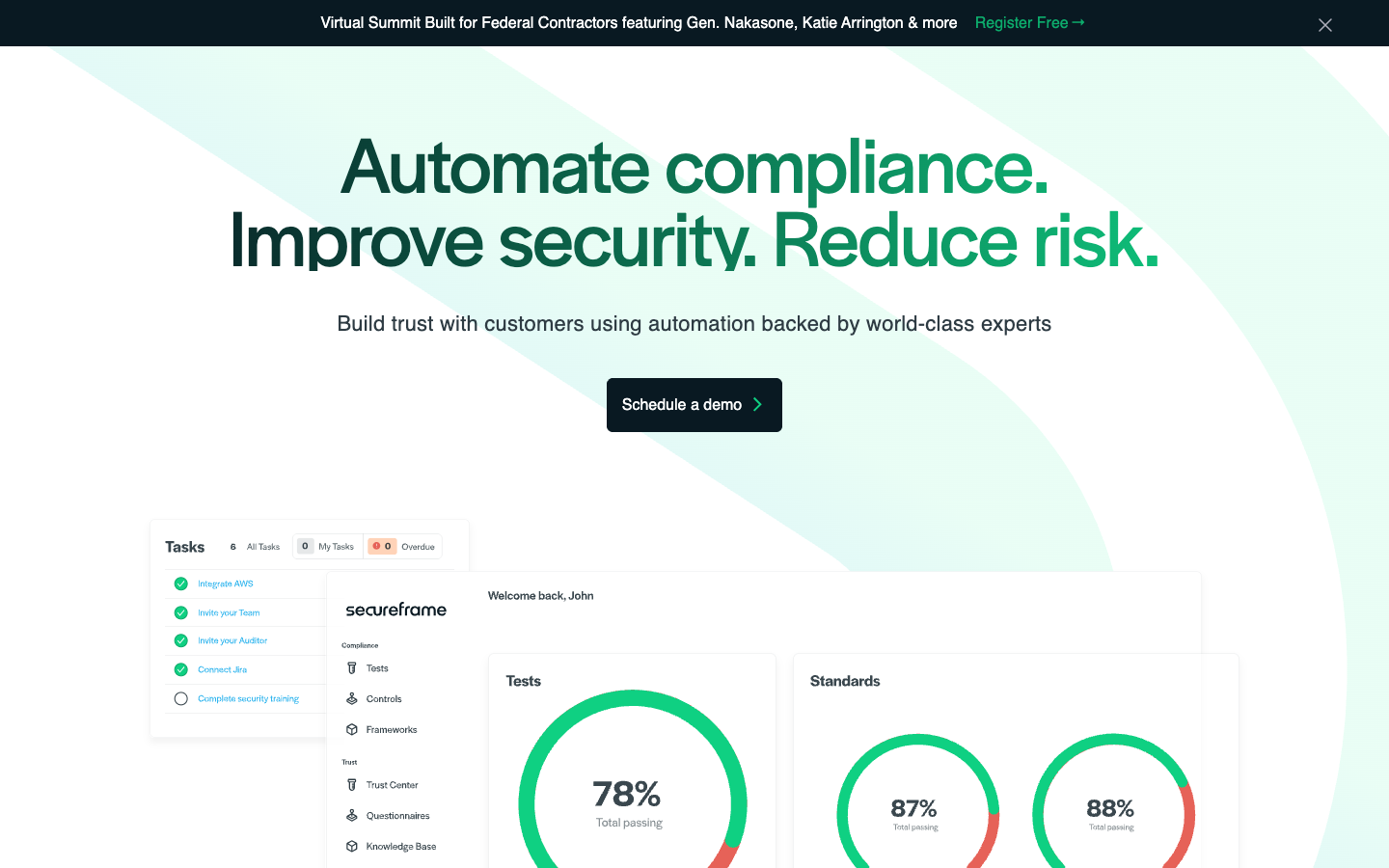
Secureframe doesn’t just offer FedRAMP support. It has former FISMA assessors on staff, and that’s a meaningful differentiator. When you’re trying to understand what a 3PAO will actually scrutinize in your SSP, having someone who’s been on the assessor side of that table is worth more than another integration connector.
The platform covers 300+ integrations including AWS GovCloud, Azure Government, and Microsoft GCC High, the government cloud environments your authorization will likely require. Its SSP generation is OSCAL-compliant with pre-mapped controls to the FedRAMP 20x KSI framework, and the C3PAO partner network means Secureframe can connect you to an accredited assessor when you’re ready. At 789 reviews with a 4.7/5, it’s close to Drata on satisfaction.
The gap relative to the top two is pricing opacity. Secureframe has a “Defense” tier purpose-built for FedRAMP and CMMC that includes SSP and POA&M management, but you won’t find a number on the website. You’ll need a sales call to get a quote, which makes it harder to budget early in the evaluation process. See how it stacks up against the category in our Vanta alternatives guide.
“
Secureframe allows us to monitor our SOC2 compliance status with ease and offers helpful insight to solve discrepancies.
★★★★★Yiorgos A.· 11–50 employees
Via Capterra ↗Key features:
- 300+ integrations including AWS GovCloud, Azure Government, and Microsoft GCC High
- OSCAL-compliant SSP generation with FedRAMP 20x KSI mapping
- POA&M management and AI-powered remediation
- Dedicated FedRAMP specialist assignment and C3PAO partner network access
- Auditor-created federal policy template library
- AI-powered security questionnaire automation
- User access reviews, vendor risk management, and personnel management
Pros of Secureframe
- Former FISMA assessors on staff — specialist support most platforms can’t match
- Widest government cloud integration set in the category
- Strong CMMC dual-track capability if you need both FedRAMP and CMMC simultaneously
Cons of Secureframe
- No public pricing; a sales call is required before you can budget
- Smaller review base than Vanta or Drata
Pricing: Contact for pricing (estimated $7,500–$100,000/yr depending on tier)
Best for: SMB and mid-market SaaS (20–200 employees) pursuing FedRAMP alongside CMMC or SOC 2, especially teams that want specialist advisory alongside the platform.
4. Hyperproof
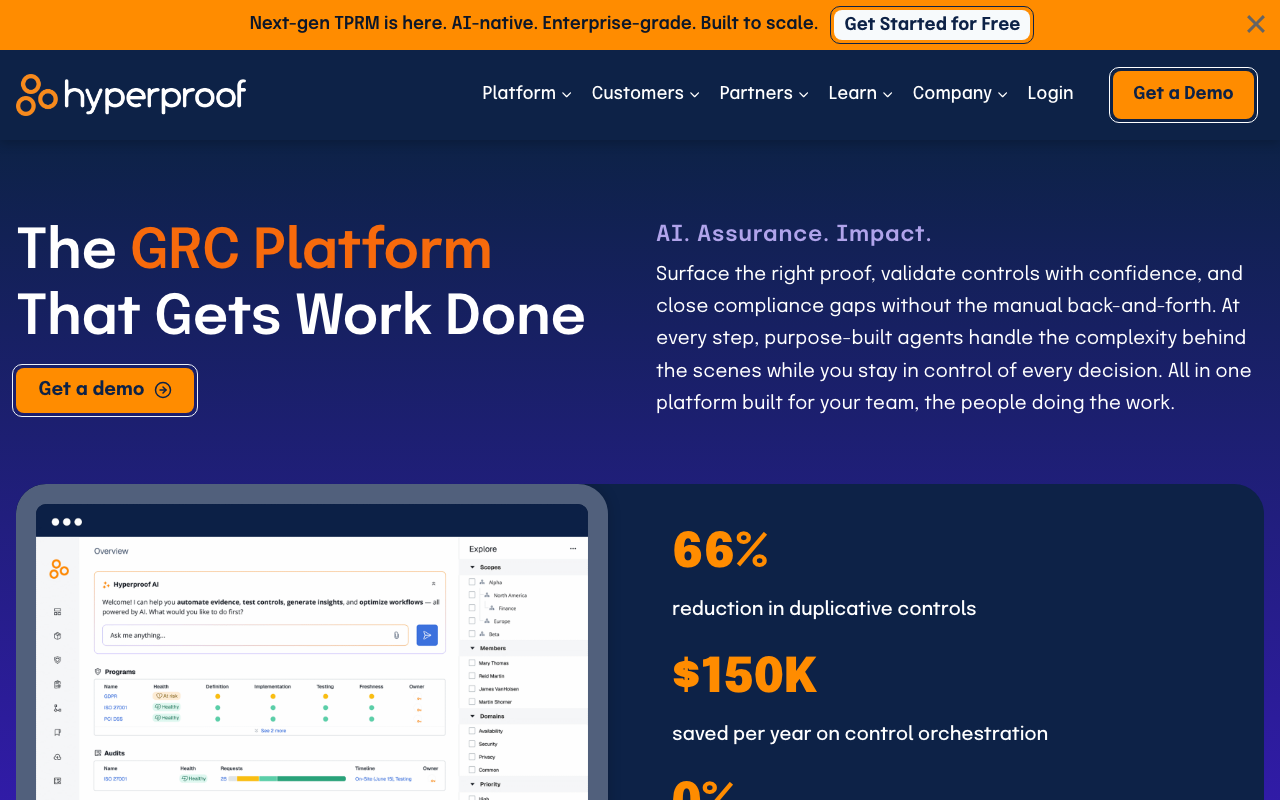
Hyperproof has one differentiator no other platform on this list can claim: Hyperproof Gov, its own FedRAMP Moderate Authorized operating environment. That’s not marketing copy. It means you can run your GRC program inside Hyperproof’s authorization boundary, which matters if your agency customer requires the tools you use for compliance management to themselves be FedRAMP authorized.
Most compliance teams won’t need this. But if you do, your options are narrow, and Hyperproof is the clearest one.
Beyond Hyperproof Gov, the platform covers 140+ compliance frameworks including all FedRAMP baselines. The Hypersyncs (200+ integrations) automate evidence collection, and the Jumpstart feature lets you reuse controls mapped to one framework across others without re-documenting everything. The SSP Appendix A auto-generation is one of the more complete documentation features in this space. See how real users rate it in our Hyperproof review roundup.
“
Intuitive, modern UI with smooth onboarding and strong customer support. Centralizes compliance into one system with robust automation.
★★★★★Giorgi L.· Accounting
Via Capterra ↗Key features:
- Hyperproof Gov: FedRAMP Moderate Authorized platform environment
- 140+ pre-built compliance framework templates including all FedRAMP baselines
- Automated evidence collection via 200+ Hypersync integrations
- SSP Appendix A auto-generation for FedRAMP control documentation
- Cross-framework control reuse via Jumpstart feature
- Risk register with assessment documentation and mitigation tracking
- AI-native control validation with human oversight
Pros of Hyperproof
- Only GRC platform in this list with its own FedRAMP Moderate authorized environment
- Strong audit collaboration: auditors can work directly inside the platform
- Excellent for orgs managing FedRAMP alongside SOC 2, HIPAA, CMMC simultaneously
Cons of Hyperproof
- Smaller review base (213 reviews) than the top three platforms
- Implementation fee is common; pricing requires negotiation
- Initial configuration can be complex for non-technical compliance leads
Pricing: Contact for pricing (estimated $12,000–$100,000/yr depending on tier and org size)
Best for: Mid-market organizations that need to operate their GRC program inside a FedRAMP-authorized environment, or that are managing FedRAMP alongside multiple regulated frameworks simultaneously.
5. Anitian
Anitian is a different kind of product than anything else on this list. It’s not a GRC platform. It’s a managed FedRAMP engagement: a company that gives you both the software and the people to execute the authorization.
The FedFlex platform uses agentic AI to automate SSP generation, evidence mapping, continuous monitoring, and POA&M management. But it also comes with pre-hardened cloud infrastructure, bundled 3PAO relationships (A-LIGN and Schellman), and advisory throughout the process. If you sign with Anitian, you’re not buying access to a compliance tool and then figuring out how to use it. You’re buying a structured path to FedRAMP authorization, with Anitian running much of the execution alongside you.
The claim is 4 months to audit readiness for Moderate. The FedFlex Starter tier provides a no-sponsor FedRAMP Low/20x pathway, which removes one of the biggest blockers for smaller companies entering the federal market for the first time.
The trade-off is full opacity: no public pricing, no public reviews anywhere (the managed service model means most feedback lives in NDA-governed references), and once you’re in Anitian’s environment, you’re committed to their infrastructure. If you have an internal compliance team that wants to own the program, Anitian isn’t the right fit. If you have a 10-person engineering team with a federal pipeline and no compliance infrastructure, it might be exactly right.
Key features:
- FedFlex agentic AI platform for end-to-end FedRAMP authorization lifecycle
- AI-powered SSP generation and NIST control evidence mapping
- Continuous monitoring and POA&M automation
- Built-in 3PAO support with bundled A-LIGN and Schellman partnerships
- Flexible cloud deployment: AWS, Azure, or Anitian-hosted
- FedFlex Starter: no-sponsor FedRAMP Low/20x pathway
- FedFlex Comprehensive: Moderate/High with full lifecycle support and ConMon
Pros of Anitian
- Fastest claimed path to audit readiness: 4 months for Moderate
- Infrastructure, software, and assessor relationships bundled in a single engagement
- No-sponsor 20x pathway removes a major barrier for first-time federal entrants
Cons of Anitian
- No public pricing; no public reviews anywhere
- Full lock-in to Anitian’s managed environment
- Not suitable for teams that want to own and self-manage the compliance program
Pricing: Contact for pricing (engagement-based; Moderate/High engagements are typically six-figure annual investments)
Best for: SaaS companies entering the federal market for the first time with limited internal compliance expertise and a hard authorization deadline.
6. Paramify
Paramify is the most interesting entrant in the FedRAMP space right now. Founded in 2022, it’s the first GRC tool to achieve FedRAMP 20x Moderate authorization itself, which means it understood the new pathway early enough to build for it from scratch rather than retrofit.
The core value proposition is SSP automation. Paramify claims to auto-generate 90–95% of SSP content using an OSCAL-based “write once, apply many” architecture — meaning when you update a control, every related document updates automatically. The KSI framework is natively built in, and the real-time 20x Trust Center gives your assessor a live view of your security outcomes. One customer achieved FedRAMP authorization in 8 days.
What makes Paramify unusual is the pricing: $8,000/yr for Low/CMMC and $28,000/yr for Moderate/High. Those are public numbers, listed on the website, with no “contact for pricing” in sight. For a category where every other platform requires a sales call to get a quote, that kind of transparency stands out. Notable customers include Palo Alto Networks, Cisco, Adobe, and Okta, which addresses the obvious concern about putting a three-year-old company in your federal compliance stack.
“
Vulnerability tracking has become so much easier. Automation reduced manual spreadsheet work significantly and support is responsive.
★★★★★Robert W.
Via G2 ↗Key features:
- SSP automation covering 90–95% of content using OSCAL-based architecture
- POA&M management with automated vulnerability ingestion from scanners
- Real-time FedRAMP 20x Trust Center with live KSI status
- “Write once, apply many” architecture: control updates propagate instantly across all documentation
- KSI framework mapping purpose-built for FedRAMP 20x
- Jira and ServiceNow integrations
- Audit-ready documentation exports in machine-readable formats
Pros of Paramify
- Only tool in this list with fully public pricing
- Most aggressive SSP automation in the category (90–95% claimed)
- Purpose-built for FedRAMP 20x; KSI support is native, not bolted on
- Enterprise customers including Palo Alto Networks, Cisco, and Adobe
Cons of Paramify
- Newer platform (founded 2022, ~50 employees); less proven at scale than the top three
- Limited general GRC features outside FedRAMP and CMMC
- Small review base (16 reviews); not enough data for a reliable satisfaction benchmark
Pricing: $8,000/yr (FedRAMP Low / CMMC) · $28,000/yr (FedRAMP Moderate to High)
Best for: GovTech SaaS companies and compliance advisors pursuing FedRAMP 20x or Moderate who want maximum SSP automation at transparent, predictable pricing.
7. RegScale
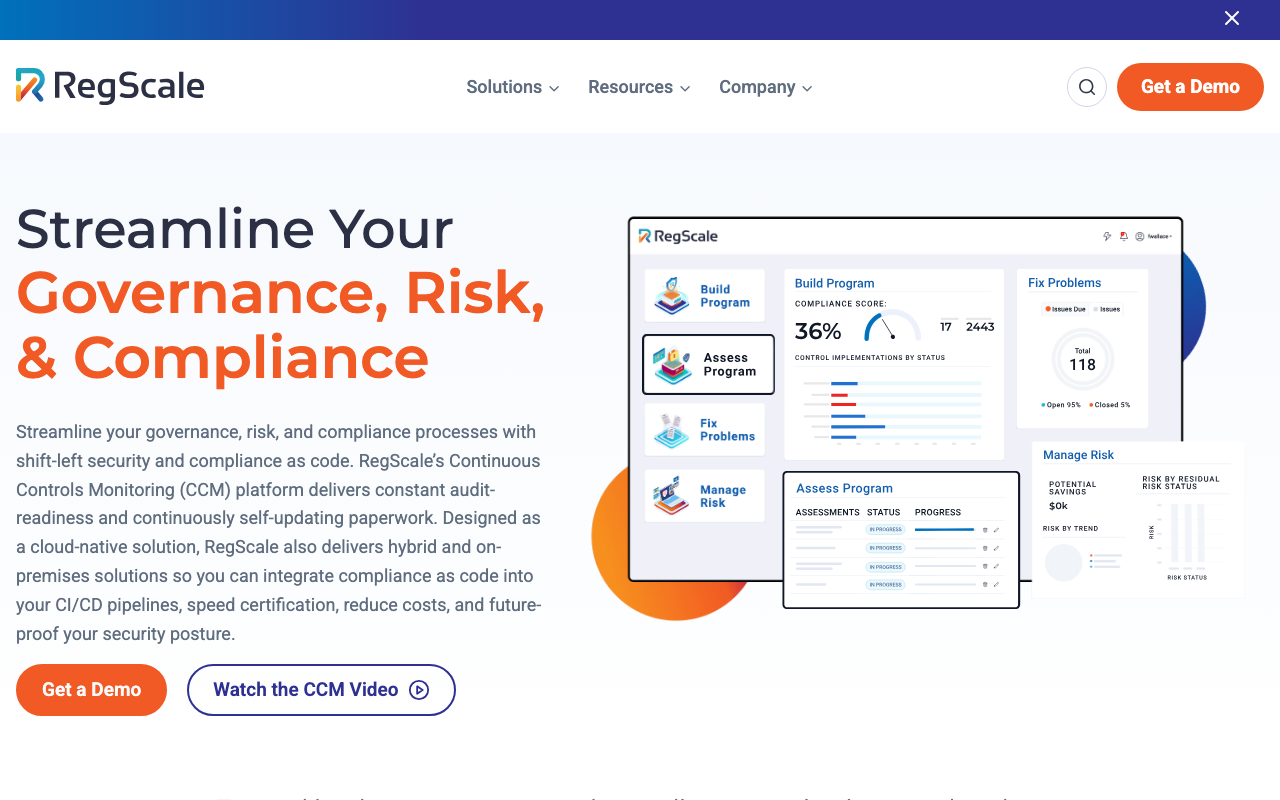
RegScale takes a fundamentally different approach to FedRAMP compliance than any other platform in this list: it treats compliance as code.
The platform is OSCAL-native, which means documentation isn’t generated from your compliance data. It is your compliance data. When you update a control implementation, the OSCAL SSP, SAR, SAP, and POA&M all update simultaneously. There’s no translation layer between your actual security state and your compliance documentation. For engineering teams already living in IaC and DevSecOps toolchains (Jira, ServiceNow, Tenable, Qualys, Wiz, AWS, Azure, GCP), this approach maps naturally to how they already think about infrastructure.
The practical claim is that FedRAMP High authorization is achievable 3–4x faster with RegScale than traditional approaches. Backed by M12 (Microsoft’s venture fund) and with $51.5M raised, this isn’t a startup that’s going to disappear. The honest limitation: if you don’t have technical compliance leads or a DevSecOps culture, RegScale has a steeper learning curve than the platforms above it on this list.
“
Overall, the product and the support from the RegScale team has been amazing!
★★★★★Anonymous· Government organization
Via Gartner Peer Insights ↗Key features:
- OSCAL-native compliance as code: documentation self-updates when controls change
- Automated real-time evidence collection from integrated security tools
- Full FedRAMP ATO package automation: SSP, SAR, SAP, and POA&M
- Continuous controls monitoring with drift remediation
- DevSecOps integrations: Jira, ServiceNow, Tenable, Qualys, Wiz, AWS, Azure, GCP
- AI-powered GRC agents to eliminate manual compliance labor
- 60+ frameworks with multi-framework control inheritance
Pros of RegScale
- Most developer-friendly compliance platform in this list; OSCAL-first with no translation layer
- M12 (Microsoft) backed with $51.5M raised
- Claims FedRAMP High 3–4x faster than traditional approaches
Cons of RegScale
- No public pricing
- No public review listing; harder to benchmark user satisfaction
- Steeper learning curve for non-technical compliance teams
Pricing: Contact for pricing
Best for: Cloud service providers and federal contractors with DevSecOps-led teams who want compliance automation that integrates directly into their engineering workflow.
8. ZenGRC
ZenGRC is the oldest platform in this list, founded in 2009, and that experience shows in the polish of its GRC features. It’s a mature, full-stack GRC platform with a dedicated FedRAMP module, and it’s listed on the FedRAMP Marketplace through a partnership with Steel Patriot Partners via Federal ZenGRC.
The GRACI AI assistant helps with control design and program scoping. The Universal Control Mapping consolidates requirements across frameworks, useful if FedRAMP is part of a broader enterprise GRC program rather than your only compliance initiative. The auditor access portal lets assessors work directly in the platform, which smooths the assessment process.
The limitation is positioning: FedRAMP is a module within a broader GRC platform, not the primary reason ZenGRC exists. Teams that need deep FedRAMP-specific automation (SSP generation at scale, KSI workflows, OSCAL-native output) will find the FedRAMP-specialist tools above more capable. ZenGRC earns its spot for organizations that already need serious enterprise GRC and want FedRAMP covered as part of that, rather than organizations that are FedRAMP-first.
“
Before ZenGRC we were living in spreadsheet hell — endless back-and-forth emails, no central management, and audits were a nightmare to coordinate.
Anonymous
Via G2 ↗Key features:
- GRACI AI assistant for control design and program scoping
- Universal Control Mapping to consolidate requirements across frameworks
- Pre-built FedRAMP templates for Low, Moderate, and High baselines
- Centralized evidence repository with auditor access portal
- Real-time compliance dashboards and risk scoring
- Third-party and vendor risk management
- Trust Center for sharing compliance status externally
Pros of ZenGRC
- Mature platform with 15+ years of GRC track record
- FedRAMP Marketplace listed via Federal ZenGRC partnership
- Strong multi-framework GRC capabilities beyond FedRAMP
Cons of ZenGRC
- Most expensive entry point in this list (~$30,000/yr before onboarding fees of $5,000–$50,000+)
- FedRAMP is one module among many; not a FedRAMP-first platform
- No publicly named FedRAMP customer references
Pricing: Start-Up ~$30,000/yr · Professional ~$30,000–$42,000/yr · Enterprise ~$72,000+/yr (plus onboarding fees)
Best for: Mid-market organizations pursuing FedRAMP Moderate as part of a broader enterprise GRC program, not as a standalone compliance initiative.
9. Xacta
Xacta by Telos Corporation has been in production since 2000. It’s the tool the Air Force uses. The FBI uses it. DHS, the State Department, the Social Security Administration. If you’re a defense contractor or a federal agency managing compliance across DoD and civilian frameworks simultaneously, Xacta is the category incumbent.
The platform achieved FedRAMP High authorization in 2025, which puts it in rare company. The Xacta.ai component uses AI to draft control implementation statements, a task that typically takes compliance teams 4–6 months manually. Xacta claims to compress that to 9 days.
The eMASS interface connects to the DoD’s enterprise risk management system, which most civilian SaaS companies will never need, but if you’re in the defense industrial base, it’s essential. Xacta 360 handles continuous compliance across on-premises and cloud environments, and the FedRAMP 20X KSI dashboard provides machine-readable security outcome tracking.
The honest read: Xacta is not for most readers of this article. If you’re a 50-person SaaS company pursuing FedRAMP Moderate to sell to a civilian agency, Xacta is overkill. It’s purpose-built for government prime contractors and large cloud service providers operating at the intersection of federal civilian and DoD compliance.
“
Xacta is incredibly intuitive and user-friendly, providing a comprehensive view of IT and cyber risk management needs. The automated compliance features save time and effort.
Anonymous
Via Gartner Peer Insights ↗Key features:
- Xacta.ai: AI-driven control implementation (9 days vs. 4–6 months manually)
- Xacta 360: Continuous compliance across on-premises and cloud environments
- Xacta.io: Automated ingestion of security scan results and risk data
- FedRAMP 20X KSI dashboard for machine-readable security outcome tracking
- One-click OSCAL-format SSP generation
- Control inheritance from common control providers
- eMASS interface for U.S. military command compliance workflows
- Multi-framework stacking: FedRAMP and DoD RMF simultaneously
Pros of Xacta
- FedRAMP High authorized; deepest DoD/IC track record in this list
- OSCAL-native output with KSI dashboard
- Customers include the Air Force, FBI, DHS, State Department, and Zscaler
Cons of Xacta
- Overkill and likely overpriced for most commercial SaaS companies targeting Moderate
- Government-centric UI that assumes federal compliance familiarity
- No public pricing; no public review listing
Pricing: Contact for pricing (Telos Corporation is publicly traded on NASDAQ: TLS)
Best for: Defense contractors, federal agencies, and large cloud service providers requiring FedRAMP High with deep DoD and IC framework integration.
How to choose FedRAMP compliance software
1. Start with your target impact level
This is the most important decision you’ll make before evaluating any tool, because it changes the control count, documentation burden, 3PAO requirements, and realistic timeline significantly.
FedRAMP Low and LI-SaaS carry a lighter control set and are accessible through most platforms above. If you’re targeting the new FedRAMP 20x pathway for Low, look specifically at Paramify (purpose-built for 20x), Vanta (20x module with OSCAL export), and Anitian (no-sponsor 20x path). Moderate is where most commercial SaaS companies land, and Vanta, Drata, Secureframe, Hyperproof, and Paramify all handle it well.
High is a different conversation: only Xacta, Anitian, Hyperproof Gov, and RegScale have the depth to support it credibly.
Know your impact level before your first vendor call. Any platform that doesn’t ask you this question early in the process isn’t paying close enough attention.
2. Platform or managed service?
Every tool in this list except Anitian is a self-managed platform: you own the compliance program, the tool automates evidence collection and documentation. With Anitian, they own much of the execution alongside you: infrastructure, assessor relationships, and advisory are bundled in.
The practical test: do you have someone internally whose job is compliance? If yes, a platform gives you more control and is likely cheaper. If you’re a 15-person engineering team with a federal contract on the line and no compliance expertise, Anitian’s managed model may be worth the premium over buying a platform and spending six months figuring out SSP writing.
3. Do you need OSCAL-native output?
FedRAMP 20x mandates machine-readable OSCAL packages. If you’re targeting 20x, check the tool’s OSCAL maturity before signing, not during implementation.
Platforms that are OSCAL-first (documentation is OSCAL by default): Paramify, RegScale, Xacta. Platforms that are OSCAL-capable but not OSCAL-first (they export OSCAL, but it’s not the native format): Vanta (20x module), Drata, Secureframe, Hyperproof. The distinction matters if your assessor or agency customer expects OSCAL artifacts to be their primary source of truth.
4. Will FedRAMP be your only framework?
If FedRAMP is your only compliance program, the specialist tools (Paramify and Anitian) are the most purpose-built. Paramify at $28,000/yr for Moderate is significantly cheaper than a general-purpose platform used for FedRAMP alone. If you’re running FedRAMP alongside SOC 2, ISO 27001, or CMMC, the multi-framework platforms (Vanta, Drata, Secureframe) amortize their cost across frameworks in a way the specialist tools can’t.
One thing worth noting for early-stage teams: if you’re still working toward SOC 2 or ISO 27001 before FedRAMP, getting those done first creates controls you can inherit directly into your FedRAMP SSP. ComplyJet handles the pre-FedRAMP compliance stack efficiently for early-stage companies, building the control foundation that FedRAMP will later require.
Free Demo
Get your pre-FedRAMP compliance done right.
SOC 2 and ISO 27001 controls you build now carry directly into your FedRAMP SSP.
5. Matching fedramp compliant software to your team size and stage
There’s a right-sized tool for every stage of the FedRAMP journey:
- Startup (under 50 people), targeting 20x or Low: Paramify at $8,000/yr is the obvious starting point. Vanta works if you want the brand familiarity and plan to add SOC 2 or ISO 27001 later.
- Series A/B, targeting Moderate: Drata, Secureframe, or Vanta. The choice usually comes down to whether you have a technical compliance lead (Drata) or want specialist advisory baked in (Secureframe).
- Mid-market with broader GRC requirements: Hyperproof for multi-framework depth; ZenGRC if you need enterprise GRC capabilities alongside FedRAMP.
- No internal compliance expertise, hard deadline: Talk to Anitian before committing to a self-managed platform.
- Defense contractor or large federal CSP: Xacta.
Frequently asked questions
Which fedramp common software tools do most SaaS companies use?
The most common fedramp compliance software among SaaS companies are Vanta, Drata, and Secureframe: all three have large review bases, cover the full FedRAMP impact level range, and support multi-framework compliance alongside FedRAMP. For companies targeting FedRAMP 20x specifically, Paramify is the fastest-growing choice. Note the distinction: software that helps you get FedRAMP authorized is different from software that is itself FedRAMP authorized. Hyperproof Gov and Xacta are both; most tools in this list are the former only.
Does a SaaS company need FedRAMP compliance?
Only if you’re selling cloud services directly to US federal agencies. FedRAMP is not required for state and local government (StateRAMP covers that), and it’s not required just because your customer’s customer is the federal government. If you’re selling to a defense contractor who sells to the DoD, check whether the specific contract specifies FedRAMP. Some do, many don’t.
Is FedRAMP a certification or an authorization?
FedRAMP issues ATOs (Authority to Operate), not certifications. The authorization is issued by a federal Authorizing Official, not by FedRAMP itself. The term “FedRAMP certified” you’ll occasionally see on vendor websites is technically incorrect. The right term is “FedRAMP authorized.” An ATO is tied to a specific system operating at a specific impact level, which is why you see tools listed on the FedRAMP Marketplace with explicit impact level designations.
What is FedRAMP 20x?
FedRAMP 20x is a streamlined authorization pathway launched in 2025. Instead of proving compliance against 325+ NIST 800-53 controls, you demonstrate 17 Key Security Indicators (KSIs): measurable security outcomes like MFA enforcement, encryption at rest, and vulnerability scan cadence, in machine-readable OSCAL format. The agency sponsor requirement for Low impact level is removed, meaning you can pursue authorization without finding a federal agency willing to sponsor you first.
Paramify is the first GRC tool to achieve FedRAMP 20x Moderate authorization itself. Vanta, Drata, and Anitian also support the 20x pathway.
What software do you need to achieve FedRAMP compliance?
The software to achieve FedRAMP compliance typically includes a GRC platform (to manage controls, SSP, and evidence), a vulnerability scanner (Tenable, Qualys, or Wiz), and a cloud security posture tool for your infrastructure environment. Most fedramp compliance software platforms in this list integrate with all three. Your 3PAO will assess the configuration, not just the tool selection.
How long does FedRAMP authorization take?
The traditional path for Moderate is 12–24 months. High takes longer: 18–36 months is common. With the 20x pathway for Low, some companies have achieved authorization in 30 days. Moderate with a managed engagement like Anitian can compress to 4–6 months. The key variables are SSP completeness when you hand it to your 3PAO, 3PAO availability (accredited assessors are in high demand), and how quickly your team responds to findings in the Security Assessment Report (SAR).
What’s the difference between FedRAMP Low, Moderate, and High?
The levels reflect the potential impact of unauthorized disclosure of the information your system handles. Low means limited adverse effects (lightest control set). Moderate, where most commercial SaaS companies land when selling to civilian agencies, means serious adverse effects, roughly 325 NIST 800-53 Rev 5 controls. High means severe or catastrophic effects: defense systems, law enforcement databases, critical financial infrastructure.
LI-SaaS is a Low-impact subset for SaaS products that store minimal federal data. The newer 20x pathway is primarily for Low impact level and is expanding to Moderate.
Final thoughts
FedRAMP is a serious commitment, and the tooling you pick will shape how that commitment unfolds over the next two to three years. For most SaaS companies targeting Moderate, Vanta, Drata, and Secureframe are the most proven starting points. If you want maximum SSP automation at a clear, public price, Paramify is the standout. If you have no internal compliance expertise and need someone to own the process alongside you, talk to Anitian before you commit to a platform.
If you’re not at the FedRAMP stage yet and still building foundational compliance through SOC 2 or ISO 27001 first, it’s worth getting that stack right. Those controls carry directly into your FedRAMP SSP later. ComplyJet helps early-stage teams get through the pre-FedRAMP frameworks efficiently, with flat pricing and a team that guides you through to certification rather than leaving you alone with software.
Free Demo
ComplyJet gets you through SOC 2 and ISO 27001 fast.
Flat pricing, 350+ integrations, guided by a team — not left alone with software.