Related Articles
No items found.
.svg)

You think you're ready for ISO 27001 until the gaps show up during the audit. On paper, everything looks in place. Policies are documented, controls are in place, and teams believe they are prepared.
The reality becomes clear when evidence is requested. Missing controls, incomplete documentation, and unclear ownership begin to surface. This leads to audit delays, rework, and unnecessary pressure on teams.
The core issue is not effort. It is the lack of a clear starting point. Without a structured gap analysis, organizations lack visibility into what is missing or what needs to be prioritized. As a result, implementation becomes reactive instead of planned.
This guide focuses on a practical approach to ISO 27001 gap analysis. It explains how to identify gaps, assess their impact, and build a clear path toward certification. The goal is to help you move forward with clarity and avoid common audit challenges.
Book a demo to see how ComplyJet helps teams identify gaps early and stay audit-ready without delays.
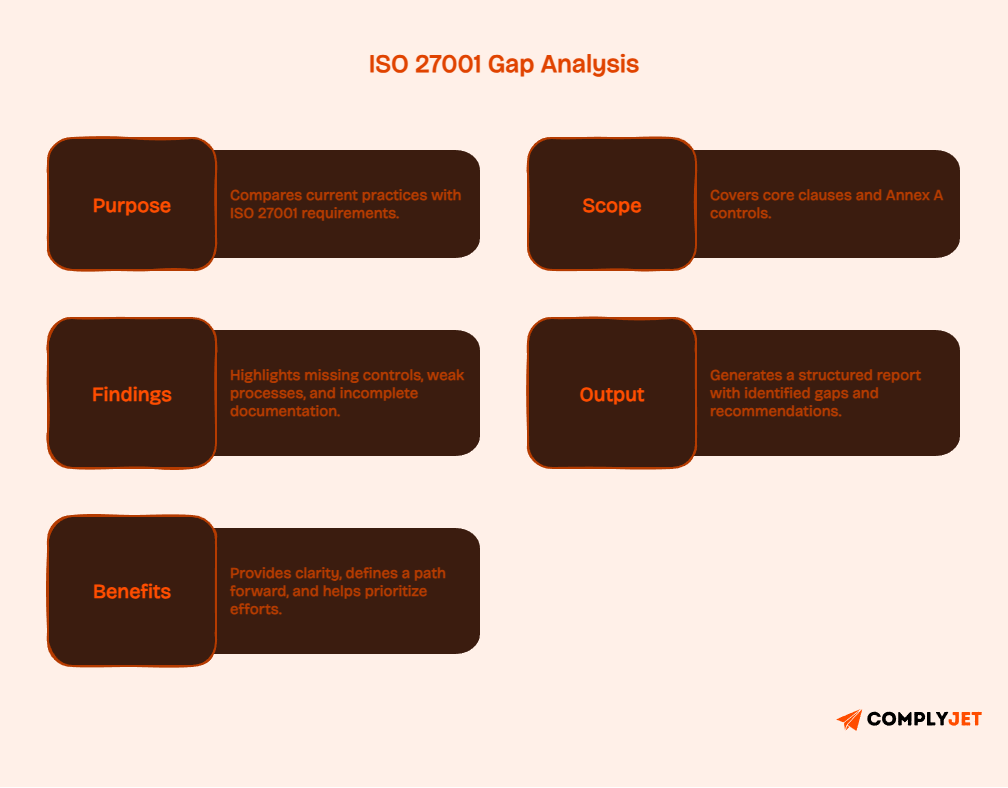
ISO 27001 gap analysis is the process of comparing your organization’s current information security practices with the requirements defined in ISO 27001. In simple terms, it helps you understand the difference between where you are today and where you need to be to meet the standard.
This assessment covers both the core clauses of ISO 27001, which define how an information security management system (ISMS) should be structured, and Annex A controls, which focus on specific security measures such as access control, incident management, and risk treatment.
By reviewing these areas, gap analysis highlights missing controls, weak processes, and incomplete documentation.
The output of this process is a structured gap analysis report. This report typically includes identified gaps, their impact, and recommended actions to address them.
It also forms the basis of an action plan that outlines what needs to be implemented, improved, or documented before moving toward certification.
At a practical level, ISO 27001 gap analysis gives you clarity. It shows what is already in place, what is partially implemented, and what is completely missing.
Instead of approaching ISO 27001 blindly, you get a clear view of your current state and a defined path to move forward. This makes it easier to prioritize efforts, allocate resources, and prepare for audits without last-minute surprises.
ISO 27001 certifications nearly doubled globally, jumping from 48,671 valid certificates in 2023 to 96,709 in 2024, according to the ISO Survey 2024. The number of certified sites reached 179,877. This surge makes a strong case for why structured gap analysis is now more critical than ever.
Gap analysis plays a critical role in ISO 27001 implementation. It gives you a clear starting point and helps you understand how far you are from meeting the standard. Without it, teams often move forward without clarity, which leads to issues later in the process.
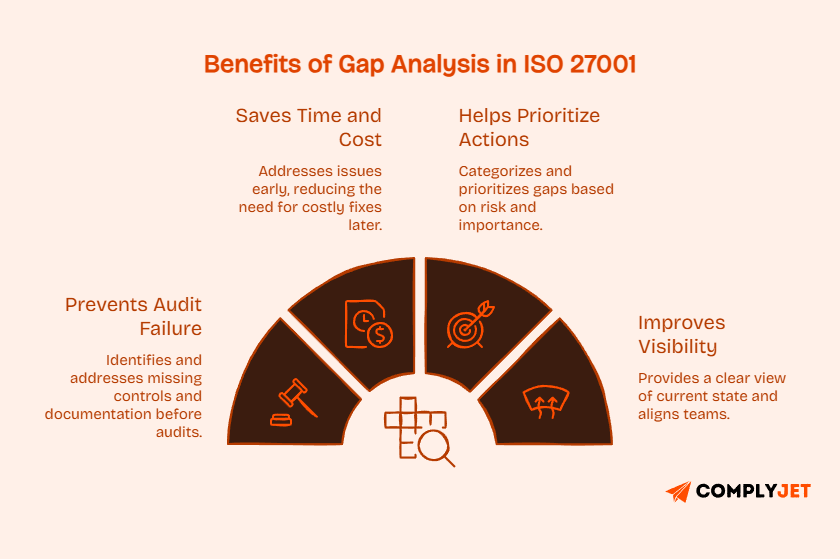
ISO 27001 audits are evidence-driven. It is not enough to have policies or controls in place. You need to prove they are implemented and working. Gap analysis helps identify missing controls, weak processes, and incomplete documentation before the audit begins. This reduces the risk of non-conformities and failed audits.
Without gap analysis, teams often discover issues during later stages of implementation or even during the audit itself. Fixing problems at that stage takes more time and resources. A structured gap analysis allows you to address issues early, which makes the overall certification process faster and more cost-efficient.
Not all gaps have the same impact. Some directly affect audit readiness, while others are of lower priority. Gap analysis helps you categorize and prioritize gaps based on risk and importance. This ensures that critical controls are implemented first, instead of spreading effort across less important areas.
One of the biggest challenges in ISO 27001 implementation is the lack of clarity. Teams often do not have a clear view of what is complete, what is partially implemented, and what is missing. Gap analysis provides a structured view of your current state. It aligns teams, defines ownership, and creates a clear path forward.
Key Insights: Most ISO 27001 failures do not happen because organizations lack security controls. They happen because gaps are identified too late, when there is limited time to fix them.
These three terms are often confused because they all involve reviewing your security posture. However, each serves a different purpose in ISO 27001 and is performed at a different stage.
Understanding the distinction helps avoid duplication of effort and ensures a structured implementation approach.
Gap analysis, risk assessment, and audit are not interchangeable steps. Gap analysis comes first and gives you visibility into what is missing. Risk assessment builds on that by identifying and prioritizing risks.
Audit comes at the end to verify whether everything is implemented correctly and meets ISO 27001 requirements.
Mixing these steps often leads to confusion, duplicated effort, and delays. Following the correct sequence ensures a smoother path to certification and better use of time and resources.
ISO 27001 is the fastest-growing certification type globally, forecasted to achieve a CAGR of 14.2% during 2025–2032, driven by increasing cybersecurity threats, data privacy regulations such as GDPR and CCPA, and widespread digital transformation.
A structured gap analysis helps you move from confusion to clarity. Instead of trying to fix everything at once, you follow a defined sequence to identify, assess, and resolve gaps. The focus should always be on action, not documentation for the sake of it.
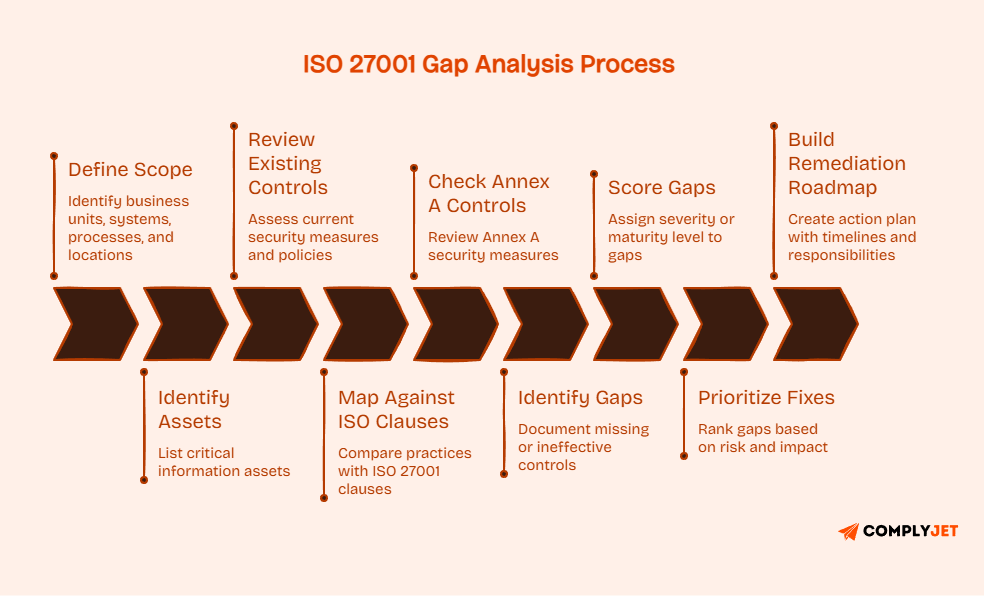
Start by defining the scope of your ISMS. Identify which business units, systems, processes, and locations are included. A clear scope ensures that your gap analysis is focused and relevant.
List all critical information assets such as data, systems, applications, and infrastructure. This step provides the foundation for evaluating controls and understanding where gaps may exist.
Assess the controls and policies currently in place. This includes security measures, procedures, and documentation. The goal is to understand what already exists before mapping against ISO requirements.
Compare your current practices with ISO 27001 clauses (4 to 10). This helps identify gaps in areas such as risk management, leadership involvement, documentation, and continuous improvement.
Review Annex A controls to identify missing or weak security measures. Focus on key areas like access control, incident management, asset management, and supplier security.
Document all missing, partially implemented, or ineffective controls. Be specific. Instead of noting “access control issue,” define what is missing, such as a lack of role-based access or the absence of access logs.
Assign a severity or maturity level to each gap. This helps differentiate between critical issues and lower-priority improvements.
Rank gaps based on risk and impact. High-risk gaps that affect audit readiness or security should be addressed first.
Create a clear action plan with timelines, responsibilities, and deliverables. This roadmap becomes your guide for moving toward ISO 27001 certification in a structured and efficient way.
Following this step-by-step approach ensures that your gap analysis is not just an assessment exercise but a practical foundation for implementation.
The ISO 27001:2022 revision consolidated controls from 114 to 93, added 11 new ones, and expanded the standard's scope to explicitly incorporate cybersecurity and privacy protection. Organizations were required to migrate to ISO/IEC 27001:2022 by October 31, 2025.
A structured checklist helps you review all critical areas in a consistent way. Instead of checking controls randomly, you can assess each domain against ISO 27001 requirements and identify gaps clearly.
Using a structured checklist like this helps you quickly identify gaps and stay audit-ready. You can also use a downloadable ISO 27001 gap analysis checklist to standardize your assessment process and save time.
Annex A controls are where most practical gaps show up during ISO 27001 implementation. These controls focus on how security is actually enforced across systems and processes. During gap analysis, the goal is to identify whether these controls are properly implemented, partially implemented, or missing.
The table below highlights some common examples of gaps and how they can be fixed in a practical way.
These examples show that most gaps are not complex. They are usually due to missing processes, lack of documentation, or inconsistent implementation. By identifying these early, you can fix them in a structured way and avoid issues during the audit.
The focus should always be on implementation and evidence. It is not enough to define a control. You need to show that it is working in practice.
Gap analysis is often treated as a simple checklist exercise, but that approach creates more problems than it solves. Most mistakes happen when teams focus on documentation instead of actual implementation.
One common mistake is treating gap analysis as a documentation task. Teams create policies and mark controls as complete without verifying whether they are actually implemented. This leads to gaps being missed until the audit stage.
Another issue is ignoring real processes. What is written in documents often does not match what teams are doing in practice. Gap analysis should validate real workflows, not just review policies.
Lack of ownership is another major problem. When controls do not have clear owners, they are either partially implemented or not maintained. This creates inconsistencies across systems and teams.
Many organizations also miss evidence collection. Even if a control exists, it needs supporting evidence such as logs, reports, or records. Without evidence, auditors will treat the control as not implemented.
A weak asset inventory creates foundational gaps. If you do not know what assets exist, you cannot apply controls properly. This affects risk assessment, access control, and monitoring.
The pattern across these mistakes is clear. Teams assume they are compliant based on documentation, but ISO 27001 requires proof of implementation. Gap analysis should focus on what is actually working, not just what is written.
North America currently dominates the ISO 27001 certification landscape with 42% market share, followed by Europe at 33% and Asia-Pacific at 25%.
Organizations can perform ISO 27001 gap analysis either internally or with the help of external experts. Both approaches have their advantages, but they also come with trade-offs.
Internal gap analysis works well when teams already have some understanding of ISO 27001 and security practices. It allows faster execution and better alignment with internal processes. However, teams may miss gaps due to familiarity or lack of experience with audit expectations.
External gap analysis provides a more structured and objective view. Consultants bring experience from multiple implementations and understand what auditors typically look for. This reduces the risk of missing critical gaps, especially for organizations going through ISO 27001 for the first time.
A hybrid approach often works best. Internal teams can handle initial assessments and data collection, while external experts can validate findings and provide deeper insights. This ensures both efficiency and accuracy in the gap analysis process.
The time required for ISO 27001 gap analysis varies based on the size and complexity of the organization. While there are general timelines, the actual duration depends on how structured your current processes and documentation are.
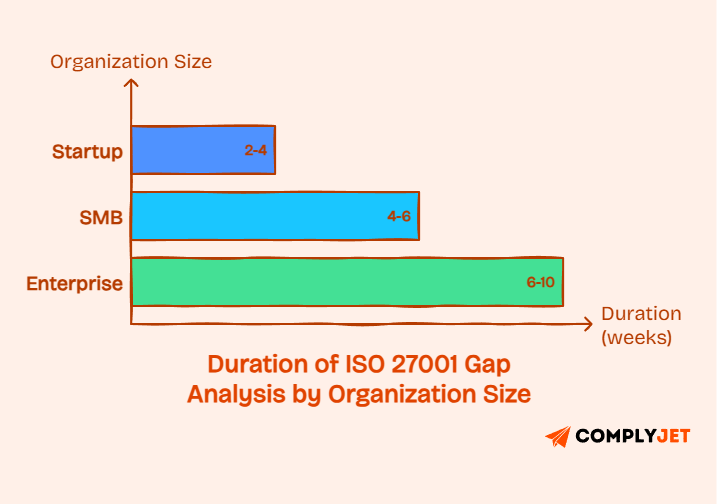
For startups, gap analysis usually takes between 2 and 4 weeks. The scope is smaller, with fewer systems, users, and processes to review. If basic security controls are already in place, the assessment can be completed quickly with minimal coordination.
For small to mid-sized businesses, the timeline extends to around 4 to 6 weeks. There are more assets, teams, and workflows involved. Reviewing documentation, validating controls, and coordinating with different departments requires additional time.
For enterprises, gap analysis typically takes 6 to 10 weeks or more. Large organizations have complex infrastructures, multiple business units, and extensive vendor networks. Evaluating controls across all these areas requires a more structured and detailed approach.
The duration of gap analysis is not fixed and depends on several factors. A clearly defined scope helps speed up the process, while an unclear scope can cause delays. The availability of documentation and evidence also plays a major role.
Organizations with existing policies and structured processes move faster, while those starting from scratch require more time.
Team involvement is another important factor. When stakeholders are responsive and information is readily available, the process moves smoothly. Delays usually happen when data is scattered or requires multiple follow-ups.
Setting a realistic timeline ensures that gap analysis is done thoroughly without rushing critical steps.
A gap analysis report is the final output of your assessment. It gives a clear view of your current compliance status, highlights key gaps, and defines the next steps. A well-structured report helps teams stay aligned and shows stakeholders that the process is controlled and actionable.

Summary: Provides an overview of the scope covered, current compliance status, and key observations. It highlights major gaps and areas that need immediate attention.
Gap Severity: Classifies gaps as high, medium, or low based on their impact on compliance and security. This helps in understanding which issues need urgent action.
Risks: Links each gap to potential risks such as unauthorized access, data breaches, or lack of monitoring. This makes the impact of each gap clear and measurable.
Action Plan: Defines what needs to be done to fix each gap. It includes recommended actions, assigned owners, and timelines to ensure accountability.
A structured gap analysis report adds credibility. It shows that gaps are not just identified but are being addressed with a clear plan and priorities.
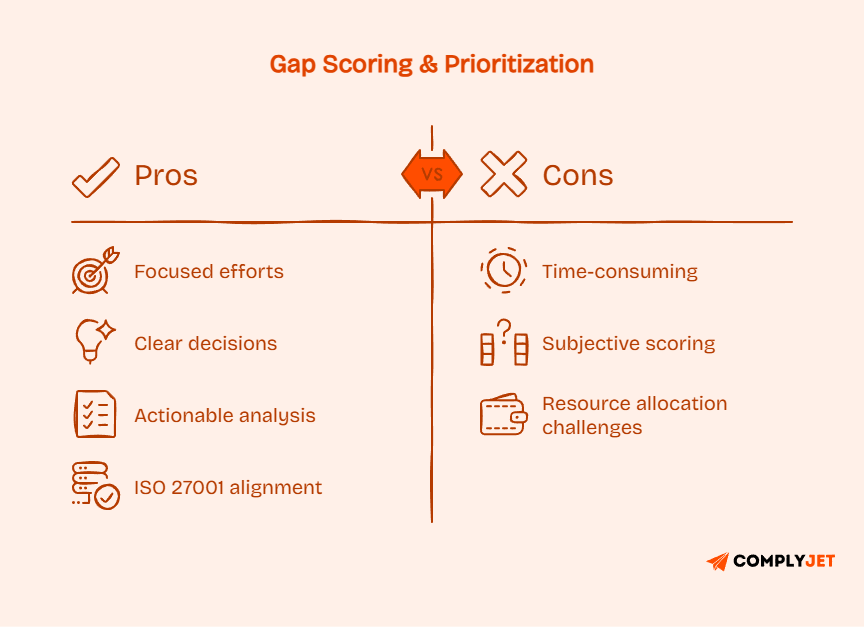
Gap analysis is not just about identifying missing controls. It is about understanding which gaps need immediate attention and which can be addressed later. Without a structured scoring approach, teams often treat all gaps equally, which slows down implementation.
A simple maturity model helps evaluate each control based on its level of implementation:
Implemented: The control does not exist. There is no policy, process, or supporting evidence.
Partially Implemented: The control exists but is incomplete. It may not be consistently followed or properly documented.
Defined: The control is documented and implemented, but monitoring or consistency may be missing.
Managed: The control is fully implemented, monitored, and regularly reviewed. Evidence is available to support it.
Once gaps are scored, they should be prioritized based on impact and risk. Controls that are not implemented or only partially implemented should be addressed first, especially if they relate to critical areas such as access control, incident response, or logging.
A structured scoring and prioritization approach helps in making clear decisions. It ensures that efforts focus on high-impact gaps rather than low-priority improvements.
This makes the gap analysis more actionable and helps teams move toward ISO 27001 readiness in a controlled and efficient way.
As of 2024, over 2.1 million organizations worldwide held at least one ISO certification, reflecting a 7.8% year-on-year increase. Approximately 65% of IT service providers obtained ISO 27001 certification by 2024 to mitigate cyber risks.
Once gaps are identified, the next step is to move into execution. A gap analysis is only useful if it leads to clear actions. The remediation roadmap helps you convert findings into a structured plan that drives implementation.
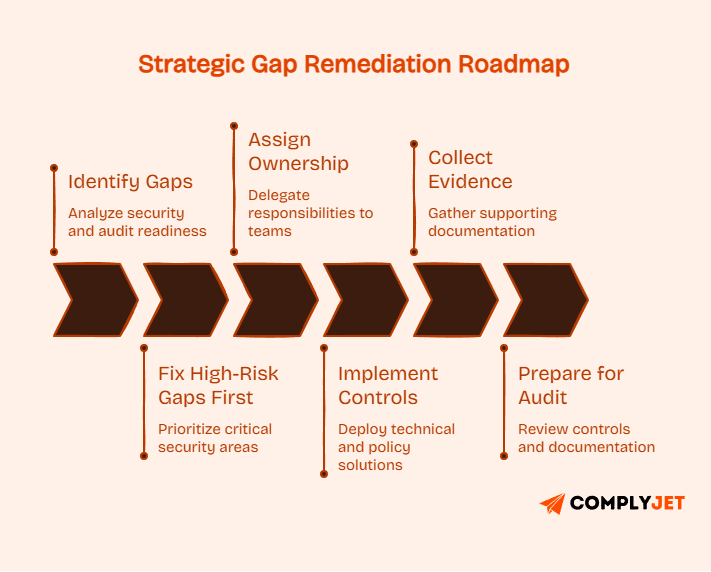
Start with gaps that have the highest impact on security and audit readiness. These typically include areas like access control, incident response, and logging. Addressing these early reduces overall risk and prepares you for audit expectations.
Every gap should have a clear owner. Without ownership, tasks remain incomplete or delayed. Assign responsibilities to specific teams or individuals to ensure accountability and consistent follow-up.
Based on the identified gaps, implement the required controls. This may include creating policies, updating processes, or deploying technical solutions. The focus should be on practical implementation, not just documentation.
ISO 27001 requires proof. As controls are implemented, collect supporting evidence such as logs, reports, approvals, and records. This ensures that you are prepared for audits and can demonstrate compliance.
Once key gaps are addressed, start preparing for the audit. Review implemented controls, validate documentation, and ensure that evidence is complete and accessible. This step helps reduce last-minute issues and builds confidence before certification.
A structured remediation roadmap ensures that gap analysis leads to measurable progress and keeps the implementation on track.
Managing ISO 27001 gap analysis manually often leads to confusion. Teams rely on spreadsheets, scattered documents, and email threads to track gaps, assign tasks, and collect evidence. This creates inconsistency, delays, and a lack of visibility. As the scope grows, it becomes difficult to track progress or ensure that nothing is missed.
The solution is to move toward structured tools that simplify the process.
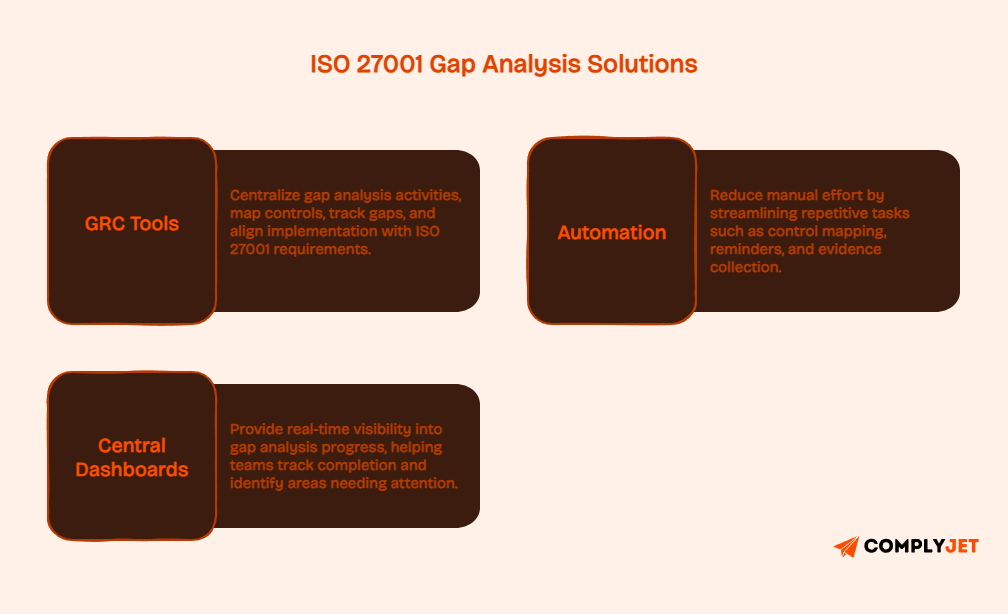
Governance, Risk, and Compliance (GRC) tools help centralize gap analysis activities. They allow you to map controls, track gaps, and align your implementation with ISO 27001 requirements in one place.
Automation reduces manual effort by streamlining repetitive tasks such as control mapping, reminders, and evidence collection. This ensures consistency and saves time during implementation.
A centralized dashboard provides real-time visibility into your gap analysis progress. It helps teams track what is complete, what is pending, and what needs attention. This improves coordination and decision-making.
ComplyJet brings all these elements together in a single platform. It allows you to map ISO 27001 controls, track identified gaps, assign ownership, and manage evidence without relying on multiple tools.
Instead of managing compliance manually, you get a structured workflow with clear visibility into progress and readiness.
If you want to move away from spreadsheets and manage ISO 27001 gap analysis in a structured way, ComplyJet helps you track progress, fix gaps faster, and stay audit-ready.
You can also read ISO 27001 vs 27002: Roles, Differences Explained (2026)
For startups, ISO 27001 gap analysis looks very different compared to larger organizations. The biggest constraints are time and resources. Teams are small, priorities are shifting, and compliance often competes with product and growth.
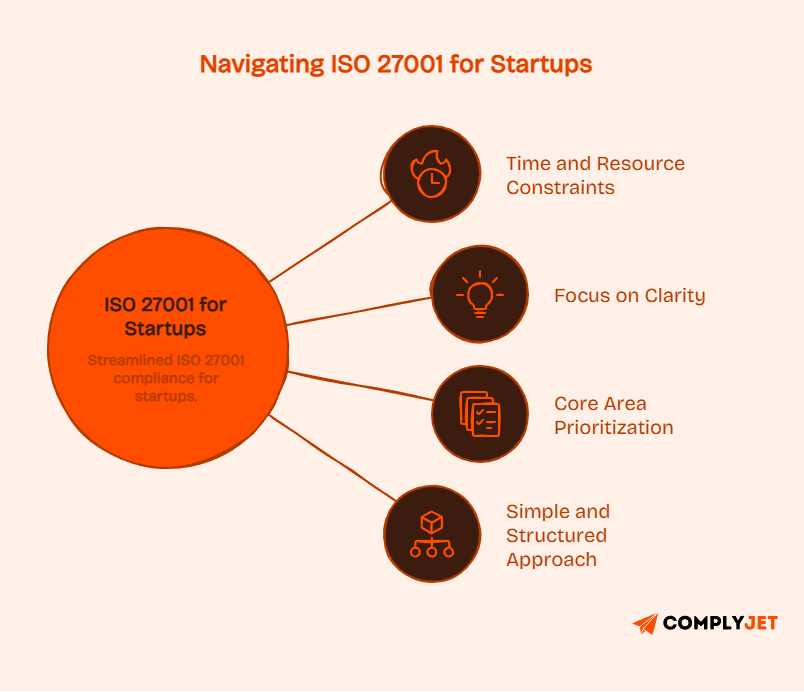
The reality is simple. Startups do not have the bandwidth to build everything from scratch or over-engineer processes. Trying to replicate enterprise-level compliance setups usually slows things down and creates unnecessary complexity.
The focus should be on clarity. Instead of aiming for perfect documentation, startups need to understand what is critical for certification and what can be improved later. Gap analysis helps in identifying those priorities early.
Start with core areas such as access control, asset management, and incident response. Ensure that basic controls are in place and supported by evidence. Avoid spending too much time on low-impact areas in the beginning.
The key insight is that clarity matters more than complexity. A simple, well-structured approach works better than a detailed but unmanageable system. Gap analysis gives startups a clear path, helping them move toward ISO 27001 without slowing down their core business.
The cost of ISO 27001 gap analysis depends on how it is executed and the resources involved. While it may seem like an additional effort, it directly impacts the overall efficiency of your certification journey.

The primary cost driver is team effort. Internal teams need to spend time reviewing controls, gathering information, and validating processes. The more unstructured your current setup is, the more effort this requires.
The second factor is tools. Using spreadsheets may reduce upfront cost but increases time and inconsistency. Structured tools help streamline gap analysis, reduce manual work, and improve tracking.
The third factor is consultants. External experts add cost but bring experience and structured methodologies. They can help identify gaps faster and reduce the risk of missing critical issues.
Time is also closely linked to cost. Longer timelines mean higher internal effort and potential delays in certification. This is where gap analysis plays an important role.
Skipping gap analysis may seem like a shortcut, but it usually leads to higher costs later. Issues identified during audits take more time and effort to fix. A structured gap analysis helps you control both cost and timeline by addressing problems early.
ISO 27001:2022 introduces structural updates that impact how gap analysis is performed. The changes simplify control mapping but require a clearer understanding of the new framework.
93 Controls Structure: The standard now includes 93 controls, reduced from the previous version. Controls are consolidated, which makes mapping easier but requires careful review to ensure nothing is missed.
Updated Control Categories: Controls are now grouped into four categories: organizational, people, physical, and technological. This improves clarity and helps in assessing controls more systematically during gap analysis.
Better Alignment with ISO 27002: ISO 27001 is now more closely aligned with ISO 27002:2022. This reduces confusion between requirements and implementation guidance, but also means gap analysis needs to be more precise.
Focus on Practical Implementation: The updated structure emphasizes how controls are implemented, not just documented. Gap analysis should focus on real execution and supporting evidence.
Simplified but Not Easier: While the structure is cleaner, the effort required remains the same. All relevant controls still need to be reviewed, implemented, and validated.
These updates make gap analysis more structured, but require a clear understanding of the revised control framework to ensure compliance.
Gap analysis becomes more meaningful when you look at how gaps actually lead to audit failures. In most cases, audits do not fail because of complex issues. They fail due to basic gaps that were missed or ignored during implementation.
One common scenario is lack of logging. Organizations may have systems in place, but logs are either not enabled or not reviewed. During the audit, when evidence is requested, there is no proof of monitoring or incident detection.
Another frequent issue is missing or incomplete policies. Teams assume that informal processes are enough, but ISO 27001 requires documented and approved policies. If policies are missing or outdated, it directly impacts compliance.
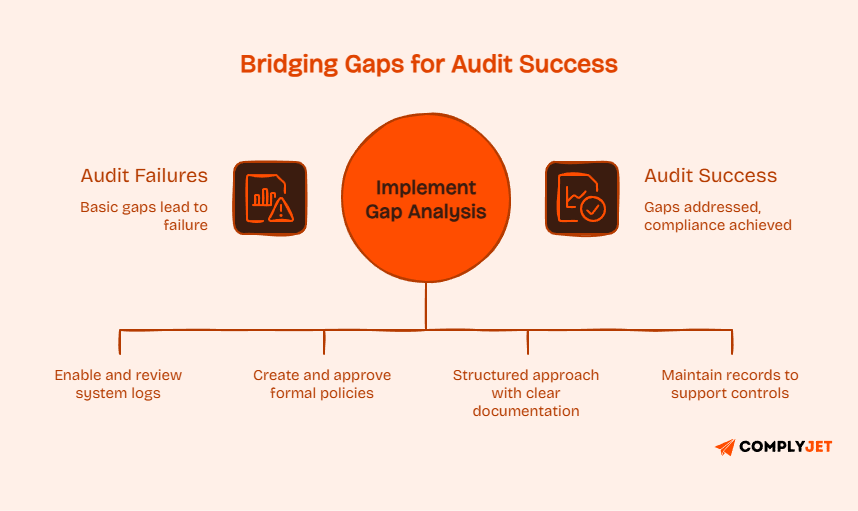
Weak risk assessment is another major gap. Some organizations perform risk assessments as a one-time activity without proper methodology or documentation. Auditors expect a structured approach with clear risk identification, evaluation, and treatment.
There are also cases where controls exist but lack evidence. For example, access controls may be implemented, but there are no access review records or logs to support them. Without evidence, controls are treated as not implemented.
These scenarios highlight a clear pattern. Most failures are not due to lack of effort, but due to gaps in implementation and documentation. Including real examples like these makes gap analysis more practical and helps teams avoid common audit mistakes.
Start your free trial with ComplyJet to track gaps, manage evidence, and move toward ISO 27001 certification with a clear workflow.
ISO 27001 gap analysis compares your current security practices with ISO requirements to identify missing controls, weak areas, and actions needed before moving toward certification.
Gap analysis is not mandatory, but it is highly recommended. It helps identify issues early and reduces the risk of delays or failures during the audit process.
Gap analysis can be performed by internal teams, external consultants, or a combination of both. The choice depends on expertise, resources, and the complexity of the organization.
The timeline varies by organization size. Startups take 2–4 weeks, SMBs 4–6 weeks, and enterprises 6–10 weeks, depending on scope, documentation, and team availability.
Gap analysis identifies missing controls before implementation, while an audit verifies compliance after implementation. Gap analysis prepares you for the audit and reduces the risk of non-conformities.
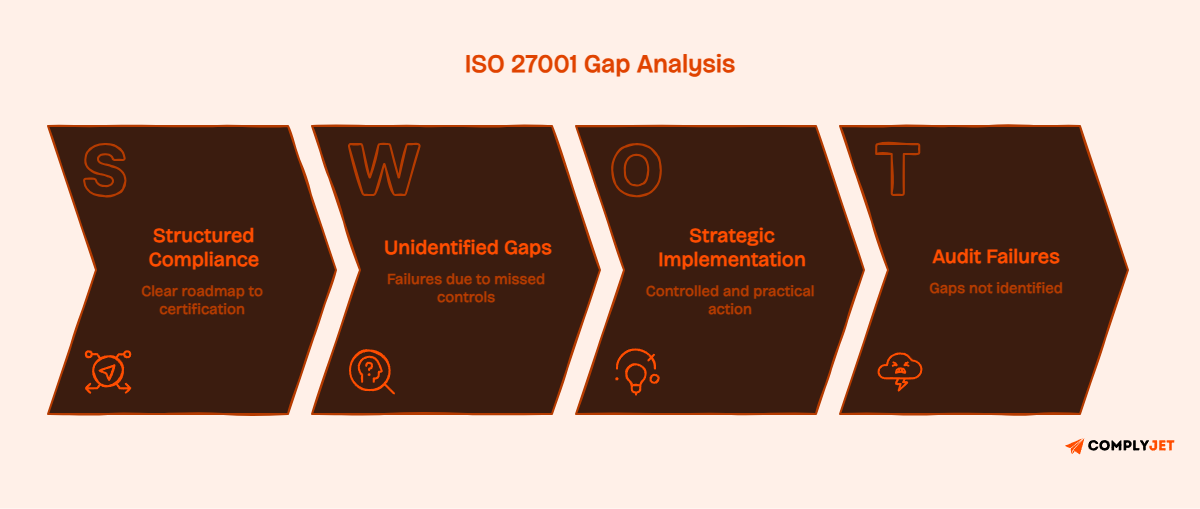
ISO 27001 gap analysis is the foundation of your certification journey. It gives you a clear view of where you stand and what needs to be fixed before moving forward. Without it, teams often work without direction and discover issues too late.
A structured gap analysis helps prevent audit surprises by identifying missing controls early. It allows you to prioritize actions, allocate resources efficiently, and build a clear roadmap toward compliance. This not only reduces delays but also speeds up the overall certification process.
The goal is not just to identify gaps, but to act on them in a controlled and practical way. When done right, gap analysis becomes a strategic step that sets the direction for implementation and audit readiness.
ISO 27001 doesn’t fail at the audit; it fails at the gaps you didn’t identify.
If you want a structured and faster path to ISO 27001 readiness, tools like ComplyJet help you identify gaps, track actions, and stay audit-ready without chaos.



© 2026 ComplyJet. All rights reserved.

