Related Articles
No items found.
.svg)

Most companies start ISO 27001 thinking it will take 3 months.
In reality, it rarely works like that.
The typical ISO 27001 certification timeline is around 6 to 10 months for most companies.
So why the mismatch? Most online guides simplify the process. They skip the real work involved in implementation, documentation, internal reviews, and audits.
Global ISO 27001 certificates nearly doubled from 48,671 in 2023 to 96,709 in 2024, covering 179,877 certified sites worldwide, making it the fastest-growing management system certification on the planet.
If you’re asking how long does ISO 27001 certification take, the honest answer is simple:
It depends on your current security maturity, team bandwidth, and how well you execute each step.
The good part is this: Once you understand what actually goes into the timeline, you can plan better, avoid delays, and move faster.
Planning for ISO 27001? Start with a quick gap assessment to understand your current readiness and expected timeline. With ComplyJet, you get a clear picture of your gaps, what needs to be fixed, and a clear path to move forward without wasting months figuring things out.
Before we break down the timeline, let’s first understand what the ISO 27001 certification timeline actually includes.
The ISO 27001 certification timeline refers to the total time required to go from initial planning to final certification approval.
It is not a single phase. It is a combination of multiple stages that work together.
At a high level, the timeline has two key components:

1. Implementation timeline: This is where you set up your ISMS. It includes defining policies, implementing controls, assigning responsibilities, and making sure everything works in practice.
2. Audit timeline: This is the external validation part. It includes Stage 1 and Stage 2 audits conducted by a certification body to verify your implementation.
Most companies mix these two. They assume that once the documentation is ready, certification will be quick. That is where expectations break.
In reality, ISO 27001 certification is a multi-phase journey. Each phase takes time and depends on how well the previous step is done.
You can also give a quick read to ISO 27001 Password Policy: Requirements, Audit Traps & Best Practices
ISO 27001 certification timeline explained with a clear 6–10 month breakdown, key phases, delays, and ways to speed up. Start your free trial with ComplyJet
Now that you understand what the timeline includes, let’s answer the question most teams actually care about.
This is where most content gets it wrong. You’ll see vague timelines, but not what actually happens inside each phase.
Here’s a practical, month-by-month breakdown of the ISO 27001 certification timeline:
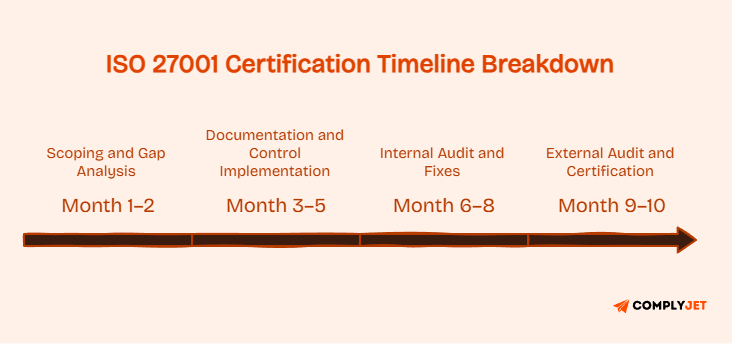
This phase looks simple on paper, but it often takes longer. Internal alignment, unclear scope, and missing inputs slow things down early.
A gap analysis for a cloud-hosted company with ~250 employees typically costs $5,700–$6,000, but it's the investment that prevents far more expensive rework downstream.
This is the most time-consuming phase for most companies. Documentation takes effort, but making controls work in practice is what really consumes time.
Documentation and policy development typically costs $1,000–$8,000 and is one of the most scrutinized components of the external audit. Poor documentation is behind 60% of all Stage 1 audit failures.
Most teams underestimate this phase. Fixing issues, updating documentation, and revalidating controls often takes longer than expected.
For better understanding, refer to ISO 27001 Certification Process (2026): Step-by-Step Guide
Delays here are common due to auditor availability and scheduling gaps.
This is a typical breakdown, not a fixed rule. The actual timeline can vary based on your company's size, complexity, and current level of security maturity.
In 2026, the average ISO 27001 auditor day rate has risen to approximately £1,500 (USD ~$2,000) — a 20% increase over 2025 rates driven by a scarcity of accredited auditors and the ISO/IEC 27001:2022 transition complexity.
Not all companies move at the same pace.
Even though the average ISO 27001 certification timeline is 6 to 10 months, the actual duration depends on how your organization is structured, how decisions are made, and how mature your current security practices are.
Here’s how the timeline typically plays out across different types of companies:
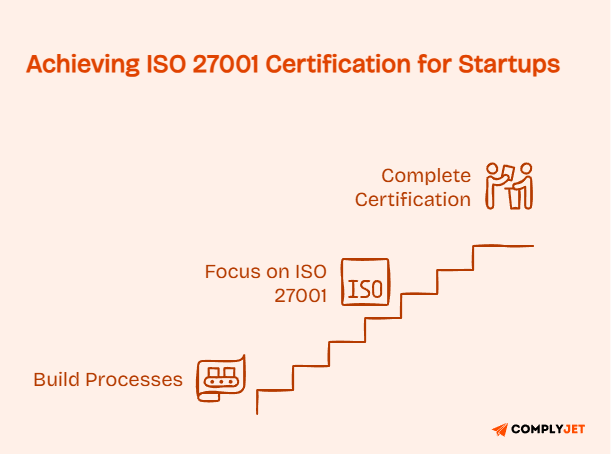
Startups usually move the fastest.
With smaller teams and simpler systems, there are fewer dependencies to manage. Decision-making is quick, often handled directly by founders or a small leadership group. This removes layers of approval that slow things down in larger organizations.
In many cases, startups are also building processes from scratch, which can actually help. Instead of reworking legacy systems, they can design their ISMS and controls in a clean, structured way from the beginning.
That said, speed depends on focus. If ISO 27001 is treated as a priority, startups can complete certification in a shorter time frame.
Small startups using GRC automation can fast-track the process in 3 to 4 months. For most startups and SMBs, the full cost of certification falls between $10,000–$50,000, covering preparation, implementation, and the initial audit.
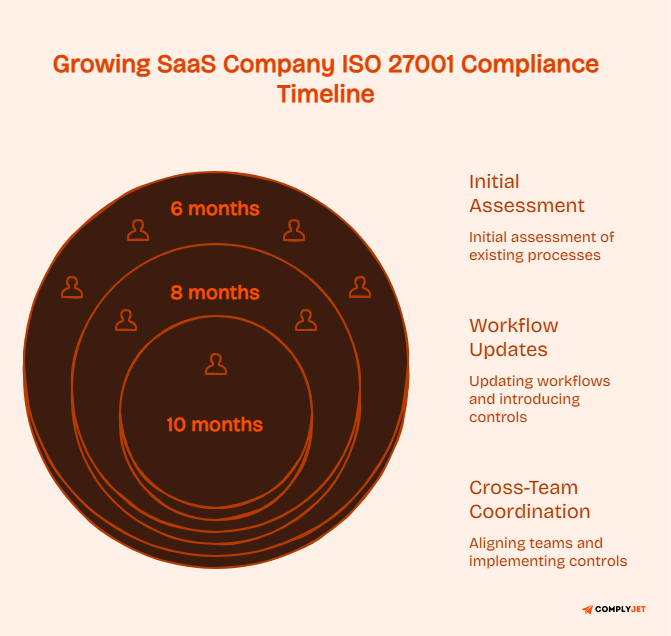
This is where things start to get more structured and more complex.
Growing SaaS companies usually have existing processes in place, but they are not always aligned with ISO 27001 requirements. This means teams need to update workflows, introduce new controls, and document everything properly.
Cross-team coordination becomes a key factor. Engineering, product, HR, and operations all need to contribute. Aligning these teams, collecting inputs, and implementing consistent controls across functions takes time.
These companies are often balancing growth with compliance, which is why the timeline typically falls in the 6 to 10-month range.
Approximately 65% of IT service providers obtained ISO 27001 certification by 2024 largely driven by B2B SaaS customer demand and procurement requirements. Certification is increasingly a deal qualifier, not just a trust signal.

Enterprises take the longest, and for good reason.
They operate with complex systems, multiple business units, and large teams spread across locations. Implementing ISO 27001 here is not just about creating policies. It involves aligning existing frameworks, updating legacy systems, and ensuring consistency across departments.
Approvals take longer because multiple stakeholders are involved. Changes often need legal, compliance, and leadership validation before moving forward.
There is also more at stake. Enterprises tend to be more cautious, which adds additional review cycles and slows execution.
Organizations with 250+ employees must invest 800–2,000+ hours in implementation. Those with multiple locations or complex environments should plan for at least 12–18 months before Stage 2 readiness.
So what actually causes these differences? Let’s break down the key factors that impact the ISO 27001 certification timeline.
Several factors influence how quickly you can get ISO 27001 certified. Most guides list them, but don’t explain how they actually impact execution.
Here are the key ones:

Organization size: Larger teams mean more coordination. More people involved lead to slower decision-making, longer approvals, and higher chances of misalignment during implementation.
Scope complexity: A narrow scope moves faster. A wide scope with multiple systems, locations, or departments increases the effort required for risk assessment, control implementation, and audits.
Existing security maturity: If you already have security practices in place, you are not starting from zero. This reduces implementation time. If everything needs to be built from scratch, timelines stretch significantly.
Resource availability: If your internal team is actively involved, progress is faster. If ISO 27001 is treated as a side project, delays are almost guaranteed.
All organizations must now be certified to ISO/IEC 27001:2022. ISO 27001:2013 certificates expired on October 31, 2025. The updated standard reduced controls from 114 to 93 while adding 11 new ones. Transitioning from the old version adds 10–20% to surveillance audit costs.
While these factors are commonly discussed, they don’t fully explain why timelines slip.
To really understand delays, you need to look at where ISO 27001 projects actually get stuck in practice.
This is where most timelines break.
Not because companies don’t plan, but because execution hits real-world friction.
Here are the common reasons ISO 27001 projects get delayed:
Poor scope definition: If the ISMS scope is not clearly defined at the start, teams end up revisiting it later. This leads to rework in risk assessments, controls, and documentation.
Documentation delays: Policies and procedures often require multiple approvals. Legal, compliance, and leadership reviews slow things down more than expected.
Failed internal audits: Internal audits expose gaps that were missed during implementation. Fixing those issues, updating controls, and revalidating everything takes time.
Lack of leadership involvement: When leadership is not actively involved, priorities shift. Teams lose momentum, and ISO 27001 becomes a secondary task instead of a focused initiative.
Auditor scheduling constraints: Even if you are ready, auditors may not be available immediately. Booking delays for Stage 1 and Stage 2 audits can push timelines further.
These bottlenecks commonly add 2 to 4 extra months to the ISO 27001 certification timeline. For organizations in the middle of a major contract or procurement, that delay can cost far more than the audit fees themselves.
These bottlenecks are common and often add 2 to 4 extra months to the ISO 27001 certification timeline.
The next step is understanding how to avoid these delays and speed up your certification process.
Want to see how ISO 27001 can be implemented without spreadsheets, chaos, or delays? Book a demo with ComplyJet and get a clear compliance roadmap.
One of the biggest factors influencing speed today is whether teams use automation or not.
The difference is not just convenience. It directly impacts how fast you move.
Between 2022 and 2025, cloud-based audit management tools drove a 45% reduction in manual auditing errors across organizations using them. Teams that adopt structured compliance tools consistently move faster through both implementation and audit phases.
Many teams reduce their ISO 27001 timeline significantly by improving execution efficiency, not just implementation.
Beyond tools, there are also strategic ways to accelerate certification.
If your goal is to move faster, effort alone will not help. Execution strategy is what actually reduces timelines.
Here’s what works in practice:

1. Start with a proper gap analysis: Many delays come from discovering issues too late. A clear gap assessment at the beginning helps you identify what needs to be fixed before implementation starts.
2. Use pre-built templates: Creating policies from scratch slows everything down. Using structured templates helps you move faster while staying aligned with ISO 27001 requirements.
3. Run documentation and implementation in parallel: Most teams do this sequentially and lose time. Writing policies while implementing controls speeds up progress and avoids last-minute pressure.
4. Use structured compliance tools: Tracking controls, evidence, and tasks manually leads to confusion. A structured system keeps everything organized and reduces back-and-forth during audits.
Execution strategy matters more than effort. Teams that plan well often finish faster than teams that simply work harder.
If you're also evaluating compliance frameworks, timeline comparison becomes important.
Both ISO 27001 and SOC 2 are widely adopted frameworks, but their timelines are structured very differently.
Here’s how they compare in practice:
You can also give a quick read to ISO 27001 vs SOC 2: The Definitive Guide (2026)
ISO 27001 follows a more defined path. You implement your ISMS, run internal audits, and then go through a two-stage external audit. Each step is clearly structured.
SOC 2 is more flexible but less predictable. The timeline depends heavily on whether you go for Type I or Type II. Type II requires an observation period, which can extend the timeline significantly.
ISO 27001 is a point-in-time assessment, making it structurally faster and cheaper than SOC 2 Type 2, which requires demonstrating control effectiveness over an observation period. Many SaaS companies pursue both but ISO 27001 is typically the right starting point when global enterprise customers are the target audience.
Both timelines vary, but ISO 27001 is generally more structured, while SOC 2 depends more on how long you need to demonstrate control effectiveness.
Now, let’s quickly break down the audit phase, which many teams misunderstand.
The audit phase is where your entire ISO 27001 effort gets validated. Many teams assume this is a quick final step, but in reality, it is a structured process with clear stages and dependencies.
Here is how the audit timeline actually works:

This is the first checkpoint.
At this stage, the auditor evaluates whether your ISMS is properly designed and documented. They review:
The goal is not to check execution yet. It is to confirm that your system is logically complete and aligned with ISO 27001 requirements.
If gaps are found, you will be asked to fix them before moving forward. Common issues at this stage include unclear scope, incomplete risk assessments, or missing documentation.
Stage 1 accounts for roughly 20–30% of the total audit fee. Poor documentation at this stage is the most common reason timelines extend, adding 4–8 weeks before Stage 2 can begin. This is the phase most affected by documentation delays.
This is the main audit.
Here, auditors go beyond documentation and check whether your controls are actually working in practice. They:
This stage requires strong preparation.
If controls are not implemented properly or evidence is missing, non-conformities are raised.
Post-Audit and Certification Decision
After Stage 2, the auditor shares findings:
Once all issues are resolved and accepted, the certification body approves your ISO 27001 certification.
Annual surveillance audits typically cost $7,500 each, while full recertification every three years costs similarly to the initial audit. Budget for ongoing compliance from day one.

This is not a fixed timeline.
It depends entirely on how prepared you are after Stage 1.
If only minor observations are raised, you can move to Stage 2 quickly.
If there are major gaps, you may need weeks or even months to fix them.
This is where many timelines stretch.
Teams underestimate the effort required to close gaps properly.
Most audit delays do not happen during the audit itself. They happen because teams enter Stage 1 or Stage 2 without being fully prepared.
Before wrapping up, let’s address the most common questions teams have.
Typically, 6 to 10 months for most organizations. The exact timeline depends on your current security maturity, scope, and how efficiently you execute each phase.
It is possible, but rare. Only highly prepared startups with a simple scope, strong internal alignment, and existing controls can achieve this timeline.
It requires structured effort, not complexity. Most challenges come from coordination, documentation, and audit readiness. With proper planning, it is manageable.
Start with a clear gap analysis, use pre-built templates, run implementation and documentation in parallel, and use structured tools to keep everything organized.
The global ISO 27001 certification market was valued at $18.59 billion in 2025 and is projected to reach $74.56 billion by 2035, growing at a CAGR of 15.2%. It is currently the fastest-growing certification type globally, driven by escalating cyber threats, GDPR/CCPA regulatory pressure, and digital transformation.
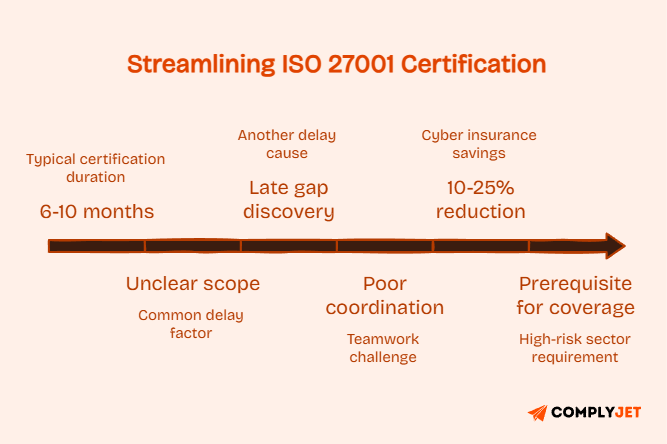
The ISO 27001 certification timeline is not random. Most companies take 6 to 10 months, not because the framework is difficult, but because execution is inconsistent.
Delays usually come from unclear scope, late gap discovery, and poor coordination across teams.
With the right preparation, a clearly defined scope, and a structured approach, you can avoid most of these issues and move significantly faster.
Certified organizations often see a 10–25% reduction in cyber insurance premiums. In high-risk sectors, ISO 27001 is now a prerequisite to even qualify for coverage.
If you're planning ISO 27001 certification, starting with a clear roadmap can save months. With ComplyJet, you get a structured path from gap analysis to audit readiness, so you can focus on execution instead of trial and error.



© 2026 ComplyJet. All rights reserved.

