Related Articles
No items found.
.svg)

Most ISO 27001 projects do not fail because the standard is complex. They fail due to avoidable mistakes made early in the process.
Many teams start with the wrong mindset. They treat ISO 27001 as a documentation task, a fast certification goal, or something that can be handled with templates and minimal effort.
But ISO 27001 is not about ticking boxes. It is about building a system that connects risks, controls, and real operations.
When this alignment is missing, issues begin to appear.
Timelines get longer. Costs increase as teams fix gaps later. Audits reveal differences between documentation and actual practices.
Even after certification, security remains weak.
This is where most organizations struggle. They follow steps, but miss the intent behind them.
This guide goes beyond a checklist. It explains real ISO 27001 mistakes that affect certification, audits, and long-term security.
Each mistake also includes a clear and practical way to avoid it.
Confused about where your ISO 27001 implementation is going wrong? See how leading teams manage risks, controls, and audits in one place. Book a demo and get clarity before your next audit
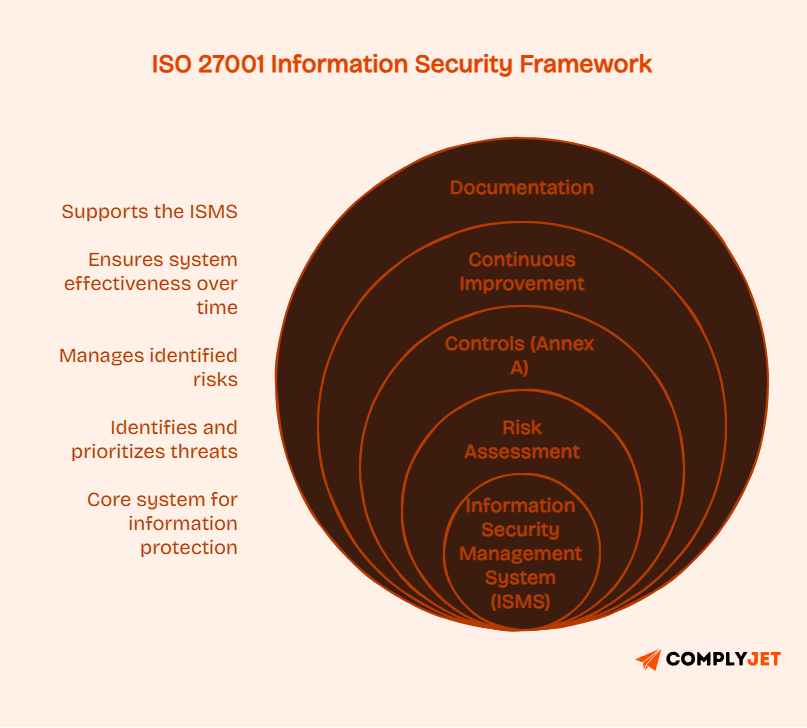
ISO 27001 is an international standard that helps organizations protect their information in a structured and consistent way.
At its core is the Information Security Management System (ISMS). This is not a tool or a document. It is a system made up of policies, processes, people, and technology working together to secure information.
The purpose is simple: protect sensitive data while ensuring business continuity.
ISO 27001 is built around three key components:
One common misconception is that ISO 27001 is documentation-heavy. In reality, documentation only supports the system. Real compliance comes from how well controls are implemented and followed.
It is relevant for:
Understanding this foundation makes it easier to see where organizations go wrong.
ISO Survey 2024: valid ISO 27001 certificates nearly doubled, from 48,671 in 2023 to 96,709 in 2024.
ISO 27001 mistakes are common because of how organizations approach compliance.
The biggest issue is the gap between compliance and actual security. Many teams focus on getting certified rather than building a working system. This leads to a checkbox approach where policies exist, but processes don’t follow.
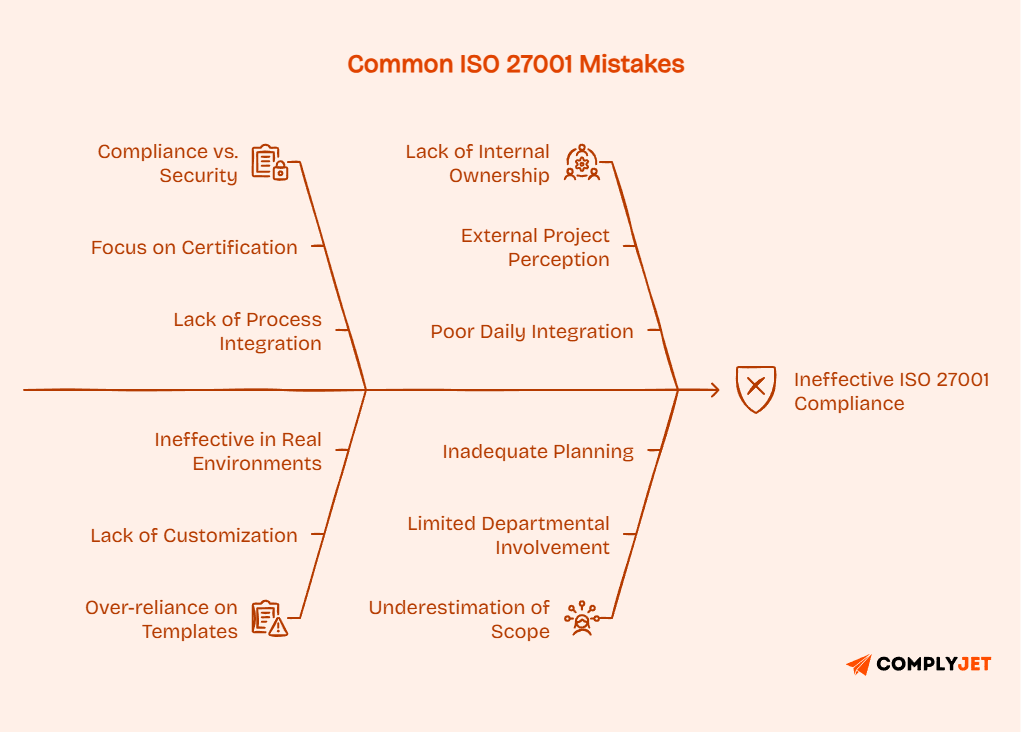
Another issue is over-reliance on templates and consultants. Templates promise speed, but without customization, they fail in real environments.
There is also a lack of internal ownership. When ISO 27001 is treated as an external project, teams do not integrate it into daily operations.
Finally, organizations underestimate the scope. ISO 27001 impacts multiple departments, not just IT. Without planning, coordination breaks down.
Most importantly, these mistakes start early and compound over time.
You can give a quick read: ISO 27001 vs 27002: Roles, Differences Explained (2026)
One of the most common ISO 27001 mistakes is treating it as a one-time project. It is not. It is an ongoing management system.
ISO 27001 follows the PDCA cycle: Plan, Do, Check, Act. This means you must plan, implement, monitor, and improve continuously.
Many organizations take a short-term approach. Their goal is to get certified quickly. They create policies, set up controls, and prepare documents just to pass the audit.
After certification, the focus drops. Teams stop monitoring processes. Improvements slow down or stop completely.
This creates issues during surveillance audits. ISO 27001 is not a one-time certification. Organizations are reviewed regularly to check if controls still work and the ISMS is active.
A better approach is to treat ISO 27001 as a continuous process. This keeps your system effective, relevant, and audit-ready at all times.
When there is no continuous monitoring or improvement, gaps begin to appear, such as:
Auditors quickly spot these gaps. This can lead to nonconformities or even risk suspension of certification.
The bigger problem is weaker security. Without ongoing effort, new risks are ignored and existing controls lose effectiveness over time.
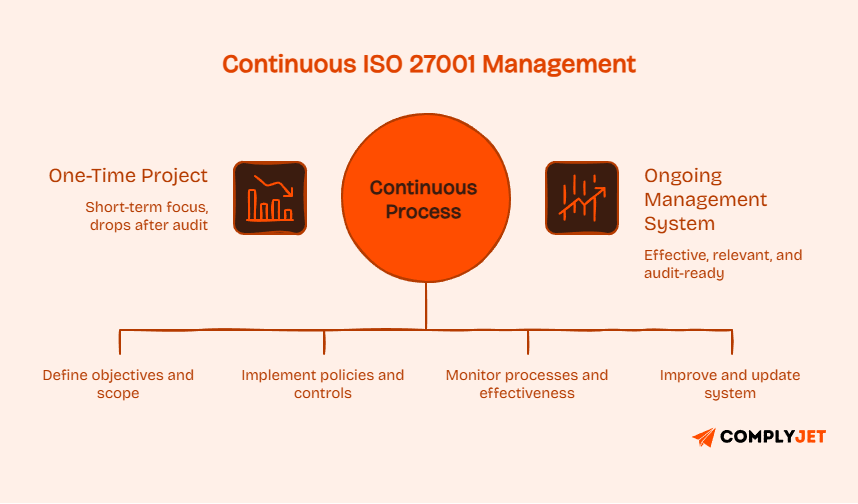
Shift the focus from certification to continuous compliance. ISO 27001 should be treated as an ongoing system, not a one-time milestone.
Build regular monitoring, reviews, and improvements into daily operations. This keeps the ISMS effective and audit-ready.
Start by building processes that support regular monitoring and improvement, such as:
It is also important to assign clear ownership. When teams or individuals are responsible for the ISMS, accountability improves and tasks are less likely to be ignored after certification.
Finally, integrate ISO 27001 into daily operations instead of treating it as a separate project:
When ISO 27001 becomes part of daily work, compliance is easier to maintain and security improves over time.
ISO 27001 implementation cannot succeed without active support from top management. A common mistake is treating it as only an IT or compliance task.
ISO 27001 is a business-wide effort. It needs direction from leadership.
Top management sets the vision for information security. They define goals, approve policies, and align the ISMS with business needs.
When leadership is not involved, security efforts lose focus. They lack priority and long-term commitment.
Without clear direction, teams struggle to implement and sustain the system effectively.
The impact of this gap is visible across the implementation process. Without leadership support, teams struggle with:
As a result, ISO 27001 becomes fragmented. Teams work in silos, controls are applied inconsistently, and risk decisions are delayed or made without business context.
Cultural adoption also suffers. When leadership is not involved, employees do not see security as a priority. Policies exist, but they are not followed.
Over time, this weakens both compliance and overall security.
Gartner (2024 survey of 318 SRM leaders): only 14% successfully balance data security with business objectives.
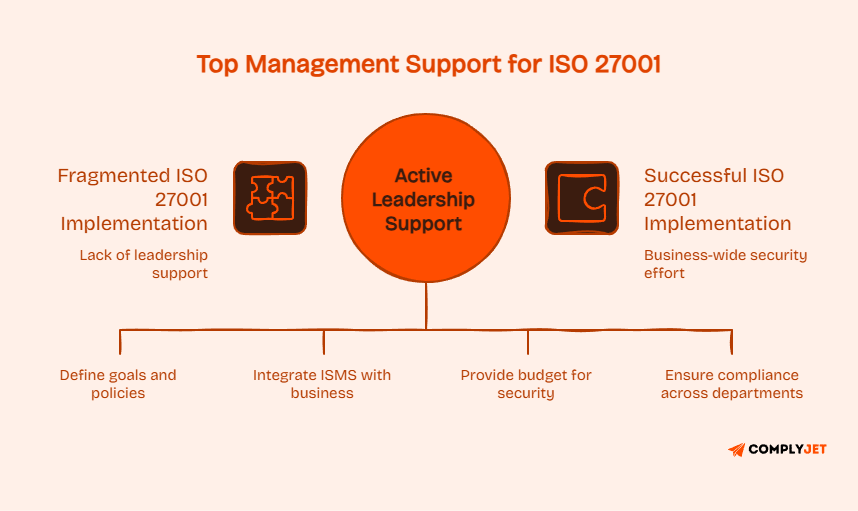
Start by clearly defining the role of top management in the ISMS. Leadership should go beyond approvals and stay involved in key decisions and regular reviews.
Active participation builds alignment, accountability, and a stronger security culture.
Start by establishing accountability:
In addition, involve leadership in risk-related activities:
Regular communication is just as important. Leadership should receive clear updates on ISMS performance, audit results, and areas for improvement through structured reviews.
When top management stays involved, ISO 27001 efforts align better with business goals. They get the right resources and deliver stronger results over time.
Over 90% of employees who admitted to unsecure actions at work knew they were increasing organizational risk but did so anyway.
Defining the scope is one of the first and most important steps in ISO 27001 implementation. It decides which parts of the business, systems, processes, and data are included in the ISMS.
If the scope is unclear, it creates confusion from the start. This leads to delays and inefficiencies across the entire process.
Many organizations get the scope wrong. Some make it too broad, while others make it too narrow.
A broad scope includes too many systems and teams. This increases complexity and puts pressure on resources. It becomes hard to manage controls and maintain consistency.
A narrow scope creates a different problem. It leaves out critical systems or business functions. This may make certification easier, but it weakens security.
It also reduces the real value of ISO 27001. Important risks remain uncovered, and auditors may question if the scope reflects actual operations.
A clear and balanced scope makes implementation smoother, stronger, and more effective.
Common scope-related issues include:
These issues not only affect implementation but also lead to audit challenges. If the scope does not accurately represent the organization, it raises concerns about the effectiveness of the ISMS.
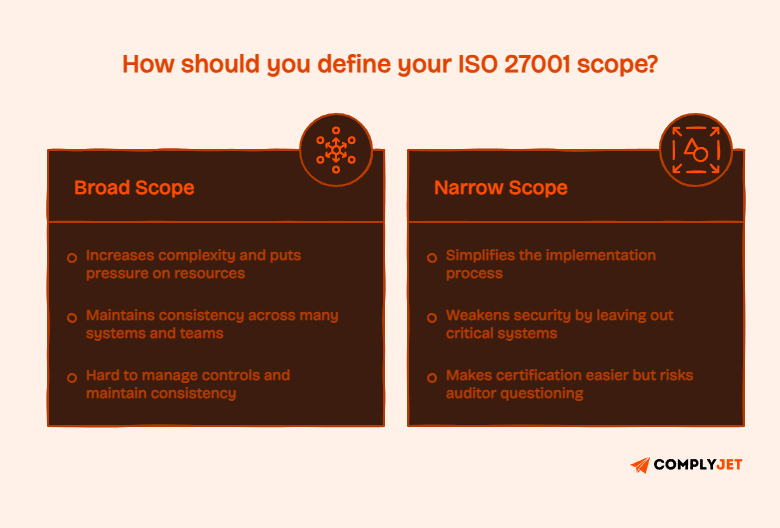
To avoid scope-related issues, organizations need to define the ISMS scope with a clear understanding of their business priorities and risk landscape.
Start by aligning the scope with business objectives:
Focus on critical assets instead of trying to include everything:
It is also important to clearly document scope boundaries:
A well-defined scope makes ISO 27001 implementation more focused and manageable. It keeps efforts aligned with real security needs.
It also improves audit readiness. The ISMS reflects the actual risk environment, making it easier to demonstrate effectiveness during audits.
85% of CEOs now say cybersecurity is critical to enabling business growth.
Risk assessment is the foundation of ISO 27001. Every control, policy, and decision within the ISMS is expected to be driven by risk. When this step is weak or incomplete, the entire implementation becomes unstable.
ISO 27001 does not require organizations to implement all controls blindly. Instead, it requires them to identify risks, evaluate their impact, and apply controls based on those risks. This makes risk assessment the core of the entire framework.
However, many organizations take shortcuts during this stage. They treat risk assessment as a formality rather than a critical process.
Instead of building a structured approach, they rely on assumptions or generic templates. As a result, the risks identified do not accurately reflect the organization’s real environment.
Common shortcuts include:
These shortcuts create a gap between real risks and the controls in place. Teams may apply controls that do not solve actual problems, while serious threats remain unaddressed.
This becomes a major issue during audits. Auditors check how risks are identified, assessed, and treated.
If the process is unclear or inconsistent, it raises doubts about the ISMS. Weak risk assessment often leads to major nonconformities.
The impact goes beyond compliance. Without a strong risk process, organizations lack visibility into threats. This increases the chance of security incidents and business disruption.
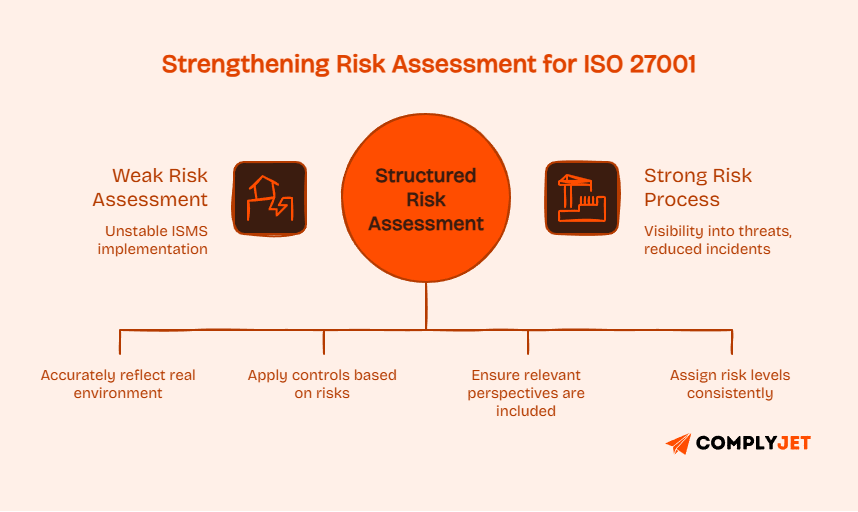
To avoid this mistake, organizations need to treat risk assessment as a structured and repeatable process, not a one-time activity.
Start by using a clear risk assessment methodology:
Involve the right stakeholders in the process:
Document risk treatment plans in detail:
It is also important to review and update risks regularly:
A strong risk assessment process ensures that ISO 27001 implementation is aligned with real risks, making both compliance and security more effective.
Documentation is a key part of ISO 27001, but relying on copy-paste templates is a common mistake.
Many teams use ready-made policies and only change names or small details. This may save time at first, but it creates a gap between what is written and what actually happens.
Templates are only a starting point. They are not a complete solution.
Every organization has different systems, workflows, and risks. If documents do not match these realities, they lose their value and become ineffective.
Common signs of template misuse include:
This becomes a major issue during audits. Auditors do not just review documents, they verify whether those documents are being followed. When policies and procedures do not align with real operations, it leads to nonconformities.
Typical audit risks include:
Poor documentation does more than impact audits. It creates confusion within teams. Roles are unclear, processes vary, and security practices become inconsistent.
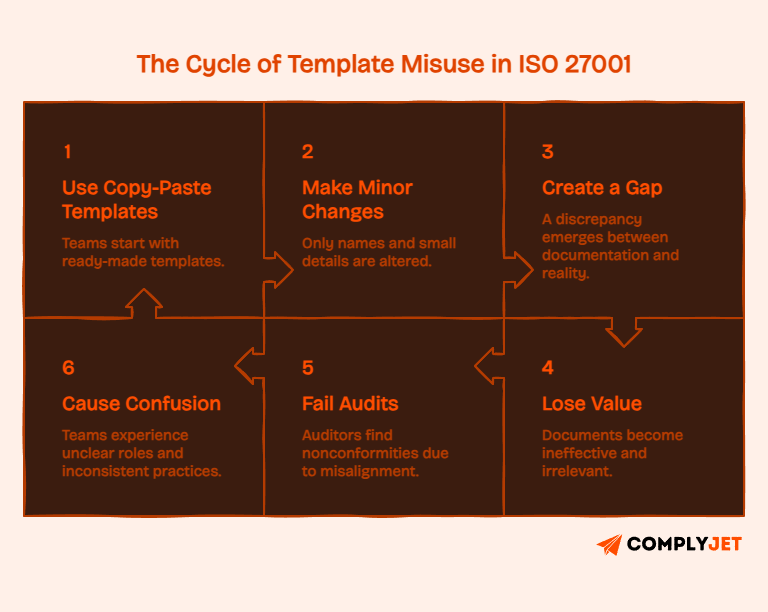
Treat documentation as a reflection of real work, not just a compliance task.
Ensure policies match actual processes. Keep them clear, updated, and easy for teams to follow.
Start by customizing all documentation:
Align documentation with actual operations:
It is also important to maintain and update documentation regularly:
When documentation reflects how the organization actually operates, it becomes easier to implement controls, train employees, and pass audits with confidence.
Tired of managing ISO 27001 in spreadsheets and documents? Automate policies, risks, and evidence collection in one place. Start your free trial today
One of the most overlooked ISO 27001 mistakes is ignoring employee awareness and training.
Organizations invest in policies, controls, and tools, but forget the human factor. This is often the biggest security risk.
Employees use systems, handle data, and make daily decisions that affect security.
Without proper training, even strong controls can fail. A simple mistake, like clicking a phishing link or mishandling data, can cause serious incidents.
Human-related risks typically arise from:
When employees are not trained, security becomes inconsistent. Policies may exist, but they are not followed in daily work.
This gap shows up during audits. Employees may not understand key policies or procedures when asked.
The impact goes beyond compliance. Many security breaches involve human error. Without awareness, organizations stay vulnerable, even with strong technical controls.
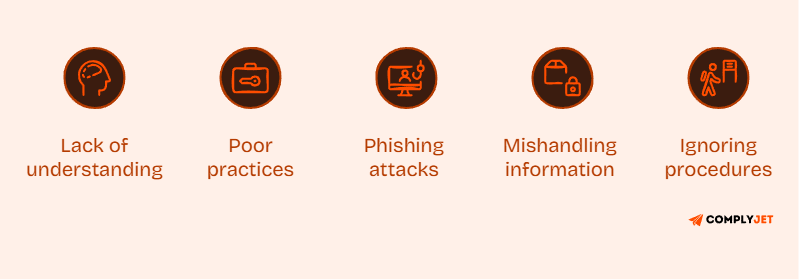
To address this, organizations need to make employee awareness a continuous part of their ISO 27001 implementation.
Start with regular training programs:
Build ongoing awareness initiatives:
It is also important to track and measure effectiveness:
When employees understand their role in information security, they become an active part of the ISMS rather than a potential risk.
60% of all breaches involved the human element — consistent with 2024, confirming this is not improving without deliberate intervention.
Control selection is a critical part of ISO 27001, but it often goes wrong when controls are not linked to real risks.
ISO 27001 does not require you to apply every Annex A control. Controls should be chosen based on your risk assessment.
When this link is missing, teams either add too many controls or miss important ones.
Many organizations pick controls from templates or copy others. This creates controls without purpose, while real risks remain unaddressed.
Common issues with poor control selection include:
This creates inefficiencies in the ISMS. Teams spend time managing controls that do not add value, while critical risks remain exposed.
It also makes audits more difficult. Auditors expect a clear link between identified risks and selected controls.
When this link is missing, it raises doubts about the effectiveness of the ISMS.
Auditors may flag gaps in the Statement of Applicability or highlight mismatches between risk treatment plans and actual controls.

To avoid poor control selection, organizations need to ensure that every control is directly justified by risk.
Start by maintaining a clear and structured Statement of Applicability (SoA):
Link controls directly to risk treatment:
It is also important to review control effectiveness regularly:
A well-maintained Statement of Applicability ensures transparency, improves audit readiness, and strengthens the overall effectiveness of the ISMS.
Underestimating the time and resources needed for ISO 27001 is a common mistake. It leads to delays, stress, and incomplete implementation.
Many organizations start with unrealistic expectations. They believe ISO 27001 can be done quickly with little effort, especially with templates or consultants.
This results in tight timelines, limited budgets, and added pressure on internal teams.
In reality, ISO 27001 is a cross-functional effort. It involves multiple teams and activities like risk assessment, control implementation, documentation, training, audits, and continuous monitoring.
Each of these steps takes time and requires focused effort.
Unrealistic planning often leads to:
As the certification audit gets closer, pressure increases. Many teams shift into reactive mode. Instead of following a clear plan, they rush to fix gaps.
This leads to mistakes and increases the risk of nonconformities.
The cost impact is also high. What seems like a cost-saving approach at first often becomes expensive later.
Rework, extra consulting support, and delays in certification add to the overall cost.

Avoiding this mistake requires realistic planning from the beginning, with a clear understanding of the scope and effort involved.
Start by allocating proper time and resources:
Plan your budget carefully:
It is also important to involve cross-functional teams early:
Finally, monitor progress consistently:
When organizations plan realistically and allocate the right resources, ISO 27001 implementation becomes more structured, predictable, and successful.
Skipping internal audits is a serious mistake in ISO 27001 implementation. It increases the risk of failure during certification.
Internal audits are not just a requirement. They help check if the Information Security Management System (ISMS) is working as expected.
They highlight gaps, inconsistencies, and controls that are not properly followed. This happens before the external audit, giving teams time to fix issues.
Many organizations delay or skip internal audits. Common reasons include lack of time, limited expertise, or too much confidence in their documentation.
Some believe that having policies and controls is enough. In reality, this assumption often leads to audit failures.
Without internal audits, organizations miss the opportunity to detect issues such as:
These issues often surface during the certification audit, when there is little time to fix them. This leads to nonconformities, audit delays, and last-minute pressure.
Internal audits help prevent this. They identify gaps early, when there is still time to act.
They also support continuous improvement. Instead of waiting for external feedback, teams get clear insights into how the ISMS is performing and where changes are needed.
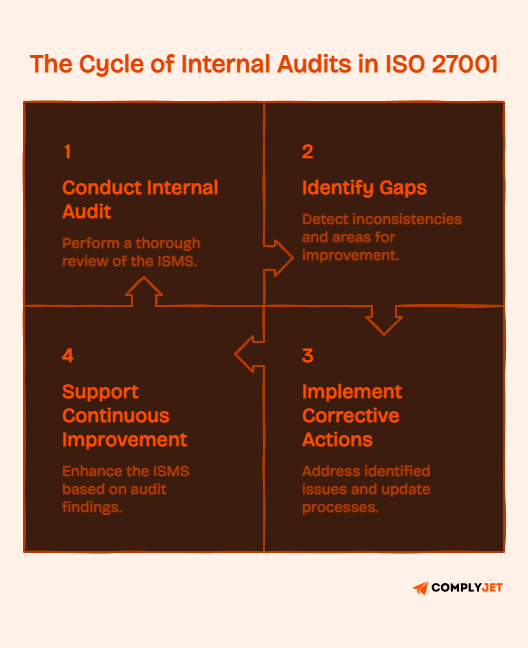
To avoid this mistake, organizations should treat internal audits as a regular and structured activity, not a one-time task before certification.
Start by conducting audits at planned intervals:
Assign qualified auditors:
Act on audit findings promptly:
Regular internal audits help organizations stay prepared, reduce last-minute surprises, and improve the overall effectiveness of ISO 27001 implementation.
Don’t let small gaps turn into audit failures. Track compliance, risks, and audits in real time with complete visibility. Book a demo or start your free trial today
Evidence collection and record keeping are critical in ISO 27001, but many teams ignore them until the audit stage. They focus on policies and controls, but not on proof.
In ISO 27001, having a control is not enough. You must show evidence that it is implemented, followed, and monitored over time.
Without this proof, even strong systems can fail during audits.
Poor evidence management often comes from manual work. Teams use spreadsheets, emails, and shared folders to store records. This creates gaps, inconsistencies, and missing data.
A better approach is to maintain evidence continuously, not just before audits. This keeps your system reliable and audit-ready.
Common issues include:
These gaps often show up during certification or surveillance audits. Auditors expect clear, organized, and traceable evidence for policies, controls, and risk activities.
When evidence is missing or inconsistent, it leads to nonconformities and delays.
Poor record keeping also affects daily work. Teams waste time searching for documents, recreating evidence, or fixing errors. This increases workload and reduces trust in the ISMS.
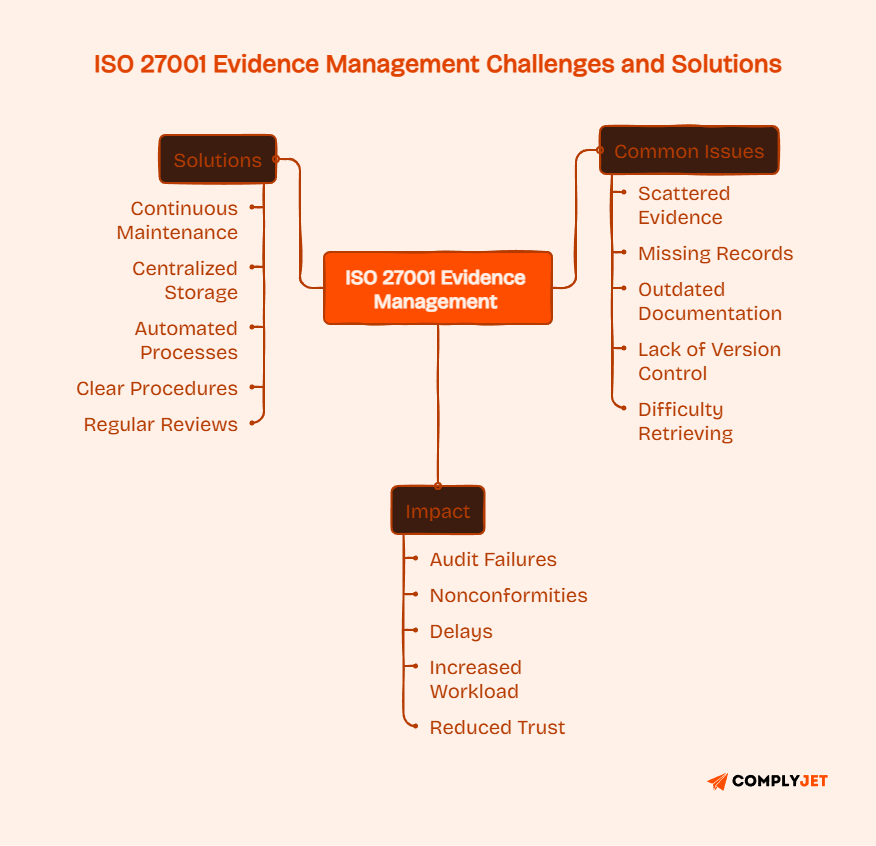
Treat evidence collection as a continuous and structured process, not a last-minute task.
Maintain records regularly, keep them organized, and ensure they clearly support your controls and risk management activities.
Start by centralizing documentation:
Standardize how evidence is collected and maintained:
Implement proper tracking and control:
It is also important to review evidence periodically:
When evidence collection is centralized and well managed, organizations can show compliance with confidence and reduce audit stress.
ISO 27001 is not static. It requires continuous monitoring and improvement, but many organizations lose momentum after implementation.
The standard is based on the PDCA cycle: Plan, Do, Check, Act. Most teams focus on the “Plan” and “Do” stages.
They often ignore the “Check” and “Act” phases, where performance is reviewed and improvements are made.
This results in a system that exists on paper but is not actively evaluated or improved over time.
Without continuous monitoring, organizations lose visibility into how well their controls are performing. Risks evolve, systems change, and new threats emerge, but the ISMS remains unchanged.
Over time, this creates gaps between documented processes and actual practices.
Common issues caused by lack of monitoring include:
These gaps often appear during surveillance audits. Auditors expect clear proof of ongoing monitoring and improvement.
If this evidence is missing, it raises doubts about how effective the ISMS really is.
More importantly, without continuous improvement, security weakens over time. Organizations struggle to respond to new risks and changing business needs.

To avoid this mistake, organizations need to actively implement the “Check” and “Act” phases of the PDCA cycle.
Start with regular reviews of the ISMS:
Define and track key performance indicators (KPIs):
Establish a structured improvement process:
It is also important to adapt continuously:
When continuous monitoring and improvement become part of daily operations, the ISMS remains effective, audit-ready, and aligned with the organization’s evolving risk landscape.
Choosing the wrong tools or relying too much on consultants is a common mistake. It affects both the speed and quality of ISO 27001 implementation.
Many organizations hire consultants to move faster or use tools that promise quick compliance. Both can help, but problems start when there is too much dependence.
Consultants provide frameworks, templates, and guidance. But if internal teams are not involved, they do not learn. The knowledge stays with the consultant.
When the engagement ends, teams struggle. They find it hard to maintain the ISMS, update controls, or prepare for audits.
The same issue applies to tools. Not all tools support long-term compliance. Some only manage documents. Others lack features like risk tracking, evidence management, or audit support.
A better approach is balance. Use consultants and tools, but build strong internal ownership at the same time.
This leads to fragmented processes and reliance on multiple systems.
Common issues include:
These challenges create long-term inefficiencies. Organizations may achieve certification initially but struggle to sustain compliance and improve their security posture over time.
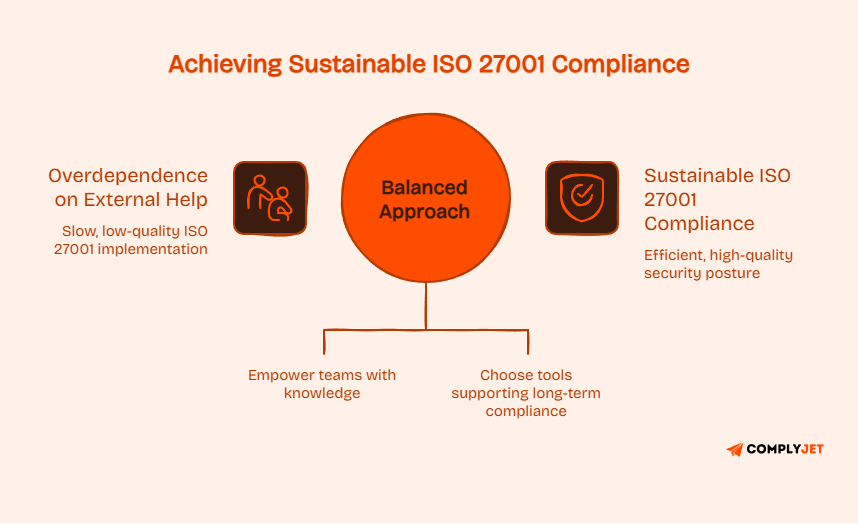
To avoid this mistake, organizations need to balance external support with internal ownership.
Choose scalable and practical solutions:
Build internal capability alongside external support:
Reduce dependency over time:
When organizations invest in the right tools and build internal expertise, they create a system that supports long-term compliance and security.
Simplify ISO 27001 implementation from day one. From risk assessment to audit readiness, manage everything in one place. Start your free trial now.
Avoiding ISO 27001 mistakes takes more than awareness. It requires a clear and structured approach.
Every step should align with real business needs and risks.
Organizations that follow a defined framework face fewer delays and less rework. They are also more likely to achieve long-term compliance.
ISO 27001 should not be treated as separate tasks. It should be implemented as a continuous and integrated process.

Start by defining the scope of your ISMS with precision. The scope should reflect your key business operations, systems, and data that need protection.
A well-defined scope ensures that implementation remains focused and manageable.
Risk assessment should guide every decision in your implementation.
This step ensures that your controls are aligned with actual risks rather than assumptions.
Based on your risk assessment, select and implement controls that address identified risks.
Effective control implementation strengthens both compliance and security.
Employees play a critical role in maintaining information security.
When employees understand their responsibilities, compliance becomes more consistent.
Internal audits help validate whether your ISMS is functioning as expected.
This step reduces the risk of surprises during certification.
ISO 27001 is built on continuous improvement. Implementation does not end with certification.
Continuous improvement ensures that your ISMS remains effective and relevant over time.
Following a structured framework helps organizations shift from a reactive to a proactive approach.
Instead of fixing issues later, they build a system that is aligned, scalable, and audit-ready from the start.
This reduces rework, improves efficiency, and strengthens long-term security.
It usually takes 3 to 12 months. The timeline depends on scope, company size, available resources, and current security maturity.
Treating ISO 27001 as a documentation or certification task instead of a management system. This creates gaps between written policies and actual practices.
They fail due to poor planning, unclear ownership, weak risk assessments, overuse of templates, tight timelines, and lack of continuous monitoring.
It usually takes 3 to 12 months. The timeline depends on scope, company size, available resources, and current security maturity.
Yes. They can define a clear scope, focus on key risks, involve leadership early, and implement practical controls without adding complexity.
Run internal audits, keep documents updated, organize evidence, train employees, and ensure controls match real business processes.
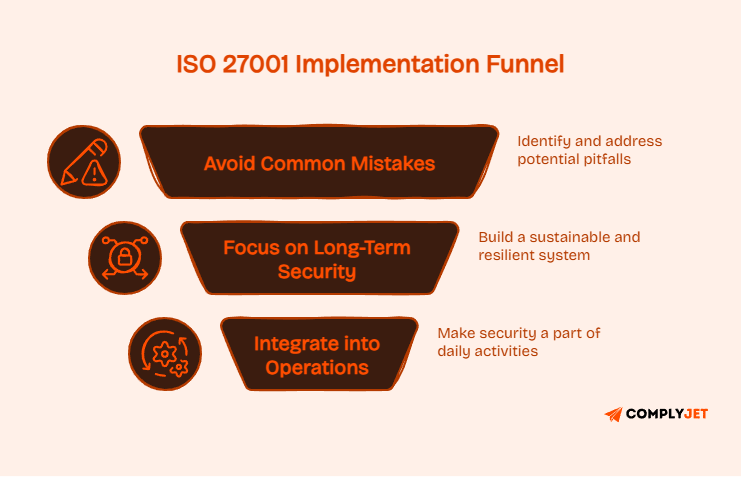
ISO 27001 implementation mistakes are common, but they can be avoided. Most problems come from the approach, not the standard itself. With the right structure, teams can spot and fix issues early.
Many organizations see certification as the end goal. It is not. Certification is just one step. The real value comes from building a system that protects data, adapts to risks, and supports growth.
When ISO 27001 is treated like a one-time project, things break over time. Controls become outdated. Processes lose relevance. Teams struggle to stay compliant.
A better approach is to focus on long-term security. This creates systems that are stable, scalable, and resilient.
A strong ISMS does more than help you pass audits. It improves risk visibility. It strengthens processes. It builds trust with customers and stakeholders.
Over time, it becomes part of daily operations, not just a compliance task.
Execution is what makes the difference. With a clear plan and by avoiding common mistakes, organizations can achieve both compliance and real security outcomes.
Ready to implement ISO 27001 without costly mistakes? Get guided workflows, automation, and audit readiness in one platform. Start your free trial today.



© 2026 ComplyJet. All rights reserved.

