.svg)

An anonymous whistleblower claimed that Delve used the same boilerplate in 493 of 494 SOC 2 reports, changing only the customer’s name and logo, according to TechCrunch. Delve disputes the characterization. Y Combinator cut ties with the company on April 3, 2026.
The Case:
Delve lost its Y Combinator backing in April 2026 after a whistleblower alleged its SOC 2 reports were largely copy-paste. Two of its customers, LiteLLM and Context AI, suffered real security incidents afterward. Delve denies the fabrication claims.
Whatever you believe about the allegations, if you're on Delve today or evaluating it, this is the moment to look at Delve alternatives. Below: what's actually confirmed, what's still alleged, and 12 real alternatives ranked and compared in depth.
Whatever you believe about the allegations, if you're on Delve today or evaluating it, this is the moment to look at Delve alternatives. Below: what's actually confirmed, what's still alleged, and 12 real alternatives ranked and compared in depth.
Here's what's ahead:
- What's actually been reported about Delve, and what's still just alleged
- Why teams are re-evaluating right now, beyond just the news cycle
- All 12 alternatives at a glance, then compared in depth one by one
- Five questions worth asking any compliance vendor, not just a Delve replacement
- What to actually do if you're on Delve today
What's Actually Been Reported About Delve
Start with what's confirmed, not what's alleged. The distinction matters, and most coverage of this blurs it.
An anonymous whistleblower operating under the handle "DeepDelver" published claims in early 2026 about how Delve's compliance platform actually produced its SOC 2 reports. Those claims made it to Y Combinator, and to TechCrunch. What happened next is a matter of public record, not speculation.
| Date | Event |
|---|---|
| Early 2026 | Whistleblower "DeepDelver" publishes allegations about Delve's audit practices |
| April 3, 2026 | Y Combinator removes Delve from its companies directory and severs ties |
| April 2026 | LiteLLM discloses hackers planted malware in its open-source code, drops Delve |
| April 23, 2026 | TechCrunch reports Context AI suffered a separate breach compromising Vercel's internal systems, also drops Delve |
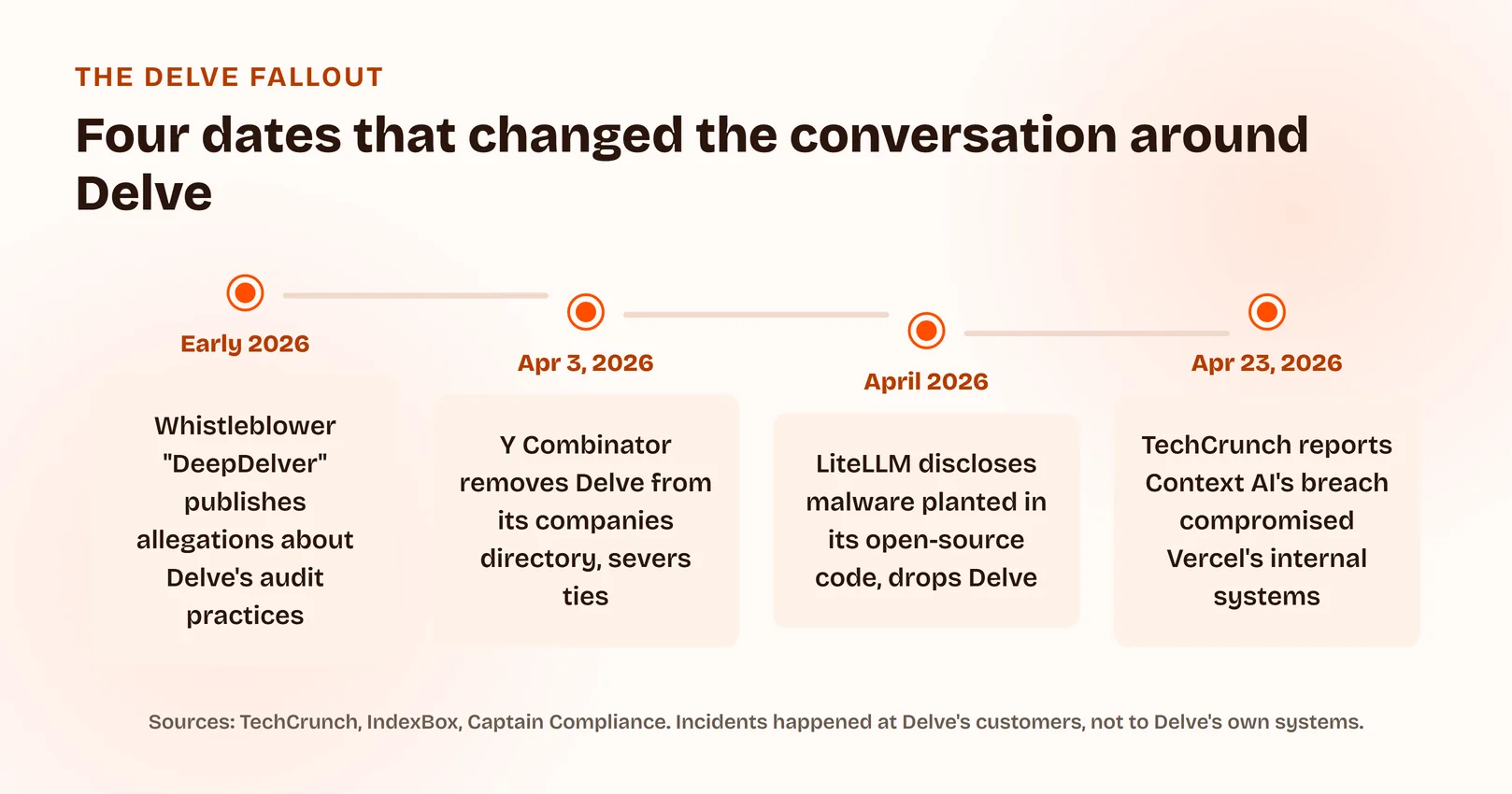
Two named customers had real, separate security incidents after using Delve. LiteLLM, an AI gateway startup, found malware planted in its open-source code and told TechCrunch it was dropping Delve and getting re-certified elsewhere. Context AI, an AI agent training startup, suffered a breach through an employee's access that went on to compromise Vercel's own internal systems and customer data. Context AI has since switched to Vanta.
A third company, Lovable, disclosed separately that it had "inadvertently shared access to customer chat data publicly." Worth being precise here: Lovable had already left Delve in late 2025, before that disclosure, so this one belongs to the wider pattern of scrutiny around the space, not to Delve's own incident list directly.
State this plainly, the way the record actually supports it: the security incidents happened at Delve's customers, not to Delve's own systems. That distinction is real, and it matters for how you read the rest of this.
What's Alleged, and What Delve Says
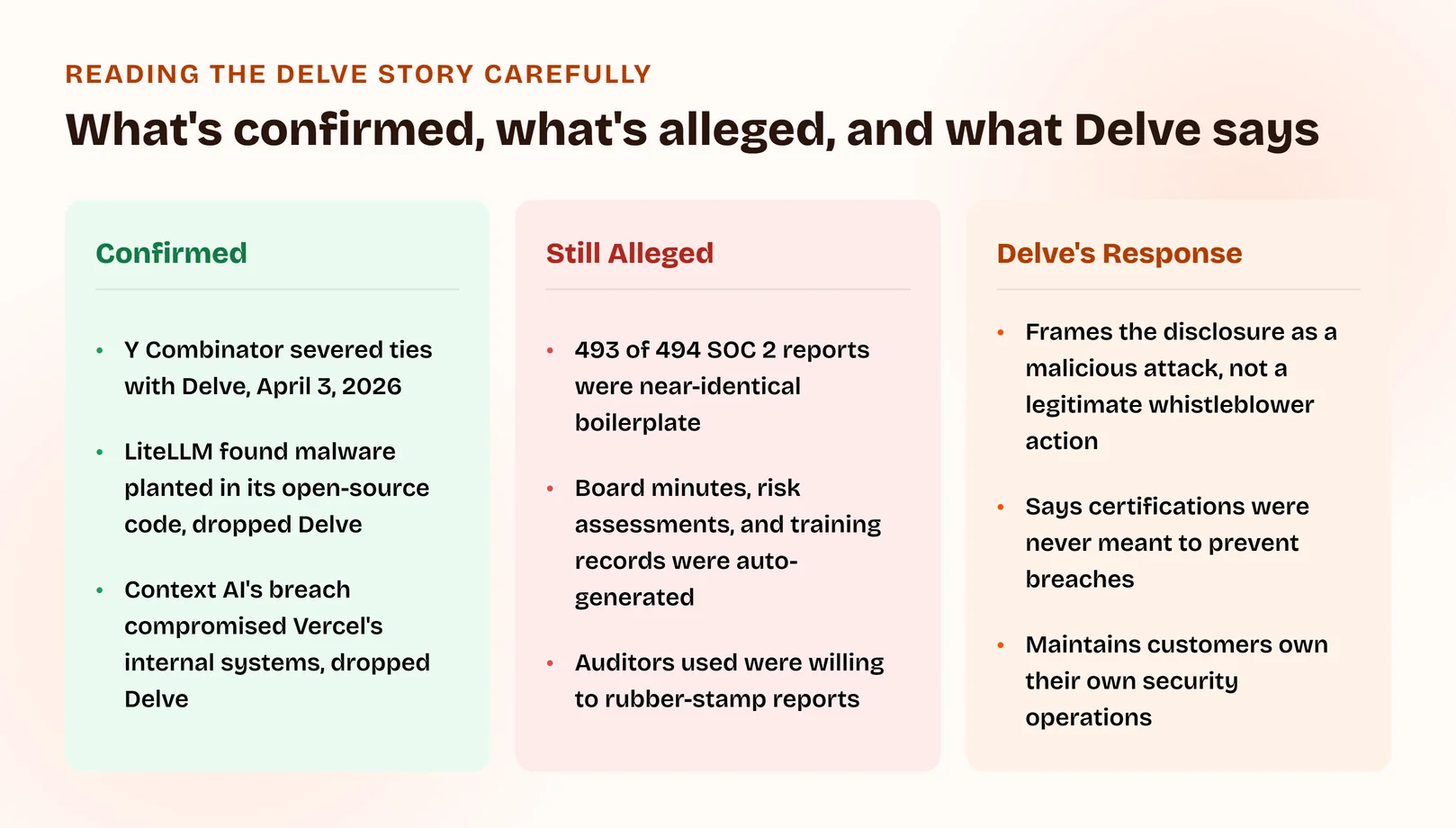
The whistleblower's specific claims go further than "two customers had bad incidents," and these parts remain allegations, not established fact.
DeepDelver's claims, as reported: that 493 of 494 SOC 2 reports Delve generated were near-identical boilerplate, company name and logo changed and little else. That the platform auto-generated passing documentation: board meeting minutes with placeholder text, risk assessments defaulting to the same 10 risks regardless of the actual business, employee training records that may not reflect real training.
The claims go further still. That every Type II report reviewed claimed zero incidents. That Delve used auditors willing to rubber-stamp reports without real scrutiny. That Delve used an open-source tool without proper attribution.
Note
None of the claims in this section are independently verified as fact. They are what the whistleblower alleges, reported by outlets including TechCrunch, and denied by Delve. Treat them as allegations until a court, auditor body, or independent investigation says otherwise.
Delve's official response, as reported by TechCrunch: the company frames the whistleblower's disclosure as a malicious attack involving data exfiltration, not a legitimate whistleblower action. Delve's stated position is that it "helps customers prepare for audits like SOC 2," and that certifications alone were never meant to prevent breaches, customers still own their own security operations regardless of what platform they use.
Both things can be true at once. A company can deny fabrication while also being right that a SOC 2 report was never a breach-proof guarantee. Neither claim cancels the other out, and neither is the full picture on its own.
Why Compliance Teams Are Re-Evaluating Delve Right Now
Set the scandal aside for a moment. There's a second, quieter reason teams were already questioning Delve before any of this became public, and it shows up directly in Delve's own G2 reviews.
The trust question comes first. If your SOC 2 report came out of a platform now facing fabrication allegations, your next enterprise buyer's security reviewer is going to ask about it. So will your own auditor, if you're up for renewal. That's a real cost even if every allegation turns out to be false: the report itself is now a conversation you have to have, not a box you get to check silently.
Evidence portability is the practical follow-up question. If you decide to move, can you take your existing evidence with you, or are you starting your compliance program over from zero? That answer varies by platform, and it's worth asking directly before you sign anywhere.
Beyond the scandal, reviewers have flagged the same product gaps for months. One reviewer put it bluntly:
"I find Delve lacking in automation and integrations, which makes compliance efforts cumbersome... The claimed 'continuous monitoring' is misleading since it lacks visibility after initial setup and doesn't provide ongoing security assurance." Aditya R., G2 review, October 2025
Another reviewer described the AI-assisted setup as the opposite of what was promised:
"The allure of their AI features was appealing during the demo, but despite what they claimed would take only a few hours, it ended up requiring weeks of mostly manual work." Rohit M., G2 review, October 2025
Worth noting for fairness: not every review is negative, and the reporting-depth complaint below comes from an otherwise satisfied, 5-star customer, not a standalone gripe.
"The reporting could go a step further. As a founder, I want a one-glance view that ties open risk/compliance tasks to business impact." Tom P., CEO, G2 review, December 2025
Put together, the pattern across real reviews, independent of the scandal, is: promising AI-led automation that still requires heavy manual work, monitoring that doesn't stay visible after setup, and reporting that doesn't reach the level a founder or board actually wants. That's the case for looking elsewhere even if you set the whistleblower story aside entirely.
ComplyJet
See what real compliance outcomes actually look like
Read how other teams describe working with ComplyJet, not marketing copy about it.
The 12 Best Delve Alternatives, at a Glance
This ranks and profiles 12 real SOC 2 compliance platforms as Delve alternatives, the same names that come up whether you search for delve compliance alternatives or just soc 2 compliance software like Delve without the current baggage attached.
It's a companion to ComplyJet's own Best SOC 2 Compliance Software buyer's guide, not a replacement for it: that page is the evergreen, vendor-neutral version of this comparison, and it's the better read if you're not specifically here because of the Delve news.
| # | Vendor | Best For | Pros | Cons |
|---|---|---|---|---|
| 1 | Vanta | Teams that want the category's most-referenced default | Widest integration library, category-leading reputation | Renewal-year price jumps, rigid templated workflows |
| 2 | Drata | Mid-market SaaS teams (50-250 employees) wanting deep DevOps ties | Excellent auditor collaboration portal, strong multi-framework support | Compounding per-framework add-on costs |
| 3 | ComplyJet | Early-stage teams (seed-Series A) wanting outcome ownership, not just software | Flat published pricing, team-guided process end to end | Smaller integration library, less brand recognition |
| 4 | Sprinto | Startup teams that want continuous monitoring without per-user pricing | No per-user pricing, strong once fully set up | Interface complexity during setup |
| 5 | Secureframe | First-time auditors wanting guided workflows | 300+ integrations, strong onboarding structure | No public pricing, some controls need manual effort |
| 6 | Scrut Automation | Teams with a dedicated compliance function wanting depth | Highest review volume and rating in category, fast time-to-compliance | More platform than most early-stage teams need |
| 7 | Thoropass | Teams that want the platform and the auditor bundled together | One vendor for software and audit, no separate auditor search | Narrower automation depth than Vanta or Drata |
| 8 | Scytale | Teams juggling many frameworks at once | 60+ frameworks supported, strong AI-assisted setup | No pricing transparency, consulting add-ons raise cost |
| 9 | OneTrust | Enterprises consolidating compliance, privacy, and risk in one suite | Best cross-framework evidence reuse at scale | Not built for startups, $50K+/year entry point |
| 10 | Oneleet | Teams that want pen testing bundled with compliance | Security-first team background, one vendor for both | Can't run multiple frameworks simultaneously |
| 11 | Hyperproof | Mid-market/enterprise teams coordinating multiple compliance programs | Broad framework coverage (118+), strong evidence reuse | Setup complexity, opaque pricing, mandatory implementation fees |
| 12 | StandardFusion | Teams evaluating it should confirm terms post-acquisition | Highly configurable, strong control mapping | Acquired by Wolters Kluwer (Jan 2026), no longer independent |
How We Ranked These 12 Delve Alternatives
The rank order above matches ComplyJet's own best-soc-2-compliance-software list for the 10 vendors both pieces cover, with Hyperproof and StandardFusion added for the two extra slots this list needed. Criteria: reported automation depth, fit for an early-stage team versus a mid-market or enterprise one, pricing transparency, integration breadth where it's publicly documented, and independent review signal on G2.
ComplyJet is one of the 12 ranked here, at #3. That's not a coincidence and it's not inflated either. It's the same rank ComplyJet holds on the evergreen comparison, scored against these Delve competitors using the same criteria as every other platform on this list.
There's no single best Delve alternative for every team. The right pick depends on your stage, how many frameworks you're running, and whether you want a self-serve platform or a guided one, not a universal winner. If your team is specifically building an AI product, ComplyJet's AI-company-specific ranking of these same platforms scores them on AI-governance readiness instead.
The 12 Delve Alternatives, Compared in Depth
1. Vanta
Screenshot captured from Vanta's official website, for informational purposes only.
Vanta is the category's most-referenced platform, and for good reason: it's held the #1 spot in G2's Security Compliance category for 14 consecutive quarters, with 400+ integrations, the widest library in this list. In a direct delve vs vanta comparison, that integration count and category track record are the two things Delve never had.
It's a strong fit for a team that wants the safest, most widely recognized name in the room, particularly if you're selling into enterprise buyers who'll recognize the brand on sight. The tradeoff shows up at renewal: year-2 price increases in the 30 to 50 percent range are a common complaint, and its workflows are described as rigid and template-driven, better suited to a standard SaaS stack than a nonstandard one.
For the full breakdown of its report types and real onboarding process, see ComplyJet's dedicated Vanta SOC 2 guide.
| Pros | Cons |
|---|---|
|
|
Pricing: quote-based, reportedly $15,000 to $30,000/year for an SMB-sized program.
"What I like most about Vanta is that it makes security compliance feel straightforward and far less time-consuming. The platform automates evidence collection, supports continuous monitoring, and gives a clear, up-to-date view of an organization's security posture." Balkishan N., Senior Software Engineer, G2 review, July 2026
2. Drata
Screenshot captured from Drata's official website, for informational purposes only.
Drata is built for cloud-native, engineering-heavy teams that want continuous, automated evidence collection tied directly into their infrastructure. Its auditor collaboration portal is genuinely one of the best in the category, and it supports 12+ frameworks out of the box. If you're weighing it specifically against Vanta and Oneleet, ComplyJet's three-way comparison goes deeper on all three.
The cost model is where it gets complicated: per-framework add-ons run $3,000 to $10,000 each on top of the base tier, and those compound quickly for a team running more than one framework. Pricing stays opaque until late in the sales cycle, the same pattern as most of this list.
| Pros | Cons |
|---|---|
|
|
Pricing: Foundation $7,500 to $15,000/year; Advanced $15,000 to $25,000/year; Enterprise $25,000 to $100,000+, plus $3,000 to $10,000 per additional framework.
"The best feature Drata has is the mapping of recurring requirements of different frameworks/standards to generic Drata Controls... This is a tremendous time-saver compared to other GRC tools." Dylan E., Information Security Officer, G2 review, May 2026
3. ComplyJet
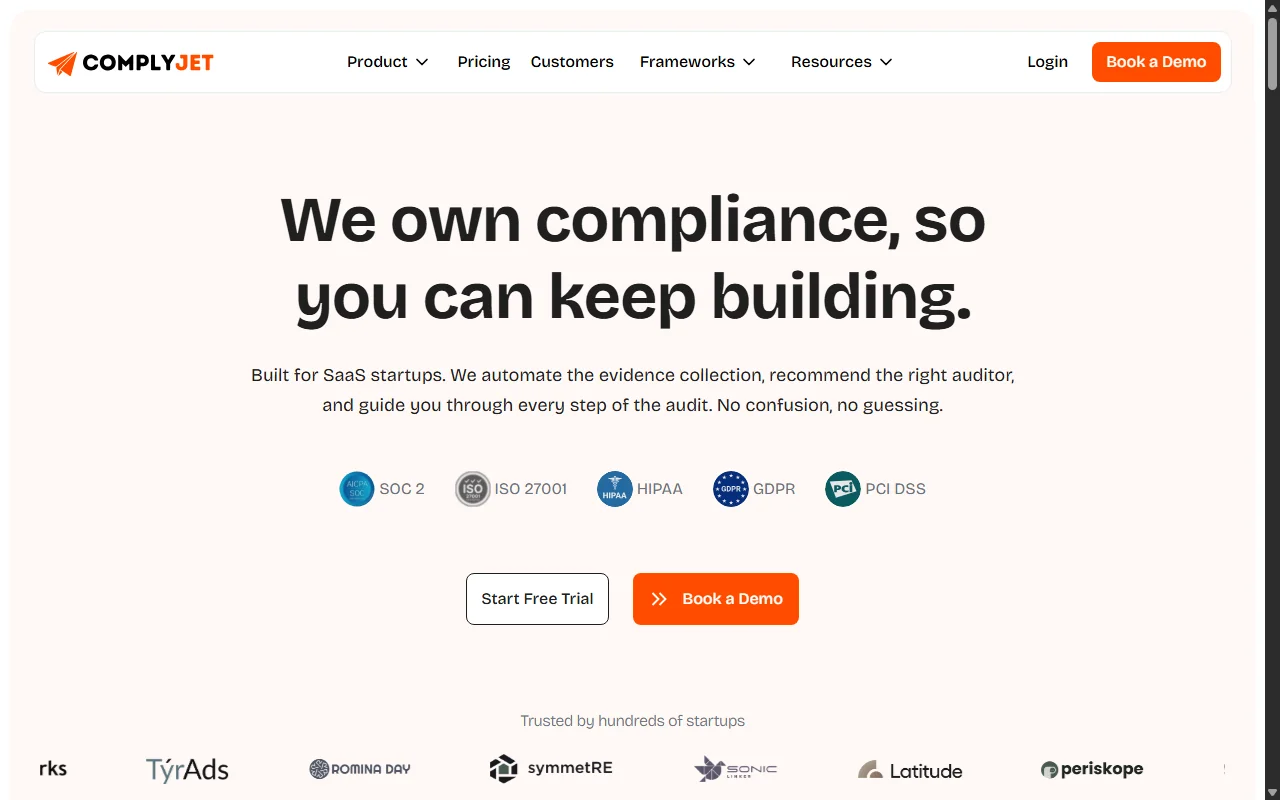
Screenshot captured from ComplyJet's official website, for informational purposes only.
ComplyJet's difference on this list isn't feature count, it's what happens after you sign. Where most platforms hand you software and leave you to convert it into an actual outcome, ComplyJet's team guides you through the compliance program end to end: gap analysis, policy drafting, evidence collection, and audit coordination through a curated auditor network, not just a dashboard and a support ticket queue.
Given everything in the sections above, that distinction is worth sitting with. A platform that fully automates report generation without a real person checking the output is exactly the failure mode at the center of the Delve story, whatever you believe about the specific allegations. ComplyJet's model is built around the opposite bet: automation handles the busywork, a team actually reviews what goes into your evidence.
Pricing is flat and published, $5,000/year for one framework, $8,000/year for two, and it doesn't move as your headcount grows from 5 people to 40. That's a deliberate choice, not a limitation: as you scale through the early stages of the company, your compliance cost stays predictable instead of retriggering a renegotiation.
| Pros | Cons |
|---|---|
|
|
Pricing: $5,000/year for one framework, $8,000/year for two, flat and published upfront.
"ComplyJet has one of the most intuitive interfaces I've encountered in a compliance tool... Compared to other compliance solutions we evaluated, ComplyJet offered the best combination of features and affordability." Raghu R., Managing Director, G2 review, May 2026
ComplyJet
Software alone doesn't produce an outcome
ComplyJet's team reviews and owns your compliance program end to end, not just the dashboard you log into.
4. Sprinto
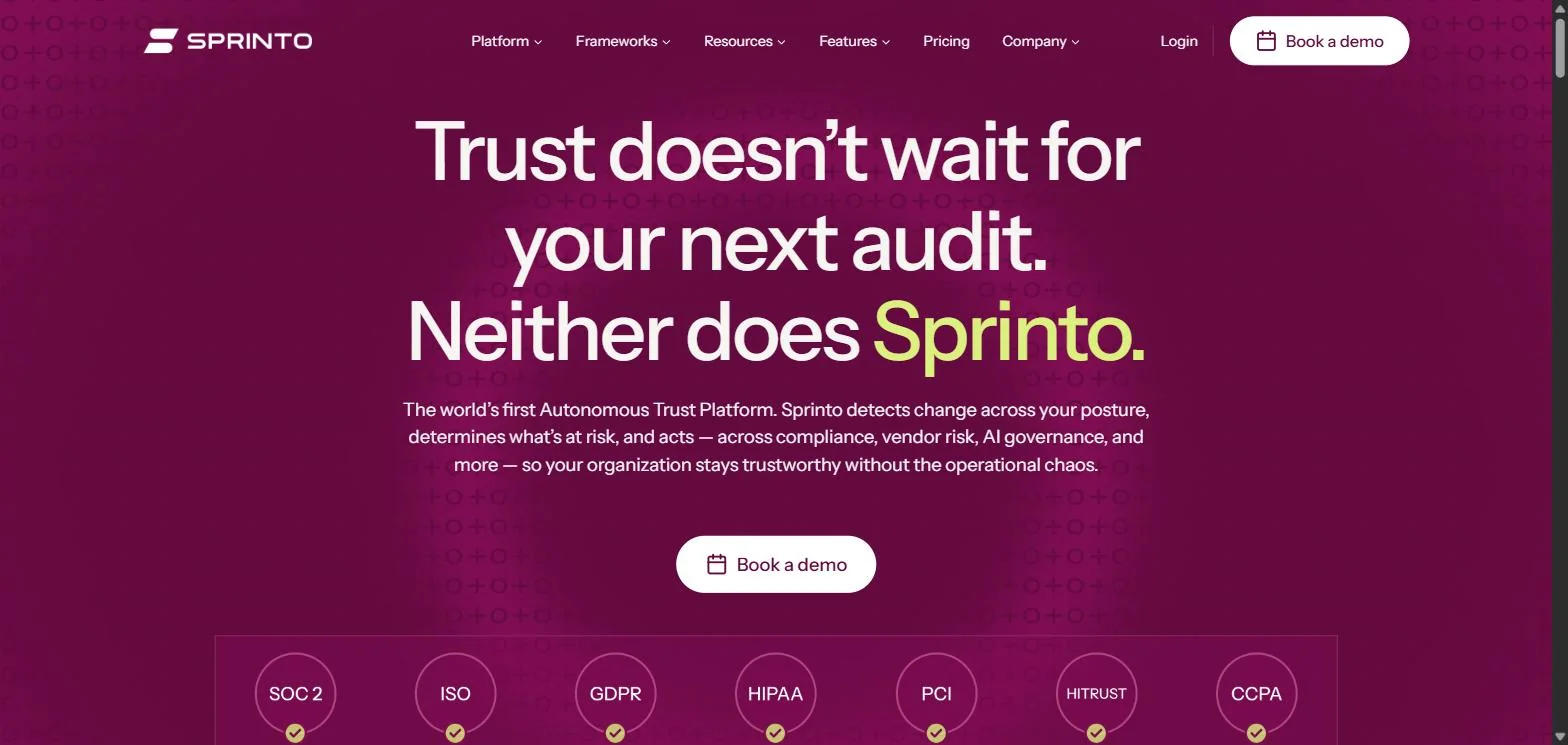
Screenshot captured from Sprinto's official website, for informational purposes only.
Sprinto positions itself as an "Autonomous Trust Platform," with 300+ integrations, continuous control monitoring, and Zones, a way to segment compliance by business unit, product, or geography. It also folds in vendor risk management and AI-assisted evidence-gap analysis as part of the same platform.
The standout differentiator against most of this list: no per-user pricing, which matters as your headcount grows. The tradeoff reviewers report is setup complexity, some integrations need manual configuration, and the platform can be more feature-rich than a team doing a single, one-time certification actually needs.
| Pros | Cons |
|---|---|
|
|
Pricing: Starter roughly $7,000 to $8,000/year; Professional $8,000 to $10,000/year; Advanced $11,000 to $15,000/year; Enterprise $20,000+.
"Sprinto has made running multiple frameworks simultaneously genuinely manageable... Continuous monitoring keeps compliance hygiene visible without having to chase it manually." Grzegorz M., Co-Founder & CEO, G2 review, May 2026
5. Secureframe
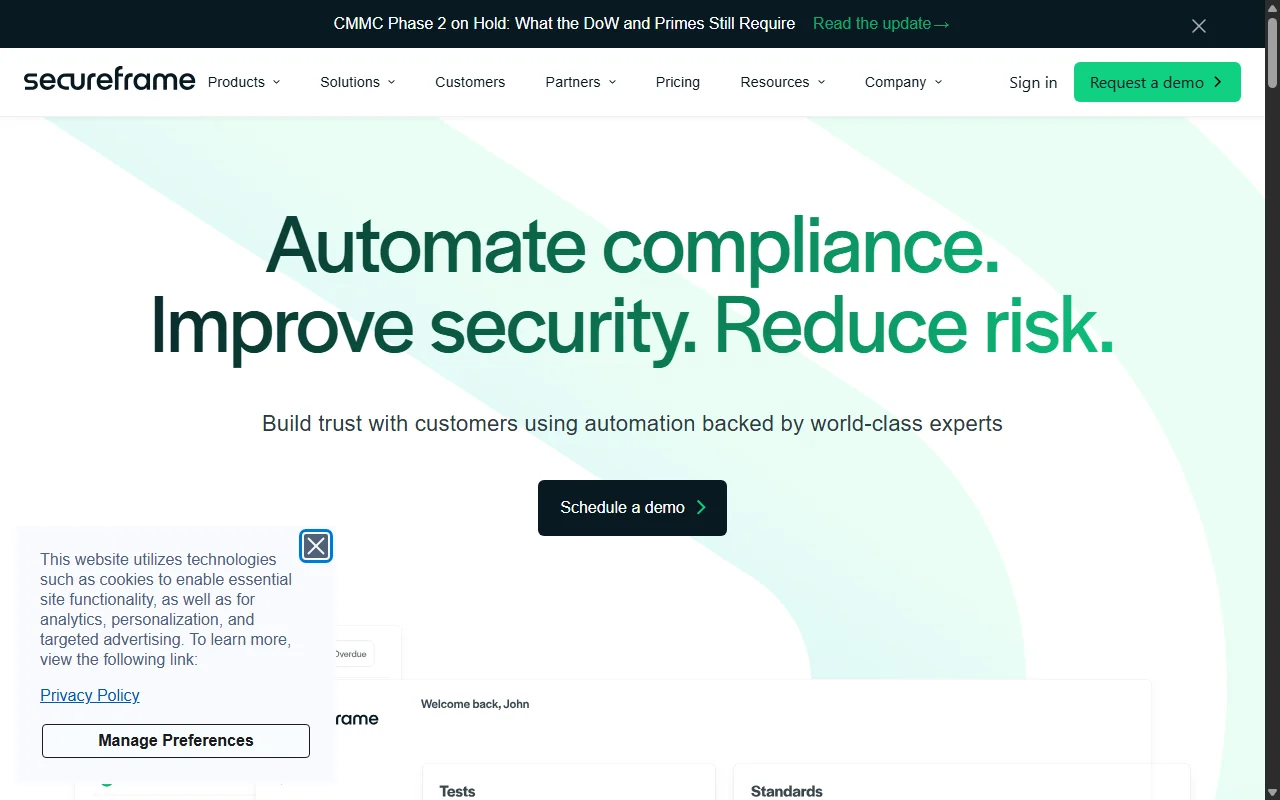
Screenshot captured from Secureframe's official website, for informational purposes only.
Secureframe is built around guided workflows for teams going through their first SOC 2 audit, with 300+ integrations and a Defense tier that adds CMMC support for teams selling into government contracts. Its closest head-to-head on this list is Oneleet, covered in ComplyJet's Oneleet vs Secureframe comparison.
It's a solid fit for a team that wants structure over flexibility: a defined path rather than a blank canvas. The tradeoff is pricing transparency, there's no public pricing, and some reviewers note that certain controls take more manual effort than the marketing suggests.
| Pros | Cons |
|---|---|
|
|
Pricing: quote-based across three tiers (Fundamentals, Complete, Defense), no public figures.
"Secureframe simplifies everything for us, making it easy to implement and manage all mandatory controls... it's really easy to find what we need in the system." Tiago F., G2 review, April 2026
6. Scrut Automation
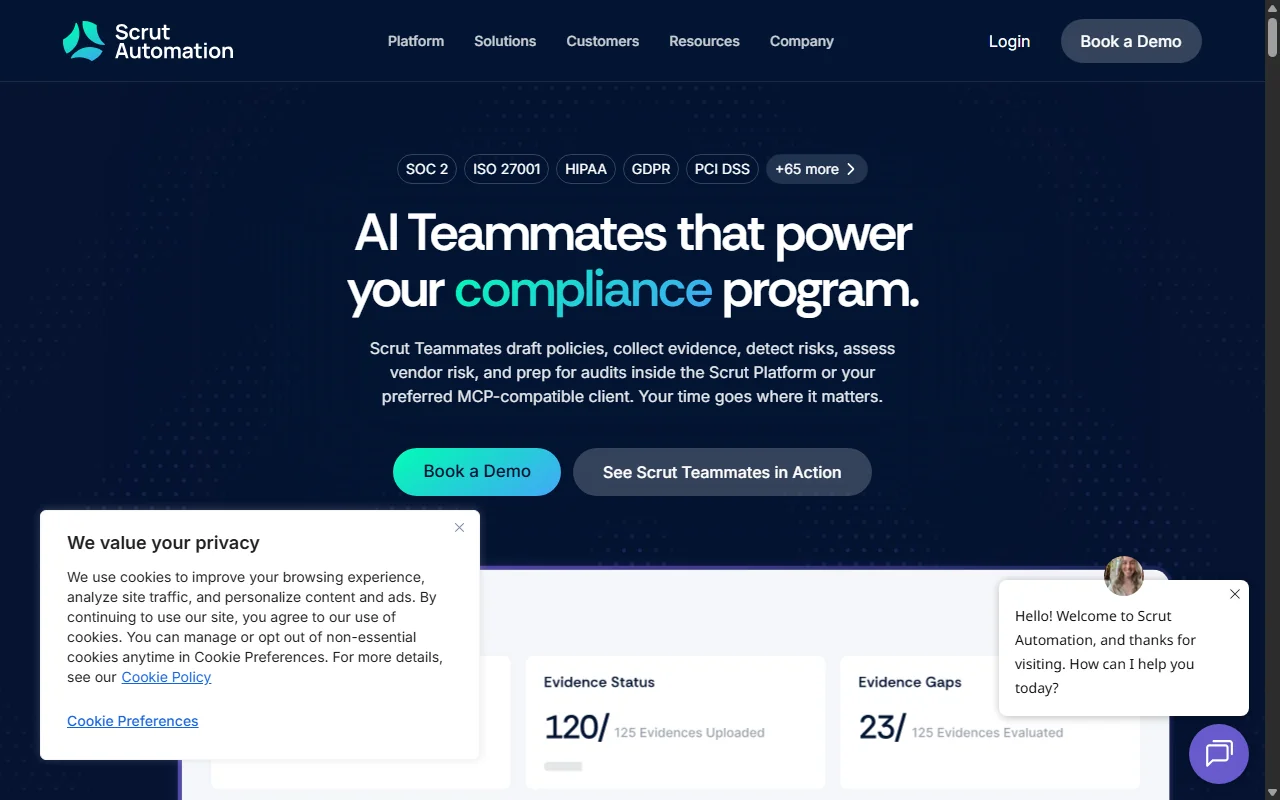
Screenshot captured from Scrut Automation's official website, for informational purposes only.
Scrut Automation carries the highest review volume and rating of any platform on this list, 1,298 reviews at 4.9 stars, and won G2's 2026 Best Software Award in the GRC category. It's built for teams that want real depth and control over their compliance program, not just the fastest path through certification.
That depth is also the tradeoff: it's more platform than most early-stage teams actually need on day one, and pricing isn't published for anything beyond the entry tier.
| Pros | Cons |
|---|---|
|
|
Pricing: starting around $15,000/year; multi-framework and enterprise pricing not public.
"Scrut has centralized our compliance management, making it easier to stay audit-ready year-round... this has not only improved our security posture but also enhanced our trust with clients." Karan A., Head of Domain Operations, G2 review, November 2024
7. Thoropass
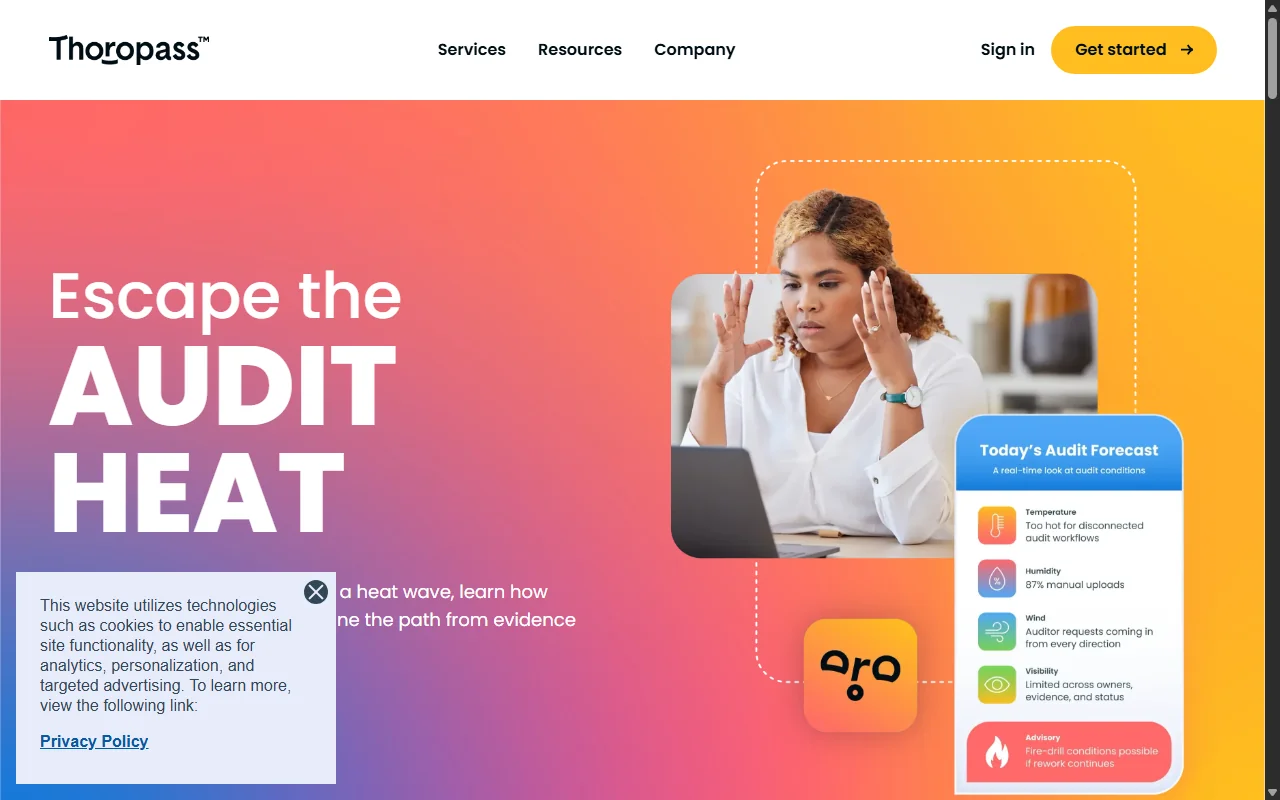
Screenshot captured from Thoropass's official website, for informational purposes only.
Thoropass bundles the compliance software and the audit itself under one vendor, which removes a real step most teams underestimate: sourcing and vetting your own auditor. It received Leader recognition across 16 of G2's Winter 2025 Grid Reports, including Audit Management and Cloud Compliance.
Automation depth is narrower here than Vanta or Drata, and some integrations still require manual evidence uploads. The appeal is having one relationship to manage instead of two.
| Pros | Cons |
|---|---|
|
|
Pricing: platform roughly $8,700/year, audit bundle adds about $5,800/year; all-in cost typically $14,500 to $30,000/year depending on scope.
G2 signal
Thoropass holds a 4.7-star rating across 568 G2 reviews, with reviewers most consistently pointing to responsive support and having tasks, policies, and procedures centralized in one place. The most common complaint is that initial setup can feel overwhelming for newcomers.
8. Scytale
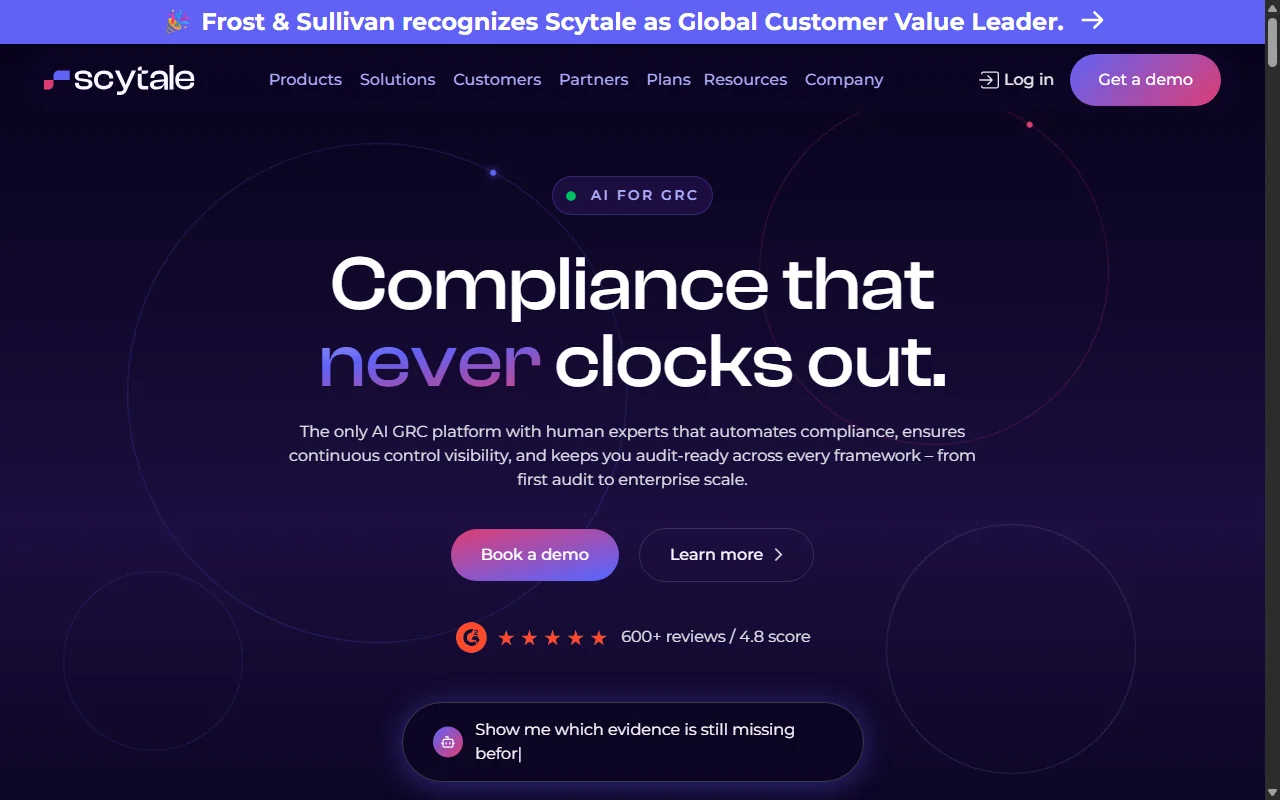
Screenshot captured from Scytale's official website, for informational purposes only.
Scytale covers 60+ compliance frameworks with AI-assisted setup throughout the platform, backed by advisors who help move things along quickly. It's a fit for a team juggling several frameworks at once rather than a single certification.
Pricing isn't published, and the consulting add-ons that provide hands-on support increase total cost beyond the base platform fee.
| Pros | Cons |
|---|---|
|
|
Pricing: custom-quoted, no public figures.
G2 signal
Scytale holds a 4.8-star rating across 555 G2 reviews, with reviewers frequently highlighting the blend of automation and expert support for teams navigating a first audit. The most common complaint is slower support response times, sometimes around two days.
9. OneTrust
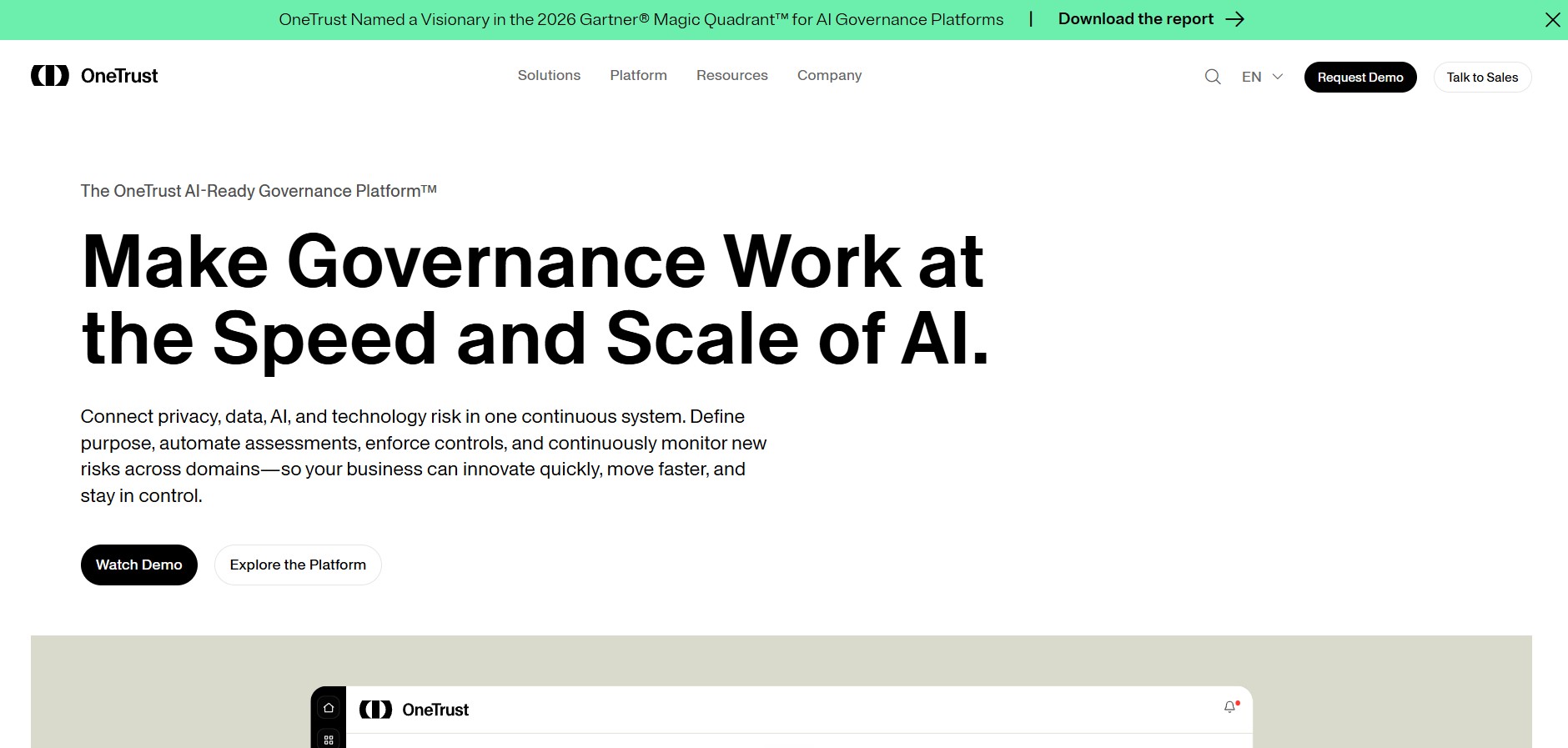
Screenshot captured from OneTrust's official website, for informational purposes only.
OneTrust is the enterprise consolidation play: compliance, privacy, and risk management under one suite, with 50+ frameworks and the best cross-framework evidence reuse of anything on this list. It's built for organizations that have already outgrown point solutions, not for a company doing its first SOC 2.
Entry pricing starts above $50,000/year, and reviewers consistently describe a steep learning curve and complex implementation. Support quality reportedly scales with contract size.
| Pros | Cons |
|---|---|
|
|
Pricing: enterprise-only contracts, GRC suite starts above $50,000/year, no public tiers.
G2 signal
OneTrust's Tech Risk & Compliance product line is rated on G2, with reviewers praising powerful automation and a centralized single-dashboard approach to risk and compliance. The most common complaint is a steep learning curve and a complex initial setup.
10. Oneleet
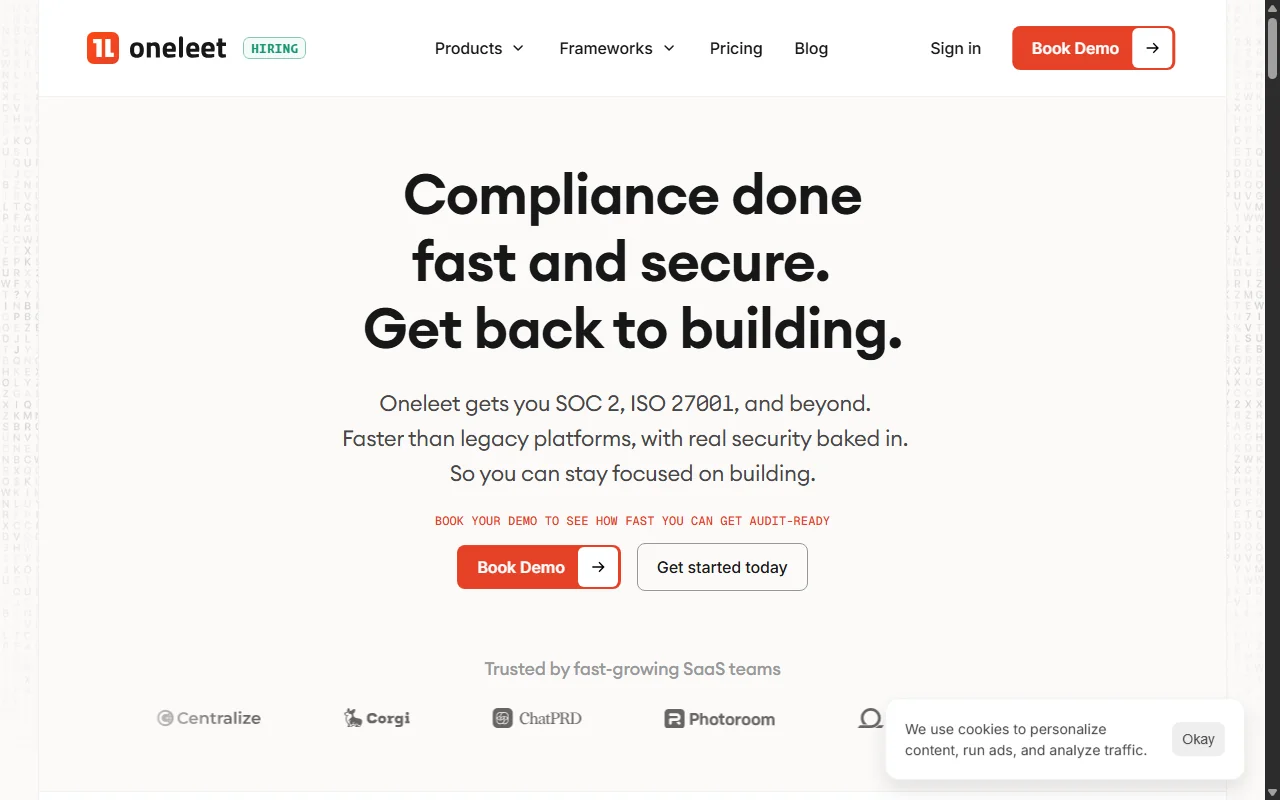
Screenshot captured from Oneleet's official website, for informational purposes only.
Oneleet bundles manual penetration testing directly into the compliance workflow, a genuinely different approach from software-only platforms. It's YC-backed (S22 batch) and has raised a $33M Series A, with a security-first team background that shows up in the product itself.
The tradeoff: it can't run multiple frameworks simultaneously, which matters if you need SOC 2 and ISO 27001 running in parallel rather than sequentially.
| Pros | Cons |
|---|---|
|
|
Pricing: custom-quoted, bundled services make it pricier than software-only options.
G2 signal
Oneleet holds a 4.9-star rating across 138 G2 reviews, with reviewers frequently praising the dedicated security program manager paired with every customer. The most common complaint is limited integration options for smaller, less common platforms.
11. Hyperproof
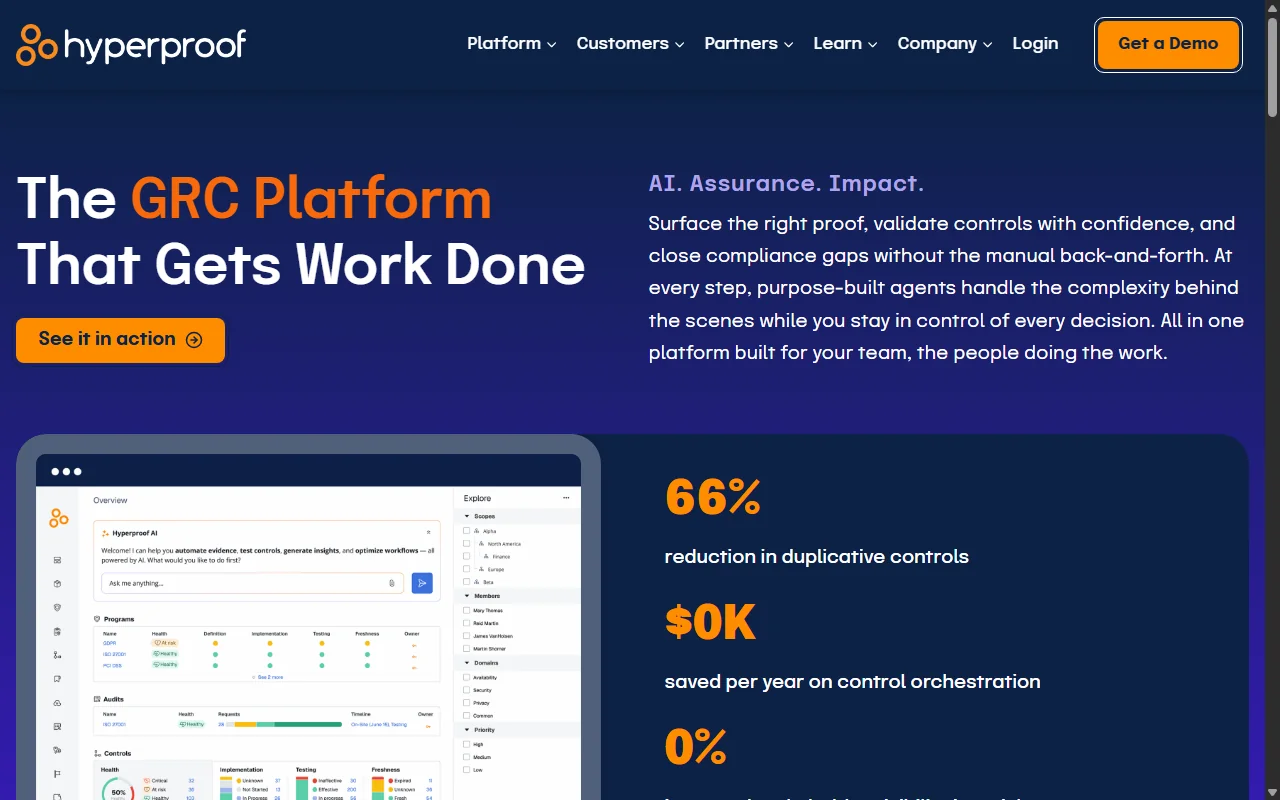
Screenshot captured from Hyperproof's official website, for informational purposes only.
Hyperproof is built for the moment compliance stops being one team's side project and becomes an operating rhythm across the company, coordinating SOC 2 alongside ISO 27001, SOX, or other programs across multiple business units. It supports 118+ frameworks, with Hypersync connectors automating evidence collection from tools like AWS, Jira, Okta, and ServiceNow, plus a set of AI agents (Navigator, Inspector, Co-Pilot, Operator) that handle gap discovery, validation, and questionnaire responses.
It's better suited to a mid-market or enterprise team running several frameworks at once than to a startup doing its first, single-framework audit. Pricing isn't public, implementation fees of $10,000 to $30,000 are mandatory rather than optional, and reviewers report performance degradation once control counts scale into the thousands.
| Pros | Cons |
|---|---|
|
|
Pricing: roughly $12,000 to $100,000/year depending on scope, reported median around $41,000/year, plus mandatory implementation fees.
G2 signal
Hyperproof holds a 4.5-star rating across 213 G2 reviews, with reviewers praising ease of use and centralized compliance management across teams. The most common complaint is a learning curve for new users and limited report customization.
12. StandardFusion
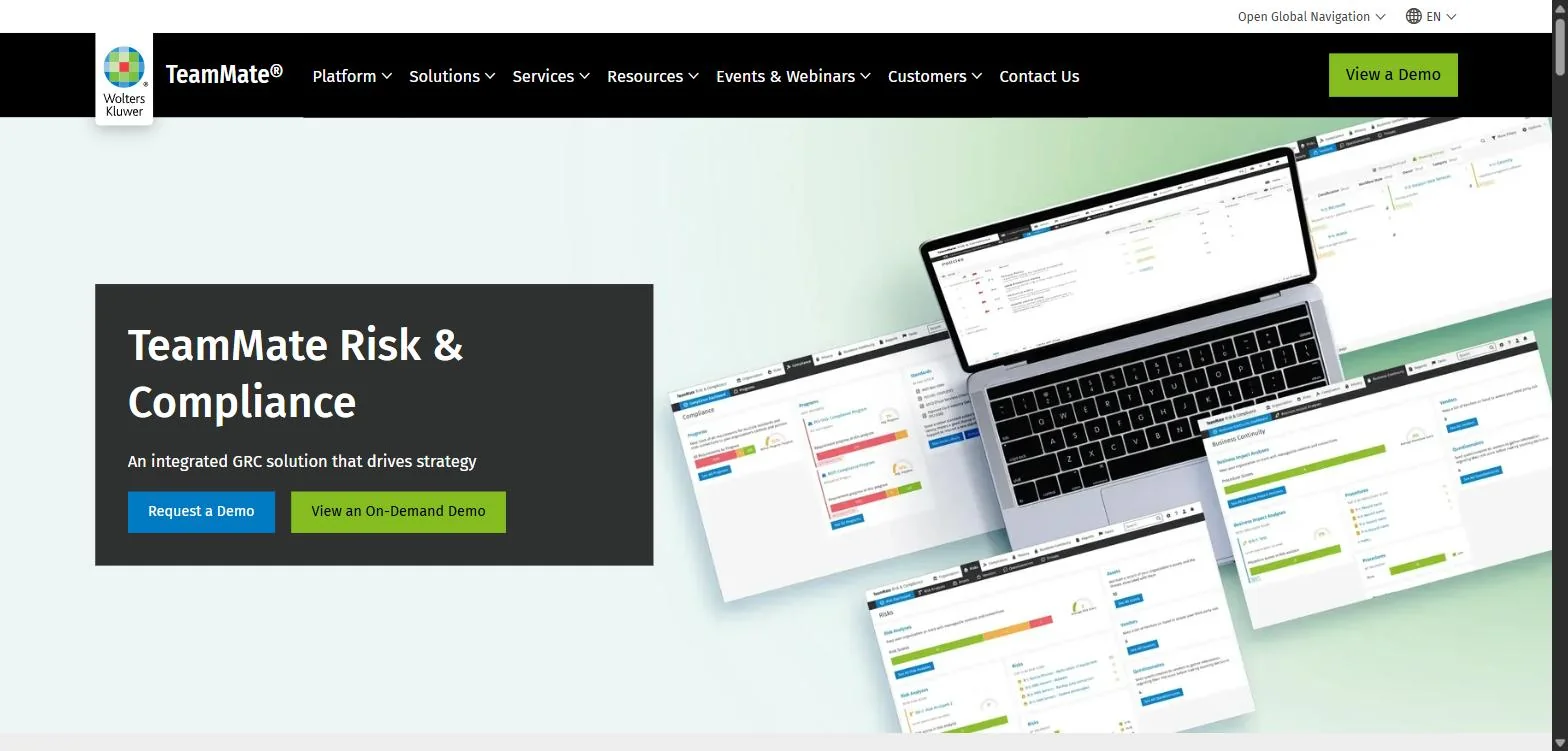
Screenshot captured from Wolters Kluwer's official website, for informational purposes only. StandardFusion's own domain now redirects here.
Worth knowing before you evaluate this one: Wolters Kluwer acquired StandardFusion in January 2026 for roughly $51.8M, and is folding it into TeamMate, its existing audit and assurance platform. StandardFusion's own domain now redirects straight to the TeamMate product page. It's no longer really an independent, self-serve tool a startup could sign up for on its own; it's becoming part of a larger enterprise audit suite.
StandardFusion was, and functionally still is for now, a broader GRC platform than most others on this list, unifying risk, compliance, audit, incident, privacy, vendor, and policy management, plus business continuity, in one place. It supports SOC 2 alongside ISO 27001, GDPR, HIPAA, and FedRAMP, with highly configurable workflows and strong control mapping.
The honest tradeoff, acquisition aside: it's less automation-native than a dedicated SOC 2 platform, with a steeper learning curve and a more process-intensive setup. Given the acquisition, a team evaluating it today should ask directly about pricing, roadmap, and support continuity under Wolters Kluwer before assuming it still operates as the standalone product described here.
Sources: Wolters Kluwer, Techcouver
| Pros | Cons |
|---|---|
|
|
Pricing: custom-quoted based on user count, modules used, and implementation scope, no public figures pre-acquisition; pricing under Wolters Kluwer's TeamMate umbrella not yet public.
G2 signal
StandardFusion holds a 4.5-star rating across 61 G2 reviews under its pre-acquisition listing, with reviewers praising support quality and audit-trail features. Reviews predate the Wolters Kluwer acquisition, so weigh them as historical signal, not a current read on the product.
Five Questions to Ask Any Compliance Vendor Right Now
Not just a Delve replacement, any vendor, going forward. The Delve story is a useful reminder of what a report alone doesn't tell you.
- Can I see a real, non-boilerplate sample report? Ask for one that isn't a marketing template, and look at whether the language is specific to a business or generic enough to fit anyone. ComplyJet's guide on how to review a SOC 2 report from a vendor covers exactly what to check for.
- Who is the underlying CPA firm, and can I verify them independently? A platform's name on the report isn't the auditor's name. Check the actual firm against public CPA licensing records yourself.
- What does evidence portability look like if I switch platforms later? Get a real answer before you sign, not after you need it.
- How is "continuous monitoring" actually implemented, not just marketed? Ask what happens to visibility after the initial setup window closes.
- What's the incident-response and customer-notification process if something goes wrong? Every vendor should have a real, specific answer here, not a deflection to their terms of service.
Pro tip
Question 1 alone would have surfaced most of what's now public about Delve, long before any of it became a news story. Ask it of your current vendor too, not only a prospective one.
ComplyJet
Curious what a well-run SOC 2 program actually looks like?
See how ComplyJet approaches SOC 2 specifically, gap analysis, evidence, and a real auditor relationship, not just software.
If You're Currently on Delve, Here's What to Do
This doesn't require panic. It requires a plan, and a real one, not a rushed switch to whichever vendor answers the phone first.
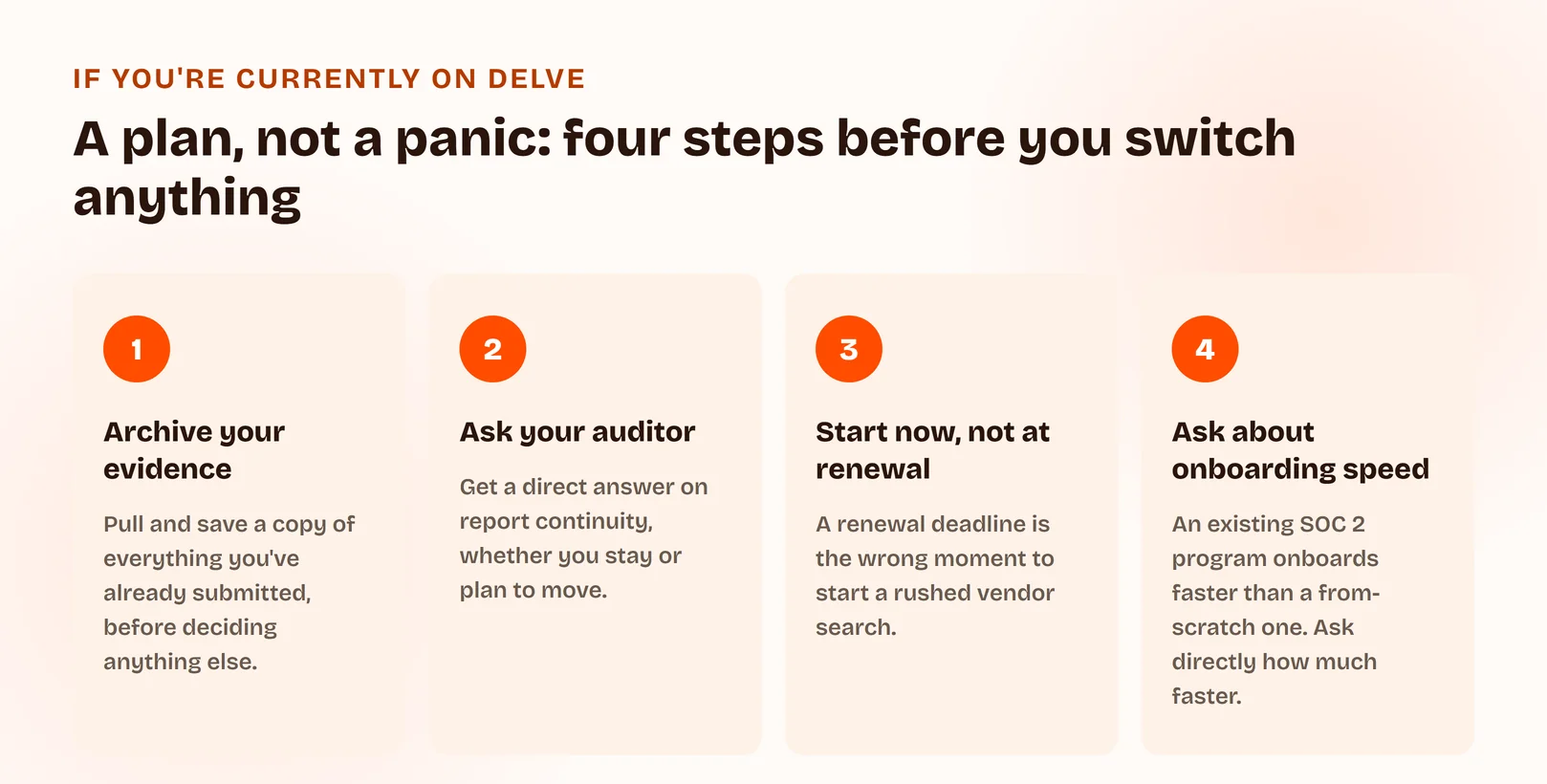
- Pull and archive your own evidence now. Don't wait for a decision on switching to make sure you actually have a copy of everything you've submitted.
- Ask your current auditor directly about report continuity. If you stay, get their read on the platform's current standing. If you move, ask what they need to keep your audit history intact.
- Don't wait for renewal to start evaluating alternatives. A renewal deadline is exactly the wrong moment to start a rushed vendor search.
- Ask a prospective new vendor how fast they can onboard an existing SOC 2 program, not a from-scratch one. That's a materially different, and usually faster, onboarding path than what a first-time customer gets.
ComplyJet
Switching platforms doesn't mean starting over
ComplyJet's team can assess your existing SOC 2 evidence and tell you honestly how much of it carries over before you commit to anything.
The Wider Lesson for Compliance Buyers
A SOC 2 report is a proxy, not a guarantee. It tells you a set of controls was tested at a point in time, by a named auditor, against a defined scope. It never told you a breach can't happen, and it was never supposed to. Worth remembering here too: SOC 2 itself is an attestation, not a certification, a distinction ComplyJet covers in more depth elsewhere and one that matters for exactly this kind of situation.
"A SOC 2 report only ever proves what was actually tested, not what wasn't. That's not a Delve problem or a category problem. It's exactly why a report should be the first thing you check on a vendor, never the last." — Upendra Varma, CTO at ComplyJet
Going forward, the evaluation criteria that matters most isn't which platform certifies you fastest. It's process transparency: can you actually verify who's checking your evidence, and does the platform's own incentive line up with getting it right, not just getting it done quickly.
FAQs About Delve Alternatives
What Are the Best Delve Alternatives?
Vanta and Drata are the safest, most widely recognized picks if brand reputation matters most to your buyers. ComplyJet is the strongest fit for an early-stage team that wants a flat, published price and a team that actually guides the process, not just software.
Sprinto and Secureframe are strong startup-focused picks with guided onboarding, and Scrut Automation carries the highest review volume and rating of anything on this list. The full ranked comparison, all 12, is above. Which one is "best" depends mostly on your team's stage and how many frameworks you're running at once, not a single universal winner.
Why Are Companies Leaving Delve?
Two separate reasons, and it's worth keeping them apart. First, a whistleblower's allegations about fabricated SOC 2 reports led Y Combinator to sever ties with the company in April 2026, and two named customers had real security incidents afterward. Second, independent of the scandal, G2 reviews have flagged the same product gaps for months: automation that still requires heavy manual work, monitoring that doesn't stay visible after setup, and reporting that doesn't reach founder or board-level clarity.
What Happened to Delve, Exactly?
An anonymous whistleblower alleged Delve's SOC 2 reports were largely boilerplate and that the platform auto-generated placeholder documentation. Y Combinator removed Delve from its companies directory on April 3, 2026. Two customers, LiteLLM and Context AI, had separate confirmed security incidents afterward and both switched providers. Delve denies the fabrication allegations and frames the disclosure as a malicious attack.
Is Delve Safe to Use Right Now?
That depends on which parts of this you weigh most heavily; there's no single verified answer either way. What is confirmed: Y Combinator no longer backs the company, and two customers had real incidents after using it. What's still alleged, not proven: the specific fabrication claims. If you're currently on Delve, verifying your own evidence and asking your auditor directly is a reasonable step regardless of which allegations you believe.
Did Delve Fake SOC 2 Audits?
This is alleged, not confirmed. A whistleblower claims 493 of 494 reports were near-identical boilerplate. Delve disputes this characterization and calls the disclosure a malicious attack rather than a legitimate whistleblower action. No independent investigation result has been reported as of this writing.
What Should I Do If I'm on Delve Today?
Pull and archive your own evidence now, ask your auditor directly about report continuity, and start evaluating alternatives before your renewal date forces a rushed decision. See the full section above for the complete list.
Who Backs Delve Compliance?
Delve was a Y Combinator company until YC severed ties with it on April 3, 2026, following the whistleblower allegations. No further ownership changes have been publicly reported as of this writing.
Related Reading
- Best SOC 2 Compliance Software: the evergreen, Delve-agnostic version of this same comparison
- Oneleet vs Vanta vs Drata: a deeper three-way comparison among platforms ranked here
- Oneleet vs Secureframe: a deeper two-way comparison among platforms ranked here
- Top SOC 2 Compliance Platforms for AI Companies: the same 12-platform landscape, scored specifically for AI-company evidence needs
- Is SOC 2 a Certification?: useful background on what a SOC 2 report actually proves and doesn't
- How to Review a SOC 2 Report From a Vendor: a step-by-step guide directly relevant to the diligence questions above