.svg)

You've got three vendor tabs open. Each one says "AI-powered compliance," two of them say "agentic," and not one explains what the AI does that last year's automation didn't. Then a 200-question security questionnaire lands from a prospect, and suddenly you care a great deal about whether any of this is real.
That's the honest starting point for shopping for the best AI compliance software: the label is on every vendor page, and it means different things on each. For some AI powered compliance software it's a genuine change to how the work gets done, policies drafted against your actual stack, evidence checked before an auditor sees it, questionnaire answers pre-filled from your own controls. For others it's a chat box on top of the same product.
So I read each vendor's own AI documentation instead of a roundup, and ranked 10 platforms by what the AI concretely does and where a human still signs off. One boundary first: "AI compliance software" also gets used for tools that govern your own AI systems. That's a different buy, and this article deliberately doesn't rank it.
What Is AI Compliance Software? The Three Meanings Behind Best AI Compliance Software Lists
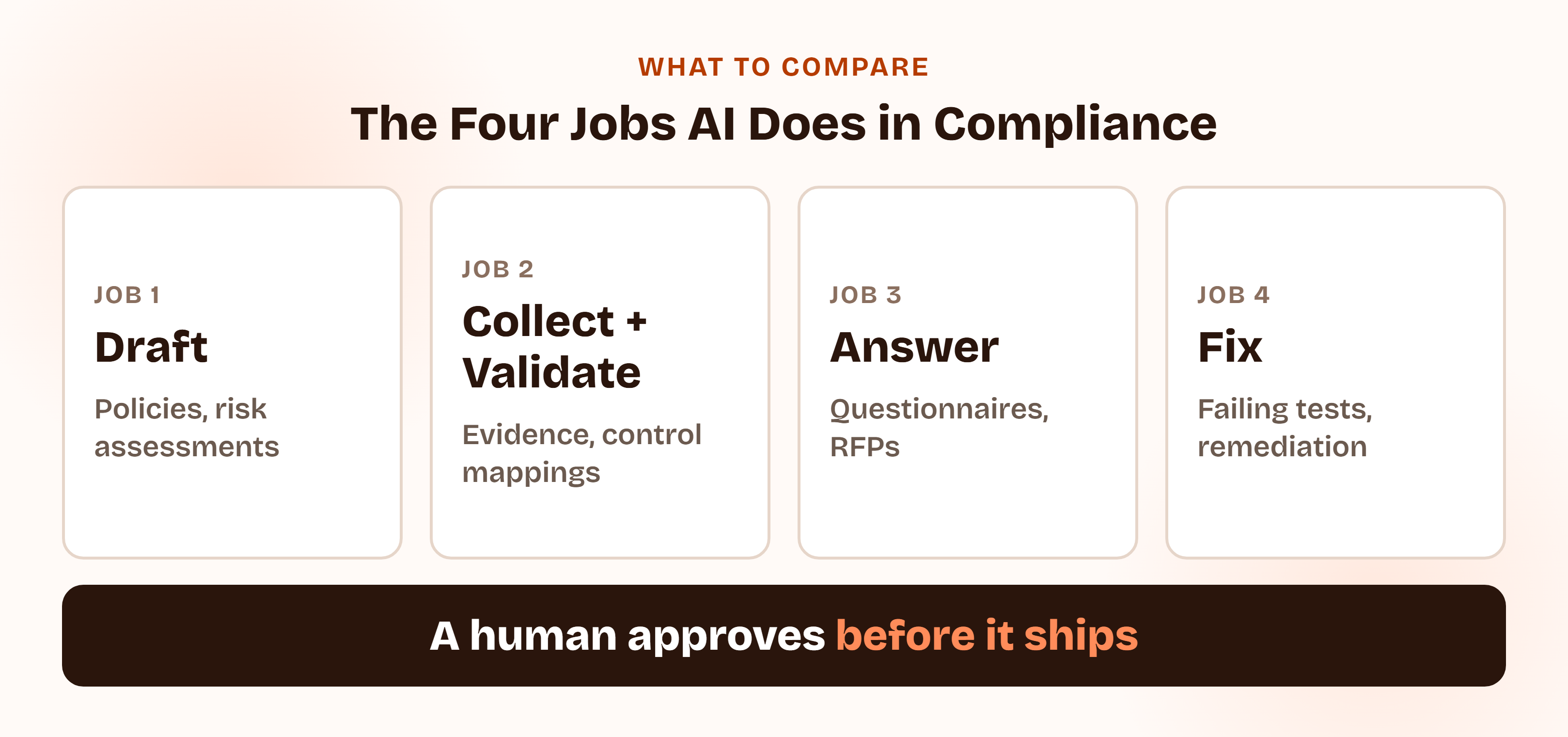
In this article, AI compliance software means compliance automation platforms that use AI to do parts of the compliance work: your SOC 2, ISO 27001, HIPAA or GDPR program. The AI does four jobs, and they're the yardstick for everything below: it drafts (policies, risk assessments), it collects and validates (evidence, control mappings), it answers (security questionnaires, RFPs), and it fixes (remediation steps, sometimes as code).
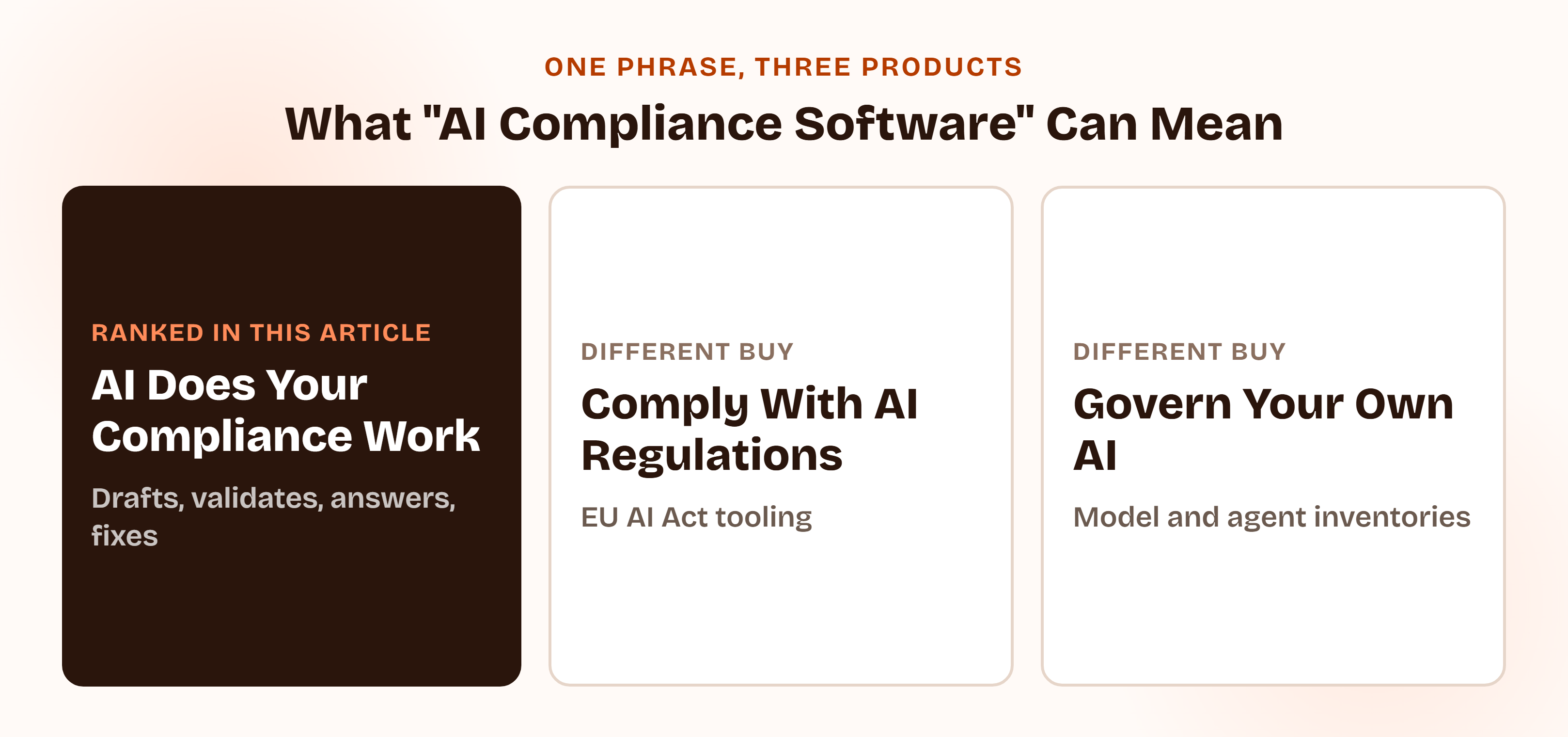
The trouble is that "best AI compliance tools" searches return a mix of three different products, and the roundups that rank well rarely separate them. Dupple's and Impakter's 2026 lists both say outright that the phrase covers more than one thing, then rank mostly the first kind:
- AI does your compliance work. The platforms in this article. You buy them to earn or maintain a certification with less manual effort.
- Software to comply with AI regulations. EU AI Act tooling: AI system inventories, risk classification, technical documentation. Different buyer, different deadline.
- AI governance platforms. Software that catalogs and tests the models and agents you build or use. Also a different buyer, and enterprise-priced.
Meant the other two?
If you searched because a customer asked about ISO 42001, the EU AI Act, or an AI governance program, read ComplyJet's comparison of the best ISO 42001 software instead. It ranks platforms by AI-framework coverage; this article ranks them by how much of your compliance work their AI does. There's a short section on the governance side near the end of this one as well.
Worth Checking First
Is the AI doing the work, or just sitting on top of it?
ComplyJet's AI drafts policies against your stack and pre-fills questionnaire answers from your own controls, and your team reviews every output before it ships. See how that works on your own frameworks.
Why AI Compliance Tools and AI Powered Compliance Software Differ So Much
Nearly every vendor now says AI, so the useful question is what kind. I sort what I read into three levels:
- Assistive: the AI suggests a control mapping, a policy paragraph or a questionnaire answer, and a person accepts or rejects it. Most of the real value on this list is here.
- Agentic: the AI takes multi-step actions across workflows, chasing evidence, opening tickets, running checks. It's genuinely more capable and genuinely harder to verify, which is why human-approval design matters more.
- Cosmetic: a chat interface over the same underlying product. Fine, but not a reason to pay more.
Any platform's AI compliance automation should also be judged on what it does when it doesn't know. The good implementations flag a gap for manual input instead of guessing, and that behavior is a better tell than any acceptance-rate number on a marketing page.
How I Evaluated These 10 Best AI Compliance Software Platforms
I didn't rank from a features-page skim or a roundup. For each platform I read the vendor's own current AI page or documentation and wrote down what the AI concretely does, then checked it against four criteria:
- AI scope across the four jobs. Drafting, collecting and validating, answering, fixing. Wider isn't automatically better, but a gap should be a choice you're making.
- Human approval design. Who accepts the AI's output before it reaches an auditor or a customer, and how visible is that step.
- Data handling. Whether the vendor states that customer data isn't used to train shared models. Only some do, and I've noted which.
- Pricing transparency, framework and integration breadth, and support model. The usual buyer's-guide criteria, because AI doesn't replace them.
Two rules kept the list honest. Where a claim appeared only on a third-party page, I said so and treated it as unverified. And I labeled every price estimate as a third-party estimate, because most of these vendors don't publish a number. ComplyJet is included on the same terms as every other vendor, checked against its own live product pages on 2026-09-29.
I left out enterprise GRC suites, AI-marketing-compliance tools, and the AI-governance specialists, since they answer a different question. The specialists get their own short section below.
Quick Comparison: 10 Best AI Compliance Software Platforms at a Glance
| Tool | Best for | Pricing | Standout AI feature |
|---|---|---|---|
| Vanta | Teams wanting the most documented AI feature set | Not published (third-party est. $10K to $12K/yr for startups) | AI Agent with cited answers, evidence checks and remediation code |
| Drata | Scaling teams adding frameworks | Not published (third-party est. $7.5K to $15K/yr Foundation) | AI-generated cloud tests and test-failure explanations |
| Secureframe | Teams wanting AI across remediation, risk and evidence | Not published | AI Evidence Validation plus a named Comply AI suite |
| ComplyJet | Early-stage startups pursuing first compliance | Flat per-company: $7,999/year Core and $9,999/year Plus on a 3-year plan, up to 50 employees | AI policy drafting matched to your stack, reviewed before publishing |
| Sprinto | Startups pursuing a first SOC 2 | Quote-based (third-party est. $7K to $8K/yr, one framework) | Review, edit or ignore control on every AI output |
| Scytale | First-time teams wanting agents plus human GRC experts | Not published (third-party est. ~$7.5K/yr) | AI agents backed by in-house GRC experts |
| Scrut Automation | Engineering-led teams testing an agent-per-task model | Not published | Eight named Teammates agents and MCP access |
| Thoropass | Teams wanting AI-assisted audit prep with the auditor in-platform | Not published | First Pass AI evidence pre-screening |
| Hyperproof | Multi-framework GRC teams | Not published | AI Guided Experiences (March 2026), humans approve final decisions |
| Comp AI | Engineering-led, budget-conscious startups | Quote-based on its own page | Open-source, auditable agents |
The 10 Best AI Compliance Software Platforms in 2026
The order reflects how much of the four AI jobs each platform documents publicly and how clearly it explains its human-review step, not a claim that number one is best for you. The How to Choose section below is where fit gets decided.
1. Vanta
Vanta is the category default, and its AI story is the most fully documented of any vendor here. The Vanta AI Agent answers compliance questions with citations, verifies evidence and documentation and tells you what's missing, compares written policies against actual practice to flag inconsistencies, and generates remediation code snippets for tools like Terraform, AWS CLI and CloudFormation.
The headline number is on the questionnaire side: Vanta states a "95% acceptance rate" on the answers its AI suggests, drawn from your knowledge base and previous responses. That's a vendor-reported figure, and I'd treat it as a claim to test in a demo with your own questionnaires, not a benchmark. What's useful is the design: suggestions are accepted or rejected by a person, not sent automatically.
Two details matter for buyers. Vanta's pricing page publishes no dollar figures, and it gates questionnaire volume by tier, 25 questionnaires a year on Plus and 144 on Professional as the page read on 2026-09-29, while the AI Agent itself is available across tiers. Vanta also holds ISO 42001 certification itself, which is a signal about how it treats its own AI, not a reason to pick it for yours.
Key features:
- Vanta AI Agent: cited compliance answers, evidence verification, policy-versus-practice checks
- AI questionnaire automation with a stated 95% acceptance rate on suggested answers
- Remediation code snippets for Terraform, AWS CLI and CloudFormation
- 400+ integrations, plus a Vanta API for custom ones
Pros
- Broadest documented AI scope on this list: answers, evidence checks, policy alignment and remediation code
- Largest integration catalog of the mainstream platforms (400+)
- AI Agent available across plan tiers, not only the top one
- Suggestions are accepted or rejected by a person
Cons
- No published pricing; questionnaire volume is capped by tier (25 a year on Plus, 144 on Professional per its pricing page)
- Third-party roundups report reviewers citing high pricing at small-company scale (Impakter, 2026)
- The 95% acceptance rate is vendor-reported and unaudited
Pricing: Not published. Dupple's 2026 roundup estimates roughly $10,000 to $12,000 a year for startups under 50 people, climbing past $25,000 with add-ons, a third-party estimate, not a Vanta figure.
Best for: Teams that want the most extensively documented AI feature set and are comfortable with a sales-led quote.
2. Drata
Drata's AI page is more specific than most about where AI sits in the workflow, and notably more modest about it. It lists five compliance-side features: AI policy-to-control mapping (suggesting control mappings from policy text), AI-generated tests for AWS, Azure and GCP, AI explanations of test failures, AI suggestions for the policy center, and AI-generated change summaries when policy versions differ.
That's a practical list. Test generation and failure explanations attack the part of compliance that eats engineering time, figuring out why a check is red and what it should have been checking in the first place. The page gives no numeric performance claims, which I'd count in its favor.
One naming trap: Drata also markets products for governing AI agents inside your own company (agent discovery, policy enforcement, an evidence trail for agent actions). That's the governance reading of "AI compliance", not the one this comparison ranks, so I've kept it out of the scoring.
Key features:
- AI policy-to-control mapping from policy text
- AI-generated cloud tests for AWS, Azure and GCP
- AI explanations of test failures
- AI comparison of policy versions with change summaries
Pros
- Concrete, workflow-level AI features without inflated numbers
- Test generation and failure explanations help engineers, not just compliance owners
- Strong multi-framework story without per-seat pricing, per Dupple's 2026 roundup
Cons
- Quote-based pricing; Impakter's 2026 roundup notes reports of per-framework add-ons near $5,000
- Compliance-side AI is mostly assistive; no documented questionnaire numbers on the AI page itself
- Impakter also notes reviewers describing a thinner third-party integration catalog than Vanta
Pricing: Not published. Dupple's 2026 roundup estimates $7,500 to $15,000 a year for its Foundation tier and $25,000+ for Enterprise, third-party estimates.
Best for: Scaling teams adding several frameworks who want AI that helps with test failures and policy upkeep.
3. Secureframe
Secureframe organizes its AI as a named suite, which makes it easy to see what you're buying. Comply AI covers remediation (generating infrastructure-as-code fixes), risk (inherent risk scores, treatment plans and residual scores), policies (generating and refining documents), third-party risk (extracting answers from vendor documents such as SOC 2 reports) and control mapping. Trust AI handles questionnaire and RFP automation.
The most distinctive item is AI Evidence Validation: it reviews uploaded evidence for missing documents, outdated timestamps and mismatched submissions before an auditor sees them. Catching a stale screenshot in week three is a much better place to find it than in the audit window.
Secureframe's page claims only that questionnaire automation saves "hundreds of hours" and gives no acceptance rate, so there's less to verify but also less to overclaim. Because the AI is split across named modules, ask which ones ship in your plan.
Key features:
- Comply AI for remediation (IaC fixes), risk, policies, third-party risk and control mapping
- Trust AI questionnaire and RFP automation
- AI Evidence Validation for missing, outdated or mismatched evidence
- Generative remediation code for AWS, Google Cloud and Azure
Pros
- Widest named AI suite among the mainstream platforms
- Evidence validation addresses audit-time surprises directly
- Risk scoring and treatment plans are AI-assisted, a job several rivals' AI pages don't mention
Cons
- Pricing isn't published; Impakter's 2026 roundup notes limited pricing transparency
- AI split across several named modules, so confirm what's included in your plan
- Impakter also notes missing connectors for some niche tools
Pricing: Not published; quote-based.
Best for: Teams that want AI across remediation, risk and evidence review in one named suite.
4. ComplyJet
ComplyJet is built for the early-stage startup doing compliance for the first time, and its AI is aimed at the two places that stall those teams: writing the policies and answering the customer's questionnaire.
On policies, ComplyJet's product page describes 30+ policy templates "generated with AI, matched to your framework requirements and tailored to your environment," with the AI reading your connected integrations so the language reflects your actual tools, cloud providers and team structure. They're fully editable, the page says you "review, customise, and approve before publishing", with version history and re-distribution to your team when a policy changes.
ComplyJet describes the drafts as arriving "80% done," which is a vendor description, not something I measured.
On questionnaires, answers are pre-populated from your policies, controls, certifications and prior answers, and the page states that every AI-generated answer is reviewed by your team before it goes out. When the AI lacks enough information, it flags the question as needing manual input, and your manual answer feeds the knowledge base for next time.
It accepts Excel, Word, PDF, CSV and Google Sheets and exports back in the original format. ComplyJet's pricing page also lists "AI-generated fixes for failing tests" and a "ComplyJet AI Agent," and its homepage carries customer reviews describing the agent as useful for drafting policies and guidance.
Around the AI sits the rest of the platform: 350+ native integrations, gap analysis on demand, continuous monitoring with alerts when a control drifts, a Trust Center, 25+ frameworks, and a team that guides you through the process rather than leaving you alone with the software.
Pricing is flat and per company rather than per seat: $7,999/year Core and $9,999/year Plus on a 3-year plan, up to 50 employees. The price doesn't move as a team grows from five people to thirty or forty while it stays inside its plan.
Where the depth stops matters, and I'd rather say it than have you find it in a demo. ComplyJet's public pages don't document a multi-agent lineup like Scrut's, or the level of detail Vanta and Secureframe publish on evidence validation and remediation code. Its own questionnaire page notes the AI works best once a compliance program is established, so a brand-new startup builds up the knowledge base as it goes.
Key features:
- AI-generated policy templates (30+) matched to your framework and your stack, fully editable, versioned
- AI questionnaire automation from your policies, controls, certifications and prior answers, with mandatory human review
- AI-generated fixes for failing tests and a ComplyJet AI Agent, as listed on its pricing page
- 350+ native integrations, gap analysis on demand, continuous monitoring
- Trust Center, 25+ frameworks, guided support
Pros
- Human review built into questionnaire answers; the AI flags what it doesn't know instead of guessing
- Policy drafts read your connected stack, so they aren't generic templates
- Flat, per-company pricing published on its site, with no per-seat creep
- A team that guides you through the process, useful for a first compliance program
Cons
- No publicly documented multi-agent suite at the depth of Scrut Teammates or the Vanta AI Agent
- Public pages say less than Vanta or Secureframe about AI evidence validation and remediation code
- Smaller and newer than Vanta or Drata, with a shorter track record
- Small G2 review base: 4.9 out of 5 from 16 reviews as of 2026-09-29 (G2)
- Questionnaire AI improves with program maturity, per its own product page
- No AI model or agent inventory, or bias testing; that's the governance category
Pricing: $7,999/year Core and $9,999/year Plus on a 3-year plan, up to 50 employees, published at complyjet.com/pricing. Flat per company, not per seat.
Best for: Early-stage startups pursuing first compliance who want AI to draft policies and questionnaire answers, with their own team approving each one.
AI, Reviewed by You
Want AI drafts your team approves, on one flat price?
ComplyJet drafts policies against your stack and pre-fills questionnaire answers from your controls. Nothing goes out without your review, and the price doesn't move as your team grows within the plan.
5. Sprinto
Sprinto's documentation is refreshingly plain about what its AI does: it reviews vendors' security documentation, answers security questionnaires, summarizes and refines policies, and handles repetitive data entry. It's a narrower list than Secureframe's or Scrut's, but every item is a real time sink for a small team.
The control design is the part I'd point at. Sprinto's docs say you can "review, edit, ignore, or provide feedback" on AI-generated results and that you stay in control by reviewing outputs before acting on them. Its wider published materials, which I didn't verify against the product itself, also describe AI agents and a no-code AI Playground for building custom actions.
Sprinto is squarely aimed at startups chasing a first SOC 2 on a modest budget, which is also where its pricing sits: quote-based, with third-party estimates in the high single-digit thousands for one framework.
Key features:
- AI review of vendor security documentation
- AI-assisted security questionnaire completion
- Policy summarizing and refining
- Review, edit or ignore controls on every AI output
Pros
- Clear, honest documentation of what the AI does and doesn't do
- Explicit human-review design
- Startup-friendly positioning and pricing range
Cons
- Narrower documented AI scope than Vanta, Secureframe or Scrut
- Agent and AI Playground claims come from wider materials I couldn't confirm in the product
- Impakter's 2026 roundup notes ISO 27001 and HIPAA sold as add-on framework layers, and quote-only pricing
Pricing: Quote-based. Dupple's 2026 roundup estimates roughly $7,000 to $8,000 a year for a single framework, a third-party estimate.
Best for: Early-stage startups pursuing a first SOC 2 who want simple, reviewable AI on questionnaires and vendor reviews.
6. Scytale
Scytale pairs AI agents with people. Its site describes autonomous agents that own evidence collection and review, policy generation, and gap detection and remediation workflows, with an "AI Risk Remediator" that flags control vulnerabilities and an "AI Evidence Reviewer" that validates each item against a framework control. Alongside those sits a team of in-house GRC experts.
That combination is the point. If you're worried that an AI agent will produce something plausible and wrong, having a named expert who reads it is a different kind of safety net than a review checkbox. Scytale covers 80+ frameworks, including ISO 42001 and SOX ITGC, and Impakter and Dupple both rank it near the top of their AI lists; Dupple also notes a 2026 G2 Best Software Award in GRC.
The tradeoff is transparency. Scytale shows no pricing on its site and, per Impakter, gates some features behind higher tiers.
Key features:
- AI agents for evidence collection and review, policy generation, gap detection and remediation
- AI Risk Remediator and AI Evidence Reviewer
- 80+ frameworks
- In-house GRC experts alongside the platform
Pros
- Human GRC experts sit behind the agents
- Very wide framework coverage
- Independent recognition (2026 G2 Best Software Award in GRC, per third-party roundups)
Cons
- No pricing on the site; Impakter notes tiered plans quoted individually with some features locked to higher tiers
- Expert-led model is a different experience from self-serve tools
- Agent behavior is described in marketing terms, with no published acceptance or accuracy figures
Pricing: Not published. Dupple's 2026 roundup estimates about $7,500 a year, scaling with company size and frameworks, a third-party estimate.
Best for: First-time teams who want AI automation and a human GRC expert on the same account.
7. Scrut Automation
Scrut has gone furthest into the agent model, at least on paper. Its site names eight specialized AI agents it calls Teammates: an Onboarding Analyst, a Policy Architect that drafts audit-ready policies and detects drift, an Evidence Collector, an Internal Auditor running continuous readiness checks, a Risk Analyst, a Vendor Risk Analyst, a Security Analyst doing agent-driven penetration testing, and a Trust Analyst that generates questionnaire responses.
It also describes a Compliance Concierge for querying your compliance program from Claude, Cursor or other MCP clients, and states a commitment not to train shared models on customer data. Scrut is itself ISO 42001 certified.
Named roles are a good way to see what a vendor thinks its AI should do, but a job title isn't a test result. Ask each Teammate for a live example on your stack. Scrut supports 70+ frameworks and 150+ integrations, fewer integrations than Vanta or Comp AI claim.
Key features:
- Eight named AI agents across policies, evidence, audit readiness, risk, vendors, pentesting and questionnaires
- Compliance Concierge for querying your program via MCP clients
- 70+ frameworks, 150+ integrations
- Stated commitment not to train shared models on customer data
Pros
- Most granular agent lineup on the list
- Explicit data-training commitment
- MCP access fits engineering-led teams
Cons
- No pricing on its site
- 150+ integrations is a smaller catalog than Vanta's 400+ or Comp AI's claimed 580+
- Agent breadth is described, not benchmarked; no published accuracy figures
Pricing: Not published on its main site.
Best for: Engineering-led teams that want to test an agent-per-task model and query their program from their own AI tools.
8. Thoropass
Thoropass takes the most cautious public position on AI of anyone here: its compliance AI page says "We don't believe AI should replace human auditing." What the AI does instead is prepare the ground. First Pass AI pre-screens evidence for audit-readiness before an auditor reviews it, GenAI-powered DDQs speed up questionnaire responses, and AI pentesting is offered for organizations deploying AI and LLMs.
That stance follows from its model: Thoropass puts an audit firm inside the same platform, which is unusual. For a buyer who wants one accountable party from tooling through attestation, that's a real advantage, and the AI is framed as removing rework rather than replacing judgment.
The limits are documentation and price visibility. The AI page names features without describing how they work in detail, and shows no pricing.
Key features:
- First Pass AI evidence pre-screening
- GenAI-powered due diligence questionnaire (DDQ) responses
- AI pentesting for organizations deploying AI and LLMs
- Audit firm and platform under one roof
Pros
- Clear position that human auditors stay in charge
- Evidence pre-screening reduces auditor back-and-forth
- One vendor across software and audit
Cons
- Less detail than Vanta or Secureframe on what each AI feature does
- No pricing shown on the AI page
- AI is framed as audit support; drafting and remediation are not the highlighted use cases
Pricing: Not published.
Best for: Teams that want AI-assisted audit prep with the audit firm in the same system.
9. Hyperproof
Hyperproof is the newest entrant to the AI-agent conversation on this list. At RSAC on March 24, 2026 it announced AI Guided Experiences, and it launched two: Suggested Links, an AI agent that identifies relationships between controls, policies, risks, requirements and evidence, and Evidence Collection and Validation, which identifies what evidence you need, recommends source systems such as AWS and Okta, and applies validation tests to catch audit issues.
The design principle is stated outright: "AI suggests and assists, but humans approve final decisions," and customer data is not used to train external models. That's the clearest human-approval language of any vendor here, though it comes from a press announcement rather than a product page.
Availability is the catch. Per the announcement, existing customers enroll through their customer success manager, so this isn't a self-serve trial, and the focus on linking and validation means policy drafting isn't part of the announced set.
Key features:
- Suggested Links: AI-identified relationships between controls, policies, risks and evidence
- Evidence Collection and Validation with recommended source systems
- Human approval of final decisions by design
- Customer data not used to train external models
Pros
- Explicit human-approves-decisions principle
- Targets a real time sink: mapping evidence to controls, policies and risks
- Data-not-used-for-training statement
Cons
- Announced March 2026, so the track record is short
- Enrollment runs through customer success for existing customers
- No policy drafting or questionnaire automation in the announced AI set
- Pricing not published; enterprise-leaning GRC positioning
Pricing: Not published.
Best for: Multi-framework GRC teams that care most about linking and validating evidence at scale.
10. Comp AI
Comp AI is the outlier: an open-source compliance platform whose site says every agent, integration and check is auditable on GitHub. Its agents cover evidence collection, policy generation and continuous monitoring, with device agents monitoring encryption and security settings, pentesting and cloud scanning listed alongside. Dupple's roundup cites its AGPLv3 license.
It claims 580+ integrations, the largest number here, and supports SOC 2, ISO 27001, HIPAA and GDPR, with FedRAMP mentioned. It's a young company and framework coverage is narrower than the platforms above, so if you need something like PCI DSS or ISO 42001 you'll want to check the current list.
Pricing is the one place sources disagree. Comp AI's own pricing page is quote-based and explicitly refuses a public rate card; Dupple's 2026 roundup lists a $199-a-month managed cloud tier. I can't reconcile the two, so treat neither as settled.
Key features:
- Open-source platform with auditable agents and integrations
- AI agents for evidence, policies and monitoring
- Device agents, pentesting and cloud scanning
- 580+ claimed integrations
Pros
- Source code you can inspect, which matters for AI you're trusting with evidence
- Very large claimed integration catalog
- Appealing to engineering-led, budget-conscious teams
Cons
- Narrower framework coverage than most platforms here
- Conflicting pricing signals between its own page and third-party sources
- Younger company with less audit-firm and customer history
Pricing: Quote-based per its own page (scope, headcount, timeline and add-ons). Dupple's 2026 roundup lists a $199 a month managed cloud tier, flagged as a discrepancy.
Best for: Engineering-led startups that value inspectable, open-source AI and cover a core framework set.
If You Meant AI Governance: Best AI Compliance Software for Regulating Your Own AI
If your real question is how to comply with the EU AI Act, or how to inventory and test the models and agents your company builds, you're shopping in a different category. Three specialists come up most, verified against their own sites on 2026-09-29:
- Credo AI describes an AI Governance Platform with an AI registry to discover and catalog every AI system, agent, vendor and model, including shadow AI detection, plus policy packs for the EU AI Act, NIST AI RMF and ISO 42001, among others.
- Holistic AI describes discovering every model, agent and application and running 40+ assessments, including red teaming for prompt injection and jailbreaks, with controls mapped to the EU AI Act, NIST AI RMF and ISO/IEC 42001.
- OneTrust offers AI governance with discovery and inventory of AI systems, runtime monitoring and assessment templates for the EU AI Act, NIST AI RMF and ISO 42001. Its site says it was named a Visionary in the 2026 Gartner Magic Quadrant for AI Governance Platforms.
None of the three publishes pricing, and none is a SOC 2 or ISO 27001 automation platform, so most teams would run one alongside a compliance platform rather than instead of one.
Several vendors ranked above also cross-map ISO 42001 or the EU AI Act; whether they cover it well is the sibling comparison's ranking axis, not this one. The ISO 42001 software comparison covers it, Does SOC 2 Cover AI? covers what auditors already ask about AI inside a SOC 2, and the AI governance policy guide covers the document most reviewers ask for first.
How to Choose AI Compliance Software
The list gets you to a shortlist. If you're working out how to choose AI compliance software, these five questions get you to a choice.
Best AI Compliance Software Starts With the AI Compliance Automation Job You Need Done
Pick the job that costs you the most time today. If it's writing policies from scratch, weight drafting quality. If a prospect's questionnaire is what stalls deals, weight questionnaire automation and ask how many answers are included in your tier (Vanta caps them by plan). If engineers dread red checks, look at test generation and remediation code (Drata, Secureframe, Vanta). If you're worried about audit-window surprises, evidence validation (Secureframe, Scytale, Thoropass, Hyperproof) matters most.
That last chore is the one practitioners complain about; a commenter on a Hacker News thread in August 2026 called manual SOC 2 evidence "a huge pain grabbing screenshots for what feels like a very performative process."
Where a Human Approves Before AI Compliance Tools Reach an Auditor
Ask each vendor to show you the approval step for a policy, an evidence item and a questionnaire answer. Sprinto, Hyperproof and ComplyJet state their review design plainly; Thoropass states that human auditors stay in charge; Scytale puts a human GRC expert behind its agents. An auditor is going to read what the AI produced, so you need to be able to say who read it first.
A commenter on Hacker News in June 2025 who says he was Head of Security GRC at Meta FinTech gave the same warning about platform policy templates, telling teams "don't accept it blindly for your organization." It applies at least as much to AI-drafted ones.
Data Handling and Model Training for AI Compliance Software
You're feeding a vendor your policies, your infrastructure metadata and your customer questionnaires. Ask directly whether that data trains shared models. Scrut and Hyperproof state that it doesn't, and Comp AI's open-source code lets you inspect what its agents do. If a vendor's answer is vague, treat that as the answer.
The Best AI Compliance Software for Startups Versus Larger Programs
This is the smart-choice-versus-safe-choice question. The category default is the safe answer for a buyer who wants the most famous name and can absorb a sales-led quote. For AI compliance software for startups, meaning under 50 people and a tight budget, the needs are different: a platform whose AI covers the first-compliance jobs well, a price it can plan around, and a team that helps with the process.
Vanta, Drata and Secureframe suit teams that want breadth and are comfortable negotiating. Sprinto, ComplyJet and Comp AI target the smaller end. Neither answer is wrong; make it on purpose.
Not everyone thinks the big platforms fit startups: one commenter in a March 2026 Hacker News thread called Vanta "a fine product" but said they "would not recommend it to startups looking to get SOC2," arguing most startups should do far less than automation platforms prescribe. Treat that as one practitioner's view, not a verdict.
Is AI the Deciding Factor in Choosing the Best AI Compliance Software?
Usually not. Framework coverage, integration fit with your stack, audit-firm relationships and support decide more first-year outcomes than any AI feature does. AI should break a tie or remove a specific chore, not override those. If two platforms fit your stack and your budget, ask each to run its AI on a real questionnaire of yours, and choose the one whose answers you'd send with the least editing.
Martin Boyd, in a January 2026 LinkedIn post comparing Vanta, Drata, Sprinto and Scrut, argued these tools "cannot automate judgment, and judgment is where breaches are usually born." That is a fair limit to keep in mind, and it is why the human approval step matters more than any single AI feature.
Bring a Real Questionnaire
Test the AI on your own questionnaire, not a demo one.
Book a demo and ask ComplyJet to show how it drafts a policy for your stack and pre-fills a questionnaire, including what it flags for manual input.
FAQs
What Is AI Compliance Software?
It's compliance automation that uses AI to draft policies, collect and validate evidence, answer security questionnaires and suggest fixes for failing controls. Some people use the same phrase for tools that govern the AI systems a company builds, which is a separate category covered in the governance section above.
Is AI Compliance Software the Same as AI Governance Software?
No. AI compliance software uses AI to help you get compliant, mostly with security and privacy frameworks like SOC 2 and ISO 27001. AI governance software helps you inventory, assess and control your own AI systems against rules like the EU AI Act. Some buyers need both, and they usually buy them separately.
Can AI Automate SOC 2 Compliance?
It can automate parts of it: drafting policies, collecting evidence, mapping controls, pre-filling questionnaires and explaining failed tests. It doesn't replace the audit, and no vendor in this comparison claims otherwise. Thoropass says so explicitly, and Hyperproof says humans approve final decisions.
Is AI-Generated Compliance Evidence Accepted by Auditors?
Auditors evaluate the evidence and the control it supports, not the tool that assembled it, so what matters is that the evidence is accurate, current and traceable. AI that pre-screens or validates evidence helps by catching gaps early. I couldn't find a vendor that publishes a formal auditor position on AI-generated evidence, so ask your audit firm directly.
Practitioners are blunt about the limit: in a March 2026 Hacker News thread on the Delve audit-report allegations, one commenter wrote "you can’t automate the audit."
Does AI Compliance Software Help With the EU AI Act?
Not by default. Platforms in this article are built around security and privacy frameworks. ComplyJet lists the EU AI Act among its frameworks and some other vendors cross-map to it, but meeting the Act's obligations for your own AI is the governance category's job. The ISO 42001 software comparison goes deeper on that overlap.
How Does AI Questionnaire Automation Work?
The AI drafts answers using your policies, controls, certifications and previous responses, and a person reviews each answer before it's sent. Better implementations flag questions they can't answer instead of guessing. Vendors differ on volume limits by plan, so check how many questionnaires your tier includes.
The hope and the doubt both show up in practitioner threads: in the same March 2026 Hacker News discussion, one commenter hoped LLMs would make questionnaires "much less time consuming" but added "it will probably play the other way."
Is the Best AI Compliance Software Worth It for Startups?
If security questionnaires or policy writing are eating your team's time, yes. If you haven't been asked for a certification yet, the AI is a reason to look at platforms sooner, not a reason to buy before you need one. Our compliance automation guide covers what automation does and where it stops.
What Should I Look for in the Best AI Compliance Software?
Look for a specific list of what the AI does, a visible human-approval step, a clear statement on data and model training, and behavior on unknowns: does it flag gaps or guess? Then test it on your own questionnaire. Ignore acceptance-rate claims you can't reproduce.
Final Thoughts on the Best AI Compliance Software
Every platform here uses AI, and the differences are in the specifics: what it drafts, what it validates, what it answers, what it fixes, and who approves it before it counts. The most documented feature sets belong to Vanta, Secureframe and Scrut.
The most cautious framing belongs to Thoropass and Hyperproof. The most inspectable belongs to Comp AI. The most direct fit for a first-time startup that wants to review everything and keep one flat price is where I'd put ComplyJet, with the limits I listed above.
Don't pick on the word "agentic." Pick on which chore you're removing, and test it on your own data before you sign.
Free Demo
See what ComplyJet's AI drafts for your stack.
Talk to ComplyJet about policies, questionnaires and the frameworks you're pursuing, with a team that guides you through it and flat per-company pricing.
Related Reading on the Best AI Compliance Software
- Best ISO 42001 Software: 12 AI Governance Platforms Compared, for the governance and AI-framework side of this decision.
- Does SOC 2 Cover AI?, for what auditors already ask about AI inside a SOC 2.
- AI Governance Policy, for the program document most AI reviews ask for first.
- Best SOC 2 Compliance Software, for the broader platform comparison without the AI lens.
- Compliance Automation, for what automation covers and where it stops.
- Best GRC Software, for teams weighing a wider governance, risk and compliance platform.
Sources: Vendor AI capabilities read from each platform's own pages on 2026-09-29: Vanta AI and Vanta pricing, Drata AI, Secureframe AI, Sprinto AI documentation, Scytale, Scrut Automation, Thoropass compliance AI, Comp AI, and ComplyJet's policy management, questionnaire automation, compliance automation, frameworks and pricing pages. Hyperproof's AI Guided Experiences: Security Boulevard, March 2026. Governance specialists: Credo AI, Holistic AI, OneTrust AI governance. Third-party pricing estimates and reviewer observations: Dupple's 2026 roundup and Impakter's 2026 roundup, flagged in-text as third-party.