.svg)

You’ve chosen your framework. Now you’re staring at a dozen compliance platforms, every one of them promising automated evidence collection and audit-ready in weeks, and not one willing to show you a price without a demo call first.
The differentiation is real, but it’s hidden. Pricing models vary wildly: per-seat, flat-rate, module-based. Some platforms bundle auditor services; most don’t. Integration libraries range from 70 to 375 native connections, which matters enormously if your stack is non-standard. And “white-glove support” means something different at a $4,000/year tool versus a $40,000/year enterprise suite.
I reviewed 10 compliance management software tools across pricing transparency, automation depth, integration breadth, and audit support. This list covers tools for startups getting certified for the first time through to enterprise platforms managing SOX and multi-framework GRC programs. By the end, you’ll know which tool fits your stage, stack, and budget.
What compliance management system software actually automates (vs. a spreadsheet)
The manual version looks like this: a shared Google Sheet tracking controls, a Confluence folder full of policies nobody has updated, and an audit prep sprint every 12 months where someone manually screenshots GitHub access logs and emails them to the auditor.
Key insight
The better platforms handle cross-framework control mapping, so your SOC 2 evidence reuses for ISO 27001 rather than being collected twice.
Compliance management system software replaces that cycle. It connects directly to your cloud provider, identity platform, and code repository, then continuously pulls evidence that your controls are in place. MFA enforced? The tool sees it. Terminated employee still has access? You get flagged before your auditor does.
The better platforms also handle cross-framework control mapping, so your SOC 2 evidence reuses for ISO 27001 rather than being collected twice. Risk registers, vendor assessments, policy libraries, and employee training are typically part of the package. The result is a live compliance posture you can hand to an auditor on any given day, not just on the one day you spent two weeks preparing for.
How we chose the best regulatory compliance management software for this list
Here is what I looked at when evaluating these tools:
Quick tip
Integration library size ranges from 70 to 375+ across these tools — and the gap between 40% and 90% automation depth is not cosmetic.
- Framework coverage: Does it support the certifications most readers actually need? SOC 2, ISO 27001, HIPAA, PCI DSS, and GDPR are the minimum bar.
- Automation depth: What percentage of evidence collection happens automatically versus requiring manual uploads? The gap between 40% and 90% is not cosmetic.
- Integration ecosystem: Native connections to your cloud provider, identity system, and code repo are what separate “automated” from “partially automated.” Library size ranges from 70 to 375+ across these tools.
- Pricing model and transparency: Per-seat, flat-rate, or module-based, and is the price actually listed anywhere?
- Audit support: Does the vendor give you software only, or do they coordinate with auditors as part of the process?
- User ratings: Review count and rating from verified users as a real-world satisfaction signal.
Quick comparison: 10 best compliance management software tools
| Tool | Best for | Starting price | Rating | Standout feature |
|---|---|---|---|---|
| Vanta | Market-default compliance automation | Pricing on request | 4.6/5 (2,424) | 375+ integrations |
| Drata | Fast-growing SaaS teams | ~$7,500/year | 4.7/5 (1,141) | Real-time control monitoring |
| Secureframe | First SOC 2 or ISO 27001 | ~$7,500/year | 4.7/5 (789) | Free trial + shadow IT detection |
| ComplyJet | Early-stage startups, first compliance | $4,000/year (flat) | — | Flat pricing, publicly listed |
| Thoropass | Software + auditor in one vendor | ~$8,700/year + audit | 4.7/5 (576) | Bundled in-house audit |
| Hyperproof | Multi-framework mid-market teams | ~$12,000/year | 4.5/5 (213) | Unlimited users on all plans |
| OneTrust | Privacy-first enterprise compliance | $10,000+/year | 4.4/5 (283) | Regulatory intelligence across 200+ jurisdictions |
| AuditBoard | Enterprise internal audit programs | $40,000+/year | 4.6/5 (1,585) | SOX + audit + risk unified |
| Sprinto | Cloud-native SaaS startups | ~$7,000/year | 4.8/5 (1,637) | SOC 2 Type I in ~30 days |
| Scrut Automation | AI-assisted multi-framework compliance | ~$15,000/year | 4.9/5 (1,298) | AI remediation teammates |
Free Demo
See how ComplyJet handles your full compliance stack
SOC 2, ISO 27001, and 25+ frameworks. Flat pricing, 350+ integrations.
The 10 best compliance management software tools in 2026
1. Vanta

Vanta is the category default for compliance automation. If you’ve spoken to an auditor recently, they’ve probably already worked with Vanta evidence exports. That familiarity matters: it reduces friction during the audit itself and there’s a well-worn path from “sign up” to “SOC 2 ready” that thousands of companies have already followed.
The platform supports 35+ frameworks and 375+ integrations, with automated evidence collection covering up to 90% of what your auditor will ask for. Recent additions include AI GRC agents that handle policy onboarding and control mapping without manual configuration. The Trust Center, questionnaire automation, and vendor risk modules are included across higher-tier plans.
Where Vanta earns its reputation is integration depth. If you’re running AWS, Okta, and GitHub, Vanta connects to all three on day one and starts pulling evidence immediately. If your stack is non-standard or legacy-heavy, the picture is more complicated.
Pricing is where things get opaque. There is no public price list. The Essentials tier reportedly starts around $10,000/year for a single framework. What consistently surfaces in Reddit’s r/soc2 community and in buyer reports is post-renewal pricing: 30-50% year-over-year increases when you add frameworks or grow headcount. It is worth factoring in before signing. Our Vanta pricing guide breaks down the full cost picture.
“
Vanta has made our SOC 2 process significantly easier. The integrations with AWS, Okta, and GitHub pull in evidence automatically, and our auditor was already familiar with the format — which cut down review time dramatically.
★★★★★Verified User· SMB · 51–200 employees
Via G2 ↗Key features:
- Automated evidence collection (up to 90%) across 375+ integrations
- 35+ supported frameworks: SOC 2, ISO 27001, HIPAA, PCI DSS, GDPR, FedRAMP, DORA, CCPA, NIST
- AI GRC agents for policy onboarding and control mapping
- Questionnaire automation, vendor risk management, Trust Center
- Auditor-familiar evidence export format
Pros of Vanta
- Largest integration library in the category (375+)
- Highest brand recognition: auditors know it, enterprise prospects recognize it
- Mature product with a well-tested path to SOC 2 and ISO 27001
Cons of Vanta
- No public pricing; renewal increases are well-documented and significant
- Customer support quality varies noticeably by tier
- Initial onboarding complexity for non-standard stacks
Pricing: Pricing on request. Essentials tier ~$10,000+/year; grows with frameworks and headcount.
Best for: Startups to mid-market teams that want the most recognized compliance platform and a broad integration ecosystem.
2. Drata

Drata competes directly with Vanta and consistently wins on UI. The compliance dashboard is well-designed: live control status, what is passing, what is at risk, and what needs attention, all on one screen. For engineering-led compliance programs where the CTO is also the de facto compliance lead, that clarity is worth a lot.
The platform supports 26+ frameworks and 170+ integrations. Automation depth is comparable to Vanta: evidence collection is continuous and largely hands-off. Where Drata differentiates is the dedicated CSM model. Every account gets a customer success manager who keeps the process moving, which matters most during your first audit when you do not know what you do not know. Our Drata review covers the product in more depth.
Pricing starts at roughly $7,500-$9,000/year for the Essential tier. The Foundation plan is around $15,000/year for multi-framework coverage. The median buyer lands at approximately $25,000/year. Like Vanta, costs scale at renewal with headcount and framework count.
“
Drata's automation is genuinely impressive. Evidence collection happens in the background, and we went from zero to SOC 2 Type II ready in under 3 months. The dedicated CSM kept us on track throughout.
★★★★★Verified User· SMB · 11–50 employees
Via G2 ↗Key features:
- Continuous control monitoring with real-time dashboard (MFA, encryption, access)
- 26+ frameworks, 170+ integrations (AWS, Azure, GCP, GitHub, Okta, Slack, Jira, Microsoft 365)
- Dedicated CSM on every account
- Auditor portal, vendor risk management, questionnaire automation, Trust Center
- Cross-framework control mapping to reduce duplicate work
Pros of Drata
- Best-in-class UI for compliance visibility
- Dedicated CSMs at every pricing tier
- 4.7/5 across 1,141 reviews
Cons of Drata
- Fewer integrations than Vanta (170 vs 375)
- Pricing scales sharply with team growth
- Control templates can be inflexible for non-standard workflows
Pricing: Essential from ~$7,500/year; Foundation ~$15,000/year; Advanced on request.
Best for: Fast-growing SaaS teams that want heavy automation and a clean, engineering-friendly compliance dashboard.
3. Secureframe
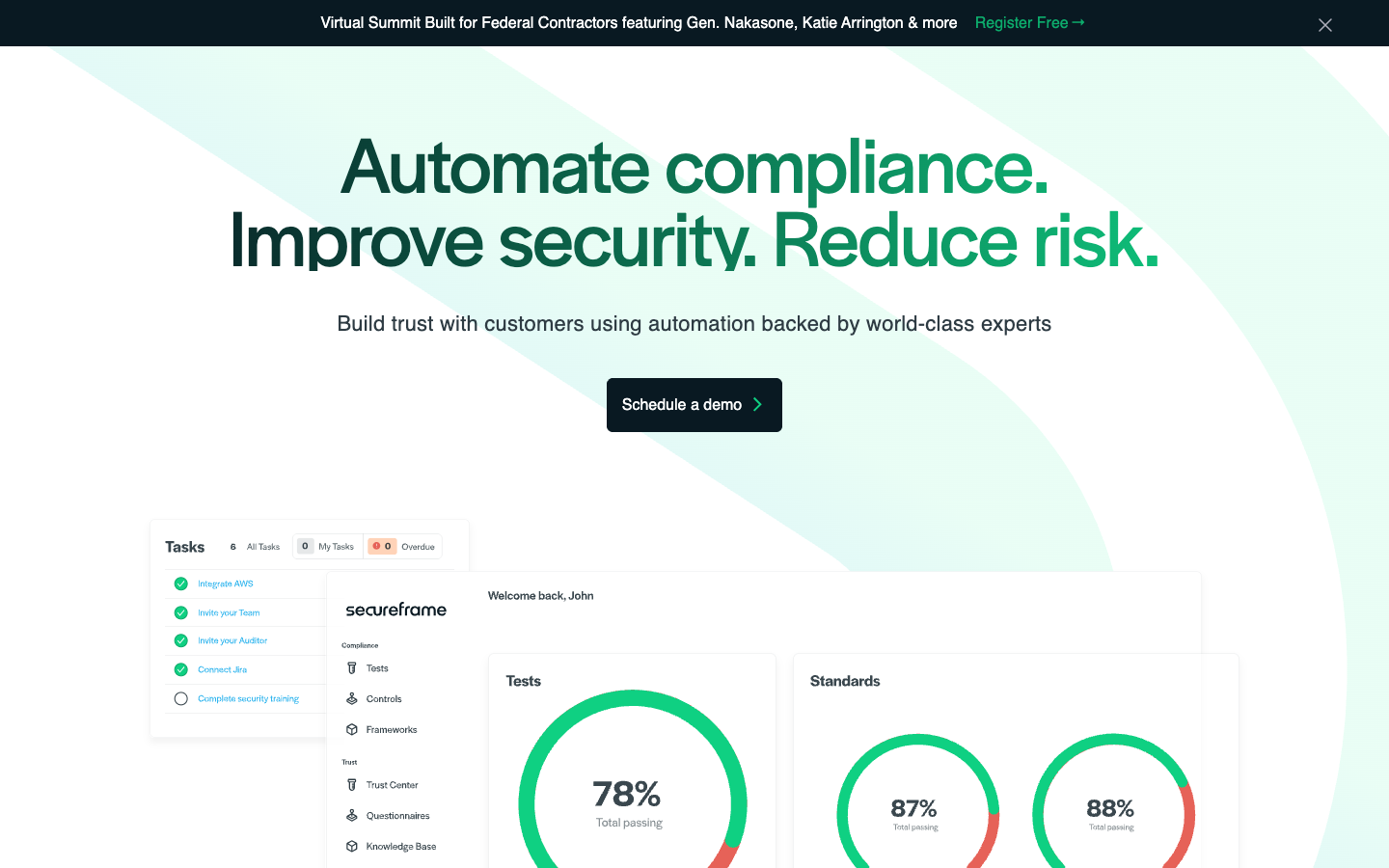
Secureframe is the only major compliance platform in this list that offers a free trial. That matters more than it sounds: most compliance tools require a signed contract before you see the inside of the product. With Secureframe, you can verify that it actually connects to your stack before committing.
Beyond that, Secureframe’s strength is multi-cloud environments. The vendor risk module includes shadow IT detection, which surfaces integrations and services your team is using that are not formally approved or monitored. For startups with fast-moving engineering teams, that is a real compliance risk that most platforms do not address at the evidence collection level. Our Secureframe review covers the product in detail.
The platform supports 40+ frameworks and 300+ integrations. The AI layer handles risk assessment and policy drafting. Pricing starts at roughly $7,500/year for the Fundamentals tier.
“
Intuitive UI with clear guidance on how to pass each compliance test. The support team answers within hours — not days — which made a real difference when we were scrambling before our audit deadline.
★★★★★Verified User· SMB · 51–200 employees
Via G2 ↗Key features:
- 40+ frameworks, 300+ integrations (AWS, Azure, GCP, Okta, Slack, GitHub, Jira)
- Free trial available before signing
- Vendor risk management with shadow IT detection
- Secureframe AI for risk assessment and policy drafting
- Built-in employee compliance training
- Trust Center and questionnaire automation
Pros of Secureframe
- Free trial: test the product before signing
- Strong support responsiveness; answers within hours per user reviews
- Handles multi-cloud environments and shadow IT better than most
Cons of Secureframe
- Integration library thinner for niche or legacy tools
- AI questionnaire responses can be incomplete or need manual correction
- Platform can feel rigid for teams with non-standard compliance workflows
Pricing: Fundamentals from ~$7,500/year; Complete ~$15,000-$20,000/year; Federal on request.
Best for: 20-200 person tech and fintech teams pursuing SOC 2 or ISO 27001 for the first time, especially those with multi-cloud environments.
4. ComplyJet
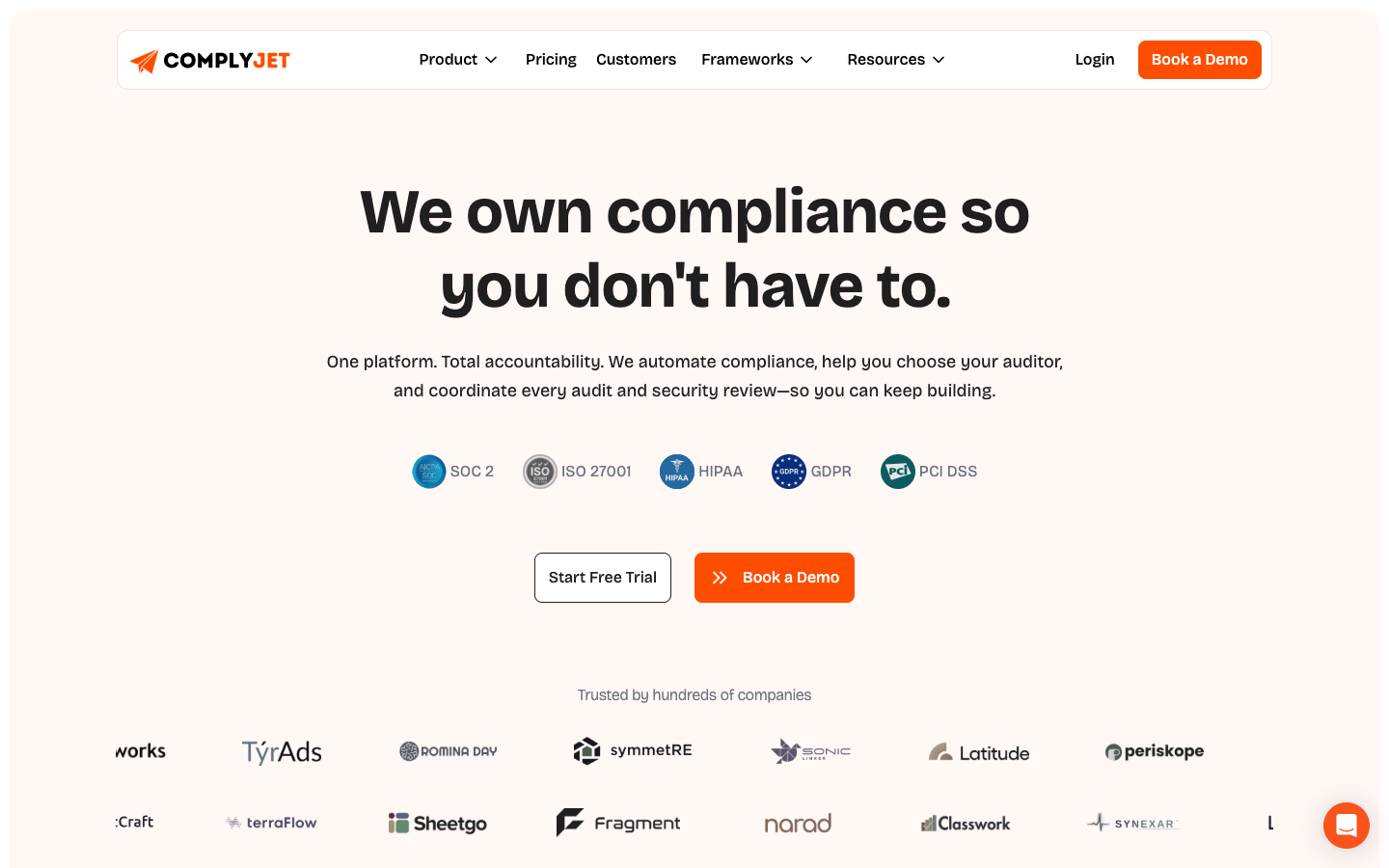
ComplyJet is built for a specific situation: an early-stage startup that needs to get compliant, does not have a compliance team, and does not want to spend $15,000-$25,000/year on software before paying for the audit.
The platform is end-to-end: compliance automation, evidence collection, policy management, vendor reviews, and audit coordination are all included. The team drives the process alongside you, which means you are not handed software and left to figure out what SOC 2 actually requires. Customers typically reach audit readiness in 2-3 weeks, which is meaningfully faster than the 3-6 month timelines common among larger platforms.
The pricing model is the clearest differentiator in this category. ComplyJet charges per company, not per seat: $4,000/year for one framework, $6,400/year for two. Whether you have 10 employees or 50, the price does not change. That is publicly listed, no demo call required. Auditing is separate, starting at $3,000 depending on scope and auditor selection.
The 350+ integration count is competitive with the larger platforms. 25+ frameworks are covered, including SOC 2, ISO 27001, HIPAA, GDPR, and PCI DSS. The Trust Center is included on all plans.
Where ComplyJet is the wrong fit: enterprises, large teams, or organizations running complex multi-entity compliance programs. The product is optimized for the early-stage context. If you are past Series A with a growing compliance function, you will want a tool designed for that scale.
Key features:
- End-to-end compliance automation across 25+ frameworks
- 350+ integrations with continuous automated monitoring
- Flat per-company pricing (not per-seat): same price at 10 or 50 employees
- AI-assisted policy drafting and compliance guidance (ComplyJet AI)
- Trust Center with custom branding and access request management
- Audit coordination: vetted auditor selection and milestone tracking
- Questionnaire automation, vendor and access reviews
Pros of ComplyJet
- Only platform with fully public, flat pricing in this list
- Typical audit readiness: 2-3 weeks
- Team guides the outcome end-to-end: not “buy software, good luck”
- 350+ integrations across 25+ frameworks
Cons of ComplyJet
- Designed for early-stage startups: not suited for enterprises or complex multi-entity programs
- Audit cost is separate (starts at $3,000)
- Smaller brand footprint than Vanta or Drata
“
ComplyJet made SOC 2 and ISO 27001 readiness manageable with automated workflows, evidence collection, and expert support. The team was hands-on and flexible.
David Orr· COO · Romina Day
Via complyjet.com ↗
Pricing: Core $4,000/year (1 framework, up to 50 employees); Plus $6,400/year (2 frameworks). Pricing is publicly listed.
Best for: Seed-to-Series-A startups (1-50 employees) pursuing their first SOC 2 or ISO 27001, who want predictable flat pricing and a team that drives the outcome.
5. Thoropass
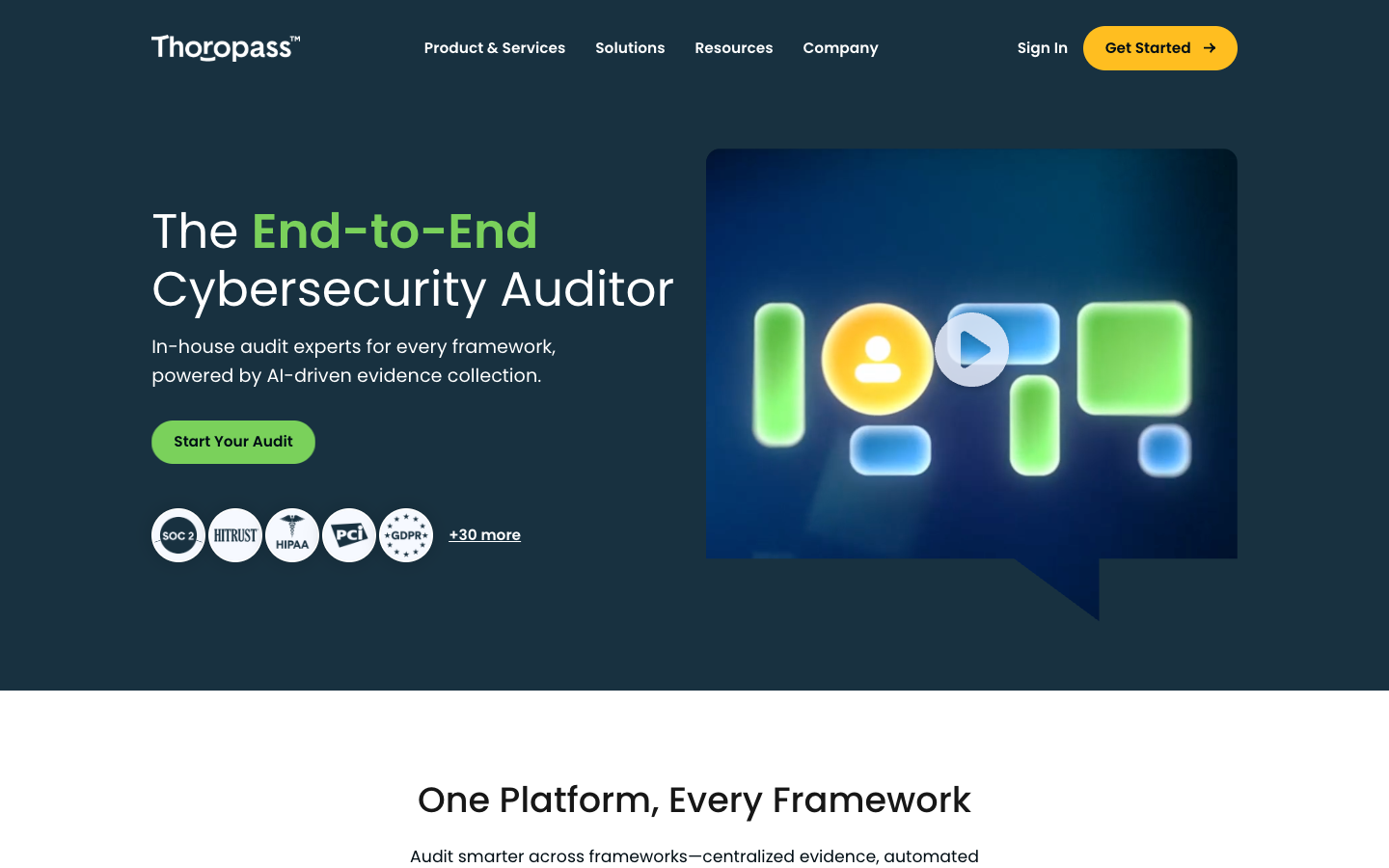
Thoropass (formerly Laika) solves a problem most compliance platforms leave unaddressed: finding and coordinating with an auditor. Most tools give you software and leave the audit sourcing to you. Thoropass bundles in-house audit services directly into the platform, so one vendor handles both the compliance work and the certification itself. Our Thoropass review covers the model and user experience in detail.
The First Pass AI feature automates initial audit preparation, flagging gaps and organizing evidence before the auditor formally reviews anything. The platform supports 30+ frameworks including SOC 2, SOC 1, ISO 27001, HIPAA, PCI DSS, and GDPR. Penetration testing is available with a 90-day free retest window.
The tradeoff with the bundled model: you are committed to their in-house audit team. If you already have an auditor relationship or want to shop for audit pricing separately, the model works against you. Integration coverage at 100+ is also meaningfully thinner than Vanta or Secureframe.
“
Having the auditors and the compliance platform under one roof made a huge difference. No back-and-forth between vendors — everything stayed coordinated and our SOC 2 came in on schedule.
★★★★★Verified User· SMB · 51–200 employees
Via G2 ↗Key features:
- Compliance software bundled with in-house audit services
- First Pass AI for automated audit preparation and gap analysis
- 30+ frameworks, 100+ integrations
- Dedicated compliance expert team throughout the process
- Penetration testing with 90-day free retest
- Vendor risk management, questionnaire automation, policy management
Pros of Thoropass
- Single vendor for software and audit: eliminates multi-vendor coordination
- Hands-on customer success; strong reviews on audit experience specifically
- 4.7/5 across 576 reviews
Cons of Thoropass
- Fewer integrations than competitors (100+ vs 300-375)
- Bundled audit means less flexibility to use your own auditor
- Higher total cost when platform and audit subscription are combined
Pricing: Platform from ~$8,700/year; SOC 2 audit subscription ~$5,800/year. Median bundled deal ~$30,000/year.
Best for: Companies that want a single vendor for both compliance software and the audit, especially for first-time SOC 2 or ISO 27001 certification.
6. Hyperproof
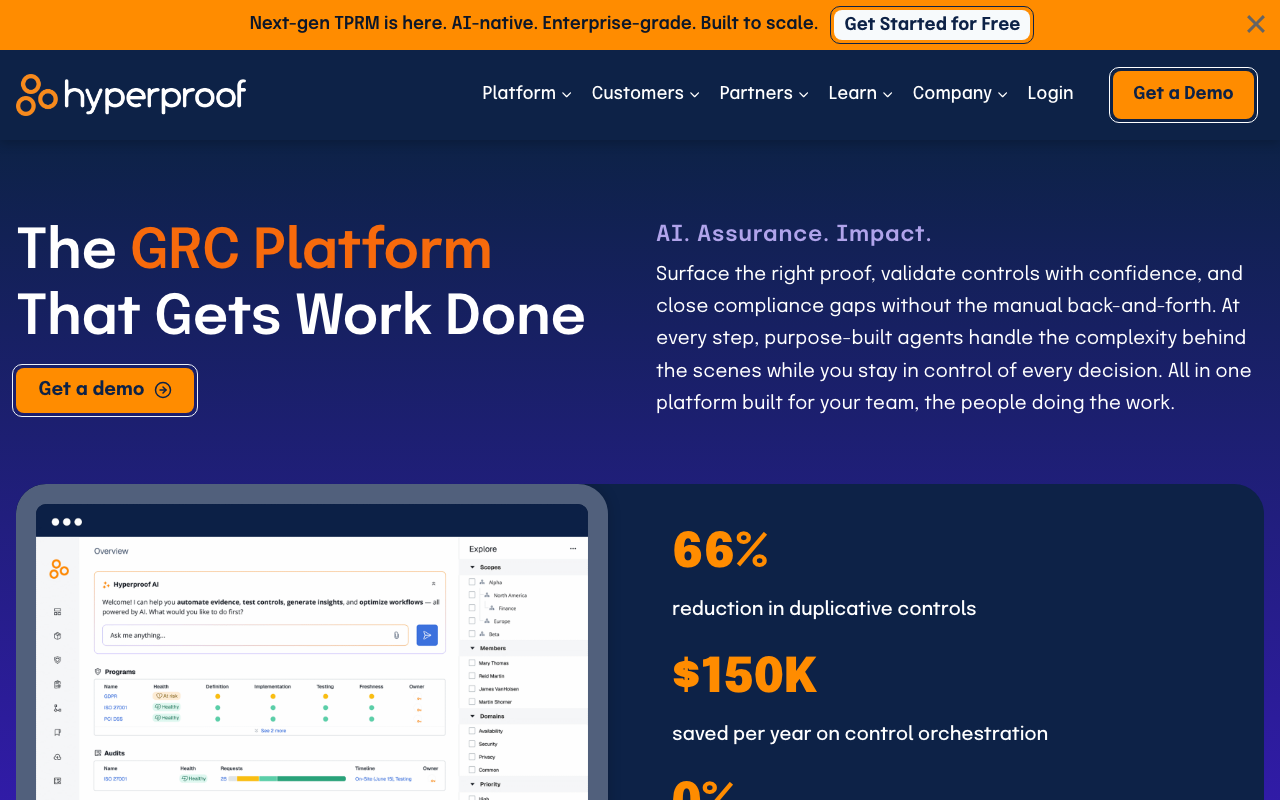
Hyperproof is designed for a different buyer than the startup-focused tools above. The typical Hyperproof customer is a mid-market IT or security team running three or more compliance frameworks simultaneously, needing to manage controls at scale without per-seat pricing ballooning their costs. Every Hyperproof plan includes unlimited users, which changes the economics significantly for larger teams.
The Hypersyncs feature automates evidence collection by connecting to cloud, identity, DevOps, and security tools and pulling evidence on a scheduled basis. User Access Reviews automate the periodic access certification process across AWS, Azure, Google Workspace, and Okta. The compliance risk management module is genuinely integrated into the compliance workflow, not bolted on as an afterthought. See our Hyperproof review for the full picture.
Starting price is roughly $12,000/year, with the median deal landing around $40,000/year. No free trial is available.
“
Hyperproof is powerful and handles our multi-framework compliance well, but the interface can feel a bit overwhelming at first — especially for new users unfamiliar with audit workflows. Once you're up to speed, it's excellent.
★★★★Verified User· Mid-Market · 201–1000 employees
Via G2 ↗Key features:
- Unlimited users on all pricing tiers
- Hypersyncs for automated evidence collection across cloud and DevOps tools
- User Access Reviews across AWS, Azure, Google Workspace, Okta
- Integrated risk management module
- Audit management and third-party risk monitoring
- 30+ pre-built compliance framework templates
Pros of Hyperproof
- Unlimited users regardless of tier: predictable cost at scale
- Strong multi-framework support for teams running 3+ frameworks simultaneously
- Trusted by Reddit, Fortinet, Thales, Appian
Cons of Hyperproof
- Steeper learning curve than startup-focused tools
- Fewer G2 reviews (213) than most competitors: smaller community signal
- No free trial; entry price higher than Vanta, Drata, or Sprinto
Pricing: Professional from ~$12,000/year; Business ~$22,000-$40,000/year; Enterprise ~$54,000+/year.
Best for: Mid-market IT and security teams running multiple compliance frameworks simultaneously who need unlimited-user pricing and deep risk management integration.
7. OneTrust
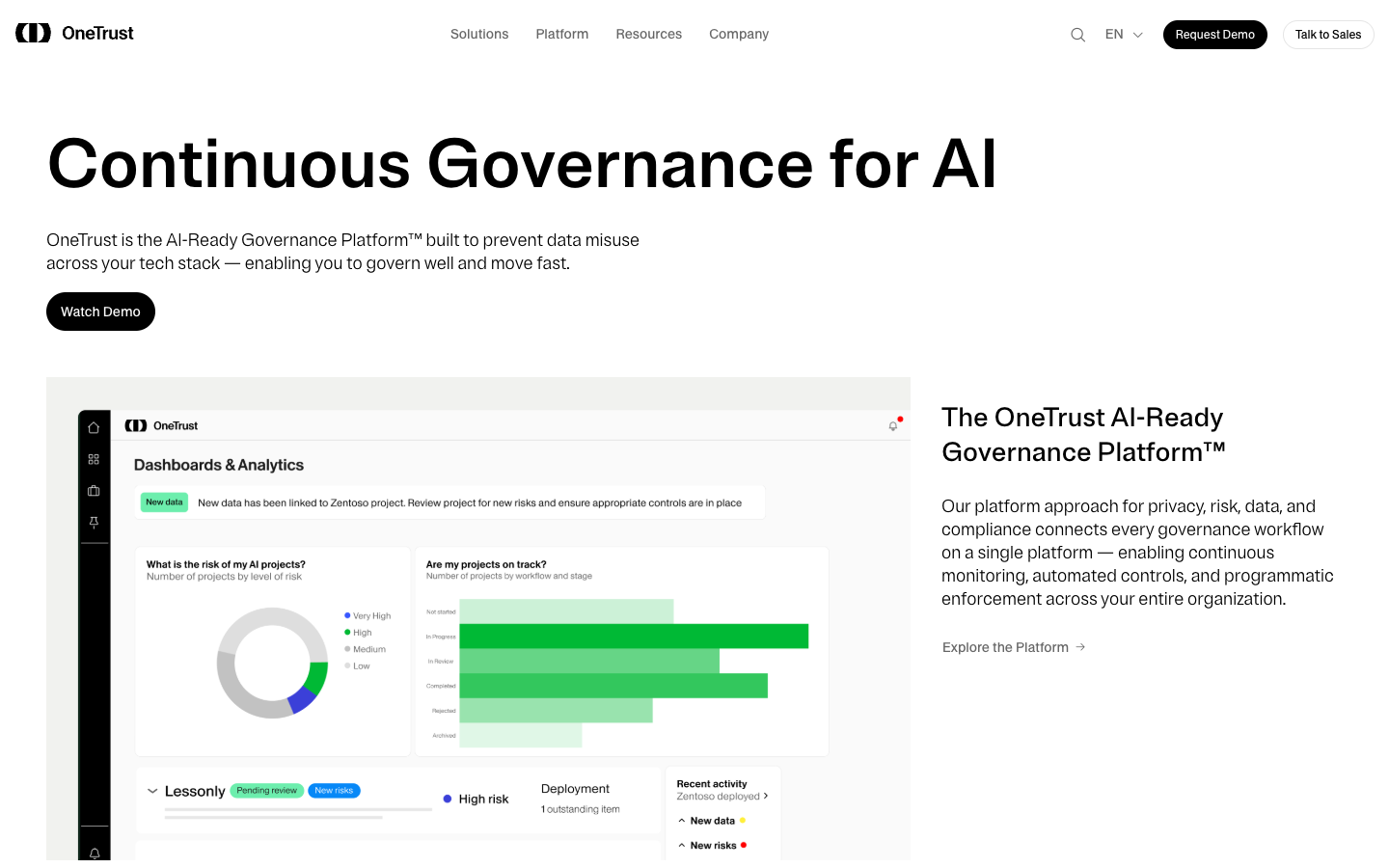
OneTrust is not primarily a compliance automation tool in the SOC 2 or ISO 27001 sense. It is an enterprise trust intelligence platform: privacy automation, tech risk and compliance, consent management, AI governance, and third-party risk all under one roof. If your compliance program is primarily driven by privacy regulations (GDPR, CCPA, or HIPAA privacy overlaps), OneTrust is the most capable platform in this list for that scope.
The regulatory intelligence module tracks changes across 200+ global jurisdictions and maps them to your existing controls automatically. That is genuinely valuable for organizations operating across multiple geographies with overlapping privacy obligations. The tech risk and compliance module handles SOC 2 and ISO 27001 alongside everything else, making it a fit for healthcare compliance management software requirements where privacy and security obligations intersect.
Implementation takes 3-6 months by most user accounts, and the platform is complex enough that the first few months feel more like configuration than active compliance work. Pricing starts at $10,000/year minimum, with enterprise multi-module deployments typically running $50,000-$250,000+/year.
Not the right tool for a startup. The right tool for a mid-market or enterprise organization with a real privacy and compliance function.
“
The regulatory intelligence feature is a game changer — we get real-time updates on global privacy laws mapped directly to our controls. That said, it's not an upload-and-play tool. Expect 3–6 months of implementation before you're fully configured.
★★★★Verified User· Enterprise · 1001–5000 employees
Via G2 ↗Key features:
- Privacy automation, DPIA and PIA management, cookie consent
- Tech Risk and Compliance module (SOC 2, ISO 27001, NIST, CMMC, GDPR)
- Regulatory intelligence across 200+ jurisdictions
- AI risk governance (ISO 42001, EU AI Act)
- Third-party and vendor risk management
- Data mapping and policy management
Pros of OneTrust
- Deepest regulatory intelligence in the market
- Covers privacy and security compliance in one platform
- Handles complex global privacy programs that other tools cannot
Cons of OneTrust
- 3-6 month implementation timeline: not for teams that need compliance quickly
- Complex configuration; steep learning curve for first-time users
- Minimum pricing of $10,000/year; enterprise deployments cost far more
Pricing: Single module $10,000+/year; enterprise multi-module $50,000-$250,000+/year. All pricing custom-quoted.
Best for: Mid-market to enterprise organizations with complex privacy and compliance requirements spanning multiple global regulations.
8. AuditBoard
AuditBoard is the internal audit platform for companies with a dedicated audit function. It won G2’s 2026 Best Software Award for GRC and Best Software for Enterprise, which reflects its standing in the enterprise segment. If you are a public company managing SOX, internal audit, and enterprise risk programs, AuditBoard is the category leader. Our AuditBoard review covers the product in detail.
The platform combines internal audit management, risk management with real-time heat maps, SOX and ITGC testing, ESG reporting, and compliance tracking in one unified system. The collaboration layer is strong: live editing, comments, and task tracking across audit teams mean everyone works from the same version of the truth at any point in the audit cycle.
Pricing is fully enterprise-grade: $40,000-$150,000+/year, quote-only, with an average setup time of about 4 months. This is not a tool for startups or companies without a dedicated internal audit team.
“
AuditBoard has transformed how our internal audit team works. Everything is centralized — workpapers, findings, risk assessments — and real-time collaboration means we're never waiting on each other. Setup was involved but worth every minute.
★★★★★Verified User· Enterprise · 1001–5000 employees
Via G2 ↗Key features:
- Internal audit management with live team collaboration
- Risk management with real-time heat maps and visual overviews
- SOX and ITGC testing
- ESG and sustainability reporting
- 200+ third-party integrations
- Drag-and-drop reporting with customizable dashboards
- AI-assisted risk analysis and audit planning
Pros of AuditBoard
- Best-in-class for internal audit programs
- G2 2026 Best Software Award winner in GRC and Enterprise
- Strong SOX support: purpose-built for public companies
- 4.6/5 across 1,585 reviews
Cons of AuditBoard
- Not designed for startups or first-time compliance programs
- $40,000-$150,000+/year: significant investment at any tier
- 4-month average setup: not suitable for urgent compliance timelines
Pricing: $40,000-$150,000+/year. Fully quote-based with no published tiers.
Best for: Public companies and large enterprises with dedicated internal audit teams managing SOX, risk, and multi-framework compliance programs.
9. Sprinto
Sprinto consistently earns the strongest user reviews in this category: 4.8/5 across 1,637 reviews. The common thread is speed. Teams regularly report reaching SOC 2 Type I readiness in 25-30 days, with Sprinto’s support team actively guiding the process throughout. The underlying reason is the common control approach: you map evidence once and it reuses across frameworks, so adding ISO 27001 after SOC 2 does not mean starting from scratch. Our Sprinto review goes into the product detail.
The platform supports 200+ compliance frameworks and 300+ integrations. Risk management, vendor risk, access reviews, policy management, and a Trust Center are all included. Pricing starts at roughly $7,000-$8,000/year for the Starter tier and scales with framework count and infrastructure complexity.
One consistent note in user reviews: the dashboard has a lot going on. First-time compliance leads occasionally find it overwhelming in the first week before onboarding properly settles them in. That resolves quickly, but worth knowing before the first login.
“
SOC 2 has a reputation for being a long, messy process. With Sprinto, everything was in one place, auditor coordination was handled, and we weren't constantly pulled away from product work. We got Type I in under a month.
★★★★★Verified User· SMB · 11–50 employees
Via G2 ↗Key features:
- Common control approach: map evidence once, reuse across frameworks
- 200+ frameworks, 300+ integrations (AWS, Azure, Okta, GitHub, Jira, Slack)
- Automated evidence collection (up to 90%)
- Risk management linked directly to compliance controls
- Trust Center, vendor risk, access reviews, policy management
- Employee security training included
Pros of Sprinto
- 4.8/5 across 1,637 reviews: highest review count among startup-focused tools in this list
- SOC 2 Type I readiness in 25-30 days
- Common control approach meaningfully reduces multi-framework duplication
- Strong onboarding and ongoing support
Cons of Sprinto
- Dashboard initially overwhelming for first-time compliance leads
- Pricing less predictable: varies with infrastructure complexity
- Limited customization for non-standard compliance workflows
Pricing: Starter from ~$7,000-$8,000/year; Growth ~$8,000-$15,000/year; Enterprise from ~$20,000/year.
Best for: Cloud-native SaaS startups that need to get SOC 2 or ISO 27001 certified fast without a dedicated compliance team.
10. Scrut Automation

Scrut Automation has the highest G2 rating in this list: 4.9/5 across 1,298 reviews, and ranked #9 in G2’s 2026 Best Software Awards for GRC. The differentiator is the AI layer. Scrut Teammates are AI agents that guide you through remediation, validate evidence, and complete security questionnaires. That is more than AI-assisted drafting: it is closer to an AI compliance manager software layer running tasks in parallel with your team. Our Scrut Automation review covers the product in more depth.
The platform monitors 230+ CIS benchmarks continuously and includes 75+ pre-built policy templates. 50+ frameworks are supported. The integration count at 70+ is lower than most tools in this list, which is worth verifying against your specific stack before committing.
Pricing starts at roughly $15,000/year for up to 20 employees per the AWS Marketplace listing. For small teams, that entry point is higher than Sprinto, Secureframe, or ComplyJet for comparable functionality. For teams that genuinely use the AI remediation layer heavily, the difference may justify itself.
“
Scrut made managing compliance across multiple frameworks genuinely manageable. The AI remediation suggestions actually make sense in context, and the customer support team is among the best I've worked with at any SaaS company.
★★★★★Verified User· SMB · 51–200 employees
Via G2 ↗Key features:
- AI Teammates for guided remediation, evidence validation, and questionnaire automation
- 4.9/5 across 1,298 reviews: highest-rated platform in this list
- 50+ frameworks, 70+ integrations
- Continuous monitoring across 230+ CIS benchmarks
- 75+ pre-built policy templates
- Vendor risk management, audit management, Trust Center
Pros of Scrut Automation
- Highest-rated platform in this list (4.9/5)
- AI remediation guidance goes beyond simple automation
- 230+ CIS benchmark monitoring
- G2 Best Software Award 2026 for GRC
Cons of Scrut Automation
- Integration library smaller than most competitors (70+ vs 300-375+)
- Starting price higher for small teams compared to alternatives
- Agent sync delays noted in user reviews: device status not always reflected immediately
Pricing: ~$15,000/year for up to 20 employees; enterprise pricing on request.
Best for: Fast-growing teams that want AI-assisted compliance guidance and the highest-rated platform in the category.
How to choose compliance risk management software for your stage
Define your compliance scope first
Before requesting a single demo, decide which frameworks you need and in what order. SOC 2 for a US enterprise deal is a different project from ISO 27001 for a European contract, which is different again from HIPAA for a healthcare customer.
The question to ask every vendor: “Which frameworks are included in the base plan, and what does it cost to add a second?” That answer tells you the real total cost of the relationship over three years, not just the entry price.
Startup, scaling, or enterprise: the right fit changes at each stage
The most common mistake is buying a tool for the stage you plan to be at in two years rather than the one you are at today.
For startups (1-50 employees) in their first compliance program, flat pricing and guided support matter more than feature depth. ComplyJet, Sprinto, and Secureframe are designed for this context.
For scaling companies (50-300 employees) running multiple frameworks, integration breadth and cross-framework control reuse become the key variables. Drata, Vanta, Scrut, and Thoropass handle multi-framework programs well.
For enterprise teams with a dedicated audit function, internal audit management, SOX support, and governance tooling are non-negotiable. AuditBoard, Hyperproof, and OneTrust are built for that layer.
Integration depth: does it talk to your actual stack?
A compliance platform is only as good as its connections to your real infrastructure. If it cannot pull evidence from your cloud provider, identity platform, and code repository automatically, you are back to manual uploads and the annual sprint.
Ask vendors to demonstrate evidence collection from your specific stack before signing. Vanta and Secureframe lead on integration breadth (300-375+). Scrut (70+) and Thoropass (100+) are more limited. For non-standard or legacy environments, verify the specific connectors before you commit.
Software-only vs. software-plus-auditor
Most compliance platforms give you software and leave you to source and manage the auditor separately. Thoropass is the main exception: the audit is bundled in. ComplyJet takes a middle path, coordinating with vetted external auditors as part of the process rather than using in-house ones.
If you are doing this for the first time without an existing auditor relationship, the integrated model simplifies the path significantly. If you have an existing relationship or want to shop audit pricing, software-only gives you more flexibility.
Pricing model: what you are actually signing up for
Most tools in this list are priced per-seat or per-headcount-band, meaning your compliance spend grows with your team size. The alternatives are flat pricing (ComplyJet: same price at 10 or 50 employees) and module-based pricing (OneTrust: pay per product area).
Per-seat pricing with no published rates is harder to budget for, especially at renewal when the leverage shifts to the vendor. Flat pricing is more predictable. The right question is not “what is the lowest entry price?” but “what will this cost in year two when we have doubled headcount and added a second framework?”
Free Demo
Not sure which compliance platform fits your stage?
ComplyJet is built for startups. Flat pricing, fast setup, guided to certification.
Frequently asked questions
What is compliance management software?
Compliance management software automates the work of maintaining and demonstrating adherence to security and privacy frameworks like SOC 2, ISO 27001, HIPAA, and PCI DSS. It connects to your cloud infrastructure, identity systems, and code repositories to continuously collect evidence that your controls are working, then organizes that evidence for auditors. The alternative is doing this manually, which most teams find unsustainable past their first certification cycle.
What is a compliance management system?
A compliance management system is the structured set of processes, controls, and documentation an organization uses to meet its compliance obligations. Software automates much of it: evidence collection, control testing, risk assessment, policy management, and audit workflows. Without dedicated software, a CMS typically lives across spreadsheets, document repositories, and email threads. It works once. It falls apart at scale.
What is software compliance?
In this context, software compliance means compliance with security and privacy regulations: frameworks like SOC 2, ISO 27001, HIPAA, GDPR, and PCI DSS. This is distinct from software license compliance (ensuring your organization is not running unlicensed software). All tools in this list address the regulatory compliance meaning.
What is GRC compliance?
GRC stands for Governance, Risk, and Compliance. It is the broader discipline that compliance management software fits inside. A GRC program covers organizational governance structures, enterprise-wide risk management, and compliance with regulatory and contractual obligations. You can read more about how GRC relates to integrated risk management. Compliance automation platforms like Vanta or Sprinto handle the compliance layer. More comprehensive platforms like Hyperproof, OneTrust, and AuditBoard extend into risk and governance as well.
How do compliance solutions integrate with enterprise systems?
Most platforms integrate via API connections to cloud providers (AWS, Azure, GCP), identity platforms (Okta, Azure AD, Google Workspace), code repositories (GitHub, GitLab, Bitbucket), security tools (CrowdStrike, SentinelOne), and productivity suites (Jira, Slack, Microsoft 365). The integration pulls evidence of your controls automatically: who has access, what is encrypted, which endpoints are managed. Integration library size varies significantly across these platforms, from 70 to 375+. Manual evidence upload is available as a fallback on all platforms.
Is there a free compliance management software option?
Secureframe is the only platform in this list that offers a free trial. Most compliance automation tools require paid plans from day one. ComplyJet’s Core plan starts at $4,000/year, which is the lowest public starting price in this list. Open-source tools like OpenSCAP exist but lack the automation layer that makes modern compliance platforms practical for audit preparation.
Final thoughts
The right compliance management software for a 20-person startup pursuing their first SOC 2 is a completely different product from what a public company needs to manage SOX and internal audit across hundreds of controls. Most of the tools in this list do both well at their intended scale. Most fail badly when used outside it.
Why it matters
Most of the tools in this list do both well at their intended scale. Most fail badly when used outside it.
If you are in the startup-to-Series-A range: the platforms designed for that context, with flat pricing and guided support, are worth evaluating before defaulting to the market-leader option. The compliance outcome is the same. The cost and friction getting there are not.
If you’re a startup pursuing SOC 2 or ISO 27001 for the first time, ComplyJet is built for you: flat pricing, 350+ integrations, and a team that guides you through to certification.