.svg)

Every fast-growing SaaS company hits the same wall.
You are deep in a sales conversation with an enterprise prospect, things are going well, and then the security questionnaire lands in your inbox. It is 200 questions long.
Your team has never done a formal audit. And the deal you spent three months building is now on hold until you can prove your security posture.
That moment is what compliance professionals call the compliance bottleneck. It is the point at which growth stalls because security certification has not kept pace with sales ambitions.
It costs fast-growing companies an average of four to six months of operational drag per certification cycle when managed manually. Scrut Automation was explicitly built to close that gap.
This guide draws on verified sources from G2, Capterra, Gartner Peer Insights, AWS Marketplace, and real customer case studies from communities like Reddit.
If you are evaluating Scrut Automation in 2026 and want an honest picture before you book a demo, this is the review you need.
If this is all you needed to see, then you might want to skip the read and explore a compliance platform with transparently published pricing .ComplyJet lets you start your free trial, without a single sales call.
But first, here is everything you need to know about Scrut.
What Is Scrut?
Most compliance platforms are named after features or founders. Scrut is named after a purpose. The word traces back to the Latin root scrutari, which means to probe, examine, and search thoroughly. That same root gave us the word scrutiny.
That is not a coincidence. Scrut was built to do the scrutinizing, so your team does not have to.
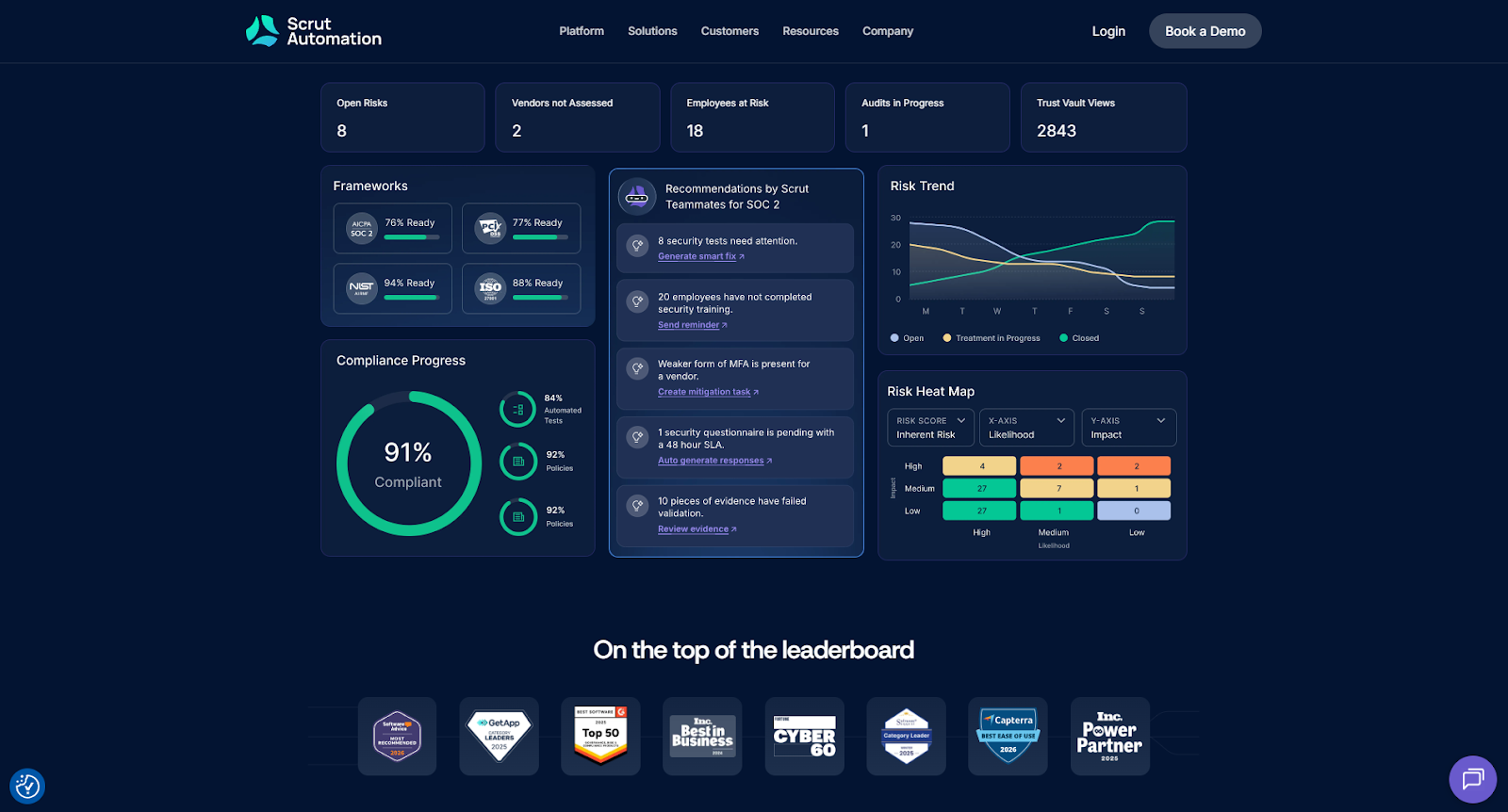
Scrut Automation is an AI-powered Governance, Risk and Compliance (GRC) platform that automates compliance workflows, evidence collection, and audit management for cloud-native companies, helping security teams reduce compliance effort by up to 70%.
The name reflects the core function. Scrut probes your systems, examines your controls, and surfaces gaps before an auditor finds them.
Most compliance teams spend months collecting screenshots, chasing engineers for log access, and manually mapping control evidence to framework requirements.
Scrut replaces that entire process with automation.
Think of it as a compliance program running quietly in the background. It watches your infrastructure continuously, flags when something drifts out of policy, and packages the evidence an auditor needs into a format they can immediately use.
Next, you need to know how Scrut makes it all possible.
How Does Scrut Work?
Scrut operates in three layers that work in sequence.
Each layer builds on the one before it, which is why teams that fully configure the platform report a significantly different audit experience compared to those running manual compliance programs.
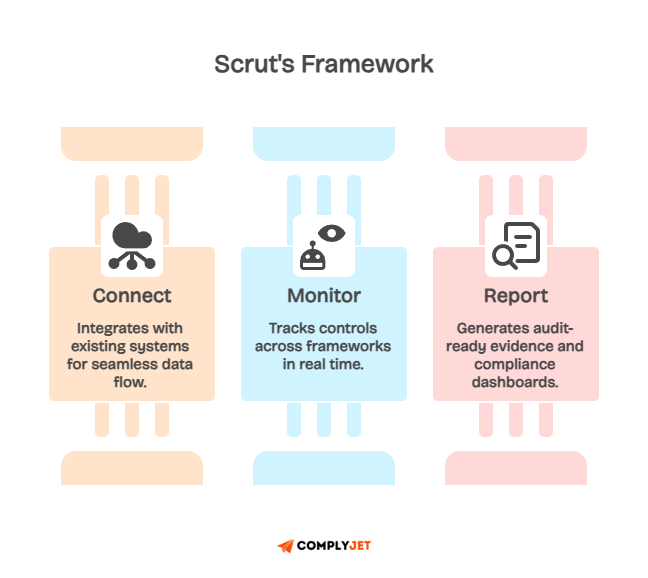
The first layer: Connection
Scrut integrates with 100+ tools across your cloud infrastructure, HR systems, developer platforms, and identity providers. It pulls data automatically without CSV exports or manual reports.
The second layer: Monitoring
Once connected, Scrut watches your controls in real time across 50+ compliance frameworks. If your cloud storage bucket becomes publicly accessible, or an employee device loses its hard drive encryption, Scrut catches it immediately rather than three months later during a scheduled review.
The third layer: Reporting
Scrut manages to pack everything together in a bundle like audit-ready evidence, pre-filled policy templates, and live compliance dashboards. When an auditor arrives, your evidence is already organized and formatted.
Now, let's have an overall view of the company before we dissect it.
Scrut Automation Company Overview
Scrut Automation was not built by compliance consultants working from the outside in. It was built by founders who ran into the compliance wall themselves and decided the only real fix was full automation.
That founding context matters because the product reflects the frustration of people who actually lived the problem before they built the solution.
The Three Founders Who Built Scrut
Three people built Scrut Automation. Each brought a different perspective to the same problem, and that combination directly shapes how the platform works today.
Aayush Ghosh Choudhury is the Co-Founder and CEO.
He came from McKinsey and went on to build a SaaS startup where enterprise buyers kept asking for SOC 2 and ISO 27001 certifications before contracts could move forward. Deals stalled. Momentum died. He understood the direct financial cost of compliance friction and built Scrut to remove it. When people ask who the CEO of Scrut Automation is, the answer is someone who was a customer before he was a founder.
Jayesh Gadewar is the Co-Founder and CTO.
He ran his first gaming server at thirteen and led engineering teams at twenty. When compliance requirements blocked their previous Startup's roadmap, Jayesh did not hire a consultant. He wrote the first automation engine himself. That codebase became the technical foundation of what Scrut is today.
Kush Kaushik is the third Co-Founder.
He has personally led over 3,000 audits across ISO, SOC 2, and PCI-DSS frameworks. His auditor's inside view directly shapes how Scrut maps controls, structures evidence packages, and handles the edge cases that most GRC platforms miss entirely.
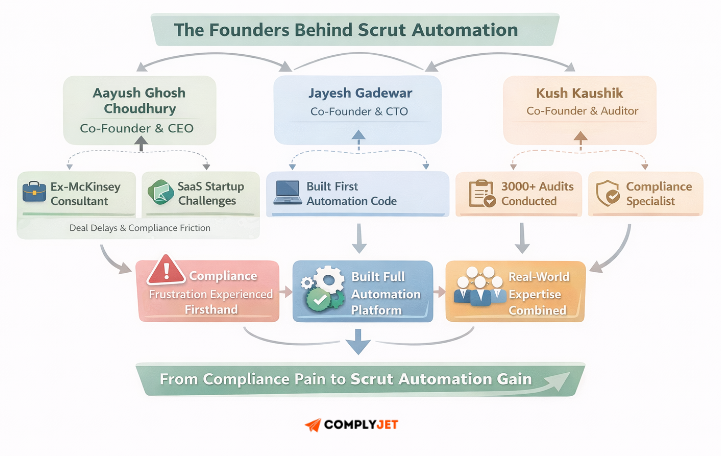
They lived the compliance nightmare together, built their own solution, and turned it into a company that more than 1,700 organizations now rely on daily.
Scrut Automation Funding and Valuation
Scrut Automation has raised approximately $20.6 million across four funding rounds from 29 investors. Backing from Lightspeed Venture Partners and MassMutual Ventures signals serious conviction in the compliance automation category as a long-term market.
The funding timeline shows clear momentum. The Seed round closed in February 2022 with Endiya Partners.
The Series A First Close brought in $7.5 million from MassMutual Ventures in February 2023.
Lightspeed Venture Partners led the Series A Second Close at $10 million in October 2023. A private equity round of $9 million from existing investors followed in February 2024.
As of May 2025, Scrut Automation was valued at approximately Rs 624 Crore, which is roughly $75 million.
For a company less than four years old at that point, the valuation reflects strong investor confidence in the market direction.
Scrut Automation Revenue
Scrut Automation reported annual revenue of Rs 78.6 Crore for the financial year ending March 2025.
The rate of growth is significant. Revenue grew 4.6 times in FY25 compared to the prior year, one of the strongest growth rates in the compliance automation category for that period.
That kind of growth at the Series A stage is a strong retention signal. It means customers are not just trialling the platform. They are renewing and expanding.
For a company competing with more capable players, 4.6x revenue growth in a single financial year suggests real customer value rather than just strong sales motion.
Scrut Automation Careers and Culture
Scrut Automation currently employs between 126 and 184 people, with headcount growing approximately 14 percent year over year. The team spans engineering, customer success, sales, and compliance expertise across both the India and US offices.
On Glassdoor, the company holds a 3.7 out of 5 rating based on 92 reviews. That score sits in the broadly positive range for a Series A company growing at this pace. Reviews consistently mention a fast-moving environment and a strong product mission as the primary reasons people join and stay.
Now, let's focus on what actual customers have to say about Scrut.
Verified User Ratings Based on Customer Reviews [2026]
Before you spend time on a demo call, it helps to know what people who already use the platform actually think. Ratings across independent review platforms tell a cleaner story than any vendor page ever will.
Scrut Automation holds strong numbers across every major review platform as of 2026. The consistency across G2, Capterra, Gartner Peer Insights, and AWS Marketplace is the more important signal here. When ratings align across different company profiles, you are looking at a genuine pattern.
G2 Reviews: What Real Users Say
Scrut Automation's performance on G2 reflects 2 years of consistent user satisfaction, with an overall rating of 4.9 out of 5.
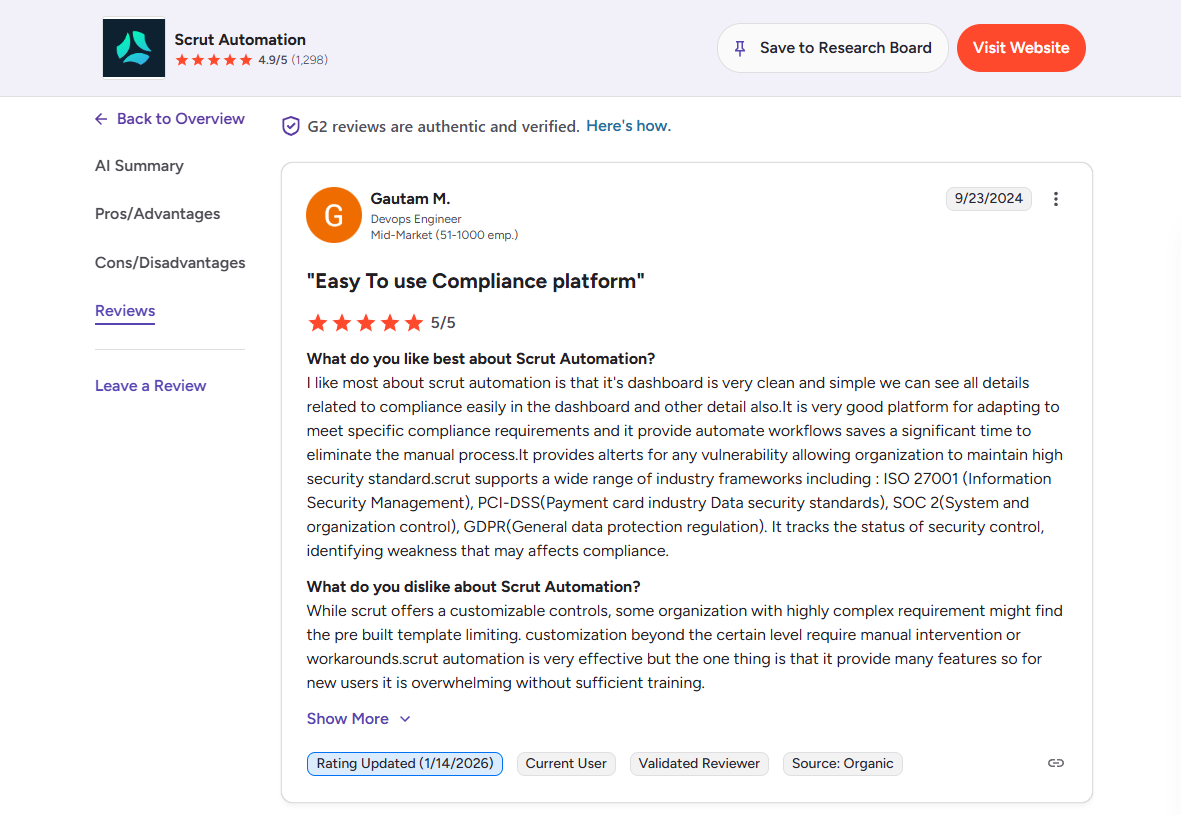
User experiences from verified G2 reviews highlight the most common themes, such as great support and an easy-to-use interface.
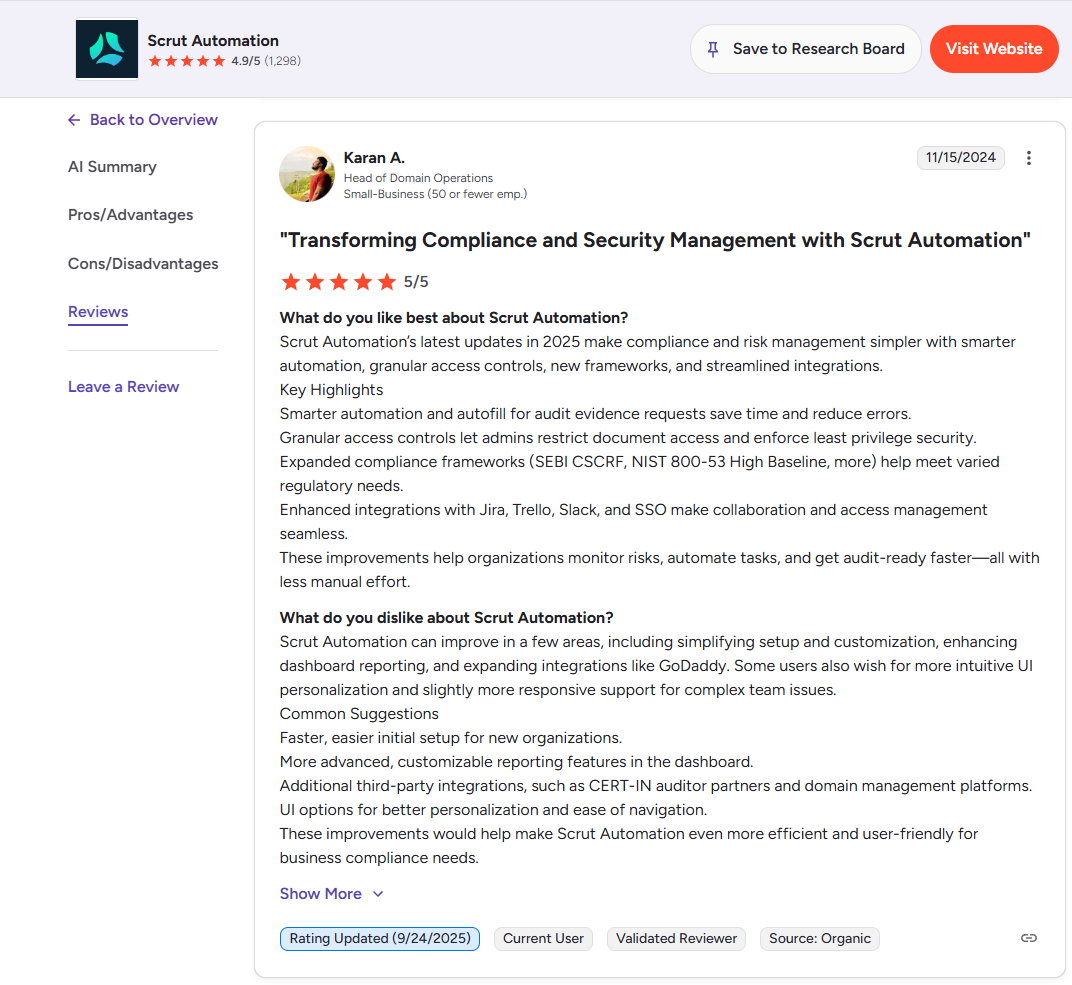
This user states it very clearly, with a caution that Scrut offers many features and that it can be overwhelming without proper support.
Here is another user who touches on the same narrative.
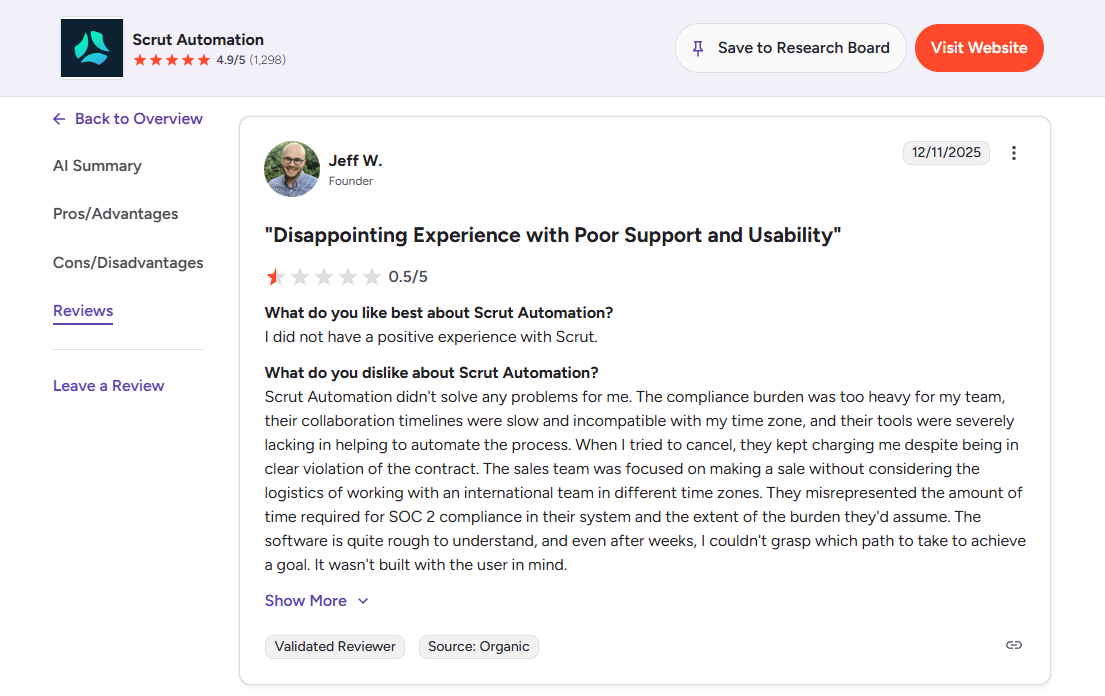
Users also report inefficiencies in Scrut's audit-readiness, which is sometimes delayed or misrepresented, as highlighted by this user.
The other users commonly report,
- Sync issues with the Scrut agent
- Price not being affordable for early teams
- Lack of integrations
- Good UX but not great
- Manual effort is higher than expected
Capterra Reviews: Verified Feedback Themes
Capterra is where mid-market buyers and department-level decision makers leave feedback. Scrut holds a 4.9 out of 5 rating there based on 70+ verified reviews, with some respondents reporting a perfect overall satisfaction score.
The themes that surface repeatedly are consistent with G2 patterns.
Proactive customer support is cited most often. Streamlined evidence collection is the second most common win, particularly from financial services users managing ISO 27001 or SOC 2 for the first time.
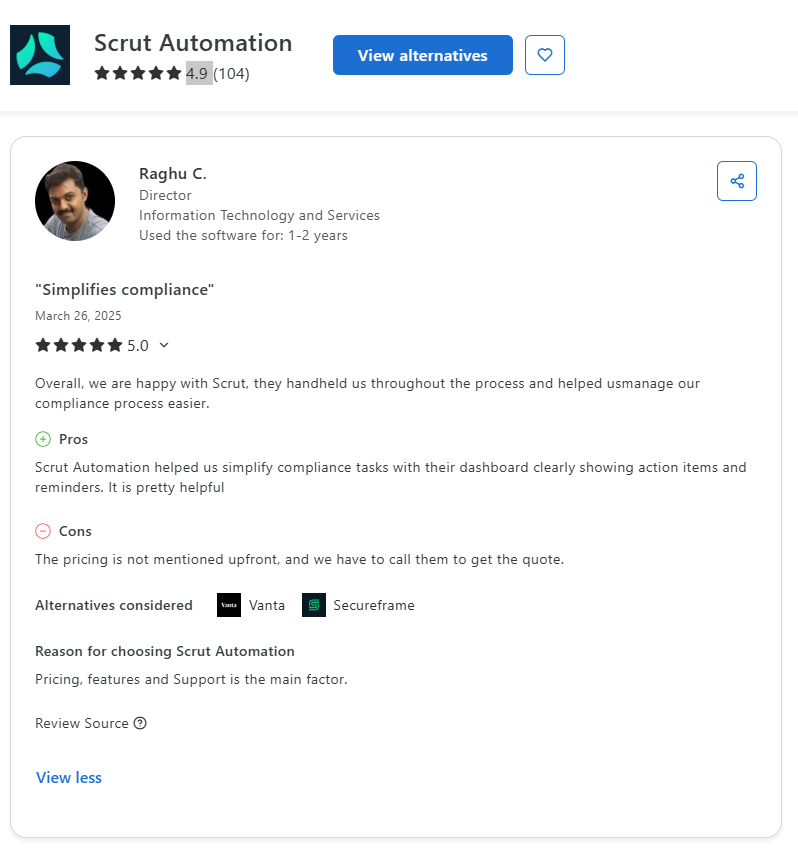
One user mentioned that Scrut is not upfront about the pricing, and a sales call is mandatory to receive a quote, as highlighted here.
The training module receives specific praise from HR-adjacent roles.
One Head of Partnerships in financial services noted that it made employee security awareness training trackable across the organization.
The most common drawback is agent sync delay, where the Scrut Agent takes longer than expected to reflect device status changes in its compliance dashboard, as highlighted earlier.
Gartner Peer Insights
Gartner Peer Insights carries a more enterprise-weighted audience: CISOs, IT directors, and compliance leads at larger organizations. The feedback there tends to be more technical and more direct than consumer-oriented platforms.
Gartner rates Scrut only a 3.4 out of 5.
The most consistent technical complaints mirror those reported by Capterra users.
Agent sync issues surface repeatedly, alongside cloud integration lag, where configuration changes take longer than expected to appear in the compliance dashboard.
Most reviewers noted that Scrut's non-compliance features offer the bare minimum to pass an audit without actively improving the underlying security program, as highlighted here.
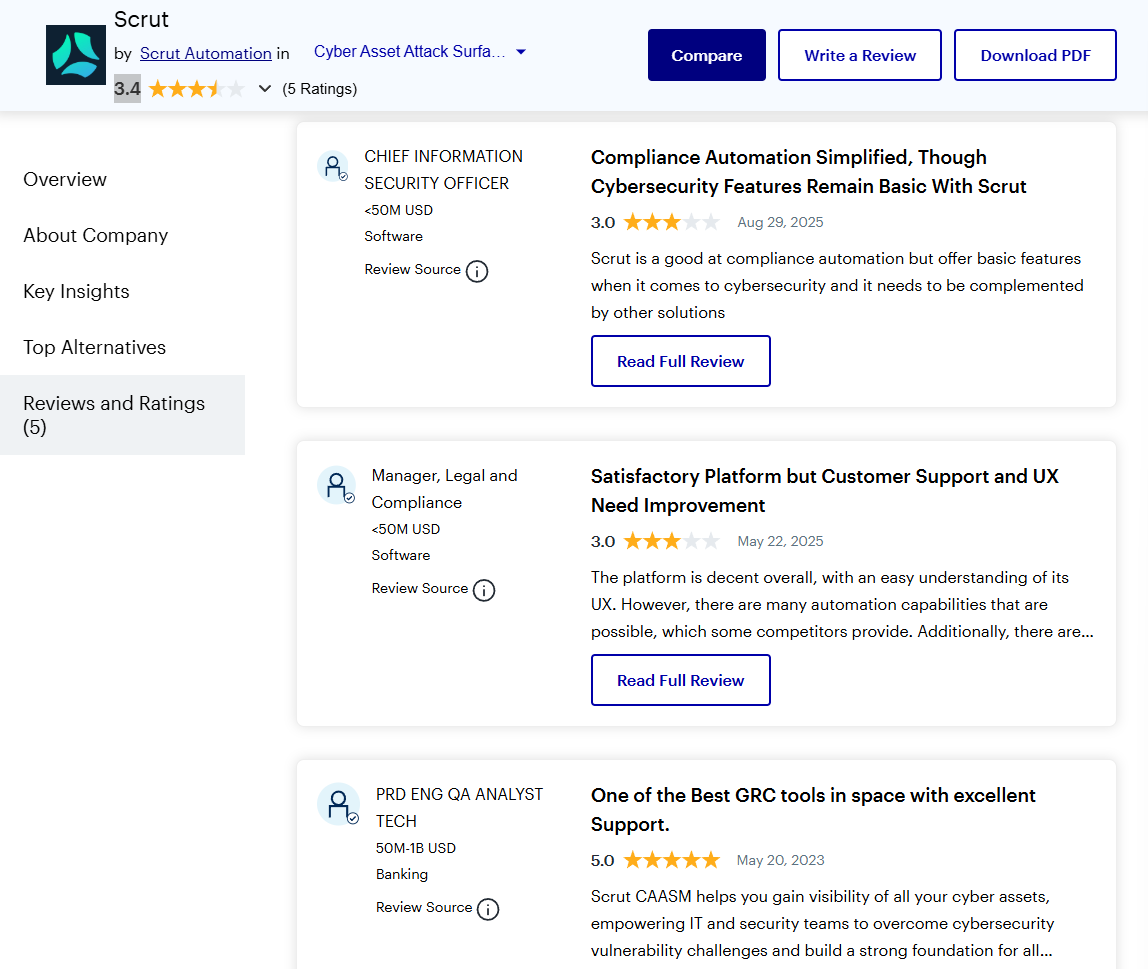
Another reviewer described Scrut as well-suited for scale-ups in a security acceleration phase, praising its continuous risk monitoring and multi-framework coverage as strong fits for companies moving fast through growth stages.
Reddit and Community Discussion
Reddit gives you the unfiltered version of how a product lands with practitioners.
Scrut Automation has a lighter presence in Reddit discussions compared to Vanta or Drata, which are more frequently mentioned in communities like r/sysadmin and r/netsec.
The community feedback that does exist follows the same pattern as the formal review themes in G2 reviews. Here is a glimpse.
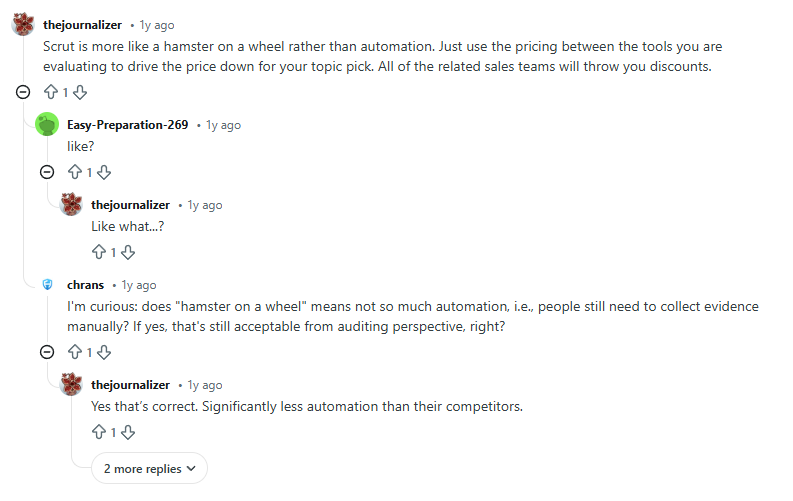
Source: Reddit
The lower Reddit volume is itself useful data. It points to limited public user feedback and weak community validation. When a tool is widely trusted, people talk about it. Silence makes independent evaluation harder.
To reach a conclusion, we will review the platform in depth and assess what it offers.
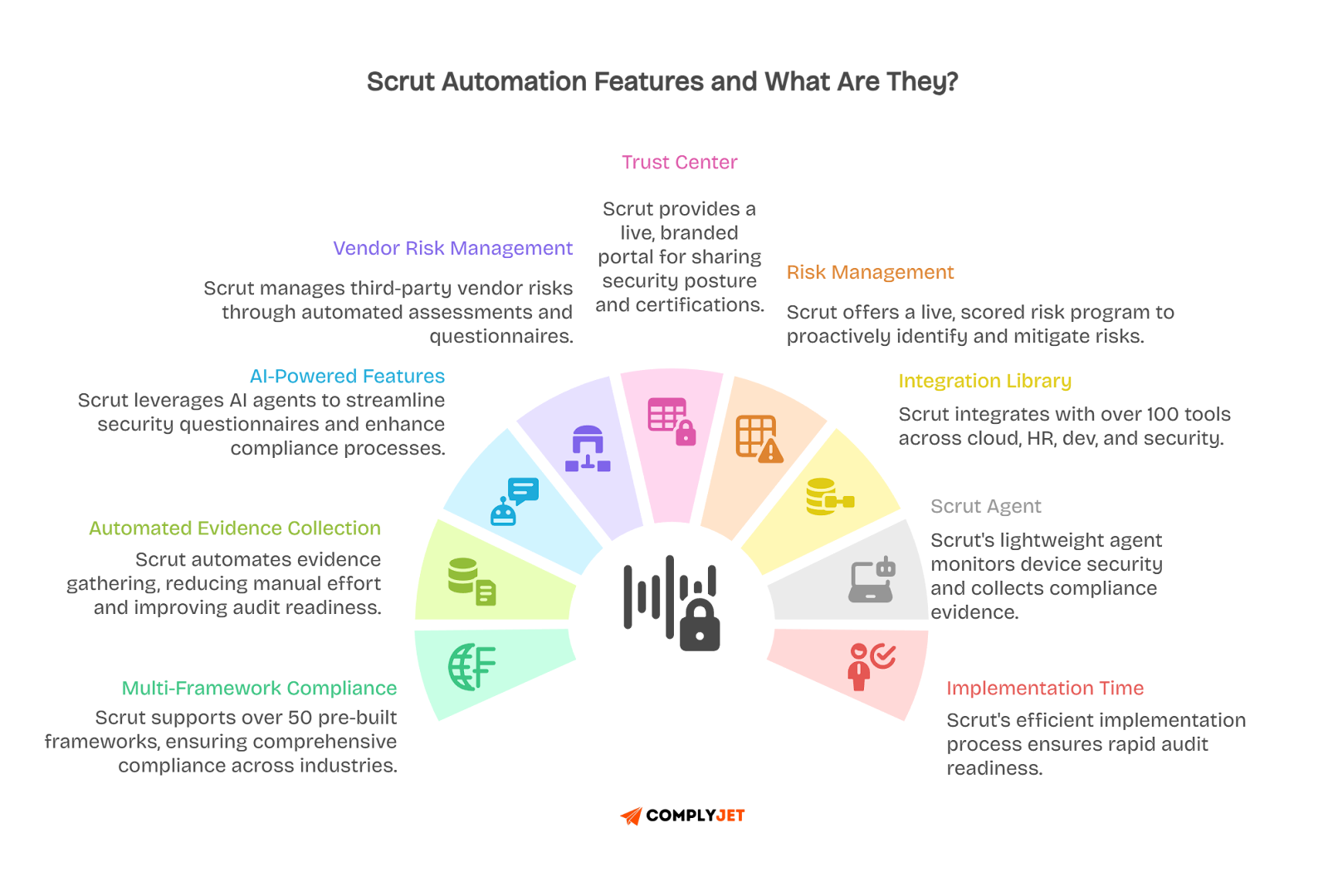
Core Features of Scrut Automation
Anyone who has done compliance manually knows how messy it gets. A policy in one tool, device logs in another, vendor docs sitting in someone's inbox, and audit screenshots saved with names like "final_v3_latest."
Scrut Automation was built to fix the operational chaos. It brings everything into one system, so you don't have to stitch compliance together from five different places.
Each feature connects to the others, so your compliance program runs as one system rather than a collection of disconnected workflows.
If you want to see how a well-integrated compliance platform actually feels to use day-to-day before committing to a sales process, take ComplyJet for a spin with a no-card free trial and compare the experience firsthand.
1. Multi-Framework Compliance Automation
Most growing companies are not chasing just one framework. You might be working toward SOC 2 for a US enterprise deal while simultaneously pursuing ISO 27001 for a European customer.
Scrut handles both simultaneously without requiring two separate compliance programs.
The platform ships with 50+ pre-built frameworks, including SOC 2, ISO 27001, GDPR, HIPAA, and PCI-DSS.
If your industry has a specific regulatory requirement not covered by default, the custom framework builder lets you map your own.
In 2025, Scrut added UAE PDPL, ISO/IEC 27001:2022/Amd 1:2024, COBIT 2019, COPPA, and FERPA to keep pace with new regulations.
The built-in library gives you 1,500+ pre-mapped controls, 400+ automated tests, and approximately 200 ready-to-use policy templates. You are not starting from scratch.
For a detailed look at what SOC 2 automation actually costs when you use a platform like this, the SOC 2 Cost Guide breaks down every line item, including platform fees, audit costs, and total time investment.
2. Automated Evidence Collection
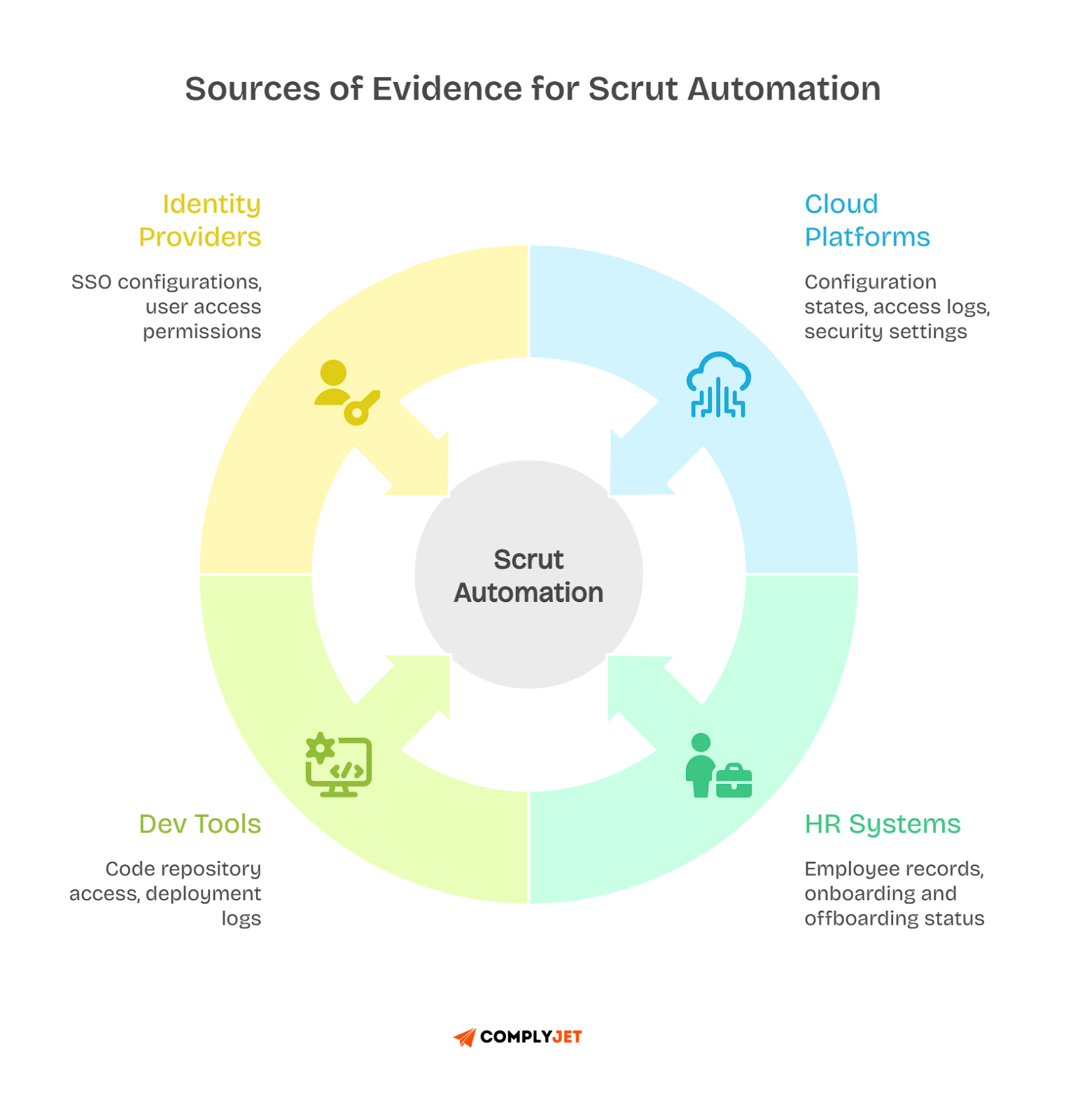
Evidence collection is a part of compliance that kills team productivity. An engineer gets a Slack message asking for a log screenshot that's forgotten. You follow up three days later. That cycle repeats across thirty controls. Scrut replaces it entirely.
The platform connects to 100+ tools across your cloud infrastructure, HR systems, dev platforms, and identity providers. It pulls evidence automatically on a continuous basis.
You are running a compliance program every day passively in the background rather than manually every quarter. This cuts manual evidence effort by approximately 80% according to verified G2 and Capterra user reports.
The shift from point-in-time audits to continuous monitoring also means you catch issues weeks before an auditor arrives.
For a detailed walkthrough of what a fully automated SOC 2 evidence process looks like from start to finish, the SOC 2 Compliance Checklist covers every phase, including evidence collection setup and what auditors actually look for.
3. AI-Powered Features: Scrut Teammates
Security questionnaires are one of the most time-consuming parts of the enterprise sales cycle.
A prospect sends you a 300-question spreadsheet and expects answers within five business days. Most teams spend days on this task. Scrut Teammates was built to significantly cut that time.
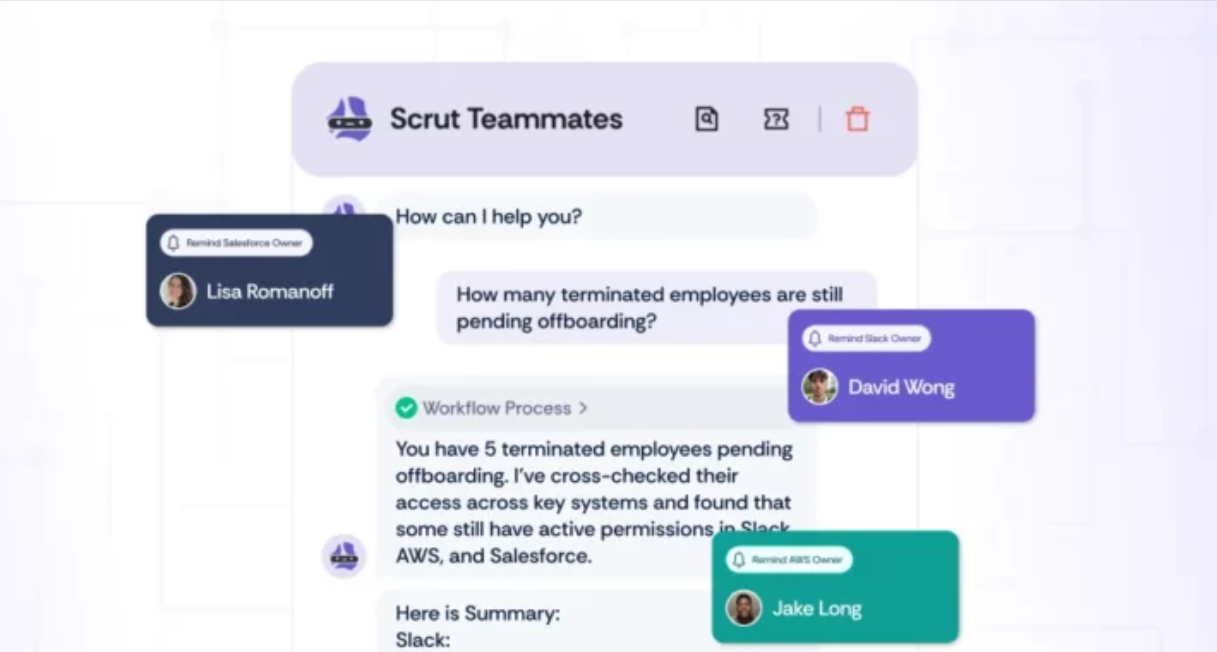
Launched in April 2025, Scrut Teammates is a coordinated group of specialized AI agents, each focused on a specific compliance domain.
A supervisor agent orchestrates the group and manages how responses are assembled.
The whole system is trained on your company's security policies, your previous questionnaire responses, and your existing mapped controls.
In practice, you answer a handful of questions to prime the system with context, and Scrut Teammates fill in the remaining responses automatically based on what it already knows about your compliance posture.
4. Vendor Risk Management
Third-party vendor risk is one of the most overlooked sources of compliance exposure. You can have tight internal controls and still face audit issues because a vendor you depend on does not meet the same standards.
Scrut's vendor risk management module addresses this directly.
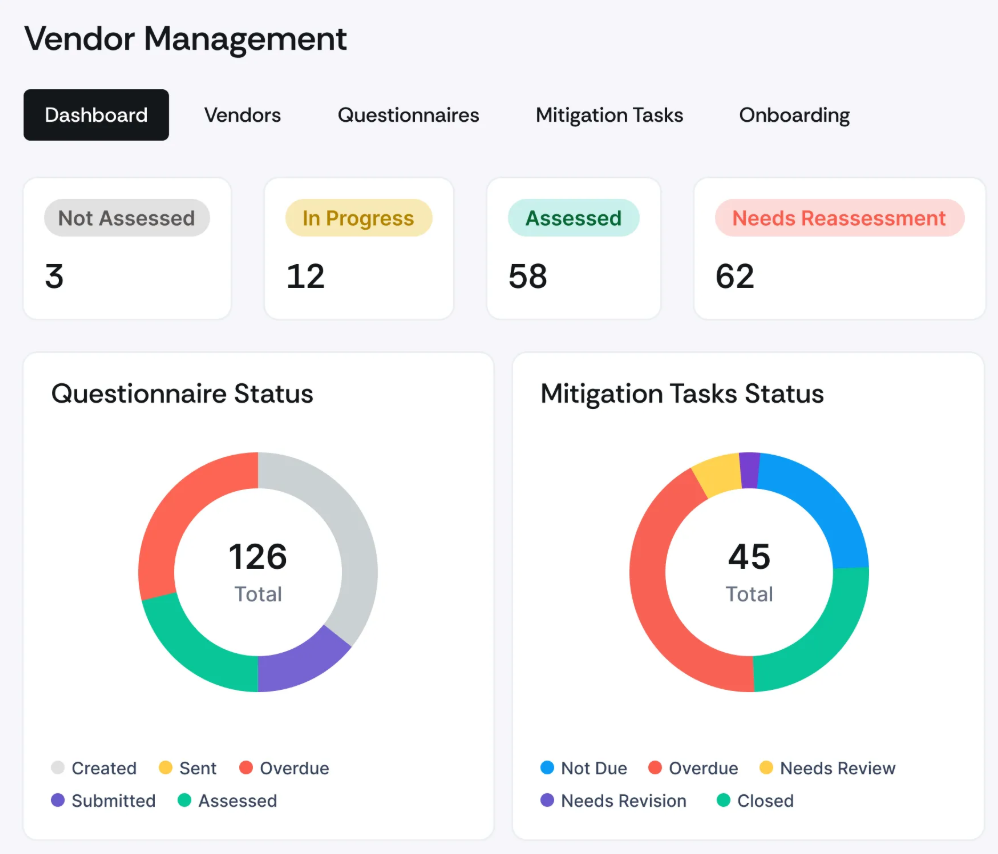
The system automatically discovers and assesses third-party applications running across your enterprise infrastructure. Instead of tracking vendor questionnaires manually in a spreadsheet, you get a central repository where every vendor is managed.
Customizable questionnaires are automatically sent, and reminder notifications follow up on overdue responses.
5. Trust Center: Scrut Trust Vault
When a prospect asks to see your security posture, most teams scramble to compile a PDF or update a Google Doc with certifications. The Scrut Trust Vault is replaced entirely by a live, branded portal that updates automatically.
The Trust Vault is a white-labeled trust center you share with prospects and customers. It shows your real-time audit status, active certifications, and security documentation.
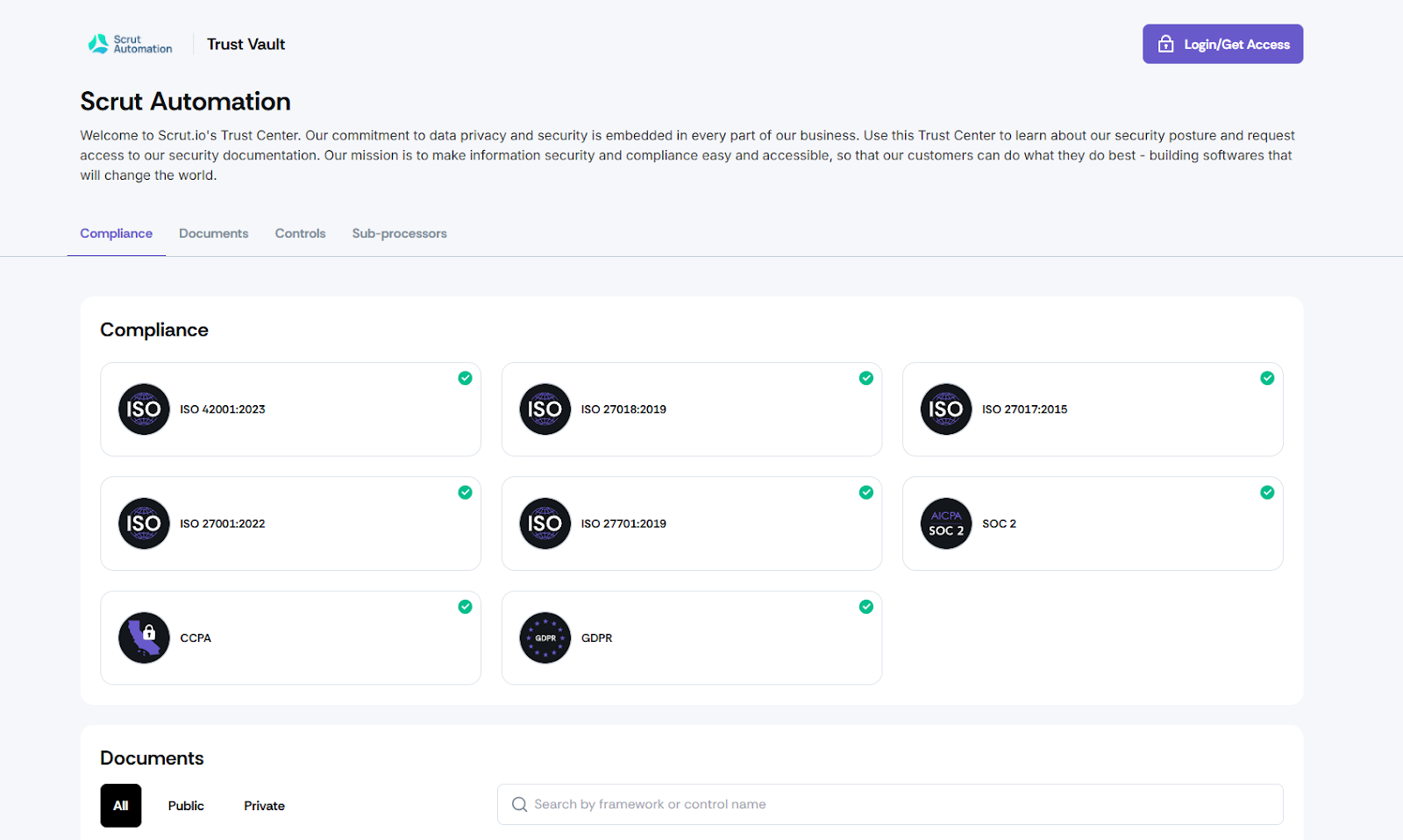
To prevent shared links from circulating indefinitely, you can gate access with an NDA and set expiry controls.
In October 2025, Scrut added multi-entity support, allowing companies to manage multiple subsidiaries or products that can run separate Trust Vaults from a single account.
A live Trust Vault link signals operational maturity to prospects in a way a static PDF cannot, and it removes the maintenance overhead of updating security documents every time your certification status changes.
6. Risk Management and Risk Scoring
A risk register that lives in a spreadsheet is not a risk management system. It is a document someone updates once a quarter and forgets about between audits.
Scrut's risk module replaces that with a live, scored, and continuously updated risk program.
You configure the scoring parameters to match your business context. Every risk in your program is automatically compiled with its inherent score, its residual score after controls are applied, the controls mapped to it, and the mitigation tasks assigned.
Nothing gets lost in a spreadsheet cell.
Built-in heatmaps show at a glance which risks are most severe and which have been adequately controlled. Custom risk formulas give you flexibility if your industry uses a different scoring methodology.
This is the GRC layer of Scrut that turns compliance from a one-time certification into an ongoing security program.
7. Integration Library
Scrut's value scales with how many of your existing tools it connects to. The current integration library covers the most common categories a compliance team needs, so a standard SaaS tech stack is unlikely to hit significant gaps.
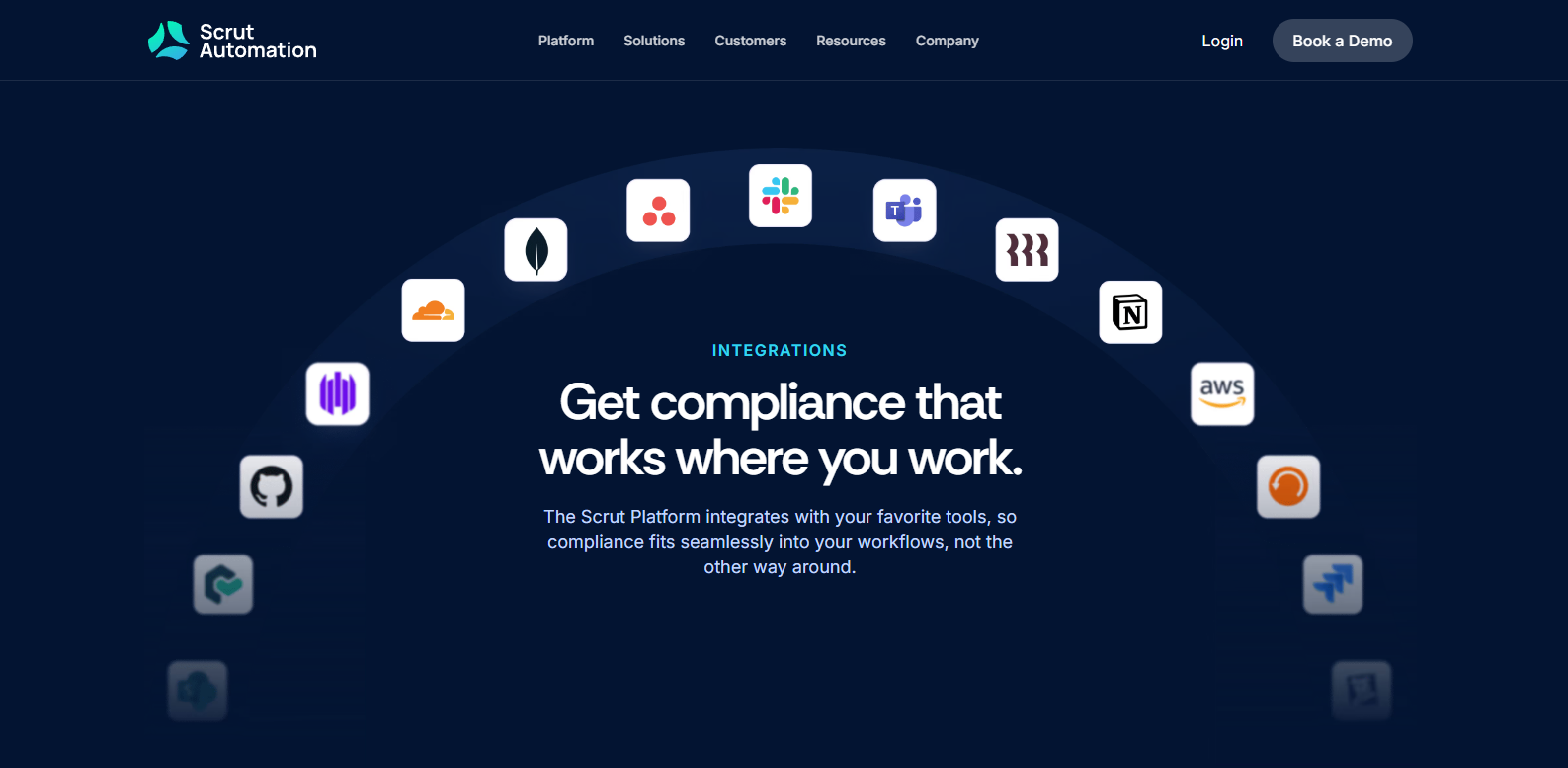
The current integration library covers:
- Cloud: AWS, Azure, Google Cloud Platform
- HR: BambooHR, Rippling, Gusto, Workday
- Dev Tools: GitHub, GitLab, Bitbucket, Jira
- Identity: Okta, OneLogin, Microsoft Entra ID
- Security: Datadog, SentinelOne, Tenable
8. The Scrut Agent: What It Does and Whether It Is Safe
The Scrut Agent is a lightweight application installed on employee devices. It monitors device-level security posture and automatically sends compliance evidence back to the Scrut platform. It does not access personal files, emails, or browsing history.
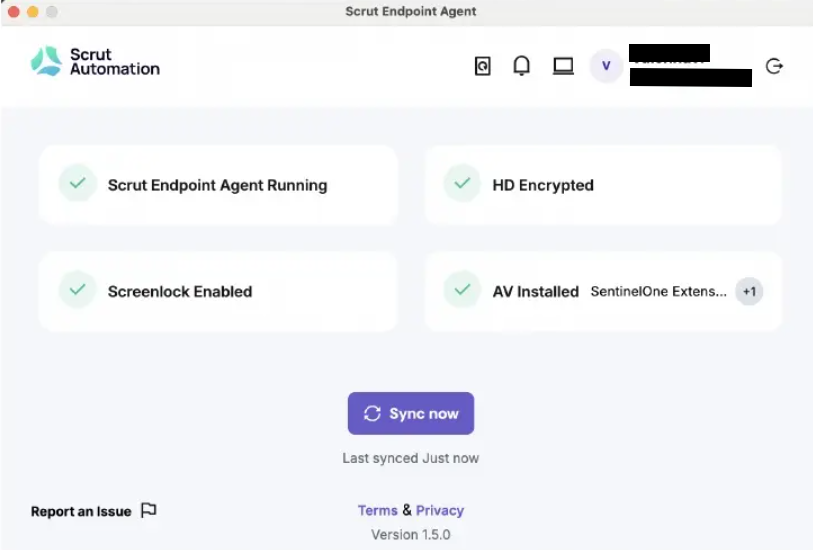
What the Scrut Agent monitors:
- Antivirus installation and whether it is actively running
- Screen lock configuration and whether it meets policy requirements
- Hard drive encryption status across the device
- Overall device security posture data for audit evidence
There is one known limitation worth being direct about. Agent sync can lag. When a device configuration changes, the dashboard update does not always appear immediately.
This is the most consistently cited friction point across G2, Capterra, and Gartner Peer Insights reviews.
Scrut's support team resolves reported agent issues within 48 hours, according to user testimony, but the delay itself is a real pattern rather than an occasional edge case.
9. Implementation Time
Getting the full platform properly configured, including integrations and policy setup, typically takes 10 to 15 hours. Teams targeting audit readiness for a single framework usually get there within two to three months. Multi-module deployments covering risk, vendor risk, and compliance simultaneously take 8 to 12 weeks to run.
Choozle, a digital advertising platform, is a well-documented reference point.
Their team completed onboarding in under an hour and had cloud tests running almost immediately.
Scrut claims to include full onboarding coverage in every subscription. But is it actually true? Let's find out.
How Much Does Scrut Automation Cost?
Pricing is usually the last thing SaaS vendors want to discuss, and the first thing you need to know before making a buying decision.
Scrut Automation falls into the category of platforms that do not publicly publish numbers, which creates friction for buyers at the research stage.
The pricing structure itself is straightforward once you understand it. Everything is bundled into one subscription. You are not stacking add-ons the way some competitors do. Here is what the model actually looks like.
Pricing Model
Scrut Automation uses a subscription-based model. The price depends on how many users you have, how many frameworks you are managing, and which features your setup requires.
Larger teams with more complex compliance programs naturally land at a higher tier.
The bundling approach is one of the more buyer-friendly aspects of Scrut's pricing. The Trust Center, vendor risk management module, and risk management features are all included in your subscription by default.
You are not paying for each piece separately, the way Drata charges modular add-on fees for certain capabilities.
According to the AWS Marketplace, the platform is available as a paid SaaS product with custom pricing determined after a sales conversation. The estimated price is around $15,000 a year.
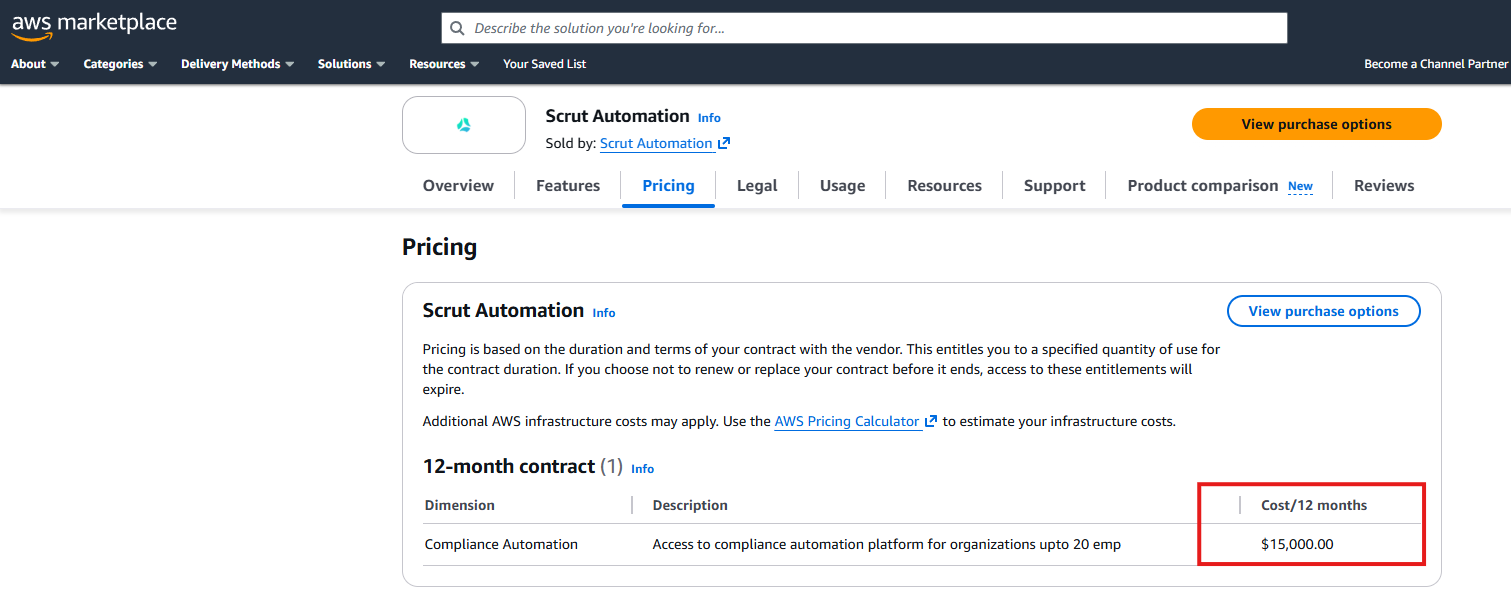
For a detailed cost breakdown comparing Scrut against Vanta and Drata across different company sizes, the Scrut Automation Pricing analysis covers real cost scenarios, three-year total cost comparisons, and the exact approaches teams use to negotiate better deals.
Pricing Transparency Issue
This complaint appears consistently across G2, Capterra, and Software Advice reviews, and it is worth being direct about.
Scrut does not publish its pricing publicly. You cannot visit the website and find a pricing page with numbers.
To get a quote, you must book a demo and speak to a sales representative. Multiple verified reviewers across all major platforms flagged this as friction in the buying process.
No free trial is available, which means you are committing to a sales conversation before you can evaluate the product in your own environment.
Unlike Scrut, Vanta publishes partial pricing for entry-level tiers but still requires a sales call for anything above the Core plan.
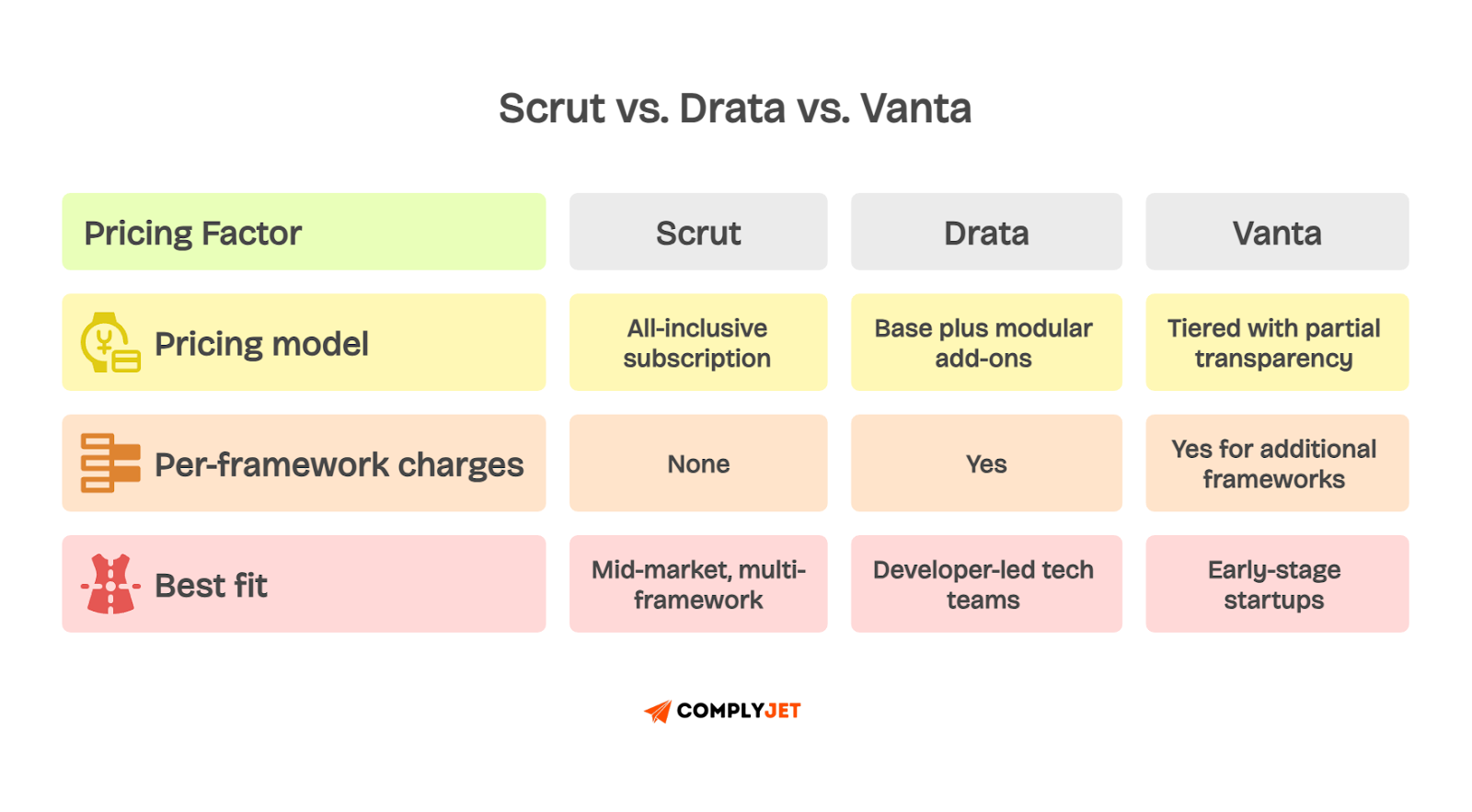
Comparing Scrut alternatives could be useful, but let's summarize the pros and cons before moving on to the alternatives.
Scrut Automation Pros and Cons [Verified User Feedback]
Every platform has a version of itself in the marketing brochure and a different version in the hands of real users six months in. This section is built entirely from verified reviews across G2, Capterra, Gartner Peer Insights, AWS Marketplace, and Software Advice.
Reading through 1,200+ G2 reviews and cross-referencing them with Capterra and Gartner data produces a consistent pattern. Scrut's strengths and limitations are reliable across different user types, company sizes, and industries. Here is what the data shows.
What Users Consistently Praise
The customer success team is the most frequently cited differentiator in Scrut automation reviews across all platforms.
Reviewers on G2, Capterra, and Software Advice specifically describe the CS team as proactive rather than reactive: they reach out before problems escalate rather than waiting for a support ticket to arrive.
Automated evidence collection is the second-most-praised capability.
Users report an 80% reduction in manual evidence effort after connecting their cloud, HR, and dev tools to the platform.
The February 2025 interface update also improved day-to-day usability, with AWS Marketplace and G2 reviewers noting the cleaner layout made navigation noticeably faster.
What Users Consistently Criticize
The Scrut Agent sync delay is the most frequently reported technical frustration in verified Scrut reviews across all platforms.
When a device configuration changes, the update does not always appear in the compliance dashboard immediately. This consistently shows up in G2, Capterra, and Gartner Peer Insights feedback from enterprise users.
Cloud integration lag follows the same pattern. Changes made to your cloud environment sometimes take longer than expected to be reflected in Scrut's control monitoring layer.
A few AWS Marketplace reviewers also flagged slow report load times as a recurring minor irritation.
Summary: Pros & Cons
The deeper limitation noted in Gartner Peer Insights is worth taking seriously if your goals go beyond certification.
Scrut is strong at compliance automation, but its cybersecurity features outside of compliance workflows are basic.
If you need a platform that actively improves your security posture rather than just helping you pass an audit, you will need additional tooling running alongside Scrut.
Let's see if other platforms are useful here.
Major Scrut Competitors and Alternatives
Picking a GRC platform is not just about finding something that works. It is about finding the right fit for your company size, your compliance goals, and the internal expertise your team actually has right now.
Scrut Automation competes in a crowded space, and knowing where it stands relative to each alternative saves you weeks of unnecessary demo calls.
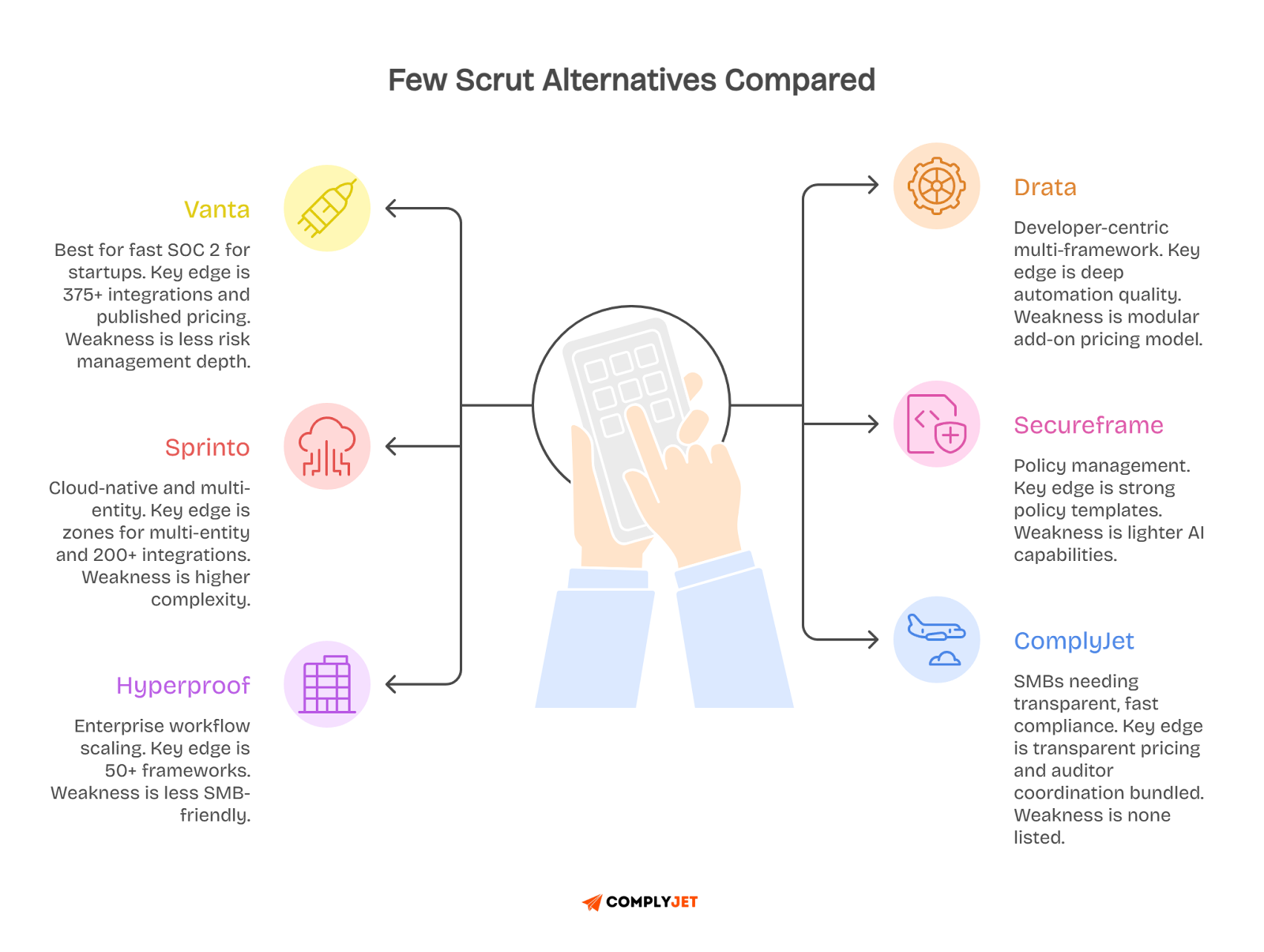
Vanta and Scrut are compared most often because they target a similar company stage.
Vanta wins on raw integration count at 375+ versus Scrut's 100+, and it publishes partial pricing publicly, which removes some friction in the buying process.
Scrut wins on risk management depth and customer support quality, both of which show up consistently in verified G2 and Capterra reviews.
For a full side-by-side of how Vanta is positioned against other tools in the market, the Vanta Competitors and Alternatives guide covers the full landscape, including where Scrut sits in that comparison.
Drata comes up frequently when comparing Scrut automation company profiles among developer-led teams. Drata's automation layer is more polished, particularly around evidence mapping and control testing. The meaningful tradeoff is cost structure.
A Drata quote for SOC 2 plus ISO 27001 often comes in around $28K annually, while the same Scrut setup runs closer to $22K due to bundled framework pricing.
Before you factor in Scrut, the Vanta vs Drata comparison is a valuable starting point.
Sprinto is the stronger choice if you are managing compliance across multiple legal entities or subsidiaries. Its Zones feature handles multi-entity compliance in a way that Scrut currently does not match.
For a single-entity fast-growing SaaS company working through its first SOC 2 or ISO 27001, Scrut is the more direct path. Scrut's sweet spot is when risk management depth matters more than raw speed or integration count.
ComplyJet: Built for Teams with No Time to Waste
ComplyJet is consistently cited in compliance community discussions as one of the most practical Scrut alternatives available in 2026. The platform combines full compliance automation with AI-powered policy drafting and direct auditor coordination, starting at under $4,999 per year with pricing published openly before you speak to anyone.
Four reasons compliance teams keep landing on it:
- Transparent, published pricing with no sales call required
- Streamlined onboarding built for teams without a dedicated GRC background (governance, risk, and compliance expertise)
- Strong SOC 2 (independent audit verifying your security controls protect customer data) and ISO 27001 (international standard for information security management) automation with a lower learning curve
- Auditor coordination is bundled in rather than sold separately.
If Scrut's hidden pricing structure, Scrut Agent sync delays, or limited cybersecurity features are blockers for your team, ComplyJet is the comparison worth making before you finalize your decision.
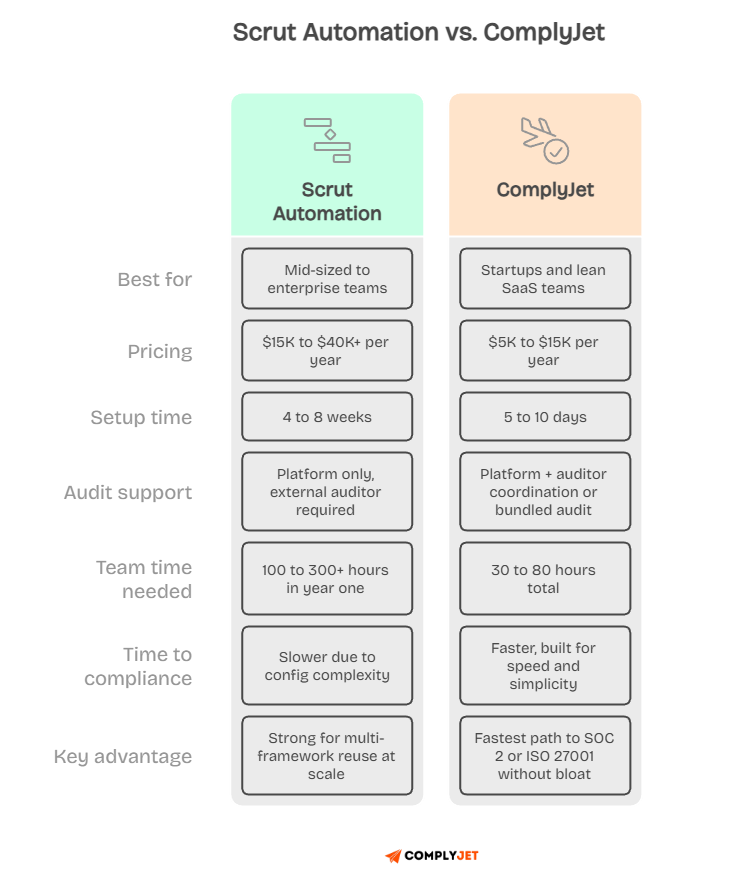
See exactly what ComplyJet includes and what it costs without booking a single meeting first.
Scrut Automation: Recent Product Updates [2025 to 2026]
Scrut ships meaningful product updates about every quarter. For a Series A GRC company, that is actually pretty good. It means the team is actively building rather than just keeping the lights on and patching bugs.
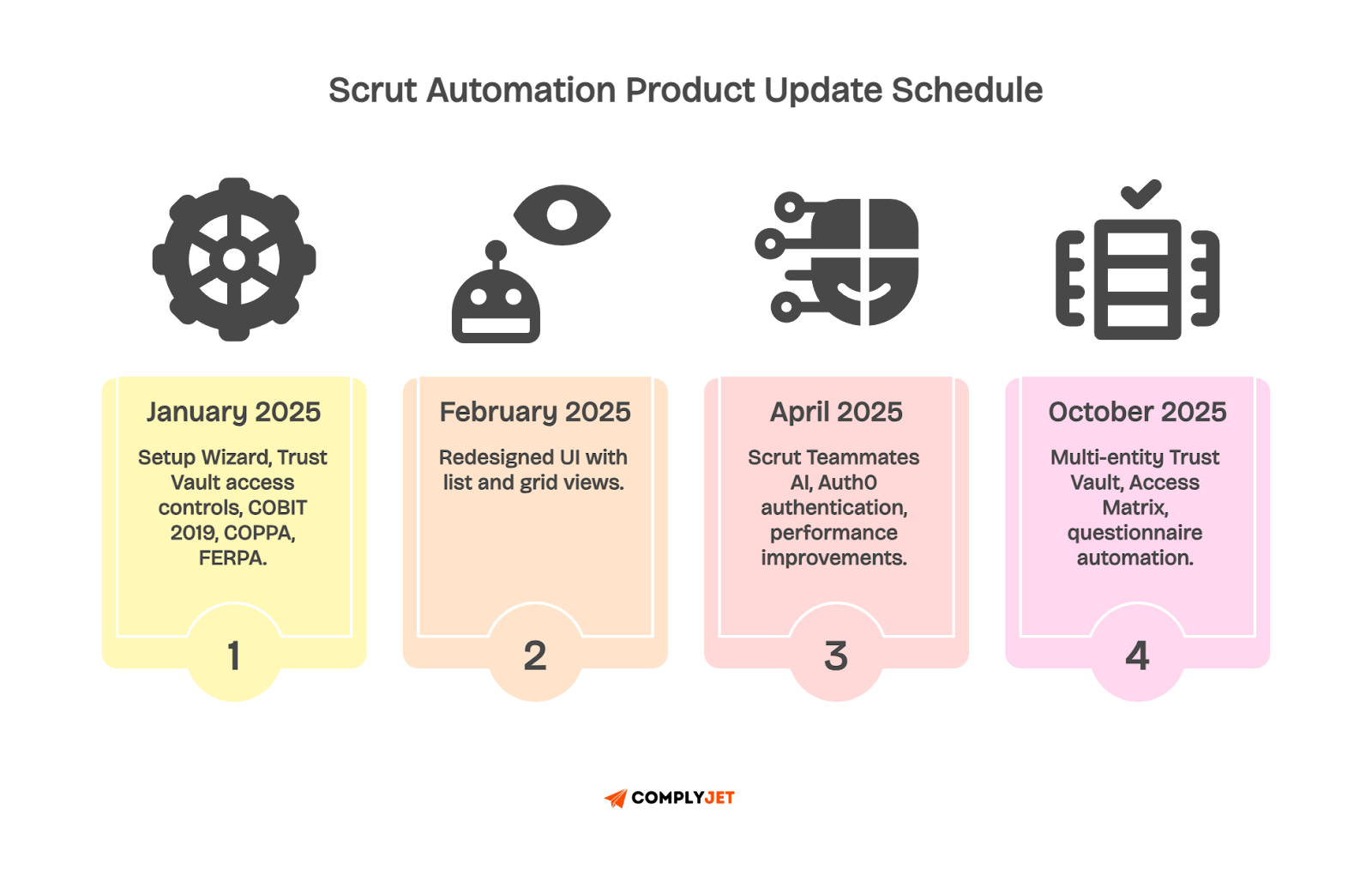
January 2025 brought the Scrut Setup Wizard, which walks you through onboarding step by step instead of dumping you into a dashboard with no idea where to start.
They also added granular Trust Vault access management, vendor portal enhancements, and support for COBIT 2019 (ISACA's IT governance framework for aligning technology with business goals), COPPA (the Children's Online Privacy Protection Act that governs how websites collect data from kids under 13), and FERPA (the Family Educational Rights and Privacy Act protecting student education records).
February 2025 was mostly a visual refresh. They redesigned the interface with cleaner icons, softer edges, a colour scheme that doesn't strain your eyes, and gave you the option to switch between list and grid views across the dashboard. Small stuff, but it makes the platform less annoying to use every day.
In April 2025, Scrut Teammates launched the AI agent system (autonomous AI programs that complete tasks by breaking them into steps and using tools to accomplish goals) covered in the features section above. The same release also upgraded authentication to Auth0 (Okta's identity platform for secure login, SSO, and multi-factor authentication) and shipped platform-wide performance improvements.
In October 2025, multi-entity Trust Vault support was added, which matters if you are managing compliance for subsidiaries or multiple products under one parent company.
The Access Matrix gives you complete visibility into who has access to what across your entire tech stack. They also automated more of the security questionnaire process (the 200+ question forms enterprise buyers send vendors to verify security controls) with smart import and export, plus vendor assessment summary features.
Frequently Asked Questions About Scrut Automation
How does Scrut work?
Scrut connects to your existing tools through 100+ integrations across cloud, HR, dev platforms, and identity providers. It automatically pulls compliance evidence, maps it to the relevant controls across your chosen frameworks, and continuously monitors everything.
You get a real-time compliance dashboard, automated audit-ready evidence packages, and alerts when controls drift out of compliance, without manual spreadsheet tracking.
What does the Scrut Agent actually do?
The Scrut Agent sits on an employee's laptop or desktop and monitors three things: whether antivirus software is installed and active, whether the screen lock is properly configured, and whether the hard drive is encrypted.
It automatically sends this data to the Scrut platform, eliminating the need for employees to manually submit device compliance screenshots or complete self-attestation forms at audit time.
Is the Scrut Agent safe to install?
Yes. The Scrut Agent is a lightweight endpoint application that monitors device security posture: antivirus status, screen lock configuration, and hard drive encryption. It does not access personal files, emails, browsing history, or any communications.
It reports only security-relevant system configuration data to the Scrut compliance dashboard for audit evidence.
How much does Scrut Automation cost?
Scrut does not publish pricing publicly. It uses a subscription-based model with custom quotes based on user count, frameworks required, and feature scope.
All features, including the Trust Center, vendor risk management, and risk scoring, are included in the subscription rather than sold as add-ons.
For a detailed cost breakdown and comparison with Vanta and Drata, the Scrut Automation Pricing guide covers real-world quote ranges and negotiation approaches.
Who is the CEO of Scrut Automation?
The CEO and Co-Founder of Scrut Automation is Aayush Ghosh Choudhury, a former McKinsey consultant who co-founded the company after experiencing the compliance burden directly while building a previous SaaS startup.
He holds a 23.18% ownership stake in the company.
What is the CSM salary at Scrut Automation?
Scrut Automation does not publicly publish CSM salaries. Nobody does in this space, really.
From what you can find on Glassdoor and LinkedIn data for similar Series A-stage SaaS companies with teams split between India and the US, Customer Success Manager compensation at Scrut looks pretty standard for a company at that stage.
Nothing crazy high, nothing suspiciously low. Just mid-market SaaS rates for a startup that raised a Series A and is growing fast.
If you want actual numbers, your best bet is to check Glassdoor, LinkedIn Salary, or Levels.fyi, and filter by location and years of experience. Those will give you a range that is way more useful than anything a company blog will tell you.
How long does Scrut Automation take to implement?
From basic onboarding to full platform configuration, including integrations and policy setup, Scrut typically takes 10 to 15 hours. Audit readiness for a single framework usually takes 2 to 3 months. Multi-module setups take 8 to 12 weeks. Scrut includes dedicated onboarding support and monthly business reviews in every subscription.
For a step-by-step view of what audit-readiness preparation looks like on any GRC platform, the SOC 2 Compliance Checklist covers every phase from scope definition to audit close.
Who are Scrut Automation's main competitors?
Scrut's primary competitors in the GRC and compliance automation space are,
- ComplyJet
- Vanta
- Drata
- Sprinto
- Secureframe
- Hyperproof
Each has a different strength: Vanta is fastest for SOC 2 startups, Drata has more polished automation for developer teams, and Sprinto is stronger for multi-entity management.
For a full competitive map, the Vanta Competitors and Alternatives guide covers the entire market, including where Scrut fits in the broader landscape.
Final Verdict
Scrut does what it says it does. But let's be honest about what is annoying here. Hidden pricing isn't what you need in 2026.
Sitting through the pitch instead of seeing a number upfront can be exhausting. That process wastes a week of your time before you even know if the platform fits your budget.
The Scrut Agent sync issue is not going away. It shows up in reviews from 2023, 2024, and 2025. Device status lags. Cloud integration updates lag. That is just how this thing works right now.
And if you are buying a compliance platform because you also want a better cybersecurity posture, Scrut won't give you that. It will get you certified. It will not make your security program objectively stronger outside the narrow requirements that an auditor checks.
You will need other tools for that.
So here is the real question: do you have time to sit through three sales demos, compare hidden pricing models, and then wait 8 to 12 weeks for full implementation? Or do you need to see a price, start a trial, and get moving this week?
If it is the second one, talk to us right now!