Related Articles
No items found.
.svg)

ISO 27001 or NIST? Choosing the wrong framework can cost you months of effort, failed audits, and lost deals.
For many organizations, compliance is directly linked to revenue, customer trust, and market expansion. Yet teams often struggle to decide between ISO 27001 and NIST because both frameworks serve different purposes and follow different approaches.
This confusion leads to delays, wasted resources, and poor alignment with business goals. Some organizations invest heavily in certification when they only need a flexible framework. Others choose NIST but later realize they need ISO 27001 certification to close enterprise deals.
The challenge is not understanding what these frameworks are. The real challenge is knowing which one fits your business model, customer requirements, and growth plans.
In this guide, we break down ISO 27001 vs NIST with clear explanations, cost comparison, use cases, and a practical decision framework. By the end, you will know which framework to choose and how to align it with your business goals in 2026.
If you are evaluating ISO vs NIST compliance, this guide will help you make a clear and confident decision.
Not sure which framework is right for your business? Book a demo with our compliance experts to get a tailored recommendation based on your goals and requirements.
ISO 27001 is an international standard for managing information security through a structured Information Security Management System (ISMS). It provides a framework to identify, assess, and manage risks related to sensitive business data.
The standard is published by the International Organization for Standardization and is widely recognized across industries and geographies. Organizations that achieve ISO 27001 certification demonstrate that they have implemented a systematic approach to protecting data, reducing risk, and maintaining security controls.
ISO 27001 certification is often required by enterprise clients, especially in SaaS, fintech, and regulated sectors. It acts as a trust signal during vendor evaluations and helps organizations meet contractual and regulatory requirements.
96,709 valid ISO/IEC 27001 certificates worldwide in 2024, nearly double the 48,671 recorded in 2023
ISO 27001 is built around a risk-based approach to information security. Organizations are required to identify potential risks, evaluate their impact, and implement controls to mitigate them.
A core component of the standard is Annex A, which includes a comprehensive set of security controls. These controls cover areas such as access management, cryptography, incident response, and supplier relationships. Organizations must select and justify applicable controls based on their risk assessment.
Another key requirement is continuous improvement. ISO 27001 follows a structured cycle where organizations monitor performance, conduct internal audits, and update controls regularly. This ensures that the ISMS evolves with changing threats and business requirements.
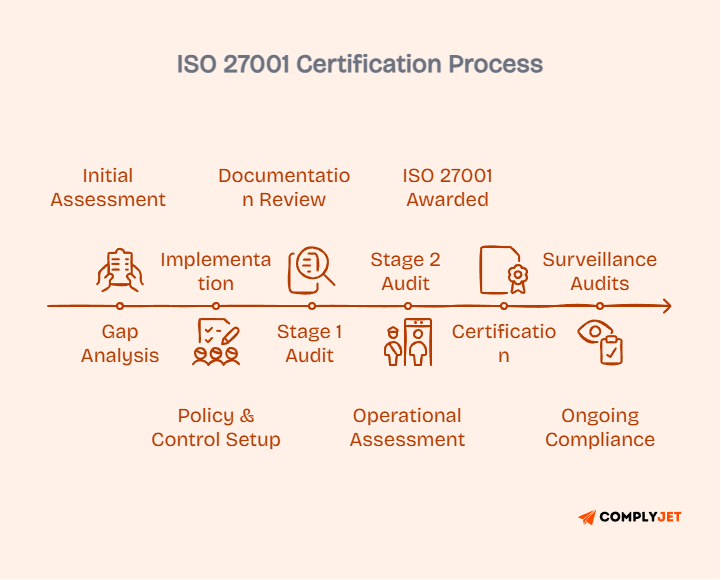
The ISO 27001 certification process typically starts with a gap analysis. This step helps organizations identify areas where their current security practices do not meet the standard requirements.
Once gaps are identified, the implementation phase begins. This involves defining policies, setting up controls, training employees, and documenting processes required for compliance.
The certification audit is conducted in two stages. Stage 1 focuses on reviewing documentation and readiness. Stage 2 involves a detailed assessment of controls and their effectiveness in real operations.
After successful completion, the organization receives ISO 27001 certification, which is valid for three years. During this period, surveillance audits are conducted to ensure ongoing compliance.
The ISO 27001 certification process requires planning, resource allocation, and consistent monitoring to maintain compliance over time.
FOUNDER & PRACTITIONER TIP: On keeping certification lean for early-stage teams: A solo founder can achieve certification for approximately £6,000–£7,500. This is done by using a DIY Toolkit (£500) and hiring a boutique certification body for a 4-day audit, skipping expensive consultants.
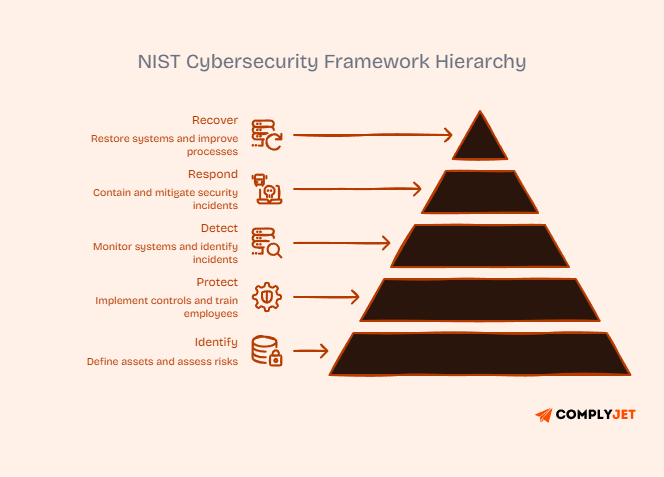
NIST refers to a set of cybersecurity frameworks and guidelines developed by the National Institute of Standards and Technology in the United States. These frameworks are designed to help organizations manage and reduce cybersecurity risks in a structured and practical way.
The NIST framework is widely used by US-based organizations, especially government agencies and contractors. Unlike ISO 27001, NIST is not a certification standard. It is a voluntary framework that organizations can adopt based on their security needs and regulatory requirements.
One of the key advantages of the NIST framework is its flexibility. Organizations can choose how to implement controls based on their risk profile, industry, and operational complexity. This makes it suitable for companies that need a customizable approach to cybersecurity without formal certification requirements.
You can also read - Best NIST Compliance Software in 2026: CSF 2.0-Ready, Ranked
ISO 27001 and NIST differ in how they approach security, compliance, and implementation. While both aim to improve security posture, their structure, flexibility, and requirements vary significantly.
Understanding these differences is critical before choosing the right framework
The core difference between ISO 27001 and NIST starts with how each framework approaches security.
ISO 27001 follows a structured ISMS approach: It requires organizations to build an Information Security Management System that governs policies, processes, and controls. Security is managed at an organizational level with a strong focus on governance and continuous improvement.
NIST follows a flexible control-based approach: It provides a set of guidelines and controls that organizations can implement based on their risk profile. There is no requirement to build a formal management system.
This means ISO 27001 is more process-driven, while NIST is more control-driven.
Compliance requirements differ significantly between the two.
ISO 27001 requires formal certification: Organizations must undergo external audits conducted by accredited certification bodies. The process includes documentation review and validation of implemented controls.
NIST is self-assessed: There is no official certification. Organizations assess their own implementation or follow internal or third-party evaluations based on requirements.
Both frameworks focus on risk management, but the approach is different.
ISO 27001 uses formal risk treatment: Organizations must identify risks, evaluate their impact, and define a risk treatment plan. Controls are selected based on this assessment and must be documented.
NIST uses an adaptable risk-based approach: Organizations can prioritize risks based on business needs and apply controls accordingly. The framework allows flexibility in how risks are identified and managed.
Implementation effort varies depending on the framework.
ISO 27001 is structured but resource-intensive: It requires policy creation, documentation, internal audits, and alignment across teams. The process is time-consuming but predictable due to its structured nature.
NIST is flexible but can become complex: Organizations have the freedom to choose controls, which can make implementation easier initially. However, without a structured approach, it can become difficult to manage at scale.
Documentation requirements are another key differentiator.
ISO 27001 is documentation-heavy: Organizations must maintain policies, procedures, risk assessments, and audit records. Documentation is a critical part of achieving and maintaining certification.
NIST is less rigid: While documentation is recommended, it is not enforced in the same way as ISO 27001. Organizations can define their own level of documentation based on internal needs.
Ready to simplify compliance? Start your free trial and see how ComplyJet helps automate compliance workflows, manage evidence, and stay audit-ready.
Understanding the cost difference between ISO 27001 and NIST is critical before starting implementation. While ISO 27001 involves certification expenses, NIST focuses more on internal effort and resource allocation.
The total cost depends on business size, complexity, and implementation approach.
Choosing between ISO 27001 and NIST depends on business goals, geography, and compliance requirements.
Each framework serves different use cases, and selecting the right one ensures better alignment with customer expectations and regulatory needs.
For startups and SaaS companies, ISO 27001 is often the better choice.
Large organizations and enterprises typically prefer ISO 27001 for governance and standardization.
For US-based organizations, especially those working with federal agencies, NIST is often preferred.
NIST is suitable for organizations that prioritize flexibility and need to comply with US-specific security requirements.
Industries such as fintech, healthcare, and government contracting often require a hybrid approach.
Many organizations do not choose between ISO 27001 and NIST. Instead, they use both frameworks together to strengthen their security posture and meet diverse compliance requirements.
ISO 27001 Annex A provides a set of security controls that can be mapped to NIST frameworks.
This mapping allows organizations to implement one framework while aligning with the other.
Using ISO 27001 and NIST together offers several advantages:
A hybrid approach ensures both compliance and operational security.
In practice, many organizations follow a combined approach:
For example, a SaaS company may use ISO 27001 certification to close enterprise deals while adopting NIST controls to meet US client requirements.
You can also read - ISO 27001 Certification Timeline: How Long It Really Takes (2026)
Both ISO 27001 and NIST strengthen an organization's cybersecurity posture, but they serve different business needs. ISO 27001 focuses on certification and governance, while NIST emphasizes flexibility and technical security controls.
Review the advantages and disadvantages of each framework before making a decision.
$4.44 million global average cost of a data breach in 2025 (down 9% from $4.88M in 2024); the US average alone hit $10.22 million
There is no single answer to "Should I choose ISO 27001 or NIST?" The right choice depends on your business goals, customer requirements, regulatory obligations, and available resources. Answering a few key questions can help you identify the framework that best fits your organization.
Before making a decision, ask yourself the following:
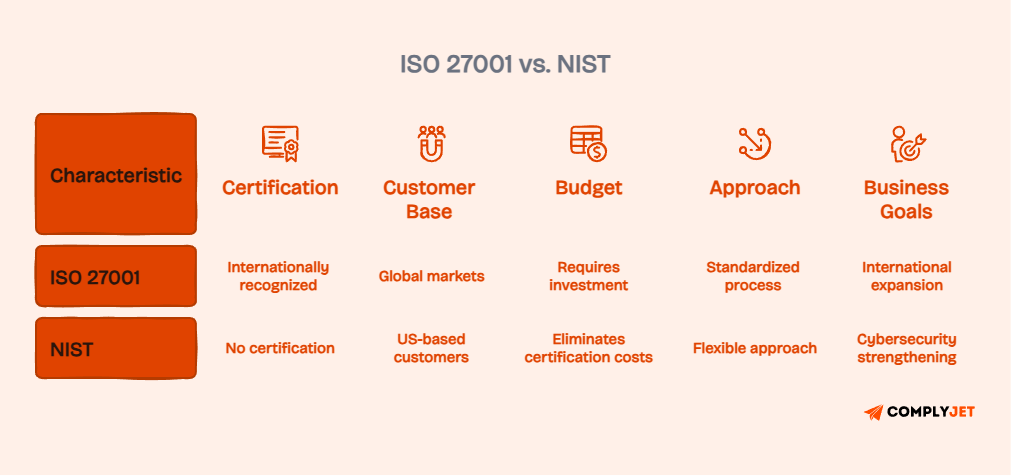
If enterprise customers, partners, or regulators require proof of compliance, ISO 27001 is the better choice because it provides an internationally recognized certification.
Organizations serving global markets often benefit from ISO 27001 because it is recognized worldwide. If your primary customers are US government agencies or federal contractors, NIST is generally more relevant.
ISO 27001 requires investment in certification, audits, documentation, and ongoing compliance. NIST eliminates certification costs but requires experienced internal teams to implement and maintain security controls.
ISO 27001 follows a standardized process with defined requirements. NIST allows organizations to implement controls based on their security priorities and risk profile.
If expanding into international markets or winning enterprise contracts is a priority, ISO 27001 offers a competitive advantage. If your focus is on strengthening cybersecurity practices without certification, NIST may be sufficient.
A growing number of organizations adopt both frameworks to combine governance with technical security controls.
Consider implementing both if you:
When evaluating ISO 27001 vs NIST, which is better, the answer depends on your business objectives. ISO 27001 is the stronger option for certification and global recognition, while NIST offers greater flexibility for cybersecurity implementation.
Organizations with diverse compliance requirements often achieve the best results by using both frameworks together.
ISO 27001 is the fastest-growing certification type globally, forecasted to achieve a CAGR of 14.2% during 2025–2032, driven by increasing cybersecurity threats, data privacy regulations such as GDPR and CCPA, and widespread digital transformation.
Choosing the wrong compliance framework can lead to unnecessary costs, longer implementation timelines, and gaps in your security program.
Avoid these common mistakes when deciding between ISO 27001 and NIST.
Many organizations select a framework simply because competitors or industry peers are using it. This approach often leads to unnecessary investment and poor alignment with business needs. Instead of following market trends, evaluate your customer expectations, regulatory requirements, and security objectives.
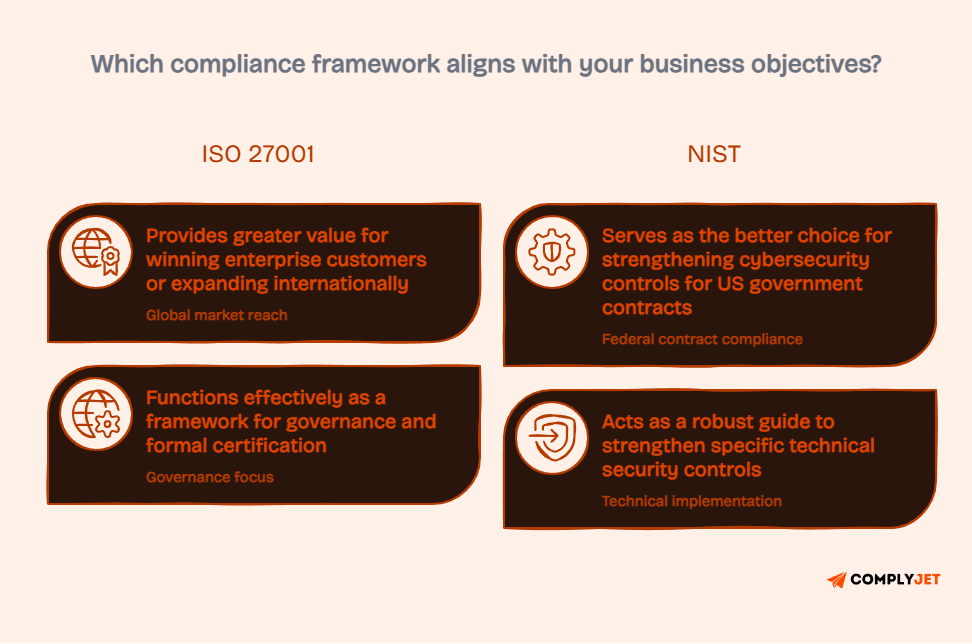
Your compliance strategy should support your business strategy. If your goal is to win enterprise customers or expand internationally, ISO 27001 certification may provide greater value. If your focus is on strengthening cybersecurity controls for US government contracts, NIST may be the better choice. Always align your framework with long-term business priorities.
Both ISO 27001 and NIST require significant planning and resources. Organizations often underestimate the time needed for risk assessments, policy development, employee training, and control implementation. A realistic implementation plan with defined responsibilities can help prevent delays and reduce compliance risks.
ISO 27001 and NIST are not mutually exclusive. Many organizations benefit from using ISO 27001 for governance and certification while adopting NIST to strengthen technical security controls. Evaluating your current and future compliance needs can help determine whether a hybrid approach is the better option.
ISO 27001 is an internationally recognized standard that enables organizations to achieve certification for their Information Security Management System (ISMS). NIST is a cybersecurity framework that provides security guidelines and best practices but does not offer certification.
NIST is voluntary for most private organizations. However, it may be mandatory for businesses working with US government agencies or those required to comply with specific federal regulations.
No. ISO 27001 and NIST serve different purposes. ISO 27001 focuses on governance and certification, while NIST provides detailed cybersecurity controls. Many organizations use both frameworks together.
NIST is generally easier to implement because it does not require certification or external audits. ISO 27001 involves more documentation, formal audits, and ongoing compliance requirements.
When comparing ISO 27001 vs NIST, there is no one-size-fits-all solution. The right framework depends on your organization's geography, business objectives, customer expectations, and compliance requirements.
If you need an internationally recognized certification to build trust and win enterprise business, ISO 27001 is the stronger choice. If your priority is implementing flexible cybersecurity controls, particularly in the US, NIST is often the better fit.
Organizations operating across multiple regions or industries may benefit from adopting both frameworks to combine governance with robust security controls.
Before making a decision, evaluate your compliance obligations, available resources, and long-term growth plans.
Choosing the right framework today can simplify compliance, strengthen your security posture, and support future business opportunities.
Need help deciding between ISO 27001 and NIST? Book a demo with ComplyJet to identify the right compliance strategy for your business and accelerate your implementation journey.
© 2026 ComplyJet. All rights reserved.