.svg)

Someone just handed you a NIST requirement. Maybe it was a customer security review, a new contract clause, or your auditor circling back. Now you’re looking at a dozen NIST compliance software options, all claiming to “support NIST,” none of them clear about what that actually means for your specific framework or your budget.
I’ve reviewed 10 NIST compliance platforms in 2026, covering everything from NIST CSF and 800-53 to 800-171 and the Risk Management Framework. This guide covers real pricing, which tools actually support which frameworks, and who each one is genuinely built for. You can stop reading sales pages and start making the call.
Here’s what I’ll cover: a breakdown of the three main NIST frameworks, a quick comparison table of all 10 tools, individual reviews with honest pros and cons, and a buying guide for choosing between them based on your team size and framework target.
NIST Compliance Isn’t One Thing: CSF, 800-53, and 800-171 Are Very Different Problems
Here’s where most teams get stuck: they search for “NIST compliance software,” get a list of tools that all claim NIST support, and don’t realise they’re comparing apples to tractors. NIST isn’t a single standard. It’s a family of frameworks, and the one you’re targeting changes everything about which tool is right for you.
Key insight
NIST isn’t a single standard. It’s a family of frameworks, and the one you’re targeting changes everything about which tool is right for you.
NIST CSF 2.0 (the Cybersecurity Framework) is voluntary, widely adopted, and the most common starting point. It gives you a structured way to manage cybersecurity risk across five core functions: Identify, Protect, Detect, Respond, and Recover. Most NIST cybersecurity framework tools handle this well: it’s the entry-level NIST play, and if a platform claims NIST support at all, CSF is usually what they mean.
NIST 800-53 is a different animal. It’s a controls catalogue originally designed for federal information systems, now increasingly required by regulated industries and enterprise customers. It runs to hundreds of controls across 20 control families. Not all compliance platforms cover this properly. Some just badge it as “NIST” without the depth required for a real 800-53 program.
NIST 800-171 is for organisations handling Controlled Unclassified Information (CUI), primarily DoD contractors. It’s tied directly to CMMC compliance and your SPRS score. If this is your requirement, you need dedicated NIST 800-171 compliance software, not a generic compliance tool with NIST on the label.
The NIST Risk Management Framework (RMF) sits across all three as the process layer: categorise, select, implement, assess, authorise, monitor. If you need dedicated NIST risk management framework software that makes the RMF process explicit rather than implicit, ask vendors specifically whether they support the RMF authorisation workflow. Most don’t surface it clearly.
Know which framework you’re targeting before you evaluate any tool on this list.
How We Picked the Best NIST Compliance Tools
I evaluated each platform across five criteria:
- Framework coverage: Does it explicitly support CSF, 800-53, and/or 800-171, or just claim “NIST” generically? Specificity matters here.
- Automation depth: Automated evidence collection and continuous monitoring, not just a digital checklist.
- Integration breadth: Does it connect to the cloud, identity, and SaaS tools your team already uses?
- Pricing transparency: Is startup-friendly pricing available, or is everything “contact sales”?
- Time to first audit-ready state: How long does it actually take to get from onboarding to a defensible compliance posture?
Why it matters
Know which NIST framework you’re targeting before you evaluate any tool on this list.
Quick Comparison: Best NIST Compliance Software in 2026
| Tool | Best for | NIST Frameworks | Pricing |
|---|---|---|---|
| Vanta | Startups scaling fast | CSF, NIST AI RMF | From ~$12K/year |
| Drata | Multi-framework teams | CSF, 800-53, 800-171, NIST AI | From ~$7.5K/year |
| Secureframe | First-time compliance | CSF, 800-53, 800-171 | From ~$7.5K/year |
| ComplyJet | Early-stage startups | CSF, NIST AI RMF | From $5K/year |
| Sprinto | SMBs wanting a pre-built program | CSF, 800-53, 800-171 | From ~$4K/year |
| Hyperproof | Multi-framework mid-market | CSF, 800-53, 800-171 | From ~$12K/year |
| Optro (AuditBoard) | Enterprise GRC teams | CSF, NIST AI RMF | From ~$30K/year |
| Scrut Automation | Growing startups with AI needs | CSF 2.0, 800-53, NIST AI RMF | From ~$15K/year |
| OneTrust GRC | Large enterprises | CSF, 800-53 | From ~$50K/year |
| LogicGate | Enterprise custom workflows | CSF, 800-53 | From ~$25K/year |
Free Demo
NIST compliance without the guesswork.
Flat pricing from $5K. NIST CSF and AI RMF. A team that drives the work.
The 10 Best NIST Compliance Software Tools in 2026
1. Vanta

Vanta is the most widely adopted compliance automation platform on this list, with 16,000+ customers and 400+ integrations. If you ask a random startup CTO which NIST compliance tool they’ve heard of, it’s probably Vanta. That brand weight matters, and the product backs it up: continuous monitoring, automated evidence collection, and AI-powered GRC agents (launched at RSAC 2026) that surface risks without waiting for someone to manually run a check.
One thing to know about Vanta’s NIST coverage: it handles CSF and NIST AI RMF cleanly, but 800-53 is present rather than prominent. If your primary requirement is a deep NIST 800-53 program with control family granularity, Drata or Hyperproof will serve you better. Where Vanta wins is breadth: 35+ frameworks in one platform, 400+ integrations, and a trust center that makes it easy to share your compliance posture with enterprise prospects.
For most startups pursuing CSF alongside SOC 2 or ISO 27001, Vanta is a reasonable default. The cost is real though: per-framework add-ons mean your annual spend grows faster than expected as you expand scope. Our Vanta pricing guide breaks down the real cost at scale.
Key features:
- 400+ integrations (AWS, GitHub, Okta, Google Workspace, and more)
- Automated monitoring across 35+ compliance frameworks
- AI-powered GRC agents for continuous evidence review
- Vanta Agent for security questionnaire automation (93% automation rate claimed)
- Trust Center for real-time security posture sharing
Pros of Vanta
- Largest integration library on this list
- Easy to get started: clean onboarding, well-documented
- Active customer ecosystem of 16,000+ companies
- Strong brand recognition helps with enterprise prospect conversations
Cons of Vanta
- Per-framework add-ons inflate cost as you scale scope
- 800-53 coverage exists but isn’t a core strength
- A 2025 security incident affected a subset of customers
- Reporting customisation is limited compared to GRC-native platforms
★★★★★Verified User· SMB · 51–200 employees
“The automated evidence collection and continuous monitoring are the standout features. It connects to our cloud and identity tools and pulls access logs and config proof on its own, which cut our audit prep time dramatically.”
Via G2 · 4.7/5
Pricing: Essentials from ~$12K/year for small teams (1–50 employees); custom for larger organisations. Per-framework add-ons apply. Audit fees are separate.
Best for: Startups pursuing NIST CSF alongside SOC 2 or ISO 27001, who want the broadest integration library and are comfortable with usage-based pricing growth.
2. Drata

If NIST coverage depth is your primary filter, Drata is the one to look at carefully. It’s the only platform in this tier that explicitly supports all four major NIST sub-frameworks: CSF, 800-53, NIST AI RMF, and 800-171. For teams with a real NIST 800-53 requirement, not just CSF, that specificity matters. You can map one control across SOC 2, ISO 27001, HIPAA, and NIST 800-53 simultaneously, which saves a substantial amount of rework when you’re managing multiple frameworks.
Drata serves 8,000+ customers and earns a 4.8/5 across reviews, which reflects its guided compliance workflows more than anything else. The platform holds your hand through evidence collection in a way that’s useful for compliance teams that don’t have a dedicated GRC hire. The integrations (200+) are solid across cloud, identity, and dev tooling, though fewer than Vanta’s 400+.
The pricing entry point is competitive, starting around $7.5K/year for the Essential tier, but watch the renewal: several users flag that pricing climbs meaningfully at the end of the first contract, particularly if you’re expanding frameworks. The CSM quality is also inconsistent, which matters if you’re relying on white-glove support to get through your first NIST assessment. Read our Drata review for a full breakdown of what to expect.
Key features:
- Explicit NIST 800-53, CSF, 800-171, and NIST AI RMF support
- 200+ integrations with continuous evidence collection
- One-to-many control mapping across 30+ frameworks
- Trust Center for stakeholder security posture documentation
- AI-powered security questionnaire automation
Pros of Drata
- Widest NIST sub-framework coverage of any top-tier platform
- 4.8/5 rating; clean, guided workflows
- Control cross-mapping saves significant time managing multi-framework compliance
- Competitive entry pricing at ~$7.5K/year
Cons of Drata
- Pricing climbs at renewal, especially with multiple frameworks
- Some integrations can be brittle in complex cloud environments
- CSM quality varies across accounts
- 200 integrations is solid but trails Vanta’s 400+
★★★★★Verified User· Mid-Market · 51–200 employees
“Drata automates many of the manual tasks associated with compliance, freeing up valuable resource for the security and product teams. The continuous monitoring checks controls, collects evidence, and validates configurations across all our NIST and SOC 2 controls automatically.”
Via G2 · 4.8/5
Pricing: Essential from ~$7.5K/year; Foundation ~$15K/year; Advanced is custom. Median contract is around $25K/year across all company sizes.
Best for: Fast-growing teams that need full NIST sub-framework coverage alongside SOC 2, ISO 27001, or HIPAA, and want clean guided workflows to get there.
3. Secureframe
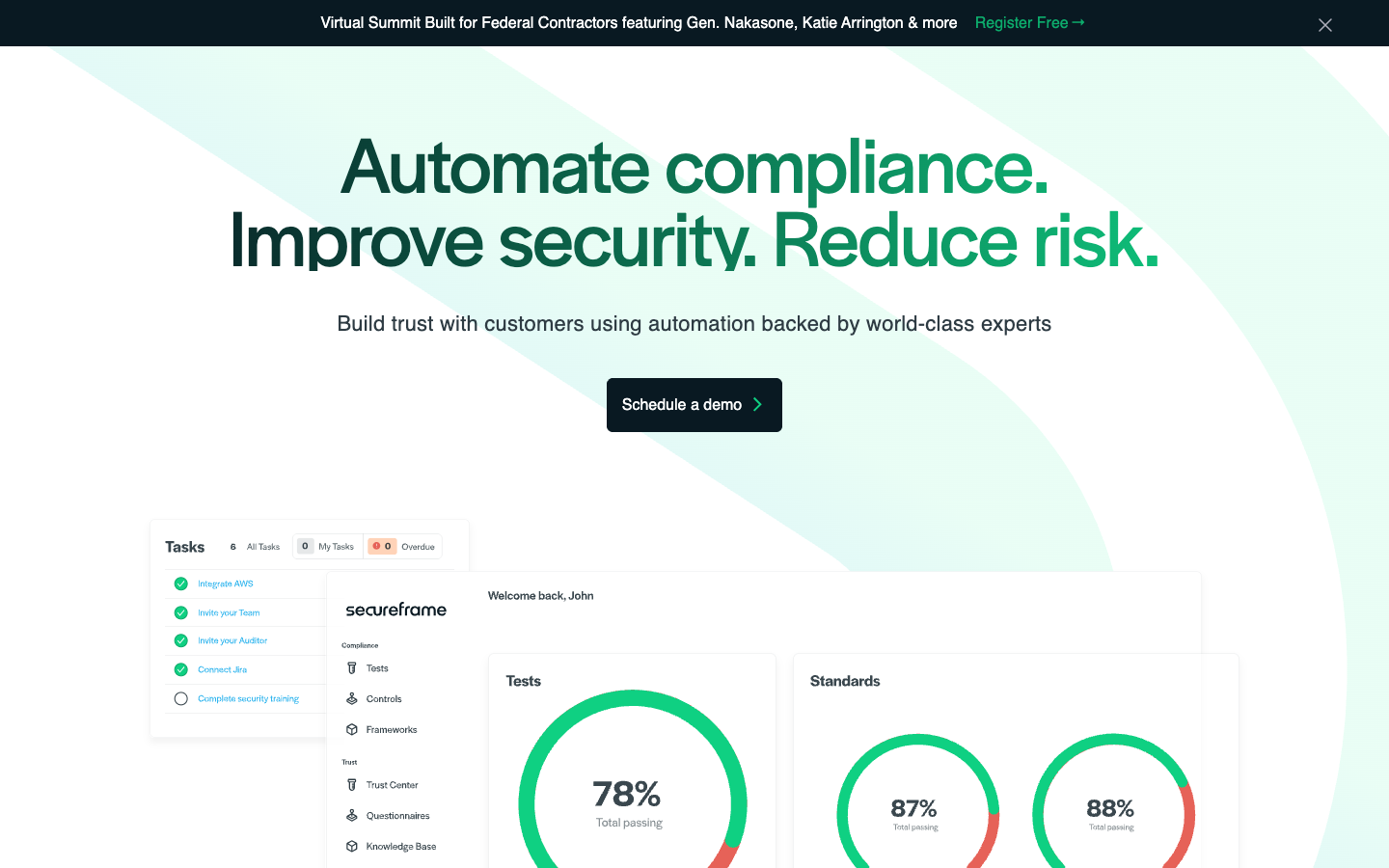
Secureframe’s standout move for NIST compliance is a dedicated product: Secureframe Federal, built specifically for CMMC, FedRAMP, and NIST requirements including 800-53 and 800-171. If you’re a DoD contractor or government supplier navigating both NIST 800-171 and CMMC simultaneously, this is the most purpose-built option in the startup price range. Most platforms treat federal compliance as an afterthought; Secureframe built a separate product for it.
For non-federal NIST needs, Secureframe’s main platform covers CSF and 800-53 across its 45+ framework library. The AI layer (Secureframe AI) handles remediation guidance, risk assessment, and policy writing, which accelerates time-to-compliance meaningfully. The 6,000+ customer base and reported 2–4 month time-to-compliance (vs. 6–12 months manually) speak to the product’s practical effectiveness.
The limitation is integration depth: 150+ integrations is solid but trails Drata and Vanta. If your infrastructure is complex and spread across many tools, you may hit gaps. And the Federal product is a separate purchase, so if you’re pursuing NIST 800-171, make sure you’re pricing the right SKU.
Key features:
- Secureframe Federal: dedicated product for NIST 800-53, 800-171, CMMC, and FedRAMP
- 45+ pre-built compliance frameworks
- Secureframe AI for remediation, risk assessment, and policy drafting
- 150+ integrations (AWS, GitHub, Okta, Google Workspace)
- Third-party and vendor risk management
Pros of Secureframe
- Only platform on this list with a dedicated federal compliance product
- Strong AI features for remediation and policy writing
- Fast time-to-compliance: typically 2–4 months
- Competitive pricing, starting at $7.5K/year
Cons of Secureframe
- Federal product (800-171, CMMC) requires a separate purchase
- 150 integrations trails Vanta (400+) and Drata (200+)
- Less prominent in SERP reviews than Vanta or Drata
★★★★★Verified User· SMB · 11–50 employees
“Secureframe’s ease of use and exceptional support simplified our compliance process significantly. The automation features reduced our manual work dramatically and got us audit-ready in weeks instead of months.”
Via G2 · 4.7/5
Pricing: Starter from ~$7.5K/year; Complete ~$20K/year; Enterprise on request. Secureframe Federal is priced separately.
Best for: Startups pursuing first-time NIST compliance; DoD contractors who need NIST 800-171 and CMMC handled in one place.
4. ComplyJet
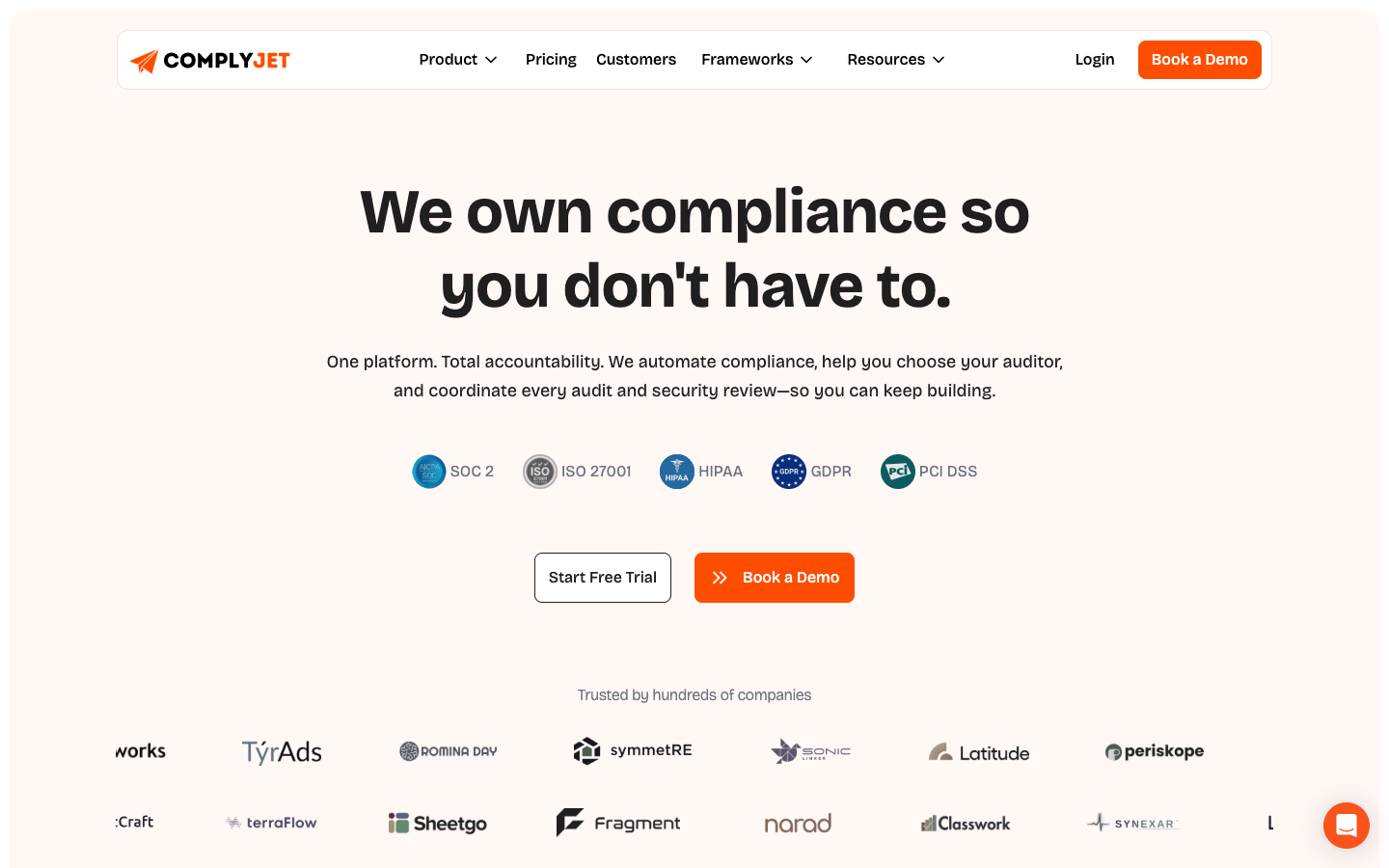
Most compliance platforms give you software and leave you to figure out the rest. ComplyJet is structured around the outcome: you get compliant, the work gets done, and a team guides you through every step of the process. That’s a different model from buying access to a platform and hoping your team has bandwidth to run with it.
The platform covers NIST CSF and NIST AI RMF with 350+ integrations, AI-assisted policy drafting, continuous control monitoring, and a Trust Center for sharing your compliance posture with enterprise prospects. For early-stage startups pursuing NIST compliance alongside a SOC 2 program, the flat per-company pricing changes the maths in a way the per-seat platforms don’t: your cost stays the same whether you have 10 or 50 people.
At $5,000/year for a single framework (or $8,000/year for two, such as NIST CSF plus SOC 2), ComplyJet is publicly priced in a category where almost everyone else asks you to book a call first. That transparency is deliberate. This isn’t positioned as the cheapest option; it’s the considered one for teams that evaluate vendor fit carefully rather than defaulting to brand recognition.
The honest trade-off: ComplyJet has a smaller customer base than Vanta or Drata, and less market visibility. If your enterprise prospect’s security team is checking vendor logos, that matters. But evaluate on substance (framework coverage, support model, cost predictability) and it holds up well.
Key features:
- NIST CSF and NIST AI RMF framework support
- 350+ integrations across cloud, identity, and SaaS tools
- AI-assisted policy drafting and gap analysis
- Continuous control monitoring and evidence collection
- Team-guided compliance: the work gets driven, not just tracked
- Trust Center for sharing certifications with enterprise prospects
- Flat per-company pricing: not per-seat, not per-framework
Pros of ComplyJet
- Publicly listed pricing: $5K/year (single framework), $8K/year (two)
- Cost stays fixed as you hire: no renewal surprises
- Team-guided process: you’re not left alone with the software
- NIST CSF and NIST AI RMF coverage
“
The platform makes it simple: it splits the work into four buckets with clear, bite-sized tasks we could fit into our routine. No sales gauntlet or upselling. The clearest, most sensible option.
Artur G· CTO · Symmetre
Via complyjet.com ↗
Cons of ComplyJet
- Does not support NIST 800-53 or 800-171: if those are your requirement, look at Drata or Secureframe
- Smaller customer base and less brand recognition than Vanta or Drata
- Newer platform: less third-party review coverage
Pricing: $5,000/year for a single framework; $8,000/year for two frameworks (e.g. NIST + SOC 2). Flat per-company rate, not per-seat.
Best for: Early-stage startups under 50 employees pursuing NIST compliance for the first time, who want a team that drives the process and pricing that doesn’t change as headcount grows.
5. Sprinto
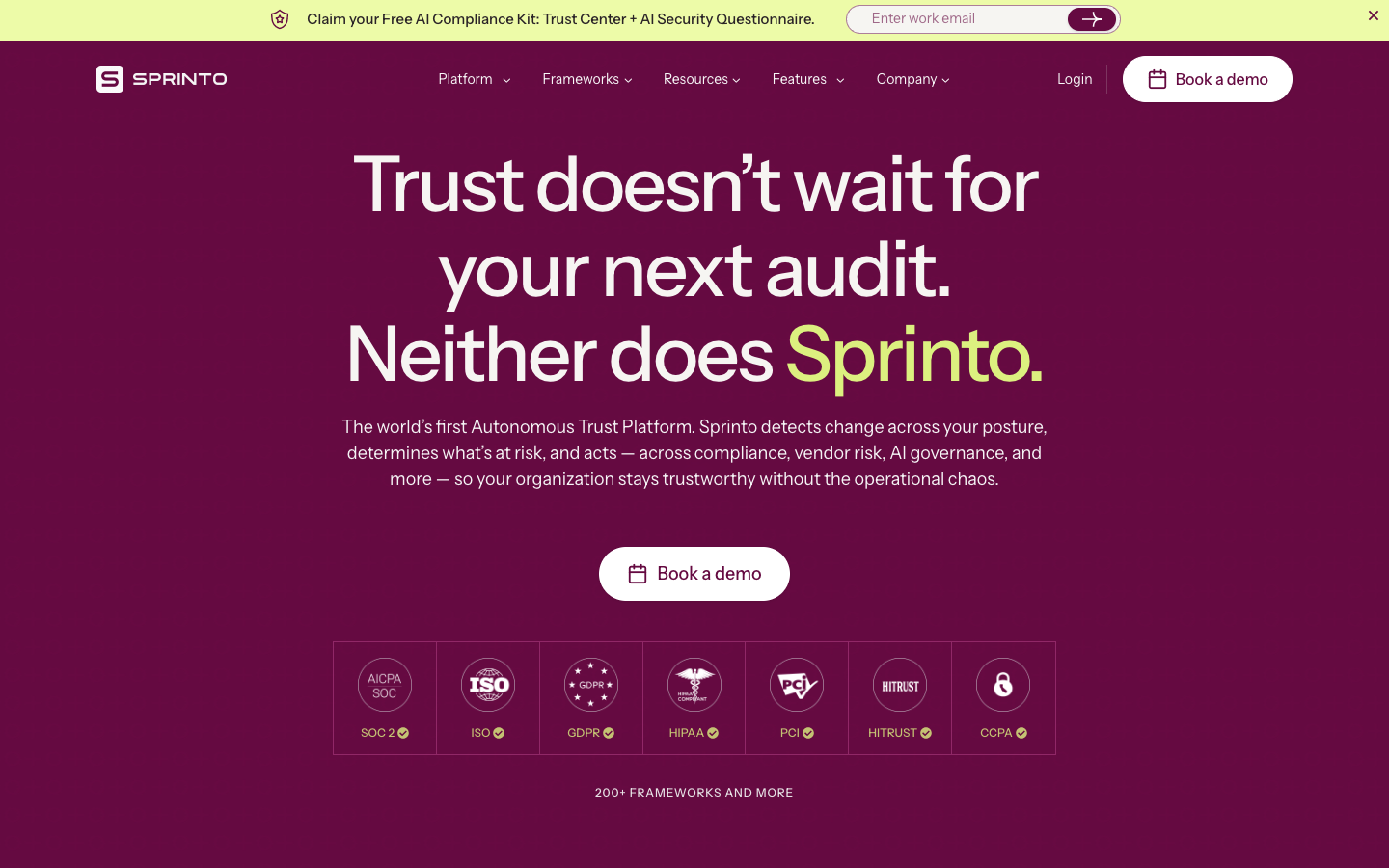
Sprinto’s differentiation in the NIST space is a pre-approved compliance program that ships out of the box. Instead of building your NIST control framework from scratch, you start with a pre-configured NIST workflow, policy templates that are already scoped to your framework, and a readiness dashboard that tells you exactly where you stand. For a first-time compliance team without a dedicated GRC hire, that head start is genuinely valuable.
The platform serves 3,000+ companies across 75 countries and carries strong support ratings. Its real-time dashboards and gap analysis tools are particularly well-regarded. Where Sprinto is honest is also where it’s a bit frustrating: pricing is entirely custom, requires a sales call, and can vary significantly between companies of similar size. I’ve seen quotes ranging from $4,000 to $20,000+ for roughly equivalent use cases, which makes budgeting harder than it should be.
If you want a NIST program that works quickly and you’re comfortable navigating a sales conversation to get to price, Sprinto is a strong pick for the startup bracket. Our Sprinto review covers the pricing model and support quality in more detail.
Key features:
- Pre-approved NIST program with pre-configured workflows and policy templates
- Real-time control monitoring dashboards and gap analysis
- Built-in incident and disaster management module
- Customisable compliance policy templates
- 200+ global standards supported
Pros of Sprinto
- Pre-configured NIST program eliminates guesswork for first-time compliance teams
- Strong support ratings: well-regarded customer success
- Entry pricing from ~$4K/year makes it accessible for early-stage startups
Cons of Sprinto
- Non-transparent pricing: requires a sales call and varies by negotiation
- Final cost is inconsistent across similar companies
- No public pricing page makes budgeting harder upfront
★★★★★Verified User· SMB · 11–50 employees
“Sprinto’s pre-configured NIST program eliminated the guesswork from our compliance journey. We didn’t need to figure out what controls mapped where. The platform laid it all out and we just executed.”
Via G2 · 4.8/5
Pricing: From ~$4K/year for a single framework. Full pricing is custom and requires a sales conversation.
Best for: SMBs and startups wanting a structured, pre-built NIST compliance program with strong customer success support, and who are comfortable with a non-transparent pricing model.
6. Hyperproof
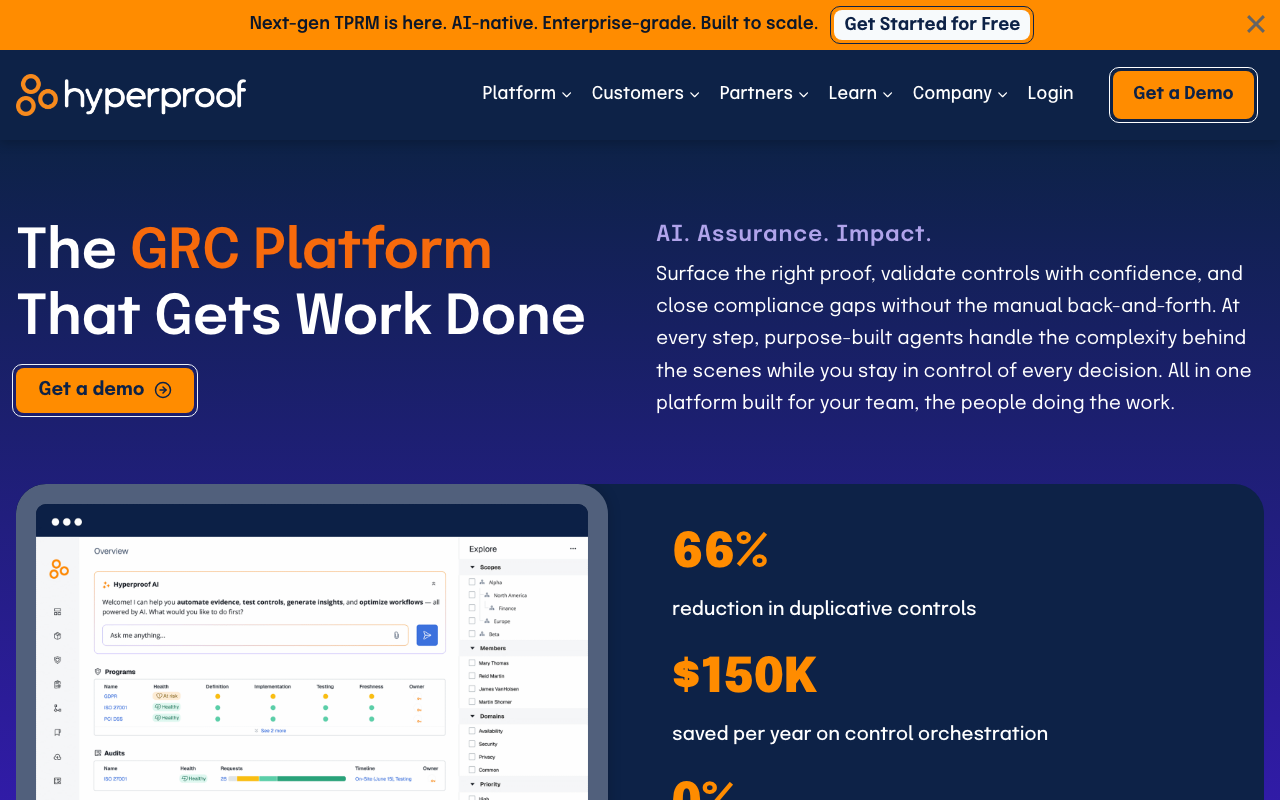
Hyperproof is built for teams that aren’t just doing NIST. If you’re managing NIST CSF alongside ISO 27001, SOC 2, HIPAA, and PCI DSS simultaneously, Hyperproof’s 140+ pre-built frameworks and multi-framework control mapping become genuinely useful. You build a control once, map it across every framework it applies to, and stop testing the same thing four times.
Two features stand out. The Freshness Meter tracks when each control was last manually assessed and alerts when it’s overdue, which solves a real problem: controls that pass automation checks but go stale because nobody reviewed them manually. The Jumpstart gap assessment identifies certification opportunities based on your current policies and overlapping controls, which is a useful starting point for teams that aren’t sure which framework to pursue next.
Rated 4.8/5 with customers including Reddit, Fortinet, and Appian, Hyperproof is a credible platform. The trade-off is cost: median contracts run around $40K/year, which puts it out of range for early-stage startups. Read our Hyperproof review for a detailed breakdown of pricing tiers and which team sizes get the most value. It also has fewer integrations (200+) than Vanta, and performance can slow with very large control sets.
Key features:
- 140+ pre-built frameworks including NIST CSF, 800-53, and 800-171
- AI-powered control mapping and automation
- Freshness Meter for tracking stale controls
- Jumpstart gap assessment for identifying certification opportunities
- 200+ integrations (AWS, Azure, Okta, Slack, Jira, ServiceNow)
- Third-party risk management and monitoring
Pros of Hyperproof
- Most comprehensive pre-built framework library on this list (140+)
- Freshness Meter solves the “controls go stale” problem other platforms ignore
- Strong ratings: 4.8/5, customers like Reddit and Fortinet
- Easy onboarding; new users trainable in under an hour
Cons of Hyperproof
- Median contract ~$40K/year, expensive for startups
- Performance slows with very large, complex control sets
- 200 integrations trails Vanta (400+)
- Heavy initial configuration for large programs
★★★★★Verified User· Mid-Market · 201–500 employees
“Hyperproof is excellent at streamlining our NIST CSF compliance. The Freshness Meter keeps us from going stale on controls we forget about, and the 140+ pre-built frameworks mean we didn’t have to build anything from scratch.”
Via G2 · 4.8/5
Pricing: From ~$12K/year; median contract ~$40K/year. Scales by users, frameworks, and deployment size.
Best for: Mid-market teams managing multiple overlapping compliance frameworks where NIST is one of several, and who need depth over breadth in their GRC tooling.
7. Optro (formerly AuditBoard)
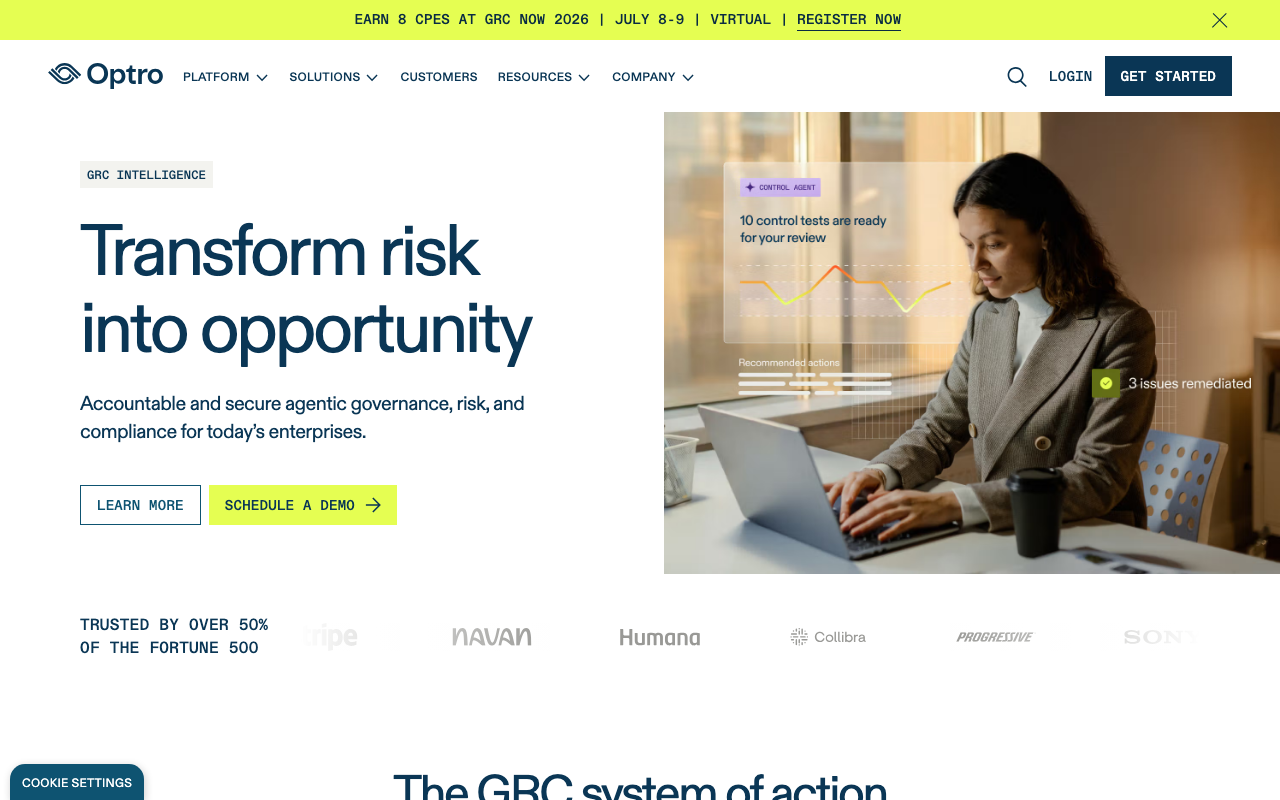
If you’re looking at the enterprise end of the NIST compliance software market, Optro (rebranded from AuditBoard in March 2026) is the Gartner Magic Quadrant Leader in GRC Tools and trusted by more than half of the Fortune 500.
The platform maps controls across SOC 2, ISO 27001, NIST, HIPAA, and SOX simultaneously, which means no duplicate testing across frameworks. Its AI-powered Intelligent Testing runs continuous control evaluations and flags exceptions instantly, rather than waiting for scheduled audits.
The NIST coverage skews toward CSF and NIST AI RMF rather than deep 800-53 or 800-171 specificity, which is fine for enterprises that need NIST as one layer of a broader compliance program rather than as the primary certification. The recent acquisition of AI-native Midship adds audit transformation capabilities that are meaningfully ahead of what startup-focused platforms offer.
The pricing reflects the enterprise positioning: starting around $30K/year and climbing well past $100K for large deployments. If you’re a startup or a growing team without a dedicated GRC function, this is overkill, and the sales cycle alone will cost you time you don’t have.
Key features:
- AI-powered Intelligent Testing with continuous control evaluation
- Cross-framework mapping across SOC 2, ISO 27001, NIST, SOX, and HIPAA
- 150+ enterprise integrations (Okta, Jira, ServiceNow, Workday, Snowflake)
- Pre-built frameworks for EU AI Act, NIST AI RMF, ISO 42001
- Gartner 2025 Magic Quadrant Leader for GRC Tools
Pros of Optro
- Gartner MQ Leader: credible at board and enterprise customer level
- 93% review recommendation rate; 100% of users rate 4 or 5 stars
- Strong AI capabilities for automated evidence and control testing
- Handles SOX + NIST + ISO simultaneously without duplicate work
Cons of Optro
- Enterprise-only pricing: starts at ~$30K/year, often $100K+ for large orgs
- Long sales cycle: not appropriate for teams with an urgent compliance deadline
- Rebranding from AuditBoard to Optro is still causing market confusion
- Overkill for single-framework NIST programs
★★★★★Verified User· Enterprise · 1001–5000 employees
“The ability to map a single control to SOC 2, ISO 27001, NIST, and HIPAA simultaneously eliminates duplicate testing across our entire compliance portfolio. AuditBoard’s interface and centralised management have significantly enhanced our audit efficiency.”
Via G2 · 4.7/5
Pricing: From ~$30K/year; enterprise contracts typically $80K–$100K+. Custom quoted, no public pricing.
Best for: Enterprise organisations with dedicated GRC teams managing complex multi-framework programs where NIST is one layer of a broader compliance and risk management mandate.
8. Scrut Automation

Scrut Automation is worth attention for two specific reasons: it’s one of the few platforms that explicitly supports NIST CSF 2.0 (the updated version released in 2024) and NIST AI RMF, which matters if your AI systems are within scope of your compliance program. The NIST AI Risk Management Framework is an emerging requirement for AI-heavy companies, and most platforms are still catching up. Scrut is ahead of that curve.
The AI layer, called Scrut Teammates, provides guided remediation for failed tests and validates evidence rather than just collecting it. The multi-framework control mapping also prevents redundant work when you’re running NIST 800-53 alongside other standards. The Setup Wizard and expert support model make it accessible to teams without a dedicated compliance hire.
The limitation is brand and scale: Scrut has a smaller integration ecosystem than the top-three platforms and less third-party review coverage. That’s not a dealbreaker, but if you’re evaluating this for a GRC program that needs to look credible to enterprise security teams, it’s worth noting.
Key features:
- Pre-built frameworks for NIST 800-53 Rev 5, NIST CSF 2.0, and NIST AI RMF
- Scrut Teammates: AI for guided remediation and evidence validation
- Multi-framework control mapping to eliminate duplicate work
- 60+ total compliance frameworks
- Setup Wizard, onboarding support, and InfoSec expert access
Pros of Scrut Automation
- NIST CSF 2.0 and NIST AI RMF support: ahead of most competitors on updated frameworks
- AI Teammates catch gaps proactively rather than waiting for scheduled reviews
- Accessible setup for teams without a dedicated compliance hire
Cons of Scrut Automation
- Smaller integration ecosystem than Vanta, Drata, or Hyperproof
- Less brand recognition: fewer third-party reviews and public case studies
- Some learning curve for advanced configuration
★★★★★Verified User· SMB · 51–200 employees
“Scrut’s multi-framework control mapping across NIST 800-53 and NIST CSF 2.0 saved us from doing duplicate work. The AI teammates catch things we’d miss and the setup wizard got us compliant without needing a dedicated compliance hire.”
Via G2 · 4.8/5
Pricing: From ~$15K/year (up to 20 employees, per AWS Marketplace). Scales with frameworks and users.
Best for: Growing startups with AI systems in scope who need NIST CSF 2.0 and NIST AI RMF support, and want AI-assisted guidance through the compliance process.
9. OneTrust GRC
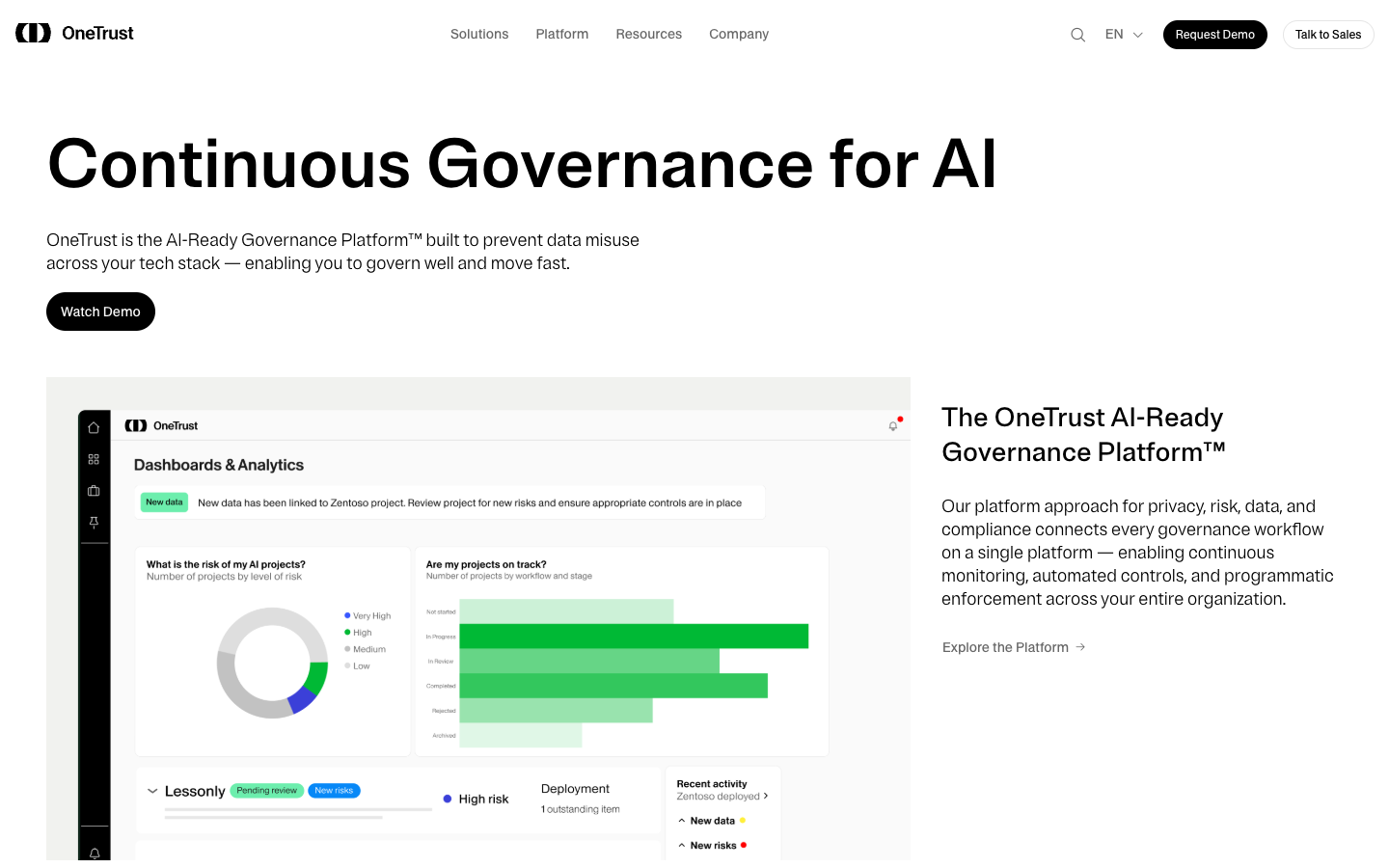
OneTrust’s Tech Risk and Compliance module is the broadest platform on this list: 55+ frameworks across 300 jurisdictions, with 500+ pre-built system connectors and dynamic risk scoring. If you’re a large enterprise with a compliance mandate that spans multiple countries, multiple privacy laws, and multiple security frameworks simultaneously, OneTrust can handle it in one place in a way that few platforms can.
For NIST compliance specifically, it covers CSF and 800-53, with CMMC 2.0 also supported. The module-based pricing model means you’re purchasing each capability separately, which gives flexibility but inflates total cost quickly. A Q2 2026 pricing change set a $10K minimum per module, which effectively closes the door for most startups and mid-market companies.
This is squarely an enterprise product, and it should be evaluated as one. If you’re a startup reading this list looking for NIST compliance software, OneTrust is not the right fit. It’s included here because it shows up in SERP comparison lists and you should understand what it is before ruling it out.
Key features:
- 55+ ready-to-action frameworks including NIST CSF and 800-53
- 500+ pre-built system connectors; 200+ collaboration integrations
- Dynamic risk scoring and automated asset mapping
- Policy management with approval workflows and incident response
- Covers 300 jurisdictions for multi-country compliance programs
Pros of OneTrust GRC
- Unmatched framework breadth: 55+ frameworks, 300 jurisdictions
- 500+ connectors: broadest integration footprint on this list
- Strong enterprise credibility and trust
Cons of OneTrust GRC
- Starts at ~$50K/year; enterprise deployments $250K+
- Module-based pricing: each capability purchased separately
- $10K minimum per module effective Q2 2026
- Not designed for startups or single-framework NIST programs
★★★★☆Verified User· Enterprise · 1001–5000 employees
“OneTrust GRC gives us coverage across 55+ frameworks including NIST and handles our complex multi-jurisdiction requirements. The breadth is unmatched, though the module-based pricing adds up quickly and implementation requires significant lift.”
Via G2 · 4.3/5
Pricing: From ~$50K/year per module; enterprise deployments typically $250K+. Module-based pricing; $10K minimum per module (Q2 2026).
Best for: Large enterprises managing complex, multi-jurisdiction compliance programs across privacy, security, and GRC simultaneously.
10. LogicGate

LogicGate is the most customisable platform on this list, and that’s both its strongest argument and its biggest warning. The no-code workflow builder lets your GRC team define custom processes without developer involvement. Spark AI automates data entry and routine tasks.
The Risk Cloud Quantify module runs Monte Carlo simulations using the Open FAIR model for quantitative risk assessment. The NIST CSF cross-mapping is genuinely impressive: every CSF subcategory is linkable to ISO 27001, NIST 800-53, PCI DSS, and COBIT, so you can see exactly where your controls overlap and where they don’t.
For an enterprise with a dedicated GRC team and the time to implement properly, LogicGate is a serious platform, as we detail in our LogicGate review. For anyone else, the complexity is a real barrier. Implementation is lengthy, the learning curve is steep without a GRC background, and native integrations are the fewest of any platform reviewed here. Multi-year discounts (up to 45%) help with cost, but you’re still looking at $40K–$80K for most mid-market deployments.
Key features:
- NIST CSF and 800-53 cross-mapped to ISO 27001, PCI DSS, and COBIT 5
- No-code workflow builder for custom GRC processes
- Spark AI for automated data entry and task automation
- Risk Cloud Quantify: Monte Carlo simulations with Open FAIR model
- 30+ pre-built GRC applications
Pros of LogicGate
- Most customisable platform on this list: build any GRC process without developers
- Excellent NIST CSF cross-mapping to other frameworks
- Quantitative risk modelling that most platforms can’t touch
Cons of LogicGate
- Complexity overwhelms teams without dedicated GRC consultants
- Fewest native integrations on this list
- Long implementation timeline: not suitable for urgent compliance deadlines
- $40K–$80K for most mid-market deployments
★★★★☆Verified User· Enterprise · 501–1000 employees
“LogicGate’s NIST CSF cross-mapping is excellent: we can link every subcategory to ISO 27001 and PCI DSS controls without rebuilding anything. The no-code flexibility lets our team customise workflows without needing developers, though the initial learning curve is real.”
Via G2 · 4.5/5
Pricing: From ~$25K/year; most mid-market deployments $40K–$80K. Multi-year discounts up to 45%.
Best for: Enterprise GRC teams with dedicated staff who need highly customisable workflows and quantitative risk modelling, where NIST maps to a broader multi-framework program.
How to Choose NIST Compliance Software: A Buyer’s Guide
NIST CSF compliance software vs 800-53 vs 800-171: pick your framework first
This is the most important decision you’ll make before evaluating any platform. If you pick the wrong framework target, you’ll end up with a tool that nominally “supports NIST” but doesn’t handle your actual requirement.
NIST CSF 2.0: Start here if you’re building your cybersecurity posture from scratch or responding to a general “we want to see your security framework” request. Almost every platform on this list handles it. Choose based on price, integrations, and ease of getting started.
NIST 800-53 compliance software: You need this if you’re selling into federal, regulated industries, or enterprise customers that require control family-level specificity. Verify that the platform supports High, Moderate, and Low baselines, not just “NIST 800-53” as a label. Drata, Hyperproof, and Scrut are the strongest options here.
NIST 800-171 compliance software: Required for DoD contractors handling CUI. You also need SPRS score tracking and CMMC alignment. Secureframe Federal and Drata are the clearest picks. Ask vendors specifically about CUI boundary scoping before committing.
What to look for in NIST 800-53 compliance software
Not all NIST 800-53 compliance software actually covers the framework in depth. Some platforms list “NIST 800-53” in their framework catalogue but only map to a generic subset of controls. Before signing a contract, ask specifically about:
- Control family automation: can the platform automate evidence collection for each of the 20 control families, or just a subset?
- Baseline support: do they support High, Moderate, and Low baselines, or only the Moderate baseline that’s easiest to implement?
- Assessment workflows: does the platform support the RMF authorization process, or just continuous monitoring?
What to look for in NIST 800-171 compliance software
Good NIST 800-171 compliance software does more than map the 110 security requirements: it tracks your SPRS score and ties into your CMMC readiness. Look for:
- SPRS score tracking: can the platform calculate and track your score automatically?
- CUI boundary mapping: does it help you identify and document where CUI lives in your environment?
- CMMC alignment: if CMMC is also a requirement, does the platform handle both without separate tools?
How many NIST compliance tools do you actually need?
One is usually the right answer. The value of these platforms is control cross-mapping: if you’re doing NIST CSF alongside SOC 2, you want a single tool that maps overlapping controls once rather than building two parallel programs.
If your only requirement is NIST CSF: pick the tool that most directly fits your stage. Sprinto or ComplyJet for startups; Hyperproof for mid-market. If you need 800-53 or 800-171, ComplyJet is not the right pick. Go with Drata or Secureframe instead.
If you’re running NIST alongside two or more other frameworks: Drata and Hyperproof have the strongest multi-framework control mapping. The time saved on duplicate evidence collection will pay back the higher platform cost.
What’s your budget and team size?
The pricing spread on this list is wide:
- Startups under 50 employees: ComplyJet (NIST CSF and AI RMF, from $5K), Sprinto (from ~$4K), Drata Essential (~$7.5K). If your target is CSF, any of these works. If you need 800-53 or 800-171, skip ComplyJet and go with Sprinto or Drata.
- Growing teams (50–200 employees): Vanta, Drata, or Secureframe in the $15K–$30K range. Evaluate based on integration depth and which frameworks you’re managing.
- Enterprise (200+ employees): Hyperproof, Optro, OneTrust GRC, or LogicGate. Expect $40K+ and plan for a proper implementation timeline.
How important is implementation speed?
If you have a deadline (a customer security review, an RFP requirement, a contract clause), implementation speed changes the calculus.
- Need to be audit-ready in 90 days: Sprinto’s pre-approved NIST program or Secureframe’s guided onboarding are the fastest paths.
- Want self-serve onboarding: Vanta or Drata; both have well-documented onboarding flows.
- Have time for a proper implementation: LogicGate or Hyperproof, where depth beats speed.
Free Demo
Not sure which NIST tool fits your stage?
ComplyJet covers NIST CSF and AI RMF from $5K/year, with a team that drives the process.
Frequently Asked Questions
What is the best NIST compliance software?
It depends on which NIST framework you’re targeting and your company size. For NIST CSF, almost any platform on this list works: Vanta and Drata are the most widely used. For nist 800-53 compliance software with genuine control-family depth, Drata, Hyperproof, and Scrut have the strongest coverage. For nist 800-171 compliance software (DoD contractors handling CUI), Secureframe Federal is the most purpose-built option. For startups pursuing NIST CSF, ComplyJet and Sprinto are the most practical starting points.
What is NIST compliance?
NIST compliance means aligning your organisation’s security and risk management practices with one or more frameworks published by the National Institute of Standards and Technology. NIST isn’t a single certification: it’s a family of standards including the Cybersecurity Framework (CSF), NIST 800-53 (controls for information systems), NIST 800-171 (protecting CUI), and the Risk Management Framework (RMF). Unlike SOC 2 or ISO 27001, most NIST frameworks don’t result in a formal certification: they’re adopted voluntarily or required by contract.
How do I achieve NIST compliance?
The process follows four broad steps: conduct a gap assessment to understand where your current controls fall short of your target NIST framework; implement the required controls and document them; collect ongoing evidence that controls are working; and, depending on your framework, undergo an assessment or self-attestation.
A compliance platform automates steps two through four, but the gap assessment is where you need to start. Most platforms include a gap analysis tool to help map your actual environment to the framework requirements.
Which NIST framework should I use?
NIST CSF 2.0 if you’re building a general cybersecurity program or responding to customer due diligence requests. It’s the most widely recognised and flexible starting point.
NIST 800-53 if you’re selling to federal agencies, regulated industries, or enterprise customers who specify this framework by name in vendor requirements.
NIST 800-171 if you’re a DoD contractor or subcontractor handling Controlled Unclassified Information. This is a contractual requirement, not a choice.
When in doubt, start with CSF. It’s the most commonly requested and the easiest to build on.
What’s the difference between NIST CSF and NIST 800-53?
NIST CSF (Cybersecurity Framework) is a high-level, voluntary framework that organises cybersecurity activities into five functions: Identify, Protect, Detect, Respond, and Recover. It’s designed to be accessible to organisations of all sizes and sectors, and doesn’t prescribe specific technical controls.
NIST 800-53 is a detailed controls catalogue originally designed for federal information systems, covering hundreds of specific controls across 20 control families. CSF tells you what to do; 800-53 tells you exactly how to do it at a technical and operational level. Many organisations use CSF as the strategic framework and 800-53 as the implementation specification.
Is NIST compliance mandatory?
It depends on your situation. For federal agencies and federal contractors handling certain types of sensitive data, NIST frameworks (particularly 800-53 and 800-171) are mandatory by law or contract. For most private companies, NIST compliance is voluntary, but it’s increasingly required as a condition of contracts with enterprise customers, government clients, or heavily regulated buyers. If a customer’s security review asks whether you’re NIST compliant, it’s effectively mandatory for that deal, even if it isn’t a legal requirement.
Final Thoughts
The right NIST compliance software depends on two things: which framework you’re actually targeting, and what size and stage your team is at. Vanta and Drata are the most common picks for startups running NIST alongside SOC 2 or ISO 27001. Hyperproof is the strongest option for mid-market teams managing multiple overlapping frameworks. Optro and LogicGate serve enterprise GRC programs with dedicated compliance staff.
Quick tip
The right NIST compliance software depends on two things: which framework you’re actually targeting, and what size and stage your team is at.
If you’re an early-stage startup pursuing NIST compliance for the first time, Drata, Secureframe, and ComplyJet are all worth evaluating. ComplyJet is the one to look at if you want publicly listed pricing (from $5,000/year), NIST CSF and NIST AI RMF coverage, and a team that drives the process rather than leaving you to run it solo. If 800-53 or 800-171 is your requirement, Drata or Secureframe are the better fits.