.svg)

You’re a Delaware C-Corp with zero offices in Berlin, so you assume the GDPR is just European homework. Then, an automated EU Architectural Audit pings your API, flagging a data leak you didn’t even know existed. In 2026, the "US-only" shield is a myth. Regulators no longer ask to see your policy; they verify your backend in real-time. If your code doesn't match your "Trust Us" banner, you’re a liability, not a business. Compliance has officially moved from the legal office to the engineering sprint. Your architecture is now your only defense.
This guide serves as the definitive market-entry blueprint for US-based startups, covering every strategic and technical factor you must weigh before committing to a GDPR compliance roadmap.
443 breach notifications a day. Up 22% in a year. The threat landscape isn't slowing down. Automate your compliance before you become a statistic - start your ComplyJet trial today.
What is GDPR Compliance? The 2026 Definition for US Founders
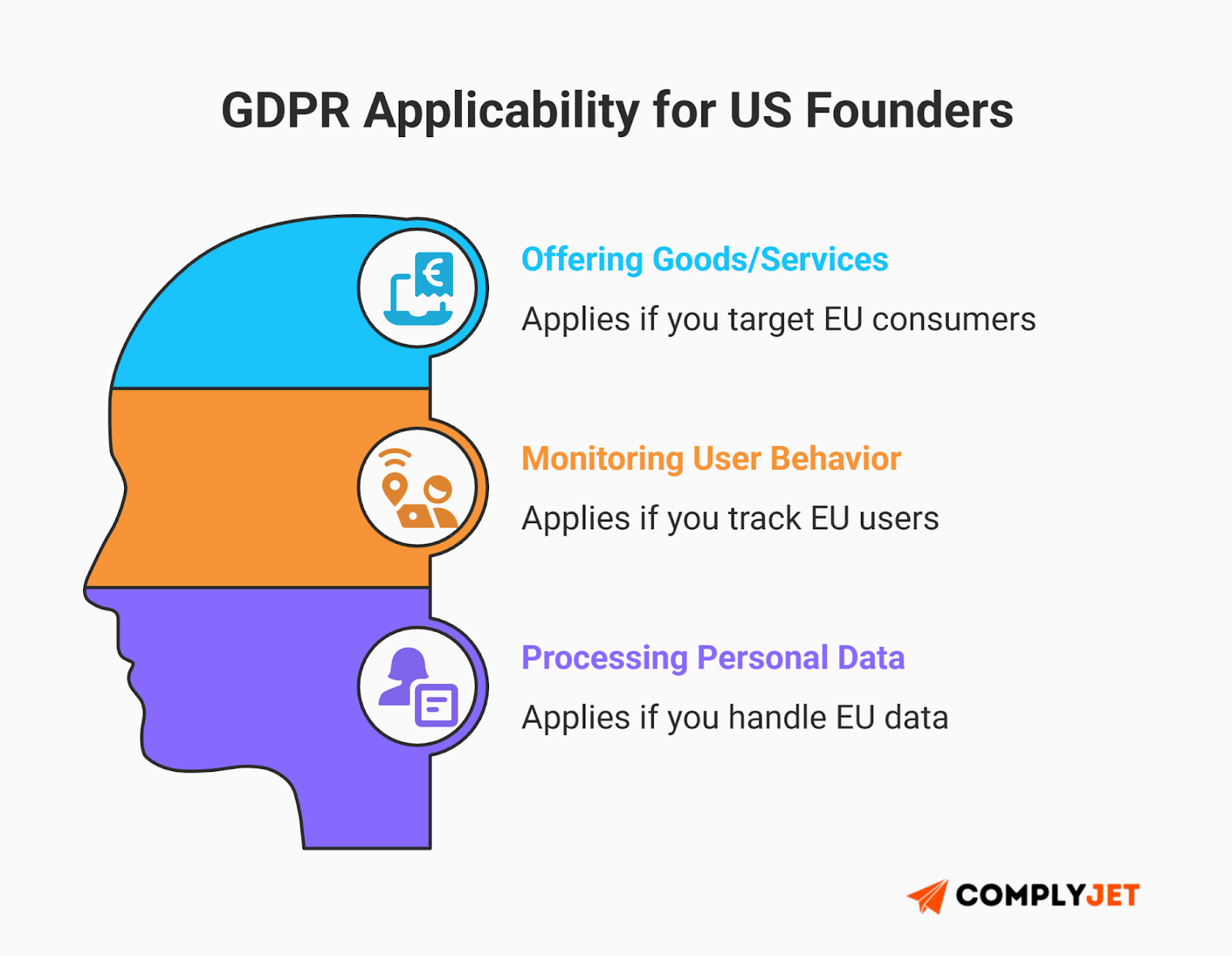
For a US-based startup, GDPR compliance is the legal requirement to protect the personal data of individuals within the European Union (EU), regardless of where your company is headquartered. Under Article 3 compliance standards, if you offer goods or services to the EU or monitor the behavior of EU residents, the law applies to you directly.
By 2026, the definition has evolved from a policy-first approach to a technical accountability model. It is no longer just about having a Privacy Policy; it is about proving the Technical Truth of your data flows.
- Extra-territorial Reach: Being US-only in your incorporation does not grant immunity if your pixels or APIs interact with EU residents.
- Technical Integrity: Under GDPR Article 32, security isn't optional. Organizations must implement state-of-the-art, risk-appropriate controls - including encryption, resilience, and regular testing - to protect individuals' rights. That means knowing where personal data resides and proving it's secured.
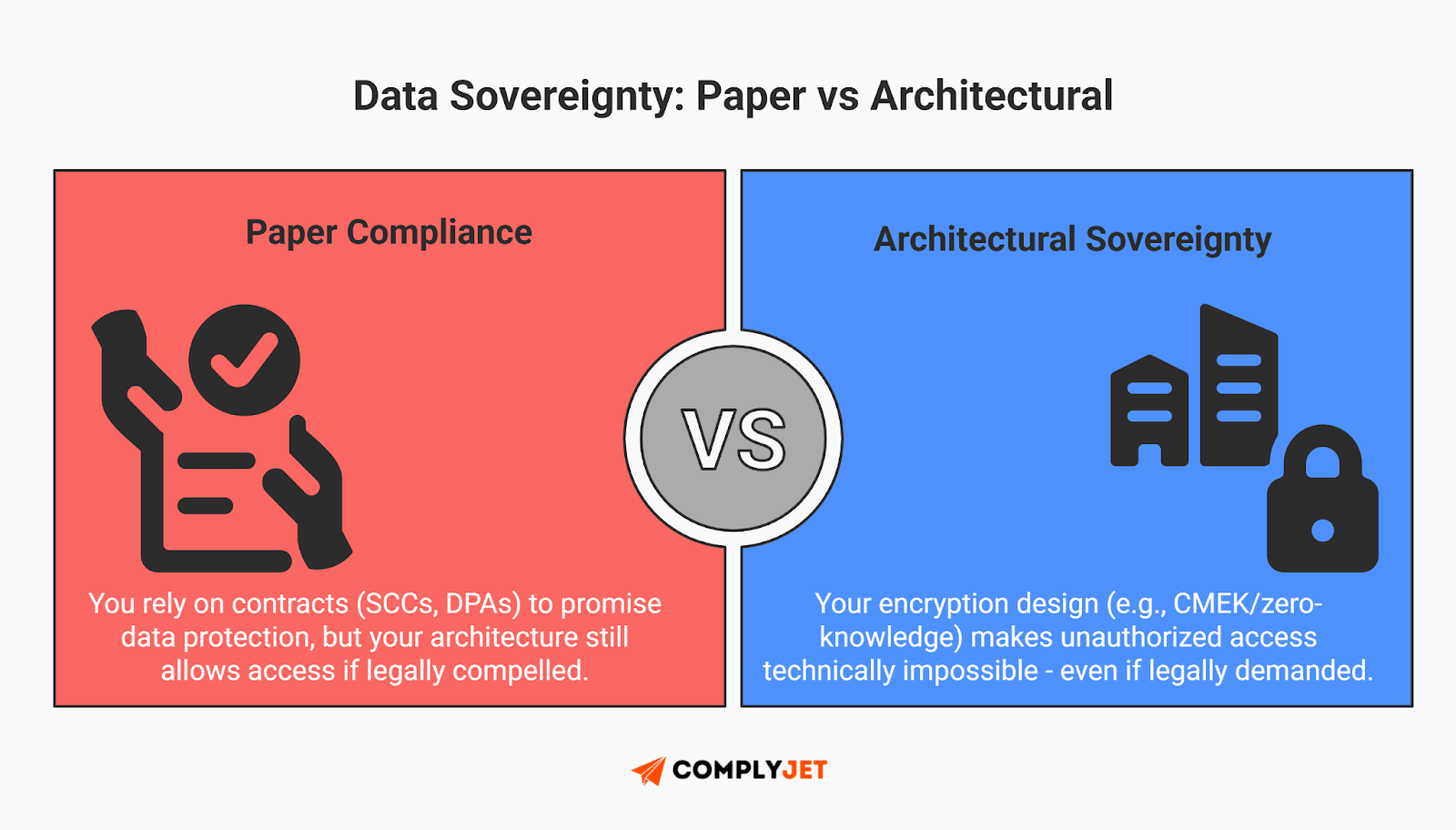
- Data Sovereignty: It involves navigating the legal double bind between the US CLOUD Act and GDPR Article 48 to ensure European data remains protected from unauthorized foreign access.
The Cost of Waiting to Scale
Many founders treat GDPR as a Series B problem. However, non-compliant firms in 2026 face an average 8% profit drop and a 26% reduction in venture capital investment in the EU relative to their compliant peers.
Why Your 2018 GDPR Playbook Is Obsolete
The old playbook relied on Privacy Theater: well-written policies that rarely touched the actual database. In 2026, that gap is where startups die. Regulators now demand technical truth, a state where your data flows exactly how your documentation says it does.
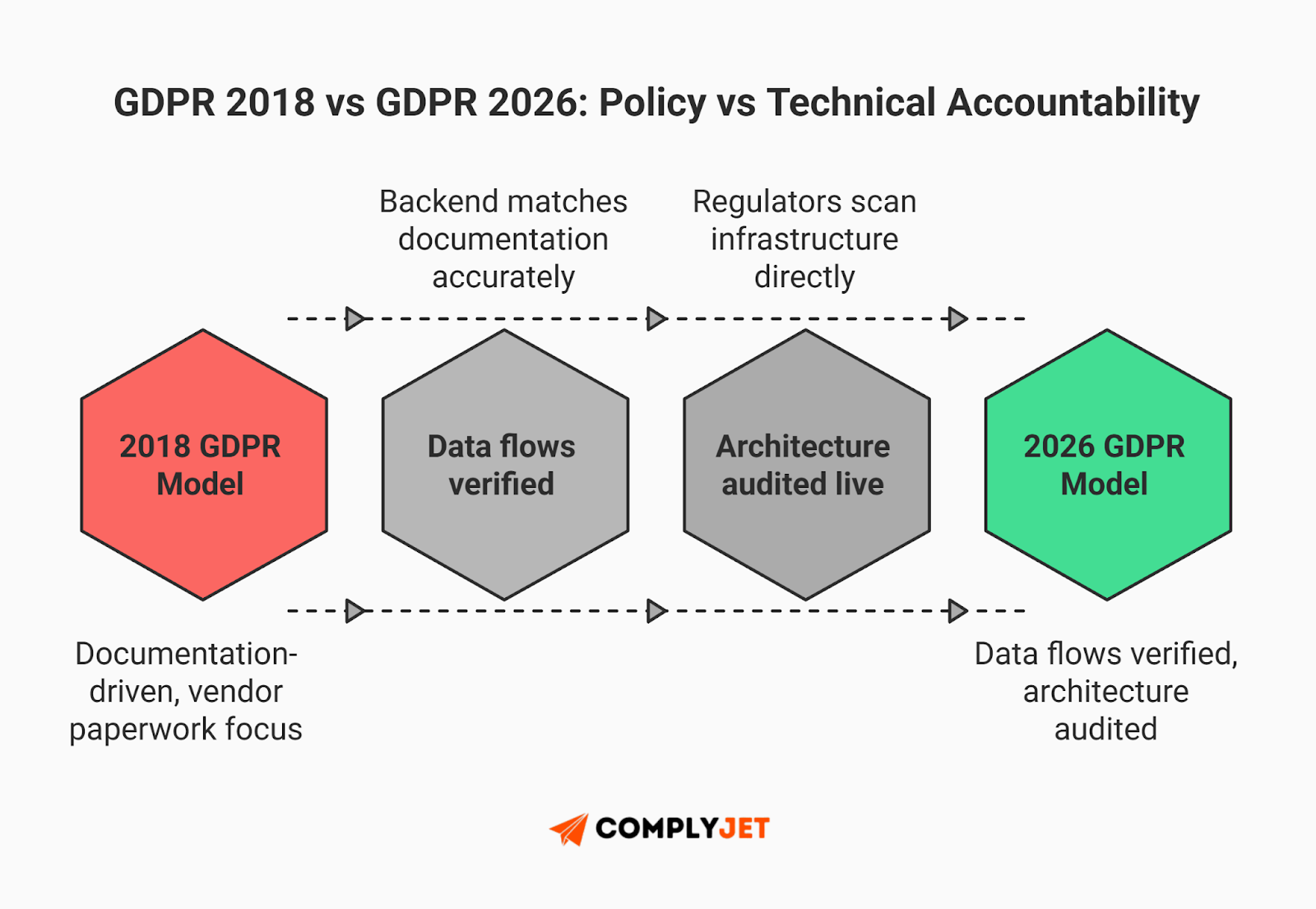
This isn't about avoiding fines anymore; it's about meeting Article 32's security standards. If you can't prove the technical integrity of your data pipeline, you have no defense during a snap audit.
The Death of Privacy Theater
Gone are the days when a cookie banner was enough. European regulators now use automated scanning tools to detect pre-consent leaks. If a tracking pixel fires before a user clicks "Accept," you've already failed the test.
This shift toward automated enforcement means GDPR compliance is now an infrastructure-first priority. You need technical truth embedded in your CI/CD pipeline, not just your legal folder.
Global Privacy Control (GPC)
In 2026, ignoring Global Privacy Control (GPC) signals is a massive red flag. GPC allows users to set a universal "Do Not Track" signal at the browser level. Between explicit US state mandates and the UK's enforcement of Article 21(5), your infrastructure is now expected to detect and honor these signals as a legally binding, automated exercise of the right to object. Founders who treat GPC as optional are the first targets for coordinated investigations.
Stat Check: 90% of high-value fines in 2026 stem from "Insufficient Legal Basis" - essentially processing data without the technical truth of valid consent.
Engineering Article 32
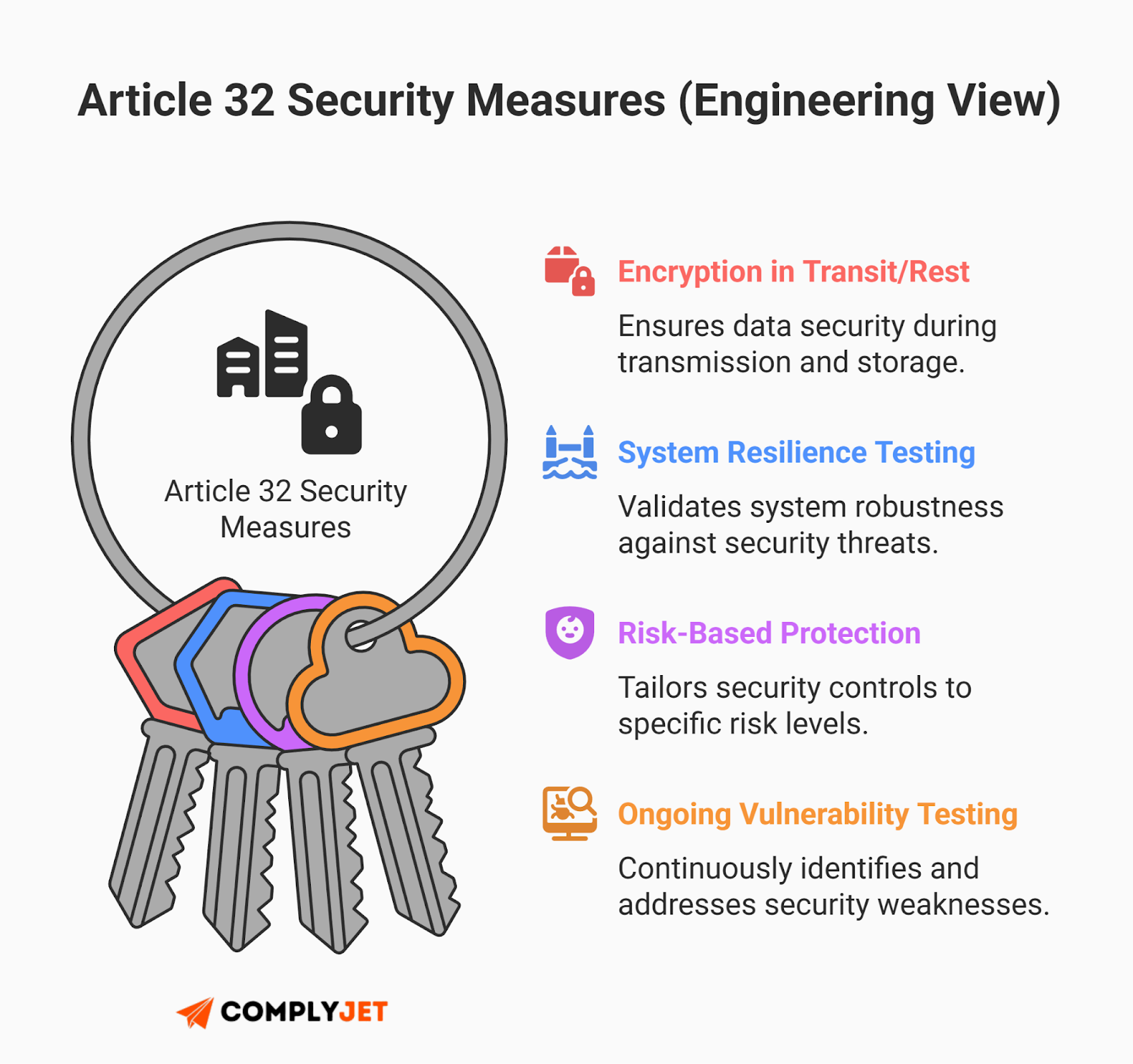
Modern GDPR compliance requires robust Article 32 security measures that go beyond simple encryption at rest. You need "Privacy by Design" that includes automated data discovery and classification. When your technical truth is verifiable, your due diligence becomes a 10-minute walk-through rather than a three-month audit nightmare.
The Remote Website Audit
In 2026, regulators don't always start with an email; they start with a scan. Before a human auditor ever looks at your documentation, they perform what is known as a Remote Website Audit.
They don't start by asking for your DPO's email. They start by running a headless browser through your onboarding flow to find unauthorized pings to third-party APIs. If the automated scan flags a discrepancy, they will tear apart your Article 32 security measures.
For a US founder, the goal is to ensure your production environment is the source of truth, not a PDF hidden in Google Drive.
Stat Check: According to IBM's 2025 Report, the average cost of a data breach for U.S. firms has hit $10.22 million, the highest on record.
The Cross-Border Legal Trap: US Law vs. EU Privacy
For a US-based SaaS founder, the biggest hidden risk to GDPR compliance isn't a hacker - it's a subpoena. The US CLOUD Act allows federal law enforcement to compel US providers to hand over data, even if that data is sitting in a server in Frankfurt. However, GDPR compliance standards under Article 48 state that such requests are only valid if they come through an international treaty like a Mutual Legal Assistance Treaty (MLAT).
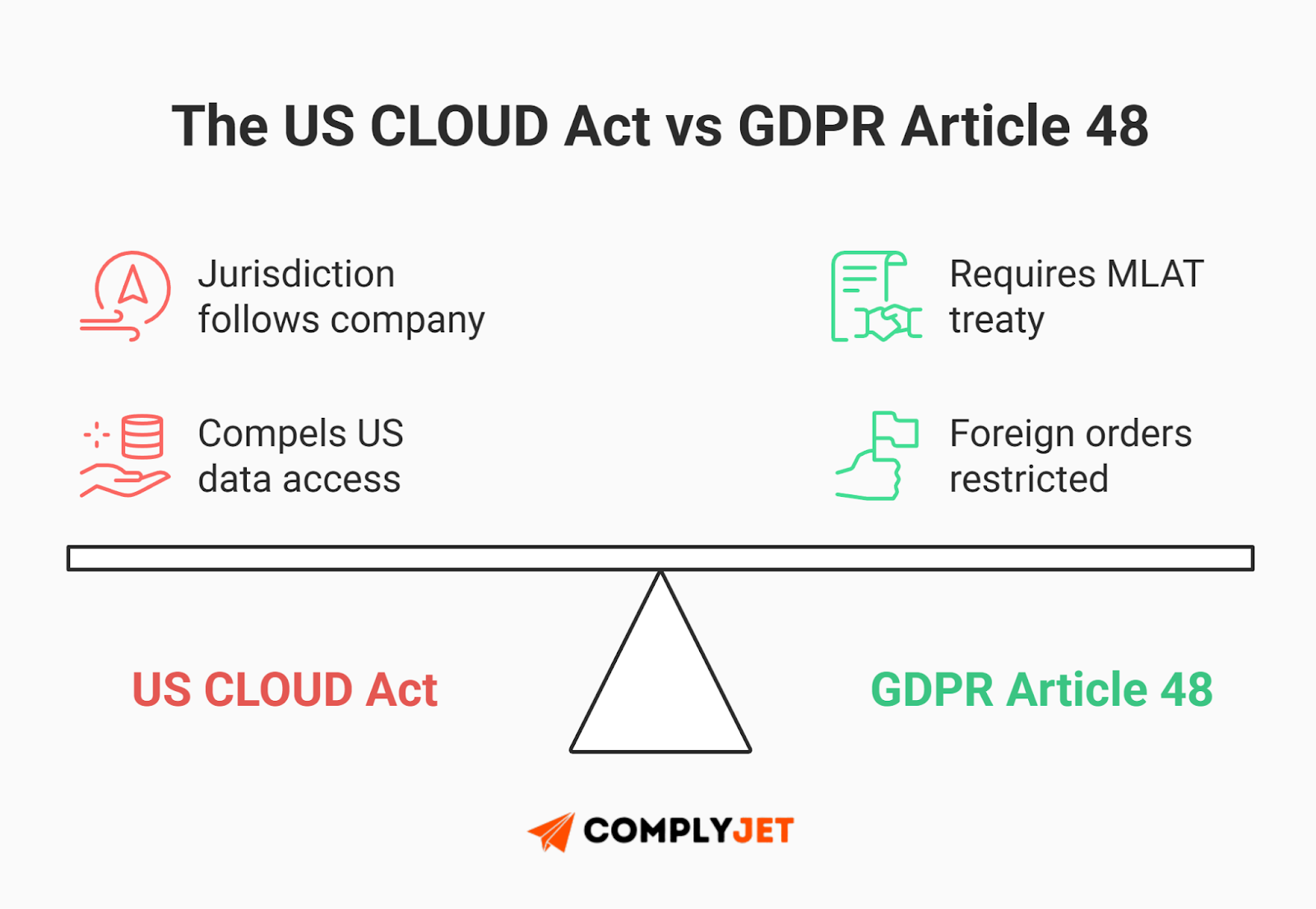
This creates a legal double bind. If you comply with the US warrant, you risk a breach of GDPR. If you refuse, you face US contempt of court. In 2026, regulators are increasingly looking past paper compliance to see how you handle this jurisdictional dislocation.
The CLOUD Act Conflict
The physical location of your servers is no longer a silver bullet. If your HQ is in the US, or if you have a "real and substantial connection" to US jurisdiction, you are within reach.
- Jurisdiction follows ownership: Simply using a European AWS or Google Cloud instance does not grant immunity.
- The 2026 Reality: Under Article 48 of the GDPR, a CLOUD Act request is not a valid legal basis for data transfer. This rule was explicitly codified in the EDPB Guidelines 2/2024 (Version 2.0). Directly honoring these requests is now a documented violation of EU law.
- Marketing vs. Reality: Even if a cloud provider calls their service a "European Sovereign Cloud," the ownership still matters. If the company is US-owned (like AWS, Google, or Microsoft), they are still legally forced to comply with US government data requests, regardless of where the servers are physically located.
Stat Check: European data protection authorities issued over €3 billion in GDPR fines in the first half of 2025, with many penalties tied to unlawful international transfers (e.g., Meta’s fine for data transfers to the U.S.).
The MLAT Bypass
Under GDPR compliance rules, Article 48 acts as a shield against foreign government overreach. It requires that any judgment from a third-country authority only be recognized if grounded in an international agreement.
- The Conflict: The CLOUD Act was designed specifically to bypass the "slow" MLAT process.
- Risk to Founders: Relying on standard SCCs (Standard Contractual Clauses) is not enough if you have no protocol for challenging these requests.
Architectural Mitigation via CMEK
The only way to achieve true Data Sovereignty in a globalized stack is through Customer-Managed Encryption Keys (CMEK).
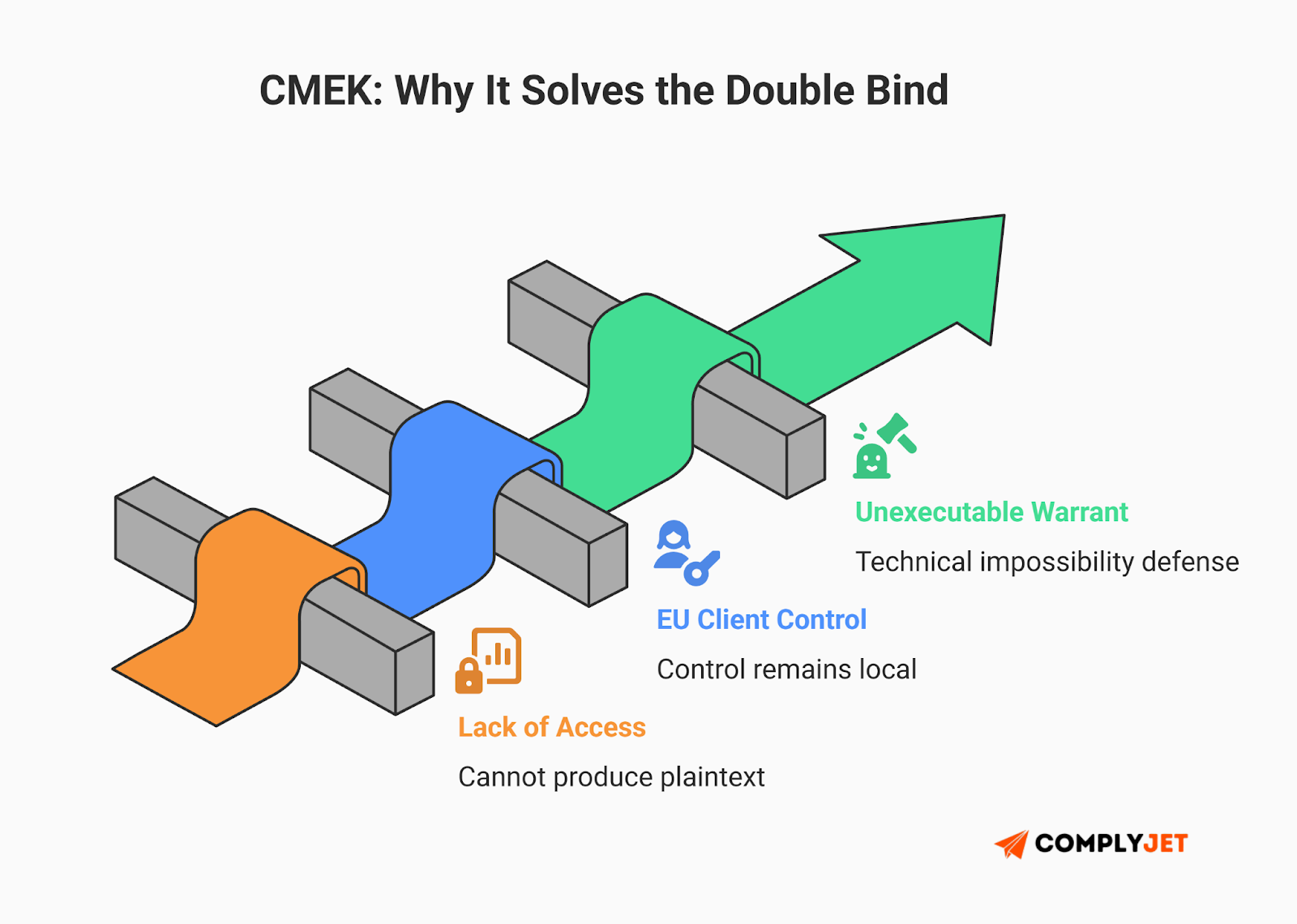
- Technical Un-Executability: By ensuring that only the European customer holds the encryption keys, you create a state where you literally cannot comply with a US warrant because you cannot decrypt the data.
- Zero-Knowledge Architecture: This moves the compliance burden from your legal team to your architecture.
- Founder Strategy: Implementing CMEK is the Gold Standard for 2026. It turns a legal double bind into a technical impossibility, protecting your GDPR compliance status regardless of which government comes knocking.
Stat Check: 72% of European businesses prioritize data control when choosing cloud/SaaS vendors due to jurisdiction and sovereignty concerns.
Using GDPR as a Blueprint for US State Laws
Managing separate privacy silos for different regions is a recipe for operational failure. GDPR compliance in US operations is your strategic baseline. By 2026, the fragmented US state law landscape has made a Unified Privacy Framework the only way to scale without drowning in manual requests.
The 80/20 Rule: GDPR as the Gold Standard
GDPR is the technical blueprint for every major US privacy law. Meeting the world's strictest standard effectively covers ~80% of your requirements for CCPA/CPRA, Maryland/California data laws, and others.
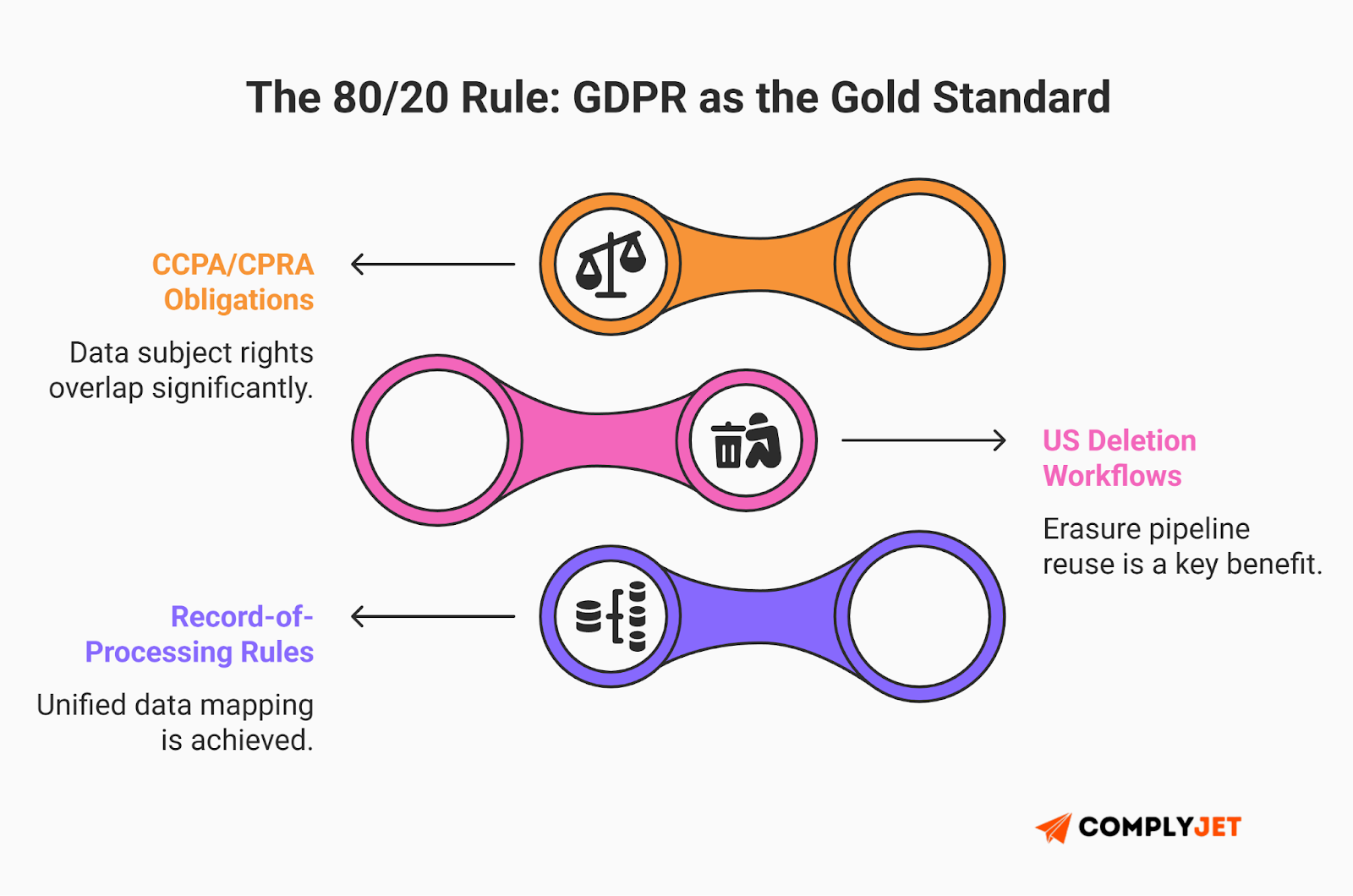
- Infrastructure Reuse: Data mapping and classification required for Europe satisfy the bulk of US Record of Processing rules.
- Risk Mitigation: Solving for GDPR requirements for US founders 2026 now prevents Privacy Debt from stalling your next funding round.
- Market Trust: Enterprise US buyers increasingly demand GDPR-level rigor as a proxy for security maturity.
The California Delete Act (DROP)
The California Delete Act (DROP), which went live on January 1, 2026, allows consumers to request global data deletion across all brokers with a single click. This has triggered a massive surge in deletion requests for US-based startups.
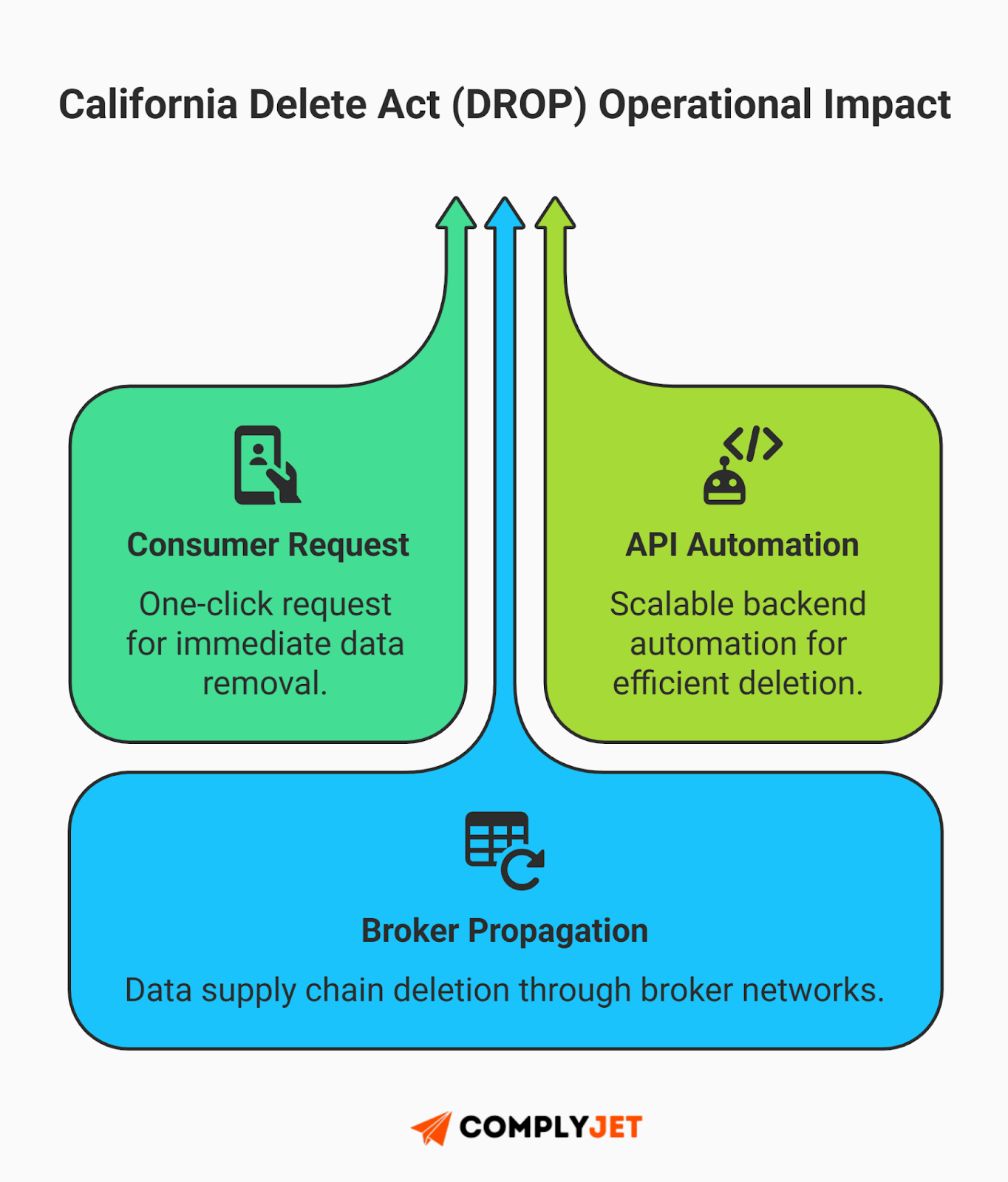
- Leverage GDPR Infra: Your existing Article 17 (Right to Erasure) pipelines are your secret weapon.
- API-First Deletion: Use the same automated deletion logic built for your EU customers to handle the DROP influx.
- Efficiency: Handling GDPR requirements for US founders 2026 ensures you have the scalable backend needed to process thousands of US requests without hiring a dedicated privacy team.
Establishing a high standard for GDPR compliance in US workflows ensures your startup is "compliant by design" for whatever state law drops next.
Founder Tip: Don't build separate Privacy Settings pages. Build one GDPR-compliant portal and toggle off specific restrictions for non-regulated regions. It keeps your codebase clean and your auditors happy.
AI Governance: Staying Compliant Under the New EU AI Act
On August 2, 2026, the EU AI Act will be fully applicable, and it will not live in a vacuum. It will sit directly on top of your existing GDPR compliance framework. For US founders, this means your AI models wouldn't just process data-they would now be regulated legal entities.
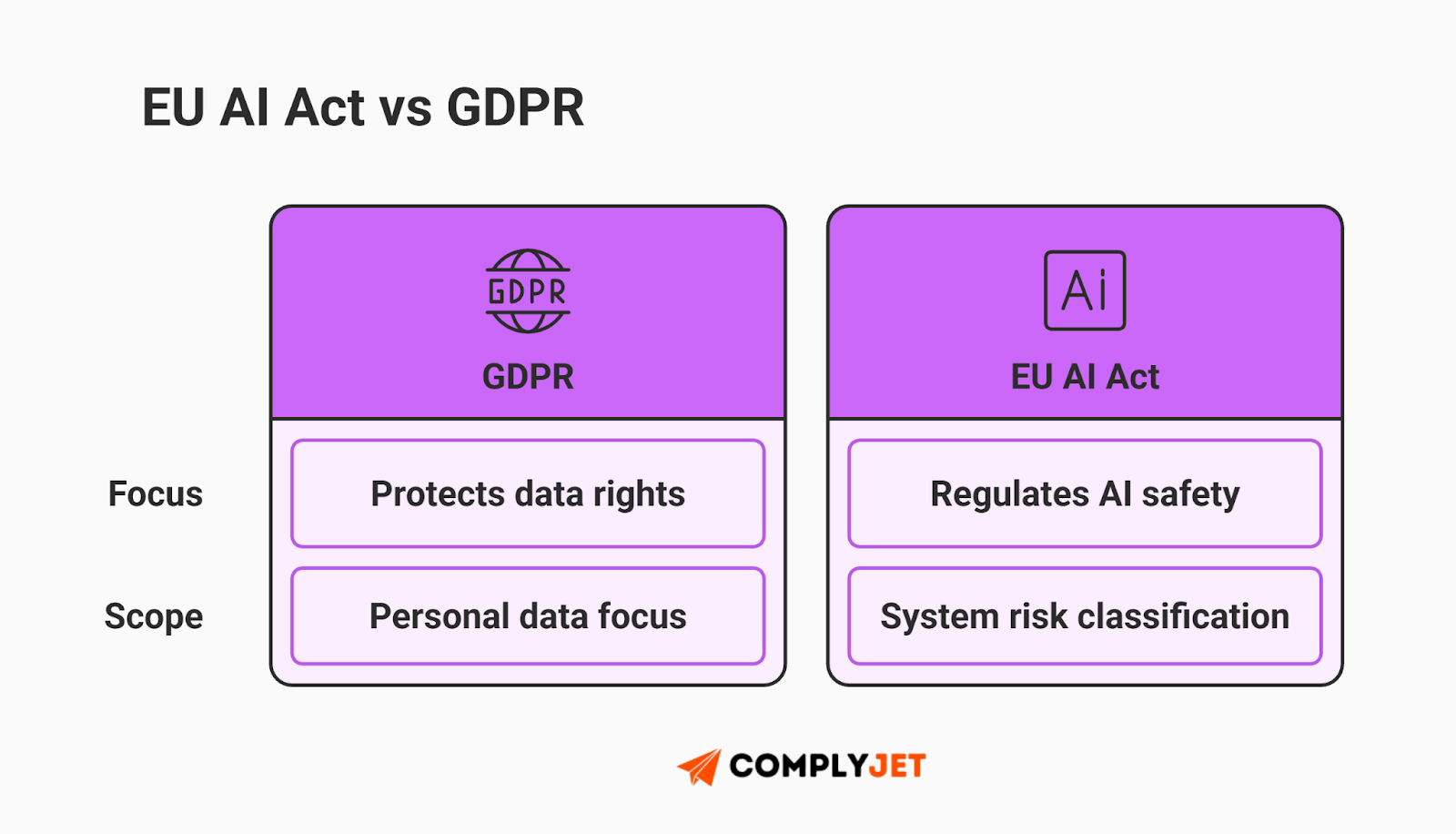
If you are building AI-driven SaaS, the debate of EU AI Act vs GDPR is over; they are now a unified compliance hurdle.
Enforcement synergy: In 2026, a single breach could trigger stacked liability: concurrent penalties under both GDPR and the EU AI Act that can significantly harm your margins.
High-Risk AI & Governance
If your startup uses AI for recruitment, credit scoring, or employee performance tracking, you are likely operating a High-Risk system. Under the new synergy, a standard Data Protection Impact Assessment (DPIA) isn't enough. You now need a High-risk AI DPIA workflow that incorporates a Fundamental Rights Impact Assessment (FRIA).
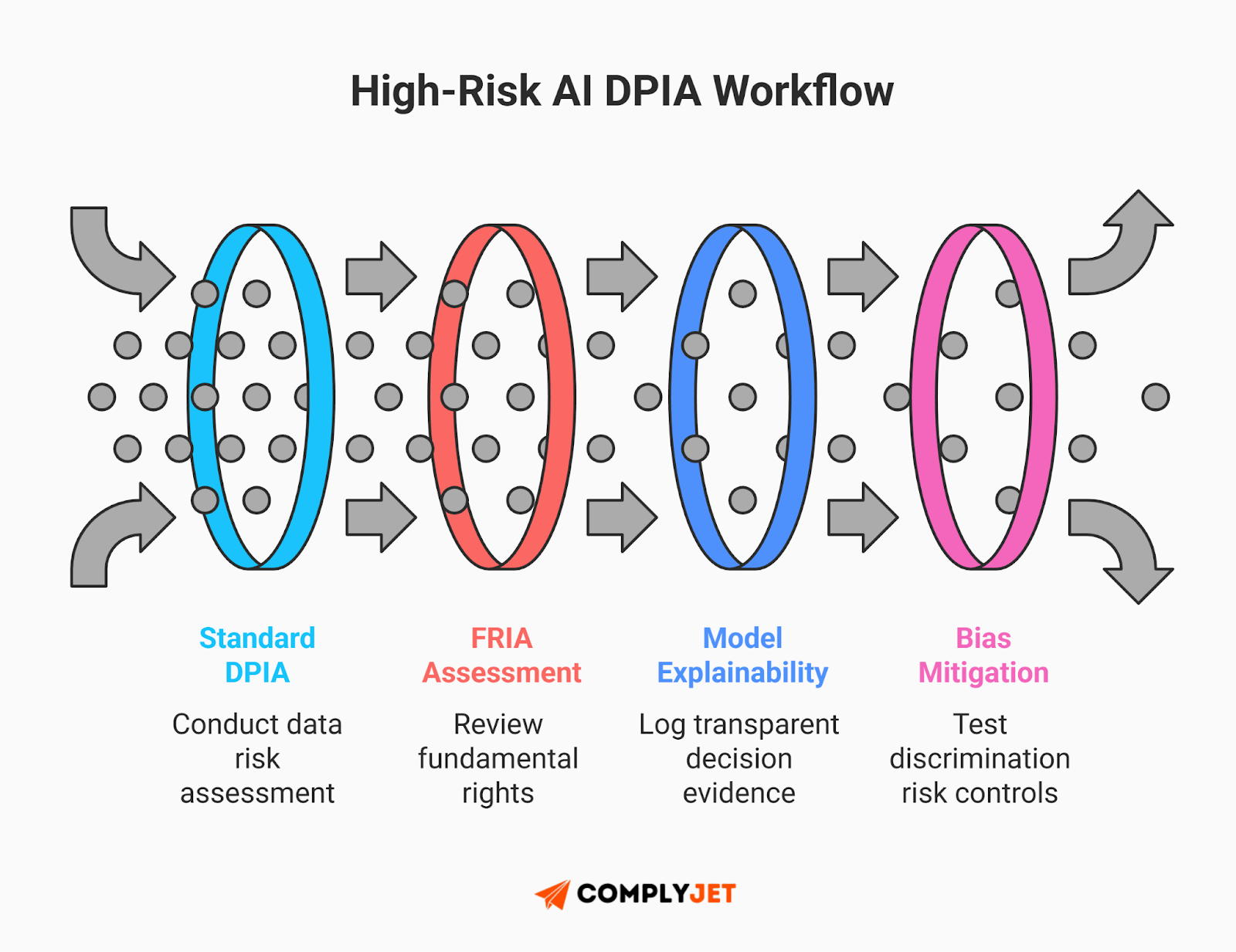
- Dual-Assessment: You must evaluate how your model impacts both data privacy and human rights (bias, discrimination).
- Documentation: Your High-Risk AI DPIA workflow must include technical logs that prove your model's explainability to regulators.
- The ComplyJet Strategy: Treat your AI governance as an extension of your GDPR compliance program. A failed FRIA is now treated with the same severity as a major data breach.
The Agentic AI Challenge
2026 is the year of Agentic AI-autonomous software agents that make decisions without human intervention. This triggers Article 22 of the GDPR, which restricts "solely automated decision-making."
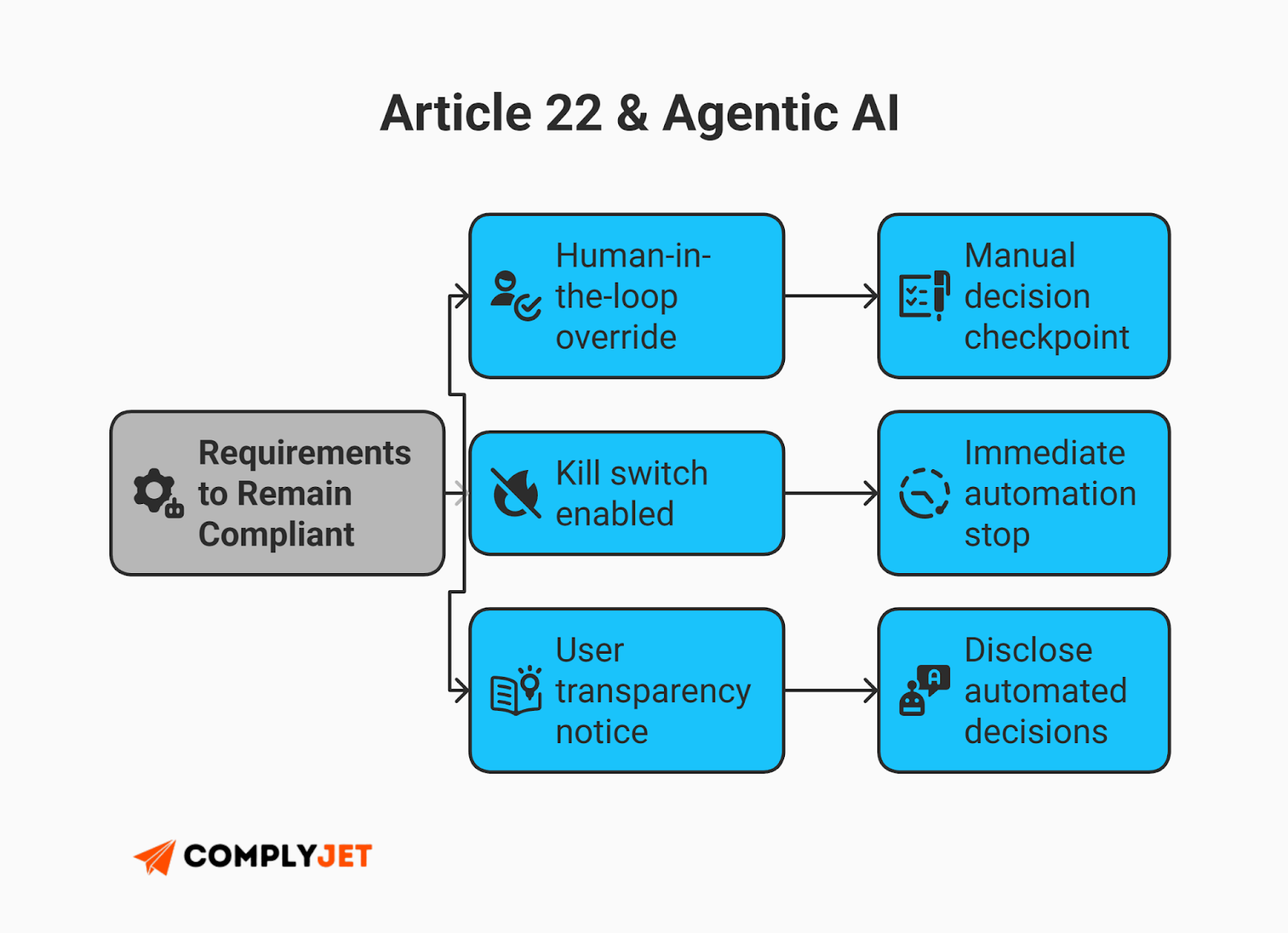
- Human-in-the-Loop: To maintain GDPR compliance, your Agentic AI must have a "kill switch" or a human override for decisions that significantly affect users.
- Transparency: You must inform users when they are interacting with Agentic AI. Hiding your bots is a fast track to a regulatory audit.
- EU AI Act vs GDPR Interface: While GDPR protects the user's data rights, the AI Act regulates the safety of the agent itself. You must satisfy both to remain in the European market.
The Cloud-Switching Mandate
The 2026 Digital Omnibus and the EU Data Act have introduced a massive operational shift: the end of vendor lock-in. For a US founder, this is a portability requirement on steroids.
- 30-Day Exit: You are now mandated to allow customers to switch cloud or AI providers within 30 days without exit fees.
- Data Interoperability: Your GDPR compliance infrastructure must support open-standard data exports. You can no longer hold customer data hostage in proprietary formats.
- EU AI Act vs GDPR Synergy: The EU Data Act ensures that the technical truth of your data is portable, while the AI Act ensures that the models processing that data are transparent.
AI Risk in 2026: 62% of organizations are planning a shift to Agentic AI, compelling US SaaS founders to re-engineer their logic to meet the High-Risk DPIA standards required by the EU AI Act.
Automating Your Technical Truth with GDPR Compliance Solutions
In 2026, manual audits are a liability. True GDPR compliance requires moving privacy upstream into your development lifecycle. We are seeing a massive shift toward compliance-as-code trends 2026, where privacy controls are integrated directly into your CI/CD pipeline.
This approach lowers ongoing GDPR compliance cost by making compliance systemic rather than reactive.
Automated Discovery = Real-Time Visibility
Static spreadsheets are dead. If you don't have a live view of your data, you don't have GDPR compliance.
- AI-Driven Crawlers: Tools like BigID and MineOS now provide automated data mapping 2026 by continuously indexing your environment.
- Shadow Data Detection: Automated tools find forgotten S3 buckets or rogue databases that manual audits miss.
- Infrastructure as Code (IaC): Use Terraform or CloudFormation templates that have privacy guardrails pre-baked. This is the core of compliance-as-code trends in 2026, preventing non-compliant resources from ever being deployed to production.
The PETs Revolution: Privacy-Enhancing Technologies
For AI-first startups, traditional anonymization is often insufficient. Privacy-Enhancing Technologies (PETs) allow you to extract value from data without the associated risk.
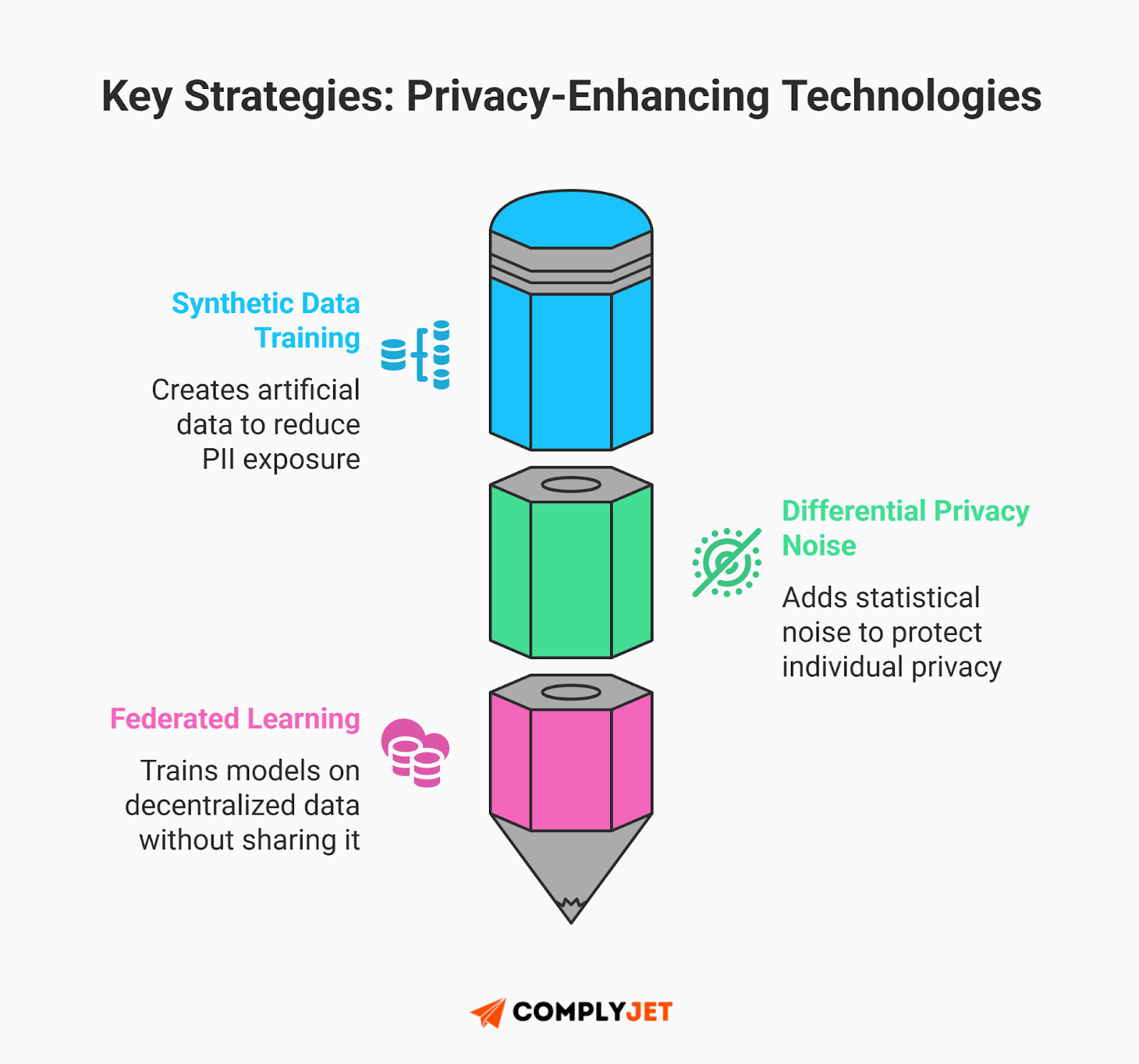
- Synthetic Data: By creating statistically accurate "fake" datasets, you can train models without using real PII. By 2026, 75% of firms will have shifted to synthetic data for initial AI training to simplify their GDPR compliance posture.
- Differential Privacy: This adds mathematical noise to datasets, allowing you to share global insights (like user trends) while ensuring individual records cannot be reverse-engineered.
- Federated Learning: Keep data on the user's device and only send model updates to your servers. This minimizes data transfer-a primary goal of automated data mapping 2026 strategies.
Founder Tip: Treat Privacy Debt like Technical Debt. If you build without PETs now, the cost of re-engineering your data pipeline during a Series B audit could be 10x higher.
The ROI of GDPR Compliance: Solutions, Costs, and Valuation
Before allocating a budget to GDPR compliance solutions, you must understand where GDPR sits in the broader 2026 security landscape. While SOC 2 and ISO 27001 are powerful tools for closing enterprise deals, GDPR is a non-negotiable legal mandate with significantly higher stakes for your balance sheet.
For US-based founders, the GDPR impact on VC valuation is quantifiable.
The Venture Capital Gap and Privacy Debt
The Venture Capital Gap is a valuation divide. Startups with provable data lineage command trust. Those with regulatory risk take a hit. Eliminating privacy debt in SaaS early flips the narrative. By Series B or exit, your data stack becomes an advantage - not a weakness.
- The Investment Gap: GDPR-related risks have historically reduced VC investment in non-optimized tech by up to 26% relative to firms with automated compliance in specific markets.
- Exit Friction: Non-compliant firms face an average 8% profit drop, and M&A deals are delayed by 14% on average due to privacy due diligence hurdles.
- Trust as a Multiple: In the 2026 market, US founders with a clean GDPR compliance posture command higher multiples because they offer a turnkey solution for global enterprise buyers.
Selecting Solutions & Scaling Costs Proportionally
To protect your equity, you need GDPR compliance solutions that integrate with your engineering lifecycle.
- Compliance Automation (SaaS): These are the go-to GDPR compliance solutions for early-stage founders. Tools like Vanta, Sprinto or ComplyJet offer real-time monitoring and technical truth mapping. They are designed for speed, helping you map frameworks like SOC 2 and GDPR simultaneously.
- Managed Services (DPO-as-a-Service): If your startup handles sensitive data or runs Agentic AI, you need human oversight. GDPR compliance services give you an outsourced Data Protection Officer. They handle regulatory inquiries and manage Article 27 representation.
- The Hybrid Strategy: Most successful US startups minimize their GDPR compliance cost by using SaaS for daily mapping and retaining professional GDPR compliance services for strategic audits and high-risk AI assessments.
Compliance can eat into 25% of revenue on average - sometimes more than half. Don't let manual processes drain your runway or lock you into big-firm retainers. Automate early. See ComplyJet's transparent and founder friendly pricing to scale without the bloat.
2026 Pricing Table: The Cost of GDPR Compliance
Disclaimer: The numbers cited above are aggregated across industry data reports and market surveys. They are meant to be indicative, not definite.
Transparent compliance pricing has become the market standard in 2026. Your GDPR compliance cost should be viewed as an investment in global market access.
Choosing high-quality GDPR compliance solutions, like ComplyJet, early prevents the compounded costs of retroactive data refactoring and effectively eliminates the negative GDPR impact on VC valuation risks. By managing your GDPR compliance maturely, you ensure your startup is built for a clean, high-value exit.
The 2026 Minimum Viable GDPR Compliance Checklist
If you are searching for a GDPR compliance checklist in 2026, ignore the 100-point generic spreadsheets. For a US founder, the goal is neutralizing "fine-magnets" and passing investor due diligence. This is the absolute minimum posture required to prove your startup isn't a liability.
- Appoint an Article 27 Representative: If you have no physical EU office but offer services to EU residents, this is non-negotiable. Regulators now use automated tools to scrape websites specifically looking for missing representative details in footers.
- Audit Your Network Logs: Don't trust your documentation; trust your traffic. Run a headless browser audit to ensure no third-party pixels (Meta, Google, LinkedIn) fire before a user clicks "Accept."
- Catalog Your AI Risk Inventory: List every LLM and autonomous agent in your stack. Categorize them by risk level to determine if you need to trigger a dual DPIA/FRIA assessment under the new AI Act synergy.
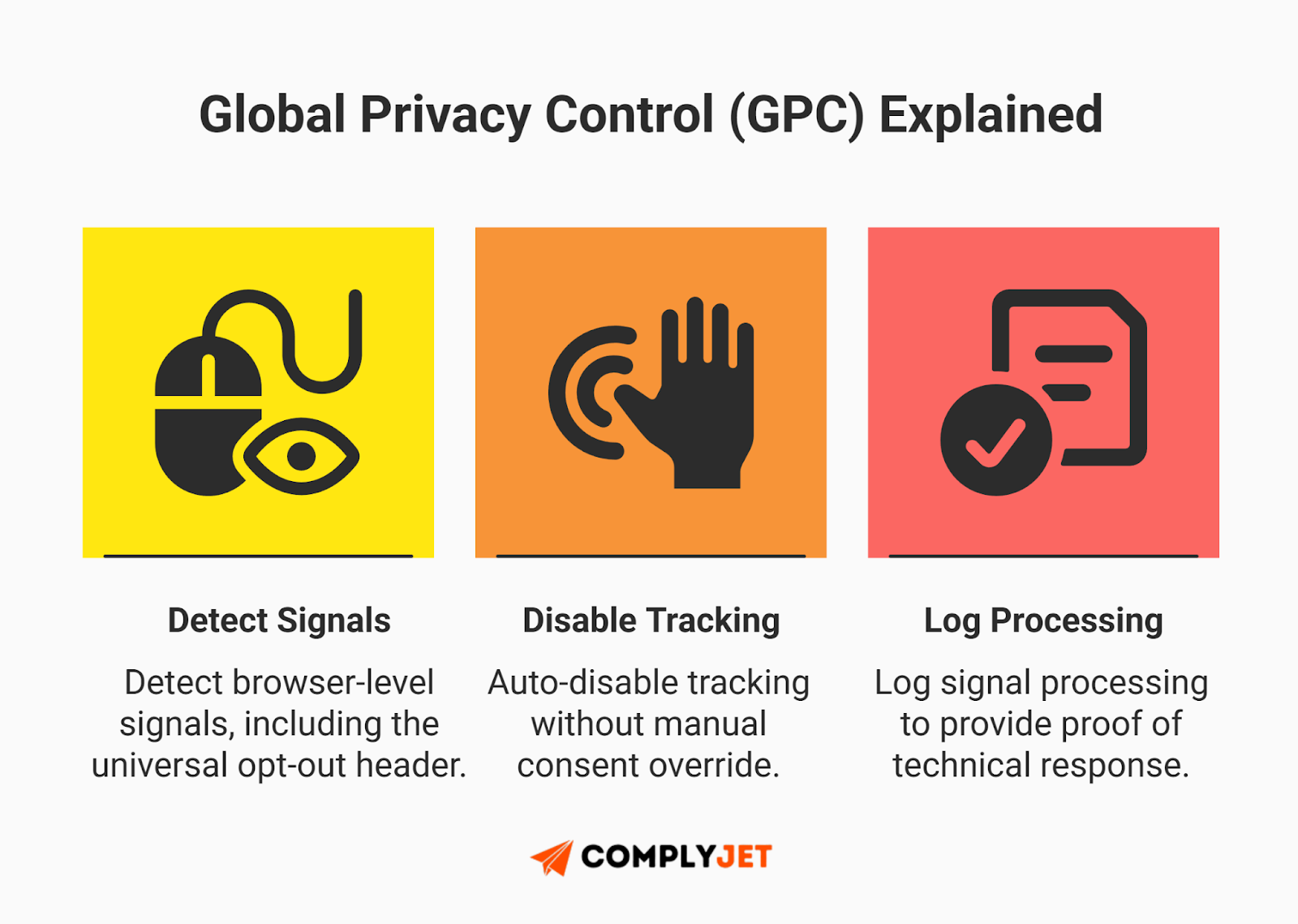
- Enable GPC Signal Detection: Configure your consent manager to honor Global Privacy Control headers automatically. In 2026, ignoring this universal browser-level signal is considered a willful violation of privacy-by-design.
- Verify Technical Un-Executability: If you handle sensitive European data, ensure your encryption architecture (like CMEK) prevents you from being compelled to hand over decrypted data under the US CLOUD Act.
Following this lean GDPR compliance checklist ensures you have addressed the high-velocity enforcement trends of 2026 without drowning your engineering team in administrative theatre.
FAQs: Founders' Most Asked Questions
How does the US CLOUD Act impact my GDPR compliance?
It creates a legal double bind. US warrants can compel data access regardless of server location, often forcing a breach of Article 48. To mitigate this, implement Customer-Managed Encryption Keys (CMEK) to achieve technical un-executability, ensuring you cannot physically comply with a decryption request.
Is an Article 27 Representative mandatory for my US startup?
Yes. If you offer goods or services to EU residents without a physical EU presence, you are required to appoint a representative. Regulators now use automated scrapers to issue quick-win fines for missing representative details in website footers-treat this as a high-priority tactical win.
What is technical truth in a 2026 audit?
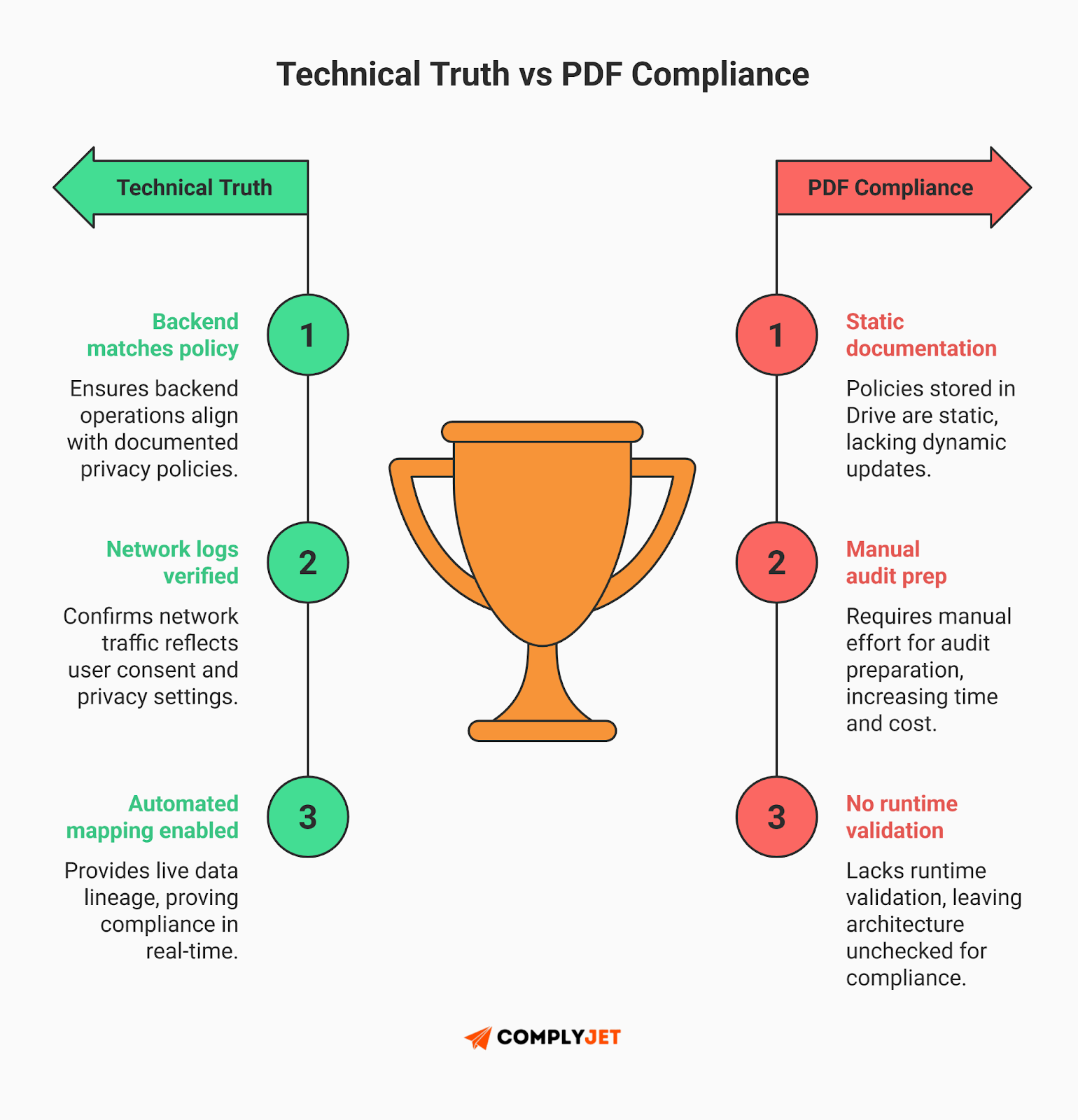
The end of Privacy Theater. Auditors now use network-level scans to verify that your backend behavior matches your policy. Achieving GDPR compliance in 2026 requires verifiable architectural evidence (like network logs and automated mapping), not just signed PDFs.
How does the EU AI Act change my DPIA requirements?
If your AI is High-Risk - such as recruitment or credit scoring - you must add a Fundamental Rights Impact Assessment (FRIA) to your standard DPIA. Explainability and bias mitigation are not optional. They are core pillars of GDPR compliance.
Can I use Synthetic Data to bypass GDPR for AI training?
Mostly. Synthetic data mimics statistical properties without exposing real PII, significantly reducing your regulatory footprint. However, the initial generation from real data still requires a valid legal basis. It is the gold standard for reducing Privacy Debt.
Does the Digital Omnibus simplify vendor switching?
Yes. The 2026 Digital Omnibus and Data Act mandate cloud-switching within 30 days and ban exit fees. While this simplifies portability and ends vendor lock-in, it does not lower the security bar for core GDPR compliance standards.
How much does Privacy Debt actually hit my valuation?
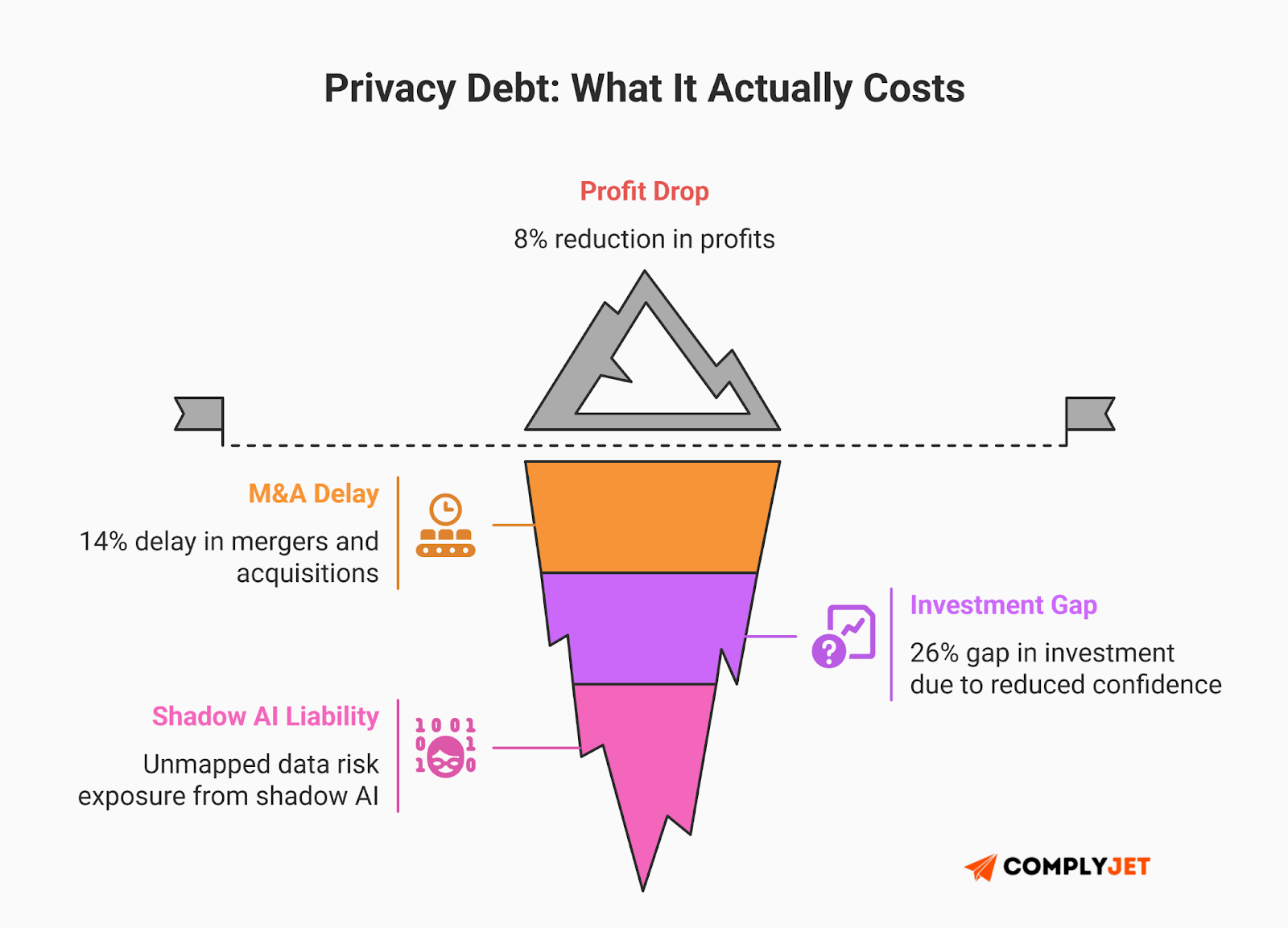
Non-compliant firms see an average 8% profit drop and 14% M&A delays. VCs now treat unmapped data and "shadow AI" as major liabilities, often leading to a 26% reduction in investment relative to compliant peers.
What is Global Privacy Control (GPC) and must I honor it?
GPC is a universal "Opt-Out" signal sent from a user's browser. In 2026, it is a mandatory requirement in the UK and several US states. Regulators treat GPC as a legally binding exercise of the right to object under Article 21(5).
The Final Takeaway
The shift from policy to technical accountability is the defining trend of 2026. For a US founder, GDPR compliance is no longer a cost center; it is a competitive moat.
By moving privacy upstream into your engineering lifecycle-utilizing PETs, automated mapping, and technical truth audits - you don't just avoid fines. You build a high-valuation, global-ready asset that enterprise buyers and VCs can trust.
With GDPR fines surpassing €1.2 billion in 2025 and penalties reaching up to 4% of global revenue, compliance has shifted from a 'legal checkbox' to a critical financial safeguard. Don't wait for a regulatory wake-up call - automate your GDPR controls and avoid costly sanctions. Book a demo with our founder today and say goodbye to your compliance woes!
.png)