.svg)

Your SOC 2 report just landed, and the celebration lasted about a week. Now a healthcare prospect wants to know about HIPAA, an enterprise buyer's security team is asking about ISO 27001, or a government contract mentions CMMC, and nobody on your team is sure which of those to chase first.
What to do after SOC 2 comes down to one question: who's actually asking. Healthcare buyers push you toward HIPAA and HITRUST. Regulated enterprise and global buyers push you toward ISO 27001, PCI DSS, GDPR, or CCPA. Government and defense buyers push you toward CMMC. Most of the control environment you already built for SOC 2 carries forward into whichever one applies, so this isn't a start-from-zero decision.
By the end of this, you'll know which framework maps to your actual buyer demand, which SOC 2 controls and evidence genuinely reuse, and which of these frameworks a given compliance platform can support end to end versus where it can't.
Here's what's ahead:
- Why "what to do after SOC 2" is a buyer-demand question, not a maturity checklist
- What SOC 2 evidence actually carries into ISO 27001, HIPAA, and CMMC
- A framework roadmap organized by who's asking: healthcare, enterprise, or government
- How to decide which framework to prioritize when more than one buyer is asking at once
- Common mistakes companies make expanding past SOC 2
What to Do After SOC 2 -- And What This Isn't About
What to do after SOC 2 is a buyer-driven question: the right next framework is whichever one the customers you're actually trying to close require, not a generic maturity ladder every company climbs in the same order.
That's a different question from "should we get SOC 2 at all," and a different question from "should we get SOC 2 or ISO 27001." It's about what comes after.
Quick answer
There's no universal second framework. Healthcare buyers require HIPAA or HITRUST. Regulated enterprise and global buyers require ISO 27001, PCI DSS, GDPR, or CCPA. Government and defense buyers require CMMC. Pick based on which of those buyers you're actually selling to, not on a generic sense of "maturity."
What to Do After SOC 2 Isn't the SOC 2 vs. ISO 27001 Question
If you're still deciding whether to pursue SOC 2 or ISO 27001 from scratch, or whether you need both running in parallel, that's a different, earlier decision than the one this article covers. ComplyJet's SOC 2 vs. ISO 27001 guide walks through that pick-one-or-both call directly, including when geography and customer base push you toward running them side by side. Everything below assumes SOC 2 is already in hand and you're deciding what comes next.
Why Startups Expand Compliance Program After SOC 2
Companies rarely expand their compliance program after SOC 2 because a maturity model told them to. They expand because a specific deal is stuck.
A healthcare prospect's security questionnaire asks for a HIPAA attestation you don't have. An enterprise buyer in the EU says SOC 2 doesn't satisfy their procurement team, and asks for ISO 27001 instead. A defense subcontract requires CMMC certification before you can even bid.
SOC 2 proved you have a real control environment. The next framework question is simply which market that environment needs to prove itself to next.
Watch out
Waiting until the deal is already stalled to start the next framework is the most expensive way to do this. Certification and attestation timelines run weeks to months, not days, and an enterprise or government buyer usually won't hold a deal open indefinitely while you catch up.
Ignoring the signal has a real cost too: a deal that stays stuck, a renewal that doesn't expand, or a whole market segment (healthcare, EU enterprise, defense) that stays closed off regardless of how good the product is.
How to Reuse SOC 2 Evidence for Another Framework
This is the part most guides on this topic gesture at without ever showing it. Reusing SOC 2 evidence for another framework is real, but it's partial, not total, and it looks different for each target framework.
| SOC 2 control area | Where it reuses | What's still net-new |
|---|---|---|
| Access control and provisioning/deprovisioning | Maps closely to ISO 27001 Annex A access control clauses and to CMMC's access control practice domain | ISO 27001 needs a formal Statement of Applicability; CMMC needs NIST SP 800-171-aligned documentation on top |
| Change management | Reuses into ISO 27001's operations security controls almost directly | Little net-new for most companies already doing this well for SOC 2 |
| Risk assessment process | Partially covers HIPAA's required risk analysis and ISO 27001's risk treatment process | HIPAA needs a HIPAA-specific risk analysis under the Security Rule, not a generic reuse of the SOC 2 version |
| Incident response plan | Reuses into HIPAA's breach notification requirements and CMMC's incident response domain | HIPAA adds specific breach notification timelines and PHI-specific handling; CMMC adds reporting obligations tied to the contract |
| Vendor and subprocessor management | Reuses into ISO 27001's supplier relationship controls and GDPR/CCPA data processing agreements | HIPAA specifically requires a signed Business Associate Agreement, which SOC 2 has no equivalent of |
Most teams comparing what to do after SOC 2 ask which framework is easiest to bolt on. The better question is which SOC 2 controls actually carry the evidentiary weight for the next framework, and which ones only look similar on paper.
Reuse shortens the work. It doesn't remove the need for a framework-specific audit, assessment, or attestation, and it doesn't replace the framework-specific gaps (a BAA for HIPAA, an SSP for CMMC) covered in each buyer-path section below.
Your Post SOC 2 Compliance Roadmap, by Buyer Type
Three buyer types drive most post-SOC 2 framework decisions, and each one points to a different next step.

| Buyer type | Framework(s) | Why they ask for it |
|---|---|---|
| Healthcare | HIPAA, HITRUST | Handling protected health information (PHI) on behalf of a covered entity or health system |
| Regulated / global enterprise | ISO 27001, PCI DSS, GDPR, CCPA | EU or global procurement standards, card payment data, or consumer data obligations |
| Government / defense | CMMC | Bidding on or subcontracting for Department of Defense work |
The sections below walk through each path: what the framework actually adds on top of SOC 2, and which specific ones ComplyJet can take you through end to end.
ComplyJet
SOC 2 is the foundation this whole roadmap builds on
ComplyJet's flat per-company pricing and guided process is how most of our customers got their SOC 2 report in the first place. It's the same control environment every framework below extends.
SOC 2 and HIPAA: What to Do After SOC 2 for Healthcare Buyers
If a healthcare prospect, payer, or health system is asking about your security posture, SOC 2 and HIPAA usually come up in the same conversation, and buyers often assume the two are interchangeable. They aren't.
HIPAA adds three things SOC 2 doesn't require at all: a signed Business Associate Agreement (BAA) with each covered entity you work with, a formal HIPAA risk analysis under the Security Rule (not a reuse of your SOC 2 risk assessment as-is), and documented breach notification procedures specific to protected health information.
- Access control and audit logging evidence you already built for SOC 2 covers much of HIPAA's technical safeguards
- Encryption and incident response practices largely transfer, with PHI-specific handling layered on top
- The BAA and the HIPAA-specific risk analysis are the two pieces you're building from scratch
ComplyJet supports HIPAA end to end, not as a side mention alongside SOC 2 but as its own directly supported framework.
HITRUST: What to Do After SOC 2 When HIPAA Alone Isn't Enough
Some healthcare buyers, particularly larger health systems and payers, ask for HITRUST specifically instead of a HIPAA self-attestation. HITRUST is a harmonized framework that folds in HIPAA, along with pieces of other standards, into a single certifiable assessment.
If your buyer explicitly asks for HITRUST, self-attesting to HIPAA alone won't satisfy them. If they don't, HIPAA compliance is usually sufficient, and HITRUST is worth deferring until a specific buyer requires it. ComplyJet supports both.

What to Do After SOC 2 for Regulated Enterprise Buyers: ISO 27001, PCI DSS, GDPR, and CCPA
This is the widest path, and the one most SOC 2 companies land on first. Enterprise, global, and EU-based buyers, along with anyone handling card payment data or consumer personal data, tend to ask for one or more of four frameworks.
Unlike the healthcare and government paths, this one often means picking more than one framework at once rather than a single "next" one, since the triggers (geography, payment data, consumer data) frequently overlap for the same company.
Going From SOC 2 to ISO 27001, PCI DSS, GDPR, and CCPA
- ISO 27001: comes up when a global or EU-based buyer doesn't recognize SOC 2 as sufficient on its own, since ISO 27001 is the internationally recognized standard their own procurement team is built around. See ComplyJet's SOC 2 vs. ISO 27001 guide for the deeper pick-one-or-both mechanics.
- PCI DSS: required the moment card payment data enters your systems, regardless of buyer type. ComplyJet's PCI DSS guide covers the full requirement set.
- GDPR: required if you process personal data belonging to EU residents, independent of where your company is based.
- CCPA: required if you process personal data belonging to California residents at a qualifying scale. ComplyJet's CCPA guide covers the specific thresholds and requirements.
ComplyJet supports all four of these frameworks directly, on the same flat per-company pricing as SOC 2, using the same shared control environment.
ComplyJet customers
Startups already juggling multiple frameworks after SOC 2
See how founders describe adding ISO 27001, PCI DSS, or GDPR on top of an existing SOC 2 report with ComplyJet, in their own words.
SOC 2 and CMMC: What to Do After SOC 2 for Defense and Government Buyers
If you're pursuing a Department of Defense contract or subcontract, SOC 2 and CMMC come up together, and the honest scope of what that means matters more here than in any other path.
Your SOC 2 access control and system security evidence forms a real starting point for CMMC's access control and system integrity practice domains. What's still net-new: documentation aligned to NIST SP 800-171, and a formal System Security Plan (SSP) describing exactly how each required practice is implemented, which SOC 2 has no direct equivalent of.
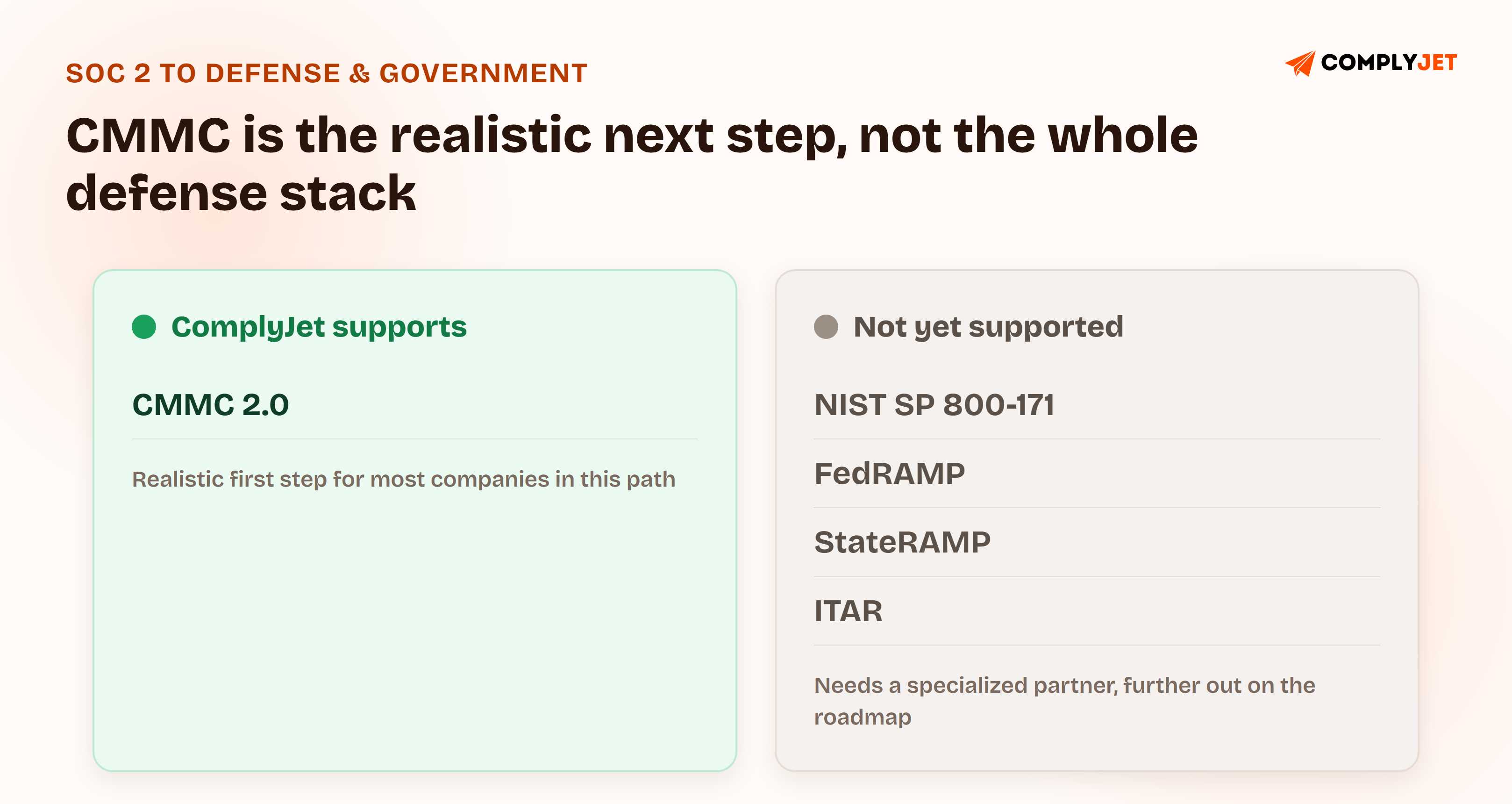
ComplyJet supports CMMC 2.0 directly, as a verified, end-to-end capability, not a soft caveat.
FedRAMP, ITAR, and StateRAMP: Not What to Do After SOC 2 Yet
CMMC is the realistic first step for most companies in this path. FedRAMP, StateRAMP, and ITAR sit further out, involve significantly deeper federal requirements, and ComplyJet doesn't support them directly.
Note
If your roadmap genuinely requires FedRAMP or ITAR, treat those as separate engagements that need a specialized partner, not a natural next step past CMMC on the same platform. Confirm exactly which of these your specific contract or subcontract actually requires before committing time to any of them, since the requirements differ meaningfully between them.
For reference, NIST SP 800-171 is the underlying standard both CMMC and the deeper federal frameworks build on, worth reading directly if your team is scoping this path.
How to Choose Your Next Compliance Framework After SOC 2
With three paths and up to six frameworks between them, the actual decision comes down to four questions, in this order:
- Which buyer segment is actually asking right now? Not a hypothetical future market, the specific deal or renewal driving the question today.
- Is the ask a hard blocker or a competitive edge? A signed contract clause or regulatory requirement outranks a "nice to have" a prospect mentioned once.
- How much of your existing SOC 2 evidence reuses? Use the control-reuse table above to estimate the real lift, not a guess.
- How much time pressure is the driving deal actually under? A framework with a longer typical timeline (ISO 27001, CMMC) needs to start earlier relative to the deal's close date than a faster one.
What Compliance Framework Should I Pursue After SOC 2?
Pursue whichever framework matches the buyer segment currently blocking a real deal or contract, prioritized by how hard a blocker it is and how much of your SOC 2 evidence already covers it. Absent a specific deal driving the decision, the general enterprise path (ISO 27001, PCI DSS, GDPR, CCPA) is the most common next step simply because it covers the widest set of buyers.
Building a Multi-Framework Compliance Strategy That Doesn't Start From Zero
Most companies that go past SOC 2 eventually need more than one additional framework, especially in the enterprise path, where geography, payment data, and consumer data triggers frequently overlap.
That's what a real multi-framework compliance strategy is: sequencing multiple frameworks deliberately instead of tackling each one from scratch:
- Start with whichever framework has the hardest deadline or the biggest blocked deal. Everything else can follow.
- Build the framework-specific pieces once, and reuse them. A HIPAA risk analysis and a CMMC SSP are both new documents, but the underlying access control and incident response evidence behind them is the same evidence you already maintain.
- Keep one shared control environment rather than a separate compliance program per framework. Each additional framework gets cheaper than the last when it's layered onto the same evidence base instead of managed in isolation.
A multi-framework compliance strategy built this way is the same reuse thesis from earlier in the piece, applied across more than one framework at a time rather than a single next step.
Common Mistakes When Deciding What to Do After SOC 2
- Picking a framework based on general "maturity" instead of actual buyer demand. The right next framework is whichever one a real, current buyer or deal requires, not the one that sounds most impressive.
- Assuming SOC 2 evidence fully satisfies the next framework. It reuses partially, as the control-reuse table above shows, not completely.
- Starting a second framework from scratch instead of mapping existing controls first. Skipping this step means redoing work you've already done for SOC 2.
- Underestimating framework-specific gaps. A missing Business Associate Agreement for HIPAA or a missing System Security Plan for CMMC can stall an otherwise-ready assessment.
- Chasing FedRAMP or ITAR-level government work before CMMC is even in place. These require a specialized partner and shouldn't be the default next step past SOC 2 for a defense-adjacent company.
- Running two framework assessments in parallel with no sequencing. Without a plan for which one goes first, both tend to slow down.
- Not confirming with the actual buyer which specific framework or version they require. A prospect mentioning "we'll need ISO certification eventually" isn't the same as a procurement team requiring it before signing.

How ComplyJet Supports Your Next Move After SOC 2
ComplyJet supports SOC 2, ISO 27001, HIPAA, HITRUST, PCI DSS, GDPR, CCPA, and CMMC 2.0 directly, all on the same flat per-company pricing and the same shared control environment your SOC 2 report already established.
That means the reuse described throughout this article isn't theoretical. ComplyJet maps your existing SOC 2 evidence against whichever framework you're moving to next, flags exactly what's still net-new (a BAA, an SSP, a framework-specific risk analysis), and builds the rest from there instead of starting over.
ComplyJet
Not sure which framework to tackle next?
ComplyJet maps your existing SOC 2 evidence against ISO 27001, HIPAA, HITRUST, PCI DSS, GDPR, CCPA, or CMMC 2.0, at flat per-company pricing, so you're not starting from zero.
FAQs
What compliance framework comes after SOC 2?
There's no single answer. It depends on who's asking: healthcare buyers push toward HIPAA or HITRUST, regulated enterprise and global buyers push toward ISO 27001, PCI DSS, GDPR, or CCPA, and government or defense buyers push toward CMMC.
Do I need ISO 27001 if I already have SOC 2?
Only if a buyer specifically requires it, usually a global or EU-based enterprise whose procurement team doesn't recognize SOC 2 on its own. If no current buyer requires ISO 27001, it's reasonable to defer it until one does.
Can SOC 2 evidence be reused for ISO 27001 or HIPAA?
Partially. Access control, change management, and incident response evidence carry over substantially. HIPAA still requires a Business Associate Agreement and a HIPAA-specific risk analysis, and ISO 27001 still requires a formal Statement of Applicability, neither of which SOC 2 produces on its own.
Does SOC 2 help with CMMC compliance?
Yes, partially. SOC 2's access control and system security evidence maps to several CMMC practice domains, but CMMC still requires NIST SP 800-171-aligned documentation and a formal System Security Plan that SOC 2 doesn't cover.
What's the next step after getting SOC 2 certified?
Identify which buyer segment is actually driving demand for a second framework right now, then check how much of your SOC 2 evidence already covers that framework's requirements before starting from scratch.
How do I choose which compliance framework to pursue next?
Prioritize by which buyer segment is asking, whether the ask is a hard blocker or a nice-to-have, how much SOC 2 evidence already reuses, and how much time pressure the driving deal is under.
Is SOC 2 enough for enterprise or government buyers?
Not always. Some enterprise buyers, particularly global or EU-based ones, require ISO 27001 instead of or alongside SOC 2. Government and defense buyers typically require CMMC, which SOC 2 alone doesn't satisfy.
Related Reading
- SOC 2 vs. ISO 27001: Picking One, Both, or a Dual Strategy, for readers still deciding between SOC 2 and ISO 27001 from scratch, or running both in parallel
- PCI DSS Compliance Guide, the full requirement set for the general enterprise path's payment-data branch
- CCPA Compliance Guide, requirements, rights, and a checklist for the general enterprise path's California-consumer-data branch
- What Is Compliance Automation?, how a shared control environment keeps each additional framework cheaper than the last