.svg)

You've narrowed your shortlist to two names, Scrut and Oneleet, and every comparison you've found so far treats it like a straightforward feature checklist. It isn't. The scrut vs oneleet decision actually comes down to a different question: do you need broader framework coverage as you scale, or do you need real security work, not just compliance paperwork, bundled in from day one?
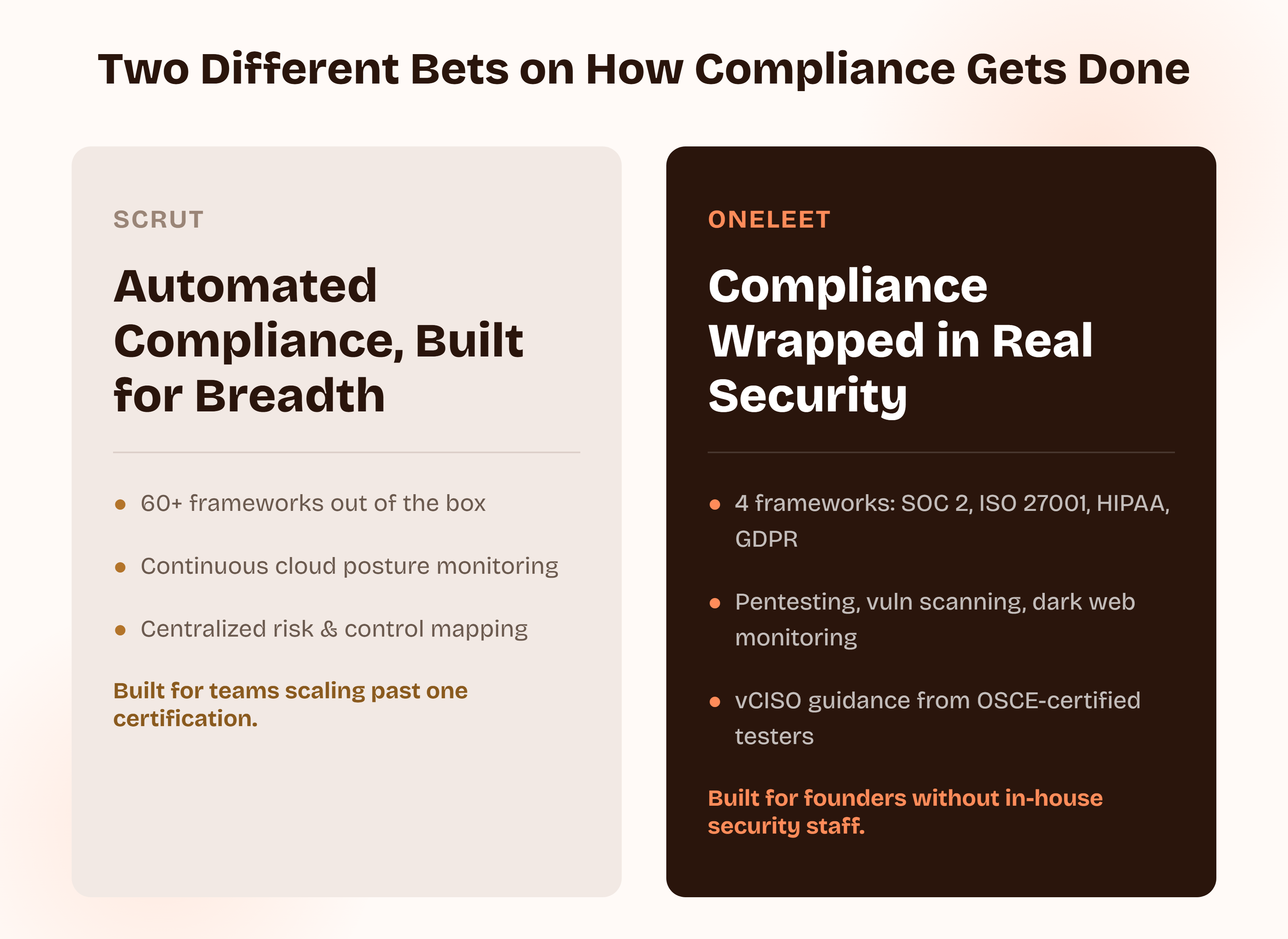
Here's the direct answer. Scrut is a broad automated-compliance platform: 60+ frameworks out of the box, continuous cloud posture monitoring, and centralized risk mapping, built for teams that expect to manage more than one certification over time. Oneleet covers a narrower set, SOC 2, ISO 27001, HIPAA, and GDPR, but bundles in genuine security services: penetration testing, vulnerability scanning, dark web monitoring, and vCISO guidance from OSCE-certified testers, built for founders who don't have security staff of their own.
Quick answer
Scrut = broad framework coverage and automated posture monitoring, for teams expecting to add certifications over time. Oneleet = a narrower framework set with real security services (pentesting, vulnerability scanning, a vCISO) bundled in, for founders who want compliance and security work from one vendor. Pick based on whether your actual gap is framework breadth or security depth.
Neither platform is objectively better. They're solving two different problems, and most "scrut oneleet comparison" content skips that framing to get to a pitch for something else entirely. The oneleet or scrut question keeps coming up because both platforms' marketing makes the tradeoff sound smaller than it is.
By the end of this article, you'll know exactly which one fits your team, not just a feature list for each. Here's what's ahead:
- What problem each platform is actually built to solve
- Why picking wrong here costs more than an awkward vendor switch
- A side-by-side look at both platforms, dimension by dimension
- Where the two genuinely pull apart, including the pentesting gap
- What's actually known (and not known) about pricing for each
- The scenario neither platform's own comparison content covers
- A decision framework for teams stuck between the two
Scrut vs Oneleet: What Problem Each Platform Actually Solves
A feature list is the wrong place to start a scrut vs oneleet comparison, because it flattens two genuinely different products into one grid. Scrut built a broad compliance-automation platform. Oneleet built a compliance platform wrapped around real security services. That's not a marketing distinction, it's the actual product decision each company made.
Scrut's positioning centers on breadth: 60+ frameworks, including SOC 2, ISO 27001, HIPAA, GDPR, PCI DSS, NIST, and CCPA, continuous cloud posture monitoring, centralized risk and control mapping, and a broad integration library spanning cloud providers, identity tools, and version control. It's built for a team that expects its compliance surface to grow, not stay fixed at one certification.
Oneleet made a narrower bet. It covers SOC 2, ISO 27001, HIPAA, and GDPR, four frameworks, not fifty, but wraps them in services most competitors sell separately: penetration testing, vulnerability scanning, dark web monitoring, and guidance from a vCISO backed by OSCE-certified testers. The pitch isn't "automate more frameworks," it's "get compliance and real security work from the same vendor."
What Scrut Is Built For
Scrut's platform leans on automation depth across a wide framework library. Reviewers and comparison sources consistently describe its continuous posture monitoring and control mapping as genuine strengths, not just a features page, and its integration library supports teams already running a fair amount of cloud infrastructure.
Pros
- 60+ frameworks supported out of the box, useful for teams that expect to add certifications over time.
- Continuous cloud posture monitoring and centralized risk and control mapping, not just checklist automation.
- A broad integration library spanning cloud providers, identity tools, and version control.
Cons
- More platform to configure upfront, which can slow down a team that only needs one certification fast.
- No bundled security services, a pentest or vulnerability scan still has to be sourced separately.
- The framework breadth that helps a scaling team is unused overhead for a team that will only ever need SOC 2.
What Oneleet Is Built For
Oneleet's platform leans on the services wrapped around compliance rather than the framework count. A startup that needs to tell an enterprise buyer "yes, we've been pentested this year" gets that from the same vendor handling its SOC 2 evidence, instead of coordinating a separate security firm.
Pros
- Penetration testing, vulnerability scanning, and dark web monitoring included, not sourced separately.
- vCISO guidance from OSCE-certified testers, useful for founders without in-house security expertise.
- One vendor relationship covers both compliance evidence and the security work buyers increasingly ask for.
Cons
- Narrower framework scope than a full breadth platform, less built out for teams adding certifications later.
- Less depth on ongoing risk management and cloud posture monitoring than a platform built around that from day one.
- The bundled security services add cost even for a team that already has its own pentest vendor.
That split, framework breadth versus bundled security, is the throughline for every section below.
Most teams comparing Scrut and Oneleet ask the wrong first question, which platform automates more. The right first question is what you actually don't have yet: more frameworks down the road, or real security work you'd otherwise have to buy from someone else. — Editor's Note
That "more frameworks or more security" framing is also exactly where a flat-pricing alternative tends to enter the conversation, especially for the SOC 2 report both platforms treat as table stakes.
ComplyJet
Both platforms build around SOC 2 first
If SOC 2 is the certification actually driving this decision, see how ComplyJet's flat per-company pricing and guided process handle it, before committing to either platform's broader bundle.
Why the Scrut vs Oneleet Decision Costs You Later
Picking wrong here doesn't just mean an awkward vendor switch. It means a real gap shows up at the worst possible moment.
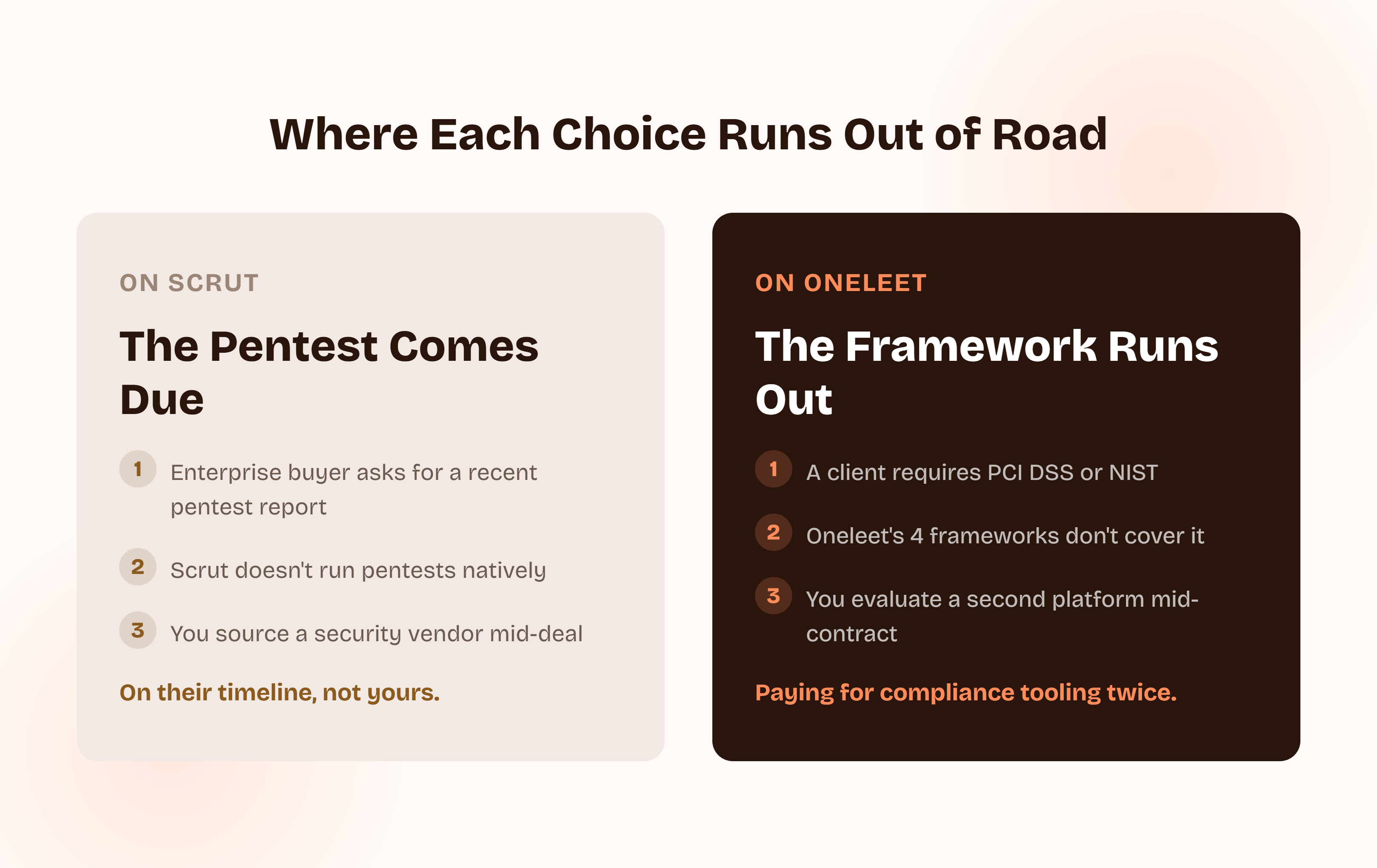
Choose Scrut, and an enterprise prospect's security questionnaire asks for proof of a recent penetration test. Scrut doesn't run one for you, so you're now sourcing a separate security vendor mid-deal, on their timeline, not yours. Choose Oneleet, and six months later you land a client that requires PCI DSS, or a NIST-aligned framework. Oneleet's four supported frameworks don't stretch that far, and you're evaluating a second platform while your first one is still mid-contract.
Note
This isn't a "which vendor is more mature" question. Both are established platforms doing what they set out to do. The risk is a mismatch between what your next 12 months of sales cycles and framework requirements actually demand, and what you signed up for today.
Scrut vs Oneleet at a Glance
Here's the side-by-side, dimension by dimension. No independently verified review-rating data is included here. Both platforms' G2 comparison pages returned an access error when checked for this article, and their star ratings aren't restated from memory.
| Dimension | Scrut | Oneleet |
|---|---|---|
| Framework coverage | 60+ frameworks (SOC 2, ISO 27001, HIPAA, GDPR, PCI DSS, NIST, CCPA, more) | 4 frameworks (SOC 2, ISO 27001, HIPAA, GDPR) |
| Bundled security services | None natively (pentesting, vuln scanning not included) | Pentesting, vulnerability scanning, dark web monitoring, vCISO guidance |
| Automation depth | Continuous cloud posture monitoring, centralized risk and control mapping | Automation plus guided, human-supported setup |
| Integration library | Broad, spanning cloud providers, identity tools, version control | Not independently verified in sources reviewed |
| Target company profile | Teams expecting to manage multiple frameworks over time | Startups and founders without in-house security staff |
| Pricing basis | Custom quote, no verified figure found | Custom quote, cited at $10,000-$25,000 by ComplyJet's own research |
Treat this as the starting map, not the whole decision. A wider framework list doesn't help if your actual gap is proving you've been pentested this year, and a bundled security service doesn't help if your next client needs a framework Oneleet doesn't cover.
A table like this only goes so far. What tends to actually move the decision is hearing how a startup weighing the same tradeoff chose.
ComplyJet customers
Startups weighing this exact tradeoff land here too
Read how founders who chose between framework breadth and bundled security describe getting through SOC 2 and ISO 27001 with ComplyJet, in their own words.
Oneleet vs Scrut: Where the Two Platforms Actually Pull Apart
The oneleet vs scrut comparison gets more useful once you go dimension by dimension instead of stopping at "more frameworks" versus "more services." Here's where each one actually pulls ahead.
Framework Coverage as You Scale
Scrut's wider out-of-the-box list, SOC 2, ISO 27001, HIPAA, GDPR, PCI DSS, NIST, and CCPA, is the concrete version of its breadth positioning. Oneleet's four cover the certifications a first-time compliance team is statistically most likely to need first, but not much past that.
Neither vendor publishes an exact figure for what adding a framework outside Oneleet's four actually costs in migration effort, so treat this directionally: a team on Oneleet that later needs PCI DSS is evaluating a second platform for that framework, not extending the one it already has.
Watch out
Framework breadth isn't the same as framework depth. Before counting on Scrut's 60+ list to solve a future need, confirm the specific framework you'll actually use is mature on the platform, not just listed.
Scrut vs Oneleet Pentesting: The Security-Services Gap
Run the scrut vs oneleet pentesting question down, and it stops being close. Oneleet bundles penetration testing, vulnerability scanning, and dark web monitoring directly into its compliance platform, backed by OSCE-certified testers and vCISO guidance. Scrut offers none of this natively.
Does Oneleet include pentesting that Scrut doesn't? Yes. A team on Scrut that gets asked for a recent pentest report has to procure one from a separate security firm, on a separate timeline and a separate invoice. That's not a knock on Scrut, its platform was never built around bundling security services, but it changes the real comparison from "which platform is better" to "which one already includes what your buyers are going to ask for."
| Security service | Scrut | Oneleet |
|---|---|---|
| Penetration testing | Not included, source separately | Included, OSCE-certified testers |
| Vulnerability scanning | Not included | Included |
| Dark web monitoring | Not included | Included |
| vCISO guidance | Not included | Included |
| Framework breadth | 60+ frameworks | 4 frameworks (SOC 2, ISO 27001, HIPAA, GDPR) |
| Cloud posture monitoring | Continuous, built-in | Not a core focus |
Side by side like this, the pattern holds: Oneleet wins on every bundled-security row, Scrut wins on every breadth-and-monitoring row. Neither platform touches the other's column.
Automation Depth and Guided Setup
Scrut leans on autonomous, continuous monitoring, once configured, it keeps watching your cloud posture without a person driving each check. Oneleet's automation is real but leans more on guided human support layered on top, which fits a team that wants a partner walking through setup rather than a dashboard to configure alone.
That split holds up across the whole comparison: Scrut pulls ahead wherever framework breadth and ongoing automated monitoring matter, Oneleet pulls ahead wherever bundled security work and hands-on guidance matter.
| Where each pulls ahead | Winner |
|---|---|
| Framework breadth for future scaling | Scrut |
| Continuous cloud posture monitoring | Scrut |
| Bundled pentesting and vulnerability scanning | Oneleet |
| vCISO / security guidance included | Oneleet |
| Guided, human-supported setup | Oneleet |
Scrut vs Oneleet Pricing: What's Actually Known
Scrut's pricing is fully custom-quoted. No source checked for this article, smartly.rocks' own comparison, Sprinto's, or G2's compare page, publishes or independently verifies a dollar figure for it. Anyone searching for a scrut vs oneleet pricing number today won't find a confirmed one for Scrut anywhere, including here.
Oneleet's range is more visible. ComplyJet's own research, in our Scrut competitors and alternatives guide, cites Oneleet at "often between $10,000 and $25,000," covering both the platform and the bundled security work. That figure is our own reporting, not an independently verified third-party number, and it isn't published by Oneleet itself.
Note
Oneleet's number folds security-services cost into one figure. If you're pricing Scrut against it, add a separate line item for a penetration test if a buyer or framework eventually requires one, otherwise you're comparing a bundled quote to an incomplete one.
The Scrut vs Oneleet Scenario Nobody's Comparison Covers
Every comparison found for this article, including smartly.rocks' detailed breakdown, stops at "here's what each platform does today." None of them address what happens when a team outgrows its choice, and that's exactly where the real cost of picking wrong shows up.
Scenario one: you're on Scrut, and an enterprise prospect's security questionnaire asks for a penetration test report from the last 12 months. Scrut doesn't run pentests, so you're now sourcing a security vendor mid-sales-cycle, on their availability, not yours, while the deal sits open.
Scenario two: you're on Oneleet, and a payments-processing client requires PCI DSS. Oneleet's four supported frameworks don't include it. You're evaluating a second platform for one framework while your Oneleet contract is still running, effectively paying for compliance tooling twice.
Neither scenario is hypothetical. They're the direct consequence of the same tradeoff this whole comparison is built around: breadth versus bundled security. Think one step past what you need this quarter, not just today's checklist, before committing to either.
Oneleet or Scrut: Which One Actually Fits Your Team
Strip away the feature lists, and the decision comes down to one honest question: is your actual gap more frameworks, or more security work?
- A team expecting to need PCI DSS, NIST, or other less-common frameworks, or that wants continuous cloud posture monitoring, fits Scrut. You'll manage more platform upfront, but you won't be evaluating a second vendor the moment a new framework requirement lands.
- A security-first startup without in-house security staff that wants compliance and pentesting, vulnerability scanning, and vCISO guidance from one vendor fits Oneleet. You get real security work bundled in, not sourced separately, at the cost of a narrower framework list.
- A team weighing both mainly on sticker price should read the pricing section above again first. Oneleet's number bundles security-services cost; Scrut's doesn't include an add-on pentest. They aren't directly comparable line items.
Neither answer is universal. A 10-person startup selling into security-conscious enterprise buyers and a 60-person company adding its second and third frameworks can land on opposite sides of this same question, and both would be right for their own team.
Scrut Oneleet Comparison Mistakes Worth Avoiding
Readers running a quick scrut oneleet comparison tend to make the same handful of mistakes before evaluating either platform closely.
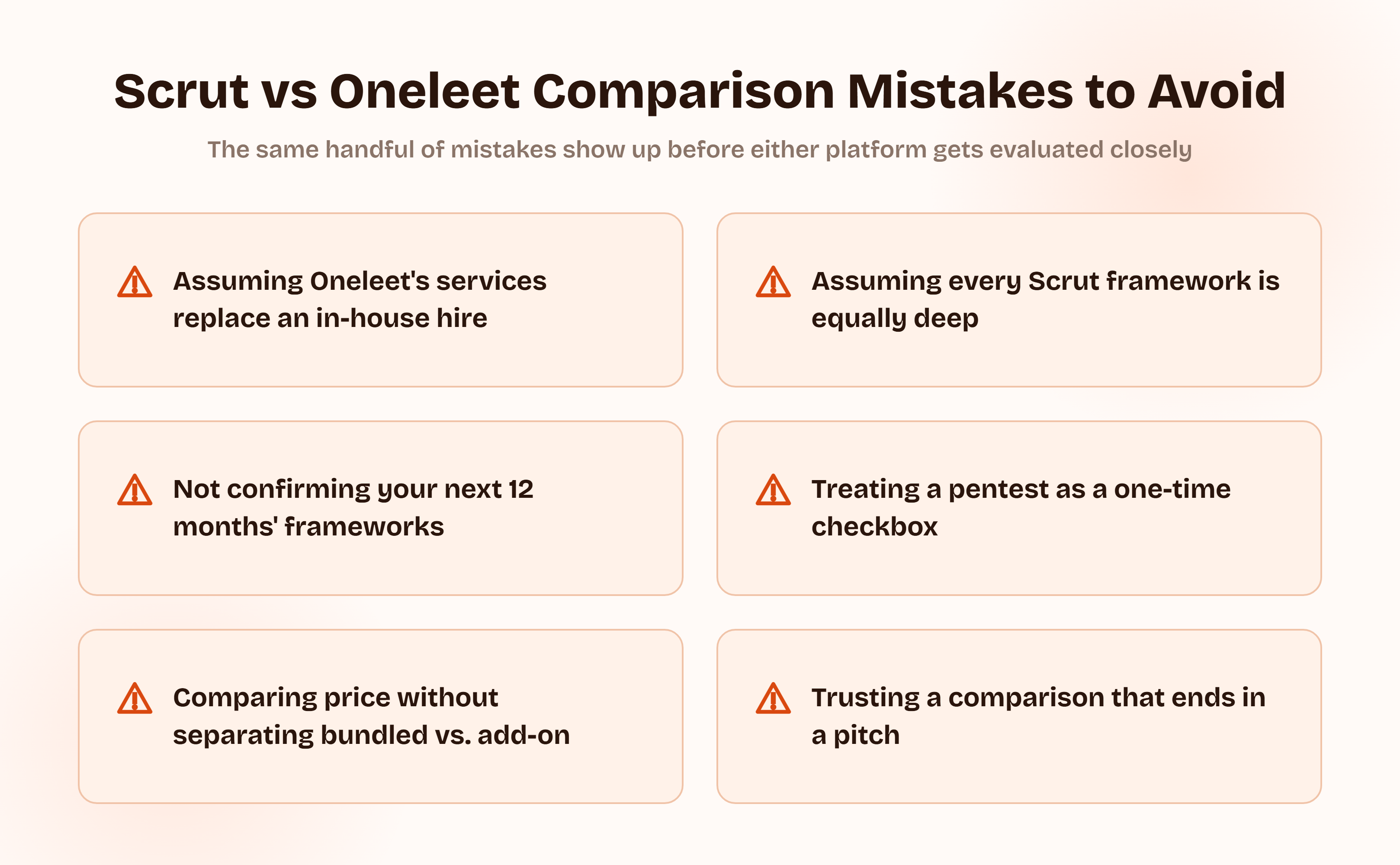
- Assuming Oneleet's bundled security services replace the need for an in-house security hire once you scale. A vCISO and an annual pentest cover real ground, but they're not a substitute for dedicated security staff at a certain size.
- Assuming Scrut's framework breadth means every framework is equally deep out of the box. Broader coverage is real, but confirm the specific framework you need is actually mature on the platform, not just listed.
- Not confirming which frameworks you'll actually need in the next 12 months before committing to Oneleet's narrower four. This single question decides more of the scrut vs oneleet outcome than any feature comparison.
- Treating Oneleet's pentest as a one-time checkbox instead of a recurring requirement. Most enterprise buyers expect a pentest report refreshed annually, not a single one from two years ago.
- Comparing sticker price without separating what's bundled from what's an add-on. Oneleet's quote includes security work; a Scrut quote doesn't, so a raw price comparison understates Scrut's real cost if a pentest becomes necessary.
- Treating a third party's own "Scrut vs Oneleet" comparison as neutral. If it ends with a pitch for a different platform entirely, its specific claims about either company are marketing, not fact.
Most of these mistakes share the same root cause: comparing Scrut and Oneleet as if they were solving the same problem, when they're actually built around two different ones.
How ComplyJet Fits Into the Scrut vs Oneleet Decision
For teams that don't want to choose between Scrut's framework breadth and Oneleet's security bundle, there's a third option worth a look. ComplyJet isn't the biggest name in this category, and we're upfront about that: we're positioned as a considered alternative, not a bigger platform than either Scrut or Oneleet.
What we do offer is flat per-company pricing across 25+ frameworks instead of per-seat costs, and a team that guides you through the compliance process end to end rather than handing you software and a support queue.
We don't run pentests or offer a vCISO the way Oneleet does, so if bundled security services are the actual gap you're solving for, Oneleet's model fits that need more directly. If it's really about wanting predictable pricing and hands-on guidance across whatever frameworks come next, that's the gap ComplyJet is built to sit in.
ComplyJet
A team that guides you through the process
Not "oneleet or scrut," but a genuine third path for teams where neither platform's tradeoff is the actual fit.
FAQs
Which Is Better, Scrut or Oneleet?
There's no universal winner. Scrut is better if you want broad framework coverage and continuous automated posture monitoring. Oneleet is better if you want compliance and real security work, pentesting, vulnerability scanning, a vCISO, bundled from one vendor. The right one depends on whether your actual gap is framework breadth or security depth, not which platform lists more features.
Is Oneleet Better Than Scrut for Startups Specifically?
Often yes, for a security-first startup without in-house security staff that wants compliance and genuine security work handled together. But a startup that knows it will need a framework outside Oneleet's four, PCI DSS or NIST, for example, within the next year should weigh Scrut instead.
Does Oneleet Include Pentesting That Scrut Doesn't?
Yes. Oneleet bundles penetration testing, vulnerability scanning, and dark web monitoring through OSCE-certified testers as part of its platform. Scrut doesn't offer this natively, a team on Scrut needing a pentest report has to source one from a separate security vendor.
Do Scrut and Oneleet Support the Same Compliance Frameworks?
Both cover SOC 2, ISO 27001, HIPAA, and GDPR. Scrut's list extends further, adding PCI DSS, NIST, CCPA, and more, out of the box. Confirm your specific framework need against each vendor's current list before deciding.
Is Scrut or Oneleet Better for Selling Into Enterprise Buyers?
Depends on what the buyer's security questionnaire actually asks for. If it's framework coverage across multiple certifications, Scrut's breadth helps more. If it specifically asks for a recent penetration test, Oneleet's bundled pentest already covers that, without sourcing it separately.
How Does Oneleet's Pricing Compare to Scrut's?
No independently verified figure exists for Scrut's pricing anywhere reviewed for this article. Oneleet is cited at "often $10,000-$25,000" per ComplyJet's own research, covering platform and security work together. Treat any Scrut number you're quoted as the actual figure to compare, not an estimate found online.
Related Reading
- Scrut vs Delve: another Scrut head-to-head, for readers still widening their shortlist.
- Oneleet vs Secureframe: another Oneleet head-to-head in the same genre.
- Oneleet vs Vanta vs Drata: a 3-way comparison for readers considering more than two platforms.
- Top SOC 2 Compliance Platforms for AI Companies: for readers who are specifically an AI/ML company, where both platforms are separately assessed.