.svg)

The General Data Protection Regulation(GDPR) has matured over the years, yet even top MNCs are suffering from hefty fines for various violations. For instance, LinkedIn was fined €310 million (approximately $335 million) for violating the EU’s GDPR.
Reason? They lacked a valid legal basis for processing user data.
Compliance has shifted the bars from records and spreadsheets to continuous monitoring, seamless integration, cost-efficiency, and future-proofing to balance the AI shift.
GDPR compliance management software compared in this guide -
- BigID
- ComplyJet
- Vanta
- iUbenda
- OneTrust
- Drata
Get GDPR compliant faster without operational bottlenecks or audit stress.
Automate Compliance Now
Quick Answer: What to Look for in the Best GDPR Compliance Software as per 2026 Regulation Standards?
In today’s regulatory environment, an efficient GDPR compliance software, in addition to legacy guidelines, must be able to
- Handle end-to-end visibility
- Automate data mapping and discovery
- Automate Data Subject Rights (DSAR)
- Continuous monitoring (including cross-border data transfer)
- Risk and Breach Management
- AI-powered Compliance
The LinkedIn example shows that choosing the right compliance software is essentially a business risk decision. One wrong tool, or just the wrong combination of tools, leaves data mapping gaps, incomplete RoPA (Records of Processing Activities), mishandling of DSARs at scale, and generates no defensible audit trail when a supervisory authority comes knocking.
This guide discusses the nuances of GDPR compliance tools, company-size segmentation, the emerging AI-GDPR intersection, and how to choose the best GDPR compliance software for your organization to tackle modern challenges, such as
- Fragmented Global Regulations
- Cross-Border Data Transfer Restrictions
- Lack of Data Visibility in Complex IT Environments
- AI & Automated Decision-Making Risks
- Vendor & Supply Chain Risk
- Operational Burden of DSAR Requests
- Keeping Up with Regulatory Updates
Why Choosing the Right GDPR Compliance Tool Matters More Than Ever in 2026?
GDPR enforcement has never been more aggressive. Regulators issued over €1.2 billion in fines in 2024 alone, and no organization, regardless of size, is exempt from scrutiny. Choosing the right GDPR compliance tool is no longer a box-ticking exercise; it's a strategic decision.
The challenge is that the market is flooded with options. From lightweight checklists to enterprise-grade platforms, it is genuinely difficult to identify the best GDPR compliance software for your specific needs. A tool that works for a 20-person SaaS startup will likely fall short for a multinational handling millions of data subjects.
What separates a good tool from the right one comes down to three capabilities:
- Automated DSAR handling (so your team isn't buried in manual requests),
- ROPA management (keeping your records of processing activities audit-ready at all times),
- And increasingly in 2026, built-in AI compliance features to address the new obligations emerging from AI-driven data processing.
Whether you're a growing SME or a large enterprise, the sections covered below break down the best options across every category. But first, let’s have a look at the current compliance market orientation.
Key Market Shift in the GDPR Market in 2026
€5.88B (~$6.26 USD)
Total GDPR fines issued since 2018. In 2024 alone, European regulators issued €1.2 billion, and the trajectory is up.
Source: DLA Piper GDPR Fines and Data Breach Survey, January 2025
The European data protection authorities issued €1.2 billion in GDPR fines in 2024. According to Coherent Market Insights, the Data Discovery and Mapping Agent segment holds the highest priority as automated compliance continues to rise. Moreover, automation integration using AI, RAP, and NLP becomes central for data recovery, SAR handling, and risk handling.
To contain the threats and support AI compliance, the EU Commission launched the second draft of the General Purpose AI Code of Practice in May 2025. It introduces AI compliance in GDPR, AI Act, KPIs, and reporting requirements.
The noteworthy market trends for startups and enterprises to keep in mind while partnering with a GDPR compliance software include,
- Using AI and ML (Machine Learning) to automate key requirements such as classification of data, real-time tracking of potential breaches, and accelerated subject access request (SAR) response.
- Data Discovery and Mapping Tools powered by AI and NLP are essential to cover real-time monitoring and analysis.
- Furthermore, Robotic Process Automation (RPA) can now automate compliance activities.
- As organizations increasingly use cloud services, cloud-native Privacy Management is now equally important for tracking and maintaining audit trails to remain end-to-end compliant.
The current market requires businesses to prioritize continuous, 360° compliance coverage integration (third-party and cloud services) across tech stack layers.
4 GDPR Tools That Make Your Organization Compliant & How Mixing Them Increases 5–10x Cost
Understanding a clear taxonomy of GDPR compliance tools is essential before you jump to choosing the right software for your business. GDPR discovery tools help you map data flows before you can manage them.
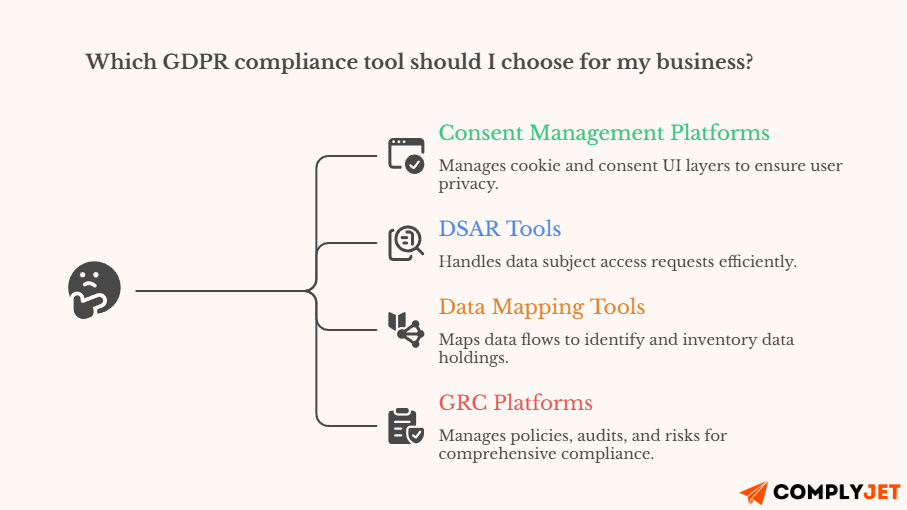
In distinction, there are 4 categories of GDPR tools,
- Consent Management Platforms (CMPs) (cookie/consent UI layer)
- DSAR Tools (data subject access request intake and fulfilment)
- Data Mapping / Discovery Tools (inventory of what data you hold and where)
- GRC Platforms (policy, audit, and risk management)
However, many business owners often suffer from a naming problem. Products that handle one narrow piece of the compliance lifecycle are marketed using the same language as platforms handling all of it.
These 4 categories of GDPR management tools are designed to solve a specific problem. Each one has legitimate standalone use cases with a defined hard ceiling.
1. Consent Management Platforms (CMPs)
CMPs handle the lawful basis of the consent, and act as per consent given by the user (or, in compliance terms, the data subject).
In practice, it conveys, “Did the user allow us to collect data?”
CMPs integrate with the website/app UI and handle -
- Displaying cookie banners
- Capture and log consent signals
- Maintain receipts
It integrates with tag managers to block third-party scripts based on user preferences.
Cookiebot, Usercentrics, and Osano’s CMP module are some of the tools used for consent-related handling for a GDPR compliance management software.
What CMPs Do Not Handle?
They do not map your data processing activities, manage DSAR, produce Records of Processing Activities (RoPA), and govern third-party data processing.
Note that consent is only one of the six lawful bases under Article 6. It handles only the surface layer of data collection.
Myth Debunking: Does Passing a Cookie Audit Make You GDPR Compliant?
NO. A CMP tool integrated with your website only means your cookie consent is defensible. Organizations passing a cookie audit do not necessarily mean that they are GDPR compliant. THIS is one of the most common gaps auditors exploit during investigations.
2. DSAR (Data Subject Access Rights) Automation Tools
DSAR tools handle user requests such as “Give me my data/ Delete my data.”
DSAR tools are a subset of GDPR compliance management tools integrates with backend and operational workflows. They are responsible for managing the operational lifecycle of data subject requests.
Their primary function is to,
- Intake requests
- Verify user identity
- Pull data from the system
- Automate deletion/export (depending on request) workflow
- Track GDPR mandated deadline (30-day response clock management)
From the very nature of their functioning, DSAR automation tools are relevant for high volumes of requests.
Therefore, ComplyJet suggests using DSAR tools only for enterprise-scale or consumer-facing businesses. For most mid-market and startups, DSARs are integrated with GRC (Governance, Risk, and Compliance) platforms for a cost-efficient solution.
3. Data Mapping and Discovery Tools
Data mapping and discovery are the foundation of compliance. One wrong integration or a missing trail can cost you significantly. Most small-to-mid businesses are exposed here!
Data mapping tools help organizations build data inventory and maintain data flow, covering PHI, PCI, and PII compliance obligations across every system where personal data lives. Once implemented, they identify data across databases, SaaS applications, cloud storage, and email platforms, and then map the data, including where it is stored and who can access it.
If your organization has implemented the right mapping and discovery tools, you can produce defensible RoPA (Records of Processing Activities) and conduct a meaningful Data Protection Impact Assessment (DPIA).
4. GRC Platforms (Governance, Risk & Compliance)
The last layer comes: “Are we compliant overall?”
This is where platforms such as Vanta or Sprinto come in. GRC platforms ensure that your website/app is compliant at the governance level. They cover:
- Policy management
- Risk assessment
- Audit workflows
- Staff training records
- Cover multi-framework coverage (GDPR + ISO 270001, SOC 2, HIPAA, and others)
However, modern GDPR compliant solutions, including ComplyJet, OneTrust, and TrustArc, cover all four categories, from DSAR automation to audit automation and managing data mapping layers.
How Mixing GDPR Management Tools Increases 5–10x Cost?
When you opt for compliance, you are not buying tools; you are building a privacy architecture.
Mixing tools without alignment creates duplication, fragmentation, and inefficiency. Thereby increasing the cost.
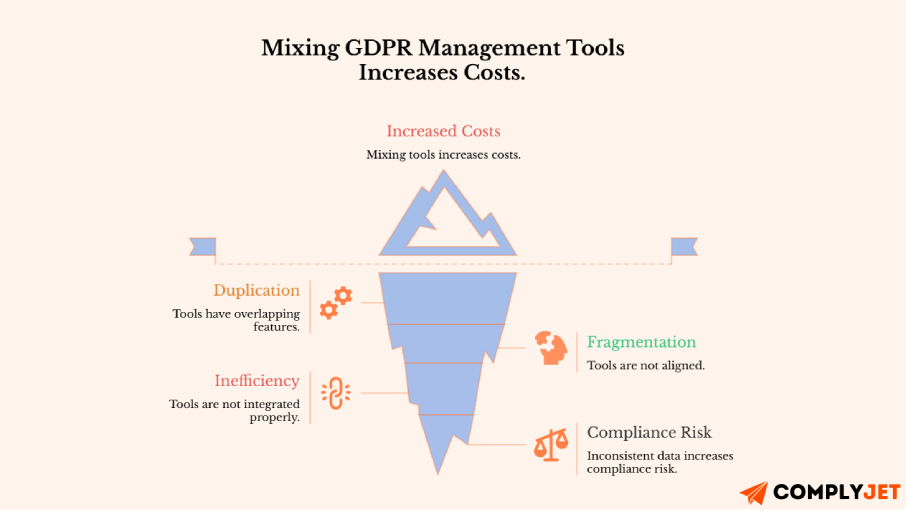
Consider the following scenarios to understand the tools’ integration failure.
- CMPs know consent, but DSAR tools don’t. Integration failure here can lead to duplicate data and more engineering work. (Cost Multiplier: 3 to 5x)
- Many tools now offer overlapping features, e.g., GRC tools handling other aspects as well. So you might unknowingly be paying 2 tools for the same work(Example: consent logs in 2 tools). (Cost Multiplier: 2 to 4x)
- Similarly, integration complexity can lead to inconsistent data and thus increase the compliance risk. (Cost Multiplier: 3 to 10+ times)
Therefore, most smart teams opt for consolidated GDPR solutions as provided by ComplyJet and OneTrust. One platform for managing it all.
(TCO Cost Comparison) Total Cost of Ownership: Should You Stitch Tools or Choose One All-rounder
*For a deeper breakdown, see our guide on SOC 2 compliance cost. The same cost drivers apply across multi-framework programs.
Apart from understanding the 4 GDPR compliance management tools, it's crucial that you evaluate the compliance vendors against your needs, and how well they comprehend the situation your business is going through.
To give you context regarding what you should be asking vendors before opting, we have designed an evaluation framework with exemplary questions!
Evaluation Framework - What to Ask Compliance Vendors & Why?
Here’s the evaluation framework you should follow, which is the same one we have used while listing the best compliance software.
Evaluating the Best GDPR Compliance Software as per Company Size Segmentation
The reason why we presented GDPR solutions as per company segments is that what’s perfect for a 50-person SaaS startup might not be even a good fit for a 5000-person enterprise.
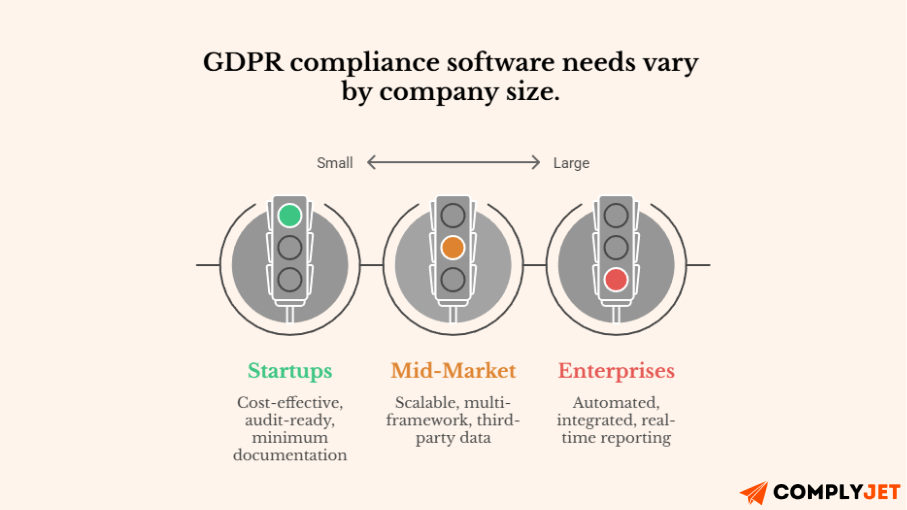
For Startups and Small Businesses (Under 200 Employees)
This segment of organizations has the following priorities regarding compliance,
- Getting audit-ready without a full-time DPO (Data Protection Officer)
- Minimum viable RoPA documentation
- Defensible consent management
- Ability to respond to the occasional DSAR without a workflow collapsing
And the solution they are looking for shall be cost-effective with quicker time-to-compliance.
For Mid-Market SaaS Companies (200 to 2,000 Employees)
This business segment faces bottlenecks such as:
- Growing DSAR volumes
- Multi-framework requirements (GDPR + SOC 2 or ISO 27001)
- Increased third-party data processors
Also, mid-market organizations should be able to demonstrate a higher standard of due diligence to serve enterprise customers. The key need is to scale, but without adding a large compliance team.
Keeping these requirements under evaluation criteria, here are the best GDPR compliance vendors to look at.
For Large Enterprises (2,000+ Employees)
This scale of businesses requires vendor risk management at scale and includes operations such as cross-border data transfer controls.
Key requirements include,
- Must handle multiple regulations (GDPR, SOC 2, ISO, etc.) in one system
- Seamless compliance connectivity with Amazon Web Services, Salesforce, and Workday-like systems.
- End-to-end automation of DSARs, consent management, and evidence collection
- Requires real-time audit trails, mapped evidence, and regulator-ready reporting.
Top vendors are,
Unify GDPR, SOC 2 & ISO in One Platform with ComplyJet.
Book a free demo!
Detailed Evaluation of the 6 Best GDPR Compliance Software
Our team has evaluated the top compliance vendors based on the evolving market. Each of the platforms is assessed against the following five criteria:
- Core Strength
- Standout capability (USP)
- Ideal customer profile
- One limitation to know
- Pricing Signal
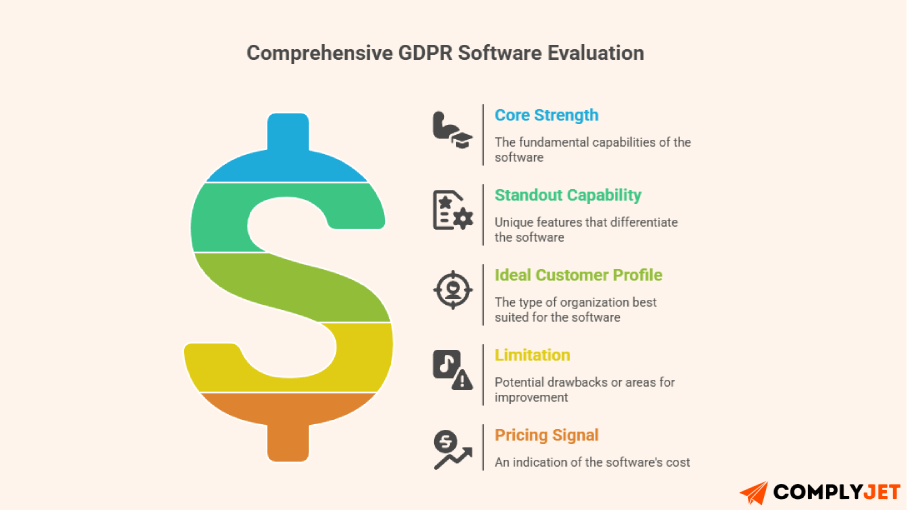
There is no one-size-fits-all in the compliance market. The following analysis presents the leading contenders and does not reflect a definitive ranking.
1. Complyjet
All-in-one GDPR compliance platform; Offers automated compliance, streamlined audits, and a trust center to showcase security posture in real-time.
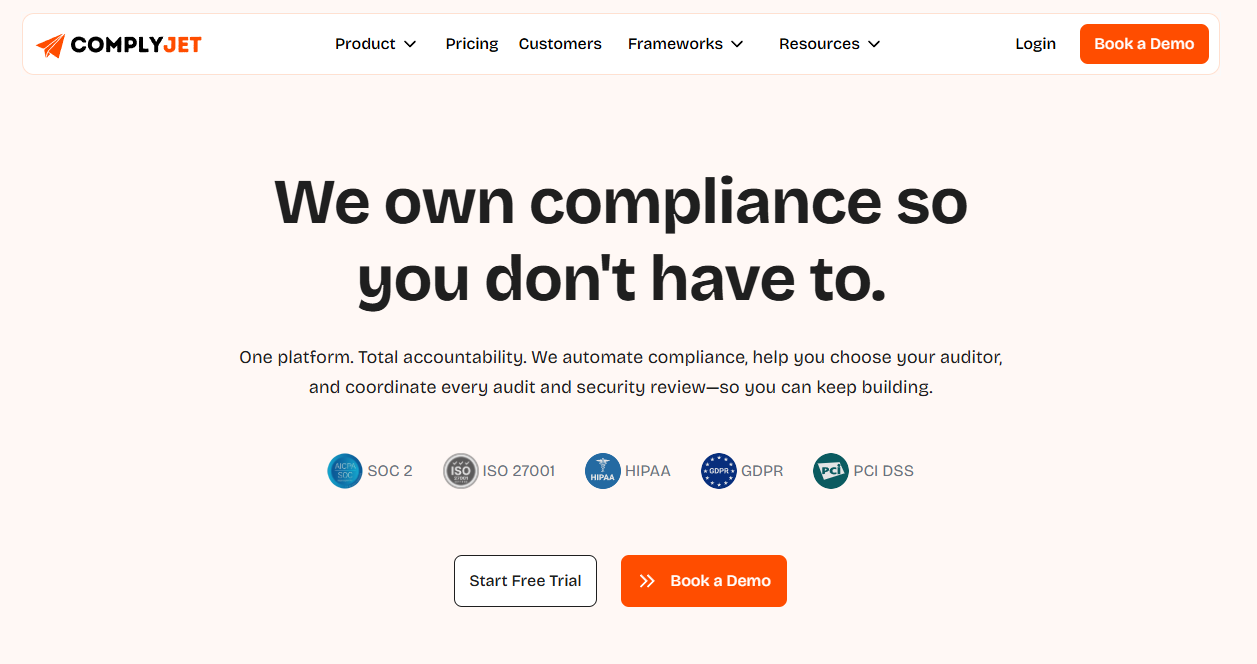
Complyjet, being a relatively modern contender in the compliance market, focuses directly on the larger market gap: the SaaS mid-market, where the problem is not the lack of compliance tools but tool fragmentation. That’s why the platform offers 350+ integrations.
ComplyJet connects it all to give you a live, automated view of your security and compliance. Its integrated architecture connects the 4 GDPR compliance management tools, offering multi-framework under one roof.
The question for prospective buyers is whether the integrated and automated workflow approach fits their compliance program's complexity requirements. And for most organizations under 2,000 employees, it does.
Organizations with HIPAA obligations can explore our full breakdown of HIPAA compliance software and automation tools before choosing a platform.
2. BigID
Data discovery and intelligence, suitable for organizations with complex, distributed data estates.
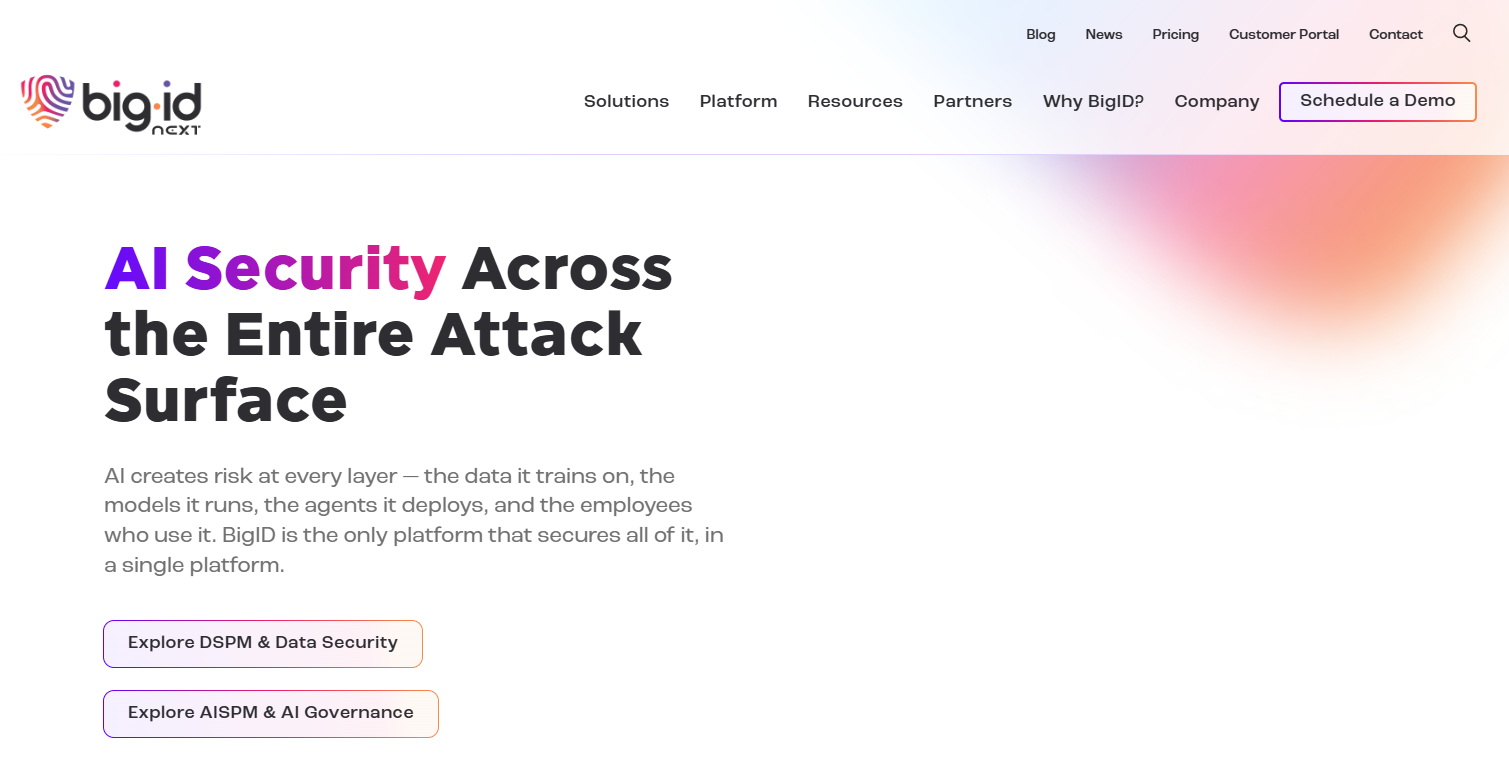
BigID solves one problem with exceptional depth: knowing where your personal data actually lives. For enterprises where that problem is the central risk, it is the strongest tool in the market.
For organizations that need breadth across the full compliance lifecycle rather than depth in one area, a more integrated platform will deliver a better price-to-coverage ratio.
3. Vanta
Security compliance automation. Built for tech companies to earn customer trust through certifications.
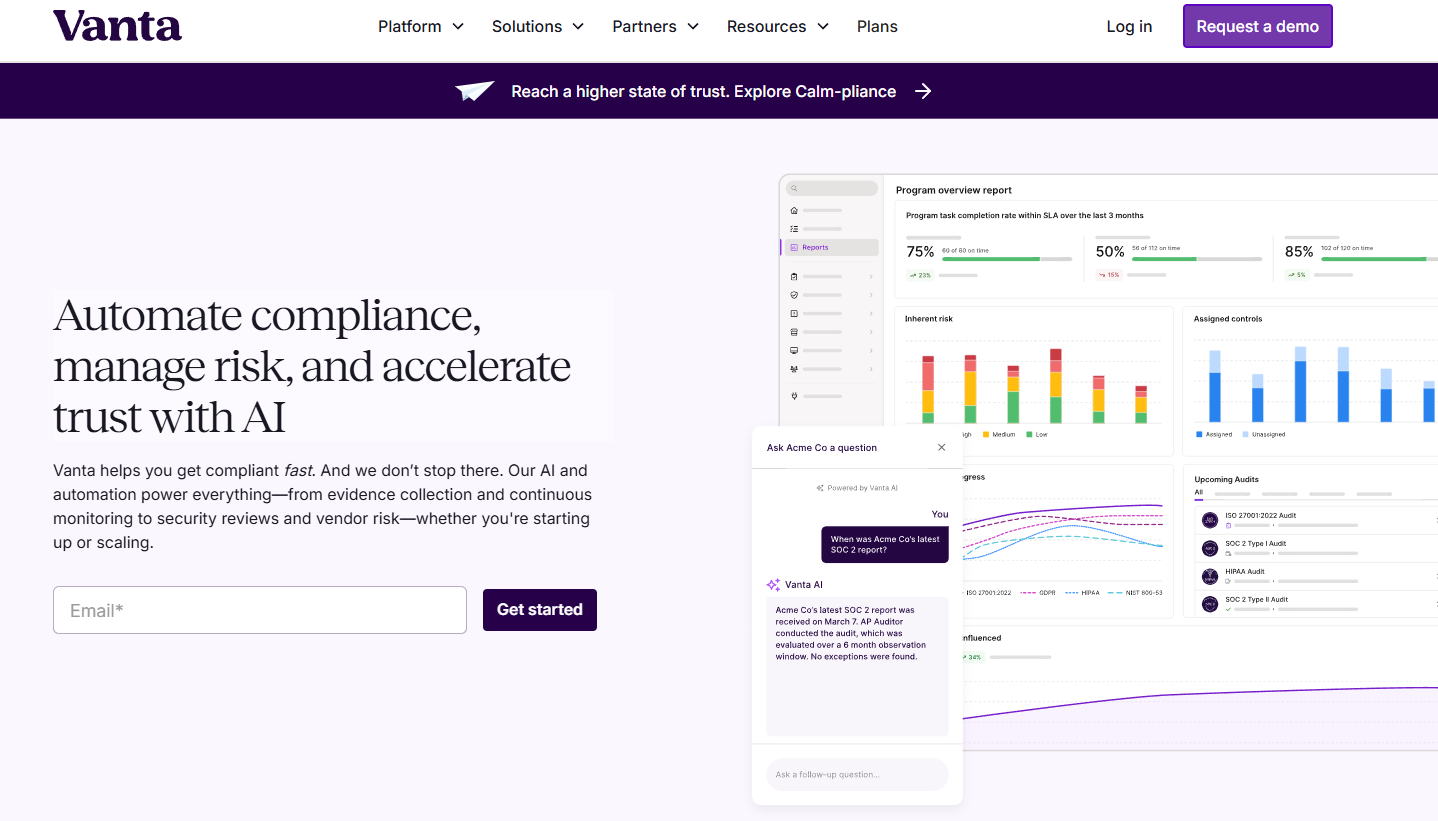
Vanta is one of the strongest platforms in the market for the specific use case it serves: B2B SaaS companies that need to accelerate sales cycles by demonstrating security and compliance posture to enterprise buyers.
Vanta is for organizations at an early compliance maturity stage, but it is insufficient for organizations with complex GDPR programs or active regulatory exposure.
Compare Vanta’s Pricing Guide.
4. iubenda
Consent management and legal document generation. Built for small digital businesses and developers.
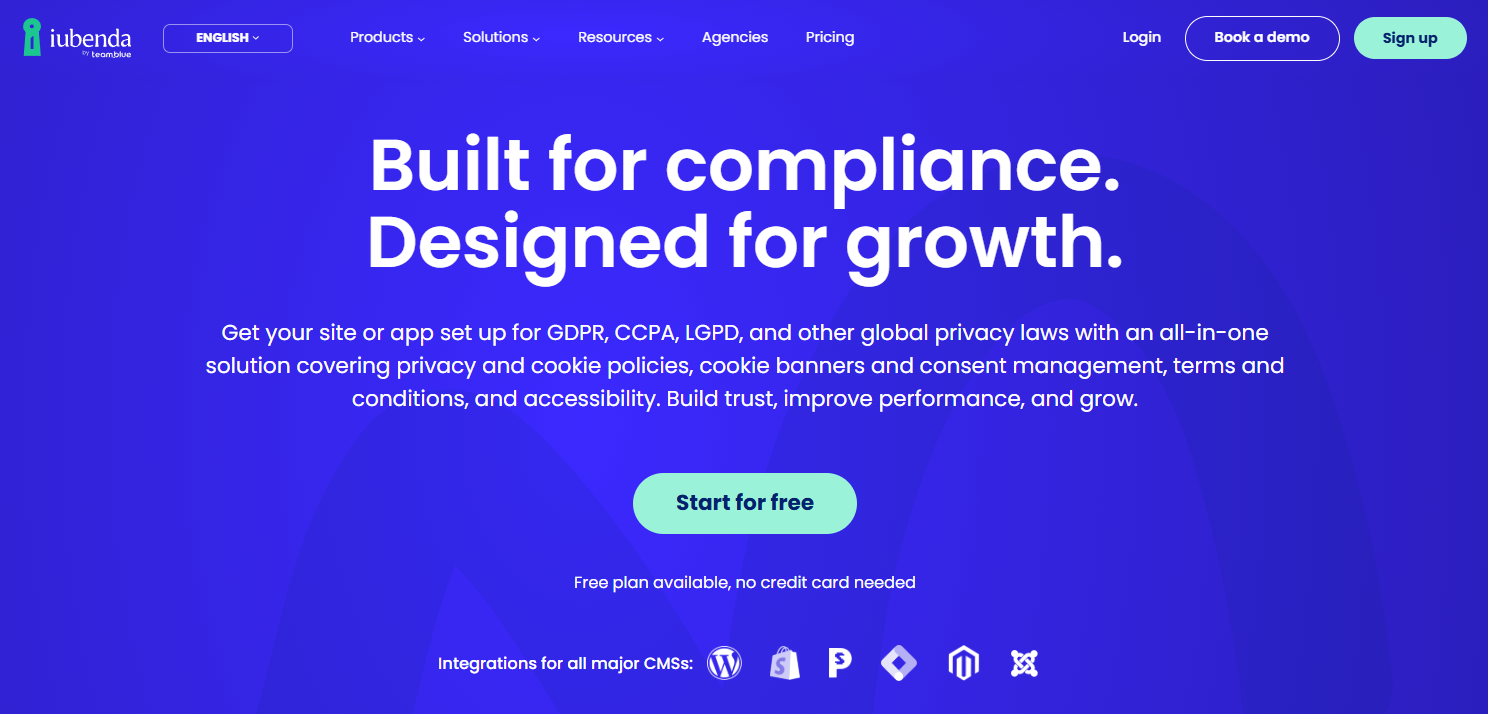
iubenda is the right tool for a narrow, important use case: getting a legally sound consent and policy layer live quickly at minimal cost.
It is categorically not a GDPR compliance platform, and understanding that ceiling before purchasing will save significant rework as the business scales.
5. OneTrust
Enterprise privacy, security, and GRC platform. Market's broadest compliance platform by capability coverage.
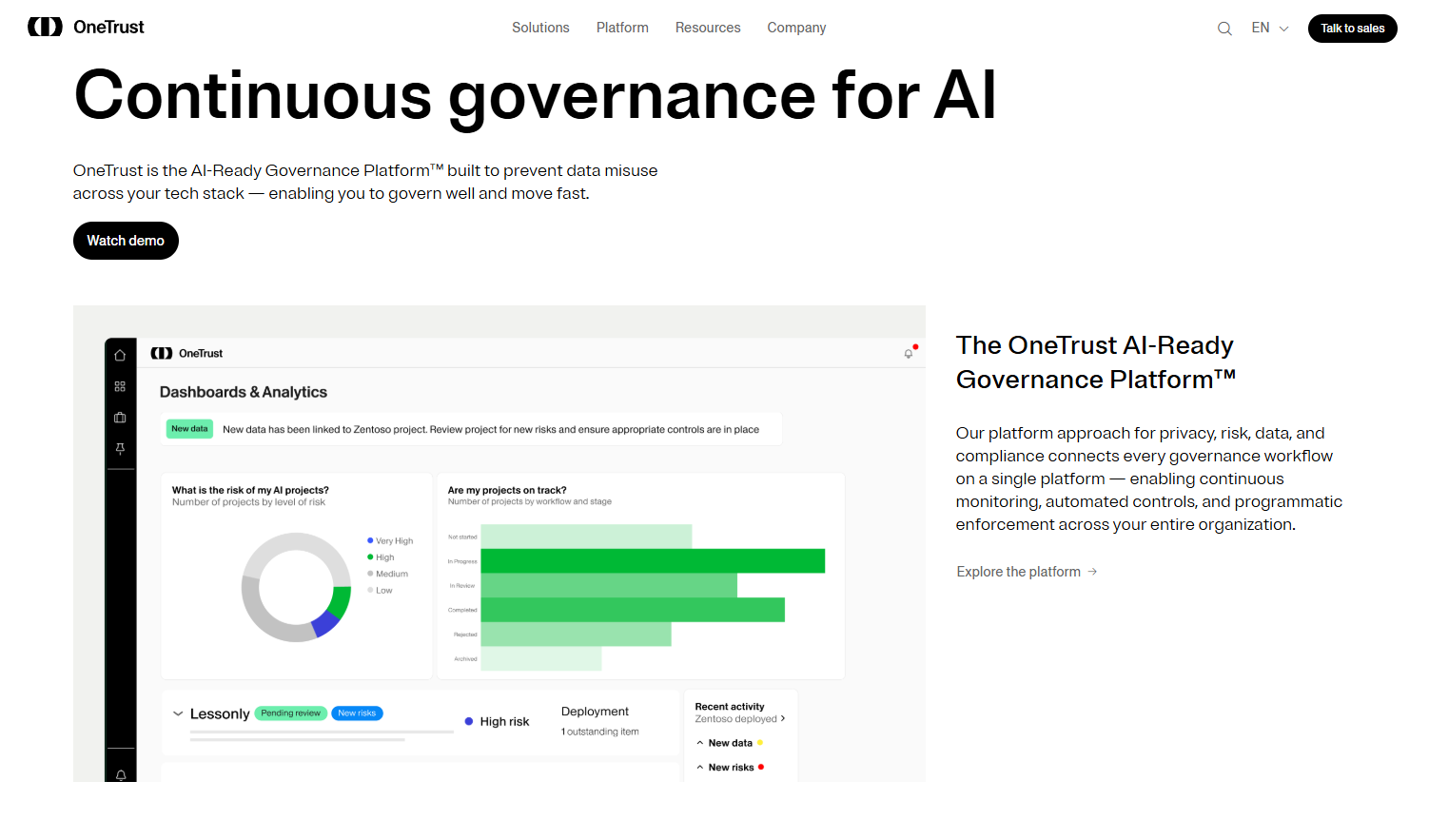
OneTrust is the reference platform for enterprise GDPR compliance. The honest question for any prospective buyer is whether their organization's scale justifies the implementation complexity and cost. For the majority of mid-market organizations, a more focused platform will reach compliance faster and at a lower total cost.
6. Drata
Compliance automation for multi-framework and overlapping compliance.
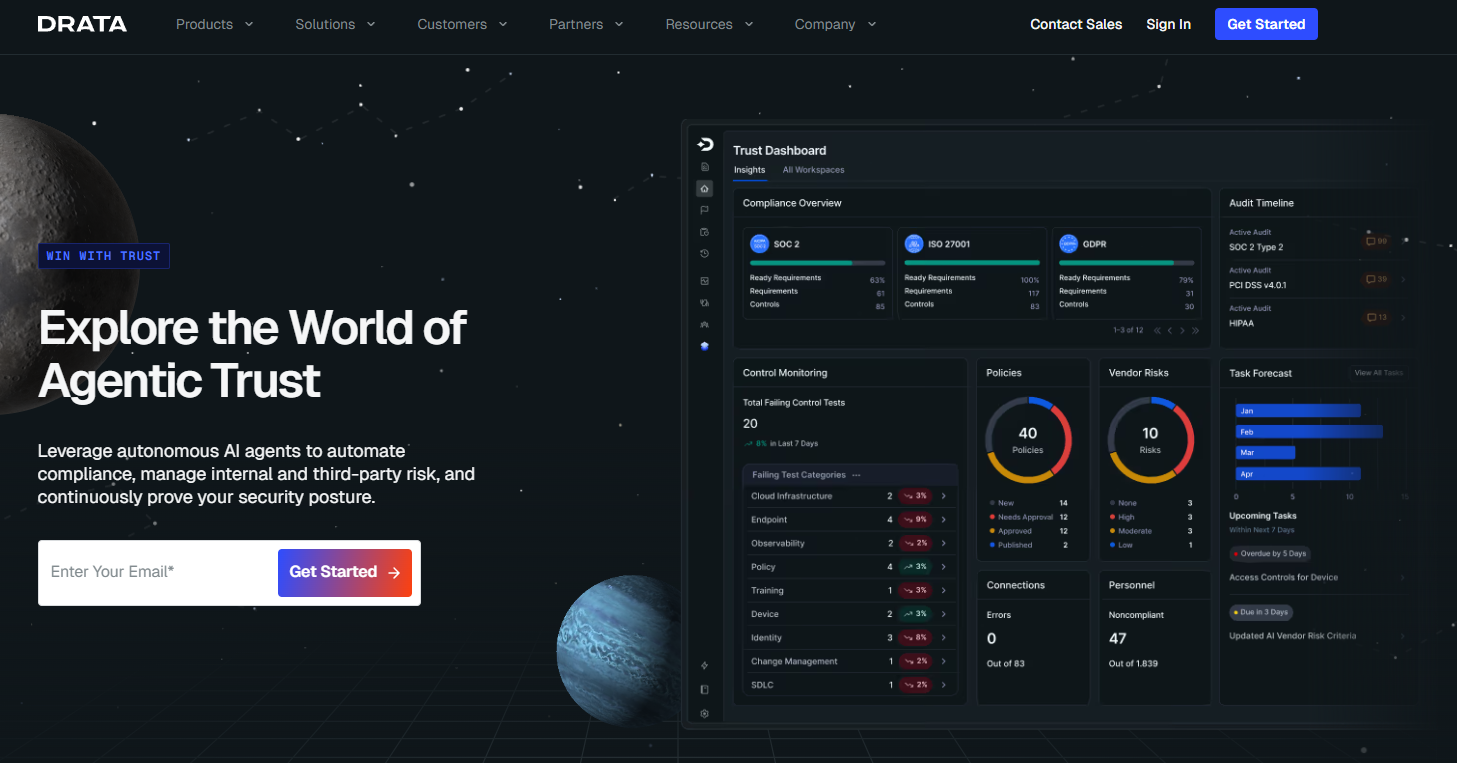
Drata's strongest proposition is the SOC 2 + GDPR combination for B2B SaaS. If your compliance program needs enterprise customer procurement requirements, Drata handles it well.
For organizations where GDPR is the primary regulatory driver rather than an appendage to SOC 2, a GDPR-first platform will serve better.
If you're evaluating both platforms together, see our detailed Vanta vs Drata comparison to understand which fits your compliance stage.
GDPR Regulation Clarifications That Most Teams Miss
How Does GDPR Apply to US-Based Companies?
The most common misconception among US companies is that GDPR applies only to European companies. Therefore, it is important that you understand GDPR requirements at practical level and how it impacts your business. GDPR applies globally; if you are dealing with a European region user for any business, you must be GDPR compliant. Whether your business is a service, marketing, or tracking.
Clearview AI, a US company with no EU establishment, has been fined over €100 million across seven DPA enforcement actions. In each case, the company's US location provided no regulatory shelter.
Dealing with European users without being GDPR-compliant directly means your business will face significant penalties across multiple jurisdictions from European regulators.
So, if you are operating your entire business from the US, but EU data is involved means the business must be GDPR compliant.
Key Requirements of GDPR Compliance Software for US Companies
Here are a few important requirements that US companies' GDPR compliance software must follow:
1. Standard Contractual Clauses (SCCs): if you are transferring data from the EU region to any other country, the data must be protected with updated legal agreements. The new SSCs introduced in 2021 are mandatory as per EU regulations.
2. Data Privacy Framework (DPF) Certification: For US companies, it is important to be enrolled in updated Data Privacy Frameworks to receive the EU user data legally.
3. Handling User Data Requests (DSARs): EU users have rights over their data, and businesses must respond within 30 days.
4. Data Transfer Transparency: Being GDPR compliant, companies must clearly document where data is stored, how it moves, and why it’s processed.
Looking for HIPAA Compliance? Read our checklist + free PDF to pass audits fast.
What Changes for GDPR Compliance for Email Marketing?
Many businesses overlook GDPR compliance in their email marketing, yet this oversight is a leading cause of regulatory crackdowns in the EU. Teams often launch campaigns without verifying GDPR requirements and end up facing hefty fines.
GDPR sets clear rules for email marketing in the EU: you need explicit permission before sending campaigns. Avoid pre-checked boxes or sneaky consent tactics. Always give EU recipients a simple way to opt out whenever they choose.
GDPR compliance for email marketing requires clean documentation of how the email data is processed and where the business is utilizing the data. Following these practices not only reduces legal risk but also improves email engagement and user trust.
GDPR and AI in 2026: Why Choose Compliance Software That Covers Both
According to Cisco's 2026 Data and Privacy Benchmark Study, 90% of organizations have already expanded their privacy programs because of AI. And as of now, only 12% of
Organizations describe their AI governance committees as mature and proactive.
AI systems that process personal data must comply with GDPR in exactly the same way as any other data processing operation. Furthermore, the EU AI Act adds another layer of obligations with rules for high-risk AI coming into effect in August 2026 and August 2027.
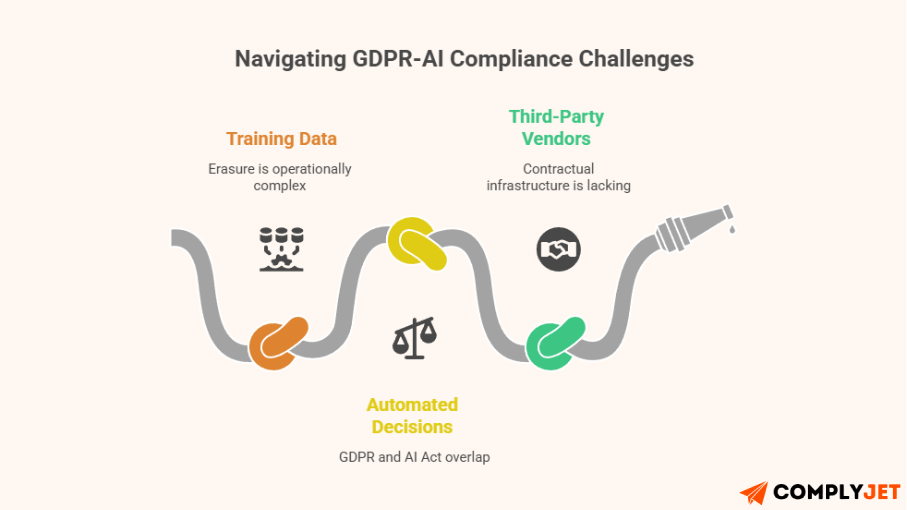
Based on the market trend and benchmark studies, the following are the most important GDPR-AI compliance pressure points.
1. Training Data and the Right to Erasure Conflict
Article 17 GDPR grants data subjects the right to erasure of their personal data. For organizations using personal data to train machine learning models, erasure is operationally complex. This is a direct gap between what the regulation now requires and what the software market currently offers.
2. Article 22 Automated Decision-Making and the EU AI Act Overlap
GDPR requires human oversight for automated decisions, but the EU AI Act adds mandatory risk assessments, system registration, and lifecycle governance for high-risk AI. Compliance with one does not ensure the other.
What does this mean in practice? Organizations risk false compliance confidence, passing GDPR checks while failing AI Act requirements.
3. Third-Party AI Vendor Data Processing Agreements
Under GDPR, an organization deploying a third-party AI model for any purpose involving personal data is a data controller and carries full accountability for what that model does with the personal data it processes.
The contractual infrastructure to support such integrations should have updated data processing agreements with AI vendors as well. Therefore, understanding the full third-party risk management lifecycle is essential before signing any such agreement.
Cisco's 2026 study found that while 81% of organizations report GenAI providers are transparent about data practices, only 55% have contractual terms in place defining data ownership.
ComplyJet Helps to Build a GDPR Program That Scales; Not One You Have to Rebuild
Now that you have seen the enforcement data, the tool stack, TCO comparison, Segment-wise recommendation, and detailed reviews. With AI handling key business operations, the question isn’t whether you need GDPR compliance software in 2026 but whether you’ll pay for four tools to do what one should, and whether the one chosen compliance solution future-proofs AI-compliance?
Now imagine a scenario: you have the data mapped, DSARs automated, governed AI vendors, and have chosen a platform that doesn't leave gaps between the tools.
That's not a competitive advantage, it's the baseline. ComplyJet is built to get you there.
ComplyJet Automate Compliance & Coordinate Every Audit
See ComplyJet in Action | Book a Compliance Audit
Frequently Asked Questions - Answered by Compliance Advisor, ComplyJet
What is the best GDPR compliance software for 2026?
The best GDPR compliance software depends on your company size and needs. For startups, ComplyJet and iubenda offer quick setup and affordable pricing. Mid-market companies benefit most from ComplyJet, Vanta, or Drata for multi-framework coverage. Enterprises handling 200+ DSARs monthly should evaluate OneTrust, BigID, or ComplyJet's enterprise tier for advanced automation.
What type of GDPR compliance solution shall a business prefer: CMP or full-stack?
If your needs are limited to cookie consent and simple data processing, a Consent Management Platform (CMP) may be enough. But if you manage data maps, handle DSARs, or work with multiple processors, you need a full-stack GDPR platform. Most growing businesses eventually require full-stack coverage to avoid costly upgrades later.
What's the difference between GDPR compliance tools and software?
GDPR compliance tools are point solutions (e.g., cookie consent platforms, DSAR automation) that handle specific tasks. GDPR compliance software refers to comprehensive platforms managing your entire compliance lifecycle—data mapping, consent, DSARs, audits, and reporting. Most growing companies need software, not just tools, to avoid integration gaps.
At what point do DSAR volumes require automation?
If you receive fewer than 10 DSARs per month, manual workflows with basic tools can work. Once you reach 50+ DSARs per month, automation becomes necessary to manage timelines, reduce errors, and stay compliant. Always plan for future growth, especially if expanding into EU markets.
Should we choose a GDPR-specific tool or a multi-framework GRC platform?
If GDPR is your only requirement, a specialized GDPR tool is more efficient. But if you also need SOC 2, ISO 27001, or HIPAA, a multi-framework GRC platform, such as ComplyJet or OneTrust, helps reduce duplicated work and audit effort. Choose based on actual compliance needs, not perceived completeness.
What features should I look for in GDPR compliance tools?
Essential features include:
- Automated data mapping across cloud, SaaS, and databases
- DSAR workflow automation with 30-day deadline tracking
- ROPA (Records of Processing Activities) auto-generation
- Consent management with audit trails
- Integration with your existing tech stack (350+ for best tools)
- AI compliance readiness for EU AI Act alignment
What integrations should GDPR compliance software support?
Your compliance platform must connect to systems where personal data lives, such as CRM, email, HR, and databases. Lack of native integrations often leads to custom development, which increases cost and complexity. Integration capability is a key evaluation factor.
What is the real total cost of GDPR compliance software?
License cost is only one part. You must consider implementation, integrations, maintenance, training, and internal effort. Over 24 months, a well-chosen all-in-one platform can reduce total cost by 40 to 60% compared to multiple tools, even if upfront pricing is higher.
Is GDPR compliance software enough, or do we also need consulting?
Ans. Software handles workflows, automation, and documentation. But it cannot replace legal interpretation or risk assessment. For most businesses. especially those facing audits or complex use cases, combining software with consulting or DPO services provides a stronger compliance posture.
Can US companies use GDPR compliance software?
Yes. GDPR applies to any company processing EU residents' data—regardless of where the company is located. US companies serving EU customers need GDPR compliance software with Standard Contractual Clauses (SCCs), Data Privacy Framework certification, and cross-border data transfer documentation.
Still having questions about GDPR compliance? Let our compliance advisors clear your doubts.
Schedule a free consultation session; asking questions is absolutely free!