.svg)

A prospect's security questionnaire arrives with a new section: list every AI system you use, who approved it, and how you assess its risk. Nobody owns the answer. Three engineers name three different tools, and the marketing team mentions a fourth nobody has heard of.
That moment is usually what starts the search for the best AI risk management software, and it's a harder search than it looks. The label covers governance suites that cost more than a junior hire, runtime security tools an engineer can switch on in an afternoon, and compliance platforms that simply added a risk register and an AI framework.
So I checked 11 platforms against each vendor's own pages and ranked them by how much of the AI risk lifecycle they cover. This isn't a list of AI that does your compliance work, and it isn't a list for ISO 42001 certification. It's about the risk that comes from the AI you build and buy.
What Is AI Risk Management Software? The Three Layers Behind Best AI Risk Management Software Lists
AI risk management software helps you find the AI systems in use, assess what could go wrong with each, test and watch them, and keep the evidence to prove you did. Gartner's market guide for AI trust, risk and security management (AI TRiSM) describes the goal as letting organizations "more safely use AI, ensure AI actions align with organizational intent, keep AI systems secure from malicious actors, and assure confidential data and intellectual property are properly protected."
In practice I use six jobs as the yardstick for everything below: inventory (what AI do we have), assess (what's the risk of each), test (does it behave, is it fair, can it be broken), monitor (is it still behaving in production), enforce (stop the bad action), and document (evidence for customers, auditors and regulators).
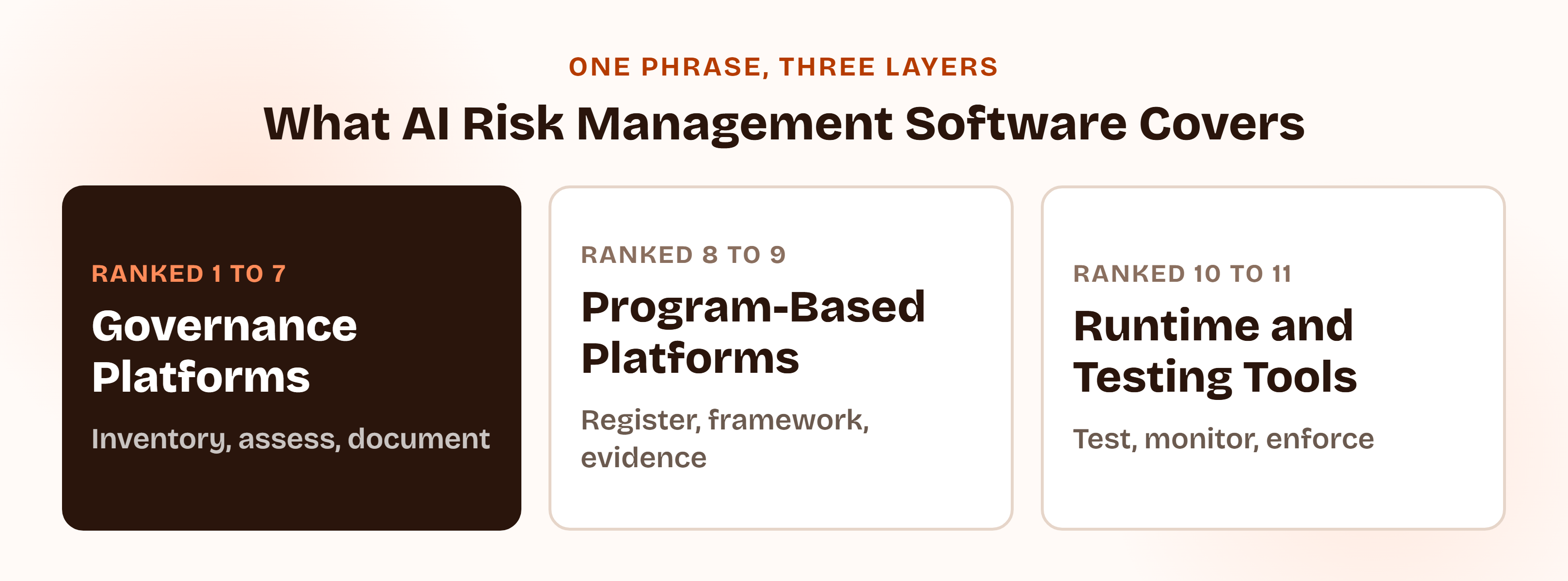
No single product does all six equally well, which is why "AI risk management tools" searches return three different kinds of software:
- Governance platforms. Inventory, risk assessment, policy packs and evidence across your whole AI estate. Built for organizations with many AI systems and a governance function.
- Runtime and testing tools. Guardrails, red teaming and observability that watch or attack models and agents directly. Built for engineering and security teams.
- Program-based compliance platforms. A risk register, AI framework support and vendor review inside the compliance program you may already run for SOC 2 or ISO 27001.
The first problem in every layer is the same one: you can't manage what you haven't found. One Hacker News commenter put the shadow AI version of it plainly:
“people will sign up for, install, and provide data to just about anything that promises to be useful” Citizen8396, Hacker News, October 2025 (thread)
Meant a different list?
If you want software where the AI does your own compliance work (drafting policies, pre-filling questionnaires), read ComplyJet's comparison of the best AI compliance software. If a customer asked specifically about ISO 42001 certification, read the best ISO 42001 software comparison. And if you want AI-assisted tools for ordinary business risk, the best risk assessment tools is the closer fit.
Start With Inventory
Not sure what AI you're running, let alone scoring?
ComplyJet's risk register links each risk to the controls that mitigate it, and its framework library includes NIST AI RMF, ISO 42001 and the EU AI Act. See how that looks for a team your size.
Why AI Risk Management Platforms and AI Governance Platforms Overlap
Vendors and analysts use different names for one market. Gartner published its 2025 market guide under the AI TRiSM label, then on 16 June 2026 released its first Magic Quadrant for AI Governance Platforms, which it evaluated 13 vendors for. Gartner defines those platforms as ones "designed to centrally define, approve and enforce responsible AI policies across comprehensive AI use cases, applications and agents."
I use "risk management" as the headline because it's what buyers type, and because the yardstick above is about risk outcomes rather than policy paperwork. Where a vendor names a Gartner placement below, it's the vendor's own statement, and Gartner's own disclaimer applies: it "does not advise technology users to select only those vendors with the highest ratings."
How I Evaluated These 11 Best AI Risk Management Software Platforms
I didn't rank from a roundup. For each platform I read the vendor's own current pages and wrote down what it does across the six jobs, then compared them on six criteria:
- Lifecycle coverage. How many of inventory, assess, test, monitor, enforce and document the product actually does, as opposed to integrates with.
- Framework packs. Whether NIST AI RMF, the EU AI Act and ISO 42001 are built in or left for you to map.
- Evidence output. Whether the result is something you can hand a customer or auditor.
- Reach. Which clouds, model platforms and ticketing systems it connects to.
- Pricing transparency. Published figures, third-party estimates (labeled), or quote-only.
- Who it's realistically built for. A six-person startup and a bank don't shop for the same thing.
The rank reflects breadth of lifecycle coverage, not fit for you. That means the specialist governance suites sit at the top, the program-based platforms in the middle, and the two narrow runtime tools at the bottom. A narrow tool ranking low is a statement about breadth. Fiddler and Lakera are very good at the single layer they cover.
A disclosure: ComplyJet is my own company's product. It's ranked 9th of 11 on the same yardstick, with its limits listed like every other vendor's. For the reader I write for, an early-stage team, it may still be the right call, and the How to Choose section explains when.
I left out AI-powered business risk tools (different intent, covered in the callout above) and AI security point products I couldn't verify directly on the vendor's own site. Third-party price estimates are labeled as such.
Quick Comparison: 11 Best AI Risk Management Software Platforms at a Glance
| Tool | Best for | Pricing | Standout capability |
|---|---|---|---|
| IBM watsonx.governance | Enterprises governing many AI systems | Published indicative tiers: from $3,500/month (Risk & Compliance Basic) | Governance graph linking AI systems, risks, controls and policies |
| ServiceNow AI Control Tower | Organizations already on ServiceNow | Not published | Discovers AI across systems, tied to ServiceNow's CMDB |
| Credo AI | Audit-ready AI governance with policy packs | Not published (third-party est. $30K to $150K/yr) | AI Registry with EU AI Act, NIST AI RMF and ISO 42001 policy packs |
| OneTrust AI Governance | Teams extending an existing privacy or GRC program | Not published | Discovery plus runtime monitoring in Bedrock and Foundry |
| Holistic AI | Enterprises wanting testing and red teaming with governance | Not published | 40+ tests for bias, hallucination, privacy and robustness |
| ModelOp | Model-heavy organizations governing the delivery lifecycle | Not published | Policy enforced at delivery time inside one AI system of record |
| Lumenova AI | Regulated teams deploying agents | Not published | Evaluation, guardrails, observability and a registry in one platform |
| Vanta | Teams extending a SOC 2 or ISO program to AI risk | Not published | Risk register with a 100+ scenario library and NIST AI RMF, ISO 42001, EU AI Act support |
| ComplyJet | Early-stage startups adding AI risk to a first compliance program | Flat per-company: $7,999/year Core, $9,999/year Plus (3-year plan, up to 50 employees) | AI risk assessment workflow and scored risk register on one program |
| Fiddler AI | Engineering teams monitoring and guarding agents | Free, Developer at $0.002 per trace, Enterprise custom | Agent observability and inline guardrails |
| Lakera | Teams shipping LLM apps that need runtime defense | "Start for free," otherwise not published | Runtime protection against prompt injection plus red teaming |
The 11 Best AI Risk Management Software Platforms in 2026
The order reflects how much of the six-job lifecycle each platform covers on its own published pages. The How to Choose section below is where fit gets decided.
1. IBM watsonx.governance
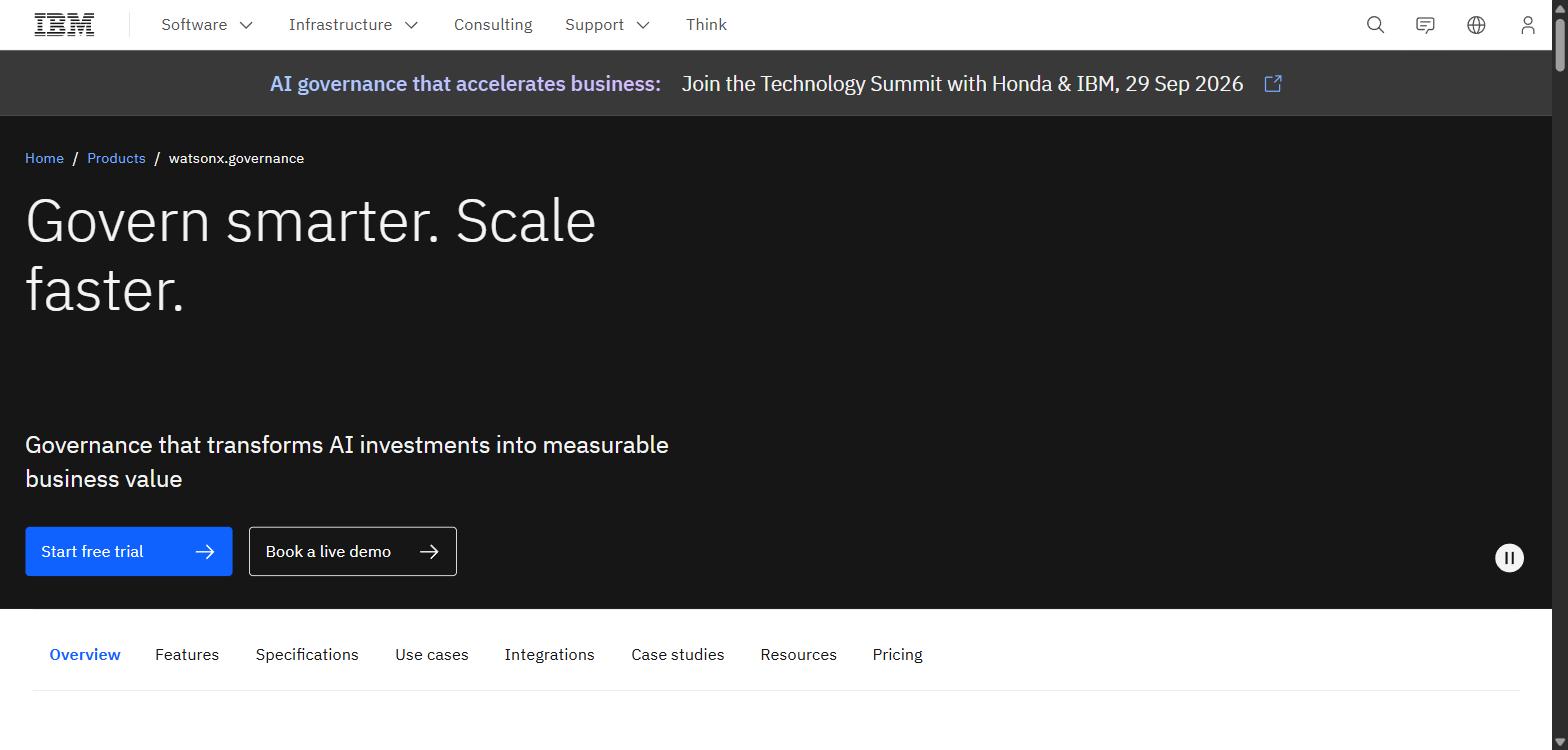
Screenshot of IBM's watsonx.governance product page, captured 2026-09-30, for informational purposes only.
IBM watsonx.governance is the broadest entry here, and it's explicit about the audience: enterprises managing many AI systems, with finance, risk and audit teams in the room. Its headline idea is a governance graph that shows the relationships between AI systems, risks, controls and policies, so a risk isn't a row in a sheet but a node connected to what's supposed to contain it.
On the six jobs, IBM's page covers most of them. It detects shadow AI, manages risk across the system lifecycle, monitors continuously for compliance and operational issues, and automates policy enforcement, obligation mapping and compliance evidence capture. It aligns to the EU AI Act, NIST AI and ISO 42001, and runs in cloud and on-premises environments.
IBM states it has been named a Leader in Gartner's Magic Quadrant, the IDC MarketScape and the Forrester Wave for AI governance, which is its own claim. It's also one of the few vendors here that publishes starting prices, and they're worth reading closely: the entry tiers include one module and one concurrent user, so treat "starting at" as a floor, not a budget.
Key features:
- Governance graph connecting AI systems, risks, controls and policies
- Shadow AI detection and lifecycle risk management
- Continuous monitoring plus policy enforcement and compliance evidence capture
- EU AI Act, NIST AI and ISO 42001 alignment
- Cloud and on-premises deployment, 14-day trial, AWS Marketplace listing
Pros
- Widest lifecycle coverage of any platform I checked, from discovery to evidence
- Published starting prices, rare in this category
- On-premises option for teams that can't send data to a SaaS tool
- Free 14-day trial lets you test before a sales cycle
Cons
- Built for enterprises with many AI systems; heavy for a small team
- Entry tiers cover one module and one concurrent user, so real deployments cost more than the "from" figure
- Prices are labeled indicative and vary by country
- Analyst placements are IBM's own statements
Pricing: IBM's pricing page lists Model Management from $0.64 (IBM Cloud, pay as you go), Risk & Compliance Basic from $3,500 a month (1 basic instance, 1 module, 1 concurrent user), Risk & Compliance Advanced from $6,450 a month, and an AWS Marketplace listing from $42,000. IBM notes prices are indicative and vary by country.
Best for: Large organizations that need discovery, risk, monitoring and evidence in one governed system.
2. ServiceNow AI Control Tower

Screenshot of ServiceNow's homepage, captured 2026-09-30, for informational purposes only.
ServiceNow's AI Control Tower is the governance pick for organizations that already run their operations on ServiceNow. It's framed around five verbs: discover, observe, govern, secure and measure. The discovery side finds AI assets deployed across the organization, including systems beyond ServiceNow, and ties them into the configuration data ServiceNow customers already maintain.
On risk, ServiceNow describes AI-driven risk assessment across models, datasets, prompts and classic machine learning, not only agents, with content packs for the EU AI Act and NIST AI RMF according to its own pages. The observe function adds continuous monitoring with live metrics and alerts in place of periodic audits.
Two caveats on my verification. ServiceNow's product page blocked my fetch, so I confirmed the capabilities from its May 2026 newsroom announcement and its own pages as surfaced in search. That announcement said enhancements would reach general availability in August 2026, so ask what's shipping today. And Gartner's 2026 AI governance Magic Quadrant names ServiceNow among its vendors, with search summaries placing it among the Leaders, a placement I couldn't confirm on ServiceNow's own page.
Key features:
- Discover, observe, govern, secure and measure across first-party and third-party AI
- AI-driven risk assessment across models, datasets, prompts and classic ML
- Content packs for the EU AI Act and NIST AI RMF
- Continuous monitoring with live metrics and alerts
- Cost tracking and ROI dashboards for AI spend
Pros
- Strongest fit when ServiceNow is already your system of record
- Covers AI deployed outside ServiceNow, not only inside it
- Continuous monitoring rather than periodic review
Cons
- Product page blocked automated fetch; some capability detail rests on the newsroom release
- Enhancements were scheduled to reach general availability in August 2026, so confirm current availability
- No published pricing
- Least compelling if you don't already use ServiceNow (my read, not a vendor statement)
Pricing: Not published.
Best for: Organizations standardized on ServiceNow that want AI risk managed in the same place as the rest of IT and risk.
3. Credo AI
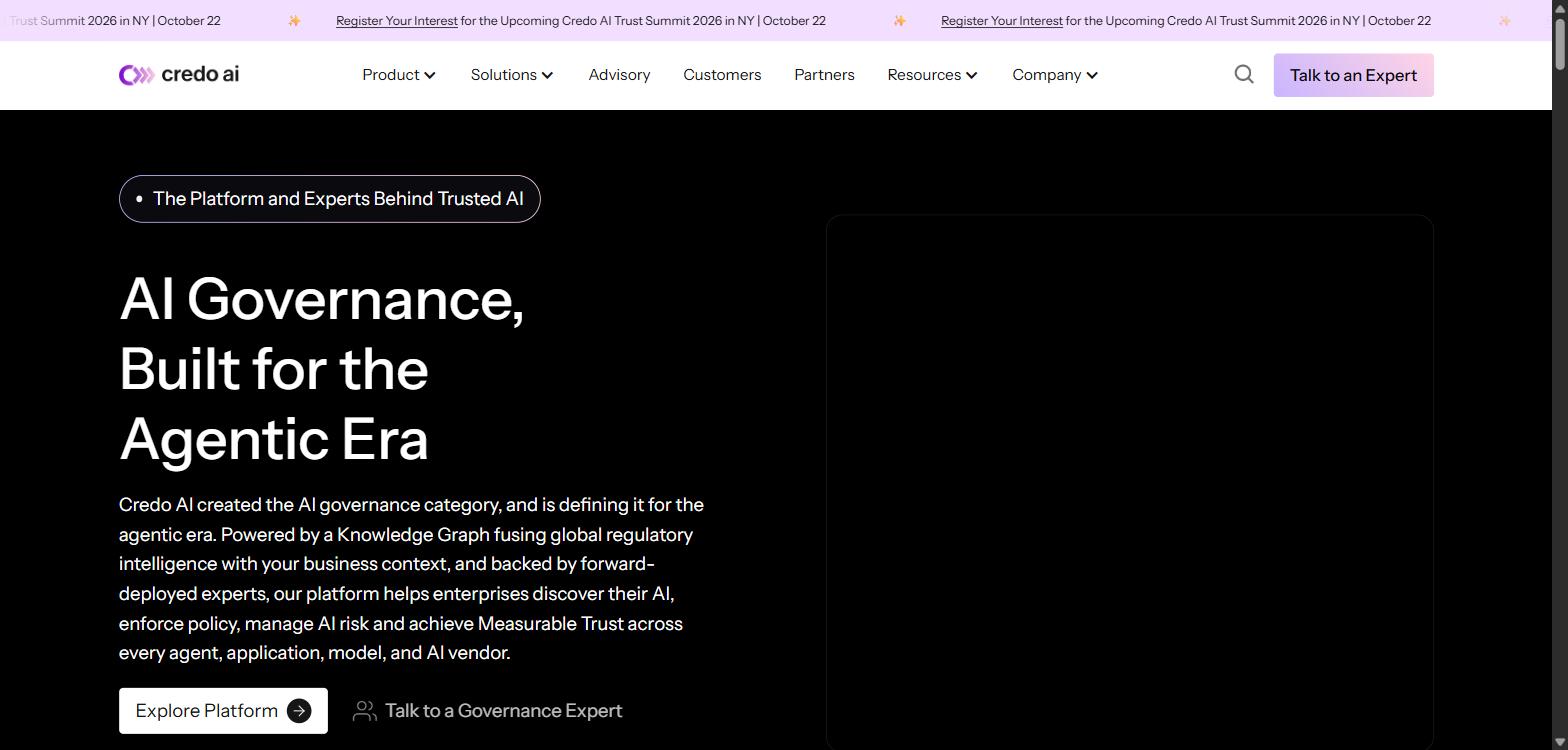
Screenshot of Credo AI's homepage, captured 2026-09-30, for informational purposes only.
Credo AI describes itself as "The Trusted Leader in AI Governance" and is the clearest example of the specialist layer. The platform is organized around an AI Registry that discovers and catalogs agents, applications, models and vendors (with shadow AI detection), a Risk Intelligence function for continuous assessment, and a Policy Engine with pre-built policy packs.
The policy packs are the headline for compliance-minded buyers: EU AI Act, NIST AI RMF, ISO 42001 and OMB M-25. Credo AI also lists integrations across Snowflake, Databricks, AWS, Azure, ServiceNow and Jira, so the registry can fill from where models and agents actually live.
Its homepage names customers including Mastercard, Microsoft, Autodesk, Amazon and Databricks, and cites a Forrester Wave Leader position. Search summaries of Gartner's 2026 AI governance Magic Quadrant list it as a Visionary. Pricing isn't on the site; the third-party estimate I found puts it at roughly $30,000 to $150,000 a year, which is an estimate, not a Credo AI figure.
Key features:
- AI Registry with shadow AI detection across agents, models, apps and vendors
- Continuous risk assessment with agentic risk controls
- Policy packs for EU AI Act, NIST AI RMF, ISO 42001 and OMB M-25
- Integrations with Snowflake, Databricks, AWS, Azure, ServiceNow, Jira
Pros
- Policy packs mean frameworks are built in, not hand-mapped
- Purpose-built for AI governance, not a bolt-on module
- Named enterprise customers on its own site
Cons
- No published pricing; third-party estimates start in the tens of thousands a year
- Built for enterprise governance teams, more than a startup needs
- Forrester and Gartner placements are reported by the vendor and third parties, not verified by me
Pricing: Not published. Third-party estimate of roughly $30K to $150K a year (Dupple), a third-party figure, not Credo AI's.
Best for: Mid-size and large organizations that need audit-ready AI governance with regulatory packs.
4. OneTrust AI Governance
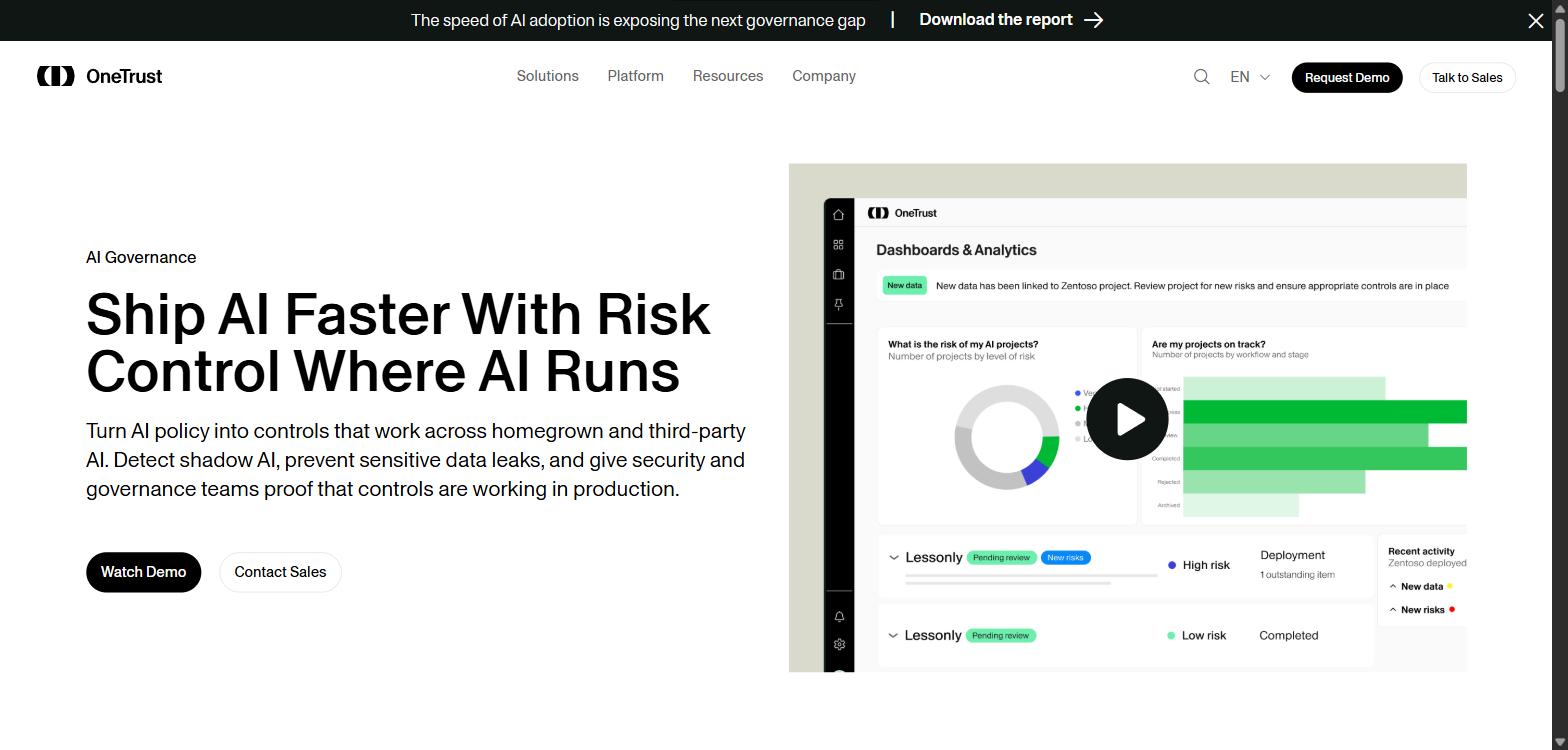
Screenshot of OneTrust's AI governance page, captured 2026-09-30, for informational purposes only.
OneTrust AI Governance extends a privacy and GRC platform many enterprises already run. Its pitch is "risk control where AI runs": translate AI policy into operational controls across homegrown and third-party AI systems.
The product page covers four jobs. Discovery and inventory continuously identify AI systems, models, agents, datasets and vendors, including shadow AI. Risk assessment applies built-in EU AI Act, NIST AI RMF and ISO 42001 frameworks and tiers risk by use case, system type and data sensitivity. Runtime monitoring observes model and agent behavior in Amazon Bedrock and Microsoft Foundry environments. Enforcement can filter prompts and outputs and block, redact or route actions by policy.
OneTrust states it was placed as a Visionary in Gartner's 2026 AI governance Magic Quadrant. The page is candid about its audience: security teams, governance councils, data teams and compliance leaders managing AI risk at enterprise scale. Its runtime monitoring is named for two environments, so check yours is one of them.
Key features:
- Continuous AI discovery and inventory, including shadow AI
- Risk tiering by use case, system type and data sensitivity
- Built-in EU AI Act, NIST AI RMF and ISO 42001 frameworks
- Runtime monitoring and prompt and output filtering
- Audit-ready documentation across assessment, approval and enforcement
Pros
- Covers discovery through enforcement in one product
- Natural extension for teams already on OneTrust's privacy or GRC tools
- Generates audit-ready records without manual reconstruction
Cons
- No published pricing
- Runtime monitoring is listed for Amazon Bedrock and Microsoft Foundry specifically
- Enterprise-scale platform; more process than a small team wants
- Gartner placement is OneTrust's own statement
Pricing: Not published.
Best for: Enterprises already on OneTrust that want AI risk in the same program as privacy and third-party risk.
5. Holistic AI
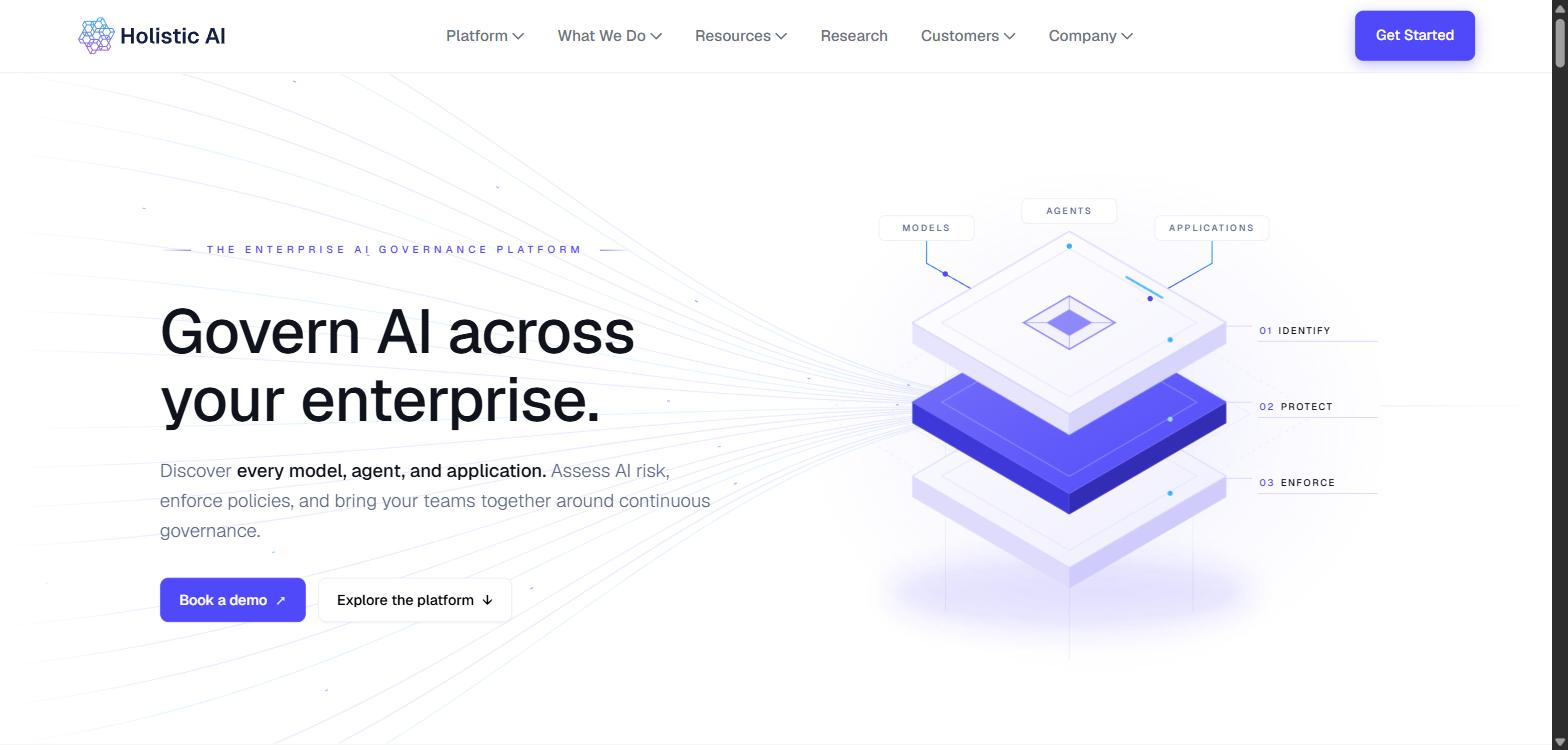
Screenshot of Holistic AI's homepage, captured 2026-09-30, for informational purposes only.
Holistic AI is the entry here that leans hardest into testing. Its site organizes the platform in three layers: identify (discover shadow AI and build a living inventory across AWS, Azure, GitHub, Databricks and 20+ integrations), protect, and enforce.
The protect layer is where it differs from pure governance suites: the page cites 40+ tests for bias, hallucination, privacy and robustness, plus red teaming for prompt injection and jailbreaks. The enforce layer maps controls to the EU AI Act, NIST AI RMF and ISO/IEC 42001, and its Guardian Agents provide real-time oversight for autonomous systems through observe, evaluate and intervene cycles.
Holistic AI lists customers including Publicis Groupe, Aon, Unilever, eBay and Siemens, and describes itself as a Challenger in Gartner's 2026 AI governance Magic Quadrant. No pricing is published.
Key features:
- Shadow AI discovery and a living AI inventory across cloud, repos and data platforms
- 40+ tests for bias, hallucination, privacy and robustness
- Red teaming for prompt injection and jailbreaks
- Controls mapped to EU AI Act, NIST AI RMF and ISO/IEC 42001
- Guardian Agents for real-time oversight of autonomous AI
Pros
- Combines governance with actual model testing and red teaming
- Discovery integrations across the main clouds and data platforms
- Named customers across industries on its own site
Cons
- No published pricing
- Enterprise-focused; the testing depth is more than most small teams will use
- The test suite's fit for your specific models needs a proof of concept
Pricing: Not published.
Best for: Enterprises that want discovery, bias and robustness testing, and framework mapping from one vendor.
6. ModelOp
Screenshot of ModelOp's homepage, captured 2026-09-30, for informational purposes only.
ModelOp approaches AI risk from the delivery side. It calls its product an Enterprise AI Command Center: a unified system of record for ML, generative, agentic and vendor AI that enforces policy at delivery time, rather than relying on manual committees to catch problems afterward.
That makes it the governance pick for organizations that build and ship a lot of models. Its portfolio view tracks cost, tokens, risk and ROI, it produces audit-ready evidence mapped to regulations and policies, and its lifecycle automation links to 50+ technologies across on-premises, cloud and hybrid environments.
ModelOp states it was named a Visionary in Gartner's 2026 AI governance Magic Quadrant and featured in Forrester's Responsible AI Landscape. The buyers it names are CIOs, CTOs, AI governance leaders and data scientists, which tells you the scale it expects.
Key features:
- Single system of record for ML, GenAI, agentic and vendor AI
- Policy enforced at delivery time, not after the fact
- Audit-ready evidence mapped to regulations and policies
- Portfolio view of cost, tokens, risk and ROI
- Integrations with 50+ technologies
Pros
- Governance wired into the delivery pipeline, not layered on afterward
- Covers vendor and agentic AI, not only in-house models
- Portfolio-level visibility for leadership
Cons
- No published pricing
- Designed for organizations industrializing AI delivery at scale
- Emphasis is lifecycle automation; less about framework-by-framework compliance packs than Credo AI or OneTrust
Pricing: Not published.
Best for: Model-heavy enterprises that want governance built into how AI gets delivered.
7. Lumenova AI
Screenshot of Lumenova AI's homepage, captured 2026-09-30, for informational purposes only.
Lumenova AI positions itself for agentic AI in regulated industries and says so directly: traditional model risk frameworks "were built for models that predict," while agents act autonomously across systems. Its platform has four functions: evaluate and validate, protect and guard, observe and monitor, and review and govern.
That spread covers a lot of the lifecycle in one product. Evaluations compare model versions and probe for accuracy, bias and robustness. Guardrails block harmful content and injections, with a policy engine for agent permissions and a self-hosted AI gateway for enforcement. Observability traces LLM interactions and attributes cost by agent and use case. The governance side adds an AI registry and audit-ready risk control documentation.
What I can't give you is proof points: Lumenova's page lists no pricing, no named customers and no analyst recognition, so the claims rest on the description alone. Ask for references.
Key features:
- Continuous evaluations and black-box probe evaluations
- Guardrails, agent permission policy engine and self-hosted AI gateway
- Real-time tracing, alerts and cost attribution by agent
- AI registry with dependency and lifecycle mapping
- Audit-ready risk control documentation
Pros
- Testing, enforcement, observability and governance in one product
- Self-hosted gateway option for enforcement
- Explicit focus on agentic AI in regulated sectors
Cons
- No pricing, named customers or recognition on its own page
- Less public validation than the larger vendors above it
- Regulated-enterprise orientation
Pricing: Not published.
Best for: Regulated teams deploying autonomous agents that want evaluation and governance from one vendor.
8. Vanta
Screenshot of Vanta's homepage, captured 2026-09-30, for informational purposes only.
Vanta is the compliance-platform entry most likely to already be on your shortlist, and it's a real option for AI risk if you're extending an existing program. Its risk management product gives you a central register with owners, inherent risk scoring, treatment plans and residual risk, with continuous insight into the controls and tests linked to each risk and a library of 100+ common risk scenarios.
On the AI side, Vanta supports NIST AI RMF, ISO 42001 and the EU AI Act. Its ISO 42001 page mentions AI-specific risk scenarios alongside mapped controls and templates, and lets you define which AI systems are in scope. Its AI security assessment tool is aimed at evaluating AI-related risk in third-party vendors.
Where it stops: the pages I read describe no dedicated AI system inventory, no discovery of shadow AI, and no model testing. That's the governance and runtime layers, which Vanta doesn't claim. Pricing isn't published on the pages I checked.
Key features:
- Risk register with owners, inherent and residual scoring, and treatment plans
- 100+ common risk scenarios, plus AI-specific scenarios on its ISO 42001 page
- NIST AI RMF, ISO 42001 and EU AI Act support
- AI security assessment for third-party vendors
- 400+ integrations across cloud, code, identity and devices
Pros
- Mature risk register connected to live control tests
- AI frameworks run on the same program as SOC 2 and ISO 27001
- AI-specific risk scenarios included, not left to you to write
Cons
- No dedicated AI system inventory, shadow AI discovery or model testing described
- No published pricing on the pages I checked
- AI risk is one module of a compliance platform, not a specialist product
Pricing: Not published on the pages I checked.
Best for: Teams already running SOC 2 or ISO 27001 on Vanta that want AI risk added to that program.
9. ComplyJet
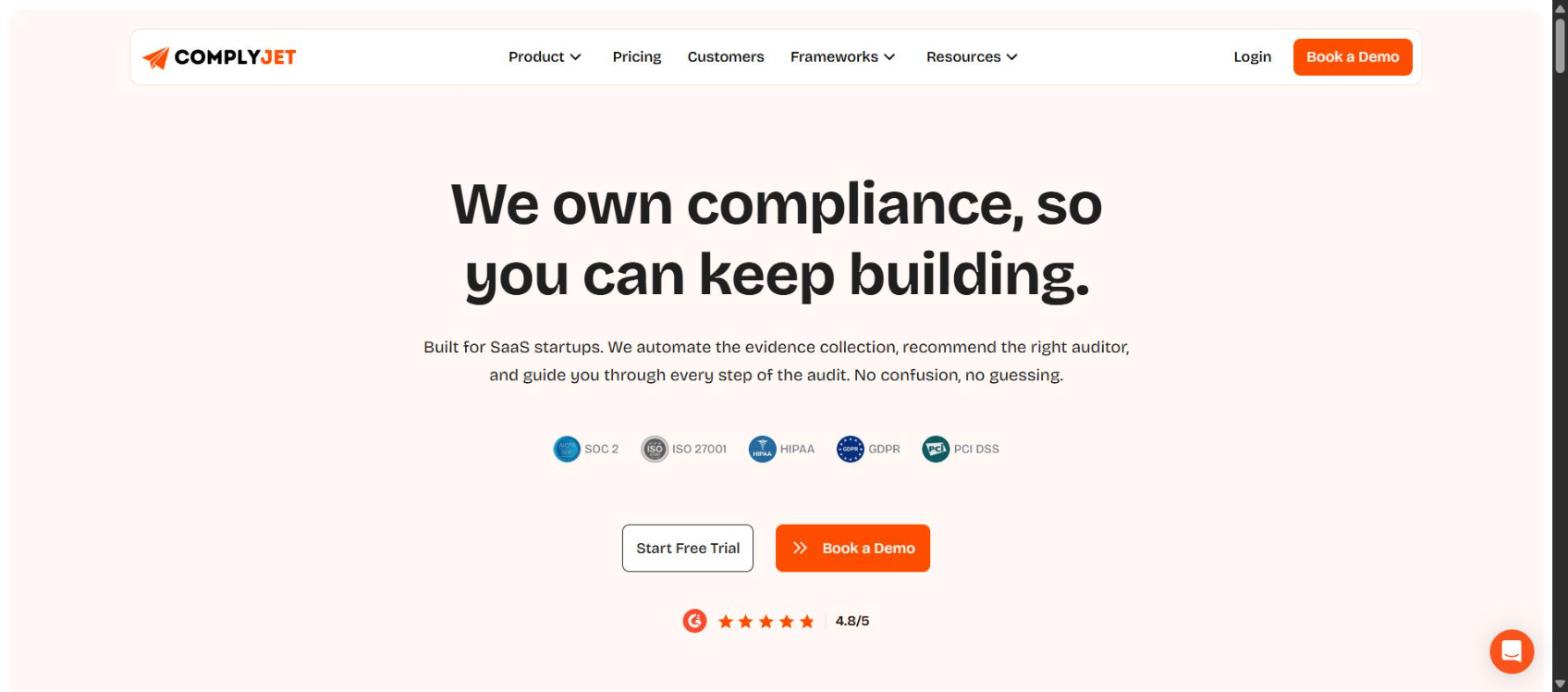
Screenshot of ComplyJet's homepage, captured 2026-09-30, for informational purposes only.
ComplyJet sits in the program-based layer, and I'd rather describe it accurately than flatter it. It's a compliance automation platform for early-stage startups, and its AI risk capability comes from two places: a general risk module and the AI-specific workflows inside its ISO 42001 offering. Its framework library lists NIST AI RMF ("framework for identifying and managing risk in AI systems"), ISO 42001 and the EU AI Act among 25+ frameworks.
The risk module is a live register in which each risk is scored on likelihood and impact, assigned an owner, linked to the controls that mitigate it, and tracked through mitigate, accept, transfer or avoid. Control gaps surface as risks automatically, and an annual assessment workflow covers the formal review auditors expect.
The AI-specific part lives on the ISO 42001 page: an AI risk assessment workflow covering harms, impacts and mitigations, AI impact assessments covering bias, transparency and fairness, and AI supply chain management to document your model providers, datasets and third-party AI components.
Vendor risk covers the AI tools you buy: a vendor inventory built from your integrations, tiering by data access and criticality, questionnaires with automated follow-up, and breach alerts. Support is a team that guides you through the process, and pricing is flat per company, published at $7,999/year Core and $9,999/year Plus on the 3-year plan, up to 50 employees, so it stays the same as a five-person team grows toward forty.
Here's where the depth stops, and it's why ComplyJet ranks 9th on a lifecycle yardstick. It doesn't discover shadow AI, test models for bias or robustness, red team them, or monitor model behavior at runtime. Its risk register page describes no AI-specific features of its own; the AI material is in the ISO 42001 workflows. If you need those technical layers, you'd pair it with a tool from the runtime layer or choose a governance suite.
Key features:
- Live risk register with likelihood-times-impact scoring, owners and treatment tracking
- Risks linked to controls; control gaps surface as risks automatically
- AI risk assessment workflow, AI impact assessments and AI supply chain management (ISO 42001)
- NIST AI RMF, ISO 42001 and EU AI Act in a 25+ framework library
- Vendor risk: inventory, tiering, questionnaires and breach alerts
- 350+ integrations, Trust Center, guided support
Pros
- Flat, published, per-company pricing, with no per-seat creep
- AI risk work sits on the same program as SOC 2 or ISO 27001 evidence
- A team that guides you through the process, useful for a first program
- Covers both your own AI risk and the AI vendors you buy from
Cons
- No shadow AI discovery or AI system inventory tooling
- No model testing for bias or robustness, and no red teaming
- No runtime monitoring or guardrails on model behavior
- AI-specific depth is limited to the ISO 42001 workflows; no standalone AI risk scenario library documented
- No Gartner or Forrester recognition in this category, and a smaller company with a shorter track record than Vanta
Pricing: $7,999/year Core and $9,999/year Plus on the 3-year plan, up to 50 employees, published at complyjet.com/pricing. Flat per company, not per seat.
Best for: Early-stage startups adding AI risk to a first compliance program who want it assessed, documented and reviewed by a team that guides them, not a specialist AI governance suite.
AI Risk, Inside Your Program
Want AI risk assessed on the same program as SOC 2?
ComplyJet runs a scored risk register and ISO 42001's AI risk assessment workflow alongside your existing evidence, at one flat price that stays the same as you grow within the plan.
10. Fiddler AI
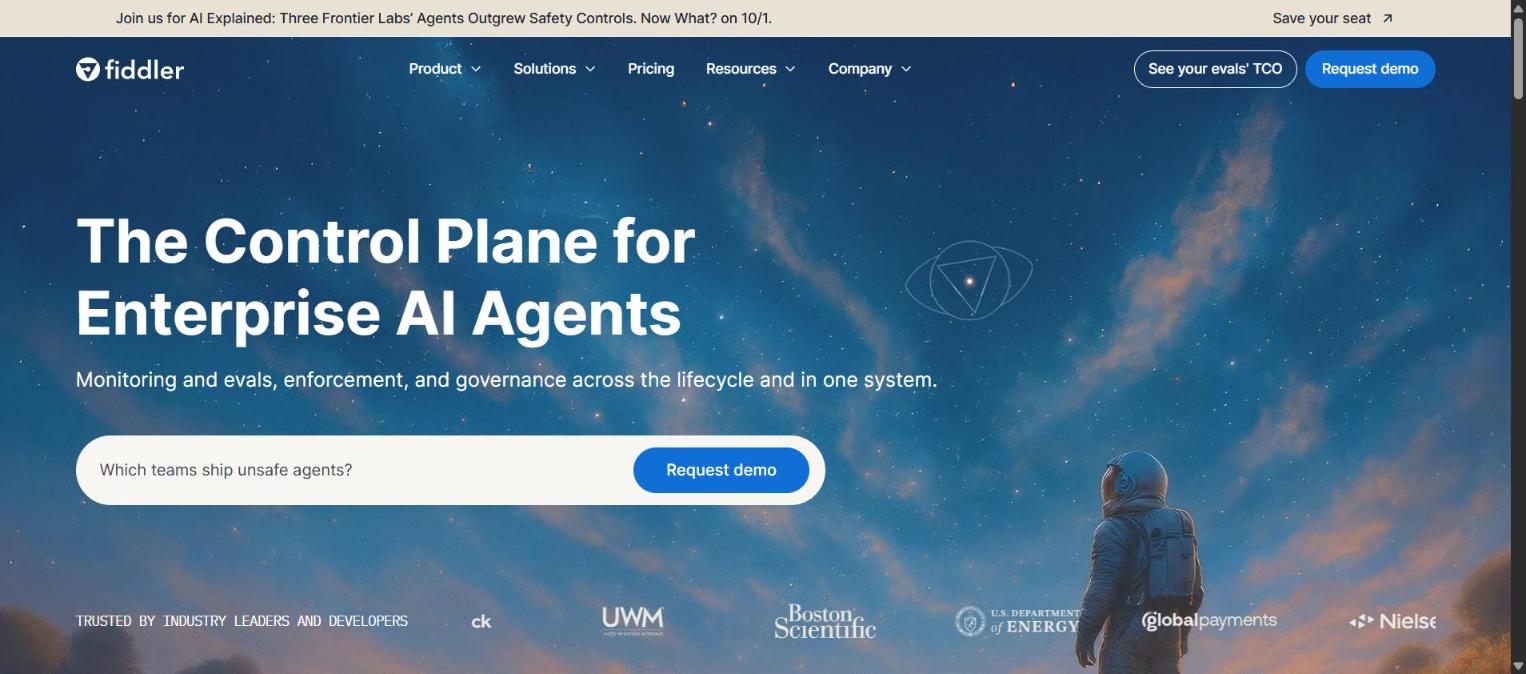
Screenshot of Fiddler AI's homepage, captured 2026-09-30, for informational purposes only.
Fiddler describes itself as an AI control plane for monitoring, evaluating, enforcing policy on and governing AI agents across their lifecycle. It's the observability end of this market: a single dashboard across first-party, third-party and coding agents, tracking every action, token and dollar by user and team.
Its page covers continuous evaluations from testing through production and inline guardrails at the request and response path (it cites sub-80ms latency) that detect and block PII, PHI, secrets, jailbreaks and prompt injections. Enforcement decisions are recorded for compliance, so there's an evidence trail, though the page leads with observability rather than framework packs or a risk register.
Fiddler is one of the only vendors here with a transparent entry point: a free tier with basic guardrails, a Developer tier at $0.002 per trace, and custom Enterprise. Named customers include Nielsen, Mastercard, Ally and American Family Insurance.
Key features:
- Unified observability across agents, with usage tracked by user and team
- Continuous in-environment evaluations
- Inline guardrails for PII, PHI, secrets, jailbreaks and prompt injection
- Enforcement decisions recorded for compliance and audit
- Free, usage-based Developer and custom Enterprise tiers
Pros
- Low-friction entry with a free tier and published per-trace pricing
- Strong on runtime monitoring and evaluation
- Named financial-services and insurance customers
Cons
- Not a framework-pack or risk-register product; it covers monitor, test and enforce
- Aimed at engineering, data and platform teams more than GRC
- Does not replace a governance record of who approved which AI and why
Pricing: Free tier (basic guardrails), Developer at $0.002 per trace, Enterprise custom, per Fiddler's own pricing section.
Best for: Engineering teams that need to monitor, evaluate and guard agents in production.
11. Lakera
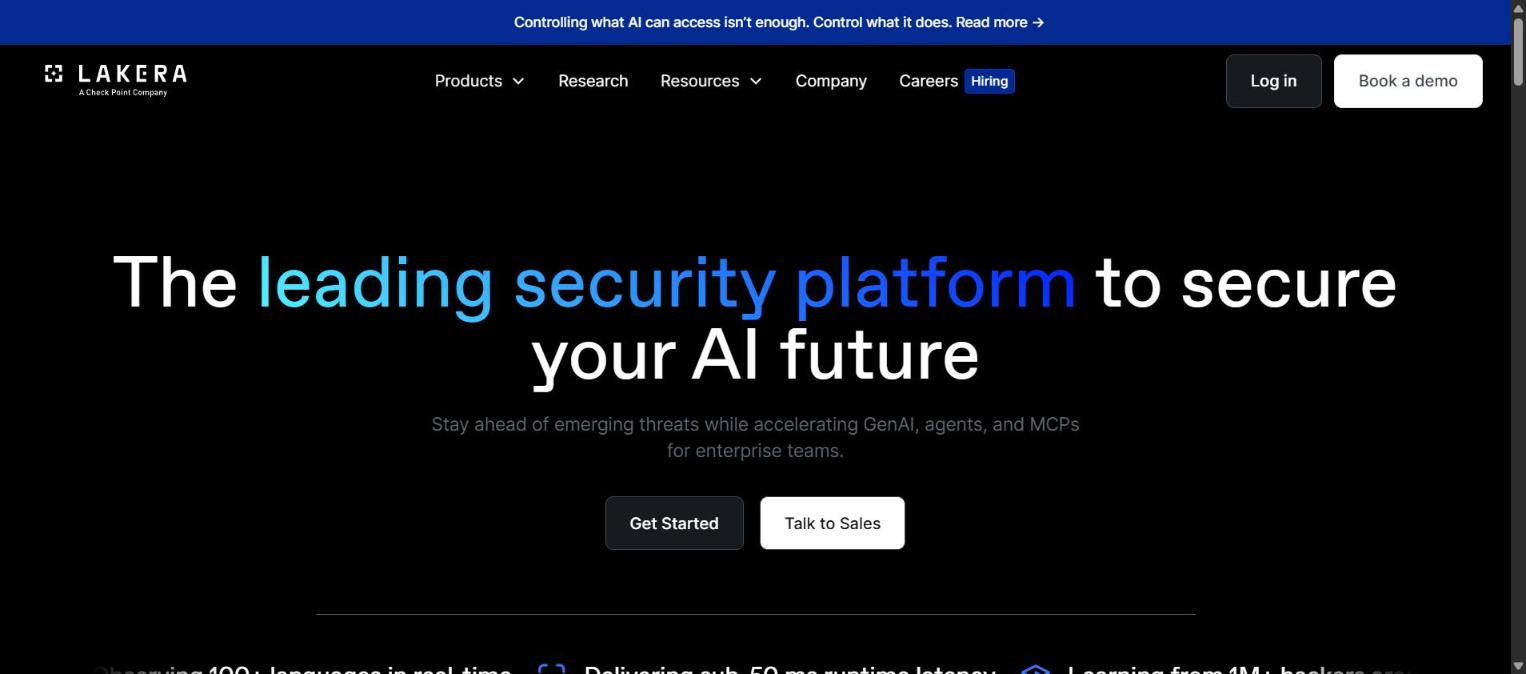
Screenshot of Lakera's homepage, captured 2026-09-30, for informational purposes only.
Lakera is the narrowest entry and, for the right team, the most immediately useful. It's an AI-native security platform with two offerings: Lakera Guard for runtime protection, and red teaming for risk-based adversarial testing of generative AI applications.
Guard addresses prompt injection, data leakage and jailbreaks in real time; Lakera cites sub-50ms latency, support for 100+ languages and a 0.01% production false positive rate, all vendor-reported figures worth testing on your traffic. Named customers include Dropbox, Pearson, Hinge Health and Nubank. The site footer carries Check Point Software Technologies copyright and privacy links, which points to Check Point ownership.
What Lakera won't do is tell you which AI systems you have, score their risk against a framework, or produce a governance record. It's the enforcement layer, and as one Hacker News commenter argued about a related problem, rule-catching alone is hard:
“Trying to catch it all with DLP rules is like trying to catch water with a colander.” craftkiller, Hacker News, October 2025 (thread), on data loss prevention rules and employee AI use
Key features:
- Lakera Guard: runtime detection of prompt injection, data leakage and jailbreaks
- Red teaming and vulnerability management for GenAI applications
- API-first, cloud-native, 100+ languages and multimodal attacks
- Start for free access
Pros
- Fast to add in front of an LLM application
- Free way to start, so you can test before buying
- Covers adversarial testing as well as runtime defense
Cons
- Security only; no inventory, governance records or framework mapping
- Latency and false positive figures are vendor-reported
- Pricing beyond the free start isn't published on the site
Pricing: "Start for free" access; further pricing not published on the site.
Best for: Teams shipping LLM applications, agents or chatbots that need runtime defense and adversarial testing.
How to Choose AI Risk Management Software
The rank above is about breadth. How to choose AI risk management software is a different question, about which risk you actually have, and most buyers have fewer than the category implies.
Best AI Risk Management Software Starts With the Risk You Need to Reduce
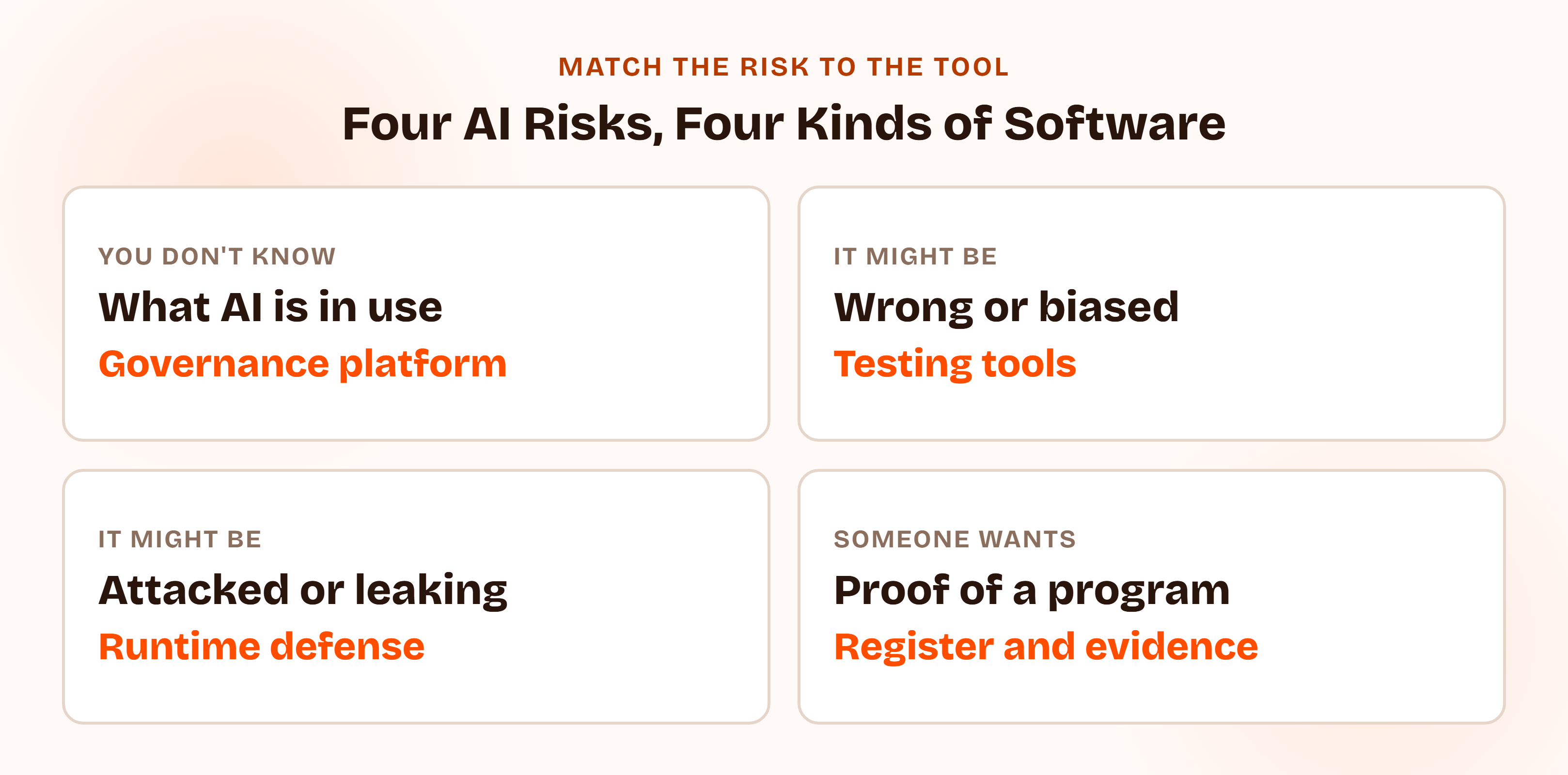
Four different risks map to four different tools, and buying for the wrong one is the easiest mistake to make:
- You don't know what AI is in use. You need inventory and discovery first. That's the governance layer (IBM, ServiceNow, Credo AI, OneTrust, Holistic AI, ModelOp, Lumenova).
- Your AI might be wrong, biased or unfair. You need testing. Holistic AI and Lumenova test; Fiddler evaluates in production.
- Your AI might be attacked or leak data. You need runtime defense. That's Lakera, Fiddler's guardrails, and the enforcement features in OneTrust and Lumenova.
- A customer or auditor wants proof you have a program. You need framework support, an assessment, a register and evidence. That's the program-based layer (Vanta, ComplyJet), and the policy packs in the governance suites.
Do Startups Need the Best AI Risk Management Software or a Program Inside Compliance?
For most early-stage teams, the honest answer is a program inside compliance. If you have under 50 people and a handful of AI tools, what customers and auditors usually ask for is an AI policy, a written risk assessment of your AI use, a register with owners, and a review of the AI vendors you rely on. You can get that from AI risk assessment software built into a compliance platform, without a six-figure governance platform.
That changes when you build and ship models or agents at scale, sell into regulated sectors that ask for testing evidence, or have so many AI systems that a spreadsheet can't stay current. Then a specialist layer earns its cost. Many teams end up with both: a program-based platform as the system of record and a runtime tool for the engineering risk.
A Program, Not a Platform Purchase
Need the AI risk assessment your customers are asking for?
ComplyJet covers the risk register, the ISO 42001 AI risk assessment workflow and vendor review for the AI tools you buy, with a team that guides you through it.
What AI Risk Management Tools Cost
Most of this market is quote-only, so published numbers are worth collecting. IBM lists indicative starting prices from $3,500 a month for its Risk & Compliance Basic tier, with an AWS Marketplace listing from $42,000. Fiddler publishes a free tier and $0.002 per trace for its Developer tier. ComplyJet publishes $7,999 and $9,999 a year on the 3-year plan, for up to 50 employees.
For Credo AI, the only figure I found is a third-party estimate of roughly $30,000 to $150,000 a year. Every other vendor here asks you to talk to sales. Budget for a proof of concept on your own systems before committing, because coverage claims are easy to make on a page and hard to verify until your own models are connected.
Paperwork or a Working AI Risk Program?
The failure mode worth guarding against isn't buying the wrong tool, it's buying a tool that produces documents nobody uses. A Hacker News commenter reacting to an ISO 42001 write-up put the skeptic's version bluntly:
“the company will be happy to put the "iso" sticker, and will stash the thousand page documents in a drawer with no one reading it” greatgib, Hacker News, November 2025 (thread)
That's a fair warning, not a verdict. What separates a program from a drawer is mundane: every risk has an owner, scores get reassessed on a schedule, findings lead to treatment decisions, and the evidence updates as your AI use changes. When you demo any platform, ask to see a risk being reassessed and an old assessment being updated, not just the dashboard.
Bring Your Own AI Stack
Not sure which lane you're in?
Talk to ComplyJet about which AI risks belong in your compliance program and which need a specialist tool, with flat per-company pricing and a team that guides you through the process.
FAQs
What Is AI Risk Management Software?
It's software that helps you find the AI systems you build or use, assess their risks, test and monitor them, and document what you did. Products vary in which of those jobs they cover, from governance suites that do most of them to runtime tools that do one.
What Is AI TRiSM?
AI TRiSM stands for AI trust, risk and security management, Gartner's label for the tools and practices that keep AI safe, secure and aligned with organizational intent. Gartner's 2025 market guide on it and its 2026 Magic Quadrant for AI governance platforms describe overlapping markets.
What Is the Difference Between AI Risk Management and AI Governance Software?
In practice, very little at the top of the market: governance platforms include risk assessment, and risk platforms include policy. The useful distinction is the layer, governance and inventory versus runtime testing and defense versus a risk register inside a compliance program.
What Is the Best AI Risk Management Software for Startups?
For most early-stage teams it's a risk register and AI risk assessment inside the compliance platform they already use or are choosing, such as ComplyJet or Vanta, with a runtime tool like Lakera or Fiddler added only if engineering risk demands it. Enterprise governance suites are usually more than a startup needs.
Does the Best AI Risk Management Software Help With the EU AI Act?
Several platforms ship EU AI Act content: Credo AI, OneTrust, Holistic AI, IBM and ServiceNow reference it on their own pages, as do Vanta and ComplyJet at the framework level. Software helps you inventory and document systems and map requirements, but classification and legal interpretation still need a person, and ideally counsel.
Can a Compliance Platform Handle AI Risk Management?
Yes for the program side: a risk register, framework support for NIST AI RMF or ISO 42001, AI impact assessments and vendor review. No for the technical side: discovering shadow AI, testing models and monitoring runtime behavior are specialist functions most compliance platforms don't claim.
What Is the NIST AI RMF?
It's NIST's voluntary AI Risk Management Framework, released on 26 January 2023 and organized around four functions: Govern, Map, Measure and Manage. NIST added a Generative AI profile in July 2024 and says the framework is being revised as part of the White House AI Action Plan. As one Hacker News commenter put it, "there are no widely agreed upon standards for AI use," which is why teams anchor on frameworks like this one.
How Much Does AI Risk Assessment Software Cost?
It ranges from free tiers and flat startup pricing to six figures a year. IBM lists indicative tiers from $3,500 a month, Fiddler starts free, ComplyJet is $7,999 to $9,999 a year on the 3-year plan, and Credo AI is estimated by a third party at $30,000 to $150,000 a year.
Final Thoughts on the Best AI Risk Management Software
The market for AI risk management platforms is really three markets. Governance suites cover the widest lifecycle and are built and priced for enterprises. Runtime tools go deep on one layer and suit engineering teams. Program-based platforms give you the register, the framework and the evidence, which is often what a customer or auditor is actually asking for.
If you're a large organization with many AI systems, start with IBM, ServiceNow, Credo AI, OneTrust or Holistic AI and run a proof of concept. If you ship LLM applications, add Lakera or Fiddler. If you're an early-stage team answering a first AI questionnaire, start with the risk assessment and register inside your compliance program, and buy more only when the risk demands it.
Free Demo
See how ComplyJet handles AI risk for a startup.
Talk to ComplyJet about the risk register, NIST AI RMF and ISO 42001 support, and what a flat per-company price looks like for your team.
Related Reading on the Best AI Risk Management Software
- Best AI Compliance Software, for platforms where the AI does your compliance work rather than governs your own AI.
- Best ISO 42001 Software: 12 AI Governance Platforms Compared, for the certification side of AI governance.
- Best Risk Assessment Tools, for ordinary business and security risk assessment.
- Best Vendor Risk Management Software, for reviewing the AI vendors you buy from.
- AI Governance Policy, for the program document most AI reviews ask for first.
- Best GRC Software, for teams weighing a wider governance, risk and compliance platform.
Sources: Vendor capabilities read from each vendor's own pages on 2026-09-30: IBM watsonx.governance and pricing, ServiceNow newsroom, May 2026, Credo AI, OneTrust AI Governance, Holistic AI, ModelOp, Lumenova AI, Fiddler, Lakera, Vanta risk management and Vanta ISO 42001, and ComplyJet's risk management, vendor risk, frameworks, ISO 42001 and pricing pages.
Analyst context: Holistic AI on the 2026 Gartner Magic Quadrant, OneTrust on the same report, HiddenLayer on the AI TRiSM market guide, and NIST AI RMF. The third-party price estimate for Credo AI comes from Dupple's 2026 roundup, flagged in-text as third-party.