.svg)

You’re shopping for GRC software, and the market looks like this: ten tools all claiming to be “the most comprehensive governance, risk, and compliance platform available,” none of them willing to show you a price without a 30-minute discovery call. The category spans from $5,000-a-year startup tools to six-figure enterprise platforms, and they all use the same marketing language.
I reviewed 10 GRC software and tools across the full spectrum, from enterprise suites like OneTrust to startup-focused platforms built for first-time compliance. I looked at framework coverage, integration depth, pricing transparency, implementation lift, and what support actually looks like once you’ve signed the contract. Here’s what I found.
The GRC gap: why most compliance teams outgrow spreadsheets faster than they expect
Most compliance programs start the same way: one audit, a shared Google Sheet, and the assumption that this won’t get more complicated. Then a second framework shows up. Then a vendor questionnaire. Then a board that wants a risk dashboard. By the time the spreadsheet has 14 tabs and nobody’s sure which version is current, the case for GRC software writes itself.
Key insight
GRC tools differ fundamentally in their starting point: some built up from audit management, others from risk quantification, others from compliance automation — and that origin shapes everything about how they work.
GRC stands for governance, risk, and compliance. Governance is who owns decisions, risk is what could go wrong, and compliance is whether you’re meeting your obligations across frameworks like SOC 2, ISO 27001, GDPR, or NIST. GRC software brings those three functions into one place: it centralises your controls, automates evidence collection, connects risk findings to compliance obligations, and gives leadership real-time visibility instead of a spreadsheet snapshot from three weeks ago.
The tools differ significantly in how they approach this. Some are audit management systems built up into GRC. Others are risk platforms that added compliance modules. And a growing set are compliance-first tools targeting startups not ready for an enterprise suite. Knowing which category a vendor actually lives in matters more than reading their feature checklist. For context on how GRC relates to integrated risk management, see our GRC vs IRM breakdown.
How we evaluated these 10 GRC tools
Not all GRC software solves the same problem. Here’s what I weighted in this review:
Why it matters
The six criteria that separate genuinely useful GRC software from platforms that look good in demos: framework coverage, integration depth, risk maturity, implementation lift, pricing model, and support quality.
- Framework coverage: How many standards does it support natively, and are they maintained when frameworks update?
- Integration depth: Does it connect automatically to your actual stack (cloud infrastructure, HR, ticketing, identity), or does it rely on manual uploads?
- Risk management maturity: Is this a real risk management tool, or a compliance checklist with a “risk” tab added on?
- Implementation lift: How long before you’re actually getting value? Six weeks of professional services or a working setup in days?
- Pricing model: Per-seat? Flat-rate? Enterprise contract? Transparency matters more than most vendors admit.
- Support quality: Does the vendor guide you to outcomes, or hand you a knowledge base and call it onboarding?
Quick comparison: best GRC software at a glance
| Tool | Best for | Pricing | Standout feature |
|---|---|---|---|
| OneTrust | Enterprise privacy + AI governance | Contact for pricing | Unified AI, privacy, and tech risk in one platform |
| Optro (AuditBoard) | Enterprise SOX + internal audit | Contact for pricing | Trusted by 50%+ of Fortune 500; 140K+ GRC users |
| Hyperproof | Mid-market, 5+ frameworks | Contact for pricing | 140+ frameworks; cross-framework control reuse |
| LogicGate Risk Cloud | Configurable enterprise GRC | Contact for pricing | Gartner MQ + Forrester Wave Leader |
| Vanta | Automated continuous compliance | Contact for pricing | 400+ integrations; 2,352+ reviews |
| ComplyJet | Startups, first compliance | From $5,000/year | Flat pricing; team-guided outcomes; 350+ integrations |
| Drata | Deep integrations, AI-first | Contact for pricing | Agentic compliance; 8,000+ customers; 4.8/5 rating |
| Sprinto | Cloud-first startups | Contact for pricing | Audit-ready in 25-30 days; 4.8/5 across 1,563 reviews |
| Scrut Automation | Multi-framework SMBs | Contact for pricing | Highest-rated in list: 4.9/5 across 1,298 reviews |
| Secureframe | CMMC + structured teams | Contact for pricing | SSP + POA&M built into the Defense plan |
ComplyJet handles the entire compliance stack — policies, controls, evidence collection, and your SOC 2 or ISO 27001 audit. Book a free demo to see it in action.
The 10 best GRC software & tools in 2026
1. OneTrust
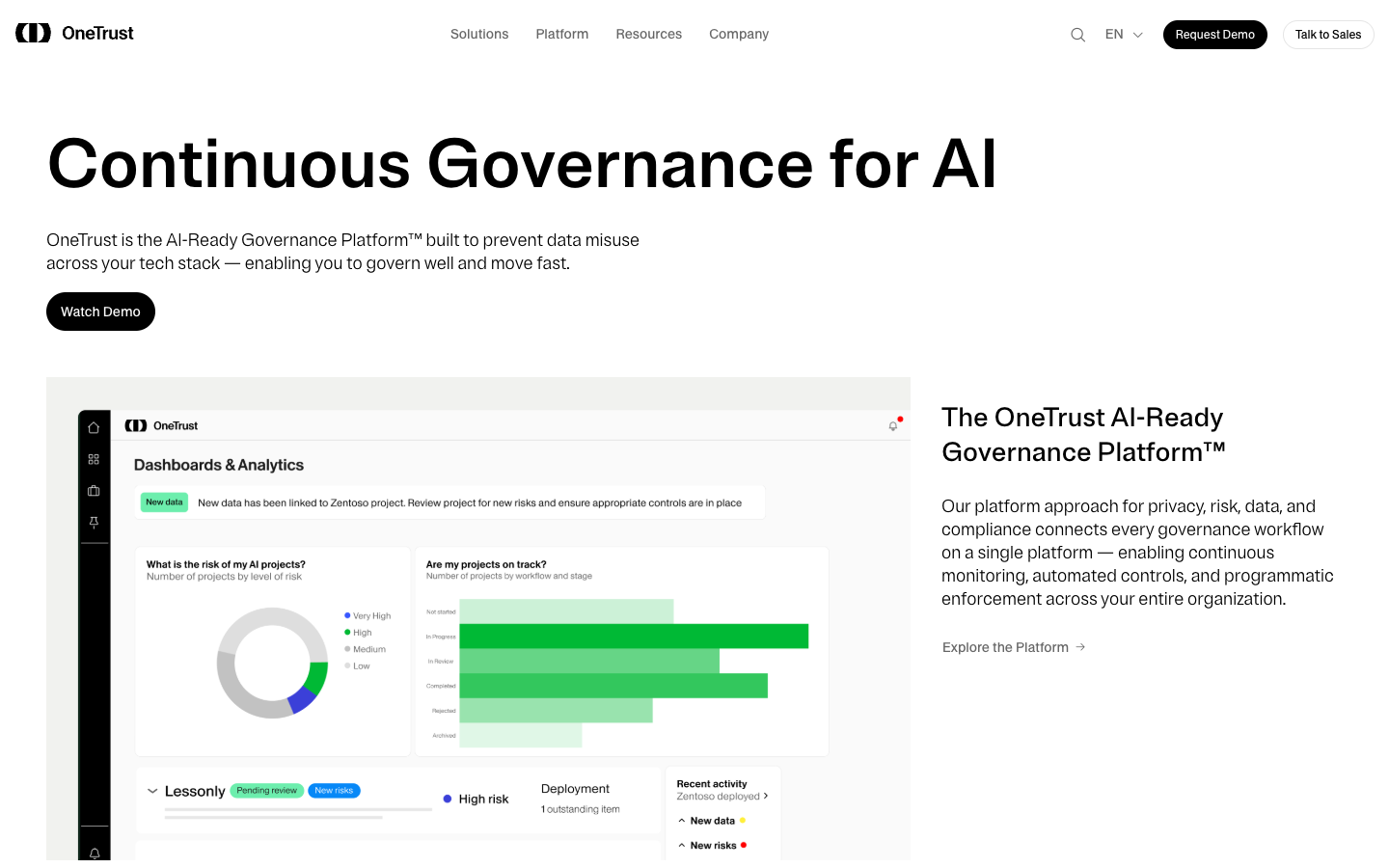
OneTrust is what happens when a privacy compliance tool spends a decade expanding into everything. It started as a consent management platform and grew into a full governance suite covering privacy automation, AI governance, tech risk and compliance, and third-party management. If you’re running a large enterprise with active obligations under GDPR, DORA, and the EU AI Act, OneTrust is one of the only platforms that tries to unify all of that under one roof.
The AI Governance module is the most differentiated piece right now: it embeds compliance controls into AI development workflows, which matters for any company needing to comply with the EU AI Act or ISO 42001. The third-party management module automates vendor intake, risk assessment, and ongoing monitoring, which at enterprise scale is genuinely difficult to do well.
The honest caveat is that OneTrust is not plug-and-play. Stuart H., a Data Privacy Consultant at a 1,000-plus employee company, put it clearly: the platform “brought structure and consistency to privacy operations” but is “not plug-and-play” and “demands significant technical investment.” Advanced modules carry extra costs on top of the base, so total cost can surprise you if you scope loosely.
“
A strong platform for managing privacy and compliance work. It brought structure and consistency to privacy operations, especially for DPIAs, vendor management, and internal policy enforcement. Not plug-and-play — it demands significant technical investment and has a steep learning curve.
★★★★★Stuart H.· 1,001–5,000 employees
Via Capterra ↗Key features:
- AI Governance module for compliance across the AI development lifecycle
- Data Use Governance with real-time policy enforcement
- Tech Risk and Compliance lifecycle management
- Third-Party Management: automated vendor intake, assessment, and mitigation
- Consent and Preferences management for consumer transparency
Pros of OneTrust
- One of the only platforms unifying privacy, AI governance, and tech risk in a single suite
- Strong coverage for GDPR, DORA, and EU AI Act obligations
- Scales well for enterprises managing global privacy programs
Cons of OneTrust
- Steep learning curve; significant technical investment required to configure
- Advanced modules priced separately, total cost escalates quickly
- Not suited to startups or lean teams without dedicated admin resources
Pricing: Contact for pricing. Advanced modules billed separately.
Best for: Large enterprises with active obligations under multiple privacy and AI governance regulations.
2. Optro (formerly AuditBoard)
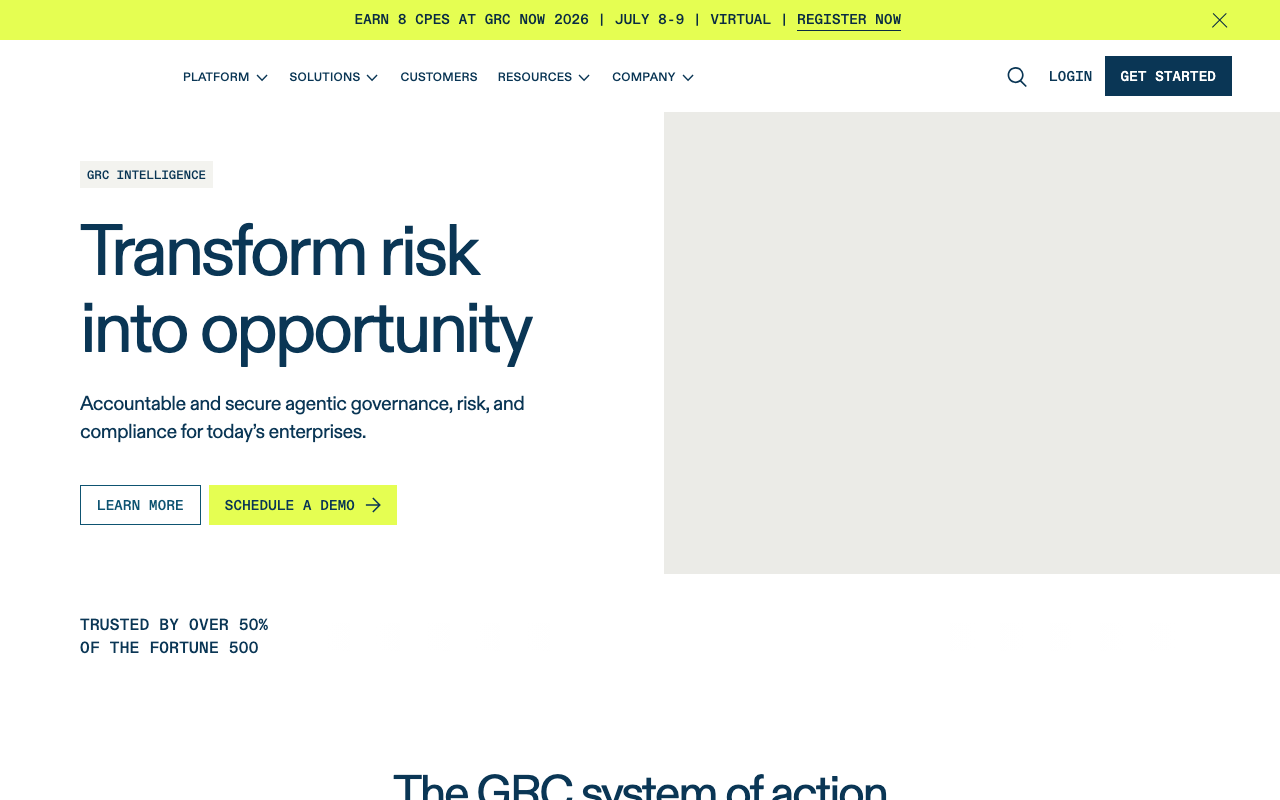
Optro rebranded from AuditBoard in March 2026, signalling a deliberate shift from audit management software to an AI-powered connected risk platform. The underlying product is unchanged, and that’s a good thing. More than 50% of the Fortune 500 use it, and 140,000 GRC professionals rely on it daily. That install base alone tells you where it sits in the enterprise stack.
It’s strongest for companies running SOX compliance, internal audit, and enterprise risk management. The audit workflow is genuinely excellent: centralised workpapers, automated PBC requests, real-time dashboard visibility, and 30-plus preloaded frameworks. The AI-powered insights layer handles complexity most tools approximate.
Dave E., a Sr. Manager of Internal Audit at a 1,000-plus employee company, described it well: “We’ve loved having AuditBoard as our GRC platform. Since moving to the platform, we’ve been able to simplify our testing and provide insight to the business.” The flip side: initial setup is complex, and if you’re not running a formal internal audit program, much of what Optro offers is more than you’ll use.
“
We've loved having AuditBoard as our GRC platform. Since moving to the platform, we've been able to simplify our testing and provide insight to the business.
★★★★★Dave E.· 1,001–5,000 employees
Via Capterra ↗Key features:
- AI-powered risk insights and audit fieldwork automation
- 30+ preloaded compliance frameworks
- Customisable reporting dashboards with real-time visibility
- Continuous monitoring with population-wide data evaluation
- Community access for 9,000+ GRC practitioners
Pros of Optro (formerly AuditBoard)
- Dominant enterprise install base; trusted by Fortune 500 for SOX
- Excellent audit workflow automation and workpaper management
- Strong AI layer for risk insights and cross-team reporting
Cons of Optro (formerly AuditBoard)
- Complex initial setup; expect a significant onboarding period
- Enterprise-only pricing with no public rates
- Overkill for companies not running formal internal audit or SOX programs
Pricing: Contact for pricing.
Best for: Enterprises running SOX compliance, internal audit, and connected risk programs.
3. Hyperproof
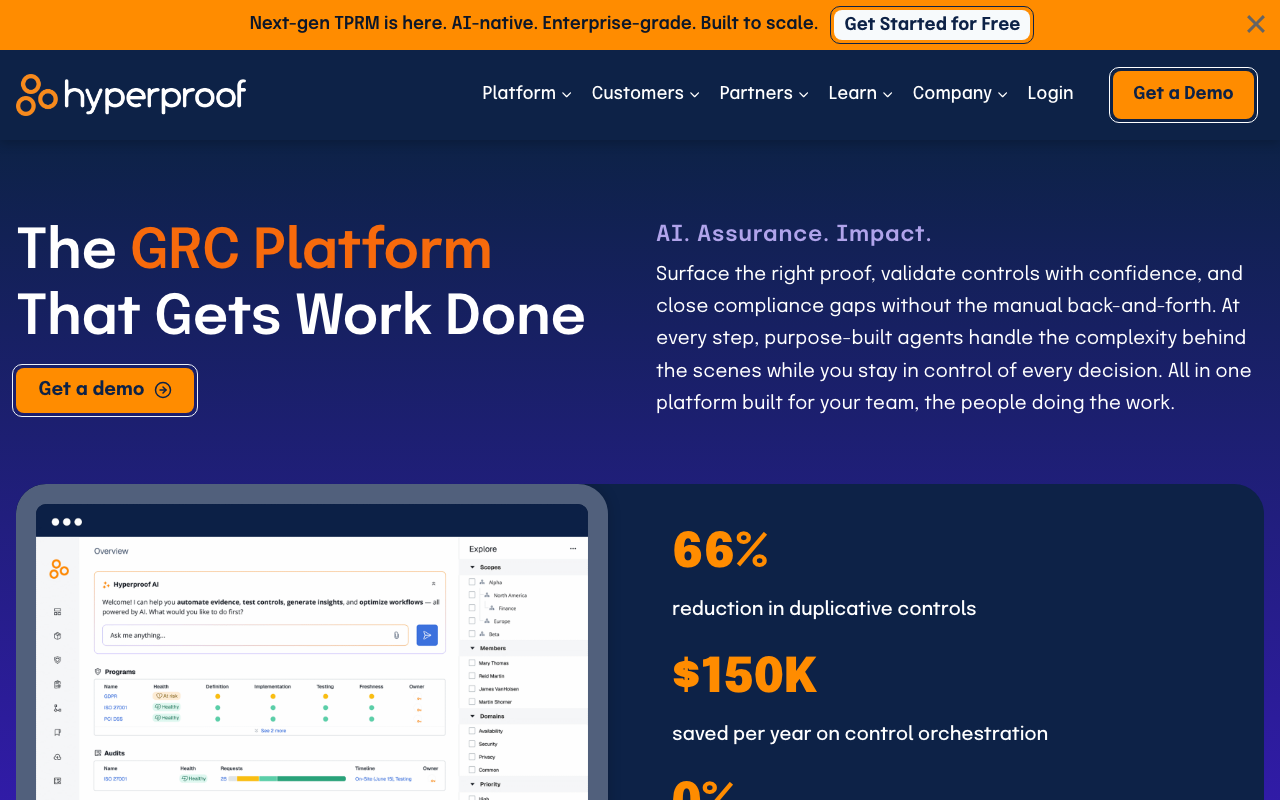
Hyperproof is the platform I’d point mid-market compliance teams to when they’re managing more than three frameworks and spending too much time re-collecting evidence for each audit cycle. The core value is cross-framework control mapping: map a control once and it satisfies requirements across SOC 2, ISO 27001, NIST, PCI DSS, and however many other frameworks you’re tracking. At 140-plus supported frameworks, you’re unlikely to find a gap.
The AI layer handles compliance monitoring, risk identification, and issue tracking. The platform serves 350-plus organisations including Reddit, Nutanix, and Fortinet, and earned the Capterra Shortlist and Software Advice FrontRunner recognition for 2026. Our Hyperproof review goes deeper on where it fits versus alternatives.
Tyler M., an IT Auditor who uses the platform, captured what makes it stick: “The ability to map controls and reuse evidence reduces duplication and helps streamline audit preparation.”
“
The ability to map controls and reuse evidence reduces duplication and helps streamline audit preparation.
★★★★★Tyler M.
Via Capterra ↗Key features:
- Cross-framework control mapping: satisfy multiple standards from a single control
- AI-powered compliance management and risk identification
- Automated evidence collection linked directly to controls
- Third-party vendor risk monitoring
- 140+ compliance frameworks supported out of the box
Pros of Hyperproof
- Best-in-class cross-framework control reuse for multi-standard programs
- Strong audit evidence automation across 140+ frameworks
- Recognised by Capterra and Gartner for compliance and audit management
Cons of Hyperproof
- No public pricing; deployment requires meaningful time investment upfront
- Reporting customisation is limited for complex use cases
- Steeper learning curve for teams new to structured GRC tooling
Pricing: Contact for pricing.
Best for: Mid-market organisations managing five or more compliance frameworks simultaneously.
4. LogicGate Risk Cloud

LogicGate Risk Cloud is the GRC platform that compliance engineers love and first-time buyers find initially overwhelming. Thirty-plus pre-configured applications, a no-code graph database for custom workflows, Spark AI for process automation, and Risk Cloud Quantify® for Monte Carlo financial risk modelling: it is a genuinely deep platform. The recognition backs it up. Gartner Magic Quadrant Leader, Forrester Wave Leader for Third-Party Risk Management (Q1 2026), and G2 Leader for 27 consecutive quarters. Our LogicGate review covers the details.
Lori B., VP of Risk Compliance at a legal services firm, described it plainly: “Great partnership and love the product. Very customizable! The possibilities are endless!” The caution is embedded in that sentence too. “Endless” customisation requires someone to do the configuring. Teams without dedicated GRC admin resources will feel that weight during setup.
“
Great partnership and love the product. Very customizable! The possibilities are endless!
★★★★★Lori B.· Legal Services
Via Capterra ↗Key features:
- 30+ pre-configured GRC applications out of the box
- No-code graph database for custom workflow configuration
- Spark AI for automation and data entry elimination
- Risk Cloud Quantify® for Monte Carlo financial risk modelling
- Automated evidence monitoring and real-time reporting
Pros of LogicGate Risk Cloud
- Highly configurable without heavy IT resources required
- Analyst-recognised leader across Gartner, Forrester, and G2
- Deep risk quantification capabilities rare in this price tier
Cons of LogicGate Risk Cloud
- Initial complexity is real; expect time before you’re fully operational
- No sandbox environment makes testing workflow changes difficult
- Reporting lacks deep history logs and customisation flexibility
Pricing: Contact for pricing; structured per application and Power Users.
Best for: Enterprises and mid-market teams needing highly configurable GRC workflows.
5. Vanta

Vanta is the category default. If someone at your company mentions compliance software without specifying further, they probably mean Vanta. That status is earned: 16,000-plus customers, 400-plus integrations, 1,200-plus automated tests, and a rating of 4.6/5 from 2,352 reviews. No other tool in this list has that market proof.
The Vanta Agent handles policy drafting, evidence checks, issue resolution, and questionnaire responses around the clock. The Trust Center gives prospects real-time visibility into your security posture. Four pricing tiers (Essentials, Plus, Professional, Enterprise) mean there’s an entry point for smaller teams and a path to scale.
Where it gets complicated: pricing isn’t transparent, contracts are typically two-year commitments, and some smaller teams have reported limited flexibility when circumstances change. If you want the safe choice, this is it. See our Vanta pricing guide and Vanta alternatives for the full picture before deciding.
“
The best part of Vanta is the easy to use dashboard which helps you get a clear overview of all the compliance issues that you might run into in the future.
★★★★★Verified CEO· 2–10 employees · Computer Software
Via Capterra ↗Key features:
- Automated compliance monitoring across 35+ frameworks
- Vanta Agent: 24/7 AI for policy drafting, evidence checks, and issue management
- Questionnaire automation (25-144 responses/year depending on plan)
- Trust Center for real-time security posture sharing
- 400+ integrations including cloud, HR, identity, and dev tools
Pros of Vanta
- Largest integration ecosystem in the category
- Strongest market proof (16,000+ customers, 2,352+ reviews)
- Broad framework coverage across SOC 2, ISO 27001, HIPAA, GDPR, HITRUST, FedRAMP, and CMMC
Cons of Vanta
- No public pricing; typically requires two-year contract commitments
- Smaller teams report limited contract flexibility at renewal
- Support becomes less personalised as you scale
Pricing: Essentials / Plus / Professional / Enterprise, contact for pricing.
Best for: Fast-growing companies wanting automated, continuous compliance with minimal manual effort.
6. ComplyJet
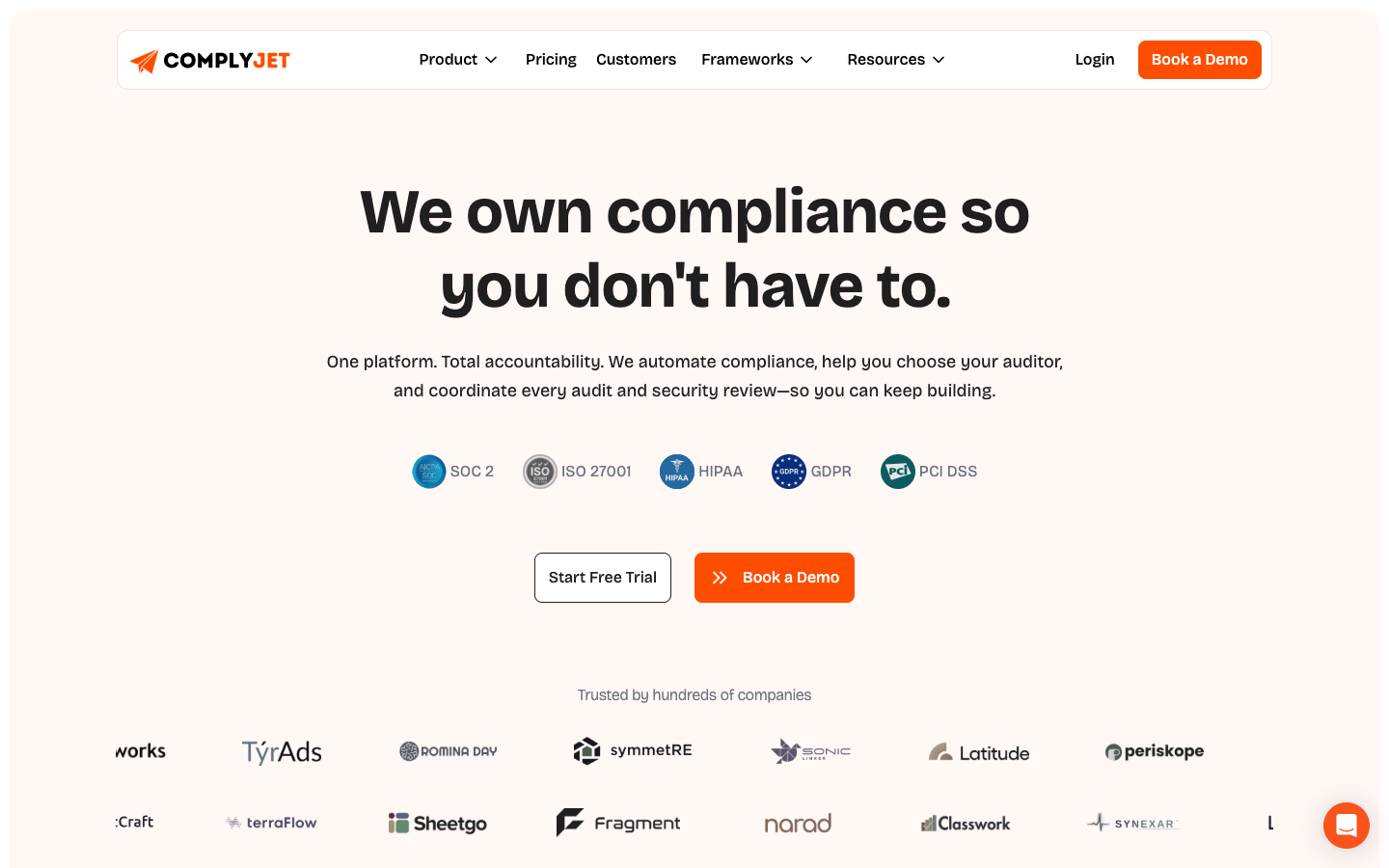
ComplyJet is built for the buyer who evaluates fit before brand. The ICP is specific: early-stage startup, seed to Series A, pursuing compliance for the first time, usually to close an enterprise deal. If that’s you, the value proposition is direct: flat pricing, 350-plus integrations, and a team that guides you through the compliance process end to end.
The flat pricing model is worth understanding clearly. At $5,000/year for a single framework and $8,000/year for two (such as SOC 2 plus ISO 27001), cost doesn’t scale with headcount. That’s a meaningful structural difference from per-seat pricing at a company growing from 10 to 50 people. The pricing is publicly listed, which is rare in this category.
What sets it apart from similar tools is the support model: ComplyJet’s team guides you through the compliance process itself, not just the software. You’re not handed a knowledge base and left to work out which controls apply to your stack. Artur G., CTO at Symmetre, described it: “The platform makes it simple: it splits the work into four buckets with clear, bite-sized tasks we could fit into our routine. No sales gauntlet or upselling. The clearest, most sensible option.”
“
The platform makes it simple: it splits the work into four buckets with clear, bite-sized tasks we could fit into our routine. No sales gauntlet or upselling. The clearest, most sensible option.
Artur G.· CTO · Symmetre
Via complyjet.com ↗
Key features:
- AI-assisted policy drafting across 25+ frameworks
- 350+ native integrations for automated evidence collection
- Continuous control monitoring and compliance posture tracking
- Trust Center for sharing certifications with enterprise prospects
- Team-guided outcome delivery: process partner, not just a tool
- Flat pricing: cost stays fixed whether you have 10 or 50 people
Pros of ComplyJet
- Publicly listed flat pricing, no per-seat surprises
- Team-guided process: you’re not left alone with the software
- Fast time-to-compliance for SOC 2 and ISO 27001
Cons of ComplyJet
- Not built for enterprise GRC programs or complex multi-entity structures
- Best for first-time compliance; not the right fit for mature, established programs
Pricing: $5,000/year (one framework); $8,000/year (two frameworks, e.g. SOC 2 + ISO 27001). Flat per-company, not per-seat.
Best for: Seed-to-Series A startups pursuing first-time SOC 2 or ISO 27001 to close enterprise deals.
ComplyJet handles the entire compliance stack — policies, controls, evidence collection, and your SOC 2 or ISO 27001 audit. Book a free demo to see it in action.
7. Drata

Drata calls itself the Agentic Trust Management Platform, and unlike most vendors using “agentic” as a marketing adjective, the AI integration is real. Autonomous agents handle control mapping, evidence collection, and questionnaire responses continuously in the background. The platform serves 8,000-plus customers and holds a rating of 4.8/5. Named customers include Brex and Okta.
The integration depth is Drata’s strongest card. Where some tools rely on manual uploads for evidence, Drata’s live system connections mean controls are being monitored and updated without a human in the loop. Multi-framework mapping means work done for SOC 2 carries over to ISO 27001 without starting from scratch. See our full Drata review for a detailed breakdown.
Matt S., an IT Manager in healthcare, used it across a complex compliance environment: “It has been very positive. We receive great support from our account rep and customer support is always helpful.”
“
It has been very positive. We receive great support from our account rep and customer support is always helpful.
★★★★★Matt S.· Hospital & Health Care
Via Capterra ↗Key features:
- Agentic compliance: autonomous AI handles control mapping and evidence collection
- Continuous compliance monitoring across multiple frameworks
- AI-fueled Trust Center for customer assurance
- Agentic questionnaire automation with a learning knowledge base
- Third-party vendor risk assessment and management
Pros of Drata
- Best-in-class AI-driven evidence automation
- Strong integration depth with live system connections
- 4.8/5 rating; named customers include Brex and Okta
Cons of Drata
- No public pricing; third-party estimates start around $9K/year
- Documentation assumes GRC knowledge; thin for first-time buyers
- Some integrations require custom connectors rather than native connections
Pricing: Contact for pricing.
Best for: Tech-forward teams wanting deep integrations and AI-driven compliance automation.
8. Sprinto
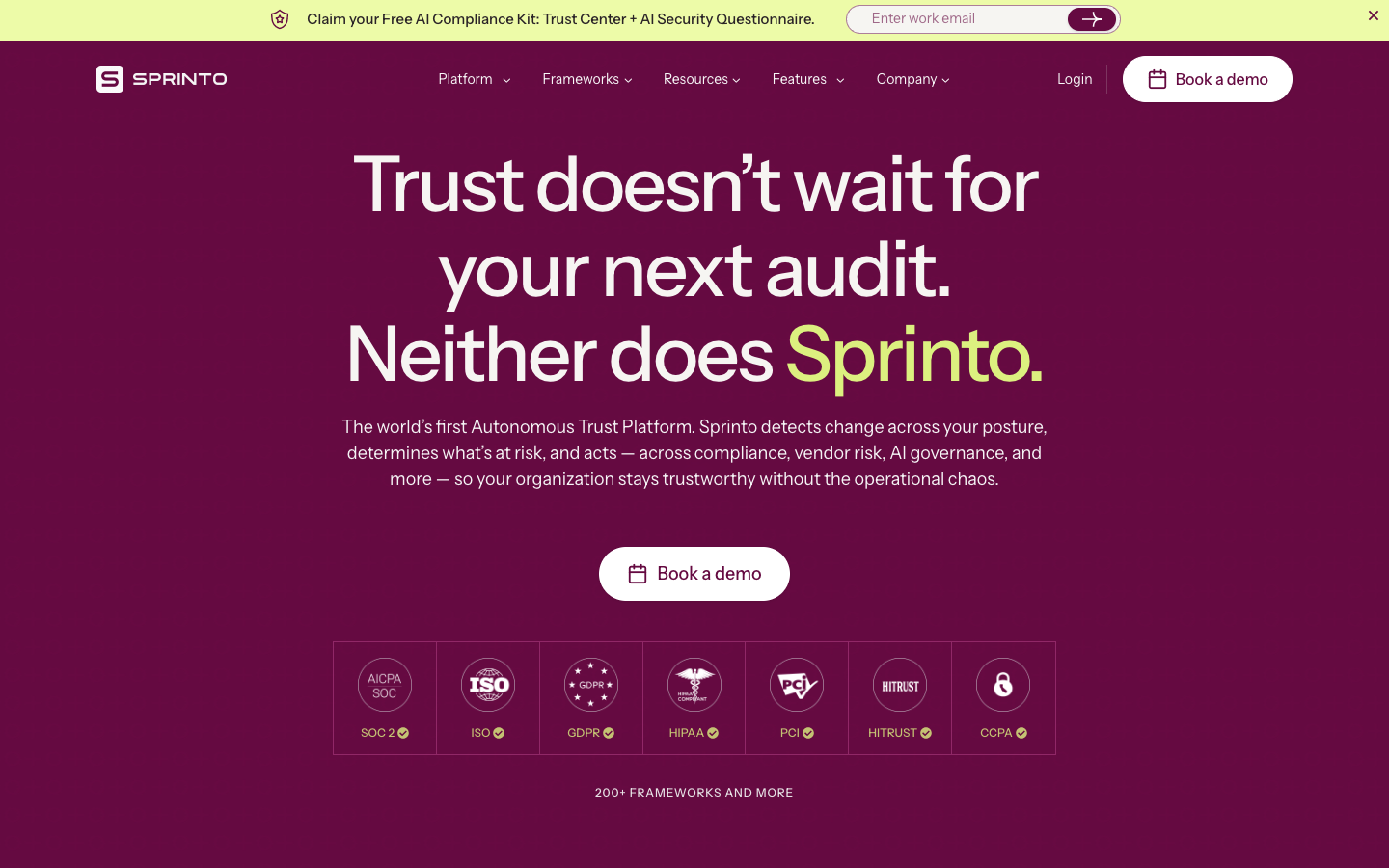
Sprinto is purpose-built for speed. The specific promise is getting cloud-first startups audit-ready in 25 to 30 days, and it consistently delivers on it. A rating of 4.8/5 from 1,563-plus reviews reflects a product that does what it says.
Vivek K., a co-founder who completed ISO 27001 and SOC 2 Type 2 simultaneously on the platform, said: “From onboarding to final certification, everything was smooth, well-structured, and easy to follow. Thanks to Sprinto, we were able to achieve both ISO 27001 and SOC 2 Type 2 certifications without the usual stress and delays.”
The automated evidence collection is tightly integrated with cloud infrastructure. Connect your AWS, GCP, or Azure environment, your identity provider, your HR system, and Sprinto starts collecting automatically. The auditor collaboration portal keeps the back-and-forth during the audit itself contained. See our Sprinto review or our Sprinto alternatives guide if you’re comparing options.
“
Our overall experience with Sprinto has been excellent. From onboarding to final certification, everything was smooth, well-structured, and easy to follow. The platform is thoughtfully designed, and their team was a true partner throughout the process. Thanks to Sprinto, we were able to achieve both ISO 27001 and SOC 2 Type 2 certifications without the usual stress and delays.
★★★★★Vivek K.· Startup
Via Capterra ↗Key features:
- Built-in compliance playbooks for SOC 2, ISO 27001, and more
- Automated evidence collection tied directly to cloud infrastructure
- Real-time compliance posture dashboard
- Integrated risk management module
- Auditor collaboration portal for streamlined audit cycles
Pros of Sprinto
- Fastest path to audit-ready for cloud-native stacks
- Consistently strong support; frequently praised in reviews
- Handles dual ISO 27001 + SOC 2 in a single engagement
Cons of Sprinto
- Some users report pricing increases at renewal
- Feature depth can feel overwhelming for first-time users
- Best for cloud-native stacks; less suited to on-premise environments
Pricing: Contact for pricing.
Best for: Cloud-first startups needing to reach audit readiness quickly with strong support.
9. Scrut Automation

Scrut Automation is the highest-rated tool in this list, at 4.9/5 across 1,298 reviews. It placed #9 in G2’s 2026 Best Software Awards for GRC products. That rating is not a fluke: G2 data shows Scrut ranks highest for quality of support (98%) and delivers the shortest average ROI at five months.
The platform covers 60-plus frameworks and provides 24/7 continuous control monitoring across cloud infrastructure, applications, vendors, and people. The Scrut Teammates feature brings AI-powered remediation guidance directly into the workflow. When a control fails, the platform tells you what to do about it. Anuj P., a co-founder in IT services, described it as “cost-effective and easy to use software that helps you reach compliance quickly and offers helpful customer support.”
It’s newer than most tools on this list, founded in 2021, which means the enterprise track record is thinner than Optro or OneTrust. For mid-sized companies in the SMB-to-scale range, the support quality and rating alone make it worth a serious look.
“
Cost-effective and easy to use software that helps you reach compliance quickly and offers helpful customer support.
★★★★★Anuj P.· Information Technology and Services
Via Capterra ↗Key features:
- 24/7 continuous control monitoring across cloud, apps, vendors, and people
- AI-powered remediation guidance via Scrut Teammates
- 60+ out-of-the-box compliance frameworks
- Automated evidence collection and audit preparation
- Vendor risk assessment automation with real-time dashboards
Pros of Scrut Automation
- Highest-rated tool in this list (4.9/5 across 1,298+ reviews)
- Fastest average ROI at five months according to G2 data
- Excellent support quality (98% satisfaction score)
Cons of Scrut Automation
- No public pricing
- Shorter enterprise track record compared to established players
- Advanced configurations have a real learning curve
Pricing: Contact for pricing.
Best for: Mid-sized companies automating multi-framework compliance with a focus on support quality and fast ROI.
10. Secureframe
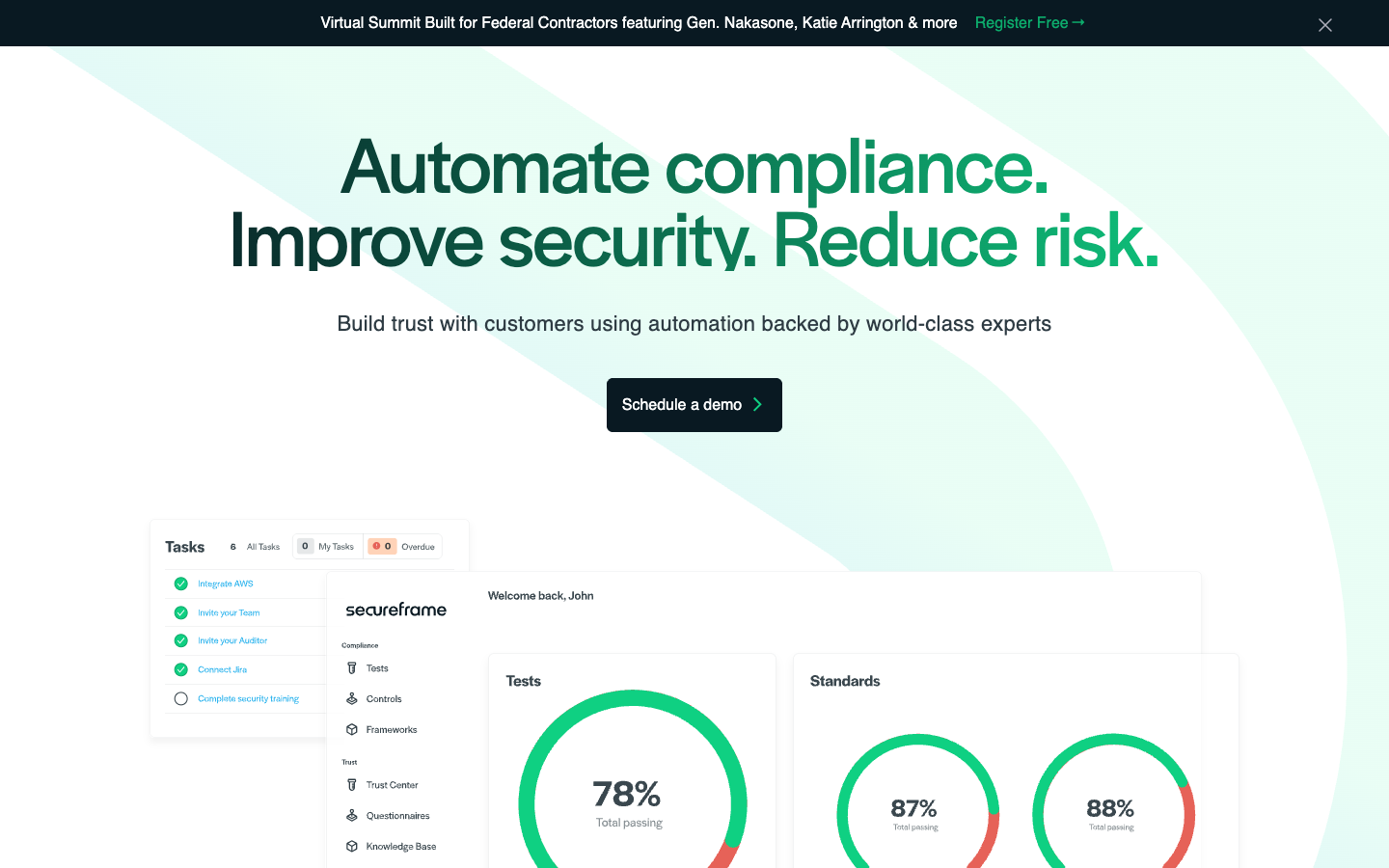
Secureframe is built around guidance. The DNA of the product is closer to a process partner than a monitoring tool. It treats compliance as a process problem for most founders (which it is), not a technical one. The result is a platform that feels structured and step-driven rather than open-ended.
The standout vertical is CMMC. If you’re a defence contractor pursuing CMMC compliance, Secureframe’s Defense plan includes a System Security Plan (SSP), Plan of Action and Milestones (POA&M), and an SPRS Score Tracker built in. That’s a level of specificity most competitors don’t match. For broader programs, the Fundamentals and Complete plans cover SOC 2, ISO 27001, HIPAA, PCI DSS, GDPR, NIST 800-53, FedRAMP, and CCPA.
Shaun K., a CTO at a 2-to-10 person company, captured the support quality: “Throughout the entire process from initial discussions to evidence review with our auditing team, Secureframe’s customer support was quick to provide assistance.” One honest limitation: the integration library is narrower than Vanta or Drata, and some commonly used tools require manual evidence collection.
“
Throughout the entire process from initial discussions to evidence review with our auditing team, Secureframe's customer support was quick to provide assistance.
★★★★★Shaun K.· 2–10 employees
Via Capterra ↗Key features:
- Automated evidence collection and continuous monitoring
- Secureframe AI for compliance task automation
- CMMC-specific SSP, POA&M, and SPRS Score Tracker (Defense plan)
- Advanced vendor and third-party risk management (Complete plan)
- Questionnaire automation and SSO/SCIM connections
Pros of Secureframe
- Best CMMC-specific offering in the SMB tier
- Guidance-focused approach works well for first-time compliance buyers
- Strong CTO and founder reviews for support quality
Cons of Secureframe
- Narrower integration library compared to Vanta or Drata
- No public pricing; average around $20K/year based on Vendr data
- Setup still requires meaningful team time and effort
Pricing: Fundamentals / Complete / Defense, contact for pricing. Average around $20K/year according to Vendr.
Best for: Scaling tech teams wanting structured, guided compliance, especially for CMMC.
How to choose GRC software for your team
Most of the tools above claim to solve the same problem. The real question is which one is built for your situation.
Free Demo
Not sure which GRC tool fits your stage?
ComplyJet is built for early-stage startups: flat pricing, 350+ integrations, team-guided outcomes.
What scope does your GRC program actually need?
A full enterprise GRC compliance software suite with configurable risk quantification and SOX audit workflows is not what a 30-person startup needs. And a startup-focused tool won’t give a 5,000-person enterprise the control depth or reporting it requires.
Start here: are you managing one framework for one audit, or multiple frameworks across business units with board-level risk reporting? If it’s the former, most tools in this list handle it. The differentiator becomes pricing, support quality, and time to value. If it’s the latter, you need LogicGate, Optro, or OneTrust.
What does your company stage tell you?
- Startup (seed to Series A): You need speed, low implementation lift, and a vendor that guides you. Avoid enterprise platforms with 6-month onboarding timelines. ComplyJet, Sprinto, and Scrut are built for this stage.
- Scaling (Series B to 100 employees): You need broader framework coverage, deeper integrations, and a vendor that grows with you. Vanta, Drata, and Scrut fit this tier well.
- Enterprise: You need configurability, multi-entity support, SOX capability, and audit-grade reporting. LogicGate, Optro, and OneTrust are the right category.
The right GRC tool is the one built for your stage, not the one with the most analyst recognition.
How many frameworks do you actually need to cover?
If you’re pursuing one certification, most tools can handle it well. The moment you add a second framework, cross-framework control mapping becomes critical. The best grc compliance tools and grc softwares handle this natively by reusing evidence across standards, cutting your evidence collection time significantly. Before signing anything, ask vendors specifically how overlapping controls between SOC 2 and ISO 27001 are handled in their platform.
What pricing model won’t surprise you later?
Per-seat pricing is fine at ten employees. At 50, the math changes. Flat-rate pricing gives you predictability as you grow. Enterprise contracts typically lock you in for one to two years. Read the renewal terms before you sign, and ask specifically what happens if you add a framework mid-term.
Does the vendor guide outcomes or just maintain software?
Ask any shortlisted vendor this question directly: what does onboarding look like, and who owns keeping your compliance program current after you’re certified? “Buy and good luck” versus “we drive the process with you” is the real differentiator between tools that claim the same feature set. See our compliance reporting guide for what good ongoing program management looks like.
FAQ: GRC software and tools
What is GRC software?
GRC software is a platform that combines governance, risk management, and compliance into a single system. Instead of managing policies in a document tool, risks in a spreadsheet, and compliance controls in a checklist, GRC software centralises everything: it tracks controls, automates evidence collection, monitors your compliance posture continuously, and connects risk findings to the compliance obligations they affect. Different GRC softwares approach this architecture differently, some starting from risk and adding compliance, others starting from audit and expanding outward.
What is a GRC tool?
A GRC tool and GRC software are used interchangeably. The category includes everything from startup-focused compliance automation platforms to full enterprise GRC suites with built-in risk quantification and SOX audit management. The right GRC tool depends on your company size, the frameworks you need to cover, and whether you need basic compliance automation or deep risk program management.
What are GRC tools?
GRC tools are the software platforms organisations use to manage governance, risk, and compliance programs. The category is broad: GRC compliance tools range from enterprise risk platforms with SOX audit management (Optro, OneTrust) to startup-focused compliance automation tools built for first-time certification (ComplyJet, Sprinto, Scrut). Most tools sit somewhere on that spectrum.
What does GRC software do?
GRC software centralises your compliance controls, automates evidence collection from your tech stack, monitors your control environment continuously, and flags failures before an auditor does. It also manages vendor risk, tracks policy acknowledgements, and produces the reporting your auditors and board need. Enterprise platforms add risk quantification, audit management, and SOX workflows; startup-focused tools prioritise speed to audit readiness and guided setup.
How do I choose a GRC tool?
Start with your stage and scope. Early-stage startup pursuing first-time SOC 2 or ISO 27001? You don’t need an enterprise platform: you need something that moves fast, has guided support, and doesn’t charge per seat. Mid-market company managing five-plus frameworks? Cross-framework control mapping becomes critical. Enterprise? You need configurability, multi-entity support, and SOX capability. Then look at integration depth, pricing model, and what support actually looks like after you’ve signed.
What is governance risk and compliance software?
Governance, risk, and compliance software (also called GRC software or grc compliance software) is the full-form description of the tool category that helps organisations manage governance structures, identify and mitigate risks, and meet regulatory obligations. Modern platforms use AI for evidence collection, risk quantification, and questionnaire automation. Earlier GRC tools were primarily audit documentation systems. The category has evolved significantly.
Final thoughts
The GRC software market has matured enough that there’s a credible option for every company stage: from the startup running its first SOC 2 to the enterprise managing a dozen frameworks with a board risk committee.
Free Demo
Get compliant without the enterprise price tag.
SOC 2 or ISO 27001 from $5,000/year, flat per company, team-guided end to end.
The tools at the top of this list (OneTrust, Optro, LogicGate) are genuinely excellent for what they’re built for. The tools toward the bottom (Scrut, Secureframe, ComplyJet) are genuinely excellent for what they’re built for too. The mistake is applying the wrong tool to the wrong stage.
If you’re an early-stage startup pursuing compliance for the first time, ComplyJet is worth a conversation: flat pricing, 350-plus integrations, and a team that guides you through the process, not just the software.
If you’re a startup pursuing SOC 2 or ISO 27001 for the first time, ComplyJet is built for you: flat pricing, 350+ integrations, and a team that guides you through the process end to end.